If you're wondering what to say to a veteran on Veterans Day, "thank you for your service" is a good start, and it often ends the conversation, because it leaves the veteran nothing to answer. The sentence that keeps it going is an invitation: "Saturday at noon, the diner on Main. I'm buying." A lunch gives you an hour to find out who they are, and it puts your thanks on the calendar where it can happen. Veterans Day falls on Wednesday, November 11, 2026. Here is what to say, how to make the invitation easy to accept, what to ask once you're across the table, what to leave out, and how to follow through.
1. What to say to a veteran on Veterans Day: thank you, then the invitation
Follow thank you with one sentence that costs the veteran almost nothing to answer. Pick the line that fits who is standing in front of you.
For someone you know:
“Thank you for your service. I'd like to take you to lunch this month.”
For a stranger in a ball cap or a unit shirt:
“Thank you for your service. Which branch were you in?”
Save the lunch for people already in your life: a neighbor, a coworker, an uncle, a friend's dad. For a stranger, the branch question is enough, and it has a single word answer.
For a veteran you know served in Vietnam, or one wearing a Vietnam Veteran cap:
“Welcome home. I'm glad you're here. Where did you serve?”
Many Vietnam veterans came home to silence, and some to anger. A first "Welcome home" can land decades late.
2. Make the lunch easy to say yes to
"Pick the day" can feel like homework. Give them something specific to say yes to:
“Saturday at noon, the diner on Main. I'll pick you up, and I'm buying.”
A named day and place turns a kind feeling into a plan, and a plan is what gets kept. You drive and you pay.
If they say yes: "Great. I'll text you Friday night to confirm."
If they say no, take it lightly: "No problem. The offer stands, and I'll check in again in December." A gentle repeat shows the offer is real.
If they say "maybe" or "sometime," answer: "Fair enough. I'll text you Monday with two days. Pick either one."
3. If you can't say it in person
A card or a text works too, and it lets a veteran answer when they are ready. Use their name and keep it plain:
“Happy Veterans Day, [their first name]. I'm grateful for what you did. Can I take you to lunch this month? This Saturday or next, you pick.”
To a coworker or neighbor you don't know well, keep it short:
“Thank you for your service. Which branch were you in?”

4. At the lunch itself
Arrive a few minutes early, put your phone away where they can see you do it, and let them choose the seat. Ask your first question after the order is in. Pay quietly at the counter before the check comes so nobody has to argue about it. When a pause comes, let it stay a pause, because people often say the real thing a minute after you stop asking. Before you leave, set the next one: "This was good. Same time in December?"

5. Ask one real question about the service
Once you're across the table, or in line at the coffee shop, keep it specific and easy to answer. Start with the job and the place. Leave the hardest days for them to bring up, if they choose to.
“Where did you serve?”
“What was your job?”
“How long were you in?”
“What did you do after you got out?”
Ask what they were good at: "What were you best at?" Questions about the work let the veteran decide how far the conversation goes.
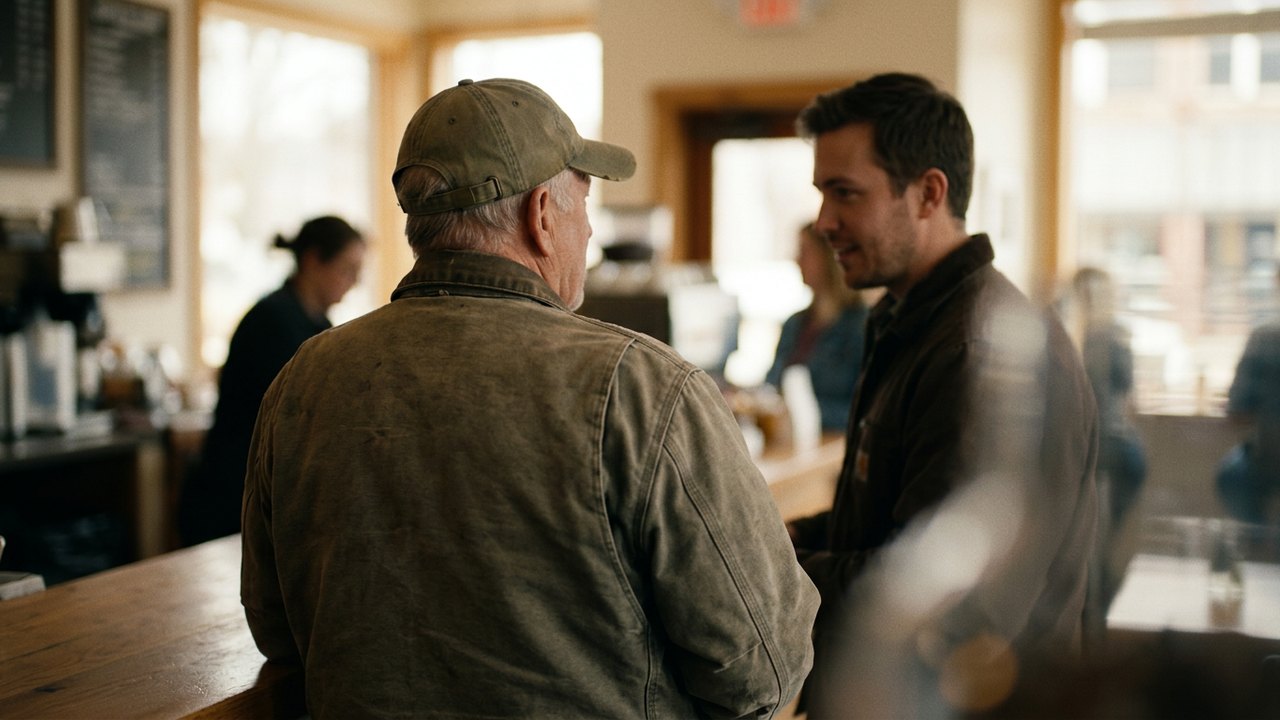
Picture a man in line at the coffee shop with an Army patch on his jacket. "Thank you for your service. What was your job in the Army?" "Mechanic." "Where did you turn wrenches?" It takes ten seconds, and he is a person with a history who has been asked about it.
6. Match their pace
Give the veteran room, and the conversation can go as far as they want.
If they start talking, stay and ask one more: "What do you miss about it?" or "How did you end up choosing that?" Then let them tell it.
If they give you one word, or say they'd rather not, or "Please don't call me a hero," accept it: "Understood. Glad to know you. Happy Veterans Day." No second try today.
If they wave it off with "I didn't do much" or "other guys did more," tell them: "You served. That counts with me."
If their eyes fill or the story turns heavy, stay put. Say, "I'm glad you told me," and stay quiet with them. You do not need to say more.
If they snap at you, say, "Fair enough. Thanks for your time," and give them space. A sharp answer on this day may have a long history behind it that has nothing to do with you.
7. What not to say
Some common lines close the door fast. Most come with something better to say.
- Don't ask whether they killed anyone or what the worst thing they saw was. If that story ever gets told, it gets told on their terms.
- Don't say "I could never do what you did." It tells them the distance between you is too wide to cross. Try "I respect that you did."
- Don't share your opinion of the war they served in, or of the politics around it. The eleventh is not the day for that. Ask about the people: "Who did you serve with?"
- Don't assume what their service was like. Combat, a motor pool and a desk are all service, and each deserves its own question.
- Don't turn it into a story about your uncle's service before they've had a turn.
8. If the veteran in front of you lost someone
Memorial Day is for remembering those who died in service, but a veteran who lost a friend, or a family that lost a son or daughter, may feel it on November 11 too. Say the name if you know it, and ask:
“Tell me about [name]. What was he like?”
Use the pronoun they use. If you don't know the name, ask, "Who were they?"
Skip "he's in a better place" and "everything happens for a reason." Those lines can end the conversation, while saying the name tells them the person is still remembered. Sit still and let them talk.
9. If the day is hard for them
Some veterans want nothing to do with parades, free meals, or being thanked in public, and that is their call. A quiet offer of company is the safest choice:
“No parade. I just wanted you to hear it from me, and I'm around if you want company.”
If someone seems worse than usual this week, more withdrawn, drinking more, or not sleeping, ask them straight out: "Are you thinking about suicide?" Say it plainly. Asking does not plant the idea, and it tells them you can handle the answer. Then listen, stay with them, and do not promise to keep it secret. Stay until they are connected with help.
If the answer is yes, or "I don't know," take it seriously and do not leave them alone. If they refuse to call, stay and make the call yourself with them in the room. Say, "I'm with a veteran I'm worried about. Can you talk with us?" Put it on speaker if they agree. If they have a plan or a firearm within reach, ask them to let you move it out of reach, and call 911 if there is immediate danger. Call, text or chat:
- Veterans Crisis Line: dial 988 and press 1, text 838255, or chat at VeteransCrisisLine.net. Free, confidential, open 24 hours a day, and the people who care about a veteran can reach out too.
- Vet Center Call Center: 877-927-8387, answered around the clock by combat veterans and family members of veterans.
- Immediate danger: 911.
For questions that get past "I'm fine," read How to Ask a Veteran If They're Really Okay.
10. Follow through on the 12th and after
Text the next day:
“Thinking about you after yesterday. Still good for Saturday?”
After the lunch, text again: "Thanks for today. I'm glad I know you." Then ask again in December, when the holidays tend to make everything louder. Showing up twice earns an honest answer.
If they don't answer a text, wait a week and send one more: "No pressure. Still thinking of you. Door's open." Two texts total is the limit.
More on our work for veterans is on the Advocacy page, and the stories behind these conversations live on Unfinished Business.
On Wednesday, November 11, you will have a few minutes with someone who served. Use them.
Which veteran will you invite to lunch this month?
“A veteran carries the day someone finally asked.”