Trinidad Aguirre
Trinidad Aguirre joins Rush on Unfinished Business, the show for veterans pursuing new missions after the uniform and the people who stand beside them. As cEO & Co-Founder, VetsForever · U.S. Navy Gulf War Veteran, Trinidad brings building something meaningful to the table.
They get into the work, the cost, and the reasons it still matters, in the kind of long-form conversation this show was built for.
In this conversation
- Building an organization with a mission
- What experience teaches about leadership
- Turning purpose into work that lasts
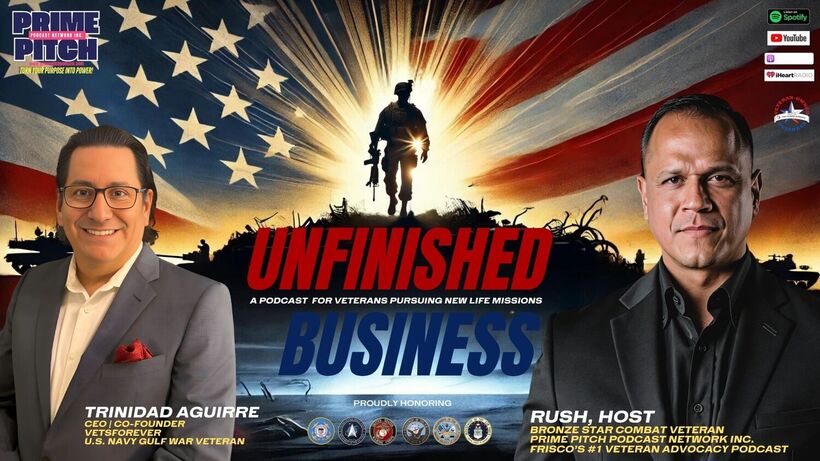
Trinidad Aguirre
CEO & Co-Founder, VetsForever · U.S. Navy Gulf War Veteran
About the show
Unfinished Business is a podcast for veterans pursuing new missions after the uniform, and for the families and communities who stand beside them. Hosted by Eric Rush, The Conversation Architect, a Bronze Star combat veteran and the founder of Prime Pitch Podcast Network.
Read the full transcript
So when you hear on the news today, you know, "Hey, we're, we're processing more claims than ever," yeah, that's true, but they're also denying, you know, 3 out of 5 claims. Yeah. So yeah, you're processing but you may not like the result. Yeah. And so, it comes down to this, in my opinion, I break it down to 2 people in the system that really matter, you know, despite all the, the largest bureaucracy in America, comes down to the evaluator and the rater.
Mm. The person seeing you with, you know, who may not give 2 shits, right? They're just basically, "Yep, you know, I'm just here to do a job," and what they write down, that just impacted your claim. And, you know, and it starts from the minute, with a simple statement, you may have tanked yourself by saying, "How is your day going?""It's going okay, thanks."Boom, just lost your claim- Hmm. to the evaluator or to the rater- Yeah.
who may be a civilian, who may have never served. Unfinished Business. Hey, what's up, guys? Welcome to Unfinished Business, a podcast for veterans pursuing new life missions. What happens when the war ends, but the waiting never does?
You serve your country, give it everything, and come home to find yourself in a system that sees you as a file, not as a fighter. But for some of us, we don't just sit and wait for a diagnosis, we build. Trinidad Aguirre is a 100% disabled Gulf War veteran. He knows what it's like to be in a invisible s- in- invisible in- in the system. But instead of walking away, he created Vets Forever, a movement, a mission, and a battle-tested process that delivers what veterans deserve: speed, dignity, and truth.
Unfinished Business, a podcast for veterans pur- pursuing new life missions, carries the same mission. We tell stories of veterans who never quit, who find a way forward even when the system stalls, because this pis- podcast isn't just a platform, it's a rallying point for veterans who still have to fight, who still have the fight in them, and for advocates who refuse to look the other way. This isn't just Trinidad's story, it's yours. The, and the next chapter starts now. Trinidad.
Hey, man. It's- Hey. Trinidad, it's a pleasure to have you on, on the Unfinished Business podcast, a podcast for veterans pursuin- pursuing new life missions. how'd I do with the intro? Man, you stuck it, I love that intro, man.
I love the energy, the passion, it just resonates. I was just getting pumped up listening to you. Awesome, man. You know, and, and it really is, comes down to, you know, um, uh, the commonality, the common bond that, that the Unfinished Business podcast, a podcast for veterans pursuing new life missions, has with your, your organization. And, um, it's so, it's so awesome to, to, to know that there's someone in the, I would say, I don't wanna say behind the curtains, 'cause you're kinda, you're in the front, you're in the front lines, you know?
Some people s- some people call it behind, but it's, you can kinda, you kinda have to play both, uh, both roles at times, don't you agree? Oh, absolutely. You gotta lead from the front and, you know, you gotta check in, uh, because if not, you're out of touch, and you've gotta be in touch with this community. Yeah, you know, um, before we, we talk about Vets Forever, um, what was the moment when the system failed you? Like, uh, when did you realize something inside of you had to break before you could actually build anything new?
Yeah, man, that, that's such a powerful question, and, and it's one that I've been really reflecting on because when I think of the system, kinda like what I tell my clients today, it's not the one thing, right? Like, "I hurt my back," and that's the one thing. No, it's a culmination of things, and I break it into 3, really, like, phases as we talk about, you know, where our journeys. In that first journey, it really starts back in boot camp and all the way through my enlistment career, right? I would do, like, first of all, I served with honor and I loved everything I do, I knew what I was signing up for, the stress, the abuses of my body, the near, you know, traumatic events I faced, I would do it everything again today.
But when we talk about it, and you're gonna hear a theme as I have this conversation, it's all about rules and regulations, right? Mm. If you know what's going on, you can work with the system and be successful. Like, without a doubt, I knew where I stood in the military, like, I knew when I had to be promoted, I knew what the UCMJ was, what I could and couldn't do. If not, I had my senior enlisted guy there to tell me exactly what I couldn't do.
But at the same time, what wasn't written was the military culture- Hmm. when you got hurt- Hmm. or when you got injured, and it was like, the mentality back in the early, uh, late 90s, early 2000s was, "Suck it up, buttercup. You're gonna go to medical for, you know, a hurt pinky or something?"You know, the, the, the mentality then, and maybe still true today, is we don't talk about our pain, you know, whether that's physical or mental. The trauma we faced, the pain, it was really, we bury it deep and we move in to complete the mission.
And that was fine, but then when you transition out, then the inverse is true, where now, the rules and regulations are more generally guidelines. There's no 8 o'clock muster, there's 8:15 maybe, you know? And everybody talked about their feelings and their emotions- Yeah. and it was a complete reversal of our cultural mindset- Mm. that we experienced.
So this juxtaposition that I found myself in was weird. It was, it was awkward because I, despite the work I did was about, you know, not connecting with my peers, my work peers, right? Um, and I couldn't fit in the company culture, right, that we all talked about, company culture. And it led to me, with this endless cycle of job rotations, I couldn't find a home. And so then, I finally manned up after talking one day with a, with a fellow vet and said, "You know what?
There's strength in weakness, right? By admitting weakness, by admitting vulnerability, I'm not weak, I'm getting stronger."And so then, I turned to the VA and I said, "You know what? There are rules and regulations there, I can understand that, and I'm finally getting on board with, okay, I'm gonna unpack some of these demons, some of these pains," and, you know, because I was looking for a service, uh, disabled veteran. And to be turned into, to be denied, you know, when, when they came in, and despite what the rules said, the regulations said-They said, "No, you're not service connected for your hearing, or your back, or your trauma that you faced."Man, what a blow. And so that moment was really a build-up from all of my life experiences as, look, I was a rule follower in the service.
Now I'm forced to talk about all my emotions, and, and I finally came 20 years after the fact to talk to the VA about all the things, and then the door yet shuts in h- your face. Mm-hmm. So to be broken, to, to get that slapped into me, it, it, it really had a profound effect or impact on my life, and it really changed the course of my life at that point. Yeah. Um, you know, that's amazing.
That, I mean, everything you just shared is like soLike I could just think about real time when I sat there in front of somebody who was evaluating me, and I had to look at a list of emoji, uh, emojis, emotional smiley faces, frowny faces- Right. and try to di- diagnose whether that was a smiley or a sad face and have these, uh-these things, right? And then you look at the person who's evaluating you, and they're yawning while you're, while you're going through this process with them. Um, uh, how much of that structure, that infrastructure, like, um, the personnel, what do you think about the personnel that, that's kind ofUh, you know, not n- now of course not everyone's what I just said, but- Right. um, in general, do you think sometimes they're just going through the grind themselves and they, they're caught up in a, a, some kind of vortex of, uh, uh, lack of empathy and, and maybe they just get cloudy callous, I guess, sometimes?
Yeah. Yeah. I mean, 'cause when you, when you're dealing with the system in terms of, in this case, the VA, you know, you gottaI would, I never try to judge, right? I put myself in their- Yeah. in the other person's shoes.
Yeah. And I think of, okay, what do I know as facts? Yeah. And those raters are doing the best that they can, right? Yeah.
Uh, despite, you know, what, what we don't know or what's not really talked about is that they're forced to review 27 claims a day. They're under this high pressure cycle of, "I've gotta get evaluated."So when you hear on the news today, you know, "Hey, we're, we're processing more claims than ever," yeah, that's true, but they're also denying, you know, 3 out of 5 claims. Yeah. So yeah, you're processing, but you may not like the result. Yeah.
And so it comes down to this, in my opinion. I break it down to 2 people in the system that really matter, you know, despite all the, the largest bureaucracy in America. It comes down to the evaluator and the rater. Mm. The person seeing you with, you know, who may not give 2 shits, right?
they're just basically, "Yep, you know, I'm just here to do a job," and what they write down, that just impacted your claim. And you know, and it starts from the minute with a simple statement. You may have tanked yourself by saying, "How is your day going?""It's going okay. Thanks."Boom, just lost your claim to the evaluator or to the rater- Mm-hmm. Yeah.
who may be a civilian, who may have never served, and they're exposed to read about your life and how it goes and then try to make a determination with incomplete data or life experience. So it's really difficult, but at the same time, that's why the rules and regulations matter, right? Did they meet the standard, yes or no? Yeah. And it's, it's not as black and white as people like to think.
Yeah. You know, uh, you were, uh, you were just ano- uh, so you were just another veteran stuck in a backlog, right? Yeah. Um, what did the, what did the waiting season do to your sense of identity and worth? You know, um, first, you know, it's kind of like watching a, a pot of water boil, right?
You know, you w- wouldAnd I say that because while you're in the service and whether you're a veteran, the lack of communication and transparency that's given to us, uh, about the VA process is lacking. You know, we may be very gladly covered on page 59 of a 90-page slide deck in TAPS, right, that we all kind of l- glaze over- Yep. sitting in that room, you know, and/or 20 years like me, after the fact, like I don't even remember what TAPS was like, and I have no idea what the VA process is. You know, there's noIt's very unclear, and there's a lot of misinformation out there. You know, you go on YouTube and talk to the YouTube talking heads, uh, experts, and honestly, it just comes down to the veteran.
I have guys that win in 3 weeks, and I have guys that win in 18 months. It just depends. And so for me, in that system, I remember going through it, and it was a large sense of anxiety and, you know, ready to stress, like, "Am I gonna get approved?"Mm-hmm."What's the status?"So looking at va. gov almost every day. It's just like, you know, it becomes your identity.
It's like, "Oh, did I check today?"Mm-hmm. And then what's worse is, "Oh, I'm on step 5. Now I gotta go, now I jumped down to step 3. What does that mean?"Yeah. Oh, man."And so you start playing these psychological games.
So that backlog is scary, especially if you're doing it alone. You don't know what's going. So for something that's supposed to, you know, relieve your stress and anxiety 'cause you're going through the process, it actually raises it because of the unknown. You don't know what the VA's gonna say about you, how they're talking about you, and then at the end of the decision, it may not be the decision you like. So yeah, it's, it's, it's a, it's a wrecking ball.
It's tough. Yeah, man. Uh, I mean, just, just understanding, I think you wa- going back to what we were talking about, like, it's, you know, the process, like is that person able to process that they're, that you are, uh, disabled-or that you are gr- you're in, you're in, in this turmoil with what- whatever ailments you're dealing with, you know? Right. Um, the, the, the point, the point about identity also, what is hanging on, you know, you're dealing with this injury, f- the prolonged agonizing, uh, issue you're dealing with as a veteran coming back from, from deployment and the things you've had to encounter.
What does that do for you, um, from your, from a identity perspective as well? You know, before the company, I felt like my identity was lost. Like really, you know, despite my accolades in the professional world and the degrees and my family, I'd never felt truly whole, right? Because, you know, I think almost every veteran I talked about, it's really what we miss is that culture, right? I had, you have my 6.
I could depend on you. Again, there was structure, and I knew where I stood. And going out of that not having by this- the same rules that I, you know, that was in place for so many years really changed me. And so, and it jaded me in a way. Mm.
And I became angry and became frustrated and, "What do you mean you don't understand? What are, what do you mean you didn't deliver this?"And because we're so mission f- uh, focused. So that band of brothers and sisters that we served with, with that one, you know, one job, one mission, one unit, all that is now gone. Mm. And what I tell folks is, in that first year especially, I mean, that first year when we talk about veteran suicide and, you know, on the eve of Memorial Day, right?
We're looking at 22 per day right now. And that transition period where when you walk out those gates, now you just lost your f- your, your military family, your community. You've lost your identity. You've lost your funding, your healthcare, hell, even what you wear 'cause we, you know, we're no longer wearing that same uniform. Yeah.
Where you live is now gone. And so that first year, they're ex- you know, they train you 4 or 5 months to be a war fighter, but only a week to train you to be a civilian, and you're like-crap. Oh, shit."You know? Yeah. SoIf they train you at all.
If they train you at all. Yeah. So, so that stress and anxiety was true for me, didn't know my sense of purpose, my worth, and it took a long time, even going to find my cr- my tribe, my group- Hm. to really understand and heal properly. Yeah.
I never knew what the healing process would look like until I was able to reconnect with some of those roots, you know? Yeah. Yeah, that's, man, that's, uh, that's so true. Uh, you get lost in that, in that, you know, this abyss of, of kind of I say like purgatory- Yeah. where you're just kinda in limbo, uh, trying to figure out, like, what, you know, I'm dealing with whatever, you know, if it's an in, if it's like, you know, knee issues from wearing the boots or- Mm-hmm.
or, you know, the, the burn pits and all those things and, and, and you're not, you're not getting, you're not getting the response you need, you know, in, for your medical care, and you're not getting the response you need from the VA to, to cover that. Um, um, it, it can be very, uh, um, very, um, paralyzing. You agree with that? Absolutely. I mean, so much so because we expect everybody to work on our timeline, and- Yeah.
and it's just not gonna happen. And so the mon- the, the timeline that we all are very used to, it should be just to hurry up and wait when it comes to anything VA, you know, whether that's disability claims or medical, just submit the claim and then just wait. Yeah. Because that's unfortunately the truth, you know, in terms of how we deal and look at, you know, outside, life outside the military. Yeah.
Um, at what point did you realize the check wasn't about money, but it was, uh, it was about, um, being believed? You know, it, you know, so when I filed my first claim 20 years after the fact, I filed for 20 things, right? You know, everything that hurt 'cause that's what I was led to believe. Yeah.18 of the 20 were denied. Hm.
And man, that sense of worth, uh, you know, being called basically a liar. Mm. You know, "We don't believe you."And I, you know, we all as veterans work with a certain set of ethos- Yeah. integrity, honesty. Like what we, if we say something's bad, it's bad.
Yeah. We're not gonna try to do anything malicious here. So my stock in, in, in how I viewed myself went down tremendously, right? It was like, "Man, what's going on?"And not to, you know, so I felt that's how people looked at me. Hm.
It was like, "I am a failure-" Mm."'cause I can't even get disabl- disability credits right."Yeah. And I'm going through all my other life stresses. So when I finally got to the 100% after years of work on it, man, it felt relief vindicated, right? Like, yes, my, I was telling the truth, you know? I was right.
Mm. And that I was justified- Mm. in my request. Mm. You know, there was no scamming here.
There's just me just trying to tell you my point, my story- Yeah. and, and to convey that, yeah, my back is jacked or my knees are jacked. I have PTSD. You know, and that really, and now finally getting the help that I need. Man, what a relief.
And it's so, it's, when people say it's life-changing, it truly is. Yeah. And, and no more than, to your point, just the compensation, but the vindication- Yeah. that we were right. Yeah, man, uh, uh, yeah that's, that, when you were saying that I got kind of choked up 'cause, you know, you go through that struggle, you know?
Yeah.20 years, I, like, how, how did you, like how did you get yourself to a place that you could do that? I mean, first of all, what was the reason it kept you from, you know, from, you know, uh, pursuing this, the help? Um, what kept you, what do you think kept you from, from doing that within those years that youYeah. What, what prevented me was, you know, the, again, the unknown. Yeah.
Right? Like, I don't know how to start the process. Mm-hmm. And, and to be honest with you, hear me in my early days, it's like, "I'm not disabled."Yeah. know, I'm tough.
I'm a vet. There's no way I'mI don't want people to look at me and look down at me or feel sorry for me 'cause that's not who I am. I mean, if you look at me today, I'm like, man there's, you know, you would not know. But disabilities, you know, not just physical but internal. Yeah.
And so not be able to prove or not allow myself to be vulnerable- Mm-hmm. not allowing me to show weakness was also big. So that was primary the reason was I didn't wanna be perceived any different than the person next to me. I, you know, people will say I wanna, they wanna take money from the next guy down. That wasn't it.
It was just my self-perception, my self-worth. I didn't believe that I was worthy of disability and that's such a myth. Mm-hmm. You know, where now when I, and when I look back at my life and, and now especially with PTSD, it explains so much. We talked, and that was truly the root cause- Yeah.
of all my anger and how I treated my loved ones, my family- Hmm. uh, you know, and even my friends, you know, and it's just, you know, so taking that and understanding what the root cause of really changed my life. But it was, took 20 years for me to get there, of looking and finally saying, "Okay, I give up."You, you, yeah. I'm gonna submit. You got, you gotta get permission, give your permission to be broken, right?
Yes. You believe that? Yeah, absolutely. I, I say it to my, my clients all the time, "Give yourself permission to be vulnerable."Hmm. By doing that, then it becomes okay, right?
It's not somebody telling me, "Oh, be vulnerable, you know, open up your feeling."No. You ha- you have to, you have to take the, you have to do the work and say, "Yeah, I, I can admit this."Because again, it's not, it's not, it's not a weakness, it's a strength. Yeah. Right? To say it takes a strong person to say, "Yeah, I, I do need help."Yeah.
And, and by doing that, changes the game for you. That's awesome, man. Let's talk about Vets Forever. Yeah. Uh, let's break it down.
Tell me what y'all do, um, how you, you know, how, what made you decide to get your why, your why, your how, what, everything. Yeah. Well my why was, you know, getting to that 100% for me, right? And it's like, man, veterans should not have to fight this hard. Mm-hmm.
Veterans should not have to go through the rigmarole of the VA and under- and try to navigate a, a bureaucracy, um, and not have anybody help them. And so for me, you know, onboarding, uh, 2 other co-founders to come in and, "Hey, do you believe in this mission? Let's do this."And putting that together was really a key defining moment, right? Because my why is t- to really help and that's it. And not just help but be disruptive.
Hmm. And what do I mean by that? So we tookSo Vets Forever is a VF accredited law group. And what does that mean? Well, we're backed by the VA, meaning we took the extra steps to go through the rules and regulations that the VA now trusts us and gives us access to certain systems that allows me to look at entire veterans' profiles because we have that background check, the trust of the VA.
And by being accredited means that we're not gonna try to scam anybody. We're not gonna try to, uh, take advantage of any veteran. And so for us, when I look at everybody, it's like, look, I'm gonna help all veterans. If I lose money, I lose money. I don't care.
It's about helping and it's about serving those that don't know how to navigate this complex system. Mm-hmm. And so different than any other law group, it's, we act faster, we generate results within months not years. And our Veteran clients now have a strong legal advocate if they do get denied, that we can represent them in the appeal process- Mm-hmm. and win.
And so that's a very powerful tool that, when you talked about oth- uh, when you look at other organizations and other li- similar models, they don't have half the clearances or the ex- access that we do. Yeah. And the ability to go to speed, knowing that we're not here to get rich, we're just here to serve. Yeah. And that's what we are about.
We are here to serve our Veteran community with the utmost integrity and ethos that we all signed up to be, right? One team, one mission, let's get you the help that you need. Yeah. You know, uh, when I, uh, when I filed my claim, uh, I, I didn't have any help. Yeah.
I did it myself. Uh, uh, I'm surprised I got, you know-I got approved the first time. Yeah. You know? So for, it's just interesting, um, but what I did find, what I did find out was, like, you know, when I'd pursue other avenues to, to, to get, um, help or whatever, it, there was never anybody there.
Um, when you compare your s- uh, Vets Forever to some of the other organizations, what separates you, what separates you from, from ou- you know, whatever the organization? I won't say their names, but you know which one I'm talking about. Yeah,Absolutely. Uh, when, when you compare apples to apples, again, the fact that we're accredited means that we're, we have a JAG officer on staff. Mm-hmm.
We have access to a system called VBMS, um, which allows me to look at your entire records. Um, and guess what? Our fees are probably, you're, you're not gonna get lower. Why? Because we're regulated by the VA.
Mm-hmm. When you go to the other guys, they're gonna charge you a lot of, not only a extraordinary, a large fee, but they're also gonna have hidden costs, um, like, "Hey, guess what, man? You need, you didn't report your back pain, you're gonna need a nexus letter."You know? OhAnd you're gonna needOr, "You're gonna need to go and talk to this doctor that we know, and you're gonna pay him X amount of dollars."And so they're nickel-and-diming you whether you know it or not, whereas we have never requested a nexus letter, uh, or have a doctor sp- you know, recommended you go see a doctor other than your primary care or the VA. And we win 90% of the time.
So I mean, when you look at the type of results that we generate compared to the other guys, we're not, again, we're not in it to make, be rich. We're in it to help you in the r- most responsible and truthful and ethical manner possible. Mm-hmm. And that's what we are about. So bottom line, I love what we do.
I mean, as an accredited agent, I have the authority. People trust us, because why? We have the backing of the VA. Point, full stop. I mean, they can't legally present, prepare, or prosecute any- Mm-hmm.
any claim. We can. Wow. That's, that's amazing, man. Dude, I gotta tell you, when I, when I was doing my research to get you on the podcast, that, that's what I felt from you, this, this, uh, this conviction, a spiritual, this em- you know, this vested conviction in who you were.
And I said, "Man, I gotta get Trinity, I gotta get this organization on the podcast, um, and, and, and get to know you better."And my, my instincts were right. Um, hearing you talk today is, you're, you're, it's like, wow, you're, you're in it. You're in it, you're in the foxhole with, with, uh, the, the other Veterans and you're, you're working, you're working this process with them. Primarily you're, you're, uh, what you guys do is get pe- uh, get, um, individuals, um, uh, uh, their ratings. Is that, is that, or accurate, or do y'all work beyond that as well?
Well, that's our primary, correct. So we help every Veteran, and I mean everybody. It doesn't matter if you've never filed or at 90%- Yeah. to get the VA rating that they've earned, right? Yeah.
And they deserve. So we help them, uh, prepare. We create a strategy session. We write a statement support of claim. We fill out all the paperwork.
We prep them for a C&P exam. And then when the decision comes, we're either popping bottles because we won, or, "You know what? Okay, we've got to appeal this, and we're gonna represent you with our JAG officer."Hmm. And so we are truly a full suite, so it's a fire and forget, you know, for you. You have one conversation with us, and then, you know, maybe some micro-conversations throughout the process.
But we're keeping you informed. We're letting you know. We're completely transparent with you on the process. And that's powerful, because again, people in this, in this state, or in this, this journey, I should say, are often lost. Yeah.
They're confused. Um, you know, they're skeptical. And if, with good reason, because again, there's a lot of noise out there. Yeah. And no one's telling them, you know, what I tell them, the truth.
And we're just here to speak the truth. Like, this is, this is what you need, this is how we're gonna proceed, and guess what? You're, you're gonna just simply approve everything that we submit. Is that true? And they're like, "Yes."And then we're a partner in that journey with them.
Awesome, man. Um, when, uh, were, were you fully healed when you launched Vets Forever, or were you still bleeding, building something for others while trying to stop your own pain? You know, great question, because I would tell you at the time when I started, "Yeah, I'm fully healed," and I was wrong. I mean, you know, I was, I was lying to myself. Um, my healing process was when I was in the front line in that foxhole talking to Veterans every day, multiple times a day.
Mm-hmm. Different jour- hearing their story, hearing their journey, and being able to relate. And I'm like, "Man, you know, that's true."And then being able to give my little piece of wisdom to them, and seeing them feel like, the relief on their, in their face or in the tone of their voice, it was like, "Oh, what you mean, you go through that too?"Mm-hmm. And for me to tell my story about, you know, my PTSD or, you know, yeah, my back, or just give themI always throw myself under the bus and I say, "Yeah, this is my, this is my journey."The more I spoke to them-the easier it was for them to open up to me. Mm.
You know, sometimes it just took a couple minutes, sometimes it was a c- whole conversation. But that, thatI gave them permission to be vulnerable because they saw me be vulnerable. And so for me, my healing really becamew- was really transpiri- transpiring then when I was talking to them. Yeah. And over hundreds and hundreds of talking to veterans, I've, I can go on any stage now and tell my story- Mm.
with conviction, and tell them, "It's okay."Like, "I'm not weak, I'm strong because this is who I am."Yeah. And if I can help one person kind of navigate whatever depth of darkness that they're in and help them see that light, then I'm okay with that. And to me, that's the journey. That'sDude, that's so awesome, man. Like, you're i- like, uh, you're, you're in that walk with them, shoulder to shoulder.
I always say, "Shoulder to shoulder, b- you know, arm in arm," um, you know, with your shield, with your sword, um, ready to do what you gotta do. You know that you're gonna go through hurt with them. Mm-hmm. Right? When they share their story, you're willing to like, like get in there with them, and even if it's triggering to you, it's, itAnd, and maybe thereHas there ever been a time where it was so triggering that you, like, you, like, got emotional?
You're like, "Oh my God," like, "I, I can't, you know, I can't"You know? It's like, I mean, you, you can't. I'm just saying, like, was there a time when it's like, "Oh man, this is, like, heavy"? Yeah, I mean- Without revealing any names, you got a story? No, no, no.
Okay, yeah. Yeah, the, uhI'll tell you the one time that really floored me, and I immediately had to tell my organization, like, "Don't do what I just did," was, it was the end of the day. My tinnitus was going crazy. I was getting into migraine. Like, I was, I, I was putting in the work.
I was tired. Got to a, a vet-, you know, my last call, and you hear like a, like this fire alarm thing going off in the background. This, and this gentleman in the background just screaming and yelling. Mm. And so it was hard to understand the veteran, and trying t- And, you know, he was an older veteran, so, you know, you gotta have some grace and some patience.
Yeah. Finally, after it's like, "Hey sir, can you just go to the other room? Can you just get in a quieter spot?"After about 50 minutes of getting what information I need, I was like, "Okay, I'm so done."And then I said to the gentleman, "Hey, you know, I just wanna send you an email. We're gonna, you know, send some contracts," da yada yada yada. And he goes, "Okay, I think I can do that.
I'm in a homeless shelter now."Mm. And, uh, I, I'll try to getAnd- Whew. Boy. Yeah, it was like a kick in the gut. I was like, "H- holy cow."Yeah.
I was like, "Who am I to judge this vet here?"Yeah. Like, here, I'm, I'm, I'm feeling bad for myself. I'm feeling bad 'cause I have a headache. Oh, oh, boo-hoo. But this dude- Yeah.
is in the, is in it. Shit. And I was like- They got me. Right? Yeah, yeah.
I and, and it is just like neverYou know, I will never judge another vet, right? Yeah. It's like, you know, and itNot that I have, but it was a r- firm reminder. Yeah, man, I'm going to war for that guy. Yeah, yeah.
You it's like, whatever he needs. Yeah. You know, he sends me limited texts."Yeah, dude."Well, I don't ca- For him-whatever time at night, dude, I got you. Yeah, yeah. You know?
But yeah, it just- Yeah. That wa- that was a time that I will never, I will never forget. No. That was your, that was your 4alarm fire, right?100%. Like you said, "I gotta keep myself, I gotta keep myself in, in, in the moment, like in this, in the zone with this guy, uh, in that foxhole, digging our, or trying to get ourselves out of that together," right?
Man, that's, that's epic, man. That, that's one of those things that only makes you, uh, uh, stronger as a leader. Do you agree with that? Oh, 100%. Yeah.
I mean, again, I, I, I pride myself on leading by my example. Mm-hmm. Like, never, uh, asking my team, um, something that I'm not f- afraid to do, right? Yeah. I'm gonna do it.
And yeah, but I think in that moment showing, yeah, even your leader fails. Like, like I had a mo- I had a temporary lapse of judgment or, or, uh, there, and by admitting that weakness, you know, I felt that my team respected me more. It's like, it's okay to make mistakes. It's what you learn from your mistakes. Yeah.
That's the key. Yeah. And that'sWow. You don't know where people are at when they're, you don't really know exactly where they're at when they're reaching out for help, right? Absolutely.
Like that, that's the big thing. I remember there's a organization called, uh, uh, Code of Vets, and I was struggling financially, and all I needed was $340 to pay my rent. That's it. You know? Yeah.
And she did, she did everything through, through Twitter, and her name's, uh, Gretchen Smith. She's very, uh, uh, popular person in, in that, in the Vet space. And, and I reached out to her, shared my story, and, and I just told her, "I need some help," you know? She gave, she sent me that money, and I gotta lay that, that thing, that hopeWhat about hope that youWhat is it about hope that you are actually like going, you know, "I'm giving," uh, "the"You're giving these people hope? Yeah, I mean, th- that's probably the key.
I mean- Yeah. because again, some of the folks that I talk to are years in the fight. Yeah. Struggling, denials. IOne case just yesterday, um, gen- a Vietnam Vet, he was in the psyc, 12You know, uh, repul- you know, in Vietnam- Mm.
Severe dementia, aggression, for years. Couldn't even remember his name. He, we sit here today, he would- Mm-hmm. And yeah, I talked to the evaluator, and you know, put up a good fight. We're gonna win the appeal, but it was calling, uh, his daughter afterwards, who's his caretaker.
And she just said, "Man," you know, "thank you for everything."I mean, it's like, "I feel like we have a fighting chance."Mm."I feel like that we're d- finally gonna get the help that we need."And 'cause I broke it down to her, I said- Yeah."Listen, here's how it went," and I didn't, I'm not just gonna go for the bare minimum. I went for the home run. I'm like, "We're gonna try and get you aid and attendance. We're gonna try and get you 100% that the argument that we put forth is, is gonna be, is gonna be there, and if not, we're gonna do X, Y, Z."Mm. And she started crying, and it's just like, thank you.
I mean, just because that type of advocacy- Yeah. is almost doesn't exist anymore. Yeah. I mean, it, uh, I mean, and with all respect to my VSOs, they don't, they're so overwhelmed they don't, they can't do that kind of advocacy. The other guy Schorsak don't do that, and, uh, c- and other lawyers and attorneys may not do that- Mm-hmm.
because they're going through a whole different system. Yeah. So when you look at, man, you got someone in that foxhole, someone that's really gonna, that gives 2 cents about you. Mm. Man, it, it, hope is everything.
Yeah. No man, it's like they say faith i- you know, when they say all you need is faith as a mustar- mustard seed, all you need is a hope, all- all you need is hope as a mus- mustard seed too. That little hope, that hope just could break this, break this person. I will say that $340 is the reason I'm here right now. That's the reason we're sitting down together right now-.'cause it, it was that moment where I could've just like, you know, wrecked my whole, my whole apar- you know, I could've been evicted.
It could've been everything, right? Yeah. And, and I say, you know, wherever you are, Gretchen Smith, thank you very much. Uh, wanna give her a shout-out for, uh, for doing that for me. Um, okay.
We're good. Before we wrap up, um, got one more question. Um, what do you hope the next generation of Veterans feel, j- uh, Veterans feel when they see what you've built, and what does it feelwhat, what, what's the feeling, what's the feeling you wanna unlock in them? For that next generation of Veterans, you know, for me, m- my biggest thing when I get on stage or when I talk to a group of folks is, I'm not here to sell you. I'm not here.
I'm not gonna sell. toI'm here to educate you. Mm. I'm here to provide you the tools and resources you need to be successful. If you need my help, great.
But education's the key. As I said, when we get, when we transition out, when we're out, you know, we don't know who to turn to. I hope that our organization provides them the tools and resources they need so that they can navigate, uh, their system to get the VA disability ratings that they earned. Mm-hmm.'Cause to me, that's the mission. Yeah.
Like, you know, it's for someone to stand by you, give you what you need to go out and get it, great. If you need our help, great. Mm-hmm. But for me, you know, hope is such a great and transformational word, because again, providing them the right education, knowing that someone does care for them- Mm-hmm. that somebody is giving him the latest and greatest news and how to proceed, what forms, all that mumbo jumbo, here's the education.
Here'sLet's, let's talk about it. And don't wait 'til you're a Veteran like me. Start while, a year or 2 before you get out. Mm. You know, let's talk about that.
Yeah. And so that way, first year of transition when you're getting out- Yeah. isn't as stressful. Yeah. isn'tYou're not as anxious-'cause now you've got a disability rating and you're getting some income, and then that may, to your point, now you don't have to worry about paying for rent or food.
Yeah. You can do both. Yeah. And having that security there is in place is my hope that no Veteran goes through what I did. Awesome.
Uh, awesome, Trinidad. That was a, a awesome podcast. Um, I always do this with each guest. Uh, I wanna do th- we're gonna do this, and I'm gonna, I'm gonna finish off with an extra step for you, okay? Okay.
Um, um, I always say, you didn't get here alone, right? Mm-hmm. Someone out there helped you get to where you're at today. Um, I always say that maybe individual out there that you wanna g- you wanna give them, uh, thanks, or y- or there's somebody that you wanna encourage to keep chasing their, you know, that keep going down that path they're going on. Look in the camera and speak to the, the individual it's you'd like to, uh, address and, and say thank you to or, you know, give them some affirmation.
Yeah. My, my, of course, uh, my biggest affirmation is to my family, uh, to my wife, right? As I was going through my pr- my demons and my journey, she stood behind me, right? To help me get to where I am today, and you know, kinda like the old movie in Rocky with Adrian, I, you know, I looked to her and I said, "Look, I wanna start this crazy mad entrepreneur journey, and I wanna help other Veterans, and we're not gonna make a lot of money, but are you with me? Is this okay?"And she said, "Yeah, I got you," and I wanna tell her how much I love her and thank you, and, and through faith of God and, you know, her support-We'll, you know, we're here today and, you know, words go without, without measure how much I love her, how much I care for her because without her giving me the green light, I'm not sure I would be here today.
Mm-hmm. And so that's my biggest affirmations to my wife who got me here and, and her support and love. Awesome. That's beautiful man. Don't, don'tI'm thinking about my wife when you're saying that.
We, we got something in common, man. Uh, we got a good woman behind us. That's right. Um, okay. Um, now I want you to do a call to action.
Say, Hey, if you're, you know, whatever, you know, people want to come to Vets Forever, you know, what, just give 'em a call to action. Yeah, absolutely. So my call to action to you is if you're struggling, uh, if you don't know where you're s- you know, where to start, you need just some basic questions answered, I encourage you to go to our website at www. vetsforever. com.
You can find who we are, see and read our blogs, our videos. You can sign up for a free strat- uh, strategy session with me or anybody on my team. We're all 100% disabled vets. Most of us are. Uh, and I mean, so we've walked the walk, we know your journey and we're here to help and support.
So I encourage you, if you're in that place and you need some help, reach out and we'll be happy to serve. Trinidad, my brother, man. AllThat was awesome, man. Awesome podcast. I th- I mean, just all the wealth of, uh, knowledge and information about the backbone of, of Vets Forever.
It, it, it re- this, what you shared today, just y- you know, highlighted the s- the spiritual essence of Vets Forever and, um, uh, thank you very much man 'cause it's very eye-opening, even your journey and you talking about the steps and stuff like that just resonated with me 'cause you know, I, I've walked the walk, you know? Mm-hmm. Um, w- uh, s- similar to you. So it's, uh, um, I really appreciate you taking the time to be on, uh, Unfinished Business podcast. Thank, thank you, Rush, I appreciate been an honor to be here.
So thank you for your time in this. You're welcome. Hey, all right guys, that's it for Unfinished Business, a podcast for veterans pursuing new life missions. As I always say, have peace and enlighten you. And remember, the ocean refuses no river.
Unfinished business.