SSG Shilo A. Harris (Ret.)
SSG Shilo A. Harris (Ret.) joins Rush on Unfinished Business, the show for veterans pursuing new missions after the uniform and the people who stand beside them. As purple Heart Combat Veteran · Empowerment Strategist, SSG brings the weight of service and what comes next to the table.
They get into the work, the cost, and the reasons it still matters, in the kind of long-form conversation this show was built for.
In this conversation
- The transition out of the uniform
- Finding the next mission
- What stays with you, and what you build next
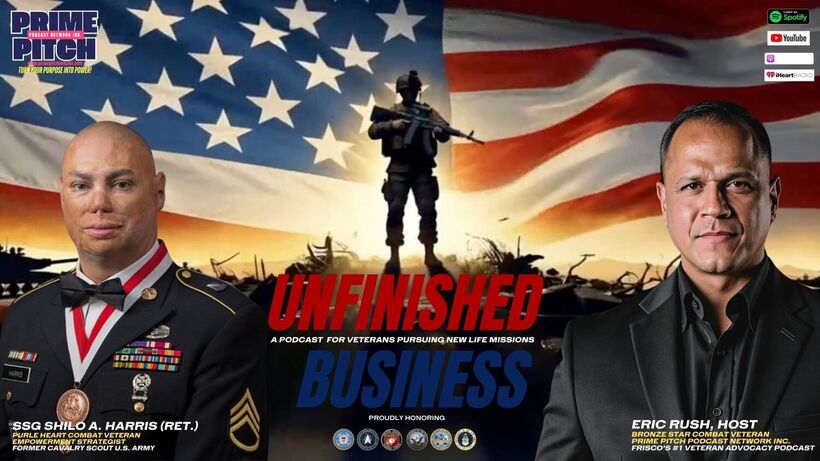
SSG Shilo A. Harris (Ret.)
Purple Heart Combat Veteran · Empowerment Strategist
About the show
Unfinished Business is a podcast for veterans pursuing new missions after the uniform, and for the families and communities who stand beside them. Hosted by Eric Rush, The Conversation Architect, a Bronze Star combat veteran and the founder of Prime Pitch Podcast Network.
Read the full transcript
Uh, you know, a lot of people would ask me if I ever got mad at God. Hmm. You know, or, or they'd ask me, "Do you have religion? And did you blame"you know, whoever. And, uh, you know, and I mean, honestly, that's a pretty valid question.
You know, 'cause some people, you know, when they deal with things like that, you know, the first thing they wanna do is blame somebody or something. You know, uh, you know, blaming God is usually at the top of the list. But, you know, it's like I said, when I experienced that coma, I mean, I was thinking, "Dude, this is as close to hell as I ever wanna get."1, 2.3, 4. Unfinished business. Hey, what's up, guys?
Welcome to Unfinished Business, a podcast for veterans pursuing new life missions. Today's guest was awarded the Purple Heart, Army Accommodation Medal, Army Achievement Medal, Public Service and Advocacy Medal, Award, and is a national s- a national speaker and veteran advocate. But let's be clear, this episode isn't a story about survival. It's about what comes after.48 days after an IED blast in Iraq, retired Staff Sergeant Shilo Harris opened his eyes to a life that began in pain.3 brothers gone, a body built through fire and faith. Every breath, a reminder that coming home is its own kind of war.
Unfinished Business, a podcast for veterans pursuing new life missions, steps into that space between endurance and meaning, where scars become scripture and silence becomes story. Here, retired Staff Sergeant Shilo Harris speaks of echoes that never fade, of shadows that walk beside him, and of the quiet faith that kept him breathing when nothing else could. This conversation isn't about recovery, it's about legacy. What we owe the fallen, what we build from the ashes, and what it truly means to keep living after the battle moves inside. Shilo, man, a pleasure to meet you, my brother.
Like you know, I mean, Lisa K., it's a pleasure to have you on the podcast as well. Thank you. And, you know, Shilo, as I was reading that, that intro, what, whatDid I hit, hit the marks? What was one thing that really kind of resonate, reson- resonated with you? Oh, first, man, I gotta say, what an introduction, man.
Thank you. I thought you were calling off your own resume there for a minute. And then a minute ago when we did that pre-take, you were like, "And the Bronze Star."I was like, "Well, that's not me, bro. That's you, for sure."I'll Yes. So thank you so much for your service, man.
Thank you for having me on your show, too. Absolutely. And, uh, Lisa, thank you for having me come speak at your event. Thank you. I mean, honestly, I wouldn't be, I guess, who I am and where I am if it wasn't for individuals like you, professional people that wanna give back to the community.
And I'm so thankful just to be a part of that and be embedded in that. Mm-hmm. And hopefully save a life, change a life, encourage better quality of life. Yes. And that's what we can do.
Let's do it. Yeah. Awesome. In that intro, I, I mentioned a couple of things. I say, um, it's aboutIt's, it's echoes that never fade, um, uh, shadows that walk beside you, and the quiet faith that kept you breathing when nothing else could.
Um, when I share that with you, what, what, what thoughts and feelings come to your mind? Oh, wow. When you talk about the shadows, I mean, the first thing I thoughtAnd you're absolutely right. You know, great introduction, by the way. Thanks, man.
And, and I'm just gonna admit, I'm g- uh, I'm gonna admit, I didn't read any of the questions that you sent me. You know why? Because I like to speak from the heart. That's awesome, man. I feel like, you know, true testimonies that come from the heart and come from that deep spot is what, uh, really means something to people.
And people can tell if you're, you know, BSing or not, so to speak. You know, so, uh, you know, when you started that shadow part, uh, I mean, honestly, first thing I thought of was that coma. Hmm. You know, 'cause I spent almost 50 days in a coma. And then even coming out of that coma, there was so much time, you know, in that first year that I was so heavily medicated- Mm-hmm.
that there was barely a timeline that I was working off of. You know what I mean? There's cornerstones, you know, wherever it was in that timeframe that I remember, you know, and I'm sure we'll get into that, but- Yeah. you know, thinking about those shadows. Now, that comaI'm just gonna tell you.
And I, and I've talked to other people who's been in a coma, and they said it's as close to hell as they ever wanna get. Hmm. Because it is. It's dark, uh, and, you know, you think, "Oh, well, they're just out."No, man. It's, it's kind of like this lucid dream state where you can sense people around you, but you can't talk to 'em.
You're in pain, you can't tell 'em. Hmm. You know, you're thirsty. You can't ask for something to drink. I mean, it was horrible, I'm not gonna lie.
Yeah. But they said it would've been worse, of course, if I hadn't been in that coma, because then I wouldn't have experienced all those surgeries and, and, you know, the in and out of anesthesia and stuff, and it probably would've, you know, shut my kidneys down, my liver. I mean, goodness knows what else, right? All those medications, so. Yeah, yeah.
You know, when you were sh- when I was reading up on you and your story, and I thought about 48 days in a coma, and you talked about those, thoseThat, that even being in that coma was like pure hell. Yeah. You know, I just had 2 hip surgeries, and they're nothing compared to what you went through. Mm-hmm. But I know for a fact, when I, when I had the, uh, the anesthesia and the medication, it start, I started seeing these demonic things going on, and it was very scary for me for the firstfor each of those, ea- each of those experiences.
And I resonated that probably you had it times 100 in that, in, in your situation, you know? Sure. Um, when you first opened your eyes, um, after 48 days in a coma, in a coma, what was the first moment that told you you were still here? And when and how did that awareness begin to shape the way you live? You know, you know, great question.
And as I mentioned, you know, it wasYou know, it was hard to say day one. You know, because I mean, I really don't know. And even when they brought me out of the coma, it was such a gradual process. Mm-hmm. And it was likeI was in ICU.
Uh, I don't even remember the showers. Now, I remember one shower, and that was all I wanted to remember. When I say that, I mean, it's like they wheel you into the shower, and it's like you're laying on thisI wanna say metal table kind of thing. And they have to scrub you, and it's called debriding. Mm-hmm.
Where they're cleaning all that stuff out. And, you know, this was probably where they were kind of weaning me off my medication still. And oh my gosh, that was horrible. So, you know, there was a lot of dark moments about this. But, uh, you know, if, if you don't mind, I'd like to just go ahead and jump in on a, on a positive note.
Yes, absolutely. But i- it's, it's, uhIt's also, I guess you could say, the cornerstone of me knowing what I was truly faced with. Mm-hmm. You know, and yeah, weThere's plenty of dark moments that we could talk about, but you know what? We're here to talk about that legacy, and I'd like to lean towards that now.
Yeah, absolutely. Yeah, and I think the question was more geared to when did you say, "This is the next step forward?"Oh, yeah. Like that, thatWhen did you realize that you were in, you were in this situation and you were being, you know, phased out ofUh, and you said gradually through the coma. When was that one day where you were like-All right, let's go. You know?
Like, let'sYou know, I, I gotta quit, I kinda quit thinking about this in a, in a negative light. Was there a specific moment that you, that resonates with you? Was there a person that stood out that, that assisted you in that, in that time that t- that flipped that switch for you? Yeah. Uh, the truth on that is, is, you know, there's been many.
You know, obviously, through the years. Yeah. But, you know, that very first one was, uhAnd I share this on stage with almost every audience, whether I'm doing comedy or the motivation, inspiration, whatever it is. Yeah. You know, because I feel like this is good soup for the soul that reminds people how strong they are, and I'm hoping that I'm reminding them through my challenges and through the things that I was faced with.
And it was the day that they came into my hospital room and I was still, you know, laid up, covered in bandages. I was an airplane splint still. Couldn't really move my arm. So, I mean, IAs far as I knew, I mean, I felt okay here. But watching TV, you know, again, heavily medicated, you know, I knew I'd been hurt, but that was it, you know what I mean?
I didn't really know- Okay. the extent of the damage. And the doctors and physical therapists and everybody come in. I mean, this is like a all-hands thing, you know? There's, like, probably 5 or 6 other people in there.
And they're like, "Sgt. Hash, today we want you to get up and take 10 steps."And I was like, "10 steps?"I was like, "Man, I do 25-mile running marches."I was like, "I'm gonna own this hospital."You know, because it's like I said, I felt right here. Yeah. Hmm. You know?
And, uh, you know, I also knew how strong I was in the military. I knew how strong I was as a young man. And, you know, so I was likeBut getting out of bed was completely excruciating. I mean, every bone, every joint, I mean, everything just screamed pain. Hmm.
And I know that may sound like an exaggeration, but I mean, it, it's really not. I mean, it was excruciating. And when I was able to stand up, I was almost so exhausted that I felt like I was gonna throw up, and they were like, "Come on, you can do it."And I took 3 little tiny steps, not even far enough that I couldn't fall back into bed, which I did. Hm. I took those 3 steps and I just fell back down-in that bed and I was just, I couldn't breathe, I was out of breath.
And, uh, anyway, uh, I wanna say this, uh, it's true, uh, it's not just for me, I mean, it's for everybody. You know, something that happens with us when we face big challenges like that is we start, uh, uh, poisoning ourselves mentally by saying things like, "We can't," "It's too hard," you know, things like that, right? Yeah. Well, I started doing that, of course. Hm.
You know, I'm like, "I'm not gonna do it. They can't make me do it. I mean, they, they can't, they're just doctors and nurses, they don't know what the hell."You know, I was like, I, I was already picturing me sitting on the front porch drinking tea for the rest of my life. You know, whether I walked or not ever again. Well, this pity party went on for about 3 or 4 days.
They had all really good friends come in and, you know, he would mentor me, we'd talk about the Bible, we'd talk about this, talk about a lot of different things. And I felt like maybe, you know, it was my mom and him and my dad all had this thing planned, right? You know? But he came in the day before and then the next morning my mom come in and she was feeding me breakfast. You know, as I mentioned, I was an airplane splint so I couldn't use my hands and my arms.
So, you know, I mean, she would come in and feed me breakfast and that was our special time. Yeah. Well, she was just saying, "You know, we really need you to do this. Your family needs you, Shiloh."Hm. And I'm like, "I know, I know."You know, but I was still really half-hearted about it, you know?
Well, she leaves and my dad comes in. My dad, military, infantry guy, you know, paratrooper. And he just stands at the foot of my bed just staring at me. I knew there was a message, you know? And as a young guy, I mean, I'm trying to kind of ignore it and I'm still negative, you know?
And he dragged this thing out long enough, and I'm trying to watch TV, ignoring him. And then finally, I mean, he just kept staring at me. I'm like, I can feel him, like, staring a hole in me. And I finally was like, "Well, what is it?"You know, being a smart-ass about it. And he said, "Are you done, soldier?"And I was like, "Excuse me, sir?"And he said, "Are you done, soldier?"And I mean, it gives me chills every time I say it, you know, and just even thinking about that moment.
Hmm. And, you know, you thinkHe put it on me like that, like, "Are you a quitter?"Hmm."Are you giving up? Is this it? Is this your legacy?"Wow. And I was just likeI mean, it didn't take him a split second, and I said, "No, sir, I, I'm not done."He said, "Then get your ass up and start doing the work."I mean, he left me with my thoughts.
Hmm. And bro, I'm going to tell you, he got deep in there, you know. I was like, "Where's my physical therapist?""Let's get this show on the road," you know. That is soMan, that, that is, like, so amazing just to have that, uh, you know, your f- your father, you know, having this strength that he's- you've, you've, you've obviously taken, inherited from him, you know, and, and, and just, just straight to your, straight into your, into your soul. What are your thoughts, Lisa, okay?
That's some- that's a major tough love. I mean, for what you went through, for your dad to stand there and do that, that is love. In a tough way, but it's love. And that's, that's just amazing. Just amazing.
Shiloh, when, um, uh, when we first started, you talked about, uh, you know, um, not- where, you know, thatHere, let me, let me, l- let me reset this for a second. Let, uhYou know, one of the things I, uh, you know, when I sit down with individuals like yourself and other individuals that have had this- their, their own, their own hill to, you know, to, fighting and conquer, right, is I always say that their suffering's very sacred, you know. And it's, uh, um, I always say that the opportunity for you to share your story, and you've obviously gotten, you know, f- practiced y- your way into being, uh, uh, just knowing your story and owning it, and, um, uh, I always say it's something sacred and it's a, um, it's a treasure when someone, uh, gives me the time toor sh- shows, you know, sh- shows interest in sharing that story, uh, with me. So, I want you to know that it'sI, I honor it, and we're r- uh, here to honor theYou know, like I said, this is not about the suffering. It's about the legacy, li- we tal- that I mentioned, and, uh, I just want you to know that, that, that I value that, your experience, and ev- anything you share that, you know, with your comfort- uncomfortable, just let me know.
We'll, we'll, we'll walk through that a different way. Yeah, I appreciate that. Yeah. Thank you. Uh, I mean, honestly though, man, there's not much that I'm too, too shy to share about.
You know, a- and speaking of that, funny story. You know, I was on a, a trip with some veterans, right, and, uh, and their spouses. And, um, you know, weThe, the, the, all, most of them were younger than me, so, you know, I kind of feel like I'm the, the older guy of thewhich is fine, you know. I'm big brother to a lot of them. That's cool.
Well, you know, and theand we all have shared, like, crazy stories already, right, obviously, you know. And these are guys that I work with pretty often. Well, I could see the girls, like, sitting in the back, you know, like, chka-kcha-kcha-kcha, you know. And I don't know why. I just felt like it was something that, you know, they were, like, I don't know, building up for.
And I don't know why, but I felt like it was directed at me. Hmm. And then, uh, I followed up. I was like, "What are you girls doing?"And they said, "Shiloh, we have a super personal question."And I was like, "More personal than some of the things we've already shared?"I'm like, "Damn."I was like, "Well, ******* get me out of here quick," you know. And, uh, anyway , he- they started giggling, and they said, "How do your glasses stay on?"Oh, my God.
And I was like, "What?"I was like, "That's your burning question, really?"And they were like, "Well, you don't have ears," and I was like, "Ah, correction, I do have ears."I was like, "I just don't always wear them," you know. I was like-"I got Spock ears. I got cauliflower ears.""I got regular ears. I'm thinking about having alcoholic ears, maybe, you know, for when I'm drinking cocktails or something.""Should have some green ones for St. Paddy's Day."You should.
And to me, soWhen they said that, like, that super personal question that they asked me about that, I was just like, "I guess I'm good at shopping for glasses," you know. I was like- I don't know. It was just so funny, you know. Uh, but, uh, I, I, I find it therapeutic to be able to do this, you know. Yeah.
And, you know, and if- if it's something that's too personal, I mean, I've, I've learned how to do how some of these politicians do where, you know, the question's over here but, you know, you know the answer over here. Yeah. You know, like, uh, so I get it. It's all good. Um, 1, when we, when we first started this, you also talked about, you know, coma was a, a version of hell.
how did this inf- uh, this- those visions influence the way you understood fear, pain, in human- the human spirit's ability to return to its, uh, its own darkness? Like, when you would go into it, like, how did you understand fear, pain and the human spirit's ability to return from its own darkness? Yeah. That's a good question, and, uh, I thi- I think I wanna, I think I wanna lead it in on this, on this note because- Oh, nice. first thing that I started thinking about was, uh, you know, a lot of people would ask me if I ever got mad at God.
Hmm. You know, or th- or they'd ask me, "Do you have religion? Did you blame," you know, whoever. And, uh, you know, and I mean, honestly, that's a pretty valid question. You know, 'cause some people, you know, when they deal with things like that, you know, the first thing they wanna do is blame somebody or something, you know.
And, you know, blaming God's usually at the top of the list. But, you know, it's like I said, when I experienced that coma, I mean, I was thinking, "Dude, this is as close to hell as I ever wanna get."Hmm. You know? So it helped me, actually, lean towards my faith, you know. And as far as the speaking, I mean, I cut a, I cut a lot of my teeth, you know, as far as, you know, you know, as far as, uh, using a scenario or whatever you wanna call it, metaphor there-You know, I cut my teeth in speaking and ministry.
Mm-hmm. You know, and i- it was just, again, something that I kind of fell into. Uh, you know, it's not something that I, I shoved down people's throat, of course. Uh, you know, because here's the thing is, I found out that whatever your faith is, you should lean in on it. You know, whether it's Christianity or whatever, but you know, something positive.
You need to fill your life with as many positive things as possible. In that coma, bro, I'm going to tell you, it was so dark and so weird that it did, it kind of pushed me to the light. It pushed me to fill my life with positive things. And again, I didn't intend on being a motivational speaker, it just happened. I'm just a happy guy.
I have bad days, I mean, don't get me wrong, you know? I mean, and, you know, I'm- believe it or not, I'm a little recluse too. I have to build myself up like, "I can do this. Let's go out here and be in the crowd."You know what I'm saying? And then I'm like, I'm in and then I'm out.
Then I'm in, then I'm out. That's great. But, you know, that's, that's part of it. That's part of who we have to be as leaders. That's who, how we have to be as Christians and how we have to be as, as people in our community leading, such as you like, something like your program.
And I, I can't wait to speak there, in fact. Yeah, I'm waiting for you, too. That'd be awesome. Share you in the whole community. Sorry, we had a, we had a, uh, an audio issue, um, what do you call it?
Say something. Yeah, go ahead. Go ahead. It's Lisa K. I don't knowLisa.
It's Lisa K. Lisa K, did I say that? What did I say? Lisa. Oh, okay.
Lisa K. Oh, that's right. Lisa K. You know, actually, I've been meaning to ask you that, if it was Lisa K or if you do Lisa. So Lisa K?
Yep. Okay, I like that. Power name. Lisa K. There's some friends-that, that'll be watching this and they know I- Yeah.
I correct everybody. I'll bewhen he was speaking, when we interviewed him- Mm-hmm. and I corrected him and he goes, "You have to do that a lot, don't you?"Yeah. Yeah, Brian, well, I mean, I think he's a close, uh, we, we both, we're, we're familiar with Brian Fleming and, uh- I love Brian. Yeah, yeah.
He's a gr- Great man. great dude. Um-Um, that explosion claimed the lives of 3 soldiers you considered brothers. Um, I'd like to honor them by n- by saying their names in this podcast. Um, when the noise and movement of daily f- uh, of the daily fa- fade, daily life fade, how do you carry them with you?
Oh, I mean, I, I guess another big motivator for me to do what I do. Uh, I feel like I honor them and I honor, h- honor a lot of the other men and women that have given everything for our country. Mm-hmm. You know, and I, and I'm sure that, you know, you both can relate and, and, you know, recognize that, you know, they are our greatest assets, you know. I mean, they literally gave everything for us.
And so I'm so grateful, you know, for the men that I served with, uh, really good men and, and am I saying their name or are you? You s- you can say their names. Yeah, okay. Yeah. So Sergeant Sean Duncan, uh, he was my roommate and, uh, obviously fellow NCO, loved him.
And then, uh, Derek Cleveland, he was my gunner that day. And then Matthew Bo, he was my medic and, uh, he was also in the back seat. And so me and my driver were the only 2 that survived and, and I just, I'm telling you, I mean, they're good men, uh, obviously. I mean, they, they believed in what we were doing, they believed in being in the military. I mean, they just, they loved America and come from really good families.
And I'm so proud and honored that I got to spend the time that I got to spend with them on this earth. Can you say their name one more time? Derek Cleveland, Sean Duncan, and Matthew Bo. All right, guys, that's what we do here. We honor, we honor the fallen and, um, I'm glad you shared those names with me because I was trying to figure them out so I could, you know, introduce them or just say their name.
But, um, you know, it's so important that we take that time to do that. Um, you know, um, you s- you, you've, you've been speaking about your role of, of faith in your healing, right? Um, during those moments when you're trapped between pain and recovery, what did faith look like for you as a private conversation? Uh, I'm sorry, say one more time. Okay.
Um, you know, uh, during those moments when you are trapped between pain and recovery-what did faith look like to you as a private conversation? Oh, I've come to understand and believe that, uh, God makes us uncomfortable to draw us closer to him. Mm-hmm. You know, it's like, if you're going through challenges, again, you know, it's either you deny God or you run towards God. Yeah.
You know? So, uh, I was one of those that I was, I, I ran towards God, you know. And, uh, and I feel like, uh, and in fact when COVID happened, you know, I lost a lot of my work as a, as a speaker, you know, 'cause there wasn't conventions, nobody getting together. Uh, so, you know, I was like, I decided to turn it into lemonade. And I was like, "That's cool, you know, it's all right."Uh, but I went to school at, uh, University of Incarnate Word in San Antonio.
Okay. Great school, great campus. And I went for religious studies. But I was kind of hoping, uh, that it would teach me more about religion and how I can help other people. But it was also a personal growth journey as well.
Hm. You know? I wanted to learn more about, you know, I guess, I, Ilike, the, the foundation of Christianity. I wanted to learn more about, you know, the apostles. I wanted to learn more about these things.
Because I felt like, you know, I wasI was so influential but I didn't quite understand it, which is religion in a way. It's the mystery, right? Yeah. You know? But it is also called faith for a reason.
Mm. And God is love. Yeah. And so, you know, again, I filled my life with all these positive things. And I mean, there's no greater love than God.
Man, I love that. I love that you turnedYou know, you, you, you turned to getting stronger, more, more, uh, um, relationship resilience with Christ and, and the journey and understanding what every, um, prolific figure in the Bible, um, what, what, what their purpose was and their cause. I'm sure that was an amazing journey for you, for sure. Absolutely. Is there a particular, um, is there a particular, um, figure in thatin the Bible that st- that resonates with your story?
Yeah. With your faith? Oh, the whole Book of Job. Yeah, I was gonna say. Yeah, yeah.
I was gonna say Job, yeah. There's a lot of verses there, you know? I'd be lying if I was gonna say one. Yeah. Uh, you know, I don't really remember all that kind of stuff like that.
But, uh, uh, I've been doing, uh, OCIA. You know, I've been working on becoming Catholic here recently. And, uh, I don't know. It'sI'm a- I'm one of those guys for originals. You know what I mean?
Yeah. I like Ford. I drive a Ford pick-up. You know, I li- I like drinking s- uh, Coca-Cola if I drink sodas. And, uh, and um, I'm gonna tell you, if, uh, if you're gonna follow Jesus, I don't think there's any closer than the Catholic church.
You know? And that's just my opinion, you know? Because I mean, I feel like it's the original. I mean, that's Jesus' church. Yeah.
The apostles started that church. And so, you know, it was like, why not become a Catholic? So that's what I've been doing. And it's been a great experience. That's beautiful.
Yeah, I was raised Catholic so I understand theeverything y- like in the Catholic faith, how sacraments and every-you know, that whole ex- I'm in it. Yeah. Very sure. Um, you've ref-Uh, you were part of pioneering regenerative research that used stem cell to regrow tissues on your hand. Um, how did standing in the intersection of science and faith change the way you understood what the human body and soul are capable of?
Yeah, another great question. Hey, y- by the way, you're really good at this. She should have a podcast. We should, right? No, you know, IAnd so, you know, IWhenYou, you have so much valuable information and I justI feel like it'swe gotta get down and get some of that sh- Yeah, actually.
juice from you, you know? I don't know that you're the special- Oh, yeah. Oh, yeah, for sure. I don'tYeah. So what are your thoughts on that?
WhatHow did, umHow did your intersection with faith and, uh, uh, your understanding of the human, human body,Well, I mean, just like, you know, our, our modern world as it is, I mean, technology and, uhwell, I should say just stem in general. Yeah. You know, science, technology, and electronics, Yeah. You know, all this stuff. All this stuff is developing so quickly that, you know, I mean, I don't know how a- any one person will be able to stay on top of it.
But that stem cell, it was crazy because it was my father again. And, uh, I remember he saw me one day. Uh, this, this finger right here, I ultimately had it removed, but it was the index finger, my pointer finger, and it was missing. It had like a little stub. Hm.
And, uh, my dad was walking around the hospital one day and saw this sign for stem cell. Well, I guess, later that day or later that week, he saw me trying to grab something with this hand, 'cause this hand was full. And he could see that that little stub was in the way. It was pushing whatever it was I was trying to grab. And I was like, you know.
And he said, "Wouldn't it be cool if you could grow that finger back?"And I was like, "You mean like Star Wars and Luke Skywalker, you know?"And I was kind of joking around. But he said, "Yeah."He said, "I saw this stem cell research at the hospital."So I brought it up to my PA and, I mean, you should see the stars in their eyes. They're like, "You'll do it?"I mean, but they were looking for a candidate and I didn't know that. And so, uh, I mean, this turned into a pretty big deal. They had film crews in the OR.
I mean, it was like a big deal. Uh, that's not why I did it but, you know, I was thinking, well, if I could be, uh, you know, part of this research and potentially grow my finger back, why not? But here's the other thing, you know. I'm at Fort Sam Houston and it's a training facility. Yeah.
You know? I mean, they tr- Mm-hmm. They trainThey also have the surgical research center right there, which they're on the cutting-edge of research, trying to push the industry forward, you know, so we can better help people. And I felt like I was a part of that as well, you know. I was like, "Why not," you know?
Yeah. And so I did it. Uh, we had about, I want to say, 4 or 5I, I, I don't re- I, II mean, it's been a little while, so, you- Yeah, yeah. Don't, don't quote me entirely on that. Oh.
Kind of a guesstimate. Uh, 3 or 4 or 5, uh, surgeries and, uh, you know, and we had moderate success. We grew about a, uh, a fourth of an inch of bone and about a half inch of flesh. But they knew that they could grow flesh. Wow.
And so that was the, that was the thing. And so theirthe thing was they're trying to develop bone. And of course, you know, I had to go back and forth to surgery. Hm. Well, at that point, I'd already had so many surgeries, you know, that eventually I was like, "You know, I don't have a finger yet."You know?
I'm like, "I don't think I can do this for the next year."Uh, and I mean, it was, it was a lot. Yeah. You know? Uh, so eventually I stepped away from it. But again, we had moderate success and that technology or that, that research actually, uh, overflowed into helping other burn survivors with, uh, what they call, um, some kind of a, um-a, like a s- paste, uh, stem cell paste or pixie dust paste.
And instead of having to do so many donor sites, which is where they take skin to put over areas where it's not gonna, you know, heal quickly or well at all- Yeah. uh, you know, they take that skin and they put it there. Well, that paste is a replacement for having to have so many donors. You know what I mean? Like, taking the skin 'cause I'm burned.
Yeah. Overall, I was only burned 35% of my body, but now with the donor and the grafts, uh, it's, umI mean, I'm probably like 80% scar tissue. Mm-hmm. Just guessing, you know. We'reSo, I mean, there's not really many parts of me that aren't scarred.
Wow. So, isn't that crazy? That's wild, huh? That's crazy. I think it's so, like, omniIt's like, you know, y- you know, omnipresence of, of God in your life to, to say for haveto will you to say yes, you know, to the research and to go down that journey several times, not just once, right?
And multiple procedures and for you to just have that, that pure faith of saying, "Let's just go for it. Let's see what's- Yeah. gonnaLet's do this and see where we're gonna go."And, and now it's, um, it's, uh, it's paying it forward to somebody else's, um, um, um, journey with the, what they struggle with as well, so- Yeah. that's, that's amazing. And probably not just military, you know, because, uh, I don't know if- Yeah.
y'all know this or not, but Brook Army Medical Center, the burn center, they take care of, uh, civilian burn survivors as well. Mm-hmm. You know, I mean, I've met people from the oil field out there. I've met people from welding accident, car accidents. I mean, you name it.
You know, if they're burned, you know, they, they, theyI mean, this is the best place for them to go, in my opinion. Yeah. Now, maybe statistically somebody else says something different, but I'm gonna tell you, I love Brook Army Medical Center. They've always taken great care of me and the burn center is absolutely, in my opinion, hands down the best in the world. Awesome.
Um, you've reflected that everything in life is a gift. Um, what did it take for you to believe that and what sustains you s- s- sustains that belief on the d- on the days you remember the heavy pain, the heaviness of the pain you, you went through? I think it's a, a mind-shift. As I said, you know, we, we all have dark days. We have bad days.
Everybody does. You know, I don't count you- I mean, nobody's immune to having a bad day. But, you know, when you're having a bad day, it's hard to think positive. It's hard to see the good things in your life. But, you know, I mean, honestly, itYou probably know this as well, you know, going to some of these countries that we go to.
Yeah. You know what I mean? You see they don't have much. Yeah. If, if anything.
I mean, uh, like, when we were in, uh, uh, Baghdad- Mm-hmm. you know, I mean, we saw the same kids often and they were often wearing the same clothes almost every day. Yeah. You know, rarely did you see them in different clothes, you know, different outfits and stuff. So, I mean, the poverty is, uh, you know, I mean, extreme over there.
Right. And I believed in what we were doing. I believed in, you knowWe were trying to help these people. We were trying to make a, a positive difference in their lives. You know, here, you know, in the United States, and I'm, I'm, uh, I'm not saying by any means that we're spoiled, you know, but I feel like it's easierIt would be a lot easier if we looked at the things in our life and the quality of life that we have here in the United States as a gift.
I think we'd all be a lot happier. Mm-hmm. That's just my opinion. I mean, I've got a vehicle. I've got a nice vehicle.
Uh, I've got a house. I got a roof over my head. You know, I, I mean, we've got services all over the country. But when you start measuring those things in your life, what's the most important to you? And I, I feel like a lot of people during COVID realized that they are lacking time with their family.
You know, and I will tell you this. I mean, I, I had so many people saying, "I feel like a super parent right now."You know, because it's like the kids couldn't go to school and they're, you know, trying to teach your kids stuff at the house and, and it was like people really connected with their family again. Mm-hmm. So, even though there's so much bad stuff going on, there were so many people looking at the positive like, "Oh my gosh, I do have beautiful children. Oh my gosh, you know, uh, I, I have a pretty good life.
Uh, even though it doesn't look great for this, you know, this is positive."And that's really what we have to do and I, I call it that aerial view. Yeah. You know, take an aerial survey, take an aerial view of your situation and look at all the positives. And if you're having a bad day, and if you can pinpoint where that bad thing is, and take it out or kick it out, whatever you gotta do, you know, start figuring out how to cut that outta your life, that's just gonna be better for you. Any good books that you read?
Have you written, you, you've either, youI know you have one. You w- you're an author of, uh, Steel Will, right? Yeah. Talk, talk, share a little bit about, uh- Well, I think that book's so great. I just keep reading that same book.
I like the author and everything. Like, man, that was a good book. I better read it again. No, tellShare with me, um, any, first of all, uh, share with, talk about, uh, uh, Steel Will. I didn't, um, yeah, I would love for you to share a little bit about it so we can, and figure, um, see where, where people can get it as well.
Well, as I told you when I first came into the studio, I just became a yes guy, right? You know, and I would, people would say, "Hey, you wanna do this?"I'm like, "Yeah, sure."You know, then I'm like, "What did I just commit to?"You know? Um, I went to, it's a, it's called Entrepreneur, Entrepreneurial Bootcamp for Veterans- Mm-hmm. the EBV. And they offered one at Texas A&M through the, uh, Mays Business School.
And they offer 'em at other campuses across the country. And I think it started at Syracuse, uh, New York. Mm-hmm. Uh, anyway, but long story short, uh, in fact, I, I hope I'm on track here still. So, oh, okay, the book.
Yeah. Yeah. So, uh, I went to the EBV course. And I met, uh, business leaders and, you know, professors and different people in different industries that were successful that was there to help coach us on our business ideas and kicking our businesses off. And I met a, a Green Beret and he started talking about his sister.
And he said, "You should write a book."And I was like, I said, "I don't know, man."You know, and that was probably the first time that I ever didn't just run at it, you know? Yeah. And I was like, "I don't know."I said, "You know, telling my story on stage is one thing. Uh, you know, but it's like, putting it in a book," I was like, "You know, there's some hard truths that I don't know if I wanna share."And, and leave it out there like that. Yeah.
You know? But we looked at it as a tool. And, and he didn't tell me, he, but apparently he told his sister. She come to one of my presentations. And she started writing a book without really telling me.
Wow. But she wrote about a chapter. She sent it to me in an email. She introduced herself. And she was like, "What do you think?"And I'm reading it and I was like, "Damn.
Well, first of all, you make me sound like a badass."You know? I was like, I was like, "It feels good, looks good."You know? Uh, but I said, "I just don't know."And she encouraged me. She said, "I've got a lot of experience."She said, "I'm a librarian."And said blah, blah, blah. She goes, "It's gonna change your life."And she was right, you know?
And anyway, but the one thing that she asked me though, she said, "If we write this book," she said, "what's your goal with it?"And I think this might have helped her with her purpose in her writing. Mm-hmm. Uh, because she was like, "Do you wanna make money with it?"Or, you know, "What's the deal?"And I told her, uh, and, you know, this has been my mentality through all of this. I said, I said, "If I can save one life," I said, "it's worthHmm."If we can save one life, it's worth it."Yeah. It's priceless.
One life is priceless. We have lose so many service members in combat that we shouldn't lose one person right here in the, in their home in the United States or anywhere, wherever we-, wherever they are that have served in our military to protect our country. We should not lose one person to suicide. And that was my thought because about that time, one of my friends had committed suicide that I served with. And I was like, it helped push me over that hump of do I wanna do this or not?
And he- and she said okay. And then I told her about, you know, my buddy. And she said, "All right."And so we filled that book with as many positive things as we could, uh, resources and that sort of thing for veterans. And of course, it's got a great storyline. Yeah.
And, uh, a lot, a lot of it I wrote. You know? And she just kind of helped polish it out for me. So I feel really good about it. I hope other people will too.
That's awesome. What are your thoughts, Lisa K? Yeah. Um, writing your thoughts from here to paper, from your life experience, didn't that also clean- cleanse you in your soul, maybe release some of the pain, memory pain? I say, I ask that because I went through some trauma in my younger days.
And God led me to an English course. And the professor taught me how to write. And so the story I wrote was about being a middle child. And what I didn't know until the end was I was crying the whole time I was pouring my heart out on paper. And then when I finished the story, I was somehow healed from the hurt.
So that's why I thought well, maybe that cleansed you in some sense, getting some of it outta your mind and onto paper. That's beautiful. Man, that, that's awesome. You know, just having that, uh, ability toYou know, I say you put, you know, put, you know, you gotta put it into writing, right? You gotta put it out in the world and let, let that faith show in your, in your works, right?
Like this, this, this example of your book is a, is a measure of your faith and your trust in Christ that whole way and that, the living testimony. That's a true living testimony, right?'Cause we're gonna die. But you have it out there in the world now. It's become a, a living entity in this world. And that's, that- Yeah.
that's inspiring likewise with you, Lisa K., with your books too. Um, uh, let's, let's make a shift on talk about, um, we got an exciting event, um, veteran, uh, the Veterans & first Responders Appreciation event. Uh, Lisa K., lead us into this. Li- Lisa, Li- Li- Lisa K., lead us into this and, uh, and, uhYeah, yeah, yeah. Yeah.
But lead us into what, what, what, what the event's about and, and, uh, what, what we can expect this year. Yeah. So we're walking into our 7th annual Fellowship Power Lunch Veterans and first Responders Appreciation event. Very excited about it. It's November the 18th at the, uh, Toyota Stadium National Soccer Hall of Fame in Frisco, Texas.
The doors open at 11:00 to 1:30. Sergeant Shilo is our guest speaker. I can't wait for y'all to come on out and meet this man and his f- learn about his faith and his story. And there's so many comrades, s- s- so many beautiful servicemen and women that will be there. So, Rush, last year, out of 305 guests, we had 172 that were servicemen and women.
Hmm. And most of 'em were in uniform. There's nothing more powerful than that. Yeah. And lots of love and lots of faith, and just lots of greatness.
That's awesome. That's fantastic. Do you know, um, this is- Uh, it's gonna be an honor to have you as the keynote speaker for the event. And, um, um, when you go, when you host a, uhWhen you, you're the keynote speaker of events, um, uh, what, what do you like people to leave with wh- when, when you're, when they're, when you're, when you're done? Uh, well, uh, as I mentioned, you know, uh, I like to make sure that they understand how strong they are.
Mm-hmm. You know, uh, and I do that through my testimony, you know, because, I mean, I was at probably the worst state that I would've been ever in my life. You know, I mean, I was a frai- I looked frail. I looked like a little old man, you know what I mean? I couldn't even stand up, you know?
Yeah. And, you know, and that kind of damage to my body, uh, you know, I mean, thatIt would've been super easy for me to give up. And, and I see some people crawl into a shell. Hmm. You know, that they're ju-Things like this happen, and they're like, checking out, you know, they fade off.
They w- they really become reclusive and, you know, they let it go. You know, uh, but, uh, I did wanna, uh, go ahead and answer your question though about the, the journaling and writing. And it is, I find it extremely therapeutic. Mm-hmm. Uh, you know, and I didn't realize that I was gonna find it therapeutic in that book.
But I had already been journaling and writing a lot of my thoughts, you know, because, you know what I mean, I try to retain everything, but I don't know if you recognize my hood or not, but man, it's, it's a miracle I remember my name some days. So, uh, but, you know, it's like I did find, uh, writing and journaling very therapeutic. And, uh, I've actually mentored, uh, other writers. You know, they, they've asked, "How do I get started?"And I'm like, "Just start writing. Start putting whatever's pouring outta your head on paper."And, and you will, you'll find meaning, find yourself in tears, right?
Mm-hmm. Yeah. That's wonderful. Thank you for that. Um, can I add one more thing, Rush?
Absolutely. Um, ladies and gentlemen, we still need sponsors. And, uh, this is a call to action. Step up. Go onto fellowshippowerlunch.
com. Click the Veterans tab. There's areas all over my website that you can sponsor. You can reach out to me directly at fellowshippowerlunch@gmail. com.
Veterans, first responders, this event is complimentary to all of you. So, uh, there's no reason why you will not be there. Go onto fellowshippowerlunch. com/veteran. Get registered and bring your spouse.
We'd love to see you there. And I look forward to giving you a big Texas hug. I love that, big Texas hugs. So, I gotta tell you a funny, though. All right.
So, uh, there was a-there was a lady. She came to one of my book signings, and she had the big Texas hair. You know, lots of hair, fade, and it was kind of poofy. Well, she gave me a hug, and my ear got hung in her hair. Oh, man.
And I did notAnd she's just sitting there just talking away, and my ear is in her hair. Oh. And I'm like, "I don't know how to get this ear," you know, without freaking her out. And I mean, I was likeI said, "Just"I said, "Just give me one second."And I'm reaching under, and she's already like, "What the hell are you doing?"You know? And I pulled my ear out, and she was like, "Oh, oh."You know?"What the hell are you do-" Like, you- you know how your grandpa steals your y- your nose?
Yeah. Well, my grandfather, he stole my nose, and he forgot to give it back. So, that's the other thing I wanna share is, we're gonna have some fun. So, not only are we gonna talk about overcoming adversity and those challenges in your life, um, but I doI'm pretty funny. At least people think I'm pretty funny.
I think I'm just funny looking, but people think I'm pretty funny and keep saying stuff too. But, uh, I have ears, and- and I'll be juggling those on stage maybe. I don't know. But no, here's the thing is we're gonna have a lot of fun. It's gonna be a great presentation.
And I am soI'm just gonna tell you, I'm s- extremely honored. Me too. I'm extremely honored to be there with my fellow brothers and sisters that have served and still serve. And for all you first responders, man, God bless you for putting yourselves out there each and every day. So yeah, man, I, I feel really good about it.
Super excited. Shilo, man, it's great to have you on Unfinished Business: A Podcast for Veterans Pursuing New Life mis- missions. Um, you know, Lisa, Lisa Kay and I have been working, uh, shoulder to shoulder in this, in this, uh, veterans, v- veterans and first responders appreciation for years. And, um, to see it evolve in such a mag- uh, magnificent way, and it has h- you know, high, high agency, high level, um, hu- hu- and s- strong humanity and understanding of, of, of the human potential, um, someone like you speak on, uh, on that at the event's gonna be an amazing blessing for everyone who attends. And I look forward to watching you in action, and laughing, and I you know, I already know what we can expect from this.
I have it already documented what we can expect. And, uh, no, it's been really cool to meet you, Shilo, um, a- admiration and respect for everything you are and you represent. And, um- Thank you. Yes, sir. It's, uh, here ev- everything resonates with me and y-wh- wh- what you've been through, so I appreciate you, man.
Man- Thank you again for coming on Unfinished Business: A Podcast for Veterans Pursuing New Life Missions. My pleasure, brother. you. All right, guys, that's it for Unfinished Business: A Podcast for Veterans Pursuing New Life Missions. As I always say, have peace and enlighten you.
And remember that the ocean refuses no river. Sound1, 2.3, 4. Unfinished business. New life missions.