Roland Ruiz
Roland Ruiz joins Rush on Unfinished Business, the show for veterans pursuing new missions after the uniform and the people who stand beside them. As decorated U.S. Marine Corps Veteran · Leathernecks MC, Dallas, Roland brings the weight of service and what comes next to the table.
They get into the work, the cost, and the reasons it still matters, in the kind of long-form conversation this show was built for.
In this conversation
- The transition out of the uniform
- Finding the next mission
- What stays with you, and what you build next
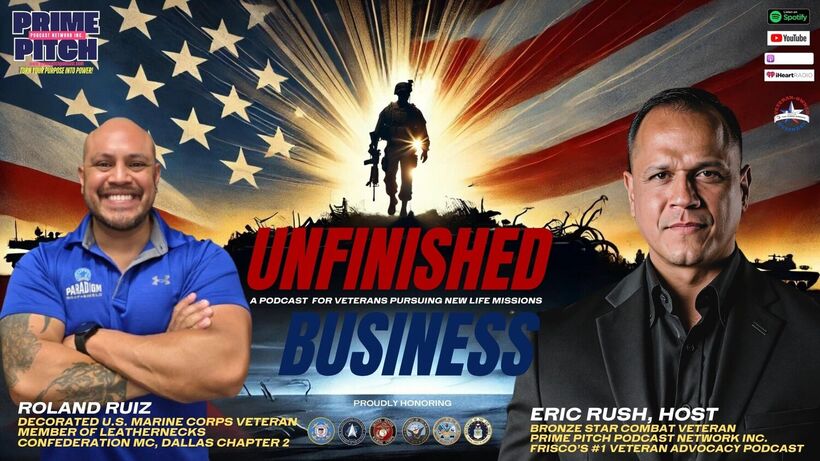
Roland Ruiz
Decorated U.S. Marine Corps Veteran · Leathernecks MC, Dallas
About the show
Unfinished Business is a podcast for veterans pursuing new missions after the uniform, and for the families and communities who stand beside them. Hosted by Eric Rush, The Conversation Architect, a Bronze Star combat veteran and the founder of Prime Pitch Podcast Network.
Read the full transcript
Um, you have an event coming up called the Ride, uh, The Ride to Remember. What makes this ride special to you and why do you think it connects so strongly with veterans and families? But we haven't done, umI haven't s- been to a ride where we raise awareness for veteran suicide. Um, it hits hard for me, very hard. I, I hit the lowest point of my life, um, almost when I got, almost when I got out, so I was like 15 years in the Marine Corps.
And then finally everything kind of just flooded back. Got drunk. And I don't say this lightly, uh, not a lot of people know this so, and, and it's hard for me to t- talk about this. Um, I got drunk, cut myself, um, bleeding, reached out, and it was, it was everything. Um, and, uh, the only thing that pulled me out of that was my family, um, close friends, um, I did counseling, and my wife, like, they pulled me out of that.
I am here because of them. So this ride is to help raise awareness because it's, it's still a serious issue, more so here in Texas. Texas is rising. Let's put this ride together, a ride to remember, ending veter- veteran suicide one mile at a time. off.1, 2.3, 4.
Hey, what's up, guys? Welcome to Unfinished Business, a podcast for veterans pursuing new life missions. The United States Marine Corps helped shape Roland Ruiz, 16 years combat veteran in the United States Marine Corps, Joe Torres, 6 years in the United States Marine Corps, with lessons written in brotherhood, discipline, and scars too deep for their eyes to see. Those lessons still travel with them, now carried on 2 wheels alongside the Leathernecks Confederation MC Dallas Chapter, a brotherhood that keeps the fire of connection alive long after the uniform is gone. At the heart of this mission rides the ride to remember, a living promise that no name will vanish, no family will mourn in silence, and no battle hidden in the shadows will be forgotten.
For Roland and Joe, every mile is more than distance. It is proof that service never ends;it simply takes a new road. This is the Unfinished Business podcast, a podcast for veterans pursuing new life missions. And today, Joe and Roland join us to talk about brotherhood, the scars we can't see, and the ride that keeps the fallen and the living alike. Joe, Roland, man, it's awesome to have you on the podcast, man.
Thank you very much. Guys, for sure. You know, um, it's, it's such a pleasure to, um, you know, when I, when I, w- you know, with Unfinished Business, the podcast for veterans pursuing new life missions, we, you, you, you see different walks, uh, you see advocacy walk, coming in different sh- different, different ways, you know? You, you don't, you don'tE- every time I sit down with somebody, I'm learning something new. for you guys, it's the, it's the brotherhood and the, and, and, and what you guys are doing with the Leathernecks Confederation MC with the Dallas Chapter.
It's, umUh, talk to me about what this, what, what the organization, um, stands for and what, what it means to you, for both y'all. Uh, so Leatherneck Co- Confederation, it is, uh, an organization of med- Marine veterans. Um, we have some Navy veteran corpsmen as well. Uh, we are open to, uh, other veterans as far as Army, Air Force. Um, they can be a support with us.
Uh, but ultimately, what it does is just brings the brotherhood back together. Mm. Once we leave the Marine Corps or whatever branch we were serving in, w- we developed a brotherhood within that service. Once you get out, you go back home, y- wherever you served or you find a new place that you j- it's not on base, and you long for it, you miss it, you look for it."Where am I gonna be? What am I gonna do now?
Where am I gonna find that brotherhood, that camaraderie that we've been, we've been so instilled from boot camp all the way to the multiple, uh, multiple deployments that we did, um, and afterwards? Like, wh- where are we gonna find that?"Yeah. The Leathernecks Confederation was that for me. Hmm. Uh, I actually saw them, um, riding around, uh, on my, at the time a Suzuki, uh, Boulevard at, uh, Harley-Davidson's.
They were doing, uh, Easter events. And so I stopped just to take a look at it and see what was going on. And, um, I see these guys walking around in, in cuts. Eagle and anchor real big around the back. I'm like, they must be Marines."Um, I haven't seen really m- many Marines in, since I got out of the Marine Corps.
Mm-hmm. Walked up to them, I'm like, "Y'all a Marine Corps vet, um, vet group?"And they're like, "Yep."I'm like, "Great.""Can I hang around?"Like, "Yeah, come on in."Uh, so, and, and it's, it was great. Like from, from day one, they opened up their arms to me, my wife, my children. Um, it's a family-oriented club. Uh, we, we follow the, uh, the traditional, uh, 3 patch, uh, rules.
We're a 99% club, uh, so w- where we have a top rocker, bottom rocker, and a, a center patch, and we have an MC cube. Hmm. Um, but we're different in the sense that family comes first. Um, then we have, um, w- work or God, um, then work, and then the club 'cause we understand that we need all those 3 before we can actually, uh, have a good, uh, developed, uh, organization like the Leathernecks Confederation. Yeah.
And, and then, and it's, it follows that. Yes. It's amazing. Um, I thank God every day for finding my brothers- Hmm. again.
Yeah. That's such a, that's such a, um, impa- impactful statement. It's, it's true 'cause once you're, once you're out, you're like, "Geez, uh, Torres went to Maryland."You know? Uh, you know, Johnson went to New York. You know, uh, e- everyone goes a different direction, right?'Cause they're all, they're all like, uh, uh,the amalgamation of people from different states and different parts of the, of the US and sometimes internationally, right?
Um, Joe, what, how, how has your experience been, uh, um, um, you're a prospect right now. What does that mean? What does being a prospect mean? So, um, I started hanging around with, uh, Leathernecks Confederation, um, November 11th of, uh, last year. Um, so I got to get, hang around with them, get to know them, uh, you know, great bunch of guys.
Uh, like Roland said, they've been welcoming, super welcoming to me. Uh, and so now as a prospect, uh, they get to decide whether I'm a good fit for them. Mm-hmm. So, I know that I want to be a part of this group, and now they, they decide whether they want me in their group also. Um, so it's been, it's been pretty amazing to, uh, again, hang around with Marines the way we did when we were in, in the Corps.
And, you know, um, l- again, like Roland said, I'm gonna echo what he said, that once you leave and, yeah, you ha- I have friends, but they don't really understand what it's like. Mm-hmm. They don't, they don't know the brotherhood. And so, that's what it's been for me so far. Yeah.
And hopefully, will continue to be that. That's beautiful, man. Um, Roland, you spent 16 years in the United States Marine Corps across different roles and deployments. What did the Corps teach you about brotherhood that still guides, uh, guides, uh, uh, guides how you live today? Uh, brotherhood is, it, it doesn't change, right?
Uh, it, uh, it's a, it's a form of trust, uh, sacrifice, um, w- with those individuals that you served with- Mm-hmm. you know, men or women. It doesn't really matter, right? Um, I've, I've deployed 4 times. Um, combat zones to Iraq and Afghanistan multiple times.
Um, and ultimately, politic, pol- politics aside, the, the, the biggest, I guess, the aspects of, of war or, or being overseas, is making sure that your brothers come home- Hm. alive. The, the Marines you serve with, the Marines you lead, uh, they come home. So, it's, it's, it's about the guy to the left and the right of you. Yeah.
Um, and I, I, it's, uh, still that in, it's instilled in me and, um, even with my job that I do, you know. Um, I, I work for, uh, Paradigm Roofing Shield. It's a, it's a veteran-owned, managed company, so th- a lot of us that are there are veterans. I take care of them. I look out for them.
And vice versa, we take care of each other. We look out for each other. That, that, that never fades. It doesn't stop there. Um, it doesn't matter if you leave the Marine Corps or any service, like, that, that brotherhood will stay with you for as long as you live.
Yeah. That's awesome, man. You know, I had, I just had a, another, uh, um, another Marine Corps veteran, uh, on the pod, on this podcast actually, and, and I asked him, um, like, you know, he's in roofing ironically, and, and the camaraderie built in- Mm-hmm. in working with guys that are in your, in, within your, you know, with, within your branch of service and the sacrifices you both make, made, they speak the same, we, we, you know, we speak in, our same language and in respective branches, right? Um, um, um, service, you know, service s- service in the Marine Corps and now service as civilian, what, what, what do you th- what's, um, what's the difference and what's the similarities, would you say?
Uh, the, well, the difference is you, you, you can't say the same things you gotta, you, you can say in the military, right? You know, we have, uh, uh, a lot of people probably don't know, or maybe they do know because there's a lot of YouTube and TikToks and everything out there, right? But, uh, uh, with TikTok's, sense of humor. But, uh, not a lot of civilians, uh, will understand that. So, uh, the, the, but the service doesn't change with the group that we're with.
Mm-hmm. Uh, even with work, right? We, we still wanna, um, be impactful. We wanna make a difference, um, e- every day and we do, wanna continue to serve our community. Yeah.
Um, so, although I'm not, you know, w- walking up and down Fallujah with a, you know, uh, with a M16 or an M4, um, I'm doing it and I'm tr- serving my community in other ways, right? I'm s- I'm, I'm serving my commu- my country in other ways, um, again, with my job. like, we, we, we, are trying to, uh, or we, we do every year, give a free roof to a deserving veteran. Mm. Um, and then here with the Leathernecks, I mean, with ou- with our organization, uh, we are looking for those lost Marines.
Mm. Um, Navy corpsmen, the veterans to, that are missing that to come enroute with us. And w- then, in turn, it, we just pass it forward. Then we go to organizations or events and, you know, support the veterans at different events or whoever's, um, throwing an event. Um, that, it, so service doesn't change.
It, it, it just, it's, it's a new mission. Yeah. Y- you just, you gotta keep on pushing forward. Yeah. That's beautiful, man.
Um, off camera, you, um, uh, Joe, you told me that you, you du- you're a, a counselor, right? Or is that right? It's- Yes. I'm a substance abuse counselor. Substance abuse counselor.
Um, you know, m- many veterans, um, leave service carrying things that don't, we don't always see, right? You know, I said that at the beginning when I was doing the intro. Um, for you, what were some of the th- um, some of the struggles after leaving the uniform, and how did you, how did they lead, lead you to your community? Um, so for me, you know, anybody who's been in the, uh, military knows, uh, we have a little bit of a reputation for drinking, uh, and sometimes drinking too much. Yeah.
Uh, and I experienced some of that. Mm. Um, and i- it was years after, uh, I got out that I really got ahold of my life and go, "I can't continue to do this."Mm."This isn't, this isn't working for me."Um, and so I got into, uh, substance abuse counseling through a friend of mine told me about it. Uh, and now I get to work with other people and help them get their lives on, uh, back on track. Um, I, you know, every once in a while will get some veterans that come through, and that's awesome to have.
Uh, and I have to say that sometimes I feel a little guilty when I have a veteran come through because who's getting more out of this- Mm. you know, this session? Me or you? Uh, because, you know, just to be able to have some, some conversation around the things that we've been through and, um, it, it, it helps me too. Yeah.
Roland, what, what i- the same question to you. Um, you know, like I said, uh, we don't always see what's going on on the inside. For you, what were some of the struggles after leaving the uniform, and how did- Mm. how did they lead you to seek the community? So, I did 16 years in the Marine Corps.
Yeah. That was more than half my life, right? Uh, I did jo- I joined right at 18, right outta high school. Um, it was in 2003. It was right after 9/11.
Um, I knew why, why I joined. Mm-hmm. I wanted to serve my country. Um, I knew where I was going. I was okay with that.
So 16 years in the Marine Corps, I, at EAS, I ended my active service, and, uh, I thought I was gonna continue that as a cop. I did everything, passed everything. Um, I went on, uh, on, on terminal leave, um, came back to the, to Dallas, or came to Texas, 'cause I was in station in California, uh, where my wife was. My wife was here, already here in Dallas. And, um, I get a call, "You didn't make it."Mm.
Broke down. What am I gonna do? All I know is how to serve. Uh, it destroyed me. Mm.
And, uh, I had no plan. I just thought I was gonna be a cop. My wife was there, and she picked me up, and she says, "We'll make it through it. We're, we're great partners. We'll figure this out together."Mm.
Um, so after a couple of days of just being down and, and destroyed, uh, and had, I had, and lost, I, um, d- picked myself back up with my wife helping me. And I figured out, okay, um, where, where do we go from here? We gotta keep pushing on, right? There, there's a mission. We gotta accomplish the mission.
So the mission's changed, but there's still tasks that you gotta do to get there. Uh, so I went back to school, uh, to UNT for business, um, and, uh, found a job, um, at a surgery center. And, uh, because my work ethic, they promoted me in 3 months from a, from a front desk receptionist-to a business administrator. Wow. Um, so I did very well.
Uh, I was like, "Okay. All right."And then, uh, moved to another job and, and worked as a orthodontist manager, um, to, leads me to this job, because I was still missing that sense of camaraderie, because they just, the, working in, in medical, there's not that many medi- military members there, right? Yeah. So, went into this job, and, uh, and now I'm the VP of operations. And my wife at 1 point looked at me and told me, was like, "You see?
It was not, it wasn't God's plan for you to be a cop.'Cause then you'd be away all the time. You'd put yourself in danger again. You already did that. Um, this was the plan."And, um, and it, it's, it's been so far a great plan. Yeah.
So- Uh, I, I do not regret the, what happened. It was heartbreaking at the time, but-uh, it's, it's amazing now. That's amazing, bro. I mean, I mean, the d- I mean, you know the divorce rate with, uh, with cop, with police officers too, right? Yeah.
It's like 60, 60%, you know? It's really high. So, you know, I always wonder if I had been a cop too, like, if I would've made, you know, a good cop. You know?'Cause I probably wouldn't have been, you know? But at the same time, I just say, like, you know, um, you know, it's one of those things that say God's pr- pr- protected your marriage.
And it's, that's amazing, man, that, um, you've transitioned out of that. I can understand the struggle too, 'cause you have that, you know, you have that, y- you serve and protect and, and as a, as a Marine you, you have another level, you know, of, of commitment. And, um, but it's awesome, man, that, that you've, that you've, you were able to have that joyful moment.'Cause that stuff callou- they callouses us, right? That's crazy. Um, what does, what does riding with the Leatherneck Confederation MC, uh, Dallas chapter mean to you?
And how does that brotherhood feel compared to your time in the Marine Corps? Oh, it's, it's, it's great. Yeah. Uh, it's, it's, we're riding in formation, right? Uh, so we're, we're used to formation.
Getting in formation or, um, you're, you're doing a, a, a combat movement up to, you know, from point A to point B, um, in the Leathernecks it's, it, uh, honestly, it kind of mirrors that. Yeah. Uh, when we go out riding we'll get in formation. We ride side by side, shoulder to shoulder, with a couple of feet from the bike in front of you, from the bike behind you. It's that trust.
We trust each other- Yeah. to do, ride the right way and get from point A to point B safe. It's amazing. Yeah. Love it.
I mean, people turn their heads and they hear that r- uh, rumble of the, the, you know, 15, uh, 50, 100 bikes just going down the freeway and they're like, "Oh, what's going on over there?"You know? Well, we, we, Marines, we like, we like to be peacocks, right? We like to show our feathers, um, if we go out there. I mean, that's why we, red and gold are, were the Marine Corps tradition colors. And, uh, and we, we ride together shoulder to shoulder and it, it does, it, it's, it's amazing.
It's a, it's a great organization. I, I can't, I can't speak enough about it. It's, Leatherneck Confederation, like, it changed my life. It changed my wife's life. It changed my children's life- Hm.
because and we're all just family-oriented. We're just so tight-knit. It's, it's amazing all brothers. Wow. It's great.
Wow, that's amazing. Um, you have an event coming up called The Ride, uh, The Ride to Remember. What makes this ride special to you and why do you think it connects so strongly with veterans and families? Oh, man. Uh, so this is our very first ever event for the Dallas chapter.
Yeah. Uh, never done anything like this. And, uh, f- I wanna say 3 to 4 weeks ago I, I woke up one Saturday morning, um, with the, uh, sense of wanting to do more. W- we needing to be more as an or- as a club. Uh, what do we do?
And I started, you know, kinda Googling and researching and I'm like, "What should we do? What should we do?"And then, then one thing that popped into my head al- almost immediately after, you know, researching was, like, you know, I d- I don't see very many rides or e- or a lot ofYeah, the, we have the 22 walk of course. There's, um, always, um, some events like that. But we haven't done, um, I haven't s- been to a ride where we raise awareness for veteran suicide. Um, it hits hard for me.
Very hard. Hm. I, I, I hit the lowest point of my life, um, almost when I got, almost when I got out. So I was like 15 years in the Marine Corps. Hm.
And finally everything kind of just flooded back. Got drunk. And I don't say this lightly, and not a lot of people know this, so and it's hard for me to tal- talk about this. Um, but this is where it starts, right? We, this is why we have to, we have to voice it.
Yeah. We have to talk about it. Um, I got drunk, cut myself, um, bleeding, reached out, and it was, it was everything. It was, it was everything flooding in, in my life, the things I've done, where I've been. And, uh, I went to a psychiatric ward for evaluation, uh, for 24 hours.
um, and, uh, the only thing that pulled me out of that was my family, um-close friends, um, I did counseling, and my wife. They, they pulled me out of that. Mm-hmm. I am here because of them. So, this ride is to help raise awareness because it's, it's still a serious issue, more so here in Texas.
Yeah. Uh, all the rates, from what I understand, around the US, veteran suicide is going down. Texas' is rising. Why? Why is that?
I asked myself. So what do we do? Let's put this ride together, a Ride to Remember, ending veter- veteran suicide one mile at a time, uh, ra- raise proceeds for Air Power Foundation. Because Air Power Foundation, we partnered up with them because they've been doing a great job. Yeah.
You know? It's, doesn't, and their mission's not done, but this is gonna help bring that resource, resources to families, to veterans who are struggling. Um, it, that's why it hits close to me. It hit, hits close to home to me, and a lot of military members because a lot of us have lost brothers and sisters to veteran- Yeah. uh, veteran suicide.
Um, the, it didn't end. It didn't end when we were over there in country or when we were servicemen. It came with us, those scars came with us, those wounds came with us. It's silent. We, we try to be big, bad Marines, you know, tough, strong.
And then if we don't talk about it, it, it, it destroys us from the inside out. I, just recently, I lost a, a Marine, uh, major. A great Marine, a great leader, and he took his life. Yeah. So that's why we're trying to do, adopt this, make this blow up eventually.
Bring awareness to everyone. Yeah. That's, uh, uh, uh, first of all, thank you, thank you very much for sharing that with me. You know, it's like, always say that people suffering and their, uh, and their suffering that they do in silence, and they do, you know, i- in the sh- in the, in the darkness of their home, in the sh- you know, when they're alone. And, a- a- and it's, and when someone shares it, I think it's always sacred.
Always say it's a, it's like a sacred treasure. It's like somebo- somebody, um, has, like, given you a gift, you know? It's like you trust me to share that with me. I shared some stuff with you earlier, and, and, um, and then it was that com- common bond when you shared that with me. I was like, "Holy crap."Like, you know?"Y- w- you didn't share that with me when we were talking, but I was doing a lot of, too much talking probably, you know?
But poor me, poor me."But at the same time, I was like, um, and hearing you talk and I, I value that, that, you know, that vulnerability, right? It's like too, too tough for our own good kind of thing sometimes, right? That we don't, we don't seek the help that we need. Um, off camera, I told you, um, that I had curated a song called, um, Too Too Too Many, right? And it was ironically, and this is a- and, and I g- I di- I'm donating that song to you guys so you can use.
But it was weird 'cause I had seen an email after I had already curated this song, and something you had wrote to the Air Power Foundation that said, "Too. Too. Too many."And I was like, "Holy shi-" I was like, "Holy crap."I was like, "Dude."I was like, I had already talked to, uh, to Melissa, I had met with her and she goes, "I got this song that I'm curating," and then I saw your email. I was like, "What? This is crazy, man."That, that's like, that's what it's des- that's what it's supposed to be about, man.
I, I think you're right that the, um, that we have to, uh, have to bring, bring that stuff to the surface and, and, and, and air it out, man. And I appreciate you sharing that with us for sure. Um, Joe, um, veteran suicide is of- often comes in silence, and just as he was talking about, in silence and isolation. Mm-hmm. How does the Ride to Remember help break that silence, and what role, what role do rides like this play in giving hope?
So, um, there's, just like substance abuse and mental health, um, as much as we're doing to raise awareness, there's still stigma around it. Uh, and there's still the idea of, "Hey, we don't talk about this. We, we take care of it of our- ourselves," right? Yeah. Um, and so, I think that this ride will hopefully bring more awareness and, and let people know that, "Hey, it's okay to ask for help."Yeah."It's okay to not be okay."Um, so for me, that's, that's the hope is that people, uh, get to a point where, "Hey, if you're, if you're struggling through something, reach out.
Ask for help. It's all right."Juan, what are you, what, what are your thoughts? You know, it's funny 'cause I, I, I, now I look down at my paper here- Mm-hmm. because I wanted to, you know, make sure I, I express exactly what I want to express.100%. So I'm nervous, butBut, um, the Ride to Remember, it, it makes silence impossible.
Mm-hmm. You, you see 100 bikes riding down at this one event, uh, it is a, a loud and clear message saying, "You're not alone."Talk. Breathe life back into yourself because we're here. We support each other. Veterans, we watch each other.
Marine, military members, we watch each other. We got each other's 6."Yeah. A- all the time, 100%. And that's what this ride, I'm hoping, does. It does, it doesn't, it breaks that silence.
Yeah. Man, man. I'm- Dude, you're not supposed to be crying on my own podcast that much. No, I, I, you know, it, it- you can't help but we share m- um, the same, you know, the bond, the, the emotional bond and the m- the mo- the, the work that it takes to get to, to break that stuff, you know? Like, and that's what you, when you speak in such a powerful way, it's like, "Holy cow."You know?
It's like, dude, that's what, that's that, that's that longing you want to ha- That's the long- the longing inside you that you want to have, like, um, realized in other people, right? Um, um, Roland, you said that the road speaks itself. Ro- the, the, the road speaks itself. When you're leading that formation of riders down the highway, what do you f- what do you feel at that moment? I, I feel like everyone's, uh, trusting me.
Yeah. Uh, trusting us, uh, to, to do the right thing, to be the right thing. Um, and I think we are trying to be better and do better. Yeah. Um, and that's what the road says every time we go out there.
It's the- it, it's saying, you know, "To me, your life matters."Um, "Our lives matter," and, uh, that no one's forgotten. We do not leave a Marine behind. Don't leave any man behind, man or woman behind. Um, we are here and we're coming. Yeah.
We're coming loud and- loud and proud, we're gonna come, and we're gonna, uh, uh, uhd- uh, bring all, all us veterans, veterans' families together. That's, that's the goal. I, I want to a- I- when I, um, wh- when I was in the military, I did- I was the guide arm. So, you know, the guide arm, you have to run around, you know, and get back in the front, and then you had to keep doing that over and over again. Um, do y'all, is that something that, that happens as well?
Do you have, like, a guide arm in the front? Yeah, our, our, our guide arm is in the front, um, and then he'll, he'll run to the back and, you know, come run back up. And it's like, "Oh, everyone's in place and accounted for."Yeah. And then I keep on pushing. Yeah.
So keep on pushing. That's cool. It's easier on a motorcycle, right? And thenWell, we do have our, uh, our SAss. Their, their responsibility is to make sure that no one's left behind.
So if somebody, for, uh, whatever reason falls out of formation- Yeah. they stay with that person because we do not leave a man behind. Yeah. And then, in turn, we also pull over because we won't leave that man behind. We will wait until they come and they catch back up or we go turn around and go get them.
Wow. Uh, that, that is just we're brothers. At the end of the day, we're, we're all brothers and we, we look out for one another. Man, you gave me a new perspective on how to see, um, you know, uh, you know, the Ride to Remember and, and the Little Neck foun- uh, co- uh, confederation and see how, how it, how it's put together and h- how organized it is from, from start to finish, um. Um, you've shown that service doesn't end at discharge.
It, it changes form. What advice would you give to veterans who are still trying to find their own next mission? Uh, that's, that's, that's good. It's, uh'Cause the, the mission doesn't end when you take off your uniform. It just changes, right?
Like I've mentioned before, it changes. Mm-hmm. Um, what I can tell those, those new veterans that are coming out of service is find what that mission is. Uh, um, talk to somebody, go to a community event, um, make something new. Just find what that new mission is going to be, know the tasks that it's gonna take to accomplish that mission, and do it.
Yeah. IfWhat, what destroys us after service is that we go home and we sit and we think. And my dad told me long ago, and I'll always remember this, is that an idle mind is the devil's playground. If you just sit and your mind just runs and runs and runs and runs and you think about all the bad and negative things in your life, that's the devil's playground. He loves it.
Yeah. You know, he, he wants to beat you. So don't. Find your mission, know what the tasks are, and then accomplish that mission. Go, push.
whatever it is, you can ride with us, um, go to a community event or like I said, just make something up for yourself. Kind of like with you- Yeah. you know? I mean, like, we've talked about- Yeah. you started the podcasts, multiple podcasts.
Yeah. And it was a, it was a sense of accomplishment for you. It was your life's goal, it was God's goal for you to go out there and do it. Yeah. And it, that's, and that's, that's what we need.
Yeah. That's what we all need. Yeah. It's, it's, uh, uh, yeah, it's awesome. That's a great way to see it, say it, say it too.
It's like, yeah, you gotta put yourselfYou gotta be present for the miracle to happen, right? You gotta be present to be blessed, right? And, um, uh, taking that step, that, that leap of faith and putting yourself where the, where the magic happens is so important. Um, let's see. When, um, when you, when you, when you look back years from now at the Ride to Remember, what do you hope they'll say it achieved for veterans, for families, and for the nation?
Oh, man. I, I, I hope and pray that they say it saved lives. That it brought hope to veterans. It brought healing to families. Um, it changed their life.
God, that would be, that would be ideal, right? Yeah. That's what we all want in life is to make a difference for the best. Yeah. And I'm, I'm hoping th- this being our very first event ever- Yeah.
it grows next year and the following year, 10 years from now, 20 years from now. And we'll all look back and be like, "Man, 2025, the Veterans Day Weekend, November 8th, that was the, that was the first step for it to being the way and how big it is now."Mm. That would be amazing- Yeah. knowing that lives were changed. Wow, that's amazing.
Um, uh, Joe, when, uh, when, when we, um, whenWe're gonna wrap up, but I wanna see if you would give some advice to people that, that, that, you know, you know, y- you see a lot of people in mental health space and counseling, right? Um, what advice would you get, give to someone out there that wants to take a leap of faith and be part of an orga- any organization, what advice would you give them? Um, I think the biggest thing is allow yourself to be uncomfortable. Mm. Put yourself out there.
Um, that's really, uh, how I got to meet the Leathernecks Confederation was, I was a lone rider for many years, you know. I'd go out and just ride, and every once in a while meet some people, whatever the case may be. Uh, but there was a ride for, um, Veterans Day. Mm-hmm. And I went out there by myself, uh, and I met, uh, one of the, one of the members.
And, you know, just I didn't know him from Adam, he didn't know me from Adam. You know, I was like, "Simplified Marine."He's like, "You're a Marine? Okay."We started talking, he's like, "How come you don't have a, a patch on your cut?"I was like, "No, man. I'm, I'm a lone rider."He goes, "No. Come on out and hang out with us."And so, for me, that would be, uh, that would be the advice for people, is come on out and hang out and see where it goes, see what happens.
And you'dI think you'd be surprised at how, um, whether it's Leathernecks or another veteran organization just will come around you and, and just take you in. And that's really how I feel right now. The Leathernecks Confederation has come around me, and, uh, I think Roland mentioned it earlier, kind of just put their arms out and have, have welcomed me with open arms. That's beautiful, uh, Ro- um, uh, Joe. Uh, Roland, take us home.
Tell us a little bit about the event. Tell everyone what's, where it's gonna be at, what date, time, all that good stuff. All right. So the event's November 8th, it's on a Saturday. Um, it's gonna start at Black Gold Harley-Davidson.
Um, they're one of our sponsors. Mm. Um, it is gonna be about 100-mile ride. It's a poker run, so there'll be 5 different stops. Um, Harley-Davidson, um, go by Golden Allen being the first stop.
Um, the, uh, culminating event will be on our 5th stop, which is gonna be at The Hub in Allen. Now, if you've never been to The Hub, it's a great place for family. And we encourage, even if you're not riding, just to come out for the, I guess, the after party, if you will, uh, is gonna be at, uh, 3:00 PM at The Hub, where we'll have raffles, we'll have, we'll announce the winners of the poker run. Um, and, um, and justAnd we'll also have resources, uh, for, for those families or veterans who are looking for resources and looking for help and, you know, communication. Um, so come on out for that.
Uh, it does start atRegistration starts at 9:00 AM. Um, last bike will leave at 10:00 AM, um, and you have basically all day up until 3:00 PM to beto go to all the other different stops. Now, the great thing about this is that each stop will have a, a tribute station for a veteran who took their own life, you know, but we're gonna put their accomplishments, you know, who they were as an individual, as a person, um, so we don't forget why we're riding these miles. Um, and then theAt The Hub, at the last stop, we will have, uh, a remembrance wall, um, where we encourage anybody and everybody who either lost a, a veteran family member or a friend to put up a picture or write a name or write a prayer. Or even more so, for the- those who survived-You know, who came out on top, who pulled themselves out of the rut, put a fr- put their name on there, because we wanna honor those survivors as well.
Yeah. So it's not only remembrance of the ones that f- that were fallen, but honoring those that survived. Um, I think it's gonna be a great event. Um, again, November 8th, uh, 9 to 10 is registration at Black Gold's, um, and then the hub will be the after-party at 3:00 PM. Awesome.
Is there a website people can visit? Yeah. So you can go onto our Facebook page. We do have the event page on there. Our Facebook page is LCMC Dallas Chapter dash Veterans Who Ride.
Um, it is open to the public, so anybody can go on there and take a look at it, and then the event is, um, also posted on there as well. Uh, we'll have flyers out at Black Gold, um, along with a lot of other, um, Harley-Davidson areas, motorcycle shops, things of that nature, um, and then also our Facebook. Awesome. Guys, man, it's a pleasure to meet you today. It's a pleasure to have you on Unfinished Business: A Podcast for Veterans Pursuing New Life Missions.
Such a impactful conversation about, about, you know, uh, healing and rehabilitating and, and, and, and putting veteran suicide, uh, upfront and center. You guys know, we kn- we all know each other's story now, right? Pretty, uh, gen- basically, right? We're like, dude, it's like we're a band of brothers already and, you know, like coming in on the podcast and, and, um, we share that common, uh, s- uh, struggle that we had to face, um, coming back from deployment. And, um, and it's so cool to, to be sitting down with you guys today, man.
I always say, you know, we're holding a mir- you're holding a mirror to my story, and that, and it always feels so good to, to, that, to have that happen back and forth with each other today. All right, guys. That's it for Unfinished Business: A Podcast for Veterans Pursuing New Life Missions. As I always say, have peace and light in you, and remember that the ocean refuses no river.1,Unfinished Business New Life Missions.