Ricky “Tank” Chaffin Jr.
Ricky “Tank” Chaffin Jr. joins Rush on Unfinished Business, the show for veterans pursuing new missions after the uniform and for the families and communities who stand beside them. It started with a small gesture. Ricky handed Rush a personalized set of military dog tags, with no idea what they would mean to a combat veteran who had once discarded nearly everything connected to his service. That moment became the starting point for one of the most personal conversations on the show.
Ricky, founder of Operation Dog Tags and House Keys, talks through childhood instability, the people who gave him a place to belong, a motorcycle accident that changed his future, and the faith that reshaped his understanding of purpose. He lays out his vision for The Barracks, a proposed veteran housing community combining transitional housing, practical skills, employment, and human connection, and the real challenges of land, fundraising, and building something veterans can depend on.
In this conversation
- The set of dog tags that brought a combat veteran back to his past
- Childhood instability, and the people who gave him a place to belong
- The Barracks: a vision for veteran housing, skills, and work
- Gratitude, his wife, and the veterans who shape his work
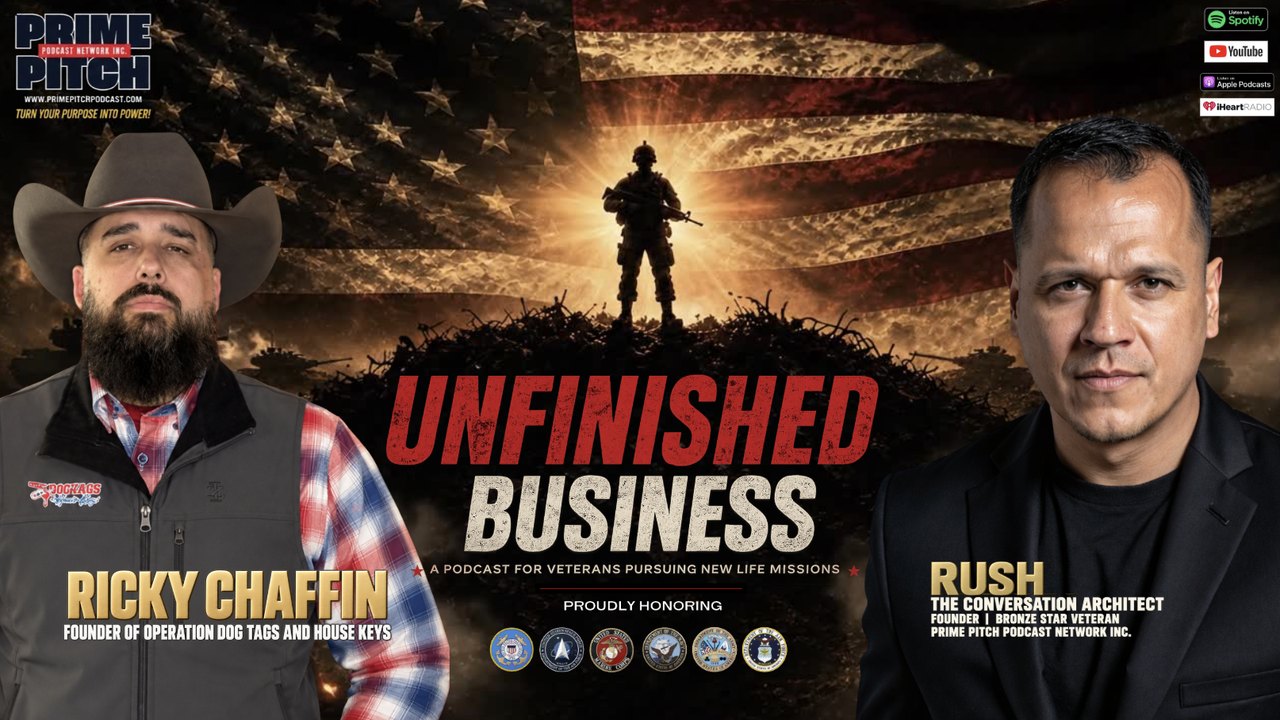
Ricky Chaffin
Founder, Operation Dog Tags and House Keys
About the show
Unfinished Business is a podcast for veterans pursuing new missions after the uniform, and for the families and communities who stand beside them. Hosted by Eric Rush, The Conversation Architect, a Bronze Star combat veteran and the founder of Prime Pitch Podcast Network.
Read the full transcript
Hey, what's up guys? Welcome to Unfinished Business, a podcast for veterans pursuing new life missions. Ricky "Tank" Chaffin Jr. grew up surrounded by adversity, carrying a family legacy of military, and a desire to one day follow in those footsteps. But the life we imagine for ourselves doesn't always become the life we're given, and perhaps one of the greatest tests of character isn't, is what we choose to do with that disappointment.
Ricky never got the opportunity to serve in uniform, but somewhere along the way, a different question emerged. If I can't serve the way I intended, what responsibility do I still have to those who did? Today, as founder of Operation Dog Tags and House Keys, he's working towards an ambitious vision of creating communities where veterans can find housing stability and the support necessary to rebuild their lives. But conviction is one thing. Turning conviction into something other people can depend on is another, and that's where this conversation becomes interesting.
What happens when faith encounters uncertainty, when personal purpose becomes public responsibility, and when the strength we've st- we've spent a lifetime developing is tested by something much bigger than ourselves? Because ultimately, the measure of a person's commitment may not be what they're willing to believe. It may be what they're willing to build. This is my conversation with founder of Operation Dog Tag and House Keys, Ricky "Tank" Chaffin Jr. Ricky, brother, it's a, it's a pleasure to have you- Yeahon Unfinished Business, a podcast for veterans pursuing new life missions.
And, you know, as I was, um, you and I have been friends for a good minute now. Yes. Maybe a year or so or something like that. Yeah. Maybe close to a year.
And I gotta say, this is really important to me 'cause, uh, you know, I wanna have-- I wanna honor the, the people that are closest to me. You know, a lot of people, we, we sometimes honor people that are f- you know, that are a little f- as 5 steps away, 5 steps- Yeah5 connections away. And, and you and have the, you and I have developed a very, uh, very, um, brother, kind of a brotherhood- Mm-hmmbrotherhood-like, um, unspoken, um, respect and admiration for each other in, in, in, in, in the short amount of time that we've had. Yeah. And it's, it was instantaneous when I met you.
It was instantaneous when I met you at the Painted Horse Association event and, um, over or, or at the, at, uh, in Fort Worth. Will Rogers. Yeah, Will Rogers. And, and us getting to talk and, and really starting to break, kinda just break the 4th wall and say- Mm-hmm"Hey, let's, let's make something really, let's make something meaningful and purposeful with, with our friendship and, and our relationship with one another."And, and so that moment I knew that something, something was gonna emerge, and I don't know. How, what, how, what did you feel like that when we, we first met?
You know, I was, I was excited. I, you know, just getting out and networking and meeting people- Yeahum, especially like-minded people. Yeah. You know, people that wanna help and serve and do better, and help the ones that did serve and do better for them. So- Absolutelyit was a, a breath of fresh air, as they say.
Yeah. Awesome. You know, and one of the things too, man, I gotta share this with you, 'cause I didn't, I, I didn't tell you this, but I might get emotional in this second, in this, in a few seconds 'cause, um, you and I were at the, uh, the, the, uh, Patriot Roundup this year. Mm-hmm. Right?
And, um, and I was hoping to see you. I was hoping to run into you, get, you know, get to see you and, and spend some time talking with you and stuff like that. And then when you came up to me, when we saw each other, when we both ran into each other, you, you reached in your pocket and you gave me a set of dog tags. Mm-hmm. Those dog tags are sitting right on that table right, right there, right in front of me.
They're always gonna be there. But, but, you know, that was a very, um, as a, as a combat veteran who, who's, who's, who's, who's transitioning into, into advocacy, into, into being part of, uh, a, a community- Sureum, to have that happen, it was very, a very powerful moment for me. And I'll tell you why, 'cause, and this isn't about me. This is just about what, what that represented. Mm-hmm.
Represented. See, I threw all my military stuff away. I threw all my dog tags. I got rid of it all. I just got, had so much animosity and- That's a lot, dude.
Yeah. Yeah, it's a lot. and so but when you, when you, when you handed it, handed those dog tags to me, they represented a, just a little bit of a, a, a, a symbol of like, this is you owning your, you know, connect- reconnecting to your service time. This is you. You can't just take the bad.
You gotta take the good, and here's the good of someone, um, created dog tags for you and, and having a willingness to accept that as a gift, and it was really a very, um, a very, uh, very kind moment. I just wanna let you know I appreciate it. Yeah, man. Yeah. I remember my wife, I went, I went home and I was like, "Dude, look what, look what Ricky gave me, man."And we just got, just got in that mo- emotional moment where it was just like, okay, man, this is part of the rehabilitation journey.
Mm-hmm. And it was very much a part of what you, what you represent too. And so I was like, "Ricky, we gotta get you on the podcast."W- I, I, I love the fact that you did that, and you took time to think about me when I wasn't thinking, when, you know, when you don't think people are thinking about you.100%. Yeah. And, and you took time, that time to think about me.
And, and let me ask you, what part, what inspired you to make, to, to, to make that, that- Start dog tag- Make that efforthouse keys? Well, just, no, just to- Or that gesture? Yeah, just that gesture, yeah. So I was going to Patriot Roundup, and then I was thinking, we, we had a gentleman from our church that got us a, him and his wife got us a dog tag machine for the nonprofit. Oh.
And the reason he did is I was telling him one day, I said, "Yeah, anytime I set up a booth anywhere, people are like, 'Y'all sell dog tags?' And we're like, 'No.'" We're obviously dog tags and house keys you would think. Yeah. And I would tell them the wh- whole story and the mission, and then we started thinking, man, that'd be a good way to raise money, as well as bless people with an inexpensive gift- Yeahthat's thoughtful. Yeah. So, um, sure enough, we were going to Patriot Roundup, and I went there early to volunteer, so set up and everything, and then I had a couple hour break, so I drove back home to Midlothian, and next thing you know, I'm sitting there and I'm like, man, I could've set up my booth there, you know?
Mm-hmm. And, uh, my wheels started turning, and I made yours 'cause I knew you were gonna be there, and then a couple other friends from Air Power, and then, yeah, I just kinda spiraled and started looking at the website and trying to make, you know- Everyone their own personal individual one. Yours I put unfinished business on, I believe. Yes, yes. So I was like, man, that'd be cool, you know, cool key chain or hang from yourWhatever it may be.
But it just kinda something that you can look at to, you know, remember what your mission is. Yeah. You know what I mean? Yeah. Yeah.
Normally people don't go out on a mission without, you know, knowing, so you know what you're doing here. Yeah. You know what I'm doing. Um, and a, and another thing with the dog tags, thinking of, of, uh, thinking of others without, you know, slowing down so you canWe've been talking about this- Mmin church this week. Slowing down.
You know, don't pass the guy that might need, you know, just to talk. Yeah. Um, when we got the dog tag machine, I'm still in the process 'cause we need help with the website. I know that's a whole bunch of stuff. I'm not a techy guy.
I build stuff. Yeah. And, um, we, um, I wanna do a page where I get with people like yourself and others that have still fighting, that have beat, whatever it may be, or the ones that have lost- YeahPTSD. So anytime we do an event, I wanna go ahead and sell one personalized one, and with each personalized one, you get a random, you know, Eric Rush. Yeah.
And then they can look at it, you know, they can look it up when they get home, but on that one, it'll have our website. They can look it up, hit the tab, and then go read your story. Oh, yeah. That's cool. So I think that's a good way to, uh, keep the ones that we lost alive.
Yeah. You know what I mean? Yeah. Like my friend Allie, she lost her brother. Hmm.
And if that were the case where someone can read and, you know, remember and read their story, that I just think it'd be a good way to give back as well as, as, as not forgetting, you know? Yeah. Man, when I shared with you what it rep- represented to me, what didwhat, what thoughts went to your mind? Uh, I didn't thinkI didn't think it was that big of a deal. Yeah.
You know what I'm saying? Yeah. Like, I didn't thinkIt's, it's, it's like, you know, I mean, the, the guy that opens your door and you can't, you know, "Oh, thanks," whatever. Yeah. And you're like, "Oh, I just opened your door."Hmm.
You know, whatever it may be. Yeah. Not like, "Oh, no, that helped."Yeah. You know? Yeah.
So- Yeahso I di- I didn't realize that at all till you told me. So that's, that's, that's pretty awesome. Yeah, dude. IDude, I'm not supposed to be the one crying. You're supposed to be.
Yeah. Yeah, yeah, yeah. I'm justYeah, yeah. Well, I'm a, I'm a big baby. I'll cry at concerts.
I just- No, no, man. Uh, no, I, I, I really think it's just really important that, you know, like this- that's how emotional it was for me. Yeah. It was just like reallyIt was very penetrating. It was like, dude, like, you know, this is part of the journey.
Like, you gotta accept everything. Yeah. Not just, you know, not just the, the, the, the benefits of going to school or, you know, not just the parts that, you know, to accept the, the, the generosity, gener- the, the, the op- the people taking that extra step to think about you. Like, really, really embrace it all, you know? And so for me, um, but also it was just like a reconnection.
I was like, "Dude, I," you know, "Dude, why did you do that?"Well, you know, it was that whole regret, that whole thing was like, "Why did you get rid of your dog tags?"Like, "Why did you," you know, "Why did you do this?"You know? But it was a reminder, like, dude, it was like always gonna come back to you. You're, you'reMy, our medals, our awards, our, our whatever we got are all in the, you know, they belongThey, they're in the Kingdom of God, you know? Mm-hmm. And so it's like, um, John Salerno from 99.9, uh, 99% Radio says, like, "Dude, you, you already know your medals.
God knows the medals you pos- Yeahpossess and you, and they're in your heart."Yeah. He, uhIt, it makes me think of, you know, doing something like that for someone. Yeah. It makes me just think, like Trace Adkins has a song called Semper Fi. Mm.
And my favorite part of that song, he says, "I sleep in my bed instead of a foxhole."Mm."And I've never heard my boss tell me to lock and load."Yeah."And there's no bullets in the side of my SUV."Mm. Ju- just to think that there's 18-year-old kids out there sleeping in the sand- Yeahgetting shot at every night while we're here griping about red lights and my phone's not working as fast and, you know, the, the, the little things. Yeah. You know, while, while these men and women are putting their necks on the line for us, so. Yeah.
Beautiful. You know, part of what I read in, at the, at the introd- at the introduction was part of your, um, your, you, you, when, your childhood as you were raised in a little bit of cer- uh, um, some of, some adversity. You grew up around drugs, violence, alcoholism. Yet you chose a different path. Um, what influenced you?
What, what influ- influenced those decisions, and who was the greatestwho, who had the greatest impact on the man you became? You knowIf you wanna touch on, like, you know- Yeah. Like- I, I was born in LA. Okay. Um, my, my father ran with some big name bikers that are, have been all over the news.
I'm not saying who, but I mean- Yeahyou know? I understand. Um, so I saw drugs and alcohol and violence as a baby, uh, you know, growing up. And then we'd be in the house while they're having parties outside. People areyou know, everything's going on.
So gr- like, people talk about that show Sons of Anarchy- Mm-hmmand I'm like, "Eh, for real."Like, I lived in it, you know- Yeahas a kid. Yeah. And, you know, my dad and my mom moved when my grandmother died in California. We moved to Minnesota first, then relocated to Texas, which my dad's from Dallas. Mm.
And going through all that, it was kinda like the, the desensitization, like when we lost Charlie Kirk. Mm. And when we lost Charlie Kirk, a lot of people, it freaked them out, but then there were a lot of people that didn't care, didn't, you know? And, and that's sad- Yeahbecause that's something that shouldn't be normalized. You know what I mean?
Yeah. So I had that desensitization already in my life. And yeah, when we moved back here about 25 years ago, my dad stopped doing drugs cold turkey. Mm. And, uh, he was just a ma- a maintenance man, and he, uh, gave his life to God.
And what he did was, um, got a, got a job, stuck with it 20-something years, retired from the Salvation Army, which is a blessing. And, um, he's a minister, and he rides with a group called Bikers for Christ. Mm. And he's the best man I've ever met in my life. Wow.
So him and my mom always put love in our heart, even though we grew up rough, seeing a lot of things. But, um, him and my mom, they, whether they were home or not, and as younger, they weren't. Like, my mom was out, my dad was out, and they weren't even together. They were just out doing their own thing. Yeah.
So, you know, you learn to make macaroni at 6 years old- Mm-hmmstuff like that. But- Yeah. But anyway, so yeah, uh, both of my parents, uh, I love them both dearly, and they both changed a whole lot. Yeah. So it's, it's awesome.
My mom, like I said, my mom's the type that'll she'll go in debt just to help you out. Mm. And that's tough to say about people nowadays. Yes. We care more about, you know, like ourselves and our shoes and our hats and our Amazon account, can't let that go- Um-than we do about even family eating.
Yeah, yeah. So I love her to death for that, and once again, my dad as well, so. So that wouldThey, they became one of the, um, um, the greatest imp- impact in, on you as a, uh, on, on the man you became. Yeah, absolutely. And then my, my dad was in the Navy, um, and before he shipped off or was supposed to go to Vietnam, he had a seizure.
Mm. So they were like, "Well, you can go, but if you have a seizure in friendly fire or whatnot, that's dishonor- I mean, that's- That's, yeahbig trouble."Yeah. So thank God he didn't go. Uh, sorry, world, but I'm here for that. Yeah.
So appreciate that. Um, and then my stepdad, which, um, when we moved to Texas, my parents were already split up. Mm. But my stepdad was in the Navy as a gunner in Vietnam, and, uh, he's, he's had some stories. But he, he had a big impact on my life too, so.
So yeah, I mean, I, I've, I've had a lot of blessings in my life that, you know, I, I don't deserve. Yeah. And I, I appreciate God for that, so. Yeah, the, especially when you think about, like, the redemption of your father, like just the, the, the turnaround that he made with, with Christ and, you know, having to walk through that. He showed hisGod, Christ showed his mercy in his life and- Mm-hmmand extending grace and mercy.
Do you see it like that? Like when you look- Yeah, without a doubt. Without a doubt, because I've done a lot of things in my life I'm not proud of. Everybody has. Yeah.
Whether they admit it out loud or not. Um, and I know he has. I've seen it. So that's, that's, uh, God's, God's mercy and God's grace is- Yeahunmatched. Um, I was gonna say, um, there's a saying that s- that goes, uh, "If I always had the parents I always wanted, I wouldn't be the man I, I am today."Mm-hmm.
I, what, what comes to your mind when I say that? Um, that's true. That's true, 'cause growing up, in high school, so before my dad stopped doing everything, um, my mom lived in Fort Worth. When we first moved here, I moved in with my aunt in Mansfield, then I made some friends. And then, um, I, I wouldn't write my story any other way in the sense that there was a time where I moved in with my grandmother, and my uncle slammed her against the wall, and I'm like 15 years old.
So I'm watching Walker, Texas Ranger. You know, I'm watching the show. I'm like, "I know karate now. I can see Chuck Norris do it," you know, whatever. Yeah.
So I go around the corner, and she's like, "Jim, get your"And I just knocked him out. Yeah. Well, when he woke up, he went and talked to my grandmother, and she kicked me out- Mmfor protecting her. And I justAnd, and, and the best thing that came out of that, I mean, I could've moved to Fort Worth with my mom. She wanted me, but I d- I had my friends in, in Mansfield.
So I didn't tell anybody but my best friend, his name's Jason Maki, he's a combat medic in the Army, and he, umI would walk to his house or I'd, I'd get to his house and I'd borrow his clothes and this and that, and then I, uh, slept at a park called Rose Park in Mansfield. Mm. And his mom heard about it and kinda took meYeah, I spent the night, a few nights at their house, and then she's like, "Do you still have a home?"You know? I didn't. So my dad at the time was apartment to apartment to apartment, doing maintenance here and there, living out of the van, apartment, and you know, doing stuff, and, um, it, there was just no stability there.
So when I moved in she, she told me like, "You know, you're home now."And every morning, th- this isI credit her big time for my giving heart. And every morning she had $5 for Jason, $5 for Jordan, $5 for JT, 'cause she worked graveyard shift. She's a sergeant on the gang task force in Fort Worth. Mm. Her name's Angie Maines.
Angie Maines. Shout out to Angie Maines. Thank you. And, um, she, uhThat first night, I spent the night again and I was there, like moved in. Um, that next morning I go to school and there's 5or 4 $5 bills for lunch.
Mm. And to me, we didn't, I mean, we didn't have $5 a week, much less $5 at$25 a week for lunch. So Jason, Jordan, and JT all took theirs and Jason handed me 5. I said, "No."But with that giving heart, anytime we went to lunch Jason would, uhLike see, I'm about to get teary-eyed. Jason and I would go to Jack in the Box for lunch and we'd each get a jumbo or a Breakfast Jack and a couple tacos.
Mm. And it was like $4 and some- He'd split his $5 with me every day until she started giving me my own. Mm. So between Jason and his mom, they, uh, I think that changed my life for the better on, you know, giving. Yeah.
So. Man, I, I, I can s- I can, I can, uh, relate to your story 'cause, you know, the, you know, I grew up in a single parent home, mom worked 3 jobs. Mm-hmm. You know? And, and but she's, you know, it was, it was the, the people outside of, outside of my home that, that were really, um, help- helping to rehabilitate me in a certain way.
As much as they could. Yeah. You know what I mean? One wanted to adopt me from my mom, so you know, like the whole, it was a whole thing. So I understand what you're talking about, man.
That's beautiful. Um, well, um, okay, so, so from that point on you, so you stayed, you stayed with, uh, An- Was it Angie? Is that- Angie. Angie. Yep.
Angie, Angie. And, and then tillAnd then when, when did you re- reconnect? Um, and then shortly, shortly after my dad had changed his life. He started, uh, he went outAnd what's funny, and this is, this is 25 years ago. Yeah.
Um, online dating was a new thing. So my dad's trying to find God, and before he found God, the funniest story I think just 'cause of changes, we'd be, we'd go to fellowship in, uh, uh, ULAS or something like that, and I'm a kid, and we'd leave the parking lot, he'd light up a joint. I'm like, "We just left church."He's like, "God put this here," so whatever, Dad. So anyway, he finally stops and he had a, he had a date with my stepmom, and he walks in after a shower and lights a cigarette, and all that stuff just grossed me out, obviously again growing up around it. And, uh, he goes, "Tank, these things stink."And I was like, "I've been telling you that my whole life, Dad."I'm likeSo he put it out and never touched weed or cigarettes again.
Mm. Cold turkey. God, God did that. Yeah. And I used to tell people, "Well, it's, it's because, uh, you know, he met my stepmom," and never let her go.
Yeah. So they met, went celibate, 4 months later got married, and then just his life took off. Wow. We're gonna have to get you down on the podcast too, man. For real.
I mean, um, um, youOkay, now you mentioned, uh, you know, uh, nickname Tank. Mm-hmm. HowUh, talk to me about that. So when I was a baby they, uhI never like going around anything. I like to just hit it- Yeahstraight on and, and some people have called me aggressive in life.
Some people call me confrontational. I just-- Let's, let's duke it out or, you know, let's figure it out, right? Yeah. So as a baby, I'd crawl, and then when I started walking, but I would never, like, give up. So my dad's example is he's like, "Yeah, we put a baby gate up so he couldn't get in one room."So I kicked it, you know- Yeahkicked it over and got through.
And then he says, "Well, we put one on the inside so he couldn't kick it."Well, I pulled it. And then, um, they had one on both sides up the stairs, and I pulled one, kicked the other one, fell down the stairs. Wow. And so they kept calling me Tank. And then when I realized, you know, learning to talk and everything, I was-- I don't know how young I was, but I cried 'cause I didn't wanna be a fish tank.
Hmm. I was very upset about it. And then they showed me the movie Kelly's Heroes. I don't know if you ever saw that. Yeah.
It's a good old movie. And then the movie Tank with a Sherman tank, and I was like, "I like that one.""Yeah, that's cool."So, so that's where the name came from. I, I'm a-- I don't like going around anything or beating around the bush. I just- Yeah, yeah. You're straightforward, man, and that's the way tanks are, you know?
They-- Sometimes they don't have, they don't have personalities. They're just made out of like, hey, raw steel, you know? Mm-hmm. Yeah. Um, you know, and that's what I was gonna talk to you about is, like, toughness was part of your upbringing, but, uh, so, uh, but so was your family's military heritage, right?
Mm-hmm. Um, what did that legacy mean to you, and how did, how did you deal with the realization you wouldn't be able to follow that, in that part, that path? So not knowing this until, you know, some years ago, I was-- I found out we're related to Patton. Mm-hmm. And as well as General Mercer.
Um, General Mercer fought with Washington. There's a, there's a big painting, um, at Princeton University, and it's an original, and it's, uh, Mercer's down on the ground being attacked, his horse behind him, and it was called The Fall of Mercer. Hmm. And when Washington heard that he-- that was happening, they rushed over to save his life. He had died a few weeks later from internal bleeding, but, um, we found out we're related to him.
So that, that was a cool thing. My dad's side of the family are Hatfields, Hatfield-McCoys. So there was a military heritage there from obviously before any of us were born. But between my dad, my aunts, my uncles, my cousins, my wife's father, he's Master Gunnery Sergeant Retired Marine Corps. Um, he's an amazing man.
Um, and then my brother-in-law, he's Staff Sergeant Kevin Valdez. Uh, they're at JRB in Fort Worth, and, uh, I love him to death. He's like one of the brothers I always wanted, you know? Yeah. And in 2014, I was in the process of talking to the recruiter, Marine recruiter, and at this time I'd already been out of school for, you know, years.
You know, I was 25, 26. And I'm talking to him. I'm working at the bar. And the reason I didn't sign up right away, 'cause I was like, "I'm making good money bartending."You know what I mean? You just gotta have personality.
You, you can make someone a Vodka Sprite when they want a Crown and Coke, and if they like it, they don't care. They'll drink it. You know what I mean? Yeah, yeah. So I finally got up the nerve, went to talk to the recruiter.
Um, they told me to do the practice ASVAB on the Army website because Marine Corps didn't have it. So sure enough, I did it, and they said, "Don't put your real information 'cause they'll kick your door in and wanna talk to you."So I put my brother, which is Jason Malka, the guy that his, him and his mom took me in, I put his information on it, and then he had told me at 1 point, he's like, "The Army just keeps calling me for some reason."I don't know what he's talking about. Now he's a combat medic. Yeah. He's, he was stationed in Germany.
Now he's been all over the world already. And, um, so I'm in the process of talking to the recruiter, and then there was a Saturday I took my Harley out, uh, me and a friend, and her and I worked together, and we're driving down 20, get in a wreck. So that's how big scar on my face started to, you know, all sorts of stuff. Well, I couldn't go back to the recruiter right away and be like, "Eh, I just messed up my body."Um, I flatlined twice. My heart stopped twice for over 30 seconds.
Hmm. Wow. The crazy part is, is Matt Mapes, which is Angie's husband, he would be like my stepdad, um, he was the detective of fatality accidents, and he got called to our accident. Oh, wow. And I, I'm here.
Yeah. You know what I mean? Yeah. So, um, weeks went by. The recruiter's calling me.
Finally I go back in, and he says, "Well, what, you know, what happened?"I said, "I got in a little fender bender."I didn't tell him. I didn't show him the pictures of my actual skull that I had- Hmmcut open. And so I guess he had looked up my records, public records from JPS, and I twisted my spine, and I'm not supposed to lift 50 pounds, which I'm done. I mean, I work construction. That's all I do.
And so he just kind of blacklisted me. Hmm. And at this time, I don't think they really needed many people at the time, 2014, 2015. They didn't need-- You know, they weren't chasing people. Yeah.
So that kinda just broke me down. And when that happened, I just grew a love for red, white, and blue. I mean, a ridiculous love for red, white, and blue. I started going to any kind of military fundraiser, any ki- just anything. And it, it just really grew a patriotism inside of me because there was finally something that I knew I wanted to do- Yeahand I couldn't do it.
Hmm. So God's got me here for a different reason. Yeah. And, uh, I'm excited. Man, that's awesome.
We're gonna talk a little bit about that. Um, um, so when you look back at that experience, what, if anything, changed, uh, changed, what changed for you? Um, so before my wreck I was like bartender. Uh, I used to be pretty, I tell people. You know what I mean?
Now I gotta be funny. So, um, but I was a guy that was partying and drinking and going out. And I, I mean, I cared about other people- Yeahbut I wasn't going out of my way to care for other people. Um, going to the bars, drinking, driving, on the Harley, you know, all sorts of stuff. So after that wreck, besides stopping drinking for the most part, I'll, I'll have a drink here and there, but I don't, not like I used to.
Yeah. And I just, it just changed my whole perspective on life, and I appreciated life. Yeah. Before I didn't really care. Mm-hmm.
I was like, "I'll go when I go."You know? And, um, it, it just made me start appreciating life and, and all the years prior to that while my dad found God, I was like, "Oh, I know there's a God. He changed my dad. If you knew my dad before, you wouldn't believe it."So I knew there was a God, but I never really, you know, tried to pursue him. Yeah.
Um, but yeah, it, it changed me in a l- in a lot of ways from partying, drinking. Um, and I also went from the bartender that, like, had a Harley, and I'd have an apartment here and there, and I'd waste my money. I'd spend 300 bucks one night, and "I'll make it up tomorrow."You know? And then after that I stopped doing all that, kind of started saving up my money and, and purchasing things I like, like motorcycles and guns and, you know, all that stuff. So- Yeahit just kinda changed my whole outlook on everything.
Yeah. Um, do you think if you hadn't had m- you, do you think if you hadn't had the motorcycle accident you'd be in the Marine Corps right now? Yes. Yeah. Mm-hmm.
When you think about when you, um, um, when you th- um, supporting veterans, uh, eventually became something you, you talked about right now that you really, you grew a passion for. Can you take me back to where that, that commitment began? Like, when did you say, "Okay, this is it," like, "I'm gonna, I'm gonna start," like? So besides working, um, at the bars since I was- Yeah18 years old, um, I always-- I worked with my uncle, which was ex-Navy, and, um, he was a framer, so he kinda brought me into the construction world. My dad being a maintenance man, I kinda learned how to do make-readies and this and that.
So between them 2 I just kinda got in that industry. So the, the recent, you know, 15 years of my life I would work construction all day, and then I'd bartend at night. So I'd sleep 2, 3 hours a night, and now I'm trained to sleep 2, 3 hours a night, and it's, it's tough 'cause I don't get enough sleep. But, um, so back then doing construction I'd watch them shows when, uh, like, Extreme Home Makeover came out. Mm-hmm.
And I'm sitting there, and one day I'm watching, I mean, this is probably 20 years ago, and I'm watching it, and I just thought to myself, "Why don't they have a show only for veterans, helping veterans?"You know what I mean? Mm-hmm. Because I thought about it. I said, "Man, they could do a show like that, talk to the owner, but instead of just saying, 'Oh, what do you wanna do with the house?' find out if they have any, like, handicaps or whatnot, and, um, learn their story, and it's, it's gonna shine a light on our veteran community."Yeah. It's gonna, you know, like, I know it's not as bad as it was in Vietnam from what I've heard when the soldiers come back, like my stepdad being spit on and, you know, all that stuff.
Yeah. So I'm glad we do live in a time where we do appreciate our veterans more than we did, but we don't appreciate them enough. Hmm. So I thought the TV show, and then back then I was like, "Man, we could call it Dog Tags and House Keys."Hmm. That's 20 years ago I thought of this name.
Wow. And I was like, "Man, I, I wanna, I'm gonna do a show called Dog Tags and House Keys, and we're just gonna help veterans."And somewhere along the line, I just kinda got distracted with money again and, and then my wreck and all that stuff, and then two and a half years ago I got married to one of my best friends. Um, well she is my best friend. But we had met at Boomerjacks working there before my wreck. Hmm.
And, um, she never gave me the time of day there, which of course I was young, out flirting with everybody, you know, single guy, whatever. And, um, next thing you know, we get married and before we got married, I built a tiny home out of a shipping container, and everyone praised it. They loved-- It was very nice. And not to toot my own horn, but it, the quality, the, the, uh, it was just phenomenal. It's, itSo I'm sitting there and I'm like, man, we could sell these.
And then as I'm thinking that, I, I-- When I built it, I was like, I want you to wake up in a shipping container and feel like you're in a million dollar home. So that's the way I designed it all. And I was talking about selling them and my friend Ray that funded it, Ray Hodge, he's a great man. We were gonna sell them and then at that time the market, you know, people couldn't get loans or if they could, the interest wouldn't warrant it. This was a few years ago.
I mean, stuff wasI mean, even now, home loans are ridiculous. Yeah. But so I get married and, you know, when you get married, everyone's there and they're all nice. They're saying nice things about you, whether they're true or not. And I started believing it.
I was like, man, maybe I'm a good dude. You know what I mean? Like, I'm all right. So we get married. A few months after we get married, um, I applied for Operation Dog Tags and House Keys.
I hit up my friend Nick, my friend Brian, asked them if they wanted to go on this journey with me, and they said absolutely. So we kinda all split the cost, filed with the lawyer to get our 501 [c] [3]. Now, when I talked to the lawyer, he says to be accepted and formed, it could take up to 3 months. He says, "And after that, you have to get your tax exemption, and that could take up to like 13 months," or something crazy. And I was like, "Oh, man, this ain't never gonna happen."Well, that was a Thursday.7 days later, I go into work and I stop working at the bar that day.
And I get home and I'm down on myself and, you know, the bar I, I'd already been feeling for a year or 2 that, man, what? Bad stories. You know? Bartending, you're a therapist at a bar. Yeah.
So cheating and infidelity and violence and drugs and DWI, just, just nothing positive. Yeah. Um, so I get home and my wife says, "Don't worry, babe. Like, God's got a plan."And, and so that week later, that Thursday morning was the first time I walked into Stonegate Church for men's group. I go to Stonegate in Midlothian, and Brandon Kurin runs this men's group every Thursday morning.
I was there this, this morning actually, 6:00. And, um, it's just a group of, of men that get together and talk and how we talk and what we wouldn't talk about in front of our wives or our girlfriend. You know, just, it's, it's different. So I did that, walked in to the bar, left the bar that day, was kinda upset, and my wife said, "Don't worry. God knows what He's doing."So when she said that, I was just kinda like.
I go check the mail 7 days later, we had our formation paperwork. Hmm. And my lawyer was like, "You're full of crap."And I was like, "No, sir."So I sent him a picture. He called on it the next day and he goes, "I've never seen it that fast."He said, "That's incredible."I was like, "You know what I mean?"Yeah. Like, the man upstairs.
Yeah. So then he told me, well, the tax exemption's gonna take, well, 7 weeks. Hmm. We got tax exempt for a 501 [c] [3] charity. Blown away.
And I've never, I haven't left that men's group yet. It's been two and a half years. I'm there every Thursday. Hmm. And what I've learned about that, I don't have the experience that you or a lot of, you know, veterans have.
But I do know, and I learned this through community group and that camaraderie in the church men's group. I do know that just like we feel more comfortable talking in that group, I compare it to how a veteran, I don't care if he was a computer guy or if he was, you know, boots on the ground. When y'all get around each other, it's just different. You can talk, you can, you know, be together, you can tell your stories and you feel comfortable, you know, 'cause it's people that understand. Yeah.
So that's really been a, a big thing, um, which I credit, you know, my church and that group, and then it helped me learn about what a, you know, a lot of veterans go through. So, so anyway, we started the nonprofit, you know? Yeah. And, and that was it. And it was a godsend.
Our first event we ever went to was, uh, Traffic 911. It was a, uh, or it is a nonprofit that kinda like, uh, what's that? Freedom, Silence? I can't think of that movie. But anyway, um- Sound of Free- Oh, yeah.
Sound of Freedom, yeah. So it's like that. So we got invited to that and it was, they said, "Oh, yeah, just dress comfy, you know, casual."So me and Nick wore our cowboy hats, our boots, you know, vests, and everyone's got suits on. I'm like, "Oh, we stick out like a sore thumb."Yeah. Well, next thing you know We're just there to learn.
You know what I mean? We don't want their money. We just wanna learn. Uh, and sure enough, we'reEveryone wants to talk to us 'cause we're the only 2 with cowboy hats, so they're like, "Who's this guy?"You know? So it helped.
Yeah. It, it really did help, and met a lot of good people. There's a guy named Brandon O'Neil, works for Fidelity Charitable, and before we knew that, he had told us, he goesHe asked what we're doing, and we told him, and he says, "Well, I'm the vice president of one of the largest foundations that no one knows about, and it's Fidelity Charitable."And I was like, "Cool."So he signed us up with an account, and then our second event we ever went to besides that was, um, the inauguration. We got invited by, uh, Heather Smith out of South Carolina, and she's a lobbyist for, uh, Lieutenant Governor Pam Everett of South Carolina, Palmetto State. And they invited me and Nick, and we weren't gonna go 'cause I just left a job.
All my money went in the nonprofit the week before I, I left the job. So Men's Wearhouse donated suits, and I called Ted Cruz's office and asked if we can wear boots and cowboy hats. I, I don't know. I don't dress up. Like, this, this is me dressing up right here.
You know what I mean? Like, I don't- YeahI'm T-shirts and jeans, you know? And they said, "We encourage it."And I was like, "Pff."So I said, "Okay, cool."Then Brandon O'Neil from Fidelity reached out and sent us a $500 grant check to help us with gas. Wow. So we loaded up my truck.
You've seen my truck. Support Our Troops all over the side. We, we sped the whole way. Didn't get pulled over one time 'cause the truck, you know, it's, it's aI'm, I'm saying that now. Now I'll probably get pulled over.
But, um, so we went up there and it was a great experience. We weren't gonna go, but everyone we talked to said we'd be an idiot if we didn't. People dream, no matter if you voted for the person or not, people dream of going to that event. Yeah. So it, it was a blessing.
Yeah. It was a blessing. It's good networking. That's awesome. What's the name of your nonprofit?
It's Operation Dog Tags and House Keys. Okay. So that's the name of it. Okay. Yeah, with Operation.
Now, we call it Dog Tags and House Keys just for, you know, short. The website's dogtagsandhousekeys. com. Gotcha. But theThat's our operation.
Oh. It's creating dog tags and house keys, so that's what the 501 [c] [3] 's under. Gotcha. Okay. Okay.
That'sMan, that's so cool, like, just things align the right way, you know? It's like God's gonna likeDo you feel, do you feel like God says, you know, likeIt's like you g- you, you have this dream and you, and, and you talk about it and you share it with your, you shared it with Brian and, and Nick, right? Is that- Mm-hmmBrian and Nick and, and, and you're sitting there, you know, sharing this, this opportunity. God says, "Okay, I'm listening."And then He makes the universe just start making a move in that direction. Absolutely.
And then, 'cause you, you were one, you were, you were oneYou know, you had stopped working, right? Mm-hmm. And you're sitting there going like, "Oh sh"You know? Is thatWhat did you, what'd you learn about faith in those moments when you were like, you knowYou know what I'm saying? Like- Yeah'cause you're like a, you're like you're trying to turn the corner from this- Mm-hmmfrom being in the, like, the bar scene and the whole, all the, all the things that come with, um, um, being a bartender and all that stuff.
But you're, you're turning the corner. You're saying, "I wanna do this," and, and, you know, what did, what'd you learn about faith? You know, my wife around that time startedI, I was always like, "Well, I have to do this. I have to do this."You know? You, you, without thinking, you tell yourself, "Oh, I have to go to work," or, "I have to get up," or, "I have to use the bathroom," or, "I have to-" Mm"change," whatever it may be.
Yeah. And I said, "Oh, I have to do something" one time around that time. And besides God showing me all them signs about the be informed, tax exempt, just everything, um, besides that, my wife told me one day, she goes, "No, you get to."Mm. And then II'm not a preacher, but I preach on that. I, I, I take that to heart to where- MmI still say I have to all the time.
Yeah, yeah. yeah. But I'm changing, and if you change your mind to a I get to mindset- MmI, I don't think there's anything you can't do because if you realizeAnd gratitude's a big thing. Yeah. And, and that's another reason I started the nonprofit is to show gratitude to our veterans.
Mm. Um, but the thing is, is if, if you get to do stuff, you get to do this podcast. Yeah. And you know how many people, you know, you, you could be driving a car down the street in the summer with no AC and being like, "Man, I just wish I had an air conditioner."And then you see someone waiting at the bus stop, and they're probably saying, "Man, I just wish I had a car. I don't care if it's an air conditioner."Yeah.
Then the guy walking onto the bus complaining about that might be someone in a wheelchair seeing it, and like, "Man, I wish my legs worked."Mm. So you get to do these things. Yeah. You get to go grocery shopping. Yeah.
You get to splurge. You get to spend money on stuff you don't need, which, I mean, is a big problem we have in this world anyway, but I get to do all these things because God. Yeah. And And your obedience, do you think obedience plays a, a, um, a major- Yeahrole in that too? Yeah, and, and, and I'm not perfect.
Yeah. Nobody is. Yeah. Nobody is. I don't, you know.
But, um, I think staying true, me and my wife, besides her putting you get to in my heart, her and I walk every day for, it could be a mile, it could be 3 miles through the neighborhoods, and we don't take our phones. Hmm. And I'm telling you right now, about a year ago, we didn't walk for like a week or 2. Oh. I got busy doing the nonprofit stuff on the computer to where I'm working and I'm falling asleep sitting up at like 7:00 PM, you know, on the couch.
And we didn't walk that week, and we wereShe was on the edge with me. And her and I never fight, still to this day. We've been friends 14 years, 13 years, never fight. And we got real edgy, and then I was like, "I wanna try something."So that next day we went on a walk again, and it's just when we go on those walks without our phones and technology, and we're walking and someone drives by and waves, "Oh, thank you, God. They were nice."You know?
And, and so we try to go on a walk every day with no phones. Hmm. And the reason is it's like a gratitude walk, and it's just our way to thank God, and we thank Him for the blue skies and the good weather and the legs to walk and so on and so forth. Yeah. And that has helped immensely.
Now, now we throw a football. She can throw a football like 2 houses away. I mean, she can throw. And catch. So now we're doing the same thing walking, but we're just being a little more active with it now.
I mean, it's fun. So yeah, I think obedience to God, um, like I said, I, I do shy away. Yeah. You know?1, one of them old like Tupac songs comes on and I'm like, "Yeah."You know? And then I'm like, "Wait, I don't need to listen to this."You know what I mean?
Get that- It, it all-habit self. The habit self comes right in. Yeah. It's hard not to, so. Yeah, yeah.
I feel that. But yeah, that's, that's cool, man. You know, like submission and submitting yourself, 'cause that, that's a big part. Obedience, submission, whatever you wanna call it. It's just like just letting yourself go into that, in that space and saying to, you know, like, "This is where GodThis is where I'm at.
This is where I'm the happiest."Mm-hmm. You feel that? Absolutely. Yeah, it's- Absolutely. Yeah, IYou know how people say, "Oh man, I, I don't know what I ever did without my wife."Mm.
You know, I don't knowWorking in nightclubs, big-time nightclubs-and, and being the bartender that did flair and threw glasses behind my back and all this random stuff or, or tried to. And you know, I've built a name for myself in the industry- Yeahwhere I guest bartended all over. Yeah. And it justThinking about all that, I'm like, "I don't know how I did that."Yeah. You know what I mean?
So- Yeahso now, I mean, obviously I don't know what I would do without my wife. Yeah. I really don't. But I really don't know what I'd do without God. Mm.
I, I mean, I do, but I don't. Like, there, thereThe thing is, is I know what I did without God- Mmand I dang sure don't wanna go back to that. Yeah. But if I didn't have Him now, I don't know what I'd do, but I'd feel like I'd go back to the stuff I- Yeah. You know?
Interesting. Man, that is so strong, dude. I was thinking about it. I was like, "I shouldI need to get some cards," and be like, "That's, that's the, that's the soundbite card," or whatever. You know?'Cause there's some epic soundbites, dude.
Like, you know, I'm just sitting here going, yeah, that's, that isThat's, that's what's up, man. I can't tell you, man, like sitting here so many times when I have men, like, you know, tough, tough SOBs, you know, like you're sitting here hard that have, you knowI had a knife stalker on here, uh, you know, the, uh, 1, a, a few, a few, a couple months ago, you know, sharing his story, and man, the one thing that every, that always comes out is the wife. Like- Yeahthe wife and how, how influential a, um, a wife is. You know? Absolutely.
And, you know, I, I, as I hear, it'sYouI get, I get lessons in this process too. It's like, dude, be a better husband. Be a betterBe, be a stronger husband, be a more committed husband. You know, like, the, these lessons that we're sharing right now are not just for, for the audience, but I'm sitting here like absorbing it too. It's like- I'm gonna go on a walk with my wife with no phone.
Yeah, yeah. No, that's what's up. That's what it's about. You know, it's likeBut, but to sit here, I think the point is, is I'm seeing that these men that I've had in this, in th- that chair right there- Mm-hmmhave always mentioned their wives in, in some way in the, in theand how the wife played an intricate, integral role of, of keeping them, you know, keeping them in, inJust, just helping to, to stabilize and, and, and, and, and nurture the relationship with Christ and, and nurture their passion and their vision and, and that's the, that's the other part is that the, you know, this night stalker said, he's like, "Man, when my wife went on a walk with the dog," this is the same, kind of the same way. It was just a walk with our dog, and he was like, he, he had this whole passion about he, he had wa- he wanted to be a night stalker this whole time, and he had seen the movie, um, um, uh, Night- uh, was it Night Hawk Down or, uh- Black Hawk Down.
Black Hawk Down. Yeah, he saw Black- Night Hawk Down. Bla- Black Hawk Down, and he said, and then he went on that walk with his wife. He said-- And she's like, he's like, "Honey, there's this opportunity," but he'd been gone for so many deployments already, and, and she said, she turned around and told him like, "If you don't take this moment, if you don't seize the moment, you're gonna regret it for the rest of your life."And man, when he shared that, he like got emotional. You, I, you have to, I'll send you that podcast, man, 'cause- YeahI mean, I mean, you listen to him talk about how in, how, how that one moment he became a night stalker because that one walk with his, with his wife, and it became one of his most, the most beautiful experiences of his life, um, becoming to, to, to- Mmto be, you know, in the 160th and, and, and, and, and be at that level of, of, you know, special operations, you know?
So, so when I sit here, that, that's, that is one of the most, um, meaningful things that I, um, I get to experience to sit with gentlemen like yourself and you and, and all the other guys that have sat there. So, so I just wanna, I just wanna lift, you know, how important. I think it's a great example too that, you know, like we're not, we're not blind to those, you know, as, as men, y- you know, we're not blind to the, especially if you're a Christian, like you're, we're not blind to the blessings that the wife brings to our, our lives. Mm-hmm. And, you know, and, and that's the other thing I get to see is to see, y- you know, to see that happening, to see it manifested, you know, going, "Okay, dude, you're not blind.
You know, and so does he, and so does he, and so does he, and so does he."But you grew up, some of us grew up like we did in, in, in a place where it wasn't the healthiest experience with parents, you know? It wasn't the healthiest relation. We didn't have that shining example. God, but God, God interceded in our life and said, "Hey, we're gonna bu- we're gonna, we're gonna put this blessing."Yeah, you know, that, that kind of makes me think of like, uh, you know, Victor Marx's- Yesthat makes me think of his story with his wife- Mmum, DJ Shipley. Mm.
DJ Shipley, um, his wife, her ex-husband was Deets from The Lone Survivor that, that died in The Lone Survivor with Marcus Luttrell. So DJ Shipley's story about his wife is wonderful, but he's, you know- Mmhe's spec ops and he just, he's a bad dude, but he came home from a deployment, and his wife had like just raided all his social media and saw all the stuff that he was in the wrong, and, and he was ready to end his life, and he was out there about to do it. Next thing you know, his wife pulls up, slams on her brakes, starts yelling, "Y- You're gonna do this to me? Like what I already went through?"And, and man, the, the, the power of a, a good woman- Yeah. Yeahand God.
Yes, and to recognize it too. Mm. You know, that God, that's God working through you and in you, all around you and everything, man. Absolutely. Um, one of the things you, you, um, one of the things is your, you have a vision, The Barracks, is, uh, your vision for The Barracks.
Talk to me about The Barracks. What is that? What- Okay, so The Barracks is, is we're trying to find some land right now. We're looking for a few acres down in Ellis County just for a proof of concept. Yeah.
Um, but The Barracks is designed as a, about 120 acres, um, with 3 building phases on it. Phase one's gonna be The Ribbon. Mm. So The Ribbon is, uh, you know, a pad site which has 4 shipping containers shaped in a square with gaps between them all, you know, with a courtyard in the middle, and it's just gonna be a one-bedroom tiny home, like I built out of shipping containers. So if I come out to Grill A Burger and you come out to Grill A Burger, well, we might make a friend.
Yeah. You know what I mean? And instead of just staying in our bubble, that's what we need. Yeah. You know?
I, I tell people all the time, you know, we, we have an issue and a problem, and the problem is drugs, alcohol, you know, violence, prostitution, gambling, whatever it may be. we have an issue and a problem, and the problem is drugs, alcohol, you know, violence, prostitution, gambling, whatever it may be. Um, and the issue is a transition. So like the VA housed, you know, they said, who knows their actual numbers, but they said 51,000 veterans last year. We still got over 30-some thousand veterans homeless right now.
Yeah. So you're housing a homeless veteran, although helping them live and eat another day is not fixing the issue or solving the problem. It's, it's just kind of putting a Band-Aid on and then when they run out of room, they rip it off, say, "All right, go figure it out now."So my goal is to, um, help with the transition. I call it a tactical, um, transition to civilian living. Hmm.
But so the ribbon is gonna be that, and then the first pad site, alpha one, 2, 3, 4, you know, just for the wordage, and all those pad sites are gonna shape a big ribbon, and then over the whole thing, kind of like a car dealership carport above it so air can still get through, it's gonna have a big carport over the whole thing. Hmm. So there's no excuse. They can go out and grill a burger, you know, pouring down rain if they want. And, um, the whole roof's gonna be painted yellow, so when you're 20,000 feet in the air, you see a Support Our Troops ribbon.
Hmm. So that's where the architectural design on that and then that camaraderie. Yeah. And then phase 2 is called, um, Fort Faith, which is women only. Hmm.
Um, learning from my best friend's mom that was a police officer, my cousin that was special intelligence in the Army, she's a little bitty thing, certain friends I have that women go through a lot. Yeah. You know? And, and we kind of think, oh, just shrug it off, whatever. You're, you're in the military.
Shut up. Quit crying about it. You're in the police force. Um, but they go through a lot. So my goal on that is they're still gonna be tiny homes across from each other, but that whole area is gonna be shaped in a cross, and with courtyards in the middle and all that stuff, and women-only staff that no men.
You'll, you'll be able to be at your house and not have to worry whether you got some post-traumatic stuff going on because what happened, um, what's that general's daughter or whatever it was where that girl was doing all that stuff with the guys. Oh. Something like that. Yeah. So they don't have to worry about that, and it's, it's just, I, I call it, uh, restoring faith in the lioness.
Hmm. And, and then phase 3 is gonna be the garrison. So that'll be, uh, families that aren't like single men or women coming home needing a place. That'll be, you know, families with kids and whatnot, and they're gonna be on 3 corners of the property to where you can't walk, climb, fenced off. You can't get to the other side.'Cause we don't need the ribbon around a bunch of kids.
Yeah. You know? We don't need the ribbon around women only that are trying to heal. So ideally, 3 different areas and then right smack in the middle is where we're gonna run a Liberty Land Academy out of. Wow.
So Liberty Land Academy is one of 3 academies, uh, I designed, and it's basically living off the land, teaching people to, like my dad does bee farms now. Oh, wow. So, uh, teaching people to farm, you know, cattle, horses, chickens, dogs, because I don't care how big you are, you see a cute little dog, you go, "Awe."It's a, you know? Yeah. It's therapy.
Yeah. So I might walk into, you know, a master chief, you know, check on him, some master chief that's living in the ribbon, and he's not used to no one telling him what to do, and now he's like, "No one can tell me what to do," so he might just wanna sit in his house all day and not work, not get out, not get any sun, and just, you know, "Hey, Master Chief, I need some help with the horses."And then ideally tell them, because a lot of veterans rely on people relying on them. Hmm. So if you get out and no one's relying on you, well, you're not even gonna rely on yourself then. You know what I mean?
Yeah. So if I can go and say, "Hey, I need your help with the horses or the cattle or whatever it may be."Yeah. That might get them out of that shell. You know what I mean? Yeah.
So that's, that's, um, that's Liberty Land Academy, and then we have TSC, which is Tactical Skills Command, and then that's the one I'd probably be, like, really active in, um, because it's framing, electrical, plumbing, building. Hmm. So while we're even building the other phases, we'll take some b- that don't know what they wanna do, some veterans. We'll find something for everybody to do. Yeah.
Um, so we'll teach them trades. I, I have a Rolodex, if people even know what a Rolodex is anymore. Um, but I have a Rolodex of companies that are ready to help once we break ground and start building. Hmm. Um, master plumbers, master electricians that wanna take veterans under their wings.
So when they get out, they don't know what to do. Well, you know, just help us build for now. We can pay you. Figure s- you know, we'll figure something out. Yeah.
And, um, so that's Tactical Skills Command. And then the third academy is called, um, DD247. Play on words, right? Yeah. Yeah.
DD214. Um, DD214 being discharge paperwork. DD247 stands forWell, I'll just give you a backstory real quick. Ever since Katrina, me and Jason, before he went to the Army- Went and did search and rescue and helped down in Katrina. Mm.
Um, when Harvey hit, I went down there, Hill Country. I was down there 3 weeks last year- Mmfor the floods, and it, it, it was tough. But I'm just like, man, there's so much that can be done that, uh, people need help. Yeah. So DD247 stands for Delta, which is arguably the best, you know, best in the world disaster, so Delta Disaster 24 hours a day, 7 days a week.
Mm. And that's just gonna be an academy and kind of aI mean, obviously not a everyday thing, but, you know, God-given, if we, we get the funds and everything to do training and all that through grants or whatever it may be, um, we're just gonna have a standby. Like, when we went to Louis- or, uh, Louisiana after Katrina- Mmthere was a Cajun Navy down there, which is kinda like a independent company. It's, it's not, you know, Blue Cross Blue Shield or FEMA or anything. But they called on the Cajun Navy to help.
Well, when I was down in Hill Country, they needed divers. They, they were calling, I mean, on their websites, combat medics, any medics, you know. So in my head I just started, my wheels were turning and I was like, "I'm gonna compile a group of men and women that are the best of the best, that, that the, the US government's paid millions of dollars to train."And what better team to have than, you know, actual military, you know, Navy divers or, you know, combat medics- Yeahor, you know, special forces, you know, security teams. And, and they need all that stuff. Yeah.
So why not, you know, why not the government call on DD247? Yeah. Stand ready, be ready. That's amazing, man. Um, building something like that is, is pretty, of that magnitude, is pretty, pretty big, right?
Mm-hmm. Where does that proj- where does the Barracks project stand today, and, uh, what, what, what's been the biggest obstacle, obstacle, and what, what ex- what has that experience about, what has that experience taught you about leadership? TheCouple things. Well, we're, we just hit our 2year mark a few weeks ago, and you can't apply for any grants until you hit 2 years. Mm.
Um, now where it stand, we're just looking for some land. Um, I've had, I can't tell you how many people, "Oh, we'll donate you, you know, 5 acres or something down there," and never hear from them again. Yeah. You know? Um, I met with Jake Ellzey when Jake Ellzey was congressman.
He was a, a Navy, I believe Navy fighter pilot. Mm-hmm. And I met with him. He's the first big name I ever met with. And I told him the whole thing, what we wanted to do, 'cause he's in our district in Ellis County, and then he said, at 1 point he says, "So you're gonna charge them rent?"And I told him, I said, "Yeah."And he looked kind of offended.
But we're not a homeless shelter. Yeah. We'll, through time we'll, we'll be taking in everybody, but we're, we're trying to help, not just give you a roof. Yeah. So I told him, the lady that was with him, she goes, "Well, you gotta teach a man to fish."And I was like, "Oh, thanks."I got frozen for a second.
And then I told him, I said, "Yeah, look, we want these veterans to get out and we wanna help them with their new chapter, and if they wanna go home and play video games and watch movies and start doing drugs and get in their heads and do all that, they can do that at their mom's house. They can't do it here. Like, w- that's not what we're doing."Yeah. So he kinda was irritated in a sense, but I didn't know what to say. Yeah.
And at the end of the meeting he says, "Well, what do you want from me?"Now, knowing what I know now, I should've said, "Well, I want some help with some grants.""Or I want some, I want some, uh"Let's get it. Um, "Or I want some, uh, you know, some money or some land or, you know-" Yeahwhatever it may be. But I didn't know what to say, and I told him, I said, "I just wanted you to know who we were."Yeah. I shook his hand and walked out, and I was like, "God, I should've asked for something."But it deemed to be good. Um, and what I've learned, my biggest thing is I'm a blue collar guy.
I, I'll build cabinets, put flooring in your house, countertops. You know, I'll remodel your house for you. And then say, "Hey, you owe me money."Yeah."Pay up."What I don't know how to do is ask people for money. Hmm. I don't know how to go out and, you know, ask for people's hard-earned money to help somebody else.
Yeah. I just, I justIt's not in my blood. Yeah. And I thank God, another thing, my buddy Steven from church, he, uh, he invited me to his, h- me and my wife to his small group. And he's like, "Yeah, Bill's, you knowThere's a guy named Bill Mulcabe.
And he's, he's, uh, works with Salvation Army. He's been there for a lot of years, big name."And, um, he, uh, he says, "Well, he'd be a good mentor. Salvation Army. Raise the money for Salvation Army."And he has. Now, it's, it's been 2 years and I still haven't asked him for anything.
I don't know if I ever will. Yeah. But I'm just trying to soak his energy up. Yeah. And the crazy thing is, is I know right now if it aligned, he could go out and ask a couple people, and we, we need 21 million is what our, you know, we have on our spreadsheet to do everything from beginning to end to build everything out to house over 200 veterans.
That's huge. Yeah. That's cheap. I mean, essentially. It doesn't sound cheap, but for, for a community that's just gonna stay and people have a 2year lease, you know, and then- Yeahmove on to whatever it may be.
Everyone we wanna work with, we wanna help them build businesses, get their homes. Come to us with your dog tags. We plan and pray that you're gonna move on with some house keys. Yeah. So I know there's certain people in my life that could go out and ask some people they know, and it, it would just, itI'm not saying fix everything, but it would, we'd be able to start building.
We'd be able to break ground. But I haven't got to where I can ask people yet. I mean, I have, but I haven't. And it, it's, like I said, it's tough. Yeah.
And Bill did give me one piece of advice. He says, he says, "If you're ever sitting in front of somebody and you know they got it," he says, "Just be confident. Don't be disrespectful. But if they write you a check, say you need 20 million, and they write you a, you know, $10,000 check or 100, whatever it may be, and when they set it down, just look at it and be like, 'I'll take it. I really appreciate it.
But what I really need is $20 1000000.'" Hmm. This'll help. Yeah. But I mean, you know, little, little donations, $100 here and there, they help, but they just help to get the word out. Yeah.
They're not helping building. Yeah. And that's the tough part. Yeah. I mean, I could try for the next 10 years to save a couple hundred bucks a month, but I mean, what am I gonna get accomplished with that?
Yeah. So. It's gonna take a long time to do that. Yeah. Yeah.
Um, you've talked-- You've described your Christiani- your Christian faith as central to, to this mission, right? Like, um, when things aren't moving the way you expect, how does that faith influence the decisions you make? I don't know. I, I, I try to do everything on-- I've tried this for a lot of years, even before I really got into going to church. But I just try to be a good guy.
My dad's a great man. You know what I mean? Yeah. He ain't always been a good guy, but he's a great man. I ain't always been a good, good guy, but I feel like I'm turning into a, a great man.
Yeah. So whether or not it's got to do with God, which obviously everything does, I just be a decent person. Yeah. You know? That, that's just all my decision-making, all that, you know?
I mean, whether I wanna help somebody out, I just, out of my heart. I just think with that, I guess. Yeah. That makes sense. Um, we've talked about, we've talked about what you're trying to accomplish for veterans.
Um, what has this work changed about you personally, including the way you approach your family, your priorities, and your own life? Um, well, I've learned teaming up and talking with a lot of different nonprofits, whether I'm helping them out or whatnot, um, I've learned that with my family, I, I have 2 amazing sisters, and they've had a past. They didn't stay away from everything like I did. Hmm. But there were times where both of them here and there would ask for, "Oh, you got 20 bucks?"Or whatever it is.
I don't care. Whatever. And then starting this whole journey, I noticed that's not, that's kinda like the government just ripping off the Band-Aid of housing veterans for a night or 2. Yeah. It's not helping.
Yeah. So I feel like I got a pretty good work ethic. So within my older sisters, when they would ask me for something, I would just say, "Well, I don't, but if you wanna come mow the lawn, or if you wanna come clean my house, or if you wantYou know."Yeah."So you can work for it."Yeah. And, and I think that was different. That's how I've handled it with family in a sense, is just going around and, and instead of just giving it away, like, earn it.
I- Earn it. Yeah. You know what I mean? So I think that's, that's helped me a lot in that aspect with my family. Um, even friends that might need something, you know.
But I mean, I'm still the guy, I'll still give you my shirt. Yeah. You know what I mean? Yeah, yeah. Yeah.
That's good, man. Um, yeah, I, I think having boundaries and setting, setting expectations and stuff like that for you is just that self, you know, agency, personal agency, right? You, youThat, that, what they say, ha- um, no handout but help up or something, something. Mm-hmm. What's that saying, right?
Yeah, absolutely. Take, take hand- uh, take handouts, take help up. Um, I think that's, that's right. Esp- especially when it comes to rehabilitation or, or trying to get back on your footing. It's like, you know, like, you know, handouts, handouts are very quickly forgotten.
Mm-hmm. You know, I've certainly had my fair share of, of, of handouts in my life that I, um, um, didn't take asI wasn't as grateful for those opportunities- Yeahyou know, that prevented me from seeing some of the other things I could have prevented, you know? Mm-hmm. And, and, um, so maybe it, maybe that handout wasn't as be- as helpful as I thought it was at the moment, you know? You know.
It certainly wasn't, it wasn't helpful to my m- my dad- Yeahwho was the one who always came to, to my rescue, you know? Mm-hmm. So when those times that I find myself on the other side of, of, of whatever I wasn't- Yeahdealing with, you know? You know, I was, uhI remember being in like 8th grade, and I kept getting in trouble. I was a class clown.
I just talked a lot. And I would get in fights and trouble and this and that, and I would get suspended for a week. And the other kid I got in a fight with would just, you know, sit in the principal's office, go back to class. And even if he was in the wrong, and I told my dad, I said, "Why is"And he goes, "Because you're doing it all the time."You know what I mean? Yeah, yeah.
He's not. Yeah. So it just kinda made me kind of a turn on that with the handout thing is, you know, everyone will remember every time you said no, but they won't remember every time you said yes. Yeah. Yeah, it's true.
Um, what do you call it? You na- we've named a few, we've said a few, uh, we've mentioned a few people, but we didn't say their names. Um, your dad, what, what's his name? Ricky. Ricky.
Ricky, yeah. I'm a junior. Junior. Or Ricky Senior. I think I saw him 0 on Facebook- Yeahlike doing things.
Mm-hmm. And, uh, and your mom? Bonnie. Bonnie. Yeah.
And then, um, your 2 sisters. Yep, Jamie and Jennifer. Jamie and Jennifer. Okay. And then I got a brother-in-law, Michael, which is awesome.
Michael. Yeah. Okay. Anybods we forgot? No, I meanWell sh- well, shout out to the, to all those individuals 'cause I think, you know, it's so important, like I always say, when we have individuals, we don't make it here by ourselves, right?
Like, and, and part of it's like saying, heyI think it's, like for me, it's like, hey, you know, you're here. I wanna know about you. I also wanna know about the people that you have to, we both have to honor. Like, if I was, if you were on my seat and I was, you know, on the other side, maybe we can do that one day- Yeahwhere you interview me. Um, um, you take over this podcast and be a host for a day for s- for that, and, um, and you know, it, it would be important.
I mean, mm-hmm. You know? But yeah. Thinking about my sister, so Jennifer lived in Oklahoma for years, the last 20 years. Yeah.
Um, which I don't know why. I don't want to move to Oklahoma. No, I'm just kidding. It's pretty out there. It's nice.
Um, I'm just texting. But Jamie, I would add, she's a painter. Mm. So there, there's a house off Hewan Street in Fort Worth and 20, and it's a corner lot. And every season, Christmas, Halloween, Easter, 4th of July, she paints the whole side of the house on the corner.
Hmm. And it's been all over the news. And well, she does all that work. So she's a mural artist, but she also does home painting and other work. So there's been a lot of times where she hasn't necessarily called me and said, "Hey, you got a few bucks I can borrow?"No, I've called her and said, "Hey, I need some work done."Yeah.
You know what I mean? Hmm. And she's always been there. And, and I hate it in a sense because I'm like, "Well, tell me what you charge."It's like, "I don't know, Danny, just whatever you think."I'm like, "I don't like that. Just tell me."You know what I mean?
Yeah. And she's just doing that out of value, wanting to help me out. You know what I mean? So I've learned while I thought I was teaching her to not ask me for anything but earn it, she's taught me a lot. Hmm.
You know? And she, and she was always there for me, but she, uh, yeah, she taught me a lot in that sense of, you know, working and wanting to, wanting to help me out. Yeah. That's awesome. Got one more question, Ricky.
Um, uh, but before I, before you, before we get to this next question, are there any questions I didn't ask you that, that you wish I would have or something I should have mentioned? Um, I do wanna talk about, um, m- what you're working on now, what you, whatAnd that, then that's gonna be one thing, too. But, um, um, why don't weYeah, if there, are there any questions I haven't asked you that- I don't, I don't think of. No? I really can't think of anything.
Okay. Um, what was I gonna say? Um, yeah, so what are you, um, before we, we get to this last question, what are you working on now? What, what's, um, um, yeah, what ex- what's exciting in your life, um, that kind of thing? Um, I started working for a huge construction company, which has been a blessing.
Yeah. Um, and that's awesome. Uh, we started, we just started a, a side business called Gifts of Gratitude. Hmm. And once again, gratitude, right?
Yeah. So we got an engraving machine, and we're just doing the whole Etsy engraving thing, but we're donating proceeds to the nonprofit. So, um, as you're getting a gift of gratitude for one of your loved ones, without knowing it, you're showing gratitude to our veterans as well. Hmm. So that's, that's a thing.
I'm, once again, I'm kinda doing everything solo in a sense. Yeah. Uh, while being busy, so it's, I can do anything, but I just don't have it set up everything yet. Yeah. Um, but that and then, um, the only other thing, we're hitting events.
We have a, we have our trademark, Make Veterans a Priority Again. Oh, yeah. That's our trademark. And I was just obviously, another play on words, right? But I love wearing my red hat I have.
It says Make Veterans a Priority Again because I love seeing people scoff at it, and then they read it, and they're like, "Oh, yeah."Yeah. Yeah. So, you know. Yeah. But I mean, they, everyone's taken that merchandise and done their own- Yeahyou know, left, right, whatever the politics are.
But yeah, uh, our goal is literally make veterans a priority again. Like, like treat them, love them, show them gratitude. Hmm. So that's really it, just, just some events going up, you know? We, we do events all over, anywhere that kinda invites us to where we can get the name out.
Yeah. Collect a few bucks and this and that, trying to raise money for the nonprofit. Um, once again, proof of concept. We're at the build-out for 12 homes, um, for proof of concept on 10 acres. Um, we're at just under a million dollars for that.
And so we're trying to hit that goal. Nice. And then once that's built, we'll have that proof of concept where, like, Cleo Green's been wanting to interview me from Channel 8. And when we get there, she'll be like, "Come to our site."You know, I don't wanna do an interview without having anything. Yeah, that's what I was saying.
You know, or without a- Yeahcon or anything. Yeah. That's what I feel like it might look like. Might lookYeah. But, um, yeah, just doing that Make Veterans a Priority Again movement is, is really just our goal.
I like it, man. I forgot to ask you. I was like, man, I should've told him, "Hey, you got any extra shirts over there you can bring? Maybe get, I'd get one next time somewhere."Yeah. Yeah, I wanna get a hat, or a hat or, or, um, I don't look good in hats no matter what, baseball hats.
Uh, but a shirt if, I'll, I'll- Yeahprobably need to get one. Well, you know what's funny is I, I, uh- Where are you getting them? Somewhere-- Can we buy those somewhere? Yeah. Yeah, you can go-- So you can go to our website- Yeahwhich is dogtagsandhousekeys.
com. Okay. And then there's a link that says Shop or Support. Yeah. And you shop, and we got our hats, our shirts, random stuff.
Wristbands that say Make Veterans a Priority Again. Um, all, all sorts of stuff there. But yeah, you can get it on the website. Shopify is Make Veterans a Priority Again. Okay.
Nice. So we kinda just cornered that whole saying to, and then put a trademark on it so no one can steal it. That's great, man. That's awesome, dude. Um, that's-- I, I was gonna s- uh, um, I was gonna say get, bring a shirt, and I'll wear it in, during the podcast, and then I'd just- Maybe when I interview you.
Yeah, let's do it, man. We'll figure that out. Yeah, for sure, 100%. Um, no, I, I'm gonna go back to what I said at the very beginning, man. Um, you know, that, that, that, that, the thought, the, the con- the thoughtfulness of you, um, extending those dog tags to me and, and having them pr- having them ready in your pocket, like, they did represent exactly what I just said.
It was, it was a moment where it's like, you know, the, the sense of gratitude of being in a place. That's why it's so important for veterans like myself to be in those places to receive certain, certain, the, the handshakes, to receive the, the, um, the, um, the, the welcomeness, the camaraderie, the bond, the bond that you're trying, you're trying to reconnect with, you know? Mm-hmm. And, and, and, and in that moment, in that moment, it, I felt that. Mm-hmm.
Like, the moment you handed those to me, and we, I felt, well, I felt that, that and before that, too, you know? It just, like, the conversation we had, and I said, "Okay, well, you know, this is, this is gonna go somewhere really, um, un- we're gonna take it to another level, our friendship."And, and, but it was like, that's that camaraderie you try to have and you try to maintain, and, and just putting myself in that position to be there to begin with and, and having to do the hard work of getting there, like, just in that moment, it was, it represented that, that, that, yeah, you giving me the dog tags, it really meant that much to me, so I want you to know that. So- Much appreciatedand this, that, and next time you hand somebody, you probably keep that in mind. Like, you know, um, maybe this could-- You don't know how this is impacting the person you're handing these to. Yeah.
That's awesome. So just know that, man. Um, okay, last question. Ricky, you've come a long way from the kid everyone called Tank, and there's still a great deal you're working to accomplish. When you look at the life, look at your life today, what remains unfinished for you, and what would you like, what would it mean to finally see that mission fulfilled?
Um, well, the tough part is, is life is when you, you finish the mission you're on, you find another one. Yeah. So obviously getting some land in Midlothian- Yeahis, is my number one step. Um, that's the one that I'm just, I'm not gonna sleep much until I do, and then I'm probably not gonna sleep after that. But, um, that, that's a big thing and, and the reason I think the land's so detrimental to us getting is because I have so many people, uh, Gulf Coast Containers, toI have so many people that wanna donate.
Uh, Ryan, which is our partner with the nonprofit that helped- Yeahuh, they talked and he's talking to his company now that they're gonna donate the, um, building of, of the, uh, of the land for the proof of concept. Mm. So, so all your development, your rough-in, your plumbing, your electrical, all that, that's what he does. So that's huge. But I, I have so many donations to where I'm ready.
Like, I'm, I'm ready to work, you know? Yeah. And I just, it's not, uhI'm just waiting. Yeah. I'm like antsy.
Yeah, yeah, yeah. You know what I mean? Like, like, I've never been in a position, but I'm like the guy waiting for the hatch to open on the helicopter to run out. You know what I mean? Like- Yeah, yeah, yeahI'm, I'm doing that right now, and it's, it's just like a, that waiting game to where- YeahI'm ready to work.
I'm ready to get it done. I'm ready to start helping. Yeah. And I just- Yeahnot, not sleeping much until we start making a difference. Let's go, man.
Whatever I can do to help advance the cause and mission purpose for that, I wanna be, be, you know, I wanna be the, a tool for that. So just let me know what I can do to help advance the cause and mission. Whenever I get involved with, whenever I have a nonprofit or some- or another organization in- involved, I'll, I'll, I'll mention your name and, and- Appreciate itand, and make sure that there's some kind of connection with that and, and I'll make sure I do my part to he- to assist you in, in, in getting one step closer to your goal. All right? I also wanna thank you for the, uh, invitation to, um, to, um, the Bulletin, uh- Bulletinin Birmingham.
Man, that was, that was very cool. Clint Bruce. Yeah. Such a great event. I, I was-- It was an honor to meet Clint, and I'll be reaching out to him to- Yeahget him on the podcast very soon, so.
Yeah, he's, he's a good dude. Him and Joanne. Joanne's awesome. Awesome. Yeah, I met, I met, uh, Joanne.
We were doing a airshow in Addison, and I met, it's not her son-in-law, but probably gonna be. It's her daughter's boyfriend. He's like, "Man, I got the perfect people you gotta meet."And he brings them up halfway through the day, and he's standing behind them like, "These are them."And I was like, "Well, I'm, I'm looking like an idiot. What are you talking about?"And, uh, they look back at him, and he's likeAnd I was like, "Oh, I'm sorry."So anyway, she invited me, and it's, it's kinda one of them, once again, closed, very tight-knit group. Yeah, yeah.
But it, it's good networking. It's good learning- Yeahother people's stories, which helps build my fire for our cause. Awesome. Brother, it's good to have you sit down with me- Yeahand share, hear your, hear your story and all, all the amazing, uh, things you got going on and, and learning about, you know, what, what made the man you are today and the husband you are today a- and, and what you, what you're gonnaand what the non- the veteran advocate that you are today. I think it's so important to set that foundation for people, you know, to know who they're relate- what's related, how to relate to you and, and, and I learned so much from you today.
For sure. Well, I appreciate it. Yeah, I know that God is what's done it for me. Yeah. You know?
And, and, uh, I didn't say this earlier. I meant to. Yeah. I just kinda skipped over it. But as we're building, um, I've talked to some people at the church, but as we're building and we have all this lumber, I wanna take the men's group, I wanna take the youth ministry, I wanna take like field trips, and I want everyone with Sharpies to write their favorite Bible verse on every single piece of lumber- Mmthat goes inside these homes.
Mm. And they will be houses that are built on faith. Man. Now, we are not a religious organization, 'cause that's a whole nother- Yeahdeal. Um, but we are Christian, so w- we'll never turn anyone away.
Yeah. We love everybody, but we're not gonna shy from our views either. Yeah. Amen, brother. All right, brother.
Thank you again, man. It's great to have you on the podcast. All right, guys. That is it for Unfinished Business, a podcast for veterans pursuing new life missions. As I always say, have peace enlighten you and remember that the ocean refuses no river.