Chaplain Rich Stoglin
Chaplain Rich Stoglin joins Rush on Unfinished Business, the show for veterans pursuing new missions after the uniform and for the families and communities who stand beside them. A retired U.S. Navy Commander, he knocked on 151 doors during his military service to deliver news about fallen or wounded service members, and he still remembers the ordinary details inside those homes: dinner being prepared, families going about their evenings.
He grew up in segregated Texas, left home for a college education his mother did not live to see him finish, and spent nearly twenty-three years ministering in federal prisons. The conversation covers caring for people in the hardest circumstances imaginable, the spiritual weight of military service, his own need for help, his marriage to Raye, and the historical work he still hopes to finish. It closes with his prayer for veterans and their families.
In this conversation
- Knocking on 151 doors with news no family wants to hear
- Nearly twenty-three years of ministry inside federal prisons
- Growing up in segregated Texas, and what dignity and forgiveness mean to him
- His closing prayer for veterans and their families
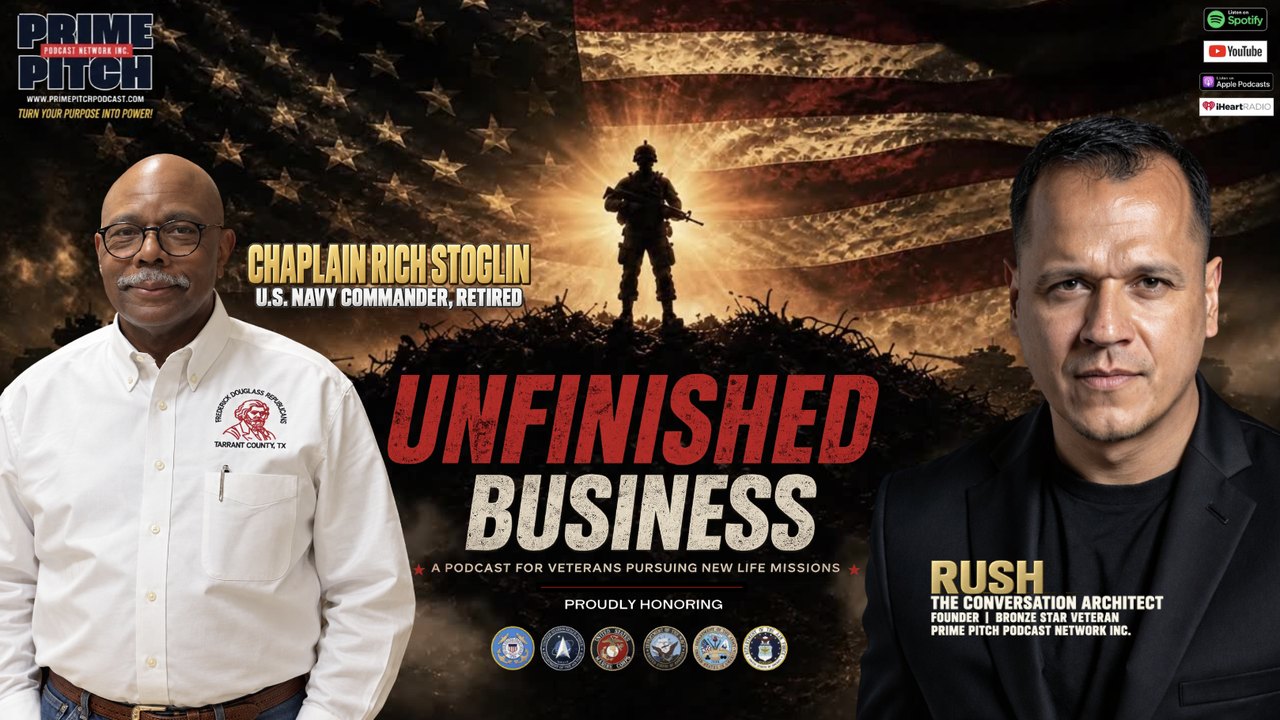
Chaplain Rich Stoglin
U.S. Navy Commander, Retired · Navy Chaplain · Federal Prison Chaplain
About the show
Unfinished Business is a podcast for veterans pursuing new missions after the uniform, and for the families and communities who stand beside them. Hosted by Eric "Rush" Christopher Rush, a Bronze Star combat veteran and the number one podcaster in North Texas.
Read the full transcript
Hey, what's up guys? Welcome to Unfinished Business, a podcast for veterans pursuing new life missions. What do you say to a family whose son has been killed in a terrorist attack? What do you say to someone behind prison walls who wonders whether redemption is still possible? And what happens to your understanding of faith when you've witnessed suffering that no words can take away?
For retired Navy commander and chaplain Rich Stoglin, these questions are rooted in a lifetime of service.23 years administer- administering inside prison, federal prisons, supporting military families devastated by loss, and serving as a wartime chaplain in Afghanistan confronting the human realities of war. His journey began in segregated Texas, but at 18 he left Waco to pursue a college education in Wisconsin, an achievement that remains one of his proudest. Decades, years lat- decades later, his commitment to serving others continues through veteran advocacy and community initiatives, particularly among people whose struggles and con- contributions don't always receive the attention they deserve. Few people have encountered humanity from so many different perspectives. His life invites us to re- reconsider how we understand faith, forgiveness, and the value of human life.
This is my conversation with retired Navy commander and chaplain Rich Stoglin. Rich, Chaplain Stoglin, it's a pleasure to have you on Unfinished Business, a podcast for veterans pursuing new life missions. I'm so excited for this podcast. You know, um, um, had an opportunity to meet you for the first time at, at the, uh, Veterans Business, um, Council, Council, um, just a couple of weeks ago, and you, you know, you know, you know you want someone on your podcast when you're listening to, you're listening to how they pray and how they, how their relationship with Christ, and I was sitting there being, I got invited by Tom Barber and, and I was just backseat and I was listening to you have, have, you count your praying and, and praying over the meeting and, and just leading, leading it in aspiritualcontext and, and just your presence there and, and I said, "Oh man, th- I hope, I hope I get to meet, I hope I get to meet Chaplain Stoglin today."And I, I will, I, I was, it was already in my mind, I'm gonna invite him to the podcast. I want him.'Cause you could feel that someone has a, the authority of Christ in their life that, that, that you can see the, the, uh, omnipotent presence of, of living through, through, through Christ too.
So I wanna tell you how much I appreciate you being here too. Thank you for having me, uh, Rush. It's an honor to be here, and I'm, uh, excited about the opportunity for us to discuss some very, very depthful conversations and questions and answers. And for those who may not have answers, maybe they have questions, and maybe hopefully we will help them to form the, the right questions and perhaps seek answers that they've been pursuing for so long. Yes.
Yes. And I, you know, one of the also things I wanna say is that, you know, outside of this, I shared with you that, hey, we have this unique perspective is where, you know, we're gonna share about what you, what, where your journey has, uh, where your journey took you, and I shared a little bit outside of this convers- outside of this podcast of where my journey has been and, and the, the way they intersect in different perspectives of being, um, the hurt- the one that's hurt and one that's coming in to help heal a- and, and in that kind of perspective. Meaning you were the one coming into places to help heal- Mm-hmmuh, whether it's veterans or those formerly incarcerated or incarcerated, should I say. Mm-hmm. And, and I was one of, I was one of both.
And so- Mm-hmmso I think that's a very, very special, um, opportunity for us to, toI, it's op- for sure it's an opportunity for me to learn, you know? It's a, a, learn to he- learn and heal and rehabilitate, and so this conversation is not just, uh, specifically designed for, it's specifically designed for the people to hear- Mm-hmmbut I'm here actively listening 'cause I need to take on as much information and knowledge that you have, you have inside of you. Um, with that, um, one of the things I me- how didWhen I read the cold opening, what thoughts or, or feelings or emotions went through your mind? Oh, there were so many, uh, because, uh, when you look at the fact of where I came from and raised by a single mother with, uh, 5 other siblings, and growing up in this state at the time, which was not conducive to people of color, a- and yet, uh, the center of all that was faith and strong, uh, mentors at that time, not only my mother, but male mentors. Uh, it was during the time of, uh, the Vietnam War where you saw a lot of, um, particularly inner, inner, uh, inner city urban, which means Black, Hispanics, and others going, uh, to Vietnam, many of whom were on the front lines in Vietnam combat, uh, veterans.
And yet some of them came back, um, with the idea that they could do something to improve the community for the better. For example, when I would be on the corner trying to imitate them, and I saw them, syrup was a big deal then. It was the fentanyl in many ways of that era. Mm-hmm. And they grabbed me by my collar and told me, "Get the blank off this corner.
You don't belong here, and go to school. Go read a book."These were men, some of whom I knew, some of whom I didn't know, but they saw something that, "You don't belong on this corner."Yeah."You're gonna do something much better than stand on this corner drinking syrup and ruining my brain- Yeahand, and, and looking horribly."So those were just the beginning. And then I thought about w- when you read the introduction, going to Afghanistan, how that was done, and then just, uh, knocking on doors and, uh, we'll probably get into that a little later- Yeahin the podcast. There were a, there was a plethora of things going through my mind about that, but there was also this glimpse of hope about you. As you said, we talked about something outside of this podcast, but also as we'll get into it in this podcast, because I have several ideas and maybe recommendations, uh, that I can share with you and the audience about those, those experiences.
Absolutely. You know, I wanna touch in, uh, absolutely, I wanna touch into you, um, um, the part of where you talked about, uh, in, and you know, right, I got your, you know, putting together your, your, your- Your, um, presentation in doing the intro, I mentioned that you grew up in Waco during a period of race, opportunity, and social expectations influenced manyThey ma- they, they pretty much influenced many aspects of everyday life, right? Um, yes. I'd like to begin with understanding th- that environment through your own experience. Um, growing up in Waco, um, Waco during that period of significant racial and social change, whatNot specific- You know, we know the history of- Mmof those times.
Um, what was that world like through your eyes, and how did those early experiences shape your understanding of life? I, uh, I, uh, m- moved from Taylor, Texas, where I was originally born, and from my, uh, and stayed from, uh, first 6 years of life. And one day, believe it or not, at that time, first graders could come home f- to sc- uh, home for s- from school during lunch hour. And so I came home one day, uh, for lunch, and thinking that I was gonna go back to my first grade class in Taylor, Texas, only to be told, uh, "Come in, use the restroom. We're going somewhere, and don't ask questions."And so I ended up leaving, and I kept saying, "I have to go back to school."And my mother and 0 older sister said, "No, be quiet.
We're not, we're not staying anymore."I didn't know what was going on. So we arrive in Waco, stayed with a cousin of, uh, my mother's first cousin and her husband. Then we moved to an- a house of our own, and, uh, it needed a lot of repair. We would see hobos walking by. And then we moved to another house that had, uh, believe it or not, a outhouse, and I was, "Oh my gosh."So eventually, we moved into the projects, the Stella Maxey Projects, and there I saw a lotI saw the, some of the last, um, vestiges of segregation, some of the signs about colored and all that.
They were comeThey had come down, but the attitudes had not. And so, uh, we lived in the projects, predominantly Black, uh, families, and saw that. And that really helped me to understand I don't wanna be in an environment where I see people fighting every day, women, people drunk. Occasionally, you'd hear, uh, shootings, but mostly stabbings, and you wonder why you can't go on this side of the city because although the signs came down, but the attitudes didn't. It was very challenging for me- Mm-hmmbecause I was a child who asked questions.
I liked to read. I was told in the second grade I was not smart enough to finish the second grade. By the 4th grade, I was reading at a 7thgrade level, and they wanted to skip me 2 classes. My mother said, "No, you're not2 grades, we're not gonna do that."So it was a time that I saw some of the signs coming down. The attitudes didn't.
But I, uh, remember at the time I was Baptist and my mother said, "We're gonna go to church. Uh, we, uh, we are going to pray. We're going to do something."And my mother started becoming very, uh, influential in the community, although we lived in the projects. People came to, to us, uh, to our apartment, and they would seek my mother's advice. And then people at school, of course, um, they would say something like, "Oh, you're the Britt people.
You're the pro-" It wasn't meant as a compliment. Yeah. Uh, later on I guess I took it as a compliment. It was a slur, but it is what it is, and you learn to live there. But we st- we still, uh, read.
Uh, my mother made sure that we would read. My mother made sure that we would, uhdidn't have much, but we'd be proud of what we had. So it was a combination of, yes, I saw segregation. I saw segregational attitudes on one hand. But on the other hand, I was given the opportunity to understand this is not where you belong.
This is not where you're gonna be the rest of your life- Mm-hmmand you can do better. Yeah. Wow, that's amazing. You know, you know, as you're thinking about it, you know, I sit here and sometimes I put myself like as, as that, that kid too, you know, a similar s- similar scenario, similar thing, and I think to, you know, I'm thinking to myself like, "I was thinking that too, but, you know, I couldn't act on it," right? Do you think kids, like, they form thatThey re- they know that something's not, you know, that's not what they want, but that sometimes they just have to accept the, the circumstances they're in?
I think that's the environment. I think if they have mentors, I think if they have, uh, for us, Chri- uh, Christo-centric, uh, faith, in our caseExcuse me. If they have opportunities to understand, and with technology now- Yeahum, and the access to technology, that helps. But again, technology is only as good as the mentors and the, the guardrails that are put up so people can begin to understand we don't have to be like this. Hmm.
We don't have to live like this. We don't have to think this way. There are other options. For example, today, thanks to technology, I'm reading that there are a million young men, g- uh, Gen Z-ers and all of that, that are coming to Christ, are coming to liturgical churches, Roman Catholic churches, Anglican churches, because they're tired of all the noise. Hmm.
Yeah, it's entertaining to say, "Oh, yes, I can see this person who has 10,000 people" that says, "Hey, that's great," but what did they say? H- can you talk to them? Probably not- Hmmunless you're on a certain list, you have a certain amount of dollars. So thanks to that technology component, they have options. Yeah.
And if they are led that way, taught that way, and sometimes through the Spirit of God, and the word spirit means breath- Hmmto breathe. Hmm. And so that's what people have to learn how to do because we don't always breathe the right way. Why? Because we don't know which breath to take.
Yeah. And so you breathe in, right, to, to get your energy, and you breathe out to release the, the dangers. You release all of those things that are not good, the carbon monoxide, for example, and blah, blah, blah. So those are the kinds of issues that I think people lack at times to believe, "This is it. I can't do any better," and they can.
Yeah. Yeah, that's, that's true. I think, I think you're right. Like, the, just the, just having that, you know, having the right p- the right people around you will really make a difference. Your environment does do that, too.
You're correct about that. Um, at 18, you d- you made a decision that would take you from Waco to a university in Wisconsin. Who or what influenced that decision, and what, what did leaving home represent at that point in your life? Loaded question, and it's a good question, uh, Rush. Uh, I wear the pin now, uh, uh, below my FMF, and we can talk about that.
And this is from the University of Wisconsin at River Falls, and I'd never heard of it. And what happened is one of the mentors, profe- uh, educators named Mr. Cleophus Babels and some others saying-- came to our, our home. By then, my mother had bought a home. Hmm.
And, uh, we moved out of the projects after about 5 years, and I remember that home, that boy, we, the weeds, we had to cut the weeds. It was like we had to do sweat equity. We had to cut the weeds. We had to get all of that stuff out, and then we had to start a garden in the backyard. And so, uh, Mr.
Babels and some others came to my h- uh, my mother, our home and spoke to my mother and said, "Mrs. Stoglin, we have to get Richmond Stoglin out of here."And she said, "Why?""Because he is so vocal. He is so outspoken. He's well known, but on the other hand, there are people who don't like that, and we think it would be better for him to leave Waco, Texas- Hmmand to go to Wisconsin."Well, I, uh, looked at the, um, the map at that time, and that was a long way. And it was.
It was 1,000 miles away, and, um, it's very cold. Yeah. And, uh, in fact, I wore this coat in September, and people would laugh at me in Wisconsin, but it was one of the best decisions that God and, and these mentors and my mother signed. She was very reluctant, and I had made up my mind. I didn't tell her that I was gonna perhaps forge a signature to get out of there.
That's how bad I wanted to leave Waco, Texas- Hmmin 1975. And so I worked all that summer and was able to save dollars and buy my clothes. And by the way, my mother never bought anything for me, uh, after the age of 14. Hmm. And I worked, uh, summer jobs, part-time jobs during school, so my mother never bought a suit, never bought a tie, shoes, nothing after the age of 14.
So I left and went to Wisconsin, and, uh, that was an experience 'cause it was predominantly white and, uh, not many Black people there. Uh, and I ended up graduating in 1979 as the 24th Black American. Oh, wow. And in 2023, I was notified by the, um, Assistant Chancellor for Finance and Development and the Director of the Alumni Division of the University of Wisconsin-River Falls that on behalf of the, uh, University of Wisconsin-River Falls, uh, Chancellor and Board of Regents, I was selected as the Alumni of the Year, and I was-- I'm the first Black American in its entire history to receive that honor,andthe university was built in 1874. And if I might pause there.
Yeah. I was going across the stage, uh, at the University of Wisconsin in 1979. I had been the recipient of the, the Martin Luther King Jr. Scholarship. And so as I'm going across the stage, the chancellor stops me and puts his hand on my shoulder and said, "Your mother and I have talked."And I was astounded-because my mother had never been to Wiscons- Well, she had been to Wisconsin once and, and, and all of that because I invited her, and, uh, she, he says, "Your mother asked me were you gonna graduate?"And he says, "You gonna graduate?"Well, my mother was dying of cancer.
Hmm. And so she wanted to know. And she did not see me graduate because she died Holy Week of 1979, and I graduated May of 1979. And so somehow, and it still baffles me to this day, how in the world she was able, without all this technology support and assistance, to talk directly to the chancellor- Mmof the University of Wisconsin-River Falls. I still don't know how she did it.
Yeah. And so he said, "You're gonna graduate, and, uh, we're not gonna disappoint your mother."And that was the kind of tenacity that my mother had. Mm. And obviously some of it, uh, I inherited, and through modeling and through examples and so forth. And with that as a, um, example, then my grandfather, who I'm named after, his name was Richmond Spruill, he, uh, would've become a millionaire, but his second wife, my grandmother, died when my mother was 9 months old, and she never knew her.
And she was raised by her aunt, my great-aunt. Mm. And, um, I was named after him. And I never will forget, I would call him collect at the time, and I would tell him what I was learning in, in University of Wisconsin, and he didn't understand any of that. But the fact of the matter is, he said, "Continue, continue, continue."And so between my grandfather and my mother, um, those were my immediate examples, and it was just, uh, uhI remember how emotional it was for me to graduate that day.
Yeah. That, man, that, that is such a, that is such a beautiful story. Like, I got emotional inside. I was like, "Oh my God, you might lose it right now," 'cause it'sI think there's, you know, there's that, there's that, you, you have your mother who, who, who in her heart's heart and heart's, heart of hearts, like, know- knew that, "Hey, you gotta leave. You gotta go.
Get, go get your identity. Go get your, your purpose. Go get your mission. Go, go out there."Uh, as hard as, as hard as it is to leave, you know, to have you, have her son leave, to, to be willing, having a willingness to, to, to, to kinda let go, you know? Right.
And, and, and IAnd there was something recently that I just, IThis message keeps coming back. It's like, you know, um, it's about, like, freedom. You know about freedom, like love is, is, is, is freedom. Yeah. It's about letting, it's about letting go, and, and, and, and in, in that letting go- Mmthat's where the freedom exists, and that's where the love exists, you know?
And s- hearing that, that's exactly the message I'm hearing is about the love to have you go and pursue the things you needed to. Uh, that's, uh, uh, yeah, that's an interesting thing about your mom reaching out to the chancellor too. Yes. Yeah. Wow, you know, I was thinking about it as you were doing, as you were going through that journey.
Did you have any kind of, um, any doubt? Like, you know, did you f- experience any, uh, you know, imposter syndrome that, that maybe I'm not built for this to go through? I think when you're 18 and you're going 1,000 miles away, although I had left the state a few times be- uh, to go, um, to Washington, DC, I was selected for that, uh, on a program. Uh, I'd gone to other places, and never forget, that's a good question, Brush, because I remember I, I, I went by bus, and then to me it looked like it was the longest trip in the world. It, it was so long.
It was 1,000 miles away. At times I felt- WowI could just get out the bus and run faster than the bus was rolling. Of course I couldn't, but it was so long. Yeah. And I'll never forget, I'd gone to sleep, and when I woke up, and this is gonna sound a little graphic, I saw a lady on the corner throwing up, and I'm like, "Oh my God, is this, is this the place?"And that was Oklahoma.
So, and, uh, and we stopped at that time at the bus station. And so I got back on, and we went and we went and we went, and it kept going and kept going and kept going. And then to top it all off, uh, they mis- mis- mismanaged my luggage, and it was the only thing I had at the time. I had clothes, a few books, and so for 3 days I was in the same set of clothes until they finallySome people that we met who were students at the University of Wisconsin-River Falls who were coming back from summer, uh, leave, uh, picked it up, picked up all of my luggage, and, uh, brought it to me. Oh, wow.
And so, uh, I was glad to get out of the, uh, uh, the same set of clothes with my purple dolphin that I had, that I won from 6 Flags Over Texas. So that was, that was pretty much what I had. And, uh, I was, and, and I was so happy to receive my clothes. And of course, to answer your question, part 2, is yes, you do have doubts because you're 18, you're a thousand miles away, you're in an extremely different culture. Yeah.
It's very cold. Um, people are, have these names that are, that are Norwegian descendants, Scandinavian descendants- Hmmand all of that. And there were notThere was only one Black professor that I had my entire 4 years at the University of Wisconsin-River Falls. Wow. So, uh, it was also Native Americans.
I learned a lot about Native American culture- Hmmbecause the University of Wisconsin-River Falls is on Native American land- Ohthat they lease to the university, and at every graduation they must read the agreement. Hmm. As part of the graduation agreement. And so I saw those opportunities, uh, as a life-opening experience. And I could go on, but those were just some of the immediate thoughts to your question.
Yes, you do feel that, but through the grace of God, you cannot allow fear or your sense of not belonging overcome your decision to stay and to make something better than it was. Hmm. Because I realized I did not really have a good choice at the time to go, what, back to Waco, Texas, and do what? Hang out on the corner or get a menial job and go nowhere and, and then 30 years later feel bitter that I, I came back because I gave up. Hmm.
Wow. Yeah, that's amazing. Yeah, that's honest, too. It's just saying, you know, I, IYou know, were you scared? Did you feel fear a little bit?
Of, of course. Yeah. Of course. Yeah. And then IWho did I know?
I knew a few people. And speaking of that, there were 5 of us who were from Waco, Texas, and I'm the only one who graduated out of 5. Wow. Yeah.1 Some of the things that you, that, uh, that I can resonate with is, uh, you've, you identified graduating from college as one of your proudest achievements. Yes.
Um, what did earning that degree represent beyond the education itself? I was not the first one in my s- uh, siblings, there are 6 of us, to go to college, but I was the first one to graduate with a 4year degree. Hmm. I had a brother who gra- who retired from the US Navy. I had a brother who went to the Marine Corps and, and, uh, got out after a tour.
Uh, so my, um, my sisters, uh, graduated from high school and, and my older sister, uh, had, um, went to a community college and, and finished a secretary certification program, but, uh, none of them finished college. I was the first one. Hmm. And, um, it was, uh, it was a very interesting experience. And in fact, uh, I had become United Methodist at the time and, and we lived in, uh, my family at that time lived in St.
Paul, Minnesota, which was about 30, 35 miles from the university. And so I had moved to an apartment in St. Paul, Minnesota, affiliated with, uh, the only Black United Methodist church in the conference of, uh, Minnesota, where I eventually would become the first Black American to be ordained deacon in that conference. Hmm. And so in the interim, um, they had churchThey were trying to surprise me, the church, it's Kamfer Memorial United Methodist Church.
They were trying to surprise me, but they couldn't. And so what happened is they had early Sunday morning worship, and then they got on a bus, and they had 2 cars, and over 50 members drove to River Falls, Wisconsin, to see me graduate. Wow. That's amazing. And so- That's so-uh, one of the professors, Dr.
Keane, uh, saw all of us, 'cause this was unusual to see 60 Black people at a graduation at the University of Wisconsin-River Falls at the time. And he came over, and I stood out of respect, and he said, "Uh, Richmond Stogner is one of our, uh, best students."He was a history major. He was a history professor."And we are glad to have him. We believe he will go far."And he just stood and just said that. And there was no rehearsal.
There was no prompting. He just said that. Wow. And, uh, came over and spoke to the congregation and to my family and I, and those were the type of professors that I had. And, um, they veryOne of, one of my professors wanted me to take the foreign service exam.
He said, "You could be a diplomat."Well, he didn't realize, uh, that he's, he was prophetic, because I eventually became a military diplomat- Hmmin my capacity as a chaplain as part of my assignments throughout, in South America and in Afghanistan and other parts of the world. So, uh, it was a very eye-opening experience, and the peop- the professors particularly were very encouraging. Uh, and especially since there were not that many Black Americans, and I was one of the very few history majors, um, out of the Black student population. Not that many of us. And, and yet, um, I was elated to graduate.
It was a sense of exhilaration, and it was, although a Bachelor's of Science in Liberal Arts, it, to me, it felt like I was receiving a PhD. And it helped break the, uh, theory of, of poverty. Hmm. And was there racism? Of course.
Were there people who didn't want me at the university? Yes. Were there incidents, uh, of racial discrimination, sometimes outward? Yes. But my objective was not to sit there and allow other people to define me- Hmmand say, "Well, because you're Black, and because you're from the South, and because you're from Texas, uh, and your accent is different than ours," uh, that I was not good enough to be there.
I put myself there through the grace of God and support. And the people who advocated on my behalf back in Waco, Texas, they didn't expect me to fail. And equally important, my mother and, and, uh, I, and my grandfather did not want me to fail. Yeah. So youIn my case, I could not allow myself to fail.
And anyone out there who says, "Well, that was then, this is now, it was different," yes, it was different. But because of situations like that, not only me, but others who paved the way, who took rocky roads and made them smooth pathways, that's your obligation. Yeah. That's the baton that I'm, that, that I'm passing on, and others like me are passing on to you, whoever you are, Black, Brown, White, et cetera. Don't, don't tell me, because I came from, from very, uh, I'd say, you could say poverty, very humble beginnings.
And look at the jewelry, look at the clothes, look at how I sound, uh, the things I've been blessed to do. Um, and you're not by yourself. So I, I know that's a long answer, Rush. No, that's- But, uh, it's a truthful one. Yeah.
And that's been my experience. And I've had other situations where people didn't want me to succeed. They told me later that they tried to prevent me from succeeding, and through the grace of God and tenacity, they failed. Hmm. That's a, that's a great point, 'cause that was one thing I was gonna ask you, is did you ever have, like, you know they say the crab in the buckets.
You know, I'm a His- I'm Hispanic and, you know, sometimes when you're trying to, you're trying to get down, go, go down a road, you're trying to, you know, break the generational curse that's over your life. And I'mIt just, uh, that one of the intersections-in this point of your story is that I am one ofI am the only, only child in my family that has a college education, you know? So for me, and I got it later, after, after going through my trials and tribulations, have a, uh, uh, a bachelor's and a master's. So for me to, to have go through that, it's like, you know, if you had that, if you were confronted with those, um, you know, naysayers kind of thing, and of course, and of course there were m- many more, problematic issues during that time- Mmfor you that you were dealing with. I'm 69.
Yeah. And I'll be 70 in January. And, uh, the years go by. Excuse me. And so you can decide what you wanna do with life.
Yeah. And, um, there may be other examples, depending on your questions. So, uh, you just have to know. Yeah. You don't have to be stuck.
Yeah. That's true. Um, your professional journey eventually took you into environments where que- where questions of faith, accountability, and human behavior are encountered under very different circumstances than a traditional ministry, than in traditional ministry. What drew you toward prison ministry, and what influenced that direction in your calling? I could stay all day on that question, but, uh, let me summarize.
After, uh, graduating from the University of Wisconsin River Falls, I was blessed toWell, I was, um, I became United Methodist, and I knew that, and so I kn- and one of the requirements, and rightly so, is to go to seminary. And seminary is not where you just preach. It's called homiletics. And depending on which seminary, uh, seminary is a three to 4year full-time education. It's full-time.
Yeah. Wow. Because when you graduate, you're equivalent to a doctor. But they say it's a Master of Divinity, so your master's is a very heavy master's. And some seminary you have to, uh, learn, uh, Greek.
That's con- that's what they call ancient Greek, it's not conversational Greek. Or, or German or y- or Hebrew, because they want to help you to try to identify for yourself, uh, the original writings or theand so forth. So fortunately I didn't have to do that, and the commentaries are so prevalent now, you don't have to. But I ended up getting a full scholarship to Gammon Theological Seminary, which is the only predominantly Black United Methodist seminary in the United States. Mm.
And so I was there from 1979 to 1982. and while I was there, and, and in the context of, of going to seminary and in the era, I met and befriended, um, American icon civil rights workers. I met the, the Reverend Dr. Joseph Echols Lowery, third president of the Southern Christian Leadership Conference, who helped Dr. King organize that organization.
Mm. And its motto was to save the soul of America. And so I met the Reverend Dr. Ralph David Abernathy, Coretta Scott King, Julian Bond, John Lewis, Andy Young- Mmuh, Fred, the Reverend Fred Shuttlesworth. These were icons from Alabama and Mississippi.
Uh, so I, they took me under their wings. Dr. Lowery, uh, called me his young warrior. And one day, when I was at SCLC headquarters, they gave me an office. And no, I didn't get paid, but I was a seminarian.
I mean, at that time, just to be in the presence of these icons was payment enough, and I was on a full sch- I was blessed to be on a full scholarship. So that included books and everything. So one day, he, Dr. Lowery calls me in and he says, "Stoglin, my young warrior, come in here."And so he, I came in, closed the door, and during that time, Rush, you know, they had those phones. We thought we were s- technology there, and they had those big phones, and you could punch the button.
And so I'm sitting in front of, uh, Dr. Lowery's desk in his office, closed door. The phone rings and he asks, as I'm looking around, and he gets off the phone and he says, "Whose office do you think this is?"I looked very puzzled, but I said, um, "Dr. Lowery, this is your office."He asked me again, "Whose office do you think this is?"I said, "Dr. Lowery, this is your office.
You, you're sitting behind the desk."He says, "This was Dr. King's office."Oh, wow. wow. And so I'm startled, and I don't know whether to cry or what. And, and you know, the, the hair on the back of my, uh, head, believe it or not, I had, I had hair then.
And, uh, and he says, "The desk was Dr. King."Mm. He said, "The chair is different because we've had Dr. Abernathy, who was the second, uh, president, and I'm the third."And he says, "These books and these papers were Dr. King's books."He says, "Now, what I want you to do is to learn from them, and you build on what we tr- what we started, because we're not gonna always be here."And I left that office baffled that day.
Mm. Baffled, challenged, humbled, uh, scared, because Dr. Lowery called me into his office and asked me whose office did I think this was, and I said, "Yours."And he said, "It was Dr. King's."Mm."This was his desk. He wrote on this desk."Wow."He took calls from this desk.
He went to that bookshelf and pulled books from this office. This was his office."Mm."This is my challenge to you."And so, uh, as a result of some of those experiences, and I, yes, I went on, uh, demonstrations and, and with Dr. Lowery and some others. Um, I was invited to their homes for the party, and I met, I met these icons, and they would stop in sometimes. Uh, President Carter came by the office.
I was outside. He went inside. Dr. Lowery and, and Andy Young was there and all of that. And, um, uh, I also heard Dr.
Lowery preach. I could literally walk down to his church. Mm. And so when I was in seminary, and so all these experiences and more, um, led me to, uh, working, uh, in an after-school program, and that's when I met this correction officer. I thought he was a, a watchman or something, 'cause he had a chain, a keychain that he would twirl.
His son was in our after-school program, and it was in Fort Worth, Texas, and I was working at a, a, uh, community center. And I was between ordinations. I had been ordained deacon, and then, um, I was waiting on my, um, ordination to become an elder. Um, and so, um, he came and, and I said, "What do you do?"And he said, um, um, "I work for the Justice Department."And I was thinking FBI, doesn't look like that. But he says, "No, I work for the Federal Bureau of Prisons."Mm.
I said, "Wow."I said, "Where is it?"And he told me, and I thought it was part of the Tarrant County College campus, and it wasn't. It was a federal prison. It was Federal Medical Center, Fort Worth, Texas. Mm. And so he said, "Now that you've asked me a question, let me ask you."And so he asked me was, herumor had it that I was a minister."Yes, United Methodist.""Or, uh, educated?""Yes, I was ordained, but I was waiting on, uh, deacon, and I was waiting on my holy orders to be ordained an elder."He says, "Why don't you go and talk to this chaplain?
He's, he's a regional chaplain," I didn't understand at the time, "Charles Tyson."And I did. And so I called, and he said, um, "Who are you?"And I told him, "I'm Unit-" He was United Methodist. I was United Methodist. He was the first Black, uh, regional administrative chaplain in the history of the Federal Bureau of Prisons. And he had 2 regions that covered 16 states.
Wow. And so I, uh, went in and, um, Rush, you would think that I would be scared But I wasn't. And he met me after going through security and said, "Come with me."And I went to his office, and very roomy office, and, um, one thing led to another and I ended up receiving a stipend to, uh, do a, uh, internship, but it, it was based upon me being ordained. Mm. And so I was, um, being ordained.
I had, uhI was ordained in Minnesota, but 2 weeks before, I've skipped some years, 2 weeks before I was to graduate from seminary, I get a call from the bishop. Uh, and he says, "We're tran- I'm transferring you."So he transferred me from Minnesota to Mississippi. Mm. And I, and I ended up going to Kosciusko, Mississippi, and I s- ended, and we rent a parsonage, and we stayed across the street from the Grand Dragon of the Ku Klux Klan of Attala County. Mm.
And so I went from Minnesota to there, and, uh, eventually, that was 1982, '83, and then I came back to the great state of Texas, and I started, uh, this process of applying for the federal bureau of prisons, and I became a, uhI was ordained. And that Thursday and then that Monday, I started as a, as an intern, or trainee as they call it, and then I did that, and I started working for the federal bureau of prisons, and went from a, a intern to a trainee, staff chaplain, and then a, uh, department head, and I was a department head for 17 years. And I went to Seagoville twice. I went to Texarkana, Texas. I went toI was stationed in Lompoc, California, and then, uh, which at that time was one of 5 United States penitentiaries.
And so, um, I'll transferred. They wereI was blessed, thanks to Chaplain Tyson and some others, to get back to the great state of Texas, excuse me, as a staff chaplain in Fort Worth, and eventually became a, uh, department head in 1990 until I retired in 2007, while I was on active duty. So I was a department head for 17 years, and there was a plethora of things that happened, uh, within that timeline. Um- Yeahit was, it was a, uh, blessing, and I was able to get my second master's, uh, after that, and my doctorate, uh, while I was there. And, um, because of tenacity, and thanks to my wife, Rae Stoglin, I was able to do those, those things.
And, um, um, the inmates were so excited when they learned that I had b- been, I had received a doctorate that they gave me a surprise party. And my contract workers, wherein on it, they conspired, and I went in one night to pray at, in the, uh, sanctuary, and they told me, "Chaplain, you have to stay here."I'm like, "What?"And, uh, they said, "Oh, no, there's nothing bad."And when I saw my contract, some of my contract workers come in, I knew, okay, this is s- this is okay, but this is strange. So they gave me aMm. Nice. So- Yeahthey gave me a party.
And strange enough, um, when it was announced to the staff, and we were in an executive meeting, and I was, uh, a department head, and only one person, only one department head after the meeting was over publicly said congratulations- Wowout of 40 department heads. Wow. That'sYeah. So the inmates were more excited- Yeahabout me receiving a doctorate than, uh, than the staff, and, and several of the inmates said, "I've never known anyone like you who, that I personally know that have received a doctorate."Yeah. Yeah.
That's insane. Um, how did the, how did the experience, the experiences ch- those experiences change, uh, shape your understanding, change the way you understood human behavior, responsibility, and the possibility of human transformation? The God we serve is real, and redemption is a reality. Uh, yes, there are bad people in prison. There are some people in prison who should never come to the streets.
There are people who actually realize they made a mistake. A lot of the, umand I worked with men primarily, um, said that they didn't have mentors. They didn't haveAnd they said if they had beenSome came from well-to-do families and some, a few wealthy families. They were never, uhThey didn't have guardrails. They were never punished for things they shouldn't, they shouldn't have done.
And sometimes they would do things so obvious so to, to get punished, believe it or not- Yeahbut they were never punished. They had, they had people who there were no mentors. And one of the, one of the major tragedies in the Black and Hispanic communities respectively is we don't have enough fa- positive father figures. Yes, we have the examples of the, back in my day, uh, Fly, you know, the, uh, all of that stuff. And, uh, uh, they had- Hmmdrug dealers and, and all of that kind of stuff.
And, and they would show you these movies. It was called, uh, the, the BlackIt was the Black movie era and, and all of that. And they would show you about the pimps and the this and the that. Hmm. And we don't need all of that.
We need doctors and lawyers, b- but who's gonna do that? We need people who are going toYou know, if you're not a doctor, you're not a lawyer, if you're not an engineer, decent, if you have a job, if you have a model. If you look at some of the civil rights workers of the '50s and '60s and into the '70s, their church school teachers were professionals. Mm-hmm. They were lawyers and doctors, and they said, "You needYou can go to Princeton.
I'll recommend you 'cause I've watched you. You can go to Dartmouth. You can go to this school. You can go to University of Texas. You can go to Texas A&M," et cetera, et cetera, because they had those type of mentors.
Yeah. We lack those type of mentors today. Yeah. For those, excuse me, who continue to harp on race this, race that, and yet you're standing still doing nothing, uh, whowhat are you accomplishing? Yeah.
What, what are you doing? I have a quote here about Thucydides- Yeahthat I'd like to share. Absolutely. And it saysAnd Thucydides, for those who may or may not know, was a commando and, uh, in the, uh, in the Greek army, and he would be a special forces guy if he were alive today. And he became, believe it or not, a writer.
He became a, a thinker and an author, and he wrote, "The society that separates its scholars from its warriors will have its thinking done by cowards and its fighting done by fools."And so this is what we're trying to get people to understand, that we havewe don't need people like that. I had a sergeant major, Sergeant Major James A. Thompson, my last sergeant major that I worked with in the Marine Corps. I was the chaplain, as you know, Rush, of the 14th, um, Regiment. That's the largest, uh, regiment in the Marine Corps.
It's an artillery regiment. And, uh, he said, "Sir, uh, SOS."And finally I was like, "Sergeant Major Thompson, what is SOS?"And he would say, "Stuck on stupid."I said, "You are not to allow this, uh, regimental chaplain to, to become that."He says, "Sir, I will carry out those orders to the letter."And so he did. He would not allow me to, uh, be stuck on stupid. I love it. You know, you know what?
I have to say that, you know, it was, it was, it was a, it was a priest inwhile I was incarcerated that, um, helped save my life. Like, he interceded and, and, uh, a coun- uh, one of the, uh, spiritual counselors too in, in, inWhen I was in Bexar County, they did everything they could to intercede in my life. They just pouredvisited me all the time, poured into me all the time. Um, you know, theI, I remember one time where these, um, city leaders came in, and we wereuh, we hadI was still in county jail going through my stuff. And this is just to kind of talk about your, your journey and, and to tell you how important that, thatyour role plays in it.
You, like you said, I think you're absolutely right. Not, not having, um, the essential tools in your toolbox, like you don't know what integrity means. I didn't know what integrity meant. Uh, you know, when you don't have those role models or you don't have the, the, the, I call it the emotional guidance systems or even the God guidance system, you know, um, morals and values that aren't, that poured into you when youat the start of your age, makes it so debili- And you, you walk around blind. You know, you walk around like you might as well be bumping into a wall 'cause that, that's what it felt like.
But, but I know that, um, interceding in my life about, you know, with, um, with God, Christ-centered- Mmuh, God-centered, Christ-centered, um, um, a spirit, it, it, it provided that conviction I needed to, to, to have waken- clo- awoken in me. You know, to wake up in me. So I certainly understand what you're talking about when you say that, you know, these guys, they didn't have, they didn't, didn't have mentors. They didn't have father figures. They didn't have that, and I canI was gonna raise my hand, say that was, that was me too, you know?
And then the other is, uh, prisonsand the word penitentiary means house of penance. Mm-hmm. And so in this country, the, the, um, house of penance were penitentiaries andbut they started by the Quakers. And the reason that the Quakers did it is because of their theological understanding of redemption, but responsibility for redemption. Mm.
So they started in, uh, Penns- the Commonwealth of Pennsylvania with a prison, uh, and they would sit with the prisoners. And theyand most of them were in for debtors. They were debtors. Yeah. And so basically they were saying, "Well, how can the man of the house, pay his debts when you've incarcerated him?"And so they would sit with them, and then once they were convinced that these, uh, men would be, were re- were redeemed, and they were sorry for their, um, uh, uh, inability to pay their debt, and they were gonna find ways to do that- Well, what happened eventually is they became so successful that the Commonwealth of Pennsylvania kept start giving them more people, but no support.
Mm. More people, but no support. Mm. And so they ended up turning it over to the Commonwealth of Pennsylvania, and that ended up becoming the Pennsylvania State Penitentiary. It closed in 1972.
Mm. So from the beginning, prisons meant House of Redemption. And so, uh, the chaplain whoThe word chaplain came from, uhHe was called the Bishop of Tours, and he was a, a cavalry officer for the r- he was f- uh, f- of the Roman army. Mm. And, uh, and he was, you could imagine, uh, this guy on a horse, he was, uh, equivalent to a general, and he had boots and all of that.
And so this beggar comes up to him, and most officers would take their spurs and kick them away, and he didn't. So he climbs down off his horse, he takes his cape, what you would call your, your outer coat, and of course, I'm sure that the, um, the beggar was like, "Oh my God, here's the end of my life."He doesn't. He t- heIt wasn't. He takes his sword and splits it in half, and takes half his cape- Mmand wraps it around the beggar, and gives him dollars. Afterwards, he res- he, uh, resigns his commission, and then he goes into ministry.
And, um, the, uhThat's why it's called the, uh, chaplain. It means kapion. It means protector of the unfortunate- Mmand guardian of the faith. And so that's what chaplains are g- are responsible for. We are the, we're the guardians of the unfortunate- Mmand we are the keepers of the faith.
And so that's why you have chaplains in prisons and hospitals, wh- because hospitals were started by religious people. That's why you have chaplains in the military because, as I was reminded so many times, you, Chaplain Stockland, are the conscience of the command. You must remain that because we have to have a barometer from which we decide right from wrong- Yeahethical from unethical. And so the chaplains have something that other, other disciplines don't. Yeah, they emulate it.
Psychology and psychiatrists, great in their fields, but we have, as chaplains, something they don't have. We have the power to bless and the authority to affirm. No other discipline has it- Mmbut us. So we have the power to bless and the authority to affirm. Mm.
And, uh, so we have to keep those, uh, situations in mind. And so why was I a chaplain in the federal bureau of prisons? Because I belong there, because there are people who, like yourself, who have the Damascus road experience like St. Paul."Oh, Lord, why are you doing this?"And then he says, "Why are you punishing?"In your case, you didn't hurt the church. You wasn't punishing or, or executing or help executing Christians, but you were executing yourself.
Yeah. You were persecuting yourself and those who loved you. You didn't know how to do that. Yeah. And so why was I in prison?
Because I wanted people to understand you're on a Damascus road, but there is hope for you. And hope is our strongest weapon. Yeah. That's true. That's true.
I remember being, uh, I remember being incarcerated and I read this book, it was called Science of Mind. It wasn't a biblical book, but it talked about there's no such thing as hope, and I had read it, and that wasI, I can't tell you. I- we'll go on that another time, but, but I, I, I remember going likeI remember thinking about it now, like looking back, I said, "Dude, you were reallyYouI really bought into that book."Like, I really said, "There's no hope. There's no-" And, and to, you know, to, to, um, supplement that thought, Rush, um, as Christians, we are taught to live. We live in a culture of living, to live, to hope."I come," Jesus says, "to give you life" what?
More le- less? Yeah. Or more abundantly? He says more abundantly. Yes.
So to live, right? What does evil do? Evil is live what? Turned around. So if you look at it, live- Yeahturn it around, is evil.
So which one do you want? Yeah, I'm glad I turned it around. So you see. Yeah. Uh, let's see here.
Um, i- during, during my research, uh, you, uh, there was one moment where I think you were on a podcast and you talked about, um, an encounter with a Vietnam veteran that influenced your decision to pursue military chaplaincy. Um, what made that experience so significant and how did that shape your direction of your ministry? At the time, um, uh, the, um, the, the VA had what they called vet centers, and vet centers were created because a lot of veterans from Vietnam despised the VA and the way they were treated. And so the VA realized we've got to have avenues, uh, it's imperative to do that for Vietnam veterans because it's no telling what's gonna happen if we don't help them, if we don't treat them, if we don't pay attention to them. So they created the vet center.
Now, at that time, we had a, uh, young man who sought to be a volunteer, and we were doing groups at the time, a lot of groups. So a lot of theAnd I started in 1984, so you had Vietnam veterans who had returned to the US. Now, interestingly enough, I was in, uh, assignments where I saw Vietnam veterans who were inmates, but I also saw Vietnam veterans who were correction officers, and they were in the same unit- Hmmin Vietnam. And so we, we started doing these groups, and, um, the volunteer f- theHe was a s- he was a staffer from the vet center in Dallas, and he, um, started coming to Seagoville. And we ran his background, and he was incarcerated.
But the VA hired him because he ended up getting a master's in toxicology. Hmm. And so, uh, he came out, and I had to really put my foot down and stick my neck out, as it were, for him because they didn't want him. The administration at the time didn't want him because he was an ex-offender. Well, he worked for the, for the vet center and so forth, but they allowed it after some pointed conversations.
So one day we were doing group. We ended upWe ended group. I was escorting him back to the, uh, control center so he could exit the institution in Seagoville. And he says to me, "Chaplain Stoglin, I wanna talk to you."And I said, "Sure."And he said, um, "I want you to do me a favor."And I called his name and I said, "You know I don't do favors."And, uh, he said, "No, listen to me."He says, "You know my story. I went to Vietnam."He was in the Navy.
And there was some structure, I should say structural, uh, differences of opinion, and so they put him, as I understand his story, in a base camp. He was in the Navy. He wasn't, he wasn't in the Navy SEALs. He wasn't trained to do that. And many, many, and severalThere were several encounters of the Viet Cong trying to overrun the base camp where he was.
And eventually he started using heroin. Hmm. And, uh, one thing led to another. He was, he sold some heroin to an undercover agent, and he was arrested, and he pleaded, and he was sent to a federal institution- Hmmon the East Coast. He gets out, and then the vet center, uh, were doing interviews and they hired him.
He said, "You know I'm a ex-offender."They say, "Yes, we know your record. And so this is a different era that we're trying to help- Yeahveterans."So he said, um, "I've watched you and I've listened to you and how you ran the groups and how you respect these men. Um, yes, they are, they are inmates, but on the other hand, they are veterans, some of whom were combat veterans."Hmm. One was a corpsman. And he said, um, "I need for you to go in and help veterans from becoming like me because I ma- I was blessed to make it."Hmm."There may be others who are not."Interestingly enough, he's Jewish.
I'm a Christian. And so I said, "Okay, whatever, and I'll go in and do my 4 years. I probably don't like it, probably yada, yada, yada."And, uh, I ended up staying 28 years and 2 days. Wow. And so hopefully Chaplain Stoglin has helped veterans from becoming like him.
Yeah. That's, man, thatWow, that's, that's so powerful, you know? Like, as a veteran myself, combat veteran, when I showed you, I told you my story as I was going through my trials and tribulations post, post, uh, uh, post-deployment and having my life unravel really fast in 4 years, basically just went on that collision course, really came unraveled. But now that I look at it, now fast-forward, you know, we're, what is it, 20-some years separated from that, right? And you look back on it and you go, you, youNow that I've been on my journey with, with veteran, um, rehabilitation and, and going to counseling and stuff like that, you know?
And, and now I'm actually part, you know, now, now I'm part of a, a prison entrepreneurship program where I go to, um, uh, the executive volunteer for TDCJ myself. but when I, when, when, uh, one thing in my speech I have is cooperation, search, and rescue. Um, I talk about, um, there are veterans behind walls, that some are, some are behind walls. You know, we have sailors behind walls-or prisoners there because of, because of alcohol stuff or drug a- drug abuse and, and maybe their combat deployment has taken there that, that, um, um, thatAnd so to hear you talk like that, it, it's such, it's so inspiring to know that. You know, a- and part of my r- rehabilitation I had i- in this journey that, that I was on, that I've been on, um, there was a time where I had, I had, um, Chaplain Lake from Fort Worth VA.
I don't know if you know who he is, but he's, uh, Chaplain Lake from Fort Worth VA. And, and, and I had a, a- a s- a, a counselor, a VA psychologist that I was, that I'd had, I'd meet with chaplain, uh, one time a week, and I'd meet the, with the psychologist, uh, during that week sometime. When I had that dual, that dual, like, coming at me at full angles, you know, like both angles, you know, it's like, "Hey, here's the, here's the health and here's the mental health part of it, and here's the spiritual health part of it," how much do you think when I, when I mention that, is that, how, how, how essential is having that spiritual counseling and, and that, and that, the mental health aspect, um, coming back, coming together? I th- I think they're both imperative. I've been blessed, again-to, um, have, um, um, this theological education, this sense of calling, but I'm also a, uh, licensed lar- uh, marriage and family therapist.
I served on the board. The governor appointed me for 6 years. I was by f- by, through default, the subject matter expert for the board- Hmmand helped, uh, veterans and active duty chaplains, excuse me, and spouses who were, who were pursuing LMFTs to have some exemptions to, so that they could further help. That in the Army, they, it's a tour. They call it a life center.
So it's a, a life center, that's what they call them, and, uh, they have chaplains that they send to school, and they come out with a master's. But the question is, would the state recognize it? And so we were able to work through that so that they can be in this state- Yeahuh, to help what military personnel. I've dealt with, uh, Marines, for example, believe it or not, who have had 11 combat tours. Yeah.
And if putting it in perspective for those who may or may not understand that, that's 77 months of combat. And in the Marine Corps, they would go out 3 to 5 times a day, and the Marine Corps starts with leadership at a E3. That's a lance corporal. He's 19 and a half years old. He's responsible for 4 Marines.
Yeah. That's a fire team. So I have dealt with them, and I've dealt with so much, as you have said, that, um, uh, I'm a disabled vet, and some of my disability that I will say, and I will disclose, it's not all, uh, physical. Yes, I was injured, my back and knees, but I also have others. And so whoever you are, um, I'm telling you, I'm sharing with you that some of mine is, is mental because I've seen a lot.
I've been through a lot. Yeah. And, uh, I was number 2 on the enemy sniper's list in Afghanistan, and so I had to have a 24/7 security team. Hmm. And, uh, my gear weighed about 80 pounds.
Theirs weighed about 140 because they were carrying munitions and weapons. And so, um, I too have unders- understood through my own personal experience. I will never forget, um, when I got back from, uh, Afghanistan, and I, uh, I have high blood pressure, and I don't know how I got it. I somehow developed it. And, uh, I was sitting there, and they had given me the cheaper, the VA, cheaper medicine.
They gave me the more expensive 'cause my wife was a, is a nurse and a medical, my medical power of attorney. She made sure that they provided me with the right medicines. So I get back, rushing. My feet swell as big as elephant h- hooves. Yeah.
And, um, so we go to the VA. I'm sitting there, and I said, um, you know, I, I, I didn't do this for charity, and I don't know who this person was. And they said, "Sir, Chaplain Stocklin?"I said, "Yes.""You're a commander?""Yes.""You went to Afghanistan?""Yes."She said, "Sir, you kept your word. It's time for the VA to keep theirs."Yeah."This is not charity. You earned this, sir."And I, I was quiet, and then there was a PA, uh, who served withHe was a combat army medic and, uh, became a PA, and he said, "Sir, I, I need to take you down to another department because you really need some help."Hmm.
And, um, he said, "Because I love chaplains. I used to deal with chaplains a lot."And, um, which is true because in the, in the, the Navy and, uh, chaplains and, and corpsmen who are assigned to the Marine Corps, they work together- Yeahvery tightly. And so he says, "You need help."And, um, and I did, and so I got help, and then my rating went up. and I did, and so I got help, and then my rating went up. So I'm sharing with, with you veterans and you veteran families that I'm telling you it's okay.
We don't need to lose any more of you with the black ring, okay? We don't need to do 22 kill a day. We don't need any more. We don't need to lose you. We can't afford it, and that your service is so powerful because you didn't think of yourself.
You thought of others. So I, as a chaplain momentarily, let me be your chaplain to say to you, "Get help."I say to you, "Get help," because it's okay. I'm a living witness of that. Yeah. I think people need to hear that, hear what you're saying right now, like, and that you're vulnerable to say, "I needed help, too."Yeah.
You know, people see they have the leaders that have this, uh, you know, you have this high, um, I always say like, um, it, it's a higher level of, you know, um, operator kind of mentality, especially when you're, you're, you're, you, you know, where you were at and what you were doing and, and even as a chaplain, you're, you're still at that high op- you know, s- operations, you know, level. Yeah. You know what I mean? Where you have to, you have to go away. You know you're going into where people ha- are facing that, and you have to be strong enough to face it with you, you know?
Rush, I, uh, I was in Afghanistan for 330 days, boots on the ground. Hmm. I, uh, learned I was number 2 on the enemy sniper's list. And so my gear, as I said, weighed 80 pounds, so I, I, uh, we had 2 vehicles assigned to us. Each of those doors were 100 pounds, anti-blast doors.
But I didn't want my staff to be bullet magnets, 'cause they would have to stay with the vehicles. So we ended up walking a mile and a half from, once we've cleared a compound, to the MOD, the Ministry of Defense, and I advised the, a senior general of the Afghan National Army who controlled the brain trust. It was a religious and cultural affairs, which is basically the brain trust, the lawyers, the, the journalists, uh, all that. He controlled the brain trust. Hmm.
And, uh, General Naseeb. And so I would be escorted in circle for a mile and a half. And, uh, during the winter months, as you know, it snows, believe it or not, and we didn't know if they were gonna plant I- IEDs along the way. Mm-hmm. And we didn't know if there was gonna be a blue to green situation, and I had 3 interpreters who worked directly for me.
So what did that mean? And if they found out who they worked for, the Taliban, what if they went to them and said, "If you don't kill them, uh, we're gonna kill your family"? So that was always in the back of my mind. I never said that. And then, uh, you're guarded, and people are willing to give their lives for you every day.
And so my security team took their jobs very, very seriously. And in addition to that, I've knocked on 151 doors. It was never good news. Hmm. There were 19, there were 21, there were 23.
You can still, in my case, from time to time still see the, uh, steam from the mac and cheese whenever you're ready to have dinner, and here we stand-with this news. And so, uh, there were so many situations, uh, not all bad, but some of it had to be there. And, uh, I've had combat-hardened Marines and sometimes, uh, Navy personnel that say, "Sir, I'll go back to combat. I don't wanna do that again. I don't wanna knock on any more doors.
I don't wanna do that."But, uh, as chaplains, we have to do that. And in my case, I did it 151 times. Hmm. And sometimes 3 a day when the war was hot in Afghanistan and Iraq. And then if they were not killed in action, they were wounded, and so we'd have to get the family out within the hour, and, and we would say, "We'll call your supervisor.
We'll call your job to let them know."And, uh, and occasionally, uh, when, uh, they were killed, the family would ask, would I come back to help? Of course. I'm on it. You, youI don't care what the schedule is. Yeah.
You, you're gonna do that. So a- as a chaplain, those are just some of the situations that we're involved in and continue to be involved in because that's who we are and that's what we do. And, um, as a Christian, uh, when we walked in with the team, that cross meant something, and it wasit's some of the most powerful, uh, challenging times when you tell a family, um, that your 19-year-old or 21-year-old, 23-year-old. And the Marines and Navy, I think someone did an analysis, spent over a million dollars on my training. Not saying I have a million dollars, but in my training.
But when a 7yearold, uh, pulls on your blouse and says, "Hey, my dad and brother, uh, has a uniform like that. Do you know him? When's he coming home?"Hmm. What do you do? Yeah.
W- is there a scripture that you lean on, like, you know, that, that's been, like, one of the ones that you, you, you know, that gets you through those, you know, has gotten you through those moments? The 23rd Psalms in, uh, Romans 8:35 through 39, he essentially says, "Nothing shall separate me from the love of God. Height, nor death, nor principalities, nor anything shall separate me from the love of God through Christ who loves me and who gives me hope."And of course, "The Lord is my shepherd. I shall not want."And then especially when it says, "Yea, though I walk through the valley of the shadow of death- HmmI will fear no evil. Thy rod and thy staff, they comfort me."And when you, uh, walk into the space of people's lives- Hmmto talk to them about someone, excuse me, who they love is no longer there or is on their way out because of combat assignments, um- You really lean, in my case, you really lean on, on those 2 set of scriptures because, uh, when you put this stole on, and, uh, either at their home or at the cemetery, and you're about to hear Taps, you, um, youIn my case, you really have got to understand the pivotal role that you play in the lives of people, because they look to you as the symbol of hope.
And I can never lose hope. Uh, were there times that I felt hopeless? Yes. Were there times that I felt fear? Yes.
Were there times I felt anger and lost and all of that? But yet when you look, in my case, the moral mirror and say, "Wait a minute here. Yes, you have the right to feel that way. You have a right to think that way, but on the other hand, how is that gonna help the families? How is it gonna help- Mmyour statement?
How is it gonna help the situation?"And, um, it doesn't, but it shows others that, yes, I too am vulnerable on situations because I care for people, and that to me is a gift. It's not a burden, but you don't want that to become a burden. So it's a, it's a balancing situation. There's a, a particular, um, umDuring your ser- your military service, you provided spiritual support to a family of a sailor killed in the USS Cole bombing. Mm.
How did that experience shape your understanding of what spiritual care can generally offer in the face of profound, irreversible loss? That took me to the edge of many things. That was the longest CACO, Casualty Assistance and Casualty Call, in the history of the Uni- United States Sea Service. That was over 3 weeks because, uh, it was Timothy Gana. He was a OS2, Operations, Operation Specialist.
He was a E5, and he had plans to come back to the great state of Texas to go to college, and he was engaged to a young lady, beautiful young lady, and, and all of that. And we went to their home, his, his, uh, parents' home, and, um, in Ennis, Texas. And, uh, it was, it was gut-wrenching, uh, because we couldn't, um, readily identify all of his human remains because he wasHe had just saved someone's life, did the Hulick maneuver, and they decided not to award him while they were there, but to, when they were gonna go out to sea, then they were gonna have a w- uh, an award ceremony. Mm. Well, that didn't occur, and, uh, until he was pres- his fam- his mother was presented a, um, Navy Achievement Medal and some other medal posthumously.
And the, uh, church was packed, and the, their pastor had never experienced a military funeral, and so they had, we had, um, all kinds of stations there, news stations. We had the govern- he was then Governor Bush. Um, he had sent letters. They sent state troopers to help, uh, do that. Um, they turned out school that day.
Uh, teachers were there. It was, it was, on one hand, it was marvelous. It was beautiful. People would stop, and they saluted. But on the other, uh, we lost such a valuable young man, um, because of some evil actors.
And, um, uh, the, um, the family and I became very close. In fact, one day, we were there so many times during that week because we were trying to keep all of the situations together without the interference from the press, that they served us coffee. Mm. And so Sarah, his mother, said, "Chaplain Steiglein."I said, "Yes.""You, you look like you haven't slept."I hadn't. I said, "This is personal."Yeah."This is personal."So she's, she's, as she's rushing, she's pouring me coffee.
She looks at me. She said, "You look like you haven't slept."I said, "I haven't."Mm. You know, uh, uh, a- and this is, this isI ask that question, I'm glad, I'm glad it's part of our discussion, to be quite honest with you, 'cause I do wanna honor, uh, uh, Sarah Gana's, uh, son, also in this, in this, uh, j- uh, what's his f- what's his first name again? Name was, uh, Timothy. Tim- Timothy Gana.
Yeah. Timothy Gana. Yeah. Tim- Timothy Ghanna, yeah. I've had conversation with Sarah before on, on, through Facebook and stuff like that.
So I'm so glad we're talking about this so we can honor their lives. I'm friends with Jeremy Ghanna and, and, and so I know that I know, I'm familiar with the story, and, uh, I think it's, this is a good moment, moment for y- to have that reflection with, with his life and what, um, what his sacrifice meant to the country. And Sarah, this is, this is to honor you as well to have this question asked and to put this in 'cause we, um, we, we wanna, we'll never forget and we always wanna We will not. Yes. We will not.
Excuse me, man. Yes, no problem. by the time y- uh, the se- the next question is, uh, w- by the time you served in Afghanistan, you had decades of theology, education, counseling experience, and crisis management, management training. Where did the realities of war challenge or deepen what you believed you understood about your calling? Uh, I think it was General Sherman during the Civil War said, "War is hell," and it is.
And some people realize, no, I'm a non-combater. I was a non-combater. I didn't carry, uh, physical weapons. I carried, uh, the, in my case, the cross. I carried, uh, all this, th- this, um, uh, these, uh, the gear that I needed to, to m- make certain that the mission was accomplished and complete without problems.
But, um, I, um, I was, um, I had these several phones, and one day my chief of staff, who was also my ch- chief of, uh, security, it was this sergeant first class, E7, all of my personnel were Army except for myself. And, uh, there were 51 Mikes. They were combat chaplain assistants. And so one day I had, uh, d- I, uh, we had 2 vehicles and un- uh, it's not usual for a chaplain to sign, uh, for them to go out. But in this case, because I was, um, I, we had a director at our own operation, I had to do that.
Yeah. I had to do it through computer so they could track it. And so they, I would send my deputy, my d- my made a practice that my deputy and I would never be together outside with few exceptions. And, um, I would send my deputy chaplain, who by design of the, um, billet, was a Roman Catholic priest. And so, uh, I sent him out, uh, on, uhAnd what, and the reason we did that is we would call the continuity of care, pastoral care.
There were some fire bases, uh, rushed that didn't have chaplains. Mm. So they would call on me because I was, um, at the higher echelon. We had 6 regions that we had to take care of, reported to the number 2 guy in charge of the war, a general, call him B3, Lieutenant General Paul Bolger. And so PhD in, uh, military history, very brilliant guy.
And so I, um, um, sent, uh, my deputy out to provide mass, provide services. And so while I was in the office, my, uh, chief of staff, uh, uh, came to me and said, "Sir, um, there's a situation."And he and I are the only ones in our directorate who had SIPR phones, secret phones. So he said, "Sir, I n- need you to come to my section because I need to talk to the staff sergeant, uh, on the SIPR. We have a situation."And so I followed him, and he, uh, basic- what happened is, uh, the sh- uh, we would always say, "Go talk to the shadows," meaning the DIA, Def- Defense Intelligence Agency, sometimes the CIA, uh, to see what was going on before we would send my deputy chief out. Mm.
And, uh, my deputy chaplain. And so, and so we would go out. So that day, um, he picks up the SIPR, he call, and they said that, uh, they had talked to the shadows before they left, no issue. Well, suddenly there was a pop-up. Pop-up in this case where it was a protest, and there was a strong suspicion that they were gonnathey had Taliban within the crowd to cover them.
Hmm. And so they decided to do a quickie in to a friendly base, fire base. And we would call, and so I said, uh, "Where should, where's the, where's the chaplain?""He's here, sir."Um, 'cause I said, uh, um, "I'll have the sergeant first class ask you weapon status," which he did."Weapon status."He said, "They're hot."I said, um, and, uh, "The, the chaplain is protected?""Yes, sir."Um, "You talking to the shadows?""Yes, sir."And, um, "Everyone is safe.""Okay. Well, on my mark, I want you to call, uh, Sergeant first Class Ebon every 30 minutes. You copy?""Yes, sir.""Every 30 minutes until, uh, until you are ready to leave.""Yes, sir."And they did.
Well, because I was, uh, the command chaplain of 39 nations, I had meetings, believe it or not, even in Afghanistan, they're a 10. Some were classified, some were not. So I immediately, uh, went to the general upon, uh, arrival before the meeting and then briefed him, and he asked me what was going on, and he said, "Good decision, and, uh, keep him in, in the loop of these developments."I did. So rushed for three and a half hours. I'm going to meetings.
I'm, um, sitting in classified briefs, and I'm back in the, uh, directorate. What do you think is on my mind? Where's my staff? You know, they were gonna investIf something, God forbid, would've happened, yes, they were gonna go through the, through the, uh, check marks. Did you sign?
Did you, did you have water? Did you do this? Yes, yes, yes. But guess what? I was gonna have to go to that, uh, my, my staff's families and talk to them.
Hmm. That was not, I could not pass that on. The military was going to make sure I would go talk to those families face-to-face, not email, not Facebook first to face. And so, uh, that was on my mind, not necessarily about their families, but them. And three and a half hours later they roll in.
Nothing had happened to them that day, but that was on my mind, and I sent them out. That was my responsibility. That was my responsibility to sign, my responsibility to make sure that they were taken care of and equipped and resourced, and my responsibility to make sure, as best we could, they would return safely. And so that's the kind of situation and environment I was in for 330 days. And among all of the, all the responsibilities, and, uh, the general, the same general, V3, came to me one day.
He would come to my office. And he said, uh, "Chaplain Stogner."I said, "Yes, sir.""YouPeople talk to you.""Yes, sir.""Uh, you've sat in on the, on the classified, uh, briefings.""Yes, sir."He said, "Do you know what's going on?"I said, "Yes, sir.""Chaplain Stogner."I said, "Sir.""Who do you talk to?"I said, "Sir, I, I talk to God, because if I talk, people will die."He said, "No, Chaplain. If you talk, many people will die. That's the responsibility that you have, and you are the conscience of this command, and we thank you for it."He got up and left. What did that make me feel?
It, uhI, I got emotional by myself, and, uh, because he says, "If you talk, not people will die, many people will die because of what you know."Hmm. And that's the responsibility that this chaplain had to carry for 330 days, boots on the ground. Well, thank you for, thank you. Thank you for, for being the conscience of- Ohour military. Um, that, that's, that's heavy.
That's a heavy load. Yes. That's a heavy load, um, to know you're gonna have to face the families, and you were, you're the one that, that it, there's no passing the buck to anybody. Cannot pass the buck. Yeah.
And that's why I'm saying, and I'm gonna repeat this, Rush: It's okay to get help. I'm telling you as a chaplain. I, I'm not, I'm not informing them. I'm telling you. And you, if you could say, "If I could, that's an order, you go get help, because you are not alone, and I want you to understand that."Whoever you are, understand that.
That's important. Yeah. Um, couple more questions. We're, we're, we're running short on time here. Um, what do you, what do you think the spiritual, uh, spiritual health is of, the spiritual health of the, the, the military is, and the veteran community?
How do you, how do you, how would you assess the spiritual- I think now that theAnd I'm just gonna be quite frank. Yeah. Now that this president and this secretary of war, uh, a- are in office, our military is proud. Uh, you know this. The recruiting, uh, numbers are up.
They were down. Even with bonuses, I mean, thousands of dollar bonuses, people just like, "No. I mean, am I gonna be supported? Am I gonna be vilified? Am I gonna be called a Nazi?
Am I gonna be called a boot-kicker?"They don't even know my name. Most people don't even know the military. There's only 1.8 of us, as you know, who serve in this country. We have to protect the 98.2. So I think the military is good from what I've seen.
Uh, as you know, uh, the part of the organization, the Veteran Business Council, through the chaplain's quarterly breakfast, is gonna be dealing with the recruits, uh, recruiters and to help, uh, create a mentorship. And I'm su- I hope you'll be part of that as well. I've been a part of that, too, yeah. And, uh, so, and then I, I ta- you know, I ta- I'm very involved in our community, uh, in Arlington and, and the DFW Metroplex. And so, um, we do quite a few things.
Uh, we helped, uh, get the, uh, the Medal of Honor here. Uh, thanks to, and I'm just gonna say, thanks to the Lieutenant Governor, uh, Dan Patrick, and, uh, Senator Phil King, and the former mayor of Arlington, uh, Texas, uh, Jeff Williams, and myself. We were able to have $18 million for the educational component of the National Medal of Honor Museum- MmFoundation. So, um, people come, and that's a proud moment, not only for the city of Arlington and the great state of Texas, but for the nation. So I think from what I'm gathering, and you know I'm, I'm around veterans pretty much every day, uh, they're feeling better.
Their heads are up. Yeah. And, uh, they're proud because we serve a great nation. It's not perfect. We know that.
But, uh, it's better than, than us, to us, the rest of the world. I mean, they s- people still look to us. So I think, uh, it's a greatIt's healthy. It's, it's growing, and I think more young people than others are s- are pr- are seeing that. Yeah.
That's awesome. Yeah. I, I think you're right. I see a, a certain pride and, and that, um, um, mystique of, of being, you know, a proud, a proud, proud patriot is also the patriotism of our country is, like, like, shot through the roof for sure. Yeah.
Um, couple more questions. Mm-hmm. We'll wrap up. Um, your involvement in restoring Arlington ce- uh, historic cemeteries has helped preserve stories that might otherwise be forgotten. Considering your own upbringing in segregated Texas, is there a personal connection to that work or what, and what does that preser- what does preserving the, those histories mean to you?
Well, I was asked to, uh, get involved by then Commissioner Andy Nguyen, and, um, he-- We had known each other, and he said, "Would you get involved?"And this, or I said, "Okay," and I drove by the cemetery. It wasIt needed help. And, uh, the whole idea that it was where Arlington started, these were the pioneers, and then there was a colored section. That's what we're gonna call it. They were not African American, they were colored, because Frederick Douglass said, "I'm a proud colored man, and we need to be, uh, thankful that we're in America."And, and, and knowing who he was, uh, he had no, uh, shame in saying colored.
And so we named it the colored section because that's what they named themselves. And people were walking around it. Part of the, that corner was used as a dumping ground, and thank goodness we had a radiation, a ground radiation to identify some of that, uh, that land, that, that property. And then knowing that the father of Tarrant County is buried in Arlington, Texas, not the, the state cemetery or in Fort Worth, but in Arlington, Texas, and all of that. So I was asked to do that, and then the first chair was Mr.
Harry Croxton. May he rest in peace. He died and, uh, while we were getting this together, and then he had asked me before to be the chair of the fundraising committee, which I accepted. And particularly after he died, I mean, I just-- We had everything we had. And so rushed 5 years and $600,000 later, we were able to raise it, and, and it's-- If you drive by it, it's very proud.
Mm. And, uh, there's a YouTube that talks about it called The Pioneers, and they ar- they were. And, uh, the 4 flags, we, we made the recommendation, and they said, "Great."And they'd worked out, uh, situations with, uh, the county and the, and the, and the city, and they have tours. And I think AISD now has, um, an agreement that they will take students through there- Mmand all that to see the pioneers, and their names up there- Mmand all of that. And so the, the families, the, the colored families, the, the other families have joined in and, and made some videos and, and been proud of that.
We are very proud of that, and it was a committee of, uh, some workers, and, and it was just great. And my, uh, my thoughts were, gosh, uh, it was segregated then, but we're, we're not segregated now, and it took a community of hands to make this day possible, and that's the best of what we can bring. Beautiful. Beautiful. Um, you're ma- making dynamic impacts in the city.
Um, what other question? Last question. Last 2 questions here. Um, Chaplain, you've explored ex- you've, you've explored experiences spanning your upbringing, or we've explored- Mm-hmmexpansive experiences, uh, spanning your upbringing, education, prison ministry, military service, and community leadership. Um, looking beyond your professional accomplishments, military service, and, um, and community leadership, what remains unfinished in your life, and what matters most in, in the chapter ahead?
Uh, 2 things. One is, uh, this stole that I wear was presented to me in Afghanistan, and you heard me talk a little bit about it in our last meeting. And the pin, I believe you can see, uh, the initial pin, uh, this is the FMF, Fleet Marine Forces, and I was the inaugural command chaplain of the, uh, schoolhouse for MARSOC, Marine Special Operations Command, and, uh, the person who pinned me was Major Jim Capers. He is the rec- uh, recent recipient of the, uh, Congressional Medal of Honor, and I was, uh, great. I was justIt was grateful to be, uh, there to witness.
I was invited to the White House and saw President Trump award him that. Mm. And he calls me his chaplain for life. Mm. And I know him personally.
And so allIt was a MARSOC room then, Rush. Now it's been renamed to the Jim Capers Special Operations Command. So I wear this everywhere I go when I put on to do public prayers, and of course my cross. So just remembering him, and we still need to do some more work to recognize what he has done. The other is I'm an Anglican priest, and again, I'm the first Black American to be ordained deacon and priest in the Anglican Church in North America, specifically in the Fort Worth, uh, Diocese.
We have 59 churches covering primarily the great state of Texas and one church in Louisiana. We need to tell the story of Black Anglican clergy, and I'm trying to get someone to write the story. I have some of the, the materials, and so far we've not been able to do so. I've talked to several people, but I'm not talking about other, I'm talking about Black American Anglican clergy who were fighting 2 fronts. They were fighting outside the segregationists and the racism, and inside they were fighting some of their own internal structures- Mmof the then Episcopal Church, and even now I think to a degree some of the Anglican, uh, people who real- who always, who some talk about diversity, but I'm not talking about DEI, I'm talking about diversity.
Yeah. Uh, that you don't see a lot of that. And so our ch- my challenge is we need someone to talk to me, uh, on writing seriously from a major publishing house about the American Black Anglican clergy experience. Hmm. And I'm the director of community engagement.
I'm the, I'm the inaugural director. And so that's unfinished business, Rush, because we, we, our story hasn't been told. People don't know who we are, what we've done. It's like we ju- I was part of a project with the US, uh, Sea Service Navy Black American chaplains. People didn't even realize what they have done and are doing.
Hmm. And so, uh, that's unfinished business. And what, one of the things that it's like the highest compliment that a Texas Ranger, not the baseball team, but the Texas Ranger will say to you is, "He we'll do the ride the river with."Hmm. That's what we were trying to get people to understand. That's unfinished business.
We need a book published on, uh, Black American Anglican clergy. And then the other finally is I'm writing a man- a manuscript that's, um, it's been a long time. It hasn't been published yet, but I have a publisher, a contract has been signed and all of that. So Rush, hopefully we'll be back maybe to talk about it. So we're waiting on, on that to happen, and that person, that publishing agent of mine, he's gonna hear this podcast, and that's gonna be a prod for him to get on with it so we can get you back on your show- Yeahand, uh, say, "Get, get the chaplain's, uh, manuscript published," so.
What's his name? Um- What's- Uh, W- Jay. Yeah. Jay. Jay, come on.
Get, uh, w- Get it goingget to work, man. That's right. Get it done. Yes. Awesome.
That's beautiful. All right, Chaplain, last question, um, and I'm gonna ask you to close us off in a prayer after I've asked you this question, okay? Chaplain, your wife is sitting outside this room. She's with us today. Um, she witnessed this, she witnessed a side of your life that no military record, professional accomplishment, or public recognition could ever fully capture.
You think, when you think about the man she's known beyond the titles, what do you believe she understands about you that the rest of the world may never know, and how does that change the way you think about the legacy you're leaving? Oh, gosh, my wife has seen so many sides of me. She's, uh, been with me when I had to wake up from nightmares, uh, and sweats, and she's seen me upset and angry and disgruntled. She's seen me happy. She's seen me, um, elated.
She hasUh, because of her I received my doctorate and, uh, some of the accolades that you and I have discussed today. Uh, she has really taught me patience. Uh, she has taught me w- this is what love looks like. Hmm. Uh, she has taught me, um, that, uh, no matter what, you never gave up, and she, and if you, when you visit our home and our office, home office, there's a sign that says, "Never, never give up."And she said, "I bought this because you never did."Yeah."You came from the projects and you never did give up."Hmm, hmm.
And, um, she's been with me every major step for almost 30 years, and, um, uh, to be, to, for disclosure, this is my second marriage and, and, uh, I told her, I said, uh, "We should've been married before."She said, "I didn't know you."I said, "That's your fault."So-so, uh, she, uh, Raye has, uh, done, has stuck by me. I mean, uh, she is the life of the life. Mm. And, uh, extends that definition of hope. That, uh, when we got together I didn't have much, but, uh, material-wise and all that.
But through the, her, our working together, the grace of God and her patience, uh, emphasize, underline, quotation marks, patience. Uh, and then being separated, um, to call her one day and said, "I'm going dark," and I'm already in Afghanistan and I couldn't communicate with her for 11 days. Mm. And I'm already in Afghanistan. Mm.
Uh, to, uh, she's had 6 surgeries and I've only been able to make 2. Mm. Because I was gone. So, um, and for her to take care of our home, for her to really epitomize what a, um, chaplain's wife, what a military wife, uh, is, she is that. And, um, um, we have, we are one.
Yeah. And I thank God for her every day. Although we have our moments-but I still thank God for her every day. I think she'll say that about me, too. Yeah.
Well, well, shout out to Raye. We know you're out there, out- outside on the other side of these doors. So we, we just wanna say shout out to Raye Stoglin. Wow. Um, it does take a b- it takes, um, one of the things I've learned in my journey is something I said in my speech, um, is that, you know, like, like, you know, having somebody with you that sees those things and goes through experiences, those hardships, um, you know, and, and then makes you a better man.
It's like I see that with so many guys that, so many veterans that sit in this chair. Whenever I have a veteran, um, a veteran, um, pod- veteran related podcast it, it, the, the, you know, when the wife comes out, you know, when they start talking about their wives, they, they hoist them up to the highest, the highest- Yeahlevel, and it's such a beautiful thing to see. It is. Chaplain, I'm gonna ask you to, um, to, uh, leave us with a prayer for the community, for, for, for the veterans. Howev- however you feel led to, to, um, to close this off with a prayer, and then, um, and that'll, I think that'll be emblema- I think that'll be so special for everyone who listens to this.
Let us pray. Remember that God is our Father who never leaves us. That we must never allow despair to overtake us. We must understand that God is above us to watch for us. He is beside us, as we, uh, re- we remember we do not walk alone.
He is underneath us so that if we fall, He helps us to get up. And He is in us because He wants us to have spirit, and spirit is breath. And so the God of hope is who we must pursue and embrace. We owe Him much, and yet by this much, as we share with others, let the, let the word of God go forth that He is our shepherd and nothing should separate us. May veterans, wherever they are, be protected and guided.
May their families who look through the windows of anticipated hope for their return be not in vain. We ask that you would bless the faith community so that they would embrace our veterans and their families. And we ask that you would bless this home of the Rush family, that what they're doing is a, a ministry to give people another chapter of hope as we write the book of eternity. It is in your name that we pray. In the name of the Father, Son and Holy Spirit.
Amen. Amen. Amen. All right, guys. That is it for Unfinished Business.
Uh, oh, thank you so much- You are welcomeChaplain Stoglin. It's, uh, it was a pleasure to sit down- My honorand we have so much more to talk about. Oh. Uh, you know that, I know that. The book, and we got other things we're gonna, we're gonna walk through, and I, I think it's such a special, uh, special, um, b- um, opportunity for us to, to, to get a little deeper in, in our relationship with one another and, and, and get to know you more and get to know what you, what motivates you and what inspires you and what is this, what's moving you and what's helping other people move, so.
And, uh, I think that's important work for me, and it's important, I told you, it's an essential part of my rehabilitation, an essential part of what, I call this now it's becoming kingdom work. And- Yesthat's what I'm here to do, is serve, and I, I just want you to know how, how meaningful this podcast was for, for me. Yes. Thank you. All right, guys.
That's it for Unfinished Business, a podcast for veterans pursuing new life missions. As I always say, have peace and the light in you. And remember that the ocean refuses no river.