Rex & Donna King
Rex & Donna King joins Rush on Unfinished Business, the show for veterans pursuing new missions after the uniform and the people who stand beside them. As lt. Cmdr. USN (Ret.), Vietnam Veteran · Rodeo Mentor & Radio Operator, Rex brings performance, health, and doing the work to the table.
They get into the work, the cost, and the reasons it still matters, in the kind of long-form conversation this show was built for.
In this conversation
- What high performance actually costs
- Discipline over motivation
- The habits behind the results
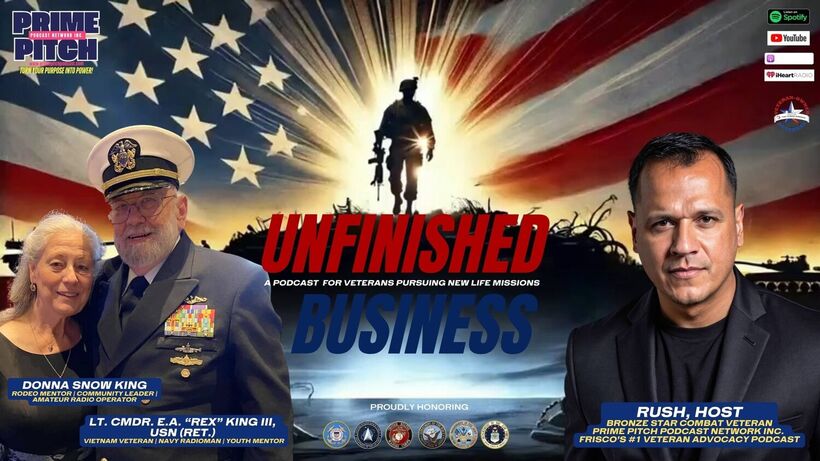
Rex & Donna King
Lt. Cmdr. USN (Ret.), Vietnam Veteran · Rodeo Mentor & Radio Operator
About the show
Unfinished Business is a podcast for veterans pursuing new missions after the uniform, and for the families and communities who stand beside them. Hosted by Eric Rush, The Conversation Architect, a Bronze Star combat veteran and the founder of Prime Pitch Podcast Network.
Read the full transcript
Again, this goesThis goes right back to when you get up in the morning, you either believe God can or God can't. Mm-hmm. You have to make a conscious choice. I was dealing with, uh, financial struggles. This was before I knew Rex.
I was dealing with some financial struggles-and I had to make a decision. I either paid my electric bill, or I gave my tithe at church. Even as bad as things has gotten' and let me add in there, a lot of it was from my own doings, but He will meet you where you're at, trust me. I had to, uh, make a decision. So I hadI said, "Lord, I just figured out something.
I can live without electricity, but I can't live without you."So forget the electric bill, I gave my tithe and offering with a prompt-to-do-it, cheerful attitude. And I said, "Lord, III can't live without you, but I can do without electricity if it comes down to it."Yeah. And lo and behold, out of nowhere, my electric bill got paid, and then increase came to me that Ifrom a- an area I wasn't even expecting. So I learned a very valuable lesson: You cannot out-give God. Amen.
I don't care how hard you try. I don't care how tall you are, how big you are, or how bad you are, you can't do it. Sound y'all.1, 2. Hey, what's up, guys? Welcome to Unfinished Business, a podcast for veterans pursuing new life missions.35 years of service shapes a person.
It shapes the way you wake up, the way you carry responsibility, the way you see the world. Discipline becomes rhythm, commitment becomes instinct, and when the chapter closes, something quieter begins, a different kind of adjustment, a different kind of purpose. For Lieutenant Commander E. A."Rex" King III, that life of long-term service did not disappear. It settled into who he is.
And in a later season, Donna Snow King entered that story, not at the beginning, but at the meaningful chapter where experience, faith, and intentional partnership carried, carried weight. Together, they share a love for radio, the patience of listening, the clarity of signal, the discipline of connection. They share a life of prayer that is not loud, butnot performative, but steady. In a time when many veterans quietly wrestle with purpose after uniform, their story carries something worth leaning into. Today, it's not about medals or time- timelines.
It's about what remains. It's about connection to each other, to faith, to the mission that continues long after formal service ends. Re- Uh, Donna, Rex- Thank you. it's a pleasure having you on the on- Thank you. on the Unfinished Business podcast, a podcast for veterans pursuing new life missions.
Um, when wewhen you heard that introduction, uh, what, what went, what went through your mind? Just living back to what my career was and how I, how, h- how I transitioned into civilian life and carried a lot of my military with me. Donna, what did youWhat were your thoughts about that, that cold opening? Um, it really basically described Rex from what I perceived his life before me was, and it definitely covered our life after there was an us. Wow, thatI mean, that's amazing.
And, you know, I'm just looking out from the, you know, 30,000 fer- foot view of who your lifes are, y- your lives are, uh, what your lives represent from, from, uh, from a spiritual sense- Mm-hmm. Right. from a, from a, a level of camaraderie and faithfulness, and, and, um, it's, it's been a, uhFor me, I've been contemplating having you on the podcast for months. Really? Mm-hmm.
Oh, wow. Yeah, yeah. Yeah, absolutely. And, and it was just like, "I wanna get to knowI wanna get to know these guys."They just have a, a, a really warm heart, and, and I wanted to sit down with y'all today and get to know y'all better. So it's a pleasure having you here.
Awesome. Thank you. Well, thank you very much. We appreciate that. Yeah.
Gosh. Absolutely. Rex, um, when you began your service i- in, uhas a, uh, Vietnam veteran, as a radioman- Mm-hmm. um, when you think about those early years working in communication, what did the world demand of you? Perfection.
That's, uh, uh, covers a lot. But when you're copying Morse code and handling messages, decoding messages, your integrity has to be beyond reproach. You have to have, uhWhen you have a top secret clearance, you read every message that comes to the command, and, and fleet messages as well. And i- i- with all the knowledge you have of what's going on and who's doing it, you can't speak of it to anyone. Mm-hmm.
You, you have to keep thatAnd I've learned to do that over the years, and I've kept confidences from my, uh, not only the military, but those who've, uh, shared their, their private thoughts with me. And it's, uh, very important to be perfect. You can't misspell a word, or it might change if you put the comma in the wrong place. It could change the entire meaning of a paragraph, which could be orders to a subordinate. So we have to keep those absolutely perfect.
And so I did that and got my license when I was 11, just went on from there. Uh, that is sothat is so cool, and I never thought of it that way, that your communication has to be perfect 'cause there's lives on the line. There's, you know, there's, there's, um, there's serious, uhthere's serious, uh, risk if you don't do it the rightif you don't say it the right way or communicate it the w- right way. Absolutely. Lives are at stake.
If I take grid coordinates for a fire mission, and I miss 00 one number in that grid coordinateOf course, people that don't understand our world don't know what grid coordinates are, but they're, uh, locations on a map. Other than latitude and longitude, we often use grid coordinates. And if I miss one character, miss one number, and I could put friendly fire down on our troops and kill our own men. So, um, my mission was always perfection. Wow.
Th- that's insane. I, I didn't even thi- think about that. When you look at, um, uh, Morse code, at, at that time, what was the different? WhatLike, during that time, Morse code wasI guess that was the pro- uh, the prominent way to, uh, comm- uh, to commun- communicate or to- Well, it was faster and more accurate. Uh, when you're in voice communications, you know, you, you kind 0 often hear the word say again.
If you've been in the field, you know what I'm talking about. With Morse code, I can get a message through even with, uh, uh, bad atmospherics, uh, bad conditions, you know, atmospheric conditions and, and other radio, I can get a message through. And it was, um, it was, uh, it, it was actually over 100 years old. It was a good, accurate form, form of communication, and still is today. Uh, we, we can't communicate with some countries unless we use Morse code.
Yeah, thatMan, you know, wh- when I was doing my research on both of y'all, both of y'all, like, you know, I was thinking, "Wh- what's a radioman? You know, like, I mean, I knew in a general sense, but once I got underneath the hood and, and I startedIt was very complex for me to, like, to kind of put it together. But now that you're s- you're sitting here with me today, I have a kind of a better understanding of like, okay, now I understand what, like, w- you know, one thing, 1, one mistake, one word different, one comma different, it just, it could change the whole, the whole thing. Um, over 35 years in the Navy? Yes, sir.
Uh, active and reserve, yes. Okay, yeah. And, um, what did that life require of you the most that, that you never see? Well, the discipline that we don't see in the civilian life, um, like we were talking earlier, uh, 15 minutes ahead is right on time for an appointment. Uh, always, always do your best to, um, put on a professionalEverything has to be professional, accurate, honest.
Uh, you can't, uh, you can't advance in the military without the characteristics of, uh, trustworthiness, of, uh, honor. You have to maintain your honor at all times, and it became even more when I became an officer. Uh, my honor was always on the line. You, you don't lie. You, you take full responsibility.
Today, you don't hear that in the civilian wor- world, especially with politicians. You know. Um, my deal was no excuse. It was myAnd I don't apologize. I tell my superiors what I'm gonna do to correct that so it won't happen again.
Yeah, that, that's a, that's a big one. You know, it's to say, "Hey, look, I made a mistake, and this is what I'm gonna do. This is what I'm gonna ensure not to"Um, that's kind of a, a strategy, uh, as far as rehabilitating your, your trust and, and, and repairing whatever, um, whatever wrongs have happened too. Correct. Um, i- whenIn your care- how did your career transcend itself?
Y- you started off, uhLike, how, how does that career for, uh, ra- uh, radiomenGive us a little bit of that. Well, I was, I was, uh, 17 when I joined. I had the draft board on my sixth, and I was about to turn 18, and I knew I was gonna be snatched up. Uh, this is 1965, and we're, we're drafting left and right. So, my mother was a naval aviator in World War II, and my dad was, uh, in the Texas 12th Armor Division ETO.
And, um, I went to the recruiter. I had a friend of mine, um, named Carl. We grew up together. And, uh, each of the branches had quotas, not like we do today."I can only take so many people."'Cause they knew the draft was gonna get everybody. So when you wanted to join a service other than the army, you had to see if they had an opening, and there was one opening in the Marines and one in the Navy.
Uh, Carl got the Marines, and I got the Navy. And, um, unfortunately, Carl lost both of his eyes in Vietnam. Mm-hmm. And we were at, uh, Balboa Naval Hospital, and I introduced him to amateur radio because he was in a very dark spot. And he became an amateur radio license, still is, uh, licensee, and still is today, very active on the radio bands.
And it brought him out of his very, very dark hole. That's beautiful. Was that something he, he, uh, liked doing brayos? Or was that something that he justYes. Yeah.
That's an amazing story, you know. Like, um, you know, for a lot of, uh, um, uh, combat veterans or those that have, uh, experienced war after Vietnam, we, for, like, for myself, I leaned heavily on, on when reading books about Vietnam, like, when I, when I was deployed, it was, it was like, you have to get in a mental space. Yes, you do. You know, like, understand that, that, that what you're experiencing here in the desert is not the same thing as in the jungle, you know? And, um, that was one of the things I leaned heavily, heavily on is, uh, to just get the, the mindset of, of, of understanding that, you know, this is not that kind of war, and, and, and, um, you see what's in front of you mores so than you see, you know, behind, behind- Oh, yeah.
on each side of you, uh, many times, and, you know, and, and I think that helped me stabilize a little bit, my experience, uh, in my deployment. Um, do you see that someDo you s- Yeah. Did you see it? Did you lean into, did you lean into World War I, War II? Absolutely, I did.
Um, tactics are everything, especially if you're in the ground. Uh, you know, IIf you're in country, uh, there's no new tactics. There'sYou learn from mistakes of other tactics. Um, yes, you come up with something different, but, um, reading history, um, there was one book, War As I Knew It, uh, by Patton, and I truly admired the man. I thought he was a, uhHis writing wa-It was a little bit odd, but, uh, his book wasWhat was in it was, uh, spot-on for, uh, someone in, in combat, uh, leading men into, into combat.
Uh, he understood, uh, history like nobody else I under- I ever met in books, and I learned so much from him, uh, and, uh, uh, others. Uh, George Marshall, um, Admiral Nimitz was one of my heroes. So was Beau Halsey. And, uh, uhCall in. And soWhere the hell I hitI, uh, thought I hit a button.
Anyway- Take it out. No. No. Huh- There we go. Okay, good.
Um, there were so many people I, that I met that, in books, that I could apply to my, my life. Uh, one of the ones I, I didn't like was, um, MacArthur. He was more political than he was a stat- a statistician. Um, so I learned uh, lots of things, and it's allAnd it's applied to my life. And I knew the faith of some of these great admirals too, like Spruance.
Hm. Um, and, uh, Ol- Ollie Burke. Uh, he was, he was very, religious. Well, uh, he had great faith. There's a difference between just being religious and having great faith, and he had great faith.
And, uh, I found that with Nimitz as well. He had a deep faith. Hm. And, uh, uh, I read that in some ofYou could see it in the books that he, that were written about him. All right.
That's, that's amazing. Man, you have such a, like a high, um, IQ, you know, just having read it, you know, wisdom, like, from those, from those, uh, gen- uh, generals and, and, and leaders in the military, you know. It's, uh, thatI mean, now I'm hearing you, I'm kind of blown away, uh, at, at, at the i- as many, uh, uh, as the many people that got you, that, that you, uh, many, um, uh, military leaders that you were dialed into, you know. Um, how much is that, how much is that, you knowLieutenant Commander, you be- you became a lieutenant commander. No one, not a ma- not ev- not everybody reaches that, that, you know?
Right. Well, especially if you're formerly enlisted. Yeah. Um, one of my bosses, you might have heard of him, Robert, uh, Sam- uh, Samuel Morrison. Admiral Morrison was a World War II hero, Korean hero, and he was commander of the 7th Fleet, which was everything out there along Vietnam, and he had a wayward son.
You might have heard of him. Jim Morrison. Oh, heWow. You want a career ender? Go in there with an 8track tape and ask the admiral to sign it.
Uh-you, you'll find your orders when you walk out. You're going someplace dark and unheard of. Well, tell them how you became a lieutenant commander. Yeah. That'd be cool.
Uh, I was on a riverboat, and, uh, driving, uhWell, I was on destroyers, and then I got reassigned to r- riverboats. Somebody said, "You're from Texas."I said, "Yes, sir.""I bet you know how to drive a bass boat."And that waswrong answer. Anyway, I was the Uber driver for the Marines out around Hue City on the Perfume River. And, um, I, I was very popular because I could make phone patches. Uh, people in, in the military after us had internet and wonderful things that we didn't have.
Yeah. But I would use my, uh, government issued KWM2, uh, columns radio to call, uh, s- someone stateside, and then they would illegally connect the, uh, radio to the phone lines, 'cause Ma Bell did not like that, and make phone calls to, uh, family members. There were certain ham radio operators that didn't reverse the charges, 'cause I never knew where in the United States I was gonna get somebody. And one of my favorites was, uh, Barry Goldwater, K7UGA, that was his call sign, Walter Cronkite, Andy Devine, uh, you know the cowboy? Yes.
Um, thereOh, I was trying to think. Oh, one of my friends, and IWe remained friends until he passed, was, uh, a guy named Paul Tibbets Jr. You ever heard of him? No, no. Well, he dropped an egg on Hiroshima.
Oh. He flew the Enola Gay. Oh, wow. Now if you'reDon't forget, tell how you became Commander. Oh, okay.
Yeah, I got off my rabbit trail. Uh, after, uh, Tet there was, uhWe were decimated. Uh, we took a, a, a, an unbelievable number of casualties, and I was wounded along with everybody, it seemed like, everybody out there, in one degree or another. And, uh, Colonel Green was out there, and, and the colonel, uh, says, "Here's your orders."I said, "Orders, sir?""Oh, you're going to OCS.""Please, sir, don't send me to the dark side.""I, I don't wanna go."Well, I went, and I came out in the top 10% of my class. That kinda, kinda refers to me as an overachiever.
He is. Yeah. I didn't get that ro- Truly. Yeah, truly he is. And then he sent me right back to the boats.
And then, uh, I did boats, and came up through the ranks. And as high as you can get as an LDO, Limited Duty Officer, that's a prior enlisted, back then was Lieutenant Commander, and I made it in 4 years. Mm-hmm. And you don't do that in civilian life, or in peacetime, you know. The peacetime promotions are much more restrictive.
Yeah. But, uh, then myI, um, had another admiral, a-, uh, that I called him up on the phone, and said, "Sir, I got a son-in-law I hadn't met."He goes, "Okay. Where is he?""Well, he's on a frigate ou- out in the Gulf, and I need some active duty time," you know, being a reservist. And he says, "You hadn't met him?"I said, "No, sir. And the XO there had to takeIs going to have to take leave, uh, for some personal thing, and I'll just take over as XO, and I've already contacted the skipper.""Uh-huh.
Okay."So, I got orders, a- and he thought, "You're, you're crazy going to a frigate."Those were little corks that bounced around in the water. Yeah. And so I got out there, and I landed on the Truman, and they loaded me aboard a l- a Lance helicopter, and they were taking me out to the frigates. The one day, the seas are very angry, and they're going up and down, up and down, and the helicopter, uh, said, "Sir, I can't land."He says, uh, "When's the last time you repelled?", as they threw me out the door. Wow.
And I'm going, "Help!"And my gear went out before me, and I saw it go thud, thud, thud. And I'm going, "Oh, no."And then I went down, and I bounced 2 or 3 times as the helicopter went up and the ship went down, we smashed together, and I go, "Okay."So I got over that and, um, I reported to the captain, like, I stood up like, "I meant to do that."You know? That's awesome. Yeah. And, yeah, I, I was good.
And s- so the captain saidwanted to know who my son-in-law was and I told him. He's, next morning at quarters, aty- the Navy has a thing called quarters at 0745. Everybody not actually on duty, the white hats were on the stern of this helicopter, uh, pad. The chief's on one side, the officers on the other and the- and that particular day, it's normally the XO that reads the plan of the day, we call it the POD. Well, the skipper was there because the XO was taken off and I was standing over there in the side.
And he went through all the mundane things and then he got down to a point and he sayshe yelled out this guy's name. I'm not gonna repeat his name, but he c- he ca- and his head pops up like a prairie dog in a, you know, prairie dog kind of looking around, "What in the world did I do wrong?"And he called him front and center and then he made him, the ma- uh, command master chief yelled, "About face."Now he's facing this horseshoe of the crew and he says, "Attention to orders."Everybody's heels click together and they all stand tall. He said, "If I'm commanding officer USS Simpson FFG-5622, Petty Officer, uh, you are hereby ordered from the captain not to refer to Commander King as daddy as long as he's on board this vessel. Do you understand?"Can you imagine what his life was like for the next 45 days-as we bounced around the ocean? He said, "Daddy."That's funny.
Um, Donna, you're here. You're- you've been married to, to Rex for 4 years. But today, when you hear his, when you hear his stories, like, you'rewe're sitting here listening. What- what goes to your heart and mind when youThe first thing I think about is how can this be so real? Um, this is things you see in the movies, you see on TV, you read in the books.
But to actually meet someone that lived it and lived it with integrity and honor and, uh, kept God at the head of all of it. Mm-hmm. And, uh, I- I just say that with everything that he lived through, that he's been through, he still continues to lead and, uh, that's in- that's important. Yeah. That's important that we still have leaders that believes in the values that the United States of America was built on to help lead the upcoming generations.
So I look at him and I say, "Even at his age, he is still doing what he's done all his life."And it makes me very proud of him. Yeah. Makes me very proud of him. And besides that, I think he's cute. Yeah.
Y'all didn't see it, but they were flirting like crazy while I was saying that. I didn't get it on camera. I wish I would have, but no. No, that, I mean, that- that's beautiful. I mean, just I was listening to it also, in my mind I was like, "I wonder what Donna feel like when she hears that?"Anything else you wanna add to that?
Well, you wanna share about our wedding? That I called all my, my friends that I served with. Donna made me get my uniform from my- Whate- whenever he finally proposed-um, uh, he said, uhnow see, thing is, is he's Catholic and I'm a good little Baptist girl. He says he's a good little Irish Catholic boy and I said, "Well, I'm a good little Baptist girl."And that was a clashing of 2 worlds. Mm-hmm.
Uh, but praise God we made it work. But in talking about planning everything, I said, "I want you in your uniform. And, uh, what about some of your buddies that you served with?"And when it was all said and done, we actually had 11 people there in uniform- Wow. uh, at our wedding. And it, it meant a lot to me.
I'dI was not a part of his life back then, but he is still that man. That's beautiful. He is still that man. And they flew in from all over the United States- Mm-hmm. to be at the wedding.
And s- I think it's 'cause they couldn't believe a Catholic was marrying a Baptist. I was wondering about that. Uh, but but th- these guys I- I served with at 1 point or another in my career and we, we remained f- friends all these years. And when Donna saidinvited them, there was no hesitation. Every one of them responded positively and showed up and some had to lose a great deal of weight to get their uniforms on.
Others went to- They said they shrunk. They shrunk in the closet. Yeah. Others went to Omar the tent maker, got new uniforms. Uh, Rex, when, uh, when retirement came, was there a moment when you felt the shift in what is eternity for you?
Well, I- I felt like I was leaving my life. Uh, this is all I've known in my adult life, even in teenage life, but, um, this is what I was used to. Discipline, um, when you talk to people and they say something to you, you- you take them for their word in the military. And, and I had to learn to question things in the civilian world. Uh, people say they're gonna be there at a certain time and they don't show up until later.
That wouldn't be tolerated in my world, and I have to get used to that. And disrespect, um, a lot of young people are very disrespectful still. Um, if I have on a Vietnam veteran hat, I still get derogatory things said about me. Hmm. Um, and, and, uh, th- th- this isn't the world I lived in.
My world was, uh, you know, e- every morning on base, we had colors. And every child in base housing got off their swing sets and off th- and out of the pl- and stood at attention with a hand over their heart. And I look out today, and I couldn't get a kid to even recognize the national anthem. And that's- Yeah. that hit a little hard on me 'cause I'm, uh, I'm pretty patriotic about how I'm just kind of a flag wave-er.
Am, am I not? You are, rightfully so. That's so, that, I mean, that's, that's so, like, you know, now, you know? Like, you were mentioning how y- how you had, um, you know, you've, you had a difficult transition, you know? Like, a lot of veterans have difficult transitions.
Oh, absolutely. Yes, they do. But you had 35 years. I didn't have 35 years. But, um, what, w- what, what do you see when you, when we talk about transitioning out, uh, uh, what is something you've learned that you've said that this, this is what I can hold onto that, that, that maybe I can help s- I can pass on to someone else?
Well, that was my amateur radio. Hmm. Because I've gotten on the air and I've l- uh, located a vast number of veterans groups. If you were in the 3rd ID, if you were in the, uh, 2nd Armored, if you were an MLRS, uh, you, if you were a submarine sailor, if you were, uh, SAC, what ev- there's a net on amateur radio for that. Mm-hmm.
And there's that camaraderie of talking to fellow veterans who served. There's Vietnam vets, uh, there's Gulf War vet nets. So people can, uh, support each other. Yeah. And it, it, and some people, uh, p- and we recognize when we have an at-risk veteran on the net.
And we assist them any way we can and, you know, encourage them, uh, especially those who have physical or mental, uh, emotional issues. We try to, you know, there's, you c- it, you don't see somebody's face when you're talking to them on the radio. Mm-hmm. So we don't know if they've lost an arm or a leg or if they're quadriplegic or, uh, blind or any other disability. They're just the same person as they were when they were on active duty, and they're treated with that same respect.
And that's, to them, is their highlight of the day, is getting on that radio and talking to people because they, while they're talking, they paint a word picture. I learned that when I was 11 years old. I'd get on, I called them my magic boxes. I'd turn on the radios and people in far off lands paint a picture to me called a word picture- Hmm. of what's going on.
And even today, uh, COVID-19 hit. Uh, a few, in, during the pandemic, I talked to a freighter, one of these cargo, uh, container freighters. Ooh. Mm-hmm. Container freighters.
As I was talking to him on the radio, and I come to find out he and the crew have been quarantined on that freighter for two and a half years. Mm-hmm. No television, no telephone, and in every port they pulled into, uh, they had military, paramilitary or military people there with machine guns or submachine guns pointing at them so they won't jump ship and spread the pandemic. Mm-hmm. So for two and a half years, 18 people shared that big old gigantic freighter.
Yeah. And he was so hungry to hear what was going on in the world because he had no news. Wow. That's, uh, that, I was gonna ask you, like, when we talk about, like, you know, the individuals out there, you know? the individuals out there, you know?
I wasMy, my question was gonna be is like, what are we talking about? Like, how many people, like, you know? But when you give me that story, it, you know, it, it really resonates. Like, it's like, a lot, many, many people from around the world. Is that right?
If there's over 800,000 Americans who are licensed as amateur radio operators- Wow. worldwide it's close to 14 1000000. Wow. That's insane. Okay, this is gonna be my promise.
I'm gonna go where y'all, or to where y'all live, and you're gonna show me what you do. I would be happy to put you in with the- With the Doc Ballard, when we talked about that. Well, we'llI wanna learn what y'all do.'Cause that, that's a very, uh, nice one to learn, you know? Well, do you remember a Medal of Honor recipient named Woody Williams? Yes.
Well, he was a dear friend of mine for about 45, 50 years. And I tell you a real quick story. Uh, I lived in Wichita Falls at the time. Had a ranch, and one of my trucks was a, what they call a medium duty truck. That's what I hauled, uh, the cattle to market in, 'cause it was a big, big truck.22-5 re- rims and all that.
Wow. That was an International. And that was the only truck I had available that day to go pick up Woody at DFW airport. So I get down there, and he just keeps looking up and up. Woody was not a, tallHe was like 5 foot 4.
Hmm. And so I put his gear in the back seat, and then I let the air out of the ride seat so it would, it wouldn't be such a harsh ride for him, 'cause I didn't have a trailer on. And he climbed up 3 steps to get up into the cab, and then he sat down. And I had my radios on. As we pulled out of DFW airport, there was a group of students talking to the International Space Station, 'cause they were all licensed hams.
Well their class bell rang, and I asked if I could call the station. And they said yes. I said, "I have a Medal of Honor recipient."Well, I don't know who was more excited, the astronauts talking to a Medal of Honor recipient from World War II, or a World War II veteran who's talking to spacemen. And- That's what he called 'em. He called 'em spacemen.
And we bounced along up I-35. He's going up and down in his seat. And I'm driving and going, "Oh, my."And he kept, he just kept talking, 'cause everybody in the military is an RTO. Yeah. So he, he had no problem push-to-talk, you know?
And he told that story for the rest of his life, about the day he was driving through Dallas talking to this spaceman. Too funny. Um, Donna, um, when you met Rex, Rex, um, um, what did you sense about those years and the discipline? No, I, I'm sorry. Let me read that again.
Um, when you met Rex- Mm-hmmwhat did you sense about those years and that discipline had shaped him? Uh, when I first re- met Rex, let's, let's get the, theLet's get straight here. I didn't think he was cute at all. I didn't. But what I saw was a man that revered family, fiercely patriotic, fiercely faithful.
And, uh, as I started learning'Cause the first time I met him, he had a, a Vietnam vet hat on. Mm. So obviously he's a Vietnam veteran. And, uh, I, I, I, I didn'tI knew about Vietnam. I had not studied it a lot, but it made me, uh, made me realize that as I'm hearing this stuff, what this man lived through, and it made me realize what that said about the man that he was inside.
Hmm. Because what was inside was what people were seeing on the outside. It wasn't a fake front. Yeah. He was who he said he was.
And he didn't have toThere was no braggadocios about it. It was just when asked, he would answer a question. And being on the outside, remember, I didn't think he was cute. Being on the outside over here, I'm watching this, because when I first met him, it was because the TV show my family and I was on. And he would come to the weekly watch parties when a new season was coming out.
Yeah. And that's where I gotThat's where I met him for the first time, and, and got to know him. Well, when you just meet someone once a week, and that would be, excuse me, for, um, 13 Friday nights, as each new episode aired, then we'd take a while off. Then the next season would come out. Well, by little, by little, it, it started building a picture, a word picture, actually.
Wow. It was like a word picture of who this man was, where he had been, and what he stood for. And, uh, I, I was honored to know someone of that stature. Mm-hmm. Now, my dad served in the National Guard, and was mobilized during the Cuban, uh, crisis.
Yeah. Um, and my uncle had served in, in the Army. And so, uh, I, at that point, I did have 2 nephews that had been in the Marines. Um, so I, I did have a taste of some of the military world, but nothing to the degree of listening to him talk as the subject would come up, or someone would ask him a question. Yeah.
Oh, as you were listening, uh, you know, and as you were sitting here, Rex, I, IYou know, one of the biggest things too about this podcast and why I wanted to honoruh, it's an honor to have you here is 'cause, um, wanted to document some of the history as well, and then you sharing that today, uh, um, you know, had to add, uh, y- IY- you talked about Shilo Harris, right? In, in, uh- Yeah. and, and you, you know, you guys know him. Uh- Oh, yeah. And the person, the, the, what, what's striking to me is you have, you know, there are some veterans that struggle with post-traumatic stress and of course Shilo has his, has his own injuries to deal with.
Yes. But one of the things, uh, and this is for you, Donna, like, um, I can't 0 you know, Shilo has a, a magnetic personality. He does. With charm and humor and laughter and fun and, and, and then you know what he's been through, right? Mm-hmm.
Was part of when, when, when, when you, when you met Rex were you concerned about that or was that, that energy, that magnetism was, was there, you know, when, when, once he was attending your, your shows and stuff like that? Um, energy and magnetism was there. Yeah. And, uh, he laughed a lot. Mm-hmm.
He still laughs a lot. And I think wheneverNow this is my personal take on it. Rex will have to, um,- Huh? correct me if I'm wrong. I wouldn't dare.
I know I'll whoop your legs. Um, but when a, when a person has lived through, seen, done, witnessed, been a part of whatever he was called upon to do- Hmm. how much worse could your life be? It, to me it's everything after that had to be for the better. Mm-hmm.
And I think that's how he started viewing it. He saw so much bad,- Mm-hmm. was involved in so much bad, but was following th- his orders. He chose to go with, "I'm gonna be happy. I'm gonna live life and I'm going to move forward."Did I say that right?
Would you agree with that? Yeah, honored God. Faith in God brought me through all that too. Mm-hmm. You know?
But, but wh- but- Yeah. Why I made a, I made a choice too. You made a choice to,- Mm-hmm."Okay, I've seen enough bad. Let's live for, as best we can, good and to be happy."And there- It took a lot of prayer. It, itThat and you drank a lot in the military.
Yeah, I did. I, I, I kept several liquor companies in business in Vietnam. Um, they, they sent me sympathy letters when theyWhen you quit drinking? Yeah, I quit drinking. I, I, I literally quit drinking after Vietnam bec- uh, I, IJust the smell of liquor just takes me back to a place I don't want to be.
Mm-hmm. And I drank an enormous amount. Well, people have to cope. Some people smoked, I didn't. Yeah.
Other people, um, uh, you know, took drugs and stuff after. I, I drank. I drank to excess and I admitAnd then I prayed, I prayed a lot and I, I needed God's help and I ne- and I just cold turkey one day. I said, "I'm not gonna drink another drop."Mm-hmm. That's beautiful.
That's beautiful. Thank you for sharing that. That's, uh, you know, I think a lot of veterans need to hear this right now, like, a lot of guy- it not, doesn't matter if you're a veteran or not. Yeah. If you're, you know, if you're dealing with some, you, you haven't coped withthat you turn to, I certainly have done that myself, you know.
Yeah, no. And, uh, and, and, but to hear you say it, uh, I think it, it's gonna penetrate a lot of hearts and minds today for sure. Let's talk about faith, okay? That's the next thing we're gonna talk about. Oh, boy.
And it's for both of you, okay? Oh. Faith clearly plays a role in your lives, right? Mm-hmm. Mm-hmm.
When no one is watching, what does prayer look like in your home? I think weCan I go first? You certainly may. You'reI think the passage in the Bible that says pray without ceasing. Yeah.
That's the first thing that comes to my mind when I hear you ask the question, because it doesn't matter whether we're trying to figure out to drive to Georgia or pray over the food, it, you should always pray without ceising. So we do, we pray about everything. And people may think, "Well, that's stupid."No, it's not. Try it, you'll like it. Mm-hmm.
It, it, it brings you answers. The biggest thing it brings is peace. So, um, we pray together. We pray separately. Mm-hmm.
Um, we pray over food. Uh, wouldn't you say one of the- a big impact we make out in public is praying over the food? Oh, yeah. If we're at a restaurant or something, people just look at us 'cause we hold hands and pray. Mm-hmm.
Um, and I use the Hallow app every day, um, several times a day sometimes. It's, uh, th- it has a lot of scripture every day that- and, uh, it takes you on a path through the Bible. And, um, I think 1.8 million people or something have got it here so far. And, um, it, it, it helps me. I, I get up in the morning and I turn it on, and my hearing aids are connected to my phone, so I get to listen to it.'Cause I get up a little before Donna, don't I?
He gets up. I- did you know, I thought there was only 14 o'clock on the Yeah. And that was 4:00 PM. Evidently, there's a 4:00 AM. That sounds like me too.
I'm the first one up. I get up at, like, 4:00. Well, yeah. It's, it's a military thing. You know?
You know, when I joined the Navy, I thought I was going on vacation 'cause my parents owned restaurants in Wichita Falls, and I worked day and night. And oftime- sometimes 11 o'clock at night, and then I'd get up and go to school the next morning after I went and got meat down in Fort Worth and drove back. And I worked like that, carrying 55-gallon m- metal trash cans out, dumping them and scrubbing them every day, and those- being military alarm clocks, for those who don't know. Um, you know what I'm talking about. Yeah, right.
Uh, anyway, I joined the Navy, and they said, "You're going to bed at 9 o'clock.""What?"And, "You're getting up at 5:00.""I get to sleep in?"You know? And everybody else was having trouble with the, with the rifles out there in the, in the grinder, doing their exercises. I was just having a great time. That's funny. Um, I wanna stay on this, on, on relationship, uh, relationship with prayer.
Oh, yeah. Because I think that, that was one of the other things that, that really, um, um, you inspired, y- y- you inspired me with too, is listening. I wanna, I wanna touch on that 'cause, um, how important is it when we think about, just from the, um, veteran community, military community, or, you know, sp- soldier spouse, soldier spouse, or, um, um, wh- h- how, how important is it for, for us to integrate that aspect into, um, the advocacy for veterans? E- e- it's paramount. Mm-hmm.
Oh, I agree with Rex. People say, "Well, when should we pray?"Well, you better pray before you get outta the car to go into a store. Um, you know, there are so many times that I, I've gotten ready to go into a store, as an example, and, and y- you know, y'all are gonna think I'm crazy, and that's all right, go ahead, and maybe I am. But when you pray, uh, "Lord, open doors for me."Hmm. Or close doors.
Whoa. Uh, "Lord, let me find what I need."Hmm."Lord, I need a, I need a parking place up close to the store because it's raining cats and dogs out here."Uh, and then, uh, "Lord, let me be an instrument of your use. Let me be a vessel. Let me be your voice, your hands, your feet."Yeah. You know?
Yeah. And lo and behold, I, guess what? There's a parking place that opens up. Yeah. I go in and I might run into somebody that I hadn't seen in a long time.
They're like, "Well, how you been doing?"And just, and, and if you will ask that sincerely, you're gonna get a sincere answer if, if it's ordained of God. And they're like, "Well, Donna, it's not been good.""Well, do you mind if I pray for you?"Yeah."Would you pray for me now?"Sure. And I say, "Sure, I will."And, uh, uh, whenever you walk that out, then you're being obedient. And a lot of people don't understand this. When you talk about tithes and offerings, we've recently had conversation about time, talent, and treasure.
Time- We talked a lot about that, yes. Time, talent, and treasure. So now, believe it or not, when I took my time to be obedient and talk with that person, pray with that person, or just give them a, "It's gonna be all right. Don't worry about it, it's gonna be all right," encouragement, do you realize you're sewing seed? Yeah.
You're sewing seed in the ground. Because anything that you do is seed. And a harvest is gonna come up, whether it's good, bad, or, well, there ain't that there's good or bad. Yeah. It's your choice.
So, um, that's how I view prayer. How do you view prayer, Rex? Well, one of the things that I've been doing is praying, "Empty me, Lord. Empty me of every evil, every sin, every, every bad thing. And then fill me, fill me with your righteousness, Lord."Hm."And then use me."Hm."Empty me, fill me, use me."I want to beAnd Donna and I do this about everything we do, whether we consciously say those words, but-just by what we do when we talk is empty us, Lord.
Mm-hmm. Then fill us with you so we can do, and use us in the community and, and beyond. Um- One, 1, one thing I want to add onto that is when you do this with the right heart- Yeah. you're also sowing seed in the people that's watching. Mm-hmm.
You're not only sowing seed in that life that you prayed for, but you're sowing seed in the people that's watching and that's being a role model. Yeah. And that's what we're all called to do, is to help mentor up the upcoming generations. That's why y'all are here. Yeah.
You know, like, y'all, y'all, y'all were putting prayers up. Yeah. And I s- I was reading it, and I was like, you know, knowing you that it was you, m- m- m- military commander, military integrating, uh, uh, prayer life into the community and on, on, on social media and stuff like that. One of the things that really, drew me to y'all was that, was like, I need to g- well, we're, we're gonna sit down, I'm gonna get these guys in- Yeah. sit down and talk about Jesus Christ, we're gonna talk- Right.
Amen. We're gonna talk about faith, we're gonna talk about your lives, and, and, and, and yeah. I mean, that, that's, that's just, uh, um, God is truth. It's what actually inspired me to invite y'all 'cause I wanted to see a- you know, I have a friend that sends me prayers, uh, privately in, in the chat, and they're really powerful prayers, you know. And, um, you're like, this is right on time, God.
Like, this is what I need to hear. So, so just know that that's, I love that. And, and the next question I have for you is, has there been a private, uh, season when faith steadied you through uncertainty? Oh, yeah, we both have that. Go ahead, sweetheart.
Um, again, this goes, this goes right back to when you get up in the morning, you either believe God can or God can't. Mm-hmm. You have to make a conscious choice. And, uh, I was dealing with, um, sorry. I was dealing with, um, financial struggles.
This was before I knew Rex. Remember even before then I didn't think he was cute. I was dealing with some financial struggles, and I had to make a decision. I either paid my electric bill or I gave my tithe at church. Even as bad as things has gotten, and let me add in there, a lot of it was from my own doings.
But he will meet you where you're at, trust me. I had to, uh, make a decision. So I had, I said, "Lord, I just figured out something. I can live without electricity but I can't live without you."Mm-hmm. So, "forget the electric bill.
I gave my tithe and offering" with a prompt to do it cheerful attitude. Yes. Always. You don't run up there and do the throw the money down there and hope the pastor and everybody else sees how much you throw in there. No.
And I said, "Lord, I, I, I can't live without you but I can do without electricity," see, it comes down to it. Yeah. And lo and behold, out of nowhere my electric bill got paid, and then increase came to me that I, from, uh, an area I wasn't even expecting. So I learned a very valuable lesson. You cannot outgive God.
Amen. I don't care how hard you try, I don't care how tall you are, how big you are, or how bad you are. You can't do it. I tried. You can't.
Rex, you wanna answer that? Well, um, I hadmy wife passed away, uh- Not me. Not this one. Oh, no. No, no, no.
Not, not me. No, I, yeah, I just laid hands on her. UhAnd it took me to a, it, it's, uh, it's amazing. When you lose a spouse, and it was, uh, no matter how long it took for her to pass, and this was the long goodbye thing, you know, all that, uh, Alzheimer's is never good. Mm-hmm.
And she had other physical health issues as well. And so, for over 12 years it was very trying. And she passes, you, you, one of the things you learn is, all your couples friends lost your phone number Yeah. They don't invite you out for dinners anymore. Well, because you don't have your spouse.
Uh, they don't invite you over for, you know, uh, uh, anything. It, all social cond- contacts just went away. So, it added to my, uh, isolation. And I, I went to a very dark place. Um, I didn't know what to do, and, but I, I did have faith in God, and I, and I kept, and, and as Donna says, we pray constantly.
And I, I prayed, "Lord, help me."I didn't know what Lord, the Lord was gonna help me with, but I, I just asked for His help. It's best not to be specific 'cause God's got better ideas than I do. Yeah. And- He's a better quarterback. Yeah, He is.
And I love Donna's TV show. The reason why, it, uh, at the time, it was affordable remodels that our veterans could afford. They were auctioning off these houses, and it, it became the number one show on AFN. And I had no idea. Yeah.
I didn't- Yeah. even know what AFN was. Arm Forces Network for everybody that doesn't know. Yeah. I didn't know that right.
But it, but we got, we were at the commissioning of the Woody Williams- Mm-hmm. uh, his ship. I needed a plus one. This is before we got married. He still wasn't cute.
No, and, uh, and her daddy, uh, well, her daddy started it off. I think he was a matchmaker. Go back to the ship. Well, anyway, we were on the ship, and, um, 2 chief petty officers came up. They were huge fans of her show.
I got a picture with her- Mm-hmm. with them. Oh, wow. And they said it was the only show on, you know, uh, on these fixer upper things that a service man could afford.'Cause they were auctioning off houses. Mm-hmm.
With, with, without land. Uh, what, $35,000, $50,000, something like that. Yeah. For a three bedroom house. That's not bad.
Not a bad, yeah. No. And then, when they put them on one acre lots, they were getting $100,000 for them, or a little over in some cases, 'cause they put a mother-in-law house behind, and, but the veterans were just overjoyed. Something we can afford. That's true.
And that's what, one of the things, what her daddy was, um, Daddy kept saying, "Well, Donna, I don't want Donna going to this without a plus one."And I said, "Oh, okay, so I'm supposed to ask her out?""Yeah."I didn't, and-and then, the Snowmageddon happened, and her house froze. It did. It was, it was no power, and without power, nothing worked, and so, we, we were over at her folks' house, and they had a huge fireplace going, and they said, "We don't have any problems. We can do this."And "No, Donna can't stay here.""Oh."Uh, so, he, we loaded up Donna. I had a big 4 bedroom house up in Denton at the time.
It was just me. So, I had power, and so, I loaded her up and took her up there. Mm-hmm. And that was her first opportunity, and it, and it was God's work. He, I introduced her to amateur radio 'cause I was doing health and welfare messages.
People needing insulin. Mm-hmm. People couldn't get to the hospital. They were, they- Firewood, too. Firewood.
Mm-hmm. Uh, power lines were down. Uh, everything. So, I was dispatching amateur radio operators saying, "Here, they need insulin at this address out here," and they got a message out to us, and we were getting things going, and we did it around the clock, and Donna was just, "Wow."That's really, that's an amazing story. Um, okay, that's, we're, we've, you're 2 steps ahead of me, Rex.
Yeah. Years later, you both shared a love for amateur radios. Yes. Mm-hmm. Um, I guess, I mean, I kinda know from Rex's standpoint what drew, drew him into amateur radio 'cause he's been doing it his whole life, but, um, what, what is, uh, for, uh, Donna, um, what does amateur radio give to you right now?
Or just has it, has given to you? Um, hmm. A lot of different things. One of the things is it gives me the ability to, to speak to people. I like to, I speak, I like, I like to speak to women's groups, churches, um, corporate retreats.
I, I like to do all types of speaking because it's supposed to be encouraging. Yeah. Well, when you get on, um, a, a net, uh, which is like saying a, a club, if you will, and it's people from all across the United States. And you get on there, and, um, just like as an exam-, I'll just give you an example. One of the net control operators, his name is WC.
His call sign is N5BRL. So, uh, in Hamilton, Mississippi. And I just love it. He'll say, "This is, uh, N5BRL, and I'm calling the Snowbird net to order."I just love it. But I get to talk to these people, and you share a minute or 2, 'cause there's a long line of people that want to talk on that net.
Mm. And they talk every night. And so I'll talk about what I've been doing. These people, I, I found out, they love to hear me talk about if I'm out back in the arena helping the kids, or when I'm going on a trip, or we was over here with Doc Ballard doing this, or we was over there at the rodeo doing that. And even though it's short talks, I still get to talk.
And Lord knows I can talk. And all the listeners. Oh, yes. Uh, one of the things too, um, that, that Rex didn't hit on a while ago, there's also what's called SWL, shortwave listeners. For whatever reason, they can't or don't wanna talk, but they listen.
And that's around the world. And that is literally in the millions upon 1000000, that people can hear you. Mm. There is nets for, uh, as he said, all, everything you can think of in the military. There's also missionary nets.
Mm. Prayer groups. Yep, that's right. Rodeo groups that travel. Anything you can think of, there is a net out there.
And it's a form of communication, and people say, "Oh, that, that's CB, right? CB radio?"No. Mm-hmm. No, it's not. Mm.
This is something that's definitely take the elevator and go to the penthouse floor. Is, it, for communication. Yeah, yeah. And for CB, you're talking within just a few miles. Yeah.
Whereas amateur radio- Is what? I'm, I'm talking across the United States from my house. I mean, we, Rex had a tower put in, and I've been putting that tower growth stuff on it, where youwhen I feed my roses. I would feed the tower, and it's up to 72 feet right now, Rush. And I'm gonna keep putting growth on it, hormones.
Oh, myBut, um, depending upon atmospheric conditions, um, I can talk anywhere. Mm. I was in my truck, my pickup, and I got a radio this big. And I, talking, I'm letting them know, W5SML, which is my call sign. I said, "W5SML monitoring."That means, hey, I'm here, does anybody wanna talk to me?
All of a sudden, I'm talking to this man, and I look up, and it's like, it s- it says how far thatHe was over 6,000 miles away. He was in Japan. Mm. I've talked to Japan out of my truck. I've talked to Australia.
I've talked to Pearl Harbor. I've talked to England. Wow. Yes. I can't wait.
I can't wait. We're gonna have to figure out when I can come down and see, see all that. Oh, we'd, we'd love to. And one of the things that Doc, uh, works with us on is helping, uh, veterans get licensed. Mm-hmm.
And there's a, uh, a company that makes a program that you can do at home. At your own pace. At your own pace. And it's a video program, and, uh, it's called HamRadioPrep. com.
And if you enter the discount code of Medal of Honor, MOH, just the letters M-O-H, they give you a discount. Mm-hmm. And, uh, then they, they canWithin 10 hours, you can have a license. Mm-hmm. And the next level up, it's gonna take another 10 hours.
Next level up from that, 15 hours. Uh, and you can do it at your ownAnd that's, there's only 3 levels of license. They give you more frequencies to talk on each level. And, uh, Doc Ballard, Medal of Honor recipient, uh, his birthday is December 5th. We were both born in December, just a couple years apart.
And, um, he, he turned 80, and in 2 weeks, he got his general class license. That's, that's the tech, and then he went to general in 2 weeks. That's 2 stages. And he's, he's eating this thing up. He's, he gets on the radio like he was, uh, a Walkman Jack or something.
Uh, he gets on- He sees, he sees the importance- Oh, yes. of what this means to his- To our community. I can't wait to witness it myself, honestly. I, I'm very excited to, to come down and check it out. Oh.
And that was one thing I thought about, like, like, you know, f- a month ago, I was like, "Man, I wanna see what they do," like, you know? Mm-hmm. I wanna get down and go see, check it out and just, you know? Sure, love to have y'all. Just- Anytime.
Besides that, we do barbecue. Okay. Okay. Well, let's start, let's go down sweet. I'll be there tomorrow.
Well, last year, last April, we had, uh, got a phone call from Linda Patterson. Uh, her husband's Robert Patterson, 101st with a Medal of Honor. Yeah. And she calls us up and says, "Rex, Bob's turning 77. I'd like to have a birthday party over at your place while we're in town."Uh, I said, "Well, how many?""Oh, maybe 10, maybe, maybe a little bit more."Then she called back and she said, "Rex, uh, it's up toI, I invited 50 people.""Really?""And what kind of rodeo can you put on?""Rodeo?
Okay. Well, it won't be a rodeo, it'll be a showdeo, 'cause we're not gonnawe're not doing a rodeo."Not bucket of stuff."But I still have to get rough stock, you know, to do a showdeo for steer wrestling and"Mm-hmm, just for steer wrestling. And then, "Well, Rex, my list grew again.""Really?""It's up to 100.""100?"And that meant Porta Johns, 'cause our septic system's not going to handle 100 people. And they said, "What kind of barbecue you having?""And, and who's the live entertainment?"And- I called some friends of mine and got them to come in. Oh, my gosh.
Well, our credit cards were on life support for 4 months. UhBut you got, uh, uh, uh, Robert Patterson, he got in there on the amateur radio and he was talking to different places. Oh, yeah. And he was eating it up. Wow.
And, uh, and some of the pictures we got, it's amazing how it's all girls and Bob. Yes. You know, there's, like, 50, 60 girls and Bob. Okay, all right, before we, uh, we havebefore we wrap up, I didyou, you, you had meantyou had introduced a book you were talking about? Yes, yes, yes, yes.
Sorry, let's talk about your book. Okay. Oh, I have a couple more questions, and then we're wrapping up. All righty. Oh, 'cause the camera'sUm, yeah, show it up, lift it up to the camera.
This, this is, um, Texas Rodeo & Radios. It's gonna be a series. This is book number one, called Down at the Nogati. Now, this is what's considered a cozy novel. If you're old enough to read, you can read it.
There's nothing ugly or risque in there, I guess I should say. Mm-hmm. It's aboutwell, I'm gonna say that it's about 90% true. wow. I took a bunch of my rodeo kids.
This is the true part. I took a bunch of my rodeo kids and I got them licensed, and th- because there had been an incident that happened. Well, they take their amateur radio license and they help solve a mystery. And there is an array of characters in this book that I think that you will absolutely love. Um, I've not gotten anybody that's read it that hated it.
Everybody loved it, and they want to know when's the sequel coming out. And, uh, it's an easy read. And actually, I brought this for you and your lovely wife- Thank you. to have. And also, I'm gonna give you my bookmark, and it has my QR code on there, so it'll get you to where you're going.
You can watch for when the sequel comes out. Okay. People can go to donnasnowking. com and go through the shop deal and you can get the book. The hardcovers are $35, the paperbacks are $20, uh, plus shipping.
Okay, $30. I'm, I'm sorry, the hardcovers are $30 and the paperbacks are $20. And a portion of the proceeds goes to Air Power Foundation. Rex and I are both ambassadors, and I think you are too, aren't you? Yeah.
Welcome to the family. Thank you so much. And then a portion of the proceeds for the sale of the book goes to triumph@spiritfoundation. org, which is, uh, Colonel Ballard, Medal of Honor recipient, where he's trying to help get radios and veterans licensed. Um, so yes, that's what this is for.
And I- I'm working on the book number 2 right now, and, uh- Do that. in prayer- Oh, there you are. in prayer, uh, God's already given me book number three and book number 4. wow. So I'm excited about that.
So help us out. And Doc's a character. Oh, well, besides being a characterWell, yeah. He truly is. Doc and Rex are in this book.
And everything that's in this book concerning them is also true. Right. So I would appreciate y'all checking it out. Uh, I don't know if II think I told you this. Uh, thank you for sharing that.
And, and, uh, um, I think I told you this or not, I think I saidI remember telling, I think, one of y'all that I said I saw y'all at the rodeo on the, the big jumbos. Uh-huh. Did I tell you that? I think it was Rex. Okay, I told you, right?
Oh. I saw y'all, like, I was, I was with, uh, Melissa, Melissa and, uh- Melissa Dabby, yeah. yeah, Melissa Dabby. And we were all sitting at, in a different area, and you were on the screen. And, okay, man, I gotta suyou, you gotta invite these people, you know?
I love it, I love it. We're going on, on, on the local screen. Yeah, I saw y'all. You were there, right? Yes.
Okay, I hope I didn'tI invite, I invite, I invited the wrong people. Uh-oh. Yeah, no, mom, no, but yeah, I saw y'all, and I was like, "Okay."Well, at least I wasn't kissing somebody other than my wife. Yeah. Yeah, right?
I wouldn't do that. I don't wanna get my legs wet. No, and, and, uh, Donna, uh-I wanna talk more about your show at another time if we can. Sure. if you're on.
I think, um, I have another podcast, and it's called Next Level Thinkers: UCHARTING NEW HORIZONS OF BRILLIANCE podcast. Which is about, um, uh, innovators in their space, uh, thought leaders, um, trailblazers, and I think, um, you would f- you would f- fit in that podcast as well. Oh, I would love that. Um, the, uh, th- the show that we will talk about at a future date, um, I, the show was all about what I'd been doing all my life. Uh, my daddy, uhOther than the home that our parents brought me to when I was born, I've never lived in a house that we didn't move in.
Not mobile homes, but house house, and we fixed up ourselves. Including the one we live in now? Yes. Because Daddy, Daddy taught us c- all 3 of us kids there's more to life than making house payments. Now, ho- And that p- Yeah, go ahead.
Ho- hold on, hold- Yes, say it. on purpose there, mister. Yeah, yeah. Let him finish what he called for. Cute looking sailor, you.
Oh. Um- Take me home. he, he said - He said, "You can do these things yourself, and that way you're never at the mercy of somebody else."Mm-hmm. So that, that, that's one. For people who don't know, uh, wh- what your show, what's the show, your show's name?
Uh, the name of the show, uh, is Texas Flip N Move. Okay. Texas Flip, then the letter N, Move. And, um, I believe it's on, uh, you can get it, I don't know if you can still get it on Amazon? Yeah, I think- And, and maybe Netflix?
I don't know. And on YouTube. YouTube, maybe YouTube. Yes. Now tell 'em about how our house that we live in today got to where it is, and w- the, the path.
It won't take me but a- Okay, go right ahead. It won't take faster than a minute or 2 in my dipper roast. Okay. I found this house. I'm gonna have to re-play this and rewind, say, "What did she say?"Uh, I found this house and I bought it.
I gave too much money for it. I gave $5,500, and it was in the middle of what was fixing to be turned into a really big lake. Lake Ray Roberts. Lake Ray Roberts. And so I had the ability and the equipment to pick the building up and move it in one piece.
However, the State of Texas said, "That won't fit in the road."So I had to cut my house. Hm. I had to cut it into 3 pieces. Wow. So we, we was all, we was coming down the road.
I get to my land, and I put the first piece there. I got my second driver coming around, and I kinda lined it up right there. And I keep standing there, and there's Billy sitting over there with the third piece of the house. My daddy walks up, he says, "Y- you waiting on an engraved invitation or what?"And I said, "Daddy."He said, "What is it, Dawn? I uncovered the tone in your voice."I said, "Sir, the master bedroom and bath isn't exactly what I want.
I know how to handle the rest of the house, but I "He said, "You know what to do?"And I said, "Yes, sir."He said, "So what's the hesitation?"He says, "I'm trying to figure out how far to set that third load out there, 'cause I'm gonna build in between load two and load 3," which I did. Uh, so now my house from left to right is 100 feet -uh, 3,000 square foot, and praise God, don't owe a penny on it or the land. Wow. Yes. That's amazing.
And there, there's a whole lot more to that story. I'll tell you- Oh, wait, wait. another time. Another time? Yeah.
Um, we're gonna wrap up with this question. Um, getting into more serious note, uh, with, uh, with, with regards to veterans. We know that, umRex, both y'all can, um, give, uh, um, yeah, put, uh, just say whatever you feel is in your heart. Mm-hmm. If a veteran feels disconnected from purpose, from people, and, or from faith, what would you want them to understand about this season of life?
Rex? Well, they'reI always tell the veterans that I meet like that, that are, that are struggling, that first and foremost, God, bring God into your life. Uh, and I, I, I, I don'tI'm Catholic, but that doesn't mean they have to be. Uh, I just need them to understand that God is there, and God is gonna forgive the sins, your sins. And, um, it doesn't mean you get to go out and do them all over again, but the ones youYou know, you ask for God's forgiveness and sincerely- Mm-hmm.
from your heart, and he will forgive your sins. And then the next thing you need to do is continue to pray because if you don't continue to pray, you'll fall back into those bad habits and those things that are gonna hurt you. And then find something with purpose. Uh, do you like to write? Do youHam radio is another one.
Do you like to, uh, uhThereDonna crochets and I've known a lot of guys that do that because it's repetitious and it's, and it, it helps them concentrate 'cause it, it's, you have to really concentrate. And some like to paint. Uh, whatever it is, with God's help, you, you can accomplish it. And that's what we do. No one thought we'd ever get married, except your daddy.
No. For the longest you weren't even cute to me. No. And then her daddy, you knowWell, there's a story. He s- he don't wanna hear about that.
Yeah. There's stories that go with that. That's another time. That's another time. But, um, like the toothache?
Uh- But I, I do crochet. I crochet toboggans, uh, tobe- beanie hats- Mm-hmm. for, uh, veterans, homeless veterans in Pitt- Street People- Yep. For Street People Ministries. Wow.
Um, there's, um, my, my advice to veterans, if I come across any, is we need to have a checkup from the neck up. Mm. Okay? Uh, let's get it out here and let's see what we're dealing with. And it's just like he said.
Without fail, you're gonna find something in there that they used to do or they've always wanted to try to do. Maybe it could be ham radio. Maybe it's, maybe it is painting. Maybe it's skiing. Maybe it's going swimming.
Maybe it's jogging or bicyc- You don't know, but you help them discover that new normal- Mm. because the old normal just went out the window. Yeah. And Ross, if you'd like to see more of Texas, we do have bulls that you can ride. That's never been ridden.
That's never been ridden. Since you've never ridden one. And you can ride it-and you'll see miles and miles of Texas. Yeah. Awesome.
If people want to get a hold of you, where can they go? Is it websites? I know you guys have some websites. You can, they can go to donnasnowking. com.
That's where my book is. Or, you can also email me at donnasnowking@icloud. com. Awesome. Thanks.
Me? Uh, my call sign is w5eak@icloud. com, and we all, both have ham radio web pages. Mm-hmm. If you'll go to qrz.
com and then up in the upper left hand, uh, area, there's a window, and enter Donna's call sign, W5SML, my call sign, W5EAK, or Doc's call sign, W0MOH. What a call sign for-a mail-only recipient, you know? Yeah. W0MOH. And youDonna has been a ham for 5 years.
And how about 8.9 million people follow her on that page? And it's looked me up. Wow. It's looked me up. That's very cool.
Well, guys, uh, I want to tell you thank you so much for coming fr- uh, coming from where, where, where are you at? Haslet. H- Haslet. Thank you for coming from, uh, from Haslet to, all the way over here. I hope, um, hope, feel this, this podcast was worth that- Absolutely.
Yes. trip up now. Yes. And, uh, uh, I just want to tell you, it's such an honor toand be ble- uh, a blessing for you to be in our home, number one. Number 2, bringing your spirit into our home and filling this room up with all the joy and, and everything that you represent.
Uh, I, I said it, I'll say it again, it was the prayers that, that, that sitYou know, we're gonna have a conversation about how prayer can be, um, instituted in, in our lives, especially when the veterans facing the mugs- Mm-hmm. And then- Mm-hmm. we just add on your journeys and, and how blessed you've been, been in, in your lives, too. So, I'mI'm hopeful- Mm-hmm. Agree.
for you guys to hear that. Well, it's been an honor. Thank you for inviting us. Yes, ma'am. Yes.
And by the way, now I think he's cute. Oh. In case anybody's wondering, yes, I think he's cute. It took her a while. Awesome.
Yeah. All right, guys. That's it for Unfinished Business: A Podcast For Veterans Pursuing New Life Missions. As I always say, have peace and light in you. And remember that the ocean refuses no river.
That's right. Amen. Well, thank you. That's a wrap.1,3, 4. Unfinished business.
New life mission.