Raymond D. Kemp Sr.
Raymond D. Kemp Sr. joins Rush on Unfinished Business, the show for veterans pursuing new missions after the uniform and the people who stand beside them. As fleet Master Chief, USN (Ret.) · Speaker & Best-Selling Author, Raymond brings the craft of telling stories that matter to the table.
They get into the work, the cost, and the reasons it still matters, in the kind of long-form conversation this show was built for.
In this conversation
- Why the right story changes how we see things
- Turning lived experience into words
- The work behind the writing
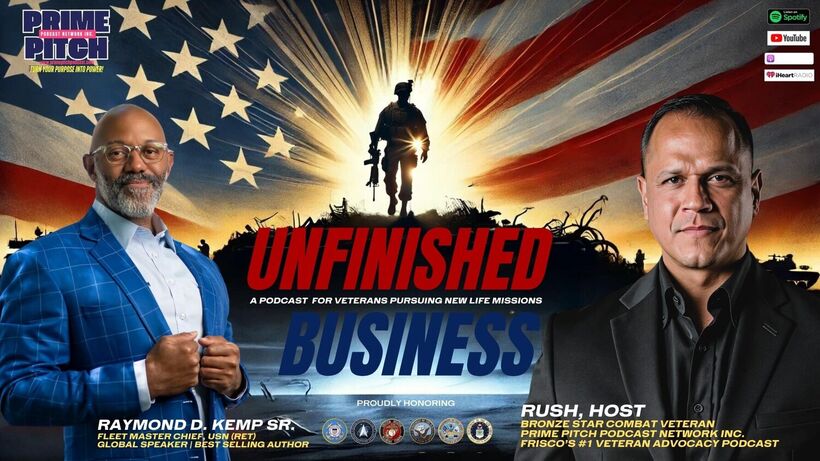
Raymond D. Kemp Sr.
Fleet Master Chief, USN (Ret.) · Speaker & Best-Selling Author
About the show
Unfinished Business is a podcast for veterans pursuing new missions after the uniform, and for the families and communities who stand beside them. Hosted by Eric Rush, The Conversation Architect, a Bronze Star combat veteran and the founder of Prime Pitch Podcast Network.
Read the full transcript
I remember, I was, I was, uh, rejected from a job because they thought I would be too, too, uh, too, too stubborn, too thick-headed- Mm-hmm. too re- too regimented. Right. Um, is that, is that s- is that somethingis that ais that something that, um, th- that kind of discr- that kind of discriminatory thing happens to a lot of veterans, do you think? It, it, it, itfrom the stories that I've talked to, it does.
Yeah. Uh, in fact, I have, um, talked to people about coming in and applying to, you know, one of my programs, and they were like, "Mm. ain't the Navy, you know. This isn't a ship. It isn't a battlefield," and so forth.
True. Um, but, but what h- what crosses those barriers is the willingness to explain to people, um, their role, um, th- th- starting with why- Yeah. and then also, eh, displaying a level of care for one to another. Because the thing is, though we were very regimented in our days in uniform- Yeah. what we also had is a responsibility to that person to grow them as a person beyond just their professional competency- Mm.
which is different. Yeah. Uh, and so we have the innate ability to express a level of care for others. Unfinished business, I've got more to give. I'm not done yet.
This life persists. Hey, what's up, guys? Welcome to Unfinished Business, a podcast for veterans pursuing new life missions. Raymond D. Kemp spent over 2 decades leading in the United States Navy, guiding thousands through the most challenging situations.
But his journey didn't stop there. After s- after his career in the military, Raymond took his lessons he learned in the Navy and applied them to civilian leadership, empowering others to rise and lead with purpose. In this episode, Raymond does a deep dive into his leadership philosophy, how veterans can harness their unique strengths to succeed in civilian life, and the role vulnerability plays in building strong teams. He'll also share how embracing failure shaped his leadership style, and how veterans can turn their struggles into fuel for success. This episode is packed with actionable insights that will inspire you to take holdtake a bold steps in your journey.
Whether you're a veteran or someone striving to lead with purpose, this m- this podcast is just for you. Raymond, it's a pleasure to have you in the Unfinished Business podcast- Absolutely. a podcast for veterans pursuing new life missions. Uh, Raymond, I heard you, I heardI, I saww- you and I got to meet over at the Fellowship Power Lunch event- Right. wh- a few times, and, and I was, uh, mesmerized when we got to share in a p- in a conversation, um, that, that, that we were part of, and also to get to hear you speak as well.
And, um, it was inspiring to hear your thoughts about leadership and, and, and your, your journey in the military, and I gotta tell you. I said, "Man, I gotta haveI have to have, have to have Raymond eventually on the podcast," and this was the time, man. I'm, I'm- Yeah, super glad. I'm so- Super glad. I'm so happy to have you here.
To honor, to honorjust get things started by honoring your, your military career, if you could share what that looked like for you- Sure. that'd be great. Sure. And, and let me say, it's a pleasure, uh, to be here. Uh, thankfully, uh, we did meet at, at Lisa Kay's event.
Mm-hmm. Uh, it was, uh, Sherry James at Phoenix Speaks that introduced me, you know, to those luncheons. Super happy, incredible ladies, glad that they connected us. Yeah. And, and, and to be here now, I'm really excited.
Awesome. Um, my career started in, in th- in the 1900s, back in the day. Uh, so in 1986 is when I joined. Now, for the listeners, I mean, I don't do math in public, but y- 1986, 20 years before that was 1966. Very, very tough time with regard to civil unrest in the United States.
And regrettably, a lot of that discrimination is how I started my career. Uh, some of those folks, the leadership that I dealt with-were adults in those really tr- trying times. Uh, and so the number of times that, that, that very polarizing word, you know, that w- that weren't so polarizing we don't even use it anymore, we just say the N-word, was one that was just slung around with regularity. Mm. Uh, in fact, when I first got to my first ship, um, the most important person you meet is the one who puts you in the various different divisions on the ship.
And he was slinging that word around like it was cool to do. And my thought was, "This is 1986. I mean, Martin Luther King's birthday is now a holiday. How in the world is this language still authorized?"But no big deal, uh, just give me an opportunity to put my hand to the plow, do my best, and see what happens. And I spent the rest of my career doing just that."Give me a chance, and let's just see what happens."And so resilience was built into me.
Uh, but 33 years on active duty, started from E1, uh, made it to the rank of Fleet Master Chief, and there's 330someoddthousand people in the Navy, and there's 4 Fleet Master Chiefs. I was one of them. In fact, I was the senior, uh, one of them. Um, Navy Europe, Navy Africa was the culmination point of my career. It's amazing.
W- wow. Th- I mean, that is amazing. Uh, first of all, um, just listening to you talk about, you know, the, the discrimination that, that, that wastha- that you had to endure is, is something that, that I th- I don't think people fully grasp until they hear it, hear it from somebody in person, like I'm listening to you right now- Right. share a piece 0 piece of that with you, um, of your story. Um, where do you thinkas far as, uh, um, your resilience, how much of th- how much of that plays, uh, uhih- how much does culture play, uh, a part of, uh, your resilience?
Well, it, it f- it has a lot to do with it, because some might say, a- and I'm not one of them, but some might say, "I c- I cannot be what I cannot see."Mm-hmm. Uh, and so they havew- when the culture has b- has been created in such a way where people realize there is, uh, a light at the end of the tunnel where success is going to happen, uh, the dream that Martin Luther King often speaks, ha- ha- has spoken of, and we often refer to, um, that we might be, you know, judged by the content of our character. And, uh, that's important. However, it didn't play that much of a part for me, 'cause I had never seen, uh, a Black person in the roles that were, you know, coming up next for me. I was the first, uh, Black person to be selected as the Fleet Master Chief of Navy Europe and Navy, uh, Africa.
And that was just in 2016. So we're talking about relevant, right now, still measures of discrimination. What I know, though, is that when leaders create a culture where there is, uh-you know, I'm, I'm gonna use a bad word, forgive me, inclusion uh, is really possible, then what happens is that people realize, oh, there is a chance this really may be a meritocracy. And I'm talking about novo construction or the military. Whe- when people realize that there is a chance that I can make it to the top, I will get recognized for the good work and the professional competency that I have, then they just work harder.
Uh, and they will, um, press into, you know, challenging situations and celebrate others when it comes down to innovative ideas like no other. So the culture is very important. That's, that's awesome. Um, and your career has spanned over, uh, uh, uh, y- uh, your career has spanned across military service, m- military service, leadership, and now transformative role into civilian leadership. Sure.
How did your time in the Navy shape your vision for leadership in the civilian world? TheBecause it's so regimented, uh, and the Navy is a very self-sustaining organization, particularly on ships. And so everything that we do, moment to moment, is lined down to what we call the plan of the day. You know, the Navy folks would call it the POD. Uh, so that plan of the day, uh, gets to the nitty-gritty of what's going on, important, shows the breaks and so forth.
For me, because I was so regimented, I, I was looking at the professional world in, uh, the corporate world in very, um, you know, very right angle, you know, way, and it's just not that. Um, the good thing is that as I promoted my way, um, through the Navy ranks, those things went aw- their plan of the day went away as well. And so I had to learn to, you know, be creative and do more of a assessing type of leadership style. And so when I transitioned, uh, outside of the Navy, which is really tough by the way, I, I will admit that, it was a very tough transition. But as I transitioned and I began to talk to civilian leaders, I realized, well, they have the same challenges with regard to people.
Uh, and they have the same challenges when it comes down to productivity and a desire for a bottom line, the same as the Navy did. The, the only difference was that the need to communicate with specificity was just a little bit different. And so once I understood that, uh, understanding that there is, must be honor, courage, and commitment in what we do, then it made the, the transition really, really easy. But what gives me the advantage over other people is I've, I've led very large groups of people and I understand what that high level of formality means. And, and the willingness to do it, because if you're not willing to start with why, you're gonna have challenges always.
Yeah. W- uh, when you think of leadership, I, I, I know a lot of f- a lo- a lo- I remember I was, I was, uh, rejected from a job because they thought I would be too, too, uh, too, too stubborn, too thick-headed- Mm-hmm. too re- too regimented. Right. Um, is that, is that s- is that somethingIs that, uh, is that something that, um, that kind of descript- that kind of discriminatory thing happens to a lot of veterans, do you think?
It, it, it, itFrom the stories that I've talked to, it does. Yeah. Uh, in fact, I have, um, talked to people about coming in and applying to, you know, one of my programs, and they were like, "Hmm, know, this ain't the Navy. You know, this isn't a ship. It isn't battlefield," and so forth.
True. Um, but, but what h- what crosses those barriers is the willingness to explain to people, um, their role, um, th- th- starting with why. And then also displaying a level of care for one to another, because the thing is, though we were very regimented in our days in uniform- Yeah. what we also had is a responsibility to that person to grow them as a person beyond just their professional competency- Mm. which is different.
Yeah. Uh, and so we have the innate ability to express a level of care for others. And so understanding how to articulate that will kinda soften the fear of that civilian person who may see, you know, a decorated veteran walk in, thinking, "Oh, boy. They've got all these rules and these things, and, and we're not necessarily, you know, flexible."The reality is, you think about those, uh, soldiers, sailors, marines, and airmen that you led in your career, the level of care that we had to give to them made us very malleable. And so th- th- it starts off as an issue, but when we can talk it through, we realize, "Okay, we're the same."Yeah, I like that fact that you mentioned why.
You have to have to know the- know the why, so you know how to- to navigate through that- through that- Absolutely. through that journey. Um, veterans often face unique challenges when stepping into new roles. What do you believe is the most powerful tool a veteran can bring into a- into their new life mission? Th- the most powerful tool that we can bring th- that seems almost natural to us is the discipline that we gained.
Uh, that discipline oftentimes came from that regimented lifestyle, um, but we- we bring predictability, we bring the ability to stick to a schedule, uh, and most importantly, we bring a measure of loyalty that is just uncommon in our society now. Those 3 things set us apart from everyone else. Yeah. That's- that- that's true. Um, when- when- uh, when- w- when you first transitioned from military ser- uh, military service to- to civilian leadership, what was the most challenging shift you had to make in terms of mindset and approach?
Uh- I think I may have asked you that in another question, but I'll let youthis might be theY- it-proper way to ask. it still rocks, because the thing is is that not everybody has that s- same level of commitment and dedication to getting that job accomplished. Yeah. Uh, we- at risk was democracy shucks. And that is just a little bit different than, you know, whatever the rules and, you know, the bedrock rules of- of behavior and so forth at Microsoft.
And so that wasThat transition of n- people's, uh, having a different level, uh, not just of competency, but a different level of commitment to getting the job done with the- the "we", not "me", uh, perspective, that was, uh, it was almost confusing at- at how, um, siloed, you know, some organizations were, and how selfish some of the leaders were. Mm-hmm. Uh, and so again, the- the good thing is that as- as, uh, I made that transition and I realized that, identified that early, I'm like, "Okay, well here's a way I can help things get better."first of all, by creating, you know, a measure of loyalty and resilience that will bring the- the- the organizations together. Yeah. I- I know, uh, we were- we were both at the, uh, Bob Tiede event when you- when he was talking about leading with questions, and he talked about how he used to th- he used to think he was a- he was a dictator, right?
I think that's the way he described himself. That's right. Do you think that that's- that- that- that- that- that was a- an approach back in the 1960s as well as you were mentioning? You mentioned some stuff about 1960s and that approach- Right. and how- how our leadership has- has evolved with leading, uh, with, uh, as answering the question why?
Sure. Yeah, it definitely has. In- in days gone by, uh, that authoritative, dictatorial type of leadership was okay. Uh, we were built for that- Mm-hmm. if I may.
Uh, I was born in the '60s, raised in the '70s, and so, uh, born in the great nation of Texas, raised in Oklahoma, so the because I said so was just part of life. You know, the knife hand was just part of life. And so when someone said to us, "Hey, go do this," psh, we would take it off and go do it because we were told to do it. The thing is, that at some point or another, why we were doing it would catch up with us, sometimes before we were done, but- or sometimes on the way, sometimes afterwards. And that was something that a lot of us forgot about and- and when we came into leadership, it was because I said so.
Now, with this young generation, 'cause I fully believe that they are as dedicated and committed as what we called the- the- the- the Greatest Generation. I think they will still run through troops and jump over walls as long as we're telling them why. Mm-hmm. If we start with why, uh, that changes the entire perspective of the reason that they're doing something. The very big difference from my perspective, Eric, is that there areWhen we entered our respective careers, we had no idea what the people who had been there 5, 10, 20 years knew.
These days now when young people join the workforce, because we have this worldwide web, likely in the- in the palm of our hand in the form of a cellphone, they can have as much information about the business and the organization as we do. Mm-hmm. And so what must happenThe nuances of leadership have changed significantly. Um, we know the why different than AI. Yeah.
And so because of that, that is crucial a- and a very big difference in the way we lead, no matter what the organization is. Yeah. That was a unique conversation I had with, uh, Bob. He- we talked about that the trend- the- the trend of this modern te- modern generation is how we, you know, explaining the why so that they can be purpose- more purpose-driven- Absolutely. and- and be, uh, uh, more empathetic or, you know, empathetic to the cause or- or motivated to- to perform a certain way.
You agree with that? Absolutely. Uh, uh, because the thing is is that if- if I'm connected to what I'm doingOf course, I need the tools, the parts, the materiel, and the administrative things to get it done. Yeah. But if I'm connected to the- the cause, you know, the- the why of it all, then again, the level of dedication and loyalty is just significantly higher.
The reason that the, again, that Greatest Generation I would refer to from World War II was so committed to excellence and the fair treatment of all was because of Pearl Harbor. Now, before Pearl Har- Pearl Harbor, we were not n- as a nation, we weren't necessarilystill bought into World War II. But after Pearl Harbor and the, um, uh, the attacks that happened there, totally different. Very similar to, um, 9/11. When 9/11 occurred, there was all kinda people with their hands up because they knew personally what that attack meant and we were connected to that.
As we grow away from that-and, and we just shift that from, uh, the defense of our nation to corp- the corporate world. If you're not connecting people to the reason behind it, not sure how long they're gonna stay. Right. Or what their dedication will be. I wanna circle back to how we originally started this conversation.
We talked about, um, uh, ethnicity and, and how, how, you know, what, what, what you had faced w- when you were, you know, when you were first in the military. Sure. How does, how have you seen that evolve, um, over time now in the corporate, in, in the corporate sector? You're in private sector now. And I'm sure you do some stuff with military s- in some way.
Um, talk, speak to that a little bit more. Sure. So these days, um, th- by the way, this is gonna be a, a, a long, "There's not much difference."Uh, so these days what has happened is that there have been a measure of rules and regulations that were initially established that said, "Hey, we have to stay within these left/right lateral limits. Make sure we treat women this way, we treat these minorities this way."Um, and then, and attain the, uh, uh, attain the, uh, accomplish the goal of the organization. Well, what has happened very recently, um, we have started to take away those left/right lateral limits, and we've started to take away those rules.
And so, regrettably, what is, what starts to happen in those instances is that that measure of treating people with dignity and respect ends up being graded on the curve because now there's not a, uh, requirement for a certain ethnicity group, uh, or a mi- a certain minority group to be allowed access into a certain school system or into a certain business for that matter. And so what I discovered is that there will not be a change until people who are not impacted are offended. Th- there will not be a change until people who are not impacted are offended. And so if we go back to the '60s again, the Jim Crow laws and all that discrimination was fine, you know, for people who weren't there and weren't experiencing it until they saw the police with their dogs and their fire hoses and so forth, and those people who were not impacted were then offended, then laws began to change. Regret- regrettably, that seems to be the Western way, that seems to be the American way.
And so we have had a modicum 0 of change with regard to discrimination. And, and whether it be through misogyny, th- the unequal treatment of women, or whether it be LGBTQA, those folks, th- until those who are not impacted are offended by the way we're treating them, there, there will not be the, uh, th- the so-called, you know, even playing field. Mm. So it's, it, w- we, we talk about it, we walk towards it, but the more rules that we change to prevent that forcing mechanism, the less likely it is to happen from my perspective. On the flip side of that, what do you see that's, um, that has been posi- that you see some positivity, positivity over?
Sure. So, so when folks are given a chance and they perform at a high level, then it's like, "Oh, okay."I- in days gone by, I think that people would say, "Hey, this is that one person amongst that group who's special."Now we're realizing, "Oh, so we don't, we don't just have to pull and spend, you know, the amount of money that we need to pull from an Ivy League school. We can also go to a HBCU. They got smart folks there, you know, as well."And so people are proving it. And so th- that's the thing from my perspective, Erik, is that if you give everybody an even chance and let them perform and let us just pick the, uh, best and brightest for the job, then we win.
And, and that's beginning to happen more and more. And so because that's happening more and more, more folks are realizing, "Oh, okay, there's, there's other places where we aren't doing that. We need to do that over here as well."And so that's working out very good for most people. Wow. You know, I have a story that y- when we were talking about this, how this story resonates with me when we're talking about, um, uh, race and, and, and discrimination.
And I remember I got hired, I was a site director for a telecommunications company a while back, and, um, and I had, um, I had m- went to, I went toI was g- I w- I was building my own team in Amarillo and these- Okay. and some of the individuals that were coming were coming from Nebraska. Mm-hmm. And, and they were coming from Norfolk, Nebraska, so it's just like, you know, corn-fed boy, whatever, I don't know. Okay, soSo I get off the plane, they said, "Oh my god," like, y- 'cause my name is Eric Christopher Rush, which is not a predominantly Hispan- Hispanic name.
I get off the plane, it's like, "Oh my god, we, we th- you're Hispanic?"And that was the first words out of my mouth, I was like, "What?"Like you know? And it made me feeland all these guy- you know, everyone was like, "Okay, if we're gonna go down this road, let's go," you know?"Well, it's great 'cause I'm your boss," you know? Yeah. Yeah, let's just hop on, hop on this. I spent a lot of time here.
Let's just get over with. Yeah, 'cause you, you might not be here for long, you know? But, uh, no, I just remember that happening to me, and I was like, "I'm your boss," soWell, what, what's interesting is that- Yeah. when, when you have folks 'cause n- it just so happens that Nebraska is 98% farmland. So they don't have a lot of exposure.
Yeah. Uh, it, it, it didn't when we were younger. Yeah, yeah. Let me say it that way. Uh, but the thing is, is that once you get there and, and contact is made, it's like, "Well, this dude's a regular guy."Yeah."I mean, he's the same as any smart South American."They're like, "O- whatever you say, boss," you know?
And so that kind of goes back to my previous point. When you put people in place and give them the opportunity, then it changes the entire culture. Yeah. But the guy who was doing it was like, you know, he was the whitest of white, you know? Anyways, anyways, so, um, anyways, um, uh, let's see here.
Uh, what role does vulnerability play in effective leadership, and how has h- it shaped your approach to leading teams? Oh, and, and that goes right back to what we were just talking about. So what can happen is that leaders get into position or grow into positions, and they feel so, um, pressurized, you know, to perform at a high level- Mm-hmm. that they begin to act almost like robots, like automatons. Yeah.
Um, and if you're not vulnerable, i- if you have not created a environment where people realize that you're human, then they will think that you're just some freak of nature and they can never be that. And so the level of dedication, the level 0 of, of sticktuitiveness may be different because they're like, "Well, he's just unusually, you know, smart, strong," whatever the case may be, "disciplined, dedicated. I could never be that, so I'm just gonna do this, you know, little bit of work-" Mm-hmm." um, that's in my comfort zone."No, no, no. That vulnerability creates space for people to say, "Man, you're just like us. Come on, if I knew that.
I mean, you have these challenges and you're sharing" to a level. Yeah. You know? Just a measure of exposure. You don't have tofrom my perspective, I think it's a bad idea to be fully transparent.
I think, you know, wave tops are good enough, you know, for you to realize I didn't just miracle my way into this position. Mm-hmm. I worked my way into it. Mm-hmm. And I've got family, I've got this life experience, so on and so forth, and I deal with these things in society.
That measure of vulnerability lets people realize, oh, okay, okay. Me too. I can, I, I too, you know, can muster up what it takes to, uh, ascend and be dedicated to the workplace. Yeah, I love that word. I love that word 'cause, uh, uh, humanized leadership, and I think, uh, uh, Rhonda Y.
Williams says that, uses that phrase a lot, R- uh, humanized leadership, and that's been one of those words that's been resonating with me this year, is like humanized leadership, humanized leadership, um. Uh, uh, so I appreciate you s- talking about just humaniz- be- and, you know, humanizing your leadership's- Absolutely. you know, and hon- um, getting empathetic with other people's, uh, understanding how they need to be led is, is, is important. Do you agree? Yeah, absolutely.
And, and the thing about empathy is that you can, you can feign empathy. But when they know that you have had your own measure of experience, then that empathy is more authentic, and then, again, you, uh, the leader, you know, comes off as more personable, uh, and someone who is more relatable, and that's crucial in communicating. Um, when you first transitioned from military service to civilian life, what was the most challen- chal- did I already as- I asked you that question. Sorry about that. Um, what role of, of what, what's the role of failure in lead- in your, your leadership journey and how can veterans use their own past struggles as stepping stones towards, uh, future success?
Sure. Uh, y- I kind of shy away from the, the language of, of failure and, and I lean, uh, towards setback and I lean towards pivot points. Okay. Uh, ifThe, the first time I, I went to a leader reactionary course and there was that 30-foot wall, and I don't know if you had to climb the thing, but shucks. Yeah.
My first thought the first time I went up and I'm young, I'm athletic, but I, I missed the rope, and I fell in and then fell down. Mm-hmm. And so I had to come back, reset, you know, my energy and my confidence, and then get back to it. That setback, um, was one exercise, a tangible exercise that I realized, sometimes in life, there's gonna be something that's a no. You know, sometimes there, in life, there's gonna be a, uh, an objective that I just can't hit the first time and I have to get back, reset, and then get after it again.
Mm-hmm. That has happened so frequently in our- in my military career and in those that I led that w- we're not necessarily attached emotionally to that setback or to that failure. And so, uh, okay, I didn't make it up the wall the first time, but I'm gonna make it up there. W- I'm built for that. I'm gonna make it up there.
Um, that perspective and that mindset, uh, for me, I try to convey to young leaders and, and those moving into new leadership roles, is that, don't think of it as a failure as an insurmountable, okay, I've got a setback and I've just gotta deal with it, orpivot and go around, you know, that particular obstacle and get to the objective a different way. Thank you for saying that, 'cause I think I'm gonna change my perspective on how I say the word, the, the F-word. You know, you know-I wanna take that out of my language and say setback and pivot points for sure. So, I think it's so important to have that, uh, that positive, that positive, uh, um, mindset, y- you know, and not take it to this fatalistic, uh, vantage point of saying I can't, you know, this is- It's just-this is beyond my reach. Words mean something.
Yeah, yeah. And, and, and I'd much rather speak life. And so, because life, uh, I believe that, you know, life and death resides in the power of the tongue- Mm. I choose to speak life as much as possible and speak in the affirmative. And so, that, the F-word, you know, that, uh, the longer F-word, shucks, it's, it's, uh, i- it's debilitating.
Yeah. You know, it can be if people hear it too much. Yeah. Um, uh, my, my next question is, what's the most important, uh, what's the most meaningful legacy you hope to leave for the future generations of leaders and how, how do you actively, um, work towards it? Sure.
Okay. There's a couple layers to that. You know, for me, what I want to be a legacy is that people treat others with dignity and respect. Uh, a way to do that very intentionally is through what I describe as the ABCs of leadership;attitude, belief, and character. Mm.
If I'm intentional, uh, about the ABCs, right, my attitude is gonna determine my altitude. I know this to be true. Uh, if I believe, um, by, just like that wall, I can achieve. Uh, and c- our character precedes us everywhere we go. And so, I, I want as a legacy of mine and those who I have had the opportunity to impact and influence, uh, is the ABCs.
Also, uh, I know that, um, building resilience is something that we have to do very intentionally. It's okay for things to be hard. Bring on the hard and then watch us work. You know, that is, uh, another legacy that I truly hope for. Then, uh, I guess the third layer of that, um, would be, okay, how do I keep all those things going?
And that'd be with 10 2letter words. Uh, those words are, if it is to be, it is up to me. Uh, I don't want a handout, I don't wanna give away. Level the playing field, make this America ta- uh, meritocracy, and with these 10 2letter words, if it is to be, it is up to me, then I'm okay with- with those results all right. Man, I love that.
If it is to be, it is up to me. Is that it? Yeah. I'm gonna make sure I have engraved that somewhere in my soul today. Um, no, it's so beautiful.
Uh, I love that. Um, okay. So, so speak to me on, on how ha- like, someone struggling with their leadership, right, their leadership, l- leadership style- Sure. um, how would they, how would they, um, go about, um, investigating themselves on how they, how they, how they approach leadership? What would, what would be a couple of, uh, tips that you would say?
The, call KEM Solutions, and I'll come help you. There you go. Hey, let's do it. Yeah. The, 1, one thing I think is important is that they, uh, that a leader needs to look inside themselves, uh, and, and be honest with themselves.
Mm-hmm. You know, what are the, um, mechanisms that are the, the core values? Yeah. You know, why is it b- that an issue, you know, communicating this information?'Cause in leadership, that's crucial. I, I must be able to communicate the intentionality, you know, to the team.
Why is that a problem? You know, is it personality driven? And, and again, that, that high level of transparityy- transparency with self is so, so important. Uh, another thing to do, uh, we talked about starting with why. There's actually a book called, uh, by Simon Sinek, uh, called Start with Why.
And, um, he, it's also a podcast, and the thing about starting with why is it allows us to, you know, ask ourselves 7 ques- go 7 levels deep on why this is important. Mm. And once I get to that, you know, 5th or 7th level, then I really know the ABCs and one through threes of what the problem is, again, when I'm vulnerable, you know, with myself and I'm willing to be honest, tell those true, those, the true facts about how things are going. Talk, uh, you mentioned KEM Solutions. Speak a little bit about your organization, what you, what you offer, what you, you know, what you, what your mission is.
Sure. Speak a little bit about that. Uh, w- we, we make le- we make leaders better. Uh, we, we take, uh, go into an organization and take the, take the leaders that they have, make them exceptional leaders. You know, build their resilience and their loyalty, uh, and that will have an impact on the bottom line of every organization.
Now, we talked earlier about the formality and the, the regimented living, uh, that, that comes along with a 33-year Navy career. Uh, so it's, I'm a natural fit when it comes down to school, to colleges and talking to, um, students there who are getting ready to transition into the, into the world. I'm also a natural fit for the, uh, first responder organizations, because again, they have very specific left/right lateral limits. but I, I do that through, uh, a program asUh, uh, so I'm a member of the WI Institute, I'm a, a certified coach through there. I'm also a John Maxwell certified speaker, coach and trainer.
Uh, and so, you know, what happens an organization will give me a call, I, I will come in, do an assessment 0 of the leaders, uh, and then help them learn how to communicate better and more successfully with the team. Wow, I love John Maxwell. His, his, his approachI took one of his, uh, courses andmany years back and I was like, wow, this isIt brought a lot of information up to the for- you know, to the surface about what I and how I needed to evolve in my, in my, on my attitude for sure. And, and John Maxwell has, you know, copious amounts of information. And I think when we, we take his information - he's been in the field for over 40 years - we take his information, uh, and weave that into, you know, KEMP Solutions, military experience, uh, and the evolution of how society is going, then it's just a recipe for something magnificent within companies that bring us in.
Awesome. WeBefore we, before we started shooting, we started talking about, uh, you, you were involved in a project with, uh, with Tyler Perry. Yes, indeed. Uh, let's, let's share a little bit about it. I said I wanted to make some time to, to have a little bit of this conversation, man.
The pictures, I was like, "Who is this star-studded event?"Like, speak, speak to- Absolutely. so speak a little bit about that. So, it turns out the President of the United States appointed me to the American Battle Monuments Commission, so I'm a commissioner on the American Battle Monuments Commission. We have 27 cemeteries and 32 monuments, 17 countries around the world. Tyler Perry wanted to shoot a scene for his movie at one of the America cemeteries over in this area called Brookwood, near London.
And we told him no. Well, I didn't tell him no. The, the team initially said, uh, no, and I said, "That's bananas. We have got "Because the thing with American Battle Monuments is that we want to continue to tell those amazing stories. We want to ensure that time does not dim the glory of their deeds, those who have fallen in battle.
And so, to have someone like Tyler Perry amplify one of these stories is a no-brainer. So, long story long, I had the opportunity to change that no to yes, fly over, be a part of the filming and then I got a personal introduction to see the opening, the, uh, Hollywood premiere of the 6 Triple Eight, and it was absolutely amazing. It- and it's a story about wem- a female postal battalion, happened to be all black, who got sent over to World War II to sort out 17 million parcels of mail. And they gave them 6, gave them 6 months to do it. Did it in 3 months and came on back and just kind of moved on.
And, and you and I both know, on the battlefield, mail is crucial. Yeah. Morale is very closely connected to mail. Yeah. Especially back when we used to get cookies and things like that.
Yeah. Um, but for them to be able to sort that out, not only did it have an impact on the hearts and minds of those in the combat zone, but to the families who hadn't gotten mail either, it had an impact on them. So it's super-duper important folks, but Tyler Perry, Kerry Washington. I got a chance to hang out with Oprah Winfrey. Uh- Wow.
all of them were a part of and in the movie, and it's w- uh, it's worth going to check out. It's, comes on Netflix on December the 20th. That's awesome. Man, I see you doing a, making a lot of moves, dynamic leadership style. I, I, I really enjoy, um, seeing all your, all the pictures that you post on, on you just being up-front, you know.
And, you know, up-, up-front but leading from behind. You know, both kind of doing dual, dual, uh, lead- uh, types of leadership and I, I really admire you a whole lot. Thank you. I'm, I'm very fortunate to spend time with you today. Um, before we wrap up, I always have this section as a ca- uh, a shout-out to a person, an organization, um, whoever you want to speak to right now.
Sure. So I, I kind of got a little bit at the beginning, uh, but let me go back to Shari James and the folks at Phoenix Speaks. What an incredible, uh, group of folks who have created space for me to meet you, uh, get connected in other places, uh, in town. But more importantly, um, they are in the mental wealth space, uh, and they are helping, uh, curb those numbers of suicides in young people. And so it's an honor to be connected, uh, to Shari James, uh, and Phoenix Speaks.
Last question. Um, you've had a remarkable career shaping others. Um, looking ahead, what are the new missions or projects that you inspire the most, that inspire you the most at this agingat this stage in your life? The, uhI'm, I'm really kind of fascinated with what AI is doing, uh, and how leaders will, uh, shift the relationship in the workplace. And so, what, what is the evolution of AI, you know, when it comes down to social interaction?
Uh, and friendly leadership is kind of what I've been kind of walking the path on, just to see how can we be as effective as possible with the advent and continued growth of AI and technology. Yeah. That is a, that is a, umYeah, it's a pretty big-resource now, you know, um. And I just see, you're right, the creativity, innovative, uh, thinking, stretching your mind- Right. being able to, to, to visualize things differently has been a, um, a b- um, a beautiful asset for, for me to be a part of in, with AI as well.
For sure. So I appreciate what you're saying. Um, Raymond, I want to tell you thank you so much- Absolutely. for being on the podcast. I think you could actually be on my other podcast called Next Level Thinkers: Charting New Horizons of Brilliance podcast where we talk about, we talk with innovator, innovators, thought-leaders and- Oh, I'd love that.
and that kind of thing. So let's see if we can get you, um, get you on that one as well and talk about, talk about how we can, uh, evolve as, as, as, as in leadership and that kind of thing. So it would be an honor to do that and talk about KEMP Solutions a little bit more. Already looking forward to it. All right, guys.
That's it for Unfinished Business: A Podcast for Veterans Pursuing New Life Missions. As I always say, have peace and light in you and remember that the ocean refuses no river. Unfinished business. I've got more to give. I'm not done yet.
This life persists. This is my story. My unfinished business. I'm not done yet. This life persists.
This is my story. My unfinished business.