Paul Slough & Gina Keating
Paul Slough & Gina Keating joins Rush on Unfinished Business, the show for veterans pursuing new missions after the uniform and the people who stand beside them. As veteran Advocate · Author of “Raven 23”, Paul brings the craft of telling stories that matter to the table.
They get into the work, the cost, and the reasons it still matters, in the kind of long-form conversation this show was built for.
In this conversation
- Why the right story changes how we see things
- Turning lived experience into words
- The work behind the writing
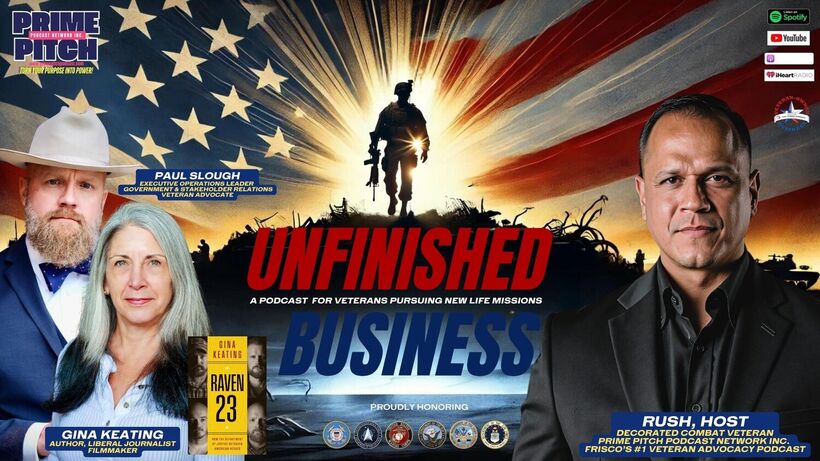
Paul Slough & Gina Keating
Veteran Advocate · Author of “Raven 23”
About the show
Unfinished Business is a podcast for veterans pursuing new missions after the uniform, and for the families and communities who stand beside them. Hosted by Eric Rush, The Conversation Architect, a Bronze Star combat veteran and the founder of Prime Pitch Podcast Network.
Read the full transcript
What was new to me was the fact that the entire system, for different reasons, collaborated on a horrible miscarriage of justice that not only spanned 3 trials, but it must have cost tens of millions of taxpayer dollars. Mm-hmm. The- I was not prepared for that. I mean, the- I don't- I, I, I was unclear about how anyone could go home at night and think that they did a good job if they were involved in this case. I think one of the cherries on top was when the Iraqi, uh, police chief was flown out- Oh.
the night before he was supposed to testify- S- that was a good one. because the, the government had found out he was tied to 2 or 3 terrorist organizations- Oh, they knew. They knew, but they were worried that the- that that was gonna come out. Unfinished Business, standKing. Hey, what's up, guys?
Welcome to Unfinished Business, a podcast for veterans pursuing new life missions. Some stories don't come to you, they come for you, not with headlines but with names, names spoken too carefully in courtrooms and too carelessly in the press, names that used to be uniforms, then case numbers, then something no man should ever become: a symbol of someone else's justice. The truth was never on trial, but the men were. Paul Slough, Nicholas Slatten, Evan Liberty, and Dustin Heard carried that weight through Bosnia, through Iraq, and then into federal prison cells, convicted in a war zone, buried in the fog of politics, nearly forgotten by the country that sent them. They weren't the defendants of a singular case.
They were the placeholders for someone else's guilt. The verdict came long before the facts were ever laid to bear, and Gina Keeney saw it happen not just in court, but in headlines and in silence. She didn't come to exonerate. She came because no one else stayed. Raven 23 is what she wrote when the silence got louder than the story.
This episode is- isn't about proving innocence. It's about exposing abandonment. It's about what happens when the mission changes and no one tells you what it is anymore. It's about a book, a team, a trial, and the truth that refuses to stay buried. It isn't where the story ends.
It's where someone finally opens the record again. Gina, Paul, my man, my brother. It's good to see you, my bro- brother. Yeah. Good to see you.
Um, yeah, it's just, uh, amazing opportunity shi- to have you guys, have you, have y'all talk about Raven 23. Um, um, the intro, was there something about the intro that you said, "Whoa, this, this-" a couple of 2 or 3 things that you're like, "Oh my God, this is- this hit me"? Yeah, I mean, all of it, basically. You, you wrapped it up perfectly in that intro. Yeah, I was nodding my head along 'cause it's exactly what happened.
when I approached it, I did not know that. It was a totally different experience for me coming in from the outside. Yeah. I had to find that out. And Paul, what about you in this intro that you- that spoke to, spoke to your heart?
Yeah, the point that, that Gina made a- the conscious choice to, uh, as they say in West Texas, stand up in her stirrups, and, uh, really go to bat for 4 people that she didn't really know anything about. Um, and her journey along that route from the first time she knew about it until we met in a prison visitation room, um, is, I think, a story just in itself. Yeah. That's amazing. Uh, which one of y'all wants to give a little snapshot of this- of, of Raven 23 and, and the, this- the situon- the situation that unraveled in Nisour?
Me, you? Who, who do you want to do it? Go ahead. So essentially it was, you know, these guys were, uh, Blackwater contractors. They were, uh, protecting diplomats and were sent, uh, to- well, actually they were the backup crew when a vehicle-borne explosive device went off about a mile from the Green Zone- Red Zone- Green Zone, sorry.
Mm-hmm. And, um, they were just waiting and, uh, eventually, uh, went into Nisour Square. They were fired upon by insurgents, which- who they saw and who civilian- Iraqi civilians saw. And, um, they had to fight their way back out to get back to the Green Zone. Hmm.
It was pretty normal from what I understand, from what my research, uh, has shown, and from what Paul and all the other guys, not just the guys who ended up in prison but the other, you know, people who were on the- um, who were in the, uh, Raven 2- 3 team. They were- they all said, uh, this wasn't anything unusual. So- 'cause it happened in 2007, which was one of the most violent periods of the Iraq War. Mm-hmm. Um, so, you know, they didn't think anything about it.
Uh, it shows up on CNN about 30 minutes later, and then all of a sudden it's a huge international incident. And the, uh, steps that were taken to, um, to blame this on them, and I mean it- the thing that is so unbelievable to me is, you know, the body count was, was not even accurate. Mm-hmm. You know, they reported shooting 8 to 10 people. That's how many they shot.
But somehow it got, uh, inflated to 34 people. Mm-hmm. Um, and it changed from one to the next- one, uh, court case to the next. I mean, the d- government was essentially locked onto this incident to try to exonerate itself with the American public and with the Iraqi public for all of the failures in Iraq. Mm-hmm.
So it, it- you know, I followed the case from 2016 until they were freed in 2020. And, I mean, there were-2 extra trials when I finally got involved. And the way that the narrative changed the entire time that this was happening was just unbelievable. It was shameless. Yeah.
Wow, that'sThat, that's insane. ItYou know, just keepsIf you're in this, this, this, uh, this vortex of narratives changingUh, Paul, how did, ho- how did that, um, how did that overtake you? Did it overtake you at times or 2 when you were in that, this situation? Oh, of course. You know, uh, uh, I recall back to the time when we had gotten the news that Judge Rubina had tossed out the first case.
So, in legalese, we were granted a cast agar hearing, which is pretty rare. But essentially, it's, it's going through the evidence to determine taint, if there was taint that found its way onto the evidence. Mm. It was about a 3week trial. Um, Undersecretary of Defense Gordon England testified at that one, along with several others and everyone walked away just kind of really shaking their head like, "Holy cow, we really find ourselves in this situation."And by the end of that 3 weeks, of course, we went home and Judge Rubina issued a ruling, believe it was New Year's Day?
New Year's Eve, yeah. New Year's Eve. Yes, it was New Year's Eve.'09.2009. That's right. And he tossed the case out and said, "Not only have you trampled their constitutional rights, these guys were already cleared by State Department officials before they left."Mm.
And not, and not only that, but there's pro- this case is rife with prosecutorial misconduct. And, uh, and also, I mean, what they did to Nick Slatten. The government, the government decided not to charge him at first because he was inside one of the vehicles. He was the s- the sniper, and he reported that he shot 2 people, or one person, I'm sorry, fi- fired 2 bullets, shot one person- Mm-hmm. who was shooting at the convoy.
Um, and they said, "Well, you know, um, we, we justWe don't have enough evidence, really. You know, we're gonna go ahead and, and, um, and dismiss him from the case."And for some unknown reason, they decided, "You know, maybe we want him back in."Mm. So, they went to him and said, "Hey, we're gonna, um, we're gonna charge you again with manslaughter."And he said, "Uh, no," and the statute of limitations had already run on the manslaughter charge. So, they said, "You know what we're gonna do if you don't agree? We're gonna charge you with murder."And that's what they did, because there's no statute of limitations.
This is the type of, uh, behavior that we saw from the Justice Department, and it happened throughout the entire case. They were completely unconcerned with the fact that this was happening in public. Wow. Um, before this story became a book, before it became a case, what did each of you believe a- about justice? I mean, it's red, white, and blue.
We don't get things wrong. We, we always get it right, and, and we're always on the cause of right. Um, and having gone through this process, you learn pretty quickly that, that that's not always the case. Um, Jeremiah 17:9 calls out, "The heart of man, who can know it?"And what we found ourselves in was a political milieu between the country of Iran, the United States, and an oil company. Um, and what, what was just a, a routine instance when we were receiving an average of 180 attacks a day in the city of Baghdad turned into what we know now is the, the most controversial gunfight, I think, in the entire Iraq war.
Wow. And, and for what reason? I mean, that's what I wanted to know when I looked at this incident, because they were comparing it to the My Lai massacre. Mm-hmm. And I thought, "Seriously?"Mm-hmm.
I started looking at, you know, at the drone wars that were conducted in the same, at the same time, or actually when they were recharged when President Obama came in. And, um, and I thought, uh, "No."first of all, there is evidence of 2, maybe 3 people who were in Nisour Square who were, who were civilians who were killed. Um, there were 2 other incidents that happened at exactly the same time, um, that had other victims, you know, but they were all lumped into the Raven 23 men. Um, so, you know, I did a lot of research on that and I thought, "You know, that isn't even accurate."Because what- what Paul's saying is true, there were so many attacks in Baghdad at the same time that this was nowhere near the worst incident in terms of death count- Yeah. at all.
Yeah. When you first, uh, when you first heard about the Nisour Square incident andWhat made you dec- decide to stay with this story long after it became politically inconvenient? Well, it was politically inconvenient from the beginning because I'm a liberal. I vote D- Democrat. I mean, not always, but most of the time.
You know, I s- I'm very, um, very sure that that is, you know, that that is wh- what I believe how we, how we, uh, solve problems is the democratic or the liberal way. Um, so when I first found out about it, IAnd it was, uh, my boyfriend at the time who saidwho was friends with Dustin Heard's father. And he said, uh, "You know, you gotta do something about this. I'm sure that this kid did not do this."And IYou know, I was a business reporter. Um, I worked for Reuters for a number of years.
I've worked, you know, in, uh, for the Los Angeles Daily Journal. IYou know, most of my experiences in law, government, business. I didn't have any foreign policy experience so I told him, "No way."You know, "No, I'm not doing this because I don't wanna r- report on the Iraq War anymore."You know, I didn't ever do it, so I'd have to learn a lot and I just don't wanna do it. Um, so it was never something I wanted to do but, um, you know, he was really insistent and so I said, "All right, look, I want to at least meet him. I wanna meet Dustin Heard, I wanna meet Paul Slough, Evan Liberty, and Nick Slaton soAnd I wanna see what kinda guys they are."Mm-hmm.
y- y- so we went. I mean, he and I went and we visited Dustin, uh, in prison, in the federal prison. I went alone to see Paul in, um, El Reno, Oklahoma, and then went up to see Evan in Pennsylvania. So I went and I met all of them. Because when I looked at the court papers, which I finally did in around 2015, um, I- I realized from covering a lot of criminal cases that there were so many irregularities that would have had this case thrown out in any other instance.
You know, the case should never have been, have gone to trial s- for so many reasons. Um, but then the fact that it just got shoved through over and over was kind of weird to me. So I thought, "Okay, this is wrong and I went to see what happened."I mean, itA lot of times, you know, prosecutors might, in my experience, and law enforcement sometimes will say, "Well, we couldn't get them on these other things but we could get them on this and that's why we're gonna go after 'em."And so I thought, "Well, I'm gonna go see, you know, what kind of guys they are."So I went and did it, and when I met 'em I thought, "What? These guys?"Yeah. You know, there's nobody more true blue, moreYou know, no more loyal to the United States and everything it stands for than these 4 guys.
And circling back on your comment where you made a comment about this trial should've never happened. It was NACDL that provided an amicus brief for our oral argument- Right. against the, um, for our appeal, and they essentially said the same thing, that this should have never happened in an American court, umMm-hmm. And so looking back, no wonder the judge was asleep during the entire tr-Well, a good portion of the trial. Mm-hmm.
Had to be woken up for objections because in his mind the outcome was already set. Yeah. Paul, uh, strip away the headlines, the politics, the trial. What was, what was the mission you believed in and what made you, w- made what you returnBringing liberty to a people that had been under the iron fist of oppression forsince I was a child. You know?
Um, seeing desperation in people's eyes does something to your soul as a person. And at that time, in my life and my experience, those people were starving, they were going through just complete rolling blackouts, they had no security. Everything was so topsy-turvy. And I mean, the moment you got off the plane, you could feel it. I don't know how to explain it but you get- Yeah.
off the plane, you could, you could feel that just pressure. Mm-hmm. And it's everywhere. Yeah. It's everywhere.
Um, Gina is a self-described, um, liberal journalist, right? Right. Um, did this story ever force you to withdraw your ideological lines? Um, I'll tell it to you this way. Um, I still believe in a lot of the p- you know, a lot of the platforms like theI would say I'm a, a Rooseveltian Democrat, so more of a moderate.
But what I, what I find so difficult and that has gotten so much worse since I started this was the fact that people simply don't hear you. It's noThe politics in this country is no longer about solving problems, it's about being right. It's about- Mm-hmm. dominating. Yeah.
It's not about looking at a system that is broken and saying, "This is totally wrong and we have got to stop this because everything that makes America great-"is, is our due process. You know what I mean? So it's like w- if we can't even, you know, make sure that people who are innocent get a fair trial, then what is th- what is this for? So, so yeah. I mean, definitely.
And it opened my mind a lot that when somebody is complaining about something and you might not be of the same persuasion as them, you might not have the same experience that they have, that you, you need to listen. Mm-hmm. You need to listen and see what their perspective is, especially as a journalist, you know? I- that- and that's something that this case brought me back to, is that curiosity is the number one thing that you have to have- Mm-hmm. to do this job properly.
And, you know, as a journalist, we have a tremendous amount of power, so it's our responsibility to listen, and that's n- and that is how this case changed me, because I think after being in the media for decades, especially in big cities, I kind of forgot that there is a different perspective- Yeah. that needs to be listened to. Wow. That's, that's like- that's omnipotent stuff that you just put out there, you know, about- just getting to another level s- of awareness of y- and what's going on around you, you know? It's a j- just awareness about what people are going through and tapping into their, their humanity and, and their hurt in many cases.
In this case, you know. Um, Paul, um, what truth did prosecutors and media have no room for in their version of what happened that day? Ooh. I'd say the most poignant moment that really put an exclamation point on that was when a Little Bird gunner was being cross-examined. Excuse me.
It was a direct examination by the prosecutor when he testified that he witnessed, uh, civilians taking off IP uniforms and wrapping up AK-47s and putting them back- in the back of a Bongo truck. And the prosecutor actually broke a tooth. Anthony Asuncion, he broke his tooth, and he asked for a, a, uh, y- an extension. Um, and so court closed for that day. He went and got his tooth taken care of.
But before we all left, and while the witness was still on the stand, he said, "Well, why didn't you say anything during the grand jury testimony?"And he said, "Well, sir, you never asked.""You never asked."In a grand jury exchange, you don't get to have a defense attorney. It's just you and the prosecutor. Yeah. And everything's behind closed doors and nobody really gets any insight into that. Yeah.
And, uh, that was, I guess, the most telling point for me, is that you just never ask, because they didn't want to answer to the questions that, right? Yeah. Yeah. And so I said okay. Do you see that now?
Like there's- there is a, a issue with, uh, grand juries? Absolutely. Yes. Absolutely. How do you- how do you take an American citizen walking into a situation that they probably have never been exposed to, have no idea even what the rules are, and what may come out of this into an environment like that without any type of representation, to me, is completely flawed.
An- and not only that, this is the cas- this case is a wonderful example about why the grand jury system is so flawed. Um, one of the things that, in my book, uh, talks about the fact that, um, in the second grand jury, as Paul r- told you earlier about, um, the Kastigar hearing, that was because another thing that really violated their rights was they had made statements, um, about the incident that were sup- that were work-related, right? They were- they were work-related. They were supposed to be confidential. It's very similar to like what police do, what happens with police officers when they have a, a shooting, on-the-job shooting or something.
That is something that they are allowed to say what happened. They will not get fired as long as they don't lie, so it's a very reliable- Hm. barometer of what happened, because if you do lie, you're gonna not only get fired, but you're probably gonna get prosecuted. So they all had to do that when they came back from this Nisour Square incident. They all gave statements, all 19 of them did.
and I truly believe this, I never was able to figure out who leaked it. But someone in Washington, I'm pretty sure from the State Department, leaked it to ABC News. And within, what was it, like a couple of hours- Hmm. or a day or so, your statement was on the internet. Your protected statement was on the internet.
Wow. Then Dustin's. So it, you know, this, all of this stuff that was not supposed to have been, uh, shown to anybody was leaked, um, because of the political situation around what was going on in Iraq, not because of what was going on in Nisour Square, because that was not remarkable in any way. Um, it was an incident like many other incidents, but just for some reason, I think it was probably because someone sold some footage to CNN that this became the poster child for everything that was going wrong in Iraq. Hmm.
So anyways, so they were, uh, uh, the whole case, first of all, should not have been brought because everything was tainted by those statements. So- Yeah. Paul's leaked, Dustin's leaked, and then all these other pieces started leaking. So everyone who saw these had tainted testimony because their testimony was not their own. They had seen ev- what everybody else had, had said.
And, um, so it was, it was all tainted, so that was one, one reason that it shouldn't have gone to trial. so they had to go to, they had a, an extraordinary grand jury, uh, process where, um, they were supposed to, um, eliminate everything that was tainted by those statements. Well, the FBI and the DOJ took the opportunity, um, under the guise of taint to remove everything that was exculpatory to them. Hmm. So they were not telling, uh, the grand jury that they were being fired at.
They were not telling them about the Iraqi civilian witness statements that said, yes, they were being fired at. You know, they were not telling the grand jury about the civilian, uh, the outlandish civilian statements about, you know, people firing out of airplanes. So it was, it was really a mess. And the problem is, like Paul said, you don't ever get to see the grand jury statements. Yeah.
So, um, so thankfully, one of the lawyers who represented a different guy who was, um, dismissed from the case, Donald Ball, he wrote to the DOJ and said he had seen it, obviously, cause he had a client. He had seen all of them and he wrote this long 12-page letter that cited all this grand jury testimony and said, You did not tell the grand jury this. You did not tell them this. You failed to tell them about this witness statement. So we had this beautiful, um, documentary of all of the things that the FBI had lied about in the grand jury.
And that's the only reason that we know how they got those convictions, or how they got the, uh, indictments. Wow. That'sWow. Wow, that's aYou know, I didn't, you know, I didn't know this much of the story, but now I know a lot and it's like, holy moly. I, I mean they were- Have you- Yeah, they didn't stop at anything.
They lied to the grand jury. Yeah. That's insane. Um, you know, you're in media. Um, how did your perception of institutions, government, media, and the justice system change you, uh, as you unraveled this legal journey with, with them?
Maybe in one, 2, 3. It, you know, I, I've covered the government for a long time and I know that a lot of people that seek government offices love power and they, uh, use it to advance their own careers. That happens a lot with the DOJ, you know? A lot of lawyers who are ambitious will go in there, serve a couple years, you know, make, uh, headlines with cases and then they'll go onto a, a big, uh, job at a big law firm making a lot of money so that they can say, Yeah, look what I did. So I, I was kinda used to that, you know, that kind of individual.
What was new to me was the fact that the entire system, for different reasons, collaborated on a horrible miscarriage of justice that not only spanned 3 trials, but it must have cost tens of millions of taxpayer dollars. Mm-hmm. That I was not prepared for that. I mean, the, I don't, I, I, I was unclear about how anyone could go home at night and think that they did a good job if they were involved in this case. I think one of the cherries on top was when the Iraqi, uh, police chief was flown out- Oh.
the night before he was supposed to testify because he- That was a good one. the government had found out he was tied to 2 or 3 terrorist organizations - Oh, they knew. that were - They knew, but they were worried that the, that that was gonna come out. So the guy who investigated it, you know, you have a, a typical crime and you usually have the in- the police investigator, right, who did all, to come and testify about how they did the investigation, right? So this guy, they decided to, uh, hire this, not hire it, but basically give this into his hands and let him do the investigation, right, in an American court.
Yeah. Then they brought the guy to the United States along with something like, was it 46 witnesses? It was the largest number- Set record. Yeah. yeah, largest number of foreign, uh, witnesses ever in any case.
Huge. In any criminal case. So they brought them all over and put them all up for months in, in the United States. I don't think they did any background checks on any of them, they just brought em to the United States. So this guy comes in and I believe that they were doing some kind of opposition type research to see who he was.
He had, uh, intelligence files open on him because he was, um, giving, uh, ev- uh, being paid to, uh, give, uh, information about US troop movements to, um, the Badr Corps and the, uh, Mahdi Army. Wow. Yeah. That was who was in charge of their, uh, the investigation into their case. I mean, we're laughing now, but it was h- it was horrendous.
And the judge would not let that evidence in. Nope. There were 2 more trials, and he would not let that evidence in. Wow. You know, I'm listening to this conversation as, as y- uh, both of y'all talk and share.
Like, I'm learning, I'm learning about, you know, the inefficiencies of our government, even at another, at a whole nother level, right? And anybody who listens to, to this podcast, they're gonna tap into what, what you're sharing, what, what we're sharing. They're gonna have, maybe they're gonna have some awareness on who they vote for and how, how they vote when it comes to, you know- I'll circle back one more time. Yeah. When you asked about earlier kind of what was the a-ha moment.
Mm-hmm. And another one was when we were in trial, and we first found out about the drone footage. Our, our defense attorneys didn't even know we had drone footage. We didn't either. We didn't know we had a drone up.
The footage shows us coming into the square, and then it's black. It's like- And then there's a wet spot where our BearCat was that was shot out from under us. And then it's over. Yeah, so it's, it's like- And it was our fault for not preserving that evidence. They tried to say that, yeah.
I mean, it was crazy cause they, they said, Oh, you know, that's because we had to recycle the tape. No, you didn't. Because if you did, the whole thing would be gone, not a little bit in the beginning and a little bit at the end and nothing in the middle to show what really happened. Yeah. So yeah.
That happened. That's insane. Oh, wow. That's crazy. It's like the Watergate of Raven 23.
Yeah, that's what I'm saying, saying, see. Um, Paul, when, when did it, when did it stop feeling like a legal case and start feeling like you were being hunted for someone else's sins? That's a good question. Um, I think when, when my first attorney called me and said that the DOJ wants to bring 150 counts on all 5 of you. Hmm.
Where did that come from? And I was like, 150 counts for what? And he just started reading through this list, and I was like, Okay. This is not, this is not a venture in truth. This is not a venture in justice.
Um, we're a scapegoat. We're a scapegoat.150. There weren't even that, there weren't even that many deaths on that day. Yeah. I mean, I went back and looked at all the media coverage from, uh, September 16th, 2007.12 people died in the entire city- Yeah.
that day. So I don't know where they got that. And, and the other thing was that was so crazy to me, because I covered hundreds of criminal trials, there was no ballistic evidence at all. The only bullet fragment that was pulled from a victim was from an AK-47, was an AK-47 bullet fragment. There were no other bullets from a US, US rifle.
In fact, the, the FBI analyst from Quantico was asking by my attorney directly, How many rounds or round shavings were found on any c- any civilian body, civilian vehicles, or the scene itself that matches these defendants weapon systems? He said none. There were none. Wow. And not only that, you know, they, at the time, they were, you know, because the US was killing so many people, and I, I actually talked to, um, Robert Ford, who was the charg- um, d'affaires at the Ba- at, in the Baghdad Embassy.
And I said, So you guys were paying people, um, w- when they died? Like, people could, Iraqis could come to the US Embassy and claim that they had a, a dead family member, and you would pay them $10,000. If they had, uh, damage to, uh, their property, they would pay you $5,000. And if, I can't remember what the last one was. I think if, if it was an injury, it was $5,000, and if you had property damage, it was $2,500.
And he said, Yeah, that's what we were doing. So basically, they got on TV after this happened, and they had- Hmm. it's like a mesothelioma ad. You know, If you got shot in Nasir Square, give us a call and let us know. I think that must be where they got that ridiculous number of bodies.
But it's just sh- shocking to me because, you know, I covered a lot of cases in Los Angeles and you can't say that the LAPD is the most, you know, ethical body, um, after the Rampart scandal. But, you know, I, I cannot imagine the prosecutors going into the judge and saying, Hey, the police didn't get there for 3 weeks and we didn't shut down the square. Oh, yeah, we didn't do any autopsies and there's no ballistic evidence at all. Oh, yeah, and all the cars that were supposedly ripped apart by their machine guns? They were towed- Mm-hmm.
immediately after. The case would have been thrown out. The judge would have laughed. Yeah. But that did not happen here, and all of that is, was the foundation of this case.
You know, as I'm sitting here a few minutes ago, I felt this, like, stillness, like this whole, like if there was, if there was a room full of 100 people here listening to this conversation, that there would've been this whole, like you could hear a pin drop cause the spiritual, um, the spiritual elements that are in pre- in present, in the present moment as we, as you g- as you both are sharing a very important conversation. Not, not, you know, not just, um, from a, you know, talking about what happened, but, but all of what happened. Mm-hmm. The spiritual, the emotional, psychological torment and, and, um, I, I feel real, I feel it's necessary cause, you know, when y'all were talking, I was like, Man, I gotta tell them thank you. Like, thank you for, you know, thank you for s- you know, coming in here and, and cause this is suffering, you know?
And it's as high, at the most at the highest levels you can get over and over- Mm-hmm.150 ti- 150 times over, right? And, and I just wanna, you know, you know, I just wanna tell you that I've, that's, like, amazing. You know, it's like, I'm thinking about this and, you know, s- everyone's suffering is sacred and I just wanna take a moment to say, uh, you know, I feel honored to be sharing this conversation with you right now. So I wanna let you know that. Um, uh, Gina, um, at what point did you stop writing about, uh, as an outsider and start sharing their burdens as someone emotionally invested in their redemption?
It would definitely be after I met them all. You know, um, I had already seen the NACDL amicus brief and, you know, at, at that time, I, I kind of dillydallied around for several months, um, after I read the trial transcript, trying to figure out, you know, whether I believed, you know, was there something missing here? Like what do, what do I not understand about this? Cause I can't even believe that this would happen. And then when the NACDL came out with that amicus brief and it just confirmed everything that I thought when I read the trial transcript, I thought, Okay, now, you know, I gotta go meet them.
And the most horrible feeling in the world, I mean, and I've never experienced this before, cause I, and I have been in prisons, not federal prisons, but to watch someone who you all know in your heart is innocent- Mm-hmm. walk back to a cell after we met- Mm-hmm. it was the most horrible feeling in the world. I mean, I can still feel it in the pit of my stomach. And I felt that way when every single one, when our visits were over and they all had to walk wearing those, those khaki uniforms, the prison uniforms, and I was, I was just thinking in my head, like, They're not wearing the uniform that they should be wearing.
You know, it's, it made me angry that they were wearing prison uniforms instead of their, their uniforms. You know what I mean? It, it was so awful. It was a huge motivator because I just thought I just, I can't, I cannot physically stand to see them walk back to that prison every time I see them. There is a limit on the number of times that I can do that.
And I could not imagine how it felt for their families- Mm-hmm. who I, and I was beginning to get very close to the families. And I gotta be honest with you, when, um, you know, I first started looking into this, they had been crucified in the media basically, and I, I told my boyfriend, I said, There is no way that th- these families are gonna talk to me. You know? I just, I worked in LA for, you know, almost 20 years at different media outfit- outlets.
Why would they ever wanna talk to me? But he persuaded them and, um, you know, and I think they were a little bit worried about where I was gonna go with it. Mm-hmm. And when we, we actually met and talked and I looked at everything, I just, like, my heart was just out of my body because of what they were going through. Mm-hmm.
So I just became a, you know, a person who, you know, I was just looking everywhere that I could to try to get them some relief. It was a thing that was, what went on for years every day. Paul, um, man, that, uh, that's, I mean, that's pretty heavy. You know, I was feeling it with you as you were emoting, like, just feeling that all of the anguish- Mm-hmm. through that process.
Um- That's a good way to describe it. Yeah. Um, Paul, when you saw, when you, when you saw you and the rest of the guys name in, uh, on the cover of, of Raven 23, um, did you feel, like, vindication or another fight you had to prepare for? Ooh, that's a double-edged sword. Um, yeah, there was, there was vindication there, um, especially knowing that this had been gone over from Legal Review, um, in my opinion, one of our greatest American authors, um, signed on the side to, to write it for us.
And, um, and in the same breath, yeah, I expect another fight for sure. Um, the powers that exist behind this, they're not quiet. Um, we'll see what, what comes on the other side of it, but, but whatever it is, we'll face it. Yeah, I mean, there's a new-can't run away from truth. It's the truth.
Yeah. I'm perfectly willing for people to try to tear this apart because when they got out of prison, there was a lot of bad press. And I knew personally some of the people who were attacking me on my Facebook page when I was saying, Yay, you know, they're out. This is so fabulous. And they came after me and I said, Okay, what is it that you don't believe about this?
Because I have, I have 60,000 documents. Wow. I can show you anything that you want. Mm. Mm.
I mean, there was a media campaign that I was just shocked that none of the other reporters went, Well, you know, this is kinda weird. Why did the government have to try em 3 times if this was such a great case? You know? Yeah. Why, you know, they're- I think Nick was 5, wasn't it, total?
No, he was 3. You were- 5. It was- But you had to go- Sorry. through your appeals. All the appeals- Yeah.
probably added up to that. But, you know, I just, I was so shocked that, you know, people who did the same job as me were just going, okay, one of the most influential law firms in the country, Williams & Connolly, defended Nick Slatten for through, through 2 trials- Mm. for free. You know? Why would they do that if they thought that this was a bad case and they were murderers?
Why did the AM- the NACDL, who was, um, want really kind of a liberal organization, why did they back these guys? They, they had get thousands of requests for, um, cases for, uh, amicus briefs every year. Why would they, why would they stick their necks out? Yeah. And it's only because they work for Blackwater.
They work for Erik Prince. They were fighting in a war that was unpopular. Mm. I mean, it w- it's just, it really broke my heart because I love being a journalist. It's, it's the only thing I've ever wanted to do.
And to see people not even care- Mm. about the truth was horrendous and it's still terrible, but n- and now I'm ready. Mm-hmm. Um, did you ever feel like stop, like not be, um, not continuing in journalism after- Yes. In fact, I wanted to leave it before I started this case.
I, I mean, I went through the 2008, um, meltdown of the financial world and the things that I saw in that were very disheartening. And I just thought, You know what? I wanna do something else. I would like to write movies. I'd like to do other things, you know?
And but I just, you know, when, when that came my way, I knew that it was something that I had to do. Mm. I couldn't leave it. So I went back and did it. Oh.
But yeah, I really, I really did. I don't e- I don't ever get emotional but I'm getting emotional right now, you know. I think when I look at it, you know, the one word that comes out, out of my mind is, is someone said, How do you define a hero, right? You know, someone that's, that is willing to face limits i- limitless consequences, right? And, and when I wanna think of you right now as you're talking and, you know, in relationship to these men that were incarcerated and, and going through this whole journey, um, I'm going, Gina, you're a hero.
Oh, God. You, you, you faced it, you faced the line of fire. you wanna add to that? Yeah, absolutely. It's, you know, it's in our particular roles, uh, when we worked for Blackwater it was get the principal home safe, period.
That's it. That's your mission. Make it happen. And, uh, you took on that same, that same mindset in, in helping us that you felt that i- that it was, it was a calling and something that, that would define, uh, parts of your work. And, you know, there's times where you and I will debate back and forth about policy issues.
Yes. And, you know, we'd, we'd do it in good fun, but at the end of the day, we're both Americans. Mm-hmm. And, uh, that's the way you saw us. But didn't you see it when, I mean, when you were doing your job, y- y- and you, you guys were heroes.
I mean, you were trying to bring stability to Iraq. You were helping American diplomats- That's it, well-try to re- Mm-hmm. try to rebuild the country. So, you know, that was what you were doing and you thought, That's my job. I'm great at it and I'm gonna do it.
That's how I see this. Mm. Every reporter needs to take a look at what's going on, you know, not what's my side. You need to say, My job, with the immense power that I have, is to make sure that people who do not have voices or w- who are being oppressed are heard. Hmm.
And that their stories are told. It's not hard. It's easy. It just takes you to step away from power and say, I'm not part of that. I am something different.
I am part of democracy and that's what I stand for. That's beautiful. That's amazing. Um, what did this book, uh, putting this book into the world demand of you, not just as a writer but as someone now forever bound- Mm-hmm. to the consequences for which we talked about?
Mm-hmm. The consequences of its truth? Well- As a hero. I mean, I feelCome on. I got all the papers.
Ask me. I'll show you. Got the receipts. Yeah. I'm ready.
I d- I mean, I, this is w- one of the proudest things that I've ever done because it's a beautiful story because of the way it ended. Yeah. You know? And the way that it continues to end. All of the guys are doing fantastic.
You know, they, what they went through is, you know, helped me every day get up and say, Nope, I'm gonna keep on going. I'm doing this. Paul and Nick and Dustin and Evan, the way that they're living right now, after having gone through what they went through in Baghdad-I can do this. And, and I think that that's what I want the book to be about is to say, you know, you have so much more power as a community than you think you do. Mm-hmm.
If you will just l- work together. I mean, the guy, the other guy who I wanna c- call out as really a hero is Michael Flaherty who was my partner in the podcast that we did about Raven 23, which is kind of the p- a precursor of this. He is a Republican. He is an evangelical Christian. We're, we couldn't be more different.
I mean, he's, he's w- actually pretty moderate in terms of, you know, his beliefs. But we came together to do this. And, um, you know, h- he just, w- we, we just kinda stuck with it together and we had a lot of disagreements about certain things. But at the end of the day, it's like Paul said, we're Americans and there's, uh, something beautiful about trying to make that work- Mm-hmm. with all of the diverse- Mm-hmm.
um, viewpoints that we have. I mean, we stuck together and did it, you know? Yeah. We, you should see, like- Sleepless nights. Tears with each other and- Right.
it was, the book itself was a journey just- Yeah. aside from everything. Yeah. I mean, it was, you know, I think all of us had a lot of, um, had a lot of trauma around it just because we, you know, it's great now. You know how it ended, but at the e- but at, when it, when we were in the middle of it, we didn't know.
I mean, Nick gotI mean, Dustin got stabbed in prison-a couple of times and I kept thinking, Man, you know, if, ifAnd they put him, you know, in such a violent prison, him and Nick. Nick was beaten by, you know, by the prison guards. So we w- we were afraid a lot that something would happen to them, that they would get killed before we could, you know, exonerate them. So, I mean, I just, you know, I wanna say to your viewers, you have a lot of power, but you have to put aside all of the things that make thing, that make you different and focus on the goal. Mm-hmm.
Mm-hmm. That's good. Paul, uh, last question for you. Um, w- what part of your incarceration still shows up when you leave today from across the table or inside, inside the system? Ask me one more time.
I'm sorry. Okay. What part of your incarceration still shows up when you leave today from, from across the table or inside the system? Mm-hmm. That human nature is both complicated and fascinating, and that the person on the other side, whatever emotion they're exhibiting, there are multiple layers behind that.
And so, even today in my own position, uh, I think that's the reason I'm so drawn to government is in order to have good governance, you gotta have people that are willing to put in that work. And so, if I'm working with a constituent, um, going through a particular issue, I realize that that was my wife one day, advocating for us. That was Gina on the phone calling up congressmen and senators. That was Kelly and Jessica and, I mean, it's, there's just so many names to go through. It was, people were advocating constantly on our behalf.
And I realize that leading up to this, life can be extremely complicated. But we can eliminate a lot of those complications by setting down preconceptions. There was a guy that I met in, in El Reno who, as I understand it, was 8 years old with a belt-fed saw on the front windowsill of his home, fighting back against gangsters. That was his introduction to life. And he found himself in a federal prison with a whole lot of time because he had lived that life.
And he came to me one day when, when we were working out and he was like, Paul, I wanna tell you something. I said, Okay. He said, Until I met you, I didn't really know there was another way to live. Mm-hmm."Wow, what do you mean? And so he walked me through his history and later gave his life to Christ and, and, uh, has been working towards that, that out date, right?
Um, good guy. Really good guy. He just, he was raised in that environment, he didn't know, and so walking away from that, um, has really instilled in me we all have our stuff, we all have our things, but if we're not willing to come to the table and express our needs in an honest and sincere way and respect the boundaries of others- Mm-hmm. we can make a lot of progress. Um, no matter if you'reNo matter what's behind your name, right?
It's, we're Americans. We're Americans and we have, we have a lot of the same goals. Yep. Amazing. Well said.
Well said. Yeah. Gina, you, this book, talk about what you want people to take away from it. What, what do, what do y'all have planned as far as tour-wise, uh, where you can find, find it and everything likeSo it's available pretty much on any platform that you, uh, BooksAMillion, uh, Amazon, Walmart, uh, Target. Can you think of anything?
Barnes & Noble. Bar- yeah, Barnes & Noble. Mm-hmm. And it's gonna be in the airports too. We're really excited about that- Oh-for some reason.
that's cool. Nice. Yeah. Um, and we're gonna just be, um, you know, promoting it wherever we can. Um, but I guess what I, uh, the reason that I wrote it was that pretty much what we just said- Yeah.
was that experience, the experience of going through that really changed me so much. Um, it- it- pretty much put the cap on my life. Like, I was a journalist for 30-something years before I even encountered this case, and it was a, it was a wonderful, fun experience, but I don't think that I felt that I did anything important until I got to this case. So the- Mm-hmm. the book talks about journalism, and it talks about-communities- Mm-hmm.
and the way that they come together and fight, and it talks about the bravery of 4 American soldiers who, you know, came from 4 little bitty towns and became international figures for, you know, a bad reason at first and then a fantastic reason because of their bravery. So- We wouldn't be here, uh, without you, without Kristin. Yep. Um, without Jessica, without Kelly, without- Yeah, all your parents. all our family.
I mean, you guys. Your friends. I mean, there was not one person who when I picked up the phone and said, I need to talk to you. I need to interview you for this podcast. I need to know what you know, not one person said no.
They all called me back. They were all interested. They were all in. That's beautiful. Before we wrap up, I wanna say these 4 names.
Paul Slough, Nicholas Slaton, Evan Liberty, and Dustin Hurt, um, you guys aren't here, but I want you to know that if you were here, I'd be asking you questions. I'd wanna know every- how you felt about every- everything we shared, so I wanna honor you by saying your names again. Paul, you're here. Nicholas, Nicholas Slaton, Evan Liberty, and Dustin Hurt, hopefully I'll have the pleasure and honor to get to meet you and shake your hand and say thank you for your service and thank you for your sacrifice, and, um, and I just wanna tell both y'all thank you for your service and s- and, and your sacrifice. Gina, true hero.
Aw. Um, you can put jur- uh, journal and then /hero on the side of that. You agree, right, Paul? Hero journalist. That's me.
A hero journalist. Doing my job. Well, there you go. Well, guys, uh, appreciate you, um, taking the time. It was an honor just sharing this conversation with you.
I'm gonna take so much with, well, from this and so will everybody else once, once we put it out there. Thank you, and thank you for having us. It's a pleasure. Absolutely. All right, guys.
That's it for Unfinished Business: A Podcast for Veterans Pursuing New Life Missions. As I always say, have peace and the light in you, and remember that the ocean refuses no river. Unfinished business, stand up tall. Alpha cadence, we answer the call. New life missions, rise like steel.
Warrior voices, battlefield real.