Pam Barragan
Pam Barragan joins Rush on Unfinished Business, the show for veterans pursuing new missions after the uniform and the people who stand beside them. As u.S. Coast Guard Veteran · Host, 2200Taps Podcast · Alumni Athlete & Support Trainer · ATF, Pam brings performance, health, and doing the work to the table.
They get into the work, the cost, and the reasons it still matters, in the kind of long-form conversation this show was built for.
In this conversation
- What high performance actually costs
- Discipline over motivation
- The habits behind the results
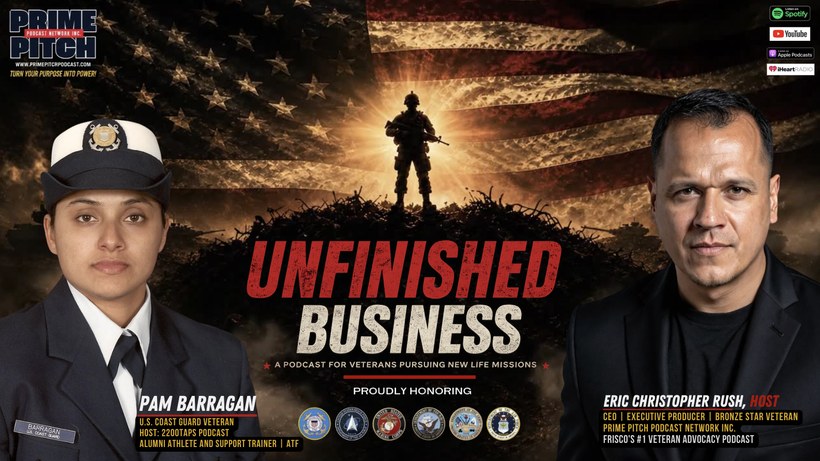
Pam Barragan
U.S. Coast Guard Veteran · Host, 2200Taps Podcast · Alumni Athlete & Support Trainer · ATF
About the show
Unfinished Business is a podcast for veterans pursuing new missions after the uniform, and for the families and communities who stand beside them. Hosted by Eric Rush, The Conversation Architect, a Bronze Star combat veteran and the founder of Prime Pitch Podcast Network.
Read the full transcript
The way that it was described to me is like a, you know, like the, the old computers, like you get like the little circle of death and you have to like, "I gotta reboot it," or, "I gotta erase those files for it to res- you gotta restart it."It, it's just like a whole thing, right? So when with trauma, like emotionally we're stuck in this loop. Mm-hmm. And with EMDR, it's designed to actually get those files and file it away. So when you go through it in a safe place and you talk through it, it will help grab those files and tuck it away and, and not get over it, but really work through it to the point where you're like, you, you can physically feel it in your body.
I feel it in my chest or my head sometimes, depending on what I'm talking about. Yeah. And then I work through it and I'm crying, and then I hate my therapist, and I'm telling him F you 'cause like we have that relationship. And he's, he's laughing, but he's like, "You just did it."Um, it's highly recommended for first responders especially, and veterans, because traditional couch therapyWe need to get there, we need to get there hard, we need to get there fast. No, no different than working out, right?
Yeah.'Cause sometimes our lives are literally on the line. Traditional couch therapy is great if you've had like a traumatic event. Yeah. Like something not minimal, but something maybe not to the extent of compounding trauma. Yeah.
Uh, which is why they really recommend EMDR to get in there quick. Yeah. Um, anyhow, so I went through, uh, a local clinic, the Cohen Clinic, with a therapist, and she's likeI, I found out I had what they call cPTSD, which is- CPTSDit's all, it's from the childhood stuff on top of military. And military, yeah. And it's all compounded to stuff.
And she's like, "You need at least 8 months to a year of EMDR continuously."Unfinished Business. Stand up tall. what's up, guys? Welcome to Unfinished Business, a podcast for veterans pursuing new life missions. One of the things I've learned is that people who change lives rarely set out to become remarkable.
More often than not, they simply keep showing up, they listen, they encourage, they create people, they create space for people to be honest about their lives even when those conversations are difficult. That's what I think about when I think about Pam Barragan. The more I learn about Pam, the more I realize her life was never going to fit neatly into a biography. Pam is a United States Coast Guard, Coast Guard veteran, the host of 2200 Taps podcast, and an alumni and support trainer with Adaptive Training Foundation. Every part of her work points back to the same commitment: investing in people.
Whether she's standing beside adaptive athletes rebuilding confidence after life-changing injuries, sitting across from a vet- veteran like me who's finally ready to tell their story, or using music to reach places words sometimes can't, Pam has devoted her life to help people recognize that their experiences still have value, their voices still matter, and their lives still have something, some- something meaningful to give. I had the privilege of meeting Pam while I was, I was recovering from 2 hip surgeries at the Adaptive Training Foundation. Her encouragement during that season left a lasting impression on, on me, and I've been looking forward to this conversation. Today we're gonna talk about purpose, service, storytelling, music, and what happens when someone chooses to spend their life investing in others. This is my conversation with United States Coast Guard veteran and host of 2200 Taps podcast, Pam Barragan.
Pam. Yes. It's a pleasure to have you on the podcast, my friend. It- Thanks for having meabsolutely. I- Thank youthis is a long time coming, you know?
Quite the intro, man. I'm a littleDamn, I sound cool. You made me sound kinda cool. Thank you, man. That, that's- For having me.
Yeah, you're quite welcome, you know. Um, um, yeah, I was gonna ask you that same, that question, was like how didYou know, when I go through these pod- these, uh, introductions and I, I, I show people who I see, who they are, what, what, what emotion went through your mind? What thoughts occurred? The first thing was I need to, I need to step up my intros on my guests. I, I, I do.
Uh, I just kinda go off the cuff on what I feel and how I know them and their background, and it works out 99.9% of the time, so, umNo, man, I just feel honored and blessed to just have these opportunities with people like you, and having had you most recently as my guest on our show, it's kinda cool how it all comes full circle. So I'm, I'm just grateful to be here and, you know, another breath, another opportunity to do something different today, and just be a good person. You know, that's kinda the goal at the end of the day. Yeah, you know, and that's that, you know, that was the one thing that, you know, what, what, what, why it was so important to reciprocate, you know? When, when people are, are, are giving you a, are, are, are, are giving you a platform to share their story like you did with me, I just, IYou know, it's so important to reciprocate that.
It's, it's so important- Sure'cause we build each other up as veterans, as combat veterans, as, as, as, as, uh, as, as human beings, you know? We, we, we push our, push each other forward. And, and one of the things, the most important things was, is our, our shared experience when we were, when I was at Adaptive Training Foundation, right? When I was, um, going through my s- um, season of, of rehabilitation and, and you were there for me. Um, when, when I was, when I, when I was going through my stuff, what did you, what did you, umWhat were some of the things you, you, you- Mmlearned about me during that time?
You know, you can be honest. You know everything, everything's on the table. Uh, well hon- like honestly, it was fun. It was a lot of fun because you were very, this guy was very vocal about what he was afraid of, which wasThat's all you could really want for an athlete that goes through, um, an organization like A- AT- We're the good ATF, guys. This is Adaptive Training Foundation.
Um, because if you're honest with yourself what you're afraid of, that's where the change can happen, and also trusting the process. And I think that was really cool to, to have those side conversations with you, and active conversations as you're going through the movement, and you're like, "I don't know about this."You're like, "Just- Trust us. Yeah. We're gonna, we're gonna, we're gonna, you know, hit the gas, but we're gonna, we're gonna pump the brakes, too. We gotta, we gotta feather it, kinda like I said, like, like a, like a manual car.
Mm. You've gotta feather those, that gas and that clutch to keep you going sometimes, especially in traffic, right? Yeah. For those that know how to drive stick. And it, it was kinda like the same for you.
Mm. As with any athlete, 'cause we have to find, all right, is this hurting you? Is it a good pain? Is it a bad pain? Yeah.
And what I appreciated about you going through it is you were very honest. Uh, you didn't have the machismo thing like someThere's some people like, "I can go through it."It's like, eh, yeah, but you're gonna hate me tomorrow, and you're gonna hate yourself because you've, you pushed it a little too hard. Yeah. So, and with, with y'all it was a 2aday, so we had to be even extra cautious. Mm.
Because we gotta get there, gotta get there fast, and then we gotta see how you're progressing, and then we have to regress sometimes. Yeah. And with your 2 hip replacements, I'm like, "Well, this is gonna be fun."It was more of a challenge, but I honestly, I trusted my, my coaches. Like, I have Tim, I have Josh, I have the staff. And then your pathology, and with that itAnd then me, you know, trusting my training that I've had the past 6 years just being a support trainer and a personal trainer, it's like, we could allThis could be a really good marriage to see you take that extra step so you can find, you know, shatter that glass ceiling that's been keeping you stuck.
And that, I think that we did, and, and I don't even think, I know we did, 'cause I saw it. Yeah. And that's, uh, and that's really cool. Yeah. It was, it was, it was, it w- you know, I, IYou know, when you think about it and say, "Who are you gonna p- you"You know, I didn't know what I was getting myself into until- Me neither.
I got the phone call and I said, "Piper, what? Yes, let's go. I, I think I need that in my life right now."Um, you know, uh, Pam, one of the things I, I kept coming back to as, as I was learning more about you is 2 people can walk through the same exact experience, and I think you, as we, as our relationship evolved a- and at, at ATF, Adaptive Training Foundation, and we got to know each other better, right? Um, um, you know, I say is that 2 people can walk through the same exact experience and come out very differently. When you look back on your own life, what do you think has shaped you the most?
Man, all the trials and tribulations. I really feel like it. You know, I grew up without my dad, my bio dad, and, uh, it was a very strained relationship when he did come back in the picture, and now I have no relationship with him at all. Mm. Um, so, you know, Mom was 16, he was 18 when I was born.
Under the same r- with my grandparents. We didn't have a lot of money. And, uh, you know, people are gonna laugh, I've recently rediscovered Kelly Clarkson. Don't hate me. I'm about 24 years behind, just so you know.
I know some songs, but I never really knew who she was. Mm. And when I, when I, like s- when I'm learning about her background, I'm like, man, we could be the same person, the same little girl at 6 years old, and then, and you keep going on. But she said, you know, when you don'tY- y- she, she, sh- I, I have this saying, like, "My own dad didn't want me. Like, you think you're gonna hurt my feelings?"Mm.
She's the first one m- recently that I've heard pretty much say the same thing. Mm. I'm like, damn, that's a thing. Yeah. So, trying to understand who I was as a little kid, going through, uh, you know, being molested as a kid, you know, you know, a teenage mom, and then all this other stuff, and then chaos in the house, and, like, I had to, we had to survive.
We had to do whatever we could to survive, especially me as a kid. Mm. And my mom and, and so forth. And that shaped me into what I ended up doing as far as enlisting in the Coast Guard. Mm.'Cause I wanted to help people.
Wow. I wanted to help people. I, I wanted toI couldn't wait to grow up so I could protect my mom. I hated boys. I still hate boys.
And I remember when it was like, where, what branch do I wanna go in? I, I, I love the beach, I love the ocean. I'm from Corpus Christi, Texas. Mm. And I'm like, well, the Coast Guard makes sense 'cause I love the water, I love helping people.
Let's do that. And then there's a lot of, like, spiraling that comes with that, and the downfall of my career and, which ended up being a blessing. Uh, but yeah, that's howIt's a long-winded answer for your question, but that taught me a lot of grit and resiliency, and almost losing my life was like the big thing- Mmthat really taught me like, hey, like life is worth living. Yeah. And that was the one thing I l- I gained from, you know, us sharing time together- Mmespecially on your podcast.
We both, I think we both st- um, even when we were, before we were on the podcast, we said, I said, "Man, I feel like we have so much in common," you know, as we were going through our- Yeahthrough the- Old school, podcast- Yeahfitness. Yeah. What else? Yeah, for real. It was like really cool.
It was like- Yeahman, and you know. And we weren't, our, our journeys aren't that far apart w- with regards to f- you know, family dysfunction and, and- Mmand um, and all the other things, you know, m- mental health, and now we had- Mmto overcome, come those obstacles and, um, yeah, it'sAnd but we are very much a l- more alike than, than you know. We're pretty much cut from the same cloth. Yeah. I need to go check- For surewe need to go check our, um, our- Our DNAyeah, our DNA.
Yeah, for real, um. Well, I always said that I might have older siblings out there, might haveSo we'll see. Yeah. I don't know. My dad spent a lot of time at the bar, so I don't know if your mom was there.
I'm just ki- Mine just slept with everybody. Yeah. Sorry, did I say that? Okay. Oh, um, you know, you've spent a lot of your life around veterans, adaptive athletes, and people rebuilding after something incredible, um, something incredibly, of some incredibly s- difficult circumstances- Yeahright?
What have they taught you about people that you wish the rest of the world would unders- understand? Man, the biggest thing, and David says it all the time. He says, you know, "You treat people broken, they're gonna show up broken. You treat them as a whole individual, that person shows up."I'm quoting David Mbor. Love you, dude.
Mm. And what I've seen in, in those 4 walls, in particular at the gym, I tell people when I meet them, I'm like, "I don't know if you're a believer or not, but I am."Yeah. When you walk in that gym and you see what happens, it's like smiling at God and you can see Him smile back at you.'Cause it's just like everything the doctor said you'll never be able to do again, it's like, well let's go figure it out. Next thing you know, somebody's taking their first steps all over again. Yeah.
And the stories, man, the resi- Dude, if there's aIf you looked up resiliency in like i- in the dictionary, it's, it's gonna have every single picture of every single person that's ever walked through that gym. Mm. Because like how the hell did you do that? It's because somebody believed in them until they could believe in themselves. Yeah.
And that's literally what we do. We know what you're gonna get out it if you trust the process fully. It's not an easy program. You did a week, 2adays. Yeah.
Imagine doing 10 weeks. Yeah. Hard workouts. People that have never done any bit of working out in their lives- Mmor had every excuse not to, I should say. Mm.
And the first thing we have them do is a 12-minute ski erg test. I ain't got no arms. I don't care, we're gonna figure it out. Yeah. Guess what?
I got a guy with no arms and no legs who just competed in his first bodybuilding competition and got a gold medal. Wow. That's amazing. He's a human starfish. Yeah.
He's got every reason, like poor me, but it's like, no, dude. Yeah. So I, and they've taught me, man, that just keep showing up. Yeah. You know?
That's, that, that's so true. That's a, that's a very, a very special way to look at it too is that, you know, um, see the whole person, not the broken one, right? Mm-hmm. And, and, you know, as, as I was takingI remember when we started, we started this, the program and it was we were gonna do sprints, right? Mm-hmm.
Um, the very first exercise I think, and I like fell, like I tumbled the first and it wasn't my turn to- You weren't the only one that fell. I can tell you. I know, but for me to fall was like, what the hell just happened to me? You know? Like, 'cause I hadn't had the hip connection and the- Yeah, the mind-body connectionbody connection.
Yeah, yeah. And that- Which to your point, not to cut you off- Yeahis back to you, is that was theWhen I saw that actually happen, like- YeahI saw it, that's when I knew like, oh, he just got it. It's just, now it's, now we're taking off. Yeah. And so.
Yeah, that's beautiful. And that's what I really appreciate about the work you're involved in and the, the, the- Yeahthe, your commitment to the, to the organization- Hell yeahis just to s- to, to, to see people who are dealing with limb loss and, and other, other issues, right? Mm. These things we can see and things we can't see, right? And, and you're, you're down on the ground with them and- Mm-hmmyou know, we have a, a very special picture of us where, where I, I think y- you're like coaching me on your own- On my kneeon one knee, like- Man, you know how hard it was to get back up from that?
Yeah. Seriously. Yeah. Those were my injuries. Yeah, I was suffering doing that exer- Yeah, that's ve- special pictureYeah, it really is.
It's a very, very special- A good oneIt's a brother, a, a brother and sisterhood in that, in that moment. Um, you, you know, I think a, uh, most people recognize strength when they see, see the finish line, right? Most people say, "Hey, I finished."The finish line's the, is the measure, right? Yeah. You spend time around people who are still in the middle of the work.
Mm-hmm. How has that changed the way you think about what strength really is? Strength I feel is vulnerability. Mm.'Cause you've gotta be vulnerable to trust this, well, this process in particular at the gym. It, they challenge you to tap into those, those parts of you that you don't wanna look at, you don't wanna acknowledge- They hold a mirror up to you- Yeahlike figuratively and sometimes literally when we're doing mirror work with some of the athletes.
But it's like, hey, like if you truly trust this process and go all in, meaning acknowledge the things that aren't working for you, man, just the weight that's gonna come off of that. Yeah. Like you can physically feel the weight coming off when you say something. And sometimes it's hard to say something out loud if itLike I've had stuff get stuck in my throat. I didn't wanna get it out, but I had shoved it so far down.
Uh, real quick, repeat that question again. I just- Oh, yeah, no problem. No, you're good. Um, I said, um- Go ahead andhow, um, most people recognize strength when they see the finish line, right? Yeah.
Um, you, you spend time around people who are still in the middle of the work- Rightright? They're in the race. And, um, how has that changed your way, um, how has that changed the way you think about what strength really is? Yeah. No, it's, it's definitely vulnerability.
I think vulnerability, like, it, it could be the, theSome people see it as a bad word. Hm. Or we- you're weak. Like the, the 4letter word that's like a bad word, but weak. You're not weak.
You know, I feel like strength, like as a woman, if I see a man be vulnerable- Mma man who can be vulnerable in his shit. Can we curse? I'm sorry. Yeah, yeah. Oh.
Absolutely. Sorry. Anyway, be, uh, so a man that can generally be vulnerable like, "Hey, I'm not doing well," or, "I'm feeling this," um, that helps me feel safe as a woman. And anytime I see a man be vulnerable in his skin in that moment, I try to acknowledge that for him, especially with a guy. Yeah.
Because I, I love to see a man smile, I love to see a man cry, I love to see a man just like feel those feelings, which all goes back to vulnerability. Yeah. And, uh, I think about some of our athletes that have climbed Mount Kilimanjaro, and our buddy Mo, uh, Mo Brissette, he was our old mindset guy, he'd always tell us, you ever seen like those CrossFit people? No offense, but if, if I offend you, then you got some work to do on this one. But w- after a workout, they just throw themselves on the ground like they're dying and there's carnage like everywhere, right?
Mo, when we worked out, he wouldn't let us do that. If we just wanted to fall 'cause we were out of breath, and these are hour-and-a-half workouts, guys, so we have every reason to fall and act like we're dying. He's like, "Don't do that. I want you to stand up and I want you to keep walking."Hm. He's like, "Because everybody always trains to get to the top of the mountain, but they never, never train to get back down it."Hm.
Yeah. I was like, "Oh, that's good. That's good."But it also teaches you to k- to keep tapping in even when you don't want to want to, when you feel like you have nothing left. So back to it, I feel like, but that takes vulnerability. Yeah.
You gotta, you can't just, "I'm gonna man up," and then just like pass out 'cause you're, you're being a dumbass. Like, no, dude, like if you're hurting, you're hurting. Yeah. Uh, I don't know if that answered that question. No, it absolutely did.
I think vulnerability is, I think, a key to strength, for sure. You know? Like, I mean, you don't, you gotta let go to, to, to, you know, to receive more, right? You gotta let go to receive more. You gotta unclench your fists and, and open up.
When was the last time you were tested and, and your v- vulnerability was tested? And, uh, is there a particular experience where you could say, well, that's not phys- you know, training-wise or maybe whatever, is there a point where you said, I, this is, I gotta, I gotta, um, I gotta let, I gotta open myself up to this? I'll be honest, I've been doing EMDR the past guess 2 or 3 months weekly. Yeah. I went through, uh, a lot- For those that don't know, just, uh, tell us what EMDR is, if you don't mind.
So it's an acronym for, uh, eye movement desensitization, EMDR, response. Basically, it's a form of therapy. Um, especially it works really well with veterans and first responders. If you actually go there and, and, and trust the process, um, you work with your therapist and like for me, they have a, I do virtual reality, or not virtual reality, I do virtual, and he'll put up a blue ball on the screen and it goes back and forth. So you're looking back and forth with your eyes, so it's firing off, you know, either side of your brain, uh, left and right.
As you're thinking about the traumatic event or as you're talking about it, depending on what theytraumatic event, or as you're talking about it, depending on what theySometimes they have like vibrating like balls or something on your, and it, it, there's different variations on how they do it. But the way that it was described to me is like a, you know, like the, the old computers, like you get like the little circle of death and you have to like, "I gotta reboot it," or, "I gotta erase those files for it to res- you gotta restart it."It's, it's just like a whole thing, right? So when with trauma, like emotionally we're stuck in this loop. Mm-hmm. And with EMDR, it's designed to actually get those files and file it away.
So when you go through it in a safe place and you talk through it, it will help grab those files and tuck it away. And, and not get over it, but really work through it to the point where you're like, you, you can physically feel it in your body. I feel it in my chest or my head sometimes, depending on what I'm talking about. And then I work through it and I'm crying and I hate my therapist and I tell him F you, 'cause like we have that relationship. And he's, he's laughing, but he's like, "You just did it."Yeah.
Um, it's highly recommended for first responders especially, and veterans, because traditional couch therapy, we need to get there, we need to get there hard, we need to get there fast. No, no different than working out, right? Yeah.'Cause sometimes our lives are literally on the line. Traditional couch therapy is great if you've had like a traumatic event. Yeah.
Like something not minimal, but something maybe not to the extent of compounding trauma. Yeah. Uh, which is why they really recommend EMDR to get in it quick. Yeah. Um, anyhow, so I went through, uh, a local clinic, the Cohen Clinic, with a therapist, and she's like, I, I found out I had what they call cPTSD, which is- Yeah, cPTSDit's all, it's from the childhood stuff on top of military.
I know, yeah. And it's all compounded to stuff. And she's like, "You need at least 8 months to a year of EMDR continuously."Hmm. I was like, "What? Okay.
Cool."So I'm, I'm 3 months in, and we're finally at a point where instead of weekly we're doing bi-weekly. Yeah. Um, but with that, I've been tested. It's been very hard. And when my therapist is like, "I want you to go back there and I want you to visualize it, what's being hap- what's happening, what they're doing to you physically," in my case I was molested on one of the things, and I'm like, "I don't wanna do this."And I'm like, "Uh, this is really uncomfortable."But I, I'm, I trusted the process.
I followed the ball. We, within an hour of doing the work with my therapist, I was able to resolve that particular event. Hmm. Which apparently has been haunting me forever, and I didn't realize that, 'cause I stuffed it so far down. And it wasn't until I started working on the childhood stuff and I'm like, "Dude, I don't wanna do this.
I, I'm, I'm a very honest person, I'm vulnerable. I'll do anything for you, but I don't wanna do this thing."But he did it. Yeah. And I felt, I felt gross. I felt like everything that you could possibly think you could feel that incident happen.
It's like, "Fuck, I don't wanna relive this."But in that moment, I chose to relive it in a safe place where I could be like, "All right. I know what could be on the other end of this, so let's just fucking go."Yeah. So you hadI always say you gotta go through it to grow through it. Yeah. I'm trademarking that.
Don't take it. You gotta go through it to grow through it. And it's like a, it's like an infection. I tell people, "If you get cut, you get an infection, what do you gotta do?"Yeah. You gotta go back in there and clean it out for it to heal properly.
Yeah, that's true. So, yeah. Yeah, it's aWell, I appreciate, you know, I appreciate you touching a base on, on, on, on traumatic experience you went through with, a- as a child, you know? I mean, those thi- those things like that are so, umYou know, it, it's one of those, those moments where you, you, you, when someone shares something like that, you know that it's like a, a vase, a gl- a glass vase that's real fragile, and, and you know, you have to hold, you have to be careful with it, stuff like that. And that's a measure of- It sucks.
Yeah, yeah, yeah. Was there, like did you ever experience it, what was your, now that you've s- resur- you've surfaced it up, was there actuallyI always say when you start digging, there's gonna be some kind of reaction to it. Mm-hmm. What, what, what came out of that? Like was there some kind of, like it's like toxic, right?
You, you, you're taking toxicity out, but you've held onto this toxicity so long, it's take out the poison, your body's still gonna react a certain way. It's funny you ask that, 'cause lately I've been belly laughing at the most random shit I would not laugh at. Hmm. I'm like, I'm starting to feel something, and I'm l- I'm l- f- f- I sound like a, like an old lady or old man if you want, like, but whatever. When, but, but I'm literally belly laughing.
I'm like, "I have not belly laughed in years."Hmm. So that's a win. Yeah. Um, I'm starting to get startled with things every now and then, and I've never been one to get startled. Like you can't startle me.
Yeah. Uh, and I told my therapist that yesterday actually. He's like, "That's a win."I'm like, "What do you mean it's a win? Why, I don't like this."He said, "You're starting to feel stuff again."Hmm. I'm like, "Okay?"Yeah.
And that, and that's my thing. I numb out so fast. I, I was a first responder. Yeah. I could watch police body, and I do, while eating like spaghetti or something that I shouldn't be eating.
A- and I'm watching this traumatic event unfold on police body cam footage and I'm just like mesmerized and I love it, and I'm just like, "Oh, this is great."I don't feel anything. I have no emotional connection to it at all. Hmm. And um, there's a lot of work that still needs to be done. Yeah, yeah.
You know? Yeah, it's a process, right? Like, you know, it is true, you know? And that's why I brought it up, 'cause it's like, you know, we go through some things, and when I started digging through my stuff, you know, like I became homeless. I started living out of my car, you know?
Out of my car, yeah. Yeah, yeah. We, yeah, I remember you sharing that with me too, so it's like- It's another thing we shareyou go through, we, yeah. Wait, what kind of car was it? I'm just kidding.
I didn't remember what kind of car. It ended in Paula, I think. Yeah. Ended in Paula. MyYeah.
Anyway, so, um, yeah. I'm like, "Rein it in, man."No, you guys- You're about to go so crazywe can laugh at it now. We can laugh at it now. Yes, we can. I can stretch 25 cents very well-if I have to.
Yeah. Right? Those gym memberships really paid off and That's right, that's how I took a shower. Yeah. Yeah.
No. You know, it's like, you know, we go through that traumatic experience, and when we start digging, you know, we're- Yeahwe're, we're pulling stuff out of ourself, and we're go- Our body's gonna have a, uh, a reaction to some coping. It's a coping mechanism, right? We cope, we coped a certain way. You like, weDid you feel that you, like, you, you held onto this hard wiring and then you had to cut the- I'll be honest with you, and that to, like'Cause it, it relates to this.
Yeah. Um, also with a Badge of Honor, another nonprofit, as a presenter, where we go in with, into police departments and fire departments and share our stories and resources. You know, "Hey, what you're going through is normal," and all this stuff. And before I came on board on the team, Sam, uh, Sam- Sam, one of the founders, she's like, "I need you to come to one of the trainings and just sit."Mm."SoAnd just listen to what we're doing."Sat throughIt is an all-day training. I went home, and, like, the next day I got sick, and for the next, like, 2 or 3 days, I felt like I had the flu.
Hmm. Mm-hmm. But I would've, but I wasn't sick. It was just my body was so achy, like I had the flu. Yeah.
I'm like, "Where is this coming from?"And, uh, through it with Sam in, in therapy, and they're like, "Your body remembers."Hmm. Because the fire department we had gone to for the training reminded me of the Coast Guard station, down to, like, the damn coffee pots. Yeah. You know? The only thing thatIf they would've had the same alarm, I would've freaked out, but they didn't.
So my body, I was like, "Man, am I even ready to do this?"Yeah. My body's still responding in a really goofy way. Hmm. Uh, but I s- leaned into it. Now I'm fine.
But- Yeahthe body remem- body keeps the score, right? Yeah. It remembers. It's, it's wild. Yeah.
You gotta work your, work yourself out of it, right? That's the thing, right? Yeah. That- that's the thing. Um, you know, you've built a, a podcast around people's stories and, and, and I've always believed that that's a big responsibility.
Um, after all the conversations you've had, what surprised you most about people? If you just sit and listen, you don't have to have the answers. You don't have to give advice. Just listen to what people have to say. People are a lot more honest.
They're a lot less confrontational. And you learn to appreciate every story, because every, every story took some sort ofMan, it's like resilience all over again. That's a big word today. Um, 'cause any one of my guestsI've even interv- interviewed my mom. Like, she's on the show.
Wow. My best friend. Uh, my, my story's there. That got interviewed, too, on there. Uh, 'cause I'm not willing to go, you knowIf I'm asking you to go somewhere, I'm gonna go with you.
Yeah. Um, yeah, just, just, just give somebody a safe place to talk, and you'd be surprised what comes out- Yeahuh, without judgment, and that's the key. Yeah. Uh, hard convers- h- hard conversations can be non-confrontational for sure. Yeah.
What do you think it takes to, to, to, to provide that for somebody? You know, like, you do that. You did it with me, and I, honestly, I was probably the mostThat was probably the most-I mean, I cussed more than I- Yeah, you didbut it was good. I needed it, you know? It was good.
All right. I, I dropped some F-bombs on that one, but, but it's 'cause I just felt so relaxed. What do you think it takes to, to, to lean into people's story? You know? I don'tI've, I've just, I've always had this niche to just sit and listen.
Hmm. Um, and then when I went through training, in particular here, there's a training in Dallas that I went through that ultimately helped save my life, and I remembered how the trainer showed up for us, how they didn'tThey'll tell you right away, "We're not giving advice. I'm not gonna give you advice."And that's really where we get in trouble. We seek so much advice, we can't think for ourselves. Mm-hmm.
If we empower people to think for themselves, and allow them to feel exactly how they're feeling- Mmthen you can move the needle- Yeahin a really good direction. I tell my best friend, you know, 'cause she's, like, feeling a certain way, even yesterday she said, "I feel this."I'm like, "All right. Feel it. If you genuinely feel this way, I want you to feel it."Mm-hmm. But what, what do we gotta do to move through it?
Not get over it. Yeah. Which I, I can hate when people, when people are grieving and people are like, "You just gotta get over it."No, F you. I'm gonna punch you in the throat. You don't get over something.
You're gonna work through it. Mm. So yeah, just feel it, dude. Be willing to sit with somebody in their own shit. If you're willing to lock arms with me- YeahI'm willing to lock arms with the next person.
Mm. I stand on the shoulders of the people that were there for me, and I wanna provide that for somebody who maybe this might be their only opportunity. And if you just shit on their opportunity, they may just stuff it, zip it up, and next thing you know, we might lose them. Yeah. And I'm not saying that's, it's gonna be your fault if they choose to take their life or whatever.
It's not your fault. But give them a, give them an honest shot- Yeahto just let it out, dude. Love them for love them where they're at. Yeah. It's crazy, man, 'cause, you know, like you, you know my story and, and I, I think in, in the podcast I shared that I held onto it for 20 years.
I kept the stuff in my, my pocket and said, "This is gonna fuel my fire. This is gonna be my, you know, this is gonna be mine. I'm gonna be angry all the time. I'm gonna be a stoic all the time, and I was just gonna be this guy."And, and, and then, um, and then getting on your podcast, you know, was like you know, it was a, a pressure release, you know, a pressure release. Um, who, who are some of the people that were there for you that helped you to help you get out of the water, to pull you out, to- Dude, first-and foremost, my best friend.
I love her to death. Name her. Charity. Charity. Okay, shout out to Charity.
Char. My bestie. Met her on the Jillian Michaels cruise, actually. Oh, really? A long time ago.
Jillian Michaels cruise. Jillian Michaels had a cruise. That's great. It was a long time ago, and we met there, and it was great. Uh, we're 16 years in to our friendship, and, uh, I met her in 2010, and then I had my, I had a really bad search and rescue case, or SAR case, in 2012, living with her and her family at the time, and then I couldn't be in the Coast Guard.
I basically, like, lost my entire career while I was living with her and her family at the time. Mm. And sheI got very codependent with her. I justLike, I didn't have tools. I didn't know how to talk.
I didn't believe in therapy. I thought people were full of shit. Like, all of it. And then I started spiraling, and then one night I tookI have a scar on my hand. I took a fork to my hand, just so I can feel something, and I couldn't feel anything.
Took 5 shots of Crown, and then I proceeded to grab a knife, walk upstairs, and take a knife to my uniform right in front of her. And ultimately got kicked out of the house. Uh, I was homeless, and she lived 2 miles away from me. Like, there, we literally had to do this. We had to, likeA good year, we didn't talk.
Mm. And I was trying to find my way, trying to figure it out. I lost my best friend. I'm like, "Who am I?"Identity crisis. Like, all the stuff that comes with, "Who am I without uniform?"And then I ended up comingI was in Chicago at the time.
I ended up flying back to Dallas for a training that I found out about, and this was it. Like, I was real close to taking myself out at this point. Mm. And an opportunity come down here, and the only reason I came down is 'cause I hadn't watered a bird in a couple years. I stand by that and I swear by that.
I was like, "I'll come down."So I come to the training and, uh, slowly started working on what's getting in my way, and very quickly did I realize it was me. Mm. You know? Being asked hard questions, being honest. Like, what did I have to lose?
I had nothing to lose. Wasn't even gonna come back for another portion of the training, and like one of my classmates paid for my entire training. Wow. I was like, "I guess I'm coming back."And then picked up a part-time job at that point. Like, there's, like, littleIt was very happenstance how everything worked out, and then in the middle of my training, Charity reached back out to me, and it'd been like a year.
She's like, "Hey, I'd like to meet you for lunch."Hell yeah, I wanna meet you. I miss you. You know, I miss my friend. And we met for lunch, and that was in 2014, and we've been so tight ever since. Mm.
Like, we had literally had to do this. I work on my stuff. She works on her stuff, and then we come back, and we still, likeWe have not fought like we did before. Yeah. And it's been, what, 12 years?
Yeah. And we have a, we can have hard conversations, healthier conversations. You know, she had another baby. Like, that little girl's a, she's, she's 11 now, but she's the best, this kid. And to be able to be like, manAnd we didn't see each other for 9 years up until a couple years ago, but we talk every week.
Mm. I never call her 'cause that's not how we do it. I message her or whatever, and she always calls me- Mmonce a week. And that's what I was telling you before you hit record, like, my phone, and I've done this to myself- Because of her background and because of I know her story, which is not mine to, to tell, I keep my phone on in case she needs something. I don't wanna be that person that misses a phone call.
Yeah. She ne- she's never asked me. She's not in trouble. She's okay. I don't ever wanna be that person like, "Man, I wish I would've picked up that call."Yeah.
So even when I present with a b- with a badge of honor, they know my phoneShe's w- my emergency contact, so she'll get through. Anytime she needs something, I'm gonna make sure I'm gonna be there, and I did that. I put that on myself because she means that much to me. She saved my life is what happened. Yeah.
Uh, that's amazing. That's amazing 'cause it, you know, it's always theI mean, it's amazing 'cause you, you haveThere's always that one person that, you know, you remember and theyI remember I was in a halfway house and there was a 19-year-old kid. I was working atI ran, I was ru- ran a c- ran a call center. I was in a halfway house, and he worked at the call center and I was managing. And, and he saw me walking.
And I'd walk, I didn't have a car. I just got out of being incarcerated, and he would give meHe goes, "Hey, you, you, would you, do you want a ride?"Like- Mm-hmm. I was in Waco at the time and was like, "Yeah, I guess. Yeah."So he say, "You would pick me up from the halfway house, take me to work," and we'd go to work together.'Cause he worked- People like thatyeah, yeah, yeah. It just took that one thing, right?
Sometimes it is the small, uh, one of those small, um, olive branches, small things like that, right? It is. And, and to your point, and it's funny you just shared that 'cause I didn't know that. Um, when I was homeless, I would always hang outThere's another girl, another woman that I'm, I'm grateful for a lo- quite a few women in my life. They're- Yesthat important to me.
This one in particular, her name's Nancy. She was a barista at Starbucks, at the local Starbucks where I was homeless, living out of my car, and I would go to that Starbucks every day. And I had nowhere to go. Every day, every day. She, she finally pic- picked up on it and she's like, "Why are you here every day?"Like, "Do you not have a job?
Do you not go to school?"And I told her my situation, and it got to the point where she would sneak, she would get meI'd always get like a venti iced green tea. Mm. And she would start sneaking them to me, like just giving me them. Yeah. And then she finally said, "Hey, I'm gonna talk to my husband and I'm gonna see if we can't take you in till you can get on your feet."And they did.
Wow. They took me into their house with their 3 kids get this homeless veteran off the fucking street. Wow. And they did. And it, it all just worked out.
And then my mom, of course, my grandma. She, I mean, there's all these women. Yeah. My grandpa was my best friend, though. Mm.
My, myHe was a World War II, Korean War vet. Wow. He had me driving his F-150 when at 9 years old. Like, that generation didn't give a shit. Uh, yeah, man, I hang onto those relationships that are still here.
Yeah. That's what's important. That's beautiful. That is a, that's so beautiful. Uh, who was the, what's the name of the person that, uh, you met at the Starbucks?
What's her name? Nancy. Nancy. Shout out to Nancy too for being a- Nancya solid one for sure. And then actually the last one, Miss Cheryl, she's, she passed away a few years ago, but I had her on my podcast early on in the days.
Miss Cheryl, she had, she ended up dying of cancer, but she gave me some vouchers for a hotel. Mm. Like, I had all these people just trying to help me, and then she got me, she gave me food vouchers. She worked at a, a Town & Suite at the mall. It was just like, it all worked out.
Wow. It really did, so. That's beautiful, and that's why you're on the podcast today. Shout out, shout out to Nancy and, and what was the last person? Oh, Miss Cheryl.
The late- Cheryl A-Cheryl, yeah. She just passed away, but she's- Miss Cheryl in heaven, we, we appreciate you here on Earth. Thank you for being there when we needed you. Yeah. Um, so one of the things I've noticed is that listening has become a lost art, right?
You and I understand that. We're podcasters. We do the same thing. We do the same kind of work, just sit down with, with one another and listen. Um, you spend years listening to people's stories.
Mm-hmm. Um, what's something you've learned from listening that you don't think you could've learned any other way? Oh, man. How to live a, how to live life. Yeah.
God dang, there's more, more, there's more than one way to skin a cat, right? We say. Mm. And then we, when you, you hear all these stories of perseverance and people that had a hard X, Y, and Z, but how, where they are today, it's all a choice, man. Yeah.
I like that what you said, it's like there's more way, 1, 1, more than one way to skin a cat. Man. And that's like, yo. You, like you'll find your way. Yeah.
You justyeah. I don't know. Yeah. It's interesting. I think that's cool that you said that, that know more than one way to skin a cat.
People have different journeys. Remember, they're not on the same, we're all not on the same path all the time, right? We go through our bumps and bruises and, but we end up, you know, put one foot in front of another- Yeahand get here, right? I mean, and that's the beauty of, of storytelling is not every s- notThe, the stories aren't all gonna be the same. It'd be pretty boring if it was.
Um, it's unique, and it's cool, and you find more methods on how to just live this life that you have. It's really cool. Let's talk about music. Let's do it. Let's talk about music.
What, what's your, what is it, uh, what is it s- what kind of superpower does music give you? Something I can't explain. My birth father is a guitar player. He's in a band. My mom's an incredible singer, and music was just always in the house.
But my guitar saved my life when I was a kid. Hmm. That guitar was my best friend. Like, my house was so chaotic that I would go to my room, lock my door, and force myself to learn how to play the songs on the radio. Like, literally, that was my best friend.
Wow. And that took me away from all that chaos, so I'd find a lot of peace and comfort in it. That's extreme, it was justAnd, and now I'm, I'm a guitar player, and I love guitar, and then music, it's likeHave you ever seen the movie August Rush? Maybe, maybe not. Maybe.
It, it's- potentiallythere's this kid, he's like a musical genius, but, like, he hears the chimes, right? The wind chimes, and people just hear wind chimes, but he hears music. Hmm. He hears the, you know, the, the electricity going through the power poles, and some people just, whatever. He hears sound and music.
Hmm. And at the end of the movie, he composes this beautiful composition, 'cause he's a musical genius, and he's like this little boy. It's great. That's what, that's w- like, when I hearI don't even know lyrics to a song. I have to be intentional to hear what they're saying, 'cause I li- I'm listening to the melodies.
Yeah. And you strike that minor chord, you're hitting my soul. You know, the major chords, like there's a, there's theWe're all made of f- we're all, we're water, we're made, we're a frequency, and, and music is frequencies. And if you get on that really, you know, the higher level, the, the more, you know, higher frequency, the happier you're gonna feel. Yeah.
The lower the frequency, the more shitty you're gonna feel. Hmm. If you think about hip hop music versus, like, happy, like, Mickey Mouse music. Yeah. You got the 808s, and that low end, it's like, "Well," Yeah."And yell hard."It's like, dude, why don't you listen to some happy music?
Yeah. You might just be a little happy, right? So I'm, I'm a firm believer, just frequency. It just hits me in all the right ways. I can't explain it, dude.
I'll cry. I'll cry with a song. I just, I love making my guitar cry, and that's, like, the goal. I gotta see that one day, Pam, for sure, 100%. Make my guitar cry?
Yeah. I wanna see you play. I wanna see you play now. Please play. Yeah, well, you know, I s- I, you know, I, I joined that, that group, uh, Guitars for Vets a while back.
Mm-hmm. I was invited to come. Mm-hmm. And that instructor, like, I, I went to the first one, and I just didn't go again, and he was calling me all the time. Mm-hmm.
That guitar sat in that corner. I'll, and I would walk by it, and, and I would be so pissed at myself- Mm-hmm'cause here's this guy do- do- donating 10 weeks, right, to me for free, right? And, and then you get a free guitar, and, and that's what you, if you finish the class, you get- Really? a free guitar and all that stuff. And, and I would, I didn't come, and, and he's like, "What's the deal, man?"He said, like, "What's the deal?"And then it just snapped.
I just snapped. I said, "Here's this guy doing 10 weeks, right? He's giving me 10 weeks of his time for free, and you're not, you're not gonna fucking go?"Mm-hmm."You're not gonna fucking go. You're gonna let that fucking thing beat your ass? Like, dude, that's how, that's, you're not gonna, you're not gonna be that guy."Like, you know, you know what I mean?
And I finally decided to com- submit, and I submitted, and I le- we started learning to play guitar. And, and I haven't got anywhere. That was a while back ago. But now that you mention it, I'm like, "Okay, that fucking guitar is in my closet right now. I need to-" What's so scary about it?
No, wait. Okay, so what I would do is I'd come, we'd come after class. I'd come after class, and my wife would, and I would sit in the living room, and I'd s- w- I'd say, "Okay, this is what we learned today."And, and I ended up getting her a guitar, and so we both, like, would practice together- Mm-hmmbut it fell off the ship. So you have a guitar here. I do.
I'm gonna play a little something after. Okay. So yeah, so what we need to do is that, number one, and number 2, I'm, I actually want, I wanna fucking master the guitar. So maybe you could, we could, we could work towards- Practicemaybe we can, um, make it a lucrative opportunity for you to teach me some guitar. I'll doI'll be f- I don't know how to read music.
Okay. So- Okay, just show me how to play. Kinda have to look on that one. Like, I don't- Short-change myselfI, I don't know how to read music either. ButSo you can show me how to play.
For sure. You know? And but let's figure it out- Yeah'cause I'm serious. Like- Well, back to the music thing, right? Like, um, I'd be more than happy to help you.
No problem. Okay. Uh, so shout out to my buddy Matt. He's the founder of Operation Rock the Troops. Okay.
And, and, and- And, um, I'veHis foundation, it's like when words fail, music speaks, right? Mm-hmm. He flew myself and a few others out to Ireland a few years ago. Whoa. PartnerYeah, they flew us to Ireland.
We were in Kilkenny for a week, and they partnered us, partnered eachThere were 6 of us veterans, and they partnered us up with a mus- a musician. Yeah. And, uh, we journaled, we talked about our stories, we journaled abou- about our stories, and then we wrote songs about our stories. Mm. And, uh, we all got to write our own song, and it's really cool how that came out.
It, the, the whole thing's supposed to be on Amazon Prime at some point, like our story. It's all gonna be released at some point. Yeah. Uh, but the songs that came out of it are really cool. Yeah.
And what's funny, I have this melody I've been working on for about 20 years, but I always got stuck at one part. I'm like, I got nowhere, so. And we all got together, never played before in our lives, but we're all musicians and guitar players, some of us. And I just started playing the melody, and all of a sudden I got my buddy jumping in with a banjo. I got another guy with a dobro.
I'm like, "Oh, where's this going?"And that ended up being the melody to my song. Wow. Like, all I needed was just a little bit more help. Yeah. And we wrote a really cool song out of that.
And everybody's songs came out great, but- That's coolyeah, when words fail, music does speak, dude. It's just something about it. Well, I, I, I want to speak more language than what I do. Let's go. So that's what I do.
For real, I do. Well, when I got, when I started going to that class, I was like, "Shit, I want to master this, I want to master this guitar."And of course, the guitar's still kicking my ass 'cause I haven't picked it up in a while, but- I would be so mad if you pull out like a freaking Epiphone. No, it's not that one. That's all It's nothing like that. I'd be so mad.
But no, I bought my wife a beautiful guitar, and we used to play together when I would come to class, go, go for class, and then we started trying to practice every now and then. But life gets in the way and all that stuff. But- Yeahwe're gonna, we're gonna revisit this- Yeah'cause this, this conversation didn't happen for nothing. My people can tell you that. Yeah.
Yeah, okay. Let's talk about ATF, Adaptive Training Foundation. The good ATF. There's oneYes, the good ATF. Uh- The good ATFum, okay.
Ad- Adaptive Training Foundation is one of, of those places that changes the way you see people, right? Um, is there a moment there that you'll probably never forget? There's so many, dude. And, and I read that question, too, in preparation. I still don't know how to answer that.
Yeah, I can imagine. I, I don't because, you know, my buddy Trav, for instance, he's, Travis Strong, and yes, his last name's really Strong. Dude's got no legs, got blown up, um, in combat. Yeah, his story's just wild. I don't want to share it.
It's not my, my place to share. But he has a goal of, of, uh, beating the world record in pushups, and he's got Guinness coming out at some point, but he already did a trial run and broke the record. Um, he did 6,589 in one hour. Wow. Pushups.
I'm not exaggerating when I say that. I might be off a number. I think it's 6,589 or, no, 500I forget. It was a lot of pushups, and I haven't, but Trav killed it. And at, at that point, he, he, he weighed almost 200 pounds with no legs.
The dude's a beast. He's an animal. Yeah. Fuck. And he'sjust everything this guy just sets his mind to, he will do it.
He's one of the hardest-working trainers there. Um, he, basically the workouts that he, he puts on, they're very spicy. For a guy with no legs, very spicy. People are, people are puking at some point. I was his support trainer a few times.
I get it. Um, Mikayla Noble, she's, she's one of ourShe's so sweet, man. She was the Prosper High School cheerleader that broke her neck a few years ago. Mm-hmm. And a freak accident, but yeah, Mikayla.
And she went through the training, and as a quadriplegic, 17 at the time, I think 18, and she got strong enough to army crawl, and she ended up army crawling 40 yards to go ring the victory bell by herself- Wowas a quadriplegic. Mm-hmm. And then I can think of our girl Kennedy Bingham, who was in a s- and it, it was a viral thing, 'cause I remember seeing her story before I met her. She got in a car wreck, and she was hanging from a power line. Femur folded up.
Horrible. She came to ATF through her training, and last summer she competed in her first High Rocks competition as a, we call them AKs, the above knee amputees, as an AK with her husband and Colin and, and, uh, our girl Casey, and it's like, ah, her leg's falling off and shit, but she still got up and did it. SheMan, it's just like one thing after another. Yeah. You can't, you can't- YeahThat's a hard question to answer.
That is a hard one. Yeah. Yeah. That's so amazing. Yeah, Mikayla's story, I mean, even Travis', is I have, I follow Travis or- Follow Travisthink maybe we connected on social media, but Mikayla's story, b- I would maybe, uh, maybe like 2 years ago I would go to the gym, watch her, watch her stuff before I went and I, I, before my, before my stuff, you know, the hip stuff, I would go in there and just dedicate some of my workouts to her 'cause I would be like, in my mind I would be like, "This one will be for her today," and when I arrived just remember, you know, like you didn't reach your, your, the peak performance that you're looking for.
Yeah. That's wild, man. I'm just thinking more and more and more and- Yeahyou and my wins there, I'm like, man.'Cause I went through it as an athlete, too, so I, I get it. I've been there. It's just m- it's, uh, uh, it almost makes me wanna cry to think, like we could've lost any, any one of them.
But they're here. Yeah. And then, um, shout out to our buddy Naz, who recently passed away. He, like, everything the doctor said he'll never do, he's like, "Fuck that," and he did it. And he lived a very good, blessed, fulfilled, magical life up until his last breath, and that was a hard loss, but yeah, man, just learning from these people.
Like, what would they do? Yeah. What do you want us to do? So. Yeah.
You know, a lot of veterans self, you know, we, uh, when we talk about you and I are both veterans and we, we're in the veteran space- Mmoften, right? Like you, you, you adapted training and inside and out we have mutual friends that are really- Yeah. That was really, uh, really cool 'cause when I s- when I posted, uh, stuff w- that you were gonna be on the podcast, I, some people were reaching out that they were liking. I was like, "All right," like yeah, right, she, we, she, she's, she's, s- she's got a reach 'cause they're- Love our crew, man. Yeah, yeah, yeah.
Uh- Love that group up hereand it just made me think, like, you know, a lot of veterans f- eventually find themselves asking a question they never expect to ask, right? Is, "Who am I now?"And, um, was there a season in your life when you found yourself asking that question, too? Outside of the uniform? Like who am I without the uniform? Yeah.
Yeah, that's when I spiraled. Mm-hmm. That's why I took a knife to my uniform. Yeah. I, like, I was so, that was my identity, be- doing search and rescue, being in the Coast Guard for almost 12 years.
I knew nothing else. Like I went from high school to college, played softball, failed out of college. Like there's a whole story there, you know? And then it's like I'm actually thriving in the Coast Guard, but then I got hurt, and then there's other stuff, and then I couldn't be in anymore. Um, what now?
Yeah. What now? And it wasn't until started working on myself, of course. Uh, finding the camaraderie at ATF, just everything that it's like, man, I'm missing something. I'm missing that.
I'm missing something. found it at ATF. Yeah. I found it at ATF, and a friend of mine, uh, or some friends of mine, Carrie and Josh, uh, Graham out there in Bella Ranch, Carrie's like, "You should get connected."And this is during COVID. I'm like, "Okay."And I walked in the gym when the world was kinda opening up.
I met Laura, she's my, my, the first person I ever met, and then I applied, got interviewed, and I quickly got in, and we were a COVID class. And, uh- Mm. Who are you without the uniform is probably the scariest fucking q- question 'cause you don't- Yeahyou don't, like I, this is me, but if you're not, if you can find out your purpose outside of it, it gets a lot better. Yeah. It's not easier.
It will in, in time get easier, but it's a real come to Jesus moment. Yeah. You know, 'cause there's ego in the way and there's this. Like I can't even, uh, I can't qualify for this job? Like I was the EVAC boat for the president and I can't even do this stupid job?
Like F you. Like it's a very big ego check. Yeah. Uh, which I've had to learn. Yeah.
There's a lot of discrimination in that too, man. Like you, you know- I'm getting fired. You know. Been fired a few times. You know what I mean?
Like discrimination in the context of like can you take an order? Like, you know, even though you take orders, you've taken orders in military, like you can't take an order in the civilian world. It's stupid. And you, you can't, and, and I wanna s- pr- I've been fired from a few civilian jobs post because you can't, and I've learned this, so you can't talk to supervisors and bosses in the civilian world the way you can do it in the military.'Cause in the military you can't really get fired unless you royally fuck up. Yeah.
Like royally. And yeah. Yeah. I got fired for workplace violence 'cause I punched a toolbox one time. It was my, it was the first time I got fired.
I was like, "Dude, you, I should just put on our do not save list, how about that?"I was so mad. Yeah. Uh, this is before I worked on myself, y'all. I no longer have explosive outbursts. Uh, it's just weird.
Yeah, it's- It's a little wild. But when you find your purpose, I think that's when it, it'll shift and change for the better for sure. Um, yeah, okay. This is not what your story was gonna share, but it's okay. Um, we throw around the word purpose around a lot, right?
Yeah. Um, everyone talks about finding it or, or living it. After everything you've experienced, what does that word actually mean to you today? Man, so I went to school for music, for audio engineering, which I love still by the way. Uh, we had to find our brand and, um, Dave Grohl, you know Dave Grohl?
Mm-hmm. Foo Fighter, Foo Fighters. He has this quote And I'll paraphrase, but it's like, you know, that's the, that's the beauty about music is you could sing a song to 85,000 people, and they're all gonna sing it back to you for 85,000 different reasons. Hmm. And that hit me between the eyes.
Yeah. Because the training I went through, there was a lot of music, and because someone chose to share their story through music, meaning the lyrics, that on top of my mentor's story helped me take suicide off the table.'Cause I was like, "Damn, I'm not alone. There's more toThere's so much more to this life than that."So hence the podcast. If, if, if somebody's story can reach somebody and give them that little extra chance of hope to help them take that off the table, then it was worth it. Yeah.
So finding purpose in my story, that's what I lean on the most. Yeah. Like, and, and, and again, back to, and this is very ATF heavy, the, the interview, and I love it. You know, finding, uh, shit. Ugh, I've been hit in the head too many times.
It's leaving. Come back. Come back. Dude, it's, I swear it does this. Um, just yeah, like, what was I saying?
Finding purpose in your story. Um, and, and likeOh, that's what I was gonna say, sorry. No, you're good. Uh, they're big on, like, you know, life happens, um, for you, not to you. Hmm.
And if you could start seeing things through that lens, all the shit you've been through, all the stuff we've been through, like man, like you could be poor pitiful me, feel sorry for yourself, "Oh, it happened to me."You're like, "Whoa, whoa, whoa."And it sucks, and yes, feel it and cry and do whatever you gotta do, but you have a choice to get back up and keep moving. Ask for help, lean on your friends or professional, whatever you gotta do. Or you can, you know, "Hey, that happened to me, but it really happened for me."Hmm. That's powerful. Because of all this shit that's happened- Yeahin my life, it has created this purpose- Yeahwhich is now the podcast and cultivating these relationships and, and just networking.
The DFW community is amazing because there's so many veteran nonprofits, first res- nonprofits for first responders, our families, civilians, and I'm like, "Dude, I don't just know people in it. Like, I know the founders."Yeah. Like, those are my people. Those are our people. Yeah.
How many times can you be like, "Oh, I know Don Graves."Yeah."I know Don, too.""Did he hit on you?""He hit on me, kind of big."Yeah."Fucking love you, Don."Yeah. But to be able to have that and, and go to these events and keep seeing the same people show up and show up and show up, we've all found our purpose. And the thing is, is like yes, the VA is good for some things. Yes, there are programs out there good for some things, but it's literally gonna take us to take care of us. Yeah.
That's what I've found out the most. Mm-hmm. If we can just hang on a little longer, buying each other's purposes, lean on that purpose, we could help save so many fucking people. Yeah. Or help, you know, shift them off that, that road of like you're in a, you're in a fucking broiling.
Yeah. Just, just take a few steps this way. And, um, and I get it 'cause I've been there. Yeah. Uh.
Battle tested. But with that you can't save everybody either, and I know that. Yeah. And that's where my, like Coast Guard hat comes on. I had to learn quickly, like you're not gonna be able to save everybody.
Yeah. And that's the reality. So can youA- and don't own it. Don't blame yourselves if, if something happens to one of our own, 'cause we do lose a lot of fucking people. Yeah.
At their 0 at, to their own hands, and it sucks, and I was almost one of them. Yeah. And I get it, but, but we lost a guy, another veteran a long time ago, and I remember this lady that was trying to help him. I'm like, "How do you not blame yourself for that?"Yeah. She tried her, her hardest.
She's like, "I'll never forget this."She's like, "How arrogant would it be of me to think that I had the magic words to save his life?"She's like, "I'm not God."Hmm. I was like, "Damn."Yeah. All right. So that helped me understand like, yeah, you can't save everybody. You can help, you can do your best.
You know you did your best, but at the end of the day, people make their own choices. Yeah. Which sucks, 'cause they pass that pain, but hang on. Yeah. Yeah.
That's powerful. Life happened for you- HopefullyYeah. I like that. Um, let's see here. Okay, yeah, y- uh, the next question's gonna be, um, you've spent years around people who refuse to quit even when life has changed the ways, uh, in ways they never asked for.
After everything you've seen, what do you think helps people keep putting one foot in front of the other? Having a, a community that doesn't give up on them. Yeah. Finding that community, buildingB- if you don't have it, build it. Yeah.
And, um, be ready for some hard conversations, be open to honest feedback, and trust that they will take care of your heart the way that you take care of theirs. Mm. And sometimes people don't. Sometimes people burn you, and I get that. That doesn't mean everybody's gonna burn you.
Yeah. Hang on to the ones that are gonna nurture you and help, help you. Um, you know, last year I gave my, uhBe honest, I gave my, my, my gun to a friend of mine.'Cause I was having some weird thoughts. I'm like, "This is weird and this is not cool."Yeah. And I'm safe.
Yeah. I'm perfectly- Yeahfine around firearms. Yeah. Uh, and it's not an option anymore. Yeah.
I was like, "I don't like these thoughts."Yeah. So being honest with myself and having a plan in place and be like, "Hey, can you just take it from me while I do some work?"Yeah. And he did, and I recently got it back and I'm like, "Man, I feel way better with it now."Yeah. Mm. So- And good on you for making the choiceyou gotta just be honest, man.
Yeah, yeah. It's not hard. Yeah. Like, there's nothing to lose. Yeah.
And in reality too, right? And yeah. What, uh, um, talk about your podcast, and we got one last question- Sureto wrap up. Talk, talk a little bit about your podcast, to introduce it to the community and, and, um, what's it about and, uh, what you wanna achieve with the podcast and how people can get a hold of you. Yeah, so we st- I s- we, we started the podcast before COVID.
We're not one of those podcasts that came because of it, 'cause we're bored and got nothing to do. Uh, I was a guest on a show and I'm like, "Man, it can't be thatIt's not that easy to, like, run this. Like, this is too easy."'Cause I was doing audio engineering and, uh, I started it by, you know, uh, again, music business class. I'm like, "I guess my brand's gonna be"I just, I always toyed with 2200 Taps for years, and I didn't know what for or why, but 2200 Taps is, like, a thing. And, uh- Tell people what it means.
Tell people what it stands for. So it's 2200 T-A-P-S altogether. Uh, some people are like, "2,200."I'm like, "No, no, it's 2200."Uh, 22 because we lose 22 veterans a day to suicide. I guarantee it's more. The zeros because that's our goal, is to get to zero, and then taps to honor the ones that we've lost and continue to lose.
So it all worked out as far as the brand, if you will. But the purpose of the show is to give people a safe place to share their stories of traumas and tragedies, but how they've been able to overcome it or push through it. And because someone chose to share their story, again, through music, and my mentor, uh, his story, that helped me take suicide off the table. So because we isolate, because we push people away in those moments, how do we get to people? Let'sHow about, how about we get on the air?
How about we do, like, radio or a streaming platform? Like, let's get through, get to them with this. Yeah. Maybe they'll just come across it. Maybe.
And maybe that was what they needed. So yeah, we've been around 7 years. April 1st is my 7year anniversary. I've had incredible guests, but I've also, because these conversations are real and hard and very deep, um, I am not your traditional podcast where I come out with an episode 2 episodes a week. Yeah.
Or a day or hour or whatever the, the standard is across the b- I don't do that. I do an episode a month. I do one. Mm. Because I did more than one before and I got tipped over emotionally, and it, it was not good.
Uh, 'cause I had some hard conversations. Yeah. I'm like, "I'm good. It's not affecting me."Next thing you know, I'm like damned near in the fetal position losing my shit 'cause I don't know what's wrong with me. Yeah.
Well, you're hearing a lot of this stuff. So it's one episode a month, uh, all major streaming platforms. I've had incredible guests. I've hadYeah, I've had a couple celebrities, but I'm not worried aboutI don't care- I'm not a celebrity. Uh, yeah.
Just kidding. ButI, I wantThat was a joke. I meanOkay. Go- Godgo ahead. I don't even know where to go with that.
Just kidding. No, you're good. Um, but, but to your, but, like, but, like, your story, right? You're honest and you were, you went deep and it went hard, and it's a hard conversation. And yes, I've had some celebrities, but I, I don't care.
I want your, everyday person. I've interviewed family members, friends, um, and then sometimes I have a one-off, like, funny episode 'cause we need to l- we need to decompress and just laugh. And I've had people that are still in. I've had, I had myA really cool episode was with Tim Henson, who, who's one of my, um, he was one of my instructors for the music school, and he was the audio engineer for Pantera and- MmVanilla Ice andSo you hear all these wild stories of, like, Vinnie and Dimebag and the Far Beyond Dri- Driven album, Pantera almost didn't happen. And he told this story.
I'm like, "Damn, that's hilarious."To get, like, firsthand this is why. Yeah. Uh, I have him on the episode. I ha- had my mom, my best friend a couple times. I've had Man, anybody that wants to just be on it, and I have to vet my guests, so.
That's the thing, though. It's not just open for anybody and everybody. I have people like, "Will you talk about politics?"I'm like, "What? I love talking about politics. That's not what this platform is."I need to stay in my lane.
Yeah.'Cause there's a brand, and I think you know that. Like we, when it comes to business and this, you gotta stay in your brand, or it's literally smarter. Um, and yeah, I mean, I have to vet people. If not, it- Yeahmy buddy Josh says it best, it becomes a Jerry Springer Show. Yeah.
For those that are old enough to know that. Yeah. He said, she said, this, that. And it's honestly not fair to my guests- Yeahto ask them to share stuff that they're not ready to share, and re-traumatize them. Yeah.
That's not fair. Yeah. So yeah, it's a, it's a special, special show, man. It'sI love it. Yeah.
I love it. Well, it's an hon- it was an honor to be on your show, for sure. Like I said, it was the first time where probably the veryProbably the first time where it was like, all right, we, weWhere I had, like, traction with my story. I understood myself better. And when I went in, it was like, you know, I was pretty f- I felt pretty fluid, you know?
Right. It was like, yeah, it was like, all right, I'm, I'm with somebody who relates, and that's important too.'Cause I've been on podcasts where I didn't know the person at all, and that- That's scary. Yeah, exactly. Okay. But, uh, but no.
That's scary. Yeah. Um, okay, last question. Let's do it. Pam, let's do it.
first of all, I wanna let you know that I've been looking forward to asking you this all day. Oh, gosh. Okay? The podcast is called Unfinished Business, right? Yeah.
When you hear those 2 words, what's the first thing you think of? I've been saying that a lot lately. I have unfinished business with Mother Nature. I'm chasing ghosts, is what I'm doing, guys. But I've been saying that a lot lately.
And yeah, you know, just trying to f- I, I feel like it's, it's trying to fi- find a way to put a, a nice little bow tie around the things that matter most to you. Hmm. You know? Like I've, I think all of us can say we have unfinished business with X, Y, and Z. Yeah.
And I just wanna know, like, when God chooses to call me home, like, I finished my business. I have nothing left. I've, I've got nothing left unfinished, if you will. Uh, pun intended. But I wanna make sure, at the end of the day, was I a good person?
Was the mission worth it? Hmm. Which it is. And did I do it right? Yeah.
I'm always afraid I'm not gonna get it right. Um, continuously working on my journey, mentally, physically, and spiritually, that's always gonna be unfinished until the day God calls me home. Hmm. And I think an unfinished, the unfinished part is actually a good thing. Yeah.'Cause it keeps you going.
Hmm. Like, your journey's not done till it's done. Yeah. But you got business to take care of, you know? Yeah.
So I don't know if that really- Y- yeahanswers that, but- Yeah, it, yeahthat could go any which way, man. Yeah. That's very cool. Yeah, I had a, um, a Medal of Honor guy tell me it's, it keeps me alive. You know, it's this- I can see thathow would you say, keeps you going.
Kinda like I say, keeps you going. Yeah, yeah. So that, very cool. Well, Pam, it's a, it was a pleasure to have you on the Unfinished Business podcast. Very being here.
A podcast for veterans pursuing new life missions. You know, I have so much respect and admiration for the work you do- Thank youin the community and, and being shoulder to shoulder to you, uh, shoulder to shoulder with you today as combat veteran, veterans and, and just being able to walk, walk this journey with you, alongside you at ATF, and you being, um, someone I could've leaned on when it, when it was time, when I needed, um, that encouragement. Absolutely. And, um, I value you as a person, I value you as a friend, I value you as an advocate, I value you in so many other different ways and, um, and I'm looking forward to learning some more guitar, so maybe we can figure out a, how to negotiate a healthy- We'll figure it out. Yeah.
No, I appreciate all that. All those kind words- Yeahand trying to- Truelikewise. I know. Appreciate it. Love you.
Love you too. All right. Awesome. All right, guys, that's it for Unfinished Business, a podcast for veterans pursuing new life missions. As I always say, have peace and enlightenment, and remember that the ocean refuses no river.
Unfinished business, stand up tall. Alpha cadence, we answer the call. missions rise like steel. Warrior voices battle