Officer Carlos Henderson
Officer Carlos Henderson joins Rush on The Rush Outrospective, the flagship show about purpose, healing, and finding the way back to yourself. As police Officer · Mental Health Coordinator · Crisis Negotiator, Officer brings hard-won insight on trauma, recovery, and mental health to the table.
They get into the work, the cost, and the reasons it still matters, in the kind of long-form conversation this show was built for.
In this conversation
- The reality of trauma and the road through it
- How recovery works, day to day
- Meeting people where they are
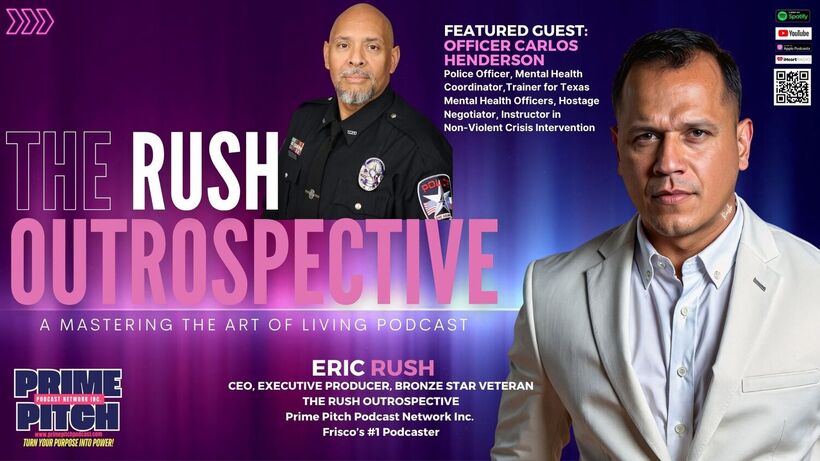
Officer Carlos Henderson
Police Officer · Mental Health Coordinator · Crisis Negotiator
About the show
The Rush Outrospective is a Mastering the Art of Living podcast: raw, honest conversations about purpose, healing, and the road back to identity, the flagship series where outrospection began. Hosted by Eric Rush, The Conversation Architect, a Bronze Star combat veteran and the founder of Prime Pitch Podcast Network.
Read the full transcript
I also believe that if, and, and I'm not the only one, that if, if one person in the family is in crisis, the entire family's in crisis. Mm. So I try to offer support to the family also. How can I help support the family? Because if you don't have support from your own family during your mental health crisis, then you're on your own.
Mm. So if I can support that family so that they can support their loved one, it helps them buy into their h- their treatment, it helps them buy into their, their mental wellness, and allows them to be a family. It's, it's the team approach. It's not just, "Hey, Carlos is offering me this resources.""Hey, Carlos is offering me a way out, a way up, a way ahead, a, a, a, a light in the tunnel of darkness that we're always chasing."How can I help them help themselves? How can I help the family help them?
Hey, we're mastering the art of living. Hey, what's up guys? Welcome to Rush Outrespective, a Mastering the Art of Living podcast. In every police department, there are officers out in the field who answer calls, file reports and then move on to the next incident. Then there's a rare few whose presence changes the meaning of work, the work itself.
Officer Carlos Henderson belongs to the, that second category. As the mental health coordinator for the Colony De- Police Department, his responsibility begins where human beings start to come apart and unfolds in the unstable space where mental illness, fear, family fracture, institutional pressure, and public responsibility all arrive at once. That's the terrain he works in day after day, and he does it with the kind of steadiness that can't be faked because it wasn't learned without cost. What makes Officer Henderson's role unusual is that he appears to understand crisis from more than one side. His authority comes from training and from his own lived experience to hardship.
That history matters. It helps e- explain why his work carries a different kind of weight. He is trained to respond, and he seems to recognize what collapse feels like before it becomes visible to everyone else in the room. This episode of the Rush Outrespective, a Mastering the Art of Living podcast, is a conversation about what it means to serve where people break, what it costs to remain steady, what it costs to remain steady in the presence of disorder, and how a life shaped by hardship can become a source of clarity for others. With Car- Officer Carlos Henderson, the deeper story is the kind of man the work required him to become.
Officer Henderson, it's a pleasure to have you on the Rush Outrespective, a Mastering the Art of Living podcast. uh, hon- it's a pleasure and honor to have you in our, in our home, and your wife's here to, to watch, watch the podcast and I'm, um, I'm very excited. I'm blessed to have, have, um, a sourceA community, uh, community leaders with a source of strength and, and courage and tenacity to help, help the community out and, and, and, and navigate, na- navigate, help, help other people navigate their lives. So I just wanna tell you that right a- right off the bat. Well, I appreciate you having me on here.
It's a, it's a real honor being able to come over to your home and, and be able to put at the forefront the importance of mental health in the law enforcement field, and for first responders, and for everybody that mental health just affects. Yeah. Um, when I was reading the cold opening, um, what did, what, what did you, what stu- stu- stu- stuck out for you? Well, the, the fact that you, you caught the essence of my desire to help others and to, to, to be more than just somebody that's carrying a gun and a badge. Uh, there's so much more to, to law enforcement nowadays especially than what it used to be.
It's, it used to be just driving fast and arresting people and, and that's about it, but now it's being that true community service member. Uh, as a police officer now, we're the, we've become the ultimate first responder. We're, we're responding to when there's a suicide, we're responding to when there's a cardiac arrest, we're s- responding when there's a missing child or a dog barking at night. So we're, we've become that ultimate first responder and a lot of it has an ef- effect to the mental health of the community and to the, and to the first responder community. That's, thatI mean, that is, like, an encapsulation of so many, um, like, you know, you see, um, from a macro level, and then you've broke it down into, to, you know, you know, fromYou broke it down to a micro level of understanding these, all these y- um, small parts of, of, of, you know, of life.
How, how, how, how fluid it is and, and, and how, people s- don't see some of the, the things that you, that you see or that officers are a part of every day. Um, you know, I was, uh, um, I was telling my wife that your work touches people in some of the hardest moments that they'll face. But what stands out to me is that there's a life behind the work that matters just as much. So I, I just wanna start there. Sure.
Um, talk to, umLet's talk about life, the, about the life, um, about the life you came from for a moment if you don't mind. Sure. So I mean, I, just like everybody else, I had what I thought was a typical life growing up until, wasn't until I started really looking at it that I realized it was not typical. Um, I grew up, I was, lived in El Paso for many years and, uh, my mother had gotten married to my stepdad and unfortunately, uh, my stepdad caused a lot of abuse. I have burn marks, I have cut marks, I have- Mmall sorts of abuse that I endured for many years.
Um, ultimately I ended up at a residential treatment center in, in Waco. I lived there for a year and then from there I went to a children's home in Itasca, Texas, and I was there for about 5 years, where I realized that some of the trauma that I was living was not, was not normal, and I realized that I needed to do something for myself. Um, I had some good support systems there at the children's home, and that's actually where I met my bride now. We were, we were just friends at that time, but it, it, it connected us at a very young age together. Um, and it gave me the ability to realize that there's more to life than just going down the path I was, a very self-destructive path that I was growing in.
Mm-hmm. So when I left there, when I graduated high school, um, I went to go work at a school district, and I started working with emotionally disturbed kids and kids with intellectual disabilities. And, and I, I realized that I needed to be the voice for children and even adults when nobody would listen to them because I remember crying out loud, uh, and, and begging for somebody to listen to me and, and for somebody to understand that I was going through trauma growing up, and nobody was there for me. Mm-hmm. And so I wanted to be that person for somebody else when nobody was there for me, and that's where I, I just really started focusing my life.
And, um, I did that for 10 years for the school district. I just worked with emotionally disturbed kids, trying to help families understand that, hey, there is a life outside of the chaos that you're dealing with right now in the school. I'm a living example that I can-- you can ma- have a traumatic childhood and still be a functioning member of society. I also worked part-time at a psychiatric facility. Um, and so there I worked also with the children and adolescents 'cause many people didn't like working with children and adolescents.
I, I enjoyed it because, again, I felt that connection of growing in that similar lifestyle. Um, after about 10 years of doing both of those things, I realized that, hey, I-- my children started coming along, and I realized I, I need to break away from dealing with children for a little bit because I was not able to be there for my children 'cause I was trying to be there for everybody else's children. Mm-hmm. So that, that took a little bit of a insight and a little bit of knowledge of knowing that I, my cup was empty. I needed to fill it a little bit more so I can give back to others.
So I spent time with my kids. I started working for a cancer imaging facility, uh, where I just helped dealing with people within crisis at that point also. Um, during that time, I'd gotten my EMT license, so I was doing a little bit of everything. Mm-hmm. Uh, I felt like I was always working somewhere.
Um, so then I just decided to-- my wife and I got-- At, at that time, we were just friends. Uh, we got connected again, and I decided that I'm gonna ask my job for a transfer up to the Dallas area. Came up here to the Dallas area. Um, she had her children. I had my children, so we're a blended family.
Um, about 2 years into my, me moving up here, my job decided that they were gonna get rid of my position. Mm-hmm. And so my wife's like, "What do you wanna do?"I'm like, "Well, I've always wanted to drive fast and carry a gun."And-a- I, I felt like I was just progressing in my ability to give back to society. I started off in education, worked in the medical, worked in, uh, on the ambulance. I, I've kinda done a little bit of everything, and I felt like this was just the next progressive step.
So she's like, "Let's do it."So she encouraged me to apply for the police academy. Uh, the children's home that I grew up at actually assisted in paying for that 'cause I was, again, without a job, so there was no way for me to pay it. I did take part of my severance package to do that, uh, but also had a family at home that I needed to help take care of. Um, so we went to the academy. Um, I made it through the academy and started lo- applying for jobs.
I feel blessed that the Colony Police Department decided to take a chance on me. Um, and I started my career in 2013 at the police academy or at the Colony Police Department. Um, one of the biggest life-altering events that happened to me was in 2015. Uh, we got a call about a, a person that had possibly fallen asleep behind the wheel, so I went to go check on them. In the process, the guy woke up before we could get him out of the car, and he drug me about 30 yards.
My, my arm got caught in the seatbelt. Mm. And he drug me about thir- 30 yards, and I thought my shoulder was dislocated. Uh, come to find out I had a shattered humeral head, torn labrum, torn bicep. Um, I had more damage than I knew really what was going on.
And after we went to the doctor and after everything was said and done, they pretty much told us that the only thing that was keeping my arm attached was the skin and a couple of ligaments. Um, so I thought my career was over. I, I'm just a baby cop, and my career is over, and it was devastating. Um, I was able to get surgery, and itI think that that's when I realized that I needed to change something i-in, in, in law enforcement, especially at my level. Because we always talk about brotherhoods and sisterhoods and we talk about the thin blue line, and I know it's not just me, 'cause firefighters talk about the thin red line and, and military has, you know, their own version of brotherhood.
And when I was going through everything I was going through with myself and, and, uh, after my injury, the- for the first couple of months, everybody checked on me. I got a phone call once a week or somebody would text me. After about 2 months, it was radio silence. Mm. Um, and I was out for 18 months, so for over a year, almost a year and a half, it was radio silence unless somebody was checking on my time sheet or when I'm doing physical therapy.
I end up having to have a second surgery. Even after my second surgery, nobody really checked on me and, and I got into a really, really, really dark place. Um, I sat at home and just watched TV in my chair. I couldn't sleep in the bed because of my shoulder. Um, my, my wife was having to take on all the responsibility for the house because I couldn't drive, I couldn't do a lot of things.
I had a process server that was kept trying to serve me for a court case that I couldn't even go to because I was on pain medication from the injury. Um, I'm also veryI, I know I have an addictive personality, so I did not take the pain medication the way you're supposed to because I was worried that that would cause me to have even further depression. Mm. Um, so fast-forwarding a little bit, I made it through that. I made it through the therapies.
I was able to go back to full duty. And when I got out-- When I came back, I was very angry. I was angry, just so angry because nobody checked on me. I got into this because I wanted to be in a brotherhood. And I wasn't quite sure what I wanted to do with my career, 'cause I was just doing patrol, just doing patrol.
And then I startedThat we were seeing a lot of mental health calls in our, in our department, and I'm like, "Man, we, we're doing this wrong. We're, we're not treating the person. We're just treating the crime, and we need to stop criminalizing mental illness."Mm. So I started talking to my department about it, and after many, after many years, because there's a lot of departments that didn't see that need for it, were given the opportunity to s- I wa- I was given the opportunity to say, "Hey, you want it, you start it. Show us what you can do with it."So after aboutRight after COVID, so in 2021, 2022, I started working on what is this gonna look like for the department for the mental health stuff?
What is this gonna look like for my officers? Because during COVID, I had an officer that got COVID really bad, and we were partners 'cause I was working warrants at that time and, and he was on his deathbed. I mean, they read him his l- last rites multiple times. And I made it right before then a point that there would never be an officer in my department that ever felt the same way I did: alone, abandoned by what's supposed to be a family. So even when he was in a medically induced coma, I would send that man a text message every day, "Hey brother, praying for you.
Hey brother, thinking about you. You let me know when you wake up. I'm here for your family."So that when he woke up, 'cause I had faith that he would wake up, that he would have a six months' worth of text messages to read through and I'm blowing up his phone. Mm. So I wanted to make sure that nobody ever in my department, if somebody gets any kind of surgery or any kind of illness or death in the family, I try to check on them a few times, because I remember what it felt like not being there f- nobody being there for me, uh, when it were.
So the community, I wanted to make sure that the community members felt like the Colonie Police Department supports you, supports your loved ones. So in, again, in 2022, I was given the opportunity to start the program. I was working full-time patrol and part-time mental health, and it's, it's like Field of Dreams, like the movie. You build it, and they will come. Uh-We got such an increase in the types of calls for service, and it's not because we had any new calls for service.
We were just starting to notice them, them more. So people started reaching out directly to me and saying, "Hey, my loved one hasis having a crisis."My officers, "Hey, we went out to this call for service and they were having a mental health crisis."And we started building those resources and started building a, a packet of different resources, and I started building community connections. And it, it's made a, a world of difference for our department of how we respond to those calls, where we stop criminalizing it.'Cause it's not against the law to have a criminal or to mental health issues. Yeah. But the jails and prisons are the largest provider of mental health services e- in Texas, or in the United States.
Mm. Um, but that's kind of, in, in a nutshell, that's what, what got me where I'm at now. Wow, that's, that, you know, that, that's ama- uh, just that whole journey, just how, how you walked through everything from, you know, from where you're at, it, it, you know, at the, the child center where you, where they helped you and assisted you and to, to where you're at now. Um, one of the big goals in this conversation is to s- to, you know, pe- what you, you're, you're kind of, you're an inspiration, you know? Like, you know, they say hurt people hurt people, right?
But not, not, not all hurt people hurt people, you know? And, and you know what I mean? And so for, for, for us to be sitting together, it's like, you know, I think it's so important to unpack what that, those pieces of those journeys taught you, okay? So I wanna go back to, um, um, when, when we was talking about, um, um, umWe're gonna talk about, um, let's talk about the life you came from for a moment. That's what we talked about.
When you look at, when you look at that life, what do you think it put into you that still shows up in the way you deal with peopleIt taught me patience. It taught me patience and listening. Um, one of the hardest things that we do is we talk more than we listen. Uh, God gives us 2 ears and one mouth so that we're supposed to listen more than we talk. And I remember growing up and feeling not heard.
Nobody heard what was below the surface. They just heard what they wanted to hear. they say that everything's kinda like the iceberg, you know? The Titanic, when it sunk, it wasn't everything that was above the water that sunk it, it was everything below the water. Mm.
So I'm the same way. So it's everything that nobody noticed what was going on below the water, and that's actually what affected me and changed my life. Yeah. Um, but I wanted to hear people, I wanted to listen to people, I wanted to be there for people like nobody was there for me growingThat's, that's beautiful. I, I agree with that 100%.
Um, you know, they say take the cotton out of your ears and put it in your mouth kind of thing. That's what I had to learn along my journey is to say take the cotton out of your ears, put it in your mouth and listen. And, and that's what spawned this whole experience in the podcast world for me. Um, you've spent a lot of your life close to people in distress. Um, and you've been part of it.
You've been, you've been part of that distress yourself. Um, what have you learned about human beings, um, umWhat have you learned about human beings there that most people never, um, learn? Have to learn? That us as human beings can be very cruel and very mean, and we take people's weakness and use it against them, but that weakness is what also makes us stronger. I wouldn't be the person I am now if it wasn't for me willing to open up and show that weakness, a little bit of that, what made me the person that I am.
So knowing that there's a ability to help somebody through that crisis and get them to, to realize that there is a light at the end of the tunnel is, is huge for me. And I was telling my chief the other day that I liked my job, but now that I'm doing what I'm doing in my job, I love my job. Mm. I have officers that bust people for drugs or DWIs, and they get those little wins all the time. I don't get a win every day, but when I get a win, it's a big win.
So it's having that patience to keep helping that person until that person gets to where they need to be. Man, that is, that, that is so important. That's so amazing. One of the other things I wanna talk about as you were going down your, down your journey was like, you know, one of the things you've uncovered in this is that, you know, much like I always say that, you know, a lot of the people who enlist in the military are running away from something. You know, they maybe have a family, a toxic family, you know, that's in strife and just, just full of violence and, you know, and they're trying to run away from something.
They're trying to run for something bigger, right? Um, you, you showed a very human side of, of, of, ofRemember, there's a person behind the badge, you know? There's a human being with a story, you know? Maybe somebody's mom got killed by, you know, their, their father, you know? Y- and whatever reasons they are, you know, that, that they come into.
And I, I really appreciated that, that, that snapshot of you, and I think the listeners who watch this are really gonna really tap into the human side, um, of, of being a police officer in the community a- and, and, and how, how, how important mental health and, and, and, and, and crisis intervention is in this, in this space. Um, um, you've worked with children, uh, psychiatric patients, as you mentioned, um, uh, y- uh, families in distress, people in, in crisis, and now within law enforcement. At this point, when you meet someone in a bad moment, what are you lo- what are you usually looking f- looking for first? I'm looking for a way to, to offer them that support, let them know that unfortunately there is no cure. There, there's not a cure.
It's diabetes, high blood pressure. There is no cure. But there are steps that we can take to help you s- be successful, just like with me growing up. You're able to do things to help you be successful. So I'm offeringtrying to offer support to the person who's in crisis.
Um, I also believe that if, and, and I'm not the only one, that if, if one person in the family's in crisis, the entire family's in crisis. Mm. So I try to offer support to the family also. How can I help support the family? Because if you don't have support from your own family during your mental health crisis, then you're on your own.
Mm. So if I can support that family so that they can support their loved one, that helps them buy into their he- their treatment, it helps them buy into their, their mental wellness, and allows them to be a family. It's, it's the team approach. Mm-hmm. It's not just, "Hey, Carlos is offering me this resources.""Hey, Carlos is offering me a way out, a way up, a way ahead, a, a, a, a light in the tunnel of darkness that we're always chasing."How can I help them help themselves?
How can I help the family help them? Yeah, you know, that, that's so important. I, IThat's a, a good touch point that I just recently had the CEO of, uh, Army Scholarship Foundation on my podcast and, and he was talking about, you know, um, uh, what is, uh, that, uh, a family ready is a, a soldier ready. You know? Like, you know?
And the same thing with, with how a fam- uh, when an individual is going through a crisis, you know, a- and it's important that the fam- you know, it starts at the home, right? Yeah. You know, how, how that i- um, impacts you. Um, how does that, how does that, umI would say, h- how does that family dynamics, how does that, like, prevent from someone, you know, someone from actually, um, getting help? You know, is that also a possibility?
It, it definitely is, and a lot of it is cultural. Mm. Um, so being Hispanic myself and understanding the Hispanic background of it, in Hispanic families, we don't, we don't talk about mental illness. Mm. Um, it's just that, the crazy uncle, the crazy aunt.
We, we don't talk about it. Yeah. And so breaking that barrier on the Hispanic cultures is, is one of the biggest ones. So letting them know that, "Hey, it's all right. It's all right.
We're here to offer that support."Um, same thing with every other culture. I mean, I'm having to learn about cultures that I don't know anything about, and realizing it's not just the Hispanic cultures that don't talk about mental illness. Um, there's also, there's some people that everything is a mental illness. Every- everything is i- is a crisis. And I tell them, I said, "No, there's a difference between somebody just having a bad day," uh, 'cause we're allowed to have bad days.
Yeah. There's a difference between somebody being sad, 'cause we're allowed to be sad, but when it gets to a certain point, then that's when we need to start looking for those resources and stuff. So how can we get to that next step? Is it just, "Hey, I just need somebody to talk to that understands what I'm going through," or somebody that's lived that similar path? That's, that's part of the reason I'm really big on peer support stuff for first responders is because we've walked that similar path.
Mm. And so being there for first responders or being there for the community, I, I, I kinda walk that double, doubleor on both sides of the fence. Yeah. I've worked at community level where I'veMy mom has mental illness, ha- has had it all my life, and it, I didn't realize what that was until later on in my life, and so I've lived it. I've lived with the aspect of what's going on with my, with, with growing up and the, the trauma that I went through as a child.
But on that first responder side too, I've lived through that trauma of being injured in the line of duty and not feeling that support from my first responder family. So I've, I've kinda walked both sides of the fence. So when somebody says, "Hey, well, how do you understand what's going on?"I'm like, "Well, I don't understand what, what's going on with you, but let me tell you a little bit of my story- Hmmand let me show you that there is a way forward."And that's, that's what helps me by that connection to the community and to my first responders. Man, there's a lot of wisdom in that too, you know? It's like, uh, using your, your test- your story and your testimony to help, um, another person, um, kinda meeting, uh, meeting them where they're at, you know?
Yes. And that, that's amazing. Um, that's the part that makes your work so important because, um, once somebody's in trouble, they're usually not dealing with, uh, one thing. They're usually dealing with several things. Is that, is that usually true?
Abso- absolutely. It's, it's never just one thing. there's, there's the oldWhen I used to teach a class, I taught a nonviolent intervention class for the school district. And we talked about it's, it's like that snowball effect. It's not justSomething didn't come from nothing.
So sometimes it takes a lot of little things before we finally break. Hmm. So if I can get you at that first little or second little thing before we reach that point where there's a crisis, then we've ha- we've been successful. so that, that's my main goal is like, "Hey, how can we intervene earlier? How can we"We, we put a lot of stuff out on our, on our webpage, and- Mm-hmmand the Colony Police Department pushes out, and there's other departments that do it also, say, "Hey, we have a person that can help you if you're having that mental health crisis before it gets to that point."And when I first started the program, nobody ever talked to me about it- Hmmand nobody reached out, but now people are reaching out prior to the crisis.
Hmm. And that's such a big win because instead of calling 911 because their loved one is having a crisis, now they could be like, "Hey, I'm gonna reach out to Carlos, and this is where we're beginning to spin again. We're beginning, something has happened, and we can get ahead of it."Yeah. That's, that is, like, so amazing, you know? I think, you know, when, when, as you're speaking, I'm just thinking about like, like, like, there should be a task force that goes out to every neighborhood- Yeahand says, "You know what?
Hey, listen, if you got family problem, if you got something going on, here's, here's a resource for, from the, from the Collin County Police De- or from, from the Colony Police Department. You know, here's a resource."There should be a whole task force for that in every neighborhood and you know, across Texas and nationwide, you know? It's to just say, "Hey, here's, hereIf we don't know what's going on in your home, and we're not a- alluding that something's going on in your home, but if you know someone that needs some intervention, maybe here's, here's a," you know? You know what I mean? When I think of, like, our department, and I know, like I said, other departments, I mean, I won't say that we're the only ones that are doing it, 'cause we're not.
Yeah. It, it's happening nationwide. Um, I just can only talk for the Colony Police Department, but we have a Citizens Patrol Academy in English and in Spanish. And so we're able to talkI have, I have a night that's dedicated to the mental health resources for the community. Oh.
So that's really big. I have such support from our administration, my officers, the city manager, the city council. At the Denton County level, I'm on the Denton County Behavioral Health Leadership Committee. I'm on all these different committees. I'm even on the board of directors for NAMI, which, the National Alliance on Mental Illness for North Texas.
So given that opportunity that my department has said, "Yes, go ahead. Do this. Um, we're gonna, we're gonna allow you to, to be a part of these groups as part of your job to help bring resources to the county, to help bring attention to the, to the city of The Colony."And having that support from the administration is more beneficial than any, any phone interview or any person that I've talked to because it's not just a one-man fight. This is a, a department saying, "Hey, we, we believe in the program. We believe in you.
We believe in our community. We wanna support you to support the community," and that's, that's amazing to me 'cause I wasn't quite sure how this was gonna play out 'cause when I said, "Hey, this is what we need to do," and they're like, "Yeah, show us what you got," and I'm thinking, "Okay, 3 months in, they're gonna like, 'Oh, this is a waste of time.'" And now I'm doing it full time. That's my full-time job now, and it's amazing. That is so cool. And that, that, thatI should just say, you know, thank you for The Colony Police Department for allowing us to have this podcast together.
It is about, you know, mastering the art of living and having resources and understanding the individuals that are out in our community trying to make impact and, a- and, and, and, and, you know, mental health is one of the m- most important ways how to master the art of living. You know, living with peace and, and, and perfect harmony, and harmony with other individuals, and, and finding core values and principles that you can, um, they can navigate, to help you navigate through life. Um, your work puts you right in, in the space where mental health, law enforcement, family breakdown, and the court system all collide. Um, where do you think people fall through the cracks the most? One of the biggest parts is that we, we, we're criminalizing a lot of people that have mental illness.
Um-m- many times when people are having a mental health crisis, they do commit crimes. I mean, it'sunfortunately goes hand in hand. But some of these are very low-level crimes. Some of them are criminal trespasses. Uh, maybe they're having a mental health crisis.
They went to the last home that they remember that they felt safe at, so they come back to the house. Or maybe they're, they're, they're just having a psychotic episode and they believe that there's a person that's kidnapped inside this house because they saw a kid standing at the window, so now they're hyper-focusing on this, and they're having a mental health crisis in the yard. An officer arrives on scene and says, "Hey, they don't want you on the property," and then it's like, "No, but there's somebody there. There's somebody there. There"And then they end up being arrested for a criminal trespass.
And, uh, recently in Denton County, we're, we're working on trying to get a jail diversion center, kinda like a, a hub to allow people to instead of being taken to a psychiatric facility or instead of going to jail, we now have an alternative. We, we have the ability to say, "Hey, a jail diversion center would be amazing for Denton County because then we can take somebody that just maybe needs some resources. They, they can go voluntarily."Where the jailed are not going voluntary, and all we've done is criminalize them. Mm. Um, and a lot of times when people are in a mental health crisis and they get taken to the jail, that doesn't mean that the crisis stops.
Yeah. So then what if they're having hallucinations, or what if they become paranoid about the people around them? Are theyNow they're possibly catching another charge. Yeah. They're assaulting a jailer.
They're assaulting an officer. They're assaulting another inmate. And many times people with mental illness, when they go in jail, one of 2 things happens to them. They either become a victim or they victimize people because, again, they're still in crisis. So we're just trying to build a better system to try to help people.
Texas is ranked almost dead last in resources for mental health. The size of Texas that we, that we are, we should not be dead last. Uh, but we're ranked in the top 3 in the need for mental health resources. And again, the jails and prisons are the largest provider of mental health services. That's not where people with mental illness get the most benefit.
Mm. They get benefit from community support, family support, having a better system in place to help them get their medications, help them get their treatments that they need. Yeah. Yeah, I just went to a, a gal- gala called, uh, Refuge for Women, and, uh, there was a, a young lady up there talking about how this organization helped her turn her life around, you know, and she was, you know, committing crimes of prostitution and, and, and that kind of thing. And, and yeah, without that support, that community support, it would make a, umYou know, she would not be where she's at today, you know?
Yeah. Um, you know, I was also, as you were listening, as I, uh, as, as I was listening to you talk, uh, you know, I've had my own issues. I had my own, myHad to learn how to think differently and had, had gone through my own substance a- uh, substance use, um, um, men- uh, counseling and stuff, and one of the things I learned is, like, you know, as I went through in and out of jail and, and, you know, and going through this whole, uh, institutional, uh, experience, it's like there's a difference between criminal addictive thinking and mental health. You know, mental- Mmm- mental, um, uh, you know, if you're dealing with a, a substance use or something, you know? And, um, and yeah, and that's the one thing I learned is, like, you're not that guy.
You know, you're not the guy going in and stealing someone'sYou know what I mean? You know, violent- Yeahyou know, violent crime. You are dealing with something that's, uh, kind of symptomatic of something like we talked about, something happening in layers. It's just not just one thing going on. It's some- something else.
So I, I appreciate what you had to say about, about that too. Uh, what are your thoughts on what I just said? Well, I mean, I, I think that it shows that again, that people with the right support systems even if, even if they go down the path and they get arrested for something or they get in trouble for something at, at different levels, by having a good support system doesn't meanOr, or it gives them the ability to get beyond that. Yeah. Then they can take what they went through and what they've learned and work with others and give people a voice and be an advocate.
That's the biggest thing that we need is to have people advocating for those that have lived through that experience, because then that way they know that there is, again, I keep saying the light at the end of the tunnel, 'cause they're, that- that's the part that we, we hit that rock bottom and we think, "Man, I can't dig any further."And then we find a way to dig further. But it takes that person reaching down into that pit and saying, "Hey man, I'm here. I'm a advocate for you. I'm gonna help you out of that darkness- Mminto the light."And then once we do that, we can pay it forward and pay it back and be that voice for that next person to keep them out of the criminal justice system. Or even when they're coming out of the criminal justice system and say, "Hey.
Hey man, that, that does not define you."Yeah."What happened to you does not define you. Let's change the definition."Yeah. It's true. I, I just, uh, be- I just got approved to be a TDCJ, uh, volunteer, but, uh, I'm an executive volunteer for a, a organization called Prison, um, Prison, uh, Prison Entrepreneurship Program. And, and I go to the prison system and weIt's this whole process with the business plan, uh, with the wholeThey set up a business by teach, uh, inmates how to develop a business so when they transition out they'll have this tangible thing.
That's amazing. Yeah, they get actually a, um, a, a certificate of, of completion from Baylor University, a real certificate from Baylor University, which is huge. I went to Baylor. I couldn't fi- I didn't have enough money to finish that day. But, but, um, um, your work seems to require compassion and clarity at the same time.
How have you learned to keep b- uh, keep ahold of both? Having a great support system at home. Um, my wife is my biggest advocate. She's my biggest support system. Um, being able to, to talk to her.
Um, having great first responder and, and non-first responder friends. Um, having a good s- peer support system. I don'tI, I practice what I preach. If I tell my first responders to utilize the ph- their peer support, I practice what I preach. If I tell family members and, and people in the community, "Reach out to a therapist, talk to somebody," I practice what I preach.
I, I talk to people. I try to have a clear head. Even before I go talk to somebody I, I do some deep breathing, I do some meditation. I try to have that clear mind because I can't, I can't pour from an empty cup, but I also can't overflow my cup with everybody else's stuff. Yeah.
Um, so I learned to do different things. I ride motorcycle. IWe went horseback riding last weekend just to get out and it was just us and the horse, and wasn't a lot of horseback riding that went on 'cause the horse was being stubborn. Uh, it decided to try to put me into a tree. Geez.
But, but the rel- the most relaxing part of like, of the, of the horsemanship stuff was just the brushing of the hair, the, the, the, that feeling your tension go into something else and then that tension just dissipating. Um, being able to do things that just kinda help reduce my stress makes a world of difference. And, and I, I, I love what I do. I can't take on everybody's stuff, and there's some days that I'm like, "Oh, I'm busier now than I was on patrol."I get home sometimes and my wife looks at me and she goes, "Just go relax for a few minutes.""And, and then go pet the dog."I have a Great Dane puppy that's like the biggest dog I ever had, and she- But the amount of just tension that sometimes an animal or other people help reduce from my life makes a world of difference. It allows me to keep doing what I do every day.
That's awesome, man. I think people need to hear that, too. You know, it's like officers that are going through tension, and they, you know, dealing withAnd, and, and you, you're dealing with the mental health aspect of it from both a, um, from a community standpoint and with officers that are, are coming to you and asking how, how, how, how, how they can do s- how they can have, you know, escape some of the, the things that they're dealing with. So I think people hearing that, it's like saying, "Well, what are officers doing to, to take care of themselves," you know? And, um, uh, with that said, there's another side to this work, and this is something that you had touched on, and I wanna, I wanna touch on it right now, that you shared with, umUh, there's also another side to this work that people outside the profession don't always see, and that's, that's what the job puts on officers themselves.
there's a, there's a public side of this work, and then there's the, um, there is what officers themselves carry. Um, what do you think this profession asks people to hold that often goes unmet? It's, it's trauma. Um, they say most people, most society see one to 5 traumatic events in a lifetime. Mm.
Um, officers, military personnel, fire, EMS, dispatchers see and hear trauma on a daily basis, whether it's somebody's screaming for help, whether it's somebody's last dying words, whether it's a crash, uh, or just walking in on something that's so horrific that as a human our minds and our eyes are not meant to see this on a daily, this, the, the human suffering on a dailybasis. Mm. Um, blessed in The Colony that we don't have a lot of that, but, um, I think of major agencies like your, your Dallas, your New York- Mmyour, your Minnesota. I mean, some of these, some of these other cities that see that trauma on a daily basis, we have to do better for our first responders. Um, people forget, like, so I, I forget what year it was, but they, they labeled dispatchers as a first responder now, and I'm glad that they finally did because they are the unsung heroes because- Mmthey're unsung heroes because they hear the trauma.
They don't see it. Mm. I at least sometimes see it. I get to process it and move on. But I always compare it to, like, scary movies are not scary.
I mean, nobody's really scared of Chucky. Nobody's really scared of Freddy Krueger. It's the music in the background- Mmthat makes it scary. It's the music in the background and the, all the sounds, the creaking doors, the, the racking of a shotgun. All those sounds- Mmare what makes a movie intense and suspenseful.
Dispatchers, that's all they get, so their mind then goes off into a different direction 'cause all they're hearing is all that stuff. Mm. So, uh, I think that, that, that, that trauma, going back to your, your question is, is that trauma is justIt, it gets built up and built up and built up, and we have to find a way. It's, uh, it's a beach ball underwater analogy. You can blow up a beach ball and hold it underwater, but you can only hold it underwater so much before it just pops out- Mmand goes everywhere.
It splashes everybody. We have to learn a way to, to unload that trauma from ourselves so that we can go from one call to the next. That's an amazing analogy, too, man. The, the, you know, no one's scared of Freddy Krueger. WeMy wife and I watched aI recently watched a, one of those Nightmare on Elm Street ones, and it was like we were never scared of this.
You know, what, why it wasAnd it was really ridiculous. But no, but I understand what you're saying, the noise, you know, the noise a, a dispatcher, um, goes through. I didn't even think about that, you know, until you said that. I was like, "Wow, that's, um, that's a, that's a, a very good analogy."Um, where do you think officers start paying the price for this work before they even realize they're paying one? Day one.
Uh, I think, I think day one, theyIt, it's the whole the, the body keeps the score. Um, we, we, we build that trauma up from day one. Um, like, my, my daughter's a police officer. Mm. Um, before she got into law enforcement I told her, said, "Hey, you gotta spend some time in the jail 'cause you gotta learn how to talk to somebody before you ever learn how to carry a gun."Because talking to somebody's gonna getTalking people into handcuffs and talking people into doing different things makes a difference.
Yeah. Um, but when she went through her FTO, uh, and when she got on her own, like, within the first month of her being on her own, she got a horrific call- Mmto the point where she called me up, and she's like, "I don't know."I said, "Hold on."And I said, "I can't be your peer support and your dad. I can be one or the other. I'm gonna be your dad right now."Mm."This is who you reach out to for peer support. I'm here to hear you, but I'm notI can't do your peerI can't do both."Mm."You need a hug.
You need me to be Dad, and that's what I'm gonna be is Dad."And that made, that madeShe told me that that made a difference in, in her career. But it startsWe never know when it's gonna start. We don't know when-When it's gonna tip the scale because I have officers, uh, that have been doing this for 20, 30 years, and they've never had aThey never had that, that point where they, they freaked out outside of work, where PTS hit them, where they sawThey thought they saw something, they didn't. We've all hadAnd forAs police officers, we've all had that dream where we're chasing a bad guy, we have to pull our gun, and we go to shoot the gun, and that bullet just kind of rolls out and falls out. Mm.
That- that's a nightmare. Yeah. And, and, and w- we get paranoid about different things. Um, I have a, aOn Over- uh, OverWatch, my peer support program that I'm the coordinator of, we have a lady that's been a FBI photographer for 30 years, and she has viewed trauma through the lens of a camera: Oklahoma City bombing, 9/11, mass graves, traumatic events worldwide, and she had an event happen to her where she was just walking by the pond, lookedover, and thought she saw a body. It just randomly happened.
She didn'tShe wasn't expecting on that Wednesday at 2:00 in the afternoon that that was gonna happen. We don't know what's gonna hit us. Yeah. So we don't talk enough about vicarious trauma. How much trauma do I pass on from one officer to the other officer?
How much trauma am I taking on? How much trauma from my childhood is gonna pop up one of these days? I have officers that tell me that, "Hey, I have a hard time responding to an assault family violence because I saw my dad beat my mom."Mm."So I have a hard time responding to those calls."So knowing what your limits are make a big difference, too. Mm. That, that brings me to another point.
IUh, maybe last year, I had a gentleman who does, uh, next ops. He's aLike, he provides jobs for veterans and, um, and, um, he talked about moral injury. Yes. Um, sh- just expand on that and, and yeah, ex- just share with me on moral injury. How, how, how am- how, how much ofIs that an issue with police officers?'Cause, you know, thereThe, the, the, you know, there's a flip side.
They don't have anyYou know, police officers don't have that. I don't bl- I mean, I know, I know moral injury is a real thing, and that's something that when he introduced that term to me, I w- I was shocked 'cause I didn't realize what moral injury I was dealing with at the time, you know? shareTalk to me about that. That moral injury, so moral injury is justI'm sure he explained it, but it, it just talks about we all, as human beings, we're born with a certain set of, of moralities. Uh, we know that murder's wrong.
We know that theft is wrong. It, it's built into us. We, we're, we're not meant to do that kind of stuff. But the more we see it, the more callous we become towards it. The we- the more we just say, "Well, that's just human nature."Uh, most officers don't go into law enforcement for the money or for the, the glamour.
They go in 'cause they wanna help others. They w- they go in there because they wantMaybe a lot of first responders go into it because, kinda like me, somebody fa- the system or somebody failed them at one time, and they want somebody else not to feel the same way. Mm. But that, that moral injury makes us have that jaded view of the world where everybody's lying to us, everybody's evil, everybody's mean, and it, it's difficult for us sometimes to get past that. Um, it affects the way we treat our loved ones.
Uh, we get mad at our spouse, and we start interrogating them like, like a, like a criminal. Our child lies to us, and we're like, "Why are you lying to us?"Well, maybe they're not, but we think that everybody lies to us. Mm. So it, it affects us. We close off our friends that are outside of our profession.
We close off to, to, to normal things. We don't wanna go into public because we know that there's crime everywhere. We become so paranoid. Uh, the, the, the hardest, the hardest table to sit at is when you take a bunch of first responders out to lunch, 'cause everybody wants to have their back up against the wall. Wow.
Uh, because we don't trust the people that are coming in behind us. Mm. I challenge my officers sometimes, say, "Hey, look. Hey, man, trust me to have your back to the door. I got your back."And I think that that, that helps break down some of that, that, that moral injury.
That helps break down, realize that hey, there's people that care, there's people that are not always against me. Wow, that, that, that's such a eye-opening, uh, thing to hear. I think a lot of people need to be exposed to that kind ofthat, that, what you shared. A- it's, I think it's so important to understand that if you can, if you think this way about veterans having to deal with it, then you should be thinking this way about, uh, first responders and law enforcement and how they, how, how, how, what experience that, that, that you guys go through as well, you know? Um, that's what the unique thing was about sitting, uh, next to you at the, um, uh, the, uh, the Cowtown Warriors, uh, event, is that, you know, um, you were sharing your experience and I was there, um, with other veterans that, uh, you know, we have a mutual friend in Drew Carlton and, and, um, just knowing that you guys work in mental health space and I had, I've had to endure, I've had to go through my own mental health battles and, and getting counseling and it was just such a, a awesome moment and I said, "Man, I gotta have you on this podcast."Um, sometimes your own life will bring certain truths to, to, into sharper focus.
Um, I'd imagine that can happen in ways that change how you see both work and yourself in, inside it. Is this true? Um, what are your thoughts on that? Definitely. Um, just, just living through the, the, or seeing the different trauma and seeing the way that people treat each other, um, makes a, a big difference on how I, how I see things.
Um, I try to be more understanding to, to people. I try to beI try not to jump to a conclusion and say, "Hey, this person's just a criminal."Like, again, what drove us to that point? Is it, is it something that they, are they doing it to survive or are they doing it because there's a, a, another aspect to it? Unfortunately there is just evil in the world. Um, and, and there's no way around that.
But sometimes it's more than just that. Yeah. And so being able to, to rely on my, my, my training, my experience, my life, my life experience allows me to look at things from a, you know, a thousand feet up where I can look at the big picture and then we can start focusing in on what's driving that behavior. Yeah. Yeah, that's, that's true.
Um, I wanna touch on, on, on, uh, uh, your, your, the drunk driving incident if you don't mind. Uh, just touch on that and then we'll, we'll, I got a couple more questions and we'll wrap up. Um, you were drunk by a drunk, uh, you were drunk by a drunk driver, um, while on duty. Did anything about that incident change the way you saw your life or did something, um, more clear, uh, did, something more clear, um, become clear to you? Well, it, it, it changed my life because I was like, man, I'm, I'm just getting into this career and- Yeahit's almost over.
Yeah. I, I, I, I, I, I almost saw it was a career-ending incident. I'm like, what am I gonna do now? How, how do I get past this? And then I realized, man, some of the things that we, that I need to do for myself is I need to, to figure out how can I make myself more resi- like mentally resilient 'cause the last thing I wanna do is like be scared to do a traffic stop.
Or to be scared to do different things. So, so I was trying to build up my mental resilience to make myself a stronger officer, to make myself a stronger husband 'cause I was depressed at home. I was, be a stronger father. I was sad because I couldn't make softball games, I couldn't makeWe, we had- Mmproms, we had dances, we had different thi- I couldn't, I, I was so depressed I couldn't leave the home. Mm.
So I wanted to build up my mental resilience. Uh, so like when I went back to full-time patrol, I went out of my way. I probably gave a lot of tickets in that area where I got injured at. And it's not because I was just being mean, but I had to f- make myself face my fear- Mmand realize that not every incident is gonna end in the same tragic way. Mm.
How do I get past that? How do I build up my mental and physical resilience? So I went out there and I wrote tir- tickets and tickets and I stopped cars and I stopped cars to say, "Hey, look, just because a bad incident happened at this day on this time doesn't mean that every time I n- I'm in this intersection I need to be scared of this intersection."Yeah. Um, and then for the mental portion of it for my first responders, the, the biggest thing that it changed for me is I realized that I needed to be able to support first responders in a way that I didn't feel f- s- supported. Um, I was doing peer support stuff before I even knew what peer support stuff was.
Um, I got connected to Overwatch, uh, the peer support program, and I realized, man, this is what, this is what I needed. Um, my department has a very robust internal peer support program. Um, a lot of departments have a very robust internal peer support program, but I'm sure just like in the military and just in, in any first responder field, we're a bunch of paranoid people. So I get scared. Do I wanna talk to my officer in my own department about something that's going on with me?
Mm-hmm. Do you-- Do I get paranoid because he might use that against me, or is he gonna turn around and say something? Even though we're protected by law, we, we're not allowed, we're not allowed to say anything. I mean, you'll get in a lot of trouble for breaking that confidentiality. But we're still paranoid- Yeah'cause we see laws get broken all the time, right?
Yeah. So I get paranoid. We all get paranoid. So learning about Overwatch and learning about, hey, this is a peer support program that's built by peer support or by, by first responders for first responders. It covers police, fire, EMS, dispatch, records, the property clerk- Mm-hmmeven the janitor that works at the police department.
We cover everybody. Wow. And then you'll never be matched with somebody in your own department. So say, for instance, you're military, and then you become a police officer. Hey, I have a peer support person that has the same, walked that same path.
I can get you connected with somebody not in your own department- Mm-hmmthat allows you to talk to somebody that's walked that similar path- Yeahwithout worry that it's coming from your own department. So I dove into that, especially after getting injured. I wantedI, I needed something toI wanted other officers to not feel the same way I did. Man, Officer Anderson, I gotta tell you, like, just having somebody like you, I always want someone like you in my fi- foxhole watching my back, making sure if I'm going through a crisis with my, missing my family 'cause I'm deployed or anything like that, you know, like you wanna have somebody who's talking you down, talking you, talking you in a, a, you know, talking you back to balance and to, to, to a steady pulse, to, to a steady line. So I, I, that's, um, um, The Calling, uh, the Ca- the Colony Police Department is lucky to have you there.
Um, let's, let's, um, I wanna, I wanna ask you a question. When somebody is sitting across from you in one of their worst moments of their life, what do they need from you that training alone can't give them? Compassion and empathy. Um, and encouragement. I mean, e- e- encouragement just to know that this is a moment.
We can get past this moment. Um, even, even I, I'm a negotiator for our department, and I've had to-- we talk about dealing with people that are in that mental health crisis, which a lot of negotiations are. But we talk about saying, "Hey, man, just give me one more minute. Talk to me for one more minute."That one minute turns into 5 minutes. That 5 minutes turns into 10 minutes.
Ten minutes turns into a day, a week. So when we talk to people, say, "Hey, I'm here to listen. Let's talk. What do you-- what would, what, what would help us get past this moment to the next win?"Not every time's gonna be a failure, not every time's gonna be a win, but right now we're in, in a low spot. How do we get to that next high spot?
How do we get to that next win? So I, I help. I, I try to encourage the people I deal with. I try to encourage my officers. I do, I do a lot ofI train mental health officers.
I certify mental health officers for other agencies. I try to encourage them, say, "Hey, look, we want to build up that person to realize, 'Hey, I can make it one more day. I can make it one more week. I can make it one more month.'" That loved one, "Hey, I'm not-- I don't hate my son. I hate the behavior."Mm-hmm.
How do we get past that behavior and go back to my loving son- Mm-hmmor my loving daughter or my loving wife or husband, whatever. Yeah. How do we get back to that good place where I can encourage them? So I, I, I tell my officers, I tell family members, I tell myself, encouragement. Encouragement, encouragement, encouragement, because that's what makes a difference.
And if we listen, we can find those things. How do we hook 'em in and bring 'em to the place where they need to be to, to get them to the next place? Yeah. That's awesome, man. I think the-- I think you, you hit all the, hit it right on point.
Um, uh, I want toI got one more question, but I wanna give you an opportunity to, to speak to the community out there, t- tell 'em what resources you have, how they can get ahold of you, and then we'll ask the last question, and we'll wrap it up. Uh, so the floor is yours. Well, I, I, again, I just wanna say thank you for giving me this platform to be able to, to talk about something that I'm very passionate about. Um, I'm very passionate about helping my, my, the members of my community. You know, we got 40,000-plus members in my community, plus visitors, plus everybody else that I might come in contact with.
Um, but given the opportunity to talk about, um, the program, my, my Overwatch program that I'm a part of, it, it, that to me, if I can give that support and give that encouragement to first responders and allow them to have that peer support so that they don't burn out, so that they know that there's other people that are going through them, then that makes a world of difference. Also, because if we're not taking care of the guardians, then there's no guardians to take care of the community. Mm. Um, Da- being in law enforcement is, is a difficult job to fill nowadays. Y- you can throw a stone and hit a department that needs 5 or 6 or 100 officers.
Mm. This is not a profession that people chase anymore. And it, and it's discouraging because there's a lot of good people out there that I think would make very good officers. But you have, unfortunately, you have bad officers that give us all a bad name. Uh, but nobody hates a bad officer more than the good officers.
We, we, we, we will eat our own if we know that you're a bad officer. Mm. And I wanna encourage the community to realize that, "Hey, look, we're not bad guys. We're, we're, we're not the bad people. We're, we're here to help, and we wanna bring more tools to the toolbox."Not, not everything is solved nowadays with a gun and a taser and a baton and handcuffs.
We have resources, uh, just like my department has resources. My department has the ability to, to help people in the community when they need that crisis. Um, whether it's somebody that's suffering from dementia. I, I just helped a lady that has early onset dementia. I was able to get her into a mind care facility.
Mm. But she was living on her own. Um, but that's not something that, as law enforcement, that am I supposed to do? I don't know. Yeah.
But I have encouragement, again, from my department and from the community to allows me to do, to, to step beyond just the, the construction of the box that I was put into when I first got into law enforcement. We're able to expand it. Mm. Um, but we have a lot of first responders that do the same thing. I haveI can't tell you how many officers I know that have bought car seats for people that needed a car seat.
Mm. Um, that have helped family members buy groceries, um, whetherOr, or helped pay offI mean, unfortunately, I have officers that have a drinking problem. I wasOr, or a gambling problem. Um, I was able to recently help an officer get into a, a facility because he was suicidal. He was having a drinking issue, and we were able to get him into treatment, and he let me know and say, "Hey, man.
You saved my life. You saved my career. You saved my family."Mm. And that right there, again, I, I talk about we don't always get wins, but when you get that one win, that makes a world of difference. Um, I can't always impact everybody, but I try to impact those that I come across, and I try to help those.
So, I mean, if you're a, if you're a first responder- Yeahagain, fire, police, EMS, dispatchers, anything like that, I encourage you to get peer support. Mm. Encourage you to use your peer support. If your department doesn't have a peer support program, or even if they do, Overwatch can be an addition to. Just be, "I'm not on our internal peer support program, it, for our internal, but I'm also, offer peer support at our department."Um, even Overwatch has now becomeIt, it started off as peer support, but now we've expanded.
So, like, when I had an agency that lost an officer to suicide, I had an agency that had lost an officer to an accident, we actually wereSomebody, they reached out to us and asked us, "Hey, can you come to our department to allow our, allow our officers to talk to you on a one-on-one?"Allow our, ourOr, we have a, a program where we kinda help with, uh, critical incidences, uh, or, or big events like that. And so more and more departments are buying into the mental wellness of their, of their officers and of their firefighters and of their dispatchers and, and everything. And that's so encouraging because we're trying to build a more resilient first responder to have a life outside of this. life expectancy of a first responder when they retire is usually 5 to 7 years. Mm.
Wow. Because of all the trauma that we build up, so it wears on our heart, it wears on our lungs, our liver. Our, our officers complete suicideFive to 7 years is not a long time after you've done 20 years in law enforcement, 30 years in law enforcement. That's not a long time. Yeah.
So if we build a more resilient first responder, then that first responder can be a better officer, firefighter, paramedic to the s- to society and to the public and to their residents of their city. But you also have a better husband, a better father, a better brother, a better sister, a better functioning member of society. Mm. Because, again, we have to take care of the guardians 'cause they can't take care of us if they're suffering in silence.'Cause first responders suffer in silence. We don't ask for help because we're the ones that give help usually.
Yeah. And by the time we do ask for help, sometimes it's too late. Mm. And so I encourage departments to, get resources for their first responders. I encourage the community to ask the department, "How are you taking care of your officers?
How are you taking care of your paramedics and your firefighters?"I encourage them because we need the support from the s- from the community. Yeah. At the Colony Police Department, we have great support from the community. Uh, we have people that reach out and just say, "Thank you."I was doing the Citizens Patrol Academy, and I had a family member come up to me and say, "You helped me and my son a year ago, and I never told you thank you."Mm. Uh, they went to my chief and said, "Thank you."I get letters of commendation to the chief and to the city council to say, "Thank you for allowing Officer Carlos Henderson," or just Carlos.
I, I just go by Carlos a lot of times 'cause I don't, I don't want to be officer. I, I, I'm, I'm a member of the community. I want them to feel comfortable saying, "Hey, I need help, and I know who to turn to" instead of, "I don't know where to turn to."Yeah. That makes a difference. Yeah.
You know, I'm gonna add to this. I'm gonna share just a, uh, just a brief thing, then I'll ask you the last question. Um, in 2017, I was going through a really bad breakup and, and, um, time, uh, time had passed, so I thought I was okay. You know? I was like, you know, started taking some medication, went to the gym, took the medication, uh, wanted to meet some friends to go at, at some crawfish boil.
Medication. I wasI, I had just got done working out. Ended up, uh, ended up mixing alcohol on a empty stomach with some medication. Recipe for disaster. Ended up getting a DUI.
And, and I felt so bad. Like, so bad that that happened, you know, because I, you know, I thought I was taking all the steps. I w- I didn't go out. Just triedThought I was, you know, for a while, maybe like mon- maybe 3 or 4 months, I didn't do anything. I said, "I just gotta get my head right, right space."But in a sense of urgency to go meet some friends, I, I made that, that, that, that, that bad decision.
And, and maybe for years, like, I didn'tIYou know, it bothered me that I didn'tI, that that officer had to handle me. He had to take, he had to take care of me. He had to arrest me. He had to save me from myself, you know? And for years, it bo- that day, the next day, it bothered me, actually.
And I was embarrassed, I was ashamed of myself and all these things. And, and so maybe like 2, maybe 3 years later, I wanted to figure out who he was, and I asked, uh, my attorney at that time, um, I said, "I wanna know who the officer is," you know? And so him and I met for a cup of coffee, and I apologized to him. And I think that was, that was one of the biggest things, um, for me, was, like, understanding that w- and this was the worst part of it, is he hadThat was his first day on the job, and I was the first one he, I was the first one he arrested. And now that was even more embarrassing for me.
But what's more important is that I, I, I me- I went over there and I, I apologized to him for having toBut I also thanked him for, for, you know, thanked him for saving me from, from myself at that moment, 'cause I had been through that, that kind of experience before. So, um, I think that's an important responsibility for communities as well, community members, that, like, if you've, if you've had a run-in with a, you know, officer because of your own undoings, like, it is so important that you get out there and you, you make your amends with, with the officer. You thank them for, for intervening in your life and, and, and, and putting you in a safe place that you didn't, you didn't hurt somebody. And if you did hurt somebody, you still should make amends, 'cause y- a person, you ultimately, um, most ul- ultimately has to make the, the decision to, to, uh, the moral decision to, to do the right thing and beHold you accountable is a hard decision to make, but someone's gotta make it. And you gotta, you gotta make amends with the officers that, that, that you've, um, had encounters with.
And, and, and it was a, it was a, a heartfelt moment. You know? It's likeAnd he accepted my apology. He made amends. I told him it was a very bigIt was a important step, it was an important step in the rehabilitation that IYou know, you, you, y- you make amends when you're supposed to.
And so that wasI think that's an important thing, too, for a commu- a community standpoint, the responsibility of making amends with those thatAnd, and, a- and know w- why you're making amends, you know? And so I just wanted to add that. Well, and you, and you probably impacted that officer more than you even realize. Yeah. Um, he, he probably tells that story to this day about how the first person he ever arrested on the first day of the job- Yeahcame back and apologized, because that's impactful.
Mm-hmm. Um, that, that's very impactful. Yeah. I mean, I, I can't tell you how impactful that would be for the guy that drugged me if he would've done that- Mmor if he were to do that. That would make aThat, that'd be almost life-altering.
Yeah. Because that means that that person has taken a little bit of that responsibility of the position that he put himself in- Yeahand put me in. Um, because again, I have a wife, I have a children. We're human. We bleed.
We, we, we have the same heart behind the badge. Yeah. Uh, whether it's the police badge or whether it's a uniform for fire or EMS, we all bleed the same way. We all have the same issues. We having trouble paying bills, we have, uh, divorces.
What- whatever it is, we're all dealing with the same stuff that you are on a, on any given day. But having somebodyAnd then I commend you, the fact that you went out of your way to find that officer- Mm-hmmand, uh, apologize, uh, that, that, that, that is life-altering. That, I mean, that's, that's awesome. Yeah. Wherever you are, Officer Couch, thank you again.
Thank you for interviewing, and, and I apolo- you know, you already know where I stand. But yeah, I just wanted to share that with you. I think that's very important for a community standpoint is your responsibility, accountability. It, it, it does, uh, you have to take it to a next step if some- if you've ever had that situation happen. Final question.
Uh, first I wanna tell you is it's an honor to have you, again, as a guest on, on this podcast. Um, I think we're a lot, we're mutually aligned in, in how, um, the m- mental health and wellness of i- of everyone in our community, including officers, veterans, and, and, and those that has, have done combat and all that stuff. So I, I, I, I'm, I, I thought it was important that you understood that I, I'm a big, a big proponent with i- it looks like, you know, Drew Carlton's, you know, the CEO of a, of a mental health clinic- Mm-hmmthat he brought us together so that we could, so that we can expand this mission on, on, uh, expand on the mission of mental health and wellness all, all the way through. Last question is, when it's all said and done, what do you hope remains in people because you were there? I'm hoping that at the end of the day that even i- i- they just say, "Hey man, that, that one officer listened to me."Uh, they don't have to remember my name.
At, at the end of the day, i- if they don't remember my name, that's fine. At the end of the day, it's not about, it's not about me, it's about the mission. It's about how do we change outcomes for people's lives. Yeah. I had, uh, I hadGrowing up at, at, uh, when, um, not the children's home, but prior to the children's home at the residential treatment center, I had somebody ask me one time, "At the end of the day, you gotta be able to look in the mirror and say that you were honorable today."Mm.
And I never realized what that meant until many, many years later, and I try to live that daily. I make mistakes. I, I, I say stupid things. I sometimes do stupid things. I've, I've had policies written about me.
Um, but at the end of the day, I, I'm able to look at myself in the mirror and say, "I was honorable today, and I was able to impact the people that I came in touch with."And that, that's the biggest thing is I wanna say, "Hey, that officer, he took the time to get me the resources. That officer helped me out. Carlos, the, the, that guy," whatever. I've been called all sorts of different things."He showed me a side," or, "He was compassionate at a time that he didn't have to. He didn't know me.
He didn't have to do what he did. He didn't have to help me," whatever. Um, we had a 98-year-old vetOh, I might tear up on this guy. Um, couple years ago, the water department reached out to me and said, "Hey, we have to cut off, uh, this guy's water because his, uh, bill's about to, uh, go."And they, umAnd we reached out to the family and pretty much the family said, "HeyWe're just kinda waiting for him to die. He was a Vietnam vet.
We're waiting for him to die so that we can figure out what we're gonna do with his belongings. So, the wa- the lady at the water department reached out to me and said, "Hey, can you help this guy?"I'm like, "Oh, let me see what I can do."So I went out there, and I met, met with him, and he was like the grandfather that I never had. just his stories were just amazing. Mm. And I was able to rally the, the city, the police department, the fire department, and we filledWeHe, he was surviving on Meals on Wheels, which you only get one meal a day for 5 days a week.
Mm. So for 3 years, he was surviving on that pretty much. Um, within 24 hours, I had his pantry filled. Um, the community raised $3,000, got his water bill taken care of, got his electric bill taken care of, and I will never forget the way that that man hugged me to thank me. That's what I wanna be remembered for.
thank you. God, youMission accomplished. Uh, uh, thank you. Thank you for doing that 'cause I know what it's like as a veteran who needed $149 just to pay my bills, you know? And when someone helped me, it was, it was like that, uh, uh- Mm.
It left meIt 0 it brought inIt opened the door for more light to come in, and, and I'm sure the gentleman's completely, uh, truly gra- gracious for you. Carlos, I won't call you officer. Anderson, I've shown you respect, but I just wannaI wa- uh, Carlos, I appreciate you being on the podcast today. It's a beautiful, like I said, a beautiful experience to share this time with you. I thought it was so important that, that we, weThat our worlds come, come together to share and, and dialogue and for me to listen to who you are and the man you are, and, um, I am so happy I did that.
I'm so happy that, that, that, that, that Drew Carlton brought us together at the same table in the same place. You know, and, um, and, um, completely in, in, in, in, in gratitude for your time today. I appreciate it. Thank you so much. Yes, yes, sir.
And likewise, um, Mrs. Anderson, uh, also. Um, guys, that's it forI mean, that's it for the, the Rush Altrospective and Mastering the Art of Living. I hope you enjoyed this podcast. I hope you go back and listen to some of the things that, that Carlos said today and shared with you and, and, and pass, pass the message along.
And of course, like I said, if, if you're, if, if it's, if it's your will, make sure you make amends wherever you need to. Guys, I love you. As I always say, have peace of mind and remember that the ocean refuses no river. We're mastering the art of living. Oh,Together we will rise.
Rise. Altrospective on mission. Widening our skies. From me to you. From me to you.
From you to us. See theyou have the ability? To be Altrospective.