Nino Fincher
Nino Fincher joins Rush on The Rush Outrospective, the flagship show about purpose, healing, and finding the way back to yourself. As rapid Therapy · Anxiety & PTSD Expert · 2× TEDx Speaker, Nino brings hard-won insight on trauma, recovery, and mental health to the table.
They get into the work, the cost, and the reasons it still matters, in the kind of long-form conversation this show was built for.
In this conversation
- The reality of trauma and the road through it
- How recovery works, day to day
- Meeting people where they are
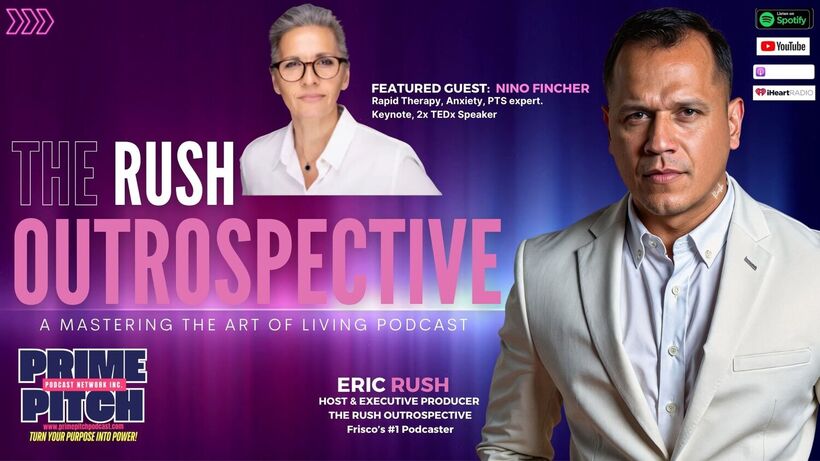
Nino Fincher
Rapid Therapy · Anxiety & PTSD Expert · 2× TEDx Speaker
About the show
The Rush Outrospective is a Mastering the Art of Living podcast: raw, honest conversations about purpose, healing, and the road back to identity, the flagship series where outrospection began. Hosted by Eric Rush, The Conversation Architect, a Bronze Star combat veteran and the founder of Prime Pitch Podcast Network.
Read the full transcript
So, like in my coaching program, which is a little bit more extended, I talk about body, heart, mind and spirit. Those are the 4 aspects that have to be in harmony and have to feed one anotherthe other in order for us to function well. and I think what what happens is in a lot of the industries or a lot of the fields that gets dissected. so you know, in for a physician, for instance, would treat, would treat physical symptoms. a lot of the time in psychology, would you would deal with mental, mental issues, but you know.
but a whole health and kind of complete,complete recovery needs to coordinate those things, because you're the spiritual perception, or your worldview, if you want to call it. if you're not, you know, not a believer in God, your world, you, your perspective, your purpose, your values have to inform how you think, and your thinking in turn then informs how your emotional state corresponds to it. and then body just kind of follows, whatever wherever it's directed. yeah, so, but that has to happen in coherence for total wellnessus, in my opinion. hey, what's up, guys?
welcome to the rush out perspective, a mastering the art of living podcast. there are some people who help you manage the noise in your head, and then they're the rare few who teach you how to quiet it, not with distractions but with truth. I know, because I've been there myself, stuck,frustrated, doing all the right things, only to find myself going around in circles. And that's where today's guest Nino Fincher comes in. She's a rapid transformational therapy expert, a keynote speaker and a 2time TEDx presenter who's built her life around helping people break free, not just from surface-level struggle, but from emotional habits and mental wiring.
most of us don't even realize we're carrying. So, whether you're coasting, collapsing or quietly carrying, more than you realize, this conversation's for you. You're listening to the Rush Outrospective, a Mastering the Art of Living podcast. I'm Eric Rush, and today we're stepping into the art of breaking free with Nino Fincher. Nino, it's great to have you on the podcast.
Thank youAgain. you know we'll take 2. we say right,That's right. We had some issues, technical problems the last time, and I apologize for that. You know, when you go through the editing process, you're trying to.
you want to have the perfect productFor sure,And I really appreciate you. coming down to my pleasure,I understandIt's such an important topic to talk abouttransformational therapy, the art of breaking free,So I'm so happy that you're here. I think it's vital that we get some information out, that you possess your knowledge, how God's credentialed your experience in life, and we're going to get into it. Okay,Awesome,Sounds good. Before we get into the methods and the framework of it, I just want to pull it back a little bit.
For you, the work you do isn't just professional, right,It's personal. But what moment or experience made you realize that helping people break free wasn't just a skill, it was something that you were called to do? I think that the death of my grandfather really was a profound, profound event in my life, and that's the event that kind of set me on a journey to ask a lot of existential questions, a lot of deep questions thatpeople need to answer in order to find their purpose and understand why they're here. And so that kind of what started me trying to understand my destiny. why am I here?
you know, and I think, once I got clear on what the purpose of what I was doing was- knowing that it's designed to serve people-that really answered a lot of questions. And your grandfather? what's his name? His name was Shalva,Shalva, okay,Yep,And does that have a significant meaning? I don't know,It's a Georgian name, so my grandfather was from the country of Georgia and it's a, which is a mountainous region of Georgiato some very tough people, and so he was an extraordinary human and I was very close to him.
I learned a lot of important lessons to him. He was a veteran and I just I had the utmost respect for the man and I miss him deeply. Every time something important happens in my life, I wish I could share it with him first. That's beautiful. In that process of going down this journey of trying to find your purpose, where was the connection?
How did it interconnect with your grandfather's life? My grandfather, I was raised in an atheist home and we never really talked about God,But I do remember my grandfather praying before sleep every time, even though it was never brought up. I was raised in the Soviet Union,So that was very curious for me always. And so when he passed away, suddenly thinking that this can't be the end of it all was a really profound thought that set me out on a journey to question,And so I started reading everything that was available to us,And we had an amazing library at home. We had all the religious texts, a lot of philosophical texts.
So I just started reading. reading. reading-kind of learning what the answers to big questions are- is what got me to Christianity and got me to the place where learning about Christ and learning about His claims, and learning about the overwhelming evidence for the authenticity of the Bibleand the claims of the Bible made me decide that I had to make a decision one way or the other. I couldn't straddle the fans. I either had to reject it altogether or I wouldn't be intellectually honest enough with myself if I didn't say I need to put my faith in Him.
That's awesome. I always wonder what the internal struggle is for someone who's an atheist or just grows up being an atheist- right,And the struggle to convert to Christianity right. What do you think that individuals go through in their mind when they're trying to organize that? Yeah, for me personally, it was very intellectual. I was raised in a home where I was taught to question everything, to not just not believe anything outright and to make sure that there's sufficient evidence and all the right questions have been asked, etc.
And so that the desire to really get clear onwhy you believe what you believe was essential for me. I was trained in that. but also it was important to me, and so I think for some people it's that. For other people, as one of my friends used to say, intent precedes the content. so it doesn't matter what the content is.
If the intention is, I do not want to surrender mywill to anyone else and i don't want any authority over my life besides myself, then it doesn't matter how much evidence or or proof you see of something being true. you you want to hold on to that autonomy. and um, autonomy isn't, uh, the best way to know god, i think surrender and and and listening is:Yeah, that is, I could. when you were saying it, I was just saying someone who goes through that struggle, it's just very conflicted. you know from what a majority of society you know is based on some faith, right.
And then, when someone doesn't have that connection, you know the battle that they're trying to. you know the pressure they're feeling from that right. It's very difficult, because you end up being the solution to all of your problems. And you know we are flawed and we don't have all the answers. And so, convincing ourselves that we are the end all and we are the only truth that there is just kind of, doesn't take you to the absolute truth.
Yeah,I think I had a friend one time who he said, I don't. you know, he doesn't really believe in a higher power. I know where it's going, but it's an interesting conversation about this, because you know, I had a friend that is an atheist and he said: well, I don't have a higher power,And I said, well, I argued with him. I said, well, yes, you do. I said, look at this picture of you and your family.
Who's your higher power in this? If you're looking at this picture, who's the higher power right? The love for your family. So the love for your family would be a higher power in many ways too. Yeah,So, definitions are important.
obviously,How people define the terms and the concepts makes a big difference, and I think it helps to understand who means what when they say you know higher power, and so on. That's true,That is true. In my introduction I said: well, first of all, let's talk about your credentials. You mentioned something that you have been educated in particular fields. Let's talk about that.
Yes,Share a little bit about what. So I started out. my studies were in linguistics,So the language, the significance and the meaning of the words is really interesting for me and important,And I speak several languages just by virtue of,you know, living in a country that allowed for that very easily,And when I graduated I became very curious about. you know, it was at that time that my grandfather died, and so trying to find out what the answers to these questions were kind of led me toto study theology,And so I did a year at Dallas Seminary, studied theology and Bible there, comparative religions as well. And then just as I was graduating, Dallas Seminary started a program in counseling and biblical counseling.
And so I thought if you could combine psychology andtheological concepts it would be mind-blowing and well it turns out somebody did it before i did and so but that that is what my master's was in and then after that i did postgraduate work in philosophy and ethics you know so i've done all kinds of interesting things wow that that's uh that i mean you talk about having wisdom you know going through those those particular um uh academic or you know umspecific genres of study, right? It's like, holy cow, that's like such a deep, like you have more, I guess, do you feel like you can see things at a thirty thousand foot view? Well, some things I would say, I don't think that knowledge necessarily gives you that. Knowledge gives you a lot, but wisdom doesn't come from knowledge. Wisdom comes from something altogether different.
And so hopefully I've learned some things that were wise by virtue of observing how people interact, what God says about our nature and from the experience. Yeah. In your studies, what did you see the unique commonality in different faiths, I would say? We all want the same thing. We all are flawed, the Bible calls it, born in sin, and we all strive for the freedom and the peace and all the beautiful concepts that kind of like your friend, your atheist friend,was defining as higher power.
All of those abstract concepts that we long after, immaterial concepts that we long after, God possesses them and He has them in His essence. And so without Him, I think it's difficult to get to them and successfully kind of download them and have them, you know,Yeah, when you think about how you've used, you know, you've connected faith and actual therapy, how do they come together? I think the way I see it is,My understanding of how Christ defines the condition of a human heart makes a big difference. And I think knowing that and seeing that helps me understand how people operate, what people long for and what the struggles are. And it's just a different perspective from what you would get just from pure therapeutic point of view or psychological point of view.
Yeah. And, you know, from my personal experience, you know, I'll testify that the most, you know, I've had therapy with, you know, with the VA counseling. And then I've also had therapy with a Christian chaplain from the VA. And having those come together, like, was probably the mostrewarding experience I could have, you know, from a rehabilitation standpoint. It just seems so, you know, one's more behavioral and the other one's spiritual and internal and your internal convictions.
yeah so i like in in my coaching program which is a little bit more extended i i talk about body heart mind and spirit those are the 4 aspects that have to be in harmony and have to umfeed one the other in order for us to function well. I think what happens is in a lot of the industries or a lot of the fields, that gets dissected. For a physician, for instance, would treat physical symptoms a lot of the time. In psychology, you would deal with mental issues. But a whole health and kind of complete recovery needs to coordinate those things because the spiritual perception or your worldview, if you want to call it, if you're not a believer in God,Your world, your perspective, your purpose, your values have to inform how you think, and your thinking in turn then informs how your emotional state corresponds to it, and the body just kind of follows whatever, wherever it's directed.
Yeah. But that has to happen in coherence for total wellness, in my opinion. Yeah, and I back you a hundred ten percent with that. In my introduction, I said that you're a rapid transformational therapy expert. How does rapid transformational therapy help address the root cause of anxiety and PTSD across cultural lines?
So again, because we're all designed the same way, a lot of these problems and frustrations that keep holding us back from moving forward are subconsciously held. And the great thing about rapid therapy is that it combines the 3 modalities that are very effective. It combines traditional cognitive behavioral therapy, hypnosis, and neuro-linguistics. And that combination allows us to get right to the root of the problem. and then transform it cognitively in the state that allows you to focus exactly on that issue with your body completely relaxed and in not a hyper, hyper engaged way.
And then linguistic part allows you to kind of rebuild the neural pathway that allows you to take a different path literally from what you are familiar with. Wow. Do you have a real-life example of what that might look like when someone's on a healing journey? Yeah, I mean, I have so many, so many client stories I could tell you. Most recent one, for instance, is a CEO that I worked with who has been struggling to move forward and make decisions and just kind of trust himself to just dive into whatever the next project is.
And the reason for that has beenhim over the years not being confident enough that his father approves. And so his father is not around anymore, but that deep perception of why try if dad isn't satisfied just kind of shows up in the ways that he doesn't even recognize that. So we dealt with that and made a difference. Wow. For him.
Those soul ties, I guess, is that some kind of soul tie that's keeping him, like, you know, captured? Yeah, I would ask you to define what you mean by that. I guess, like, somebody who, I guess, that has thatthat lived experience with his father that that that's very that created a lot of emotional yeah you know in in his soul i mean when when we're little the influences around us are people in authority whether it's our parents or teachers or anybody who has some kind of aauthority over us and how we decide to either gain their approval or avoid punishment from them becomes sort of a pattern that we then follow subconsciously without often realizing it and then it just shows up at the times that where we have to make critical decisions. And so rapid therapy allows you to transform that, usually within a session or 2, which is amazing. Wow.
We'll have to do that. You and I have to warn you. You don't know what you're getting into. I know, right? We should do it live.
We should do it live. Let's go. Yeah, it would be great. But I'll say this. When you're sharing that with me, you know,do people sometimes like don't don't even realize that that's like you know you know some people come in and they don't realize how deep you know I say you know believe beneath the surface oh yeah most people don't yeah I think I mean you have to be extremely self-aware even people who are very focused and kind of observant and understand what's happening with their body and their their minds still sort of neglect ordon't understand the connection between the impact that something made that seemingly, if they brought it up, would be something random and they wouldn't have paid attention to.
For instance, I had a client who, again, struggled with decision making. I don't know why that keeps coming up. So she was in a park one time,and she ran to get some ice cream. And then, because there were a lot of people in the park, once she got the ice cream, then she couldn't find her people, her parents or her siblings, you know, and she just kind of stood there with this ice cream looking around. And you know, she would have never remembered that.
as a reason or thought about it as a reason for why I'm struggling to make decisions and move forward. But that is what made an impact on her as a little child and said, you can't go anywhere. You can't see. You can't see. You don't know where they are.
You don't know where the security or safety is. You know what I'm saying? So it's just a really interesting way the mind operates and connects the dots. And so being able to help people see that and transform that, it's just the most rewarding thing. That's crazy.
I mean, it's crazy, like, just the, I can sense, you know, I've spent years in rehabilitation programs, so for me, when I hear you talk about it, I can kind of relate, yeah, forWhen we think about the psychology, theology, and you're a personal trainer as well, you're kind of intermingled with all 3. Is there an example of where psychology, theology, and fitness working together, is there an example of when they had a breakthrough with all 3 together? Yeah, before when I worked with people who struggled with depression, I often would prescribe boxing to them. Not everybody, obviously, but it was a great way to release a lot of the anger. A lot of the times, I think depression is an angerturned inwards.
And allowing your body to release that tension is very helpful. So what we need to do, I think, to transform is once we are informed by what our worldview or desire is,is, then aligning our thinking with that produces the chemicals and emotional state that locks in that clarity. And then your body becomes a function of just moving that emotion through and aligning you to that. So yeah, I mean, all of those parts have to work together in order to get to the freedom. Yeah, freedom.
What myths around anxiety and trauma do you challenge in your work? That can be healed, or it can be changed, or people sayI'm an anxious person or I have anxiety or this is my anxiety. They keep trying to own it. Anybody who says this is my and then attach some kind of a disorder or a habit or a state that is dysfunctional to it, your mind is going to fight to hold on to it because itidentifies it as something that you own. And so people a lot of times are very skeptical about being able to change things.
I just spoke with a gentleman who's been in therapy, I think he told me since 18. He's 61 now. Wow. Yeah. That's a long time to be in therapy for the same issues.
Yeah. Do you know what I mean? Yeah, I do. Is that some form of security blanket in some way, too? Like, you know, that's the emotion they Yeah, for some people it is.
I mean, it's, you know, subconsciously I mean, there's different reasons for it, obviously, but in the mostThe saddest cases would be that people use it as some kind of a function to fulfill something that they don't know how to fulfill in any other way. It may be attention, or it may be an opportunity to stand out in some way as a victim of something, or everybody cares about me. And so we subconsciously desire after that, but we get it through the means that aren't healthy or helpful. Where does prescription medicine fall into that? How is it, you know, what are the, you know, how does it impact you negatively?
I guess we'll start with that and then maybe positive. Yeah, well, I'm not a physician, obviously, but I think that function of medication is to temporarily give you assistance until your body heals itself. Obviously, there are exceptions, but oftentimes peopleit becomes a crutch and it becomes something, a safety net, rather than thinking of it as a temporary solution to get you over the bridge until you can walk yourself or until you can think yourself, until you can support yourself. And I think if more people perceived it that way, I think we would have less dependence or need for a lot of the medication that's continuously prescribed or sought after. You know, going back to us doing it live, I know I kind of laughed a little bit about it, but I'd be game.
I want to learn. I want to grow. I want to expand, you know, reach, stretch myself. So let's figure out when we can do that. You never know.
We might. Okay. Let's see here. You talked about your 8week program, right? What makes your 8week program effective, and can you walk us through how it's designed a little bit?
So this is kind of what my TED talk was about, and I call it the MOVE framework. It's M-O-V-E. And MOVE, M stands for creating movement in order to get to the momentum. You cannot get to the momentum until you make a decision and start creating at least one change or one type of movement in your life that is different from what you were used to doing. and uh all stands for overcoming and that's where rapid therapy comes in rapid therapies part of my coaching program uh with my clients and so being able to really get them deep down and dirty and understand what that is that thing is thatmakes you think that you can't overcome it or haven't overcome it, that's what we deal with.
And then value is where my training or my purpose clarity session comes in and that's where you have to understand what is it that you want and why do you want it. and uh that's where we do a purpose purpose uh clarity session i work with the purpose company and they uh have developed some one of the most incredible tests comprehensive tests and understanding what your purpose is what your maximum fulfillment and frustration is and so we address that and then he has to do with the expectation how you perceive the outcome and how you uhcreate the clarity for your mind and set your mind in such a way as to expect something that will move you to success. And so those are the things we address in the 8 weeks or, you know, roughly 8 weeks. Yeah. I actually have been talking to the people from the Purpose Company.
Right. Somebody, I think I Eric, maybe? Yeah, I think it is Eric. Yeah, I connected you guys. Yeah, I think we Yeah, that's right.
Yeah, you did. I forgot. Yeah. I was like, how did that happen? That's right.
Magic. Yeah. Where do most people hit resistance in that journey when they're in your program and what tends to break it open? I think fear is huge. Fear of, you name it, attach whatever you want.
Fear of failure, fear it's not going to work, fear that I'm not good enough or I won't be able to connect. Fear is huge. I could talk about fear all day. We won't have to do a podcast alone for that. Yeah, it's just, yeah, it's not a good thing.
Yeah. And holds people back definitely. So I think that would be one of the biggest challenges and lack of confidence in themselves. But, you know, a good therapist who understands what they're doing or as anybody who understands what they're doing, I think,is able to communicate why the solution is available and why the solution is possible for anybody that come their way. And so I think it's kind of my job to help people understand why you don't need to be held back by that if the success is available.
Jillian, I forget her name, Jillian Michaels, maybe, or Jillian, anyway, lady from The Biggest Loser. Yeah, Jillian Michaels, yeah. I heard her once say, why choose failure when success is an option? And I think it's a great statement, you know? That's pretty good.
I was going to ask you, it was a question, oh, okay, you know,We talked about, you talked a little bit about, you know, a good psychologist, right? How does someone go about, like, you know, someone who's saying, I'm going to seek help? Yeah. You know, how do you organize it to, how do you get to a place where I need to pick a psychologist and I don't know what to look for? Yeah.
What would you do? That's hard. I thinkto me I think a person who social proof basically is huge like being able to speak with people for whom this therapist or professional has made a difference and then maybe even interview a professional understand what their perspective is on healing or recovery what is it that they thinkthe outcome can be. How much of an engagement do they expect from me? What is it that they have worked with?
I mean, just kind of getting a good, clear understanding of who is it that you're working with and whether or not they're going to be rooting for you and really will want to put themselves out of business. Do you know what I mean? It would be a good way to check. That's pretty, I think, yeah. It sounds simple, right?
But in the outside, someone's at home right now dealing with some issues. They don't know how to go about it, but now that you've offered that, even me, I was like, oh, yeah, social proof. Yeah, just ask for testimonials. Ask if it's possible for you to speak with somebody they've helped. Ask about some of the cases that they worked on, perhaps, that are related to what a person is dealing with.
How do you define real progress in therapy? You don't need me anymore. You can do it yourself. it's not it's not a very lucrative lucrative way to to do it but you know the truth is i i don't want to see you a lot like i just want you to get clear on how your mind operates what to do with your emotional state align all of that and go make decisions on your own you're capable you don't need me for everything i mean it's nice to my clients come back andYou know, do a little check, or there's some interesting moments, and we usually just do coaching. But I've never had anybody come back for the same issue to me, which is, I'm thrilled about that.
Yeah, that's awesome. Yeah, okay, so I'm kind of going, okay, that's why, you know, like I'm thinking about how, you know, like I said, I've been in therapy before, so I know what's the point where you go, you know, and I think you just said it was like when you don't need me anymore. Right, yeah, stop coming, like, you know. Stop coming, you're good. We can go for coffee, you know, which is not really appropriate, but I'm just saying, like, you shouldn't have to need a therapist forever and ever.
Yeah, yeah. Coach, yeah, but, you know, it's not, I think that at some point,My goal is to equip people enough with the tools and the skills and understanding so they can now do it for somebody in turn. One of the veterans I worked with, an extraordinary human being who was struggling with PTSD, amazing musician, hasn't played in years. So we worked, we did a session and he started playing, started creating amazing music. And now he's thinking about starting a music shop and assisting other veterans through music.
I mean, that's wonderful, isn't it? So it's very cool. So that's the success right there. That's awesome. I told my friend that just the other day, the same friend I was talking about, was like, you know, he's going to counseling session for a certain thing.
I said, man, you know, your counselor's only going to do so much work. How much work are you doing outside of that counseling session? It's only one hour, you know, and maybe once a month, you know, or whatever. It's like paying personal trainer and then expecting the fat is just going to disappear once a week. So I challenged him.
I said, you find a book. And I'll read that book with you. That's great. That's great. What's it called?
I forget what it's called. That's beautiful. No Bad Parts. That's what it's called. Nice.
What role does faith play in your process? I don't push my faith on anybody. I think nobody wonders whether or not I'm a believer. I'm very open about Christ transformed me. He's my Savior.
He's my life, and I'm not afraid of death because of Him, and He is really the freedom for me. And so I want people to understand what exactly he did and what his claims are and why he is unlike everything and everybody else. But when it comes to me helping people, those who are open to that, I'm happy to discuss it with them. For those who are not,they have to determine what their values are and then they're going to have to align their values with how they operate. And sometimes they will find that there are challenges because they're not always necessarilybased in truth, perhaps, from my point of view.
But again, in rapid therapy, I don't address it very much unless the client requests it. But in coaching, I want the client to determine where their world view and the value system is and how that informs what they want to do in life. curious to know what like faith internally for you when you to continue to you have to have some strength somehow right like you to to to to go through walk to walk with people through their own journey how does how does even in that capacity where does faith lying you know I for me personally I understandwho I am, and that foundation is not changing. If I lose everything tomorrow,I still will have my identity because it's rooted in somebody who is not changing and who is solid and I don't have to prove myself to them. Everything I do as a Christian is out of gratitude for what God did for me first, not to prove myself or to earn something from him.
So it's an incredible place of peace and rest and comfort. But then as you have that foundation, as you understand sort of what God's perspective on human behavior, human condition, the condition of a human heart, the choices that inform, you know, the decisions that people make as they make choices and so on and so forth, for me personally,brings a lot more clarity than any psychology book can because nobody identified a condition of a human heart better than Christ, in my opinion. Wow. That's awesome because you, you know, as someone who walks that journey, you know,The Christian journey, as myself, when I listen to you say that, it's like a very profound perspective of how knowing who you are, based on solid rock, solid foundation that you believe in, and that gives you that empowerment and that strength and gratitude. I think the word gratitude was a beautiful word for you to use.
I was like, wow, to have this gratitude to be able to assist other people in whatever they're dealing with. Last question, how do you keep clients engaged, especially those skeptical of traditional therapy? How do I keep them engaged? Yeah. It's good when people have questions, and it's good when people are curious, and I think it's my job to help them understand clearly how rapid therapy works, why it works, give themKind of like when interviewing a therapist, give them stories of who it worked for, why it worked that way, how your mind operates, how your heart is designed to operate, how your nervous system operates, and why this method makes sense and is the best way to get them to where they need to go.
That's awesome. Okay, this is the part where I do my guests. I tell my guests to give a person, a team that you may know, somebody, some encouragement. Just call them out by name. Say, I want to give this message out to A, B, and C.
Oh. And say, I want to just encourage you or just want to say I thank you for your help and all that, whatever. Well, thank you to the veterans, to all of our veterans. I appreciate your service, and I'm so grateful for men and women who do this extraordinary work, and so absolutely a shout out to all our vets. You know, and I've had so many incredible teachers in my life that I could list them all day.
Like somebody said, we stand on the shoulders. That's what gives us the ground and the height, right? But I'm very thankful for all of my professors who taught me how to think, how to analyze things, how to ask good questions and the right questions. I'm grateful to my parents for giving me the freedoms that I needed to study and to travel and to move around. I'm thankful to my husband and my children for giving me the space to do all the exciting things that I get to do.
And, yeah, I'm just, I'm grateful to Christ because I, without Him, I'd be looking in despair and fearful. And He gives me purpose. He gives me clarity. And He is the one I'm looking forward to being with. That's beautiful.
Okay, so if people want to get a hold of you, how can they get a hold of you? I'm very findable. So LinkedIn is the easiest way. That's the platform that I'm most active in. Or my website, it's ninofit.
com. It's N-I-N-O-F-I-T. com. And you can get in touch with me through that easily. You know, we did it the second time.
That's right. You know, the first time was fantastic. Unfortunately, there was audio issues and stuff like that. And I think the file got corrupt or anything like that. But it's a pleasure.
It's so beautiful to share this experience with you and get to know you better. Likewise. I do want to try the rapid, the therapy, the transformational therapy for sure. Yeah, sure, we can talk about it. We'll figure it out.
And I'm down anything that will break free and have that freedom. More freedom, right? For sure. I think that word freedom is an undervalued word. That's everything.
It's a beautiful word. Because with freedom, you have peace. With freedom, you have choice. With freedom, you have fearlessness. I mean, it's everything.
Do you have a favorite quote? We can leave with a favorite quote. Oh, I have so many. We were just talking about freedom. I said, whoever the sun sets free is free indeed.
That's a beautiful verse, right? But I think Hmm. I know I put you on the spot. Yeah, I have a lot of good quotes that I like. Anything that C.
S. Lewis has said, I always enjoy. I'll give you a quote by Richard Sibbes. He wrote a book called A Bruised Read. He said, there is no certainty as the certainty gained after a doubt.
Because when you have gone through a doubt and gotten clarity on the other side of it, it's so solid and it's so powerful that nothing can shake that, and I like that quote. That's awesome. I'm going to keep that in my mental registry for sure. I'm going to investigate, knowing me, like after this I'll be like, what is this, what is this, and I'll do a deep dive just on that for sure. Richard Sibbes, there you go.
All right, Nino, thank you very much again for having me on the podcast. You know, it's a blessing to know you and to have you as a friend. And look forward to continued growth between you and I and everything we do. Same, same. Thank you, Rush.
All right, guys, that's it for the Rush Outrospective, a Mastering the Art of Living podcast. As I always say, have peace and delight in you. And remember that the ocean refuses no river. I find my way You lift me up when skies are grey Outrospective, but flying high