Michael Etcheson
Michael Etcheson joins Rush on The Rush Outrospective, the flagship show about purpose, healing, and finding the way back to yourself. As executive Relations Manager, Prison Entrepreneurship Program, Michael brings second chances and the work of reentry to the table.
They get into the work, the cost, and the reasons it still matters, in the kind of long-form conversation this show was built for.
In this conversation
- What real second chances require
- Rebuilding a life and an identity
- The people who make reentry possible
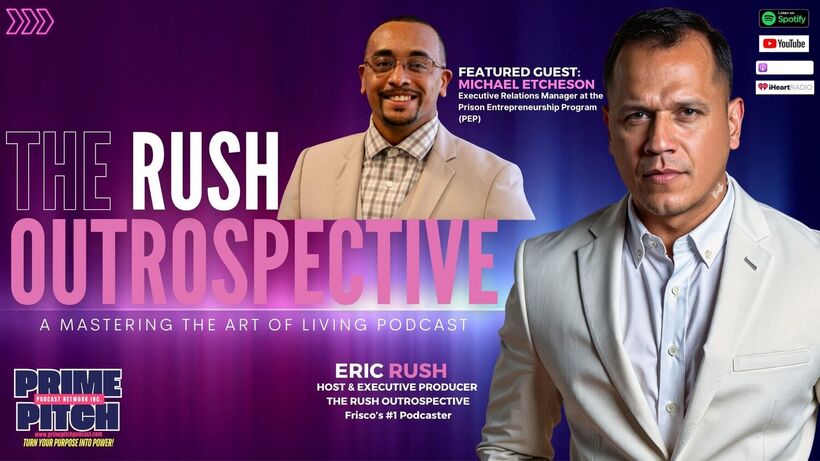
Michael Etcheson
Executive Relations Manager, Prison Entrepreneurship Program
About the show
The Rush Outrospective is a Mastering the Art of Living podcast: raw, honest conversations about purpose, healing, and the road back to identity, the flagship series where outrospection began. Hosted by Eric Rush, The Conversation Architect, a Bronze Star combat veteran and the founder of Prime Pitch Podcast Network.
Read the full transcript
Do you- when you, when you loo- when I say that to you, do you feel like this is part of an anointing by Christ to, to go down this mission? I do. I believe everything was written from the start. Mm. From the timing that I moved to Texas to today, right now, sitting in this seat.
It is- i- it was put in motion before I was even here. Yeah. Before I was even to take my first step, right? This is what I was supposed to be doing, this is what God had planned for my life. And I thank God every single day for putting me in prison in Texas.
Mm. It's a blessing I went to prison. Yeah. It's a blessing that I got caught. It's a blessing that, uh, th- all the things that went on during that time, from the people that you lose in your life whenever you're incarcerated and you come home and you're never gonna see these people again.
Um, all, all the losses that I've taken, um, it's a blessing. And I thank God for it every single day. Hey, what's up, guys? Welcome to Rush Outrospective, a Mastering the Art of Living podcast. You know, prison's supposed to be the end of the line, or a place where choices catch up, where possibi- possibilities close down.
But sometimes, in the quiet of a cell, a different story begins. For Michael Etchison, incarceration wasn't the final chapter. It was the fracture that forced him to ask harder questions. Who am I really? Who do I want to be when no one is watching?
Out of that silence came something rare, not just a decision to change, but the discipline to rebuild a life from the inside out. Today, Michael is a 2time Community Impact Award recipient, the executive relations manager for the Prison Entrepreneurship Program, and the founder of Cream Coffee, Coffee and Pastry. Today, his story is proof that transformation isn't about escaping your past. It's about reframing it, turning scars into strength, and using them to build bridges for others to cross. This is the Rush Outrospective, a Mastering the Art of Living.
I'm Rush, and in this episode, we'll explore what it means to master the art of look- living by looking outward through connection, honesty, and shared wisdom. Michael's journey isn't- is more about- is more than redemption. It's a blueprint for resilience, for second chances, and for the systems of hope that we can create when we stop asking people if, if people deserve another shot, and start asking, "What can we build with it?"Michael, brother. What's up? It's- it's great to have you on the podcast, my man.
It's good to be here. Yeah, it's been a, a long, a long time coming, you know? We've been, we've been doing a lot of stuff together. Yes, mm-hmm. Um, I was asking the guests, uh, before you on another podcast, I was asking them, you know, every time I read, uh, this, uh, the cold opening, um- Mm-hmm.
uh, what do you, wh- what kind, what get- when you listen to, to, to me break stuff down, what, what goes through your mind? What, what really touched me the most was when you stated, as far as being in the cell, turning your life around, and being somebody of integrity and compassion. And then, for me, being able to walk that life and outlive that, honestly, that dream or that fantasy of somebody with compassion and integrity, and to be able to walk truthfully and be able to speak the truth and tell the truth, without you know, having to tell a lie, and then another lie to cover up that lie. Yeah. Um, so much comes from being honest.
Yeah. Yeah. Yeah, it's hard when you're, when you're thinking about, you know, you've gone through some, some, some- you made some poor choices and mistakes, and there's that level of- Mm-hmm. um, you have a, a struggle with humility and humiliation. Yeah.
And what's the constant battle with that, do you, do you see, when, when you think of the 2? You know, the different- and, and talk about the difference between the 2. So humility and, what was the other one? The humiliation. The humiliation.
Yeah, yeah, yeah. Oh. Toanother question? No, no. Is it tough?
To, to, uh, just, just to be able to be true to yourself, and to be down. Yeah. Right? To be able to walk in your own skin and be comfortable with it. Mm.
But also not to be cocky but confident. Yeah. Right? And to, to be able to remain humble. Yeah.
Right? Um, I think that's, that's what really hits me when I think of humility, to be able to lower yourself, and then you will be raised up. Yeah. Yeah. You know, and that's, uh, that is a hard question to answer, you know?
So, you know, you walk through humility and humiliation, and, and you've got- Yeah. That's-in, in some ways, um, you and I have both walked in some, um, 1, uh, at 1 point, one of this, one of that, and now we're, and we're walking in humility, right? Yes. And, and so I could see how this is- it could be very difficult to understand, you know? But- Yes.
and then to explain it away in this fraction of a second, I can understand that too. So man, um, you know, it, it, uh, I think that's a unique perspective you talk about, is not be cocky but be confident, um, you know, have the silent confidence until God asks you to rise up and, and can take it to another level with that confidence. Exactly, exactly. Um, there was a saying that I loved whenever I first read it. It was, you know, even the king of the jungle, the lion doesn't even have to roar in order for you to know that he's the king.
Mm. Right? Mm. To be silent, you will be able to accomplish what you want to accomplish without a lot of interference, but also to be able to remain humble, right? Yeah.
And that does take a lot of confidence in yourself and the understanding of who you are. Yeah. Um, emotional intelligence plays a big part in it- Yeah. to be comfortable with yourself. There is- I learned there's a thin line between, between ego and, and self-esteem.
Mm. Right? A very thin line between ego and self-esteem. Or as I like to call it, God-esteem. Mm-hmm.
m- e- ego is who and what you think you are, and your God esteem is who and what you know you are. This is who God told me who I am, this is what I am. Yeah. I'm a man that walks in integrity- Yeah. and can show compassion- Mm.
you know, as once before I wasn't able to. Yeah. Or it just wasn't in me. Yeah. That's beautiful, man.
Uh, call it Godfidence, right? Like, uh- Godfidence. Yeah. Um- Yes. Uh, Michael, before we, we get into where, uh, where you are now, let's rewind 'em.
What do you remember most about the mindset or pattern in your early years that eventually led you to prison? Mm. So the mindset always growing up is I, I always had to be tough. I am the one that always has to be first to that action. Mm.
Right? Um, the, the, and, and that was the pattern. That was the pattern that kept me in that box. It was just a vicious circle, right? You, you tend to grow up without even knowing what love is or having an understanding of what love is, and it's just simply a word.
Mm. And you don't even have the feeling of love. The mindset was just no love. Yeah. That wasYeah.
You know, um, and where do you think that came from, where you, you didn't understand? Wh- ho- how do you feel that that was not how you, or that's never, was never nurtured totally? So my first experience with feelingAnd I, and this, this played a big part in my life. Hmm. Um, being in a household whenever there was domestic violence present.
Mm. Right? Now, it's either verbal or it could be physical. Um, mental, domestic violence, like, it's, it's present. It comes in many different forms and shapes.
Yeah. And it's not prejudice. It's, this is gonna hit everybody. It can hit everybody. It can touch anybody.
And I first felt this fact of, of being all my lone and not being able to want to show love or need lo- need love really is, um, a day that I witnessed my mother get knocked unconscious. And as a five, 6yearold boy, um, leaning over her body, waiting for her to wake up, um, running downstairs to try to get the neighbors to help that's supposed to be her friend- Mm. and they shut the door in my face, you, you, you tend to lose a piece of yourself, right? You tend to know right then and there, well, it's just, it's just me or it's just us, and I'm the only one that she has right now. Yeah.
A lot of pain, a lot of hatred, a lot, a lot of negativity came from that moment in my life. Yeah. To the point, you know, I could still, I could still hear the sound of the contact to her, to her f- her face, yeah. Wow. You know, it's, it's interesting, um, you always say that a father's responsibility is to teach his son how to love his mother, you know, and that, and when he does that, um, he, he teaches how to love his wife in that process too.
Um- True. when you, when you, when you hear me say that, what comes to your mind? Is that true? W- And how, how was that? How did that impact you?
Well, I tryAs a father myself, I try to be the man that I want my daughters to marry- Mm. every day. So I try to walk and act and behave that way and treat other people in that way. Yeah. Like, I wanna be the man that I want my daughters to marry.
Um, and your children are going to follow you, right? They're gonna follow in your footsteps, whether you think that you're teaching them something or not. Yeah. They're going to behave in a way you behave. If I'm treating my wife, or my s- my spouse, or my significant other, in a proper way and my children see that and witness that- Yeah.
they're gonna come and follow behind that. The s- Especially young boys. Yeah. Yeah. Yeah.
It's weird 'cause you, you know, you can also admire your father in a way that's not healthy too, right? Say, "Look at this.""He doesn't take, he don't take no BS from nobody, especially even my mom or even his girlfriend or even, you know, the girl next to him," you know? Yes. Like, like, and that'll teach you something too, right? Yes.
It truly does. And that's the person that you do admire. That's the person that you do wanna grow up to be like, a lot of times, is your father. Yeah. And a lot of times if we feel some type of negative way towards our father, we still will pick up those mannerisms and the behaviors.
Yeah. And next thing you know, you are your father. Yeah. Whether you like it or not, this is just what it is, you know? UmYeah.
Growing up, my f- m- as far as my father, he wasn't much in the picture. Hmm. Um, back and forth. Yeah. You know, so I was, I would, I'd be with him or be with my mother, so it was, it was back and forth a lot.
Hmm. But still, it was somebody that I looked up to and, um, wanted to be like even though that it was negative. Yeah. Right. Yeah.
Uh, I could see that, that, that, could see how that resonates with young men and, uh, did resonate with me too at a time. But I always say like, you know, you know, you're a father, um, we grow up, you start to mature, you get that emotional maturity and- and you start to realize that, "Hey, maybe I was doing it the wrong way the whole time."And- Yeah. and- and then, th- they say it's not how you start, it's how you finish. Yes, very true. Very true.
You learn, you- you learn to be a better parent as the more kids you have and of course I have a handful of kids, so each one I feel like I became a better- better- a better father than the last one, right? Um, it is so, it's- it's a blessing. It's uh, it's we- we'll call it practice. Yeah. You know, as- as doctors, you know, in the medical field they say, you know, we're practicing medicine and a lot of times it's because, well they use the word practice is because they- they really don't know what's going to happen.
Mm. If I take a Benadryl, it would do something totally different to me than what it will to you if you take a Benadryl. Might make me sleepy, it might make you hyper. Yeah. And I'll tell a lot of the brothers that goes through Prison Entrepreneurship Program, you know, we're just practicing life.
Mm. It's what we're doing, we're practicing life, we're gonna get it right. Mm. You know, I know if this doesn't work, well let me try something else. Yeah.
So yeah. That's a good way to look at it man. Mm-hmm. Um, you know a lot of people see prison at the- as the end of the road. For you, it became the starting of something new.
Yes. Um, was there a moment inside you when you knew that you had to change the direction of your life? Yes. Um, my s- actually oldest son, and I don't even know if he knows how much influence he had on me during that time in prison. Again teaching, behaving a certain way and your kids following in your footstep.
And I was probably about 3 years of my prison sentence, maybe clo- yeah close to about 3 years of my prison sentence, and my oldest son got incarcerated. Mm. He started getting in trouble. And that hurt me so bad, I, you know, I cried. Mm.
That's how bad it hurt. Knowing that my son followed me, he is wearing the same clothes that I'm wearing right now at this time, he's eating the same exact food that I'm eating at this time. He is dealing with the same mess that you have to deal with when you're incarcerated, at the same very moment. It really broke something inside of me. It truly did.
I- I believe, you know, I stayed in a bunk I think about 2 days straight. And I had to come to a realization and a conclusion that this- this is real, when it really hit me is that I, it's- it's not just me that's incarcerated. Yeah. It's my whole entire family. It's my children.
Yeah. They're going without a father, they're going out without a mentor because of my selfish behavior, and because of what Mike wanted to do and what, you know, Mike wasn't doing what he should have done- Mm. and I put him in that position. It- it- it's not my fault but it was my responsibility to keep my children safe, and I didn't do that. Mm.
I didn't do that at all. And that's when that turning point came, that I- I s- put a lot of stuff away, a lot of certain behaviors, a lot of the, uh, the language that I was using, um, a lot of the thoughts and the mentality really dropped. Um, i- he had a big influence on my change. Mm. Yeah.
Yeah, that- that uh, the child becomes the parent and the- the parent becomes the child, right? Yes, sir. Yeah. Yes, sir. Um, it's one thing to decide to change and it's another to actually live out- live it out day by day.
Mm-hmm. What did rebuilding integrity look like in those early mo- um, uh, every day, in those every day moments when nobody was- was watching? When nobody was watching. Well it was new to me from the get-go. Integrity actually wasn't even a word that I even knew the definition of or I- I don't even think I ever even heard it for the first time 'til a few years ago, right?
So it was brand new, so rebuilding it wasn't something that I had to do, it was something that I had- had to implement something new into my life. Mm. What it looked like at times, it's, it- it was tough. Yeah. And that's because I didn't want to be open.
I didn't wanna open up my heart, I didn't wanna open up my feelings, I didn't wanna open up my thoughts to somebody that- that I know that is even there to help me and benefit me. I still didn't wanna open up to that individual. So it- it was. It was tough to come to the realization of who, the person that I was, or the person that I am- Yeah. and to be able to open up.
And not even open up to that individual but open up to yourself and to be truthful with yourself. Right, it was, it was t- it was tough. Yeah. You know, um, you know, I- I was, uh, there's a psychologist, her name's Mel Robbins, have you heard of her? no, sir.
Okay, so she, she talks about that everyone's an 8yearold, like everyone start off as an 8yearold. Mm-hmm. And like and adults are 8yearYou can see everyone you meet is an 8, an 8yearold. Yeah. And I was thinking about it the other day and, you know, how you were talking about integrity and that there wasn't a word that you really knew, you know.
Um, and I was thinking about even like, like likewise with me is that there were ce- certain tools in my toolbox that- Mm-hmm. I didn't have. I didn't know what those were, I didn't know what core values were, you know, and, and this falls in line with what you're, what you're talking about, um, when we talk about core values an, and, and, uh, boundaries and, and, um, um, expectations of yourself, um. Mm-hmm. Do you believe that, that, that ma- there's certain elements of, of people that are incarcerated that are lacking th- this essential equipment, and once you get it- Mm-hmm.
it's like, it's like, "Well, I never saw m- I never saw my life this way before in this capacity"? Yeah, most definitely. There are most definitely people that's incarcerated that, that has never experienced or been able to use those tools that has been provided to us- Mm-hmm. naturally. Yeah.
Right? Naturally provided to us and that's because it was stripped away. Yeah. And you have people that's not incarcerated that, that's in the same boat. Yeah.
Right? Um, but we tend to, as far as being behi- hinding walls and doing whatever we're doing to get in, you know, behind them walls, a, a lot of that stuff was nothing that we would even think about pulling out to use as a tool. Yeah. Because y- you, you have to have this certain persona. I have to keep up this, um, image of myself- Yeah.
of, of being out in the streets or, you know, running down the highways back and forth. I had no use for those tools. So yeah, using them is brand new. Yeah. It is, it is very brand new and it can be painful.
Okay. M- mentally, most definitely can be painful, uh, but growth comes at the end of that. Yeah. Yeah. Expansion, right?
Yes, sir. It's, uh, uh, more space. Y- let's clear out your garage kind of thing. Yes, sir. Um, in your role with Prison Entrepreneurship Program, you, you're connecting executives with men and women coming, or men, particularly men, but- Yes.
they coming home. W- why is that bridge so important and how has your jou- own journey helped you lead in that space? Yes, it is. It's, it's my life. I have family members that are incarcerated, family members that's back and forth from being incarcerated.
Myself, I know the feeling. I have an understanding of what it's like to come home and not have anything. To not e- and I mean, not have anything as far as a pair of socks to put on your feet, right? Mm-hmm. Yeah.
Like, absolutely nothing. I have an understanding. I know what it's like for their parents and how their parents feel. I know what it's like for their children because my children felt the same way. And a lot of times, I'm, I'm doing it for you, yes, but it gets deeper than that because I'm li- I'm doing this for your children as well.'Cause I want your kids to see you as the man that you're supposed to be.
Yeah. I want your kids to be able to love their dad the way that a dad is supposed to be loved and the dad to be able to provide the love that's needed for the children that they have. It'sThis is life to me. This is something that'sIt's, it's not a job. This is what I'm passionate about.
It's the most spiritually rewarding thing I've ever done in my life. Hmm. It may not be glamorous at times, but I know this is my purpose and this is what I'm supposed to be doing, is helping these brothers and providing a way for them to gain what is meant for all of us to have. Yeah. And that is a healthy, stable living, and to be able to be beneficial to those that need it.
Y- I just wanted to, to flow over from me to them to somebody else. Proving a way for so many men and, and being able to make society so much more safer- Yeah. than what it was yesterday. Yeah. That's awesome, man.
Uh, I was thinking about this while you were talking is that someone told me, he said, you know, "Russ, you're, you're, you've been redeemed, delivered."Mm-hmm."Now it's to find out if you've been anointed, anointed."Yes. Do youD- when you, when you loo- when I say that to you, do you feel like this is part of an anointing by Christ to, to go down this mission? I do. I believe everything was written from the start. Hmm.
From the timing that I moved to Texas to today, right now, sitting in this seat, it, it's, it was put in motion before I was even here- Yeah. before I was even to take my first step, right? This is what I'm supposed to be doing. This is what God had planned for my life. And I thank God every single day for putting me in prison in Texas.
Hmm. It's a blessing I went to prison. Yeah. It's a blessing that I got caught. It's a blessing thatall the things that went on during that time from the people that you lose in your life whenever you're incarcerated and you come home, you're never gonna see these people again.
Um, all, all the losses that I've taken, um, it's a blessing. And I thank God for it every single day. That's awesome, man. So yeah, this is, this is all touch by God himself. That's beautiful, man.
He's your author of everything, right? Yes. Um, first question, did you bring me any coffee? Okay. I would, I would drop it off.'Cause this next questionUm, you startedThis next question is, um, you started KREAM Coffee and Pastry after prison.
Yeah. Um, whyUh, why- why did building that business teachUh, what did, what did building t- uh, building that business teach you about resilience and power- Mm-hmm. and the power of second chances? Oh, it's, it's encouraging, not on- only to myself because I see how it's grown and I see how it's prospering, but it's also encouraging to the brothers that get to watch it. Yeah.
And it's motivating too, right? KREAM actually started about 2 y- it started about 2 years before I was even introduced to PEP- Hmm. during my incarceration. Wow. During my f- my first step of accepting Christ and God into my life is when KREAM came about.
And it, it all came about because during this time of me writing letters to my children and my family and everybody, I started writing, uh, a book, a children's book, to my children and I would send them a chapter, a chapter of that book in the mail every single week. Wow. Well, as I'm started reading the, the word of God and trying to have an understanding of it, I'm also now trying to get my children to understand it. Yeah. And I want to bring them into it.
But the only way I was able to do so was to make it a little more hip. And KREAM Ministry actually is, was the start of it. Hmm. Name KREAM, yes, it's a play on words. Um, you know, cash rules everything around me, Wu-Tang.
The only difference is I changed the cash to Christ. Ah. So KREAM is actually an acronym standing for Christ Rules Everything Around Me. Wow. And the coffee shop idea actually came up because I needed a way to be able to fund the ministry, and I figured the proceeds from the, from the coffee business would be able to go to fund the ministry.
Hmm. Now, of course, it's changed. Yeah. Um, it's changed over time, so the, the goal for KREAM Coffee and Pastry is to actually partner with different non-profits- Hmm. every month throughout the year.
Oh, wow. And that non-profit will gain 10% of the proceeds made from bags of coffee sold. So this also encourages me too because now I'm not only helping the people that's coming out of prison, this provides me with an opportunity to help people that I wouldn't even think of. Because you have, y- you have 6,000 non-profits in Dallas or to Houston. Yeah.
That's a lot of people that I wouldn't think of. Yeah. That it provides me with the way to be able to provide for those that need it. Yeah. And that's what's encourage, that's what encourages me to keep going, to wanting to push it, and that's what motivates me.
Talk to me a little bit about the flavors, my favorite profile. Uh, before we do that- Mm-hmm. I'll tell you, I'm on a fast right now, so you go with it. Like-I'll pretend like I'm tasting it. Yeah.
SoNo. No. Talk to me about the flavors you got. Okay. Uh, yeah.
So I'm, I'm working with about 10 different roasts at this time right now, 10 different, uh, coffee, coffee blends. And one of my most popular is the Brazilian. Uh, so it has a, a tasty note of peanut butter, chocolate, floral-uh, sugar cane. Uh, so that is one of my most popular ones right there. And, and then, um, I believe the next one would actually come the Kenya, which it's a little more robust, smooth, very clean, very fresh coffee.
It does come from a, a farm out of Kenya. Mm. So it's not actually being, um, handed off to so many other people, uh, such as some of your most popular coffee businesses or coffee shops, right? Yeah. So it is very clean and very fresh coffee.
In the Kenya, dark chocolate, it has a little hint of peanut butter in it. Um, very, very good. Sa- send me some, um, after we get done with this podcast, send me some, uh, some of the, the pictures for it so I can at- ta- add it on to the end of the, the podcast for you, okay? Will do. Uh, joking aside, I mean, I didn't set you up for that, but, uh, I- I didn't mean to do that to you, man.
No. No, but I'm excited for you. I'm excited for your business and your KREAM Coffee and, uh, of course I want to elevate whatever I can to do that. And, um- Thank you. Uh, it's an inspirational, uh, inspiration to see you, um, having that, uh, that venture on the side of what, of everything you're doing too.
So- Thank you. Um, but yeah. So, um, we'll get, we'll get that, um, put that in. Um, coming home, um, people often say stigma even as they- they're celebrated for success. Yeah.
Um-you've won 2 community impact awards. What has it, uh, ha- what has it been like to carry both the weight of stigma- Mm-hmm. and the honor of recor- the recognition? Ooh. I spoke on this not too long ago.
It'sAs far as the weight, it, it feels like I can't fail. I have a lot of people that is looking up to me now in a totally different way- Hmm. on which they, it does push me, it does encourage me and motivate me to do so. Hmm. I just know not to jaywalk no more because you know, or anything more than that because I feel like you, you know, that might just turn around and come back onto me.
Hmm. Um, this, this stigma of coming home, correct? It can be discouraging. It can be very, very discouraging. Now, thankful I had a community and individuals are with the prison entrepreneurship to, to build me up and build my confidence up, right?
Hmm. The most discouraging moment I had whenever I came home was applying for employment. And I applied for a work-from-home job. Hmm. No contact with anybody, and I got denied.
Wow. I got denied the position because of my background. And so, me, I'm like, "Well, I, I don't even have to talk to nobody or see nobody, and I'm still being denied."Yeah. And the, the, the, the way that society and individuals can look at you because you have, um, lived a certain way, or you made a mistake, 'cause there's plenty of people that just make simple mistakes and ends up in a bad position. Yeah.
You're looked at as if you can never change- Yeah. and that you are a outcast and nothing good will come from you. Yeah. It, it, that's not only employment, that's also housing. Yeah.
You know, housing, a lot of us has to pay triple the amount just to move into a place, and it may not even be in a good neighborhood to, to where we can actually feel safe. The, the, the look that we get is, uh, it can be tough, it can be discouraging. Yeah, but thankful to PEP and the community that surrounds all of us within PEP- Yeah. it continues to push us and build us up. Yeah, you know, I was thinking about this the other day, it was like, you know, um, you know, uh, you know, a particular situation is, it's, I'm involved with right now.
Mm-hmm. And, um, I was thinking about how we don't, uh, in, in, in theory, we don't really want a community that's in this moral high ground, like, entirely moral high ground, right? Right. We want, we want some, uh, w- I- and it's just not just for, like, from the, from a community standpoint, we want people to, we don't want everyone to be perfect, you know what I mean? Right.
Like, in fact, we want some people in our jobs and in our community that are building and, um, uh, creatives and, and, and ge- people that have, uh, dreams- Mm-hmm. um, that have been through some stuff. Right. You agree with that? Right.
And I do agree with that. I believe the individuals that's actually been through the mud, and, uh, we tend to feel like we have something to prove. Now, I'm, I mean, to actually, with me saying that, in the same breath, I wanna say, you know, the only thing that we have to prove to anybody is to God and to ourself. Yeah. But we still have that thought of, "I have to prove to this individual that I'm not who they think I am or who I was."Yeah.
And so we put in a little bit more work. We work harder. Yeah. We, we're gonna stay up later to get the job done. Yeah.
We're gonna get the job done without even having the tools as needed in order to get the job done. Yeah. Right? The, so, uh, it, yeah. Yeah, that's, um, that, that was something I thought about the other day.
Um- Mm-hmm. um, here on, uh, The Rush Outrospective, we talk a lot about, uh, talk a lot about, about looking outward. Um, what are, who are some of the people inside or out pri- outside of prison who, whose wisdom has stayed with you and shaped th- the way you live today? Yes. A brother that had a big influence on me, c- look up to him, um, it was part of actually the first program I ever enrolled in whenever I was incarcerated, and, uh, that's a brother by the name of Pastor James Reed.
Hmm. Look up to him t- so much. Um, he's, consider him a mentor. Um, just never gave up, right? Always push.
If you need somebody to talk to, he was there. On the inside, and of course he's, he's outside, he does do pri- prison ministry. On the inside, I remember sitting at the same table every day, um, with the, uh, older gentleman, he was a master sergeant in the military. Hmm. Um, been through multiple, multiple wars, combat situations.
And all we would do is sit there and play dominoes and he would just preach to me all day long. But he was, he was still just real and open with it too as well. Yeah. Had a lot of influence on me. Yeah.
A whole lotta influence on me. Yeah. Just pouring into you, huh? Just pouring into me. And, and the thing is, and it's something like that brother right there, you know, he's serving a life sentence- Hmm.
and never sat one time in a cell just to, just to let it come in multiple way, right? Yeah. Uh, he was actually there feedingor, yeah, just feeding individuals that needed it. Yeah. And individuals that, um, would just sit and listen- Yeah.
and be able to accept what he's telling. Yeah. You know? It's interesting to have that happen, right, where somebody's convincing you, who's a lifer, you know, trying to convince you that this not what you want for yourself, man. Very, very true.
Very true. And that's the individ- you know, that's the people you wanna listen to the most. Yeah. Right? Yeah.'Cause they've already been through it, you know.
They, they are the outcome of our actions if we continue to live a certain way. Yeah. Right? Yeah. And yeah, we really gotta accept what they say.
Yeah, for sure. Um, there was a question posed to me is, you know, "Do you really want to stay here for the rest of your life, Rush?"I was like, you knowWith that habits, I wanted to say yes out of pride, but, uh, you know- Oh, right. uh, no. Um, but here we are doing the podcast today, man. Um, um, when you think about the future- Mm-hmm.
what's the legacy you hope people leave through, uh, leave through your work at PEAP, your business, and the story you're living right now? Legacy I wanna leave behind is the love that I've been able to provide those who need it and that accept it. I wanna be able to leave a legacy, um, when it's concerning my children that, you know, I was the father for them. I was the best father for them. Yeah.
I was going to do whatever I needed to do in order to provide them what they needed or what they want, in a legal manner, of course, now, right? Yes. To, to be able to go home knowing that my individuals were taken care of that I love. Yeah. Man, I gotta say, you know, it's a pleasure to, to have met, to know you.
I met you last year. And, and being part of, uh, the Prison Entrepreneurship Program, um, you know, it opened doors for me. It openedIt, it helped me to real- to just to confront the, the inexperience in my life that was very tragic and painful and- Mm-hmm. And, but it was also, it's also been aNow, it's, uh, a, a weapon or, you know, a weapon to use- Mm-hmm. to, to, uh, to help other people transform their lives, too.
Yes, sir. Is there a mes- message you wanna, uh, you wanna leave to, to, um, to somebody who's looking that has, who has gone through a similar experience? Um, what kind of message you wanna leave? You can look at the camera. Yeah.
For those have, that has been through a situation such as me or the brothers that are within the Prison Entrepreneurship Program, to stay focused, stay committed to your change. It, itThere's, there's going to be 3 things that's going to come from change, and it can be pain, um, it can be physical pain, most definitely it's gonna be mental pain, it can be embarrassment. But the third thing that's gonna come from it is growth. Growth is going to be the most important thing that comes from change. For the individuals that haven't, I truly encourage you to, to look at the individuals that has been through this and provide them a second chance.
Provide them a stepping stone to better their lives. With your help and with the change that you will be a- be able to help these brothers within, there's so much power in that. Our volunteers are individuals that look at individuals that come out of incarceration to actually help, you have so much power. You have the ability to break generational curses. You hold that in your hand, and I just ask to release that and give that to somebody else.
That's beautiful, man. That is like, you know, break theThat's, that's really what, that's really what's going on here too, man, is we're breaking some generational curses, you know? Yes. Is to, to reallyThat, that's like saving the 5 lives after you, you know what I mean? Like- It is.
And that's, that's a beautiful way to say it too is like 5 lives after you. You know? And, um, well, Mike, it's always a pleasure to sit down and talk, talk with you, you know? Yes, sir. Um, and, and had the pleasure listening to you speak, uh, speak the, uh, last, uh, month, month or 2 ago.
Mm-hmm. And, uh, the whole room was silent and, and it was awe- awe-inspiring. I hope that you continue to, as I say, say it's not glamorous, but, yeah, I want that, I want that shine to continue shining from you, man, 'cause it does look- Yes. It, it looks beautiful, you know? Thank you.
And, um, I just wanna tell you that, man. Yes. Thank you again. Thank you for having me. You're welcome, bro.
God bless you. God bless you, too. All right, guys, that's it for the Rush Outrospective: A Mastering the Art of Living podcast. As I always say, have peace and the light in you, and remember that the ocean refuses no river. In your world, I found my way.
You lift me up when skies are gray. Through your love, I see the truth.