Lisa Benson
Lisa Benson joins Rush on Unfinished Business, the show for veterans pursuing new missions after the uniform and the people who stand beside them. As u.S. Army Veteran · Veteran Advocate, Lisa brings the weight of service and what comes next to the table.
They get into the work, the cost, and the reasons it still matters, in the kind of long-form conversation this show was built for.
In this conversation
- The transition out of the uniform
- Finding the next mission
- What stays with you, and what you build next
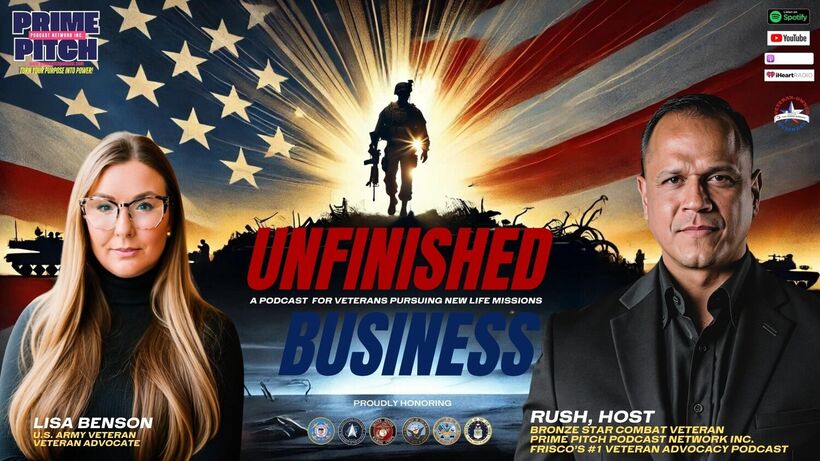
Lisa Benson
U.S. Army Veteran · Veteran Advocate
About the show
Unfinished Business is a podcast for veterans pursuing new missions after the uniform, and for the families and communities who stand beside them. Hosted by Eric Rush, The Conversation Architect, a Bronze Star combat veteran and the founder of Prime Pitch Podcast Network.
Read the full transcript
When veterans get out, they want to move a thousand miles an hour. They say, would you say comparisonitis? Like they want to catch up to speed to whatever someone else's family's doing. Is that a bad mistake? It's a bad mistake how you process it.
If you're using it as, okay, I see that Eric is doing this and I really like what he's doing. I'd love to reach out to him and find out how he got there. That's a good way to do it. Oh, Eric's out here and he just spends, you know, 20 minutes on a podcast and he's making millions because that's what we automatically think everybody's doing. And I I don't know his struggles.
I don't know what he did. I don't know anything. And I'm just like, I have to be him because he is making 1000000. we still shake. I'll find my stake my claim.
Cause heart is never the same. Unfinished business, I've got more to give. Hey, what's up guys? Welcome to Unfinished Business, a podcast for veterans pursuing new life missions. Lisa Benson isn't just another veteran turned entrepreneur.
She's proof that transformation doesn't follow a straight line. From becoming an army machine gunner to dominating the roller derby track, Lisa found her battling more than just opponents. She was facing PTSD, uncertainty, and the challenge of redefining her identity. But instead of staying stuck, she built DeBella DeBall Designs, a marketing powerhouse helping veterans and small business owners turn struggle into strategy and survival into success. So what does it really take to pivot, to rebuild, and own your next mission?
That's exactly what we're going to unpack today. And Lisa Benson, it's a pleasure to have you on the Unfinished Business Podcast, a podcast for pursuing new life missions. So I appreciate you talking to me. I'm so glad to be here. I've been watching you for a while, so I'm really excited to actually be part of it, not just part of the audience.
Yeah, and that's the thing. I always say that this podcast experience is open to everyone and anyone who is living a life with purpose, passion, and has a mission. And that that is one hundred percent what I actually that stuck out about me. Not only, you know, they say if you spot it, you got it. So to knowing that, knowing, knowing that you have been watching my podcast tells me that, well, maybe I should watch you a little bit now in return.
Right. Because if you got if you're you see what I'm putting out, what I say, if you see what you're putting out, you know, that kind of that saying, whatever it is, I get what you're putting down. I get what you're putting down, too, in the community and how you're helping veterans and helping yourself through the process as well. Yeah, what is that? Like begets like or something along those lines.
You gravitate to people who follow the same interests or have the same passion. Maybe not the same passion about the same thing, but the same passion level. You know, let's start off by talking a little bit about your military experience. We'll do a little abbreviated, a short version of your military experience and why you joined and that kind of thing. So my parents got divorced my senior year of high school, which led me to college, obviously.
I went to college and got that going, but then I realized I didn't have enough money for college. The 2 of them made too much money. They used both of their taxes in order to create what it was. So I joined pre911 for the college money. I was supposed to go to language institute.
They told me that it was going to be a 2year thing. I said, ah, no. What's the shortest job with the most amount of money? And that was actually a truck driver, which the truck driver turned into the machine gunner. When we deployed, no matter what you are, you're in the military.
So you got to do what you got to do to survive. And the young gentleman I was with were amazing humans but they weren't exactly timely and they didn't pay attention to the nuances and that's kind of what I love to pay attention to is the nuances. So I took over the machine gunning because I knew what headspace and timing was and I knew that meant that my weapon would fire. Yeah, you know, that's crazy because it is true when, you know, when they say, well, what MOS were you, right? It's like, well, which time, what, at what day, on what day did I wake up and build that, become an engineer and build my own foxhole?
On what day did I come out and become a sanitary, you know, whatever, right? Sanitary, kitchen, I don't remember all the MOSs, but what day was I what? Yeah, what day was I what, on which day when you're out in the theater, you know? facing the conflict that you face. You know, it takes a lot of courage to get through, to go through combat and have that happen upon your life.
Talk to me a little bit about how that, what that was like for you. So it didn't start out the best way. I experienced some difficulties when we were preparing to deploy. Another soldier took some advances that he shouldn't have on me, and we'll leave it there. You can assume what you need to, or you could DM me if you need to.
I use that as my fuel. I use that. And each day my brother had deployed, my husband had deployed. So there's a lot of things that I kind of knew if they could walk the walk, I could walk it alongside them. So anytime that I struggled while I was there, I was able to think about that.
Plus I had some friends that I'd had for years that were with me. So it wasn't, I wasn't with a new company. I was with a new company. We augmented another 3, 6,transportation unit, we augmented another unit, but there were 5 of us that went together. So I had my battle buddies, not just the battle buddies that I was given, I had my battle buddies.
Yeah, wow, I'm sorry to touch on that spot, but it's kind of one of those things wherefirst of all, I think anyone who suffers, any suffering is sacred. You know what I mean? It's like someone giving you a little vase and saying, hold on to this for me. Hold on to my story for me. And let me share a little piece of this, why this vase is so fragile, why this story isYou don't want to, you want to be gentle about it, right?
And be compassionate about it. So I'm sorry that you had went through that. Going through, and that also, like, I agree with you, because sometimes when you're in that space and something negative happened, like, for instance, like, I got in a fight with my mom the day I was getting deployed. Like, the moments of that, and that'll send you off on a different road if you allow it to. Yeah.
Absolutely, and we're going to get into a lot more of what that goes to, but I will say for me in that scenario and why I said if you have any issues, DM me, it took me a long time to own that space. It took me a long time to own that that had happened to me. I thought it was my problem, and it was. The aftermath is somewhat my problem, but I wasn't the one who asked for it. There was nothing that I did that warranted the situation.
It was just someone who was inebriated, who walked into a place that he wasn't supposed to be. Oh, my God. I'm sorry that you had to go through that. When you left the military, did you ever imagine yourself as a business owner or was that completely a foreign concept to you? That was a foreign concept.
I went and got my master's degree. I was going to take on the VA because I knew the VA was a broken system. We all know that. And that was right at the height of Walter Reed and going through and figuring out what was going on there. So I was going to fight the VA.
Well, I realized that you still have to be a member of the government in order to be able to fight the VA. So I opted to try to find some other ways to do it, but it took me a little bit to get there. And that's when I developed my own company that helps veterans not just survive post-service, but actually thrive post-service. So that was why I was like, I can't help them here, but I can help them in another way so they don't feel alone in a journey. and the name of your business is develop all designs and the reason for that is roller derby that because roller derby was a part of my healing journey i wanted to keep a piece of that with me so that i can honor that space that gave me that chance to heal which i'm going to get into which leads us into the exact question you turned a roller derby on during the difficult time how did physical movement and competition help you process your emotions in a way that traditional therapy couldn'tWell, traditional therapy was kind of, I wasn't ready to dig in.
And that's what it's kind of piece by piece by piece. But I was able to find strength in women, strong women around me who were struggling with their own identities, their own personalities and their own issues. And we kind of lifted each other up rather than the typical women environment, which is tear each other down. And it was a really, it was where I needed to be. My husband was still deploying on the regular, so it gave me a sense of strength and community.
And I have some of my best friends from that, that, I mean, I was talking to one on the way here. Wow, that's crazy. So what is, what is, okay, soHow many people are in a roller derby team when you're out on the floor? How does that work? There's 5 people out on the floor at one time for each team.
One's a jammer. That's the one if you look at and you see any advertisement, they've got the star on their head. And the pivot is the one with the stripe on their head. The pivot's kind of like, if we're going to compare it to football, theJammer is kind of like the running back. They got to run through and get all the points.
Where the pivot is kind of like the quarterback. They can run or they can stop. They got to do whatever they got to do. I loved it because I could hit people and it was okay. The mic picked that up.
So I can hit people. Some people, some harm. How about that? Yeah. It's funny because I've been skating since I was 3.
Actually, I started competing when I was 3, but I've been skating pretty much since diapers. You can legally hit somebody on roller derby. Yeah. That's interesting. the concept of that, the intensity, I'm sure, am I right or wrong?
But talk to me about the intensity, the kind of feel you get when you're navigating through the, you know. When you're going through the pack and whatnot. So for me, it's different echelons. When I first started, it was just a matter of getting comfortable hitting people, right? You're just like, oh, I can do this.
And because I had skated so long, I didn't even have to really hit anybody. I could outskate them until I got to the elite level. And that was, we were top 3 in the world for most of the time I skated with Texas. And it was just the mostFantastic feeling. It's like playing hockey or football or soccer where you just, every time you go out, it's an adrenaline rush.
Adrenaline rush after adrenaline rush. I am an adrenaline junkie, which is actually why I did well in the military and why I did well in roller derby. And it's also why I'm doing well in business because I'm able to just ride the high, win the low hits. Things happen. And we'll talk.
I'm sure we'll talk about that later. Yeah. You know, and you started your company. Am I right about this? Blending massage therapy and marketing?
Yes. So I was a massage therapist because I knew that the answer to healing a lot of stuff from deployment was not actually shots, vaccinations, medications, because in my mind, those led to more. uh more bigger issues because if you feel good because you took flexerol because your muscles are hurting you're going to take flexerol pretty regularly and that tends to build into addiction and other problems and i was like there's something more here i also came back from iraq with a big eczema score that ended up being like my full legs and most of my body due to the5th anthrax shot, I think it was. It was just all of a sudden I had it. So in my mind, there's some connections going on and I didn't necessarily make all that happen.
And again, I still wanted to help veterans. So I was doing massage for some people and thenI was marketing for Texas Roller Girls, helping them do a lot of their stuff, and everything just started connecting. And it was like, okay, well, I can use this under the LLC. I can use this under the guide. And then it just kept growing and building.
At first, I was just helping coaches out. And then one of my coaches that I was helping said, why don't you help the veterans? That's where your heart lies. And that's what got all of that going. But I It's justYou can't get business for massage or anything if you don't have any marketing to get you there.
Yeah, I was going to say, owning a business is hard enough, but the marketing aspect becomes one of the most integral parts of being successful in business, right? Would you agree with that? Yes. People think it's sales, but if you don't do the marketing and the branding properly, you're never going to get to the sales aspect. So it's a messaging thing.
Yeah. AndYou know, how you approach it, I know because I have somebody that I work with right now trying to help kind of navigate her career as far as branding-wise. So how much time does it normally take to get a business marketed the right way, would you say? Well, it depends on if they're running or if we're starting them up. So I have actually, ironically, I have 2 things called the 9 line.
One's a nine line for businesses starting up and one's for businesses that are in flow. It's actually harder to get somebody in flow to get their branding because in their mind, they've already talked about a lot of things that they really think that they need to talk about. and they're so busy talking to themselves they're not talking to their audience if they're stuck and if they're starting out you can spend a lot of time focusing in because you want to go deep on what you're doing you don't want to go wide and a lot of people in their mind if they go wide they can serve a lot of people but you become part of the noise you don't become part of the clarityGotcha. Gotcha. So yeah, I think you're right.
A lot of people just, you know, they've abandoned their audience for sure. Let's talk about career pivots. You know, a lot of people fear career pivots. What's a belief you had to unlearn about changing paths and how did that shift your perspective? The biggest thing was thinking failure was actually a bad thing.
And it's really not. We've all been there. He and I talked offline a little bit. Hitting rock bottom is actually the best place to be, even though it sucks. It is the platform for you to grow from.
You've learned what didn't work. You have an opportunity to see what does work. And you can just keep adding layer for layer for layer. And the biggest one besides failure is not what we think it is, is also going deep and not wide. Because you want to make sure that you're hitting what you want to do, serving who you want to serve, and being who you want to be before you spend timetrying to talk to thousands of people.
You don't just get to walk out and be a Tony Robbins. You have to spend time talking to your ideal audience and grow that ideal audience and then talk to the next audience and build the layers, build the staircase so it can sustain your growth, not weebly wobbly. Yeah. And you do talk, you work closely with veteran entrepreneurs, right? Yes.
What mistakes do you see veterans make when stepping into the business world? And what's a mindset shift that would help them succeed?1, we tend to have poor money mindset. We're our biggest detriment. We think we're going to make a million dollars tomorrow. I think a lot of entrepreneurs think that, but in general, we think it's going to be an instant success, and if I do X, Y, and Z, it's going to happen, and it's going to happen right, and I'm going to be a millionaire.
The biggest thing is getting them to understand it is X, Y, and Z, but there's X one, X 2, X three, and we have to get there, and it takes a little bit of time. And the other one is when we walk out of the military, nobody cares about your rank, and it'sI was a captain in the army. Well, yeah, you were a captain in the army, but you're not Captain Universe or Captain America. Not everybody knows what a captain in the army does. And if they look at cartoons, they think that that's a joke.
So we have to pivot their mindset, let them know that the money's coming, let them know that they have to put in the work. It's not as hard a work as they think it is, but they have to do step by step by step by step, and they're going to get the growth. Things you think that are immediate took somebody years to make. It took them the history of what they had to go through as well as all the work they've done to get to where they're at. Yeah, that's true.
Yeah, I think that I like the poor money mindset. It's like, yeah, I agree with that. What other things do you have another thing that youThey put the cart before the horse a lot. I mean, I think we do as society in general, and it doesn't matter where you are in the world, we do that. We see the immediate success that somebody has online.
We want to copy what they do. We don't want to create our own uniqueness. And then we didn't do the business paperwork we need to in order to support what we're doing. So we're out the money, out the taxes, and often something's trademarked and we didn't know it and we owe money for that too. So you just end up putting yourself backwards rather than, okay, this is what I want to do.
I'm going to do X, Y. Think of it likeSo if you're doing a nine line medevac, you have your steps you have to do. If you skip a step, can you rescue the person or can you get rescued? Yeah. Yeah.
You might be able to, but it's a lot harder to get there. Yeah, that's crazy. I do think it's like you got people ask me, how are you? So you got to earn your stripes. You got to turn on the camera at least and do something.
You know, you can't like I can't tell you how many times I've revamped this whole scenario. Well, how many times do you rerecord? Yeah. Well, I don't rerecord. I mean, not this stuff, but like your intros.
Yeah, yeah, yeah. Or I know that you do your promos and stuff. Yeah, takes and retakes. Yeah. A lot.
Sometimes a lot. I wish they would know that the stars did that, right? The movie takes sometimes years to make because of the retakes and the changing of what the expectation is. Give yourself some grace, would you say? Oh, I like that one.
Yeah, give yourself grace. Okay. Marketing is about human connection. You agree? Yes, absolutely.
Okay. Given your background, do you see marketing as more of a science, an art, or even something philosophical? I think it's more philosophical because actually I think it encounters both of the other things and there's a little bit more there. You have to have the data and the science to know it's working. You can't just go and expect it to get you 1000000.
It might, but the likelihood is not there. But you also have to be able tomake connections, there's an art to it because cut and dry and boring things just don't catch the eye. Like you're very vibrant, you're vivacious and you just you gravitate attention one when you're in person, but also on camera. I can't just say, hi, my name's Lisa Benson, unless that's my whole identity, right? So I think if you can encapsulate those and create the nuancesIt amplifies the human connection, and that's just, that's where the gold lies.
Which brings me to a point, you know, this is a podcast called Unfinished Business, a podcast for veterans pursuing new life missions. And in new life missions, do you think that, likeCreativity is one of the most important aspects of having a successful transition out of the military. Absolutely, because we think that we only have to do one pivot. And even when you're in business, you have to make pivots throughout the time while you're in business. So an example would be, for those of us who've been around long enough, there was YouTube, and that was about the only video that you had to do, right?
And maybe you take a little video live while you're on Facebook, et cetera. Short form video became huge. And you had to be able to pivot to gravitate to that so that people could Basically that sped up your know, like and trust factor. So your buying power or your selling power becomes amplified when you're able to do that. And that takes a lot of creativity, but also fluidity.
Fluidity is huge and that takes you from the data to the creativity and back to the data. But I think to be in business, creativity is key. And consistency? Oh, yes. Consistency, not complacency, because we know what complacency does.
Yeah, for sure. When self-doubt creeps in, because it usually does at some point, what's a question you ask yourself to keep moving forward? Is there a particular moment in your life when that mindset was tested? Yeah. The first time I had a hater on YouTube was that mindset was tested.
Am I in the right space? As you can see, I was born with small eyes, and that guy said I don't trust somebody with small eyes. So I responded. I have XYZ. I was born this way, but I was a machine gunner and served my country and did all these things.
What have you done for the world? So I use that as a tool, but as a whole, when self-doubt creeps in, it's usually when you're not getting the lead generation or the sales that you want. And I used to be like, oh, I'm just not good enough. And then one day I had somebody, it's actually a girl that I get on every morning and we do power hours. She's like, well, what's triggering that?
Well, I saw so-and-so get all of this. well why are you comparing yourself that's apples to oranges you're 2 totally different people so i usually look back and say what's triggering this is this something in my control or out of my control if it's in my control i can handle it i can either put it aside if it's me just comparisonitis or i can actually take some time and dig in to see what the bigger deal is and usually it's just it boils back down to comparisonitis for me yeah and theI don't know what somebody's journey is. We talked a little bit about our past journeys. I mean, I got out in oh nine and it took me to 18 to really get my business legs. So that's 9 years of this didn't work.
Let's add this. Okay, that didn't work. And just building a solid foundation so I can serve. And I think being able in adjusting and knowing that serving is at the base of what I want to do really can help when you're hit. Who do you want to serve?
How do you want to serve? And how are you making the world better because of what you're doing? Yeah. Yeah, that's awesome. Your why, right?
I see your why. Yeah, that's insane. You know, it's like anybody who wastes that negative energy for no reason. It's not necessary. You know, it's like, what purpose does it fulfill for anybody to go down that road with anybody for that matter?
I was thinking about, like, when adversity hits, like, oh, yeah, that people want to, you know, people, when veterans get out, they want to move a thousand miles an hour. They say, what did you say, comparisonitis? Like, they want to catch up to speed to whatever someone else's family is doing. Is that a bad mistake? Yes.
It's a bad mistake how you process it. If you're using it as, okay, I see that Eric is doing this and I really like what he's doing. I'd love to reach out to him and find out how he got there. That's a good way to do it. Oh, Eric's out here and he just spends, you know, 20 minutes on a podcast and he's making millions because that's what we automatically think everybody's doing.
And I I don't know his struggles. I don't know what he did. I don't know anything. And I'm just like, I have to be him because he is making 1000000. Now, if that's what feeds your soul, you should talk to the people that you want to emulate.
You should talk. I think there's enough space in the world that we shouldn't worry about comparisonitis. There's enough space in the world where I can talk to you about what you do. We can talk about how we have likes and how we have dislikes and growth. And there's enough space for all of us to do what we love.
Instead of being like, I have to shut that person down or I have to be better than in order to stop. We can compete, but not be competitors, if that makes any sense at all. Yeah, it does. It does make sense because you don't you know, you want to be a competition with yourself. The first step you got to take is put yourself in front of a camera to say, and if you can't even do that, we're not we're not in the same, you know.
that's the one difference between me and someone else who's like that's the podcaster well it's like or you know wants to be a podcast like put yourself in front of a camera because that's what i'm doing you know and the first thousand takes might not be the right takes but yeah one thousand and one might be yeah that's funny because i do have a video of me like having this guy's last name was just some weird last name and i just kept stumbling over his last name over and then iIt was just me and the camera, and I was walking off the cameras, and you could hear me just going off on myself because I couldn't get the name right. I had that with saying entrepreneur when I was doing a podcast. I couldn't say it to save my life, and I had it like 5 different times, and it was a different way every time. And I was like, why is this word the word? Yeah, yeah.
Lisa, talk about your business. Talk about what you do, your company. Oh, I love it. This is the topic I love. Now, I love being able to serve those who want to serve others, whether I help them start their business.
I do minimal business coaching. My goal is to help people that are two hundred fifty thousand and below because they're the people that need help and they're often the people that are hungry to learn.250 to 500. They're growing their legs. If you don't say something they like, theyeither you don't know what you're talking about, or they just, they're not gonna follow it. And I know I'm classifying them too, there are the people that do, but the reason I love helping military people is if you give them a roadmap, and a lot of small businesses, you give them a roadmap, like my 9 line mission start, and you just, they go layer by layer from, hey, this is how you fill out your LLC.
This is why you choose an LLC over, and then you just take them layer by layer, they love it. I've got a friend who just started an embroidery business and she's going through it.1, because another review is always a good thing. But 2, test the waters and see if it really is working or if people are floating your boat. And I love helping them start learning and honing in on their message because your mission is often your mess, which then you make your mission and then your message. So when you're looking at businesses, you look at them to see what's going on.
Is it their marketing message? Is it their sales process? Or is it their overall systems and processes? And we offer some help as far as that's concerned. We use High Level, which is an awesome platform.
If you don't know it, I can tell you more about it. It's a great way to create some automations and follow-ups so you can do a lot more with less. And then we put them into our ClickUp. and we actually build out their business in ClickUp and we have both of the systems talk. So you can take a team that's usually struggling to keep their hours to 40 hours.
We serve 25 clients right now and there's 2 of us that serve the 25 clients and that's because we have systems and processes in place, we audit them regularly and we go in and we adjust things and we get people into the space that they need to be successful. So it could be 5 people's worth of work. We got it down to 2. We both work 40 hours a week or less. And it just really hones in.
And I just, I love being able to help. There's just, I don't know how to explain the feel when you take somebody from that struggleto feeling like they've got legs. And that's gonna evolve throughout business, you already know that. Some days the struggle bus hits hard. And some days it's just like, okay, I'm on a cruise ship and I'm enjoying life.
What's your website? DeBellaDeBall. com, pretty much anywhere on social media if you look up DeBella DeBall or DeBella DeBall Designs, that is me. Like I said, that was my roller derby name, so you'll see some roller derby stuff in there, but you'll also see me. And it's really, I love being able to help.
So even if you have questions, and you don't necessarily want to bring us on, hire us, or anything like that, you just have some questions to ask,about your marketing, about your mission, about anything, I'm available. And I'd love to be able to spend half an hour with you to just get some clarity and see what works for you. Okay, a couple more questions and we'll wrap it up. first of all, the spelling of the description, the spelling of DiBella DiBall will be on the description. So just to make sure y'all know that.
A couple more questions before we wrap up, okay? The version of Lisa Benson who left the military could see you now. What do you think she would say? And more importantly, what would you say to her? What she would say is, how the heck did you get to there?
Because of what my intent was, you know, fight the VA and things like that. But what I would say to her is it gets better. Every day is a new step, is a new challenge, but enjoy the challenge becauseAs we know, and you all know, 22 a day is too many.22 a day leaving this world because of stuff that they experience in the military and that they can't deal with is too many. If you can be that help, you can be that hand, you are a blessing, and it's a blessing that you're here. I love the fact that you're educating veterans on how to embrace marketing strategies and helping their transition to be more smooth business owners and just making their owning business a little bit smoother for them, the processes, setting their processes in place for them to be successful and be able to breathe in between theirin between the struggle.
So that's accolades for you. I always do this for every one of my guests. I always say, is there a particular shout out to someone you want to give a shout out to that you really appreciate their work or someone that needs some encouragement out there? The floor is yours. Well, I've got 3 people.1, you, because I think what you're doing is excellent for veterans.
And you're giving people a place to express where they were and a good place to tell you how they've transitioned from the struggle to finding flow.2 would be my husband, because he puts up with me. And 3, my best friend, you'll see she's actually starting her business. I'm the godmother of both of her kids. She is a mom of a special needs child, and she decided she's going to start her business. That's her name?
Quintina Browder. Oh, I was going to get there. You'll see her. She is doing excellent things, and for her to be able to manage that while managingsome of the things that our special needs son needs is just absolutely fantastic. And when I was struggling, when my husband was deployed and in Korea and things like that, she was my go-to, she was my battle.
In fact, those of us that know, I think it was Fort Campbell, they had the one brigade called Balls Deep. I think it was artillery. We actually developed one of her campaigns. She's doing embroidery for softballs, baseballs, and things like that up in Bastrop in the Elgin area. And she has one campaign that's called Balls Deep.
And I think that's hysterical. And that's an homage to my husband and I. So it's likethose of us who know it love it kind of thing and those of us those that don't know it they just don't understand it and that's okay but she has found she's been a guiding light for me we go we vacation we do a lot of things together and knowing that i've got her in my corner and i'm in hers we got each other back it's nice to know someone's got your 6 not just your family and those kind of people but your chosen family not the one you were givenYeah, that's awesome. Thank you for doing that. Okay, last thing I always say, message to the veterans out there, as a veteran yourself, what would you like to share?
What would you like to say? You're worth it. You're worth it. You're meant to be here if you need help. Call anybody.
You can call me. My phone number is on my website. You can call me. I might not have the answers for you, but if you just need somebody to talk to so that you feel worth it, I am here. Every suffering is sacred.
And I hold it like I would want someone to hold my story. So it would be an honor to get more into that in another podcast. Absolutely. We can definitely do that. Let's do it.
Part of the healing journey. Let's do it. We'll get you on the rush out respect of a Mastering the Art of Living podcast where you can take this story and you can flip it into how you've mastered getting married and that kind of thing. We'll go down that journey too, okay? Absolutely.
All right, guys. That's it for Unfinished Business, a podcast for veterans pursuing new life missions. As I always say, have peace and enlighten you and remember that the ocean refuses no river. We rise, we fall, but we don't break In the silence, we still shake I'll find my way, I'll stake my claim Cause a warrior's heart is never the same Unfinished business, I got more to give Been through hell, but I'll stay