Lew Duckwall
Lew Duckwall joins Rush on Unfinished Business, the show for veterans pursuing new missions after the uniform and the people who stand beside them. As founder, North Texas Patriot Anglers · U.S. Marine, Lew brings building something meaningful to the table.
They get into the work, the cost, and the reasons it still matters, in the kind of long-form conversation this show was built for.
In this conversation
- Building an organization with a mission
- What experience teaches about leadership
- Turning purpose into work that lasts
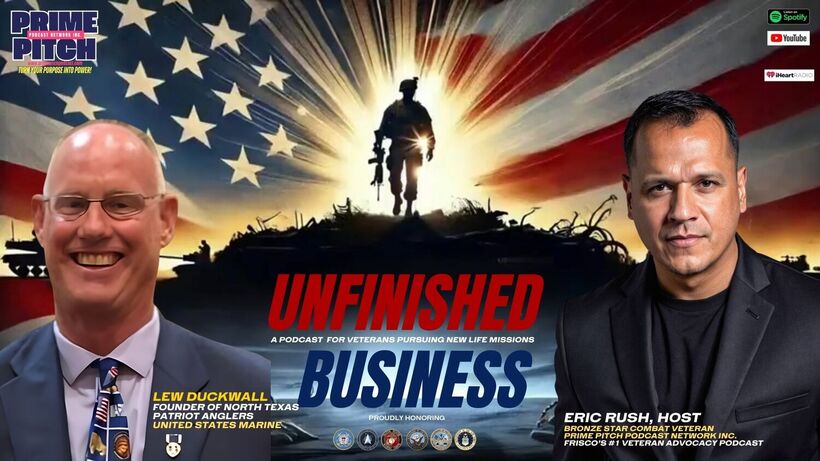
Lew Duckwall
Founder, North Texas Patriot Anglers · U.S. Marine
About the show
Unfinished Business is a podcast for veterans pursuing new missions after the uniform, and for the families and communities who stand beside them. Hosted by Eric Rush, The Conversation Architect, a Bronze Star combat veteran and the founder of Prime Pitch Podcast Network.
Read the full transcript
I don't want to go through another veteran suicide. And, uh, we did just recently. I found out about it 2 days ago, and it's justA- a- and when that happens, you think, "Man, if I just had him to the, to the program one more time, or if I just called him one more time," and you know. So that's, that's what, that's what the ins- inspiration is for me. Yeah.
Um, that trip to Idaho wasn't just a fishing trip. What did you feel standing in the water that you hadn't felt in years? Well, uh, uh, you know, it's funny because I hadThat morning that I was supposed to get on the airplane, I probablyGoing to DFW Airport, I probably turned around 3 times 'cause I wasn't gonna go. Mm. And I finally got to the airport and went, and when I got there, everything they did, it was Heavenly Father.
I m- uh, uh, most importantly, they put me with a fella who was a fantastic fisherman. He was a Christian, which is probably most important. He, uh, was not a veteran, not a combat veteran, but he had lost people that were close to him in a work accident. But most important for that time in my life, he was probably 2 inches taller than me, and he had shoulders you could land a 747 on. So here I am in the presence of someone that all of a sudden I wasn't gonna bully, no matter how big I was.
So I just kinda had to swallow my pride, shut up.1, 2.3, 4. Business. Hey, what's up guys? Welcome to Unfinished Business, a podcast for veterans pursuing new life missions. Some lives are hard to introduce because a story carries more weight than a few simple words can hold.
Lou Duckworth was raised in upstate New York in a home where survival was part of everyday life. Long before he became a United States Marine, long before he earned his r- his place among men who know how to operate under pressure, he carried the wound of being sexually abused as a child. That kind of pain doesn't leave just because a man gets older. It follows him into how he trusts, how he reacts, how he protects himself, and how he survives. The United States Marine Corps gave Lou structure, discipline, and a place to put the intensity he had been carrying for years.
Years l- y- later, after, later after loss, severe injury, and a hard return home, Lou found himself carrying anger, isolation, a kind of pain that simply couldn't keep, he couldn't keep outside his home. Then came a fly fishing trip to Idaho. Standing in the water, something cut through the noise. It brought him back to a part of himself he thought life had taken from him. Today he isToday, as the founder of North Texas Patriot Anglers, Lou has turned that experience into a mission for veterans and first responders who are still carrying the fight inside them.
That's why this story belongs on Unfinished Business, a podcast for veterans pursuing new life missions, because this show is about the men and women who are still answering the ques- who, who are still looking for, looking to answer the question of what comes next. Lou's answer became a mission, a community, and a way back for others. Lou, it's a pleasure to have you on Unfinished Business, a podcast for veterans pursuing new life missions. Uh, so, so, I'm so grateful for you to be here today. I'm grateful.
I'm grateful for the invite, thank you. Absolutely. Let me ask you a question. When, when I was reading this, this, this cold opening, what were your thoughts going through your mind as I was, as I was reading that? Uh, the thoughts were, first of all, the last name is Duckwall.
Duckwall. But everyone gets it wrong. My bad. A- and the other thing is, is, um, what happened when I was a young, young boy in upstate New York with the sexual assault really dictated my life. Uh, in many ways it dictated it negatively, but then I learned to turn it into a positive and th- we have Patriot Anglers now.
That's awesome. Um, when you think about, when you think back to growing up in upstate New York, what did survival actually look like in your house day to day? Well, uh, uh, we just didn't have a whole lot of money, and there were difficulties. A- a- and I had the greatest mom in the world, and at times I had the greatest dad in the world. Unfortunately, sometimes Dad would be one of 2 different people, and if the angry dad was home, it was just not a pleasant place to be.
Uh, I learned a lot from watching my mother. We had no money, and the things my mother could do with nothing and still make life comfortable for her 4 children and her husband, uh, it still sits with me today and I'm ju- uh, it's just remarkable to me what she did for me. And, and really, there are some great things I got from my dad, but the leadership under pressure I learned from my mother. She doesn't even know it. She's, she's very quiet at times and kind of sits in the background, but just watching her handle stuff the way she did was a great lesson in humility and in leadership for the rest of my life.
That's amazing, you know? Like, uh, like you, like you, well, I grew up in a singl- I mean, I grew up in a single parent home, but the pressure of having to sup- to support 2 children and what she could do with the, the, the, theShe had to work 3 jobs, but it was like what she could do with that, with so little. Um, sometimes we, uhDo you believe that sometimes, like, we don't need everything in the world to be happy, we just needW- what do we, what do you think we need most? Um, I think we need love. I think that's the most important thing we need.
I will tell you that although I wished for the nicer things, you know, as a kid, as a 65-year-old man right now, I am grateful that I grew up in the, the way I did. I'm grateful I grew up with the family I did, with the siblings I did. It was kind of a Huck Finn, uh, way to grow up. We were outside all the time, and it was just incredible. So learning to live without the better things makes me appreciate everything I have today.
That's, that's, that's awesome. Um-What did hunting and fishing mean to you back then w- before anything in your life became complicated? Well, it meant a great fun for me. I mean, there was hunting and fishing. There was also, the way I made my money, the way I supported myself, bought school clothes and stuff like that, was I trapped animals.
I trapped beaver and muskrats and stuff like that. And that to this day, even though we have a great fly fishing platform, that's still my favorite thing to do outdoors. But, uh, but hunting and fishing also put food on our table. I mean, it wa- it wasn't just the enjoyment value. If we went out, we, we expected to bring something back, 'cause that went right into our, either right on the 0 stove or in the oven or in the freezer at the very least.
Wow. That's, um, that's such a unique way to be raised, you know, and, and knowing that you gotta go, um, go chase your, chase your dinner sometimes, right? Like, uh, w- when you look back at it and you compare it, compare and contrast to maybe how you raise your children today, I don't know if they do the same, but h- h- how do you see the, how do you see the, how that helped you? Well, um, w- I didn't raise my children like that. I wasn't in an area where I could hunt, and, and when I did, I lived in Montana for a while.
I was trying to survive, raise the children. I was a single dad up there, and I was working two and three jobs. I was like, just like your mom. So I didn't even have the time to hunt or fish. Hmm.
So my children, unfortunately, uh, well, all but my oldest. My oldest still lives in Montana with her family and, and she's a, she's a hunter. She, she gets outdoors and she's a tough girl. Really? I'm very proud of her.
Uh, but, uh, the rest of them think all of, uh, you know, uh, have experienced all the food coming from H-E-B or Kroger's or somewhere like that. Wow. That's, that's, uh, that's amazing. Um, you know, your daughter, what, what's her name? What's your daugh- Beth.
All right. Well, shout out to Beth-for having these, uh, these, uh, alf- alpha, I don't know, hunting skills, whatever you, whatever you would call them. Um, you've spoken about what happened to you as a kid. Um, what did keeping that to yourself duty do, do to you in ways people couldn't understand? It built fire in me, and it made me very angry.
I think it's what made me decent in athletics, so I was so angry all the time. I, I, I, it compensated for my lack of talent. Uh, when I went in the Marine Corps, I just wouldn't let anything get in the way. I, I, you know, whether it was boot camp or going through different schools, um, you know, like, it was almost as if they wanted you to fail, see if you can make it, and I would just, I would just hunker down and make it through it. Same thing in Air National Guard when I fought wildfires in Montana, everything.
I just, it, it just built a toughness in me, um, that I don't think I would've had otherwise, and I'm very grateful for that s- because most men who survive childhood sexual trauma either go that way or the, there are only 3 ways. They become a bully, and they just live a life of violence, absolute violence. And at times in the military I did, but I mean just become the bully on the block. Or they become very timid and very withdrawn, and they, uh, their skills go unused. They, you know, they have no confidence to do anything for the rest of their life.
Yeah, I could see how that could be. It's that some people, they say hurt people hurt people sometimes and, but not all the time, right? Right. Yeah, so that, that would make sense. Um, that's, that's, um, that, that is like one of the things too is, is it could have gone a different direction, but what partUh, let me ask you this before.
Um, uh, before the Marines, what did anger feel like inside your body? It just boil. Just, just, j- just like a boiling pot on the stove. And I was very adverse- or I, I w- very common for me to just blow up at things that, it was silly looking back on it. Um, losing a softball game.
Uh, even as an 18, 19-year-old, losing a softball game, throwing my glove, throwing my bat wasBecause I thought it was, I thought it identified me as a weak individual. I thought it identified me. Uh, another thing when you go through something like that, or at least this was the experience I had, is you feel like there's a, a, a scarlet letter on you somewhere that identifies you to everyone, that this is what this person went through and this is what, what, uh, and, and you carry that, and it's like an anchor the rest of your life until you learn to accept what happened, that it didn't ha- you know, it wasn't gonna happen again and, and you found a way to make it, make your life better because of it. How did the, how did the Marine Corps, like, just take that and, and how did you, uh, how did the Marine Corps r- help you with that? Well, it was a place for my anger to go.
Uh, you were expected to be angry, you're expected to be tough, you're expected to, um, work hard. I was infantry and so, um, by the end of the day, um, even as a young man, I did the same silly things that all young men do, you know, carry a, a, a case of beer up to the t- third or 4th floor or whatever, barracks you were in and such. But, you know, you were tired a- and there were accomplishments it seems like every day. You, youA- and the camarading, uh, camaraderie was awesome, man. So.
And the leadership, um, um, having different type of leadership, the, the, the NCOs or whoever, the, the guys that were in charge of you, how, how did they shape how you saw, um, uh, you as a man? Well, they were incredible. They were my heroes. I mean, when I first went into the Marine Corps, my drill instructors, my instructors at, uh, uh, infantry combat school were all, for the most part, were Vietnam veterans. Mm.
A- and they were just heroes to me. I grew, I grew up during the Vietnam War, War. I remember it. A- and these men were absolute heroes to me. So, uh, you know, they were a little rough around the edges, needless to say, but, um, they transformed me into, uhI wanted to be like them.
I wanted other people to respect me the way I respected them. That's beautiful. Um, earning the Hawg's Tooth isn't accidental. What part of, um, what part of you made that possible? And could you explain, uh, for the audience what a, the Hawg- Hawg's Tooth is?
Well, Hawg's Tooth is what you earn when you become a Marine Corps scout sniper. And, uh, I, I go back. Uh, uh, my dad taught me. It was, it was a combination of my mom and my dad. My dad taught me.
My dad was a great outdoors man. He was incredible. He was just, he was just good at everything he did. He had this intellect that was, uh, uh, above board, and, and you would watch him. And he had no military experience, but you would watch, watch him stalk animals in the, uh, in, in the, um, wild and everything.
He was just incredible. So I had some of that in me already before I ever went to school. But when things got tough and you thought, "Hmm, maybe I can't do this," I would reflect back on my mother, and I know there were times when sheI, I know she cried herself to sleep at night wondering how am I gonna take care of this husband and these 4 children with the things I don't have. And yet she always did it. And so I thought if my mom could do it, I could do it.
Wow. You know, the, um, the topic of Mom keeps coming up, resurfacing, you know, and I have to ask you, like, like, you know, in a family dynamic, I know we're gonna take a little detour here, but in a family dynamic, how important is, how important is a, a strong mom? I think it's everything. I, I think it'sI think a strong father is, is, is incredibly valuable, but a s- I think a strong mother and her nurturing instincts. I will tell you everything I have right now, and the family I have, and even Patriot Anglers is because of my, my second wife.
The woman I'm married to now- Mmis a very, very strong woman. And when I was acting out, and I was blaming everyone, I was getting into fights, and I was doing the wrong thing, she finally told me, uh, one day, uh, "You either n- need to go away or get help, or you just need to go away. I'm always gonna love you, but I can't live with you right now."And, you know, she's half my size, but she was not intimidated by me, and it helped shape me into the person I am now. And I think all my siblings are very, very, uh, successful, and, uh, I would say my father had a lot to do with it, but the, the strength comes from my mother. Yeah.
It really does. Yeah. It's beautiful, man. I, I, I think that's so important, too. Like, you know, we were talking off camera about, you know, being rai- you know, how I was raised with my mom and the, and her, this toughness she had to have to, to raise 2 boys and, and, and, and it makes us, like, as men, understa- have understand as, uh, understanding our spouse's role as well, right?
Like how to see it, and I see that, too, 'cause I'm blessed with a beautiful wife and who cares for me and, and has to deal with some things, too, you know. Um, whatever I work through and, and, and her being strong enough to, to s- have that staying, stick-to-it-iveness and staying power in that, in those times of, in those moments and ha- being nurturing is so, so, so important. Um, w- at what point did th- what point, at what point did that same part of you stop being enough? Like when you, yeah, what? Well, I went out of the, my military career, got out of active duty, uh, in the mid-'90s.
Um, uh, wanted to pursue something else. And to be honest with you, this is not a political statement, I just didn't wanna serve under the Clinton administration. There were draw downs and everything after Desert Storm, and, you know, the money wasn't there for training. And so I got out. Uh, the, the wife I was married to at the time, at the time, we took our 3 children and moved to Montana where she was from, and I took up, uh, I was in the logging business, I was in lumber, uh, did some wild land fire fighting.
But I started to miss the military. So I, I, I ended up, I did a couple different things, but the only thing open for me was an Air National Guard unit, and I got into combat engineers. I had, I had operated heavy machinery as a civilian, and absolutely loved it. We went over to, uh, uh, the Middle East in 2002, and, uh, when theWe were a construction company, and there was a really bad accident. I was wounded severely.
Came home, um, couldn't do the things a man, um, uh, in his early 40s was supposed to. At times couldn't feed myself. I had, uh, I had passed away twice. I had, uh, some, um, I had a spinal cord injury, um, some paralysis, um, couldn't do the bodily functions. Like I needed help with everything, and I just felt like I wasn't a man anymore.
Right. I just really hit rock bottom. Hmm. And what happened for me was it took me back to that incident, um, to where I felt weak and vulnerable again. I couldn't protect my wife and children that were in my home, and that, that very much destroyed me.
Hmm. You know, I recently had a guy, uh, just, uh, this past weekend, had a guy who was, um, um, who fit, athletic, had every- He's a d- doctor of chiropractic. Um, and, um, uh, bacteria got on his leg. He didn't know how he even got it, but all of a sudden it ate his leg, ate his leg away. And in, in that, in that conversation we talked about surrender.
And he said, "Well, what, what was it? What, well, you know, what"He, he said it was, it was surrender. How, how much, how much has surrender played a role in your life right now? I, I think it's everything. I think it's where I am, um, on the fir- It's the first week in May of 2026.
Um, I am where I am now, I have the family I have now, uh, the program is, uh, is as successful as it is now because I had to realize that it didn't matter if I was in, had been in the Marine Corps, it didn't matter how much weight I could bench, how fast I could run a couple miles. I just had to let air out of my ego and say, "Heavenly Father, what do you want me to do?"And a lot of it was my wife. I mean, I am deeply in love with my wife. She is everything to me. And when she told me to get out, I guess I was old enough and mature enough, even as immature as I was acting at times, but that resonated with me.
I didn't wanna lose her becauseA- and it wasn't just losing her. If I lost her, I lost the 4 children that were in the house at the time, and I didn't wanna lose them either. Hmm. So y- for me, I had to, I had to raise my hands up and say, "Okay, let's, let's, let's begin this healing process. Let's, let's start to help.
Let's get some help."That's beautiful. Um, yeah, that's, uh, that was a, a poignant moment when the conversationAnd, and I remember him saying it was me versus me, you know, the battle of me versus me, and I had to, I had to surrender, you know? Yeah. I think that's a great way to put it. You don't realize it, but you're hitting your own head against the wall.
It makes no sense, but i- you're just so angry, so despondent. You know, I, I couldn't lead men anymore. W- what good was I, you know? Yeah. I couldn't ma- I couldn't, I wasn't making a paycheck.
I just felt very, very low. Yeah. Um, you've lost friends. You've seen death up close, and when your bodyAnd then your body was, was taken from you in, in that accident. Um, which of those moments actually changed you the most?
I would say it's a combination. I would say that when you lose friends in the military, especially in a combat type situation, that sits with you, that resonates with you for the rest of your life. But when I was wounded and I had to come back from that, and then the friends that I've lost to suicide are the ones that have really shaped me, have really made me determined to grow a program. And before I go any further, it's not my program and I'm not the sole success. I think I have the greatest group of volunteers in the world, and they're fantastic.
And, uh, this program has been built on their backs as much as mine, but that's why I want this program to succeed. I don't want to go through another veteran suicide. And, uh, we did just recently. I found out about it 2 days ago, and it's justA- a- and when it happens, you think, "Man, if I just had him to the, to the program one more time, or if I just called him one more time," and you know. So that's, that's what, that's what the ins- inspiration is for me.
Yeah. Um, that trip to Idaho wasn't just a fishing trip. What did you feel standing in the water that you hadn't felt in years? Well, uh, uh, you know, it's funny because I hadThat morning that I was supposed to get on the airplane, I probablyGoing to DFW Airport, I probably turned around 3 times 'cause I wasn't gonna go. Hmm.
And I finally got to the airport and went, and when I got there, everything they did, i- it was Heavenly Father. I m- uh, uh, most importantly, they put me with a fella who was a fantastic fisherman. He was a Christian, which is probably most important. He, uh, was not a veteran, not a combat veteran, but he had lost people that were close to him in a work accident. But most important for that time in my life, he was probably 2 inches taller than me, and he had shoulders you could land a 747 on.
So here I am in the presence of someone that all of a sudden I wasn't gonna bully, no matter how big I was. So I just kinda had to swallow my pride, shut up, and listen to him for a week a- and it was incredible. And I learned that because of my physical limitations, I was never gonna be as good at fly fishing as I once was, but I still enjoyed it as much. And just being out in the wilderness and feeling that water rush past, it, it was, it was therapeutic and it was freeing all at the same time. And it was like, "This is what I wanna do for the rest of my life."You know, when, uh, uh, Drew, our, our mutual, uh, friend, uh, Drew Carlton, uh, CEO of Mesa Springs Mental Health Clinic in, in Fort Worth, um, um, reached out to me.
He said, "Hey, I got this guy. He's a world-class dude. Would you, would you, would you like to ha- w- would you mind having him on the podcast?"And I said, "Y- well, yeah."I mean, any friend of Drew's is a friend of mine. Yeah. Uh, he's a world-class guy.
And I said, you know, "Of course I would," you know, and no questions asked. But as I delve- delved into your story, as I dug into your story, the heart of who you were, um, uh, res- resonated even more. And I was like, "Well, there you go," you know? It's like, it's, you know, it's like the math is math and when, when you have people who are, who are walking in the same faith with you, you know? And- Yeahum, um, talk, let's talk aboutLet's switch gears and talk about North Texas Patriot Anglers.
Tell, tell everybody what it is, um, uh, how the, how, how you, which, what system you have in place for it and all that kind of good stuff. North Texas Patriot Anglers is a 501 [3] nonprofit. We're vetted by the federal government. Um, we started in 2013. This month, in about 10 days, we will go over, we will be at our 13-year mark.
We started off with another fly fishing group, but it just got to be too political for me and started talking to some of my, my, um, my more, uh, stablenot stable, but they were ha- my volunteers have been with me for, for a little bit. And we all agreed. I mean, y- you know, this is Texas. We can raise our own money and we can do this as good or better than they could. And so we just, we just wanted to do North Texas, Southern Oklahoma.
That's where it started. And so we started, and we, we mostly have been going to Broken Bow. We've done 180 trips to Broken Bow over the last 13 years. Um, we also have a group, uh, in East Texas, about 40 miles southeast of, uh, Greenville, and that's all warm water species, bass, crappie, the whole thing. We, we have been to and will continue going to New Mexico, Colorado, Arkansas.
Uh, we have a, a satellite unit in Utah. I absolutely love Utah, and we have a group up there. One of my best friends moved up there. And, um, you know, it's just, uh, go to our website, uh, patriotanglers. org, and there's a place on there how to get involved.
And, and all the emails come directly to me, and I, I answer them. I call everybody and see what their interest level is, see what their schedule is. We do about 20 outings a year. Um, w- in the lastThree years we've opened it up to, um, law enforcement, firefighters, all our first responders, the people that take care of us on a daily basis. And then after, uh, COVID, my wife is a RN, and she did the COVID response.
Hmm. She did New York City, Baltimore, all that. And, and I saw what that kind of work did to people, so we opened it up to frontline COVID workers too. So, uh, we are, we are busier than ever and, um, you know, we do have a, a female portion of the program. Females are allowed, like we have, like say back in December I think it was, we had a group from the Fort Worth Police Department.
Hmm. And they did bring I think 2 female officers. So if females are comfortable coming with the men and, and hanging out with them and, uh, dealing with their silliness-then of course they're allowed to. But we also do female, um, only- Hmmoutings, so if the problem is, um, military sexual trauma- Hmmthen they don't have to th- feel threatened then. Because if they come in there and they're worried to begin with, then they have no chance of relaxing.
There's no way this is gonna be a healing environment for them, and that's what we want it to be is a healing environment. Yeah. That's, that's amazing. That, that's like you're covering all your, all your tracks. Is it a day, is it a day trip or is it a overnight?
Is it camping orWe do both. Um, we, uh, the majority of it is either 3 or 4 nights. Um, we pay for everything. Uh, the transportation not so much, especially m- since most of our people are from Dallas-Fort Worth, going to Broken Bow is i- between a two and a half and three and a half hour trip. Yeah.
Uh, we ask them to carpool and, and if they'll pay for the gas. All that being said, if we have someone that says, "Hey, I, I can't make it because I can't afford the gas," we'll fill up their tank and we'll go ahead and, and, and pay for the gas and stuff, 'cause we don't want anyone to n- to not, uh, experience a healing time because of finances. Um, but um, you say camp, a- and that's a reaction I get from most of the"You know, uh, Lou, I'd love to go fishing, but I don't wanna sleep in a tent. I don't wanna sleep in a sleeping bag."We don't do that. Okay.
Uh, we, we rent some really incredible cabins. Yeah. Um, everyone gets their own bed. Um, most of them, in fact I would say all of them now, have hot tubs. Um, there's usually between three and five TVs so they canA- and it's just incredible.
Yeah, we've, we, we take care of them. Wow, that sounds, that soundsIt's not glamping, it's, it's camping. No, it's still, it's a, a cross between, right? Yeah, unglamping. Wow.
All right. And they, and they eat good too. I mean, that's something we're known for. Uh, I have a couple volunteers and myself that have done the majority of the camping. Or, I'm sorry, the majority of the cooking.
But now lately we've had volunteers come in. In fact, uh, in January my, uhJanuary? February, my older sister and her husband came up from Georgetown, spent, uh, spent the 3 days with us and, and cooked every meal, and it was incredible. It was awesome. That's awesome.
It sounds soI'm already hungry, yeah. What, uh, I was gonna ask you, what do you th-Then I'm gonna revert back, go back to this, um, to this question I had for you. Um, um, the trip to the Idaho, um, when did you realize that experience w- wasn't just for you? On the plane ride home. I was just sitting there and I just started crying and, uh, got, got emotional.
It was like'Cause like I said, I had passed away twice after theAnd I spentWell, I was wounded in 2002, so I spent, had spent almost 10 years wondering what value was I, what was I supposed to do? How could I be, have value as a man, as, a- as heavenly father, son, the whole thing. And then I looked at it and it's like, I have a wife who, who makes a really good salary, and she's a 25-year military veteran too. So she- She, she gets it. Yeah.
And she went to Afghanistan twice and Iraq once, so she gets all this. And, um, I just thought, now I know why, uh, now I know why, uh, I, I, I survived and I, I'm living, is I'm supposed to do this in Texas. Mm. I'm supposed to start a program, and I'm supposed to figure out a way. I, I had never been a businessman.
I had no idea how I was gonna raise the money or anything, but it's all worked out. And I justAnd, and once I s- Because when you are healing, you really don't understand it and you don't see it, but when you see it in others, it's just the most incr- in- incredible experience. And to know that you are a part of that, of that recipe for that to happen- Mmjust, just invigorates you to where you just wanna do more and help more people. Yeah. That's, um, that is so true.
You know, I'm, I say I'm, I'm relatively new into the, uh, veteran advocacy space. Like, like learning about all the advoc- all the different l- layers of advocacy. Uh, y- you know, fishing, fly-fishing. Um, I just got done doing something at, uh, Adaptive Training Foundation with- Incredible people there. Yeah.
Incredible. Yeah. It was, uh, it was, umYeah, it was amazing. I just finished it last week, a whole training program, a whole week long. It was with other individuals that were adaptive athletes and, uh, and, uh, that was an experience for me.
Understanding, um, the layers of advocacy has been such a, umIt's like opening a array of, uh, you know, of re- That's the thing isAnd, and that's what I w- uh, that's whatOne of the things I like to say is, you know, veterans, once they get out of the military, our veterans throughout history have just been some of the most unique individuals. You know, the World War II vets and the Korean vets, they came back to a country that had been, before the wars, had been dealing with, um, um, the Great Depression and stuff like that, and they, they rebuild, they rebuild America. They rebuilt the middle class. Mm. Uh, our Vietnam veterans, probably no group of veterans have been treated as poorly, and they came back, and they came back to an incredibly broken VA system.
Mm. A- and they said, "No more. No other group of war fighters is going to come back to this garbage, and we're gonna make s- we're gonna see if we can't elevate it, make it better."A- and then our generation of warriors, we came back and we figured out that, y- you know, we complain a lot about the VA, but they do some really good stuff. Mm. But they just can't do everything.
Yeah. So if we really wanna heal, it's our responsibility to find ways to heal ourselves. And oh, by the way, let's be unselfish about it, and if we're gonna heal ourselves, let's take some friends with us. That's how I started. I took 3 inner city, um, Dallas soldiers with me on the first outing, uh, that I had been going through a PTSD group in, at the Dallas VA.
Had no idea what I was doing. HadA- and it just worked. It just worked. And, you know, a- and one of the guys, if you've been to Broken Bow, you know where the dam is. So we're, we're fishing right below the dam, and all of a sudden we couldn't find one of them.
So we look up. He's trying to scale the dam. Now, that's incredibly dangerous. Mm. But that's also a point of healing because you have someone who all of a sudden has the confidence to try something he would've never tried before, and that's really where I think the fly fishing comes into play, is unfortunately, it's, it's, it's, it's kind of viewed as a rich white guy sport.
Well, I'm not rich, and I never was rich, but it, it's, it's, you know, in pictures you'd see it dominated. But we get folks in, and either the VA or their, their own military, um, service has told them, "You're broken. Here's thisHere's a certain amount of money. Just sit on the couch a- and, and, you know, you'll be comfortable, but you'll never be able to do anything again."And they pound that into our head."You have TBI. You have PTSD.
You have no value. You have no worth, and if you're not taking drugs all the time and a handful of pills 3 times a day, you're not gonna have any value."Hmm. Well, you get them out there in a, in a stream and fly fishing until you learn how to do it, and even after you learn how to do it can be difficult. But you see these men and women, all colors, all nationalities, and when they catch their first troutYou know, I can't tell you the number of times that we gather at the fly shop there in the, in the park, and it's usually, we usually do Tuesday, Wednesday, Thursday because you n- we wanna stay away from the crowds. So Tuesday morning we get everyone together, and there's usually one or 2 people, individuals, men, that kinda stay off in the corner.
You go up to shake their hand. They won't look eye to eye. You know, they're very quiet. They won't hold their head up high. I can't tell you the number of times that by Wednesday night, you can't get them to shut the hell up.
They're having such a good time. Oh, yeah. And it's like, i- i- it's this miracle of healing- Mmand them starting to really enjoy themselves. And, and I've heard them numerous times, "I can't wait to get back home to my wife," like, or, or husband."I can't wait to get back home to my children."A- and I look, a- and I look at my volunteers, and the volunteers, like, and we just smile, because being a part of that is just so incredible. Mm.
Let me ask you a question. As we were talking about it, I was like, how does that work? Like, fly-fishing, what does that work in a person? Like, have you noticed, like, in yourWhat would, what would you say? LikeWell, you're fine-motor skill's for one thing.
You need to learn how to cast, and you need to learn how to, especially when you catch a fish, you need to learn how to, um, um, um, get the fish to the net and get it in. Uh, but the other thing, I think the most important thing is, isAnd I'm sure you experienced this when, with what you went through, is the biggest thing we lose when we come home and we have difficulties, is we lose self-discipline and we lose concentration. And you're not gonna catch fish fly-fishing if, if, i- i- if you're not disciplined and, and, and you don't, you don't have some concentration. And we don't get them to concentrate by standing there like for, like for, um, uh, DIs and screaming at them. You just said, "Just watch, just watch, just watch the, uh, strike indicator."And it's just so much fun.
And I also think, like with me, a number, a number of our participants have said, "I don't care if I catch fish, Lou. I just love standing in that water. I love listening to it rush past me."Mm. There's just such a healing nature, uh, uh, healing value in nature, and you just, you just can't ignore it. That's beautiful.
Well, I'm, I'm gonna look forward to joining you soon, okay? But it's one thing I've learned, and maybe you can agree to this, is that, um, saying yes to opportunities is so important when you get invited. Don'tDo you agree with that? I absolutely agree with that, and I will tell you, I never give up on people. I've hadI would bet 50% of the people we've taken out, at one time or another have, have, uh, agreed to go on an outing, and then the day of or a couple days before, they'll have an excuse not to go.
Mm. Because they just, you know, we get into these ruts of self-isolation, lack of confidence, and just self-abuse, and that's really what it is, that the thought of going out and having a good time and healing just scares that ooh, you know what out of us. And we just, we don't know how to handle that. What, what do you mean someoneThey don't know what I see when I look in the mirror, and here's this goofball offering to take me fly-fishing. I don't know if I can do that.
I don't know if I can wrack. So we just say, "Okay. Well, when you're ready, give us a call," and I'll call them and, and, uh, and, um, yeah, we get them out there. And then they'll look at you and say, "I can't believe it took me 2 years to get out here."SoA- and all, the only answer to that is, "It doesn't matter. It didn't take you 4."Yeah.
Wow, that's, that's amazing. It's true, 'cause I think I remember I got, uh, called for, uh, Guitars for Vets, and I joined the, I joined the program. And then, like, they give you a guitar to use and everything. I sat that thing in the corner and didn't play at all. Like, just watched it, and every day I'd be so upset at myself when I looked at that guitar right there just sitting in the corner and never picking it up and trying, you know?
And then he called me and said, "What's the deal, man?"You know, it was likeI saidHe said, "I'm calling to"A- I just realized that this guy's calling to help me. Why don't II mean, he's donating his time. I'm not paying for guitar lessons. And, and what is your obligation to this? Like, the obligation is for you to say, "Yes, thank," and thank you.
You know? And, and take it and learn and- Just give it a try. Yeah, yeah, give it a shot. Yeah, and weMy wife, because of that, my wife and I would co- I'd come home from the class, from the private lesson with him, and, and we'd pract- we bought guitars, and we learned, we started learning how to play guitar together. That's fantastic.
Yeah. question, couple more questions, and we'll wrap up. Um, you've helped thousands of veterans find something out there i- on the water. What is it that you think they actually come backThat they're actually- I think they come back, especially the ones who are there for the first time, and we haven't been successful with everyone. Some people have said, "This isn't gonna work for me."But for the majority of the f- over 4,500 individuals we've helped, especially after the first time, we show them that they can enjoy life again.
Mm. That they can have fun, that they can smile, that they can feel emotions inside of them that they don't, that they haven't felt in a long time because they've had this self-hatred and self-frustration. And I think they go away saying, "You know what? I've spread enough of my crap amongst my family. Now I need them to see this again."Mm-hmm.
So, and it doesn't work right away. I mean, you go home after years of being, um, angry and, a- and, and just all this visceral, and, you know, it took, it took me forever to get my children to believe in me and to kinda let their guard down, that, you know, this is the dad we've got now, and we're so grateful for it. So, you know, you burn some bridges. You, you, you burn some trust and stuff, but you gotta start building that back. Yeah.
You know? That's so beautiful, and it's so raw and real, and I think a lot of veterans need to hear exactly that, what you just said, you know, 'cause I've experienced exactly those, those exact same things that you just, you just emoted, and you go, you know, you have that reflection time, and you go, "Okay, you know, people don't trust you, and all, they're scared of you," and all those kind of things, and, and so I certainly understand that, and you're right. I think, um, gettingThat, that's beautiful. You're helping people realize that they can enjoy life again, and that's beautiful. Okay, so next question.
Last, this'll be the last question for you. Um, when it's all said and done, what do you want man- the men and women who come through your program to carry forward long after they leave the water? I want them to have the feeling that they are still in the military. They're, they're still a military person or a firefighter or in law enforcement or whatever they are. They're still a hero no matter how they left the military, but I also want them to realize that their life is not over just because they don't wear the uniform anymore.
And Heavenly Father put us here for a reason. He didn't put us here f- to have the nicest house or the fanciest car or anything like that. He put us here to take care of each other, and everyone can teach somebody else something. You know, it doesn't have to be fly fishing. It can be cooking, how to mow a lawn correctly, make, get your ga- lawn mower concerned.
Give some service. That, to me, that's the greatest way to heal- Mmis just give service to others. Hmm. Lou, it's a pleasure to have you on- ThanksUnfinished Business, a podcast for veterans pursuing new life missions, and, and so I'm so grateful f- for the opportunity to share, spend some time with you and to learn about your, learn, to let everybody see your heart, your passion, your mission right here, full f-, you know, raw and real. A- and, and, and, and that's what, that's what makes this podcast so great is that, you know, we're seeing people pursue new life missions, and you figured out, you figured out the hard stuff already, and now you're just, now you're turning back the ship and giving some other people- Took me a while.
You, you- There's a reason I didn't score real well on my ASVAB the first time I took it. You and me both. Yeah. No, I think it's true. It took me a while as well, and, and, hey, it's, it's, it's, it's not a des- destination, right?
Yeah. I mean, our destination's heaven, so we- Yeahthat's, that's the place we need to get to. It's a, it's a journey, and you need to make, make the most of it. Yes, absolutely. Again, thank you so much for coming down and being part of the podcast.
Thank you very much. And thank you to, to Drew Carlton, amazing guy. Thank you for, um, um, saying that, "Hey, would you mind having this guy on the podcast so he can promote, promote, um, North Texas Pa- North Texas Patriot Anglers?"And if, if people wanna get ahold of you, what, what, what's your website again? PatriotAnglers. org.
Okay, Patriot Angers, An- Anglers. org. All right, guys, that's it for Unfinished Business, a podcast for veterans pursuing new life missions. As I always say, have peace and the light in you, and remember that the ocean refuses no river. New life missions.