Lendon Wilson
Lendon Wilson joins Rush on The Rush Outrospective, the flagship show about purpose, healing, and finding the way back to yourself. As cEO, The Business Development Alliance · Author of “The Entrepreneurial Difference”, Lendon brings the craft of telling stories that matter to the table.
They get into the work, the cost, and the reasons it still matters, in the kind of long-form conversation this show was built for.
In this conversation
- Why the right story changes how we see things
- Turning lived experience into words
- The work behind the writing
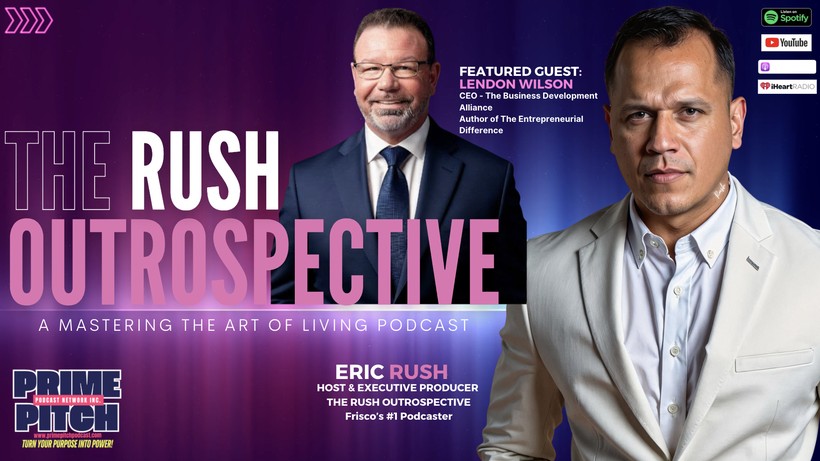
Lendon Wilson
CEO, The Business Development Alliance · Author of “The Entrepreneurial Difference”
About the show
The Rush Outrospective is a Mastering the Art of Living podcast: raw, honest conversations about purpose, healing, and the road back to identity, the flagship series where outrospection began. Hosted by Eric Rush, The Conversation Architect, a Bronze Star combat veteran and the founder of Prime Pitch Podcast Network.
Read the full transcript
Hmm. So, one of the things that, that, I try to make everybody understand is there's only one thing in the professional world that cannot be replicated, duplicated, or imitated. That's you. Yeah. No one can imitate you.
No one can replicate you. No one can duplicate you. Any product, any service, they can do that. Yeah. So your strong branding, unless you're a large corporation, Walmart, things like that, your branding is you.
Yeah. And so you've got to learn to bring out the authenticity. You've got to learn to share your core values, and be proud of them. Our dreams align, our hearts combine. Introspective love you shine.
Hey, what's up, guys? Welcome to The Rush Introspective: A Mastering the Art of Living Podcast. Where others reach to be seen, Lendon Wilson reaches to make others feel seen, and builds infrastructures that make it possible. He understands something most people never stop long enough to notice: visi- visi- visibility isn't just a matter of media, it's a matter of dignity, that when you build systems rooted in trust, powered by purpose, and reflective of real contribution, you don't just help people get seen, you help them remember who they've always been. As a creator of The Community Difference and the Business Development m- Development Alliance, Lendon doesn't just design platforms, he establishes ecosystems, environments that prior- prioritize meaning over metrics and community reputation over empty reach.
A- And through his positive impact branding philosophy, he offers leaders, entrepreneurs, a- and change makers the structure to step fully into their own significance without having to audition for it. Today's conversation isn't about what Lendon's building next, it's about what he's already set in motion, and a deeperand the deeper values that make his platforms feel less str- strategy and more like home. Lendon, it's a pleasure to have you on The Rush Introspective in Mastering the Art of Living podcast. and that introduction, did, did that feel right? Did I, did I hit the mark?
Oh, absolutely. Did Idoes that hit theaccentuate what, what you're doing here? You, you did that well. Very well. Aw- awesome.
You know, um, The Community Difference. Talk to me, uhlet's talk about The Community Difference. You know, I, I see your work getting, getting in front of people, and, and h- giving individuals a platform to, to share their, their mission, their purpose, and their vision. Um, what does that feel like? Uh, wh- when did you start?
When did, when did this idea come into play? Well, it's, it's hard to say the exact time. I, I started, uh, helping people with video branding about 5 years ago. I got an offer, an opportunity to be on a radio show. That was right before COVID.
Hmm. And COVID struck. Eh, at the time we got on the radio show, we had, uh, been able to climb up till the number one rank show on that particular station. We didn't want to quit. We had, we had really established something that w- we were all enjoying.
And so we built The Community Difference Network. And it has evolved, Rush. It, it's, it'swe thought we knew what we were doing, but opportunities keep presenting itself. Uh, we keep seeing different directions that we can go, different ways that we can help not only the people on the podcast, but the people in the community. And so I've told people before, it's, it's likeit's like, uh, uh, building an airplane, you know, while you're trying to fly it-or, or running and trying to tie your shoes at the same time.
It's almost like it just keeps evolving and we keep growing with it, and that's been one of the biggest joys. It's been one of the biggest challenges, but also one of the biggest joys, is to look back and see how far we've evolved. That's awesome. You know, when, when you think about your earliest sense of visibility, not the m- the media kind, but the human kind, what shaped you for that? Who, um, who first made you feel seen or unseen?
Well, it, that, it's hard to pinpoint because I, I think that being seen or unseen comes back to relevance, and that's really a lot of the foundational principles that we have, is the more relevant you are, the easier it is to be seen because you're worthy of being seen. Hmm. Right? So, so many people want to be seen, but they're putting surface level up, especially with social media. Yeah.
Where it really hit me, Rush, is probably about 4 years ago. Okay? So my younger years all the way up, I'd already started the podcast. Previous to podcasting, I, I, I ran a business, and I was pursuing 2 business professionals to partner with, and t- I pursued them for about 10 years. I couldn't get a call back, email back, text back, thumbs up, thumbs down, nothing.
Hmm. I had people that knew them that tried to connect us. They would not, in any form or fashion, connect with me. Fast-forward, we've got the podcast going. Um, it's doing well.
I'm at a networking event, social thing, and, uh, I look up and, and there's the gentleman that owns one of the businesses and there's the, the, uh, the female that owns another. I'd never seen them in person before. Hmm. And before the night was over, they both approached me. When I saw them coming, I got nervous, cause I'm like, Oh my gosh, here's the stalker.
They're gonna say, Here's the stalker, and I'm, I'm gonna set him straight. But they came up to me. They shook my hand. They said, Hey, you're the guyThey didn't know my name. You're the guy that does the podcast, right?
I'm like, Yeah. How do we get on it? And as I left that night and I'm driving home, that's when it hit me that I had relevance now. Before, I was just a product or a service that they didn'tuh, I was a commodity. And you'll hear that a lot about what I talk about.
I had gone from being a commodity, or how people perceived me, into something of need. Wow. That's insane. I know what that feels like when you'reyou know, you'reas you'reyou'rewhen you're podcasting and you invite people, right? You want them toyou'veyou feelyou see them and you see their purpose-driventheir pur- purpose-driven life, right?
Yeah. And yetand, and you were on that purpose-driven life. You're like, I'm gonna reach out, a- and y- and, and you want to be part of that solution, right? Exactly. And, and, and the otherthe con- the versetheconversely opposite for podcasters is you, you're inviting people cause you see that purpose-driven life, and you want to invite them so that you can accentuate the purpose lifepurpose-driven life.
And-when they don't answer and you don't get that response. It's, it's kindaDid you ever feel like it was like a, like did you ever feel like a little bit, um, like maybe had an imposter syndrome in some ways for not being acknowledged or- No, I didn't, I didn't feel that. Um, I just felt like that, you know, you go back to, I think, what a lot of us do, and you try to simplify what the root cause is. Mm-hmm. I thought, Well, I'm just not saying the right thing.
I'm not messaging it the right way. I'm not packaging it the rightand it wasn't that. It's just what I, what I was trying to offer them, they didn't need. Mm-hmm. It wasn't of value to them, right?
And so, I think that that's a challenge for a lot of us in the professional world, and that's what I deal in. That's, uh, you know, being a business development strategist, is that we get so tied up in our brand, our product, our service, our features, our benefits, we let that become our identity. Mm-hmm. And when you're taking that identity, and then you look next door to it and there's another identity just like that, people don't know how to differentiate, right? Yeah.
And if you're not building that relationship with em for the know, like, and trust that everybody understands, um, you again become a commodity. And that's what I was to them. I was just another person that did what all these other people were approaching them for. Yeah, that- I didn't stand out. Yeah, that- That's where I came up with the name of The Difference, okay?
Yeah. So when I decided what I wanted to go, I'm like, The Difference, we gotta be different. Is that, it's, uh, the, oh, The Community Difference. Okay, okay. Yeah.
And then, and then the other one's called, uh, buildi- uh, the, uh- Business Development Alliance. yes, the, the Business Development Alliance. Um, The Community Difference and The Business Development, uh, Alliance, Curate Lenses. What responsibility do you f- what responsibility, responsibility do you feel not just to offer space, but to shape how others are perceived inside that space? So, I, I, I really looked at that question, and I thought about it deeply.
I don't feel a responsibility to shape others. That's up to them. Yeah. My job, where I've, where I've defined my role, is create pathways for em to do it- Mm-hmm. and show them how to do it, show em the difference.
Again, show em the differences of where you are now, and how y- you blend into the crowd and the noise, and how do you separate from that? Once I teach them that, once I show them that, and it's not just teaching and showing. Um, we can talk about that with the Business Development Alliance. Yeah. It's a training program.
Our whole concept about what we do and who we partner with is teaching them how to grow and develop professionally and personally and becoming someone that the community needs beyond their product or service. Wow. Yeah, that's so true. It's what the community needs beyond the product or service, right, is how are, how are you making that difference in, in your, t- leveling up, like, you know, I have a podcast called Next Level Thinkers, and it's like charting your horizons of brilliance. How are you charting your horizons of brilliance in your, i- in your, in your career, or your, your, your position?
The question I ask my, my people all the time is, If I take away your product or service, why does anybody need you? Hmm. Man, that's true. And, and, and that becomes scary for a lot of people because they've built their identity on what they're selling. Yeah.
And it's important to do that. But what I wanna be able to do with our, with our programs is I wanna be able to build the typeNumber one, you have to humanize it, right? You gotta get away from the commer- commercialization. Mm-hmm. But I wanna build the type of, of human and person and business professional that everybody knows, everybody needs, regardless of what it is that they're buying or, or needing at that point in time, as far as consumption.
Yeah. Yeah. Um, do you remember a time when your clarity on building visibility for others clicked into place? Um, again, several. I mean, I've been doing this for, I've, I've been- Yeah.
doing this for so long. It's when, it's when people are out. Okay, so it's- it's hard to pinpoint it. Yeah. But when I get a call from one of our co-hosts or our hosts, and they go, Oh my gosh, I was at a networking event tonight, and, like I said before, a person walked up to me and goes, Hey, you're so-and-so on The Community Difference podcast.
Yeah. I saw you do this. I saw you do that. I loved it when you talked about this. I loved that guest that you had on and what y'all's conversation was about.
Hmm. That's when I know that we've hit our mark. Yeah. It's, it's building that relevance so that people know you when you walk into a room, and they respect you. Wow.
What's your background? What, uh, what got you into this media space? I I have to ch- you know. Okay, so that's, uhMy first, uh, my, my first career, I, I was a fitness center owner. Okay.
I owned several fitness centers. Um, got out of that, got into the mortgage business. Um, and basically, I've always been fascinated with, with business and how to grow a business, right? Yeah. Um, I grew up in a time where we dialed from phone books, right?
We just went through the phone. We couldn't do that today, but you just dialed people up in a phone book- Yeah. and said, You wanna buy what I got? And, uhWe must be the same age. Pretty close.
Um, so understanding, uh, uh, y- you know, again, it goes back to that word, how to be different. Yeah. How to stand out in a crowded market. What can I do that's authentic and that's relevant and that's worthy? Um, not salesy or anything like that, self-promotional.
I stay away from that. And, and so I started off in fitness. I went into mortgage. That led me into 18 years of, of credit and, uh, as I was doing credit, I was teaching our, uh, realtors that we had and, and things like that how to u- understand and, and to utilize credit to their advantage. And itthat led me into, uh, helping them brand themselves and market themselves early on- Mm-hmm.
on social media, YouTube, you know, back in the, back in the day when it was, you know, in its infancy, before it changed and became a little bit more complicated. Yeah. You know, uh, like back in the day, nobody was doing, you know, selfies and videos and stuff like, so you could stand out really easy. Yeah. Um, and that's, that's what led me to where I am today.
Wow. Was part of that like, uh, like, corporate training as well? Like, uh, did you do some of that as well? I did some of that, yeah, yeah. Yeah, yeah.
That'll stretch you out as well. Um, your book outlines, um, your book outlines positive impact branding not as a pitch, but as, um, a paradigm. What shifted in your own thinking that made you say, There has to be another way to do this"? Watching everybody struggle. Watching everybody in the s- trying to fish in the same pond.
Yeah. Right? The challenge that we have as business owners is that when we come out of corporate world where we've been an employee, sometimes it's hard to break free from that employee mindset, and when you come out, you've got a skill, okay? There's y- whether you're a plumber, whether you're an electrician, whether you're a media person, whatever it is. When you work for someone else, you have a skill, and you feel like that you're not being appreciated and rewarded for that skill where you are.
And if I go out on my own, that's gonna happen for me. What you don't realize is that there are 15 different responsibilities you have now as a business owner. Hmm. Right? Yeah.
And so what we tend to do is we tend to imitate. We imitate others marketing, we imitate others branding, or we hire somebody that basically does it for us, but they're templated. Hmm. So they'reThey may change the logo and they may change the tagline, they may change the color- Yeah. but the template's the same.
Yeah. So the noise is the same, right? Yeah. So there's no differentiation there. That's when I realized that we had to do something different.
Yeah. That's crazy cause there is. You're right about that. In, in today's world, do you f- uh, do you still feel like that, that it, a lot of things are template, or is it, uh, more chaotic? Both.
Both. I think that it's mainly chaos, and then when you start to kind of understand or define and you start to look at others, um, to try to see what they're doing, you end up imitating them, right? Yeah. You're, you're not finding your true identity. Hmm.
So one of the things that, that I try to make everybody understand is there's only one thing in the professional world that cannot be replicated, duplicated, or imitated. That's you. Yeah. No one can imitate you. No one can replicate you.
No one can duplicate you. Any product, any service, they can do that. Yeah. So your strong branding, unless you're a large corporation, Walmart, things like that, your branding is you. Yeah.
And so you've got to learn to bring out the authenticity. You gotta learn to share your core values and be proud of them. Hmm. Right? Because what happens when you do that, and this is the challenge and the, and I think the fear most people have.
When you are bold enough to share your core values, you're going to alienate half the people watching you. They don't align with that. Regardless of how righteous and worthy they are, some people just aren't gonna align with you. That's just nature. But the thing that we're looking for are the people that do align with that, the people that respect it and appreciate it, because when you find those people, that's when you find your best client.
Yeah. Because they love you, they appreciate you, they understand you. If there's a challenge, if there's a hiccup, you get grace. You don't get grace from people that don't align with your core values. Yeah.
Ma- wow, that's crazy. That's so good. You know, the, the, the podcast is called The Rush Outrospective in Mastering the Art of Living podcast, and the Mastering of the Art of Living is part of everything that you just mentioned, you know? It's like, you'reyou know, you have to walk through this, this certain, um, i- idea that, you know, that you, uh, y- about authenticity and how that's gonna accentuate, um, how you live your life and how you r- run through business. It does.
I had a, I had a mentor one time that, that really helped me understand that, and he said, Imagine"your marketing, your branding, your message as a radio frequency. And you're- you're- someone's out there trying to dial in the radio frequency and all they're getting is noise, static, static, static, and they keep turning and finally they hit that frequency and it's what they want to hear. It's what they want to listen to. But you've got to have that frequency and be committed to it. Yeah.
That's beautiful, man. Tha- tha- that's beautiful. You affirming some things that I may be, uh, you know- and as we talk, I'm listening an- listening to you how y- how you're, mm, you're hitting some marks from me and how I'm taking my approach to podcasting in, in a different genre- or a different, uh, niche-specific podcast that I host on. you've helped others be heard. When the spotlight finds you on stage, on camera, what's your relationship to that attention?
Comfortable, complicated, or something ent- entirely different? I've now become more comfortable, so it- funny story, I'm the guy in college that dropped speech class 3 times because I was too- I had too much anxiety to get up and talk to people, right? I just couldn't do it. Finally got through it, um, not gonna tell you what grade I made but I made it. Um, fast-forward many years later when I'm, uh, running the credit company and I had a great mentor that she called me one day and she goes, I need you to come down and teach a class to these real estate agents about credit.
Mm. And I'm like, Um, Taisa, I'm sorry. I love you but that's not my thing. I do credit on, you know, on the backside but I'm, I'm not a public speaker. She goes, But I've seen you sit down with 2 or 3 realtors and have that discussion with them, and the way you explain it, they really can, uh, absorb it.
And I said, Well, it's easier that way. I can't do a room full of people. And this was on a Friday, and we talked for several minutes and finally she says, Well, okay then, I will see you Monday at 12:00, and she hung up the phone. Now she was in Austin. Well, I tried to call her back.
I'm like, No, we have a- there's a misunderstanding. I, I, I didn't say yes. Oh, wow. She wouldn't answer the phone. She wouldn't answer the phone the whole weekend.
Wow. Monday morning, I get up and out of pure allegiance and obligation, I drive to Austin and I'm praying for 2 flat tires. I got one spare tire. If I can get 2, I can get out of this, uh, and save face. Didn't happen.
Get down there, I wouldn't even talk to her. I'm so upset, I'm sick, and I go in and I start talking, and I tell her- the first thing I told everybody is, I'm not a public speaker. This is probably gonna be brutal. And for the first 10 minutes, it was brutal. And then someone asked me a question and I responded.
Someone else asked a question, I responded. And I realized at that point in time that I was where I needed to be. Mm. That I had the knowledge and the ability to share with them what they came for. Mm.
The rest of it went great. When it was over, I walked up to her, I hugged her and I said, When can we do this again? So, the comfort has built over years. When I got into video branding, obviously cameras, replaying, hearing yourself on a mic, all that- all the things that we all, uh, cringe at, you know, sometimes we still do. So I'm comfortable but, Rush, to tell you the truth, it's that journey for me is why I wanna do it for others, right?
I wanna show them that there's more inside of them than what they've allowed themselves to be shackled by. And so, that's why I created the processes and the- and the systems that I did is, is not only to, to transform people in, in, in multiple ways but also that confidence. That's amazing, man. Like, that's just like that, I love that, you know, how she handled the situation that you, she put your, you know, she put your butt on the, on the line to, to get this done. Ah, she didn't give me a choice.
She gave you a choice. She did not give me a choice at all. Isn't that, isn't that strange that ma- you know, like, um, do you find it strange that some people, like, they, they, they can't recognize their own authority? Like, you know, bra- Oh, yeah. You know what I mean?
Like- Because of the imposter syndrome like you, you mentioned before. Yeah. A lot of it is misplaced. Yeah. A lot of us have more ability, we have more qualifications, we, we have more value than we believe we do inside.
Mm-hmm. And, and part of that is because of we know who we were 5 years ago. Yeah. We know who we were 10 years ago, right? Yeah.
And we're still living with that. We don't see ourselves today the way people see us today. Wow. You know, I felt when w- when I reach, when I reached out to you, I kn- we've, we've known each other for a little bit- Mm-hmm. you know, followed each other in, in some ways, and, and, you know, I think we've connected bef- before prior to this, right?
Before, maybe months ago, and, and I said, Man, we, we align on so many things just from a, from, uh, intangible, you know, from these certain intangibles. And, and I said, I bet he has a story thatyou know the story that, that I could, that, that, that we, that I could find out about. You know? And, uh, that was such a coolThat's amazing cause I feel that there are those moments when you, you, you question your own, uhYou don't have personal agency and you don't know how to us- use your authority to maximize your, your fullest potential. Absolutely.
And Russ, you just said one thing that, really hit again, and, and that's the fact that I followed you, you followed me. You know, you get to know people on social media that you've never met before. What's great about it is if you're authentic and you're consistent, people start to see that. They get to know who you really are. Yeah.
In today's market when it's all about sales, we all can put on a good sales pitch, right? We've got that, we've got that elevator pitch, all the thingWe're gonna say all the right things, but that doesn't mean that's who we are. Yeah. That's what I love about media and being able to do what we do with the Community Difference, is you're going to see over time that our people that we partner with, their consistency, their growth, their transformation, their commitment to their community, to what they do and the people around them, and it has really elevated their ability to grow their businesses. Mm.
That's awesome. You know, you've built systems that run on meaning, not metrics. What keeps your compass steady when the world around you pushes you for numbers, noise, and speed? Again, I've gotta give you kudos for all the questions cause- Thank you. because that's a, that was a challenging one for me as well.
It is about meaning for me. It, it, it is, it's about that authenticity and who we are at the core, um, what drives us, wh- what our why is, but it's also I'm, I'm a, I'm a data nerd. Mm-hmm. Um, metrics are important to me. And I use metrics on our, uh, on our podcast because one of the things that is very important from a professional standpoint that we often overlook is our behavioral brand.
That's who people see us as we are, not as we want them to see us, right? Mm-hmm. It is how we show up consistently, reliably, um, trustworthy, all of the different things. And I tell people that come on and partner with us that in what we do and the way that we do it, you're gonna brand yourself one way or the other. It's either gonna be a good look or bad look.
But it's all gonna be based around your behavioral brand. Are you following the things that we do that make you, that transform you and help you grow into that person that people want to be around? Or are you gonna try to take the shortcuts? Because that's gonna be exposed, which I, I have people all the time they call me and they're like, umCause we give a pretty intense what we call a run sheet, and they call and go, I, I didn't read it. I, I'm, I, I can wing it with the best of them.
And I tell them this, I'm like, Here's the thing about winging it. You will only impress people less intelligent than you when you're winging it. Wow. I need aI'm gonna cut this. Not cut that.
I need to keep that as likeBut it's true. Yeah. It's true. And we s- we, we fooled ourselves into believing that I can just get in, in, and- and BS our way through it. Yeah.
But people see it. Yeah. They really do. The ones that we want to do business with, the ones that we wanna connect with, the one that we wanna partner with, they see it. Yeah.
The ones that don't see it, is that really who we're trying to partner and, and grow with? Yeah. Hmm, probably not. I know. I, I, I think I remember having a, you know, just you get some of these, uh, professional speakers sometimes.
I've had professional speakers, and I'll, I'll ask them something that's very, you knowMy questions, I try to get that question that no one's ever asked you on another podcast or, or any of that stuff, but I'll ask, but they'll h- go into their whole, their whole, uh, motivational speech. You know? Like, wait, I'm asking what color the sky is. It's a canned res- it's a canned response, right? I'm like theI'm asking you what color the sky is and you're telling me about some motivational thing, you know?
Mm-hmm. Um, but they get caught up, and it's true. Like, I think you're right about that, 100%. Um, what's something in Community Difference that still surprises you, a feeling, a reaction, or a moment when youthat you didn't see coming, but now you chase it on purpose? Oh.
The impact. There's several things. There's, there's a one positive, or there's several positive and there's one negative I may, I may address. But the impact that we can have on those around us- Mm-hmm. um, our communities, bringing awareness to certain things.
You know, people are, are so frustrated and, and tired of mainstream media and all the negativity that comes with it, being told who we should like, who we shouldn't like, why we should like them, why we shouldn't like them. Um, just being almost brainwashed into how to think. I think that's why podcasts have become so popular and so powerful is because, first of all, there's a plethora of them. You can find what you're looking for and what you need, uh, but they're authentic, right? We're not here trying to drive thoughts and opinions.
We're just laying it out. And so whenThat's part of the, the evolution of what we had. You know, in the beginning, I was, I was trying to show people the differencebetween 2 business professionals, one that had accomplished this much and one that accomplished this much, but yet they were working just as hard. What was the difference? Mm.
What was th- the real difference? Because that in, in my data, and, and being a data nerd, and, and being a business development person, that's, that's what I wanted to know. And, but what we evolved into is that we can help impact community initiatives, right? Yeah. So- Yeah.
the people, places, and events in our communities that aren't getting the spotlight that they need to so that the residents of that community can feel more endeared to the community, feel like the communi- there's more positivity going on. Yeah. Because if all we watch is mainstream media, w- we just, we feel like that's what's happening in our community too. It's not necessarily true. Right, that's so true.
Um, let's talk about Community Difference, the, and the, the Business Development Alliance, and your, uh, uh, The Positive Impact branding, book that you have as well. Okay. Um, so Community Difference is where we bring on local business owners and we partner with, uh, civic leaders, uh, uh, school board leaders. We bring on what's happening in our community that's relevant and, and, and personal to us all. Uh, it's why we need to pay attention.
You know, I, I look at, and not to get political, but I look at our national elections and we all get fired up for those. But then our local elections happen and nobody goes, I mean, about 7% of the people start to vote. Yeah. And it's not becauseIt's mainly because we just don't understand the value and the importance in it. And what impacts our daily lives more than anything is the, is the local elections and, and the local policies and how that, um, is, is created and carried out.
And so, we want to bring those people on and give them an opportunity to talk about not the mudslinging campaign, but what they want to change, why they want to change it, and how they want to go about changing it. Mm. Right? And so, that's the Community Difference in a nutshell. By utilizing the strengths of our high profile business owners within the area and allowing them to facilitate a lot of these, it helps their branding.
Again, it goes back to the behavioral brand, and that helps elevate their business. Yeah. Business Development Alliance is something, um, you know, I've, I've been around, you probably have too, a lot of networking events, a lot of professional organizations. Um, and they're what I call referral dependent, right? Yeah.
I'm going to get a referral to give a referral. You become seen as just a referral provider, right? Mm-hmm. That, that devalues you. Again, you become a commodity, right?
Yeah. Yeah. Wow. And, and in most of those, that's what you are. So, one of the things that I was told by a friend of mine years ago when we were doing some training is she goes, I have been to every seminar, webinar, training that you can think of.
The problem that I have is once I leave, I don't do anything with it. I've got a head full of knowledge and no application. So the Business Development Alliance seeks to change that. So we have panelists that come on. We, a couple, uh, months ago, we had the Area Chambers, uh, of Commerce Presidents within Collin County.
Last month, we had the EDC. This month, we're gonna have business funding. When it's over, everybody gets an e-book. And what that e-book talks about, here's what you heard, here's what you didn't hear, here's how to apply it. Wow.
And if you apply it, here's what your business is going to benefit from it. So it's training involved, right? Yeah. And it's, it's, it's partnership training. That is cool.
That is awesome. Well, everybody that comes in, they go, I've never seen anything like this before. Yeah. Yeah. I'm like, It's because it's different.
That, that's amazing. Um, qui- last question is if your, if, if your platforms disappeared tomorrow, what belief or value would you s- would still guide how you move in this world? I love that question because I do believe that the platforms will disappear one day. Um, evolution of technology, um, people's attention, where it goes and where it- Mm-hmm. where it stays, I mean, it's changing rapidly.
YouTube may be here in 5 years, but it's gonna be different than it is today. Um, Facebook changes every week. Yeah. Um, you know that as well as I do. Yeah.
And for the g- for the good or bad, it changes, and, and we have to keep up with that. It's, it's staying true to who I am. It's the fact that I want to help people that struggle. Um, you know, w- we had a conversation before and where we've come from in our past, I, as a business owner, I have, I've, I've hit the highs and the lows. And I've seen the mistakes I've made, I've seen the opportunities we have now, and if I can serve those people that are, uh, experiencing the same pain points that I did, um, then that's my purpose.
That's where I find success. So core values, you know, staying true- Mm-hmm. to my core values, serving, helping, advancing the human condition. If I can do those things regardless of what platform it is or whether I'm just standing on the street corner yelling it, um, I think I'm gonna take, uh, satisfaction in that. That's beautiful.
That is awesome, man. Um, you know what? I, I'm so happy I've had, I've had you on the podcast today. It just, you know, r- you resonate, you know, everything you're talking just r- even right now with this, the way we ended this or we, w- we finished with this question. It just, it just makes me more aware of what I n- you know, need to be prepared for if, if, if things do shut, you know, w- the whole- Mm-hmm.
the whole, um, the whole system changes, you know? You mind if I add to that? Yeah. Because I think this is important. Um, and this is just, this, this from who I am.
Yeah. None of us should become dependent on these platforms. Okay? We, we need to be forward-thinking. We need to be introspective and outrospective.
I love that you do that because everybody talks about introspective. Yeah. Outrospective is thinking ahead.100%. Introspective is thinking behind, right? Right.
What, what, what did I do? So if you're not planning now for this to happen, um, and that, a- and you're dependent on it, don't, uh, as I say, don't put all your eggs in one basket. So start preparing now. What is your alternative if what I'm doing now goes away? Mm-hmm.
What's next? Mm-hmm. And be ready for what's next and start preparing yourself and educating yourself to do it. That's awesome, man. I'll have to get togetherWe'll have to get together and, um, talk about your program a little bit more off, off camera.
Um, okay, so I end up every podcast with, uh, um, say, uh, having the guest say, I'd like to, you know, I want to give some encouragement to this person or some affirmation to this person, or, I want to be, I want to g- I want to give thanks to indi, uh, individuals or organizations. So I'll let you talk to the camera. Oh, wow. Um, how much time do we have? Uh, you know, obviously family.
My family has been a, a big support of a journey that I've taken that I didn't know what I was doing when I started. And so the support that I've got from them, um, that I still get from them, the encouragement that I get, the team that I've built at The Community Difference- Mm-hmm. um, you know, the willingness for them to trust me and trust my strategies, uh, and, and to step out there. You know, one I, I want to mention I- is Brian Poduska. Um, and he was, he was my very fir- the first person I talked to when I decided I was gonna do a podcast.
Mm-hmm. I talked to him. We didn't know each other the first time we met. Wow. I said, Here's what I want to do.
I don't know how to do it. Do you want to be a part of it? He goes, Yeah, let's go. And he is still with me today. Wow.
Still with me today as the host of The Community Difference Collin County. Nice. And his growth and development has been unbelievable and I want to thank him. I want to thank him for his loyalty. Um, and I want to thank Collin County, um, for accepting us, receiving us, understanding what we're trying to do and, and all that the people and the professionals in Collin County do to help us.
And, uh, the one I should have said first is I want to thank God. I want to thank God for pushing me to places I didn't want to be so that I could do the things that I needed to do. And Rush, I want to thank you for having me here today. Hey, you know what? I want to thank you for being here, you know?
Uh, I feel like I gained a brother in this conversation just listening to you. Uh, I had a, a, you know, my inGod's discernment tells me that you're gonna bring, you, you're gonna meet Lendon and he's gonna be, he's gonna, he's gonna, we're gonna be on that same like-minded, like-mindedness spiritually, um, philosophically, business-wise and stuff like that. Absolutely. So I've, I've learned a lot through this podcast, I want you to know for sure. Thank you.
Um, I hope I brought some value.100%. All right, guys. That's it for the Rush Outrospective. As I always say, have peace enlightening you and remember that the ocean refuses no river. I