Kirk Driver
Kirk Driver joins Rush on Unfinished Business, the show for veterans pursuing new missions after the uniform and the people who stand beside them. As founder, ZeroGray Leadership · Fort Worth Police Captain (Ret.) · USMC, Kirk brings life on the front lines of public safety to the table.
They get into the work, the cost, and the reasons it still matters, in the kind of long-form conversation this show was built for.
In this conversation
- The weight first responders carry
- What the job asks of a person and a family
- Service that does not end at a shift
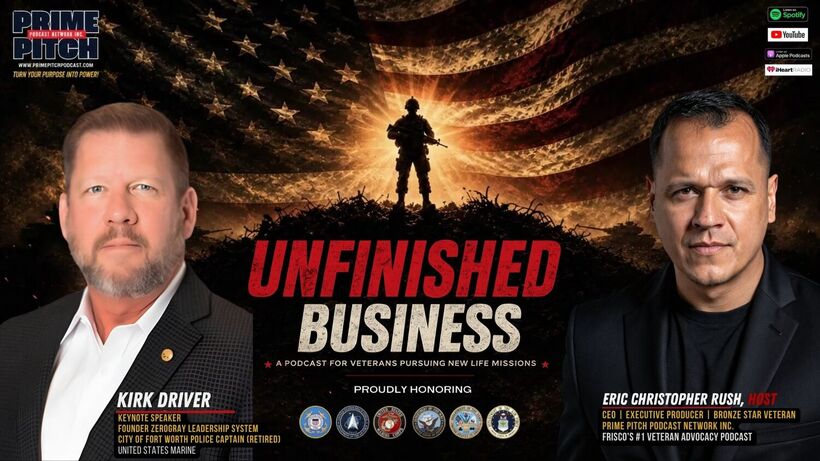
Kirk Driver
Founder, ZeroGray Leadership · Fort Worth Police Captain (Ret.) · USMC
About the show
Unfinished Business is a podcast for veterans pursuing new missions after the uniform, and for the families and communities who stand beside them. Hosted by Eric Rush, The Conversation Architect, a Bronze Star combat veteran and the founder of Prime Pitch Podcast Network.
Read the full transcript
How does, how does a leader remove the gray area without becoming rigid, controlling, or impossible to work for? Absolutely you don't want that guy. Okay? Removing the gray area isn't about being a d- just a total jerk disciplinarian. Mm.
It is literally about developing the standards, communicating those standards, living up to those standards in your personal life, and holding pe- other people accountable to them. It can be, I, I, you know, the absolute worst part of my job when I was captain, I was a division commander, and the part that I hated the most was when people got in trouble and, and I had to make recommendations on discipline. I absolutely hated it. That is the thing that kept me up at night. Am I making the right decision?
A- and, and, you know, take everything into, in a, in a factor on this. And, and w- in doing that, for me it's what's the level that's gonna get their attention? Hmm. And, and correct the behavior. And, and that goes hand-in-hand with what I call redemptive leadership.
Yeah. Okay. So, like I said, this is the stuff that kept me up at night, because I hated giving out discipline, but as a supervisor, as a, as a leader, sometimes you're in a position you have to. And the most important thing is, is it commensurate to the act? Are we smacking some dude down just because, you know, we think he's an arrogant jerk or whatever?
Or is it actually what, you knowDoes the punishment fit the crime? And is it standardized? Did this guy over here do the same thing 3 weeks ago and the boss gave him a written reprimand, and you're over here trying to get this guy a 10-day suspension? Unfinished business, missing parts. Stand by- Hey, what's up guys?
Welcome to Unfinished Business, a podcast for veterans pursuing new life missions. There is a space inside organizations where damage starts quietly. It doesn't always begin with crisis. It does not always begin when pressure hits. Sometimes it begins much earlier, in the gray area leaders allowed to sit too long.
The unclear standard, the soft expectations, the conversation nobody wants to have, the moment a team started guessing instead of knowing. Captain Kirk Driver understands that space. That's why his story fits Unfinished Business, a podcast for veterans pursuing new life missions. Because Kirk's taking the s- ser- what service and command taught him and carrying it into a new area of leadership. He's a United States Marine, a retired Fort Worth police captain, MBA graduate, and a creator of 0 Gray Leadership.
He spent 34 years in law enforcement working inside environments where standards are tested in real time and confusion does not stay harmless for, does not stay harmless for long. But this conversation's not, uh, only about command, it's about, it is about people, good people. Teams trying to do the job right while unclear expectations, selective accountability, and weak standards slowly eat away trust. Kirk brings a message that feels direct because he has lived it. Today on Unfinished Business we talk about the cost of gray area, area leadership, what pressure exposes, and why some standards have to be settled before the room gets heavy.
This is my conversation with Kirk Driver, founder of 0 Gray Leadership. Kirk, pleasure to have you on Unfinished Business, a podcast for veterans pursuing new life missions. you know, it's such a, aIt was a pleasure and honor to meet you at the, um, at, at the Big Country Veterans event, um, this year. Sure. And, um, what an amazing organization, what an amazing event.
So, um, uh, w- Kir- uh, uh, Cody Palmer, um, Dr. Cody Palmer and, and Michael Grome had put together, uh, that event, and it was a, a, a pleasure to have, have you sit at the same table with everybody a- lo- around us. I wanna just tell you that. Well, thank you. It was a great event.
And, uh, th- thanks, Eric, for having me on your show. I'm really, really enjoying, uh, being here, and I look forward to getting into some good topics with you. Awesome. You know, as I was going to, I always ask this for all my- I always, I always ask this for all my guests. Um, when I read the cold opening, what thoughts went through your mind?
Well, okay. You know, i- in, in that, I, I'm, I'm looking going, "Uh, that's a lot."I mean, it, it, we, when, when we look at ourselves, it's like, man. Mm-hmm. Saying a lot of words. Does, does all of that me?
Yeah. And, and it, it is, but it's like, wow, you know, hearing it from the outside ra- Because I'm the guy who's like, I, I just do it. Yeah. And I get in there, I, I do the job, and then, you know. So, so when you hear someone from the outside describe me, it's like, hey, all right, I'm kinda, you know, it's making me feel good.
Yeah. That's great, man.'Cause I, you know, I have a lot of respect and admiration for your career and, you know, understanding that you spent 34 years, you know, at Fort Worth Police Department as a captain. Yep. And, and, and, and you know what, I n- you know, I can onlyI can't imagine, but I can only imagine that, you know, what all, all that entailed from a, from, you know, fr- from a professional standpoint, from a physical, mental ps- you know, all, all of it above when you put it, when you package together. So I thought it was so important to, to get, to, you know, get in there and like, like let's, let's, let's, let's, let's point to that and that and that and that and that, 'cause that, all that deserves respect and honor and, and, and I wanna make sure I do that today.
Well, thank you. I appreciate that. And I do have to say, it's been a crazy ride. Yeah. I, um, a- as I've said for many years, being a police officer, working the inner city, uh, the violence, just the, the crazy stuff that you see, it is literally a front row seat to the craziest show on earth.
I've seen evil. I, I'll tell you right now. Yeah. I've seen abject evil. Just-Things that, a- and, and I don't wanna go too far into, you know- Yeahlike, oh, you know, religious stuff or whatever, but- It's necessaryhey, I've seen evil that I can't describe short of demonic possession.
Mm. I've seen people that are so ate up with evil that literally they are incapable of thought. They are just a big, uh, whirlwind of violence. Hmm. And, and, and in a zone through mental health issues, addiction issues, whatever have you, thatAnd, and, and thankfully in my, in my career, it's only been a handful of people that I've actually seen, witnessed that have just been j- just gone.
Yeah. But I'll tell you the other side of that coin is I've seen abject acts of kindness from people who ain't got nothing. Hmm. I mean, people who've just got nothing, giving the shirt off their back for a total stranger just because it's the right thing to do. Yeah.
And you know, there's 2 schools of thought out there. There, there's that idea that man is inherently bad and good's trying to get in. Hmm. And then there's the other side that says man is inherently good. We're just polluted with, with the sins that, that, you know, create our human state, if you will.
Yeah. Well, I choose to believe in that latter version and, and, and have hope that people are good. Yeah. Most everyone has, has got some sort of goodness in them. You just gotta findYeah.
That's, uh, that's amazing. Hmm. That's amazing. Would you- Let me get you some water. No, you good?
You good? Okay. Okay. Um, um, no, that's amazing. That's a way, amazing way to, to, uh, to, to point to its necessary societal, societalYou know, when people are dangerous, they're dangerous, you know?
And being honest about it, right? And beingYou call it evil if it's evil, right? And that, and that's, that's exactly what you're doing. And I, I, um, and yeah, it's so important to, to call it by its name and, and that's what it is. Um, but, um, it'sAt the same time I'm like going, you, you know, there's great acts of f- from your r- you know, as a police officer that you do for protection, for the community, serve and protect the community and, and I wanted to make sure that we, we in, right?
In, into the, into the gray area and try to, and try to extrapolate it so that organizations, um, nonprofits, big organizations, small organizations, just regular leaders can, can, um, grab ahold of something tangible today from our conversation. Sure. Um, so I wanted to ask you, um, Kirk, when, when did you first understand that, that the gray area and side organizations can create more damage than the crisis itself? Well, I've, I've see- I've known this, or I say known this. I've learned this over y- over the years.
I meanSo I, I was in the Marine Reserves, uh, activated. I spent about half of that contract on active duty. Part of it was Desert Shield, Desert Storm. And, uh, I got some, uh, uh, not just the general Marine Corps leadership lessons, which I got plenty of those, NC- NCO schooling, all the way, all the way up, the things I did, but, uh, actual in-the-field lessons. And, and in fact, for the keynote work that I do, uh, one of the first stories I tell is about that Desert Storm e- e- experience.
But, but as we move forward, uh, you know, the, the gray area stuff, uh, this all comes from personal experience. You know, having this supervisor who, uh, that was a bad supervisor. Or this one, man, he was a great supervisor. And so as I, as I progressed through the ranks, you know, and made it to, you know, corporal then sergeant, lieutenant, captain, and, and along the way as I start leading more and more people, I really started examining those things. You know, what is it that makes the good leaders?
What is it makes the bad leaders?'Cause you can have a leader who leads from the front, you can have one that doesn't lead from the front, and that don't necessarily mean he's, he's a bad leader. Hmm. Okay? There's, you know, you have servant leader, and then you have a command and control leader, and then both of those can be the right thing for that situation. Mm-hmm.
But what is it that makes, w- what is it that makes it stand out? And, and for me, it was, j- and I, and I use leader very loosely. You know, the, the bad leader, yeah, that guy wasn't a leader. He's a manager. Hmm.
Yeah. He wasn't a leader. And, and I, and I, and I'll s- and I'll tell you why, because, you know, if you look at the, you know, what are the def- what is leadership? What's that definition of leadership? And, and I've, man, I've looked up and down and 9 ways to Sunday.
Yeah. And the clearest, most basic one, you know, leadership is getting other people to voluntarily do the things that need to be done, right? Okay, now that's- That's simplethat makes sense. Yeah. But I also read another definition of leadership, and I love this one, and that is, "A true leader makes those people under his command or under his, you know, authority, whatever, want to be better versions of who they are."Hmm.
You know, that, that's- I like that onea whole nother level. Yeah. It's one thing, you know, as a manager, I can get you to do something that voluntarily. Why?'Cause if you don't, you don't get a salary 'cause you're fired. I mean, it's- YeahBut to get people to say, "Wow, you know what?
Because of this guy, I want to improve myself. I wanna go back to college. I wanna, I wanna get in better shape. I wanna improve my relationships because this person is challenging me to do that."Hmm. That's the leader that I wanna be.
Well, w- well, what does that mean? You know, what, what are those attributes of that leader? Yeah. And what I found is the difference in the good ones and the bad ones oftentimes are the good one has identified, okay, here's the mission. Here's your parameters.
Here's our standards. Here's the why we do what we do. Hmm. And all of those things, you know, clear and, and, and transparent communication with their people. We're not hiding things.
We're not pulling punches. I'm not gonna give you part of the information. And I've seen that where, where I'm, I'm, I'm gonna give you part of it, but not all of it 'cause I don't want you to outshine me 'cause you might take my job. Yeah. Well, I got news for those people.
Somebody gonna take your job eventually, one way or another. Yeah. Okay?'Cause this whole life thing, none of us get out alive. So - Yeah. so that being the case, isn't it imperative upon us all, as in, in leadership roles, to try and help those people behind us rise up- Hmmand do even better and go even farther than we did?
That's how, that's how we progress society. Yeah. Not just our organizations. Yeah. That's, that's, uh, that's amazing.
I think you're, you know, you hit it right on qui- on point, you know, um, differentiating between a manager and leader and, and- Yeahactually understanding there's good, good leaders and progressive people. I, I remember I was a site, I was a site director for a telecommunications company for, uh, for a while, and, and the one thing I always said is, "I want you to take my job," you know? Absolutely. You know what I'm saying? Like, I want you to replace me, so, you know, and when you replace me, I can go do something else.
You know- AbsolutelyI can go get another, a career, um, advancement. Um, in the Marine Corps, what did you learn about standards that later proved to be true in law enforcement? So the, uh, one of the things about the Marine Corps that, and law enforcement, is again, a lack of gray area. It's a very rigid environment. Hmm.
They tell you how to dress. They tell you how to bathe. They tell you how to wear your hair. But, but more- Yeahimportantly than that, they tell you, "Here's the rules for combat. Here's, here's what, what you can do, not just in combat, but in your personal life, and what you can't do."Got you.
That's true. So, so I mean, but they, they have to. Yeah. Marine Corps takes a bunch of unruly heathens and sends them all to boot camp, and they come from all over the country, and some from upper class, some from lower class, all kinds of races, creeds, and- Yeahand, and every, religions and everything else, and what do they do with them? They destroy all personal ego, and, you know, as they say, m- make 'em, make 'em feel lower than whale dung at the bottom of the ocean.
But everyone's equal in that regard. Yeah. And then they bring them all up to their standards. The Marine Corps standards are very defined. Yeah.
Okay? So I move into law enforcement. It's not as defined, but it is a paramilitary organization. Yeah. So they, they follow a, a very parallel track.
And what we're findingSo I came on in '92 in the police department. Uh, I will tell you the standards then aren't what they are now- Yeahbecause law enforcement is steadily progressing, okay? The way we treated the public, our relationship with the public wasn't anywhere near what it is now. Hmm. And, and for good reason.
Yeah. Okay? We've gone through evolutions in law enforcement. In the 34 years I was there, this, this giant evolution, you know, is slowly but surely bringing us actually back to the very roots of law enforcement. So law enforcement was started by this guy, um, Sir Robert Peel in London.
And, and his f- the first general orders, there's like 9 of them, and the first one of those general orders was, "The police are the public and the public are the police."Now think about that. When I started out in the department, we were, we were pretty much, you know, separated. Yeah. And then back in my dad's day when he joined California Highway Patrol, that was the years, there was an old TV show, Dragnet, and it was just the facts, ma'am. Just the facts.
I don't, I don't care about your personal stuff. the reality is, we gotta know about that personal stuff. We gotta know about all the, you know, what i- what is really bothering you? If we're gonna solve your problem, I can't have just the facts. I have to have the f- the, the color commentary- Yeahof why we did this.
And that same thing applies internally, okay? YouThere was a time when I, when I was in the Marine Corps and when I came on the police department, sergeant told you, "I need you to go over here and do this.""Yes, sir."You know? What, what, what's the old Marine Corps saying?"Mine is not to wonder why. Mine is just to do or die."Mm. Okay?
Well, it was that way when I came on the police department. You try that with, with the kids coming on nowadays. That's not gonna get you very far. You can't lead that way, because if, if they don't know why, where's their skin in the game? Mm.
You gotta get buy-in from people. Buy-in means I need to convince you why you need to do this. Yeah. Because now y- you will do this more than willingly when you understand the why. Mm.
That's part of that transparency. That's part of removing the ambiguity. Yeah. Man, that's so true. You know, circling back to, to, you know, um, when you're in Desert Shield, Desert Storm, I had, um, uh, the CEO of, uh, uh, Army Scholarship Foundation, Jeff Galt, here on my podcast.
Mm-hmm. Yeah. And he, I said, "What surprised you about the leadership in, in, uh, uh, you know, in, in Ser- in Desert Shield and in Desert Storm?"And he's like, "The leadership."And he wa- and then he went on to say how, how all the first lieutenants, second lieutenants, like, toLiterally broke down, like emotionally. Really? Yeah, he was just saying that.
Wow. He was just saying it was shocking. And I kinda s- understood what you were saying, not that you were saying it in this way, but when you were talking about how leader- your first, um, leadership, which some of the stuff you learned in leadership by being, you know, being deployed, um, I kinda learned what leadership w- was like too in that similar fashion that Jeff did, 'cause- Yeah'cause I was like,What's this guy doing? We just got here and you're already break," you know, having this, you knowLike, you know, it's like- Right, right, yeahyou're having this breakdown right now. Like, you know.
That was not my experience. Yeah, yeah, but yeah, with, you know, yeah. That, I justYeah, I thought that was just really strange that, you know, the different types of leadership. Sure. Yeah, yeah.
So I've got the, again, me, I, I'm keynote speaking. Yeah. And the, and, and when I keynote, I open with a story from Desert Storm. Yeah. So when we, when we get there, uh, I get there right after Christmas and, and my unit, we're at Camp 15, uh, in Saudi Arabia and, and, uh, the Port of Jubail's down the street.
So we k- gotta get a work party together. I'm part of the labor party. So we got labor, we've got truck drivers, we've got heavy equipment operators. We gotta go down to the port and offload these ships. Mm-hmm.
Ships, you know, supply ships coming in, and they got trucks, they got gear, they've got tanks and all kinds of stuff. And so we're living in a warehouse, sleeping on cots, working, working long days. We're getting 2 MREs a day, and we get one mystery, one mystery meat sandwich off the back of a truck. Some dude who don't even speak English rolls up. And he's got, it's pita bread, mystery meat, and, and, uh, they said it was cheese.
I'm not so sure, right? And so we're eating cold rations 3 meals a day. So about 3 weeks into this detail, 2, 3 weeks in, when we're on the ships, we're allowed to go inside the structure. You know, we're supposed to stay out and get in the cargo area to offload this stuff. But we're allowed to go in- inside the structures.
Uh, there's a head, a restroom right inside, right? And so I go inside. Well, it's right by the galley. Hmm. And I look, and, and, and when I'm, when I'm making a head call, I, I see there's a couple dudes eating, and they got like this, like buffet line set up, and I'm like, "Man."And, and so I go up to the cook, and I'm like, "How many people can you feed on this line?"He said, "I can feed 150 a day if it comes down to it."And I said, "No kidding."He said, "No, yeah, I can."I said, "We got 72 on my work party.
How hard would it be to get, get these guys through for, here for a hot meal?"He said, "No problem, just, you clear it with the captain.""Well, where's the captain?""Well, he's right over there."He introduced me to the captain of the ship, and I'm like, "Hey, you know," and I'm a sergeant. I mean, I'm a, I'm a, I'm just a worker, right? Yeah. Sergeant said, "Hey, I'm on this work party. We, we're getting cold rations, have been for the past couple weeks.
How hard would it be to get a hot meal?"And he says, "No problem at all."He says, "We, we can set you up for as long as we're in port. Just, just fill out a chit."Okay, and so I organize with my guys, and I'm re- and I report to a staff sergeant, a staff sergeant over each of these 3 units, the, the labor, the truck drivers, the heavy equipment guys, right? And so talk to them, and you get this organized, and I start running people through, okay? You know, 10 at a time, get in, get your food, get out. We gotta get back to work.
Well, next ship comes in, I liaison with them, same thing. This goes on for, you know, about the third ship comes, and, and we're rocking and rolling. My pe- you know, my people, the, all the people, you know, we're happy because- Yeahyou know, we're, we're taking care of the business, but we're getting good chow. And so this gunny comes up to me. I've never seen this guy."You Sergeant Driver?""Yes, I am, Gunny.""Come with me.""Well, where are we going?""We're going to see Captain Black."Hmm.
Okay. So I, I, I don't know who that guy is. I wish I did. I'd love to find this guy. So any of your listeners out here- Yeahuh, this, this is a, an ask to you.
If any one of you knows someone who can get into the archives to look at Desert Storm, Desert Shield, Port Hacabial, Captain Black was the captain who was in charge of the warehouse area where we're offloading stuff. So anyway, I get put in front of this guy, and he says, "You Driver?""Yes.""Are you the one who authorized these guys to eat inside the ships?""Yes, sir, I am.""Who told you?"And he, and he gets all like, you know, knife hand, right."Who told you you could do that?"And I said, "Nobody, sir.""Explain yourself."I said, I, I said, "Nobody, no- nobody, I took it upon myself.""Explain yourself."And I said, "Hey, look, you know, we 2, 3 weeks, cold rations. I see an opportunity. I talked to the ship captain. Don't cost us nothing, and we're, we're above board.
We're signing the chit, and he turns it in, and the government on the way out, they'll reimburse him. And it's a win for everybody because these guys got hot chow now, and their productivity's going through the roof."And all of a sudden, the anger fell out of his face, and he said, "Walk with me."And we walked down the pier, and he says, "I like your initiative, and more importantly, I like that you're taking care of your people."He said, "If you remember one thing, remember these 3 words, mission, men, me, in that order."Hmm."You take care of your mission. That comes first. You take care of your people, because people are the one that can make that mission a success. And then you take care of yourself.
It's, it's vital that you do the self-care to keep you in the fight, taking care of your people. You do those 3 things in that order, you will go far in this Marine Corps."Hmm. And I've taken that lesson for the rest of my life. Wow. Mission, men, me, or in, in, in non-military, non-combat environments, mission, people, self.
Yeah. That's amazing. And I guess that's the difference between good leadership and bad leadership- Absolutelyin that one moment, and I think that's what we're referencing when- Yeahwhen I s- um, brought, uh, Jeff into the conversation. Um, um, also, you know, I, it's unique, 'cause the second question I asked you was about the, how, how your cr- how the police department has changed. You know, they changed too, 'cause I had a, a mental health coordinator for the Colony Police Department here, and he talked about, you know, this isn't the, you know, bad boys, bad boys, what you gonna do coming after you cops anymore.
And that's, that's a transcendent moment for, for law enforcement. That's beautiful, man. I, I think it's great to hear you say that too. Well, j- and, and you, you talked about the changes, and, and one of those changes, in the military, it hasn't been until recent years, past decade or 2, that we've really started understanding and putting more emphasis on mental health. Hmm.
TBIs. Yeah. PTSD, you know, all of that stuff. And we're getting, we're getting a lot better. A whole lot better.
Yeah. Uh, especially the last 5 to 10 years. Oh, yeah.5 years especially. We're do- it's, it's groundbreaking. Well, it's the same thing in law enforcement.
I came on, uh, I was involved in a critical incident, uh, very early in my career, and we met with a police psychologist, and he's like, "Yeah, I know. Yeah, you got in this thing. Um, uh, i- if you need to talk, I'm available. But you sound, you look fine, so carry on."And that was it. Nowadays, and I got, I got like a 3day vacation out of it.
You know, go, go chill out at home and- Yeahbut nowadays-If you, if you show up on a wreck and there's a dead body, they record that, and that becomes a part of your file because PTSD is, now that's a workers' comp injury. Hmm. Okay? Yeah. You, y- you're exposed to gunshots, that goes in your file because now we're tracking potential hearing issues because of that.
You go into a call that's, uh, ex- especially stressful and, you know, uh, you know, a lot of, you know, traumatic stuff going on. Yeah. They get you in front of peer counselors within 24 hours. Literally d- oftentimes within 8 in my agency. Hmm.
And, and it's because they're finally starting to recognize the importance of taking care of the mental health aspect of, of these, you know, men and women out here who are doing the job. Yeah. That's beautiful. Um, during your 34 years of policing, what pattern did you see in leaders who created clarity versus leaders who created confusion? So, I'll tell you the pattern I saw.
Most of the leaders that created confusion, they were in it for personal gain. Hmm. It's all about me. Hmm. What can I do for me?
How can I make my smell- self come out smelling like a rose on this, even though I just crapped on the people underneath me, or led them down this primrose path of, "Yeah, I know it's outside of policy, but if you do what I'm, I'm telling you to do, I'll take care of you."And when it gets c- and, and when they get caught, "I never told them to do that. I can't believe they did that."And I've seen that. I've witnessed it firsthand. Thankfully, I wasn't one of the followers in that situation. Yeah.
I stood up and, and myself and another, it was, I was a sergeant at the time, myself and another sergeant, we said, "We're not gonna do that."And, and we ended up taking heat for it from this lieutenant who we worked for at the time, short term, but it all came out in the end. And it was like, "Okay, yeah, these 2 guys did the right thing."And that's why it's important, again, part of my keynoting is about moral compass. Hmm. You gotta have yourIf you, before you can even think of leading someone else, you better get your own moral compass straight. Hmm.
Yeah. And that means having that long talk with yourself and sitting down and saying, "What am I gonna do in this situation where my morals, where my ethics are on, are on display and challenged?"Yeah. When the boss says, "Hey, I need you to fudge these numbers," or, "Do this," or, "Do that," and it's outside the policy, and you know it's ethically wrong. Right. What are, what are you gonna do in that situation?
Yeah. It's, it'sAnd, and that's where you gotta have that hard conversation with yourself. Yeah. And s- and, and, and pre-game this thing.'Cause if you don't, uh, you knowIt, it, it's kind of like the, you know, and I'm sure your, your wife will really appreciate this. You know, if you find yourself alone with a pretty girl, and you're a married guy, you may not have done anything, but if she makes an advance on you, you've already lost.
You've al- The point is, is prepare yourself for that situation so that you don't get into it. Yeah. Is it s- fair to say? Yeah. You understand what I'm saying?
Yeah, absolutely. Yeah. It's like, you know, I know for me, it's, uh, this ain't my first rodeo, and I haven't always been a good guy. But what I will say is, uh, I know ahead of time, and I've already pre-planned my script, that if this type of thing comes up, I know how I'm gonna get myself out of it. Yeah.
Yeah. And I say that to, if you're working for, for an employer, you're leading your teams, always make sure that you know that, you know, as best as you can, pre-game this stuff. What are the issues that might come down the pike, and how am I gonna address them? Hmm. Because once it's presented, i- if it hits you blind, man, it's a lot harder to get yourself out of it- Yeahpositively than it is if you've already scripted this thing in your mind.
Yeah. It's like proactively reactive, right? Instead of- Exa- yesreactively proactive. Absolutely. Yeah.
Proactively reactive. Yeah. It's like firefight, you know? Yeah. Like, you're, you're on a combat patrol, and if you're expecting the ambush here, man, when it comes, you know what to do.
Yeah. Right? Yeah, yeah. But if you're just ditty-bopping along with, "Oh, the, we don't even, we aren't even thinking about an ambush here" Yeahthat's when you get slaughtered. Yeah.
And this is the same thing. Moral- On a, on a less injurious, you know. Yeah, that's so important, moral compass. That's, that, even when you mentioned it, I was like, "Dude, you gotta check your moral compass."Like it's gonna, because it's super necessary. You can't just, you know, sometimes you gotta do it weekly, you know?
And, and as, as a leader, you gotta check it every day you show up to work, you know, sometimes. Do you agree with that? I mean- Absolutely. Absolutely. Uh, and, and, and you, as a leader, you need to always be evaluating and reevaluating.
Yeah. Because everything changes. Yeah. Situations change, uh, values change, okay? Yeah.
What was acceptable when I came on the department, what was acceptable when I was in the Marine Corps, and I'll tell you what, it is night and day difference now- Yeahfrom the way it was 40 years ago in the Marine Corps. Hmm.40 years, man. You know, 30, 40 years. I w- WowI went in the Marine Corps in '86, so that's 40 years ago. Um, it's not the same.
Yeah. Okay? And it's the same thing in law enforcement, same thing in fire service. And, and a lot of people don't realize, yeah, we expect military to get a lot of leadership training. Yeah.
But police and fire service, the public, I don't think they understand just how much training goes into these guys on leadership. Hmm. Uh, you see the, the policy stuff, the, you know, when, you know, a fireman shows up on the scene of a wreck, you expect him to do the paramedic stuff. And when the police show up, you expect them to call a wrecker and do the reports and all that other stuff, but you don't see the other side of it, but we expect it. When the cops show up, you do what the cop tells you to do.
Yeah. So that officer better know how to lead people- Yeaheffectively, whether it's the public or if they're in a leadership position in their agency. Same thing with fire service. And what I've done with 0 Grade Leadership is I've taken all these experiences, and as I came up to retirement and was thinking, "What am I gonna do?"Uh, you know, what am I gonna do when I grow up? Well, I'm grown up now, so what, what am I gonna do?
Well, you know what? I'm gonna try and pass on those leadership lessons. Yeah. But leadership's such a broad topic. Yeah, it is.
Where's my niche? And, and for me, it's taking the clarity that we develop, good leaders develop, in the first responder and military situations, and converting that into a corporate, uh, environment. Because what I've seen from the outside is the corporate environment, a lot of times they don't get that leadership training. And, and from my- Yeahyou know, personal conversations with people in that environment, I tr- I talk to them about it, and it's like, holy smokes, these are things our mid-level managers need to hear. By the time you get to the C-suite, you've, you've picked it up probably.
Yeah. But that front, frontline supervisor and that middle manager in an organization needs to hear more than the HR spiel stuff of, "Hey, don't sexually harass people, and make sure you turn your time sheet in, and don't steal time from the company."It, it, that type- Yeah, yeahof stuff pretty obvious. Yeah. That's, that's interesting, man, 'cause you think about the way, um, you know, just how, how the workforce is today being, you know, hybrid, the hybrid thing going on, and how you're gonna hire some, a m- you know, a leader or a manager for that matter, and, and you don't get a first, you don't get this w- you know, this face toYou get a face-to-face contact, uh, conversation over Zoom or something like that. Sure.
But then, then you f- you know, my wife, you know, she's a HR systems director, so she, she, she's had her share of incidences with, with some people, you know, um- Uh, sureyou know, for people they've hired and had questionable character. And, um, let me ask you a question. What does ambiguity actually do to a team over time? Destroys it. The, the bottom line, plain and simple.
Yeah. And, and let meSo ambiguity can come in many forms. I'll give you a couple examples. This guy over here is your top sales leader, and man, he is bringing in the bucks. But he gets drunk at a convention, and he tells off your best vendor.
Hmm. You're the boss. That's a policy violation that's worth firing. You gonna fire that guy? He's your best producer.
Hmm. If Jill over in accounting did the same thing, she'd be gone in a heartbeat. Yeah. But you got a different set of standards for this guy because he's bringing in more money. That's ambiguity.
Hmm. That's one type. Yeah. Or I'll bring a, I'll, I'll bring a different scenarioYou got 2 folks, a guy and a gal, both working in the same job, okay? Both got the same background roughly.
Both got their bachelor's degrees. No one's done any higher past that, whatever. But they're both rocking and rolling in their job. They're taking care of business. They're doing it relatively well.
One's a woman, okay? Uh, she's single, ain't got no kids. The other one is a, is a guy, and he's got a family, okay? And so you're their manager, and you've given them both the exact same evaluation. But it's a level up from you that actually approves raises.
So you make a recommendation, both of them get a 4% raise. And it makes it to your boss, and you find out a week or 2 later that your boss gave the guy- Hmma 6% raise, and she only got a 4%. Hmm. Well, what's the problem here? Yeah.
And you talk to him."Well, he's got, he's got a wife and kids at home."Hmm. Okay, well, do you see the dilemma? Yeah. Yeah, I do. Yeah.
It, itWell, they're doing the same amount of work. They're doing the same level of work. They both got the ex- exact same evaluation, and your recommendation was they both get the exact same raise, which is fair and per standard. Hmm. But when you got someone in your organization that takes you out of standard for whatever reason that has nothing to do with the work product, now you create ambiguity.
Now you create conflict. Yeah. Uh, you ever heard of that polling organization Gallup? Yeah. They, they, they do a bunch of polls.
So I read recently that roughly 68% of the workforce, I think it's 68, maybe 62, it's in the 60s, of the workforce is somewhat checked out. Hmm.17% of the workforce is entirely checked out. Like, they're just breathing air and holding a place and not doing anything, waiting to get fired and, and- Yeahbe happy and don't care when they do. But I think s- 62, 68, don't quote me. It's well over 50% of the workforce is somewhat checked out or to a degree checked out from their, from their job.
Yeah. Uh, and, and, and this poll, they, they wrote an article behind it and, and, and there were, like, 4 reasons, and one of the primary reasons is lack of clear standards and communication and clearly defined goals from their leader. Hmm. From their leadership team. What does that cost?
I don't know what it costs your individual organizations or, or your viewers' individual organizations, but I know worldwide it's about a $9 trillion loss every year. Hmm. Now, what does that mean to the individual organization? I mean, imagine you're a president of a company that's, I don't know, a couple million dollars a year. Mm-hmm.
If my workforce matches this, this, out of the Gallup poll, if I can come in and have some people help me clearly define our standards and help remove that ambiguity in my organization, what if that, what if that increases my productivity 10%? Is it worth it? Yeah. And, and that's where I wanna help companies. Yeah.
Man, it's so true. I finished my master's in, uh, in 2021, and one of those statistics was how many voluntary terminations were there, you know, during that, that whole, you know- Surefew years, you know? And, um, it was, it was, it was compelling, you know? And, uh, and one ofwas exactly what you had said, what you stated. Um, uh, a lot of leaders talk about accountability, but very few define it well.
Um, how do you define accountability in a, uh, in a way that is firm, fair, and useful? Doing what you say you're gonna do and holding your people to it too. Clearly defined standards. And it meanThat doesn't mean I just defined it to them. Yeah.
That means can they repeat it back to me? Hmm. Yeah. Because my job as a leader isn't just to get the message to them. It's also to do everything I can to ma- make sure that they understand that message- Yeahand are willing to go forth and, and, and carry out the, the orders therein, if you will.
Yeah. Okay? Uh, clearly define, you know, accountability. Do what you say you're gonna do. Say you're gonna be here 8 hours.
Say you're gonna be working 8 hours, work for 8 hours. Okay? As a boss, I know this guy's your buddy and you fish with him on the weekend, and this one you don't like, but if they both commit the same violation, they both get the same discipline. Yeah. Pretty simple.
That's accountability. It's, it's keeping fair and defined standards, pardon me. Yeah. And not only enforcing them in your people, but enforcing them in yourself. Hmm.
I can't expect my team to go out here and take care of the business all day if I'm sitting in my office BS-ing about my golf game to a- another co-manager. That's not how it works. Yeah. That's where the accountability comes in. Yeah, it take me back to that story where I told you I was a site director where- Yeahmy friend and I went to Da- we, we went to Dallas for the weekend.
We were living in San Antonio, and, and heI said, "Man, just show up to work on time on Monday. And if you don't, like, you know, I'm gonna write you up."You wrote him up."I'm gonna write you up."I said, "Show up on time, 'cause I need you to be here on time. We can go have a good time, but when you need to be here on time."He didn't show up on time, and I wrote him up, and then he quit. Well, but, but- Yeahyou did the right thing. Yeah, yeah.
Because you're holding the standard- Yeahand you're making your people accountable to it. And we can be friends. Yeah. We can, you know, boss and subordinate relationship, we can still be friends- Yeahoutside of work, but when it comes to work- YeahI'm, I'mThis is my job, and if you're my buddy, you'll respect that. Yeah.
Otherwise, we have a conflict that has to resolve one of a couple ways, and the way that I'm gonna resolve it is the way that is the path of righteousness, if you will. I'm gonna do the right thing. Why? It's not just for my company, but more importantly for me. If I, if, if I know I'm doing the right thing- Yeahor to the best I can- Yeahthat helps me sleep better at night.
Yeah. That's, that's a great point. you've said people do not rise to the occasion. They fall back to the highest level of en- enforced standards. What did your career teach you about that?
So in a very physical way, I've been in a situation, like I said, I was in a critical incident, uh, years. I've, I've been in a, in, in a few over the years, and one was, was a very big one. And what I found in that, I went on autopilot during the event. And, and you having, you know, having served, got your Bronze Star and everything, you understand that, that you're in the middle of a firefight. It's almost like you're, you're not even in you.
It's almost like there's times when you're- Hmmsitting over your shoulder looking at you and how youBecause there's a certain, for me, there was. There was a certain, almost a calmness. Don't get me wrong. It was not a calm situation, and it was chaotic and everything. Yeah.
But there's almost a calmness inside because this means this. This person did this, therefore I do this. Okay? Hmm. So but that's because the training was there.
Yeah. Okay? I trained and trained and trained and trained. You see these SWAT teams doing, you know, doing stuff, and th- you know, no offense to SWAT guys, um, all the SWAT operators I've seen have been very good. Hmm.
But here's the thing. Everyone's like, "Oh, that's such a dangerous job."They train all day, every day for this type of stuff, and then they control the clock. I'm not saying it's not dangerous, but I am saying they control the clock. They get to determine if and when they actually breach that door. Hmm.
So there's a lot of control in that, and you've taken away a lot of theYou've taken away all the ambiguity you can control. Oh, gotcha. See what I did there? Yeah. Okay?
Yeah. Now you take that patrol officer who goes and stops a car, and he walks up to that car, and he don't know what's inside. There's 4 dudes in there, and, and when he stopped, and they're all moving around and shuffling under seats and everything. He don't know what's going on. Yeah.
Now you've got that level of ambiguity and unpredictability you don't have. I mean, there's still some. You're not gonna erase it all. Yeah. And that's my whole message is, make sure I don't hit this mic, there's a, a writer, it's back in the '90s.
It's, I know it's old, but it still applies. There's a guy, uh, named Stephen Covey. He wrote a book called "Seven Habits of Highly Effective People."Yeah. And one of the things he talks about is the circle of influence. Anything inside this circle, I can control.
Now, that's in my personal life. That's in my organization. You know, organizationally, my team can control this. Anything outside there, we can't control. Okay?
Yeah. If we do everything we can to remove all of those gray areas, that ambiguity that we can control, that sets us up to focus on how do we respond to the things we can't control when they come, because we know they're coming. Hmm. So, in the military and on the SWAT teams and on law enforcement, we train. We train, we train, we train.
We do simulated, simulated training. You know, s- the tier one operators, before they, you know, Delta or whoever goes into a building, you know, hostage rescue or whatever they're gonna do, man, to the best of their ability, they get an exact mock-up of that facility that they're going into. You know, they took Maduro out. They had a village that they actually created that was like the Maduro compound. Hmm.
And they trained on that over and over and over again. What did they do? They removed the gray areas. Yeah. And that's what I say, you know, you know, how canHowWhen we, we don't rise to our highest level, we fall back to our, what our training is.
Hmm. And if you don't train for it, now what do we do? Yeah. It's dangerous. And for an organization, you know, what do we do if, if, if we don'tHey, something as simple as a fire drill.
What if we don't practice fire drill? Fire breaks out, some people may die. Yeah. But on a more day-to-day, uh, you know, what do we do if, I don't know, a tornado runs through our building? Is that possible?
Yeah, it is. Then, okay, even with a tornado drill, you know, we got that part. Do we have a business continuity plan? Hmm. What if it knocks down our data s- uh, center?
Do we have a backup? Do we have backup electricity? Yeah. Do we have backups on our files somewhere off-site? What happens if, uh, the boss is taken out?
What if the boss has a heart attack? It's not even a tornado. What if the boss has a heart attack? Do we have the systems in place to keep this entity going? Yeah.
And we've trained for it. That's what I talk about. We fall back to, to that lowest level of training. Yeah. Yeah.
Uh, that's, man, that's, that's pretty, uh, eye-opening, you know, when you hear it. You know, when youYou know, it's like, how do we get to that higher level, you know? Um, how does, how does a leader remove the gray area without becoming rigid, controlling, or impossible to work for? Absolutely, you don't want that guy. Okay?
Removing the gray area isn't about being a, a, just a total jerk disciplinarian. Hmm. It is literally about developing the standards, communicating those standards, living up to those standards in your personal life, and holding pe- other people accountable to them. I gotta be hon- I, you know, the absolute worst part of my job when I was captain, I was a division commander, and the part that I hated the most was when people got in trouble and, and I had to make recommendations on discipline. Hmm.
Okay? And, you know, here's the range. This person violated this general order. He did this, she did this, whatever have you. Here's your range of discipline.
You can give them a written or, or you can take it up to a 5day suspension without pay. Or, you know, that's just an example. Yeah. I absolutely hated it. That is the thing that kept me up at night.
Am I making the right decision? A- and, and, you know, take everything into, in, into factor on this. And, and w- in doing that, for me, it's what's the level that's gonna get their attention- Hmmand, and correct the behavior? I'm gonna be a jerk. I've known people, it's like, "I don't like that guy.
I'm gonna give him, I'm gonna give him," you know. Man, this person's a screw-up and a blankety blank and blah, blah, blah, and they've done this and they've done that. Okay, that's fine. However, they haven't done this one before. Yeah.
This is a different one, and it's hard to aggravate the circumstances of they lied on a time sheet, and you're trying to throw in here that they were late to work for, you know, 2 weeks in a row. They were late to work 5 times, and that was a year and a half ago. You're mad about that. You gotta take that out of it- Yeahand look at the situation at hand. And, and that goes hand in hand with what I call redemptive leadership.
Yeah. Okay, and then there'd be, you know- Go ahead. Lead me into it. Yeah. Let's golike I said, this is the stuff that kept me up at night, because I hated giving out discipline.
But as a supervisor, as a, as a leader, sometimes you're in a position to have to. And the most important thing is, is it commensurate to the act? Are we smacking some dude down just because, you know, we think he's an arrogant jerk or whatever? Or is it actually what, you knowDoes the punishment fit the crime? Yeah.
Okay. Yeah. And is it standardized? Did this guy over here do the same thing 3 weeks ago, and the boss gave him a written reprimand, and you're over here trying to give this guy a 10-day suspension? You know, there, there's a difference.
Yeah. And that's that ambiguity. Hmm. And that kills teams, because when these guys find out, "Man, I got hammered over something that guy just got a, you know, got paper discipline on," n- now we got a conflict internally, and we also got folks that lose their belief in the mission of the organization. Yeah.
Th- th- they, they lose their belief inBecause it's not fair to them. Yeah. And, and, and it's just like this thing in, in, in law enforcement. One of the buzzwords lately is p- procedural justice. And, and so, you know, with criminal stuff, one of the things they're pushing out is even if this dude's gotta go to jail, if you're fair and you explain things to him, provided you have time, okay.
You explain things to him, "Hey, look, dude, you broke the law. I gotta take you to jail. Not gonna be a jerk about it, but we are going."So if you're nice to people while you're doing it, they tend to cooperate a lot more. Yeah. And, and, and they leave with aAnd not just them, but the rest of the community that sees this has a better, better opinion of the, of, of the police.
Well, it's the same in business. Yeah. You're a jerk to this guy and not a jerk to that guy, man, you as a boss, people are just gonna say, "I don't wanna work for that guy. He's a jerk."Now, let's talk about redemptive leadership. So that person has, has been through the ringer.
A guy years ago came to work for me, and he'd worked in another division, and he'd screwed up. Off-duty man, he, he d- he got drunk, and he's on the river, and got in a fight, and got arrested for public intox. He's gotAnd he got hammered. He drew a big suspension. But he kept his job.
And so when he comes back to work, the sergeant he's working for is like, "Oh, this guy's a turd," and starts writing him up on everything."Hey, man, your shoes aren't polished today. Here's some paper."Hmm. She don't write anyone else up for that."Oh, hey, you were 2 minutes late to roll call.""Man, sergeant, you know, there, there's, there's a big wreck on the freeway. I was stuck.""Don't matter. Here, have some paper."And this guy was getting justHe was getting wallpaper.
Okay. Hmm. So they sent this guy to me. You know, he'd been in trouble, and, and, and my bosses were like, "Watch this guy like a hawk. He, man, he's a bad egg."And he was a Marine.
So I can, I can speak the language, right? Yeah. Yeah. So after our first roll call, he's on the team, and he's looking like, you know, like a dog that's been kicked too many times. I said, "Come on inside.
Let's talk."We go outside, and I said, "Hey, look. Here's the thing. Yeah, okay, you got in trouble. Yeah. Yeah, dude."I said, "I don't care about that.
don't care at all. That's passed, and you paid your price for it. What I care about is today and every day from here forward."I said, "If you want to repair your reputation, which is not really good right now, if you wanna repair that, I'm your guy. You take care of, you take care of your business. I'm not asking you to do special stuff.
You take care of your business. You go out here, you answer your calls, you do your business. Keep the drama out of your, your personal life."Hmm."Go home at night. You know, do what you gotta do, but stay out of the newspaper, okay? That's all I ask, and I will be your biggest promoter.
On the other hand, like Dr. Phil says, you wanna keep going down this road? Well, how's that working out for you?"Hmm. And he said, "Sergeant, I'm, I, I wanna, I want the, I wanna, I wanna rebuild."3 months later, that guy is my, my go-to guy. Hmm.
And ended up being my team leader.6 months later, I'm trying to get him onto a specialized team because he's a rock star. And my boss was like, "Are you sure? ThisYeah, yeah, yeah."I'm like, "No, I'm telling you, this guy's turned a corner."So when I left the police department, I was over tactical investigations. I was in charge of narcotics, the vice unit, and the gang unit. And one of my proudest moments wasSix months before I retired, that guy promoted to lieutenant.
And I had recruited him to run the gang unit for the Fort Worth PD. Wow. And that guy is a rock star. Redemptive leadership. Yeah, they screw up.
If you didn't fire, if you fired, fine. You fired him, boom, they your problem. Yeah. Well, once they've been disciplined, and that's passed, give them an opportunity to redeem themselves. Now, if they continue down that road, by all means- Yeahyou know, hammer- Yeahthem if you need to.
Yeah. But give people an opportunity for grace. Yeah. And give them the space to learn and grow and become better versions of themselves. Yeah.
Man, that's so, that, that's so important too, 'cause what do they say? It's, it's, um, if they knew how to do better, they would kind of thing, you know? Yeah. And then sometimes it just takes a little coaching and somebody believing- Yes, sirin you to take them to another level. Um, let's talk a little bit, let's talk about, um, let's talk about 0 gray leadership.
Okay. Um, uh, floor is yours. All right. Well- Talk about ituh, we've talked pretty much, I mean, we, we've walked through this stuff. Yeah.0 gray leadership, it's not a, it's not a new thing.
Yeah. I'm, I'm not inventing no rocket science or brain surgery or any of that stuff. I'm taking observations I've seen, the good and the bad, from, from an early adulthood in the, in the Marine Corps, followed by 34 years in law enforcement. I've seen the evolution of, of these organizations. I've seen evolutions in leadership.
I've seen good stuff, I've seen bad stuff. All I'm doing is saying, "Hey, here's the good stuff, and here's the bad stuff."And I'm taking stuff that the military and law enforcement does really well, and I've f- I've seen some gaps in the, in these, you know, corporate sector and in nonprofit organizations. And I'm saying, "Here's something that we've done that I think would benefit your organizations."What does that benefit look fine, like? Well, for an organization that is a, you know, a corporation, they're in business of making money. And if we can reduce that ambiguity inside your organization, remove those gray areas to the best we can, get everyone lined up on the same page talking the same message, that makes you more efficient.
That makes you more effective. That leads to higher employee morale, which means lower turnovers. Turnovers cost money. Yeah. Turnovers cost a lot of money.
That means better customer satisfaction. That means fewer employees checked out. And what are we doing? We're just helping def- to define those standards, enforce those fa- standards fairly, hold people accountable, not being jerks about it, but let them know, "Hey, there's rules here."Yeah."And, and, and we're gonna follow them, unless there's a really darn good reason to break it."And sometimes there is, but it better be for the better of the organization and the customer. Hmm.
Okay? And with all of that, profitability goes up, I think. Yeah. Seems to, seems to reason that it would. Yeah.
The, uh, the, do peop- uh, what website do you have? What, uh, do you have a website? Uh- I douh, where do people go to? You can reach me at zerogray. com, the American spelling, G-R-A-Y.
G-R-A-Y. Just run it together, zerogray. com. Is the Z- is G-R-E-Y the wrongIs that- That's the British version. Oh, okay.
And that won't get you there. Okay. That's good to know. I didn't know that until right now. Um, that's awesome.
No, I think you, I think it is essential, especially, you know, especially with the type, um, theYou think where we're at culturally, you know, like, a soci- societal norms has, has shifted so dramatically f- in the last 10 years that you're like, you're going, "Man, this is what we need to have. We need to have this, set manage- set the expectation" And, and, and the mission, like you said, start with mission, and do you see that? Well, yes and no. I say younger, the 25 to 35 set. That's pretty young.
And those guys, when, when I spoke to them, I've spoken formally and informally to these groups, and, and, "Oh my gosh, this is great. I've never heard this."Well, if you'd been at Rinker, you'd have heard it. Yeah. You'd have been a cop, you'd have heard it. And, and, and that's not knocking on them.
Yeah. That just hasn't been a priority in those organizations for a long time. Yeah. Maybe, maybe 50 years ago it was more prevalent, but then again, so was that rigidity of you're clocking in, you're literally punching a time clock, and don't do that nearly like we used to. Um, some places do, but most places don't.
There's a lot- Yeahmore flexibility there. But the, but the values, the, the systems. Again, this is basic stuff that's been around forever. Yeah. But this younger audience especially, the folks that are your first-line supervisors up to your middle management, oftentimes nowadays, somehow, somewhere along the way, we as a society stepped away from this stuff.
Yeah. And I'm saying here's an opportunity to bring it back because it will pay off for that organization. Yeah. I do see a shift too if, uh, you look at, you know, the way h- you know, you see some issues with, with corporations, how they take stance and what, you know, they, you know, how they, whatever they take a s- either a political stance or co- a societal stance or whatever, um, you see that they're kind of, "Hey, we need to be together in everything we, we" you think. And, you know, having, when I was getting my ma- my master's, um, in learning technology, one of the things was the biggest issue was like, you know, people didn't wanna work in teams.
And, and I, and I see that. Yeah. Why is that? Uh, theyWell, bad leadership, you know, I would think. Mostly.
And, um, one of the things too I would say is, um, I don't know. I, I would think that there's, it'd be lack of knowing their job or not, um, lack of proficiency. Lack of a set standard. Yeah, set standard. That everyone is held to equally.
Yeah. Yeah. think that's one of the biggest team killers. Yeah. You know, they're, "Why do we get"You know, I, I remember, you know, I was going to get my master's and my business degree, and they put us in teams, and it's like y- I was just praying constantly that, man, I hope everyone on this project- Does somethingholds, you know, holds the line and comes through- Yeahand brings the deliverables like they're supposed to.
Yeah.'Cause ultimately, you know, what's, what's the issues with teams? Yeah, some- If you've got that one guy or that one gal on your team that's like, oh man, this person is not gonna put, they're not gonna perform. Yeah. They're not gonna take care of their business, and the rest of us are gonna have to carry it. Yeah.
Okay? Well, how do you fix that? Back to the defined standards and holding everyone accountable equally- Yeahand fairly. Yeah. That fixes that, and if you have a leader who can not just get people to do the job, but get people to actually want to become better- Yeahthat fixes a lot of your team issues.
Yeah. I love that. I love that. Couple more questions. Um, when you work with civilian organizations, where do you usually see gray era, area hiding first?
Uh, enforcement of standards. Like we talked about. Yeah, yeah. This guy's a good performer- Yeahand he plays fast and loose with the rules, and everyone else on the team resents him for it. Yeah.
And more importantly, they resent leadership because leadership isn't reigning this knucklehead in. That's one of the biggest ones, and that'll kill, that'll kill your morale in an organization quicker than anyone else- Hmmor anything else. Last question, and then I'm gonna ask you to do something. Um, um, after this question, um, what do you want 0 Gray Leadership to help leaders stop tolerating? Again, uh, what I just mentioned.
Yeah, yeah. This, this separate standards based upon this, man, this guy's a rock star and bringing in money. Yeah. Yeah, and you're also killing the rest of your team because you're allowing this guy to run roughshod and chew you out. I've, I've, I've, you know, I've seen that where- Yeahuh, you, "You can't fire me.
I'm your best performer," blah, blah, blah. And the boss, you know, "Well, uh, he, he's right, you know, and we're gonna lose money."I say, you know what? Build up your reserves and, and fire that clown- Yeahbecause you're losing money in other ways that you're not seeing it because- Yeahyou're having to train new people constantly over here- Mm-hmmwho are leaving your organization because you've got this toxic problem. Yeah. Last, uh, what I was gonna leave, ask you to do is if you have, um, words of advice to, to, to leaders, uh, organizations that ha- you know, that, that manage or lead, um, give them, give, give something that they can hang onto, and we'll close off with that.
All right. Well, um, as was stated before, um-I'm open for keynote speaking. So, uh, if you, uh, want me to come to your organization, talk with you about that, I'm, uh, q- very quickly, uh, building up my training deck for half-day and full-day seminars. That'll be an offering in the future. But something that'll lead an actualSomething for you to take away immediately goes back to what we said earlier.
It's mission, men, me. Mission, people, self. You take care of your mission, you take care of your people, and you take care of yourself. You do those things, and you will be far and above what your peers are. Kirk, brother, my man, um, what an, um, inspiring conversation.
What a, what a thought-provoking, uh, analysis on how, how organizations can be stronger and be more efficient and proficient and, and, and, you know, what do you say? Pro, um, reactively proactive in, in, in putting out, um- Proactively reactiveyeah, proactively reactive. Yes. Yeah, proactively reactive. Um, so that way they can prevent things from- Yeahfrom getting out of hand and, and, and, and be pr- profitable as well.
Yes. Um, very thought-provoking, very, um, inspiring. I wannaI was, I was so excited to have this conversation because you bring a lot of leadership, you know, a- and n- not in, in, in, in the community. You bring a lot of leadership in, uh, just in, just in general from, from being in the military tw- 34 years in law enforcement, and I was really excited to have you today. Thank you.
And it was, uh, it was, uh, one of those ones that you go, "Okay, let's, let's, let's give some, give some necessary information to the people out there."And I think, um, organizations, you know, nonprofits, um, we tou- touched on that. Like you said, I think there's a lot of nonprofits that could use this kind of leadership as well and, and getting- Yeahand make it m- um, so they can reach more people, you know? It, it's universal. Yeah, yeah. People are people.
Yeah. And it doesn't matter if you're in the military, it doesn't matter if you're in law enforcement, first responder, you know, fire service or EMS or any of that group. It doesn't matter if you're in corporation. It doesn't matter if you run the softball team. Yeah.
Leadership's leadership. Yeah. Yes, there's different approaches to it, but the core elements are the same. Treat people fairly. Defi- define your standards, enforce those standards, treat people fairly.
Absolutely. Pretty basic stuff. Yeah. That's awesome. Before we close off, I wanna say a special thanks to, uh, um, Drew Carlton, who in- invited me to, to, um, the, the, um, uh, Big Country Veterans, uh, gala that we were, we were- That was a great event.
Yeah, it was an awesome event. Yeah. It was really good. Yeah. Um, you know, great, um, Big Country Veterans holds a special place in my heart.
Great organization. Yeah. Great people, great purpose, great mission and, and, um, and I just wanna tell, uh, Drew, uh, Drew Carlton, thank you because of, because you, because you invited, invited me to the, to, to, to attend, um, I got to meet Kirk and to have him on the podcast today and, um, I just wanna say thank you, brother. Um, many blessings you keep bestowing upon me from that, just that d- that event and, um, I'm grateful for, for, to know you and w- we're happy to be acquain- uh, to be connected today. So- Semper Fi, Drew.
There you go. We love you guys. As I always say, have peace. That's it for the Unfinished Business, a podcast for veterans pursuing new life missions. As I always say, have peace and a light in you and remember that the ocean refuses no river.