Katie Von Kral
Katie Von Kral joins Rush on Next Level Thinkers, the show about mindset, effort, and how high performers actually operate. As fine Artist & Live Event Painter · Art by KVK, Katie brings mindset, effort, and human potential to the table.
They get into the work, the cost, and the reasons it still matters, in the kind of long-form conversation this show was built for.
In this conversation
- How high performers actually operate
- The difference between effort and outcome
- Mindset put to work, not just talked about
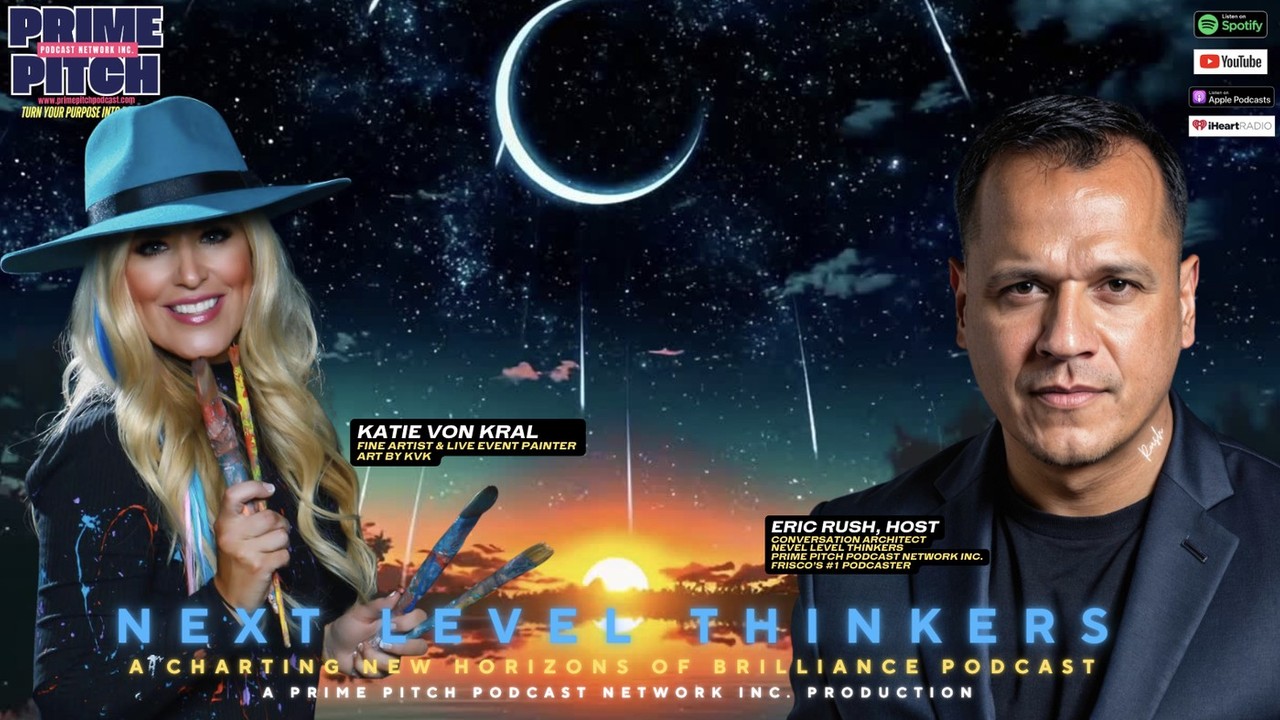
Katie Von Kral
Fine Artist & Live Event Painter · Art by KVK
About the show
Next Level Thinkers is a Charting New Horizons of Brilliance podcast: conversations with high performers pushing the boundaries of effort, mindset, and human potential. Hosted by Eric Rush, The Conversation Architect, a Bronze Star combat veteran and the founder of Prime Pitch Podcast Network.
Read the full transcript
But then as I kept going through the journey with my art and I was dedicated to it, um, you know, there's a struggle with that too because you're, you're depending on, you know, the, the jobs that come in, you know, having to keep hustling to keep 'em, still keeping 'em come in. Sometimes you don't know. Sometimes you have a lot of security for a while. And there were those moments where I was like, um, uh, "God, I, I think maybe you're telling me I'm done."You know? Yeah.
And with this. And then as soon as I thought maybe I was, boom, you know, they kept coming back. And so, um, e- you know, every time I was ready to give up, God said, "No, you know, you're not giving up," you know? And then, and then pretty soon I just embraced, "No, this is what I'm supposed to be doing."We're flying high, yeah. Beyond the stars.
Next Level Thinkers, here we are. Hey, what's up guys? Welcome to Next Level Thinkers, a Charting New Horizons of Brilliance podcast. Before I invite someone to sit in this chair, I spend a lot of time trying to understand why their story won't let g- go of me. With Katie, it happened almost immediately.
I kept coming back to this image of a little girl sitting in church while her father preached. She had a pencil in one hand filling pages with drawings. Most people would have assumed that she wasn't paying attention. Katie says the opposite. She says drawing was how she listened.
And of course, I couldn't stop thinking about that because if that's true, then maybe everything she's become started right there. Maybe that's why she has the ability to see something in other people that most of us might miss. Maybe that's why families entrusted her with the m- with the memory of the Granite Mountain Hotshots. Maybe that's why she's willing to paint people whose names already carry admiration, criticism, faith, and convic- conviction before the first brush trick, brush str- stroke is ever made. The more I learned about Katie, the more I realized the paintings were only part of the story.
I wanted to understand the person behind the paintbrush. What shaped the way she sees people, and what allows her to capture something that most of us might miss? Guys, welcome to Next Level Thinkers, a Charting New Horizons of Brilliance podcast, and this is my conversation with Art By KV- KVK, Katie Von Krall. Katie. Hi.
It's a pleasure to have you on Next Level Thinkers, a Charting New Horizons of Brilliance podcast. Um, uh, you know, I know you just flew in. When did you get in, today? You- Uh, yesterday. Ye- yesterday Yeah, it was in the evening.
Yeah, yeah, cool. Um, you know, I've been following your work, and of course we're, we're affiliated, you know, uh, with Air Power Foundation and the amazing work that Air Po- Air Power Foundation does, and, uh, and, um, it, it's, it's great to see. I see you in action. I've seen you in action multiple times, and, uh, and I was like, "Who is that girl? She's, like, locking in, and she-and she's, she's getting ready to r- rock and roll with, with her art."And, um, let me ask you, as I was reading the cold opening, what thoughts or feelings went through your mind?
Oh, um, you know, one thing that stood out to me was something that you recognized, actually, that I don't know that I've even ever recognized. Uh, 'cause you, I mean, you were sitting there saying how, you know, putting the pencil to paper while I'm listening, I mean, and all of that is true. It did, it did help me for different reasons that I could explain. But how you, you said something about maybe that's why I was able to see things, you know, and I've never even put that together- Mmthat that could have been the start of it, to be honest, you know? Yeah.'Cause I was just a, I was f- like a child.
Of course.5 years old. Yeah. But, um- Wowthat could be true, you know, that that's, that's- Yeahwhat started, you know. Yeah. Um, so anyway, that, that's one thing that went through my mind as you were reading the cold opening.
That, that's a very, uh, penetrating thought, that you were 5 years old and you were drawing at 5 years old, and it was your abi- it was your way of listening to your, your, your father preach. Take us back to, take us back to Sunday mornings. What does that look like in, uh, in the Von Krall household? Yeah. Well, um, so as a PK, we, we were at church a lot.
Uh, so you know, I think as a kid you're, you're not always engaged. Yeah, yeah, yeah. You know? And, you know, you, you go because this is what we do and, and everything. But when, when I would be in the sermons hearing my dad preach for, you know, the 1000th or whatever time, uh, I just, I found, you know, I was always kind of fidgety, wanting to do something.
Mm. And, uh, not having any training or, um, you know, anything intentional as to, to being an artist, I would just draw. Yeah. You know? And, and what I noticed in, and even to this day, I am able to download in- more information- Wowif, if I'm, because, 'cause the drawing is secondary for me.
Mm. Like it's, it, I don't have to think about it. You know what I mean? Yeah, yeah, yeah. So I'm just doing it.
Yeah. And, and then the listening, there, there's some kind of pathway that opens up for me to be able to actually hear what's being said. Yeah. Yeah. How much of, uh, you know, I was thinking about that as you were saying, I was like, how much of that is that, like, you know, I know you were young, so maybe- Mm-hmmit may not apply so much, but like how much of that was, like, emotion driven?
You know, like you, you know, see your, your, your father's up there giving a sermon and is very, you know, spiritual and emotional. Um, how, could you attribute that, some of that, like that was expressing your emotion in, in that particular moment, you think? Um, I, you know, being so young, I think it was more about being, you know, it was like technically I like to make a good piece. I like to, you know, um- Be doing something. Yeah.
So at that young of an age, I don't know that I could say that. Hmm. Okay. You know? Yeah.
Uh, but I think if we went deep enough, we could find something. Yeah. But if, if I'm being really honest, about that young, I don't think I've thought that deep quite yet. Next time I'll, I'll get a couch here. Next time we'll be- Yeah, yeah.
I was like, "Tap into this, get"You know, so- It's been a while. Let's getImagine I'll give you a piece of paper and say, "Imagine you're a child in- Rightin the cubes right now, okay?"Yeah. Okay, looking back, um, who was the, uh, who was the artist that first saw something in you that you hadn't seen in yourself? Uh, so, um, there was probably 3, uh, artists in my life- Hmmwho have come into my life and kind of, I don't wanna say changed the course, probably elevated my, the, to something else. But the very first one, I was in high school.
Um, I was actually very academic. Hmm. You know? And, but I would take the art classes because that, that is what I enjoyed. Hmm.
And, uh, at the time, my mom and my stepfather had hired a, uh, an artist and a, a muralist to come in and do murals in our, in our house. And I would come home from school with my art projects and just, you know, forI would show her my projects, and I would sit and just talk to her for hours while she was painting and drawing and stuff, and I was just mesmerized. And, uh, you know, at the time, she was, like, 6, 7 years older than me, and so that's a big gap when you're that young. What's funny is, um, to this day we're actually best friends. Oh, wow.
But, but at the time, I was like, I just looked up to her. But she, she would tell me, you know, "You're really talented," and she would see my work and, and it, what it led to was by the time I was a senior in high school, she was actually hiring me to assist her- Hmmon her work. But anyway, having recognized that, she was the one that really encouraged me as I was figuring out, where am I gonna go to college? What do I really wanna do here? And I, I actually even had an academic scholarship.
Whoa. And she was like, "You, uh, I really think you've got something here, and you could pursue this," you know? Um, I don't know if everyone in my family thought it was the best idea, you know? But, uh, then I tried to make a calculated decision of going into graphic design first- Hmm'cause maybe that would pay off a little more. Yeah.
But first year of college, I was like, "Yeah, no computers please."I mean, later I, I, I embraced it, but at the timeSo I just switched to fine art, drawing and painting versus graphic design. But she was the one who initially encouraged me and saw that, and which is very interesting because, uh, now I would never see myself as anything but. It was like she actually saw- Hmm'cause I don't even think it's like, oh, you have talent. Some people just have talent, but is it who they are? Hmm.
And what I know now is, like, no, that that is who I am, it is who I was. And so yeah, she saw it. Yeah. You know? Um, that's my first experience of- So give a shout-out to, what's her name?
So Tina, uh, Tina G- Giannattasio was her maiden name at the time. But it's Tina Dia now. T- Tina Dia. Yeah. Shout-out to Tina Dia- Yeahright, yeah.
Right? Yeah. Let's go. No, she has been- All rightvery, very special in my life on many levels, but it started there. That is so cool.
Yeah. If somebody recognized something like that, you know, to recognize your, your, uh, your talent, you know? And, and then that became the s- that was you speaking your truth at that moment. You know, you was trying to gravitate to some other things, right? Yeah.
Yeah. Take some, you know. What was graphic design like for you? I mean, maybe it was too, too linear. Is that or?
You know, no, I actually like the design part. Yeah. Um, I, I had already been doing the murals- Hmmand getting to kind of paint, I call it freely. Yeah. You know, I was, I was doing custom work.
But I just felt confined doing it on a computer, right? I, and I wanted the, the texture. I wanted the, like- Yeah. you know, the thickness of the paint, and I don't know, there was just something about it that it felt flat. Yeah.
Um, 'cause it probably was, butIt is. The computer screen. Yeah. But, um, but I, I didn't, I didn't, I don't hateI still, I actually use it sometimes now. Yeah.
I mean, with AI it's, you know, we don't need it as much now. Yeah. But, you know, for graphics. But, but no, um, it, it just felt confining. Mm-hmm.
And, and that's another reason why I know I'm an artist. You know, confinement, the conforming-and those are all ti- I have a-a little difficult. I love it. I- Yeahyou, we're cut from the same cloth apparently. Yeah.
No, I, um, I, I did some artistic wall finishing a, a, a time or 2. I was hired to, to, to work and, uh, to do some, to help somebody do that, and I was like, "Man, this, this is really cool."And I said, "Well, we're gonna learn how to do this, you know, wall finish or artistic wall finishing."It was pretty cool when I did that. Yeah. You know? Yeah.
I was always impressed the artists that could make a home look, um, you know, aged and all that kind of stuff. Yeah, it was really cool. Yeah. Um, at what point, um, at what point did creating art become part of who you were instead of simply something you did? Like, you say, "Okay, now this is, this is the s- this is my, this is it.
This is the moment."Yeah. Um, you know, I think there were just, there were different steps in life that kinda showed me those things. Um, you know, I had gone to school, uh, for the fine arts, you know, ultimately. But, uh, even through that and getting paid to do jobs all through college, I had my mind set on doing, uh, makeup for film and TV. And so as soon as I got done and graduated with my fine arts degree, I went to LA and went to, uh, makeup school- Ohfor film.
And so I did special effects and all that stuff. Oh, wow. So I was, I was in California doing that, you know, kinda up and down the coast. And, um, I, I don't know if you know about the condition that I've s- suffered with, which is endometriosis. Yes, yes.
And, um, I started having issues with that at, like, uh, 19. I mean, true, I, I probably had them earlier, but 19 is when they hit really, you know, in a, a- And for the pe- and for the people that don't know that, I'm sorry, I didn't mean to interrupt. Yeah. If people don't know what that is, can you explain a little bit about that? Uh, well, uh, endometriosis is a, I mean, the condition is usually defined as, uh, where the lining of your uterus grows outside of it and can even grow into other areas of your body.
I think it's actually a condition that, um, people are very misinformed about. I don't think that, um, they know enough. I mean, they know a lot more than they used to. Mm. Uh, because it, um, m- most people think it only affects, like, your lower pelvic area of your body.
Yeah. But it can go, you know, into your intestines, your lungs, your diaphragm, and in, they've even found it in the brain before. Mm. Um, so anyway, with that being said, yeah, it's a condition that causes, uh, a lot of pain. It can call, uh, a lot of other ailments and things that happen.
Um, generally it's a female condition. I mean, generally 99.9% of the time it's a female condition. Mm. Mm. Yeah.
But, um, there, there's different stages that you could have, a stage one to stage, stage 5. I had stage 5. I also had it, I, I still have it in my lungs and diaphragm. Mm. Um, but, uh, every woman, because it's, can, you can have it in different stages, they, they probably suffer with it a little bit differently.
Mm. Yeah. Okay. And I'm sorry, I didn't mean to interrupt your thought- Noon what you were just talking about, your journey in Ca- Mm-hmmCalifornia and how that was causing you issues. Yeah, coming back to that, uh, so having the endo, we call it endo, uh, Okay.
Having the endo, uh, it, it did create some derailments, you know, with what I was doing. Yeah. Um, it, it eventually was pulling me back to Arizona because we didn't know what I had. Mm. Um, you know, I, I had, uh, several different times where that would happen 'cause I was in and out of emergency rooms and, um, different things, and they, it just took so long to figure out what I was dealing with.
And- Yeahum, with that being said, I also kept getting calls to, to continue my art. And, uh, because my condition didn't allow me to, uh, function every day the way you would with a job where you have to be there functioning every day or on a film set. Mm. You know, you can't tell the director, I mean, I, I pretty much knew when I would get sick 'cause it was timed with your, you know, your month. Yeah.
And, um, so it, you can't say, "Yeah, I, I really wanna be on that job, but just so you know, uh, a week or 2 out of every month I'm probably not gonna be that great."You know? Yeah, yeah. Uh, that's not a good way to get hired, but it's the truth, you know? Yeah. So anyway, as I kept getting the art jobs and, um, it, it, it started showing me that this is more conducive to my lifestyle, that right now I can't change because we could not figure out what was wrong.
Yeah. So we didn't know what was wrong, we didn't know how to treat it. Actually, you said something earlier, you can't know- Yeahwhere you're going if you don't wa- and, and that was- Oh, yeah. I mean, I lived that way for so long with this condition, not knowing. Yeah.
Um, so, so the art, I, it kept pulling me back, you know, to doing the art 'cause it, 'cause it worked. But then as I kept going through the journey with my art, and I was dedicated to it, um, you know, there's a struggle with that too, because you're, you're depending on, you know, the, the jobs that come in, you know, having to keep hustling to keep 'em, still keeping them come in. Sometimes you don't know. Sometimes you have a lot of security for a while. And there were those moments where I was like, "Um, uh, God, I, I think maybe you're telling me I'm done," you know?
Yeah. And with this. And then as soon as I thought maybe I was, boom, you know, and it kept coming back. And so, um, e- you know, every time I was ready to give up, God said, "No, you know, you're not giving up."You know? And then, and then pretty soon I just embraced, "No, this is what I'm supposed to be doing."You know, I, I had another mentor artist that I'd mentioned.
There were 3. Yeah. And, um, he, he is, uh, Frederick J. Brown. Um, he, he's passed now, but he, I spent a lot of time with him being mentored.
He was, uh, he worked with Willem de Kooning, who, de Kooning, who worked with Picasso. Mm. So it's kinda cool. But he would tell me, "You know, Katie, if you have a fallback, you will fall back on it."Mm. And so there were just these cool little messages that I got throughout my, you know, journey, and with these other artists, where it made me realize, "Yeah, I, why do I keep giving myself this out or this, like, spot where"You know?
And, and, and then I was like, "No, okay, here we go."Like- Yeahthis is what we're doing here. I mean, and of course, I don't think if it wasn't what I was supposed to do, God wouldn't bless it. He wouldn't be continuing it. Yeah. So it's all those things that really made it come together of knowing, "No, this, this is what I'm supposed to do."You know?
That- Yeahthat was the beginning of knowing. Yeah. Because I feel that that even evolved, right? Yeah. Within that.
But- Y- yeah, let's- That's my answer. That's, that's- Lock it in. Yeah. Lock it. Lock it.
Do we need a photo, Bren? Just kidding. Uh, no, that's so cool. I mean, that, that is, you know, you have these limita- you know, these, we talked about how, you know, before we got on the podcast, how I had told you, uh, I didn't wanna have anything to do with veteran stuff, and now I host a veterans, you know, a veteran advocacy, uh, podcast. And, and it's so unique that, that you wanna, you know, what do you say, self-sabat- Do you think some of that was, like, self-sabotage maybe in some way?
Could you see it that way? Or did you, you just w- were just trying to f- um, you know, trying to really, like, say, you know, like you would say, "Hey, I got a mental block, that maybe this is a me- a s- mental, spiritual block that I need to get out of"? Yeah. Um, I mean, the more I learn about the brain and how it works, I mean, uh, I, I mean, I, it could've been slightly self-sabotage just because by the way I was thinking. Yeah.
Right? Yeah. Because that's the most important thing. You know, once you know how to think, then you know how to be. Yeah.
You know? And then, and so, so maybe I was, I was too young, or maybe hadn't, you knowI mean, the, the more that I grow spiritually, I think that would've been, that would've changed things. Yeah. You know? Yeah, yeah.
Um, but working with what I knew, um, I think it would've been that. I, I mean, I gotta tell you, the being sick and all that, there's just things that- Mmyou know, when you're constantly being, being taken down, and then you, so you're, you're like, and the, the, uh, the, you have to work against it every single time, and I'm doing this every month of my life, you know, and no, no, uh, resolution, you know, nothing, uh, that's hard. Yeah. You know? It's hard to, uh, when, uh, like, I don't know a better way to explain it, when you've got chains on you- Mmand then someone clips one off and one, and so then you go, "Oh," and then, then they're back again.
Yeah. It's, uh, it's hard. K- you know? So it tookYou know, I'm, I'm a lot better than I was now, so that's part of why it's changed a little in that way. But- Yeahum, so self-sabotage or, or- Just with-outside things that I couldn't control.
Yeah. You know? Maybe both. Yeah, no, that makes sense. Yeah.
A lot of sense, just having in- internal battles and actual, you know, literally physically internal battles, you know? Mm-hmm. That'll debilitate somebody and derail your, your, some people's dreams sometimes. And, and the fact that you didn't, that didn't happen 'cause God ordained that, "Hey, this is where, where I want you to be."The, the physical battle will affect the mental battle. Yeah.
And so I think, like, that was hard. Um, you know, but, you know, I'd, uh, good or bad, I think I was born with a pretty strong will. So even when it was, even when it was difficult and painful, for some reason, God still gave me that spot that was like, "No, I'm gonna get through it," you know? You know, it's cr- it's interesting you say that- Yeah'cause, like, when I first saw you, like, I saw you at, I think it was at The Patriot last year. Oh, yeah.
Last year. That was my first time with Airpower, and I said, you could tell that you had this determine- l- you had this determine, this determine energy around you. Oh, really? Yeah. Oh, yeah, 100%.
I didn't even say, we didn't even talk or anything like that. I just saw you from a distance, right? That girl's got a mission. Oh, really? Yeah.
That's so funny. Like, when I'm painting, or? Or before that, you were setting up. You were getting- Oheverything prepared and just, you- Yeahgetting organized. And I was like, "That girl's on a mission."Yeah.
I could s- I could see that- Yeaha mile away.100%. I'm very systematic. It's like, "Nope, gotta get this done. What time is it? Okay.
Blah, blah, blah."Yeah. I saw that. Um, help me understand something. Um, when someone sits down in front of you, and it could be a subject, not the per- actual person, but when you, you actually have a person or, or, or people that you gonna, you're gonna paint- Mm-hmmum, um, before a single brushsto- stroke is made, um, what begins happening inside of you? So, um, you know, before I work, to get in that space, uh, I, I need to eliminate distractions.
And so it, h- for me, uh, and, and this will all tie in to, to the answer, but I need everything to be put away in, in its phase. I need, you know, a certain level ofYou know, there are certain distractions that I can work with, kinda like the sermon, while I'm working. Yeah. But if, uh, different things are coming at me that won't allow me to focus on it- Hmmum, then it's pretty much impossible. You know, like, I gotta have the right space- Yeahyou know, to be, to be there.
But I would honestly say, going into that moment, the, the way that I g- I, I get there is to really empty out what's going on in my head- Hmmversus what is going through it. It's almost like, it's almost like, "No, we want nothing, just, but just to, like, let, let the canvas come alive. Let me focus on what I see and- Hmmyou know, what color needs to go here to balance out this, you know, over here."Or maybe it's a technical thing or whatever, but uh, it's, if I had other things going on in my head, I don't, I think it wouldn't allow me to do what I need to do. Yeah. So.
Yeah. Uh, I also choose what goes on. Like sometimes I like it quiet. Sometimes I put on a sermon, actually. Oh, really?
You know, music every once in a while. But I actually tend to like talking more- Yeahum, while I'm working. Yeah. Yeah. Maybe it is, is at those times where I still get to download the messages - Yeahin the head.
I like that, a tabula rasa kind of mindset where you, it's a, the blank ta- uh, tablet. Mm-hmm. You wanna start from, you wanna empty it out, and that way you can d- get free from distraction, and maybe that's also what I saw in you. Yeah. That she's on a mission.
You know, it's kinda the same thing. You know, it's like saying, "This girl, she's d- you can tell she's dialed in, getting, trying to get focused."Yeah. You know? As a, as, as somebody who, who c- curates podcasts too, I see that. I was like, "That's something I have to do too."Yeah, like, you're gonna have everything all ready to go so you know when I come in, you know, that, that we're, we're, we're ready, right?
You can focus on the task at hand. Yeah. So that's like getting set up, get the stage done, get all that. And once I know we're good, then I can do my job well. Yeah.
But if I'm worried about how that didn't get taped down right or this didn't, I won't do my job well. You know, I was scheduled that day, or last year I was scheduled to get, get some sound bites, and I said, "I ain't going up to her."Oh, really? Yeah. I was kinda like, "No, no, we, we just"'Cause I, I, I mean, I really meant, like, it was like youUm, I was scheduled. I was gonna go up to you and ask you for a soundbite, but I was like, "Nah, that girl's too dedicated."But here we are, so we got it.
We are. Yeah, we did. We got to. Good deal. Yeah.
You can always come up. I'm probably just like, "Gotta stay."Yeah. I'm not, no. It's just a matter, I think the part is, like, you know, as say God's time is always perfect, and here we are in my studio- Yeahdoing a podcast together, so- YeahI'm glad I waited. Yeah.
It's true. That's awesome. That is awesome. Was there ever a season when you prayed to God, um, to make you different, only to realize He had already woven in, He had already woven into your calling? Um, you know, I, I, I don't think I've ever prayed for God to make me different.
Mm-hmm. Um, un- unless it's like a character issue or something. Yeah. Yeah. You know, improvement like that.
But as far as, like, who I am as an artist or who He made me to be, I think I've always embraced that, um, you know, we are uniquely made. Mm. We are specially made. Mm. We're valuable.
And, um, however God was leading me in that direction, like, I was okay with. Um, you know, I mean, I think younger, not quite as submitted to Christ as I should've been. I probably derailed that a few times. But um, I don't know that I ever, uh, I don't think I prayed to be different, maybe just improved. Hmm.
But not different. Yeah. Yeah. Yeah, I could see that. I could- Yeahimagine that.
Uh, yeah, I was wondering, 'cause you know, you go up against, you know, like you said, your parents were like, "I don't know if that was a good idea for the"You know what I mean? Yeah. as, as they look at your career now, like, you know, how did they, how do they respond to your, how, where you've, where you've taken this? Yeah. I, I think they're proud of me.
Um, uh, you know, and I, I guess I should answer that question a little better. The only times I thought maybe I'd want it different is, like, if it was causing a struggle financially. Mm. Then I was like, "You know, I had an academic scholarship. Maybe I should've been a doctor," you know, or whatever.
But- Yeahbut still, that never- Yeahyou know, again, every time I maybe even thought I was done, it always brought me back. So- Yeahyeah, just continue to embrace it. But back to your question on that, no, I think that, I think that my parents, well, they probably recognized I was strong-willed too. Yeah. But, uh, um, I, I think, I think I did hear my dad say to me in the past few years something about, you know, "I'm really proud of you, how you've really followed your art, and how you've really made something of it."Mm-hmm.
Um, and I know he was meaning that in the best way, and but there was a part of me that thought, "So you were doubting me sometimes?"You know? You know? Yeah. But the outcome is, is that we're good, and they're proud of me. Um, yeah, I know my mom is too, so.
That's beautiful. Yeah. What are their names? Uh, so my, my dad, my, my biological parents, my dad's name is Kurt Crawl. Okay.
And then my mom is Lael Crouser. Okay. Yeah, so when I was young, there was a divorce- Okayvery, very young and, and whatnot. So they're, they're remarried now. Yeah.
But, I don't know. Well, C- uh- Mmshout out to Kurt Crawl- Yeahand, and what was your- Laeland Lael, and Lael for having- Yeahuh, having such an amazing, uh, daughter and, and being able to, um, inspire people with her art and, and God's gift to her and, uh, it's beautiful. Um, I've always been, you know, one of the things is when I saw you in action, right, I was really fascinated by speed painting because e- every decision becomes public, right? Like, that's- that's insane for me to deal with that. Holy c- you know?
Like, thinking about that while everyone else is watching the painting appear, what are you paying attention to? Oh. I mean, I think I'm most focused on, you know, when I'm on stage and there are the speed paintings and- Yeahit's a timed situation. Yeah. So sometimes I'm doing a fast 10-minute to music, which I don't know if you've s- you've probably not seen that yet because all the events- Nowe've done here, I've done- Yeahlike, longer paintings, like 2 hour, one hour, 2 hours.
Mm. Um, either way, though, I know I'm in a time crunch, so I'm, I'm definitely concentrating on making sure I'm pacing myself correctly to get it done, uh, you know, making sure I, it looks the way that I want it to look. But, but also, um, I'm always concerned about the ultimate outcome of making sure it pays off for the, you know, the event I'm doing it for. Yeah. You know?
Uh, they're having me come out, hiring me to do, do this for them and, you know, just, uh, making sure that itC- 'cause ultimately, uh, with the work I do now, it's, I always want it to be uplifting and effectual, you know, in some way that impacts. So if it's, sometimes it can just be what I paint, but sometimes it's what c- uh, it brings to a situation, like they raise a bunch of money from it. Yeah. So either way, I'm, I'm getting to help, right? So, so I mean, there's all those things- Yeahthat, that I'm concerned about, you know, in that moment.
Mm. Um, I practice the pieces beforehand a lot of the times. Mm. And so, um, it becomes second nature by the time I'm up there. Yeah.
You know? At least that's the goal. Yeah. Wow, that's interesting. I never thought about that, you're, like, you know, you have to, you know, when you're doing that kind of work, you gotta practice, you know?
Like, you gotta prepare to, to present something, you know? It's not something you, like, you take lightly. You gotta work on your craft outside of this. Mm-hmm. That's in- That's very cool, man.
I didn't, I didn't think about that, but that's, like, that's just, like, prac- you know, it's just, it's super necessary for you to become that expert level. Um, um, when something unexpected happens during a performance, what usually, what, what usually takes over first? Preparation, instinct, faith, or experience? Um, so, uh, I know this is kinda generic, but I would say all of those things happen. Okay.
You know? Um, it, I, I haven't had too many moments where anything was unexpected to the point that it wasn't salvaged. Yeah. You know? But, uh, I feel like it's like anything in life.
Those things kick in. Your instincts kick in. Of course, it's gonna be better if you have experience. Faith is at the core of everything. Yeah.
You know? Uh, so, so no matter what, umA- a- and I always just believe, same with like a painting, uh, to me it's you can't mess it up. Yeah. You can fix it. It's paint.
You know? And- Oh, yeahyou know, maybe the timing's different than you planned. Maybe it d- you know, it's not exactly the way it was supposed to look, but, but sometimes those are the best pieces. Mm. So, uh, to me it's also- Yeahkind of life, you know?
Um, you, you embrace it, you work with it, and then, well, look at this. It, it actually came out better. Yeah, yeah. You know, something's better because of it, you know? Yeah, yeah.
Actually, I just got back from, or came straight from an event in Colorado, uh, doing theI was painting with a Chicago tribute band- Mmwhich was, it was cool with the mountains behind and all that. Oh, that's cool. Uh, but the sound went out in the middle of the concert-and I'm painting. So anyway, everything just stopped, you know? But, and so I just, I stopped too, covered the painting until we got it back up.
You know, it was only like 10 minutes or something. But, but what everyone said was it was kinda good for the whole event 'cause it was like it broke the tension. Oh. Right? I don't know, like everyone, even in the- Mmyou could feel it.
After that everyone was just, you know, more relaxed. Yeah. So I don't know, you know? Yeah, yeah, yeah. Things happen the way they're supposed to.
Yeah. You know? There's a- Yeahbetter season than planned says- Yeahyou know? It's like now we need to give this a break. Yeah.
Let's plug this music up now. Yeah. No, it's, that's, that's so cool. I think you're right. I like the metaphor you used too, 'cause you know, like you said, just like in life, you know?
Mm-hmm. And that you, you know, all these instincts, the faith, and the, the, you know, your experience in how you handle adversity in these particular moments and just in life in general, I think that was an excellent, uh, correlation with that. Um, has a painting ever surprised you? Um, it c- can, uhIn what way? That's a good question.
I ask the questions here. Yeah. You're like, "I, I did not give you permission to do that."No, I'm just kidding. You never know. Um, you know, I don't know.
That's a, that's a high level question. Okay. That I can't answer. No, I think it's like where it took your, it took your breath away, you know? So like it shocked you.
Like, it's like, you know, it could be, um, it could be the response, it could be, you know, it could be however y- Yeahwhatever lane you wanna go down. Okay, gotcha. Whatever, yeah. Speak to whatever, whatever you think it is. Yeah.
Okay. Um, so on a, on a just a aesthetic level- Yeahum, when I'm doing the, the stuff on stage, I don't get a minute to look back, to walk back and look at my piece, right? Yeah. When we're doing murals and paintings as artists in our studio, we're gonna get up probably, you know, every few minutes or an hour, whatever, and we step back to look at our piece. Yeah.
But when I'm on stage, I don't, I don't get that kinda time or, or, you know, whatever. So, so sometimes I, I will look back or when I'm done, and I'm always like, you know, maybe I have someone there then, uh, and I'll be like, "Does it look okay?""Oh yeah, it looks great. It looks great. Like, you need to come see it from back here."You know? Yeah.
And, um, I mean, 'cause I'm so up close to it, and then I, I- That's trueI get back there and then I'm like, "Oh, that does look good."You know, even that. Yeah. So I mean, there's those little surprises like that. Yeah. But, um, you know, and, and kinda what I was saying before, there are paintings where maybe I'm frustrated with where it's going or whatever, and it's, it's those moments of really having to dig in to get there.
Mm. And then they end up being better. Yeah. Um, so those are nice little surprises. And then, and then I love the surprises where we do events and the paintings go for 15, 20 grand.
Yeah, yeah. You know? And all of that, of course I love those. Those are cool. So yeah.
Yeah. Yeah, that's cool. Those are the things that come to mind. That's awesome. Yeah.
Yeah. I wouldYeah, I was just, that's a good question. I think I was like, you know, that's awesome. Uh, your live performances have helped raise money, we're talking about that right now- Mm-hmmum, um, helped raise signific- sig- significant, uh, support for charitable causes. do you remember the moment you realized your gift could become a form of service?
Um, so I would definitely say that really came more to light, I mean, I may have known it to a degree, but really came to light whenSo then this is the third artist that influenced me. It's, it's good it's all coming through. Yeah. Uh, Randall Hedden, uh, he's also a speed painter. Um, he's a lot older than me, um, more seasoned.
His work, he's, he's excellent. Very good artist. Mm. Um, but when he brought me on to speed paint, like, 'cause I was, I always was doing the, the art, fine art and all that, but this was like maybe 12 plus years ago. Uh- So Randy, we call him, he, we had a mutual friend/client, and he was talking to him about, "Hey, I really wanna add a female to my show."Like, so it's not just him on stage.
Hmm. You know, and we do- Yeahlike a cool thing together on stage. Yeah, yeah. And, um, client friend said, "Well, I think I know the girl, you know, that you should talk to."So he got us, you know, hooked up talking with all of that stuff, and Randy's like, he's like, "Listen, uh, y- I've, I've asked other artists to do this. Um, some of them just say no right away 'cause they're not comfortable, you know, in that space, or they just simply don't wanna learn something new, or they come for a while to learn, and then they quit."And I'm like, "Well, I'm game.
You know, let's see what we can do here."And so, uh, we, we did go in the studio for a good 6 months, you know, learning, practicing, making sure we're ready, I'm, I'm ready to be on stage. He was fine. Um, you know, doing some shows together. But, uh, when I got to go to the events he was already doing and then the ones he brought me on, uh, that was when I got to see how these paintings would go for X amount of dollars, and then to- towards whatever foundation- Yeahor helping veterans or whatever it might be. Um, and it was like, oh, th- this can really you know?
Um, that was the first moment I saw, I saw it in that avenue. Yeah. Uh-huh. Yeah. As things have moved forward, now I concentrate even, I do work for, um, you know, people where I get to commemorate, you know, some event that happened.
Yeah. Sometimes it's tragic, sometimes it's not, but no matter what, it's bringing light to something that deserves that honor. Yeah. Um, and so in both of those ways, I've gotten to see that develop. Yeah.
Um, but I think the, the most that stands out as far, as far as the beginning moment for that was working with Randy and doing the speed painting for- Hmmfor foundations and- Yeah, yeahcharitable work, yeah. That's awesome, man. As the, you know, 3, 3 significant, um, mentors and models of your you know, transcended your experience as a painter. That's, like, so cool. Yeah.
You know? Not everyone has those kind of people, you know, where they s- they have these 3, 3 significant people who have actually helped, helped them evolve, you know. You break the doors wide open I should say, right? Mm-hmm. Mm-hmm.
Um, which brings us to the, to, to the, the Granite Mountain Hotshots memorial because it, it's spec- it's something special, right? Um, you weren't just painting a mor- a mural. You were being entrusted with the memory of 19 men and the families who continue to live with that loss. Um, when did you begin carrying that responsibility personally? In particular with the Granite Mountain Hotshots?
Yes. Okay. Um, so that, covering that story and doing the mural for that, um, came about because of the TV show I was hosting. I was, like, the host/artist, and I, I got to pick the stories and the people I would interview. And that particular episode, which still needs to be edited, we have the footage, but, um, so in case people are wondering where it's at.
Um, you know, that was the one that I- because there was so much to cover- Mm-hmmand, and bring light to, I, um, that was the, it's the grand finale episode. And, um, uhLet's see. You asked me when that came about, but I'm trying to remember- Yeahhow we started the question. Yeah. When did, when did you begin carrying that, that responsibility- Yeahpersonally, yeah.
Yeah. And so whenYou know, and that was one, another one of those moments where it was like, well, I'm gonna reach out and see if the families are open to, you know, want to, to being interviewed.'Cause what I would do is I would, I would collect the information, interview people because I think the stories are important. Yeah. But then I would, you know, with that information, ch- produce, produce the work that would be revealed at the end of the show to honor, you know, these guys and the families and everything. Yeah.
So getting that to even happen was a lot and, and really a God thing. Yeah. Because, um, all the things that had to come into place for that to happen because it was, um, you know, it was, it was very well recognized, the, the reveal of the mural. Mm-hmm. Uh, we did it on the 10th anniversary of the death of the Hotshots, so it was on the news, you know, all over Arizona and, and all of that stuff.
So in carrying that weight, you know, I mean, I, I brought it on as far as accepting that to do it, and I actually asked for it, but when I did, um, uh, I'm not sure if I knew all the weight it would carry. Mm. You know? And so going through it, um, I was extremely emotional and, and I did feel the weight. Mm.
You know? I mean, just painting these guys, um, I did the majority of all the portraits in the mural, and, um, there was something, you knowAnd I, I had interviewed some of the, the parents, the wives, you know, siblings of some of these guys, and, um, just really making sure that you're honoring the families, you're honoring the man that, that was there and, but also why is this still good? Mm. Why, how can we still see God in this situation? Mm.
So every one of my episodes, that was important to me is that we always brought it to a point where there could be some level of hope, some le- some message, some level of comfort- Mmbut something- Yeahthat, you know, um, really that, that God could bring, you know- Yeahto, to, to the situation. But- Yeahum, that, that was how that, that came about, you know? Yeah. Mm-hmm. That's really, that's really, really impactful, you know, is to have some remembrance and always give it a living entity in this world.
Like, you, you literally, like, imprinted that, that in the world, you know? They're not gone. They're, they're gonna be forever in a, in a, in a mu- mural. Mm-hmm. So that's like, that's like, that's next, that's just like next level stuff, you know?
Like, and no pun intended, but it is. Like, that's that, that's that higher level of God consciousness I like to say is like, like, you know, your responsibility to take that on and ask for it. Like say God pushed you that way and said, "Ask for this," you know? And, and you were, you had that, that emotional and mental, spiritual, psychological wisdom and, and, you know, it's like, that's, that's amazing. Yeah.
Yeah. It was heavy. Um- Yeahyeah, 'cause I, I interviewed even, like, the fire chief- Yeahand, you know- Yeahwhoever was willing really, you know- Yeahto talk about it. Yeah. Um, but yeah, it w- it was tough.
It was tough. Wow. Yeah. Well- Just, and just making sure you're, you're honoring them correctly, you know? Yeah.
Like, the people who are still living that still love them. Yeah. You know? Yeah. Yeah.
Um, has, has there ever been a commission you chose not to accept because it conflicted with your convictions? Not, not in any way that was, like, you know, very serious. I've had, you know, probably males joke around about certain pieces that are maybe inappropriate or something, but- YeahI, I shut those down real quick, so-we don't have an issue there. Yeah. Yeah.
I don't think I'mNot, not really. I also think people know. I mean, I don't, I don't publicize exactly, you know, I mean, I, at least I don't think I do. Uh, I'm not pushy with where I'm at. I just like to, hey, here's an experience.
Here's what I know. You know, um, but you can tell if you see my social media, you see, you know, you kinda c- I think you can tell who I am. Yeah. So- 100%I would say people that wouldn't wanna, you know, wouldn't approach me, you know, they probably wouldn't anyway. Yeah.
So- YeahI think we're good there. Well, they say, "I don't want everybody to like me. I should think less of myself if some people do."Yeah. Yeah. I think if everyone likes you, actually, that might be a, you know, you might need to think, like- Yeahyou know, like- No one, doesn't like me.
Yeah. Right. Like- Okay. Uh, let's see here. This question, um, let's turn, uh, let's turn the turn to your Charlie Kirk painting.
Mm-hmm. Um, because public figures often arrive carrying, um, other people's opinions before they ever arrive as people. What convinced you that, like, what convinced you this was a painting you needed to create? So that's, that's a good question. Um, interesting because, uh, and I've said this several times, I'm very planned.
I like, and part of it is, like, a, th- there's some ADHD here. So I have to be very systematic in, in, you know, managing my time and stuff and, and I stick to it, too. And so, I mean, years, actually, Frederick Brown was the one who told me, "You need a calendar. You gotta do that or you're- Yeahyou're gonna have anxiety all over the place."And so I, because of that, I stayed pretty close to everything that I, you know, planned to do. When Charlie got murdered, um, there wasn't even a pause for me.
I've never stopped everything I was doing, uh, ever- Oh, that's rightto, to do a painting. Yeah. Ever. And, um- I just, I was, I was just completely, uh, I'm doing a painting of Charlie. Like, and, and for me, it wasn't like getting on the bandwagon with, you know, other artists or evenI had no idea how many people would even see it, to be honest.
Yeah. It, it, I kinda just did it for me Yeahin a way, you know? Yeah, yeah. Um, and, um, I calledSo one of the, the, the guys who did some of the camera work on the episodes, I know these guys charge a whole bunch of money, but I'm like, "Hey, this is Charlie. Who knows?"Yeah.
So I called, I called him and I said, "Would you be interested in shooting this video- Mmof me painting Charlie? You know, I want to have some kind of message with it. This is like, this has hurt a lot of us to our core."Yeah. Um, but we need to be a part of the, what, what this is gonna bring because of, of, you know, what hap- what Charlie, you know, his legacy. Not just his legacy, the message.
Yeah. You know? And to me, um, it wasn't political at all. It, it was faith. It was a direct attack on faith.
Mm. Because, um, I don't believe Charlie was doing anything he was doing out of, you know, wantingAnd it, the agenda didn't come from selfish reasons and to, to complete this agenda. It came from his calling to who he was as a man of God. Yeah. And, um, when he got murdered, when, you know, people say, "We are Charlie," it's because when they killed Charlie for who he was- Mmthey killed us too.
Yeah. You know? And, or, or they s- they at least put a bullet in us and we felt it, you know? Um, so I had no pause. Like, and I just, we did the painting, we did it, put it out there, and it just, it happened to circulate, you know- Yeahquite a bit.
Yeah. And, and led to some, you know, big things that I painted for, which was cool. Um, but I didn't act- I, I have to say, like, I, I don't even know that I'd had to make the choice. It was just- Mmso automatic. Yeah.
It, it, it, it really got me to my soul. Yeah. You know? Yeah. So, um, yeah.
Yeah. For me, doing the Charlie painting, uh, that was my way of saying how can I continue forward in any way what he was doing- Mm, yeahyou know, with what I have, my talents, and, you know, how I can present something. And so, uh, even, you know, when I did get approached to do, um, any work with Charlie, I'm like, "All I want is my costs covered," and then that was it. That's it. Yeah.
You know? I'm notLike, that, that is, that, that's the core of everything, right? Yeah. To me. Yeah.
Attacking your faith. Yeah. That's, uh, got me emotional. Yeah. That motivated me from- Yeahyeah.
Mm. Yeah, it's emotional to hear. Yeah. It's, it's im- what, what, I think what im- got me emotional more is I, that was like a, like a, it was like there was no question about w- you know, that you had thatWhen you have that untamed faith- Mm-hmm'cause that's what that is, right? Yeah.
Like, when I see that untamed faith, it's overwhelming. Yeah. And, and you sharing the way you had shared this, how you went about it. So like you didn't even think you hadYou didn't even think about it, you just see something that just untamed, right? And that was overwhelming, powerful to, to like, to li- as, uh, as you listening to your response, it's just like, you go, "Whoa, that just like hit me," because, 'cause that's, I think, you know, I think, yeah, Charlie's life, you know, uh, um, a very important, uh, centerpiece of our, our society was lost in that, in his, in his willingness to get in front of people and share, you know, and, and educate people and, and, and talk about Christ and talk about, um,uh,change is possible and all the things he talked about was, you know, he was out there in a, in an, a, what was supposed to be a safe environment.
Mm. You know? And his life was taken, murdered. He was murdered. And, uh, and, um, but the fact that you, again, you, you took action right away, that's like beautiful.
It's like awesome. And I was talking to my friend, our friend actually. Um, he was telling me, uh, he- we were talking about the Charlie Kirk painting and- Mmand, uh, he said he, I think he has it, right? Or something like- Kevin, yeahyeah, yeah. He has one of them.
Yeah, he's one, he has one ofYeah, so he, so he was just talking about how, you know, you know, how important that was for him to, to, to have one of, to have one of 'em. And, and, and, um, and that, um, he said just, it was just a real talking point that we talked about. I said- Yeah"I was gonna have you on the podcast."He's like, "You are?"I said, "Yeah."And yeah, I says, "Yeah, yeah."And I think he's the one who introduced you to Airpower. Is that right? Yeah.
Yeah, yeah. He found me. That's very cool. Yeah. That's awesome.
Yeah, no, Charlie's death was a pivotal moment in history. Yeah. It was, there was a, it was a worldwide revival. I mean- Yeahum, and I just know for me personally, it was a major moment for me of just, I don'tIt's like I always, I've always thought that my faith was strong, but after that point, it was like, I don't know, something happened even for me where I was like, "You know, we should all be that convicted that we will do our job as followers of Christ and be willing to die for it."Yeah. And at that point, I was like the, the, the level of submission and the freedom- Yeahand it, and it was because of Charlie.
Yeah. You know? Um, and it wasn't because of Charlie before he died, and I'm not saying his influence wasn't that- Yeahstrong before. Yeah. But when that happened, that changed things for me.
Yeah. Yeah. So. Yeah. That's, that's b- that's awesome.
I- YeahI s- there's a book called The Barbarian Way. Yeah. And it talks about un- untamed faith, and it just talks about like how, you know, you should be, live life, your, your faith should be barbarian. You know, like you should live life untamed, where you're not, you know, conditioned to respond. And I think Charlie represents that barbarian way, where he was out there, you know, unafraid, un- you know, knowing that there would be, there may possibly be a consequence that would take his life.
And, um, um, and for you to have the, the, the- Tenacitytenacity, the conviction, the- You know, likeyou know, like you're standing your ground with him, you know? Yeah. That's beautiful. Yeah. That's awesome.
Well, there's that, that determined thing again, right? Yeah. Yeah, that's one of the best- You know, it's funny-thingsit's funny you say that 'cause I know, uh, even when I was little, like we're talking like 3, like some really, uh, good family friends of ours that I've known since we were little. Yeah. The Mountages, Mike and Mary.
And Mary, I remember she would always say, "I just remember when you were a little girl, you were just so determined."That's, uh, it's, I'm like, "I guess that's a, must be one of my characteristics because that's very consistent."Yeah. I wasn't gonna interrupt you either. Just kidding. Yeah. And let's see.
When someone stands in front of that painting, right? Mm. Charlie Kirk painting. Right. What do you hope happens?
Uh, I mean, it's all gonna relate back to what you said, is like, I mean, first it's, you know, uh, honoring and recognizing the man, Charlie. You know? Um, but ultimately it's, it's, it's the message. It's the message of why he's not here anymore. It's the message of what you should be doing because of it, you know?
Yeah. Um, uh, yeah. I mean, to me that, it's that really. Yeah. You know, ultimately it should be what he always preached, you know, or, or taught.
Like it, in the end, hopefully it brings glory to God in some way. Yeah. You know? Well, the fact that we're speaking his name right now and, and, um, in relationship to Christ is like already a W. And, and then this is gonna go out to as many people as I can get it to in manyAnd yeah, so that's awesome.
Yeah. Um, once a painting leaves your studio, people naturally bring their own stories to it, right? At what point do you have to let go of trying to control what it means to someone else, if that even's a- Yeahthing you could do? Um, you know, I think generally I'm al- I'm always gonna kinda sit back and let people- Mm-hmmum, you know, figure out what it means to them, if someone asks.'Cause a lot of people do."And what were you thinking? What was your intention here with this piece?"And so then I'm, you know, of course I'm happy to talk about it.
Yeah. Uh, but even at that, I still want it for them to figure out how it's relevant to them- Yeahand what it means to them. Yeah. Um, so I guess the only time maybe I would care is if it was being misinterpreted badly. Yeah.
But otherwise, no, I want it to resonate with them. You know? So what, in what way does it resonate with them? And may- maybe I can add to it, you know, for them if, if we can talk about it, but. Oh, yeah.
Yeah. That's cool. Yeah. Yeah, it does. I guess you're right.
I mean, now, now you says, "How does it resonate with you," you know? Mm-hmm. That's awesome. Um- Like, you mightI mean, what do you see when you look at my Charlie painting? Oh, I see-I see conviction.
I see- I'm asking the questions. Well, I'll answer that. I see, I see a man can, um, as, you know, like I said, untamed faith, a bar- you know, the, the, um, standing, standing his ground, you know, as, with Christ as his, as his centerpiece and, and, and knowing that his life would be pr- um, would be covered No matter the outcome of, of the disagreements or the, the whatever was coming. Mm-hmm. And, um, and yeah, that's who I b- that's what I see.
Yeah. Absolutely. See, I love it. Yeah. I mean, and- Yeahso it isActually, I like hearing how does it, you know, how did it, how does it, and, you know, what do you see when you see this?
Because- Yeahsometimes people see things I don't see. Yeah. You know? And, and so that's cool, like, kinda like you even said at the beginning with the how things may have started- Yeahyou know, with me drawing during sermons. Yeah, yeah.
You know? That's awesome. Yeah. Okay, let's see here. Couple more, and we'll wrap up.
Uh, let's see here. Um, over the years, you've encountered remarkable people and extraordinary stories. What have those experience, experiences taught you about being human? So, um, because I, I've, have come across some really amazing people, I've come across people who have been through major adversity, there is one that really stands out to me. I mean, it's, uh, it's a lot of those interviews I did during the TV show.
Yeah. But I did have, um, Mark and Nicky, I don't know, Mark Fugarille f- and, uh, Nicky Browder. I don't know if you know who they are, but Mark was a, a victim of the Boston bombing. Mm. And, uh, both of them, for different reasons, do life without all of their limbs.
Like, and- Mmyou know, Mark having gone through this major, uh, you know, incident, um, you know, PTSD-type things that you've seen, you've, you've gone through, and then he continues to do life, and he does it with still, uh, gratefulness. Mm. He does it still with, you know, um, a message, inspiration. He does it with a smile on his face. He does it in pain.
He does it, you know, uh, you know, I mean, I sometimes, and I think about the endo, you know, and, you know, the, the, the perseverance you have to have with these things. But for me, it, it would affect my attitude, it, you know, at times. Not, not as much anymore- Yeah'cause it's not as bad. But, um, when I got to sit down and be around these kind of people, and knowing what they went through, what they still go through, and then how they're still doing life, um, I just remember sitting there going like, "I am, I need to be so much more thankful."Yeah. You know?
And, and grateful. And, uh, it, you know, there are times when I'm praying and I'm like, um, I'll, I'll thank God for just silly things, you know? Like, "Thank you for my fingers. Thank you for my eyes that can still see. Thank you for"You know.
Yeah.'Cause they don't even have their legs, or they don't have th- and, and they're, they're out skiing. How do you ski without yourThere's ways that they can do it. Yeah. You know? And but- Yeahfor me, I'd be, I'd be like, "Oh, well, life's over now."Yeah.
You know? Yeah. And, um, so just, I don't know, being able to see it in a way where, you know, it, how, how it's still good. Yeah. It's still good.
Mm. You know? Yeah. Yeah. That's- It's trueit's true, too.
Like, I've, this year, actually this year, Kevin-Kevin Fallon, he, he c- he called me up and he said that Air Power had this e- event, uh, it's called, uh, uh, Adaptive Training Foundation. Mm. I don't know if you know who they are. Uh-uh. They deal with, uh, people with limb loss.
And- Okayand it was a training, um, training, a hyper training that he asked me if I wanted to attend. I would go and, and be part of the training. And I, I just had 2 hip replacements, so it was like, I said, "I really need to kinda get that next gear going," you know, 'cause it kinda shut me down a little bit. And, um, so I went, and it was the first year that I actuallyI mean, it was the first time I had ever been around with individuals with limb loss, you know, at, to such an extreme level, you know? And they, what they do is they tr- they do do a complete workout.
It's a whole, like, intense workout. It's like boot camp- Yeahfor real. Like, they don't, I don't, they don't care if you're in a wheelchair. They don't care. You know, they say, "We're gonna push this limit.
We're gonna, we're gonna find a way to do it anyways."And- Rightand they push it, push that, and then, um, and, uh, it was sup- so surreal to, like, realize, like, you know, like, these, these individuals are, are dealing with limb loss s- but their spirit, you know, like you talk about, and that's the thing. That's what I was thinking about. Yeah. Is, like, theirIt's, like, supernatural, super, you know, omnipotent, om- omni, you know? The omnipresence of healing in them that, that takes them to that whole, you know, that whole nother level, you know, to watch that and be a part of it and, and, and say, "I had hip, 2 hip replacements."This guy, you know, this guy, one of the doctors, like, had a flesh e- eating bacteria.
He had, like, 0%, uh, 7% body fat. He was a f- well, I mean, BC would see is amazing. I think I sent you the video of that one. The podcast of that guy. Yeah.
Yeah, uh, Dr, uh, David Osman. Yeah. His story's so compelling. But, but, uh, he, you know, you c- you, you see this guy and he's, you know, rehabilitating his life and, and but m- I have such admiration for, for the individuals that have to overcome those d- physical disabilities, for sure. Yeah.
Yeah. And I think, um, so when, you know, you have parts of your life in which I think, I think you have to. I think if you're gonna walk as a Christian, the Christian walk, you're, there's always gonna be something that creates the, the need for dependence on God. Yeah. And so in any of those situations where you're asking me about these remarkable people I met, I will tell you that in every one of my interviews that I did, it, they would all come back to their faith.
Hmm. And you know how I think that, that, that area that needed God, right? Because it, that, that maybe you're missing this, that you, I have toIt still creates that dependence and, you know, on your faith and carrying you through. I think it all works together. Um, but I, I did notice that too in all ofEven the Granite Mountain Hotshots, so tragic.
I mean, um, even some of these families that you look at and you're like, "Wow, they're, they're, they're crying, but they're still smiling."Yeah. You know? They're joyful tears. Mm-hmm. Yeah.
Um, okay. So, uh, what do you got working? Okay, we know that you and I are gonna be at the Air Power Foundation's Patriot Roundup, um, this, this week on Thursday- Mm-hmmuh, June 30th, or July 30th. Yeah. And I'm really excited about this one.
This one's about farmers, and, uh, this is, uh, honoring western heritage farmers and ranchers that, uh, veterans that, that are f- um, that are farmer, ranchers that served our country. Mm-hmm. And, uh, when you walk into this p- this event this year, um, what, what are you walking into knowing that? Oh. ItWhat am I walking into, like?
Like, knowing that this is what we're, we're honoring. These, these are the, this, this is the essence of our, of this particular roundup, r- uh, Patriot Roundup. Like, last year was honoring n- Native- NativeNative Americans, right? Yeah. You walk into this one, and you're, and we're doing veterans, uh, mar- farmers and ranchers that served our country.
Yeah. What, what, what are you walking in with? Like, uh, you got a surprise for us? Well, I am gonna paint live- Okayat the event. Yeah.
And then there have been some that I've done prior to the event. Okay. So I think those are gonna be surprises for several people- Yeahum, which will be fun. Um, I think this is gonna be really cool. I don't know if I can say, I think I can say Red Steagall- Yesis our, you know, one of the celebrity spokesperson.
Yes. Um, which I think Fort Worth is gonna be really excited about that- Yeahis what it sounds like. Yeah. Um, uh, I mean, it's gonna be exciting. I think whenever we can honor veterans in any way, shape, or form, you know, I think, uh, that'sI love doing work where it's, it's recognizing people who, who are, who sacrifice, who, you know, have served our country, and they, that this is, you know, getting to know you're doing something influential and something that matters.
Yeah. Right? So no matter what, walking in, that's great. You know, um, yeah, doing the, the live painting and getting t- you know, to be a part of all of it is als- is awesome. W- and the h- honoring farmers and ranchers and in the Western arena is a little bit up my alley, so that's nice, you know?'Cause- Oh, yeahyou know, 'cause I do a lot of the- Yeahpaintings of country western- Oh, there-type stuff and- Yeahwhatnot.
Yeah, yeah. So, um, so that's fun too 'cause it, it kind of fits- Fusesyou know, in there. But yeah, uh- That's coolyeah, so it's exciting. Yeah, a couple days we'll- Yeah, we'll be- We'll bewe'll be watching. Yeah.
Enjoying ourselves. Um, uh, what else? Well, I got one more question. I'll ask you this, um, in just a few seconds. Um, what, uh, what other projects are you working on?
Any other projects you're working on? Like, uh, um, and are there ways that people, if they wanted to reach out to you, how, how could they do that? Yeah. Um, so I'm, I always have custom, uh, commissions usually going at the same time- Hmmyou know, that take longer. Yeah.
They're more detailed. Uh, at the same time that I'm, you know, preparing for shows and doing shows. Uh, I still do murals every once in a while too, and, and, uh, if I can pull out an original here and there that's, shows mine, I, I like to. Yeah. Um, I tend to be kind of booked up, so I don't get to do that as much anymore.
But, um, I have a couple projects. I think I can say that, and there's some for the Petroleum Club in, in Fort Worth. Okay. Like, um, on the horizon here, there will be some new pieces there. Nice.
Yeah. Um. And, uh, some financial management firms and stuff that I'm doing stuff for. Yeah. But, uh, yeah, and then if, if people are interested in, in any of that with me, they can, they can, uh, call me, text me, email me.
Website? Yeah, artbykvk. com. And, uh- Yeah. And then harveykavink@gmail.
com. That's awesome. Yeah. You know, it's, it, it's such a pleasure to have you. You know, when I, when I started thinking, was like, "Man, how many artists have you had on podcasts?"I'm like, "None."Oh, yay.
Yeah, yeah. first one. But I think it's, I mean, you know, think of artists, you know, and they, you, you, you wanna know if you can go, you can go into their space and like, you know, you know what I'm saying? And, and get to know them. And it's a, a, it's, I mean, it's a beautiful conversation we've had today.
Um- Yeahlast question and then we will wrap up. Um, when people encounter your work long after both of us are gone, um, what do you hope they understand about the artist behind the art? Wait. About the artist behindWhat, what do they understand about the artist behind the art? Um, I think, uh, I think that the, one of the, I mean, a couple things come to mind.
Um, I definitely hope that they understand that, uh, all of it was hopefully to make some kind of impact. Sometimes it's small. Sometimes it's just, "I love that piece and it makes me happy."And then sometimes it means something deeper. Mm. But hopefully it leads them to a place that is different and better by having, by seeing it, by having it.
And as far as me as the artist, um, that, I mean, I mean, I just probably that I genuinely, it, for me, I, I, I put my soul into it and it's, it's, I, I mean, I know it's what God wants me to do. Mm. You know? So prob- maybe it's just even that. Yeah.
You know, it's genuine. Yeah, yeah. Yeah. That's beautiful. Yeah.
That's, that's so great. Um, Katie, it's such a pleasure to have you on Next Level Thinkers: Charting New Horizons of Brilliance podcast. I think you charted new horizons-of brilliance, and it, it was natural, too. It's like, you know, the, um, you show, uhYou know, when you sit down with people and you just, you listen, like I've listened today, it's like, man, it just kept going higher and higher. Yeah.
I was likeSo it's been a really great conversation, so thank you so much- Yeahfor being on the podcast. Thank you for having me. Absolutely. Yeah. All right, guys, that's it for Next Level Thinkers: Charting New Horizons of Brilliance podcast.
As I always say, have peace and enlightenment, and remember that the ocean refuses no river. Next level, next level. We're reaching for the sky. Next level thinkers, we're aiming high. Pushing through the galaxies, no turning back.
We're on a mission, blazing a funky track. Next level, next level. Come and take a ride. To the future, where brilliance and power collide. Get on up.
Get on up now.