Kara Martin
Kara Martin joins Rush on Unfinished Business, the show for veterans pursuing new missions after the uniform and the people who stand beside them. As u.S. Marine Veteran · Veteran Advocate, Kara brings the weight of service and what comes next to the table.
They get into the work, the cost, and the reasons it still matters, in the kind of long-form conversation this show was built for.
In this conversation
- The transition out of the uniform
- Finding the next mission
- What stays with you, and what you build next
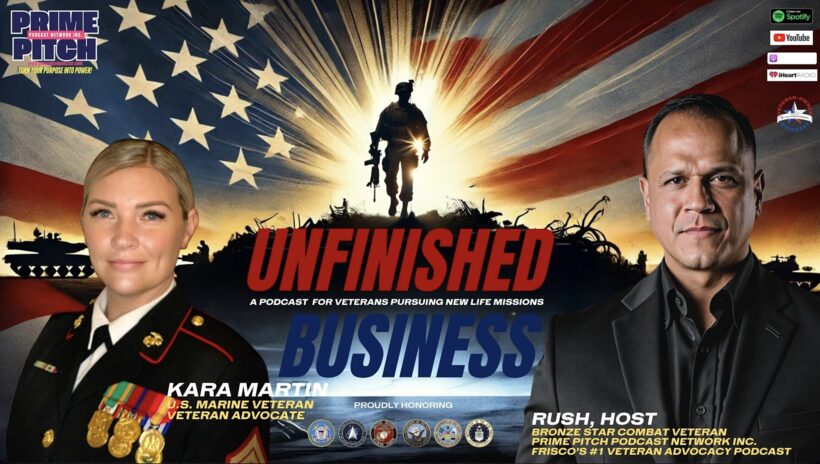
Kara Martin
U.S. Marine Veteran · Veteran Advocate
About the show
Unfinished Business is a podcast for veterans pursuing new missions after the uniform, and for the families and communities who stand beside them. Hosted by Eric Rush, The Conversation Architect, a Bronze Star combat veteran and the founder of Prime Pitch Podcast Network.
Read the full transcript
But then I saw other veterans struggling to do that and get out. And then I started losing my brothers and sisters in that same manner. So that was my defining moment on how can I change that? How can I make a difference? And I personally struggled with it.
So I knew that it was something near and dear to stop and see how we can help because it was so difficult. Happy birthday, United States Marine Corps. On this special day, we celebrate the legacy of the few, the proud, and brave. For nearly two and a half centuries, the USMC has exemplified honor, courage, and commitment protecting our nation with unwavering dedication. To every Marine, past and present, your service and sacrifice inspires us all.
Your courage fuels our freedom, and your commitment strengthens our nation. We stand together, proud to call you our heroes. May this year be filled with new victories, camaraderie, and the knowledge that your spirit lives in every heart you've touched. Happy birthday, Marines. Semper Fi.
Today we have the special privilege of welcoming a remarkable individual who has left an indelible mark through her dedication and wavering commitment. Carolyn Martin's journey into the military began at the early age of seventeen and she went on to become an aviation hydraulic structural mechanic in the United States Marine Corps. Throughout her five and a half years in the Marines, she displayed remarkable poise in the face of challenges, including deployments to Japan and active duty during Operation Enduring Freedom in 2011. But her passion and commitment extend beyond her military career. Armed with a bachelor's degree in psychology and a master's in social work, specializing in veteran services and mental health issues, has emerged a powerful advocate and resource for her fellow service members.
Her extensive involvement in several nonprofit organizations, including her role as an ambassador for the Air Power Foundation, underscores her dedication to her community and well-being. and the well-being of her fellow veterans. Carolyn Martin shines as a symbol of resilience, compassion, and unwavering dedication. It's a true privilege to have you here today on the United States Marine Corps' two hundred and 48th birthday, and together we're going to explore your journey and her ceaseless commitment to making a positive impact on those who honorably served our nation. Welcome to the Unfinished Business Podcast, Carolyn, a podcast for veterans pursuing new life missions.
Happy birthday. Thank you. Thank you for having me today and on this amazing day as well. Happy birthday to all my fellow Marines out there.248 years strong. Yeah, you know, it's so crazy.
As we were getting this together, we were talking about it. Oh, my God, I'm going to be doing this on Marine Corps birthday. And it's like such a special opportunity. It's a great, I can't think of a better place, a better way to celebrate today than with you right now. I've only done this one other time on Marine Corps birthday.
It was with Jacob Schick a long time ago. Oh, okay, yeah, yeah. So, yeah, it's very special. We're here at the vintagewith the Vintage Flying Museum. So if you hear some airplanes in the background or you hear a mechanic working on it, this is a working museum.
So a lot of the planes here are, I'm gonna talk about this in a little while in our break. But let's start, let's get this conversation started. Carolyn, it's been a while, right? Yes, it has, almost 3 years, I think. Yeah, you know, can you share with us,You know, one of the things is you get your choices when you get ready on a list, right?
Army, Navy, Air Force, Marines, Coast Guard. What inspired you to join the United States Marine Corps? I'm not sure necessarily that I was like inspired to join a branch. I would put it as in my case, I had a really traumatic upbringing as a child and moving into high school. I graduated in 3 years.
I just had a really traumatic situation to where I was. I needed to leave. And the only way I felt like I was going to survive my circumstances wasjoin the military. So I was only 17. I graduated high school early, as I said previously, in 3 years.
And then when I went to like the small recruiting area in Corsicana, Texas, the Marine Corps just happened to be the first recruiter to return like any inquiry, 1. And 2, at the time, that was the only branch that didn't require you to cut your hair. And I know it's super weird, but it was important to me. Not that I knew the extent of how serious our hair was going to be in the Marine Corps. I just didn't want to have it chopped off.
And so that was a whole lesson in itself. But ultimately, that's that was the first recruiter call me back. And that's where I went. My dad did make the comment that that's the only one he was going to sign for. It took my mother as well.
I really didn't know anything about the branches of service at that time. I'm 17 years old. It was just a way to leave. Yeah, you know, in my experience, there's a lot of service members that they're trying to maybe escape some upbringing or escape whatever stranglehold life has on them to try to elevate and then use the military as a stepping stone. Do you feel like you've gained something from that, from enlisting in the Marine Corps?
Oh, absolutely. I think that despite some of the barriers that I had in the Marine Corps, it absolutely transferred me into the adult that I am today. There was a lot of growing, a lot of learning, just becoming an adult that way. I turned 18 in boot camp, unfortunately. So there was just a lot of growing up very quickly.
And I don't think that I could have done that, that level of discipline in any, I needed it. So I don't think that any other branch would have benefited me like the Marine Corps did. Yeah. That's many years ago. That's awesome.
What would you say? Like, you know, we were talking before, you know, cameras were rolling. We're talking about defining moments. Right. When you that helped shaped your help, shaped your help, support your vet.
You know, that helped shaped your decision to start helping veterans today. What do you think? Was there some defining moments? I know you talk. We talked a little bit on camera.
Yes. So I think understanding it, my defining moment was when I went to transition, everything that I went through. And then seeing that also get more and more difficult for my husband when he transitioned out after ten years. I also did an undergrad study that displayed the longer thatmilitary, the longer you served in the military, the more likely you were to commit suicide. That's what the research showed.
That was not what I was looking for, but that's what it did. We were looking at transition trauma. So after experiencing getting out myself and I utilized the resources that I had, the GI bill and the different transition class at the time, which was like a 3day class, but I didn't notice is that there was only 3 different options, either entrepreneur, retirement, or if you're going to school, it didn't help you set up it for credit. It didn't help you set up for likeliving outside of the military and how to survive off that. So I would manage to do that, but I also married a Marine at the time who was still serving active duty.
And I think that's what carried me. But then I saw other veterans struggling to do that and get out. And then I started losing my brothers and sisters in that same manner. So that was my defining moment on how can I change that? How can I make a difference?
And I personally struggled with it. So I knew that it was something near and dear to stop and see how we can help because it was so difficult. Yeah, you know this podcast is called Unfinished Business, a podcast for veterans pursuing new life missions. I can't think of a better shining example than you sharing just right now the story, part of your story about transitioning, right? And now you're at a different, you're in a different space, right?
You're kind of, you're an advocate for veterans. Deployments, including combat deployments, how have these experience influenced your advocacy work for veterans, particularly in the context of mental health support? So again, because I personally have struggled with mental health, whether it was because of the trauma I endured as a child or the trauma that I also endured in the military is then seeing that. And then also in combat, it's even worse, right? We have Marines, well, all veterans, but obviously in my case, Marines that are outside the wire, inside the wire, that just because we're inside the wire doesn't mean that we're not dealing with trauma over there in a combat situation, whether it'sseeing bodies coming back.
I mean, just kind of a lot of the support I did, we supported the medevac, the Army's medevacs. And as soon as we sent out air support to be able to do air attacks, then it was ultimately not long after medevac was going up to get, you know, my brothers and sisters. Sothat also contributed to mental health. And so that's kind of what led me to really learning resources. And as my master's of social work, I had a niche for resources and being able to find those and networking and connecting people.
So that's what ultimately the combat experience that I have did is being able to, it's one thing to sympathize. It's another thing to be able to empathize and veterans respond better to that. And I feel like I can help more because I can empathize with them. Yeah. You know, it seems like, you know, uh,because you've been there, you've done it, right?
So you just, you kind of are like really shoulder to shoulder, arm in arm with the other, another combat veteran's humanity, right? And you're trying to, and you can relate, you can have this relatedness, you know, they call it a conscious empathy where you really, you know, cognitive empathy where you truly understand the nooksYou know, the cracks that people fall through, so that's amazing. You know, as a devoted wife and mother of Irish twins, how do you balance your life, advocacy work, and a career to ensure that you're making a positive impact on the lives, on the veterans' lives? I'm not sure there's a thing called balance. I have learned the difficult way that I'm 0 to a hundred.
I'm either running at nothing or I'm running at a hundred myself. I'm also, I'm a hundred percent prominent, totally disabled veteran. And those disabilities are definitely not always visible. And that's something that with cognitive empathy that I understand as well. We may look normal, what society says, but I have to, I've learned that when I need to increase my self-care, I've had a very long coming up actually on a year and a couple of days where I attempted, I failed at committing suicide myself.
I am very grateful. that through divine intervention, I'm still here. And I think that that failure really opened my eyes to self-care and what I have to do that I can't help take care of anybody else if I'm not taking care of myself. So I have learned some balance. But ultimately, I do find a very strong purpose in helping others.
It feeds me, it gives me life. And it's not just veteran nonprofits. I mean, I do the baseball stuff that I know that we've talked about before. And there's a lot of, we're in a huge military community, hence the Vintage Flying Museums right here, Meacham, the airport, and the NASJRBs here. So a lot of children, their children play baseball.
So that's something that I have fun with what I do and love what I do. And I think that's been my balance. Now that my children are a little older,even though there are Irish trends, there'll be 8, 9 here shortly, is that they also help me a lot. I have not sugarcoated the difficulties I have with the neurological issues I have or the mental health issues, just letting them understand that if I'm tired, I'm tired. But they help me a lot.
And then they're also a big part of what I do now. And I love giving back as well. So that's kind of where I've balanced that. My husband is very supportive. He often has to travel for work.
However, that and then just in general, the different nonprofits I work with, the people that are behind those have become family to me. And they're also they're ensuring that I balance that as we help each other. You know, thank you. Thank you very much for sharing that with me, because I understand the trauma of, you know, losing hope and and having to. Just know where you think you have one option and then when something spiritually intervenes, right?
And then you're like, oh, this is not my time. This is God's time, you know? And that's beautiful. What I like about it most is, what I wanted to ask you was,Courage. Do you think it takes courage to be up in the front?
You're not in the back quietly putting things together. You're up in the front talking about your story like you are right now. How does someone build that courage up, I guess was my question. I think you have to believe in yourself. I think as much as I push resources out and help other veterans, I have to learn to practice what I preach, and that in turn has allowed me to have this courage.
I found that as difficult as it is to still talk about what happened this past year, and especially a year ago, again in a couple days, is thati felt guilty at first and i was like i can't talk about this but the thing is is that i learned while while back and talking about it that it helps me heal um i know that everybody's like you're great at public speaking you're great at these podcasts you're great that and internally i'm not i'm a super introvert if i have to be pushed out there i think that's submarine in me that comes out but i learned that in sharing my story it not only heals me but thatit also helps me understand that I'm not alone. And that's the biggest thing is that they push. It's OK not to be OK. Well, it doesn't feel like that. And so I think the courage really comes from utilizing the same resources I preach.
And I have done that, whether it's therapy or through nonprofits. I have done that and leaned on my support system. And that thus has in turn, I believe, encouraged me to have the courage to sit and do this stuff and talk about it. That's amazing. So that's awesome because not everyone can't.
Not everyone's, you know, they have the potential. They have the, you know, they just haven't figured out that. It just takes one podcast out, one opportunity to say yes to conversation, and then their whole world will change. It'll change, yeah. Okay, we're going to take a break for just a second because I wanted to talk about today's atmosphere today.
We want to give special thanks to the Vintage Flying Museum in Fort Worth, Texas. The Vintage Flying Museum is a unique working museum where visitors can see what it takes to keep them flying. They are home to 5 separate nonprofit groups, all working to preserve America's rich aviation history. Your role as ambassador for various organizations highlight your extensive involvement in charitable initiatives. Can you describe some of the initiatives or projects you're currently passionate about?
that and the impact they have they've had on veterans? Yes so the largest one which is kind of the foundation of of what got me to here is Air Power Foundation. A while back I had did my dog late dog Coco service dog what him and I were trained in San Diego with next up service dogs. I had moved to Fort Worth after a long journey and one of the members of theservice dog organization asked me to be at a board meeting to present this plaque in gratitude for a grant they had received. I had no idea what Air Power Foundation was at that time.
So I came into the board meeting, assumed that it would just be me and my dog Coco at the time. And just an example of of the fact that they not only trained veterans, but a dog you already have if it meets the requirements. And then ultimately back then it saved my life. I mean, he was everything to me mentally, mobility wise and such. SoI was asked to tell my story and where it led.
And so I did, and then I was asked to speak. And so at the time they were launching their huge gala, which I'll talk about Skyball at this place called Star Power. So I came and spoke for them. I'd never done public speaking prior to like anything in the Marine Corps. And I shared my story on that.
Well, little did I know that the more I continued to get services and resources is that, especially veteran stuff that's separate from the VA is that Air Pound Foundation was behind it. So they are a five Oh one C 3. They are considered a foundation because the difference is, as they raise money throughout the year or with the Vent Sky Ball, which again I'll talk about shortly, is all of that money is grant funded and kicks out to any veteran 5 over C 3 across the nation. So here there's adaptive training foundation, which there'll be amputees there, people that were told they'll never walk again. And I just watched a story where the woman has been in a chair for two and I don't know if she's a veteran or not, but most of them are veterans and a wheelchair for 2 years told she'll never walk again.
And she just walked a mile. Air Power Foundation provides grants to them. Recovery Resource Council has its own veterans program for mental health and different services, child therapy, family, marriages, you name it. They provide grants there. So ultimately what they do yearly is they do the Skyball, which is the huge gala, the fundraiser, where it used to be with American Airlines.
We are now with the Texas Rangers. And, of course, Texas has won the World Series. Yeah. Not that I'm a Texas fan. I'm a Dodgers fan through and through.
I will be real about that, but I'm still very proud of everything that's done and they've partnered. So on November 16th, we will be at the Skyball Gala. They fly in Medal of Honor recipients. They fly in different heroes from all over. CBS is 11.
Doug Dunbar comes out and is our emcee. He is a gold star child, meaning he lost his father. who served in the military, also a big baseball fanatic. He comes out and so it raises, Robert Irvine Foundation is there. The chef comes out and does that stuff.
Terry Fader will be there as entertainment this year. So ultimately what it does is it raises money and all of that money then turns around and gets kicked out to grants to support that. Part of that then expanded into Holidays and Heroes. And that's another thing I'm very passionate about. They actually provide Christmas to active and reserve military families who go through an application process, which we brought electronic this year.
And there's really, it's a high threshold because we really just, the sponsors just really want to give back. But that's also something they grant fund. I attend roll call luncheons and that maxes out about 500. There's all generations down to World War II. Some people have celebrated just their 100th birthday.
and they provide lunch to us once a month over in White Settlement. And those are just some more local things. But ultimately, Air Power Foundation is behind all that. And I have just found it, 1, it helps meI'm giving back to those who give to us and they have also become extended family. The new chairman this year is Wanda Cox.
She's the first female chairman and she is a Air Force pilot's wife. He is a veteran and just the whole family in general. Everybody behind it has been super supportive and so that's really been my drive as I was a recipient at first of that unknowingly and then I've just continued to expand my network in that and helped in different ways. Ultimately, the only thing I get out of it is that I'm helping. There is, I do attend Sky Ball, that is something I do, but that also kind of sent me towards pageants, and that's what, to bring that to national level about what we do here in Texas, because it's a big deal.
Yeah. Talk to me, you have a sash, is a sash called a sash? Yes, it's a sash. I don't know what they call it. I don't know what the Miss America, you know, what are they, a sash?
Talk to me about your sash, talk about it. Miss America's Select Veteran. Select Veteran. Select Veteran, yeah. So you and I both crossed paths back in twenty twenty and you interviewed me when I was one of the top 25 finalists for Miss Veteran America, which ultimately had a platform specifically for homeless female veterans and children, which is still something I work with or work towards as far as aum platform my platform now though is veterans resources to reduce recidivism and that's recidivism and everything we've talked about today whether it's homelessness financial criminal justice because i do work with the veterans treatment court here in fort worth that just made national news as wellAll of that, that kind of entry into pageants, because I'd never done them before, kind of introduced me to this, some of the females that I competed with in Miss Veteran America.
We call each other kind of the Fab 8. We were in the top ten, and we've all stayed really close as well. they one of them went over and was like rural productions pageants is opened their inaugural yield of having a veterans only division and that allows us to be able to do pageantry but with other veterans so we're not competing againstthe model figure or the Toddlers in Tierra, you know, I have the utmost respect for all those women, but it allows us to be unapologetically us. And so Rural Productions Pageant, the first year I lost my rant, I left with like a little medal, like a participationparticipation thing that said thanks for showing up and I just was lost and I was like there's no way I'm coming back but after the hard year I did the CEO Natasha was like no you got this come back and there's definitely not a lot of Marines that do it I'm the only Marine thus far I'm hoping to make that change this year as we do informational zooms coming up but I went this year and I just it was a lot to come out of my box because let me tell you walking down that runway the women are empowering and it's amazing to be a part of that butlike you think it's okay and then you get in front of everybody and you're just like frozen, right? It's high glam, it's high everything, but we get to show our tattoos.
We even have a tattoo optional that we compete in and they just allowed us to be literally us. Like, I think that's one of the things that I struggle with is just like, I'm so worried about pleasing everybody else and helping everybody else that I don't do something for me. And so then I took the national title of Miss America Select Veteran for 20, 23, 20, 23, 20, 24. And so now that comes what it does is I just use that and tie it in together with what I do here. As far as appearances, podcasts talk about it because it gave.
us a place. It really has, the divisions are out there for anybody, but it gave us veterans, especially female veterans, a place to be us and compete with just us. And so the sisterhood that we've developed there too has just been absolutely phenomenal. And I'm very grateful thatI wanted me. You have to earn it.
Don't get me wrong. But that I was, I guess, just kind of just astound that I won. I took my daughter. She competed, too, in the kids division. And that was like the blind leading the blind.
But it really has become just something else for me to do with mymyself and with my daughter. She really loved it. It's really her personality. And it was something we got to share. Like, again, it's stressful, but we got to do it together.
And nationals are in Atlanta, Georgia. So we get to travel together. And again, though, that everybody I talked about helped support it and sponsored me to make this possible. And so that's where it comes full circle, I guess, as far as supporting them that support us. So yeah, I went fromYou know, Miss Veteran America, and I love that experience, but this gives me a different level and to come full circle with actually a title.
And the other thing, I mean, I'm sure the camaraderie with other women, right? Like the military veterans, like that you'reyou're engaging with it, you know, at the events. I'm sure that's right. Right. Yeah.
Because once you get out as a civilian, you lose that sisterhood. Yeah. It's very different to I mean, yes, there's a lot in common as other moms, baseball moms, baseball coach. And that does give it the Marine I am. I just separate myself from that.
And so it's like I've got to take it to the next level. But it's very hard to find that same type of sisterhood. We are different once we come out of the Marine Corps or the service. and finding that opportunity to link up with those other women that we share that and then we share the same platforms and love for our community too with the veterans. That's amazing.
Yeah, I'm sure that's really cool. Let's see here. Not many people fully grasp the challenges veterans face when transitioning to civilian life. What advice would you offer veterans and their families during this crucial phase of their journey? um i think the key word that you said their rush is crucial um that ultimately can make or break um the battle of suicide right they say 22 a day and i really wish they would update the statistics i unfortunately think they would be way higher um the most crucial thing is to prepare yourself to come out to learn what you have um and just you're gonna have to do that stuff on your own though you have to find those resources you have to learn about credit you got to learn about owning a homeYou've got to make sure you have a job lined up or education or whatever it is to take care of yourself and family.
It's really something you have to prepare from the beginning, really, because you don't know when you're going to get out. You might get out medically. You might get out because you're just done. You might get out because you hit your 20 years and your life's flown by and you just what do we do now? You have to know yourself and know that purpose and those resources and trust the process.
But definitely like just lean on those resources and not let the pride overcome you to prepare you from the start onon that and just kind of things like this. Just teach yourself so that you prepare yourself and your family to take care of them going forward. Yeah, I mean, I agree. Let's see. Veterans Day serves as a day of recognition and remembrance.
What message would you like to convey to the public about the importance of supporting veterans and honoring veterans, not only on this day, but throughout the year? I think it's important that we still live with a generation where our Vietnam veterans are alive. And we still live with generations that understood where America didn't support that generation. I think we've come a long way in that. And I think that on Veterans Day, what I love about this community is that they do do so much for veterans.
The parades, I was just at my kid's school this morning and they did a breakfast for us, a Chick-fil-A breakfast, not just donuts and some coffee, some good breakfast. And teaching, and then today the guest speaker taught the children. They had an essay contest. So I think that bringing it to schools, bringing it to the community, educating yourself, and then just thanking those veterans. Having those stories, come to those roll call luncheons.
Those are open to civilians as well for a small donation of 5 bucks to come sit with veterans and learn. Allow your teenagers to volunteer for that stuff. But most importantly is just to educate yourself and thank them for that. Every day we sit down and we have water and we have food and we havethese first world problems and stress that we can only thank our veterans and we're currently serving reserve active, you name it, past, present, future veterans for providing this life that we have, that American dream that still some of us hold on to is to just thank them and honor them every day for that, just asNot to cross it biblically, but we thank God for everything that we've done for those that are believers or whatever denomination or lack thereof spiritually. But ultimately, this is a physical, tangible person that's gone and served this country, fought for this country, whether we agree with what we're fighting for or not.
We do that so that everybody can do what they want to do and have peace with their life. So just ultimately thanking them and respecting that. I'm sorry. Whoa. Sorry.
I got a little emotional there. You know, I was thinking about it today, like or yesterday, actually, you when you serve your country, right? Like you like they say sacrifice, you know, like you sacrifice. What did you sacrifice? Like, you know, like it's like, what does that mean to some people?
Right. Like. you know, loss of time, sometimes a loss of identity, sometimes a loss of relationships. The sacrifice you've put in front of you and, you know, you have to get back when you come back home, right? Like, it's like the transition, that's whysome people have difficult times doing that, right?
But then something clicks in them like you, me, other veterans, right? That you go, they click and then something just says, let's go, let's go get it now. Let's go get this thing, right? And it's beautiful to watch it, blossom the way it is, you know. Looking ahead, what are some of your key priorities and goals in your continued advocacy for veteran services and mental health?
And how can othersget involved in supporting what you're going through, what you're chasing? So I have public pages. That's Carolyn M., DFW advocate. And following that, I post resources. I post events.
I post anything that comes up, even if I'm not going to be participating in it. I continuously try to educate and provide that stuff. People have reached out nationwide. So that's a place that they can find other things to do to get involved. You can get involved in by just donating the money thatMeta does have it set up so that all the money like with the current fundraiser I have running for Air Power Foundation goes directly to them.
There's no financial benefit for me on that end. It goes directly to them and then those turn around and get kicked back out to veterans. There's tons of stuff, especially in DFW, but across the nation, whether it's the VFWs or American Legions or just look for nonprofits that are legitimate. good nonprofits that they can be a part of that. But reach out to me.
I'm always available. I'll answer those messages and stuff like that. But following those pages and then just kind of looking for those resources that they want to get involved or donate. And that's what it looks like going for me. I just hope that this grows and grows.
I hope that my advocacy, at least one person at a time, changes lives or touch lives the way that everybody at AirPower Foundation and Holidays and Heroesand roll call, that all of them have changed my life. I do not have immediate family, like on my side, biologically here, except for my grandmother. I just lost my grandfather, who's an Air Force veteran, in July unexpectedly. And we buried him on September 18th at the Air Force, on the Air Force birthday, actually. And so for me, they have become family.
And I just hope to continue. I don't feel like there's any any level of anything I could ever do. to thank them for everything they've done for me and my family and continue to make sure that I'm here and that I'm okay, first and foremost. And then working with me to be able to give back on that end. So most importantly, I mean, social media is a good way to get involved in that stuff.
And I'm just grateful. Carolyn, I can't tell you, it's such an honor and blessing to sit down with you on Marine Corps birthday and celebrate what you're working on and lift you up and put you on that platform so that other people can hear what you're doing. what other what organizations are doing making you know making a difference too so it's a pleasure to have you here on the unfinished business podcast a podcast for veterans pursuing new life missions and you're definitely on a mission and a bunch of missions right yes yeah and um but umThank you so much for taking the time to come out here to the Vintage Flying Museum. That should be easy to remember, right? The Vintage Flying Museum.
We want to thank the Vintage Flying Museum for having us here at this hangar. It's amazing. You got to come out here and check it out. And Carolyn? Happy birthday again.
Thank you. And thank you for having me rush again. Absolutely. And providing this opportunity. Like you said earlier, it's not easy.
It does take courage. But it's people like you that can do podcasts, something I can't, that allow me this opportunity. And I'm forever grateful, especially today for the birthday. Yeah. But just in general for me to share my story, my successes, my failures, and where I hope to be.
So thank you again. I'm very grateful for this opportunity. Awesome. Also, give a shout out to Air Power Foundation. I reached out to them to say, hey, let's do something.
Maybe I can go interview some of your people at your event one day. Guys, that's all we got for the Unfinished Business Podcast, a podcast for veterans pursuing new life missions. Happy birthday, United States Marine Corps and all my friends that are Marines. Love you guys. And as I always say, have peace and light.
And you remember that the ocean refuses no river.