Justin Pickering
Justin Pickering joins Rush on Unfinished Business, the show for veterans pursuing new missions after the uniform and for the families and communities who stand beside them. After nearly two decades in U.S. Army Special Forces, the retired Green Beret Sergeant Major describes a world where combat reduced life to one clear problem set, and what happened when that clarity disappeared. In his words, combat felt peaceful. Coming home was harder.
They talk about combat logic at home, the cost to his family, losing an institutional identity, veteran suicide, and emotional intelligence, along with the realization that the same mind powerful enough to build extraordinary capability can also turn destructively inward. Justin explains the thinking behind his book, The Deliberate Mindset, why action creates information, why readiness can become camouflage for fear, how faith changed the way he understands impact, and why his answer to what strength requires now came down to grace.
In this conversation
- Why combat felt peaceful and coming home did not
- Losing an institutional identity, and what it cost his family
- The Deliberate Mindset: action creates information
- Faith, impact, and why strength came down to grace
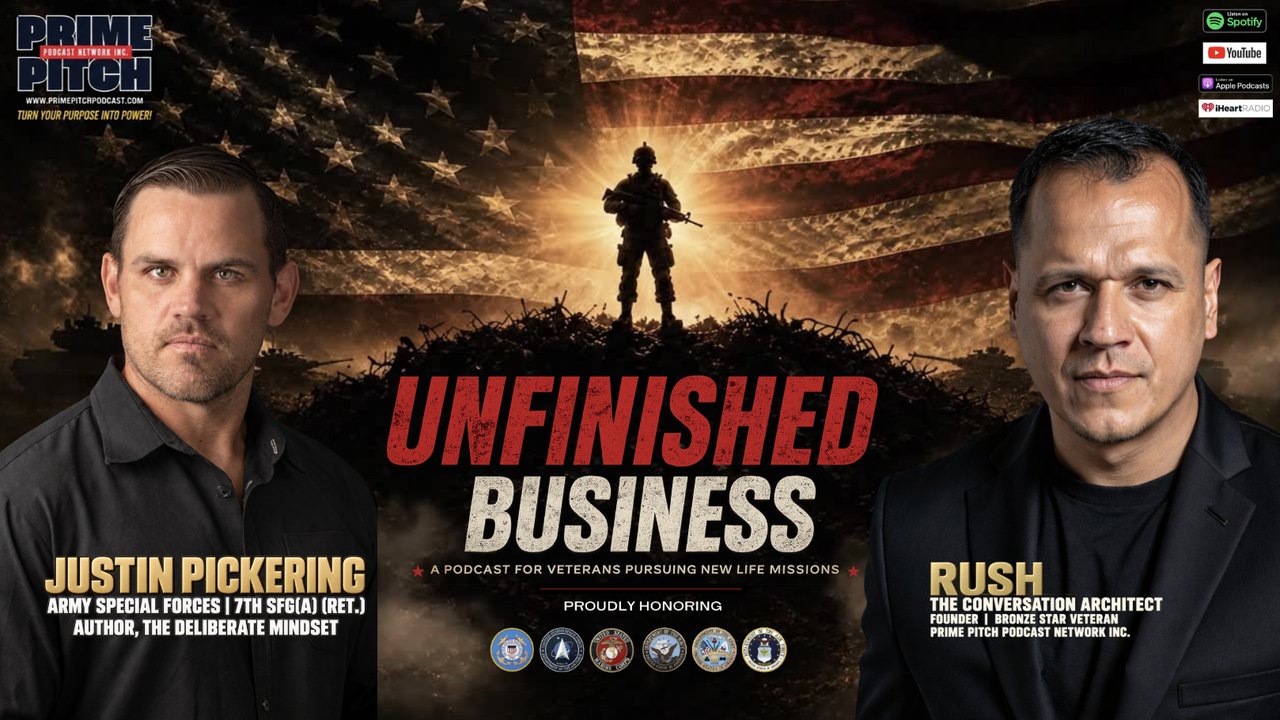
Justin Pickering
Army Special Forces, 7th SFG(A) (Ret.) · Author, The Deliberate Mindset
About the show
Unfinished Business is a podcast for veterans pursuing new missions after the uniform, and for the families and communities who stand beside them. Hosted by Eric Rush, The Conversation Architect, a Bronze Star combat veteran and the founder of Prime Pitch Podcast Network.
Read the full transcript
Hey, what's up guys? Welcome to Unfinished Business, a podcast for veterans pursuing new life missions. There are men who become exceptionally good at operating under pressure. The harder question is what happens when the pressure is gone, but the system that learned to survive s- is still running? Justin Pickering spent nearly 2 decades in 7 Special Forces Group, ultimately serving as a Special Forces, a U- United States Army Special Forces Sergeant Major.
He learned to lead when the stakes were real, making decisions with incomplete information, and operate in a world where intensity had rules. But later came a different challenge, combat logic in ordinary life, institutional identity beginning to disappear, and the realization that instinct once built for survival could become wrong for the environment he was now standing in. Today, Justin works h- Justin's work sits at the intersection of deliberate human agency, adaptive identity, leadership, and faith. This conversation is about what it takes to rebuild the internal system without erasing the man it helped create, and what strength requires when toughness alone is no longer enough. This is my conversation with Justin Pickering, retired United States Army Special Force- Special Forces Sergeant Major and Green Beret.
Justin, it's a pleasure to have you on the podcast, brother. Um, man, it's such a, it's such a, you knowW- you know, when I, when I, when I'm reading this, you know, I, I don't always like, you know, I get overwhelmed when I'm reading some, and this is one of those moments where I'm like, "Holy cow, like, who do I have on my podcast right now?"Um, when I, when I read the cold opening, what thoughts, uh, thoughts and feelings went through your mind? Honored. Um, yeah, I'm honored to be here. I'm honored for the opportunity to, to tell my story.
You know, for, for 20 years in Special Forces, we don't talk. In fact, that the motto of the Green Beret is silent professional or quiet professional, right? Um, and, and transitioning and telling my story was hard 'cause I initially thought, you know, what are my brothers gonna think of me, right? And so I'm very careful with the story I tell, and I only wanna tell stories that help people. Hmm.
And, and I, I think my fellow Green Berets, uh, see that, and they've even wrote me and said, "Hey, y- you are helping people. This story's okay to tell," right? So, uh, I, I wanted to maintain that professionalism of, of quiet professional. But at the same time, people are hurting, people need help. Hmm.
I need to tell my story so I can help. Yeah. Yeah, and I think, yeah, you see, you know, you talk about quiet professional, right? But sometimes it's raw and real, right? Like you have to be raw and real with that.
Do you agree with that? Oh, 100%. Uh, that's what's getting people to listen. It's-- You'll, I mean, you'll, you've read the book. You'll hear my stories.
Uh, most of them are embarrassing for me. They're not, they're not heroic stories. They're stories of my down, you know, the, the, the lows of my life, but how I got out of them and how I climbed out. Yeah. It's beautiful, man.
Yeah, that's what's so important about our conversation today is like, uh, you and I had the intersection of, of so many, of intersection. We're in 2 different lives, you know, uh, 2 different lives, 2 different worlds, but it's kind of the same, same struggles, the same, the still, same hill to climb. And, and, and man, that, that, you know, when I, you know, when I think about that it's like, likeUh, let me ask you this. When- knowing that, that you had, you and I have a similarity, does, does that reveal, like doesn't it reveal to you like this, you were never really truly alone, that there were other people going through the same thing? What, what's funny is I hear that, right?
So, um, I, I give speeches and, and, uh, uh, a couple of my friends that I've met here since I moved to Texas who don't know me that well, but we, we go to the same gym. One of the men, you know, one of the guys came up to me and was like, "Man, I didn't know you felt that way. I didn't know you had the same problems I, I did."I, I said, "What do you mean?"He said, "Well, you're a Green Beret, man. You're tough, and like, I didn't know you had emotions like that."I was like, "Yeah, man, I'm just like you."There's 0 difference between me and you, right? Yeah, I, yeah, I, I earned a Green Beret, but we all go through the same anxiety, depression, the, theAnd then as a man, you know, carrying the household, paying the bills- Hmmbeing a good husband, being a good father, it's all, I, I have the same struggle, right?
So, um, I, I think it's good for, for people to hear that, yeah, we're Green Berets. We're, we're special. Guess what? We're going through the same things everybody's going through. Yeah.
It's true. I think also when I look at it too, it's like our stories might be started off differently, right? And yours, um, you grew up with some adversity. Um, you grew up into, you grew up in an environment that was, um, um, filled with addiction and, and instability. Talk and talk, share a little bit about your journey from s- from that point.
So, um, um, you know, grew up in a trailer park. Um, you know, not that there's anything wrong with that, but just trying to, to, to give you an example of, of our life. You know, there was 3 of us boys living in a eight by 10 room on a twin bed. Uh, so me and my brothers are really close. Uh, physically we were really close, and then of course our bond is, is, is very close.
Um, you know, my mom struggled with, with, uh, uh, pain meds and, and, uh, NyQuil. She would, you know, she would mix stuff like that, and, uh, that was on and off throughout our lives. Uh, and she was married 4 times, uh, different men coming in and out of our lives. Um, our-- But what, what's funny about our childhood is if somebody asked me to describe it, uh, 10 years ago, I'd have said, "Well, it's just normal."Right? And, and what I've learned is, uh, when you live in chaos so long, you start to label it as normal.
I think this is important to, to bring up. Uh, in May, I went to the youth detention center in Denton and gave this speech, and tomorrow I'm giving it in Gainesville, and what I've talked to these kids about is, uh, what you're living in is not normal. Hmm. This is not your life. This is a chapter of your story, and guess what?
You get to write the next chapter. Don't let this chapter be your story. Um, but I thought that was my story. You know, I thought that kid I was, I thought that was normal. I, I, I didn't realize what we were going through wasn't normal until I- I was, I had my own kids.
And parents are around. Like, I, I don't know if I saw an adult when I was a kid. Like, we were never around adults. Hmm. Um, um, just put into a lot of weird situations that, uh, that kids shouldn't be exposed to at a really, really ear- early age.
So, uh, I won't go down that rabbit hole of what that was unless you want to. I'm good. But, uh, um, y- you know, w- we were raised in a very different, uh, lifestyle than, than, than people probably knew, right? Yeah. When you, when we talk about our, our stories, you know, we talk about our lives, you know, and we think about our parents, you know, and then the things that were going on during that time, you know.
It's, it's such a, it's such a, umIt's kinda like, you know, from our perspective, you know, we, we saw, we saw rough upbringings, right? At the same time, we're like, you know, um, you, we know that our mom's listening to our podcast right now, and, and we know that our dad's listening to our podcast if they're s- still around. Like, my dad passed away, but, but in the context of, like, when we look at it as a man now, we look at their story, what, what, what do you think about, like, your mom's journey or your, y- yeah, your, your, the journey you were on at that time with your mom and where you're at today? So my mom passed away in 2010. Okay.
Um, you know, uh, I talked to my mom every day, uh, even after I turned 18. We, we spoke every day. Yeah. I had a, a, a, y- I don't know the best word, love-hate relationship. Obviously, I love my mom, but, uh, um, y- you know, weIf she was alive today, she'd be living with me, right?
That's, that's how it is. Like, she, I would've took care of her. Um, I don't have any hate for my mom. I think she was doing the best she could. I think she was addicted, and the addiction was real.
Yeah. Um, I wish, if she was alive now and I, and I knew what I knew now, I feel like I could help her. Um, but, um, she did love me. Good. She loved all of us.
Nobody can ever deny that. But she was battling addiction. Um, but what's worse is nobody knew she was battling addiction because, um, you know, this is not part of the podcast, but she was actually the D. A. R.
E. officer. My mom was a cop. Oh. So it makes it even weirder that at home she was a complete different person.
So that also made our childhood everybody thought we were living one life and didn't realize what we were actually going through. Hmm. My friend has a saying, it's that pr- performing perfectly in public, perishing in private. Yeah, he's 100% one Yeah, and that's, that's really unfortunate, man. Like, um, I empathize with you, you know, and I say the same thing.
My mom's still around, but at the same time we had that, that relationship where there was always conflict, and I think just decision-makings in those times were very, are very tense and however they coped at that particular moment. It's like, you know, grace has to be a p- part of our, our, our conversation, right? I hold no ill will towards my mom. Yeah, yeah. I love her.
Um, but man, yeah, she, she, um, she put us through some stuff, for sure. Yeah, yeah. Um, um, when you look back now, what do you understand about the way the environment shaped you and that couldn't have, you couldn't have understood while you were living it, in it? I, I think I've already kinda said it. Yeah.
That wasn't normal. Yeah. I thought it was normal. Um, y- you know, and again, I don't wanna go down a rabbit hole, but, like, my childhood was sexualized at a really, really early age. Like, at 4 years old- HmmI'm exposed to stuff that,You know, when I'm 30, I actually thought that was normal, right?
Yeah. I'm raising my own kids, and they're, they're 12 and don't have any idea about that world, and it, it, ILiterally, like, in the last 5 to 10 years I started to realize, wait a minute, that wasn't normal. Why, why was I in that situation? I didn't even question this stuff- Yeahuh, until about 5 or 10 years ago, because that's how normal it was. Um, so yeah, that, thatThe message I'm trying to tell these kids at the detention center, this chaos you're living in is not normal.
Yeah. There is a different life, and you can write your next chapter. Yeah, that's, that's beautiful, man. I think it's true. Um, by high school you were carrying a lot of anger, right?
I mean, you, that, uh, is that the proper word? Yeah, yeah. yeah. I would call it a chip on my shoulder is, is how when people ask me, um, and, uh, yeah, well, I, I- Yeah, yeah, yeah. No, that-- you didn't, you didn't- Your gumyou didn't wanna be home, and, and football became a place where, uh, some of the intensity had somewhere productive to go.
Um, what was football giving you at that age beyond, uh, competition, and what happened when the structure wasn't around? Yeah. So, um, if you don't mind, I'm gonna tell a quick- Yeahbackstory so to kinda lead up to- Go wherever you want, manwhere we're at with this. So, uh, my oldest brother moved out at 16. So remember, me and my 2 brothers are really close.
Um, but he moves out at 16 to get out of the chaos, right? Mm. Um, you know, so things progressively start getting worse. And then my little brother obviously graduates, and he leaves at 18. So now I'm 15, about to turn 16, uh, doing my first year alone, right?
And, um, my mom was, uh, divorced at the time, so a bunch of different boyfriends coming in. No big deal. I sat her down and said, "Hey, I don't care about all this stuff, but do not get married again."And she promised me she wouldn't, right? Um, so this takes it back to a story where, um, we're driving home from a football game. We're on the bus, and my friends start saying, uh, "Hey, Justin, did you see your mom's engagement ring?"Mm.
And I got defensive. I said, "My mom's not getting engaged."They're like, "Yeah, man, she's been showing her ring all day. She"And I said, "My mom wouldn't do that. She promised me she wouldn't get married. She would've told me first.
There's no way she told y'all first."The whole football team knew. To where I got aggressive on the bus. I was trying to fight one of my friends. Like, "Don't-- Quit talking about"You know, I was defending her. So then I go home that day.
Um, I walk through the door. My mom and him are sitting on the couch. They're holding hands and, of course, I see the ring. Yeah. And the guy says, uh, "Justin, some good news for you.
Me and your mom have decided to get married."And, um, I walked up to him. I pulled out a pretend gun, you know, and I, I put it to his head, and I pretended to shoot, and I walked out. I didn't even say a word. When you talk about me falling off the cliff, that was probably the day, right? Mm-hmm.
So I was already a chip on my shoulder, but now it's, I mean, it's full-blown. So what did I do? Um, I stayed at school. Uh, I didn't come home. One of the advantages of a small town is everything's unlocked, right?
So I'd be in the gym. Uh, I came home, I'd-- we'd start, uh, you know, PE or, or athletics at 2:00 p. m. I'd come home around 9:00 p. m.
I was basically just coming home to sleep, uh, 'cause I hated being home. Yeah. What that did for me was I got in really good shape. You know, I got really good at sports. Um, so, so that, you know, y- you asked what it did for football.
I got really good at football, right? Because I was, um, um, never wanting to come home. Um, another side story. Now that I'm a dad, and my kids are trying to play sports, and I'm telling them, you know, 5 years ago, I'm catching myself telling them, "Hey, you guys are coming home too early. You need to be working.
You gotta do all this extra stuff. You need to be dedicated like I was."What I've s- you know, as I've told them that story and, and now as I've broke down my life, I look back, and I'm realizing that maybe I wasn't super dedicated. Maybe I was just trying to escape. Mm. And maybe it's okay that my kids might come home and be with their da- you know, be home, right?
So, um, I backed off them a little bit. You know, I do want them doing a little extra work, but they don't need to live in it like I was 'cause I'm not sure it was dedication. I think it was escape. Yeah. Man, that's, that's deep.
That's so deep that you recognize that now, but also, like, that you, you know, that you, yeah, you recognize it now that you, you know, you-- it was kind of an escape route, you know? And, and you turn down the noise every time you, you, you, you're in there getting a lift up or whatever, right? Like, and doing extra running or whatever, you know? It's like, and now your kids. That-- It's so, it's such a, uh, like, um, what do they call it where it's like it kind of, they conflict with each other, you know what I'm saying?
Like, you, you want your kids to be successful in sports, and you want them to be successful, and then you have to battle, well, am I pushing them too hard or, or do they, do-- can they be at the, the level of, um, athleticism that I was? Talk about your athleticism during that time. What did it lead you to? Um, yeah. Well, I mean, um, you know, like, like I said, I ended up being pretty good at football.
Um, when I left home- MmI escaped the chaos of being home, and I, I fulfilled one of my dreams, right? And that was to walk on to Texas Tech. Yeah. Um, and I, and I, and I did it. And you know what?
I was actually pretty good at Tech. You know, I, I, I was doing well there. Uh, the problem is I chose the wrong crowd. Um, y- you know, and I, I talk about this in the book a little bit, you know, the, the, the, the, the 2 rooms I, I, I could have walked in. You know, there was, there was guys on that Texas Tech football team who were good people that I, I could have attached to a- and learned from.
But what did I choose? The ones who were, you know, partying and, and doing all the extracurriculars. Um, it, it's funny 'cause you escape this one chaos, and you're finally free, but I didn't know what to do with it. And, uh, so I created a new chaos. Mm.
Uh, that's another thing I need to- Mmum, reform. So yeah, I started, I, I started messing up. Yeah. That's, you know, that's weird that, I mean, the word chaos came out 'cause as you were talking, I was like, yeah, what-- The, the question came up in my mind was like, can-- do you think chaos can be kind of addicting? Like, you know, like, whenYeah.
I think comfort is addictive. I think, uh- Well, I know it is Yeah Why people don't wanna start something new is 'cause it's uncomfortable. Yeah. So, um, it doesn't matter what state you're in. If you're, once you're in it long enough, you get comfortable.
A- a- and, and that's what y- that's what you, you search for. I think our brain works that way, right? That's a survival instinct is just to try to stay comfortable. So, um, I don't know if it was addicting, it was just what I was used to. You were used to.
Okay, that makes sense. Yeah. It was justYeah, I can understand that now that I say that. It's like, um, you know, s- trauma, the trauma in itself, right, like your childhood trauma, do you think that can be addicting? Like, you know, anxiety, um, you know, the anger.
Is anger addicting? Uh, these emotional, these emotions that are attached to it. Um, I don't know if addicting is the right word. I mean, I'm trying to think of a better word. Yeah.
Uh, I, I mean, scientifically, and I don't wanna go too far into the brain- Yeahbut the, you know- Go for itthe brain has the hippocampus- Yeahwhich is your library. Yeah. And yes, this stuff is getting stored in the library, uh, of, of your brain. Yeah. So it can affect you.
Um, when you say addicting, it makes my brain goes to w- we want it. Um- Mmand I don't know if we want it. I, again, I think we just get used to it, so we accept it because it's comfortable. Mm, okay. I can see that.
I guess from my perspective, I'm going, you need it. You need to have this chaos to be functional. Um, I would say like, um, you might be talking more about combat and, and, uh, the excitement of, of risk. That can be addictive. Yeah.
Right. But, uh, I don't know if my childhood traumasI'm, I'm violent. Yeah, yeah. Addicting. Yeah.
Okay, that makes sense. Um, how much responsibility you think you c- uh, you carry for the environments that shape, that shape us? And also- Yeah, I mean, I, I kinda talked a little bit about it. I think- Yeahuh, you know, this is in the book too. Yeah.
Um, y- you know, surrounding yourself with the right people, 100% matters. Choosing your environment, 100% matters. Uh, I don't teach cutting people out of your life. I've never said that to anybody. I do tell you to attach yourself to, um, to the person, people who hold the values that, that you aspire for, right?
Mm. So surround yourself with those people. What I've found is the people who don't fit that fall out. Yeah. Um, you don't have to cut 'em out.
Yeah. Um, just surround yourself with the right people. But, um, um, as adults, we, we, we can 100% choose our environment. This is where I, I have a, a real empathy for the children I've talked to in the detention center. Yeah.
They don't control their environments. Yeah. And some of that's not fair to them, right? Yeah. Um, what I'm notBut that's why the message I try to deliver to them is, uh, this isn't permanent.
This is aAnd it's not permanent, and it's not normal. Don't think that this is how it's supposed to be. And guess what? When you get your second chance, when you get out of here, you are in control. Yeah.
Going back to that, like when you go into these, into, you know, the youth, uh, youth correction- Mmcorrectional places, um, when, when kids or, or kids in that environment, right, they're in that environment 'cause they ran with the wrong people, right? Um, how do they decide? How are they able to decide what's right or wrong, you know? Like, um, if they don't have the tools in their toolbox, like, like, like core values and stuff like that we talked about. Somebody's gotta teach 'em.
Yeah. Um, I pray that, that, that it's me. I pray that it's the books. I g- You know, I give, I give books to the library. They can check out books.
Um, um, it has to be taught. Yeah. And, and it's not being taught. What's being taught is punitive discipline because that's easy. Mm.
Uh, but punitive discipline is temporary. Um, it, it's not reinforcing, right? So, um, no, unfortunately, we need more people like you, uh, like me going and talking to these kids and giving them, um, that there, there's other options out there. When you go in there, what do you talk about? What do, what are some of the things you go through?
Like, what are some of the- Oh, I tell the full story. It's, it's, itYou know, I give them a, a 30-minute speech about how, um, my childhood was, how the military was, how I climbed out of this depression of my childhood by being successful in the military, and then found myself right back into depression and, and PTSD towards the end of my career, right? So it's just this, this cycle. Um, and then how I climbed out of, of that, right? And, and, uh, yeah, I go through the full story of from start to finish, basically of my life.
And, and, um, again, the, the, the title is, uh, you know, Write Your Next Chapter, and You're Not Your Worst Story.'Cause I think these kids label themselves as, "I'm, I'm a thief," or, "I'm a, I'm a bad kid."That's not who you are. It's something you did. What you did was wrong. Yeah. The act was wrong.
That's not who you are. A- and that's the message I really try to, to, to land. Yeahit's not you. Yeah, it's true. It's like, what is that?
You don't, you label yourself to, you label yourself by the decision you made. Mm-hmm. Right? That kind of thing. Yeah.
Um, in, in your, uh, you write about, um, uh, there's a bathroom mirror moment. So share a little bit about it. You had, you, you had been awake for nearly 48 hours, um, looked at yourself and could see where your life was going if nothing, if nothing changed. Yeah. So, you know, like I said, football was a, a big deal to me, and I'd screwed it up.
I had just been kicked out of the program because, uh, I had a zero GPA, because I didn't go to class. Um, so I went on a pretty bad bender. Um, you know, I'd been partying for about 48 hours straight, and I used the bathroom, and I walk up to the sink. I look in the mirror and, um, you know, I don't know how I look on camera now, but, uh, much paler than I am now. Um, but I had bruises all over my face.
I had giant bite marks all over my neck. And, and I just remember thinking, like, "What am I doing?"Hmm. Um, and, and I write about it in the book, and I know it's silly, but this is the true thought that came in my head, you know, 48 hours, no sleep, high on drugs. my senior year of high school, I was voted Most Likely to Succeed. I know it's silly, but- Yeah, no, yeahthat went through my head.
And, and then, you know, I felt, I had this feeling that this isn't, this isn't who I'm supposed to be. You know, I was supposed to be more than this. I was meant for more than this. Um, so I, I had a decision. I could, I could die, go to jail, or join the military, right?
And that's what I felt. A- and the military wasn't new. You know, I'd alwaysThe military was always kind of my backup plan. So, but yeah, that was a big decision point of just being embarrassed, looking at myself in the mirror. I mean, I looked awful.
Yeah. It's interesting, man. Like, you know, some people go with this, withHave you ever heard of the, uh, the vicious cycle of guilt? It's like, you, you go through it. You, you, you make a mistake, or you, you act out or something.
You get angry. You yell at somebody, and then you feel bad because you f- you know, you feel bad because the way you treated somebody. And then you, you, you feel, um, um, ashamed of yourself, and then you feel inferior. And then you go, and then you get angry. And then you take, then you get irritated by that.
And then you take that same anger, and you just keep going, repeating it over. You be feeling inferior again. Now you feel even worse, and it becomes this tornado. Um, when you look back at that, like, how fortunate are you that you had that, that, that, um, that, that, you know, looking in the mirror moment? Uh, it saved my life.
Yeah. I would've been in prison. Mm-hmm. Um, probably have wished I hadn't. Yeah.
Um, probably should've gone a few times and just got up, to be honest with you. Yeah. But, um, no, I, I, I would've been in prison. Yeah. Wow, man.
That's a big, that's a big leap, right? Making that, that decision. How, how old were you then? Uh, 19.19. That's an early age to catch it, too.
You know, like, to, to really, to say, "Well, if I don't"Like, you know, you're out, you're by yourself, too, right? You're, you're, you're at, uh, in Lubbock, right? Yeah. By yourself, right? Yeah.
And so it's like you're there, and you, you're at a, you're at this crossroads, and you go in the mirror, and you see that. Like, um, it's like your habit self and your inner self, like, came to fa- came to face, right? You're the habit self standing outward, and your inner self is the one in the mirror. It's not the other way around. Mm-hmm.
Uh, does that make, does, does that make sense? Makes sense, yeah. Um, um, shortly after that, you walked into the Army recruiting office asking for the hardest thing they have. Especially Special Forces eventually put you in an environment where standards were high, uh, purpose was clear, and intensity finally had, had some, had, had some guidelines, right? Um, how much of the man who became a Green Beret was built by the Army, and how much of it was the Army giving direction to traits that were already there?
Yeah, so traits that are already there. Let me, uh,I'm gonna go with persevere- perseverance. Um, think my childhood, uh, helped me with that. Hmm. Um, and then I'm gonna give some credit to my high school coaches.
Uh, I've said this, I've never said it on a podcast, so this is important I say this because I, because this is how instrumental they were in my life. Um, and now that I'm an adult and I see the coaches my kids have, I had the best coaches ever. Like, I look back, I've, you know, I've been through a lot of football, watched a lot of different football coaches, and, uh, you talk about luck, man. I had the best coaches. Hmm.
Um, so that hard work, um, you know, you know, integrity, work ethic, I would say came from them. Uh, so perseverance, work ethic. Pretty much everything else the Army taught me. Yeah. Uh, I joke about it in the book.
I mean, it's not a joke, it's, it's real. Uh, I'd never shot a gun. Um, you know, I was the third, I was the third, you know, the youngest in the house. My older 2 got to do Boy Scouts. By the time the third baby comes along, moms, moms are less- Tap, tap, tap doneI didn't get signed up for any, so I never did Boy Scouts.
I never, uh, man, I'd never done anything camp- I'd never been camping. Like, I'd never done anything military related. Um, which makes it even funnier that I asked for Special Forces, 'cause I had no clue what I meant. Yeah, I was trying to sound cool when I said it. Um, and, and, you know, I signed up for it and, uh, got a lot of lessons.
Yeah. Got hit in the face pretty hard. Uh, I was definitely the most unqualified person there, for sure. That's kinda good though, right? Like, if you, you're the most qualified, you might be the most arrogant one there, and you might cause a lot of trouble.
Actually, one of the drill sergeants said that to me. That, that it was easier to train me to shoot than other people who like, went bird hunting with their dad because they learned these bad habits. Where for me, they got to build me from scratch. So, uh- Yeahin some senses, maybe you, you know, you might be onto something. Yeah.
It's like, you know, like you wanna build somebody the way you want 'em, you want 'em to operate, right? And that that may not be good too, right? We could go down that road. Um, let's see here. Um, you spent y- uh, nearly your entire lifetime in sp- in the 7 Special Forces Group.
Mm-hmm. Dang, that's, man, that's, that's a long time. Um, over time competence, rank and responsibility, brotherhood and purpose became part of the institutional identity. Is that, is that- Yeah, that's right. Okay.
W- when did you begin to realize that being a Green Beret and sergeant major had become deeply connected to the way you understood who you were? Yeah. Um, my first thought goes to, uh, yeah, the military wasn't new. Um, yes, I wanted to try football first. I wanted to, to-uh, you know, I wanted to try that.
But military was always in my, uh, you know, in the background of my mind. So 5th grade career day, we had to get up in front of the class, tell the teacher what we wanted to do. And, uh, I actually got up and, and I remember this story 'cause I actually got in trouble for it. It's a, it's a silly story, but I get up in front of class and I said, "I want to be an F-16 pilot."Mm. Uh, and my teacher got mad at me.
She said, "You're too young to be wanting to join the military and talking about combat."And I was, I was offended. I said, "No, this is what I wanna do. I wanna serve my country."And she made the comment, "Well, what if your mom is in one of those enemy planes?"And me being the smart alec kid I was, I said-"I guess I'd have to shoot her down. She chose the wrong side."Oh, Jesus. So I got sent to counseling-uh, for saying I wanna kill my mom.
You hear, I did not say that. But that's the real story. This teacher accused me. That's, that's not what I said. She put me in this hypothetical situation and I answered it.
Anyway, I tell you that story to tell you that, that I had a s- I already had a, a, a, a strong conviction, a conviction to serve. Um, and that's important to know going in. Then you go to 7th Group, and it is a brotherhood like I cannot describe. Oh, man, uh, probably not the right word, but the word that comes to mind and it, it, it's almost cult-like. Mm.
But in a, in a, in a good way for me, anyway. Yeah. I, I loved it to the point where my family was my team, and then my second family was my real family. Um, and I treated it that way. Mm.
And, you know, I'm lucky enough to have a wife who put up with that. Um, to be fair, I was honest with her. I told her I, I put my, my guys before my own family. Mm-hmm. And, and as you read the book, you'll see what that led to and how it kind of broke my family.
Um, but yeah, I mean, that's, it was my, it was everything. It, it was, they were my life. Um, and I was a warrior. I mean, uh, deep down I still am. You know, I'm still dealing with that, right?
Yeah. You, you hear me talk about it sometimes is, uh, um, I'm a warrior trying to live like a civilian. That's weird. It's hard. Um, I don't, you know, it's hard to describe sometimes.
I mean, you probably understand, right? Yeah, I understand. What, uh-- For those that don't know, what is a 7th Group? So the, the people who tune in, they're like, "7th Group?"Tell, talk to, talk to us about that. Yeah.
So 7th Special Forces Group is, uh, our AOR is Central and South America, but during the Global War on Terrorism, our AOR was where the United States needed us, which was, uh, mainly in Afghanistan. We did a couple to Iraq, but our primary focus was Afghanistan. Um, I did 6 trips there, uh, with 7th Group, and then I did 4 to South America. Um, we-- Our language is Spanish, so all Special Forces have to learn a second language. For 7th Group, it's, it's Spanish.
Um, and, uh, we're there in Eglin Air Force Base. I started out at Fort Bragg, and then 7th Group, uh, did a BRAC move to Eglin Air Force Base in 2011, and then I was there until I retired in 2025, soWow, man. That's, like I said, that's, you know, an entire li- life, your adult life in, in- One unit, one battalionin one battalion. Yeah, that's, that's highly irregular. It's a lot.
Yeah. People don't know what I'm talking about. Since you're military, right, you'll understand this. I was in the same battalion for 18 years. Oh.
Wow. The only one who's ever done that. I never left. Uh- Yeahuh, I just kept, I just kept deploying and training. That's, that's crazy, man.
That, that's pretty insane. I was like, I was like, "One battalion? What the heck?"I never PCS'd. Wow. That's insane.
Your final combat deployment was in 2019. It seems to be where several things began to collide, right? You knew that the chapter was closing, but the system that had made you effective didn't simply shut it itself off when you came home. When there was no mission, no immediate threat, no clear objective, what did combat logic start to do-- start doing to the way you experience ordinary life? Yeah.
Um, probably to tell another story here- Yeah'cause I, I like to frame stuff so people understand- Yeahthe mindset. Um, so I told you I'm a warrior. felt like I was a warrior since I was a kid. I mean, I, I wanted to join the military. It was my destiny.
Um, I have a warrior's mentality. Like, that's just how my brain works. Um, you know, I tell the story about, and you'll appreciate this, is I love helicopters. And, uh, you know, we flew the helicopters into our objectives. And, uh, a helicopter makes a very distinct sound when it starts to land, right?
As it starts to hover. The chop of the blades sounds so beautiful and so crisp. I dream about it a lot. And, um, at treetop level, that's when our nods come down. So everything's black.
Now everything's green, and you can see everything, and then you land, and the ramp opens, we run off. And, um, knowing that I will never get to do that again felt like somebody stabbed me in the heart, right? and I, I don't know how else to explain it, right? Yeah. Um, and then I tell stuff, uh, I'll tell people, "Well, combat's easy."They're like, "Well, what do you mean?"I said, "Well, it's peaceful for me, and here's why."There's 2 options, right?
There's live and die. There's-- It's everything'sAnd everything's laid out, right? If we get shot at, this is what we do. If we receive mortar fire, this is what we do. You know, there, there, there's a SOP for everything.
There'sIt's quiet. I-- It's hard to explain. I know there's sounds and stuff. Yeah. But it's so peaceful because it's one problem set, right?
Where coming home had a bunch of problem sets that a warrior doesn't understand, like, uh, a wife who wants you to do, uh, a soft cycle on the clothes. I'm like, "I don't even know what that means," right? Um, but yeah, to, you know, back to your question, I'm trailing off here a little bit, but, uh, I'll continue to frame it. So that last trip when I come home, um, I'm gonna tell 3 stories about each kid, some- Yeahhow you see, how I escalate, right? So the first one is my youngest.
I get off the bus. Uh, my kids are there waiting. The older 2 come up and hug me. The third one stays back. He's probably 4 or 5 at the time.
This is on video too, so if you ever wanna see it to verify the story, it's a real story. Um, and I, I know he's-- I see him hanging back, so, you know, I walk up to him. I get on my knees to be on his level, and I put my arms out. And he says, "Who are you?"Hmm."I'm your dad."You know, and I give him a hug. He's scared.
Um, all right, so that's day one when I come home, right? Now let's go to day 7. Um, a wife being home alone for 9 months with the kids, um, she did the best she could. She went from 500 tasks to 1,000 tasks, right? Because she has to do it all herself.
So naturally, some of those get dropped, and usually one of the first ones that a, a, a wife will drop is, is that discipline that the dad brings, or what we call discipline, right? Yeah. So, um, no fault of her, just she's got a lot on her plate, right? So when I come home and there's no rules or no structure to the day, I'm gonna fix that, right? So examples, "Stop running.
Stop jumping on the couch. Close the door. Turn out the lights."For 7 days, that's all I was saying to my kids. Hmm. So finally, the middle one says to me, he says, uh, "I'm so sick of all your rules.
I wish you would have died."Oh my God. Right? So another stab in my heart, right? So all-- Again, I tell the story about not being a warrior first kid, 7th kid, and then it culminates with the third kid about 30 days after I got back. We're on the farm, and we had cows, chickens, pigs, and he's the only one really old enough to actually help me.
Um, so we, we, you know, we were out there on the farm working, and I, I tell him to do something, and he kind of mutters something under his breath, and he turns his back on me. Well, in any culture, that's disrespectful, right? Uh, so I grab him by the shoulder, and I turn him around. I said, "Don't you ever turn your back on me like that."And, uh, now we're gonna fly back to Afghanistan for a second so I can paint this picture for the viewers, is, uh, in Afghanistan, when you're in the Special Forces, we work in very small teams, and we're surrounded by hundreds of Afghans. And in a tribal culture like that, respect is paramount.
In fact, it's the difference between life and death. It really, really is. Um, so when we were disrespected, we were quick to, uh, you know, drop the hammer and, and regain control of a situation, right? So we, we would get pretty aggressive if we were disrespected. Um, and, uh, another thing that was disrespectful in that culture is talking with your hands.
See, Afghan men, um, don't respect women and children. In fact, that's why we grew beards. If you ever wondered why we had beards in Afghanistan, it's so we were respected and c- and can have conversations with, uh, with elders. Um, so if you ever had an elder talking to you with their hands, they were being disrespectful, basically saying you're a child. Hmm.
And so if they did that, we would, you know, take control of the situation. We would get aggressive with them, uh, because you're not gonna disrespect us, right? back to the farm. So myI spun my kid around and said, "Don't ever do that again," and he starts talking with his hands, and, uh, you know, I don't know what he was saying, and I, I completely blacked out. Um, I, uh, it's back to that hippocampus, right?
I had this library of Afghanistan stories, and that's where my brain went. You know, I, I, uh, my son wasn't in front of me. It was a, it was a, it was an Afghan elder. And, and when I say I was in Afghanistan, I saw it, and I tasted it. You probably remember that.
I, I, I smelt it like it'sI was there. Um, and, uh, I said the stupidest thing I've ever said in my life. It's the most embarrassing thing I've said in my life. Um, I told my son, uh, "If you don't put your hands down, I'm gonna have to defend myself."Uh, and, umSorry. And Eric, I tell the story 100 times, and I choke up 100 times.
No problem, man. Hey. Embarrassing. Um, if you saw him, it's even more embarrassing, right?'Cause he's a nerdy kid with glasses, and I'm a trained Green Beret saying I'm gonna have to defend myself. I mean, how stupid can you be, right?
Yeah. I usually stop the story there. You know, it did escalate a little further. Um, immediately after that, I, I jumped in my car, and I drove to 7 Group, and I checked myself into the, uh, the P3 program, which is the psychological performance program. It's a special program for the SF guys, and, uh, started getting help.
Hmm. Wow, man. That'sYou know, that, I seeMan, that'sA lot of people, that's pretty deep. You know? That's pretty deep.
You know, you just think about it, just very, very deep. Well, thank God that you had the wisdom to, like, go and actually s- see you, you know, see yourself for what was going on in that moment, right? And it took a child to kind of reveal that to you, right? Like, man, that's deep. I don't think, you knowI don't know how many people go through that, that, you know, that experience.
Maybe there are, you know, a lot of veterans that do that. I think, you know, when I was listening to your story, actually, when I was thinking, listening to your story, I kind of felt like that too. You know, we, you know, we have a s- My wife has a son, and, you know, I've never, you know, I've never been around kids like that, you know, and, and, and I had a lot of problems, you know, just trying to figure it out. You know, she, he, he lives with his dad, but, but, um, I just had a lot of problems trying to adjust to, to that kind of, you know, that kind of thing, where I had a child and, you know, you don't know how to handleYou know, you're, you're doing adult, you know, life or death situations, you know, and, and you're living that way too, and that's the way I was doing for a long time too, you know? how to hand- you know, you're, you're doing adult, you know, life or death situations, you know, and, and you're living that way too, and that's the way I was doing for a long time too, you know, life or death.
So in that, in that program, what were some of the things that y'all worked through, you, you walked through? Well, I was like every stubborn Green Beret, and, uh, I didn't talk for about the first 6 months. The first thing she wanted to do was put me on pills. I said, "No, I'll never take a pill. My mom died taking pills, so you can, you know, you can shove it right here."Yeah.
And then she tried to talk to me, and I stayed on surface levels about everything. Um, and then, uh, about 6 months in, she was getting frustrated with me, and she said, "Can I, can I at least take your-- Can we draw your blood? Will you let me do that, you know, and check your cortisol levels?"So we did. Um, and they came back extremely high. Um, so she put me on-- I, I-- Once she showed me that and said, "Hey, Justin, there's, this is actually what's wrong.
You have a hormonal imbalance. You are stuck in fight or flight."Hmm. Um, she's like, "This is the highest cortisol levels I've ever seen. Like, you need to do something about this."Uh, so she convinced me to take Wellbutrin, which helps bring your cortisol levels down. Um, and, and to be honest with you, uh, the Wellbutrin's saved my life a second time, right?
Yeah. Um, you know, and, uh, I don't take it anymore. We can get to that part of the story later, but, uh, um, you know, it kept me from hurting somebody 'cause I was very, very aggressive, um, you know, at stoplight. I mean, there were some close calls, um, and, uh, the Wellbutrin calmed me down, but it brought a second issue. Hmm.
I didn't-- I, I had no feelings. I wasn't happy. I wasn't sad. I wasn't-- I was just a shell, right? And that kind of led to the, to the next set of issues that led me to, you know, uh, picking up some old books and then eventually writing my own book.
Yeah. Man, it's, it's tough, man. I think that's the problem is, is how do you battle, how do you battle some of these things without any, you know, like, without medicine, you know? That's, I think, I-- You know what I mean? Like- Yeahlike the, the VA is like, "Yeah, I got a whole"Man, if I, I have bottles and bottles on stock of, ofYou know what I mean?
Like, it's just like you, you stack them up for a while there. I-- Yeah, you take your stuff. You're like, "What do you mean this is an anti-psychotic medication?"You know? Like, "I didn't know it was this."You know? Like, "Why am I taking this?"You know?
You have to get off of that, and you're, you're trying to will it. You're trying to do it with self-will, and then you find out that you literally had a neurolo- had some kind of a hormone, had some kind of imbalance going on with you and, and that it required some medication that really need, needed to be adjust, you know, to be adjusted. And, and, and I took it for 4 years before I stopped. Um- Yeahyou know, not to get off subject too far- Yeahbut to get off, um, I started, I started doing things that I talk about in my book, right? Um, you know, these practical tools.
I, I started applying them, and things started getting better. Um, you know, I, I, I tell the story about my wife. Um, and I gotta s- I gotta state this. I would never tell anybody to do what I did. What I did was wrong.
Um, you should talk to your doctor, and you should make these decisions with your doctor. Yeah. But Justin Pickering decided I was gonna stop cold turkey taking all the pills they were giving me, uh, because I felt like I had found some tools that I, I could beat this by myself by having a deliberate mindset. And, um, so again, I'm not advocating for this, but this is what I did. So, uh, stopped taking the pills.
About 8 weeks after I stopped taking the pills, my wife said to me while we're in the kitchen one day, she said, uh, um, "Justin, did they up your meds?"And I said, "No. Why?"She said, "You just seem happier lately."And that's when I knew I was onto something. That's when I knew deliberate mindset was real, and I needed to start writing my journey down, which a year and a half later led, led to the book. Yeah. Man, your instincts-- That's the other thing is, I was also gonna say is that your, your, uh, instincts interpreted your, your own son through your c- your, through a combat frame.
Mm-hmm. Uh, what did that teach you about trusting instincts that, that had once served you extremely well and about the work required to re-re-retrain them? Yeah. I think, umYeah, I was just kind of talking about it when I, when I go down this deliberate mindset journey. I spend a lot of time in, in the subject of emotional intelligence.
Uh, what's funny is now I go around the country teaching, uh, leadership and emotional intelligence. And, uh- Wowemotional intelligence has 4 pillars. It's, it's got, uh, uh, self-awareness, self-management, environmental awareness, and relationship management. That's the 4 pillars of emotional intelligence. Um, so self-awareness is, is identifying your triggers, right?
So, um, your amygdala fires. Uh, again, I won't try to get too scientific, but, you-- that's the first thing that happens. And, uh, your hippocampus is right next to there. So a, a, a trigger's fired, uh, an emotion happens. That emotion's usually tied to some kind of, of old memory.
Um, but what happens next is, is where emotional intelligence lives, right? Um, the-- So to answer your question, your initial emotion is natural but almost always wrong. Right. Yeah. Um, learning what to do with that is, is what emotional intelligence actually is.
Yeah. When you s- and thinking about it now, like in an emotional stand- uh, standpoint, like when you look back to the kid you were, like how, how oriented to you were 19, I guess, like, would y- how- what would youEmotional maturity, at what would you consider yourself emotionally mature during that time, and now you're like, you feel like you have a higher level of, of emotion? Uh, zero out of 10. I, I joke with women all the time. I say, "You know, men don't mature until about the age of 35."And on a one to 10 maturity scale, we peak at 7.
So even our peak maturity, we don't hit 35, and it's only a seven. Yeah, yeah. Man, I thought it was higher than that, but I don't know. I- I've come a long way, uh, specifically with emotional intelligence. Yeah.
It's changed my life. Um, you know, recognizing my triggers, um, and then using these practical tools from the book- Yeahto make a decision next, right?'Cause that, that's where emotional intelligence lives, right? Yeah. That first emotion is normal, but it's not right. You gotta learn how to engage the prefrontal cortex, which is the part of your brain that reasons, um, before you do the act, right?
Yeah. So learning how to, uh, put space between the amygdala, that initial reaction, and the decision you make is, is emotional intelligence. Yeah. Talk about your book. Tell, tell, talk to me about what, um, what the book's about and people that haven't, have, have never heard it or know about it.
Um, talk about what your book and the practical tools that are in there. Um, yeah, share, share a little bit about that. Yeah. So, um, you can kind of tell where, at what point I wrote this book. I was pretty down.
Uh, so again, the, uh, Wellbutrin took away the anger, but it brought, you know, a lot of just, what am I here for? No feelings. Uh, and then now I'm deciding 2 years out that I'm gonna retire, and a new depression sets in 'cause I'm losing that identity. So there's just a lot going on in my life. On top of that, um, I had this thing playing in my head all the time that I've lost more friends to suicide than I did in combat.
And I started to wonder if I was next. Am I gonna be that next statistic? And, um, I didn't wanna be, so I decided to startW- why is this happening to my friends? Why are they doing this? Um, so what I found is the mind is powerful.
It's so powerful, it could take a regular trailer park kid with no man skills and help him earn his Green Beret. That's pretty powerful, ain't it? Yeah. But not used wisely, it could take that same Green Beret and kill him, right? So that's the duality of the mind.
It's, it, it can, it can build, but it can also destroy, right? So that's where the word mindset comes from. Uh, deliberate came from how could these Green Berets, um, these guys who took their own lives, they weren't bad soldiers. They were the best soldiers. Some of our best are the ones that committed suicide, so how, how is it that they were able to perform overseas to an ability that you can't even explain to people?
Like, these guys were true giants. And, uh, what I found was while deployed, you have very specific mission tasks, outcomes, like everything y- y- you, you had stuff to work towards. What's missing is when you come home, there isn't a playbook. There isn't a playbook on how to talk to your wife or, you know, be a husband, be a father, uh, pay bills. I mean, all this like regular wife stuff everybody else does, there's not training for that.
We're trained to do this other stuff, right? So, um, I got to thinking, "Well, what if there was a deliberate blueprint to give the, you know, give these guys something to follow on how to be home?"So that's where deliberate came from, so I, I titled the book Deliberate Mindset. Um, each chapter tells a story, and then there's, um, some practical tools, reflections, and it ends with a faith tie, and every chapter's that way. Hmm. Um, I try only to tell one story per chapter.
Uh, it was very purposeful how I wrote the book. It's, it's a 3hour read on purpose because I wanted, uh, as many people to read as possible. Not just people who are interested in self-help books, like Tony Robbins books- Yeahyou know, James Clear books. Great books, but they're 300 to 500 pages long. They go deep into the science.
I try to stay way tops on the science, tell a story, and then give you a tool to actually use. When you, um, uh, one ofWhat makes your work, um, compelling to me is that you didn't simply develop a philosophy about the mindset. Through all of this, you became an applied expert in deliberate human agency and adaptive identity. What is deliberate human agency and adaptive identity? That's a good question.
Um, you know, for me it's that, it's that emotional intelligence one. That's those 4 Yeahpillars, right? Self-awareness, self-management. So first, um, we gotta be a, a- aware of where our triggers are. Um, and then self-management is what are we gonna do when we are triggered, right?
Yeah. How do you stop the spiral? Um, in the book I call it a spiral. Um, what's funny is there was a time in my life where things would happen, a spiral for me might last 10 years. That's how long I'd hold a grudge.
Hmm. And, and as I've gotten- Me toobetter it's gotten down to, you knowUh, I'm still not perfect. I, I make that very clear in the book- Yeahis this book is almost, um, m- as much as it is to help other people, it's an accountability tool for me too. Right. Yeah, yeah.
Written for me as well. Like to keep me honest and make sure that I continue to do these things that I s- I advocate for, so, umit's, it's gotten better, right? Now I'm able to, to move on after a minute sometimes, which I'm pretty proud of. Yeah. I could hold onto stuff for years.
Um, and the, uh, within theAnd that's that self-management. You know, some of the things I, I, I've done, um, you know, I think we'll probably talk about this in a minute. Yeah. Uh, you know. Well, go ahead.
Yeah. Well, what did you actually have to ch- uh, change internally before your life on the outside began to change? You write about, you write that, um, action creates information. Yeah. What exactly that- That's the, um, umI'm gonna finish my, my previous thought.
Yeah, yeah. Sorry. No problem. No problem. Go back to, uh, um, you know, the, the changes that I made that actually, umI get asked this a lot, like, "Well, if you could make one change, what, you know, what was it?"And, and for me it was gratitude.
Um, it, it, I know it sounds simple, but it changed my life. I used to tell people, um, I was a realist. I'd, I'll tell you how it is, right? And the problem with the realist sometimes is they're finding everything that could go wrong and never looking for what could go right, right? Hmm.
Which is really just a pessimist, right? Yeah. I was a pessimist disguising it as a realist. Um- Yeahso what did gratefulness do for me is, uh, I mean, it changed my life. So every morning I wake up, I read my Bible for 30 minutes, and then I list 3 things I'm thankful for.
And that's the single most important tool that I talk about in the book, and it sounds so simple, 'cause it is. But let me show you what that rewire looked like, um, you know, 3 years later, after doing this for 3 years. Um, another story for you. Uh, this one's in the book as well, but, uh, I'm, uh, getting ready to move to Texas. My family has already moved.
I'm leaving the biggest part of my life, right? Retired from the military, everything I've known, so obviously a stressful situation. I'm living by myself in a house on an air mattress because my family had already moved so they could get enrolled in school here in Texas. Um, and I'm just ready to get home. I have a 16-foot trailer.
Uh, trailers in Florida, the tires, man, you gotta protect them. That F- Florida sun will eat, eat those tires. Hmm. Um, I knew the tires were probably not in the best shape, but I was like, "I just wanna go home."You know, "I'll fix them when I get home."Well, I made it about 12 miles on the Interstate Building 75 and 2 trailer tires popped. Hmm.
You know, and it, it's a, it, it, it's a bumper pool, so it's immediately pretty rough.16-foot trailer with about 6,000 pounds in it. I mean, it was pretty- Hmmdangerous going 75. So I started to pull over. I hit the bumper strips and the other 2 popped. So now I have 4 blown tires on my, on my trailer, and I, I get to the side of the road.
And, uh, this is proof the deliberate mindset works, and that this training that I've done is now natural, it just kicks in. You know what my thought was 10 years ago? What? F this. I have the worst F-ing luck, Pickering luck.
Nothing ever goes right. I just wanna go home. That was old me. You know what new me said? Holy crap, my truck is okay.
The trailer didn't roll. I didn't hit anybody else. I'm alive. So, and then it just keeps getting better. So I get out and I, I look up mobile tire companies.
Didn't even know it existed, but I call the first number and the guy says, uh, uh, "Hey, man, what do you need?"I said, "Hey, well, I blew out 4 trailer tires."He goes, "Hey, you're in luck. I'm at the tr- I'm at the tire store right now."I said, "That's awesome."So I read him the, the, you know, the tire size. He goesAnd I could hear the guy at the register say, "Yeah, we got 4.4 in stock."He's like, "Hey, man, you- today's your lucky day. They actually have 4 in stock."I'm like, "You want me to get them?"I said, "Yeah, go ahead and get them."He goes, "Well, send me your pin where you're at."I send him the pin. He goes, "Dude, I'm 12 minutes away."Wow.
So maybe 47 to or 60 minutes I was back on the road, right? And, uh, and it was good. You know, I had gratitude through all that. Yeah. It's changed my life.
So, um, um, now we can go back to your other question. I'm sorry, but I wanted to finish. No problem. Yeah, no, it's good. No, yeah, go ahead.
Uh, you want me to repeat it? Yeah, if you'd like. Okay. Yeah, no problem. Yeah.
What did you actually have to change internally before your lifeWell, I think that's-- I think you may have answered that, right? Uh, what did you have to change internally-- What did you actually have to change internally before your life on the outside began to change? Okay. I think it was the previous question. The previous question.
Let's see. Was it, uh- Like, uh, I just answered that one by accident. Uh, let's see. Um, I think I asked you about adaptive, uh, deliberate human agency and adaptive identity. Next question.
Next question. Okay. Have you got there yet? Let's see. Um, youOh, yeah, you write about a- uh, action creates information.
Action. Yes. Yeah, a- and that, that idea it ca- it came from, came out of en- environments where waiting could c- have real costs. Um, but civilian life doesn't always reward speed the same way combat does, right? Um, how have you learned, how have you learned when a- what, what-- How have you learned when action is the thing that creates clarity and when the more deliberate choice is, is to wait, the more deliberate choice is to wait, listen, or let something develop?
Yeah, I think this is a, a fantastic question. That was actually one of my favorite questions you asked because I wanna be clear, I do teach action creates clarity. Um, um, but it's deliberate action. I think that's important. And deliberate action doesn't mean speed either.
It just means do something, right? And I'm gonna give you some examples of, of what I mean, 'cause I coach a lot of people and this, you know, I coach other entrepreneurs and, um, we-- Readiness is a luxury of hindsight and, and readiness is also a camouflage for scared, right? Yeah. We're always need to do one more thing before we're ready, and I'm just gonna make this up because I'm here in your, in your office. But, like, let's say when you first started podcasting, uh, you know, y'allI don't know, y'all can't see the room in here, but it's super nice, man.
His, his studio is beautiful. Um, my guess is it didn't look like this day one though, right? No. Okay, right. Yeah.
So what I face is, let's say I'm coaching a brand new en- entrepreneur who wants to start a podcast, right? And, and, uh, this is usually how it goes. They'll say, "Yeah, Justin, I just signed up for this course with this guru. It's a 90-day course, and they're gonna teach me how to public speak, and then they're gonna teach me how to, uh, write hooks, right? To really grab those listeners, and then I'll be ready."I said, "Okay, cool."90 days goes by and I said, "All right, so did you start?""No.
You know, uh, I just realized, you know, I was in this other podcaster's studio and I, you know, his name is Rush and, and man, you should see this studio. Uh, I need about $25,000 before I can get the right equipment before I can start. You know, that's gonna take me 6 to 12 months to save up, so I'm just gonna wait till then."So when I talk about action creates clarity, this is what I mean- Hmmis people use readiness as camouflage to say, "I'm not willing."And I, I make them go through this exercise. When you tell me you're not ready, "I'm not ready to start a podcast," change it to, "I'm not willing to start a podcast."Hmm. It changes your feelings a little bit, right?
Yeah. So the point I'm trying to make to people about, it's not about speed. It's about how can you make adjustments if you don't have data? You're just guessing. So during your plan, there's a lot of guessing going on.
Yeah. You don't know if that's the best speaker. You think it is. You did some, uh, research. I'm sorry I said, "Excuse me," by my microphone.
Like- Yeahum, the only way to do it is to take action, 'cause action creates data, right? Uh, data creates clarity, and then clarity creates confidence. So your people try to skip to the confidence. It doesn't work that way. You gotta do the thing first, right?
And you gotta look at the data, adjust. That gives you the clarity, and then the clarity will give you the confidence, right? So, um, I'm definitely not saying substitute speed. Think of, think ofYou're military, so we've talked, you got a shotgun blast versus a, a sniper shot. When I'm telling you to take action, I'm telling you to take that sniper shot.
Just take one deliberate step. Mm-hmm. But everybody wants to start out sprinting. Like, no, h- how do we just start out sprinting? Well, you can't.
You just gotta take the next step. Yeah. It's true, man. I think you're right. Like, and, and the step doesn't have to be big, you know?
It, it just needs to be a step, right? Yeah. I mean, it's so true too, man. Like, when I started podcasting, like, you know, uh, only camera I had was the one that the vocational rehabilitation got me. Mm-hmm.
And I used that for 5 years, you know? And it, and, and, you know, it was like, it was nothing on that $8,000 camera that I had to buy myself, you know? Give you the day that you need it- Yeahto get the right camera, right? Yeah. Yeah.
And, and then that'sIt gave you that clarity. Look howAnd dude, you guys should see this place. Like, he's crushing it down there. And I mean, the, the confidence is there. Like, uh, uh, you know, even as we led up to this interview, the way you send emails, everything you do is so professional.
Um, I can see the confidence, right? And that was built throughYou did it first. You took action first. Yeah. You got some data.
You got clarity. And look at you now, man. You're crushing it. Thank you, man. And you know, I, I wanna say this.
Like, like, like how much is trusting yourself a part of that too, right? Like, like, you know, like for you, you, you were in your situation. You, you know, you were, you were going through your thing. You were going through your tr- your, your ex- your, your difficulties and, and, and, and stuff like that. And then when you started taking action steps, right, like you, you wrote a book, dude.
I mean, you know what I'm saying? Like, you know, like what came out of you was a book, you know? Uh, you know? And It, it, it's funny you say that 'cause, uh, I wrote aMy English teacher passed away, but I, IAfter she passed, you know, once I wrote the book, I wrote her a, a note, you know, basically saying, "You'll never believe this.""The kid who gave you misery in English wrote a book."Yeah. What a thought.
And, and I'm glad you even brought that up because that's proof that action, that's what it was. Yeah. Um, I just did. Young people I talked about, same thing."Hey, I wanna write a book. I just need to do this first.
I just need to do that first."I don't do that anymore. I just start doing. A- and I don't know how to write a book. Yeah. I do now.
Yeah. Um, and, and how? I started to write a book. Just start. Um, it wasn't easy.
It was, it was fucking really hard. You know what else was hard? Doing an audiobook. Never done that. But I, I stopped thinking and I used to try to plan the, perfectly everything, and I truly don't do that anymore.
Yeah. Uh, that Audible book- YeahI just went in there and did it. We sat there for 14 hours- Wowall in one day. Um, I didn't know what I was doing, but we did it, you know? And, and it, y- yes.
I, ISo it's not about speed, it's just about action. Um- YeahI wanna drill that home is, is, you know me, we talked before, and I told you, "I think you should write a book."Yeah. You, you don't need to be ready. Yeah. You just need to start.
Yeah. It's true too, man. I think that's what I'm saying. It's like, for you, it's like, you know, I think the inner self just starts to take over. You know what I mean?
Like, you, your inner self, your habit self is gonna block you every kind of way, talk you out of all kinds of shit, and then all of a sudden you're just like, you know, and then you're, you're there stuck, you know? You know what I mean? Well, yeah. Go do it imperfectly. Yeah.
Okay. Yeah. Yeah, yeah. NoThere's no perfect way to do it. I mean, a- again, you, you need data to adjust off of.
The only way to create data is action. Yeah. So just start writing your book. And believe in yourself too, 'cause like, you know, like you start doing something, you know, you say those emails, right? But you don't know how many times I've ren- I've re- rewrote that email, you know, to people, right?
They say, "This is too much."Just, "I'm being a little too this, and"You know, like being, trying toYou know, but I get it out, but still you find that one time. I just say like for, like you have to believe in yourself. You gotta have someJust allow your inner self to take over, you know? Like, it's like, "Hey, I gotta g- I gotta let this-" I also encourage you not to overthink it. Yeah.
Hit send. Yeah, yeah. Yeah. Ask for feedback. Yeah.
And you make it better the next one. Yeah. And 5 years from now, you won't, you won't be second-guessing those emails. Like, you're just, you'll be unaffected. Um- Yeahum, quit worrying about everything, right?
Um- Mm-hmmfocus on the inputs, let the outputs be what they- Yeah. The deliberate mindset is something, you know, every time I have a guest on, on a show, there's something that I usuallyThere's something I get out of that, and it's like be deliberate. You know, the deliberate mindset, it's like the deliberate, the de- deliberate blu- blueprint. It's like, that's one of the things I could say honestly, like go do. That's what you're struggling with a little bit.
You know, it's like, yeah, it looks like you're, you're deliberate on things, but it's always like, okay, you got this. Okay, now go do that. You know what I mean? Like it's more, um, not proactively reactive, but react- pro- uh, reactively proactive. You know what I mean?
You know what I'm saying? Um, okay, next question. Last question, um, let's see here So let's talk about, uhyeah, let's talk about your, let's talk about your book right now. Where can people get it? Uh, where can they sign up?
Um, do you do coaching and that kind of stuff? Yeah. So I have a, a website. Uh, it's deliberateblueprint. com.
Um, the book is on Amazon, Audible. Uh, uh, so y- yeah, there's, uh, hard copy, Kindle. It's on Kindle Unlimited. It's on Audible Unlimited. So, uh, th- pretty much through Amazon is, is how I manage the book.
Um, you type in The Deliberate Mindset in Amazon, it'll pop up, or if you go to that website, um, there's a link to the book. There's a link to my leadership coaching, uh, on there as well, as well as my public speaking, which, uh, has really taken off. I've been doing a lot more, uh, public speaking. It- it's one of my favorite things to do. Um, so I gotta, I gotta go down this route.
Yeah. Do it. I told you before we started, the work impact is just really in my head lately. Mm. And, uh, y- y- you know, if I can plant seeds and, and, and help people, and the more people I can talk to, the more seeds I can plant, and then that, that excites me.
That's what gets me up in the morning. Um, and the last thing I wanna tell you, when you're asking where to find me at, there's something I started out of all this, you know. Back to my English teacher, you know, who's probably laughing from heaven right now. Um, I, I write weekly now. I write a, a weeklyIt, it- I call it the, uh, Sunday Compass.
Mm. I'm super proud of it. Um, it'sLike podcasting is your PTSD therapy, this has kinda become mine. Mm. Um, and IIt's one story, one action, one verse.
It's usually less than 350 words, so it's a quick 2 to 3minute read. It goes out Sunday at 8:00 PM, and, uh, it's to help you start your week off right. Uh, and, and it's, it's a real story from my life, usually pretty recent, uh, an action you can do with it, and then a Bible verse that goes with it. And, uh, on my website, there'll be a QR code, uh, or a, um, there's a place to sign up. You just put your name and email.
Uh, it's free, doesn't cost you anything except for maybe, uh, 2 minutes of your time on Sunday night, but hopefully it helps you, um- I'm signing up, mancapture week, right? And start your week off right. I'm si- I'm signing up for that, man, 'cause I, you know, I need to have, I need to have some more impact for sure. No, I, I definitely am. I just think, you know, you knowThat's beautiful, man.
I think that's just so awesome that your, your, your, your, you know, whatever's in is coming out, you know? Whatever it is coming out. You can't keep it. You know, you gotta give it away. You gotta, you know, you gotta make impact.
You gottaDon't leave nothing left inside you that people don't, can't learn, grow, and transform from, right? And I see that from you, man. I'm so proud to know you and get to develop a f- a, a friendship, and let's see if we can continue to, like, build on something too, meaningful. Maybe you could come guest, be a guest, uh, guest host one time on the podcast. You pick a guest, you pick a guest, and you get to interview them here.
How about that? That would be awesome, man. Yeah, that'd be awesome. Yeah. We'll figure that out, all right?
Um, uh, last question. Oh, I wanted to ask you this. Um, um, in your journey, you know, you talk about, you know, um, Bible verse and, and you, about you reading the Bible, and, and, um, um, your spiritual, your spiritual life whenOr would youOr let's talk aboutWeUh, let's talk, let's talk, let's talk about your spiritual life. Like, how has this, like, how has this grown? How has it, you know, how has, through this journey of yours, just what have you realized about, about Christ and his relationship, your relationship with him?
And yeah. It's funny. Our pastor read my book, and he asked me that same question. He wasYou know, I think everybody's looking for this, like, um, knockdown moment where, where it hit me, and I don't have that story. Yeah.
Actually, Christianity was always a part of my life. Um, right or wrong, I think my mom took us, she took us to church to, as a babysitter, just being honest. Um, you know, so we were at the church a lot. Um, had a wonderful pastor. Um, God was always part of my life.
What's changed now is he's first in my life, right? Mm. And, and, uh, so I don't have a, a hit in the head moment. It's, it's, umMy story's actually very biblical. If you read the Bible, you will find, uh, man screws up, God gives grace and forgives.
Same man screws up again, God gives grace and forgives. And, uh, that was me, right? Like I, I, I knew what I was supposed to be doing. Uh, I'd mess it up. I'd correct.
And, and back to that spiral is, um, I think used to I spiraled longer in sin than I do now. Like I still sin, but- YeahI, I, I get out of that spiral much quicker than I used to. And if you ask me what changed is God is first, um, even before my family, right? You know, when I wanted my family to go back to church, um, y- you know, theyI don't think they really wanted to go. Uh, you know, I was tired of arguing with them, waiting for them to get ready.
So one day I just said, "Hey, I'm going to church. You guys can come if you want."And, uh, not only did they believe me, they want away. They, they've went with me ever since, right? So like, I justYou know, I, I, I put Him first and then my family followed, right? And, and, uh, that's my approach now is, isSo God's always been in my life, He's just first now.
Yeah. And that's, that's, uhI, I can't, I can't nail it down to one moment that, that this is when it happened. Yeah. I always knew He should be first. Yeah.
Just deliberate, right? Yeah. I deliberately put Him first now, where before- MmHe, He fit in where He fit in. Yeah. That's beautiful because God calls us to be the spiritual leaders in our home, right?
And youAnd that's, that's Him like just saying, "Hey, you know, you need to put me first, you know, and, and, and everything will follow in that."I, I wanna, I wanna do something. I do theI've been doing this lately with my podcast. Um, let's talk about, uh, Amber. Right, is that her name, Amber? Yeah, Amber, your wife here.
Wife, right? Um, um, let's talk about her. What, how, um, how is herW- what, how isWhat is, your relationship with her, like, i- in this process? Like, what can you say that's just like, you know, about her and, and, and this journey? I'll tell the story that makes me look bad again, because I'm good at that.
Um, we fought a lot, um, you know, before I started taking the Wellbutrin. And, uh, IShe was crazy, man. Like I, I was convinced everything she, she was causing all these fights.99% of all fights were her fault. Mm-hmm. And like, so I start taking the Wellbutrin, about 6 months goes by, and I notice we don't fight much anymore.
And I can remember, like vividly remember realizing I was the crazy one. Yeah. And I, I, I had that thought like, man, all those fights were me because we just weren't fighting much anymore. Um, so I owe her a lot. She put up with a lot.
Um, she lost a lot of friends because of me, because I wasAs depression set in, I recluse, right? You know, I, IWe didn't go out much. I just drank at home. Stopped drinking at bars and just got drunk at home. You know, uh, um, and sheSo she stayed with me, right?
Which means she didn't get to go out and hang out with people, and we didn't invite people over. Um, just, uh, really shut off, and she, she put up with it all. So, um, she put up with being septic too. I told you, septic group was my family. My, my team was my family, and I was blunt and said stuff like that to her.
And, and she, you know, she's still there. So, uh, beyond fortunate to have Amber. Um, yeah, haven't got nothing but positive things to say. I mean, she's, uh, she stuck by me through all that,Yeah, it's beautiful, man. I, I, I think it's, like, one of the things I'm learning in this process of sitting down with the special operators and, uh, just, uh, the, um, the chaplain that, you know, uh, uh, Navy commander that I just had, you know, it's likeAnd I, I visited a friend of mine who was a, youHe was in the hospital yesterday, and we talked about our, our wives.
You know, we talked about, like, what a vital role they play in, in your relationship, you know, in your relationship with yourself, you know? Uh- With my kids too. Yeah. My kids are good. Yeah.
I, I, I have 3 really good kids, and guess what? I didn't raise them. I was gone. You know that, the 19-year-old, he went through all 10 deployments. I was gone six and a half years of his life.
Wow. I didn't raise him. She did, you know? Yeah. So, so credit where it's due.
I mean, she raised 3 really, really good men. Um, you know, obviously I'm in their lives now, but, um, they went a long time without a dad. Yeah. What are your boys' names? Caden.
Caden. He's 19. I got Justin Jr. We call him Bubba. Uh, he's 14.
And then, uh, um, Leonidas, who just turned 12 in September. Leonidas, all right. Yeah. So we got a, uhI'm a Spartan fan, you know. I'm a Greek, so.
Leonidas. That's pretty cool. I was like, whoa, all right. That's aYou gotta get one of thoseYou gotta respectWe went Spartan in there, right? That's beautiful, man.
No, I just, I want to honor the families ofBecause we don't get here by ourselves, right? Like that's the one thing I learned is like we don't get here by ourselves. And this with my wife, you know, it's the first time I've ever had anybody walk with me on this journey and, and go through that and, and be, be beside me and never, n- n- never did- It means something. Yeah. When I pulled up to the studio, that she's out there to greet me with you.
Yeah. That's powerful, man. Yeah. It- Something I noticed when I walked up, I'm like It's, it's nice to have a wife support you. Dude, no oneI'm not supposed to be the one crying, man.
No. No, but no, it's, it's true, dude. Like, and for her it's, i- I think, you know, from, from a perspective from, oh, for her it's like, you know, giving her agency in this space too. Like, you know, it's like, "Hey, you know, introduce, let me introduce you to this 500 war fighters that are watching me speak right now and, and, and let me show you this is what the veteran experience is about. This is what honor looks like, you know, when it's coming to you and, and for you, and for us, and for, for them, the people out there," right?
And so that, that's, that's been a beautiful thing for her. She's never had that either. So it's, umAnd I, I knew that I, likeI was like, "Dude, you can't, this is not just about you, man, anymore. Like, get your wife in there. Get that, get her in there, man, and make it happen," you know?
So no, it's been a blessing. Yeah. Before you close out, can I tell one more thing? Yeah, yeah, absolutely. Yeah, yeah, yeah, yeah.
Go right ahead. Felt your impact and- Yeah, yeahmy brain and, uh- Yeahyou know, you, you, you brought up God and stuff and, and it's important to me, and I'm gonna tell you how I know God's real. Um, I'm an introvert. I don't reallyI talk to people now 'cause, 'cause I have a mission, right? Yeah.
Um, but generally speaking, like if I'm at an airport, I'm not just walking up talking to random people. Um, so I'm on an airplane. A lady sits next to me, and she pulls out this book called Atomic Habits. It's James Clear's book. Yeah, I've heard of that.
Looked up, had an influence in my book. You'll see me reference James Clear several times in my book. And I had my headphones on, and I'm watching something on my phone, and I see her pull that book out, and I think to myself, "Justin, you gotta get better about talking to people about your book. You know, if you wanna sell the book and you wanna help people, you need to talk to people."And I talked myself out of it. You know, um, IIt'll look weird talking to a woman on the plane without my wife here.
I don't want her to get the wrong impression. So I talked myself out of it. Um, so I go back to watching my movie.15 minutes later, she pulls out the Bible. I don't know, Raj, man. There's something in me that said, "No, God's telling you, you need to talk to this girl."I, I, I can't explain it.
So I took my headphones off. I s- literally stared at the seat in front of me for 5 minutes and finally worked up the nerve and said, "What do you think about that book?"She goes, "Well, I just bought it, actually."I s- she said, "My brother, uh, had type 2 diabetes. He was extremely overweight. He bought this book, Atomic Habits, read it. He lost 200 pounds and just ran his first marathon.
So I thought it would be, uh, a good book for me to read."So I said, "Yeah, your, youIt's an amazing book. You should read it. In fact, it influenced some of my book."And I pulled my book out and showed it to her, and she said, "What's this book about?"I said, "Well, I lost more friends in combator to suicide than I did to combat."I s- "I lost more friends to suicide than I did in combat."And, uh, um, you know, I told her why I wrote it, just like I told you, and she started crying. And there I am like, "This is why you gotta talk to people."And I was so embarrassed 'cause I mean, you know, we're 30,000 feet in the air. This girl's crying.
There's nowhere to escape to. I'm super embarrassed. I'm like, "What did I say wrong? I messed this up."And, uh, she takes about 5 minutes to kind of clear herself up, and she said, um, um, recently, um, her husband had just called the suicide awareness line. Mm-hmm.
He was, he was planning to kill himself. It was by recently, like 3 days prior. She goes, "And here I am on this pre-planned trip that I had to go on. The doctors told me to go, and my family told me to go, and I feel like a bad wife. I feel like I should be there with him.
But I had to come on this trip, and I feel like I made the wrong decision, and, and, you know, I'm just, miserable right now. And right before you tapped me on the shoulder, I was praying to God, and I said, 'God, if you could just have somebody help take some of this weight off my shoulders.' And then you tapped me on the shoulder, and there you're handing me this book."So I signed the book, left my phone number in there for, you know, for the husband. Um, and uh, you know, hopefully he's reading the book and, and, and finding some healing. But, uh, I don't believe things like that happen for no reason. No.
Um, so- Yeahthis is that impact I'm talking about. Yeah. If you wanna know what's driving me, that. Yeah. That right there.
Good. Awesome, man. I wanna do anything I can to help you out, man. Advance your cause, have another podcast, whatever we gotta do. Let's make it happen.
You know, let's, let's, uh, help you. Whatever you need. If you need help getting a podcast, whatever you want, man, like, I, I'm there. I'm down for you, brother, okay? You're welcome, brother.
Um, okay, last question. You spent most of your life learning how to act, adapt, endure, lead, and take responsibility, but your faith introduced y- in- introduced another reality. Some, some things cannot be controlled, fixed, or outworked. After everything you've lived through and everything you've had to b- rebuild, what does strength require from Justin Pickering now that it didn't require from Sergeant Major Pickering? that's a tough one.
Um, Mike, I'm gonna go with the first thought, but it, it's gonna develop from there. Um, patience, right? So I, I think, um- Mmin my older age and experiences, I've learned to slow down. One of the techniques I talk about is, you know, it's called a mantra. Uh, you know, ask yourself, is it really that big of a deal?
There's something called the 10-5-1 rule. Will it matter in 10 years? Will it matter in 5 years? Will it matter in one year? Mm.
Will it matter in 10 minutes, 5 minutes, or one minute? So back to that amygdala trigger, right? Yeah. That emotion. Ask yourself that question, that 10-5-1, uh, or just simply ask, is this really that big of a deal?
That's engaging your prefrontal cortex, so you can have reasoning. And, and the truth is, my son didn't shut the door all the way. It's frustrating, but it's not that big of a deal. Don't spiral and let it ruin your whole day, right? Don't yell at him and berate him.
Correct him. Mm. Be happy he's alive, right? He, you know. And, and, uh, um, that's that, where that gratitude comes in.
But I, I think patience is still not where I wanna stop because you're still gonna mess it up. Even as I go through this journey, I'm teaching this stuff, and I'm messing it up still 'cause I'm not perfect. So I'm gonna go with grace. Um, and God taught us that, right? Mm-hmm.
None of us are worthy. So if, if God's greatest attribute is grace, I would say we, we should mimic that and, uh, not only give grace to others, but give grace to ourselves that, that we're gonna mess it up. It's okay. Yeah. Go and keep moving forward.
So, um, yeah, that'sGrace. I'm gonna stick with that. Yeah. That's awesome, man. Uh, Dustin, you know, Dustin Poirier is the MMA fighter.
Yeah, he has a saying, it's called gracious and graceful, and I, I keep that in my mind, said, "Be gracious and graceful."100%. Um, um, we're gonna wrap up right now, but before I wrap up, are there any questions that I didn't ask that you wish I did? No. I think, um, you did a good job covering a lot of things. Um, I mean, each one of these topics I could probably spend a few hours on, to be honest with you.
Yeah. Especially when you start getting to entrepreneurship and bu- uh, business building, um, I mean, I can, I get really excited about that too, so, um- Well, we can have another conversation with that too, man. I have, I have a, I have a, what IIt's a ca- a podcast called Next Level Thinkers: Charting New Horizons, a Brandon's podcast. Yeah. And it's about, like, uh, innovators, thought leaders.
It's about, um, it's about, um, um, trailblazers. Let me tell you my author journey, so. Okay. I wrote Deliberate Mindset. Okay.
Next up is Deliberate Leadership, and then my third book in the series would be Deliberate Business. Okay. Um, Deliberate Leadership is in the early stages. It's called mind mapping. Mm.
You know, so as you start to write your book, just Google mind map. Yeah, I know what that is. Yeah. Yeah, yeah. So, uh, I've completed the mind map, and, uh, I'm patient.
See, and it's not about speed, but I, uh, um, I write mostly notes. Just as things happen, I'm taking notes. So I may take 10,000 notes, and then when it's time to actually start writing, I'll put it all together and start putting it in the correct order with the correct stories and, and matching it all together. So, um, my goal is December of 2027, uh, to be wrapping up Deliberate Leadership. That, I'm purposely taking my time on it because I, I, I wanna get it right.
And then Deliberate Business will probably be like a 2030 project. Oh, wow. All right. I got it planned out. Okay, man.
Well, I want you to know that you always have a, a, you know, whatever, if you got something going on and you want, you know, if you, you know, if you got something on that you're excited about, let me know and, and we'll figure out how to get you to get you on. You'll have a open, open seat every time that we have a podcast. Okay. So, uh, potentially we're working on putting together a men's conference February 27th- Yeahin Frisco. Okay.
Um, as I-- Once I get the details for that, I, I'll send it to you, but it's like, uh, it's gonna be from like 8:00 AM to noon. Uh, I'll be the keynote speaker, and then do a breakout session, and I will go through some of these practical tools I use to, uh, self-manage, you know, in those emotional intelligence pillars, so. Very cool. Yeah. Brother.
Yes, sir. Pleasure to know you and have you in my home. Uh, it's an honor to have you in our own, in our, in my home. You know, I think we have so many, um, in, um, high level, you know, even everyday people in, in, uh, on, in the studio that bringthat, that are making dynamic impacts. A- and, uh, uh, um, this, and, and when I created this studio, I said, "You know, you're gonna, you're gonnaThis house, this room's gonna be full of those spirits all the time," so.
Well, as much as people talk about all the bad in the world- Yeahman, it's good too. Yeah. For sure. Y- y- you can prove it. You just said hundreds of people walk through here that are doing good.
So quit focusing on all the people that are doing bad. There's a lot of people in the world doing good. Yes. The, the world has good too. You just gotta look for it.
Yes, sir. All right, guys, that's it for Unfinished Business, a podcast for veterans pursuing new life missions. As I always say, have peace enlighten you, and remember that the ocean refuses no river.