John Mabry
John Mabry has spent his career watching the distance between how people look and how they actually feel. As a public speaker, life coach, and connection expert, he works with the ones who have learned to perform, to look composed and capable while something quieter is coming apart underneath. In this episode of The Rush Outrospective, he and Rush sit honestly with that gap, the one between performing perfectly in public and perishing in private.
They get into the mask, why the most put-together person in the room is often carrying the most, and what it actually takes to close the distance between the public self and the private one. It is a conversation about being known for real, not just admired from across the room.
In this conversation
- The cost of looking fine when you are not
- Why high-functioning people hide the hardest
- What genuine connection actually requires
- The first honest step out of private struggle
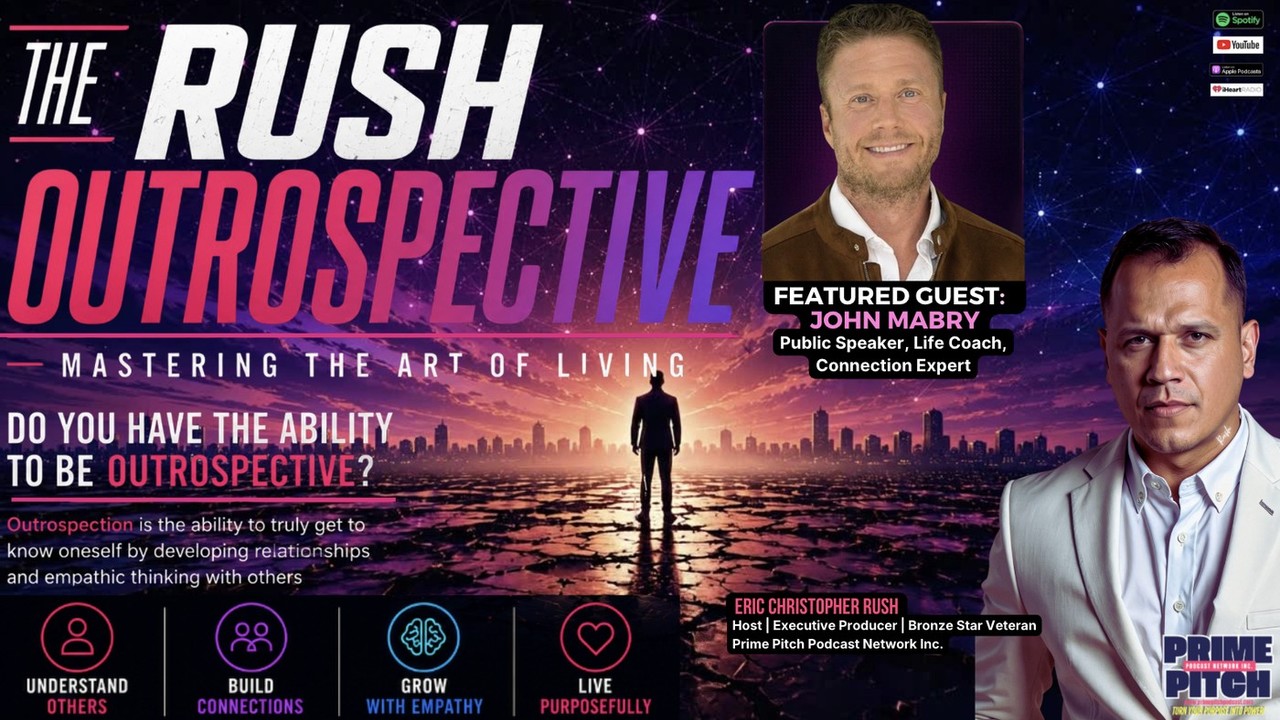
John Mabry
Public Speaker · Life Coach · Connection Expert
About the show
The Rush Outrospective is a Mastering the Art of Living podcast: raw, honest conversations about purpose, healing, and the road back to identity, the flagship series where outrospection began. Hosted by Eric Rush, The Conversation Architect, a Bronze Star combat veteran and the founder of Prime Pitch Podcast Network.
Read the full transcript
I l- I learned the tough lesson of vulnerability through my brother's death. So, uh, in my program I talk a lot about, um, becoming unsilent. Um, for peopleMy brother didn't die of a drug overdose. I found him from a drug overdose, but that's not what killed him. What killed him was his silence.
Mm. Like, let that set in. Silence kills people. My brother was, got his MBA from Georgetown University, top of his class University of Texas Business School, brilliant guy, performing perfectly in public, perishing in private, and his silence killed him. And what I'd learned from his death, from finding my brother, he'd been deceased for 3 days, alone, isolated in a room in Beverly Hills, is vulnerability, uh, is what I learned from that experience, is like I have to share what's going on because he didn't share what was, what had happened in his life.
Yeah. And it kill- you know, the silence killed him. The Rush Outrespective. A journey outward. Hey, what's up guys?
Welcome to Rush Outrespective, a mastering the art of living podcast. There comes a point in someone's life when getting back up becomes part of who they are. John Mabry had already survived the wreck that took his leg and the life of his friend. He rebuilt. He found his way to Hollywood.
He endured the loss of his brother to an overdose. He fou- he fought his own battles with addiction, went through treatment, found sobriety, and eventually became someone helping others find their way through recovery. And then he fell again. At one of the darkest moments of his life, after everything he had already survived and rebuilt, John finally said, "I don't have another one in me."His friend didn't ask him for another comeback. He asked him to take one step, and maybe that's where John's story becomes about something bigger than resilience, because eventually life takes things from us that no comeback can return.
The question becomes how do we beco- become whole anyway? That's what interests me about John Mabry. Not simply how he survived, not how many times he rebuilt, but what those experiences taught him about faith, identity, connection, surrender, and the difference between rebuilding a life and actually healing one. And this is my conversation with the dynamic speaker, John Mabry. Hey, thank you so much.
John, John. Um, what anMan, what a, what aYou know, I readYou know, when I was going through your, through your journey and, and, and going through this, I was trying to find the right words to, to, to express, you know, all the, all the, all the valleys and the, the highs and the- Mm-hmmlows. When I, when I read this cold opening, what thoughts and feelings and emotion went through your mind? Um, I'm humbled. Honestly, I'm just, I'm humbled to be here today, um, in front of you.
Thank you for putting this together for, for your show. Uh- YeahI'm honored to get to be here. Um, I, I don't feel, uh, like I've earned the right to, uhI don't deserve what God has given me, but- MmI'm grateful to show up. And, I mean, I'm nervous. I'm nervous.
You know, I, I do this, I do this frequently, and to be honest with you, I'm, I'm a, I'm a little, uh, nervous of what's gonna come out because, um, but, but God doesn't ask us to be perfect, he just asks us to show up. And so, uh, thank you for giving me the opportunity to show up today and- A- amen, amen to that, brother, 'cause it's true, man. Like, showing up is, isBeing present is, is half the battle Christ wants us to be at, right? He wants to say, "Show up. Be present.
Just show up, that's all you gotta do, and I'll, I'll work the magic around your life. I will, I will, I will reconfigure things in a, in a such a supernatural way that you'll, you'll be like unrecogni- it'll be unrecognizable to l- be- between the, to the earthly, earthly- Yep. beings in our world," you know? So, um, to have you here I would say is a tremendous honor, and I l- and I always say that part of, part of hosting a podcast is a form of my own rehabilitation, 'cause I get to sit down with people who have walked the walk, who, who don't just talk the talk but walk the walk, and, and really, um, take in their story, their, their, their information. I, if you ever see me doing this in a podcast and you see my hand going like this, you know I'm taking that and putting it as a treasure next to my heart, and I'm gonna own it for the rest of the, for the rest of the day, week, month, year, and we'll see how long it lasts.'Cause, uh, there's, there's always so many dynamic things that I get to be, be experience so, uh, to experience in this and, and being part of this conversation with you.
So it's an honor to have you here. Mm. And I thank God, um, nothing happens by accident. You know what I mean? Yep.
We both share a, a, an amazing friend, Dr. Dave Hausman, and he lives in Tennessee, and you live in Tennessee, is that right? Yeah, so I was one of the, one of the first guys he met after his amputation last year. Yeah. So we met, uh, we had the same leg dealer, and I went inI, I, I heard about him through a friend, 'cause the amputee community's kind of small.
Yeah. And so I heard about him through a friend, and then, uh, I saw him in my office. I saw him, I was like, "Oh, that's the guy. That's the new guy," you know? Yeah.
So I just went up and shook his hand, next thing you know we're, you know, great friends andYeah, and, and I think just the way, you know, the world, the world brings people together to, to do that. You know, Dave, uh, Dr. Dave, he, him and I met in a, in a, in a adaptive training foundation that deals with people that are dealing with limb loss or some kind of physical disability and, and issues, and, and they like to, um, they like to push you over the edge and say, "Here, start flying," you know? Mm-hmm. And, and, um, and even if you don't have any arms, you gotta start flying, you know?
Like- Yepand it, I, it was a beautiful experience to share that, that with him. I learned so much about him, um, just as, as a man and his journey and s- and hearing his testimony in, in, in, in our podcast. And, um, and I know if, they say, the apple doesn't fall far from the tree, and I get that feeling from you too, so I want you to know that. Thank you. Thank you.
Absolutely. Honored to be here. Absolutely. You know, there's, uh, you know, as I was r- as I was reading the cold opening, I wanted to say that, um, there's, there's an interesting difference between getting your life moving again and actually healing from what stopped it in the first place. John, uh, looking back- Hollywood seems to, s- seems to have represented a moment in life when, when life was moving again, and by your own account, you felt like you had arrived.
Um, could you explain that to me a little bit? I've had a lot of experiences where I've had a lot of external success where I was, um, performing perfectly in public and then perishing in private. Mm. And LA was just, it's like a magnification of that, performing perfectly in public and perishing in private. And so I'd lost my leg in a car accident here in Texas in March of 2000.
Tire blew out on a friend's car. We rolled 8 to 10 times. Mm. Killed a friend of mine, Ashley Furman was her name. She passed away March 11th, 2000.
I ended up, uh, having my leg amputated after 14 procedures in a year, and then, uh, graduated from Baylor University 6 weeks later on a temporary prosthetic. Mm. And it was all to show everybody I was f- I'm gonna go show everybody I got this. And so next thing you know, I'm in LA doingUh, I got my master's in counseling at San Diego State, stumbled into some acting stunt work in LA using my prosthetic leg, got my foot in the door in the industry, and next thing you know, I'm in, uh, you know, major Hollywood productions like NCIS and ER and the movie Superbad. And so, uh, performing perfectly in public and, and perishing in private, and I, umHere, repeat the question for me, please.
Yeah. Well, the question was, it was just about what, when you, what, what did it mean, what did it mean that you had arrived, that you felt like you had arrived? But there's more to the question. It's like, when did youI guess the real question is, when did you begin to understand that rebuilding a life and healing, uh, a life weren't necessarily the same thing? Man, yeah, so rebuilding was the easy part.
I've rebuilt a, a bunch of times, but healing, that takes effort. Yeah. Consistent effort. And if you've gone through the trauma I have of lo- losing my leg, lost a friend, I mean, I, I chose to amputate my leg. I found my brother dead from an overdose.
He had been deceased for 3 days in his Beverly Hills home. Uh, you know, lost marriage, access to my kids for quite some time, all the things. And rebuilding was, is, has, I found to be easy, but healing is very personal, and I've found you've gotta block out the crap from the world. Like, I had to, I've had to really downsize my life and quiet my mind, going into rehab centers, going into support groups, and really the he- the healing part is done in rooms like this. Like, I, I have, I have had more healing- Hmmin church rooms with, uh, my s- my men's support groups of crying with other men and sh- and, and doing 12-step work in a group of men in a church basement, uh, 2 hours on a Monday night from 7:00 to 9:00 PM.
And, and sharing my honest, vulnerable parts of me with other men, that's where healing is, is like it's in theThat's where the work is, not in the rebuilding, what everybody else sees. Yeah. And I, and I love to say, like, my, if you go, go to my socials, you'll see I had this really full life on social media. Yeah. But people have no idea how full my life is behind the scenes.
Mm. you have no idea how full my life is behind the scenes. Yeah. So grateful for that. Yeah.
And it's been because I've been willing to take time to myself to heal me first, and to do it for myself first and foremost. I always tried to heal for somebody else, or always, or I always tried to get better externally for somebody else. Hmm. But I wasn't willing to do real internal work on a consistent basis, and even though I failed and messed up, I was willing to keep coming back, so. Yeah.
Was there a moment when it actually, like, it clicked with you to say, "Look, I'm, this is like, I'm, you know," what they say is more the same, you know, like, like this, I need to get to another, that, thatI call it the evolutionary zone of being. You know? Like, you're like, "Okay, man, like, I'm still like, I'm still tra- I'm still swimming to shore."Yes. It was, um, about s- uh, 6 years ago. I'd hadI lost my house, my wife, and my kids.
COVID hit, and, uh, I was living alone, and I was not doing very well. And I was, uhDid I tell the story of my friend coming over? So friend of mine's a member of SEAL Team 6. Hmm. And that, that's, that's when it, itWell, right before that, my, uh, my 12-year-old son, um, caught me drinking, and it's shameful to say it.
I don't even wanna s- I don't like saying it publicly, but that's my truth, and that's, I, I was caught drinking when the court was on top. I already had court restrictions. Hmm. Uh, being drug tested every week, breathalyze, uh, within an hour of seeing my children. I had to breathalyze into a camera that would take a picture of me with my blood alcohol content and email it to the people who needed to know.
So I had all these restrictions on me, and I still messed up. And my 12-year-old called me out on it, and his mom had to come pick him up. Eeh. And so to see my 12-year-old look back at me and see what a loser I was, "My dad can't-- I have to protect my little siblings 'cause my dad can't even be a dad. I have to be Dad."And he called me out.
Mm. And so then that's when I called my friend over, member of SEAL Team 6. He's in my living room, and he's likeHe goes, "I, I took Bin Laden's watch off of his dead wrist when we shot him. I've seen death in the face. I laid on top of Bin Laden as our helicopter took off out of the, out of the compound."He goes, "You're not far off."He goes, "I see it in your eyes.
You're not far off."And he goes, "You're gonna make me show up at your funeral and tell your kids what a great dad you could've been. That's pretty selfish of you, isn't it?"Yeah, that's pretty deep. Yeah. And so, and that's when he was like, "Dude, everybody loves a comeback story."And I was like, "I don't know if I have another one in me, man."Yeah."If I have another one in me."And he goes, "Let's start with one thing today. What's one thing you can do today?"I was like, "Dude, I don't even know where to start.
I've, I've hosted podcasts on addictions. I've, I've spoken on addiction panels. I've done all this stuff, and now I'm back down here at the lowest I've ever been."And he goes, "Can you start with a shower today? Think you can take a shower today? Can you just start with that?"Mm.
I was like, here's a Navy SEAL, SEAL Team 6, telling me, "Can you take a shower?"Or asking. And I was like, "Don't leave until I do 'cause I don't know if I can do it."So he waited around. I took a shower. I was likeHe goes, "All right. Now let's get started."Mm."It's time, now it's time to start your comeback story."Wow.
That is sick. That is so sick, man. Like, you know, um, I mean, some, it's, uh, it's those small and incremental steps, isn't it? Like, you know. So that was a realization of, like, uh, like I, I came to an end of myself of, like, everything else I've tried externally is not working, and it was like I went back to church.
I was like, "What is not working?"And I went to Celebrate Recovery. Celebrate Recovery is a Christ-centered 12-step group at churches across the country. It's free. And that's, my evolution began when I came back to Christ, where, um, I was brought up in the church. My grandpa, uh, went to school with Billy Graham.
He and Billy Graham went to Bible college together. So my grandpa was a kind of famous preacher. He and Billy Graham were friends throughout their entire careers. I grew up in the church, baptized by my grandpa- Mmin his church at age 11, and, um, but I didn't have r- have a relationship. And so it was when I came to the end of myself in those moments, um, that I came back to Celebrate Recovery and started working the, uh, 12 steps with Christ as the center.
Yeah. And that was when things started to change. Dude, that is, that's like, uh, I mean, a lot of youI mean, I, it's, it's so insane, you know. You know, you hear people say, "Just take, ma- make, um, take the next right move," you know? Just make the next right move, right?
Like, and you're like, "What does that mean?"And then, w- and then, but when you do it, you actually know. Like, yo- that's the next right move, right? Mm-hmm. Like, you know, it's like, you know, it's like it did that one thing. Ev- and it kind of, when you were talking about, like, you know, just can you take a shower, like, you know, it was, that is so small, and it reminds me of, it kind of took me back to when my wife was, she was in ICU f- with C- COVID.
She were, they were gonna intubate her. A- a- and, and, and I just told her, "Please, just, just do me one favor," 'cause they were saying, "You, don't move. You're not gonna get up. You're not gonna, you're gonna stay in bed."I said, "Just do me one favor. Just, just get up 0 out of the bed and just touch the floor with your feet."Yeah.
That was it. And I said, "Let, just to," 'cause I said, "Just want you to just touch the floor with your feet. That's all I care about."'Cause they're telling you you're, you know, you're, you're gone. You're, uh, uh, "We're gonna put you in a coma for a while," you know? Yeah.
And I said, "Just, you gotta show m- you gotta just do this for me, please."'Cause I wanted her to feel, like, what it, what that, just that one next move, just that simple move of touching the floor, taking a shower, and just, and cl- you know, having that feeling of, of, of you again, you know? Yeah, just a sense of accomplishment. I'm in my body. I can feel something. And I'm doing something small.
It, I'm doing something. It doesn't have to be big, but- Yeahsomething in the right direction. Yeah. That's so cool, man. Um, you know, um, um, one of, one of the things I, I thought about is that, like, how much is his resilience is in this, his story, and of course there's s- there's l- there's la- there's lather a lot, aYou know, you're lathered with resilience and, and, you know, God's made you a resilient man and, and all this stuff.
But, um, you know, resilience usually, um, is ta- uh, is usually talked about, a- about as an unquestioned, as, as an unquestioned value, right? Get back up. Keep moving. Don't let what happened to you define you, define you. But sometimes I wonder whether movement can serve more than one purpose.
Um, how have you learned to recognize the difference between moving forward and moving away from something? I would say when I, when I came to the end of myself and was willing to start wor- building, rebuilding my relationship with Christ, when I started moving toward that, the other things that I didn't need started to fall away. It wasn't like I needed to remove things from my life. It's like I needed to add the one thing. Mm.
It's like add the one thing. That's a relationship with Christ. If you add that, the other things start to fall away. It's, it's like the magic of recovery. You know, it's, it's when you go into recovery rooms and you share your stuff, it's like I don't, I don't need to necessarily stop doing things.
I need to start doing the one thing, and that's seeking a relationship with Christ first. Yeah. I mean- Yeah. And how did you, like, you know, you moving, moving away from things, how much of that was like a, a hill that you had to, you had to climb, you know, or had to get 0 get over? How much did that play a role?
Oh, say that again. Like, how, how much that moving away from things, you know? You, we have an inner self, right? And we have a habit self, and the habit self has these, these ideals and, you know, just, you know, "I'm gonna eat this cake," you know, whatever, you know? Like, I'm gonna t- I'm gonnaUm, it's more, um, a self, self-glorifying and, and, and especially in your, in, in your story.
You're in Hollywood, you've done these things, and you, you have this, um, you know, this s- super story where you, there's, um, a lot of ego and those kind of things. How did you, um, w- when you, when those things that you had to move away from, how did you con- how did you battle those, um, how, what, what was the thing you had to do? Yeah, I would say surrounding myself with, um, acc- with men- Yeahof Christ in accountability because my mind wants to g- immediately go to the quick fix. Yeah. My mind wants to go to my old habits.
My mind wants to, "I wanna do this," but instead I pick up a phone call. Even, even, you know, this week I've made a couple phone calls going, "Hey, is this the rightI had this idea. What do you think?"Running it by guys in my, in my group, guys that can help me see things outside of myself that I don't see. Yeah. So I would say surrounding myself with other men, um, and having regular conversations with other men, being vulnerable and going, "Hey, this is where I'm at today."Yeah.
And, um, so it helps me move away from things that I wouldn't normally wanna be drawn to. Yeah. And to be honest with it, you know? Be honest with, uh, you know, I got an ice cream, I got an ice cream addiction. I got an ice cream issue.
Uh, I, I might need to find an accountability partner for that, but- Um, so yeah, that's what I would say is- It-surround yourself with- It's so true too, man, and that's the, that's the essence of the Rush Out perspective, right? It's like, it's saying, "Look, I've done all the personal inventories. I canThis is, this, you know, this is what this show essence is about. It's like I've done all the personal inventories. I've done all the, the 12 step programs.
I've done the introspection. I've done the, you know, um, list of character defects, the defects of character. I've done all that work, right? And then I still find myself in the same exact place, right?"It's like I'm, I still have a interpersonal pro- I have a personal problem with me, you know? Still?
You know, you know what I mean? No, I have a, I've, I've developed this personal problem with me, right? And I think when I hear you talk about, like, you went to, you reach out for your friends, you reach out to your support group, the people that you're in, in your community, you know, and you, you po- you put the idea out there. It's like, you know, that's, it's about individual and collective values and how you can fi- and, and listening to people who give you, who listen to their stories, and in that process you can identi- you can see how you can live maybe a different way and maybe de- define yourself. Hey, one of the greatest thing, just, this just happened 3 days ago.
I had a great idea. This is a great idea for my career. This is what I need to be doing. I call my s- strategist. I've got, you know, coaches in different areas of my life.
I call my strategist and I, "Oh, no," I leave him this voicemail. I was like, "Grant," I was likeAnd he called me back and he left me a voicemail. He goes, "I love the passion in your voice, but here's what I think. This is what we need to do strategically."And just, and after I left the voicemail, I heard myself say it out loud, and I knew it was a bad idea. Like, I knew it wasn't the right i- I knew it's a, maybe a great idea later, but not right now.
Yeah. But just when you say it out loud, you hear yourself s- tell somebody, you, you know, it's, um, yeah, youI, I get to hear my, I get to hear myself say it out loud even if it's a crazy idea, but I have safe people that I go to to get my crazy ideas out, and then they can help me sort through, hey, that's actuallyIt, sometimes it's good to be delusional. You know, it's good to have- Yeahdelusional thoughts and go, "I'm, I'm not gonna s- I'm not gonna let this stop me."And there's other times when I'm like, "No, I'm delusional."That's like- Yeah. But saying it out loud, you get to hear yourself say it, and then somebody else gets to give you some feedback and mirror back what they heard. Yeah.
That's awesome, man. Um, a long life gives most of us identities, right? In your case, some of those transitions have been much more dynamic than most. Survivor, actor, brother in grief, patient, recovery ad- ad- uh, advocate, speaker, coach. There have been a lot of different versions, right, of John Ma- Mabry.
Um, do you see those chapters as a series, a series of reinventions or a gradual discovery of who you actually are? It's probably moreMan, these are good questions. Thank you. It's probably more of a gradual becoming who God already made me to be. And it's kinda like the, uh, what's the Michelangelo statue.
It's like the block of stone was there. Michelangelo was already there. You just had to chisel what's not Michelang- or is it Michelangelo? What's the- Uh, yeahuh, the statue? You basically- Yeahchisel away the, the, the piece- Yeahof art that's already there.
Yeah. Like, it's, it's a big block of stone, but the art's there. You just gotta chisel away what's not- Yeaha part of it. So I think that's been, um, that would probably be my journey, as opposed to reinventing myself. It's like, now I'm just, I need to keep being, keep going to who God's already called me to be, um, and chip away the parts that aren't, aren't what He meant for me.
Mm. Man, that's powerful, man. That is so powerful. Um, I had a, a guy who had spent 15 years incarcerated. He is a Marine, and, um, he injured himself and then he got medically discharged.
And, and, uh, he, he got discharged, and it was, he was gonna make, he was gonna, he wanted to be a Marine, a lifelong, a career, um, uh, Marine, and then he injured himself and they discharged him. Um, and then he went to this bar, got drunk, killed somebody in the bar, and then he spent, he was supposed to do a 30-year sentence. In 15 years, he spent 15 years, and he says, um, one of the things he says that's so powerful, he said, "I had the, I had the privilege of being incarcerated for 15 years. I had the privilege- Mmthat God gave me the privilege of, of, of, of, going through this, this extreme turmoil."And, and he said it was in prison why he has this book called, uh, this thing called Weekday Remedies. His name's, uh, uh, David Gathers.
David Gathers, if you're watching, what's up, brother? Yeah. But he, uh, he, um, you know, he talks about, he says, "This is why I wrote my book."And, I share that story with you. How much of that kind of, uh, aligns with you, intersects with your life, that kind of idea? Absolutely, man.
It's like when I'm being squeezed the most is when the most growth happens. Mm. And I've learned to, I've learned to better, um, welcome the resistance, like welcome the pressure, 'cause the pressure's where the magic happens. You know, it's like when I'm comfortable, I'm not growing, but you know, it's like a diamond grows under pressure. A, a pearl grows because it's, it's got, you know, a foreign object inside of it, or inside the, inside the oyster.
It, uh, that's how the pearl forms is, is a foreign object- Yeahgoing in, and it starts to coat itself over and over and over again to create the pearl. And so now whenSo and I, just in the last two and a half years, I've been, um, on crutches, in a wheelchair, and a boot for over a year of the last two and a half years. But with a near second leg amputation. I had an ingrown hair, uh, a little over 2 years ago. Just buried my mom, fly back to Nashville, and they almost cut my leg off above the knee, and then I've had 2 ankle surgeries last, last year.
And literally a year ago right now, I was on, in a boot, on crutches for 9 weeks on a prosthetic leg. Mm. And, um, when these kinds of things happen, I'm like, at this point, I'm like, "Bring it. Bring it, Satan."Like, I know you're trying to take me down, and I'm not letting you. Like, you've taken me down before.
I'm not giving up anymore. And so, but it draws me closer to God. It draws me, going, "Lord, I can't get through this on my own. I can't get through this on my own."Make an extra phone call. It's going to extra support group meetings.
Like, what do I need to do to, to get through this tough thing? Um, but now when the tough stuff happens, I'm like, "Bring it.""Bring it."But I don't do it alone. Yeah, yeah. I don't, I don't say, "Bring it," and just decide to go through it alone. Bring it, make some phone calls.
Bring it, go to a support group meeting. Bring it, you know- Yeah, yeahhave, have, schedule lunch with a friend. Yeah. So. That's, that, man, that's, that's so cool that you, you know, you're able to tap into that.
let me ask you this. Um, how much of, how much of you losing your, uh, losing your leg has, has been a blessing, and what ways has it been a blessing to you? It has been great. Yeah. It's so great.
You know, I was having dinner with a friend last night, with 2 friends last night. One's a new amputee, and it was like, um, I get a real unique opportunity to connect with people very quickly and very deeply because of my prosthetic leg.'Cause when I'm wearing shorts and I'm out in public, people see it, and it's an outward representation of not everybody knows what it's like to lose a limb, but everybody knows what it's like to have an amputated spirit or to have lost something that they didn't wanna lose, to have something severed, relationship, a job, a, a career that didn't work out, whatever. And so immediately people have a connection of like, "That guy's been vulnerable before. That guy's been through some stuff."And the conversations I get to have with people are so amazing. Mm.
I've met some of the most amazing people. I've, I got to, also because of my prosthetic leg, if this didn't happen to me, um, it's possible Hunter Woodhall, who won a gold medal in the Paralympics last year, would not have gotten a gold medal in the Paralympics. I invented a sock that manages sweat inside prosthetics years ago, and nobody's figured out sweat management inside prosthetics for 3,000 years. The first Egyptian toe was, is, was, uh, made 3,000 years ago. Egyptians could build the pyramids perfectly aligned with the stars, true north, all the things that they did.
They couldn't figure out sweat inside a prosthetic. I did. So within a year, I had worldwide distribution on the greatest sock ever created for amputees, and it helped, uh, Hunter Woodhall was wearing them crossing the finish line last year. His double, double leg amputations. He's crossing the finish line in the Paralympics wearing the socks that I invented.
So, uh, yeah. And the guy, and I was the first amputee on the first TV show about the war in Iraq. So when the war in Iraq happened, the first TV show that came out was called Over There on FX. Mm. I was the body double for the lead actor in the firstSo I was the first stunt double-of the first wounded soldier, uh, about the war in Iraq.
So it's opened up some pretty cool doors, man. It's, you know, sometimes the, the toughest things that happen in your life are actually the greatest. Yeah, man. That's why I asked you that quest- 'cause I was like, you know, you know, we can talk about the, the pitfalls of that. You know, we can talk about, you know, what, how, w- how the ble- what the blessings are with that.
You know, like my buddy Dave, David Gathers, you know, it's like, you know, he sees it as a blessing. Now he's a b- uh, he goes to all the prisons and talks about y- you know, he's an advocate for, you know, prison reform, and he does all these m- m- um, s- magnificent things with the, the, the thing he had to endure, you know? And, and for you, that's what I, I've wanted to know is, like, what, what was the most im- impactful. Well, that's pretty cool, man. Yeah.
An, a, a, a Olympic, uh, gold medalist. Paralympic gold medalist. Yeah. Yeah. He, uh, broke a world record again this past year, uh, broke his own, uh, world record, so, uh, it's still- Manpushing limits, man.
That's the thing. It's pretty cool to be a part of that. Tell me about your friend that's here. You said he's, uh, uh, I, I know you, you have a friend with you, um, that's getting ready to eat. Uh, could you just go articulate with that?
Yeah, so one of the greatest things about being inSo this is the hardest fraternity to get into, I'll tell you that. Uh, I pledged fraternity in college. It's, you know, can be a challenge, but, uh, becoming an amputee, part of the amputee community, you literally have to cut a limb off. You know, I mean, you literally have to have a, a limb severed off and suffer for the rest of your life, and I'll tell you r- uh, weI talk about all the great things and the cool s- cool stuff that amputees do. Yeah.
It just sucks. Yeah. Like, the reality is living like this sucks, and it's not talked about enough. Mm. Um, it's a grind, dude.
The chronic pain, the, uh, the uncomfortable fitting. The, the prosthesis doesn't fit as often as you would like. Parts break all the time. Insurance. I mean, the, the greatest barrier is insurance.
I need aIf you need a new leg, they're gonna, they're gonna put every barrier possible for you to not get a new leg. They don't wanna pay for it, and so you have to jump through all these hoops. You have to go, you have to suffer enough and document your suffering enough with your practitioner before they'll even consider maybe giving you a, a, a new part or a new leg. Like, it's just, it's, it's not cool. Um, but all that to say is we are a very tight-knit community, so when somebody new comes to the nub club When somebody new comes in, you drop everything and you go help them, 'cause that's what people did for me.
Yeah. And so, uh, my buddy Roadside Ricky lost his leg a little over a year ago changing a tire on the side of a road. Mm. He was already named Roadside Ricky. What?
Uh, foreshadow. Yeah. He, he, he changed tires for a living. He changed tires on 18-wheelers and big things- Reallyand stuff for, for a living supporting his 5, 5 children, and, uh, got run over last year changing a tire. Uh, hit-and-run.
Don't know who. They still haven't tracked the guy down, and so he is, he's, he's struggling. He's struggling to adapt to a new life. He's not able to work 'cause, you know, it causes financial issues, chronic pain issues. Uh, putting on weight, all the things.
And so as a, as a life strategist, as a coach, um, I've taken himbeen fortunate to be able to take him under my wing, bring him here to Dallas to get him some adaptive training. So he's doing some adaptive training right now while we're here, and then tomorrow we're doing a running clinic with an amazing organization called the Challenged Athletes Foundation. Mm. And, uh, they're doing a mobility clinic here in town to help, uh, people with amputations learn to run. And so Ricky's not at a place to be able to run just yet with his situation, but, uh, just to be around the community, connect him with other amputees, and starting to give him some knowledge, that's what it's all about, so.
Yeah. Well, that's, you know, that's, that's amazing, man, and I think now, now we're just talking about that, I'm like, okay, man, you still got some work to do with the, with the amputee community. You still got some people to pe- feature on from the amputee community 'cause, you know, like I told you, Dr. Dave, when he was here, it, it, it, you know, first being a part of the Adaptive Training Foundation, I wouldn't be surprised if Ricky's running right now. They will not, they will not take you ain't running for an answer.
They will not. Trust me. You'll be like, "I ran today," you know? I have a puke bucket. I saw yesterday, we drove by there, and there's, there's our puke bucket.
I'm serious too, man. He, like I hadn't ran, I had 2 hips, hip replacements last year, and, and I hadn't ran, like, in a while. He'sAnd I started running. I, w- I, the first, the first step I took, I wa- you know, I had both of my legs and I tumbled, you know? Like, it was, that's where it was bad.
I was on the ground. At first I was like, oh, my God, we're starting off on a bad note. Yeah. We can't go any further from here, you know? But these guys with, you know, one leg and, and, you know, it's like they were running.
I wasDave was running. I was like, here I am falling. Yeah. So they didn't take no for an answer. I would, I w- I'm, visualizing it for him."Rick, you- YeahI really regret to get the ice bath.
I got a, I got a cold plunge here if you need it."But no, that's, uh, that's cool, man. Uh, um, you know, his journey. He, and he's lucky to have you- Yeaha friend, you know? And, uh, you know, it's, it's great toI'm just glad I get to travel with him 'cause I mean, he, he, he, right before we get on the airplane, his leg bre- He's got a $100,000 leg. He's above the knee, so he doesn't have a knee joint.
Mm. Of course, it breaks, so he's hobbling through the airport. We got him in a wheelchair hobbling to the airport. And so yesterday morning we had to make a, a last-minute appointment to a practitioner here, and they're, he had overnight apart, and they're at the Adaptive Training Foundation right now putting a new knee on him right now- Mmas he's doing this thing, uh, today. So there's all these technical things and, and frustrations- Yeahand it's just, it's good to have peer support.
Yeah. And I guess for your audience, you don't have to, again, you don't have to have lost a limb to know what it's like to need peer support. But whatever it is that you're struggling with, whatever, you know, amputated spirit, you might have s- find support for- Mmfor what you're going through so you don't have to go through it alone. Yeah. Um, one of the greatest human contradiction is, is that, m- um, is that knowing better doesn't always mean we're capable of doing better.
Uh, would you agree with that? Mm-hmm. Um, education can give us a language. Agi- experience can give us insight. Um, we can even recognize something clearly in a person and, and remain unable to change within ourselves.
Um, when did your own struggles eventually teach you that all your knowledge about counseling, addiction, and recovery couldn't? Say that last part one more time for me. What did your own struggles eventually teach you that all your knowledge about counseling, addiction, and recovery couldn't? That I'm not God, man. Like, that I, as much as I want to try to control my life and control my s- l- you know, my situation, my surroundings, it's like get the freak out of the way.
Like-just get out of the way and let God take over, man. So yeah, all the k- yeah. Master's in counseling and all, 5 rehab centers, 3 sober living houses, all that stuff. It's like, um, you still, I still had to get enough consequences and get far enough down to realize like, "I don't know what I'm doing here, man."Mm."I, I don't have the answers, dude."Mm. And, uh, so I guess that's probably what I would say.
Yeah. That's a, that's, man, that'sYou know, people who don't know that, I know that when you say that. You know, get out of the way. You know, you gotta get out of your own way, you know? Yes.
I had a counselor tell me one time, he said, "Rush, if someone calls you a horse, go buy yourself a bag of oats."'Cause then you, you know, he was just, like, saying, "You know, you're gonna go out there and you're gonna do what you're told. And, you know, when you're out there in, in, in the real world, in the world now, you're gonna do what, do what you're told, man."Mm."'Cause your way ain't the right way."Yeah. Here's a great example. I was in a treatment center. Um, the first treatment center I went to, I did step one.
It was this high-end celebrity treatment center. I did step one of the 12 steps, was, uh, maybe, took me about an hour to present it to my trauma group, maybe 8 or 10 people in the room. Presented about an hour of my questions, step one. Relapsed after 3 days, after 45 days in this high-end treatment center. End up in another one, and it was hardcore.
And they, bunch of guys sitting around in a circle. There's a round table in the middle with a counselor on the other side, with a rattlesnake in the middle of the table, stuffed rattlesnake looking at you with its fangs open. And step one was 70 questions. It took me 12 hours over the course of 3 days to go through each question, and everybody could chime in if they wanted to. And so I'm on step 2, I'm working through step two, and I'm answering questions.
And he's like, counselor just, he's like, "On 37 you said this, and on 38 you said this. What are you lying about?""What?"He goes, "You've been lying to yourself for so long, you don't even know that you're, you don't even hear yourself doing it. Guys, do y'all hear this? Do you all hear what he's lying about?"And they're like, "Oh yeah, we all hear it. We can, we can tell you're lying."I was like, "What?
This is my truth."And he's like, he threw his book down and he goes, "I'm gonna tell you something nobody out there is gonna tell you. You're a crippled drunk.""That's it, dude. Until you can come to the realization that you're just a crippled drunk, you're not gonna make any progress. Get out of here. Go to your room."I was like, "Whoa," uh, "you can't talk to me like that.
You don't know who I know."Like, "I've been at the Playboy Mansion with Adam Sandler," you know? Like-"I know people."I was- Um, but you know, sometimes you, you gotta have somebody just be like, "Dude, that's where you're at."Yeah. Like, admit that's where you're at. And so that's one thing when I coach people is go like, "Where are you really at?"Not a washed up, you know, s- s- Yeahsoft version of where you're at. Where are you really at?
Yeah. And let's start there. Yeah. How, as a counselor, how, how, how much courage do you have to, like, confront somebody like that, like this counselor did with you? Like, you know.
Um, I've gotten better at it. I have, I got soft for a while there, where I was just trying to baby everybody's feelings. And now it's like, "Dude, we don't have time."Yeah. Like, there's not time to mess around. That's why I needed, you know, Alec.
Yeah. I needed my, my friend to sit there and go like, "You're not well."Yeah."You're not well."Mm."You gotta make some changes now."And then to have that counselor go, "You're, this is who you really are."And so to be able toAnother, another example is, uh, Dave Ramsey. Dave Ramsey fired me face to face. I got fired by Dave Ramsey for my, uh, untreated mental illness and addiction on the job. I'll just leave it at that.
Um, but you know, I needed somebody like that to go, "You're not well."To hold up a mirror and go- You obviously have some issues. I'm gonna let you go get the help that you need. And so I take that now when I work with people of like, "Dude, you don't have time. make the change. Like, you gotta do it now."Yeah.
So. Yeah, sometimes you gotta fast-track that shit. You gotta fast-track that stuff, man. Like, you gotta be like, "Hey, we ain't got noAnd your feelings got no place here in your"And I'm just- I-a licensed counselorso I'm not a licensed counselor, but, uh, I've been through enough where- I don't mind telling somebody the truth. Yeah.
You know, "This is it, buddy.""I've been told this, and I got better because of it. I'm gonna tell you this 'cause I know you have more in you."Yeah. You know, there's a, a, a particular vulnerability that comes with becoming someone other, someone other people turn to for help, right? There's a cert- significant vulnerability, right, that comes with becoming someone other people turn to for help. Um, the role itself can carry expectations, especially when the sub- the, the subject you're helping navig- um, the, the, the subject you're helping people navigate is something you've had to navigate yourself.
Um, when did you learn about allowing yourself to need help while also being someone other people look for, look- Yeahfor answers? Great, deep question. Um, I'll say the vulnerability, you mentioned the word vulner- vulnerability, um, I'd l- I'd learned the tough lesson of vulnerability through my brother's death. So, uh, in my program, I talk a lot about, um, becoming unsilent, um, for people. My brother didn't die of a drug overdose.
I found him from a drug overdose, but that's not what killed him. What killed him was his silence. Hmm. Hmm. Like, let that set in.
Silence kills people. My brother was, got his MBA from Georgetown University, top of his class, University of Texas Business School, brilliant guy, performing perfectly in public, perishing in private, and his silence killed him. And what I'd learned from his death, from finding my brother, he'd been deceased for 3 days, alone, isolated in a room in Beverly Hills, is vulnerability, uh, is what I learned from that experience, is like, "I have to share what's going on," because he didn't share what was, what had happened in his life. Yeah. And it killed, you know, the silence killed him.
And so I've learned to be able to, umIt's almost like sponsorship and 12-step recovery work. When you become the sponsor, you hear yourself telling yourself what you need to hear. So when I'm coaching somebody, when I'm talking to somebody, and they go, "Hey, Dan, I got this problem," I'm like, "You should maybe look at it from this angle or look at it from this angle," and half the time I'm talking to myself. I'm tell- I'm reiterating to myself like, "Oh, I needed to hear that today," you know? Yeah.
So the more I get to work with people, the more, uh, vulnerable I'm willing to be, and they're willing to be with me, it's, we all grow in that process together. Yeah. So. That's cool, man. Yeah.
Um, you've heard a saying is that you have the solutions to everyone else's problems, um, you know, but you don't have the solutions for yourself. Um, how much of that is true, you think? Say that again. Like, uh- You have everybodyYeahyou have the solutions for everyone else's problems. Dude, that's where I get coaching.
I have coaches in- Yeahnumerous different areas of my life, and it's, I don't have all the answers. Yeah. And then, and then I had somebody call me on something last week, very heavy, and I didn't know how to respond. I go, "Let, let me think about it, and I'll get back to you."I call somebody, I'm like, "Hey, I got this. Somebody came to me with this problem.
I don't know how to answer it. What do you think? You know, you know me. What, what's-" Yeah."What, what do you think?"So I don't have all the answers, but I c- I can reach out and find somebody that does. Yeah, I think that's the point.
You know, it's like, you know, we, we all have answers. Like, you sitting here providing answers for someone else. When someone watches this podcast, they're gonna be like, "These are the answers I've been looking for," you know. You're providing the answers and, and then someone's gonna speak to you, and you're gonna get some answers that you need. And you're speaking to me right now-and I'm giving you some answers I need.
And it goes to communication. Yeah, yeah. It goes to connection. Yeah. You know, uh, we might cover that here in a minute, but- Yeahyou know, it goes to connection.
Connection is, is, umThe opposite of addiction isn't sobriety. The opposite of addiction is connection. Hmm. And addiction doesn't have to be a substance. Addiction can be food.
It can be silence. It can be addicted to your ego, addicted to your job, you know? So. How about feelings? Is it addictive to- Yesanxiety?
You could be addicted, you could be addicted to your story. You can be addicted to the victimization. Dude, I was the victim. Man, you talk to my ex-wife, I was the victim for years. Yeah.
You know, just playing the victim story. Well, I found my brother dead. I lost my leg. Of course I can go get pills from a, from a, from a doctor. Yeah, give me some more pain pills.
I'm, I'm hurting. And I played the victim for so long, and, uh, I w- I was addicted to my victim story. Yeah. Mm-hmm. And that was hard to break that.
Yeah. How's the relationship with your, your ex-wife now? Is it, is it- Mm-hmmis it- Good, man. We- Yeahwe're so fortunate. Or, you know- Yeahlive 2 miles from my, um, my k- we live 2 miles apart, so I'm, uh, active with the kids on a regular basis.
Just, we just dropped my son together. We, uh, we didn't drive together, but we, um, we dropped off our son, our oldest, at, uh, college last week. Yeah. And- Wowto see him off and set his room up and, you know, hug him out and cry together, all of us cry together, and it was, uh, really, really special. Thank you for asking.
Yeah. That's soMan, that is, I mean, hearing you say that, it's so beautiful, man, just, just knowing that there's that evolution, you know, like, of, of your relationship has come full circle, connected together, man. You know, if somebody out there, if you hear this and you're not where you wanna be, keep going. Uh, when my son was 12 and he looked up at me and told me what a loser I was basically, um, to hug him, uh, he, he got a full-ride scholarship to University of Alabama business honors program. He got to move in early, kind of VIP status last week.
And when we hugged at his dorm, I mean, he, he didn't let go. Mm. Like,And, uh, that's, like, you know, one of the greatest honors of my life is to be able to be there and show up, and I, I, I didn't give up. I've done all these things we're talking about, been vulnerable and asked for help and surround myself with other guys, because I can't do it on my own. It's like I need a prosthetic to get out of bed every morning.
Uh, I physically have to put on a prosthesis to get out of bed every morning. And before I get out of bed, I also put on my spiritual prosthesis. So without God in my heart, in my life, and in the men that I've surrounded myself with, and, and women as well that have helped support me, um, I'm able to show up for those kind of life events now, and it's the greatest feeling. You know, when I'm in the treatment centers and I'm like, "What am I doing here? Where's my"I mean, I, I got, I moved into a trailer on the banks of a river with a roommate named Beaver.
I went from parties at the Playboy Mansion to living in a double wide mold-infested trailer to seeing my kid in business honors program and hug him out was- That's, that's awesomeGod does redeem if you get out of your way. Yeah. That's- Get out of his way. Yeah, you know. Now I see that and I, I mean, I almost got, I, when I saw the visual, I was visualizing as you were talking it out, I was like, "That's what's up, man."It's like, you know, then when you reach that level of spiritual and emotional maturity, you know, it's just like, you know, things get a little bit, you know, there, there's not much more decisions you have to make.
Do you agree with that? Yeah. It's like getting all the, all, all the money and all the, you know, accolades and all the awards and all the stuff and the People magazine features and all that stuff, it's like, just show, can you be present with your kids? Yeah. You know?
That's, that's all now, dude. You know, it's like the new currency for me is, is peace. Mm. You know? It's not paper, it's not paper bills.
Yeah. It's, it's, like, the greatest currency for me is peace of mind. Yeah. You know, for me too, like, I would say, um, for me it was like, like I, I realize that God's not asking me for anything. He's commanding me to doMm.
He's commanding me. There's no more asks. Like- Yeah."Rush, you already did it. You're, you already, I asked you to do this and I asked you to do that and I asked you to be this person, and your self-will ran riot."Mm-hmm. You know what I mean?
So, these next 4 chapters, peace, joy, love, and happiness, you know? Like, if you put 10 years on each one of those and said, "That's what I command you to chase, nothing else," like, that's, there ain't no decisions. There ain't no feelings that are gonna get in the way of that. There ain't no, like, this is the direction you're going, and that's where you're gonna go. And, um, when I started doing this podcasting, that was one of those things.
You're gonna, you're gonna go through a season of listening. You're gonna, you know, you're gonna shut up and listen for a while. So that's what this exercise is. Horrible. So God is here with us right now.
Like, he ordained it, he ordained it for me to be in a season of listening for a long time, I guess, you know? But, um, but good, 'cause I ne- I definitely needed it, you know? And I think all of, um, like you, you know, we listen to, we, we, we're looking for those listening as opportunities to listen to people, um, uh, to their advice, and you're reaching out like that with other people to get, to get those tools, essential tools that keep you, you know, in, in, in, uh, keep you steering the right direction. Yeah, I think, you know, a lot of people, a lot of men, you know, I can relate to more, a lot of men just don't ask for help, and they, "I'm supposed to, I'm supposed to know this."Yeah."I'm, I'm supposed to do this."And man, oh, I don't know what I'm doing half the time, man. I'm- That's- When I wake up before I put my leg on when I'm in prayer, I'm like, "Please, Lord, help me not screw the day up.
Help me getI'm gonna find every which way to screw the day up. Help me stay out of my own way."Yeah. That's a, that's a good point that you make, you, um, that you, you make is we ask for help as though that's the finish line, right? Um, your story, uh, complicates that, right? Because you've, you know it was up.
Um, treatment happened, real efforts have been made, and there's still, there's still the setbacks, right? What happens to hope when you're sincerely trying to change and that change doesn't hold? Uh, I got to a point of hopelessness. to legit, I was hopeless. Hopeless.
Because I kept doing it on my own. I kept trying to do it my own way. Even though it, I was tryingI would ask, I wanted the treatment center to fix me. I wanted the therapist to fix me. I thought, like, um, taking your car to a mechanic, you leave the car at the mechanic and you come back and the car's fixed.
Like, I don't know anything about a car. Yeah. Like, I just expect the car to get fixed. So I thought if I just entered, entered treatment, I entered a sober living house, like, I would just, like-magically get fixed.0 one thing is they, they gave me the tools, but then I wouldn't use the tools on a consistent basis on my own on the outside. Mm.
And so, um, I finally get, yeah, I got to a place of hopelessness, and that's when things start to change, when I was asking for help, asking for help, asking for help. But, um, I finally had to do it for me. Yeah. And not, and not, not expect, umShowing up and doing the step work or showing up and doing, um, therapy work, um, wasn't enough. It was personal relationship- Yeahthat I had to do at home when I wasn't performing.
Even, even in treatment, dude, I was the best guy in treat- I was the best patient. My first time in treatment, the, uh, th- they had family week. They had family days where, like, my, my mom and dad came in and my ex-wife comes in, and one of the girls was like, "Oh, you're, you're, you're, uh, you're John's wife? Oh my gosh, he's the greatest. Like, we all love him around here."And she's like, "You have no idea."You know, it's like Yeah, yeah.
So, uh, even though I was asking for help, asking for help, and I was willing to get help, I f- um, but I kept getting in my own way. Man, you get to a point of just complete hopelessness and just, I give up. Yeah. That's crazy, dude. Like, I think that's so crazy you said that, 'cause you could be like the, the, the A+, uh, tr- uh, treatment center patient, right?
But it's like I think that's a red flag for counselors. They're like, "Oh, this guy, like, you know, he's whacking some poetic crap here right now. You know, he's probably got, he's intellectualized this stuff and, and you know, he's, he's got this down," you know? Well, so after my first treatment, 45 days in a high-end celebrity treatment in Arizona, I get home and I go to intensive outpatient for 6 weeks. Yeah.
And I'm getting toward the end of intensive outpatient, and they go, um, uh, "Do you mind bringing your, your wife in? We think we need to have a conversation."I was like, "I'm, I'm graduating early. I'm only 4 weeks in and I'm graduating early. Look at this."And they come in, the 2 counselors, and my ex-wife and I are sitting there, and they're like, "Um, we think he needs more treatment."And she was like, "What are you talking about? I just spent 45 days with 2 chi- I'm nursing our second child.
I'm home alone while he's off, you know, getting massages and playing pool volleyball, and, uh, he needs more treatment?"And they're like, "Yeah, it's not really s- he's not, it's not sticking," you know? So- Yeah, yeahI feel like, "Man, I, I did so good. Everybody loved me."Yeah. So- Yeah. Um, Hollywood.
Hol- YeahHollywood, right? They call you Hollywood. What, do you have a nickname? Uh. No.
Just wondering. Um, yeah, no, it'sTake the mask off, guys. If you're out there, the, I guess the, the moral of the story is take your freaking mask off. Mm. Like, just take it off.
Yeah. Whatever mask you're wearing right now, take it off, and, and let's, let one person, let one person just see who, who, who's, what's really going on. Don't be silent anymore. Yeah. If you're listening to this and there's something going on in your life right now, today's the day that you don't have to be silent about it.
That, man, that's, that's true, man. Um, uh, it, the mask gets heavy after- Mmyou know, so many years. You're like the w- you know, stuff you're not supposed to be carrying, you're, you're still carrying it, you know? Mm-hmm. You know?
Um, uh, there's, there's one moment in your story that feels different from everything that, that came from, that came before it. Your friend says everybody loves a comeback story, and everything, and everything you've already come back from, your answer was, um, "I don't have another one. I don't have another one in me."What had you finally reach, um, what, what had fin- what had you finally reached the end of? I kept trying to create my own comeback stories, and I wasn't following the greatest comeback story- Mmever told, and that's Jesus Christ coming back. tried to c- I created my own comeback from my car accident.
I walked 6 weeks after my amputation on a temporary prosthetic to get my diploma from undergrad. I go to graduate school. I get my master's in counseling. I go to LA. I do the thing.
I invent a sock that helps people around the world. Worked for Dave Ramsey. Worked for treatment centers. I hosted a podcast on addiction. I had 3 of the members of the band Korn on my show.
I'veGuy from 3 Doors Down. I had Lindsay Lohan's dad. I had, like, all these people on my show- Wowspeaking on addiction panels across the country, doing all that stuff, and comeback after comeback after comeback, and it was all on my own power. It was all like, "Look at me."It was all ego-driven. And when I finally w- went out, and my buddy was like, "Dude, like, everybody loves a comeback story," and I was like, "I've tried to do it on my own."Hmm."I need to follow the greatest comeback story ever told, and that's Jesus Christ coming back.
Let me goL- let me try that. Let me g- Let, let me try that route out again."Yeah. And here I am today, by the grace of God. Amen. Yeah, it is by the grace of God, right?
Mm. We're both here. All of us are here, right? Like- That's rightit's like, you know, he says, "Man, I'm gonna take that disaster, and I'm gonna make it, I'm gonna make it something beautiful, you know, and, and I'm gonna let everybody see the kind of work I've done with this person," you know? TheAnd, um, it's beautiful, man.
I'm glad you're here, and I, I can say, you know, recently I, I, when II'm a executive volunteer for TDCJ, the, the Texas Department of Criminal Justice. So I went to the prison, uh, last week, and, um, and there was this guy, and, and it's, it's an entrepreneurship program that, that they have at TDCJ, and, and I, I'm, I'm the executive, uh, volunteer for that. And, and there was a inmate there that really wanted to meet me, and he's like, he, he wasHe is amazing guy, great energy, like, ugh, like heYou know, that high, you just high, that high-level energy, and you're like- Yeah. I'm like, "Okay, man."I'm like and he, uh, and he's aThey, they, they made a special arrangement for him to meet, for us to meet, and he's, um, he goes, "Man, I wanna become a podcaster. I wanna be this amazing podcaster.
I have a story to say. I have a story to give."And I saidHe goes, "So what's the secret?"I said, "Man, it ain't the talking that's gonna save you. It's the listening."And, and he was shocked 'cause he had this whole powerful, like, "I canYou know, I'm gonna go in there, and I'm gonna grab this microphone, and I'm gonna give it. I'm gonna giveI'm gonna just wax my now knowledge about me being incarcerated."And, and uh, I was like, "Dude, it's not the talking. It's the listening.
If you wanna be an amazing podcaster, you have to learn how to listen."And, and, um- Mmhe was shocked, and he really, he really wanted- He needed to hear that. Yeah, man. His pers- He, he got quiet, like real quick. But I goI mean, I said, "Let me tell you, when you get out of here, you're still gonna be in rehabilitation, you know that? You're still in recovery.
You know, you're getting out. You're being ca- incarcerated. You still got a whole life to rebuild. You gottaYou're starting over. But you need to go, and you need to justIf you wanna be a podcaster, then you need to be able to listen, you know?"And, and, um, he was, he was shocked that I told him that.
But his story was so impactful, dude, 'cause I just real- When I, when I walked away, I didn't know his story. Um, but he got up in front ofThey introducedHe had something to say. Like, this whole big thing. They, they brought 3 people up on front, and his story was that his family left Syria a- and, you know, and- Hmmyeah, and 10 years a- uh, 10 years ago to come to America 'cause they were, you know, they were being bombed and being attacked, and, and, um, and so he leaves. And he falls into the, the drug culture in, in America.
Mm. And his life goes a different path, but I didn't know that at the time. If I would've known that, I would, I would've probably had a little different conversation with him, but I think he has a beautiful story to tell. But IHow much of that storyLike, now you said you were a podcaster, right? Like, and that's why, 'cause we have some common thread.
Now you're sitting here in my, my podcast studio. But how much of that story do you go, "Look, I need to be, you know," uh, um, how much of that is a, "Not the talking, it's the listening that makes you a great podcaster"? You know, you know whatYou had people on your podcast, right? Um, h- how much of that is, you think is true? Yeah, absolutely.
Um, and look at, like, like Joe I, Ilike Joe Rogan. Yeah. I appreciate the, you know, the various, uh, range of guests that he has on there. But he, you know, he, he, he hears an answer, and then he asks the next question underneath that. Yeah.
You know, it's kind of like, "Okay, hear you. What about this?"And so to be able to even, uh, to get, continue to get beneath the surface, you gotta kind of read between the lines, and a lot of that is just showing up and listening. Yeah, man. I, I, uh, that'sIf you, and, and you, if you'reAre you gonna do a podcast again, you think? Would you take a different approach?
Well, my, my- Or your time's-my coaching team tells me I'm supposed to, and I, I'm refusing to do it. And, um, I'm kind of reworking my, uh, my keynote speech right now. I got about 10 weeks before I'm presenting that in front of a group of my peers. So it's, again, people performing perfectly in public and perishing in privates. That is- Hmmthe, the new thing.
And so they're telling me, yeah, I'm supposed to be doing a podcast. And I'm like, "I don't wanna beI'm"And so I told my strategist and my coach the other day, I was like, "I don't wanna be like a Mel Robbins. I don't wanna be a, a Lewis Howes. I don't wanna be one of these, you know- Yeahbig podcasters."And he's like, "I'm gonna give you some pushback."He's like, "Don't, don't say you're not gonna do that because you could be really good at it."Yeah. It's a lot of work, man.
It's a lot of work. The production on this stuff, dude, I give you credit, man. This is not an easy job. This is not an easy job by any means, so I give you credit for it. And part of it is I don't wanna, in all the work that you put in.
Okay. I appreciate being on other people's podcasts 'cause I don't have to do all the, the, the, the, the small minute stuff. yeah, my guys are saying I might have to do it one day, so we'll see. A- a- again, it's, and this is part of my continued evolution. Do I- Yeahget out of my way?
Yeah. Am I worried about the work that I don't wanna do or the, the tediousness of- Yeahum, the marketing and the, and the posting everywhere and all that stuff? Hey, maybe if I just get out of my own way, and I'm hearing myself say this out loud- Yeahuh, this is therapy session for me. Yeah. Is if I get out of my own way, God can put the people in place.
Mm. And I just shut up and get out of the way. Yeah. And so and I have people on the outside telling me, like, "Dude, you need to be doing it."Yeah. And you're like, "No, no, no."But yeah, you know, that's why I say it's so therapeutic.
This is part of my re- I, that's why I start off saying this is part of my rehabilitation journey.'Cause I, I, I, and this is something I would, I would say too is like, like you said, they, they call you a horse, go buy yourself a bag of oats. They say they call you a podcaster, go buy a microphone, you know? Like- It's like they're, they see what, they see- They see what I can't see in myself, right? Yeah, yeah, yeah. Good.
But yeah. I would say, like for me, when I started podcasting, it was like God was saying, he was like, "You're gonna go back home from Calif-"I was living in California in, you know, Laguna Beach, California, beautiful area, but I'm from Texas, and so, "You're gonna go back home. You're gonna meet your wife. You're gonna, you're gonna go to school. You're gonna get your film degree, and you're gonna become a podcaster.
You're gonna sis- you're gonna shut up and listen. You're gonna ask questions, and you're just gonna listen."Well, one of the things was, for me, was like I did not wanna be part of the veteran community at all. I had so much, so much, uh, built up, frustration with the military- Okay'cause my journey and the things that came from that. And, and so I, I did not wanna be that. But God kept saying, "You're gonna go start a podcast for veterans, and you're gonna sit down, and you're gonna, you're gonna get in front of veterans, and you're gonna ask them questions."And I use- I've learned to use this as part of my rehabilitation project.
Pa- pa- um, not project, but part of my rehabilitation, you know? And-the 3 podcasts I host are, are this one, The Rush Retrospective, and Mastering the Art of Living. It just so happened to be things that I really need to master. My Mastering the Art of Living, The Unfinished Business, a podcast for veterans pursuing new life missions, which is what I, you know, it's part of this, you know, and then the other one's, uh, Next Level Thinkers, Charting New Horizons with Brands, 'cause I wanna get smarter than I am. You know?
But- That's truebut it's, it, it does come down to like, say, create a podcast of something that you need in your life- Yeaha- and go down that road. Not what other people need, but what you need, 'cause that's where the res- that's where it's, and you're gonna be magnificent. Yeah, it's like, uh, we're most uniquely, uh, able to serve the person that we used to be. Yeah, yeah. So as we continue to grow and develop, it's put yourself in theSo to, to, like for you, uh, I see like resentment, maybe you had resentment comes up- Oh, yeahwith the military.
Oh, yeah, yeah. And, and 12-step recovery, resentment's the number one offender. Yeah, yeah. So if you're carrying that resentment, God, he's just like, "I'm gonna go, you're gonna go ask other people about the military."Oh, yeah."Ask people about veterans."You're like, "I don't wanna talk about this stuff. I resent it."Yeah.
But I don't know, maybe this is part of your process. Yeah, I just had, um, I just had a, um, a Navy SEAL mom, a Gold Star mom come on, on, on having my podcast, and you sit down. I had 2 Gold Star moms in one week, and it was just like pretty heavy, you know, to sit down and break the conversations down and have conversations about the son they lost in action. And, and you go, and then you reach another level of that evolutionary zone of going, now you're this advocate for ve- veterans now. And, and when I say now I wanna be an advocate for, for those with li- limb loss and what those, those, those obstacles we have to come, like we have to overcome and, and, and especially in the treatment stuff.
So we're, we're, I'm gonna circle back on that with you for sure. All right. Um, let's see here. Um, let's see. Faith is an interest, is, is interesting in your story because Christianity wasn't something you discovered for the first time at the bottom.
It had been part of your life much earlier, and yet the way you describe Christ has a different weight to it. Yet today, uh, the way you describe Christ has a different weight to it. When did faith move from something you knew to something you had to depend on? That would be, as I previously described, after my last, uh, big relapse and a buddy telling me that I wasn't gonna be around much longer if I didn't make changes. And so going, uh, again, crawling back to church, crawling back to Celebrate Recovery.
If you've seen any of my social media posts, I was s- 55, 60 pounds heavier, don't even look like the same person. I was a, I was just a shell of myself, and I was just completely overweight and miserable. And so, yeah, I grew up in the church, got baptized by my grandpa when I was 11, and like I described before, but it was really like there was no relationship. It was religion, but there wasn't a relationship. Mm.
And so the Christ-centered 12-step group of Celebrate Recovery helped flesh that out for me. And so the physical changes that have happened to my body are, are really a direct result of the internal changes God did by building relationship first and foremost. Mm. That's beautiful. My friend has a book called, uh, Theology of Fitness, and he talks about faith and fitness.
They're, they- Mmthey're not, uhThey say they belong together, you know? Man, that's a great- So when I'm in, when I'm working out these days, a lot of times, uh, I mean, that's, it's a, it's a form of worship for me. It's a form of meditation. So when I'm doing a hard set and I get done with that hard set and when I put the weight down, a lot of times I go into breathing, right? And, you know, I get my nervous system, my nervous system, my blood pressure, everything's hyped up, hyped up, hyped up, and then I immediately start bringing myself back down.
I go, go into my body, breathe, calm myself down in the middle of a set when mySo, so then on the outside in the real world when I'm nervous on a podcast like this, I can go into my breath and be like, "Shh, I've been through a lot worse."Yeah. You know? But, um, I use working out as a, as aYeah, fitness and faith is sh- yeah, that's, that's spot on. Yeah. Because, uh, it is a form of meditation for me and a form of, uh, you know, "God c- how can you use my body and my mind to move your kingdom forward?
And so help me push further through this set than I think I can push with your strength," you know? Yeah. So it's, um, yeah. Yeah. Well, shout out to D'Angelo Lee for that book- Ahthat he wrote in prison.
Great us up. That he wrote when he was incarcerated. Yeah. That's even, you know, that's even a, a whole thing on its own. Um, um, what's your favorite, umI know you talk a lot of your sc- uh, your relationship with Christ.
What's your favorite scripture? Um, oh, gosh. I would probably just go back toI need basic stuff. Yeah. I, I don't, I don't wanna make things complicated, but- Yeahum, for God so loved the world he gave his only begotten son, that whoever believes in him should not perish, but have eternal life.
Mm. Basically, yeah. Going back to, like, I just need to start with a shower. Yeah. Yeah.
I just need to start with the, the basics, man. ThatHey, that's all you need to remember, you know? Like, you know? Yeah. Went all the way- Remember where you came from.
Remember where, you know, what, what, um, God had already proclaimed over your life from the day you were born, you know? And he had, he had this, you know? This was already preplanned. I just had to get out of my own way, and continue to get out of my own way if he's gonna continue to use me, right? So- Yeahwe'll progress.
Do you, do you think you, umYou know, they say redeemed, delivered, and then the last one's anointed, right? Which stage do you think you are in that? Redeemed. Delivered, anointed. Definitely been redeemed, definitely been delivered, and I wanna say I'm anointed, but there's, like, a hesitation there.
It's almost like, do I deserve it? Um, I had somebody tell me the other day, he said, uh, I met him for 15 minutes. And he goes, "John, I"He goes, "I don't think you know how powerful you are."And I was like, "What are you talking about?"He goes, "John, you're more powerful than you realize."And I wanna say I'm anThere may be an anointed part of me there, but I'm scared 'cause I'm like, "I don't know. I don't do"Like- But, um, I'm showing up. I'm showing up as I am today as best I can today.
Yeah. And, uh, whatever that means is, is whatever God has for me today, so I don't need to try to be something I'm not, but- Where's that? That's where I'm at today. I'm gonna call you a horse, man. You're a horse.
You're anointed. You know, you're anointed, 100% you're anointed, and, um, and that, that's, that's a given, you know? Now how we, we, we revolve around that, right? Mm. Like, for me is I had to learn that, too.
I had to learn, like, you know, this, this podcast is, is out, I'm anointed to be a podca- you know, s- to, to create, a, a conversation ar- architect, you know? It's like create these dialogues and then, and really, um, really sit down and be a listening leader and, and say, "Okay, you're anointed to, you, to, uh, to, to, to put people on a platform, to push them t- you know, on the hill and where the light shines bright, and, and, and, and other ways, too, you know? Um, and now, now he's saying you're, you're in the studio, right? He's saying you're in the studio. When you gonna get up in front of the stage- Mmyou know?
And learn. A- and that's the thing, too, man. This whole podcast experience for me is, like, learn how to, learn how people, learn people's stories so you can tell your own, you know? Mm. Like, learn how to, uh, learn, like you telling your story.
Gotta learn and say, okay, like, that's, give me that wisdom on how to articulate myself and give me that wisdom how to carry myself in a re- responsible and respectable way, and don't let that, don't let anything else get in the way from what, what, um, what God's majesty has for you, you know? It's like the teacher becomes the student. Yeah. It's like- Yeah, no. Yeah, man.
I- Thank you for that. Yeah, absolutely, man. One word seems to keep, um, surfacing in, in the way you talk about life now: connection. We talked, you said that word would come up. It is, uh, connection to God, connection to ourselves, to other people, to purpose.
And its opposite, disconnection, can happen quietly even while life looks perfectly functional from the outside. What have you come to understand about the relationship between silence and connection? Um, had this conversation with a friend at dinner last night how he ha- he had a group of friends for 20 years. They see each other almost weekly, you know, over the, over the decades, and nobody ever talked about anything real. They talk about the Cowboys, they talk about their jobs, they talk about their family, but they didn't talk about real stuff.
And when my friend went through a divorce, he was the first person in the friend group to, like, have something major come out, and he was like, "Sure enough, when that came out-" This friend started saying this, and this friend started saying this."He's like, "We've had this friend group, but it's been surface level all these years."And so now they're more deep, and now they have like a Bi- now they do, like, a men's Bible study on Zoom, and there'sfriends with an Olympian who's in this group, who's now all of a sudden becoming more vulnerable. I mean, this guy's a 3time Olympian, and he's in this men's group that's, like, becoming vulnerable and talking about God more, and it's because of the vulnerability and the, the connection. Yeah. But when they sit in silence, when they sit in silence, when I sit in silence, I'm freaking isolated, I'm miserable, I'm scared, I'm in fear, I'm anxious. But as soon as you say it out loud to just one person or say it out loud in a prayer to God, say what's, what's going on underneath the surface of your life, say it out loud, it's connection.
I mean, that's conne- it's si- silence kills. Yeah. And, um,Man, that's heavy, dude. I mean, you know, from a veteran standpoint, you know, like- You don't wanna talk about your stuff. Yeah.
Yeah. Um, I've held a lot of details of my recovery journey away from my kids, 'cause it's like, ah, but I was able to talk to my s- my son just went to college last week, recently about some of the, some of the more gritty details of kinda what I've been through, and I think it's, I think it, it creates a deeper connection when it's like, "Hey, dude, here's what I really went through. I, I've beenI'm, I'm shameful to even say this, but here's some of the stuff that I, you know, dealt with."And telling them the story about how I was crippled, called a crippled drunk, and it's like, man, I've had to be humble, dude, over and over and over again, but it's made me who I am today and where I'm able to sit here in front of you today. And, you know, f- uh, speaking creates connection. And, um, my life is more full than it's ever been before 'cause I'm more connected and I'm less silent than I've ever been.
So there's a direct correla- I'm finding a direct correlation. Yeah. That's awesome, man. Like, I think it's, I mean, that's, that is beautiful is just, you're right, man. I think, you know, silent connection is so important, you know?
And that's what, I think that's part of the premise of this too, you know? It's like saying, "Hey, connect," you know? Like, get, get those people in front of you. You need to have, to, to listen to what they have to share, and then in the process, other people are listening. You know, there's 3 of us in this room, right?
You know? Mm-hmm. There's one, all we need is one more person in here, you know? Like, the, the person who watches this podcast, so that's the person we need to touch, right? And then- Um, let's see here.
I'm getting ready. I got a couple more questions. Well, one of the, one of the, one of the things I, when I was reading your thing was a, a term that you used that was really powerful to me, man. It was like, I don't know, it was just so powerful. It's called the amp- amputated spirit.
Mm-hmm. Yeah. Physical amputation gives the idea that, uh, uh, gives you, gives, um, gives that idea a very literal origin, right? But the metaphor reaches muchIt's like, you know, it goes a lot further. Um, event- eventually almost everybody loses something that isn't coming back.
How do we become whole without requiring life to give us back what we've lost? Connection. Yeah. So I get reconnected every day. I reconnect myself with something, uh- Mm.
S- something outside of my s- I rely on something outside of myself to complete me, and so this is, like, a physical representation of that. But what I've found is I need, uh, th- there's something inside of me that's completed me all along, that I don't have to put on, that I don't have to have a prosthesis for. It's, it's, it's Jesus Christ already there. Like, it's already, everything you, everything I need is right here. Yeah.
And, um, so I don't know if that makes sense, but- Yeah, yeah, it makes sense, brother. It's a bre- you know, it's the, the armor of Christ, you know? Yes. Yeah. So yeah, we've all, we've all had something severed and cut off, and we've been cut off from s- something or some situation in our lives, but it's, um, really, you don't need something to fix you from the outside.
You already have what you need on the inside if you tap into it. Yeah. John, uh, we've talked a lot, asked a lot of questions. Tell us a little about wha- tell us a little bit about what you're working on and, and, and where people can get ahold of you and all that stuff. We'll wrap up with this last question.
All right. So yes, I'm, um, currently working with kinda, um, highly influential people who are struggling, you know, uh, who are, who are performing perfectly in public and, and perishing in private. So, uh, I've got, uh, working with clients for that. Have a couple spots open for that. Um, also, um, yeah, revamping my keynote speech, so will be out on the road, uh, doing more of those here before too long.
Been able to take a step back and, and work on, work on some things. Uh, but if anybody is looking for a speaker, I am available to do, um, kinda a little bit of, uh, old song and dance, but I got new stuff coming out, so be ready for that. And then, uh, yeah, John Mabry, uh, John Mabry Connects, Instagram, uh, Facebook, and, uh, TikTok, and soAnd johnmabryconnects. com. Is there a question I c- I, uh, that you would want me to ask you that I didn't ask?
Hmm, ooh. Ha ha ha. Putting me in the podcaster seat. Yeah. Podcaster hot seat.
Yeah. UmHmm. A prosthetic, a silly prosthetic question may, uh, comes to mind, like, uh, like how much does a prosthetic cost? Let me, let me, let's start with that. It's just a simple question, but a lot of people don't understand this is a, uh, $30,000 leg.
So mine's $30,000, but buddy Ricky's that broke yesterday is $100,000. Mm. This kinda goes to your point of like, um, a lot of people don't understand how expensive these are and how tough these are, so if you were to ask, like, "Dude, how much does that leg cost?"I'd be like, "This is a $30,000 leg, and it's not fitting great, and I w- I need to get cast for a new one. This socket area needs to be recast 'cause I've lost weight, and I have to, again, document enough amount of pain over a n- a long enough period- Mmthen to, for insurance to say, 'Yeah, we'll, we'll grant him.'" You know, the great Oz, uh, who are these insurance people that are making these decisions behind the, behind the curtain? Yeah.
And we have to rely on patience and God's timing to be able to sit back and go, "I'm, I'm gonna suffer through some, some pain until I, I can get a new prosthetic covered," but they're very, very expensive. And then in, in terms of, uh, sports, that's where people like the Adaptive Training Foundation and Challenge Athletes Foundation that we- Yeahtalked about earlier come in. A lot of times people with disabilities, it's not that they don't have the, the drive or the will or the, the ability to succeed in sport or an active lifestyle, but they don't have the, uh, they don't have the funding. Yeah. And so, um, if anybody out there is looking to, uh, support, uh, Adaptive Training Foundation or Challenge Athletes Foundation, um, support, uh, prosthetics and, uh, equipment for people with disabilities.
Yeah. yeah, for sure. That is a good question, you know, but I think just the more information we put out there in the podcast world, like, you know, um, having more, uh, conversations about- Uh-huhuh, those that have to deal with it, the obstacles, the, the physical, the me- the medical necessities of, or trying to navigate through the bureaucracy of all that, you know, like, like- Yeah, like, like a running leg-it still doesn't- A running leg's not a medical necessity. Yeah. Right?
And I was like, "No, it is."Like for my mental health and my- Yeahwellbeing and my physical health, it's, it's like, are you saying running shoes aren't a necessity for the average person? Yeah. Like, you know- That's, like, yeah. It's like- Wowthis is like wearing a boot all day long. I can run in boots.
Yeah. You can run in boots, but it's- Yeahit's clunky, it's heavy, it- Yeahcauses more blistering, but if I had a running shoe, I could be more active. I could be mentally better, physically better- Yeahmore present for my children, and so, like, a, a simple running leg is, that's not a medical necessity, so you gotta find a way to pay for that, and- Yeahthat's where it'sYeah, that's- Challenging. Yeah, that, man, that's- It's a lot of moneyThe, the goal is to get as closest to your, your other leg as possible, right? Like, just to get it, just to have that, um, that whole thing complete so you feel f- you'll live- Feel like a whole person again, yeahyeah, yeah.
And, uh, yeah, we're all, we're at the mercy of the insurance company so much, it's, it's, uh, challenging. I'm gonna look at, I'm gonna look s- more into that, man, 'cause I haven'tI mean, when I had D- uh, Dr. David, it was like, wow, I didn't think about those kinda things, you know? You justAnd he brought, he shed some light on it, and I think the whole conversation about that. I even told, I d- I even told Dr.
Davis, "Man, join some amputee groups and get in, like, just, you know, maybe you should, you know, be the one, you know, to get, to get that thing started with, man, a heavier, a bigger voice."You know? He's a very smart, smart guy. Um, last question: Maybe one of the evolutions of your story is that life stops being entirely about the next comeback. There comes a point when surviving, rebuilding, achieving, and even recovery have to give way to the larger question of how we actually want to live. After everything life has taught you, what does mastering the art of living mean to, to you today?
What does mastering the art of living mean to me today? Using the voice that I have and the knowledge and experiences that I have and the skills to bring up the next person, whether it's an amputee, whether it's somebody struggling with addiction, struggling with trauma, g- going through trauma, somebody who has succeeded or the, the CEO of their company and they're doing everything perfect, and they have the house, and they have the kids, is to bring up the next person. Yeah. Which is kinda why I have somebody in the studio today to bring up another person who can hopefully be sitting in this seat so that my voice isn't the only one being heard, but that the next voice gets to be heard as well. So that's, um, mastering the art of living is what we're doing here today.
Yeah. And I'll say this. I'll, I'll say this. I've had, um, I had a, um, a, a NFL lineba- uh, lineman come on my podcast, this one of th- this podcast specifically, and, and he had, he had, um, injury, he had a injury, and, and we s- talked about hisHe got it, he was, like, getting r- he was during COVID er- era. He was a Dallas Cowboy, and he, um, he got injured, and then when COVID hit, he had all these scouts that were gonna come see him to see him, you know, to recruit him to play, to get, to, to play, and then CO- COVID hit, so they shut down the NFL, right?
You sat on my podcast, and then we talked. We, you know, I'm gonna ask questions, you know, like I do. I think the most important part, he got out what he needed to get out of himself that was, that was really debilitating his mindset during that pod- during that podcast with the, you know, he, you know, he got NFL shut down. His career went down, you know, was that was the end of his career 'cause of COVID stuff, you know. They shut it all down, and he never got togot looked at to see if he was ready to play again.
Yeah. And he had all these, uh, recruiters already, um, NFL recruiters to come see him, but scouts and, and they, he sh- shut down his career. But when he sat down, man, that guy sat down, and he let that stuff go. Mm. And that guy took off like a rocket ship.
He just wentI was like, "Man," he started speaking everywhere. I was like, "Dude, what, how do you go?""Yo, man, it was your podcast, man. Like, something happened," like, you know? Said, said, "Just, you know, I got to, I got to, you know, do some work, you know, get, get, get into myself. I felt like I was getting stuck, you know, getting stuck on being stuck," you know?
Yeah, yeah. And it was a, it was a good conversation. So I think talking- Mm-hmmon the podcast is sharing your testimony, sharing your, your, the, you know, the, the hills you have to climb is, is so important, and, and we're, I look forward to that. I think you already have a seat here already. The seat's gonna be filled with you, um, for sure, and we're gonna, we're gonna get that, we're gonna get that working, okay?
Promise you that, and we're gonna make it impactful and meaningful because we're both gonna save some lives in that process, okay? Man, I, I guarantee you that. But, uh, John, it's a pleasure to have you on The Rush Outrospective, A Master in the Art of Living podcast. Um, you, you've been an, you're, you are anointed. You've, you've, you, you know, you reached a standard of excellence, and now you're gonna use it in a wi- you're using it in a, in a, a more wise way and a more, um, therapeutic, in a s- you know, more, you know, spiritual way, and I think with God centered, centered in your life.
It's, it's, you know, that's, that's where you're at, and that's, man, that's just heir apparent. I'll just say that, man. Oh, thank you. Yeah, absolutely, man. It's a, a pleasure to have you on the podcast, brother.
Honor to be here. Thank you. Awesome. God bless. All right, guys, that's it for The Rush Outrospective, A Master in the Art of Living podcast.
As I always say, have peace and light in you, and remember that the ocean refuses no river