John Kirk
John Kirk joins Rush on The Rush Outrospective, the flagship show about purpose, healing, and finding the way back to yourself. As national Inside Sales Manager, Stronghouse Roofing, John brings building something meaningful to the table.
They get into the work, the cost, and the reasons it still matters, in the kind of long-form conversation this show was built for.
In this conversation
- Building an organization with a mission
- What experience teaches about leadership
- Turning purpose into work that lasts
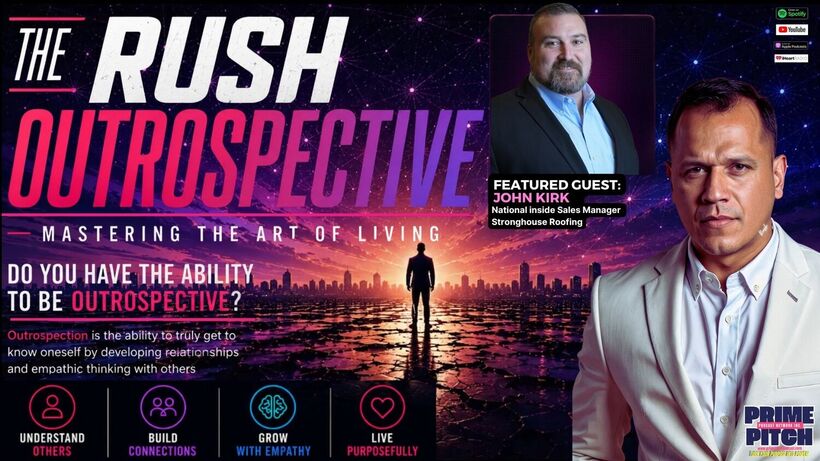
John Kirk
National Inside Sales Manager, Stronghouse Roofing
About the show
The Rush Outrospective is a Mastering the Art of Living podcast: raw, honest conversations about purpose, healing, and the road back to identity, the flagship series where outrospection began. Hosted by Eric Rush, The Conversation Architect, a Bronze Star combat veteran and the founder of Prime Pitch Podcast Network.
Read the full transcript
What have you learned about the way relationships quietly shape people's lives over time? Uh, well, relationship, for a relationship to be impactful doesn't mean it has to be this long relationship. It's, it can be somebody that's just in your season for 6 months. Hmm. And whether you're getting that impact from somebody else or you're, you're giving that impact to somebody's life, it's, it's not something where you really have to think, "Well, I'm not, I'm not s- spending every day with this person.
I don't, I may not see them very often."Yeah. But you can still be meaningful with the time you do spend with them. And if there's somebody that, that you look up to, you know, just soak it in when, when you're around them. It's, uhThere's a, there's a concept that Andy Andrews c- should get credit for. Hmm.
Andy Andrews is an, is one of my favorite authors. He has a book that's called The Traveler's Gift. Which, if you're gonna read one book, you need to read The Traveler's Gift. It's, uhIt really, it really had a big impact on, on where I'm at now, and it got me, uh, much more interested into reading other books to, for self-improvement. But he talks about having your board of, uh, you know, y- businesses have boards, charities have boards.
You're probably on a board. And everybody can have a board. Now, those people may not know that you're on your, they're on your board. Hmm. And they don't have to know.
But you have people that you think of that when you're going through something, whether you haven't seen them in a year, you wanna reach out to them. Hmm. You wanna get their opinion. you trust them. Yeah.
And they're on your board. And so it'sI have many people where I don't see them very often, and, and I would hope that there's some people that feel the same about me- Yeahthat I don't see. And maybe, maybe I'm, maybe they were in my high school season or my college season, or they were in my car business season, or in my personal training season. I mean, all these seasons that I've gone through, I still keep connections with those people. Maybe we talk once a year.
But I, you know, I hope that they consider me somebody that's, that they can countWe're mastering the art of living. Hey, what's up guys? Welcome to Rush Retrospected, a Mastering the Art of Living podcast. One thing I've learned through- over the years is that careers are rarely built by skill alone. Relationships matter, trust matters, reputation matters.
The rooms you enter, the people you stay connected to, and the way you carry yourself through changing seasons all shape the trajectory your life takes. That's part of what stood out to, to me about John Kirk and the work he's doing through Cowtown Networking group. What interested me wasn't simply the network- networking component, it was the deeper understanding that meaningful connection still matters in business, in leadership, and life. John's story moves through athletics, entrepreneurship, sales, roofing, real estate, family life, faith, and community leadership. But underneath all of it is someone who understands the long game of relationships, adaptability, and staying grounded while life evolves.
Because the truth is people don't just need opportunity, they need rooms where trust can form. They need relationships that sharpen them, encourage them, challenge them, and remind them they're not alone, not building alone. That's where networking becomes more than a personal or professional tool. It becomes part of how people find direction, momentum, and meaning. This conversation explores leadership, reinvention, faith, relationships, and the human side of building a meaningful life over time.
This is my conversation with John Kirk, founder of Cowtown Network. John, welcome to the Rush Retrospected, a Mastering the Art of Living podcast, my man. Thank you for having me. Absolutely. Um, you know I always ask this question.
I'll start off the same way I do with most of my guests is, as I was going through the introduction with you, what went through your mind, spirit, soul, heart? Well, you mentioned the long game. It is a long game. It's, uh, it's something where the younger person has trouble seeing that. Mm.
And, and I, so did I when I was, I was young. And then it's, it's if you're always just living for the immediate gratification, then you're gonna be missing out on a lot of opportunities. Yeah. And it'sAnd if you get in this like, "Well, this isn't worth my time," attitude- Hmmthen, then you could be thinking that about anything. And I mean, so I mean, that's, that's one of the things that, that yeah, I, I doThat is something that's important to me.
Yeah. You know, I was thinking about like, you know, what isI guess it goes, it goes with the saying, there are no shortcuts in life, right? No, there's not. Yeah. Um, you know, you've moved through a lot of different rooms in your life.
Locker rooms, business rooms, leadership rooms, networking rooms, family rooms. Um, looking back now, which environment shaped you the most as a man? Well, I, IThe car business was where I probably sharpened a lot of my skills. And, uh, and started really seeing that bigger picture because it, it did require me to start wearing a lot of different hats in the same role. Hmm.
And, you know, I did the car business for a long time, and actually my family's has a long history in the car business- Hmmin Fort Worth. It was Kennard Brothers Automotive. Okay. It was my grandfather and his brothers, and I never intended on, on getting into sales. And just a, a funny thing about sales is that when I was in college, I remember saying to myself, "I'm never gonna be in sales."And my mother, who did Yellow Pages, she was like, "Yeah, you know, you, you may not enjoy it, you may not be good at it," even though she did sales.
And then the first job I got out of college was sales. Because it was a job of opportunity. It was a, I needed a job. Uh, I intended to fight forest fires, but whenB- between when I graduated and when forest fire season started, there was about a 6month gap, and by that point I had stopped playing football and I had gained some weight, and I said, "I need to get in shape, so I'll go get a job at a gym."Well, the only gym job that they had available was, was doing sales. Hmm.
SoAnd, and I've been in sales ever since. So the different levels of sales, but the car business definitely gave me, um, s- that bigger picture, you know, really honing in customer service and understanding that's, that's making ref- And that's where I started making referrals. That's when I really first started networking. okay. Um, which set me apart from the other guys at the dealership that would just wait.
We would call them lot lizards. Hmm. Yeah. They're just waiting for somebody to drive up, and then they pounce on them. I mean, I would help those people out also, but I started networking then.
Uh, I would network really anywhere I went. I mean, if I was in a public space, I'm gonna try to start a conversation with somebody. And I always, I've always believed if you just show genuine interest in somebody, eventually it's gonna come around where they're gonna ask you, "So what do you do?"Yeah. And then, you knowAnd if they don't ask you that, well, that kinda tells you a little bit about that person. But that's when I started doing BNI, um, so that's really where, uh, where I feel like I started to really become an adult at that point.
Hmm. Wow, car sales, you know, uh, what a, what, what an interesting career to like, to start off with, you know? Like, you, you knowSome people have a misconception of, you know, when they, you know, "Oh, I gotta go to the car dealership and I'm gonna get pounced on," like you said. Um, how did you, how did you, um, mentally, like, prepare to overcome that, that, that kind of a, a reputat- that reputation of, of car salesmen and, and like- It's tough. TheEverybody loves to buy stuff, but nobody wants to be sold.
Hmm. So you have to come at it from that attitude that I'm here to f- just get out of this person's way from buying something. Nice. You know, they're, they're here. They obviously want or need a car, and they're gonna get a car from somewhere, so it might as well be me.
And, um, it wasI wanted to make sure I had the most knowledge, first of all. So when I first started car sales, I just dove into the literature, understood every model, all the options, so that I could answer those questions when I got them. And, and then it was about the follow-up, because many people weren't buying on their first visit. Normally, theyThere's sever- you know, you have to have a few interactions with somebody before they actually feel comfortable with making a large purchase like that. So appropriate follow-up, not hounding them, but also giving them, you know, the information they needed.
Sometimes I'd send them videos of the car they were looking at. You know, and I'd say, "Hey, here's this, you know, just wannaOr we just got this one."So it's, umyeah, it's, the, there is a negative s- stereotype with, with many different sales. Yes. And, uh, but again- Yeahthey're gonna buy from somebody. And, and if you just make, make the process easy, that's really what they're looking for.
They want tran- people want transparency. They want to just have clear answers to their questions, and I felt like I did that. And that, and that allowed me to be one of the top salespeople in the dealership. Wow, that's an interesting pers- um, interesting positioning on how you said, you know, "I just want, I, I need to make sure I get out of their way. They're here for a reason," you know?
Yeah. And I think, you know, recently I bought myself a new pickup, a 26, 2026 Toyota Tacoma TRD, and, and all I kept thinking is, you know, I went in, but, you know, I saw it, and I was like, "Okay, yeah, that's it," you know? But, but I did feel, you know, I was like, "Okay, what am I gonna get, what am I gonna endure here? What am I gonna go through?"But the fact, the way the gentleman who helped me out was, like, kinda get, just process, you know, like helping me- Yeahwith the process, not really the selling, you know? And, and, um, um, and so yeah, I think you're, I think that's a, that's a, that's a very wise way to look at, um, when youThat when they're expecting something different, you're giving them something different than what they're expecting in from their experience, huh?
Yeah. Um, okay, so, uh, a lot of your identity f- when you and I first met, first of all, for those that don't know, John and I met at Big Country Veterans Gala this year, and a shout-out to, to, to Cody and, uh, Michael Graham, Cody Palmer, Dr. Cody Palmer and Michael Graham, uh, for putting that event together. It was at such an amazing event. And, and you and I had shared about, um, your time in, in, in foot- in football.
Yeah. Uh, speak a little bit about that. I want people to know who, who's, what kind of athlete I was, that's sitting in front of me. Well, I, uh, athletics has always been important to me. Um, I did go to college at Texas A&M.
So we're- we're, you're always gonna see these rings around, which looks a little bit like your ring- Yeahbut not quite as fancy. So, uh, there I was offensive lineman at Texas A&M. I actually didn't start at Texas A&M. I, I originally went to a college in Louisiana. I think it was mainly just 'cause I, I knew I was gonna get to play more.
Uh, and after about a year of where we didn't win many games and, and, uh, I just didn't feelI felt led to go to A&M. And I have a, a long family history at A&M. Hmm. So my father played football there. My grandfather went to school there, and my brother went to school there, and my aunt and uncle went, and my cousins went to school there.
So it, it really felt like home. But, uh, so there I, I, um, was on the team all 4 years. I didn't play much. Hmm. Uh, there was only, only got to play when we were up by quite a bit.
As offensive lineman, it's not like other positions like defensive line or D tackles, uh, or, you know, wide receivers, things like that, where there's a l- lot of rotation. Typically, the 5 guys that start the game are the 5 guys that finish the game. Hmm. So, and there was 20 of us. And, and I was making a trajectory where I was getting better and better, and then we had a coaching change.
Yeah. So the coach that I had came in under, he was let go, and which was R. C. Slocum, and then, uh, Coach Francioni came in, and he had a different vision for the team, which meant he was gonna be playing a lot of underclassmen. Hmm.
And so I enjoyed it. Uh, I, uh, tried to stand out in the weight room. While I was there, I had the, uh, bench, squat, and incline weightlifting records. Oh, nice. So, uh, yeah, like, they got sh- I got to be showcased in some of our weightlifting expeditions ex- called the Night of Champions.
So, uh, yeah, those are things I'm really known for at A&M. Uh, I wasn't known for being on the field very much. Hmm. Which was disappointing. Uh, and I didn't really intend on continuing to play football, but then I got opportunity to play arena football.
Hmm. You know? Even though I didn't play, I was still, I was still practicing and competing with other high-level players. So, you know, when I got to arena, it was actually a lot easier- Hmmin some, in some respects. But I enjoyed that, and I did, you know, I did it for a few years, but at, at some point, you always gotta hang up your pads.
Yeah. Yeah, so that was tough. So now I, I still exercise. Uh, recently been doing Highland, uh, Scottish Highland Games. Sent you a video of that.
Yeah. Uh, you know, just want s- some opportunity to be competitive. That's awesome, man. That's awesome. Um, you know, uh, when a identity forms early around competition, like, uh, you played sports most of your life, I get, right?
Um, um, around competition, momentum, or performance, what does adult, what does adulthood eventually teach you that those environments can't? Well, I'm, I, it's hard for me to look at adulthood without looking at it through a father's eyes. Hmm. So I don't know. Somebody that, that was my age that didn't have kids, I think they would probably have much different answer to that question.
Hmm. So f- you know, for me, theWhen you get past that initialYeah, where you're young and you're looking for accolades, you're looking for, to, for milestones. It, you eventually have to have a bigger why. Mm. You know?
The why can't be to have an awesome truck. Yeah. It, it, it, it just can't, you know? I don't need a big house. I only need a big house if I have people in it with me.
Yeah. And if it was just my wife and I, then I, I don't feel like I would be the person I am. I feel like the kids really comingI have a passion to not only, I wanna be a role model for 'em. L- and, and I, but I also have a drive to provide for them. Yeah.
And it's, uh, it's, you know, I wanna, I don't wanna spoil 'em, but I, I, I want to give them opportunities. And, uh, so that's, to me, that's, that's my drive as an adult, and I can't think ofI mean, I love it. Yeah. That's, that's, man, that's awesome, man. Like, to think of it in that, in that, in that realm.
You can only see it through fathers, through, through, through fatherhood, you know? Yeah. And, and that's a, that's a answer that I, you know, I'm going, wow, man. That's like, that's deep, you know? That's so deep, you know, what your motivation is and, you know, why your, your why, why you're doing the things you do is to, to care for your kids, honor your family, and, um, provide.
And, and that is, um, when you think about that, right, that, you know, from a father's eyes, in today's culture, let's talk about today's culture. What's the, what does that look like? Uh, you know, p- you know, what does it look like to you today? I mean, me. Like, like this, this isWould you say that's, like, from an era that, uh, you know, looking through a father's eyes, uh, is that an era of, of, like, a mindset or a, um, um, a belief system from a particular era?
You know, like, a 1980s- Sureyou know what I'm saying? And then we look at today, what is, what is the, what does this era look like from, if someone was looking in through, through their own eyes? What would that, what would you say that w- that would- Well, I, I'd like to say that it's timeless. Um, you know, the Bible has many examples of, of great fathers and, and, uh, it's, there's distractions that make it maybe more challenging. Mm.
You know? It's, it's aPeople have their identity in with their career, and it's, it's, it's hard to serve 2 masters, you know? If you'reI- is it your family or your career? I mean, one of them is gonna have to be a priority, and they can both be a priority, but one of them's gonna, one's taking the steering wheel. Yeah.
And it'sAnd then you have just self-desires, too, which I have self-desires. I love to travel. Mm. But I don't wanna travel alone. Yeah.
You know, I wanna be with my family. A- and I do think it's very important to travel along with your wife from time to time. Uh, but I always tend to find myself, when we are that, like, oh, man, I really wish my, my sons and daughter were here to experience this with me. Yeah. So to, to answer your question, um, I do think there are some distractions that make it challenging for some fathers, and there's certainly no shortage of publicity out there of people that are, you can say, failing at it.
And I, I, I think that, um, I think everybody, if they can turn it around, you know, relationships can be met. Just because you're, you've been focusing on your career doesn't mean you have to continue that, down that path. You can, you can sit down, you can have some introspective and, which is what this podcast is about. Uh, and, and just change. Uh, change y- change the way you do things.
And, uh, soYeah. That's a- Yeahthat's a, thatMan, that's, that's so true. Let's give a shout-out to your family, man, right now. Let's haveWhat, what are their names? Say hi.
to My lovely, wonderful wife, Jill, uh, who she doesn't like it, but, um, I always mention that she won Wheel of Fortune. Oh, wow. Or won the whole thing. We did- Like, like she went all the way. Maybe you should get on here.
Yeah. But, uh, uh, so that wasAnd then of course she has many accolades I could spend a whole podcast on. Uh, and then my oldest daughter, Natalie, who, uh, is very into choir. Uh, and she also does powerlifting, so she has- Mma bright future in both. And then my, uh, son William, who's currently doing band, but also has a passion in culinary and metalwork.
Hm. And then my s- youngest son, Duncan, who's a free spirit. Um, you know, sometimes likes to swim nude in our pool, which, you know, it's like- How it's- It's a recent thing. Yeah. Well.
But he's 11, so you know, we have high fences, so. That's funny. Well, he, uh, out of all ofDo, have, have, what's his name again? Duncan. Doug, yeah, Duncan.
Have Duncan call me and say, "Hey, man, can you edit that out?"No, I'm just kidding. If he doesn't call me, I'm keeping it in. Okay. I'm just kidding. Um, a lot of people, let's talk about networking.
You know, a lot of people reduce networking to transactions. When you strip all that away, what do you think people actu- are actually searching for when they walk into rooms like Cowtown- Yeahnetworking group? They, they wanna be belong, they wanna belong, and they wanna be understood. Uh, most people who are networking most likely in some type of sales field. Uh, we don't get a whole lot of people at our group that just have a salary position at Lockheed or, you know, or, or work as a manager at Neiman Marcus or something.
It, itMost people that are, either they have their own business or they do sales for another bigger company. And even though we're not really necessarily always doing business with each other, you know, I, I do roofing. So- Yeahuh, if very, it's, you know, you only get 2 to 3 roofs probably in your lifetime. So it's, it's not very often that somebody that comes to our group says, "John, hey, come replace my roof."Of course it does happen. Um, but more so it happens to where they're referring me to their friends and family.
Hm. But they understand what it's like to be in sales, and they wanna be around other people that have that sa- that go through that same thing. So it's, it's aYou know, we're networking. We don't have to talk about it. We don't have to talk about the stress that comes with being very reliant on a sale or a commission.
W- we know about it. But we, just by having those conversations and with people that are going through some of the same stresses and challenges that we all are, brings us together tighter. Yeah. And then, you know, we, we know how, we know how it feels when, when you have somebody that's like, yeah, that says, "Okay, I want it."You know, when you earn somebody's business, and we know how it feels when, when you go through a drought. Where, you know, maybe it's, it's been a while that, that you're not expecting, and so you're, you know, you're have some bills that you're need to be paid or you're going through your savings.
And so it's, that's what I like to say, is people wanna be around other people that understand what they're going through, and- Yeahyou that. Yeah. That's, that's, that's true. I, ISo Capelli, tell everybody about, uh, uh, what company you're with at the roofing- Yeahand what youUh, talk, speak to that a little bit. Sure.
I'm with Strong House Solutions. Uh, we are a nationwide brand that does promo- primarily roofing, gutters, and siding, and windows. So we started not too far down the road in Addison, and it's, now it's blown up to where we're in about 25 different states. Hm. Uh, we, uh, merged with some other companies through a capital equity opportunity that we had.
And so my position is I'm still doing roofing sales here locally, but I also manage some programs that we have with carriers. We're actually, we're so big now and we're so reliable that the carriers wanna send us jobs. Yeah. Like people, like if somebody in Iowa needs a new roof, they don't know anybody, they can ask their carrier, like, "Who's a reliable company?"And, and so it'll be like, "Well, use Li- use Strong House."And, uh, and then I'll get in touch with them and work it out, and somebody from our Iowa branch will come, will go run that install. So I have a lot of hats with the company.
I'm al- We're also doing a lot of specialty lifetime, uh, roofs, like synthetics and rubber shingles and things like that, that I'm doing a lot of training on for the company. But, uh, I enjoy it. It's, I, I got out of car sales mainly because it did not give me the freedom that I needed to spend time with my family. Hm. It was in car sales, and by the end of the car sales I was working in finance, which if you know anything about being in the automotive industry, that's really the position that you wanna be in if your goal is to make a good paycheck.
Yeahbut you are there all the time. Dealership doesn't work unless there's somebody in finance to complete the sale and get the bank to approve the loans, go over all the options, make sure the hund- the customer understands what they're purchasing. I was getting 2 or 3 Saturdays off a year, and, uh, it wasI was just in this little small box. And it, uh, it was, uh, great financially and it did allow us to, to do some other investments that have really benefited us, um, in real estate and things like that. I was just missing too much.
Yeah. So roofing gives me the flexibility to come sit with you. Yeah. Uh, you know, go to the choir concerts, go to the band concerts, go to the sports events. Uh, you know, take a vacation when I, we feel like we need to take a vacation.
Uh, so it's, it's really been a big blessing, and it's something where I use a lot of my skills that I had developed in the car business to, in customer service, to just get out of somebody's way. They're gonna needIf they get a hail, they're gonna need a roof. Yeah. And they, like same thing as they're just looking for somebody that's transparent, somebody that's gonna make it easy- Yeahanswer the questions that they have. And, uh, and, you know, fortunately the insurance is paying for most of this, so it's a little bit easier.
But yeah, so Strong House Roofing. Yeah. I, I have several friends in the ca- in the, in the real es- I mean the roofing business. Yes. So many that, you know, it's crazy how, how, how lucrative it, it, you know, the, the, it is for, as a, from a business standpoint, you know?
Um, and just for the record, I was in the car business for a little while. Yeah? Yeah, I was. I was with a, a company called Arthur Murdy. Ar- Ar- Arthur Murray.
No, not Arthur Mur- Ar- Arthur Dahm Motors. Dahm good cars for a Dahm good price. Really? That was their, that was their, uh, catch, but uh, I worked in the car business for a while back in the day. Um, yeah, it was, it was one of those things.
Um- Yeahit was, that was a little different then. It was a little sketchy. But it was, yeah. Yeah, it's so funny. I- Well, it's, it's hard to get out of the car business.
Yeah, yeah, yeah. You know? It's, it's aIt is lucrative- Yeahand it's, it's, it's hard to walk away from that. Yeah. There's a whole lot of people who just spend their whole life and, and, uh- Yeahand, you know, may or may not have some regrets.
Yeah. Yeah. I had an opportunity to, to, uh, some owners of a car bi- a car lot in, in Waco said, "Do you wanna take this over from us?"Like, you know- Yeah"Take it over completely."And I was like, "That sounds pretty good," but no. I, I knew what it was gonna demand of me every day- Yeahall the time. Um, let me ask you this question.
Um, first of all, I love the fact that, you know, that, you know, that you're engaged with your family, family time's so important to you. A- and, um, and there's a lot of men, uh, kids that don't, don't have that father figure in their life. What can you say about like, you know'Cause I think this is one of pre- one of the pro- predominant parts of this discussion is being, being, being the head, you know, being the head of the household, so to speak. Yeah. I- in the context of, of being present.
Um, if you look at the other side of it where a father's not present, uh, what is your thoughts on, or your, your feelings about what it does to a family? Well, and, and I, like everybody else, know several people that are in h- homes with- without fathers. Yeah. And it'sIt can go really good or it can go really bad. And it's, it's, it's, it's, uh, some, some kids really flourish and, and they might find a good role model outside of the home.
That is important. Uh, I participate in a charity called CASA, which is, uh, Court Appointed Special Advocate. Yeah. You did share that with me. Yeah.
It's a, uhIt's something that they need more volunteers. And because right now, and there's a CASA in every major market area- Mmall over the nation. Uh, so like I'm participating in CASA Tarrant County, but these children that are going through the foster care system, they don't haveThey, they may have a caseworker that has 100 or 200 other cases. Yeah. They have a lawyer that has multiple cases.
They're, the judge has multiple cases. There, there'sBut CASA operates where you really only have one case at a time. Yeah. Maybe 2. Hmm.
So they need more, 'cause there's, there's only like 20%, 25% of kids in the foster care system that even has a CASA representative like myself. Hmm. So it's, if somebody's looking for a volunteerBut when I got into CASA, before I, they ha- assigned me, we went through a month-long of training where we understood these traumatic events that really set a kid back. Hmm. And one of them is a parent leaves the home.
So- Yeahif, if a father for whatever reason leaves the home, whether they get incarcerated, whether they die or, or just, just choose to leave, that's a traumatic event. And, and so what CASA tries to do is just try to do what they can to just offset that. And then when you have, you know, a mother that's, has substance abuse and things like that, it just- Yeahit gets to a certain point where like once there's 3 or 4 traumatic events, it's, it, the future for that kid- Yeahdoesn't look great. So it's, umSo to answer your question- Yeahuh, you know, uh, it's, it's not, it'sThe, we- there's some great mothers out there that are doing- Yeahsome amazing work, and they're, they're filling both shoes. And, and the, there's a lot of kids that are coming from single mother fa- homes that are excelling, and they're, they're doing amazing, and those mothers should get all the praise- Yeahthat they can get.
Yeah.100%. Yeah, no, that's a valid point. I just thought we'd do a side note with that 'cause I think, I think that's the essence of what I felt from you when you were talking about your kids, and I wanted to make sure I, I put a little spotlight on that- Well-of mineit's, it's certainly ideal to have that nuclear family with mother and a father. Um, and it's challenging without, but, you know, I just, I think, I think there are some good mothers doing some great work out there. That's awesome, man.
Um, you have a lot to be commended for to, to be a, be any kind of man you are in the home, and a father that, that the kids are, are probably the same pride you have in them, they have the same pride and joy and love for you, too. So that's, that's, uh, beautiful to, to- Well, you know, I have teenagers. Yeah, yeah. They're, I, I feel, I know they feel it. They just may not vocalize it.
Yeah. But I, I, I do feel the love. That's awesome. okay, let's back to networking, okay? I think networking at its best, uh, becomes a form of social, uh, social architecture.
It creates trust, proximity, momentum, and access. What have you learned about the way relationships quietly shape people's lives over time? Uh, well, relationship, for a relationship to be impactful doesn't mean it has to be this long relationship. It's, it can be somebody that's just in your season for 6 months. Hmm.
And whether you're getting that impact from somebody else or you're, you're giving that impact to somebody's life, it's, it's not something where you really have to think, "Well, I'm not, I'm not s- spending every day with this person. I don't, I may not see them very often."Yeah. But you can still be meaningful with the time you do spend with them. And if there's somebody that, that you look up to, you know, just soaking in when, when you're around them. It's, uhThere's a, there's a concept that Andy Andrews should get credit for.
Andy Andrews is an, is one of my favorite authors. He has a book that's called The Traveler's Gift. Which, if you're gonna read one book, you need to read The Traveler's Gift. It's, uh, it really, it really had a big impact on, on where I'm at now, and it got me, well, much more interested into reading other books to, for self-improvement. But he talks about having your board of, uh, you know, you- businesses have boards.
Charities have boards. You're probably on a board. And everybody can have a board. Now, those people may not know that you're on your, they're on your board. Hmm.
And they don't have to know. But you have people that you think of that when you're going through something, whether you haven't seen them in a year, you wanna reach out to them. Hmm. You wanna get their opinion. You, you trust them.
Yeah. They're on your board. And so it's, I have many people where I don't see them very often. And, and I would hope that there's some people that feel the same about me- Yeahthat I don't see. And maybe, maybe I'mMaybe they were in my high school season or my college season, or they're in my car business season, or in my personal training season.
I mean, all these seasons that I've gone through, I still keep connections with those people. Maybe we talk once a year. But I, you know, I hope that they consider me somebody that's, that they can count on. Yeah. That's an interesting, uh, way to look at it.
Now, you know, now you're thinking about, "Man, I need to create a board," you know? Like- Yeah, you don't have a board. Yeah, get a board ofYeah. You know, think about it. Yeah.
That's a, that's a very interesting perspective. I'm gonna put that in my audiobooks to listen to, um, and- Mr. Freeman. Yeah. Okay.
Yeah. He has a really good podcast too. I, IAnd then- Yeah, he does. Okay. Well, I'll make sure I, I dive into that too.
Um, let's see. Um, okay, this question is you've worked across very different industries and seasons of your life without sounding cynical about any of them. Um, that's clear. Um, what helps people stay open instead of becoming hardened over time? Well, for me, it's faith is a big aspect to that.
It's aYou have to give it to him. Mm. You have to kneel, you have to put your stresses at his feet, um, because it's, it's not something that benefits you. And, and, and that's what he tells us to do. Yeah.
It'sFor me, it was aBeing in commission sales, being in the 1099, it's very easy to get cynical. Like, then going back to the car business, I know a whole lot of old, crabby car dudes. Yeah. Uh, and they probably didn't start off that way. But you interact with people, and maybe you have some people that the interaction doesn't go well, and you start to have this cynical view on life that there's more bad out there than there is good.
Yeah. And then you compile that with watching the news every day, you know, reading bad articles. You do that, you're gonna create a habit of negativity- Yeahwhich is gonna cause you to be cyn- cynical. We don't watch the news at our house. It's not, not that IWe're not totally, we're not totally under a rock.
I mean, I understand what, what important events are going on in the world, but at the end of the day, 'cause outside my bubble, I really can't let it take over my- Yeahmy mental condition. I, I have to focus on the things that I am directly in control over and, uh, the, and the influence that these things have over my life. Uh, like going back to having kids- Yeahit's scary. Like, the things that our kids are getting, uh, umThe things that are going on with some of the scams, you know, there's people trying to blackmail teenage kids. Hmm.
You know? Some young, some young boy that's, hashaving an online in- interaction with who, what he thinks is a, is a pretty girl, ends up going south. And, um, re- recently I got to hear a talk from one of the FBI guys in Fort Worth. That's a big thing of what they do- Hmmis they combat these scams of these peop- these teenagers that are getting blackmailed, and trying to figure it out before the teenager unfortunately takes their own life. Yeah.
And so those are things that as a parent I need to be aware of, and I need to make sure that my, my kids understand the pitfalls that are out there. But I can't let it make me cynical. Yeah. Yeah. Uh, whatOkay, a lot of people, a lot of people spend years trying to build influence, but influence and trust are not the same thing.
You agree with that? Yes. Okay. Uh, in your experience, what action makes peoplewhat makes people trust someone? I think you could probably answer that a bunch of different ways.
The thing that first comes to mind is reliability. And- Mmit's not so much am I trusting that what you're telling me is the truth, it's do I trust that you're gonnathat if I need you, I can count on you. Mm. Yeah. It's, now you may be lying to me, but I'd almost rather me be able to count on you- Yeahand you lying to me about a couple things.
Yeah. I wanna be that person that if you need to be bailed out, you can call me. Mm. Okay? If, if no matter what time, I want people to think of me that way.
Yeah. And I wanna have at least a few people in my life that I can think of that way. And I do have some. I have a lot of people that I would not call. Especially if I had one phone call, there's a whole lot of people that would not be on that list.
Mm. It doesn't mean I'm not friends with them, you know, I love them, they'reBut do I trust that they will be there for me when I need them? That's what I, that's what I want more in my life. Yeah. And that's what I wanna be for other people.
That's beautiful, man. That's beautiful. Reliabil- uh, reliability, that's a, that's, that's a, that's a valid point. Um, the, uh, 2 more questions and we'll wrap up. Um, at what point did success stop meaning achievement alone and started meaning stewardship, responsibility, and impact on other people?
At what point, like in- In your life, I guess I would- Yeahsuggest. It's, you know, the trophies, you can't hug a trophy. You know, you can't- Mmyou can't go on vacation with a trophy, and, and they just collect dust. So it's, it's at the end of the day, from a career standpoint, you know, you wanna beAnd I don't, I can't really say exactly when I, I really started feeling this way. Yeah.
I think it's a gradual transition. Yeah. But I mean, it comes to a point where I have a job to do, I do it to the best of my ability. But it is not what I want to be identified as. Mm.
And I, I, it's much more meaningform- meaningful for me to spend time with the ones I love, and to go fun places with the, with the people I love and than to get any kind of accolade that somebody could, that I, I would be, you know- Yeahsomebody could give me. Just a question on, on when did you start, when did you, uh, when did, when did you decide, "I'm gonna, I'm gonna start a networking group"? When, when did that happen? Well, so the, uh, in the roofing industry, there's 4,000 people in DFW that call themselves- Mma roofing contract. Mm.
So networking can be challenging because, you know, you'reYou go to events and, you know, there might be 4 or 5 other roofing companies there. And so it was, I wantedAnd, and then at the same time, if you're good at what you do, you're very busy. And so I could not commit to something that met every week, and I did not want to be a part of something that had a, a charge. Um, so I was like, "Well, I just need to"So there really, and, and, and Fort Worth specifically, there wasn't one that was really about Fort Worth. Like, so it was, there was the chamber which had a few, you know, maybe quarterly or monthly events, uh, which, you know, I'm a big supporter of the Fort Worth Chamber and, and all chambers.
So I just said, "There's not exactly out there what I want.""So I just need to create one."Yeah. And for a very long time it was just me and 2 or 3 other people, and, uh, we started to get the word out and the group started growing. Uh, and, you know, and now we're, we're anywhere from around 30 people- Wowthat, that are coming. And it's a non-city specific group, so we don't requ- You know, I think probably because I'm hosting it, there's not a whole lot of other roofing companies that are coming to it. Yeah.
But, uh, but we're not city specific. The other roofing companies are welcome to come. Uh, we don't kick them out. And then the, the, uh, we meet only twice a month, uh, during lunch at a place where has, you know, affordable food and, and, uh, good atmosphere. And so it's-Uh, so yeah, I just, I j- there wasn't one out there that I created, so it was like, well this do- doesn't exist, I just need to create it.
And, um, now there's some, uh, people that are helping me run the group. Anna DeLeon, who, uh, is a real estate professional. Mm. Uh, Laura Marshall, who does branding, and Brian Higgins, who's, umI think you met at the Invictus thing. Maybe, yeah.
Uh, he has H3, which is- Ohum, which isSo, um, so they, we're all, we're all, you know- Wowdoing what we can to, to make it continue to grow. Wow, that's beautiful, man. D- and you have these in- these, uh, inner, inner connections, you know? And the different, um, you know, just have people in different industries connecting and making that, making what you started off as something, you know, just small, now it's starting to expand to- Yeahmorphing out. That's beautiful.
That's awesome. Okay. Last question. I think I know this answer already, but I'm gonna ask you. first, I wa- first of all, I w- uh, first before, before, before I get this last question, I wanna take an opportunity to thank Drew Carlton, um- Yeswho bo- who brought John and I together to sit at the table and enjoy m- uh, a meal at, at, at the, uh, Big Country Veterans Gala.
Yeah. Uh, Drew Carlton invited me, he invited Pal- like, he invited you as well, and, and brought us to, to, to the same place at the same time. And, and, and now, uh, I just wanna say thank you to Drew Carlton and all the work he's doing co- um, connecting people and, and, a- and putting people in the, inJust putting p- people together so that they can meet and get to know each other and, um, and- Drew is reliable. Yeah, he's reliable. You can trust him.
Yeah. But don't believe anything he says about me in college. I have one story, but I'm not gonna go there. But, um, uh, but you know, I do, uhYeah, I, I have a lot of respect and admiration for Drew and the work he's doing and his networking skills and, um, how, how he- Yeahhe brings people together, so. And you know, of course a friend of, a friend of Drew's is a friend of mine, and, and my- That's rightfather was, uh, uh, wantingThat's why I said, "Let's go.
Let's get you in, and let's, let's figure this out."Um, so I just wanna say a special thanks to Drew Carlton. Um, okay. When pe- when people who know you best, your family, your friends, the people who've built, who've built alongside you over the years, think about the kind of man you were, what do you hope they remember the most about the way you lived? I, uhThat's a tough question, and, uh, it's something where I'd probably have to really have some self-reflection on the answer. Ultimately, I do wanna be remembered for, for my faith.
I wanna be remembered for my ability to, to love and to smile and to, uh, have fun. You know? Uh, and it's aLike I said, I wanna be remembered for being reliable. Yeah. Uh, and, uh, and just legacy is important to me, and that's probably something else that when you go talk about men this era, I don't know how many people, how many other men would have that same opinion of having, of having a desire to have a legacy.
Yeah. You know? They may just be living in the day to day. Mm. And it doesn't mean they can't change, but I want to have an impact on my great, great, great, great grandkids.
Yeah. Somehow, some way. Yeah. Whether it's the things I'm doing financially now to maybe set up a trust to pay for education or to have, uh, you know, some accomplishments that, that they can be proud of. Um, it'sOr, or just really just setting down a mindset- Yeahthat can travel through the generations.
And I, I want them to, I want them to have some understanding of what I was like and, and that is, uh, I don't, I don't think it's selfish to want that. You- YeahI think that if you have that mindset of, of doing something or having, uh, char- character traits- Mm-hmmthat outlive you, I think that'sI think if everybody did that- YeahI think we'd probably, we'd be in pretty good shape. Yeah. That's beautiful, John. That's really, really beautiful.
I remember one time I was at this bar or a, a restaurant in, in Dana Point, California, and there was this montage of this fisherman- Yeahand, like, he would t- he would take people out fishing. Like, and there was this whole, like, huge, a huge thing. It had all these pictures of people that he had, he had taken fishing, and it was a memorial thing that, that'Cause he had passed away, and they were gonna have a memorial service there. Yeah. And I was like, "Dude, look at, look at all these people."And I was like, I was so sho- I was so mez- I was so mesmerized by that.
I said, "Dude," "you got some work to do ," like, you know? Yeah. You gotta, you gotta cre- you gotta have meaningful conversations like I have today with you, and, um, and that's part of the essence of part of the podcast and s- sharing space with individuals like yourself. And, um, I'm very appreciative of your time today, John, and, uh, I got to know you better through this conversation. Now that, that means something to me.
It means something to the people that are gonna listen to you. Um, they wanna get to know you better and, um, watch you tear down those walls and break you know, have fun, like you said, have fun telling stories. And, uh, and, um, I'm really excited for, for everything you got going on, man. Thank you. So I wanna tell you thank you very much for being on the podcast.
Of course. Absolutely. All right, guys, that's it for The Rush Outrospective, a Mastering the Art of Living podcast. As I always say, have peace and the light in you, and remember that the ocean refuses no river. Uh.
We're mastering the art of living. Outrospection the mission. sky. From me to you. From me to you.
From you to us. eyes. Do you have the ability. To