John Kelty
John Kelty joins Rush on Unfinished Business, the show for veterans pursuing new missions after the uniform and for the families and communities who stand beside them. A U.S. Navy veteran, John served in Crash and Salvage aboard the USS Dwight D. Eisenhower, where young sailors carried extraordinary responsibility for the safety of others. Years later, the relationships formed on that flight deck became central to a different kind of responsibility: helping veterans and military families through challenges that are not always visible.
It is a deeply personal conversation about the influence of his grandparents, the loss of fellow sailors, the realities of military transition, and the decisions that forced him to look at his own life with greater honesty. John talks about accountability, the people who stood beside him, and how Christian faith shaped his understanding of grace and service. He shares the story behind Shield Down, the volunteer-led nonprofit he founded with fellow Navy veterans to provide peer-to-peer support, practical resources, and faith-centered community, including its Faith and Fire Bible study.
In this conversation
- Crash and Salvage aboard the USS Dwight D. Eisenhower
- Losing fellow sailors, and the hard realities of transition
- Shield Down, peer support, and the Faith and Fire Bible study
- When the strength we rely on keeps us from receiving help
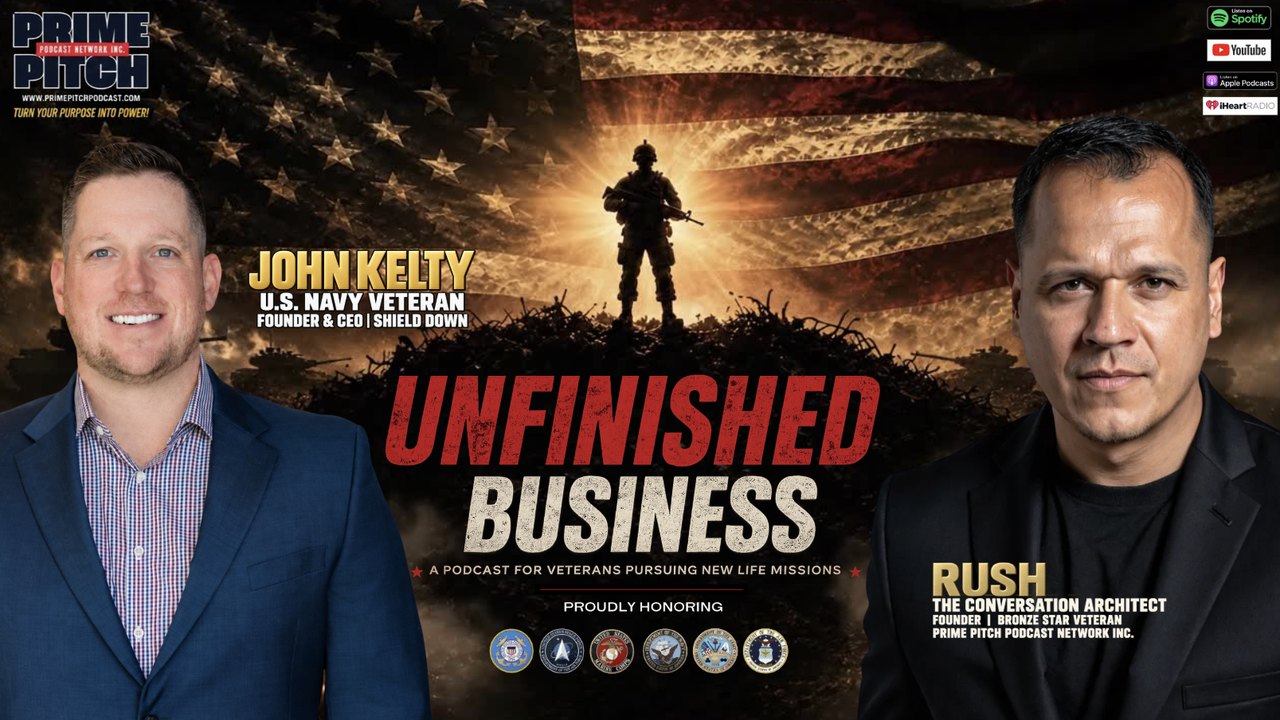
John Kelty
U.S. Navy Veteran · Founder & CEO, Shield Down
About the show
Unfinished Business is a podcast for veterans pursuing new missions after the uniform, and for the families and communities who stand beside them. Hosted by Eric "Rush" Christopher Rush, a Bronze Star combat veteran and the number one podcaster in North Texas.
Read the full transcript
Hey, what's up guys? Welcome to Unfinished Business, a podcast for veterans pursuing new life missions. Some emergencies announce themselves with alarms, flashing lights, and the unmistakable urgency of humans, human lives at risk. Others happen in complete silent- silence. My guest today, US Navy veteran John Kelty, served abroad the USS Dwight D.
Eisenhower in crash and salvage, where recognizing danger and responding to it were matters of extraordinary responsibility. But what happens when the person who needs rescuing is the one who has spent his life helping everyone else? John's story takes us into the complicated story of military brotherhood, personal accountability, Christian faith, and the difficult relationship between strength and vulnerability. Today, as the founder of Shield Down, he's confronting a question that reaches far beyond the veteran community: how do we recognize the suffering we cannot see, especially when the person carrying it is ourselves? This is my conversation with US Navy veteran and Shield Down founder John Kelty.
John, my brother, it's a, it's a pleasure to have you on Unfinished Business, a podcast for veterans pursuing new life missions. Um, uh, you and I met at the, uh, Celebrity Softball Classic and, and, um, a- and as w- as we met, and it was very brief, but I can tell you, as we, as, as, uh, as I was going through Facebook, yeah, and, and w- and watching organizations, grassroots organizations that are, are in our community, I thought it was so important, uh, that, that, that I try to give you a, awanted to give you an opportunity to be on the podcast.'Cause I love, I loveYou know, there's big organizations that, that, you know, have the push, you know, so to speak, right? They're, like, out, they're out there in the front and all that stuff. But for me, I really believe that the ones that are really doing the grunt work right now are the ones that, the ones that are, that need more recognitions are the grassroots ones because they're, they, they're working through a sys- They're, they're getting organized. They're getting stronger.
They're d- they're, they're, they're, um, they're, they're strong. Their platform's becoming lar- larger and larger, and I, I like to be at the beginning of those kind of things. You know what I mean? And one of the things that really stuck out to me is, like, um, um, is your, the h- what, uh, Shield Down represents i- in, in the larger scale is this, is how do we, how do we h- how do we impact a, a veteran's life, um, before the, before the emergency happens, you know? And, um, and so I wanna tell you, it's a great honor and a pleasure to have you today on the podcast.
And as I was going through the cold opening, um, what stuck out to you? You know, I think, 1, it's, it's great to be here. Thank you for, for taking time out of your day and, and, uh, and really the d- the days leading up to this, uh, to have me here. Uh, I think what stood out to me is, is a lot of the correlation and the kinda the transition in life. You know, the, uh, you hit the nail on the head, I think, with, you know, being, being the person who is, uh, is, is wanting to extend the hand to help, but also knowing that you're human and that you, too, uh, need a hand, whether it's yours or someone else's.
Uh, you know, none of this, none of this happens, uh, alone. We, we don't get through life alone, right? Yeah. I had a, um, a former, uh, boss of mine year- years ago, uh, that said there's no such thing as a self-made man, and I was really young at the time. And, and I was like, you know, impossible.
Absolutely there are. Like you use, you, you pull yourself by your bootstraps, and you, you know, you, you don'tEspecially being young and, and, uh, and I would call it naive and, and thinking, man, when you pull yourself out of, out of the mud, so to speak, and, and you take pride in that. And so it's, and sometimes you don't i- immediately, in those, those, um, those higher testosterone young years, uh, see all the people that were in your corner- Yeahyou know, along the way. And, and, and luckily, as the years unfolded, seeing that and seeing those who are pulling me out of the, out of the scene. Yeah.
No, I think it's so true, too. Like, you know, you get your ego, and you're young, and you don't, you know, and, and you're trying to be impressionable. Um, you know, and, and, um, maybe you fall into the, the, the hero wor- you fall into the trap of hero worship, where people worship you for your service or your ac- all these things. And, and, and, um, and yeah, it's, it, it's one of those things where you're like, you know, you think you do- you're doing it on your own. Your, your chest is a little, you know, pumping your chest.
Like, look at me, I'm Tarzan or whatever. But at the end of the day, it does take, it, it does take a village, right? And, um, and, you know, especially for guy, uh, for, for, you know, individuals like you were in crash and salvage, right? And, and, and you're out there, um, you're in real harm's, you're in har- you're in harm's way. You're, you're out there trying to, you know, you're lit- Uh, with the guys that save lives, like you're literally out there going out to rescue, you know, search and rescue kinda things.
Um, uh, I think that's even more of a reason why you're like, okay, you know. I just had a, I just had Chaplain Stoglin on the podcast, and he talks about, you know, like even I need help too. Even though I'm out there, I'm out there, um, you know, you know, trying. I have to notify families and, and tell them that they've lost their loved ones, you know. He said, "I need, I need help too."You know, I also seek help, and I always seek that, that, um, um, n- the necessary, um, counseling that I need to, to kinda have my peace.
Yeah. I could, I can only imagine how, how heavy his shield gets, right? Yeah. Uh, be, being a chaplain with all roles and, uh, and, you know, working on the flight deck. Uh, if, I always say if I, if I had to be on a boat, I had the best job on the boat.
Uh, I wasn't stuck behind 4 gray walls, which sh- you know, you, you need every, every sailor, right? Uh, but I got to, for better or worse, be out on the flight deck and exposed to God's elements and, uh, and had a great job, but it was a dangerous one, obviously. You know? Yeah. We, uh, and, uh, we, we lost, uh, the first person that I served with, uh, Big Rob.
We lost him when I was 19 years old. Uh, and I came from a very small town. Very big wake-up call just months ahead of our, uh, first deployment. And so you, you realize quickly how dangerous of an environment. It's gotten a reputation for being, um- Yeahfor, for a reason.
and, and, you know, going to crash and salvage, that was always, you know, ev- there's this fun rivalry on the flight deck. Everyone knows, if no one knows anything else about the flight deck, they know that there's different colored jerseys, right? And, and everyone performs a different job. When you, when you enter as a ABH, you enter as a blue shirt. You got a few stops along the way as a blue shirt, but then you either, uhUltimately, uh, if you're, if you're progressing well enough, you go yellow shirt or red shirt, and there's a stark line, uh, in the sand on whatwho, who wants to do what.
Uh, the yellow shirts are known for directing the aircraft. Red shirts are, are crash and salvage. And, uh, and for us in crash and salvage, we took a lot of pride in getting to be selected to, to go to that work center. Yeah. Yeah.
That's, uh, that's, that's amazing. Yeah, I think it's everyone has a job to do, and I, I agree with you 100%. Um, you know, one of the things, one of the, one of the things is I, I like to navigate when I do the podcast is to say what, you know, let's talk about, let's talk about how, how someone, um, made the decision to enlist, right?'Cause I think every veteran has a unique perspective on why they li- enlisted, right? It's like what didwhat, what was your cause? What was your reason?
And, and I wasAs, as I was doing research as we prepared for, to get you prepared for this podcast, um, um, you grew up surrounded by grandparents whose lives were shaped by faith, military service, and very different generations of American history. I'm curious about what a young boy absorbed from, um, people like that. You know, a couple things that really jump out are, are pride. Pride and, and, uh, not just your country, right? That, that feels like the, the cheap, easy answer.
Uh, but, but pride in a, a hard day's work. Pride in, in the things that you have, uh, uh, because you, you earned them, whether through sweat equity and, and a good week's wages. or, or something that's built over generations. Uh, coming from Northeast Texas, uh, Clarksville, Texas, is where I grew up, in Red River County, you know, you've got land that's passed down through generations. You've got, you know, much of what's in your house is probably passed down, and so, uh, there's a lot of pride.
Uh, a- and, you know, you, uh, relationships and c- community, uh, take a, take on a whole new level. I think a lot of us here in DFW can, can, uh, we get excited when we ha- feel like we've got this closely knit community feel where we live and where we work. Uh, but it's, it's all you know where you-- when you grow up in a small town and, and that was, that was some of that. You know, my, my grandparents, hard workers, uh, selfless. They took us in when they didn't need to.
my parents split up when I was five, and so, uh, my dad moved in with my, uh, paternal grandparents, my mom with my maternal, uh, grandparents. And so, uh, they, my grandparents every bit raised me as much as my parents did. And so really getting to learn from, from that generation, the Greatest Generation, was, was a treat. Yeah. Wow.
That's, uhYeah, I think you're right too, man. Like, uh, you have that heritage and it's really, you knowHow, how big is Clarksville?3 square miles. And the re- and the, uh, the reason that comes to mind so quickly is because I was talking with a coworker over lunch this week, and he mentioned that, uh, the apartment, uh, property, uh, condo property he lives at in DFW has its own 3 square mile lake. And I told him, "Wow, my hometown is 3 square miles."So we're the county seat- Yeahat 3,000 people. Yeah.
Yeah. Wow, that's cool. I mean, that's, that's in- that's interesting. Yeah, you know everybody knows everybody, right? Right.
Everybody knows everybody's business too, right? Um, when you look at the way you lived your life to- When you, when you look at the way you live your life today, what do you recognize in yourself that came directly from them? I like to think, uh, relationships are theNot to over, oversimplify, but, uh, relationships are very important to me. I'm not, I'm not one in the 99.99% that can perform brain surgery in this world. And so, uh, but what I have learned is that a lot of what y- what you'll do in life or experience in life boils down to the type of relationships you, you create and you foster and you, you pour into and, and value.
Hmm. And were you, uh, were you, uh, were you in sports or athletics and stuff like that? Absolutely. I, I call myself aggressively average as an athlete. And But, uh, if you, if you play one sport, that means you played them all.
So, uh, I, I played, I played every sport at Clarksville except for basketball. Uh, football, track, baseball, powerlifting. Okay. Yeah. Okay.
That, and, um, well, and, and during those, uh, during those years, those formative years in, in athletics, um, what, what was, what was that? Uh, what did you learn from that experience from being in sports and athletics? You know, you know, 1, one of the, uh, the, the biggest lessons I think we all learn, whether we grew up in a city or, or a small town, i- is that, you know, you're part of something bigger than yourself. Uh, and, you know, learning that from, again, my grandparents and from my community i- itself, but, but with sports, you, you quickly learn, you go beyond that what you think you know as a, as a teenager or, or what have you, to what you, what you see the results of on, on, on the field, on the diamond, whatever it might be, uh, and, and how you contribute to a larger moving machine there. Yeah.
And, um, at 17 you made a decision that you believed might define the next 20 or 30 years of your life. That's right. What, well, what, tell, talk about your, what that decision was. Yeah, yeah. So, I mean, growing up, I, you know, I just idolized my grandfathers.
Uh, on one hand my, my grandfather that lived to almost be 100, uh, uh, I was attached at his hip whether we were working cattle at the ranch or, or construction projects at his, uh, uh, different c- uh, project sites. I, I was, if, if I was with him I was happy. Slapping tar on a flat-roof house in summer, didn't care. And so, uh, but, uh, and he was in the Army. He was, uh, a part of 1st Cav in World War II.
Uh, he was a, a combat medic for, for la- lack of better words. And, uh, and so I got to even in middle school doing projects on World War II, I would, I would have a, a big camera set up interviewing him and, uhBut then on the other hand, my paternal grandfather passed when I was really young, and so, uh, I don't really have very many memories of him, but he was in the Navy in World War II as well, on the USS Guam as a gunner's mate. And my connection to him and, and my, my only cousin on my mom's side w- was a male as well and only just a few months older than me. We were in the same grade, so we kinda grew up right alongside each other. We spent a lot of evenings and afternoons looking through our grandfather's old Navy stuff.
And so, uh, really, really, uh, idolized both of them in that capacity. And so fast-forward to, to middle school, uh, w- when I was 12 is when 9/11 happened, and I just remember laying there. Uh, I had a, a big old, uh, a small, deep TV in, in my, my bedroom, and, and I just refused to turn it off. And my mom's like, "Go to bed. Go to bed."And, uh, I refused to turn it off just 'cause it, I just was taking in the gravity of that, and I was so angry and c- and also confused.
Why would anyone do that? And, and, uh, so between already having a huge liking in military history, uh, and seeing that and being old enough at 12 to understand what the, the, the, the sadness that, that involves and, uh, that, I made that, my mind that night that I'd join the Navy and, well, the military. But my cousin and I, when we were 16, uh, being latchkey kids in a small town during the summer, uh, while our parents are at work you're just at home or, or running around with your friends. But, uh, we would have Army recruiters at the house while our parents were at work, and, uh, we were talking to them, figuring it all out. We decided we were so mature we were gonna put this plan together and not just ask them to sign papers at 17.
And, and so then it came time to ask. His dad said yes. My mom said no. And then I, I hit probably my first wall. Okay, now what?
Uh, but luckily she did say while she would not sign for the Army or the Marine Corps, she would sign for the Navy or the Air Force. And in my infinite patience at 17 years old, I couldn't just wait, you know, 12 more months until I could sign on my own. Uh, so I said, "Well, had, you know, my other granddad was in the Navy," and so I started looking at jobs there and, and joined the Navy the summer between my junior or senior year of high school. Mm. Wow, that's, uh, that's pretty advanced th- uh, that's pretty advanced thinking as far as, like, you know, having, you know, having a plan in place, right?
I mean, at, at 17, I, you know, I was like, I don't know if I was there, you know? Um, uh, when, when you, when you look back at that 17-year-old, right, you look back, you say, "Man, uh, you know, how was I that kid," like, right, you know, in that moment. What, what do you see? You know- Does that make sense? Y- yeah, yeah.
So I, I think when I, when I sit back and, and look at that kid, I, I'm proud that, I guess, that I had, you know, en- enough poured into me that I can make a decision like that. You know, I, to me at the time it, it just felt like a no-brainer. It was something I was already interested in. Almost like baseball, right? Yeah.
It's, you have a kid that says, "I'm gonna play professional baseball," and they commit their whole adolescence to baseball in pursuit of that. Uh, I was just so, uh, uh, interested in the military, and ratchet that up after 9/11, that that was just kind of where my, my brain was at. Uh, al- uh, albeit a, a brief hiatus when I thought I was gonna follow my, my, uh, uh, older girlfriend to college, uh, for a brief moment before, uh, things realigned. Uh, I just always knew that was gonna happen. And so I, I guess, you know, I'm thankful for that track of mine and, and exploring that.
Uh, I think there's also some things that, you know, uh, the, uh, the innocence of, of that age, you don't realize some of your other, you know, actions you gotta get in line, too, that took me years to, to figure out. Yeah, yeah. I was gonna say, well, what did you imagine, imagine your life would look like if you, if everything went according to plan? Oh. Oh, man.
Yeah, I, you know, I had a buddy that I went into the Navy with. Uh, not from high school, but we met in boot camp, and we were, we were both RPOs. So, uh, if you're not familiar, in, in boot camp you, you, you had different roles and leadership you can play, uh, if, if selected. And so I was the RPO, the religious petty officer, so my, my job was to, uh, help my, my shipmates there in our division, about 100 recruits, uh, navigate, uh, church, figuring out when service times are, getting them there, all that stuff. And so, uh, so he was also his division's RPO.
We had the same job in the Navy. We went to the same A school, the same command, the same division- Ohon the flight deck. And so we were, we were shoulder to shoulder, uh, for a huge chunk of that time, and he and I were just all in. We just knew we were gonna, uhThat first, I'd say probably- Year and a half, 2 years. uh, spend 20, 30 years.
And, uh, our plan was to put on chief so that we could go through that experience and get that, that, uh, that, that highly revered en- enlisted, uh, title, and then put our officer package in to go officer and, uh, and then see, see how far we go. Uh, but Yeah. Wow, man. That's like pre, that's pre-me- that's like pre like just locked in. Yeah.
That's, that's sick, dude. That's, that's so crazy. When you compare that, like, like, you know, you know, you've, you've run acro- uh, you've run acro- across, uh, veterans that have different stories of why they list, you know, um, you know, they, why they, why they, um, they enlisted, right? You've, you've walked through that with other veterans. Um, um, when you see yours and then you see the opposite of that, what is the opposite that you've, you know, and with Shield Down a- and you talk with veterans and they share their story of why they enlisted, what is the opposite of your you've seen?
Oh my goodness, you s- you see it all, right? And, uh, what's cool is like that's why the military is the most, uh, i- is the best population on Earth in terms of getting a community together w- with people from all walks of life, uh, uh, because n- not only are they raised in, in different places, but they, they've, they've got different experiences in life. And so, uh, you know, I, I had a roommate who's still a good friend to this day that, uh, he was, quote-unquote, "the old man in our group."He was, he was 30 among, among us roommates. At the, at the time, that, that, that seemed old, right? Uh, but he, he joined later in life because he was 6 figures in debt in college, and he needed a way to get out from underne- underneath that.
And, and he wanted to serve his country, and, you know, it was a win-win. And so he, umUh, but then you also had people that, that, uh, a, a rough upbringing led to them living rough, and it was a way for them to straighten their life out, to get a shot at it. Uh, or some that had nothing left to lose, and, and they had someone voluntell them to, to join the military to, to, to figure it out. And so, I mean, you see, you see it all. But I think probably the, the polar opposite would be someone who, you know, they didn't necessarily have a long-term vested interest, but they, they wanted something different in life.
Yeah. And, um,Yeah. So you, uh, you, you served in crash and salvage aboard, aboard the USS Dwight D. Eisenhower. That's a responsibility most civilians, uh, know, know very little about.
Talk a little bit about whatUh, you did talk a little bit about it, but get a little bit more in detail what cr- crash and salvage is. Sure. So, uh, all of your, uh, firefighting, salvage, and rescue operations on the flight deck, uh, and the O3 level right below that, uh, come from crash and salvage. We're essentially aviation firefighters. And so the, uh, when you look at the flight deck, you've got launching operations, uh, you know, the receiving operations, uh, uh, catching the landing gear on the backside, and all the transit and everything like that.
Even when there aren't any flight operations, if, if an engine's turning for maintenance or, or s- or a, a refueling's happening, you know, you, you've got, uh, crash and salvage out there as well. And so, um, in terms of what that looks like, you've got 18 to 23-year-olds. You know, if you're, if you're on your second enlistment, then, you know, maybe 25, 27, uh, out there coordinating, training each other. Uh, you know, we've got our, our big 3 manuals we look at. But, uh, when, when things go wrong, you've gotta be prepared to, to respond so that if, A, if there's no casualties or become no casualties, and B, if there are, you can limit the damage as soon as possible.
Mm. And, you know, on a flight deck that is, you know, 50 yards by, by 330 yards roughly, you've got hundreds of people running around, uh, with different roles between the squadrons and ship's company. And so you've gotta assume that, uh, it'll be mass chaos when anything happens, and that you gotta be the, the, the very few people that will be kinda taking control and, and seeing that through to, to, to I guess a safer, uh, environment. And crash and salvage as a whole is about 25 to 30 people from the, the presiding officer over that group on down, and you've only got, you know, probably 5 people on the entire, that entire 4acre flight deck, uh, at a given time. Mm.
And so, uh, I'd say it's a lot of responsibility, but one that I think as a, as a young man or a young woman you take a lot of pride in because you're getting trusted to do something very important. Uh, the ship won't even be cleared to go out to sea and catch aircraft if the crash and salvage crew is not, uh, current on their qualifications. Hmm. Wow. Um, and, um, what did that ser- what did that reveal to you about the demands of working alongside people whose lives depended on, on one another?
Oh, yeah. I think there's, there's a saying that people use in all kinds of walks of life is, "Hey, this isn't life or death work. Like chi- chill out, relax."Uh, but there it was. Yeah. Uh, quite literally.
And so, uh, I think it, itYou know, I keep saying the word taking pride, and so I think it, it r- it requires you to take a lot of pride in what you do, whether it's the maintenance on your equipment- Yeahuh, that's not gonna be used but once in a blue moon, uh, or ever potentially. or, or, uh, you know, the, what you're, what you're looking for, uh, on the flight deck and, and how you're training. Uh, I think the hardest thing to do is, is train like it's a real scenario because you, you train so much in the military, uh, for when those things do happen that it's easy to get desensitized, maybe not take it as serious. Yeah. But, but, you know, I think for, for me to kind of come back around is, you know, when, when we lost Big Rob on the flight deck in 2008, October 4th, 2008, uh, that was an early wake-up call.
I was still a blue shirt at the time. I wasn't in crash and salvage. And, um, and that gave me, uhAnd that was a training, uh, mission at that. We were getting, we were doing workups, getting ready for a deployment, uh, that February, that coming February. And, uh, so I think luckily for me it, it made the attachment even deeper on why I wanted to, as we went up, you know, be in crash and salvage and take the job seriously.
Yeah. Um, you've spoken about the people you've served with, with in a, a way that kind of, um, I guess it suggests that those relationships have never really belonged in the, to the past. What does that mean? Uh, you know, I, I love the way you word that, that relationships do not belong in the past. Uh, you know, I mean, look at fast-forward to Shield Down.
I, I, I got out of the servi- I was hitting my, my 20-year reunion in high school, which means that I, I, I went into the Navy 20 years ago and, and got out 15 years ago. And so, uh, the guys at Shield Down with me who are on our, my, our founding board of directors are all crash and salvage guys. Uh-huh. Wow. Uh, and so the, uh, we're that close.
I value their opinion that, that much. I give them, I give, I give them, um, the, you know, that much control over my whole life that much because I value them that much. And, uh, I think part of that is, you know, you grow up together. You became men, you became women together. You know, 18 years old, sure you're, you're legally a, a man or a woman, but, but, uh, but really you're not.
You gotta go through some life to grow up many times. Yeah. Some people grow up much, much quicker. But so we, we all grew up together for lack of better words and, and experienced things at a younger age that most people won't have to experience their whole life. Uh, don't get me wrong, people, people who served in other capacities saw way crazier things than we did.
But, but getting to do that, you get that sweat equity together and a certain bond you get there. And, uh, I'll never forget my stepdad telling me, he served in the Army, and one of his biggest regrets was that he didn't stay in touch with his, uh, soldiers he served with. Hmm. And you know, luckily for better or worse with technology today, uh, luckily it's a little bit easier to keep in touch, right? Yeah.
So, uh, but what we found was w- we, we lost 3 men from the flight deck, uh, in the first, uh, in a 3year span.2008, and then one on our 2009 deployment, uh, uh, Master Chief Garber. And then, uh, 2010, uh, Abrac, a, a pilot. And so, uh, and then our boatswain who was over us, uh, he, he died, uh, to cancer while he was still in uniform before he even got to retire, take off the uniform. But then what's interesting is the first 3 years after service we lost 3 more. Hmm.
And then ultimately 5. And so, uh, so that's why I wear, I, I, I really wear 2 memorial bands 'cause one's for those who, who never took the uniform off and, and one's for those who, who did but, but, uh, you know, died young and, and didn't get the, the, the pleasure of getting to grow old. And so, uh, I think it impressed upon us the need to stay close. That I don't think. I know.
We talked about it. We talked about it, uh, at multiple funerals about getting together when, uh, outside of a funeral and, and, and how do we e- enable our families to, to grow together too from different time zones. And so, uh, that group of guys actually, uh, uh, most years, uh, in the last several years we've gotten our families together for a co-family vacation- Oh, wowsomewhere, whether it's Tennessee or Florida or what have you. Yeah. That's cool, man.
Y'all guys sticking together and, and staying in contact. You're right. Like for me it's like, man, I, I don't, I don't, I don't know where anybody is, you know? But, but you know, you know my journey a little bit. You know, we get lost.
I got lost, and I wasn't thinking about anybody but trying to save myself at the mo- you know, during that time. But, um, but I understand what you're saying to, to, to have that unique perspective of saying we need tow- we don't need to be just meeting at funerals. We need to be meeting at, we need to meet atWe don't need to meet at any more funerals. We need to meetLet's go on a family vacation together. Let's, um, um, y- you know.
When you look at the guys next to you and you're at, and you're at, you're at a function, right? You're at, you, you go on vacation together, um, and you have that. Speak to the level of camaraderie, what it, what it truly means to you. Yeah, it's, it's different. It's, there's-- It's one thing to, to get together at your high school reunion or to, to have really close friends that are also very valuable, meaningful relationships, uh, that are, that are non-military.
But a- again, I think going through something like that together creates n- not necessarily a better bond, just a different bond. And, uh, and so it, it just meansIt, it means the world to me. We-- When we get together and, and now that we're, now that we're a little bit older, uh, and, you know, things areW- we're not so worried about what's cool and what's not. We just sit around and we enjoy the fact that our families are together, you know? Yeah.
Watching our kids from, from babies to, to teenagers, uh, all get along. I mean, we, we, we got 20-something people in a house. It, it's great. Wow, 20-something. And, uh, so but it's, uh, in terms of what it means to me, it just, it's really hard to put into words what it means, 'cause it's, it's, it'sYou feel like you're doing good by your brothers that you've lost along the way, who, like I said, didn't get to grow old.
Yeah. Uh, I, I think back to, uh, the very first loss. Ag- again, I'll, I'll probably, that'll probably be a common theme, uh, with Big Rob. I remember when we had the, the ceremony in the hangar bay, uh, for his memorial service, and seeing his wife and kids walk by while we were all in formation. And, uh, I just remember looking at his kids and just hoping that they can hold onto who he was.
And, and every year on, on, on the anniversary of his passing, you know, I wonder, how are they doing? Do they, do they still know their father's legacy is alive and well with, with s- with people outside of their home? Yeah. Uh, and that's part of, you know, why Shield Down exists and is to honor those legacies. And so it's-- I feel like we're doing right by those we served with by, by coming together and, uh, remembering those we lost, but then also, and giving flowers while people are here.
Yeah. That's cool, man. Uh, what, uh, what are the names of the guys you, uh, that are part of your team, uh, with, uh, Shield Down? Yeah, yeah. So we have Zach Stump.
Uh, he's another day one. So he and I were in the same, uh, division in boot camp. Uh, he and I, uh, went to, went to, um, uh, chapel together. Uh, same A School. We were headmates in A School, so you know, those Jack and Jill dorm rooms.
Yeah. Um, so, uh, and then again, uh, we, same boat, same division. We were both in crash and salvage together, to take it a little bit further. Um, but we were even roommates in our first year, even though our, our, uh, our chief petty officer told us all when we checked into the boat 2 things."Don't go buy a car your first 2 weeks off base."Yeah."Don't go get an apartment your first 2 weeks off base."We s- we did it anyway. But, uh, so he and I are very close.
Uh, but then you also have Drew Warner. Uh, so, so Stump is in Florida. Uh, so he, he does our operations there in Florida. Uh, Drew Warner, who is in Maryland, who just had his third kid. Uh, then we have Kyle Hamlin in Michigan.
Jay Yant is in Ohio. Wow. So they're all, they're all over the US. Yeah. Right.
That- At least all that, that eastern half, I guess. Yeah. You know, going back to, um, um, losing people you care about, um, um, I'm wondering how much of that period you've had an opportunity to examine. Like, um, what were you telling yourself about how you were doing during those years? I think it went through phases.
And for a while, I just, I just, uhI, I, I've always been outwardlyI try to outwardly, intentionally be happy, right? And, and, and try to impact other people in that, in that way. Uh, and kind of forsaking my, myself Mm-hmm. or like, "Hey, suck it up, buttercup," type of mentality. And like, it, it-- you'll figure it out or you'll get through it.
Um, because myYou know, I never saw my grandad complain. He was allI, I get a lot of my humor and my, and my personality, uh, or at least my attempt at humor -uh, and personality from him. And so, uh, but he never complained, uh, even though he, he went through a lot. And, and so, uh, I try to do the same. But in the early years after service, you know, I, I complain in, into myself that people don't understand, but I also didn't give people a reason to understand either.
Hmm. Uh, uh, and, and then, you know, while I wasn't necessarily drinking every day, you know, uh, my, my roommates would be confused why, you know, uh, it'd be a weeknight on a school night and I'd be in the living room, you know, drinking more than I should or something like that. And IAnd usually it's because you have something that, that reminds you that people don't understand. And, and then for me, I just leaned into, to the, the c- the, the memories of the common bonds and all that stuff and, and, and drank into it. Uh, and to, to I guess maybe to be close to it, you know?
Uh, as opposed to really trying to understand it, to get back, back around to your question. Yeah. So it took me a long time, and unfortunately, l- you know, multiple poor decisions to really say, "Hey, you can't ignore this."You know, you got this thing in this box in the corner. The military teaches you to compartmentalize things, and it's a wonderful skill. And I absolutely think you should apartmen- compartmentalize something.
Yeah. Um, but you also have to know when that's not the right approach. And so, uh, and working on the flight deck, uh, especially being in crash and salvage, you had to be guarded with, with anything that happened to you physically or, or mentally- Yeahbecause- Hmmuh, they, they wouldn't see you as fit for duty, and you, and you'd lose it, and, and what would you do then? Yeah. You'd be, you'd be cast to the berthing crew to, you know, to clean the head or, or, or clean the berthings, things of that nature.
And so, uh, you've just been conditioned not to, but that's no excuse either. I had to get a little bit further. And so for a, uh, I had to unfortunately finally learn, uh, by coming to a kind of a, a, a f- a fork in the road or, or really a T in the road, um, to, to start to examine that. Yeah. And what did you have to confront about yourself before you could really, you could begin making different decisions?
I think that I'm, that I'm not 9 foot tall and bulletproof. Uh, I'm, uh, again, aggressively average in height. I'm justBut, uh, uh, but you know, uh, when, when ultimately my own decisions, uh, impact others, that's, that's where I feel probably the most shame and the most guilt. And so, you know, uh, while you can, you can chalk off doing the wrong thing one evening as whatever and, and shake it off and say, "I'll do better," and, but when it, when it impacts either, A, yourself permanently, or B, someone else, that, that's a little bit different, right? And so, uh, for me, you know, in my, in my late 20s when I, uh, when I got that DUI and I, and I totaled my truck, that was a waking call for me that I had to examine myself and realize that, hey, you, you aren't 9 foot tall and bulletproof.
You aren't God. Even though I'd, I'd always grown up in a Christian household and, uh, I put my, my faith in the Lord in middle school, the, uh, I didn't, I never really went deep, right? Yeah. And, uh, and then I was in and out of church, things of that nature. But I was very much so living with one foot in Christianity and one foot in the world.
And so, uh, there's things I was willing to hand over to God, and the other things I was like, "Nah, y- thanks, God, but I got this part over here."Yeah. And I think that was where I had to learn that, uh, nothing is yours. It's all God's. And you can try to be, the, the, the savior of your own life, but it's not gonna work out well for you. And unfortunately, it took an irreversible decision like that, uh, that, that thank God, you know, no one was, was hurt or killed.
But the, uh, but a, a moment like that to, to wake up to examining that. And then once you can do that, you can be honest with yourself and, and, and make the right changes, so. Yeah. Uh, you know, I like what you're saying. It's like, you know, you had to really, um, you know, you thought you wereI, somebody gave me an example one time.
They said, you know, you can, like you can put your feet together, and this is just a, an analogy. Say you put your feet together and nail them, nail them down. You can actually hold a nail in here, and you can nail this hand, this one down. But when it comes to your right hand and you're holding the hammer, w- and someone, you, will you hand the hammer to somebody else and let you nail your other hand down? And how, or, or will you fight them, you know?
And, um, using that analogy, um, um, when you were at that s- that crossroad, that, that wa- that watershed moment, I guess, or like the stop sign, left or right, right? Um, um, who were the people that were at the stop sign with you that were like, "Hand us over the hammer," you know? Like or, you know what I mean? Like who were there to, who were the ones that were saying, um, yeah, who were the people around you that- Yeahthat inter- interceded in that andYeah. Well, to your point, I see that as a great analogy.
To your point, I, I did, uh, I, I did a good job of, of hammering a lot of those nails myself. But for that final one, I, I begged God to do the other, the, to hammer the last nail, uh, m- you know, many, many a nights, and thank God he, he, he didn't. And I thank God I was, uh, I, I was not brave enough to, to do it myself. Yeah. But, uh, you know, part of that fork in the, that T in the road, if you will, is, uh, and, and understanding real accountability and not just doing what I've had done for years previously of saying, "Oh, it is what it is.
I'll do better."Um, everyone's got a plan till they get punched in the face, right? Yeah. And so the, um, uh, you know, I started calling those who are close to me, and I felt the need, whether, uh, whether warranted or not, uh, I felt the need to s- kind of ap- apologize for any time I'd let them down, uh, kind of be vulnerable with them about what brought me to this, this phone call. Uh, uh, ask for their grace and, and their accountability and, and I was met with ex- exactly that on the other side, you know? The, and you know, my, my closest friends, uh, some, f- some of my Navy friends and those crash and salvage guys, and, uh, and they did exactly that.
I didn't know what to expect. It was, it was terrifying, I'm sure. I didn't sound like a, like a grown man on the phone. Like, uh, not that, uh, you know, I was necessarily, you know, bawling or anything, but I'm sure my voice was shaking out of just out of, um, uh, it, uh, self-in- intimidation. But, uh, but on the other hand, every time, uh, you know, I was met with, "Yeah, you're right.
You, you shouldn't have done that."you're all right, brother. You're gonna, you know, you know, we're, we're not gonna leave you because of that. We, you know, we still think you're a great human with a lot to give, and yada, yada. And, and, and I appreciate that, and that was ultimately what ledIt, it'sThere, there's something about vocalizing something, like when you've hit, when you feel you've hit rock bottom. Yeah.
And, and then then you can really kinda turn the corner. And, and what, you know, a- as God would have it, that would be then, you know, roughly a, a year later, meeting my, my bride, Bailey, and, and be in a much better spot to meet her and, and do life with her and- Yeahand pursue Christ together and raise kids together. And, and, and thank God that He, He ruined my plan several times throughout life and, and, and ordered my steps toward her, so. Yeah. That's, that's, that's, that's beautiful, man, that, you know, that you had a willingness to, like, try to make amends with individuals, and I think that's part of the big step, right?
It's like, it's a big step, and, and to go through that and say, you know. Um, how much of that when you look at, you know, you know, 'cause you know my story. You know, I had substance, uh, su- uh, substance use issues, um, after military when I came out, you know, and had to deal with, uh, um, you know, drinking was a, a big issue for me. And, and, and, and, um, you know, one of the things I had to learn was, like, you know, this is, there's, there's- Yeahthis is rooted in something, right? Like, this is, this is, this is, me drinking is medicating some, a, a, a deeper cause, right?
Um, what was that? Was that something that you thought as, as, as you went through that? Was that something too that you had to, and confront? Yeah, I think, I think 2 things, right? Like, I think I needed to really, not to sound all, uh, all sterile and business-like, but I think I really had to root cause some things.
Like, to your point, like, not why is the symptom happening, but, but the why is that happening? Okay, okay, now why is that happening, and then why is that happening? Um, ab- absolutely, I definitely a- agree that the same, uh, showed itself for me. But then on the inverse side, I, and I think I found with a lot of, uh, m- uh, my brothers and sisters who have transitioned out of the military and, and trying to wade those new waters, is that I had to f- I had to, I had some good advice early on that really resonated with me that I've, I've used to this day, which is when, you know, when that grenade goes off and you can't see anything in the room, you don't have to be able to see the egress point. You don't have to see, be able to see the door.
You just have to be able to get that one foot in front of the next one. And then before you know it, you'll, you'll find your, your, your egress point. And so I think be okay with, with not being perfect or having the clearest of vision, but not standing still either. You've gotta do something. Yeah.
And so, um, I think trying to root cause things and then being okay with, "Hey, I don't know how they're gonna receive this phone call, but I got, I gotta, I'll take a step and- Yeahand go from there."Yeah. You know stories of other veter- you know other v- stories of veterans that ha- have had dealt, dealt with alcohol and, you know, a- and substance use and, and how they medicated their own traumas and stuff like that. Um, um, how lucky do you feel that it didn't get, like it didn't go further for you? Oh, very. I, I, I could've, I, I could've been dead t- 20, 30, 40 times over, uh, before I even got to that point.
Yeah. I mean, growing up, you know, the, uh, when I turned 14 is, is when, uh, I started, uh, going to, to pasture parties to, to, the, do the only thing there is to do in a small town. And so, uh, and so that associating drinking with, uh, with, with life was, was very, uh, normal. At that point was not, you know- Yeahcatastrophic by any means. And so for me, uh, it, it could've, things could've gone worse a- at any time.
I have a number of memories from, you know, uh, high school and the Navy where, um, where, you know, things could've easily taken a, a- another turn. And- Yeahyou know, it's not for me to, like, to know just yet of whether that was God protecting me from myself yet again or, or, or just a, a lucky moment until He did wake me up or what. But, uh, but yeah, it can, it could've definitely happened sooner. Yeah. No, I, you know, I don't, um, yeah, I don't mean to harp on this stuff, you know, on, on, on, on this issue, but- No, you're goodI mean, no, there's no but about it.
It's like the, you know, um, it's great that you, you know, you figured out part of the reasons why, you know? what, um, it's great that you, you know, you figured out part of the reasons why, you know?'Cause I think that's the solution, right, is you gotta know why so you know how tohow, right? Sure. Like, why, why did ILike, for me it was like, why did I drink in excess? Like, really, why did you drink in excess?
Like, why are you at a bar by yourself, like, drinking by yourself, you know? Like, why are you that? Why are you, like, you know? Like, why do you feel this, this need to do this, you know? Like, and it's not as if it was, like, to socialize.
Well, why do I need to socialize to this extent, you know? Like, why do I have to drink to that extent? And so answering those questions, like, really put a, uh, kind of a s- a stopping point in saying, "Listen, man, like, you don't, you don't, you don't have to re- you don't have to do that. You don't have to be that guy," you know? Like, and trying to, you know, trying to, just to feel comfortable, you know what I mean?
Um, um, how much of that, like, the comfort, like, feeling comfortable in your own skin, like, was part of that battle? Oh, absolutely. Yeah. Yeah, yeah, 'cause I think, uh, it's, it's so easy to, to see something wrong in, in someone else, right? Uh, and you know, like, like I'm sure I'm gonna butcher it, but just like it says in the Bible, do, you know, to point out a splinter in someone else's eye ignore a, a branch in your own.
Yeah. And so, uh, that, that's and that, you know, that'sI don't know if that's, uh, Satan doing that, uh, clouding our vision or what, but, uh, but through reflection, especially when you're, you take, again, pride in some of the things you've done, not that you've really, you know, not that I've really done much, right? The, there's no, no gold peace prize in, in my closet. But the, uh, it, it's hard, it's hard to do that, especially when you like to be a, a rock or a source of life for others, to say, man, uh, they, they're going to a tainted well, right? Yeah.
Um, so that was, that was very difficult. And, and, you know, uh, even after that moment, it, it's, it's not like I woke up the next day from totaling my truck and, and had everything figured out and, and now, uh, I'm able to, to, to be this, this perfect person all the time, you know? Far from it. And so I still stumble, but I think what's, what's better now is along the, along the years I've learned, uh, you know, what, what are non-negotiables? What do you, what do you stop doing?
Okay, now what do you, what do you know when is, when is right or wrong? Or, or when's enough? Or when's, uh, what to just not even, what situations you can, not even put yourself in. Yeah. Yeah.
I appreciate you sharing that too, man. I, I think that that's a certain vulnerability to share that kind of, your, the story, you know? Um, to share that, that part of your, the chapter in, in, in coming back from, from home, coming back from deployment and feeling comfortable in your own skin and, and those kind of things. Um, um, that's so, you know, it's, it's so important, and I feel like, um, like it's just, it's just part of it. And, and to be honest with you, I had to make amends.
One of the amends I made I remember was, like, I had to meet the officer who arrested me on my DUI, and I met him- Wowand, and, and told him how sorry I was, like, that he had to do that, but he saved me from myself, you know? Like, you know? And I had, I had wrecked my, totaled my truck. Well, not totaled it, but I did pretty bad damage. But I had totaled it.
And then when he showed his, shared his story, he was likeI go, he goes, "Yeah, I was, I, that was my first night on, on patrol. That was my first night on, on duty."And you were the firstYou were, you were, he was, he was a rookie cop, and he was, he, I was his first arrest. And I was like, man, that, like, hit me. He di- I didn't know that at the time, you know? I met him, like, maybe 4, 3 or 4 years later.
But I thought it was super necessary to, like, make amends with this guy. Um, he was, it was just him and I that knew this happened, you know, like, at that time. Yeah. But it was so important. I said, "Dude, you're at a level of maturity that you don't, uh, you need to understand that this, this is the last one, bro."Like, you know what I mean?
This is the la- this is the last. And, um, but when he accepted my apology, and I said, "At this point in my rehabilitation, man, I need, uh, um, to make amends with you and apologize," and he was really grateful. And, and, uh, but it taught him too that, you know, that there are some people that have deep, uh, deep regrets and remorse with, with what, when, and out of respect for what he had to endure that night, right?'Cause he wasI put him through shit. You know, I put him through some stuff too, you know? Yeah, yeah, absolutely.
Yeah. Yeah, and I had kind of the opposite, uh, involvement with, with the officer. Uh, the officer who, who arrested me was a clo- very close to retirement, and so, uh, he was kind of, uh, fed up with, you know, um, n- uh, you know, uh, fed up with, with guys like me. And so I actually, this is gonna sound weird to say, but I got lucky because at first I thought I was extremely unlucky. The, uh, at first a, a much more junior officer on the scene responded.
He interviewed me and, and he was about to let me go. And then last minute, this gu- this other officer shows up. He's like, "No, wait, I wanna, I wanna take a look at him."Mm-hmm. And he didn't buy anything I was saying and, and so it progressed accordingly from there. And, but you know, while, uh, I wish that had not ha- had happened, uh, I wish I hadn't been making those mistakes I sh- I, I should say, uh, but because he did that, it forced me to, to again con- confront that, right?
And, uh, I, I haven't met the gentleman, but I remember the, uh, at first I was gonna try to, you know, like, fi- how do I get out of this? How do I not take accountability for this, basically. Yeah. Uh, and the, the attorney I had said was that, "Well, he probably won't even show up to court 'cause he's about to retire. I've dealt with him many a times," yada, yada.
And, uh, but, but anyway, uh, long, long story short, I have not gotten to meet him. Um, uh, and I wonder how that would, how that would go if I did get to. Yeah. That's cool, man. I think it's, the, us veterans talking about these kind of issues that we, some of us hide that stuff, you know?
We hide it, you know? It's like, you know, being, you know, like, these are real, real scars, you know? They're real things that happened, and they're always a, they're always a symptom of something greater going on in us, you know? Well, la- last thing, you know, I, I think, I think we have to because, you know, we're only doing damage by, by not doing it. So if you're, if you're leaning into to help others, they're already in a position where they are, they're vulnerable.
They're notThey may not be thinking as confidently as they would, uh, otherwise. And, uh, by you coming in with a, uh, a, a, behind some veil th- and where they think maybe you can't relate to them, you, you've got it all figured out- Yeahand, and all this, you're, you're gonna stunt your ability to, to help others, and that's what we're here for, right? Yeah. I, I, you knowAnd there's, um, uh, Jacob Shick with One Tribe Foundation. He's a, he's a wonderful example of someone that has shown me- Mmthe way early on.
He, he is so open about his story- Yeahand he's so authentic, and, and being able to, uh, help others by showing that, hey, this is someone who's been in movies and, and because of his story and everything, but even he's not, like, ignoring, um, you know, a- any part of his story. If, if, if any part of his story can help someone, then awesome. The worst thing that came about it for, for him is, is that, uh, he had to talk a little bit longer to get that part of his story out. And I, I really respect that. And so, uh, you know, in, in latter years, I'm really trying to also be a- be as open as possible because worst case scenario, you just had to talk a little bit longer.
Yeah. Yeah. That's so true, dude. That's so true, man. Dude, like, I'm so proud of us, man.
Like, if you think of, like, the 20-something-year-old guy-ourselves, where we be sitting here as grown-ass men talking about our mis- like, our shortcomings, dude. Like, this is, like, a sick moment, and I hope- YeahI hope people really see what's happening right now.2, 2, 2 veterans, 2 guys who s- who endured their own, their ownYou know, they walked, they had to, they walked their walk and make, makeWe have errors, and we're sitting here and talking about that kind of stuff, man. Like, I sat withIAnd you know, it was funny you mentioned Jacob Shick 'cause he was one of the f- umWhen I started podcasting, he was one of the, one of the guys I had on, one of the guys I had on myIt was called Believers in Business. I had a podcast called Believers in Biz- Business, and, uh, and he was on my podcast, and he was very vulnerable about his, his, his bouts with alcohol. And I was listening, and it, it was at a time where I wasn't ready to be that guy.
I wasn't ready to share that stuff. I would listen. I was like, "That's me."Like, I would hear that voice like, "Dude, that's you, Rush," like, you know. Yeah. Uh, but I'm not telling nobody.
So. You know what's ironic is there's people that, that are probably gonna hear this today and, and learn that I got a DUI for the first time. Uh, and you know, that's, uh, just a point of vulnerability that's gotta, that's gotta be okay because, uh, while it might surprise some, some people that, uh, uh, uh, a very few people that, that I know, hopefully, hopefully it helps someone. Yeah, yeah. And, and really one life is, is, is great,That's good, man.
Yeah. Let's, uh, let's get back to the Ch- uh, your, uh- Yeahyou mentioned Christian faith i- was part of your upbringing, right? Um, you described receiving both grace and some difficultUh, you, you, um, you receiving some, some grace and some difficult, um, but necessary honesty from, from the people who cared about you. What, what have those experiences taught you about the relationships between grace and accountability? I think, uh, love requires both.
Uh, and, and you know, uh, God is love, right? Yeah. We, we, we don't, uh, most commonly talk about love in, in, in the, in the Christian sense, but, but, but God is love. And the, the grace and accountability piece are so critical because G- you know, God showed us grace and, um, uh, but also, you know, talks repeatedly about the accountability side of love. And, and I heard this the other day.
Um, oh, it was, uh, uh, um, Phillip Anthony Mitchell, uh, pastor of 2019 Church in Atlanta. He, he just put out a book called Contend, and I'm l- in the middle of listening to that, and he said, uh, "Love without accountability is abandonment."And- Mmand that's, that's something I think is really gonna stick with me for a while because, you know, I, I think we see t- in today's day and age on social media and everything that everyone's like, "No, that's okay, Rush. That's justThat's okay. That's part of your story, but that's okay, and, and everything's okay."Mm-hmm. Uh, but, but, uhAnd that's great on the grace side, but there'sWe've seen a overindexing and a swaying the pendulum to, to that side with no accountability.
Yeah. And it allows a lot of things to continue or even worse, kind of grow and take on this life of their own. Mm-hmm. And, and I think, you know, Christianity is not necessarily comfortable. And so, uh, you know, su- sure there's moments of, of comfort, but, but you've gotta, you know, struggle and, and lean into that struggle, and part of that is that accountability piece.
Yeah. So I was really lucky that although, as I mentioned earlier, like mu- much of my life I've, uh, I kinda lived with one foot in Christianity and one foot in the world, the, um, uh, I would have these, these connections that would, would keep that tether there, uh, uh, l- long enough to, to, to keep me from veering too far off, I guess. And then, um, I mean, even going back to, to my second deployment. You know, when I was in the Navy, I had stopped going to church the, the, uh, the day I left boot camp. And theBut a buddy of mine in crash and salvage, um, uh, Tommy, he invited me to a church in Virginia Beach, and, and I loved it, and bought a new Bible, started, started going.
Turns out, uh, Captain Pete Matisu, our air boss on the Eisenhower, uh, he went to the same church. And, and so we kind of uncovered that somehow, uh, through conversation, and he broughtHe got with the church leadership team, and he brought this, uh, long Bible study plan, uh, out on deployment to be able to basically hold church for our home church on deployment. And so, uh, even though we were all doing flight operations, which are like 12 to 14-hour days, and then, uh, work, work hours. Uh, and so we would go on a off day to the chapel, uh, w- after flight ops were ended when we're all tired, and, and he would, him included, he would, he would basically lead church for us and kinda kept that connection on deployment. And then fast-forward to using that GI Bill down at Texas A&M, uh, I had a friend invite me to, to Breakaway, which was every Tuesday night on campus thousands of college kids would fill either Reed Arena, the basketball arena, or Kyle Field, or Blue Bell Park, and hold church, basically.
It's a big- Wowit's Bible study but, but it's basically hold church. And, and, uh, I, I s- I f- I was immediately d- drawn and connected to that. It was so cool that at 10 o'clock at night students would, on a Tuesday, would go to, go to church basically on campus. And I got involved with them, volunteering, while again still living in the world. Um, and so I always kept that close enough to where thank God I didn'tUh, you know, I had that, that foundation that I could eventually turn to when I finally grew up- Yeahuh, in my late 20s- Yeahor early 30s.
It's a good way to say per- uh, spiritually mature, become spiritually and emotionally mature to, toYeah, that'sMan, that's so cool. I, I think that, yeah, having, just having that, that tie, you know, that soul tie with Christ in a unique way. It might have been you know, my one shoelace was not tied and you know, it's not enough, you know? But you gotta have both be, the both shoelaces tied, you know? And, um, um, but having that soul tie with Christ has been, always been that thread that, that you've been holding onto, which part of your salvation, brother, right?
Yeah, that's quite right. It is. Um, um, uh, I wanna, I wanna connect with you, what you said, um, about faith and accountability right now 'cause, um, um, you were building, um, to the life you build- were building outside of the Navy. You went to college and worked in professional sports and eventually moved into human resources. Um, which of those experiences cha- uh, most challenged what you thought you wanted from your life?
You know, 1, I was really glad to survive college. Uh, I had a, uh, 1 At A&M. Yeah. Yeah, yeah. I, I had no business getting accepted into A&M.
Yeah. Uh, but, but thank God that they, they did accept me and, uhBut my freshman year went really well and, uh, and I had some great rigor in place, and I got comfortable so I ended up taking on, uh, 3 jobs and at one time, and, and 3 student organizations, and I was just trying to do everything. I was like, "This, this is great."And while, while staying out too late, right? And then going to Northgate and all that good stuff. And so the, uh, after my sophomore year, I got a hold put on my account and I got a email, uh, from the, the assistant to my, my dean and said, "Hey, uh, before you're allowed to register for classes you've gotta meet with, uh, with Dean such and such."Uh, I said, "Oh, man."You know, it was a thing.
So I, I go and it's, it's exactly what you expect. I go into this, uh, like, big fancy office, wood, wood finishings everywhere, and he wanted to seeEssentially he was, he me- heYou know what? He met me with grace, uh, and accountability. He, uh, he, uh, he didn't come in saying, you know, "You're, you're screwed up. Y- you know, we gotta fix you.
We gotta figure out. You gotta get out of here."Uh, he just called out what the truth was with my grades and all this stuff and wanted to know if I wasHe wanted to get a feel that I was, uh, accountable and serious about finishing this. Hm. And, uh, luckily I said the right things. Whatever I said- YeahI said the right things, enough to give him confidence to let me register for classes, and I, and I turned it around and survived.
But, but leaving A&M, uh, getting my degree in sport management, I, I thought I was gonna, uh, spend a career in the front office of professional sports, and I quickly learned that you wear more than you make for a long time. And so, uh, I, uh, I was, uh, driving Uber during bar hours from like 9 to 3 AM, uh, while working business hours and even later during the sports season. because you, you work your, your office job and then you have to work the games too. And so I was quickly, you know, decided, made a, made a decision that it, it, it did wrong. I had to, I had to make a decision, you know, are you gonna leave this behind what your plans were and, and do something different?
And so the- Uh, I made a tough decision because I s- I figured, you know, I can always buy a ticket to the game, but I have to afford one first. So- Yeahuh, and the, uh- and, you know, I was in myat, at that time I was in my, my late 20s, and I wanted to be able to start to build towards something. I, you know, I had the 5 years in the Navy, and then I, I stopped that chunk to have 4 years of college, stopped that chunk to gr- begin my career. And so I wanted to, to start to build something where I, where, uh, you know, that, that would attract the right wife that, that God would eventually send me. Yeah.
And so, uh, hopefully, I also believe that you gotta, just like in Crash and Savage, you gotta, you gotta take calculated risks. You gotta make your mind up, you gotta go, and then you gotta commit to it. And so the, uh, that's ultimately what I did. And, uh, what I thought was leading to another sales opportunity really led me into, to HR, um, um, via, uh, ADP, uh, because they sell, you know, all the different HR products from payroll to benefits to retirement to- Hmmuh, uh, talent acquisition resources. And, uh, a, a young lady who worked for me in college had called me, uh, whoshe went to Amazon out of their, uh, college recruiting program, university recruiting program, and said, "John, your, your leadership style, your, your military background, you would love it at Amazon.
I want to refer you."And so I was like, "Absolutely, sure."And, and eventually they called me back. And so then I, I would pivot from ADP to Amazon and, go from there. Yeah. That's cool, man. I like that.
Um, you're, you're a tran- I, I went to Baylor. I startedWell, that's where I was, was at Baylor. And when A&M people would come in, it would be like cha- it was like everyI mean, it was chaos, bro. I mean, yeah, it's a real party animal school. For sure.
That checks out. Yeah. But that's, yeah, that, yeah, that checked out. But yeah, like, um, it was funny 'cause I had, umfirst of all, I had no business, like you said, I had no business getting accepted at Baylor, you know. Especially after all I had been through.
I'd already been through what I'd goneYou know, my stuff, I had already gone through it. But it was, the irony was, is that I had, um, applied anyways. I was like, screw it, man. Like, you're in junior college at MCC in Waco, and you might as well just apply to see if it does it. And try it.
And I did. And, and, and they, they called me in. But I was attending a life group. I was attending life groups at Antioch Church in Waco, and I was just going to life groups all the time. I was in a halfway house and, and going to life groups doing that.
And, uh, and, um, and, um, and so they call me in. I go sit there. And one of the guys that was from my life group was in the advis- was one of the advisors that was sitting in the meeting with me at the- Wowand he goes, he goes, "Rush, what are you doing here?"And I said, "Man, you tell me."No. And dude, it was a very emotional moment because I knew that, that, that I had been through theI had already been through it, you know? And, and to have to be accepted was like one of those things you go, you know, like there's a guy from your life group literally sitting right here, and he's evaluating you too.
And, and it was a really m- uh, one of those moments. Yeah. You know? I kinda relate to it. It was- Oh, goodness, yeah.
Yeah, yeah. So I was on the other side trying to make it in, you know? Not trying to save myself. But, um, but yeah, it's a unique per- uh, you know, intersection of perspectives. Um, um, let's see here.
YouBy the time Shield Down began to take shape, you had built a career, started a family, and remained connected with men who had served alongside you. You've already stated that. Um, what, what was the conversation or experience that finally moved this, this idea from something you cared about to something you were prepared to build? You know, uh, on one hand, I felt like I had dealt with some of the things I needed to deal with to, uh- Let me stop you right there. I'm sorry.
Let's talk about Shield Down. Okay. Uh, talk, talk about what you do first, and then we'll go into that question. Yeah. Great.
Okay? Yeah. Yeah. So, so Shield Down, uh, we- What is it? I'm sorry.
One more time. And, and also what does Shield Down represent? What itThe, theHow'd you conceptualize the name Shield Down as well? Yeah. Yeah.
So, so Shield Down, uh, obviously a veteran nonprofit. And the way it came ab- uh, well, I'll tell you what we do, and then I'll say, uh, what it means. Okay. Uh, so we provide peer-to-peer coaching and resources to veterans that have transitioned out. Uh, not that they would survive, but they would have fulfillment in life.
They would have the same, the hope that, that, that you walk around with today, that I walk around with today. that I walk around with today. Um, w- and then we do the same with surviving family members, uh, Gold Star, White Star family members, uh, of veterans who are no longer with us. And so we wanna empower veterans and honor legacies. That's what it boils down to.
And we'll, we'll do that any way we need to, right? But what I, what we've noticed is that, now th- w- we live in a day and age where there's a million and one nonprofits. Uh, and y- you know, you can really get lost in, in knowing where to look to. Uh, you can kinda cannibalize each other, and that's another, another thing that, uh, that, uh, Jake Schick, um, taught me early on, too, is that, hey, no egos. Like, like w- we just wanna help however we can help, and if that means we send you to another nonprofit, great, because, you know, sometimes people get caught up in and know we wanna be, we wanna be the source of life.
but no, the thing is just making sure that person is supported. And so- Yeahuh, but what we've noticed is that, so faith has always been one of our core values, uh, and one of our, uh, pillars of support. And so what we've really leaned into in terms of our identity is, is, is helping however we can, whether it's with career help, uh, faith resources, uh, help navigating the, the VA, whatever it might be. But do it in a way that shows them Christ's love on, on display if they see it nowhere else. And hopefully, and, you know, uh, that leads to, you know, a life that will end up being transformed by, by Christ.
We, uh, we really try to lead with our, with our faith, and, and, and ask God to, to make sure that He shows us what, uh, is what we're doing, the, the right thing to be doing, not just doing something. And so while, while it may not be that, you know, you, you directly find, um, interview prep or, or, uh, or fixing resumes in, in the Bible, there's a way to, to, to live out Christ's love in however you do those things. And so, uh, that's what we do in, uh, way too long of a, of a form. But the Shield Down itself came from a, a multipurpose kind of, uh, approach. I think because our shield, we, we all carry a- as veterans, and really people in general.
Yeah. But, uh, as veterans, this, this shield, our, our, our defense, and, uh, that grows heavy over time. Even, even the strongest of warriors, right? Yeah. I think you've probably interviewed a, a, a million, uh, warriors who have, uh, have been very capable, have done amazing things, far more challenging things than I've ever will do.
Uh, but they, too, their shield got heavy at some point or time, uh, or does every now and then. So how do you, how do you help that veteran pick that shield back up and get that, get the right defense back up when, when they're vulnerable? Yeah. Um, but then, but then also, how do you, how do you get them to take the shield down? So sometimes we, again, that, that whole compartmentalizing thing, we can use the wrong, the right tool for the wrong reasons.
And so how do you help them, um, you know, get to where the, the, they're pulling the shield up at the right time? They're not using it for everything or the wrong things. And so- Yeahuh, to get their, to get them to put their shield down, so it's a bit of a, a- Yeahuh, a countering effect. That's what, that's what it came from. Yeah.
Yeah. Yeah, I remember like, I remember when I was, uh, researching y- your organization and the things you stood for, I was like, "Shield Down. I'm trying to figure that"Then I realized, Shield Down. I got that. I see the, uh, the polarity, the, the, the- Yeahpolarities between, um, nec- and the necessary to protect self-preserv- you know, to protect yourself and, but from things, but not to the point where you, you isolate yourself, but also you, you, and then put it down when, when you're, and it's time to receive- Yeahthe help, you know?
Like, yeah, I felt that for sure. Yeah. Good. Good. Yeah.
Yeah, it was epic. Yeah. You know, the last component I, I, I shouldn't leave out, uh, just 'cause I really like it just from a nerdy aspect- Yeahbut, uh, is that, you know, the, the phoenix is on our logo as well. Yes. And, and, uh, the phoenix and the shield are both forged from fire.
Yes. And so, you know, I think, uh, we, we often say together we fight, together we rise. Uh, just, just like the phoenix, right? And it's not that we worship the phoenix. We only worship Jesus Christ.
But, but really more for symbolize, symbolism, uh, in terms of, you know, you've gotta forge. You, if you've lost your shield along the way, you've, you, you've gotta, you've gotta create a new shield. You've, you gotta forge that, and there's no way to do that other than going through the fire. And so just like the buffalo run into the storm, we wanna, we wanna hop in that fire alongside you and help you forge your new shield,That's sick, bro. That is so sick.
Honestly, that, that was another thing that stood out for me 'cause there were lightI have a song called Fire Light, and it says, uh, "You refine me."You know, fire light, you refine me. And it's all about Christ sending, you know, the fire was, is, was born to, to, you know, re- refine me. And, uh, so, uh, that was one of the other reasons I reached out to you, too, was like, you know, you're forged in the fire, and that rem- that it sym- thatI'll send you that song. Um, I wa- I was gonna send it to you before. I just didn't do it.
Um, but it, it, it, it's a s- um, symbolic of what you guys stand for, about being forged in the fire. But that's, you know, that's that Christ, uh, fire, you know, that kinda melts- That's rightyou down and reshapes you into the sword your s- you know, carry, or having a sword or being the sword, you know? And- That's rightand, um, so I really valued that a whole lot, too, man, and- Thanks, brother. Yeah, for sure. Um, with regards to, um, is there, do you guys do, like, a ment- uh, t- mentoring, or do you guys have, like, a, um, course or things like that in the, the organization?
How do you walk through somebody who's, who, how do you walk with somebody in that journey? Yeah. So when, when someone reaches out or, or referred to us, uh, we have introduction call, and we, and we just get to know them and, and wanna know, "Hey, what, what brought you here?"Like, let's, you know- Yeahnot, not necessarily dancing around it. You wanna be able to help someone, so, "Hey," like, what, you know. We also don't wanna be overly pushy, but you also don't wanna forsake helping someone for being afraid to, to approach a topic.
And so, uh, understanding, understanding what brought them here, what they're, what they're looking to get out of it, how, uh, if they'reA lot of times, sometimes veterans who are seeking help can be very Uh, even though they're, they're willing to talk that first time, they can be very brief or very, uh, very short on words. Yeah.'Cause it's a, it's a very- Yeahyou know, a- as, as you and I both well know, it's a very vulnerable feeling to sit there and talk about your, you know, your w- Messyour shortcomings, your, your mess, whatever it, whatever it looks like for you. And so, uh, sometimes it's about knowing what questions to ask appropriately, you know, and, and asking, "Hey, man, h- how are you? Hey, where do you go to church?"You know? Or, "Where, uh, you know, how is your career doing?
Like, what do you, what do you do, what do you do for work when you're not chasing your kids around?"And, um, and so trying to understand where we, where we can help them too. And so, uh, I think the reason we do that is because Shield Down started long before we f- we, we filed paperwork in 2024. So, like, and the reason it did is 'cause we noticed in, in, in maintaining contact with our, those brothers we served with and, and having those conversations with them when life was kind of punching them in the face a little bit. And like, this is so, this is so odd because, you know, y- I, I worked with you in the military. I've seen you do really challenging things and do them well.
And so you knowI hate to see, you know, you go down this path. Let me, let me, let me just shed an, something to think about in terms of how you approach this next. Yeah. And, and then you, you see someone start to slowly figure it out and, and then couple that with the fact that I've had buddies who, uh, have reached out that are fatigued 'cause they're on their, their third VA therapist in 3 years and- Yeahuh, and they, they don't wanna tell their story one more time, or- Yeah. WowI had a guy that, uh, so I managed a Smoothie King.
As, as one of my jobs was managing a Smoothie King, uh, on Texas Avenue in College Station, and, uh, I had this veteran buddy of mine that would just come in and sometimes not even order a smoothie. He would just come in and talk, and he would, uh, uh, complain about this or that with the, with the, with the VA and his therapist, and he reached a point of, of frustration with them prescribing yet another medication to him. And, and he, they, he, they weren't hearing him. He didn't want to be prescribed medication. He wanted to be able to understand what's happening and, and where it's coming from and, and trying to address it so that he didn't have to mask it.
Yeah. Uh, and so- Yeahuh, and don't, don't get me wrong. I don't want this to, to be a, the, me, me turning into harping on the VA because the VA is absolutely wonderful. Yeah. Now, is, does it, does it have its own reputation for some shortcomings?
Don't, don't we all, right? Uh, but I think they're doing a lot of good in turning some things around and getting a, uh, they're, they're putting the sweat equity into getting a, a better reputation and, um, but that's a hard place to work too. Yeah. And so the, uh, I'm, I'm sure it's gotta be tough on, on the employees- Yeahwhat they're dealing with every day as well. But, but anyway, whether it's, whether it's the brothers and sisters reaching out and just talking about life and catching up and going through those struggles- Yeah, yeahand, uh, or someone who's going through, uh, this big cognitive wheel type system and being met with, with walls, um, and trying to help them through it, that's where it kind of started beforehand.
We're like, hey- Yeahsome people don't, don't wanna see a therapist. They wanna talk to a peer. They wanna talk to someone who's, who's been shoulder and shoulder with them, uh, even though everyone's walking a bit different. Yeah. And, uh, I probably got way off topic from that.
No, no. But No, you didn't. Actually, you didn't. I think you're revealing a lot of things, you know. It's like, you know, talking about like, you know, like you're right.
they reach, uh, fatigue. I call it the, um, I, I think on one, uh, some, I forgot it was like the, um, the, um, a loop of like the phone call loop, you know? Like, or the, um, theI've been through-I've been through that process, you know, where you, you know, you get a vet, you get one psychologist, and then, then they refer you out to community care, and then some psychologist that's like yawning while you're in the middle of, you know, I've already spent 8 years with this k- psychologist at the VA, and you're, and m- that person's getting, uh, over-inundated, right? It's like 200 to one, uh, counselors, for counselors, right? Or V- you know, psych- Yeahyeah, it's like it's so flooded.
It's floo- it's over, over-inundated, but at the same time, you go, you get put with somebody who honestly doesn't, um, just, you know, just, just that he's like, like not present, or you have to start from over, you have to start over again. You know what I'm saying? No, I'm not doing that. Yeah. You know?
It's like crazy. And but, you know, the one thing I, I think I love about this, and this conversation, is that you're int- you're introducing a Christian, a Christian, uh, faith into this. It, because one of the big things I did, one of, one of the big things was last year, I had a re- I had a dual, I was getting dual counseling where, um, I had the VA chaplain, um, and my psychologist. So I would have 2 meetings with the psychologist, or I had, I had one with the VA one week, and, and then I'd have this, the chaplain VA me- uh, counseling the second week. So there was an intersection between Christ and, and mental health.
And that, like, really, like, I mean, you talk about, like, twisting me up in aIt like, it like, it s- it bound, it bounded me a certain way. It was just like, dude, you know, like, like, this is the way you do it right here. Yeah, and- Do you agree with that? Yeah, absolutely. Because, you know, we can, and this is one reason why we're, we're, we're slowly kind of leaning more and more into this, oh, this is where our identity is.
Uh, w- a- and because, you know, you can, you can help a veteran figure out their, their finances for a month or a quarter or a year. You can help them, uh, land that job, get their career back on track, or even on track. Uh, get, get, get some healthy habits built, whatever it might be. Get, navigate the VA system. Um, uh, all that, right?
But it's all temporary, 'cause this world is temporary. And so what's the best way to impact someone, uh, th- than hopefully showing them the love of Christ, that maybe they might too know, know Christ. It's their decision to make, right? Yeah. We, uh, we're certainly- Yeahwe're certainly not gonna know saviors, right?
But, but if we can point them in that direction, that's, I think we can feel good about what we're doing, and not, and, and not feel too, too big either, 'cause there's a lot of veterans out there, you know? Um, how do we help people? If we can just show them Christ, then I think we, we can lay our head down at night knowing we're hopefully planting some seed for the future that we, we may never see take r- ta- break through the soil, right? Yeah. Ever.
Yeah. Uh, but hopefully. Yeah, that's one of the questions I asked, uh, Chaplain Stoglin in the ga- in the, in my podcast. Uh, where is the spiritual health in our, in our veteran community? Like, like, not just the mental, but where's the spiritual health in it?'Cause I do see a gap between spiritual, you know, like, where's prayer?
Where, where is p- you know, 'cause we would pray. The chaplain and I would pray."Can we say a prayer? Can I say a prayer before we leave?"And, and that's like, dude, that's like next level, you know? It's like next level stuff. It's like, it's like, get in there, you know, like, with Christ.
And he, he'd pray after the meeting, before he closed in there, and he'd, and we'd be on a V- a virtual, and it'd be like, dude, this is what's, this is where it's at, you know? So I think that's a big gap. That's a gap that, that needs to be closed, is prayer. You know, s- um, the sp- the spiritual, faith-based, um, aspect of, of, of m- mental health and wellness, you know? Yeah.
Yeah, there's, uh, another program we do is Faith and Fire. And so that's our, uh, our semi-monthly Bible study. Okay. And so what we do is, uh, we meet every first Monday and third Monday, and it's a, it's a cigar Bible study. But first Monday is no cigars, third Monday is with cigars.
But what that was born from was figuring out how to have a, a formalized approach to, um, pouring into, um, to veterans with the, and, and, and the community in ge- general, uh, uh, in the Christian faith. But, uh, but also giving, giving a reason to come out. And so, um, you know, I work across from En Fuego, a, a local cigar shop. Oh, I know where it's at. At, at- Oh, there's one in, in, in McKinney, or here?
There's 2 in McKinney. Oh, there- There, there's, there's, uh, there's some all over, but- Yeah, yeahif I, I think different, uh, as I understand, different franchise owners. And so, uh, the, the gentleman who owns the one in downtown McKinney and off of 121 in McKinney is an Army veteran himself. Hmm. And so I was sitting, I was, uh, I'll sometimes will take a cigar lunch, as I call it, at work.
I'll, uh, a way for me to shave a few calories instead of eating, a- and also be able to relax. And so I was talking with him about it, and, and talking about, with him about how I'm also trying to figure out how to, you know, get my, my generation of veterans to come to the doors of the VFW. And, uh, and he said, "Well, hey, do you know we have Holy Smokes here?"Which they have, uh, so Mike Todrick, a, an awesome, salt-of-the-earth, uh, Vietnam veteran that works at En Fuego. Uh, he ha- he is a retired pastor, uh, from Illinois. And, uh, but he, anyway, he moved down here, and he does, uh, Friday mornings, he does Holy Smokes there every Friday morning.
And, you know, the place fills up, 20, 30 men just, they're soaking the word. Wow. And, uh, at 8:00 AM in the morning. And, uh, and he said, "Well, have you thought about, uh, hosting your Bible study at the VFW through Shield Down?"Because the Bible study is Shield Down, but it gets people to the VFW. And the VFW, we have a, uh, like a 4shelf cigar humidor that stays pretty fresh because of the poker players, uh, that they source from En Fuego.
And so, uh, I was like, "Oh, that's a good point."Like, they could come. They won't have to drink, 'cause this generation of veterans is not drinking as much as, as prior generations. But they can still do something kinda manly with their hands and, and, and get some really good, uh, development out of it. And so I approached my, my leadership at the, at the VFW about, "Hey, can I host Faith and Fire here?"And they're like, "Absolutely."You know? Yeah.
And so it started as once a month. Yeah. And, uh, and the, 'cause we have a climate-controlled cigar lounge, 'cause we, we say, uh, well, a smoking lounge, because it's about, you know, while some people smoke cigarettes, it's r- it's really a lot of cigar smokers. Uh, but, uh, so we do it there. And for the first 6 months, it was definitely like a season of obedience.
Uh, not a single person showed up. And, and so I was just sitting there, uh, just waiting and trying to figure out if, you know, that is this what God wants me to be doing? And then lo and behold, one person comes in. And, and it was a, uh, a retired salty chief, uh- She's a wonderful lady. I've known her through the VFW for a long time and, and, you know, she, she's had a wonderful heart.
Uh, life has been really tough. She, like, like with everyone, has, has its own challenges. And well, she and I often do Buddy Poppy, uh, tables together with the VFW, and, and she said, "I, I need a QR code made for this table so people can'Cause people don't carry cash. If they wanna donate to our veteran relief fund, they don't have a way to."I said, "Hey, I'll, I'll make you a QR code if you come to Faith and Fire."And she chuckled and she said, "Absolutely, I'll be there."And so then, uh, uh, lo and behold, got a QR code. She walks in, but she walks in in tears.
And she says, she points to the Bible and she says, "I don't wanna, I don't wanna talk about that. Uh, I just wanna talk."And, uh, and it wasAnd we had just a, a great conversation where we just talked about life and just go deep real fast- Yeahand, and just be human. And, you know, I got to talk about, you know, rooting, you know, my beliefs in Christ but, but also not saying, "No, you, if you're gonna be here, you gotta do this," right? Yeah, yeah, yeah. And, and so, uh, and she's one of my favorite people at the VFW, and I think that was a, a, a sign for me from God that, "Hey, you're doing the right thing," and it's, it's, it's grown.
It's, it's not massive by any means, but it's grown to where now we do it twice a month. And, uh, you know, we, we might have 3 or 5 people there, but we have people that come consistent. What's, what's great is that, um, the, you know, the, the desire for that depth of a connection is, is there. Because it doesn't matter if someone's come to their first one or their, their 6th one, they are, they're opening up and going deep. And, and what's unique about it is, you know, 1, we find out that we're all more similar than we realize.
Yeah. Uh, 2, that we're all broken to some degree, and that we all need Christ. Um, but then, you know, there, there's something in knowing that someone's been through something similar. And, and you talked earlier about how everyone's upbringing and what led them to join the military can vary so greatly. Mm-hmm.
Say, you know, same thing. People- Yeahuh, I, I've seen, uh, men that are 50, 60 years old that, that are not afraid to go in and talk about things from their own childhood orAnd, and it, and it helps the, the guy in the Bible study next to them. Yeah. Um, and then we're bringing it all back around to, to Christ- Yeahand the force, right? Yeah.
That's cool, man. Hey, well, I wannaI was thinking about it. I said, what if we did it, like a special, podcast, like there, like we did a Faith and Fire collab with, uh, Unfinished Business. Mm. And, and we, we do a whole thing that we put something together.
We'll put a podcast out at the VFW, um, and, and we'll do a whole thing, bro. Like, we'll, we'll, we'll- I'm down for ityou know, we'll do a wholeWe'll, we'll sit down, we'll, we'll figure out a date and, and we'll do this, hey, uh, Unfinished Business gonna, uh, partner with, uh, Holy Smokes. If you're, if you're, if, if you're, you know, if you're a Christian or you're f- you're, you're exploring, you know, you're having, going through this or whatever, we'll figure out a whole thing for it. Yeah. All right?
That'd be great. I get, I get to play that, dude.'Cause you never know how you, you know, where that one moment to reach someone. Yeah. You know? Yeah.
And, and it can be brief. Yeah. And, and how you handle that moment, and that's something that I've had to wake up on, you know, my, my old party habits, right? Like, I s- I still like to entertain, be entertained- Yeahand have a good time. Yeah.
But, but knowing that you, you might only be exposed to someone for a brief moment. If that's what you're showing them- Yeah, yeahuh, that Christ look like, then, then shame on you, right? Yeah. And, but I say that to say lastly, uh, the, uh, with Faith and Fire, we, w- we haven't done the, the, like the Facebook Live type sessions yet. But what we have just started doing is, as we finish up a section, there's a, there's a tab on our, our page, our website, uh, for Faith and Fire, and you can go see the current series and you canUh, right there we have attached the, the, the Bible study packet for every, every series we've wrapped up.
Yeah. So, so we try to, we put on Facebook what the pre-reading is, and then when we're done we put the packet online so if someone's not to a point where they feel like coming out yet, they still have a way to access it from their home. And hopefully that'll be that- Yeahthat, that privacy in their living room, in their bedroom, wherever that they're looking at it, uh, will, will impact them if they're, if they're not here in McKinney or they're not, uh, quite ready to come out. Okay. Well, let's figure it out, man.
That's right. Okay? Let's do that. Okay. A couple more questions.
Um, one of the complexities of helping people is recognizing that even our best intentions have limits. Um, you have, you have responsibilities to your family, your professional life, and the people Shield Down serves. Um, how have you learned to recognize the difference between being responsible to someone and feeling responsible for everything that hap- that happens to them? That's, that's a, that's a big one. And, and part of the answer, I, I should back up to your previous question about what enabled you to, with your crash salvage yards, to really press go on Shield Down.
Yes. Uh, my amazing wife, you know? She has been, uh, Bailey, she has been such a supporter of, of anything that I wanna do and such a, a, a yes woman of, of, "Hey, if this is something you're passionate about, then I'm passionate about it. If, if it's gonna serve others, then I'm, you know, I'm here to s- figure it out with you."And I can't thank her enough for that, because she is just a voice of life and everything that, any crazy idea that I get, instead of a voice of, negativity or, or, or, uh- Yeahor why the reasons not to do something- That's his own, that's his own, yeahyeah, don't get me wrong, she's got great discernment and, and will, you know, when I get to a little too wide-eyed, and she can, she can help me see both sides of it. But she is just, like, the best supporter, and God, you know, puts together the right timing.
Uh, but then fast-forwarding to this, this la- latest question is, you know, I think it is, it, you do have to check yourself because w- we're all in this 'cause we've, we've all got our own story, too, and it's very easy to, um, to, to kind of over-lean too far over past your skis, and then, and then you, you, you need help as well. And, uh, we all need help at all times, but, but I mean, like, you are in a tough spot. And so, and, and for me, one of my, uh, uh, partially guilt kind of fuel fuels my, my work with Shield Down because, uh, th- the military in, in, in my eyes is one of the, the, i- i- that 5year chapter of life, I, I feel like I've never done anything better than, than that. And I'm like, man, I was so good at that. I wanted to do that for a career, and I just left those guys, you know?
Yeah. And so for me, it's like how do I, how do I still serve those guys, uh, on this side of the uniform? And, and for, for selfish reasons even, it's like, hey, I'm still, I'm, this is my way to still be in the fight with, with them- Yeahand when I get out and stuff. And so, uh, so it's really easy to lean so far into that, and you've gotta know that I've also gotta be even more so a husband, a, a father. Uh, I gotta, I gotta be a colleague.
I gotta, you knowUh, Shield Down is 100% volunteer, and so, uh, I, I have to be all in on my, my paying job. Um, and so that's, uh, I think it, that is, for one, it is easy to, to let yourself slide past that when, when, when you're in it for the right reasons like I believe we are. Yeah. And, and you can, you can be looking down and working so hard before you ever look up and realize that you're just kind of, uh, things are spiraling a little bit. And so, uh, I'm actually kind of coming out of a season where, hey, we did some really good work, uh, early this fall, and we're gonna, there's some things that'll be consistent throughout the rest of the year, but, you know, maybe we t- we take the foot off the gas a little bit in terms of larger scale things to be able to recharge our own batteries and while keeping those consistent things going.
Yeah. And, and, um- You gotta build that resilience, right? Yeah. I- and with your organization, too. You gotta build- Yeahthat muscle, right?
Like, you gotta keep- Yeahthat muscle. Yeah. Does that make s- does that sound right? No, absolutely. Yeah.
You get into atrophy, right? And then you start wearing down, and, uh, and, and I have, you know, my 3 kids are nine, five, and the youngest will be 3 on the 3rd. Okay. And so, a- as you can imagine, all that comes with that season of life. Yeah, yeah.
Any, uh, sports. Um, my, my oldest daughter is, is doing an amazing job at soccer and basketball. We're in the middle of playoffs for basketball. My, my son, uh, we're about to start, uh, we just wrapped up basketball, about to start playoffs for baseball. So it's like, uh, it's, it's so busy.
And I don't want, uh, again, listening to, to Philip Anthony Mitchell's, uh, Contend book, uh, he, he is, was very vulnerable in that third chapter talking about, uh, where he felt a lot of guilt about not being there for his family and, and sitting around the table and having the vulnerability to apologize to each of his kids, who are much older than mine. Yeah. Um, and, um, and have that moment of healing. I don't wanna get to the point where I regret losing their, their elementary, middle school, high school years. Uh, and so it's, it is that ba- bit of a ballet to pour into others, but pour into your, your home, too.
Yeah. Yeah. It'sAnd, you know, the, uh, that question, man, that hits aI, I asked it because there are a lot of, lot of, uh, lot of leaders in, uh, in nonprofits that they can he- take wisdom from what you're saying, you know? Like, is, is pace yourself, right? Yeah.
Is pace yourself and, and build that, that muscle, you know? This is a journey, not a destination, right? It's like, um, and, um, um, we know the goal. God knows, God's had his, has in h- his hand in it, and, and He's omnipotent, omnipresent, and I, and He will bring you the things in His timing, you know, too, right? Yeah.
Um, so that, I thought that, I think that response is what people need to hear from, from perspective of other nonprofit leaders that are in the, our community. Um, John, we've covered a lot. Um- We've covered a lot from, from people who, who, whoWell, first I wanna say, what's your wife's name? Bailey. Bailey?
Mm-hmm. Bailey. Shout out to Bailey, man, like, for being there, being, you know, being the rock of Rock and John's life and, uh, and, and your family's life. It's like, you know, um, I've sit with, I sit with a lot of, I sit with a lot of amazing, um, lawyers, you know, guys that go out, have gone to serve our country. And, and every single one of them, when I talk about their wives, like, they, they just hoist them up and, and, and, and they lift them up, uh, to the m- to the highest level.
And, uh, a- and, and so shout out to you. I wanna make sure we say that. We gotta honor- Thank youwe honor the wives onI always honor the wives and the people that are, that are integrated in, in this, this ex- experience too. Yeah, man. I, I love the way you honored Courtney and, uh, and y- and your testimony and that, the award you received.
And- YeahI know you do it, I know you do it all the time, but- Yeahuh, I think that's, that's cool. It's, it's not, uh, it's not uncool to do that. It's cool. Yeah, yeah. And, and, uh, I think you're starting to see more, more men, uh, wake up to that.
Yeah. That was the first time I've ever done that for any w- any woman, so I mean- That's realI mean, no, for real. Like, I, Ishe's the only one that's ever walked with me through this, this veteran's journey, you know? Like, um, you know, I just wasn't, I wasn't ready. I wasn't ready for that, and I wasn't wanting to bring anybody in it, but I thought it was super important.
Like, "Hey, dude, y- you know, you're an advocate for veterans now. Like, your wife needs to be very much a part of this journey."So I appreciate you saying that. Absolutely. C- can I tell you a quick story? Yeah, yeah, yeah.
Before you get to the last thing. Yeah. The, uhSo my wife and I, um, a- again, a, a God moment of, of not meeting too soon. Uh, 1, I grew up a bit of a social butterfly and wild child, and so, uh, my wife was much more well-behaved growing up. But we grew up, uh, in the same area, 10 minutes down the road, went to rival high schools in Northeast Texas.
We're pretty, we're 99% certain that a buddy of mine and I were on their girl's track bus in high school trying to throw some game that they weren't having. And, uh, uhbut can- can't quite fully recall, but there was no reasonWe graduated a year apart. There was no reason, ran in similar circles, no reason that we did not meet, uh, growing up. Hmm. Uh, uh, uh, the, the overlap is, is just insane.
The, uh, but the, uhfast-forward, you know, life would take us in 2 very different directions, and we'd meet on a dating app in Dallas randomly. And so we're just texting, talking about weekend plans, and I said, "I've- I'm going back home to visit my granddad.""Where's home?""You've never heard of it.""Oh, oh crap, I know where you're from."And, and so it, it was one of those things where I think God protected us from meeting at the wrong time. Yeah. Um, and sure, we all, you know, we wish we would, would've been high school sweethearts from the beginning, right? But, um, everything works out as it should, and now I've got the absolute best lif- lifelong partner I could have, so.
Yeah. I appreciate that, man. Too, man, I'll share withI'll, I'll, I'll share with that as well. Courtney and I, and I met on a dating app, but, uh, she was 45 minutes late, and I was sitting there. It was during COVID, and I had bought a, like a, uhboy, is she gonna hear this.
She gonna hear this later. She gonna be like, "What? You threw me under the bus?"She was 45 minutes late. I told her, "Can you get some ice? Can you bring some ice?"And for some reason she couldn't figure out where to get the ice.
I'm like, "What?"Like, so you know, habit Rush would've been like, "Man, what kind of girl is this, you know? She can't even figure out how to get ice."Like, there's an ice place at every grocery store along the way. She lived here. So it was like, um- The nerves. The nervesYeah, yeah, whatever.
So- So forI was sitting there. Like, I went to Crew and got a pizza, and I forgot, like, cheese board, and I'm sitting there in Plano at some pond, you know, with a table because everything was closed, and I'm sitting there with that, that pizza. I'm like, "10 minutes late."She's like, "I don't know where to go to get ice."I was texting her, man. I said, "I'm not rescuing her, man."Like- But I, I, you know, and I'm notI s- and something just said, "Don't leave."Like, "Just stay there."Like, and part of me would've been like, I would've ate the pizza and the cheese board and gone home, you know? And so I justwhen I sat there and when she showed up, I was like, "Okay, God," like, "thank you for giving me that discernment to sit there," like.
But ev- the habit Rush would've been like, "Screw this girl. I'm go- I'm, I'm, I'm gonna eat this pizza. I'll see you later. Yeah, I'll be there. When you get there, I'll be there, and I'll be, like, in my home or at your house."I was waiting for ha- habit Rush.
Yeah, habit Rush. Yeah, that was habit Rush. Yeah. But no. But we stayed there, and I, and I say that like, yeahAnd she could've quit too, you know?
True. She could've said like, "Oh, you don't wanna tell me where ice is? Well, screw you."And be like, "You don't wanna go get it? Okay, screw"I was like, "No, I'm not going to get it. I'm here.
I got everything here."And so it was one of those things. We weren't rescuing from each other, but no. Um, uh, I think, uh, let's see. Did I say this already? Um, we've covered a lot from the people who, who raised us.
Did we read this question already? No. Um, okay. Um, you, um, from the people who raised you to, to the experiences you have shaped thatLet me read this again. Um, John, we've covered a lot from the people who raised you to the experiences that have shaped the way you see yourself and others.
I wanna leave, I wanna leave you with the question at the heart of this podcast. When you look at your life today, what still fee- feels unfinished? It. Uh, life, you know? And I think that's the beauty of it.
I think, uh, we, we search for answers and find, uh, um, moments. But-I think, you know, and you've probably seen this, uh, time over time yourself, but I think as soon as you feel good about something, uh, in one area, another area of life is, uh, feels unraveled and needs some, needs some tidying up. And so, uh, I think thatA- a- and I love a good a- accomplishment and, like, and checking something off and, and getting something complete. And so, um, I think for me, it, it feels unfinished, and that feels fine. You know?
Like, that'sAnd that doesn't feelI, I, I say it so freely 'cause it's not a burden. Yeah. Uh, where that, in the past, that might- that would've been a burden. Um, and so I, I think if someone, you know, is listening to this, I would probably encourage you to look through fresh eyes on that as well because, you know, all the way to, uh, to, to Paul's death, he was suffering and, and preaching God's word to show others, right? Mm-hmm.
Uh, John, even though he was, uh, boiled in oil and survived it and, and cast out to Patmos, he, he was still writing to, to, to spread God's word. And so, uh, I think, hopefully, if I'm doing, uh, anything right, I'm just living in the moment, though. And I- MmI think every, every season I'm in, I'll still feel content, hopefully. Um, even though everything'sWe, we have our ups and downs. I don't wanna make it have some disingenuous image here of, of it, of everything's hunky dory.
But, um, but I think when you haveYou put your peace in, in somewhere else like Christ that, that, uh, if you're leaning in and, and doing the right things in the moment, you'll, you'll feel good about it. John, I'm so glad we had this podcast, man. Like I said, um, there was so many me- there were so many, like, um, when I wasI said when I started, uh, and kinda doing research on, on Shield Down, I was like, well, you know, like, like, look at this, man. You have a song called The Sword's Already Down, and then it's, it's about battle. It's about stop fighting.
You know, the victory's already been won. And, and it's, it's a whole ho- homage to, um, to St. Michael the Archangel who fought demons and, uh, you know, and all that. But, but the sh- the Shields Down, Shield Down, the, the Forged, Forged By Fire, the fi- the fire light, my song. I was like, uh, and everything about it just meant, hey, dude, this is, this is someone walking the same wa- uh, walking right beside you, too.
So, um, I appreciate you, man. And I wannaI do definitely wanna see aboutI would be really excited to do that, that collab with, uh, you and, and get some, get some more participation in, in it, in the, uh, call to action and get people. Uh, do a, we'll do a whole call to action, people come, um, a whole thing for, for, um, holy, uh, faith, uh, what is it? H- Faith & Fire. Faith & Fire, yeah.
Faith & Fire, yeah. And, um, but yeah. So I wanna thank you very much for coming, brother. No, thank you. Uh, honor's all mine.
Thanks for taking the time out. And, uh, um, yeah. We me- meant to cross paths, so I'm looking forward to, to- Absolutely, manalongside of you and the friendship as well. We ain't gonna cross paths. We're gonna make something.
That's right. That's it. Amen. Amen. Exactly.
Better way to put it. Um, all right, guys. That's it for Unfinished Business, a podcast for veterans pursuing new life missions. As I always say, have peace and enlightenment, and remember that the ocean refuses no river.