Jim Morris
Jim Morris joins Rush on Next Level Thinkers, the show for visionaries, innovators, and high performers shaping what comes next. Jim believes we cannot become the greatest version of ourselves by ourselves. Author of Connect or Die: How to Survive A.I. and CEO of Human Touch Publishing, he has spent a lifetime learning to read people and build real relationships, a skill first forged through a hard early life and now sharpened against the rise of artificial intelligence.
This is a conversation about the human connection no machine can replace. Jim and Rush go deep on the difference between confidants, allies, and acquaintances, why relationships take energy, effort, and time, and the practice of intentional integrity: doing what matters most in the moment that matters most. As AI learns more about us than ever before, they ask what exists between two people that technology can never truly reach.
In this conversation
- The difference between confidants, allies, and acquaintances
- Why real relationships take energy, effort, and time
- Intentional integrity: doing the right thing when it costs you
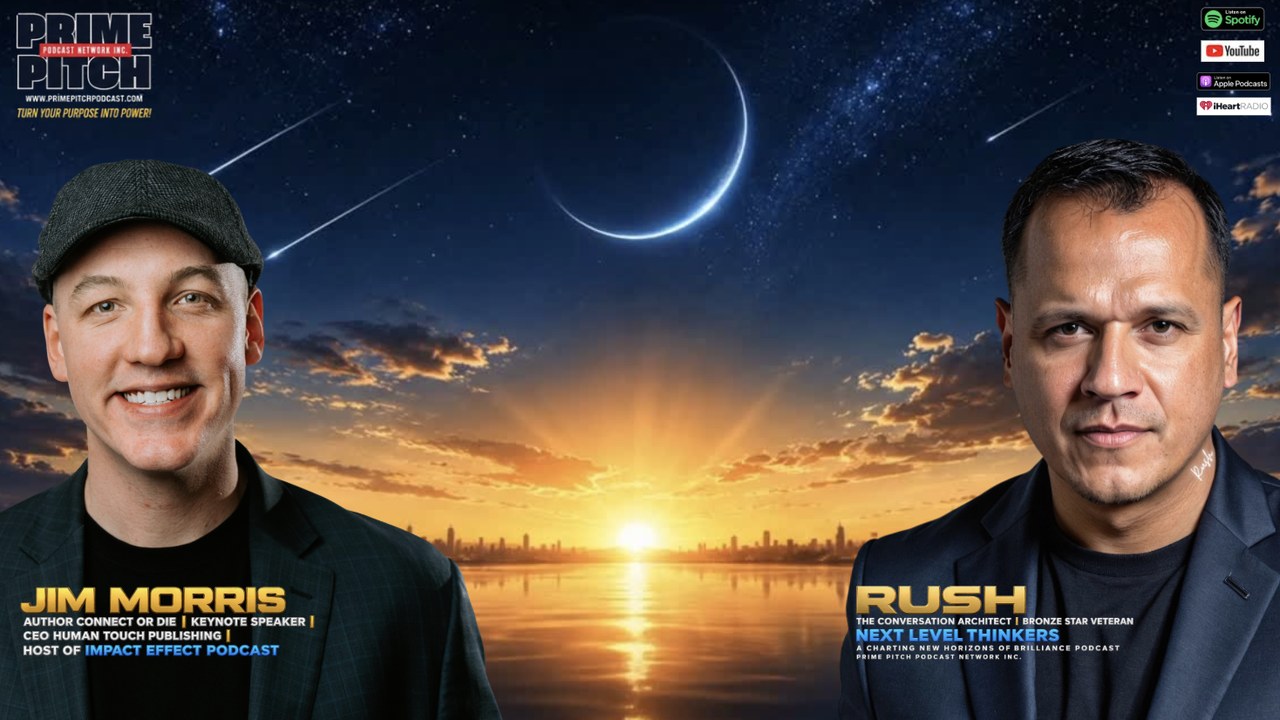
Jim Morris
Author of Connect or Die · CEO, Human Touch Publishing · Keynote Speaker
About the show
Next Level Thinkers is a Charting New Horizons of Brilliance podcast: conversations with high performers pushing the boundaries of effort, mindset, and human potential. Hosted by Eric Rush, The Conversation Architect, a Bronze Star combat veteran and the founder of Prime Pitch Podcast Network.
Read the full transcript
Wanted to bring AI into this, now because of course, Connect or Die, because of Connect or Die, technology is getting better at listening to us and remembering us and communicating with us. And I wonder what it's going to do, what's it gonna do to the way we relate to actual people. What concerns you more about where we're headed? AI becoming increasingly human in the way we communicate with us, uh, we- the way we communicate with us, or human beings becoming less practiced in genuinely connecting with one another? I think human beings, uh, not connecting, being truthful, having the soft skills to engage back and forth, to learn, to ask questions, right?
I think outsourcing our genius is the scariest thing for me. The other piece, and I write about this in the book, is you can now have AI companions. Like, you can date a companion. At what point are we gonna have sex with a robot, right? Like, there's the reality coming- Yeahto the world we're living in.
And I, and I actually share, like, I want my daughter to not have a perfect companion so she can grow and learn through making the mistakes of what it takes to have a really in-depth, intimate relationship with someone, right? Next level, next level. We're reaching for the sky. Next level thinkers. We're aimingPushing boundaries.
Hey, what's up, guys. Welcome to Next Level Thinkers, a Charting New Horizons of Brilliance podcast. Jim Morris grew up in Massachusetts in a home shaped by addiction. As a young man, he sold drugs to help pay for college, and in, during those years, one of the people he knew would later be convicted of serial murder. Jim went on to become an entrepreneur, publisher, author, speaker, and a podcast host.
But across a very different life, one subject has continued to hold his attention, the people we allow close to us and the influence they can have on who we become. Who, who do we trust? Who really knows us? And how much of who we eventually become carries fingerprints of somebody else? Those questions take on a new meaning now as artificial intelligence learns to listen, remember, respond, and communicate with us in increasingly personal ways.
Jim i- Jim is the author of Connect or Die: How to Survive AI, and he believes he cannot b- we cannot become the greatest version of ourselves by ourselves. I wanna know what his life taught him about that belief, and what happened to human, what happened to human connection in a d- in a world increasingly capable of imitating it. This is my conversation with Jim Morris, CEO of Human Touch Publishing, and the author of Connect or Die: How to Survive AI. Jim, my brother, it's a pleasure to have on, have you on Next Level Thinkers, a Charting New Horizons of Brilliance podcast. Um, you know, um, we're connected through John Avery, and John Avery's a fantastic, uh, human being, and he's, he's, uh, faced a lot of the, the, the valleys of life and, and, and the things that, that he's had to endure, and it's very compelling to have, have, um, have him, have had, have had him here on the podcast and it, and to have somebody that's closely tied with him, I'm expecting then that theThat like they say, the people we know can influence us, right?
And, um, um, tell me about how, uh, tell me a little bit how that, how true is that when, when it comes to re- your relationship with John? Yeah, I mean, I think, you know, when you understand who you are, right, and you have defined that, and you don't have shame or guilt for maybe mistakes you made, and you really spend time looking inward. Who am I today? Who do I wanna become? Who have I been in the past, right?
And I think when you can really define that and then create a vision of where you wanna go, you start to understand who's similar to you, who's on a similar path- Mmwhere that alignment, um, stacks up. And the people in my life today are all people that were trying and committed to making positive impact in the world, and John is certainly one of those men. Yeah. Well, you know what? I'm glad.
I, I feel honored that you're here now, now having you say that 'cause, um, honestly, I, I think you're absolutely right. Getting this, this liken- this like-mindedness, you know, and this c- um, really, um, like-mindedness and connection with one another in a human, uh, spiritual, intellectual, and emotional level is, is so important. And to haveyou know, know that 2 guys from Tennessee are here, that have been in my home, and it's like, oh, where are they coming from? All right, I love Tennessee, man. Um, uh, but, uh, I, I think that's even better.
You know, I love Tennessee, and I love the people that are there, and, uh, you guys, um, inter- being, uh, co-mingling with each other, and then me and par- me parting, being part of that tri- that triangle is, uh, really cool, man. Um, you know, when, when I started this, when I started, um, the cold open, I mentioned something about, um, um, your home was shaped by addiction. Uh, sh- let's, let's walk through that a little bit and then we'll, we'll, we'll process that, and we'll, we'll continue down. Yeah, I mean, I grew up, you know, as a kid, very average lifestyle, right? Yeah.
Things were good. I played sports. Parents worked. Um, had a lot of friends. Everybody kinda came to my house in the summers, right?
We had a pool and, you know, things were, things were coasting and rolling. And, you know, at age 14, I found out my parents were addicted to OxyContin. Hmm. So living a life that was very connected, um, open dialogue, you know, spent a lot of time with my parents, to feeling extremely disconnected- Hmmright? And my parents were great parents.
Even through the addiction, they always taught me right from wrong. They always taught me to help others. You know, I can even remember my dad saying, you know, "If you're walking down the street and someone doesn't have a shirt on their back, and you know you have a shirt at home, take your shirt off and give it to them."Right? And that was an analogy of loving on people and helping others and, you know, supporting each other. So throughout that, I still had that baseline of ethics.
You know, my dad taught me integrity, right? And I, I'll share that story later, but, um- Going from connected to extremely disconnected- Yeahwas really hard, right? And I felt lost, and I was playing victim, and why me, and, you know, all these things. So when I think about connection, when I think about the people in my life, you know, w- life is never this upwards trajectory where we just keep going one rung on the ladder, better and better and better, right? Yeah.
We'll hit waves, and we'll be in different seasons, um, but we're always gonna get knocked down a rung. And in those times, you know, I didn't really have anybody to go to to be honest and vulnerable and be heard or ask for help. Um, so living that life where I was connected and really had resources to no resources, I really under- started to understand how important connection was. Yeah. Right?
And it's not this thing where let me go make a connection, and, you know, I know this person has a podcast, or this person may write a book, you know, one day. So I'm not building connections solely to get, right? Mm. I believe when you love on people, when you support them, when you make introductions, when you help them with their dreams- Yeahand their goals, that fills you up as well. And when you build a r- deep relationship with someone, things will come full circle, and you'll both rise together.
Yeah. So I, I just believe it's so important, and now with the rise of AI, we're starting to outsource our genius. We're starting to communicate when, with words that we wouldn't drum up from our heart and soul. Hmm. But yet a machine would.
And it may sound better. It may sound smarter. But is it really you? And are you really putting your best foot forward to connect from my heart to your heart? Yeah.
That's so true, man. It, it, it, it, it, you know, it's so true, going deeper within yourself and how to, how to, how to reach a, a certain level of that, you know, the high, you know, the new horizons of brilliance, emotional, intellectual, spiritual brilliance, you know? A- and I do believe what you're saying is that, you know, that, you know, part ofAnd this is interesting when you were ta- when you were saying that, that, you know, we help each, we help build each other, we help build each other up. And immediately when you said that, I actually felt, I felt like that's what we're doing today, you and I. You know, you're here on my podcast, and you could be anywhere else, and, and you could be in another, you know, somewhere else at, at this moment, and, and you're choosing to be here, and I accept, I accept you being here to boost, boost my podcast, you know, my, what I do with this platform, and then a- and it's kind of this, this mutual connection with one another, and I really respect it, and I'm ver- I'm very thankful for that, for sure.
So, um, and so I want you to know that's how I see it, too. It's like you're here. We're, we're both doing each other. Well, we, well, we, we know the mission. We know we're on the same mission, too.
That's the thing, right? We know that we got a message that we wanna push out, and we know that, that, that, hey, this podcast is about this, and, and this is where I, this is something I align with, you know?100%. That's very cool. And when you look back now, what do you think those early years taught you about the people, about people that you, you weren't really f- you, you weren't able to fully understand until much later? I think for me back in those days, you know, I, I was hurt.
I was frustrated. I didn't have an outlet or resource to talk about what was going on, right? My, my parents asked me not to share it with my 2 older brothers who were out of the home, later finding out that my parents asked them to do the same with me. Hmm. Right?
So my 2 brothers and me, we knew about the addiction, but we weren't communicating about it. We were, out of respect to my parents, we, you know, we were holding it all in. Um, and what I learned in those moments is, man, you have to have people around you that you can trust, right? And I just posted yesterday that 70%, a study showed 70% of people don't trust people that aren't like them. Hmm.
So living without a mask on, being who you are, showing up, you know, what you believe in, owning that, being you, will attract the right people and allow connection to hap- happen even faster, better, and ultimately deeper. Yeah. Um, so realizing that I didn't have those outlets, I, I felt the pain of connection, and I didn't have those resources early on. And what I realized about people is, in a lot of ways it's not their fault, right? I don't blame my parents.
My dad fell off a telephone pole at work, broke his knee, prescribed oxies. My mom had a piece of her lung removed for cancer, prescribed oxies for the pain, right? Mm. So people will make mistakes. Again, we're not perfect.
Yeah. But if I can ensure that I align with the right people, I understand them, they're seeking positive impact, they wanna show up for others, they have a good heart, right, then, you know, I can move through different relationships because people do make mistakes. Yeah. So that was the first thing I learned through that, is not to hold a grudge. We're all human.
Yeah. Right? Yeah. Um, the other thing was, man, connection's so important because when you feel alone, when you feel anxiety, when you feel stress, you ultimately can't be the best version of yourself. Yeah.
Right? What do they say? IQ drops 50 points when you're highly stressed. Mm. So, you know, not even just the intelligent side of yourself, but just being comfortable enough to be you.
Yeah. Right? I felt like I always needed to, um, fit in because I was seeking that connection that I once lost from my parents. Yeah. That, wow.
Um, was there a certain, like, certain, you know, not to, you know, I always say the grandiosity of things and nothing like that. Was there a certain, um, thing that really, that, as when you found out they were addicted to that, was there something they were, uh, behaving like, or was there, um, something you actually saw that said, oh, you know, this is, this was the moment where you realized that this is a, this is what, this is a m- a moment where it's shocking to you? So my, because my dad was injured, broke his knee, was on the couch, right? Like, he was injured, was my thought. Yeah.
Um, didn't realize the timeline, didn't realize the prescription usage, didn't realize that he wasn't going out or doing anything. He was on the couch, right? So as a young, you know, young adult, I didn't understand it, but what had happened was a good friend of mine, one of the toughest kids I know that I grew up with, like Golden, you know, Gloves, won every boxing match. Like, s- seeing him one-punch people. Like, one punch and knocked out.
Yeah. Right? I- i- in, in a boxing ring and in the street. He had come to me and, and we were outside of my house, and he said, "I have to, have to tell you something."And, um, you know, I was in the car with my older brother, and his friend was driving, and he was selling OxyContin, and we pulled up, and your dad got out of the car and bought them. Hm.
And that moment was the realization of, oh, this is what's happening. Hm. Right? And I was frustrated, and I was upset, and I was mad. And then when I finally confronted my parents, um, you know, I, I lost it.
I freaked out, so much so that I, you know, swung at my dad. Hm. Missed him, put a hole in the wall. Um, but it was a moment where I felt that, man, I, like, I'm kind of the parent now. Hm.
Like, how can I trust you? How can I, um, f- how can you, how can I listen to your advice, right? Like, you did the thing that you were telling me to never do, right?'Cause through the, all of this, my parents were, "Don't drink, don't smoke weed, don't do drugs," right? And, and that's, and now today at 36, I admire and I'm grateful for that. Right.
But in the moment it was, "You don't have integrity."Yeah."You, you're doing the thing you're telling me not to do."Yeah. Right? And when I talk about integrity, and I talk about how I learned that, um, I talk about the fact that your integrity can be compromised all the time. Just because you have it in one situation doesn't mean you're gonna have it in another. Yeah.
That's true, man. Wow, that's a, those are painful, uh, family com- uh, pain- painful family revelations that, you know, and you being a young man, it's like you become the parents and it'sYou know, I know what that feeling's like when you have to confront your parents for their own mindsets, right, and their own behaviors and, uh, and, and they, and they may have some healthy rationalizations on why they were in that part- you know situation. Obviously, they were injured and, and they were both dealing with their own med- medical issues. So, you know, that's one of those things, man, you, you look back at it now, you go, "Okay, now I understand."So you're, now that's the root cause of this, the pain you're dealing with, you know? It's hard to understand it when you're in a certain, in a certain age.
Um, there's another part of your life, um, you s- um, you started selling drugs to help pay for college, right? Um, and one of the, one of the people you knew during that time later, uh, was convicted of being a serial murderer. Um, uh, that's a pretty powerful that's pretty powerful how people around us can affect the direction of our lives. Now, um, when you, when did you begin understanding that connection by itself isn't enough and, and who, and who we allow close to us matters just as much as the ability to connect to everyone? Well, I think for me it was survival mode, right?
It was, okay, you know, I got a scholarship to play baseball for college for 35,000 a semester. Hm. College was 40,000. And my parents said, "Well, you can't go to college. We don't have the money."Right?
And you would think, especially in today's world, $5,000, right, it's not that much money. Yeah. It's a lot of money, but you know what I mean, to make a massive decision like that. Um, so th- then I had gone down to community college, and I had, you know, 3 weeks late. I, and I basically built the relationship with the enrollment woman, and I went down 3 days in a row.
I was vulnerable, I was honest, I was real. I told her what was going on, and she had let me in. Mm. So now my parents couldn't get financial aid 'cause they made too much money, but they didn't have money to support college. So I started selling drugs 'cause I had to pay for college.
And realizing that I didn't wanna do that, realizing there was dissonance, right? I was one person in one moment, and I was another in another moment. Um, I had to build these relationships. So that gentleman, um, he protected me throughout that, that scenario. But I also had the vision to realize exactly wha- to answer your question, was, "I don't wanna be like this.
I can't be like this. This actually isn't me."Yeah. Right? So I built a relationship to get protection, and I did that through vulnerability. I told him, "Hey, you know, this person you're hanging around with, that you're working with and, and partnering with, you know, he robs people.
He sets people up," right? Um, so it built instant trust because I was the only person to go to him and say, "Hey, watch out for this guy."Mm. And it was very scary for me because that could've gotten back to him, and he could've came after me, right? But I felt in that moment it was the right thing to do. Yeah.
Um, so watching the lifestyle, and, and, and, you know, I, uh, I never really thought of it, but I, watching what he did, I knew that if I kept hanging around with these guys, I'm gonna do the exact same. Yeah. So I started to build the plan to get out of it. Mm. And, you know, I think the people around you can be a network, and they can, you can rise up with them, but they can also be a cage.
Yeah. And I knew that in that moment that I wasn't gonna be stuck in this cage. Mm. I'm doing this now. I don't wanna do this forever.
It's out of survival. You know, I've gotta pay for college. I've got a, you know, apartment to rent. Um, and, and the crazy thing is I was working full-time salary job, minimum 45 hours a week. Wow.
Yeah. So I was taking night classes, working during the day, taking night classes, and selling drugs to pay for freaking college. Um, so y- but I think back on it, and I think of what my parents taught me, like, I knew what I was doing was wrong, but I could only live so much longer masking who I really was. Yeah. I, I'm not a drug dealer.
I learned a lot from it. Learned how to do sales, learned how to build relationships, learned how to get referrals. Right? Yeah. But those skills, I knew I didn't wanna stay in the same path that I saw everybody else, right?
There's 2 things that happen when you sell drugs. You go to prison or you die. Yeah. And I knew that if I stayed in those circles, those were gonna ultimately be the outcome. Yeah.
Man, I, I feel the stress when you're, when you're talking about it. You know how you, you have that, um, you're, you, you have that oppressive, you know, the, the oppression of that weight on you, right? Like, you wanna perform, and you wanna, you wanna get what you want, and, and this is, this seems like the only me- by any, you know, the only means of doing it to, to g- to, um, to, to, um, to actually get, get the, get to go to school, you know? And then, and then you, and then you ultimately, um, you figure out that that's, that's, that's not the way to do it. You know, a lot of people have struggle with that.
They get stuck in that, um, the, the criminal addictive thinking pattern, right? They get stuck in the power of premeditation. And, and, um, and, when you think about the power of premeditation, you know, "Hey, I gotta sell this much drugs to get, to get X amount of money," right? Or, or someone or, you know, "I gotta go meet somebody at this time, and, you know, I'm gonna m- I'm gonna score big time here," or whatever. You know, you say, um, when you think about how that weight of that premeditation, w- where do you think, where does it take you?
Like, you go, "Oh, man, I, I, I gotta make this money so I can do this," you know? I think for me, it, uh, I mean, early onSo it's an addiction I think, right? Yeah. Because you know the big paycheck's coming. Yeah.
And you've done it so many times, and you didn't get shot. You didn't get arrested. You didn't go to prison. Um, I think for me, though, is there's more, more and more tugging me away from going to do those things, but when you know there's a couple thousand dollars sitting there, and all you gotta do is pick something up at A and drop it off at B, it becomes this lifestyle. Mm.
It becomes this automatic solution in a way. Yeah. Right? Like, I was really good at it. You know?
I was going to business school, so, and taking financial accounting and building budgets, right? So, like, I luckily wasn't someone who would be justI knew my profit. It was a very high margin. I knew how to negotiate, right? I learned all that in business school- Yeahand I applied it in that role.
Um, so for me, it was something where, you know, you know, but you also understand like, I would always say like, "I'm the cat with 9 lives, and I'm on the, on my 9th."Mm. Like, it just takes the next time, and all this ends. Yeah. You know? And that right there was scary.
Yeah. Scary enough to say, "Hey, I'm done with this."And even so f- years later when I was in financial hardships, when business didn't go well, when I was really struggling, that thought always comes back."Well, let me go pick up this and drop this off, and I can make 10 grand," and- Mm. You know what I mean? Yeah, yeah. But, you know, you have your conversation with the man upstairs.
He reminds you what's important in life. He reminds you who you are, and, and you're like, "You know what? I don't need that. That's the easy way."Yeah. And if I got here to this moment in life compared to what it was 20 years ago, I don't need the easy way.
I can push through the hardships and get to the other side. Yeah, man, I always have this saying. I said, "You don't have to hit rock bottom. Rock bottom will come hit you if you"You know? It'll come hit you, you, you know, just based on your decisions that you make, and, uh, um, and if you have those voices that are, you know, the, the, evil voice saying, "Go do this," well, rock bottom will come looking for you if you, if you stick around long enough.
It's funny you say rock bottom because now you're making me think of in 2006 on Myspace, yeah, Myspace, I made my little profile quote or whatever it's called. I can't remember."You have to hit rock bottom to truly understand."And I remember being at the lowest point and s- telling myselfAnd this was probably, I j- I went to 2 different middle schools. This was probably the 6th house we moved into- Mmwhile I was in high school, and I said, "I'll never be here again. I don't, uh, like I will, this will never happen to me."Mm."This is awful. Like, this is miserable.
I don't care what I have to do as long as it's ethical, as long as it's right, and this will never happen."And, and I think for me, having to go through that and that suffering and that pain really pushed me to continue down the path to follow my dreams as hard as, uh, as it can be in some of the moments to navigate them. Oh, you know, I'm sitting here like I'm processing how you thought, how you actually thought that, and I'm com- I'm, I'm kinda like in my own life going, "Dude, like you didn't know how to think like that."You know? You know what I'm saying? And there's a lot of people that don't know how to think like that. They don't have that switch that turns on and say, "Ah, I don't wanna do this."They just f- have to make the mistake over and over again.
You, you believe that? I do, and I think, um, and I think in, in a lot of ways I've made the mistake over and over again. But one of the things that, you know, I have a lot of gratitude for and I feel very blessed for is having foresight and vision. I'm a very futuristic thinker. Mm.
Right? Yeah. So like whether it's, you know, hey, something feels off. Let's build a plan, and it, like I'll, I will shut down 2 businesses on like wrong timing, wrong pricing, wrong partner. Mm.
Right? So I think having, being able to take risk and having that vision and learning from the failures, I think I've always just kinda kept pushing forward, and I don't really know where that comes from. I think maybe that moment of, now that I think about it, that moment of rock bottom where I'm like, "Man, it couldn't have gotten worse than that."You know? And, and in that moment and, and- At least you think you couldn't have. It couldn't have.
Yeah. Yeah. Yeah. Um, in that moment I remember too like my, my mom, my dad coming to me and saying, "You know, the insurance will only cover one of us to go to rehab. Um, your mom's gonna go to rehab.
I need you to give me $500 for oxies or I'm gonna take my life."Mm. And I thought to myself and I'm like, "This will never happen again."And I gave him the money, but I'm like i- it, like I, I can't feel this pain again. Like now, of course, anything can happen in life, but I've gotta get out of this situation, and I am, will never put myself in a similar situation. So like, you know, on a lot of those drug runs and doing those things, um, I was building connection with those people so they wouldn't do the bad thing that they could do when there's a lot of- Yeahproduct in the back, right? And like I think I was always thinking, "How can I connect with them?"You know, no one's gonna, no one's gonna pull out a gun if they like you.
No one's gonna, gonna rob you if you know a lot about them. You know where their family lives. You know what, what excites them, what doesn't excite them. You know their spouse, their girlfriend, their boyfriend. So a lot of the connection piece was out of survival for me.
Mm. And it was strategy, and it was n- and it was negotiation in some ways, right? Yeah. I would If I knew someone had a bad rep, I would still make the deal or the play, um, but I would allow negotiation to happen to feel like they won because I- I'm like, all right, if they're gonna negotiate down a couple hundred bucks, they're probably not gonna rob me. So I'll make a couple hundred bucks less, but I know at the end of the day, they're not pulling out a, a weapon.
Yeah. Yeah. Yeah. Yeah, man. Um- You're not gonna negotiate and then rob me.
You're just gonna rob me. Yeah, yeah, yeah. There's not gonna be no negotiation here. Um, you know, uh, I really like the way you talk about, uh, uh, confidants, allies, and acquaintances. Um, um, I think most of us probably have people in our lives that, that we expected more from than, than the relationship was ever really built to give us, right?
I mean, that's 100%. Um, how did you come to understand those, the different levels of relationships, and what, what do you usually discover when we honestly look at who is actually standing around us? I, I talk about this a lot in the book, and it's, it's a very important chapter because it took time to figure this out. I made a lot of mistakes around it. but I do aIn each chapter at the end, there's a connection rep.
Hmm. Because I believe connection is a skill. I believe that some people are born c- with charisma. Most people learn it, right? Um, but that chapter, I ask people to draw a bullseye with a big outer circle, a s- a smaller middle circle, and a small circle in the middle of that middle circle.
And every quarter, and I just did this Sunday night, by the way, so it's funny you're asking me. Yes. So yeah, I just did this last night. Um, I, I take my network and I put people in the acquaintance, ally, or confidant circle, and the reason why is because if you just do this once a year or once a lifetime, you're not taking into consideration that we are humans and there's a lot of change that occurs over time. Yeah.
Right? Yeah. Um, so for me, I really wanna have a good understanding of who's in what bucket. Yeah. Right?
And it's not so I can get something from them, but I can understand the relationship at depth. Yeah. You're gonna have way more acquaintances than you are confidants. You're gonna have way more allies than you are confidants, and people are gonna change out of the, those 3 sections. Yeah.
Right? Certain people can be in your life for just a season. Certain people can be in your life for just a reason. And I think that if you can really start to understand your network, you know exactly where people stand. Hmm.
So I've had friends that, and I've had mentors that, a mentor, um, sold his business and he was a confidant for me, and he was never available after that, right? And I kept, "I don't wanna get a new mentor. I don't wanna buy coaching. I don't wanna get a coach. I've got this guy."And I went, like, 4 months trying to keep him in the confidant circle, but really he had become an ally.
Hmm. So I lost 4 months of being mentored and coached. Um, I've also had people in the acquaintance where they were- we were really hot and heavy. We felt super aligned. Things were good.
I, I threw a conference. They spoke on my stage, and 48 hours after that, I didn't hear from them. They just wanted to get the stage presence. They just wanted to be a part of my community for that small season. So I, I've learned through it, and, and everything in that book I've learned through.
Like, no one said, "Hey, Jim, you know, do this chart of confidants, allies, and acquaintances."I just sat down in silence in my sauna in my garage and I said, "Man, this isn't working out. Why am I miscategorizing relationships?"Well, Jim, look inward before you point fingers, right? One of my first, one of my lessons, I was like, what can I do better? What did I mess up? And what I realized was I always will have control of my, over my network because I will always have control over my energy and over my time.
Hmm. Right? And that's not arrogant because we don't get unlimited energy and we don't get unlimited time. So if I'm not gonna have my back, then who is- Yeahwhen it comes to something that solely I can control? And that's when I really started to realize, okay, I'm making a lot of mistakes here with this.
I'm, I'm getting really close with people, and they're, they're not a confidant. They're an ally, right? Yeah. They wanted something I had, or they wanted to do business in this season. Maybe I wanted to do business with them in this season.
Um, maybe they worked for me. Maybe they were getting paid, right? And that's what was important to them, not really the relationship, keeping a consistent check. Yeah. So I just broke everything down, man, be- out of my own personal mistakes.
Yeah. And it really allowed me to categorize, and then I do this qu- every couple months because things do change, and we're humans. Yeah. Man, it's so crazy we talking about this 'cause, like, like, maybe just about 2 or 3 hours, I went on my Facebook, right? And I, and some new, some, some, some things went down, let's just say.
PeopleJust that some things went down, and I went into the Facebook, the Facebook friend, right? And you click it, and it says, "Unfriend," uh, "Acquaintance," or, uh, um, s- uh, "Restrict" or something like that, right? And I was like, "Man, I thought I knew this person."I literally2 people, I was like, "Acquaintance."Acquainted. And I was like, I was like, dude, I, I just, it, it sucks when you go through that, you know? Man.
And, and, and I think a lot of the time is, you know, i- if it sucks, but you just don't know what other people are going through, right? Yeah. And, and I used to blame, and I used to point the finger, and I used to get super upset, but I'm like, hey, if we croth- cross paths in the future, maybe it's meant to be. Maybe we can rekindle. Maybe, you know, th- they're hot and heavy on this, or, you know, they're going through a divorce, or they just lost their job, right?
And but also, I mean, let, l- I'm gonna be direct here. A lot of times, none of that's happening, and there's just this hidden thing about someone that is, like, disgusting to finally see in- Yeahin reality. Mm-hmm. Right? And, and it's okay to make those decisions because i- if you're gonna stay connected to certain people that you're not aligned with, it is gonna pull out energy.
Yeah. They are energy vampires. They're gonna, they're gonna suck it out of you because a- and it's, there's people on social media that I, um, um, not unfriend but unfollowed- Yeahbecause I'm sick of seeing all the successes when I know them well enough to realize that their life is in shambles. Hmm. That they cheat on their wife, right?
That they, um, occasionally do use drugs. That they, um, have sold stuff to people and took their last 5 grand and didn't fulfill it, right? But I'm also like, hey, I don't, I just don't wanna see it. Yeah. I don't wa- I don't wanna, I don't wanna think those thoughts, so I'm just, I'm just not gonna follow them.
I'm not gonna see their content. I'm not gonna play into the game that they're playing for thems- with themselves. Yeah. Man, it's true, man. I, I, I say when I did that just a couple hours ago, I was like, man, I, I, I don't, I don't, not ready to say, like, uh, unfriend, you know?
But I was like, "I gotta put them as acquaintance 'cause I didn't know them. I thought I knew them, but I'm, I know them, but I don't know them."You know what I mean? Yeah. Uh, yeah. So, so we should be intentional about building relationships, but we also don't wanna start looking at people based on what they might eventually be able to do for us, right?
Um, where is that line for you? I think for me, if you engage in a new friendship, relationship, do business with someone, right? And you, whatever scenario it is for you 2 to come into conversation or communicate, um, I wanna get to know them. I want to show up with compassionate curiosity. Mm-hmm.
Right? I'm not just asking questions to see if they're gonna become a client or if I'm gonna sell something to them. I genuinely am curious. Yeah. But it has to have compassion, right?
Because a lot of, like, sales playbooks and a lot of connection, human connection books, a part of it is curiosity. Ask questions. Ask questions. Ask questions. Yes, you, to get to know someone, you should allow them to do 80 to 90% of the talking, right?
But if you actively listen, and I believe in order to actively listen, you need to silence your mind, right? Yeah. And in order to do that, you're not thinking about what to say. You're not thinking about what to respond, and you're giving yourself an opportunity after they share with you to pause, right? And it's really hard to do that, right?
I talked about a 7second pause in the book, and people are like, "That's awkward. I can't do that. They're gonna think I'm dumb. They're gonna think that I'm not paying attention."And, and I said, "Well, if you're really thinking, then think."I do this when I think. Hmm.
Right? And most people do based on body language studies and experts and that I'm friends with. But really think through that, and then loop it back to them what they just said so they know that they're being heard. Hmm. Then they start to be more comfortable because they know that you're paying attention, right?
And I break all this down in Verbal Mastery, Compassionate Curiosity, some of the body language chapters. But ultimately, I wanna be compassionate with my curiosity to really understand someone because some of the best relationships Started out with listening to someone who needed a babysitter because that was the most important thing that they needed in that moment. And I connected them with a babysitter, and then, you know, years later they sent me a huge piece of business. Wow. And it was over something as simple as being human from one person to another.
Yeah. But if we're thinking about the sale, we're thinking about what we can get, and we're not listening for the problem, and we're maybeWe might not even ask, "What do you need?"Right? And I learned that when I first started an event company back in 2020. I was the crazy guy who threw in-person events when no one was meeting, right? And it, and it started because I was losing a business.
My revenue went to 0. Um, I had 8 entrepreneurs around a table, and I put down my phone, opened up my contacts, and I looked at them and I said, "You're screwed. You're screwed. You're screwed. I'm screwed.
What do you need?"And that has stuck with me for so long- Mmbecause if I can engage in a conversation rather than saying, "What do you do?"and say, "What do you need right now? What's your dreams? How do you n- how are you navigating them?""What can help?"That opens up a depth of a conversation for me to serve and for me to help, and I believe when you serve someone, when you help someone, now you're giving. They understand where your heart is. They understand who you are, and man, something good's gonna come out of that.
Yeah. Right? I've even, I've even met someone, asked them what they need. They said they needed to meet more people for their business. Invited them to an event.
They end up meeting their wife. Yeah. Never have done business with them- Yeahand probably never will, but dude, how cool is that? Like- Yeah, yeahyou met your wife at my event, and it started be- by me asking what you need, and you need a new business connections, and then that happened. It's like getting- It's like-a match.
Yeah. It's like you just won the Super Bowl. You know what I mean? I hope. Yeah, yeah.
Yeah. I hope it, I hope it, they stick around. Yeah, yeah. How do we become more intentional about our, our relationships without turning it into, turning it into opportunities? I think for, for me, you know, it's really understanding peop- what drives people, what people want, what people need.
Yeah. Right? Now, if you reach out to someone solely to touch base before you make an ask or you try to make a sale, man, you're playing the game the wrong way. Yeah. Right?
If you reach out to someone 'cause they popped in your head or they're on your heart, that's how you build relationships without seeking the opportunities or the benefits. And for me, I do this thing. It's called the 5 Alive. I take my phone out. I call this a positive impact scroll.
I go to my contacts, I scroll 5 times, and I stop, and whoever's on that screen I reach out to. Mm. And it's as simple as, "Hey, Brad. How are things? Was thinking about you."Sick.
Yeah. That's cool, man. The last time I did that, I did that live at an event, and Brad response was, "Hey, man. I, I'm, I'm really busy. I'm traveling a lot.
I'm doing a bunch of stuff. I, I don't know if, you know, if this is the season God wants me in, and I'm just struggling with my faith right now 'cause I'm really grinding. I'm really tired. I'm stressed."And, and we, we engaged in a dialogue. I'm not asking for anything.
I'm not seeking an opportunity. Yeah. And then Brad's like, "Oh, I know this woman, and she'syou know, was in the Olympics and, you know, I thought of you and, and, you know, want to make an introduction and want her to jump on your podcast."And I didn't do it to get a podcast guest- Yeaheven though we knew that woman, right? Yeah, yeah. Um, every morning I start out reaching out to 5 people before I start my day, and it's as simple as, "Hey, you're on my mind."I say, "You're on my heart," right?
Because that's my vernacular. Yeah. You don't have to say that. Yeah. Right?
But if, if I'm thinking about you, and I'm inclined to reach out to you, I'm gonna say, "You're on my mind. You're on my heart. How are things?"Yeah. And that can open up a dialogue. I can do it in an audio message.
Mm. Right? Yeah. Um, where people can feel my energy. And John, where we started talking about this, um, he had said to me, he said, "I'm, I'm pushing out this new business program," and all this stuff.
and so I sent a, a, an audio message back, and this was just a couple weeks ago, and his response was, "Man, I didn't know I had a, a hype man."Because I was like, "Dude, I'm so excited for you, man. You're"And it was like 26 seconds. Yeah. It's like, take the extra couple seconds, hit the plus sign, audio, and speak from your mind, speak from your heart, speak from your energy. And, you know, for John to be like, "Man, I didn't know I had a hype man," and all this stuff, like, it probably felt good.
And it felt good to hear that back. I'm like, "Yeah, I'm gonna hype you up, brother. You're in this for the right reasons. Let's go. Positive impact."Yeah.
That's so cool, man. I did the same thing for him, man. I just did it, too. I did that for him, uh, like, maybe 2 days after he was on my podcast. I wanna just, just tell my man, "You'reYou know, it was a pleasure to have you on the podcast," but just wentI went in it.
I wentI wish I had my phone with me 'cause I'd do it. Let's, let's do it right here. Like, "Hey, this is for John."Do it for Johnny. Let's go. All right.
Um, no, it's so cool, man. I think you're so right. What I really liked about what you said was, um, 'cause that was one thing I noticed when John was in the seat, he, like, paused, and, like, he closed his eyes, and I'd be like, "Dude, this is sick."You know, like, if you know what, you know what you're watching, you know, you get it, right? And it's not like he's just like, "I don't know what to say."He was, like, in it, you know? He was in his soul, and I was like, "That's what's up right there."And I was like, he took a pause, internalized the question, and then just, and then let it fly, and I was like, "That's what's up, dude."Let's go.
Yeah. See, and that's the thing about this experience for me, the pod- you know, beingYou know, I say it's a, um, a listening leader. I consider myself a listening leader, and, uh, and, uh, being able to, to, uh, watch, uh, individuals like yourself and John and other, other individuals that sit in this chair, um, they, they, they articulate themselves, and I hear their message, and I, I get, I gain wisdom from that. You know what I mean? I, I get to see how they deliver their message and where the, their heart is an- and their sincereAll every, all the tone, everything.
It's like, "Okay, man. Like, that's so cool, man. I'm gonna, I'm gonna take that. Another thing to put in my pocket."Like I said in John, I say I always having, when I have, like, why is this, why is thisI might be wearing, wearing a, a, one of those, uh, bomber jackets the next time I come in. Why is it so big?'Cause I got all this wealth of, of, of, of wisdom in me, you know?
Uh, no, um, you know, uh, one of the things you talked about was, uh, intentional integrity. Talk to, talk to us, talk to me a little bit about in, uh, intentional integrity. I like that. It's early on in the book, you know. It talks about loving yourself, then it talks about intentional integrity because I think those 2 things are important- Yeahto connect deeply with others, right?
We talked about loving yourself a little bit. Yeah. So intentional integrity is if you don't have integrity with relationships, they suffer. It's as simple as that. Yeah.
And then ultimately, you suffer because if you continuously go down a path with no in- integrity, then are you really being the person you wanna be, right? We all wanna have integrity. We all wanna do the things we say we're gonna do. Yeah. But at what point do you bail on stuff?
Do you back out of things? Hmm. And all those little micro, um, compromises, they start to stack up and become the average. Hmm. So when, when you don't have integrity, and you sayAnd I, uh, let me give you a, an example.
You and I go to a networking event, right? It's exactly our clients. It's amazing people, athletes, whatever, right? And how many times, and I am guilty of this in the past too, how many times have you said, "Yeah, let's grab coffee next week. Yeah, I'll send you an email.
I'll send you a text," and you walk out of there, and you talk to 10 people, and you maybe text one of them? Hmm. Those little micro compromises of saying you're gonna do something and not doing it-is gonna show up in everything, especially relationships. Yeah. And if you want to build deep relationships, if you want to leverage them for new opportunities and grow and be in different circles and, and around the people, 'cause we know how much it matters to be around the right people- Yeahum, you're compromising that.
So, uh, you know, I said earlier with my dad, he taught me integrity. I, I was a little boy. I wa- had a friend over. We were jumping back and forth from bed to bed. Um, we're probably not supposed to be doing that.
I remember we were watching the Ninja Turtles on VHS, right? It was, like, a Friday night, eating popcorn, pizza, like, best night ever, and we're jumping back and forth, and boom. The lights go out, and we hit each other, but the boom wasn't from our heads. Someone drinking and driving had hit a telephone pole out front. Oh, man.
And my mom ran in, got us situated. About 20 minutes went by. I came back out. I was like, "Where's my dad?"He had ran out the front door, and he had pulled the guy out of the car, and the car caught on fire moments later. Hmm.
And he saved his life. Wow. And the police had come, and when I had come out of the bedroom, um, they were kinda yelling at my dad, and I heard the conversation, and they were like, "You shouldn't have touched him," and, you know, there was someone that pulled out a body out of a car, and they ended up getting injured, and they sued him, and they won, and the guy lost everything, and in that moment is how I define integrity. Yeah. My dad saidThere was some explicit language 'cause he had said, you know, "Screw you," basically."I'm gonna do what's right in the moment that matters most."Hmm.
And if my dad thought about being sued or the risk, then that man would have burned to death in that car. Yeah. Right? So when I think of integrity, it's doing the things that matter most in the moment that matter most, and if you are going to tell someone and look them in the eyes and say, "I'm gonna reach out to you"- And not do that, then it's going to hurt the relationship. Yeah.
And we're not perfect, and I am not perfect. I don't have 100% integrity, and I don't think I'm the most, I, I have the, I'm the person in this world with the highest integrity. But if I can focus on it, and if I can commit to the things that I said I'm gonna do- Yeahand I can just spend a little time, or I can look at things that are in the future and say, "Okay, I committed to this. How I make this happen?"Rather than not making it happen moments before- Yeahthen my relationships will grow. Hmm.
And out of all my close confidants and friends, they know that if I say I have your back, that I will have your back. Hmm. And if you need a ride, if you need help, if you can't talk to anybody. And that's where I think integrity lies the most. Wow.
I, yeah, I think you're so right about that, man. It's, it, it have, you know, um, integrity, character, you know, those are heavy, those are heavy words for me, you know? They, they really are, you know? And I'm glad to hear you say, like, I don't, you know, I don't necessarily think I'm, you know, I'm still working on it, you know?'Cause that's exactly what I thought. I was like, dude, you're still working on that, you know?
Like, you know? Yeah, you know? And the person who says, "I have the highest level of integrity"- Yeahman, they don't have integrity. You can't, you can't self-proclaim your integrity. Yeah.
Right? Yeah. No, I say, "I'm working on it."Yeah. I say, "I'm focused on it."Yeah. Right?
Yeah. Like, it matters to me, let's just be real. Sometimes things happen. Sometimes you forget. Like, we're humans, right?
Yeah. Um, but if I can focus on it, then I know what I focus and put power behind- Yeahwill grow. Yeah. Yeah. Is there, is there a moment when you, uh, actually, um, you could take us back to a time when you, um, when you did what you believe was right, actually cost you something, and, and, and you still decided to keep the promise no matter how, how much more it was gonna protect, uh, prot- protect the outcome?
Yeah. There was, um, there was a mentally retarded kid in our, uh, high school and, um, you know, he was getting picked on. And I stood up for him, and I got my butt beat. Hmm. Like, I got my ass handed to me, and it was rough.
And I knew I was gonna, you know, lose the fight, and I was scared, and I was timid. But if I walked away from that and didn't stick up for what was right in that moment, then it would've haunted me my entire life. And yes, like, I took a beating. It was not fun. Um, but I didn't wanna live looking and turning the other way.
It's like, if I see a man hit a woman- Yeahuh, and, and just like, "Oh, that's not my problem," it's like, who am I? What integrity do I have? Yeah. You know? Now, I'm not gonna go try to beat someone up, but I'm gonna try to break it up and stop it from happening.
Um, and these are just things that I've seen happen. These are things that I know, okay, if I'm getting involved into something that's may not be my problem, and it may not, you know, I may get beat up. I m- may something bad happen to me, but, like, man, I don't wanna be on my deathbed, you know, I think I'm gonna live to 130, so I don't wanna be 130 and um, think about those moments where I should have done something and I sh- and what would've happened if I did do the right thing. Yeah. Knowing that that is the right thing in my heart.
Yeah. Some people might say, "It's not my problem. I don't wanna get involved. I don't know the story. I don't know the scenario."That's a ch- choice you have to live with, right?
Yeah. I know the choices that I have to live with. Yeah. And there's already plenty of mistakes that I didn't show up with integrity or didn't do the right thing, so those are in the past, and I don't have shame or guilt around them, right? Selling drugs, didn't love it, it happened.
It was out of survival. I can live with that. Yeah. But if I seen, you know, some guy beating on some woman- Yeahor his girlfriend, domestic violence, and I just kept walking, I'm gonna have to live with that. Yeah.
What if he beats her to death and I could have prevented that from happening? Yeah. I just get involved somehow, right? Maybe it's call the cops. Maybe it's, you know, just breaking it up.
But, like, that's the person that I wanna be. Hm. Siblings, you have siblings? I have 2 older brothers.2 older brothers. Okay.
What the age gap in them? One's 10 years older and one's 7 years older. Okay. So, um, you know, they were out of the house, you know- Yeahum, as a teen and whatnot, but, um, yeah, man, they're, they're, they're good people. That's awesome, man.
here's something I've seen in leadership. Um, you can have people who really care about each other and care about the organization, and they can still be afraid to tell the truth when something isn't right. Agree? I agree. Um, how do you create the kind of connection where people feel strongly enough about, uh, belonging to stay, but also feel safe and responsible enough to tell you when they believe you're wrong?
I think building a relationship requires a level of vulnerability, right? And if you can share a moment with your staff, your employees, your associates, support staff, vendors, where you just didn't hit a home run when you took a swing, where you've made mistakes, where youI call it falling on the sword. I think when you make a mistake, you need to fall on your own sword, and it's not that the sword's gonna go through your chest and out your back. It's gonna pierce a little bit. It's gonna hurt your ego, right?
Just a little bit. But creating a culture that I am hiring you because you're an expert, I am working with you, you're on this team because you have a skill set, you play a piece of this puzzle, this puzzle is incomplete without you, we cannot win if it's just me, we win together. Be- creating that team, becoming, I call it a connected leader- Hmbecause you're connecting with people and being honest, real, and vulnerable. Like, you are not perfect. Your team knows that, right?
Unless they're getting down on their knees and, you know, doing this every day and bowing down to you, like, they know that you're not 100% correct. They know that you make mistakes. They know that you're a human. So why are you trying to portray yourself as this perfect, you know, top tier, everything I do tu- turns to gold when they don't even believe that because most people don't believe that about anybody, right? Unless that's their higher power or they're, they're spiritual, right?
So w- you're playing a game that you can't win. And if you can be vulnerable, like, I, like, some of the best conversations and the most inspiring motivational things I've said to people is sharing the fact of a mistake or a scenario where I didn't hit a home run, where I swung and missed, and then it, then they felt, "Okay. Yeah, I'm not perfect either."Hm. And then they felt good leaving that meeting, right? I've gone at people coming into my office when they worked for me thinking that I'm gonna fire them, and they go out on that room running full speed ahead more motivated and inspired than they ever could, and most of the times those conversations started with me saying, "Hey, I make mistakes, too, and I messed this up, and here's a story about this.
Come to me. I'm here to support you. I'm here to"This open door policy when I was in corporate, like, I, I think when I worked for certain companies, I was the only one that actually believed it, and people would actually come in my office because it was a safe space. Hm. And my 0 only rule was, I want you to critical think.
So if you don't know what to do, if you made a mistake, come in, tell me, and bro- broker an idea, broker a thought. Yeah. Right? I don't wanna give you all the answers. Let's work and build this thing together.
Yeah. Right? And if you can do a little bit of thinking, then I will help guide you based on my experience because I've probably been there before, and if I haven't, then I'll tell you I haven't been there. I'm not gonna make something up, and we'll go get the resource together to help you in those moments. Yeah.
I think that's some of the most powerful stuff, and we have this big ego, and we've gottaEverything's gotta be perfect, but that's just not reality. That's just not life. Yeah. Now, you need to stand in your experience. When you know something's right because you've been there, you've done it, hold strong, right?
And I, and I think that's, you know, you're leading the pack, right? But that's not gonna be everything. Yeah. And you're not gonna be right all the time. So asking for people's opinion, like, I, I've had so many conversations with employees of mine where the-- I've s- I've said that, and they, they're like, "Well, I think this and this and this and this and, and I've brought this idea and we're, I, I think you're wrong."And there's been times where I said, "I really appreciate that idea, but we're gonna do this because I've been there, I've got the knowledge, I've seen this before."Right?
And, um, even when that was sideways, I never pointed the finger, and I'm not right all the time, so I've definitely said, "No, we're gonna do this," and I was wrong. But giving people the opportunity to dialogue with you- Hmand to be part of the solutions- Yeahman, that's how you lead people. That's how you lead as a connected leader. And those people will fight for you. And then, you know, one of the things I think about leadership that I think we get wrong a lot, and I definitely have gotten it wrong, is- If I'm the leader and say I report up to the COO or the CEO, EO, or VP or, or there's someone above me, right?
In a lot of cases it- I report directly to the president or the founder or the CEO when I was in corporate. Um, if there's a mistake, it's my fault. If there's a win, it's the team's. And I think if you can live a life as an executive or in a managerial role where you own the mistakes and you don't point fingers or blame, and then when there is a win, give kudos to the team, then you're gonna have a great team. Mm.
You're gonna hit home runs m- a lot more often, and you're gonna be well respected for that person you do report to. Mm. And I think we wanna, we wanna grab all of it and say it was all me and, and hit on the chest, but like you know this. Business success goes by numbers most of the time. Yeah.
So, like, you can have all the right ideas and not hit the numbers and be fired. Yeah. Y- you know? So, like, if you're hitting the numbers, they're not gonna replace you, dude. Right?
Yeah. You'll probably get a promotion. Yeah. Like, uh, give the team the credit. There's no such thing as self-made.
Yeah. You know? You can't be the greatest version of yourself by yourself. Mm. Man, that, this, that sound bite is so sick 'cause it's so true, man, and, uh, there's a lot of leaders that need to hear that.
Like, so many need to hear that, you know, understand as, as, as every- They- It's humanized leadership too. I, I, I had an interview with a guy named, uh, uh, his name's Bob Tiede, and he has a, uh, Leading With Questions, and that's his book. He says he has 3, 365 questions just like there are in the Bible, and he, he goes, he says, "This, uh, this is the way Jesus led."You know, he has questions and, and he goes through this whole, this breakdown about leading with questions and, and, um, and it was just, it's so epic, so I li- I gotta go- I'll have to look that up. That sounds- Yeah, dude. Yeah.
Oh, oh, Bob Tiede is so, like, dialed in. He is so smart. He talks about multipliers and, uh, and, um, uh, multipliers and, umI forget the other one, but it's, it's the opposite of that, and, uh, he, he just talks about, uh, it, it, it's so cool. Yeah, he's great. Um, Jim, when I look at your story, you seem to have, uh, learned how to read people pretty w- early, right?
Um, and that might've been some of your drug dealing days, uh, too. Um, you've carried that ability into a lot of different rooms over the years, and I'm curious about where you think it actually came from. Do you think that that was something you developed later in life, or was it a survival skill that eventually found more, a c- more constructive place to live? I think it was a survival skill at first, and then I think that, um, every opportunity I've been given has come from someone, or if I've created a company or an idea or a product, it's only accelerated because of someone. Mm.
So I got really dialed in on other people, because I want people to feel energized around me. I want people to, um, feel aligned with me or d- or not aligned, right? Like- Yeahconnection is not just to connect with everybody. It's to also not connect with others, right? Yeah.
If I could ask you a bunch of deep questions and within the first 30 seconds I know that you could care less about positive impact, you just wanna make billions of dollars, you'll sell anything and do anything to anybody, well, I, now I don't have to go to coffee with you next week. I don't have to get on a Zoom with you. Like, I've just saved a bunch of energy and time. Yeah. But I think, going back to your question, the most important thing for me was this is a world of humans, right?
Like, every opportunity, every growth, every lesson I've learned has come from someone, whether it's in a book, whether it's on a podcast, whether it's meeting them at a coffee shop, at a grocery store, through friends, right? Like it- Yeahcomes through humans, and that's why I believe that's how you survive AI is if you outsource everything to a machine, what do you have left? Yeah. If you're not critically thinking, if you can'tIf you don't have soft skills. Some of the, the best opportunities could be in a conversation with someone, and you don't know how to navigate that conversation.
You don't know how to square up with them and have your body language face them to show them that you're interested. You don't know how to ask compassionate questions to get them talking and to get them to feel comfortable with you. You don't know how to be vulnerable. You don't know how to know that if you're telling a story and it doesn't align with someone based on what they've gone through in the past, trauma, whatever, and they start to shift a little bit, that you need to pivot away, and you keep going into that story, and now you've just hurt that relationship. Hmm.
And it's not because they didn't like you. It's because you made them feel uncomfortable with what you were saying in that moment of that story or what you were saying. Yeah. I've done this 100 times where I've looked at people and I'm like, "Oh, pivot" in my head, 'cause I'm reading the body language, right? The eye contact dissipates, the, the, the feet move.
Janine Driver in my book, she's a body language expert, she calls it naval intelligence when the belly button isn't looking at you, right? Like, that means they're not interested. Yeah. Um, and there's micro expressions and cues and, and all types of things. When someone touches the back of their neck, they're uncomfortable.
Um, you know, people get it confused when a woman touches their hair, they think they're flirty. That is true in a lot of ways, but when they touch the back of their hair, that means they're uncomfortable. Hmm. So different things can happen, and if you read people, you can serve people. Yeah.
This isn't to g- I don't teach this to manipulate. Yeah. I don't teach this to catch someone lying and call them out. Yeah. Right?
But if you can use the same skills for positive impact to serve, to align, then opportunities will come. Yeah. That's awesome. Man, Connect or Die: How to Survive AI. Um, w- talk usUh, let's take a, uh, let's take a pause and talk about your book.
Tell, tell everybody about, um, what's in it. Um, what's your favorite chapter in this book? I think the Loving Yourself chapter in the beginning is really important, because I, I believe that you cannot have outward connection without self connection, right? Yeah. So you've gotta know who you are.
You've gotta have your core values down, and you've gotta build a plan to stay, you know, in the zone of those things. Yes. Um, and then the confidence allies and acquaintances, because that was so pivotal for me. Um, when I was feeling misaligned, when I was feeling a lot of friction in my life, um, I went and I did that exercise, and I, I had it all jacked up, man. It was like, uh, an epiphany for me.
I'm like, this is why when I was financially in a bad situation, um, no one reached out to me. I was feeling very lonely. I was thinking about taking my own life. Like, this is why. It's 'cause I had people in the wrong categories."Hmm.
Right? Yeah. And I, and I thought these people were here for me, and they weren't. They were here for one thing, and that was what I could offer in that moment. Um, you know, the technology piece, digital connection, um, i- is huge because we can use technology to connect in a human way, to connect deeper, right?
Um, we can schedule text messages now- Yeahto theso they land when someone is best w- able to receive the message you send. It's a small advantage that has a huge opportunity for impact, right? If, if I know you're an early riser, I'm not gonna send you text messages at midnight hoping that you're gonna respond. But why not schedule them for 7:00 AM?'Cause I know you're up early. Yeah.
Right? There's so many different ways to use the technology. Um, and I'm just really excited, you know. It's a very vulnerable book. All the lessons I learned in there, I lived through.
Um, you know, it's my, my life. There's a lot of honesty and vulnerability. Um, and there'sIt's all true. E- every piece of that is true. And, um, it took a lot of reps to learn them, and I'm still practicing, you know.
I do the workbook that comes with it. I give a free workbook in the back. I do the workbook myself- That'd be, that's awesomebecause it's a rep. Yeah. Just like the muscles in the gym.
That's so awesome. You gotta work on them. Yeah. That's so, that's so awesome. How long did it take you to write?
Three and a half years. Dang. I'm like, okay, man, three and a half years. Like, 'cause, you know, I wanna write a book. I'm probably gonnaWannaI think that's the next phase for me, but, wow, three and a half years, man.
And youI like the fact that you said that, man. I still working on my book.'Cause that'sYou know, I had a friend. He, he has this book called Theology of Fitness, and I was like, "Dude, like, you need to go on podcasts, have your book down, man. Like, get in there and, and, like, just know, know which chapter, here's your favorite chapter. Know, know what, you know, know certain sections of it that, point it out and "'Cause it, uhHe's like, "All right, man, I'm gonna get back into it and I'm, um, I'll make sure.
I wrote it, you know, I just haven't really got itI left it, you know, I left it on the shelf for a while."If that's a piece of advice I could give an author- Yeahis do the audio book in your voice- Okayand listen to it. Man, it is an emotional ride. I cried through mine. I had moments of pr- I was proud. I was grateful.
Um, I even have it on my cellphone in my Apple Music. Hmm. So, like, when stuff's on shuffle, a random chapter will come up and it's me reading my book. That's good. Because it bring, it ju- Yeahjust like anybody's book, right?
Yeah, yeah. You c- you could read this book today and read it in 8 months and pull completely different things out of it. Yeah. But going through it and hearing your own voice, man, it's powerful. Not only to, uh, the random reader who buys it off Amazon, but also yourself.
Yeah. And you really s- you really have a, a different range of emotions when you do that. Hmm. Um, and we love that. Like, at Human Touch Publishing, we do audiobooks as well for our clients, and it's one of our favorite things because we're in a room with them going on the ride- Hmmof them hearing their story again, and they're getting emotional, and sometimes we have to do multiple takes.
Yeah. You know? We, we have people cry right there. It's like, okay W- we want the reader to listen to it clearly, so we have to retake it. Yeah.
But, like, you gotta read through that. That's emotional. Relive that- Yeahand come out stronger. Yeah. And not only that, man, some of it's like, man, I can't believe I, I, I own what I know now, you know?
Like, my li- my lived, my experience of life, my life experience, I actually own it, and it can be, like, overwhelming, you know? Like, I, I was telling you, you know, I had just my f- one of the first major speaking engagements, and, and man, I sat down and I was like, dude, I got emotional. Like, there were times it was, like, just hitting me. I was like, dude, I can't believe I'm saying this, you know? Like, I can't believe I'm hitting this mark this way.
Um, I can't believe that this is, this is the r- this is real, you know? Like, for me it was ait came back to me, it hit me in the face, like, dude, like, youIt was kind of a proud moment, you know? It was proud, but it was also sorrowful 'cause you, your stories sometimes, you know, it can be painful, too. But, um, I just think it's really cool that you go back and do the work, man. Um, working it, working your own workbook.
I like that. Um, um, uh, I think we brought AI, too. We, I think we, um, I wanted to bring AI into this c- now because, of course, uh, Connect or Die, because of Connect or Die, technology is getting better at listening to us and remembering us and communicating with us, and I wonder what's going to d- what's it gonna do to the way we relate to actual people. What concerns you more about where we're, we're headed, AI becoming increasingly human in the way we communicate with us? Uh, yeah, we, you know, the way we communicate with us, or human beings becoming less practiced in genuinely connecting with one another?
I think human beings, um, not connecting, being truthful, having the soft skills to engage back and forth, to learn, to ask questions, right? I think outsourcing our genius is the scariest thing for me. Hmm. The other piece, and I write about this in the book, is you can now have AI companions. Like, you can date a companion.
At what point are we gonna have sex with a robot, right? Like, there's, there's, there's a reality coming- Yeah, yeahto the world we're living in. And I, and I actually share. Like, I want my daughter to not have a perfect companion so she can grow and learn through making the mistakes of what it takes to have a really in-depth, intimate relationship with someone, right? Yeah.
So, like, when I think about my th- 3, soon to be 4, year old, I'm like, "She has to make those mistakes to learn from them."She has to be embarrassed. She has to, um, grow from, you know, how to treat people. Yeah. When you're getting brown-nosed by AI, and it's telling you everything you wanna hear and it's perfect, like, that's not the world we live in. Yeah.
Right? That's an algorithm. That's a robot. That's a machine full of steel and data centers that doesn't have a heart, and it damn sure doesn't have a soul. Yeah.
I, my, I want my daughter to ha- ha- go through real life. It's not perfect. Yeah. So when I think about these things, it just worries me, and I think, I mean, I don't know. We haven't seen it at its maximum yet, but, like, y- you probably feel the same way.
Right now you know when something's off. You might not be able to tell. Like, I'll look at something or I'll see an AI avatar and I'm like, "Something's off."They're either, it's, they're either not telling the truth, or they're, they're reading, like, a script- Yeahor it actually is a robot and it's not even a real human. Yeah. Now, I don't know if it's g- if we're not gonna be able to tell that, but if we get to that point, I think people are gonna lose it because they've lost trust, and I think we're gonna revert right back to this stuff that's in the book.
Hmm. Like, I wrote this as an evergreen book because I feel like it is timeless. I feel like more and more people are going back to connection as a way to survive through this stuff. Yeah. At what point do you just get everything you wish and want from a robot and have no struggle and have no, like, reality?
Yeah. You know? Is it comfort? I believe comfort zones are where your dreams go to die. Yeah.
I believe if you're not growing, you're m- you're going backwards. Yeah. And if we lose all those opportunities, at what point do we just Ready Player One, like that movie? You plug into a VR and, you know, you live a, all day long in a completely different life. You take the thing off and, like, they live in, like, stacked containers, and it's dirty and filthy and gross, and it's like- Black Mirror stuff.
Black Mirror stuffyeah, yeah. That's crazy. Yeah, man, I was watching this, uh, watching this, umI was on YouTube and this, this woman was, um, she had a hair salon, and the guy's like, "I"Um, he did it, this whole system was all AI. She had, like, 5 TVs in her salon. Like, it was to, to, to, uh, she was gonna go to a fashion show and she wanted to learn how to market her, her product.
She had hair extensions, and she had 5 TVs in there, and each one of them had a, was an AI-generated, like, person who was talking to, talking to her and coaching her, and they all had different personalities. And she's like, "So what do I do now? I'm gonna, I'm gonna do this and that."And then, then wh- one person would say this, and the other one would respond, "I don't think you should listen to Jim."I was like, this was actual, realI was like, oh, wait, it was a real scenario- Yeahreal thing. I was like, "Holy crap."They all had, like, like, uh, L- Lego faces, and I was like, "Oh my God, this is crazy."And she went over there to the, the thing and she said, "I just, I just went in there and, and I forgot everything they told me, and I just was myself, and I, I landed the, the client."Yeah. That, you're performing.
Yeah. If you don't believe it, you don't- Yeahfeel it, you don't trust yourself, you're performing. There's a reason why we go with the gut. Yeah. Right?
Yeah. There's something in our soul that tells us, that protects us- Yeahthat says, "Go do this."And we tr- and if we trust that, in the most part, it, it usually ends up well. Yeah. And we're removing that. We're removing those real-life situations.
Um, couple more questions, and, uh, let's see here. Uh, what is it about real relationships between human be- 2 human beings that you believe technology will never be able to re- replicate, no matter how sophisticated it becomes? Unless, uh, you know, a robot's spying on you 24/7, there's things that are never gonna make it to social media. There's things that are never gonna make it to the internet that they're gonna be able to pull from. AI is an inbound/outbound structure, right?
Mm. So if you don't tell it all the things you're going through, then it can't give you the best outcome. It can't give you the best solution. Yeah. Right?
I think about it like this, and I say it in the book. You know, you and me are friends, right? You're a confidant for me. I'm a confidant for you. We're gonna have a conversation that 99.9% of people will never hear.
Unless we're being recorded, right? Yeah. But I'm gonna know that, you know, your, the book on your nightstand is about grief because you lost, you know, your best friend 10 years ago, and it keeps popping up, and you're struggling through that, right? AI's not gonna know that. Yeah.
They might know you purchased that book, but I know that, man, every time I come over to your house, and we, we go through, you know, wherever, and I look in, and, and I see the book there, and I know 'cause we're talking deeply, you're like, "I, I keep going back to this book. I keep struggling. I keep having these triggers. This popped up. This song came on.
It reminded me of my best friend," right? All those things. So I, I think AI will never be able to get that depth of a relationship. Yeah. Um, and I think those are the most important relationships.
Yeah. And it doesn't need to be your best friend. It can be a spouse. It can be, uh, someone who works for you. It can be someone you work for.
Like, I don't think there's limits on, on who you can connect with deeply. It just depends if you're gonna focus on it and wish, want, and hope to connect with them deeply. So I think AI will only get a percentage of the reality, um, unless, you know, they're feeding everything off our iPhones when that green dot hits and we know it's recording us into an AI, and then maybe it will know everything. Who is the, uh, in, in, in your lifetime, who is, uh, someone that, that you, you know, you've, you've gone down this journey, right, connect or die. Was there an inspirational, um, person or book that you read that started, um, helping you, helping you see things clearer?
It really was my best friend. Uh, my best friend Steve, he's in my TED Talk. I make a funny comment, "Everybody should get themselves a Steve."Okay. Um, but, you know, he's been there for me on everything I've ever needed, in all the darkest days. Mm.
Right? When I had a conference and I had $240,000 cash of my own money on the line, one-day conference, I'm 32 days out. I just lost my team, right? I didn't know what I was doing. It was this huge conference, 65,000 square feet.
Yeah. All my cash invested, right? I went to him and was crying and panicking, and he was like, reminded me who I was. I bor- I borrowed belief from him in the moment that I had no belief in myself. Mm.
And, you know, when I really sat down and said, "Jim, what's the thing that you're best at?"Right? And I did this a few years ago. I posted on Facebook, I'm like, "If I was gonna do a TED Talk," this is before the TED Talk, "what would it be on?"Everybody's like, "Relationships, connection."I didn't even know that that was my thing. So then I went to him and I said, "Hey," like, "man, I just value you. You value me.
Like, you've, we've been through it all. We've been friends since 7th grade."Um, he currently is living with me in Tennessee right now. Oh, wow. Um, like, you know, a- and he's like, "Man, you're a good friend."And when I started to look back, I did a timeline of my life, and I had just 0 to 7, what was important to me? What happened?
Just whatever came to my mind, wrote it out. Middle school, high school, college, post-college, my 30s, and I looked at it. Everything related back to connection. Hmm. And I'm like, "Okay."And then I started researching over the last 3 years and reading studies and looking at body language and all these things, but it really was a friend that pulled that out of me and gave me the belief of how important connection is.
That's beautiful, man. Um, couple more questions and we'll wrap up. Um, you spend a lot of time helping other people think about their relationships, trust, integrity, and who they, they keep arou- uh, keep around them. Um, at some point, I imagine you had to turn some of that thinking back on, towards yourself, right? Um, what has this philosophy caused you to see about Jim Morris that maybe you hadn't seen clearly before?
I wasn't living what I was teaching. Hmm. I, um, wasn't doing the things, right? You, youWe talked about the book and the workbook. Like- YeahI'm doing the things.
I'm always trying to, um, live what I teach, and there was a period of time 5 years ago where I wasn't doing that. Yeah. Um, and the best compliment I can get, and I get this often, is people who have bought my book or people who I've spoken on stage and we're following up. I'm loving on them, right? I do my 5 reach-outs every morning no matter what.
Um, they're like, "Man, you really embody this. Like, you don't just talk about it. You actually do it."That's the best compliment because there was a period of time where I wasn't doing it,Hmm. And I just called someone the, the other day. I said, "Hey, man, what's up?
Uh, don't need anything from you. Not asking any questions about business. How are things? How are you, Daryl?"And he's like, "Man, IA lot of people don't call me and just ask me how I'm doing."Hmm. I said, "I know, man.
You're a high performer. You're crossing stages. You're getting paid a bunch of money. You're coaching people. You're putting on TEDx Youth events.
You're doing all these amazing things.""I know. I'm not calling you for anything. How are you?"And we just had a really beautiful conversation. And he's like, "Man, this is what I love about you, Jim. You say you do this stuff.
You actually do it."Right? And I, and I'm not sharing this story to toot my own horn. I'm sharing this story that this is how you build deep relationships. Hmm. And you've gotta make a decision of what level of importance is that in your life, right?
I, I, I, I do keynotes, I do workshops, I talk about this all the time. I- the first question I ask is how many minutes on your calendar are you focusing on relationships? You say you, you, this is important. You say you love relationships. You say it gives you all these opportunities.
I've even heard people say relationships are rocket ships,You came to this keynote. You told me in the hallway you're really excited. You've bought my book. You listen to my podcast, right? You come to my events, right?
You pay 300, 500, $2,000 for VIP at my events, but you have no time on your calendar, so how important is it? If you wanna get sales, you have time prospecting on your calendar. You have time calling leads. So carve out the time to love on people, to build relationships. And, and with technology, you can do the scroll through if you can't think of anybody.
You can go on your Facebook and look at stories- Yeahand go, "Oh, Johnny. Let me call Johnny. Let me text Johnny."And it's 30 seconds and a voice memo. You can do it while you're driving. You know, I make a funny joke.
I do it on the can in the morning. Right? Like, I- in my book. There, there is these solutions. It's just are you willing to focus energy, effort, and time?
relationships take energy, effort, and time. Now, you can maximize that time. You can maximize that energy, right? And there's ways to do that, and I talk about that in the book. But you've gotta make the decision, and you've gotta do it if it's important to you and put time on your calendar.
A lot of people are like, "I don't need to."I talk about this stuff. I need to put it on my calendar. Yeah. Right? Yeah.
Like, I love my wife, but at 7:00 AM, on my calendar every day is tell my wife and kids how much I love them. That doesn't mean I don't love them-but it's important for me enough to put it on my calendar in case I get a phone call early in the morning from a client, in case something goes sideways, you know? We had to switch cars 'cause she's taking the kids and I'm going here, and right? Like, there's life that happens. So what are your safeguards?
What are y- what are your boundaries, rails, um, to keep you in the lane, right? Yeah. And I use my calendar for that. Yeah. Yeah, I started lo- using a calendar too recently 'cause of, you know, just the, you know, starting to get organized with my time, especially when I'm scheduling podcasts and stuff like that, and then being intentional about just carving out time to work on my s- work on the things I need to work on for myself and things I need to do.
Um, so I get that, man. Um, is, um, is there any questions that I didn't ask at you that you've, that you hope I would? No, I just think, um, the last thing I'll leave you with is just, you know, relationships for your personal life, but also relationships in business, right? I think we all wanna be a human-centered leader. Um, if you're a CEO, a VP, an executive, you're managing people, um, like, buy the book.
Give it to your team. Share it with them. Bring me in for a wor- workshop. I'm happy to do this stuff because you are gonna make more money in your business if you are a connected leader to your team. You're gonna have less turnover.
You're gonna reduce expenses. You're gonna be able to stay in your lane of doing what you love, 'cause you're not gonna have to interview the next person below you or that reports to you, right? So I believe you're gonna grow revenue, you're gonna be more effective, your team's gonna be more efficient. They're gonna run into the burning building with you if you're connected to them. Yeah.
And w- when, we all know business isn't just all this glorious, everything's working out perfect. Well, when you're down in the dirt, in the mud, you're gonna need your team to lift you back up. So a, a lot of this stuff in your personal life, but a lot of it applies to business as well. Yeah. That's awesome.
I got a legacy question for you, and then we'll wrap, we'll call it a a a podcast. Um, when you look at the man you are today, um, whose fingerprints do you see in your life? And whose life do you know you feel responsible for leaving your fingerprints on? Um, people whoTh- there's a long list, and, and they're in the book in the acknowledgments, but there's people who gave me something when I had nothing. And there's people I borrowed belief from when I didn't have hope, when I didn't believe in myself.
And those are the people that have their fingerprints on my life. Um, for me, I want to do that for my kids and my family, right? I, I wanna be connected to them. Um, I think we live in a world of, you know, everybody wants freedom, and we want to, you know, graduate high school, and, and move out of state, and run away from our parents, and, you know, build our own thing. And, and I think those are the people that love you the most, that are, support you the most, that will die for you.
And I wanna make sure my kids know that I will do all those things for them. Um, you know, I, I love mentoring people. I, I wanna create positive impact for as many people as I can. Um, you know, and, and I, that's why I do what I do. I help people write books because I don't know everything, and their stories are gonna be more relatable than some of my experiences, and their frameworks may align better, right?
So I f- I, I feel really synergized right now because I can s- play the smallest sliver of impact by helping someone get their book into the hands of the right people. Podcasting, why you're doing this- Yeahprobably, right? Yeah. Like, I can bring on great people who, stuff I, I learn from and, and the audience learns from. Um, speaking on stages, if I can open your mind with a keynote, and you can make one small shift, and focus on relationships, and be a better leader, be a better boss, and l- you know, love your family more, and show up for them, and be connected to them, then that's amazing.
If you wanna go deeper and, and come to a workshop or a breakout or work with me, great. But if I can just play one little sliver of positive impact in you, then the ripple effect can be massive. That's awesome. If people want to get ahold of you, where would they, where would they go? My website, realjimmorris.
com, um, connectorguybook. com, and social media, Jim Morris. I love to connect. Man, I, Jim, I'm, I'm looking forward to this, this book, man. I'm looking forward to reading it, man.
I, I think, uh, I gotta say something real quick, and this is to John Avery. Um, you know, when we started this, I think you told Jim to prepare, uh, for this podcast, and actually, I think you should've called me and told me I should prepare for this podcast, 'cause, um, Jim, you, you, um, you dropped, you dropped some truth bombs, um, on my life. You know, you're speaking things that I need to hear a- and that's part of the reason I have guests on my show is to speak the, to speak the things I need to hear. And, um, I, I especially love what, I love the things you talk about, like just integrity and, and, and, and making sure that you t- you, you have those connections. Uh, uh, what was it called?
The 5, the 5, the thing, what'd you say? Health- 5 alive.5 alive. Grab ahold so you can- Dude, I, I wanna do that, so if you see me, if I do say I'm 5 alive and you, I, I'm gonna, you know, s- We'll have to, you, if you wanna a, a pinch of that, uh, that, uh, monetization of that. You better monetize it. No, 5 alive, I, I, I'm gonna start doing that 'cause I think it's so important.
It's something I practice a little bit, but, but I think it, and, and with intention, a little bit more intentionality would go a long way. But again, uh, John Avery, I think you had it backwards, and, uh, it, that's a fact. Uh, I, I had a amazing time with you on the podcast. I gained so much insight, so much wisdom, so much, uh, understanding about, um, uh, leadership and what, what, what w- you know, the ego and everything that we've, we've talked about today. It's been very insightful in this room.
I always say I ca- I, you know, I wantUm, I need to have a jar or some kinda like thing where you capture your spirit and be like, "There it is. Look."You know, it's like, "There he is. Jim's in the house."Um, you know, but, um, no, I'm so grateful for your time and, and energy, and, and your talent that you've, um, bestowed upon us today, and thank you, brother. I love you, man. I appreciate you.
Thank you, man. Thanks for having me. Uh, absolutely. All right, guys, that's it for Next Level Thinkers, a charting, definitely charting a new horizons of brains today podcast, and I wanna thank everybody for tuning in. As I always say, have peace enlighten you, and remember that the ocean refuses no river.
Out of the box, we light the flame. Fueling the future, we're changing the game.