Jennifer Achu
Jennifer Achu joins Rush on Next Level Thinkers, the show about mindset, effort, and how high performers actually operate. As cEO, J.Achu Ventures · Founder, Miss Frisco Scholarship Pageant, Jennifer brings building something meaningful to the table.
They get into the work, the cost, and the reasons it still matters, in the kind of long-form conversation this show was built for.
In this conversation
- Building an organization with a mission
- What experience teaches about leadership
- Turning purpose into work that lasts
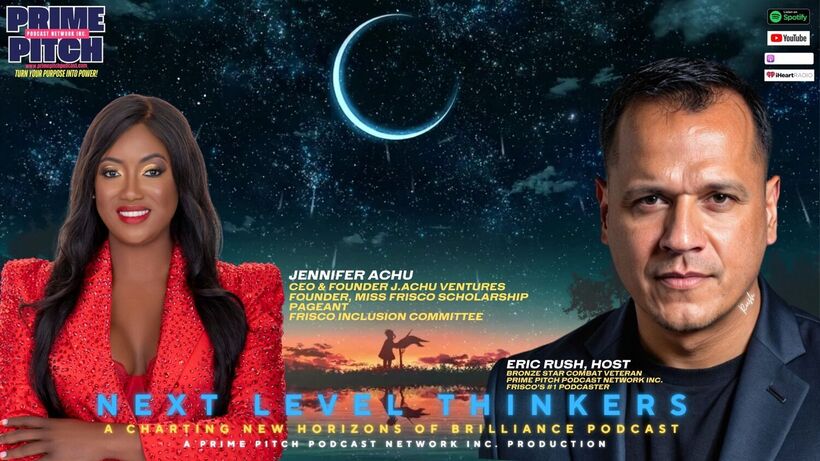
Jennifer Achu
CEO, J.Achu Ventures · Founder, Miss Frisco Scholarship Pageant
About the show
Next Level Thinkers is a Charting New Horizons of Brilliance podcast: conversations with high performers pushing the boundaries of effort, mindset, and human potential. Hosted by Eric Rush, The Conversation Architect, a Bronze Star combat veteran and the founder of Prime Pitch Podcast Network.
Read the full transcript
Hey. What's up, guys? Welcome to Next Level Thinkers: A Charting New Horizons of Brilliance podcast. At Next Level Thinkers: A Charting New Horizons of Brilliance podcast, we believe leadership isn't measured by titles or accolades. It's measured by ecosystems you build and the lives you shape along the way.
Jennifer Achu has spent nearly 2 decades living that truth. As a nurse, she's learned the power of being fully present in moments of need. In real estate, she helps families find more than houses, she helps them anchor their lives. Through her foundation, her ventures, and her cultural work, she has built platforms for scholarships, amplified African voices, and strengthened the civic fabric of Frisco. Her story is rooted in presence and driven by purpose, and defined by the systems she creates, places where others can grow, lead, and thrive.
Today, on Next Level Thinker- Thinkers, we sit down with Jennifer Achu to explore her journey, her vision, and the brilliance of a legacy that continues to unfold. Jennifer- Yes. it's a pleasure to have you on Next Level- Hey. Thinkers: A Charting New Horizons of Brilliance podcast. Yep.
It's a lot to say, right? WellUm, when I- when I rea- when I was reading your, um, your- your introduction, what- what- what thoughts went through your mind? Uh, I was just, uh, it- it sounds soYou know, when I- when I think about it, I'm like, "Eh, you know what? That is me."You know, there's been times where I don't own up to all the things I've done, and when you list it out and you express it like that, I'm like, "You know what? That's good.
That's me."That's awesome, you know. And- and that's true. You know, I think, uh, a lot of times when I- when we do the- when I do these, uh, introductions, people are "Holy cow."Like, I can't see- I can't see that about myself sometimes, right? Mm-hmm. Why do you think that is?
Uh, for me personally, it comes from a place of humility. Mm-hmm. Um, because, uh, when you serve in everything you do from a place of purpose, you don't think about it as something to project self. Right? So you take a backseat, and, um, when someone puts it all together and present it, you're like, "Oh.
You know what? I didn't see it that way."So for me, it's from a place of just being humble about the things I do. That's a beautiful answer, man. I- I think that's-just right on point when having this level of- of humility and not, you know, kinda just keep- you just keep on going forward and- and then you are- you are able to- we are able to look back today and see what you forged. Mm-hmm.
Right. Um, you spent nearly 2 decades as a nurse. Can you share a moment at the- at the bedside that showed you what it really means to be present for someone and how that shaped the way you lead today? Oh, my. Uh, there's been many, many different scenarios, but, um, one really stood out to me because this is one that a lot of people don't talk about, the end of life.
Mm-hmm. Um, I had a- a patientAgain, I've been a nurse for 18 years, so I hadOne day, I had a patient, it stood out to me because she was at the end of her life journey. Mm. And that's the day that everyone knew it was happening. Her family was out of state, um, couldn't be there, and I happened to be the primary nurse.
So, uh, it- it just brought me to a place where you just stay in the room and hold her hand, you know. Y- you have to be present. So that taught me presence because at that point, she wasn't looking for solution, she wasn't looking for medications. She just wanted someone there and feeling her presence and- and just feel like she's being heard, you know? Mm.
So holding her hand, sitting there, uh, as- as a nurse, uh, really watching someone give out, it- you know, it shaped a lot in me. Uh, it happens a lot, but, you know, the primary nurse is not the primary person there, it's family. But this particular patient had no family around, so I just, you know, show presence- Yeah. and- and show that they're valued, even though they're not looking for solution at that point. Mm-hmm.
And how do you think it shaped your leader- the way you lead today? Uh, it shaped the way I lead in l- lot of ways. It teaches me presence. Um, sometimes when you're leading, people are not looking for solutions. They wanna be heard.
Mm. They wanna be valued. They wanna know that you're present and you're listening. Mm. So, um, being a nurse taught me how to just be present and- and show value in what I'm doing, and also showing the people that I value them and listening, even at that point, if I have no full solution of the process.
You know what, um, as we're talking, uh, you know, I wanna tell you, like, it's- itNursing and the- the nurses, I have so much admir- admiration and respect for nurses. I mean- Thank you. seriously, like, ER nurses-you just name it, trauma s- tr- trauma nurses, I don't know what- what different categories there are, I'm sure there's so many, the one thing I've- I've really known about the nurses that I've met along the way is their disposition. Mm. Their- their person-Their- their, you know, their- their, uhThe way they, um, kind of are kind of co- calm, cool, and collected in many ways.
Right? And, um, and also the- just the temperance of what they have. Right. Where does that come from? Uh, we have to be that way.
Uh, a- a nurse is wired to be, uh, calm, cool, and collected. Most of the time, we're in theWe walk into our shifts, we don't know what's gonna hit us. I've beenI've worked the entire end-to-end spectrum of nursing, from ER, to cardiac nurse, to being a case manager for a family- Mm. being an insurance nurse. So I have been through it all with families.
So if you're not cool, calm, and collected, you can't think properly, and in times of crisis, just like you walk into a scenario, like a- a policeman walk into a- a- a place, you have to put that hat of being calm and start critical thinking. Mm. So we have this thing we call critical thinking as a nurse. So if you can't be calm and analyze the situation, you can't critically think- Mm. to bring a solution.
So we're solution-oriented. We don't look at the-scenario as flustered. We have to just be calm. Not a lot of emotion, uh-you gotta take the, you gotta take the, you have empathy, but cognitive empathy. Yes, yes.
Yeah. Yes. You have empathy, cognitive empathy, and plus, you have to be able to be present, that way you can report to the team.'cause most of the time, the nurse is the primary focus of the care team. So you're the one navigating telling the doctors, "This is what's going on."The physical therapist, and keeping everybody in one space. So if you're not calm, cool, and collected, it's not for you.
Mm-hmm. Uh, that's amazing. Now, circling back to, to your answer about being there at, in, uh, the end of life, you know, um, last year was the first time I had experienced, uh, you know, s- so my father passed away and it was one of those moments that I, you, when you think about the nurses that are caring for- Mm-hmm. you know, who took care of my father and throughout, they were there, there was, there were shifts of people, right? Right.
And we were there for a few hours and then we w- had, were forced to leave till we could take care of our homes or whatever. But, um, just the admiration and respect that I have for, for, uh, nurses and- Thank you so much. and to have you here today is an honor. Thank you so much. For sure.
Appreciate it. Um, you know, lea- your leadership has never been confined to a single role. It's systematic, intergenerational- Mm-hmm. and deeply relational. When you think about the kind of leadership that creates cultural change, what does that ecosystem look like?
That is a very interesting question. Um, when I think of that, I think of it building a structure. Um, a structure where everyone feels valued and everyone belongs. No matter where you're from, no matter what you look like, uh, it's about community. Mm-hmm.
So, I, I envision a structure where everyone can, um, embody themself and be valuable, a- and provide value and also be valued. Yeah. So value, it's a big thing for me, um, because I feel like if you know, uh, someone's value, you can utilize that value to benefit th- the bigger population in the community. Yeah. So an ecosystem of just like a structure of, because a culture, it's the young are learning from the older, you know, and then the elderly are teaching the young, from knowledge to wisdom.
So an ecosystem where everyone, no matter where you belong, no matter where you come from, you feel like this is where I belong, and I wanna grow, and I wanna be valuable. Mm. That's awesome. Um, being A- African, what, what's the comp- uh, cultural advantage of being African, would you say? Uh, so being African, the reason I took a deep breath is because I've, I've lived experiences- Mm-hmm.
um, from across the board, internationally and, uh, home, here. It just, the experiences are different, and, um, I was more honored because growing in Africa, I was very young, and I grew up in a family who was kind of thinking like me. My mom grew up in the US. Mm-hmm. So my mom grew up in New York.
Uh, hi, Mom, if you're watching. She grew up in New York, and, uh, went back to Africa and had us. So she had a lot of, um, the American mentality growing up, as we would say. Yeah. But she just kinda rooted us in discipline.
You know, Africans, we're very disciplined, we're very religious. It's a very religious continent. Mm-hmm. Um, so we're based on values from, from the Bible. So the culture there is that's what it is.
And sometimes if you're not a Christian, if you're not, uh, following some kind of religious beliefs, you, you may be left out of place. Yeah. So it just kinda roots us in this structure of, of, you know, respecting the, just the Ten Commandments. Yeah. It makes life just what it is.
That's so, that's awesome. You know, I, uh, I have some friends that have, um, that, that were on the podcast that you know as well, and, uh, they were telling me, you know, that, you know, when they went to Africa, they just f- had this, um, they were so s- uh, surprised at the faith. Mm-hmm. And, um, that's amazing. Um, was there a specific moment when you realized you weren't just succeeding in your work, but actually building systems, uh, ecosystems something larger than yourself?
Absolutely, yes. Over the years, um, from when I used to just, uh, organize the Miss Africa Scholarship Pageant and then now, I'm more up to the Miss Frisco Scholarship Pageant, uh, or just being a mentor through the, uh, whatever foundation I have out there going on, I see a lot of, uh, young people and listen to a lot of young people. And sometimes, the young people just need someone to talk to and someone to know that they're being heard. Mm. And once you give that to a young person and motivate them and encourage them, not only encourage them, show them how, and then provide the process which they can co- accomplish what they're trying to do, it's amazing.
I've watched young people gone from just, "I don't know what I want to do," to actually building their own purpose and, and process. Mm-hmm. Wow. And, and empowering the world. Mm-hmm.
You know, I've seenUh, I can name names of, uh, uh, the young women who have come through my, uh, organization and they're out there killing it. Wow. Just changing lives, you know. Even when I take aWhen I took a trip to Africa, um, just handing out my book. You know, I wrote a book in 2016, Finding Your Inner Purpose: The Journey.
Um, it was just for young people- Mm. young adults to know that, you know, no matter what you do in life, you have to know who you are. Right? Once you know who you are, know what you are about, know who you are in Christ, then you can accomplish anything. So im- um, instilling that in the young people, even in Africa, it motivated so many, so many yo- youths that now I h- I can guarantee you the, the main person who is running and managing all my processes back at home in Africa, that came from my motivation.
And when I watch him and I just say, "Wow, you remember when you graduated university? You had no opportunities?"And he is so grateful. Barnes, um, he's right there in, in Cameroon doing, killing it, killing it in everything he does. So, when I see stuff like that, it, it makes me feel accomplished and fulfilled because that's the purpose of what I do. Yeah, that's beautiful.
Um, yeah, I always s- uh, even I struggled with who, who, who I was. Mm-hmm. You know, as a kid, didn't know who I was. Broken home, the whole 9 yards. Um, and, and, and it wasn't until later on in life where I had to say, "Well, I don't know who I am, but who do I want to be?"Exactly.
You know, it's like saying, "But who do I want to be?"Yeah. What kind of person do you want to be known for? And when that0 once, once I broke that, once I wrote it on a tablet- Mm-hmm. God listened and, and he started reshaping me, resculpting me to the image He- Exactly. wanted me to have.
Um, um, you know, we're talking about pageantry. Um, uh, it's often seen as s- as surface level at first, right? But- . you've turned it into, as you were talking about- It's driven. into a platform for scholarship and visibility and leadership.
Um, what led you to remag- reimagine pageantry in that way and what impa- well, you've told me the impact it's had. Yes. But what led you to do that? What led me to it? Yeah.
Uh, when I was growing up, uh, back when I was in high school in Boston, Massachusetts, um, I was a young woman as well, just going through the ch- the changes in life, you know, trying to also figure out who I was, what I wanted to do. I knew that I had this presence of, you know, empowerment. I just hadBut I just didn't know how to go about that. Mm. So when the opportunity came for a Miss Africa USA and I got selected to be Miss Cameroon, representing Cameroon in, in the major pageant, which, you know, it's been going on for years.
I was Miss Cameroon USA in 2006. So, going through that process, it taught me a lot of things about pageantry. Mm. And that is exactly what I wanted to instill in young women, because we look at it as a surface level beauty, but I switched it to be beauty with a purpose, right? Mm.
You look at a beautiful face, you c- all you see is beauty. Uh, what can you do with that beauty? Because God gave you a gift for a purpose. Yeah. So that started registering in my mind.
And, um, during the process of being in a, in a pageant s- uh, system, I had to think about who I was. Mm. Because you have to think about what's your purpose. You have to do a presentation about that. Yeah.
What do you want to give back to the world? You have to do that. And then you have to walk it 'cause it's not all about working- Yeah. uh, and just talking. So in all of that, it shaped me into kind of figuring out who I was in Christ, because I'm based in that.
And once that I, it wa- I was unstoppable. And I wanted the young people to feel that, that you have the beauty. Everybody sees you as a beautiful face. What can you do to use your beauty and empower the world or the community? Mm.
That's when the, that vision came and I just never stopped. That's beautiful. I mean, som- somewhere along the way, we always find this cheat code, right? That, you know, you got involved in pageantry. Someone, um, influenced you to do that.
And then, um, you were sculpted and reshaped in that process. And then now you have a s- cheat code that you pass on to other people. Yes. Is that fair to say? That's pretty much it, yeah.
Um, your African heritage is a powerful part of your story. Um, and your civic, your civic work in Frisco is- Mm-hmm. is another. Yes. Um, can you share a moment when those 2 worlds came together and shaped how you l- how you led or how you lead?
Yes. Okay. So coming from an African background, heritage- Yes. I'm very rooted in that. Um, and then also growing up in the United States, I'm very rooted in that.
So these are the 2 cultures that are so different, but similar and different in way, in ways that we don't understand. So I know that everyone is looking for ways, like I've said, to be valued. Sounderstanding that I have the extra knowledge of being in a community where I've seen that, you know, some people are not valued and the opportunities are lacking. In Africa, um, even though there are a lot of leaders who are trying, there's a lot of community organizations who are trying to provide. Even my organization, I provide services in Africa through the Jennifer Achú Foundation.
Uh, so with all of these foundations coming together and supporting, uh, the African continent, um, I thought that, you know, being in America, we have a lot of opportunities. And it just made me to capitalize on those opportunities to benefit the m- more people- Yeah. that I could, you know? And also, to apply myself, because some of the things that I could do here easily, it would be a struggle doing it where I was actually born because of how the systems and the structures is set up. Mm, mm.
Um, so i- it shaped my- my leadership, because I was more pushing to get results. I'm very result-oriented. Mm. I don't do things because just because. Yeah.
Uh, I've never been that person. If I- if it's not bringing value, if it's not from a place of purpose, you won't find Jennifer there. Mm. So, I usually would do this and then, um, if I see that there's no value, I step back, try to rea- re- reorganize and- and- and then provide value. And that's where, uh, it came from my African background- Yeah.
because there's no opportunities. Yeah. So when you get the opportunities, you wanna make an impact. Mm. That's- that's amazing.
Um, you know, I was thinking about, like, uh, when you, you know, you were talking about howvalue, right? How do you h- what's one wha- what's one exercise you do with somebody who- who- who doesn't feel valued, but you value them? Mm. And how do you- h- how do you- how do you show them that they're valued? What is one exercise you do?
Okay. It has been many, many. I can talk from, you know, having a patient to having someone that's trying to look for a home. Yeah. And I'll give you an example from, uh, a- a patient standpoint.
Uh, someone would say, "You know, I- I think th- I have a liver issue because I drank so much. So you know, it's okay, whatever. This is my fate."Kind of giving up, and I'm like, "Hey, just because that happened doesn't mean you're less of a human. So, let's think about it this way."And they'll be like, "Huh? So you don'tyou're not judging me?""No, no, no, no.
We're here no matter what happened to you. You're here. My goal is to make sure that you're better, to get back to your life, not to down talk you or judge you, because you are a human."Mm."Regardless of how you became this, you're a human being that should be cared for, valued, and healed."Yeah. And it- it makes them like, "Oh, wow. Okay."So, they're being heard.
They're not talked down to, um, they're not just being pushed away like, "Oh, it's your fault-" Yeah." this is happening to you now."Yeah. So on that note, can utilize the real estate side where, you know, I had a patient who was looking for a home and they hadThey were looking for a bigger space because they had had an amputation from knee down. Mm. And they were looking for a place with a bigger bathroom, bigger, you know, doorways so they can wheel their chairs. And he was just like, "You know what, Jennifer?
I just think we can't find anything that I can afford. Um, it's just away out there, you know, and let's not even worry."I said, "No, let's think about it."Mm."You know? Let's talk to people who actually can hear you and know your needs, 'cause you don't know what the funding it's out there, or the lending and all of those things."Yeah. And I connected that person with one of my lenders, and all of a sudden they got pre-approved for something they could actually afford. Mm.
For me, it's just the listening part and hear what people are not saying- Yeah. behind what they're perceiving- Mm-hmm. there's something more that's causing them to say that thing. So, you have to have that extra listening ear to show value. Yeah.
That's- that's awesome. Time. They say time equals value. Yes. Give them the time to listen, um, taking the time to listen to somebody.
Um, um, building systems takes a lo- uh, takes- Mm-hmm. that, uh, that lasts, takes constant energy and sacrifice. Hmm. What's one moment when the weight of that responsivi- responsi- responsibility felt heavy? And how did you care for yourself while caring?
Every day, every day. Every day. Even today. Hmm. Even today.
Um, I have, I got to understand that when God give you a purpose, God has given you a purpose. And it- it didn't give it and show it to everyone else. You have a vision, you have a purpose, God showed it to you. Hmm. And there will be days that nobody can understand what you're doing, nobody would support what you're doing, but God told you, or you've heard, and you gotta keep going.
Yeah. So my, uh, motivation comes from a lot of prayers, a lot of meditation. Hmm. Um, there are days where I wake up, I'm like, "You know, I can't do this. It's too much, overwhelming.
My goodness, this vision is so bigger than me, I can't do it."And- and then the next minute, I'm busy working hard. And then God, I hear this voice who say, "Are you serious? You're gonna quit? There's no way you can quit."Yeah. Even though I've tried so much over the years to just hands off, throw the towel, "You know what?
I'm done," I find myself, it's a constant thing- Hmm. to want to serve, even from the city level, to just serving the community, to just serving the young women, and just being from a place of purpose, I know that it's here to stay. And even the down days, I just, I- I- I pray, take a break. Yeah. Go hang out with my friends, talk, catch up, call my mom.
Yeah. And- and- and move on. It's a, I say like, it takes you a lot longer to hit the ground when you're way up there. You know what I mean? You know what I'm saying?
You have time to catch- catch yourself from falling all the way. Yes. Um, um, what was I gonna say? Talk to me a little bit, we'll go circle back on the real estate. When did you start, why, when did you start getting into real estate and- Uhhow- how is that?
I'm fairly new in the real estate world. Mm-hmm. I'm still trying to 100% find exactly where I belong. But I know that my- my joy is to find residential homes for families. Because I'm very family oriented.
I want to make a family feel valued. So when I, I thought, you know, "What is the other ways for me to help people?"I've been a nurse. I love being a nurse. I enjoy being a nurse. Done it for 18 years.
But there was something else that was nudging in me like, you know, do something else. But still, once a nurse, always a nurse. Yeah. I'm even nursing when I go out talking to families. And once they figure out she's a nurse, everybody bring their own health issues.
You know? Yeah. And that's okay. I, I'm- I'm very licensed, and I'm still legally licensed, so I would talk to them on a nursing perspective, and then we talk about real estate. Yeah.
So I've only been a- a couple months. I started, uh, my career this summer, uh, as a realtor. Um, and- and I enjoy it. It's something that I love it. It- it just an easy space for me.
I have a lot of friends who are in the real estate, uh, business. So my goal is to, you know, grow this part of my business and- and- and empower and help a lot of people find homes that they truly deserve. That's awesome. You know, I think, that's what, when, you know, you just called one of your new customers or clients a pa- a patient, and it's true. I mean, I have a friend that does, uh, the, you know, he does roofing, and he- he looks at it as a, he- he'll, he's, uh, gonna be on one of my podcasts later on this week.
And he talks about how he looks at servicing people's homes as a, as protecting their house as he was when he was in the Marine Corps. Yes. So, um, I like the tra- I like that. I think it's so awesome you have the disposition to carry- carry through. And people aren't at a crossroads physically in many ways, but they are at a crossroads of where they want to find peace in their, in- in- in where they live, right?
Yes. And- and to be, to add to it, um, when I worked as a case manager, my- my recent healthcare job, 'cause I was in bedside for the past, I wanna say, 8 years. Mm-hmm. You know, I was more ca- in management. So I would do a lot of case management, working with families end-to-end, or, um, help families trying to figure out their next move in healthcare.
Where do they go next? So I've, I dealt with a lot of patients who were elderly or with many issues that they had to relocate, move, give up homes, and move into a long-term living facility, or get into a residential facility where they have help. So I noticed that me understanding what their needs were, it was the best thing that I said, "God, this is the purpose why you have me as a realtor."Yeah. Because I would talk to my patients in the, in the DFW area, and they would tell me, "Jennifer, I was just trying to get a home, but I don't know."I'm like, "Oh, you know what? If I can understand that healthcare, you know, if I can understand the real estate world, I can service my clients even better because I'm already helping them with a lot of major health issues."I know their needs from the health perspective.
I know what kind of home would be beneficial for their current situation. They don't want a bedroom upstairs. They want a bedroom downstairs 'cause mom is on the hospital bed. So you start to look at these things. And when you talk to people who are in the market selling, buying, you know, you- you're te- telling them from a place of knowing- Yeah.
what your- your patient or your client really needs. Yeah. That's awesome. Um, every vision meets resistance. Mm-hmm.
We talked about. Uh, when we were talking about resistance. UmYeah. Can you share a time when your ideas were challenged and how you- you pushed forward without losing momentum? Uh, you know, as- as we grow up, your challenge, orY- y- your ideas are being challenged every single day.
Mm. Um, you just have toAnd I can give you an example. Even when I started with the Miss Frisco Scholarship Pageant, um, it's a, it's a, it's a vision that not a lot of people buy into it, but I, you know, I still continued doing it on purpose because- Mm. I know the vision that I have for young people in the community, in the City of Frisco. And, um, a lot of people di- d- didn't buy into it.
The support was, "Yay," but when it comes to actually teaming up with people to provide these scholarships for the contestants or for anyone who took part in a scholarship program, I found myself fitting the bill from my personal finances. Mm. So, um, at that point, you start to- to step back and sayWhen you're doing something that's bigger than you, you have to get the right people who have the mindset- Mm. of bigger than self. Yeah.
It's not about what I'm gaining from this purpose. It's about what I can do or give that's gonna make somebody else's life better or feel valued. Yeah. So, you know, you get those resistance andBut you- you step back and you- you- you analyze things, you re-strategize, and you start to find people with the same vision- Yeah. and the same mindset, the same purpose driven, and- and move on.
And I've got some supportive people who are, you know, coming onboard and helping. That's a, that's a good point that it's notI- it's not what you get out of it, right? Like, when I look at, when I look at nonprofits and- and- andYeah, nonprofits in general or events like yourself, right? It's like, I see sometimes that- that the- thatLike I always say, when does this- this nonprofit eventWhen does it stop being yours and start being the community's? You know what I mean?
Yes. Where's thatWhen doWhen isHow do you defineHowWhen do you, umItWhen it- when it becomes really bigger than you. Yeah. Um, you start something. It picks up momentum.
You're like, "Oh, my God. What did I just do?"And then you haveYou know, I have multiple applications right now of young people trying to get on the scholarship program because it's not only the scholarship that they're getting. They're getting a platform to grow in the city even in their careers, you know- Yeah. to get the right mentorship. And I'm like, "Oh, my God.
I need a team that is more dedicated, because if it's just me and a few volunteers, we can't do this."So you know now it's bigger than you and it's the community, so you open it up to community volunteers, start working with structures that are already in the community, like, you know, try to get into working with people in the chamber or foundations that are already there, like the Frisco Education Foundation. Uh, try to have those discussions that are very community-driven because it's not about self, it's about what you can give out- Yeah. to- to these people. That's beautiful. I- I- I totally agree with you, you know.
I want to partner with you in some way- Ooh. with the- the- the Frisco pa- Yes. pageant. The Frisco, uh- Scholarship. Scholarship Pageant, uh, for sure.
Let's figure it out and, you know, Iwe've- we've talked about bringing some of the- some of the win- winners- Winners. or maybe even contes- contestants in here to talk about some things and prepare them for, um, for being on camera and- and those kind of things. So let's see if we can figure that out. Definitely, that would be a- a great support. Good exercise.
Um, it's an exercise for- for adults, you know, when- when I bring guests on, they have to prepare for how they'reYou know, and, um, um, see if they can see value in themselves as well. Mm-hmm. Um, um, w- let's talk about Elaine's. Oh. I know weyouwe mentioned this, this- this amazing place.
I hear a lot about it. It makes me hungry. I looked at their menu. I was like, "Oh, my God. I gotta go there."Talk to me what you're doing with Elaine's.
Uh, Elaine's wasIs an idea, you know? Within Elaine's, there's a- a team of people, you know? Mm-hmm. It's notElaine's is not one person. Elaine's was born from a place of, uh, of love.
I want to say that. FromJason Young has been doing a lot of work to get everything out there and together. We were on the, um, Channel 5 News the other day. Our lead, um, chef and- and the bartender, they were over there and making, uh, Elaine's known. So we have investing partners.
I'm one of the investors of Elaine restaurant, downtown Main Street. Very new. It's a European-inspired restaurant. Mm. And it's more like feminine driven.
Uh, the girls can bring, uh, their spouses and, you know, bring friends and have a great time. Beautiful place. Just, uh, a welcoming space. Um, not only that, the food is so amazing. Mm.
And when I say that, and when you go, you wanna try the shrimp and grits. Oh. It's- it's great. Um- My wife loves grits for sure, but yeah. Yes, so I- I- I love Elaine's.
It's like a family place and, uh, friends in Frisco are welcome to come and just share with us. And when- when you complain about the Rail District not having support and- andBut there's a couple of us for 2, 3 years who've been putting a lot of work downtown. Yeah. Because we wanna see the place, uh, grow. Instead of complaining, you wanna put something in and- and make it, uh, for the community.
Yeah. So it's mostly a community-driven space for people to come feel loved, feel belonging, and- and network. Yeah. Mm-hmm. Yeah.
That- that's amazing. Uh, yeah, I hear a lot about Elaine's. I'm glad you're telling me about it. I'm, my stomach started growling. I'm actually on a fast right now, so when you start talking about the food like that, oh my God, shrimp and grits.
Yeah. That sounds so amazing. No, I have friends that have been posting about it and, uh, I'm excited to take my wife there. We're gonna have to figure out- That would be amazing. we'll figure out what day, we can do that.
Um, wh- when you look back at what you've builtMm-hmm. whether it's in healthcare, real estate, pageantry, or cultural work, um, what do you hope people, um, hope they'll say about that kind of- the kind of leader you are, you? I would love for people to say, "Jennifer was a leader who showed up."Hm. Yes. I show up and I was a leader, uh, who hasI- I put my mouth where my money is and I don't pick up tasks that I cannot do.
Mm. Um, so I want them to say, "She's someone that was present."Yeah. Um, you can count on Jennifer even though she might not know the- the ins and outs, but she will be there for you. Yeah. And be present and hold your hand through situations where you may not understand where it's going, but as a leader, she'll walk it with you.
Mm. And you together will find solutions. Yeah. So that's how I wanna be remembered. That's amazing.
Jennifer- Mm. um, is there anything you, any other information you would like, uh, the individuals that watch this to know? Um, I'm just very grateful for this opportunity. Uh, I'm sure there will be more things for us to talk about as we evolve- Yeah. and- and start working and networking together.
Yeah. Uh, this has been so amazing, uh, just to sit and talk about some of my experiences. I know we left, probably left out a couple of things, but I'm very happy and I just wanna let the audience know that if you ever, ever thought of volunteering in any organization, consider us, The Jennifer Achu Foundation. We are not only local. We, uh, you know, I do go across borders.
You know, in 2000 and I think it was '22 or '23, I got an award in London. Mm, wow. Um, for, uh, you know, an award that was in the House of Lords for the services and the things that I do in Frisco and across borders. Wow. Yeah.
And then in 2000 andI think 2001 or '02, they had the Jennifer Achu Day of Frisco, which is August 1st. Yeah. So, um, just doing these things, not for those awards and those days, but it's just to be open to say, "This enough for me."It's like a Jennifer Achu day of service. Yeah. I don't want it to be like, "Oh, you won this award for being such a impact in the diaspora."It was a Diaspora Impact Award- Yeah.
from the House of Lords in London. It's not about me. It's about, how can I do it to serve a bigger purpose? Yeah. So if you ever wanna find a place to volunteer, you contact me.
Awesome. Jennifer, it's awesome to have, you know, spent time with you. You know, we're talking about time equals value. Mm-hmm. I've always valued your, what you- you, what you've been doing in the community from afar.
Yeah. And now to have you, uh, sit down a- a- on Next Level Thinkers: A Charting New Horizons of Brilliance podcast. And it really is about like, new horizons. Like, you're- you're always, you- you're creating this ray of light that's shining upon Frisco and- and giving peopleThank you. Thank you so much.
Um, each ray is n- helping people, is- is giving people direction to where they go. They can find, um, um, their purpose as well. So I wanna thank you so much for being part of the podcast today. Thank you so much for having me. You're welcome.
I really appreciate it. You're welcome. All right, guys, that's it for Next Level Thinkers: A Charting New Horizons of Brilliance podcast. As I always say, have peace and enlighten you and remember that the ocean refuses no river.