Jeff Gault
Jeff Gault joins Rush on Unfinished Business, the show for veterans pursuing new missions after the uniform and the people who stand beside them. As cEO, Army Scholarship Foundation · Retired U.S. Army Officer, Jeff brings life on the front lines of public safety to the table.
They get into the work, the cost, and the reasons it still matters, in the kind of long-form conversation this show was built for.
In this conversation
- The weight first responders carry
- What the job asks of a person and a family
- Service that does not end at a shift
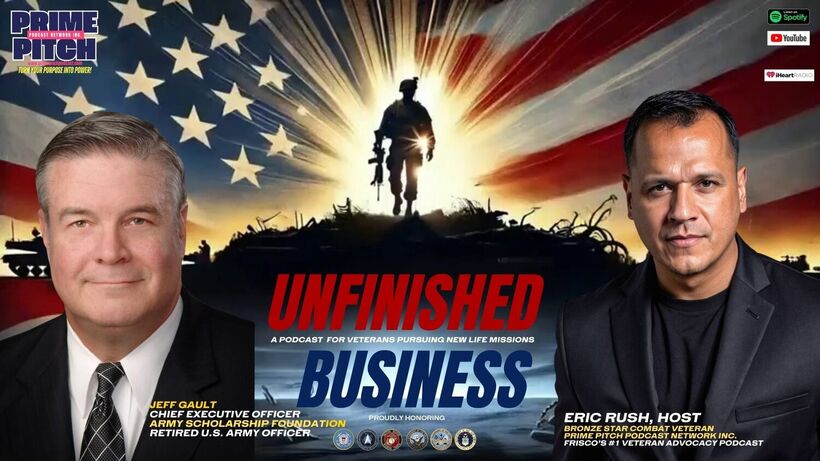
Jeff Gault
CEO, Army Scholarship Foundation · Retired U.S. Army Officer
About the show
Unfinished Business is a podcast for veterans pursuing new missions after the uniform, and for the families and communities who stand beside them. Hosted by Eric Rush, The Conversation Architect, a Bronze Star combat veteran and the founder of Prime Pitch Podcast Network.
Read the full transcript
As I said, it's been, uh, 25 years. Uh, it was established by a group of soldiers who had gotten out of the army after 9/11, uh, or before 9/11, and then 9/11 happened and they said, "Oh my gosh, you know, our f- former comrades are now going off to war. What can we do to help them?"And they established this scholarship foundation to, uh, to help provide scho- scholarships to children of soldiers and spouses of active duty enlisted soldiers. Mm-hmm. Uh, so 25 years, we've given thousands of scholarships for millions of dollars.
Uh, our first 23 years, if you will, we were all volunteer, no paid staff. Mm-hmm. Uh, it was, uh, it was run by, uh, a group of about 25 to 50 volunteers across the country who were helping us to raise money. Unfinished Business, stand up tall. Hey, what's up, guys?
Welcome to Unfinished Business, a podcast for veterans pursuing new life missions. Some leaders understand the mission, some understand the system behind it. A rare few understand both and know exactly where to apply that experience next. Jeff Gault has operated at scale, 5 tours in Europe, deployments during Desert Shield and Desert Storm. He later sh- served in senior roles at Boeing and Raytheon working on national defense initiatives.
He understands what it takes to protect the nation. But what defines Jeff is where he chose to focus next. As CEO of Army Scholarship Foundation, the Army Scholarship Foundation, Jeff now directs that experience towards strengthening military families. Millions of dollars in scholarships, thousands of army family members supported, he understands something fundamental, force readiness begins at home. Stability in a household shapes strength everywhere.
This is leadership that reinforces the foundation first. Jeff, Mr. Gault- Jeff. it's a pleasure to have you on Unfinished Business, a podcast for veterans pursuing new life missions. Um, I always, always ask each guest that when I read the cold opening, what's something that hits you?
I say, "Who is that guy?"Rush, thank you for having me. I really appreciate the opportunity to talk about, uh, the Army Scholarship Foundation and, uh, the successes we have had in helping our army families. Yes. You know, I had the very good fortune of, of attending, um, the Army Scholarship Foundation, uh, many years ago. And I don't know, it was maybe about 4 or 5 years ago, eh, when you had it, and you and Rob All- Rob Altman and some of the other guys, um, I got to interview at the foundation.
It was kind of my first, uh, coming out party as far as trying to, um, to, um, um, shed light on the, on, on veteran advocacy. And I got to say, I was very, like I wasfirst of all, you know, when you're, when you're going down, when you're starting to go down veteran spaces, it's a, it's, it's a growing moment. You don't know how many, how many, how much, how many spaces there are for, you know, to, um, for veteran advocacy. Mm-hmm. And, and un- learning about the Army Scholarship, Scholarship Foundation during that time was, um, inspiring, to be honest with you.
And, and listening to the sound bites as I was preparing for it, I've always wanted you on my podcast, to, I'll just- Yeah. tell you straight up. And, and, and because I thought you had a high understanding, a high level understanding of what veteran advocacy means and, and, and what it means to families, what it means, uh, from, from guys that, or people that are, are purs- you know, the families back at home trying to, um, um, trying to keep the pieces of their life together. So, um, you know, COVID and all the other nuances along the way got in the way of that. And, um, but better late than never, and I'm glad you're here in my home.
It's an honor to have you, um, in our, my home. Like I told Chuck just a few minutes ago is this is the first time I, w- I'm opening my home to- Mm-hmm. to this space and have your spirit and the things you represent in our, in, in the Rush household is, is a beautiful thing. I just wanted to let you know that. Well, thank you.
And thank you for having me. And, uh, congratulations on really growing and spreading your wings with the, uh, with the successful v- podcast. Uh, it's really come a long way and, uh, I'm glad that you have, uh, been able to get such a wonderful audience here in the North Texas area, and hopefully worldwide. Yes. And that's, that's the, that's the goal, right?
Is to, to, um, educate people and inform them about opportunities and resources that are made available to, to, um, those who serve and their family members and beyond that. Um, Jeff, when you, uh, when you first raised your hand to serve in the United States Army, is that correct? Yes? United States Army. What did you think responsibility would feel like?
And how did that understanding evolve over time? Oh, gosh. Well, I actually raised my hand twice to serve. Ah. Uh, I went to the US Military Academy.
And when you first report in on your very first day, the 1st of July, uh, as a cadet, you have to take an oath of allegiance to the, uh, of course to the Constitution. Uh, and I did it. At that time, I was 17 years old, uh, just ready to embark on a college career and, uh, you know, starting a military lifestyle if you will. I had no idea what responsibility meant and what I was getting into at that time. So, uh, it was really more with trepidation than anything else.
Mm-hmm. And then when I graduated, uh, 4 years later, uh, and raised my hand again and took the oath of office, uh, as a commissioned lieutenant, uh, then by that time the, uh, the notion of responsibility had begun to sink in and I had started to, uh, learn a lot more about what I was heading off to in a career as a soldier. Uh, knowing that I would soon have a platoon of 30 or so soldiers that I would be responsible for- Mm-hmm. uh, to lead them and to train them when I, at that point as a novice, knew very little myself. Uh, so, uh, my sense of responsibility evolved both while I was a, a cadet in college and then as a young officer, and then, of course, throughout my later career, uh, it continued to evolve.
Wow, so you, 21 years old and you had, you had your own pli- you had your own platoon? Yes, yes. Wow, that's pretty, uh, out of the s- that's pretty supercharged. How did thatWell, that's, it's not unusual though. I mean most, uh, most second lieutenants, their first job is as a, a platoon leader, be it infantry or, uh, quartermaster corps or what have you.
Uh, so, uh, I knew that that would be my first step along my career journey, and, uh, had studied all along to do that, so it was just something I knew was gonna happen. That, that, that is amazing. Um, during, uh, your time at Desert Shield and Des- or Desert, and, and Desert Storm, um, was there a moment of, that clarified for you what leadership truly meant in real time, in real terms? I'm sorry. Well, you know, I had a, uh, of course being over there for almost a year- Yeah.
uh, Desert Shield, there was really not much going on other than sitting and waiting and training and preparing. Uh, and then, uh, the air war started, uh, and I was the deputy commander of a Patriot brigade. We, uh, uh, we had oversight or responsibility for all of the 7 battalions, uh, of air defense that were in country, uh, from Tabuk all the way to, uh, Dhahran and all the way north to the border, uh, with, with, uh, Kuwait and, uh, Iraq, uh, at the outset during the air war. And, you know, it's, it's funny, the, uh, the first thing that really struck me was, uh, when we had the first barra- I was in Riyadh at the time. When we had the first barrage of SCUDS, uh, that attacked, I was in the, uh, the third army headquarters, and what struck me, uh, we didn't know if they had chemical weapons.
We had been, uh, told to expect chemical weapons and that we were gonna be, uh, attacked with, uh, with some sort of chem bio which they had used against, uh, uh, Iraq previously, uh, or Iran previously. And, uh, what I was astounded when I saw the fear on the part of so many senior officers who were really near paralyzed, uh, when the SCUD alarms w- alerts went off and, and people were scurrying to, I mean, some of 'em were, you didn't wanna get in their way, heading for the SCUD bunkers and putting on their chemical suits and the gas masks and everything. I was just surprised at the, at the, uh, the different reactions by different people, and some who you would have thought would have not ha- uh, exhibited fear, but rather would have been able to exhibit leadership and presence of mind, and so it was very diverse. Uh, people change when they're under fire. Uh, the second example, uh, was again, uh, during a, uh, a major SCUD attack and then, you know, they were exploding above us, and, um, we had a Patriot crew that went out of the SCUD bunkers.
We had fired all the missiles off the launchers, and they had to go out and reload, and we were having explosions overhead, and we had about 10 soldiers that went out there and braved that, uh, to go through the reload procedure, the crew drills that they had practiced daily forever, uh, to do that under fire, and it was later my, uh, my great opportunity and, and pleasure to be able to, to, uh,decorate some of these guys for their, their, their bravery while all those, uh, rockets were going off over their heads. Yeah, you know, that, that's interesting. I, I, you know, you're probably one of the first men that I actually, that I understand your story when you came, when you came to, like, your second lieutenant was having these breakdowns 'cause I was out there a- during that time too and, and I was shocked. I was like, "What are we doing here? Like, you, this, we just got here.
Like, we just la- landed, like-"" 5 minutes ago and you're"You know, it's, uh, it's pretty alarming when you have, um, when your life in- is, is in someone's in hands that's in a, you know, the, in a hi- in a leadership position like that. And, uh, so, uh, you're the first person I heard that, that kind of, that story resonated with me 'cause I remembered that. Um, you served 5 tours in Europe. Mm-hmm. What does sustained service tea- what did sustained service teach you about leadership that crisis moments cannot?
Oh, gosh. Uh, well, it, it, it, I was fortunate, I thought, to serve 5 tours in Europe, uh, uh, 4 in Germany and, uh, and one in the Netherlands at a NATO headquarters. And, uh, and of course, these were at progressively higher levels starting out, as I mentioned, as a lieutenant, as a platoon leader, uh, and I rose up, uh, uh, to higher levels, battalion executive officer and battalion commander. Uh, and, um, you learn, um, teamwork is so important. Mm-hmm.
Uh, teamwork is, it, it, and, and trust, trust is the glue that, that holds teams together. You know, you, it's, it, leadership and, and the cohesiveness of your team are so important, uh, that, uh, that's what leadership is all about. You know, you've got to, uh, you've got to build the trust of your soldiers, uh, and, uh, working on that at, as you go higher and higher and higher in, in, in various positions. Also, the, uh, the importance of our host nation, you know, the German-American relations and the responsibility for that and the, the, the service of those soldiers and our hosts, uh, is, is very, very important. And, uh, and so I learned how important host- host nation relations were both in terms of our, uh, hosting us and allowing us to maneuver on some of their farmers' fields- Mm-hmm.
uh, as well as, uh, uh, hosting us in their homes in many cases and as landlords for s- our soldiers and their families, uh, and all of the sacrifices that they make. So, um, and we had numerous crises while I was there, uh, uh, traffic accidents, you know, soldiers, uh, injured or killed. Uh, fortunately, I didn't have any killed in traffic accidents, but I certainly saw more than my share, uh, in, in adjacent units or elsewhere. Uh, so, uh, as you, as you progress in the levels of responsibility, the nature of the leadership somewhat changes, if you will, a- and you have to, uh, you know, when, when you're responsible for 30 guys, that's one thing. When you're responsible for a thousand guys and their families, uh, it, it, it's a little different.
Yeah. Wow, I could see that, you knowUh, what is it, what does it feel like to be responsible for a thousand, thousand men and women? Uh, it's, you know, it, it, you're always on the go. Uh, m- m- I had, uh, uh, f- it was a, a Hawk missile batter- battalion. Mm-hmm.
I had, uh, a headquarters battery, 4 firing batteries, and, uh, and a support battery, a maintenance battery, and they were spread all over a whole section in Germany. So I was always on the go, uh, a h- h- 150 miles from one battery to the other battery. Wow. Uh, and the commander has to be present, you know. If you're gonna be a leader, the soldiers have to know you.
I mentioned earlier that trust is the glue that holds the unit together. Uh, you've got to develop, uh, the trust. Uh, you've got to display the leadership and the integrity, uh, in your acts and your decisions in, in dealing with the soldiers. And so, uh, to do that, you gotta be present. You have to visit your soldiers.
You have to get to know their families. Uh, you have to get to know them and their jobs, as well as, of course, their equipment. Mm-hmm. Would you consider that humanized leadership? Yes.
Uh, yeah, uh, very much so. I mean, you've gotta, you've gotta get to know the, uh, the soldiers and build up their trust and confidence. Yeah. I, I could see that, especially, um, I, I think one of the, the compelling things is that, uh, as I mentioned at the, at the start is that you, you know, the stability at home, you know, is having understanding that stability at home is what's gonna make, uh, is gonna keep that soldier at, at a peace of mind. Um, when you transitioned i- into senior, um, defense leadership roles, what surprised you most about how influence operates in that, at that level?
Uh, I thought it's, it's relationships, uh, uh, I, I, I knew relationships were important in, in the military. Uh, I didn't realize how important relationships were at the, uh, in, in industry, if you will. Uh, you have engineers and you have people who are technical experts in working in, uh, the, uh, the scientific and the developmental aspects of the various systems that we worked with, uh, at, uh, at Boeing and Raytheon. We were in, uh, uh, uh-army systems primarily or missile defense systems. Uh, I also worked on some, uh, some border initiatives at Boeing.
Um, i- uh, it's as much who you know as it is what you know. Mm-hmm. Uh, and the who you know, in many, many cases, most cases, is far more important than what you know. And so, if you're, if you're trying to persuade somebody to a certain point of view, uh, or you're trying to set up a meeting, uh, to d- to, to brief, uh, senior, uh, defense official or procurement people, uh, how you go about it and the folks you know are so important, uh, in developing, uh, in developing, uh, success and progress. Yeah.
I would imagine that you, you have different, um, companies, I guess, you know, trying to come together for the same cause. Yeah. It's teamwork. Well, uh, uh, in 2, in 2 aspects. One is, uh, you have competition.
You know, you have, uh, Lockheed Martin may be trying to, uh, uh, sell a certain type of radar that Raytheon is working on the same similar type radar and there's a competition there, and then there's, you know, down selects and so on and so forth. Uh, but also you work with teammates. Uh, companies have different levels of skill and expertise in different areas and so they have to combine to, uh, put together a proposal, uh, to, uh, to, uh, achieve certain goals or to win the contract from the government. Uh, so you have to collaborate but you also are competing in many respects, uh, in defense industry, which is a different thing. The competition is different from, uh, when you're in uniform.
Uh, in uniform, you know, it's, it's kinda like cooperate and graduate, you know. You all have the same objective. You may have 2 infantry battalions side by side. Yeah, there may be competition but really not in the sense that you have in industry when 2 people are competing for the same weapon con- weapons contract or, or, uh, a radar contract or what have you Yeah. That's, that's interesting.
That's very interesting. Um, at what point did you begin to see that supporting military families, um, as a strategicUh, h- wha- at, at what point did you begin to see supporting military families as a strategic, as a strategic priority, not just a philantrop- a philanthropic one? Well, I, I, I mentioned of course military families when you're, when you're in uniform, uh, the families of your unit, your soldiers are, are so important, you know. It, it, uh, uh, they used to say in the army, uh, "It's not a soldier who re-enlists, it's the family who re-enlists," because they go through the, the hardships, the moves, the, the, the many, uh, the deployments and all the other things. Um, and when I, uh, when I got out, uh, I retired, uh, my wife actually went to work for, uh, uh, in Washington DC while I was with Boeing.
She went to work with the Marine Corps Scholarship Foundation. Hmm. And, uh, I learned about this organization that had been around, uh, by then for 30, 40 years and they gave scholarships to children of Marines. Uh, it was established, uh, when a group of Marines found out that a World War II Medal of Honor recipient, uh, was destitute and couldn't afford to send his own child to college. Uh, so a bunch of these Marines got together and had a, a big dinner, uh, to raise some money to, to pay for his kid's college and then they said, "Hey, this is not a bad idea.
Let's, let's do this and expand it across the Marine Corps."And so she was working there while I was working at Raytheon and, um, I realized, I attended a number of their events, and I began to realize how, uh, helping these military families, how much that impacted upon the readiness, uh, of the units. Uh, and then later, I got the opportunity to, to, uh, step into the position with the Army Scholarship Foundation and it was just reinforced. I mean, the, the military, uh, family members go through so much. Uh, deployments, different schools, uh, challenges, uh, you know, the, the fear of deployment, you know? When, when your military, usually it's the dad, uh, is deployed, you know, the, if the phone rings or the doorbell rings, there's a, you catch your breath for a minute and there's an instant, uh, well, and, uh, that's when I be- began to realize that there was this really, really important strategic value to families, uh, to the service.
Uh, and the services were at large, you know, the Army, the Navy, the Air Force. They realize that, uh, but there's not a whole lot that they can do to really, really, uh, help, uh, those families and those family members that are in need at that, in that particular way, uh, educationally. Yeah. You know, I was talkI had, um, I don't know if you know who Shilo Harris is, for the most part? Yes.
Yeah. I was just recently on his podcast, um, uh, actually a couple of days ago. He invited me to come on the podcast, talk about my story. And, um, and we talked about like ma- you know, the hardest, the hardest part of being deployed or probably being in combat is the, the, the, the heart, the heart ones. Yeah.
The ones at home. The ones that- Yeah. you're worried about, the ones you care about. And, and we talked about how, how, how much of a, how much of a, how much stress it causes individuals. What are your thoughts on that?
I, I, I agree with you 100%. I mean, you know, it, it, it, it, it's, I don't wanna say easier. It's different nowadays than it, than it used to be. Yeah. Uh, I think about first you think about the World War II, the greatest generation.
And those soldiers, sailors, airmen, Marines, they went off for 2 or 3 years. And the only communication between them and the family was written letters that had to go through a censor to mark out anything that you couldn't write. Uh, and, and I've heard stories about, you know, families who, who, uh, who received the last letter from their loved one a week after they'd been notified that he had been killed in action. You know, it's, it's- Wow. Uh, and then, of course, progress, if you will, by the time I was in Desert Storm, uh, Desert Shield, Desert Storm, and then my later deployment, we did notwe still didn't have internet.
Uh, we didcell phones were out there, but it was like a big brick, you know? You didn't, you didn't have the little flip phones or the things you have. So, even then, communications was a challenge to your family. Uh, whereas nowadays, uh, even when deployed, uh, even in combat zones, uh, families are able to at least communicate. They'll have a video conference or they'll be able to call, uh, during lulls or so on.
So, there is a little bit better communication now between the families and the military. But, um, it's been a challenge all along over time. Uh, and it's, uh, it's, of course, one of the most difficult things that, uh, that our families and our units have to deal with. Yeah. Um, yeah, you could go on and on about that.
Um, with this, um, with the Army Scholarship Foundation awarding scholarships at scale, how do you stay connected to the individual stories behind the members? Well, first of all, I have to say, there are so many individual stories. Yeah. Uh, you know, every, uh, every story is unique. Uh, every family is somewhat different.
Um, and it's very hard. I mean, w- we get, uh, well over 1,000 applications every year. And we are in that application period now. They're coming in every day- Mm-hmm. new applications.
Our application window is open from the 15th of January to the 15th of April. Uh, and, um, as I say, that 1,000 come in. And, uh, the sad part is, is that, uh, we're not able to give all of those 1,000 plus kids and spouses of active duty soldiers, uh, a scholarship. Less than half really that we're able to fund just due to our financial situation. You never have enough money to do everything you wanna do.
Yeah. But one thing is, uh, I read every single application. So, all of these 1000, I will personally go through each and every one of them. Uh, and, of course, you know, there are stories that jump out to you, uh, heartaches. Uh, uh, I read, uh, this morning, uh, in, in scoring some of them, looking at them and reading them, uh, you know, at least 2 families of KIA, uh, in action.
Hmm. Uh, stories of, uh, you know, these are high school kids whose father, usually the father, oftentimes it's the mother, but it's usually the father, you know, 3 tours in Iraq, 2 tours in Afghanistan. I mean, you think how many tours the, you know, the parent has gone for, uh, in harm's way and what that does to affect a child who's in elementary school, grade school, uh, high school. And, of course, it gets more challenging for high schoolers. Uh, and then you add on top of that, they're moving around.
I mean, y- you know, the, the kid goes to-7, 8, 9 different schools over the course of their K through 12 experience. Uh, you know, that's, that's really, uh, a challenge. But we ask these, uh, scholarship recipients, you know, "Tell us your story. Send us your success. Let us know when you graduate."You know, we wanna, we wanna track and we wanna be able to, uh, to keep up with these, these, uh, unique stories of, of these, uh, these family members.
And of course, you know, high school kids, you know, they got a lot going on. Yeah. SoAnd not all of them tell us how they're doing, so we can't really keep up with all of their successes, but, uh, we stay connected with a lot of them that way. Uh, it's a, it's a wonderful thing. They'll send us a, a graduation picture in their gown when they graduate from college.
Mm-hmm. And one thing I have to say that we're really proud of at the Army Scholarship Foundation is that, uh, over 90% of our scholarship recipients graduate from college. Mm-hmm. Uh, and if you look nationwide, the graduation rate for college students is somewhere, 60, 65%, uh, after 6 years. Uh, and so we like to think, first of all, that the kids that we're giving scholarships to are deserving and that they have a drive to better themselves.
And that that resilience that they develop while growing up in a military family gives them the, the sticktoitiveness to, to continue to graduate, uh, whereas many civilian families don't necessarily have that. So, so we ask them for their stories, we like to have their stories, we love to tell their stories, uh, and what all they've done, uh, and the successes that they've enjoyed. Do you think, uh, this Army Scholarship Foundation is, um, is a symbol of hope? Yes, absolutely. Um, you know, we, uh, we have a, a, a young lady here in town who, uh, you know, just to use a couple of stories, uh, who, um, her father was, uh, retired disabled from the, from the army and was unable to work.
Uh, he, he later got some meaning- uh, some menial job, uh, but then he lost that and the family, uh- Who-the, the young lady that I'm talking about had to, as a high schooler, had to go to work as a barista to help the family- Mm-hmm. uh, keep food on the table and have a roof over their head. And so she was forced to give up her aspirations for college. Uh, but she kept hoping and hoping and, and applying, and she was getting turned down for scholarships and then weOne day she said she got our scholarship and it was the first one she ever received, and that gave her the, the hope to keep trying and she subsequently got a couple more from us, graduated, went to work here in town, uh, got an internship, and is now married and got a kid. And she's just, uh, uh, she gives us much of the credit for her success, uh, in giving her the scholarship.
Uh, we had, uhTh- this is the 25th year of the Army Scholarship Foundation. Oh, wow. We're celebrating 25 years of, uh, of helping, uh, our military kids and we're reaching out, again, these individual stories, we're reaching out to, uh, some of our earlier recipients and, um, we just got a note from our very first scholarship recipient- Wow. who, he went to Arizona State, uh, graduated, uh, it was our scholarship that enabled him to, uh, to stay there and graduate, was commissioned in the army, and, uh, he is now, 25 years later, uh, retiring from the army as a lieutenant colonel- Oh, wow. and is going off on his second career.
And I mean, that really- Yeah. we touched his life, you know. He's a married guy with kids now, uh, and embarking on his second career. A- and those are the stories we like to get from some of these, uh- Yeah. recipients, uh, as you say.
But unfortunately, we don't get all that we would like to have. Yeah. That's, that's so, umI mean, that's sometimes all it takes, man, is, is, is some, you know, you reach your hand out and, and no- and somebody doesn'tYou know, you're reaching for help and you don't get the help, the assistance you need. But then when you do get it, it could li- it, it's like a, a ray of, like a, a ray of sunshine. Yeah, it opens doors.
It really does. Yeah. All you need is a s- you know, small little sliver of light to come into your heart and, and see it like that. And that'sI thought th- I thought that's why it was really important to have you on this podcast. Mm-hmm.'Cause I know that that's what, that's what, um, the Army Scholarship Foundation, um, represents as far as, uh, from a, from a larger scale is that it, it represents, um, healing, hope, help, um, um, holistic, uh, wh- a, a holistic approach to, to moving forward in your life.
And, uh, and, and it, it, it's, itI just, I just thought it was so important to, to, um, to have you on here. Um, tell us a little bit about the Army Scholarship Foundation. I know you said it's been 25 years. Mm-hmm. Talk ab- talk a little bit about it, and then we'll, we'll, we'll tie it up with something.
Yeah. Well, uh, as I said, it's been, uh, 25 years. Uh, it was established by a group of soldiers who had gotten out of the army after 9/11, uh, or before 9/11. And then 9/11 happened, and they said, "Oh my gosh, you know, our f- former comrades are now going off to war. What can we do to help them?"And they established this scholarship foundation to, uh, to help provide scho- scholarships to children of soldiers and spouses of active-duty enlisted soldiers.
Mm-hmm. Uh, so 25 years, we've given thousands of scholarships for millions of dollars. Uh, our first 23 years, if you will, we were all volunteer. No paid staff. Mm.
Uh, it was, uh, it was run by a, a group of about 25 to 50 volunteers across the country who were helping us to raise money and enhance, uh, uh, the scholarships. Uh, you know, they started out, uh, smaller amounts, $500, and now the average is well over $1,000 per scholarship. Uh, and, um, as I said, our incr- our, our number's over 1,000 applications this year. The application numbers go up by about 10% every year. We try to increase, uhYou know, our biggest, uh, issue is to try and give every deserving and qualified army family member a scholarship.
We're, we're failing miserably in that regard, because we, we're roughly, uh, just under half that we're able to give an award to now. Mm-hmm. So, uh, it, and it's all about funds. We would, uh, always love to have more money. We have a, a fundraising event or 2, uh, throughout the year.
We have a big luncheon in the fall. Uh, we have donations that can be made online, uh, through our website at armyscholarshipfoundation. org. That's also where the students apply. There's an application link for, uh, kids to, uh, uh, and spouses of, uh, enlisted soldiers to apply for the scholarship, uh, during this window that I said.
Uh, we have a mailing list, uh, for email cause of contact that we send out notifications. Uh, and then we have, uh, campaigns throughout the year. We just finished up here an 11/11 campaign where we asked, uh, supporters to donate $11, uh, in prep- in, in, in the build-up to, uh, Veteran's Day- Oh.11/11. Yeah. Uh, donate $11 for, uh, uh, in memory of a- someone you know, a soldier, some family member.
Now we're gearing up, uh, we're gonna do a 25 for 25 campaign, you know, make a monthly donation of $25 to honor us in our 25th year. Uh, but, um, we'll give out probably half a million dollars this year in scholarships. Wow. Uh, and, uh, it's never enough, as I said, you know, so we would love to have more supporters and donators, uh, which can be done, as I said, online at armyscholarshipfoundation. org.
Uh, would love to have people, particularly here in the North Texas area, come to our Help Our Heroes Luncheon that we'll have in the fall. Uh, we, uh, we had, uh, uh, we've had a very successful luncheon. We've had, uh, uh, Captain Groberg, who was a Frisco Area Medal of Honor recipient, has been our speaker in the past. Uh, we've had, uh, General Joe Martin, uh, who's, uh, former vice chief of staff of the army, has been a speaker. We've had an astronaut who has come and spoke- Mm.
uh, at our luncheon. So we always have a very interesting, uh, speaker who will come and, uh, hopefully, uh, uh- Raise some funds. Make it fun. Yeah, it's a great, and it's a great event. Um, we have a- usually a, uh, a national anthem sung by a member of the army chorus, who joins us from Washington, DC.
Uh, and we have, uh, a number of other, uh, dignitaries from town. Congresspeople come. Keith Self, who is your local representative here, has been a regular attendee at our luncheons. Uh, so, uh, but that's our, our hope, uh, is to continue to grow the organization. Mm-hmm.
I'm honestly trying to transition out now. I'm looking for a successor to be a new CEO and run the, the foundation for the next 10 or 20 years, uh, and, uh, as we continue to grow and professionalize our operations. So hopefully we'll do another 25. Yeah. And while we're asking 25 for 25- 25 for 25.
and then we'll ask for, we'll ask for 25 for 50.25 for 50. Let's go. No, um, IThat's awesome. You know, that's awesome that you guys are contributing to so many families. Half a million dollars a year?
Uh-huh. Wow, that's a lot. Um, I will say this. If you ever needIf, you know, at this event that you have, if you need somebody likeYou, you obviously saw how, how that digital asset has helped you in, in your, inIt carried its weight for this many years. Mm-hmm.
It brought us back together. Mm-hmm. Um, I would love to offer, offer myself up to help, uh, doc- have some document- Great. rights of sound bites- Yeah. Thanks.
and things like that, let me know. Mm-hmm. Um, I'll be happy to assist you, uh, you know, for free, you know, and, and I'll go out there and do the same thing, the same way I did it the last time and, um, and get some sound bites from, from some of the participants. Great. Yeah, that'd be wonderful.
Yeah. And I have to help you in that, I'm 100%. Okay? So just let me know when the date is and we'll see if it doesn't conflict with anything else. Yeah, yeah.
We really try. We do everything we can to keep our expenses at a bare minimum. Yeah. Uh, our legal counsel, legal advices, uh, is pro bono. Our webmaster is pro bono.
Uh, we have, uh, all of the various, uh, functions that we have to do to keep everything going. Our offices are donated. Mm-hmm. Uh, so, uh- Good. we really wanna keep our expenses down.
Uh, and as I said, we were all volunteer up until a couple years ago. And so, uh, you know, we're justwe're keeping, keeping our expenses low so that we can give more money to scholarships for deserving military kids. That's beautiful. That's beautiful. I do a lot ofI just startedUh, these, um, Air Power Foundation just made me an ambassador for their organization.
Oh, congratulations. Yeah. Thank you so much. And, and part of my, part of my, uh, job is to do, uh, special event correspondence like, like I did for you, for your event at thatduring that time- Mm-hmm. as well.
So, um, just let me know. Just tell me when and where, and we'll see what we can make it, okay? Mm-hmm. Um, uh, I gotta tell you, Mr. Gault, it's a pleasure to have you finally sit down- Yeah.
and talk about, about what you're passionate about and whatum, how you continue to serve and, uh, extending beyond the uniform and, and how, how, howI have, I have a friend that actually got a scholarship from you, actually. Oh, really? Right? Dr. Katie Ballio.
Yes. Yeah, she's- Wonderful. very sweet. I had her on my podcast, actually, on this podcast, and talked about her, her roles in, in women advocacy for veterans. Oh.
Beautiful conversation. And, um, so I, I could see you guys are making dynamic impacts and I know what it's like to receive help, um, when, when I reached out for $175 to pay for a bill that I couldn't pay- Uh-huh. and I got it- Uh-huh. just like, it was likeThat's all- Yeah. you know?
We had. We are- No big deal. We are changing lives. Yeah. We truly are.
Yeah. And, uh, uh, we would like to hear more stories from those whose lives we have impacted, uh, because we want to share that with all of our donors and all of our supporters. Uh, because if you make a donation to help a kid go to college, you are helping to change the future. Absolutely. Absolutely.
Okay, last question. As you look ahead, what part of the mission still feels unfinished for you? Oh, gosh. Well, um, really, the fact, as I mentioned, that we're not able to give every qualified and deserving military family member a scholarship. Yeah.
Uh, it's a sad duty when we have to send a, a note to a, to a applicant and say, "I'm sorry."Mm-hmm."Uh, we weren't able to select you this year."Uh, so, uh, only being able to satisfy half of the requests is clearly the most unfinished business we have. You know, we wanna be able to satisfy 100% of the qualified, deserving military kids who are applying for a scholarship. We wanna say yes to them. And so it's funding, uh, to be able to say yes, uh, that's the, the, the, the most important thing. And then as I mentioned, you know, I'm looking to transition and find a new chief executive officer who can take this organization to an even higher and better level.
And, he or she can bring in, hopefully, that money to pay for the other 50% of the- Yeah. applicants who were not able to, uh, to qualify. So, those 2, those are probably 2 of our biggest unfinished businesses, uh, if you will. Will. Continue to give scholarships to everybody, and then to help transition the leadership to continue to grow.
Well, that's the reason for this show, uh, um, Jeff, is to close the gap on the unfinished business and try to, try to make it a little clo- uh, smaller and, and I hope we did that for you today. Well, thank you, Rush. Thank you for giving you guys a platform to talk about what, what, what, what you're doing with the, the Army Scholarship Foundation today. Well, thank you so much, Rush. It was appreciate having you.
Wrap up. Pleasure to be here. All right, guys. That's it for Unfinished Business, a podcast for veterans pursuing you life missions. As I always say, have peace and light in you, and remember that the ocean refuses no river.
Unfinished business, stand up tall. cadence, we answer the call. New life missions, rise like steel. Warrior voices battle