James Hauke
James Hauke joins Rush on Unfinished Business, the show for veterans pursuing new missions after the uniform and for the families and communities who stand beside them. As Program Director of Trinity Oaks Outdoors and a U.S. Army combat veteran, James knows what it means to trade one mission for another, and to help other veterans find theirs.
This is a conversation about what happens when the next mission has to come from you: the search for purpose after service, the healing that happens outdoors, and the brotherhood that carries a veteran the rest of the way home.
In this conversation
- Finding purpose after the uniform comes off
- How time outdoors becomes a path to healing
- Why the next mission has to start from within
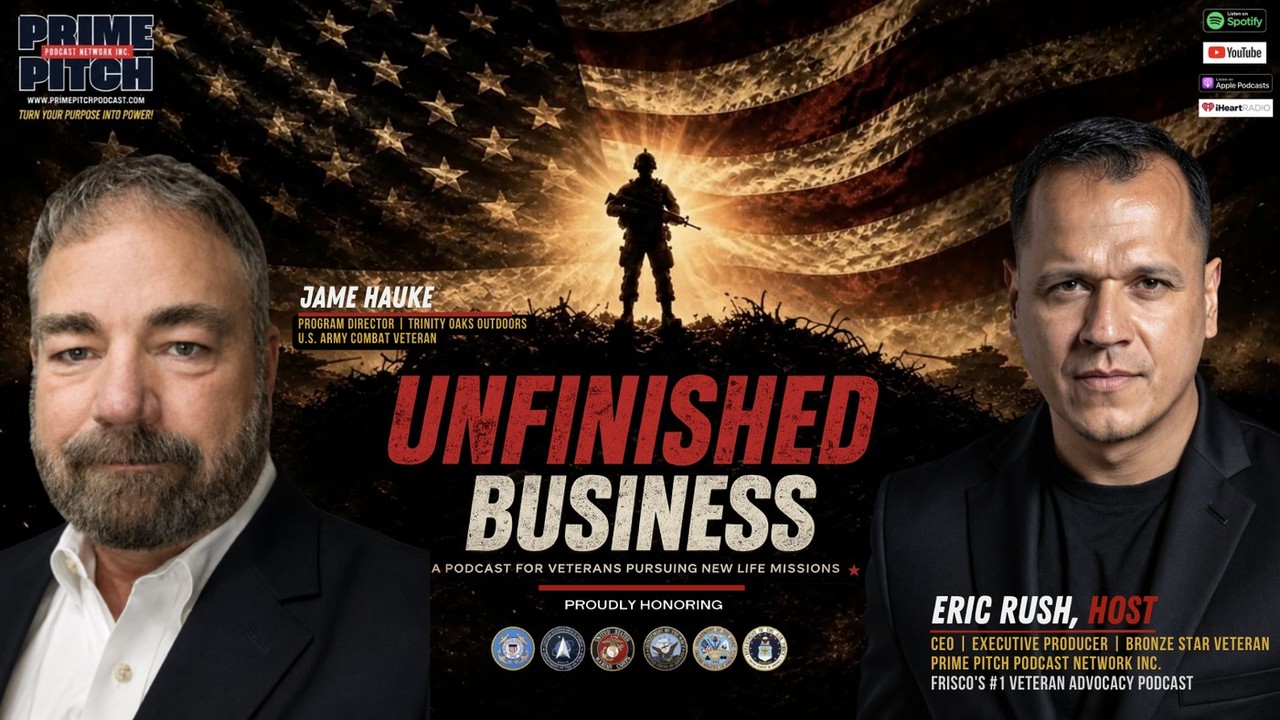
James Hauke
Program Director, Trinity Oaks Outdoors · U.S. Army Combat Veteran
About the show
Unfinished Business is a podcast for veterans pursuing new missions after the uniform, and for the families and communities who stand beside them. Hosted by Eric Rush, The Conversation Architect, a Bronze Star combat veteran and the founder of Prime Pitch Podcast Network.
Read the full transcript
Man, I've selected my own mission, and that's to try to make people's lives better. I, uh, there was a really selfish point in my life where it was all about me, and there was probably a time where I would've said, "See my Medal of Valor."But, uh, I don't wanna be that guy, and I wanna be the guy that makes life better for people. I wanna, I wanna do for them and, and help them and take care of people. Unfinished Business, stand upAlpha Cadence, we answer the call. Hey, what's up guys?
Welcome to Unfinished Business, a podcast for veterans pursuing new life missions. James Hawk was a young man who could admit something about himself that many of us spend years trying to avoid. He needed direction. The Ar- Army gave him discipline, structure, responsibility, and eventually war. He became a paratrooper with the 82nd Airborne, and served during Desert Shield and Desert Storm.
That experience would become part of a much longer life of service.24 years in law enforcement followed. Patrol, investigations, K-9 service, and a Medal of Valor. Then came work with veterans, first responders, Gold Star families, and children carrying consequences of sacrifice they never chose. James has described that chapter with one word: calling. And maybe that word carries more weight after a lifetime of service because James knows what it means to receive the mission, carry the responsibility, and live with what service asks of you.
Now the question is, what becomes worthy of your life when the orders are yours to give to yourself? This is my conversation with James Hawk, Program Director of Trinity Oaks Outdoors. James, man, it's a pleasure- Absolutelyto have you, man, on, on, on Unfinished Business, a podcast for veterans pursuing new life missions. I mean, you know, um, we go back. We go way back to, um, to, uh, you know, I was, I was, uh, I was, uh, taking lessons with Guitar for Vets- Rightand they had the, um, we had, uh, what they called is a Ford experience.
Uh, it was a Bronco, the new Bronco they just released. Oh, yeah, the Broncos. Yeah. Yeah. And you know, it was one of those things when I was doing, when I got involved with them, it's like, "Rush, we want you to be, like, go out there and represent, uh, re- represent Allen, Texas."And I was like, "Okay," like, "Let's go."I was, I'd never had, I never had done anything like that before in an advocacy s- uh, like, repre- gone to an organ- uh, gone to an experience.
And I think, I think that one, 1, that one thing kind of started, started broadening my, my participation and stuff and, um, it was such a, a unique experience. And, and I got to meet you and Nigel- Yeahand, um, some of the other guys. And, uh, yeah, I mean, and to have you here today and going back, way back, way, way, way back. you know, during that time I knew we would somehow get, we, we need to get connected 'cause I really appreciated and admired, and I think we even talked about it the time we met, was like, you know, what you were doing with, uh, uh, Trinity Oaks Outdoors and, and we were, we kind of f- kind of m- messed around with that a little bit, but now we're here. Oh, yeah, here we are.
I know, and we're here in Frisco, Texas, and, uh, you got an amazing gala, a gala going on tonight. Talk to me a little about what, tell 'em, tell, tell the audience a little about what we're gonna expect tonight. A experience. Well, our, our gala is, uh, this is one of 3 that we do every year, and, um, this is our Fort Worth gala. Um, you're gonna meet some really great people, hear some really impactful speakers, um, see some pretty heartfelt moments, and, uh, hopefully we see people, uh, open up and, and share with us.
Yeah. That's beautiful, man. Uh, um, uh, for those that don't know, um, how long have you, how long have you been with, uh, Trinity Oaks 0 Outdoors? So I started as a volunteer in 2016. Okay.
And, um, in 2020 I had an opportunity to be one of the first full-time employees- Hmof Trinity Oaks, and we're still only at 4 employees. Wow. Wow. Yeah. And to become a, a, um, an employee that must mean, you know, you know, they respect what, what your leadership is about and what your vision is and, and what you can, um, what you can make happen for the organization.
Um, James, um, when I read the cold opening, um, what, what, what thoughts and feeling or thoughts went through your mi- through, went through your mind? Man, a lot, dude. Just kinda my whole, uh, life kind of flashed before my eyes hearing all that stuff that I haven't heard in a long time. Yeah. And- And, and yeahyeah, it's, uh, you know, takes you back to day one when you're wandering around trying to figure out what you're gonna do with your life and then you start putting those puzzle pieces together, and we end up with a pretty cool picture at the end.
Yeah. That's so cool, man. I mean, that's a lifetime of service and a lifetime of, of, of, of being in this, in, in, in this journey. And to learn about you and to research and you said, like, man, you went in, you went in, you got, got deep. Yeah, I gotta know who's s- you know, like I said, I gotta know-who's coming to my house.
No, that's okay. No, it's not about that 'cause I already knew the, I knew your heart already. I met you and, and all that good stuff. Do me a favor. If you'll just move the mic just a little bit closer to you, just, just for, just so we'll have it- Okayyeah, just a little bit.
That's good. Perfect. Just we'll make sure. Um- No worriesyou know, you described your younger self pretty plainly. Um, you were going, you were going nowhere and knew you needed discipline, structure, and, and a future.
Um, when you look back at that younger man now, um, what do you think he was really re- searching for that he didn't know how to name? You know, I think I grew up playing sports. Started playing ball when I was about 10, and, uh, the whole team concept and how everything worked is if, um, you know, if the pitcher does his job and the catcher does his job and the f- first baseman does his job, everybody does their part, you're gonna be a winner, right? And, um, or that's the way I felt. And you know, there's that discipline.
You had guidance and instruction and all of that, and I, I really en- With wolves for that once I quit playing ball. Mm. And, um, it was, I need that, and I need to find that again. And construction just wasn't it, and that's where I ended up, and it just wasn't for me. Yeah.
Yeah, I could see how, you know, you have those really deep-seated connections, you know, the camaraderie and, and those kinda things, you know. Like, you had the camaraderie in, in sports and the, you know, just the, the fun and the, the- Yeahthe competitiveness, the, m- you know, the, you know, the go-after-it kind of mentality with the, with the, with the group of, of, of boys, right, and young men. And, uh, I could see how that could impact you once you, um, detach yourself from that. Um, um, the Army gave you structure. Absolutely.
It, it gave you standards, responsibility, brotherhood, and a ve- very clear sense of what to ex- um, what you ex- what, what it, what it expected from you. Um, at what point did being a soldier stop being something you were doing and start becoming part of who you believed you were? Man, early. I, I wanna say, like, maybe right after AIT. Um, I was 11 Charlie, so I was infantry, and I started really feeling that purpose, uh, right after AIT, and then straight into jump school.
And once I completed jump school, that was kinda it for me. I was, that's who I was. I was a airborne dude then. Yeah. And, uh, off to the 82nd.
Wow. That's cool, man. I mean, most people, when they're in that space, you knowI mean, I guess if you were, what, what was your MO, what was your MOS again? I was 11 Charlie. Okay, 11 Charlie.
So you, you know, you were already in it, you know? Like- That's it. Yeah, yeah. That's so cool, man. I, I mean, to know that y- you know, you knew your des- you knew this was gonna be part of who you, who you were gonna become, um, become during that period of, that season in your life.
And, and man, that's a f- a fr- fast transition. When you ever, when you were through that, did you go, was there ever a time you said, "I don't belong here"? No, from day one, it was like, "I am, I'm digging this."Yeah. That's cool, man. Yeah.
You know, some people go through that. They go the physical- Oh, absolutely. Yeah. Um, I, I saw it with guys in my basic training- Yeahthat were like, "I really wanna go home. Uh, this isn't for me."Yeah, for sure.
Yeah, I remember there was a guy who, like, uh, he had to dig his own grave in a, in somewhere in Fort Dix. He ended up in a mountain somewhere, and he had to dig his own grave, 6 by 9, just shoveling, shoveling. Just smarting off and, uh, really- Yeahyoung guy. He was like, he started, left. He left theUh, "Where you going, man?"Like, "You're stuck out here on a mountain, man.
Ain't you"It was funny. Uh, but I see people go through that, that experience. Um, there, you know, as, as I was looking through, through, you know, getting prepared, uh, there was one sentence in your biography that, that carries a lot of weight. And this is one where we talk about the recruiter. The recruiter had stole the love for the military.
Um, what happened during that chapter that changed your relationship with an institution that had once given you so much that, of what you were looking for? Man, that was, that was a terrible time in my life. Um, I had just come back from the desert deployment. Had been gone 10 months or so. And, uh, came back and I was prepared to and hadMy chain of command was really awesome, helped me walk through, um, getting a position at airborne school as an instructor.
And, uh, I was really fired up about that. And 3 days after we sent in my packet and my letter of acceptance and all that, I, uh, get hit with this, "Hey, congratulations, you're going to Fort Ben."And I was like, "Fort Benning, here I come."They go, "Oh, no, no, no, no. Fort Benjamin Harrison, Indiana."And I'm like, "Well, what's there?"And they're, they're like, "Oh, that's where recruiter school is."And I was like, "No, no, no. I'm supposed to go wear that black ball cap and, you know, teach young guys how to jump out of airplanes."And, um, said, "Well, I'll make the best of it."And, uh, got my duty assignment, and I went to a station in a suburb of Birmingham, Alabama called Fairfield. Um, I get there, and my wife at the time was 8 months pregnant.
We pull up in a U-Haul truck in front of, uh, the recruiter office. I walk in, and, uh, the guy s- the station commander, really out of rags, um, you know, chili dog down the front of his shirt- Oh, yeahuh, out of sight haircut, you know, justAnd he's like, uh, "Hey.""I'm here. You know, I'm your new guy. I got, you know, this, need a place to stay, so I'm gonna start looking."And he's like, "Here, take this list and start making some phone calls."And I'm like, "Hey, I got my wife out in the car. She's 8 months pregnant."And he's like, "I don't care.
I said make phone calls."So I call my sergeant major, my new sergeant major-who had given me 2 weeks permissive TDY to find a place to live. And I said, "Hey, this is not working."And so he got everything lined out. And then it was, uh, it was horrible. It was 7:00 in the morning to 9:00 at night, 6 days a week. Mm.
Sometimes on Sunday. Um, and I thought, "Man, I thought I did a pretty good job in the, in what I call the real Army, right? And, um, I feel like I'm being punished for whatever."And I said, "Man, if they'll do this to me, there's no telling what they'll do to me."Yeah. And so I started looking to get out. Shortly after that, I finished my commitment as a recruiter and ETS'd.
How many years was that, had you been in, what, 8 Eight and a halfeight and a half, okay. So you could, you know, you did, you were on virtuallyWere you planning on doing a career be- in a career, uh- If they would've left me at Fort Bragg, I would've signed up for 20 years. I would've justIt was- It was that-that much fun to me. Yeah. That's crazy.
Uh, that's crazy, um, to, to hear stories about recruiters, man. I hear a, I hear a lot of stories where, you know, chili dog and, you know, all these things. And man, it was, uhYou know, they would tell you, "All right, you need to put in 2 this month. That's your mission."And you could put your 2 in the first day, and, uh, you go, "Hey, I need to take off Wednesday."And they go, "No, no, no, you can't take off.""Well, I, I made mission.""Yeah, but Rush hadn't made mission."Okay. Well, then Rush makes mission the same week, and then it's, now it's, uh, the company hasn't made mission.
The battalion hadn't made mission. The brigade hadn't made mission. USARC hadn't made mission. And so you're just grinding forFelt like I spent more time there than I did at home, for sure. Mm.
And, uh, probably sounds like I'm whining, but- Noit was just horrible. It wasn't what I had signed up for. It wasn't the Army I wanted to be a part of. Yeah. And, uh, that was kinda it.
Yeah. That's, uh, you're a f- um, so you're, are, like, aWell, you consider yourself, you know, all this stuff is just, like, background stuff, you know- Yeahkinda get, you know, get to, um, introduce you to, to people and, and learn your journey and stuff. Um, were you us- were you an outdoorsman type of person? Or, uh, uh, you know- Oh, yeahI'm just- I started hunting and fishing as a young kid. And- Okayhad done that kinda stuff all my life.
Yeah. That's what I, that's what I, that's what a lot of guys that I interview, you know, guy, uh, Lou Duckwall, he does, uh, he does, uh, North Texas Wranglers, and he, and he, he talked about his dad used to take him hunting, and, and he became, um, he became a scout, a scout sniper for the Marine Corps. Yeah. And he talked about his, where that lineage comes from, you know? It's so cool to, to, to see how that bridge, how it, how it takes you there.
Right. That's very cool. Um, uh, when, when the Army ended, um, you moved into law enforcement. I did. And spent another 24 years inside a world built around service, structure, responsibility, and mission.
Um, you, looking at, looking, looking back at it now, do you think law enforcement's, law enforcement was simply your next career, or did you give, uh, did it give you a way to carry forward part of a military life that you were, you weren't ready to maybe wanna leave behind? I, I think a lot of it was I don't have much of a sense of fashion, so if somebody could tell me what to wear every day, you know? Yeah. I'd be okay. But no, it was the whole, uh, obviously law enforcement is a paramilitary organization.
Yeah. And, uh, so it was a fairly easy transfer from one to the other. Um, had an old guy tell me one time, he said, "You're airborne infantry."So he said, "You're qualified to be a hit man or a janitor."And I'm like, "You're right. I got nothing to do. There's no skill that transfers," you know?
And, uh- So law enforcement was a, was a next step- Yeahin life, and I had a really good time doing that. And you were out in Brady, Texas? Bryan. Bryan, Bryan. That's right.
Bryan, Bryan, Texas. Um, uh, what is, uh, how did, um, what is some of the things that you could say, like, you know, I look at, I, you know, I have some people that have been on podcasts, some guys that are, uh, mental health coordinators for law enforcement on. And, um, when you look at that culture back then, what, what, uh, what, what area, what timeframe was that in? So I started in '96. Okay.
And, uh, ended in '20. Okay.2020. Um, what did you What is the pol- is there any polarly differently things that, that the military had that, you know, difference between military and, and, uh, and, um, law enforcement would you say? You know, the, there's the whole military is pretty much play to win and, uh, at whatever cost. Yeah.
And so if you need to blow it up, blow it up. If, uh, you know, law enforcement is a little kinder, a little s- more step down from that. We're gonna try a lotWe wanna do a lot of other things before we blow it up. Yeah. And, uh, yeah, so I think that was, uh, the probably the biggest difference.
Okay. There's a part in your, in your biography that you, you didn't, you didn't write, all right? And I, I caught wind of that. And it, it kinda s- I'll just talkI'll, I'll speak to it after you a- uh, after I ask you the question. I'm- Fairum, during your, um, during your time with, uh, Bryant, Bryan Police Department, you received a Medal of Valor in, in, in 2007.
Okay. sir. Um, why was that not important enough for you, for you to include when you were deciding which parts of your life, um, told me who Jane Hawkins? You know, those were things that I, I did. They were part of the job, and, you know, you, you did it.
Um, did they tell you that I had 6 community service citations- Yesas well? Yes. And, uh, to me, those are more important. Hmm. Those were actually getting out of the car and out of the patrol car and talking to people and, and finding out what the real problem was in their neighborhood, not, you knowWhat y- your perception of the problem is not always what the problem is.
So when you get out of the car and you start talking to these people and find out what their, what their concerns are, and then you start addressing those, it's amazing the amount of cooperation you start to get from the neighborhood. If you just roll in and jump out, handcuff everybody, and drive off, then that's what they expect. But when you go in there and you start asking, "Hey, what can I do for you? What would make this neighborhood better for you?"Um, so those are really more important to me than the, the Medal of Valor. That was, uh, if, uh, if that makes any sense at all.
Yeah, it does make sense. It does make sense 'cause I, I sit down while you were talking, I was thinking about, um, um, Medal of Honor recipient, Doc, Doc Ballard, you know? And, uh, and he told me, um, he told me one time, he's like, "Rush, this, this is a trinket, trinket."And I was like, "Is he?""Yeah, I got it, you know, for, um, for jumping on a grenade and saving a group of Marines."Yeah. He called, um, he's, um, medic guy, um, uh, for the Navy, but he was in, uh, in Vietnam, and he, he saved a, uh, a few guys. And, um, he goes, "This is a trinket."He said, "What really matters to me is the service that I'm doing now.
Like, this is, that this is, this re- this Medal of Valor is me- this Medal of Honor represents what I'm doing today and that, okay, you know, it's a trinket, but what, what it's put, what it put me in a position to do is more important."Right. Does that sound like? Oh, yeah. Um, I obviously wouldn't compare my Medal of Valor to a Medal of Honor, but yeah, I get it. Yes.
It's that, that, that was one moment in time where the others were spread out over 24 years- Yeahof trying to do good and trying to make a better neighborhood. That's awesome, man. Like, I, I think that's so cool that you see it that way, you know. I think a lot of, uh, a lot, a lot of guy, like, a lotI always, even other Medal of Valor, uh, Medal of Honor guys, um, Pur- Purple Heart guys, they used to just say, you know, "It is what it is. I was doing what, you know, I just happened to be at this right place at the right time."You happened to be doing the right things at the right time in a consistent basis.
You know what I mean? So that's beautiful. Um, okay. I learned about that you were, I also learned that you were a, a K9 instructor. Is that right?
I was. I was a K9 handler for about 8 years, eight, eight and a half. Okay. Um, just short of 9. Um, uh, that was kind of a unique thing with our department.
You, we trained inside, in the house. So when you became a handler, not long after, within the first couple years, they sent you to instructor school. Hmm. Um, not only do you gather a lot more information as when you become an instructor and kinda hone your skills, but, um, we trained our own dogs in house. So our dogs were untrained, green dogs when we got them.
Hmm. And, um, that was a really good program, and I really had a good time with that. That's so cool to learn about that, you know. Like, as I'm sitting here and when thinking about, like, you know, I mention these people 'cause there seems like there's always this connection to somebody. My friend, uh, uh, my friend is the, uh, he's the f- uh, founder of Operation K9 Hero.
Okay. And his name's Jason Johnson, and I flew out to, to Nashville to go interview him at his, uh, he's got this whole sanctuary for, he does, like, you know, um, military working dogs and when they're retired and when he, he, he, he's creating a sanctuary for military working dogs. And I learned so much about, like, like, what goes in, what goes on in training, and how to care for them, and then these dogs are, some of them are wounded, and, and those kind of things and, and how to, how they can become, you transitions, uh, transition them, transitions them to, to being, uh, you know, um, service dogs for somebody in, in their home. Um, you and Falco, that was one of your- Falco was my dog. Yeah.
Y'all guys spent years together, um, through hundreds of operational deployments. What, uh, the, basically you, you did that, and, um, um, what did Falco teach you about trust, loyalty, responsibility, and partnership that another human being probably would never have taught you in quite the same way? You know, just the fact that the communication, um, it's a one-way, you know, communications is m- me giving commands, and he could kinda communicate in his own way, like, maybe. Yeah, right. And, uh, but it was, uh, you learn to trust something that it's dangerous, basically.
I mean, um, can turn around and get you at any point if he wanted to. Yeah. And you just have that fine line of, "I'm the boss. You're not, and we're gonna do it my way, and we're gonna keep doing it until you get it right and do it like I want it done."And, um, man, if only people could be like that sometimes. Yeah, right.
Don't talk, just do. Yeah. Um, just, but, uh, yeah- So- It's a, it was very much a ch- a trust. You had to be able to send him, and if, if he says there's a bad guy on the other side of the door, you have to be able to believe him that there's a bad guy on the other side of the door. Hmm.
Um, if he says there's drugs in the car, um, you need to, uh, be able to believe that there are drugs in the car, um, before you start taking one apart. And, um, our, really proud of our dogs. My, you'll actually meet my old K9 partner at the gala tonight. Oh, awesome. And, um, they used to say, um, "If you want an indication, call the county dogs to the south of us.
If you want drugs, call the Bryan guys. Their dogs will get them every time."And so we were pretty much the only dogs in our county in supporting Bryan College Station, uh, the sheriff's department, and, uh, they kept us all pretty busy. But what a great experience. That's awesome. Well, that, that little dog I have out downstairs- Love that little dog.
You know, and she was supposed to be a Belgian Malinois, but my w- she was, but my wife said, "Nuh-uh, you ain't getting one of those."So when I see her, I was like, "But she worked me."You know? She- Yeahthem dogs like that work you to death. Yeah. If y- if you're tired of her, I'll take her with me when I leave here today. I know, man, I swear.
Just throw her in the truck. I wanted a Belgian Malinois so bad, and my, my, my wife was like, "You, no, you're not getting one of those. You'll train, you'll train to, to do things other," you know? And so she goes, "We're gonna get a pochon."I was like, "What the hell's a pochon?"But one day she was just sitting there. Well, I, what I recall or refer to as my, uh, step-dog.
And it's, uh, my girlfriend and her daughter have a, uh, golden doodle. Oh, okay. And, uh- Yeah, they're beautifulI get to babysit that dog every now and then, and, uh, we have a really good time together. Yeah. Th- they're smart dogs, aren't they?
Yeah. Oh, yeah, she's really smart. Man, this dog, she's smart. She is a l- the smart, little smart cookie, for sure. Um, by 2016 you had alr- and, you know, all this stuff is like, you know, this is historical for you, so I think if some people listen to this podcast right now, they'll go, "What?
B- James didn't tell me this."Right?"What he care, is that, what the? I'm getting to know James right now through this podcast."So shout out to your, to your team. Your team's getting ready at, at Trinity, at, at Trinity 0 Trinity Oaks Outdoors. You guys are getting ready to hear some stories from James. And you've heard some already, and, and I hope that just, uh, you know, helps keeps that connection with your, you and your staff and everybody.
Um, um, by 2016 you had already been a paratrooper, gone to war. Spent decades as a police officer, and yet, uh, yet after one Purple Heart Heroes hunt, you said, "I knew I found my calling."Um, what happened there that was, um, that was different enough for a man who had already spent most of his life serving to suddenly recognize something as a calling? Those are big words, right? Yeah. Um, I met a guy, and he introduced me to Trinity Oaks.
I met him in San Antonio. I was watching some of my music friends perform. And, um, he knew my buddy, the fiddle player, and he come up and started talking to my buddy, and he had a Trinity Oaks shirt on. And I looked at it, and I was like, you know, a couple beers in, and I'm like, "Trinity Oaks, what is that, some kind of rehab?""Some kind of, you know, landscaping? What do you got going on there, right?"Yeah.
And he, he was really, uh, really passionate about it, and he starts telling me, you know, "Oh, we do stuff for veterans, and, you know, we do stuff for terminally ill kids, and, and all"And I'm like, "Well, that sounds-" Yeah"pretty cool, and I like to hunt."Yeah."So if you ever need anything, call me."I gave him one of my cards. And, um, we talked about every, every day after that. And, uh, he called me and he goes, "Hey, man, we got an event coming up."He goes, "It's a Purple Heart hunt," and, um, said, uh, "Need some help with a police escort, and I know you're a cop. Can you, can you help with that?"And I go, "Need a police escort? No, no problem.
We do those every day," you know? Yeah. Hung up with him, and I got to thinking. I'm like, "I wonder how far this escort is. Oh, maybe I should get some details before I put my foot in my mouth."And, uh, he called and it ended up being from South San Antonio to, uh, Port Mansfield.7 counties.
Yeah. Yeah, right? Yeah. So I called a guy I knew in, with DPS, and he goes, "Man, we don't do escorts."He says, "Those are actually a policy violation for us."And I'm like, "Okay."He goes, "Tell you what."He goes, "I'll have my trooper on duty that morning on the side of the road, lights and siren, and I'll have him salute y'all when you go by."Big caravan, just, uh, probably 50, 60 motorcycles. Wow.
You know, 7 or 8 cars, trucks, and some media people, some videoing for us. And, um, he said, "I'll have him salute when you go by."And I said, "I'll take it."And he said, "Call this guy."So I call a guy from Atascosa County who was a chief deputy at the time. Uh, he's a constable down there now, but, uh, Greg Thompson, Thomas Thompson, Thompson. And he said, um, he goes, "Man, all my deputies are veterans."He said, "We're in."He said, "And I'm gonna give you a number to call in 10 minutes."He goes, "Don't call it in 9, don't call it in 11.10 minutes."And I said, "Okay."10 minutes I call. It's the next county down.
And he goes, "We're in."Call down next guy, "We're in."All the way. And, uh- Wownow I'm like, I'm pretty amazed that people wanna help get these Purple Heart recipients to their destination for their hunt, right? We stop in Robstown to get fuel, and, uh, one of the guys calls and he goes, "Hey, um, I need y'all to exit off at Sarita at the checkpoint."And I'm like, "Man, I'm a volunteer and this is my first time. I don't know."And I go, "You're gonna have to tell me what you got."And he goes, "Well, we got a surprise for the guys."He goes, "My best friend from high school, he, uh, owns a Subway sandwich shop here in town, and he wants to feed everybody."And I go, "You realize there's about 100 people?"And he goes, "Oh, yeah. We have 100 sandwiches, water, and chips for everybody."And I'm like, "Okay."We exited off, and what he didn't tell me is there was a, a elementary school, middle school right there at the exit, at the off ramp.
And, um, as we exited off, um, there were probably 100 teachers, kids holding signs, thank you for your service, um, American flags, the whole deal. Um, I had 2 Vietnam veterans in the back of my truck, in the backseat. Mm. And, uh, they were crying like little girls. Mm.
And, um, we pulled over. The crowd just, like, came to us, and all, everybody that was driving or riding got a pat on the back. And, uh, they just like, "Hey, thanks for what you're doing," and went right by, and, uh, went to these guys and just loved on them, and hugged on them, and thanked them, and, you know, told them how wonderful it was. And we had, we had, like I say, we had 7 of them, and we had them everywhere from Vietnam to Afghanistan. Um, so we covered a lot of ground and a lot of different ages.
Um, and obviously it had the bigger impact on the Vietnam guys, because they had not seen that, um, in their return or their lifetime. Um, went and I get, got to do the event, and I got, ended up getting to participate more than I expected. Um, I actually ended up getting to guide the 2 Vietnam guys. Mm. Went down there with intents to just be a gopher and help where I could help.
And, uh, we got it now, we got our animals. And, um, on the way home, I, uh, I was like, man, what if we could do this same type thing for, uh, fallen officer kids? Um- Mm. Good friend of mine, mentor, zone partner, went on to our traffic unit, was, uh, killed on his motorcycle. Mm.
Police motor. Um, left behind a couple kids. And I was like, golly, man, what if I could take these kids and do stuff like that? And, um, stopped, bought a notebook on the way home from Port Mansfield, Texas, and started making notes and, uh, how this should go. Every stoplight, I'd write something down.
And, uh, got back to PD. And, um, my supervisor at the time was a, uh, former Marine. Um, him and I would eat breakfast together every morning, and we started discussing this, and I started showing him my ideas. And he goes, "Why don't we just make it for Gold Star military- Mmfirst respon- all first responders, police, fire."And I go, "Man, that's a pretty good idea."And so I kept working on my notebook. And 8 months later, I'm, uh, back in San Antonio and I'm at the office where our founder is.
And, um, he goes, "Hey, uh, you're a police officer, right?"I go, "I am."And he goes, "Well, uh, we're interested in doing more and starting to do things with first responders."At the time, they didn't do anything with first responders. Um, and I go, "You got a minute?"He goes, "Oh, absolutely."So I went out and I got my notebook out of the truck, 'cause I never left home without that notebook, 'cause, uh, if it was important or an idea, I had to write it down. And, um, I brought it in there and he started turning pages and reading and shaking his head. And, uh, he said, "I think we want to do this."He goes, "I'll have to get it approved by the board, but I think we want to do this."And, um, the next day, he called me and he said, "Hey, I called the board last night on the phone and we're gonna do this. What's your next move?"I go, "Well, it's, uh, you know, February, so I'm thinking we'll, uh, wait till hunting season and we'll do a hunt."And he's like, "No."He goes, "You got 90 days."He goes, "We got ac- we got, uh, exotics and stuff we can hunt on the ranch."And I'm like, "Okay.90 days."And I hung up with him and I'm like, where am I gonna find all these people?
I don't know thisYou know, I had no idea about the Gold Star or the fallen officer community really. Yeah. Um, I just knew the 2 kids I knew. And, um, I remember there was an officer, um, a DPS trooper that was killed, Randy Vetter, in San Marcos. Mm-hmm.
Um, and I remember that, that was Au- that was August of 2000. And, um, I remember, uh, watching the video. It's a terrible video, and you can see it. It's, uh, ugly. But, um, he gets shot sitting in his car, running a license plate.
Um-and, uh, I had the newspaper clipping that I'd cut out of, uh, DPS troopers carrying his casket down the aisle in the church. And I said, uh, cut that out, and I had it laminated and stuck in my locker, and it hung there for 24 years. Mm. Or well, not 24 years, 'cause 2000 I'd already been there. So it hung there 20 years.
And it was a reminder to meto die. He was killed by a 75-year-old man. Mm-hmm. Um, it was a reminder not to get complacent and not to, uh, not to overlook anybody, 75 years old or 17 years old. It didn't matter.
Um. I was able to contact his widow, and so her son was one of the first ones that we took hunting. Um, another friend of mine that was killed, uh, in a shootout, Justin Hurst, was a game warden there in my county, so I knew him through law enforcement. Um, and when he was killed he had a brand-new kid, like- Mmbaby. And, uh, his kid was on that hunt as well.
And so I rallied up 5 or 6 kids, and, uh, we went on our first hunt, and it was awesome. Uh, and I've just been at it ever since. Man, that's aThat's, that's, that's a lot, man. That's so heavy, it's soLike, just e- the in- just everything. You're just like, you just, uh, you know, you're taking out your notebook.
Um, you know, taking out your notebook, you're taking notes. Every time an idea came you put it down. Every time you, you did pages and pages of things that you had, you, you justYou, you kept, kept showing up in that mind, in that mindset as like, you knowWow. I mean, uh, wow, this is the, this is the story, man. This is, this isYou know, I always say, you know, you know, uh, Operation Search and Rescue is not just a boat, it's a fleet, you know?
And hearing your story, I hear the fleet. I hearAnd you were one of the captains of that, that fleet. You were the commander of that fleet in many ways. Um, when you think about, when youWe're talking about it right now, right? Like, what, what force w- was having you take action like that?
Man, God's got a plan. I mean, it'sHe's gonna put- Yeahput you where he wants you, and, uh- 100%. Yeah. Yeah. You could probably ask some of my friends, um, I'm a lot different dude nowadays than I was back in the day, so to speak.
Yeah. Um, it was easier, easier to break things than it was to fix them. Hear that. SoThat's beautiful, man. That's beautiful.
YouObedience, right? Being obedient, having that message is saying you, you knowGet that pen to paper, James. Get that pen to paper. Every single time. You, to have that, that, like, that, umJust thatI mean, that's deep, man.
That's, that's not like, it's not like, you know, accidentally doing it, right? Yeah. This is like, uh, I say accidentally on purpose, you know? Right. You kept documenting and putting it in the world, you know, putting it in the paper.
I'm a big believer on that. It was, uh, it was something that I, that I think I would've figured out a way to do even if Trinity Oaks wouldn't have bought off on it. Yeah. I think it's something I would've tried to pursue- Yeahon my own. What have you, what have you learned, like, okayAnd this is crazy, 'cause, you know, um, I have just gotten, uhYou know, I've had 2 Gold Star moms on my podcast recently.
Right. Uh, Nathan Gage, Navy SEAL Nathan Gage's mom, uh, Chris- Christy Hughes, and, and Margie Taylor, um, her son Joey Lenz, and then, and my friend Carla Wicks, who introduced me in my speaking engagement. Um, and, you know, I'm gettingAnd then I, I recently had a meeting with the Bu- Blue Star, um, Blue Star Mothers of America, and, here in Frisco, the president here, and, um, or the pers- person who's running this, this, uh, area, this district, I guess they call it. And, um, it was prettyYou know, like, these things have really, umSorry, Nick. No, that's all right.
Yeah, they, they really have likeThey open up your, they open up your eyes to what's really going on, you know? And, um, you get to see in your story, you know, you know, kids losing their, their parents and, and, and their f- you know, their father and, or their mother and, a- and, and the act of survey, ser- in service, the service to the community. Um, um, what has that, what have you taken from that? What has it done internally to you? Some of these kids are strong.
And, uh, I mean, I had a 10 or 11-year-old boy tell me about how his dad, uh, got up and w- from watching TV and went to the bathroom and shot himself. Hmm. Um, yeah, that's the, that's kind of a tough one, and that was one of the things that I was really working on on my way over here is, uhBut thankful for all the programs that, that are available to these kids, um, that they get to go and, um, you know, there's some of them that have, uh, some of the programs have components of sitting around and talking about your parent that you lost, your, uh- Yeahum, we do not. I'm not gonna tell you to be quiet. If you wanna tell me about your dad, I wanna hear all about him.
Yeah. But I'm not gonna pick that scab. I want to, I want to bring you out here and get you in the outdoors and expose you to something really cool. Mm-hmm. Um, we do a summer camp every summer at the ranch, and, uh, we have a bunch of Gold Star kids come down.
And, um, some of the things we do is all the, all the cool outdoor stuff, right? The hunting, fishing, kayaking, all, all of that, right? All the goodBut then we, uh, I have a group of guys that come in, and we teach what we call dude skills. Hmm. And, um, dude skills are how to change a tire, how to start a barbecue pit, how to, how to cook on a grill, how toWe, we'll change the insides of a toilet, right?
The- Yeahthe float and the valves and all that, and show them simple stuff like that. How to repair PVC pipe. I mean, just- Yeahstuff that, uh, your dad would've taught you, right? Yeah. So these are dude skills, and, uh, that's what we try to teach these kids.
How to start a lawnmower and, you know, stuff that they're not getting that I'm glad we can help. That's, that's awesome, man. That's, those, man, kids need that essential. They need to be hands-on with some things, right? Not- Yeahnot just their cell phone.
you know, as, as, as a soldier and police officer, you knew sacrifice from the s- uh, from the side of the person willing to accept the risk. STAR Kids is, is, um, is, uh, brought you, has brought, brought you face to face with children left to carry the consequences. Um, what did those kids teach you about sacrifice that being a soldier and a police officer had never taught you from the other side of it? You know, I've learned a lot about, uh, grief. I've had to do some reading.
Um, I have a really good friend that's a counselor, and I, I visit with her every now and then and kind of get a new perspective, trying to, trying to make myself a better person. And, and I realized that, uh, their sacrifice, I w- I was blessed, man. I had great parents. Um, you know, their, I just lost my mom last, not this past July, but a year ago in July. Um, her and my dad had been married 61 years.
Hmm. Um- Sorry about that, man. Ah, you know, she's in a better place now. Yeah. And, uh, she's not in pain anymore, soBut, um, yeah, I learned that I was pretty fortunate to have a great dad and, you know, uh, all that.
And I, I see these kids, and I, I kinda wanna be all their dad sometimes, you know? I'm like- Yeah"I'll be your dad, you know?"" 'Cause you're a good kid, you know? You're"Yeah. Um, the moms, man, hats off to them ladies. Unbelievable.'Cause, uh, to raise a kid, to go through what they go through, and to step up and play that dual role and come out with a really good kid on the other end is, uh, pretty impressive.
Yeah, that's, yeah, for sure. And hats off to moms that have had to endure that and, and had to keep their, their life together- Yeahand had to push through that. You know, sometimes the dad was a breadwinner or whoever, and mom, you know, whoever'sYeah, that's, that's, that's true, man. Um, you lived, uh, you lived with missions assigned b- to you by the army, responsibilities defined by the police department, and something at Trinity Oaks, you chose a calling. What have you learned about the difference between a mission somebody gives you and a mission you finally decide is worthy of giving yourself to?
You know, a mission is just pretty much orders, right? And, uh-That's truemaybe I'm on God's mission. I mean, maybe- Amenmaybe these are orders from Him, um, sending me down this path. But, um, it's a whole different, uh, it's a whole different world to, uh, work with these people, the veterans, and, um- Yeah. We've had veterans come through and go, "You know, I came on this hunt with all intentions of doing one more fun thing and then taking my life at the end of the, you know, when I leave.
Um, and because of the love I was showed- Mmum, I didn't do it. And now here I am and I wanna give back."And we have so many veterans that come on our, our sh- our hunts and our events that, uh, can't wait to come back. And, um, you'll meet one tonight. Our keynote speaker tonight, um, was a guest on one of our hunts. He was- Mm.
We have a Bucks for the Brave hunt that we do every year, and it's, uh, one from each branch of service, a retired police, retired fire, and a retired EMT. Mm. And, um, he was the Army representative last year, and he's our keynote speaker this year. Wow. Um, and, and just wants to give back.
Before the event's ever over, he's asking how he can give back."What, what can I do for y'all? How can I help y'all?"Yeah. Um, so man, this is, uh- Yeahthis is the best job I've ever had. I mean- Yeahit's, for sure, it makes a difference. That's, that's beautiful, James.
You're being blessed by, by your service, the service here, by, by being in connecting, in connection with the community and, and, and, and the veteran community and Gold Star, uh, Blue Star families. And you have a very, obviously you have this huge advocacy space of all different from d- co- shoot from different angles, right? Like, you have so many things that you're, you're, you're holding onto. And, you know, I always say, man, if you have to ask, like maybe I'm in God's plan, there's no more maybes. It's just I'm on God's plan, right?
That's right. That's it. That's it. And I just gotta show up where he puts me, you know? Um, you know, it's funny because when I started this podcast, I, you know, I talked about you and I meeting at, at, at, at the, uh, Ford, the, the Bronco Ex- Ford Bronco Experience, right?
Right. And I had joined a, um, um, um, and I was thinking about, man, how, how the heck did this happen? Like, 'cause when I start, when I did the, um, the Guitars for Vets, I didn't tell you that, like, they give you a guitar, right? It's 10-week course, right? You know the system, right?
Well, I w- I went to a first session, and then I left the guitar in the corner of my house for like 4 weeks, and I never played it. I never picked it up. I never, I ne- I just walked by it, and it would just piss me off, bro. Like, I would just be like, "That damn guitar is sitting there, and why aren't you picking it up, man? Why aren't you, like, right, just grabbing it?
Why aren't you doing this?"And I would have that conver- internal conversation and be mad at myself, dude. I would be so mad at myself and beat me up just that guitar sitting on that thing. And I'd just be likeAnd then, uh, um, uh, um, Lane from Allen, the g- he's, he's one of the instructors there, he said, "Rush," like, "What's going on, man?"Like, I, and I was just like, I just am quiet. He goes, he goes, "Bro, what's going on?"Like, and I just sat there, and something just snaps, like here's this dude, he's given up 10 weeks of his life to teach me for free- Rightto, to play guitar for, because you served our country, and I'm sitting here like, like being an asshole, like being a- Rightso, you know, just being a jerk about it. Like, n- not being a jerk, just trying to work through the mental, spiritual, and psychological bonds, the, the bondage I had.
And, and, and I resisted, and then when I finally s- decided to let that go and start going, I went for 10 weeks, gave me a free guitar. I started playing with my wife. We would, every time I came up for a session, I would go to the sit down, and we would play together, strum together, and try to learn a song together. It just became one of our things. Yeah, that's awesome.
Yeah. And then, and then I get to meet you, James-at this event. And then, you know, we get to enjoy the Ford Explorer experience, and then you're here on the podcast today. Man. Right.
Yeah. It's those puzzle pieces. Yeah. And I was like, and now, and what if you had never picked up that guitar? What if you just, like, returned it back to him, right?
Yeah. You know? You know what I'm saying? LikeWell, I, I think about all the people I've met, and it's just, uh- Yesit's, it's puzzle pieces, man. Yes.
Uh, this piece goes here, and this one goes there, andThat's true, man. And taking action, putting that thing, you write it down. You wrote it down every single time. You could have said, "No, this idea, nah, it's not good. Yeah, leave it alone."You know, you could have kept doing it over and over again, right?
The habit itself has this unique way of convincing us not, not to walk through certain doors, and you walk through every door every time. And, and that is amazinglyThat's just so cool. It's so amazing. And your journey, now I know how you got to, to now I know how you got to, to, to the Ford, uh, um, to the Ford, uh- To the Ford experience. The Ford experience.
Hey, we should get a, we should get a, aWith that said, we should get s- I should get a Ford sponsor. You should, right? I know, right? Put the logo right here somewhere. No, um, no, it's so cool.
Talk to me a l- uh, I got one more question. Um, um, well, 2, 2 more questions, but before I do that, let's talk about Trinity Oaks Out- Outdoors. Tell everybody what you offer, where they can get ahold of you, and that, that kind of stuff. So Trinity Oaks Outdoors was founded in 2007 guy named Tom Snyder, and Tom is still on our executive board. He's still the president of our executive board.
Um, he founded this. Uh, he started by taking one sick kid on a hunt. Um, that led to another and another, and then it was, "Hey, we got this veteran that could really use some outdoor time. I'll take him."Um, and to hear him tell the story, he, uh, he says, "My accountant finally said, 'Look, you either start a nonprofit or you're gonna go broke spending all your money on these animals and trips.'" And so they did. And, um, man, very fortunate.
Um, we've taken thousands of veterans, um, and kids, just what I refer to as normal kids. Um, 1000. We do- Wow5 youth events every year. Um, up to 150 kids per event, and we've been doing that for quite a while. And the really cool thing is everything's free.
Hmm. Um, if you come on a hunt, you just have to get there. Um, and we feed you, put you up, things like that. I have a great, um, veteran coordinator, um, Philip Washington, and it's kind of an odd, odd pairing. Um, he's not a veteran- Hmmbut he has a huge heart for veterans.
Wow. So he makes their experience just incredible. Um, brings them in. We do fishing trips and duck hunts and deer hunts and camping trips. You name it, if you could come up with an idea, he would take you to do it.
Wow. Um, and our, uh, our terminally ill kids, man, our kids battling life-threatening illnesses is, uh, you're a really big part of their, their life. Hmm. And, and when they go, when they pass, it's, uh, man, it's, it's like you lost one of your, one of your own. Um- Yeahand it's so awesome to see the ones that go on and beat it.
Um, we had a kiddo from Tennessee that wanted to shoot a big whitetail. Wasn't whitetail season. Um, brought him down to let him shoot a big axis deer. Um, Tom told him, he said, "Man, you hang on," and, uh, he had like 3 or 4 months was what the doctors had given. Yeah.
And, um, he said, "You hang on, and we'll bring you back. Whitetail season starts in October. We'll bring you back, and we'll get your big whitetail."Uh, brought him back 6 months later, and, uh, he's still, still getting it. Um, he ended up 2 more years. Wow.
Um- Wowand I, I think a lot of that can be credited to getting him in the outdoors. Yeah. Activating him. Yeah. Yeah.
That's- It's, uhYou'll meet one of those kids tonight. Yeah. Yeah, that's great, man. Yeah. I, I can't wait.
Look forward to it. I want to offer up my services to go to one of those events and, and sit down and do some interviews like this with some of your guy- the, the people that come and sit down, and let's get the, let's get some of their stories on, onYou know? This is what I do. It's my specialty to go to, um, be a special event correspondent to s- to events like that and, and, and, and get their testimony, a little bit of their testimonies. We could schedule it however.
Yeah. And, um, um, go down there and, uh, and get those heartfelt stories that, that can be, and that can encapsulate, encapsulate the spirit and the, um, um, of, of Trinity Outdoors. So I want to offer that to you today for sure. I'm in. All right, awesome.
Okay, last question. Um, eventually the uniform, titles, and assigned missions fall away. What remains is the person they, they helped shape. Um, so after everything, the Army, war, policing, uh, Falco, Gold Star Families, and these children, um, and these children taught you, what do you believe makes a life worth- worthy of time we have left when nobody else gets to choose the mission for us anymore? Man, I have selected my own mission, and that's to try to make people's lives better.
I, uh, there was a really selfish point in my life where it was all about me, and there was probably a time where I would've said, "See my medal of honor."But, uh, I don't wanna be that guy, and I wanna be the guy that makes life better for people. I wanna, I wanna do for them and, and help them, and, uh, yeah, take care of people, and that's my, that's, that's my new mission. That's beautiful, James. I don't know what took us so long to finally do this, man, but we fi- Oh, man God's timing's always perfect though, right? Heck yeah.
Yeah. Uh, people wanna go, uh, find out about Trinity Outdoors, where do, what, what's your website? It's, uh, trinityoaks. org. Okay.
Yeah. Awesome. Trinityoaks, uh, dot-org, guys. And, um, James, love you brother. Hey, brother.
Love- Thank you for having me. I look forward to coming to tonight's event. Um, you know, we're really, uh, we feel, feel blessed and honored to be a part of, to barter the experience and to sit at the table with you and share and get to conne- um, connect with, uh, those that are, are in the organization. I wanna get to know the organization better. My family's in San Antonio.
My whole family's in San Antonio. So there's a reason to come down, and there may, there's another reason to come down, 'cause sometimes they're not as easy available, and if you guys got something going on, just, uh, I wanna be, we wanna be invited, and we'll see what we can do. Okay. All right? So that gives a- That sounds awesometo the winner, man.
Yes. My dad's, um, buried in San Antonio too, so it's a time I can see him as well. So. Awesome. I, uh, appreciate you having me on, and anybody that wants to, any veterans, first responders that wanna sign up for some of our programs, uh, they're on our website.
You just go to the program. Our Heroes program, um, is, covers our veterans and first responders, and then the rest of them are pretty self-explanatory. But- Very, very cool. Anything else? Man, that's it.
All right, guys. That's it for Unfinished Business, a podcast for veterans pursuing new life missions. As I always say, have peace and enlighten you, and remember that the ocean refuses no river. Unfinished business, stand up tall. Alpha cadence, we answer the call.
New life missions, rise like steel. Warrior voices, battle field real.