Jace Newman
Jace Newman joins Rush on Unfinished Business, the show for veterans pursuing new missions after the uniform and the people who stand beside them. As u.S. Marine Corps Veteran · Expert Roofer, Jace brings the weight of service and what comes next to the table.
They get into the work, the cost, and the reasons it still matters, in the kind of long-form conversation this show was built for.
In this conversation
- The transition out of the uniform
- Finding the next mission
- What stays with you, and what you build next
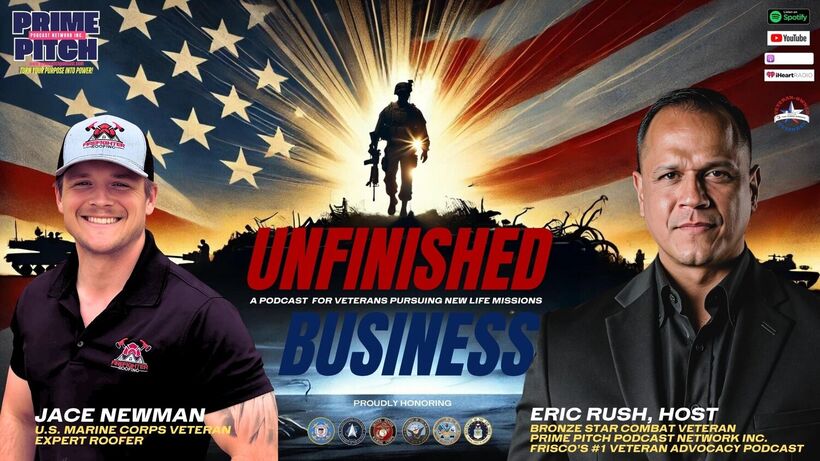
Jace Newman
U.S. Marine Corps Veteran · Expert Roofer
About the show
Unfinished Business is a podcast for veterans pursuing new missions after the uniform, and for the families and communities who stand beside them. Hosted by Eric Rush, The Conversation Architect, a Bronze Star combat veteran and the founder of Prime Pitch Podcast Network.
Read the full transcript
One thing that I preach a lot is that, that, uh, finding your purpose once you get out of the military is gonna be the hardest thing for you. Mm-hmm. And honestly, uh, prayer, prayer was, prayer was huge for me, and prayer led, prayer led me to, uh, getting, getting help, getting, uh, help that for, umAnd I, I implore anybody, uh, whether you're in the military or not, if, if you've got issues that you can't identify by yourself, you've got to get help. My therapist is my best friend. Yeah.
Man, th- that's my girl. Sound the horn.1, 2. Sound the horn.3, 4. Unfinished. Hey, what's up, guys?
Welcome to Unfinished Business, a podcast for veterans pursuing new life missions. When a marine takes off the uniform, the world gets quiet. No roll call, no sound of boots marching on the ground, no new, no new marines waiting on his leadership. For Jace Inuman, that quiet was in 2019. After 4 years at Camp Pendleton as a machine gun squad leader with the 1st Battalion, 1st Marine Division, the mission ended.
The days that followed weren't filled with p- parades and celebrations. They were filled with silence, the kind of silence that forces you to ask, "Who am I now?"He carried the memories of leadership, of trust, of the creed etched in every m- marine, Semper Fidelis, always faithful. The q- but the question lingered, how do you stay faithful when there are no more orders, no clear mission, and no one calling your name? This is the Unfinished Business, a podcast for veterans pursuing new life missions. I'm Rush, and today, Jace Inuman takes us inside the silence and what it means to keep serving when the uniform comes off.
Jace, brother, it's great to have you on, on Unfinished Business, a podcast for veterans pursuing new life missions. We've been closely connected through, through fellowship, Power Lunch, um, and you've been active in community repres- um, as a veter- veteran advocate and being, and, and, and, you know, being present in environments where, where, where other veterans need you the most. And I wanna tell you, it's been a long time coming. Your name has always been on the, on the, on the I gotta get him in, uh, get him into, into the Unfinished Business podcast, and I feel so grateful to be spending this time with you today. I've been waiting, man.
I'm glad to be here, Rush. I really appreciate you having me, man. Yeah. You know, uh, it's, it's one of those things where, you know, as, as, as a, as, as veterans ourselves, we, we, we, we have to, we have to, like, we have to unite. We have to bring, bring in, pull each other forward, right, and keep pushing each other to the next, to the next level so that we can, um, so that we can achieve our goals and dreams and, and, and fill the space that needs to be filled with, with camaraderie an- and the things that, that we miss from being attached to, to our respective branches, right?
Absolutely. Exactly. You know, um, um, when I was reading your, your bio that you had sent me, I wanted to, to ask you, um, when you were growing up in Brownwood, the uniform meant something big to you. Um, can you take, take us back to what being a m- being a marine looked like in your mind then, and how had, and how has that meaning changed now that you're out of it, that you're, you've lived it? Uh, it's interesting.
I'm, I'm, I'm the first in, I'm the first in my family to, to join the, the military. Um, and I'mSo, uh, I didn't have any perspective on that whatsoever, uh, prior to signing the dotted line. Um, you know, before joining, I looked at it, um, with, uh, with selfish intentions, honestly. Um, you know, uh, first, uh, somebody, uh, thinking about joining the military for the first time, they think about free college, uh, benefits, you know, healthcare, what- what- whatever it may be. Um, and those are definitely tools you can keep in your tool belt if you're thinking about joining the military.
Um, but, uh, you know, inlooking back on it now, it, uh, it taught me the exact opposite actually. So, I mean, now, looking, looking back on it now, I have a band of brothers forever. Mm-hmm. Those guys, no matter how spread out across America we are, I've got, uh, veteran, uh, brothers here in Texas, California, Wisconsin, um, uh, Michigan, Cleveland, Ohio, Florida, Boston. You, you name it, I've got, I've got buddies all over the place that would drop a dime and do anything for me.
Um, and, uh, not 0 not only that, but I mean, you know, it's, it's, it's, it all comes down to, you know, we have a annual fantasy football draft we do every year. I just got back from that a couple weeks ago, and they're all terrible at fantasy football, butBut, uh, but yeah, I, um, uh, given that, I mean, it just helps me, it just helps me take, take them with me everywhere I go, you know? And, uh, their willingness to do whatever it takes for me, I take that everywhere I go, and I try to pass that forward anywhere I can. Yeah. That's, uh, that's amazing, man.
Like, you know, I mean, that's the same way, reason I joined college. I thought I needed to get ahead, you know, with, um, from, from a scholastic standpoint and get some, some, some of the most essential tools in our toolbox. But, um, I share that, thatI re- I share that meaning with you, your, the connections that you've made that are gonna be lifelong. You know, it taught you, it taught you what you really were made of in, in that- Absolutely. particular time, huh?
If you look back and you see the, the, the camaraderie there, cama- camaraderie that you had, what do you, what do you appreciate most about that time? man. That's such a loaded question. It's so much, it's so mu- I mean, what I appreciate, what I appreciate the most is, looking back on it now, is probably the most miserable times I had when I was in the Marine Corps. All the times I say, "Hey, it's the most fun, I never wanna have ever again."So some of the, some of the most long-lasting memories of mine are literally just sitting in a fighting hole that I just spent 18 hours digging with an MRE spoon.
Not literally, but, like- Yeah. you know what I mean? Might as well be. Oh, yeah. Absolutely.
And, uh, getting 2 hours of sleep at night and just, and just talking with your, with your buddy in the fighting hole. You know, uh, you both have a mission. You both have a purpose of being there. And that, I've been able to, uh, take the responsibility that was given to me, uh, during those times. And I, I pay that forward any, any chance I get.
So honestly, the, the shor- the short answer to your question is probably the most miserable parts of it. That, that's what I appreciate the most, which is such a weird answer. That's a, that's a, such a cool answer, too, man, because it is when you're in that foxhole, in that, that moment when you'reyou know, like, you've goneyou, you did the work to build a bunker, you built a, a foxhole, and, and now you're, you gotta sit here and, and e- endure this, uh, this suffering, you know? I guess that, that, that's gonna s- I'm gonna save a little bit of that qui- that answer, uh, for later down the road. Um-As a squad leader at Camp Pendleton, you carried more than weapon- a weapon.
You carried the lives of young Marines. What did that kind of responsibility feel like day-to-day and what lessons come- what lessons come from those years you, um, you're- that are still with you now? Man, uh, I, uh, that gave me more purpose than, than what I ever knew I was searching for. It gave me so much purpose that I had no idea that I was- that I was even looking for. Hm.
Um, you know, from the front porch looking in, it doesn't seem like that would teach you much whenever- but, you know, being in charge of the welfare of, uh, subordinate Marines whenever you, uh, go out to the field to train or do whatever you have to do, uh, transporting millions of dollars of equipment from mountain to mountain- Hm. and making sure that that equipment gets from point A to point B, man, it's- it- it really- it really teaches you a lot about- about what kind of, uh, what kind of- uh, what- what you can be tasked out to, uh, to do in- in the civilian world. No, I- I- I understand where you're coming from, you know. Now that we- you started mentioning some of those things too, you know, it's not just leading. Like, there- there's essential logistics that need to take place and that security has to be part of, you know, part of that- that mission, right?
Mm-hmm. Absolutely. It helps me take whatever I'm tasked out now, it helps me take that same- that same seriousness with- it- it tak- same seriousness into- into my task that I have to do here in the civilian world. Yeah. That's- that's a- that's a- like, I- when, you know, I've sat down with a lot of individual- a lot of combat veterans and the one thing that you- that really pa- hit- hits point- hit- hit home with me is- is, yeah, there's- there's a lot of logistics that need to take place when we're talking about e- equipment and stuff like that, that- that kinda people don't understand that that's another tool that y- you know, as a- as a combat veteran in your position that you've had to- you've had to s- you've had to be responsible for too, not just training people how to shoot a gun, you know, m- machine gunning and- andthat kind of stuff, so.
Absolutely. Some of those things can really cognitively wear on you whenever you're stressing about, "Hey, do I have it- do I have this optic? Do I have this? Do I have that?"Like, if- if somebody's missing something like, "Hey, we better damn find it."You know what I mean? Yeah.
Yeah. Um, you've described, uh, leaving the Corps as stepping into the silence. What did that silence really sound or feel like for you and why do you think it can- it can be harder to face than combat itself? Man, uhGrabbing for combat itself. Yeah, absolutely.
Um, you know, while you're- while you're in uniform, you have- you have all of your- all of your boys and, uh, you have your brothers and sisters in arms to- to go to for input, and, uh, you know, you're training for a life or death situation. Yeah. So the people you're going to for input give you that same seriousness. They bear that responsibility on their shoulders whenever they're- they're giving you input, helping y- helping you accomplish whatever task you're doing. And getting out and I come home and I'm operating a skid steer for a construction company or I'm cleaning horse stalls outside of the town where I go to college or when I was a bouncer at a concert venue, it- noth- nothing against those colleagues that I worked with at those places, but they- that- that level of seriousness in trying to help you accomplish those tests, it d- it doesn't transfer.
Hm. It doesn't transfer whatsoever. So, uh, that is- that's something- that's something that- that I had trouble- I had trouble with for- for a really long time. I just didn't feel- I didn't feel that same camaraderie at all because, uh, it, uh, to put it short, it- it- you just don't get it. Yes.
It's- if- if you don't get it, you just don't get it. Yeah, yeah. You know, how much does sacrifice, the- the common thread of- of making- making the sacrifice to enlist, you know, to- because it is a sacrifice, you know. Um, how much does that play a role in the- in that, you know, the- the- the silence, you know? That you've- you had these same people that you- that sacrifice- are making the sacrifice to protect, uh, our nation, um, how much does that play a role in- inI mean, the big, the big difference is that nobody else raised their right hand to give their own life- Hmm.
for you if the situation re- represented itself. It all boils down to that. Yeah. And just raising your right hand and making that promise to somebody else, itThat's a, that's a service unlike any- Yeah. unlike anything anybody could ever provide to me.
Yeah. I could see, you know, I could understand what you're talking about too. Um, you know, a lot of veterans say the military told them exactly who they were, and civilian, and civilian life didn't. How did that loss of identity show up in your own life and what did you start, uh, what did you do to start piecing it back together? Man, that, that issue identified itself hard and fast.
Yeah. It, it was, um, it was immediate. Um, and, uh, 1, one thing that I preach a lot is that, that, uh, finding your purpose once you get out of the military is gonna be the hardest thing for you. Hmm. And honestly, uh, prayer, prayer was, prayer was huge for me and prayer led, prayer led me to, uh, getting, getting help, getting, uh, help that forUm, and I'm, I implore anybody, uh, whether you're in the military or not, if, if you've got issues that you can't identify by yourself, you've got to get help.
My therapist is my best friend. Yeah. Man, th- that's my girl. And that's, uh, that, that's really, uh, part of how I, you know, overcame that coming out. Yeah, I, you know, um, yeah, I understand.
What, what, you know, part of your identity, it's like, you know, you, you come out and you, you, you're lacking that purpose. Mm-hmm. Like I said, I said that a- a- a while back ago about, like, you know, you have no, you lose, you know, you lose, you don't have a purpose, right? Um, what is one of the purposes that you, that, uh, a purpose you have in your life right now, um, that you, that you've been, um, working on and that you've been, you know, just putting your time and energy to? Um, well, my occupation for one.
You know, uh, I started, I started doing roofing about 6 years ago and, uh, part of, part of finding my purpose was, um, you know, working my way up to a management position to where I could help other contractors, uh, be their best. And that kind of gave me some of the same, um, emotions as I did being a squad leader. Hmm. You know? Uh, it's, it's not, we're not training for life or death situations here, but the fact that I have done that before, trained for life or death situations, uh, that helps m- that equips me to take care of those, those other contractors the best I possibly can.
Yeah. And, uh, ano- another thing is, is, is my family. You know, I was, I was away from my family for 4 years, um, and that was, that, that's really tough. Yeah. So, one thing I've been trying to focus on is just, is to, uh, is to focus on my family and, uh, en- enrich my relationship with, with my, with my family.
Yeah, there is a, there is a huge gap when, you know, when it comes to you lose a lot of birthdays, uh, you know, if you're an uncle or, you know, those kind of things that your relationship kind of s- Mm-hmm. you want to piece back together. So, that's- Yeah, I'm s- I'm single with no kids, but I'm the baby of 7 siblings and I've got 17 nieces and nephews. Yeah.'Cause it's, it's, it's a lot of responsibility. That's a lot of responsibility.
Yeah, a lot of FaceTime responsibilities-. whenever you're across the pond, you know? Yeah, that's very cool. Um, so you shared, uh, you just recently, you just, you just s- shared that, uh, prayer helped you through the hardest nights after leaving the Corps. Um, is there a night or moment that really stays with you when faith gave you enough strength, that, when faith gave you enough faith to keep going?
Absolutely. Um, you know, and I'm, I'm gonna reiterate it again, I can remember the day where, uh, God pointed me in the direction of finding my own help. And, you know, my, like I said, my therapist is my girl. Like, that is one of my, one of my best friends. She, she saved my life.
And, uh, you know, there's, there's a lot of negative nuance to whenever it comes to, uh, to, to, uh, to counseling. Um, and let me tell you, like, the- there is nothing wrong, nothing wrong with getting, uh, outside help to help you identify issues that you can't identify yourself. There is n- there is nothing negative about it. And I can't, I can't preach that enough. What do you think, um, when you, uh, you know, you talk, when we talk about counseling and therapy, you know, I always say, well, what, what do you think about when, when I say, um, that don't talk to people that aren't qualified to an- to give you the right, the right information you need to, to, to make a good decision?
Uh, do you feel that sometimes people depend on other people outside of, of, of s- a, a licensed clinician that would be able to guide you? Um, I mean, sure. I mean, it, it just kind of depends. Yeah. It depends on every situation.
Yeah. Um, I mean, if it, if, if it, if it reaches a point where it's, it's, I mean, whenever you are, whenever you have anxiety, if you have depression, if you're e- were at a point, uh, where I was where you're having trouble finding your purpose, there's something going on cognitively- Yeah. that just your buddy down the street isn't gonna be able to identify. Mm-hmm. You know?
Um, uh, I, I preach all the time, you know, to talk to, talk to the people who are close to you and that is, that is a, that is an am- a, that's amazing. Yeah. But sometimes, man, sometimes the, you're, you're, what you said is you hit the nail right on the head. Sometimes, like, somebody is just not totally qualified to tell you what's going on in your head. Yeah.
Something, there's a chemical reaction going on in your brain that you need to counteract. Your brain's playing tricks on you, and you need to play tricks on it right back to get you in a different mode so that you can, uh, attack, attack your issues. Yeah, no, I 100% agree with that. Um, yeah, that'sHow did y- h- why did you finally say, okay, how did you finally say, you know, through prayer, uh-that you started dev- defining your purpose? What were some key thing, 2 or 3 things that you did that say, "Okay, I'm gonna start, uh, start a prayer," and what else did you do to start narrowing that, uh, the focus on, you know, your new purpose?
Man, uh, admitting you have a problem. Hmm. Admitting that something is going on that you can't identify is the biggest part of it. You know, um, I'm a big supporter of the Til That Hall Project, you know, 20 veterans kill themselves every day. Hmm.
And, you know, I, uh, um, I, I, I got to a point where I, I didn't knowman, I, I didn't, I didn't know what was going on. I didn't know what I was thinking. I didn't knowI, I didn't know what was going on in here. I had no idea. And, you know, whenever you start playing around with, uh, playing around with the idea of taking your own life because you just don't know what to do, I mean, that's, that's one 0 that's one of the main things I, I, I said in my prayers, "God, I don't, I don't wanna be here anymore and I don't know why.
I don't know what is going on with me, I don't know what's going on with my head. I have no idea what's going on. I'm, I'm gonna put this all on you-" Mm-hmm." and please just point me in the right direction."And that's, that's where, that's where he took me. That submission is so important, right? Yeah.
Just the submission to have, um, an obedience. That's, that's really cool, man. We wanna take that 20 a day, we wanna make it 0. Yes, we do. I wanna make it 0.
Let's go. Yeah, there's a new, there's an event that's coming up, I'll have to send you the information. Um, it's something I have on one of my podcasts next week. I, I'll get the information to you. I don't, I don't have it like right in front of me, but, um, they're, they're hosting an event for, for, for, um, suicide awareness and, uh, I wanna make sure you're plugged into that.
Oh, please do. Absolutely. I will, yeah. Okay. You know, uh, roofing isn't the path most people imagine for a marine, ma- marine veteran.
What was the moment you realized that this wasn't just work, it had become a mission, and how does protecting a home connect w- in your mind to protecting the squad? Man, uh, you know, from their front porch looking in, it may sound silly or comparing roofing to leading a squad full of marines. But, you know, uh, the way I see it, you know, i- uh, here, uh, especially nowadays, a home is the biggest thing anybody will ever invest in. Yeah. The average American, their biggest investment that they will ever have is their home.
Hmm. And, you know, pr- protecting them and their family from the elements is very important. And so, uh, you know, I'm back on the, back on the subject of moving around millions of dollars worth of equipment. I don't know if you've ever priced out a roof before, but it ain't cheap. Shingles ain't cheap, felt ain't cheap, none of it's cheap.
And so getting, getting that equipment from the di- distribution yard to in front of the p- person's home on a pallet to on top of the roof, that kind of, it, it, it translate, it translates a little bit better for me. It tr- translates pretty easy for me. And, uh, man, f- starting roofing 6 years ago, that, that re- that was really a big point of helping me, uh, uh, finding my purpose again. Yeah. That, I think, is so cool, man, the way you, you make that connection.'Cause it does, it does really resonate with me 'cause I, you know, I have, I have insight.
You know, like, you know, I shared that time, right? With, with other, uh, combat veterans and veterans period, right? It's like, yo- when you've done that time you understand the logistics of everything and I, I connected with that part, portion of i- h- the unique way you represent yourself. And, not only that, we both have a lot of, uh, uh, uh, Marine friends and brothers that, like, that are in con- are in, uh, are in roofing, you know? That run roofing businesses.
And, and I find that just so, like, so special and unique that you're still in that grit and that grind and, and in that, uh, that, that sun and, and you have that, theI always admire the, the brotherho- brotherhood that y- that I s- um, you see in that. Absolutely. Yeah, that's, uh, that's, uh, uh, awesome. Is that part of it, that, what you experience too with the people you work with too?100%. And, uh, especially with where I've landed now, uh, with, uh, Firefighter Roofing.
Yeah. Uh, they have a heavy emphasis on, on helping out veterans, firefighter, police. You know, the owner, uh, Phillip Perdue, he was a, a former 24-year firefighter, and, uh, there's a lot of, uh, uh, firefighters that work f- with us part-time as well. And getting to chop it up with those guys is just, it's, it's the best. It really is the best, man.
There's been, uh, marines and army veterans come in as well, and they, there's, uh, there's a couple of army veterans that work with us as well. So just the fact the Monday and Friday sales meetings, getting to ch- getting to chop it up with those guys, man, it, it takes me back. It's awesome. That's so cool, man. That's, that's so cool.
It's, it's very rare to find, uh, you know, to find that connection afterwards and to be, uh, be with a, um, um, a body of your peers with like-minded attitudes and beliefs and, and have made the sacrifices, and makes it all the better, man. So- Absolutely. that's awesome. Semper Fidelis, always faithful, when you look at your life today, from Brownwood to Pendleton to rooftops across Texas, what motto, what, what does that motto mean to you now? Man, I try to take it everywhere, everywhere I go with me.
You know, um, I'm, I'm no stranger to serving homeowners who are also veterans and, uh, you know, those, those relationships are so organic. And it's, it's so organic and being able to pay it forward to those guys is, is so fun. It's awesome. Um, you know, um, you know, the, the motto alwa- the motto always faithful, um, you know, that theyit, it really resonates with me because, um, like I said earlier, like, that my, my band of brothers that I have, we would do justwe would do anything and everything for each other on the drop of a dime. And, uh, that helps me pay that forward to, to my clients and my network too.
That's awesome, man. Um, uh, Jase, if, if, if people want to get ahold of you and wantneed some, you know, need their roof repaired, how can they get a hold of you? Uh, they can call me. My number is (817) 408-5557. And, um, one last thing I'll say, um, if, um, uh, if, uh, if a Marine Corps veteran is, is transitioning out of the military and is trying to find a purpose, look at the camera and give the, the person that might be looking at this some advice.
Well, I just gave you my phone number, you can call me. But, um, one of the, one of the biggest things I can say is that, is that finding your purpose is not impossible and you will find your purpose. Um, pray on it. If you need help, get the help. If you need to talk to somebody, uh, in your close circle, talk to them.
above all, pray. Pray about it. He will point you in the right direction, I promise you. Man, Jase, brother, it's so awesome to have you on, on Unfinished Business: A Podcast for Veterans Pursuing New Life Missions. It's, um, um, you had a treasure trove of, of, uh, different ways to see, see things and I really admire and appreciate that, you know?
I always say this, that high, high, you know, el- from a higher elevation standpoint, I, I, I resonate. I could understand exactly what you were speaking to. So I ad- and I admire your dedication in the community and the things you, you're, you're a part of with Fellowship Power Lunch and attending the meetings. And, and maybe one day we'll get to hear you speak in one of those events and- Oh, man, that'd be cool, wouldn't it? Yeah.
I think I'd have to get a little bit of a higher pay grade to get, to get h- 'cause man, they, the, the speakers they have there, man. Yeah, man. I can't speak highly enough of those guys. And they get you sometimes, man. How- Oh, man.
I, they really do. They get me t- they get me teared up, man. They, like you said, you, you saw me taking videos and sometimes I video the whole thing before, man. It's, it's so powerful. It's so powerful.
It's some moving moments. Well, guys, uh, that's it for Unfinished Business: A Podcast for Veterans Pursuing New Life Missio- Missions. As I always say, have peace and light in you, and remember that the ocean refuses no river. Sound off.1, 2.3, 4. Unfinished Business New Life Missions.