Gerald Dooley
Gerald Dooley joins Rush on The Rush Outrospective, the flagship show about purpose, healing, and finding the way back to yourself. As manager of Prison Initiatives · Prison Entrepreneurship Program, Gerald brings second chances and the work of reentry to the table.
They get into the work, the cost, and the reasons it still matters, in the kind of long-form conversation this show was built for.
In this conversation
- What real second chances require
- Rebuilding a life and an identity
- The people who make reentry possible
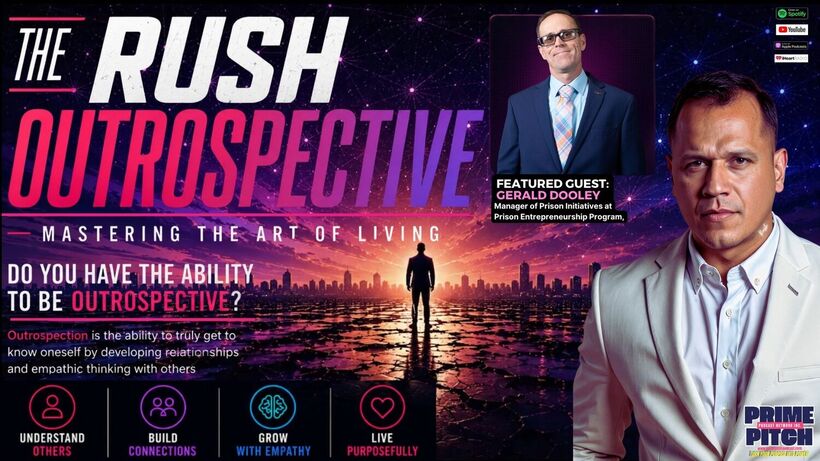
Gerald Dooley
Manager of Prison Initiatives · Prison Entrepreneurship Program
About the show
The Rush Outrospective is a Mastering the Art of Living podcast: raw, honest conversations about purpose, healing, and the road back to identity, the flagship series where outrospection began. Hosted by Eric Rush, The Conversation Architect, a Bronze Star combat veteran and the founder of Prime Pitch Podcast Network.
Read the full transcript
I would say hope. I didn't have hope, um, for the longest time of my life. Hmm. Didn't much care about it, didn't think about it. Um, but God, He, He gave me a lot of hope, uh, in my life.
Uh, and He continues to show why that hope is real, right? Hmm. Relationship with my daughter, uh, my career, um, just everything that goes on around me. And then of course, you know, I still have those, uh, struggles, uh, quiet struggles in my own heart, right? You know, none of us are perfect.
We'll never be perfect. Yeah. Um, but having that hope when I go home at night and I'm alone, it, it just really helps me, uh, stay happy, stay true to what, um, what God's done for me. Yeah. We're mastering the art of living.
Hey, what's up guys? Welcome to Rush Introspective, a Mastering the Art of Living podcast. Some time doesn't come back. That's the truth Du- Gerald Dooley had to live with. A daughter grows up, birthday- birthdays pass, ordinary moments disappear, and when a man comes home, he doesn't get to pretend that absence didn't cost anybody anything.
Gerald's story includes incarceration. It includes missteps. It includes the kind of consequences that follow a man long after the sentence is over. But Gerald didn't come home asking if, asking life to forget where he'd been. He came home and started doing the work.
Today he serves as the manager for Prison Initiatives at Prison Entrepreneurship Program, helping other men wrestle with the same questions he once had to face. Who am I now? Who, what can I repair? What do I do with the time I, I still have? The relationship he's built with his daughter wasn't handed back to him.
He had to earn the trust in real time, through consistency, through humility, through showing up when words weren't enough. That's the part that a restoration people don't always wanna talk about. It's about, it isn't clean. It isn't quick. It doesn't happen because a man says he's changed.
It happens when his life starts proving it. This conversation's about fatherhood, accountability, prison, purpose, and the long road back to becoming someone people can believe in again. This is my conversation with Gerald Dooley. Gerald, my man, it's, it's a pleasure to have you on the Rush Introspective, a Mastering the Art of Living podcast. Um, when I read that cold opening, what, what, what thoughts or emotions went through you, through your mind?
Well, thought quite a bit about my family, you know? Uh, sometimes the things we do in life, uh, they don't just hurt ourselves, right? They hurt the people that are around us. And actually, we tend to forget that they hurt them more. Hmm.
Right? Yeah. And so it just kinda had me reflecting on, uh, not only some of the pain that I've caused, but uh, how I've been able to rectify that. Yeah. Yeah.
You know, and that's, and I think there is, you know, people have, people are gon- people are gonna confront obstacles, whether it's, it's, it's incarceration or any kind of financial, uh, poor decision-making financially, and it does, it's gonna impact your families one way or the other, right? Um, how we pick up the pieces is so important and, and, and that's why this is, it was so important to have you on the podcast because Mastering the Art of Living means does that you didn't have all the answers all the time. You know, this is about finding the answers and finding the solutions to, to, um, that you found solutions along the way that helped you to evolve and become the m- uh, the manager of Prison Initiatives for, uh, Prison Entrepreneurship Program. What do you think about what I just said? I don't know if I'd use the word master, but uh, you know, I, I try my best to instill in everyone that I come across the things that I believe are going to be a positive influence for them.
Um, but especially for the guys on the inside because they're stepping out into a world that they may not remember. Hmm. Some of these guys have been gone for quite some time. Yeah. And things have changed, and we have to change with them, right?
Yeah. So walking, walking alongside those guys, instilling what I believe is beneficial to them i- is, is very meaningful to me. That's beautiful. You know, when people meet you today through your, through your work with Prison Entrepreneurship Program, they see you in a position of leadership. How do you describe the man you are now beyond the title?
Oh. Well, I live a very, uh, quiet and simple, very intentional life. Hmm. Right? I guess you could call me a closed book.
Hmm. Right? Um, stick to myself mostly. So if I am open with you, if I'm sharing myself with you, it, it means that I genuinely care and that I truly trust you, so. That's awesome.
Well, thank you, man. I really appreciate you coming here to be a part of this experience. You know, a lot of guys, even myself included, we just, I just shared off camera how I held my cards close to my chest, having been incarcerated, having gone through my, my life struggles, and I held it for 20 years, and letting that, that, that thing build up in my heart and my head. And, and r- as a result of that, I had to work on doing the hard wiring to, that I had integrated in my bo- my mind, body, spirit, and soul, you know? Um, before the work you do now, before people saw you in this role, role-What was the internal reality of your, of your life during incarceration that most people would never have seen?
So, you know, some people, some people are built for prison. They actually thrive in that environment. Yeah. Right? That's for sure.
Uh, I did not. Okay? Um, I struggled a lot with depression, so I was blessed, uh, by a wonderful God and His Son to, uh, forgive me and to care for me in my time of my incarceration. But that didn't stop me from thinking a lot about the things that I've done to hurt people, uh, pretty continuously while I was in there. So- So prison can be a very, uh, reflective place- Yeahif you really let it be.
So. Yeah. Yeah, it's true, you know? I mean, you got a lot of time to think, you know? Um, we talking about pers- I was sharing with you about personal inventories and, um, um, um, understanding your defects of character during that time, but, but there's also, there's, there's alsoDo you feel like sometimes there's, there's, there's a cleansing in that moment as well?
There very much is. So in that time where you're actually ta- able to take a really deep look at yourself, right? Not how everybody else sees you, not how the world has seen you in, in your crimes, but, like, how do you see yourself? How do you really see who you are, who God created you to be? Hmm.
It's true. Um, was there a, a, was there a moment when your l- when, when you knew your life had to move in a different direction, or did that realization come slowly over time? No, it was a very clear moment. And, uh, you know, I've actually never told anyone this. Oh.
So I can typically not even think about it without crying. So I'm gonna do my best here to uh, uh, get this out. But, you know, when the detectives served my warrant, uh, on the crime that led me to prison, um, in the police station, and they let my mom come up to get my personal property, and she brought my daughter with me. She was 7 years old. And we're in the middle of this police station lobby, and I'm saying goodbye to my mom, and my daughter, my daughter wanted me to come home.
She didn't want me to stay there. Hmm. But I had to. I was under arrest. And, um, I, I remember, uh, collapsing on the floor and crying into this little 7yearold girl's arms.
And that broke me. Like, that destroyed me. And, uh, you know, I left from thereExcuse me. It's okay. Take your time, my man.
Take your time. You're in safeYou're in, you're in, you're, you know, you're in a safe space today. I appreciate that. Yeah. Um, I left from there, went to jail.
Um, I was put in solitary confinement, and I reflected on that moment for the longest. And still to this day, like, I can't even, like I said, I can't even think about it without, uh, coming to tears. I neverI've hurt a lot of people in my life-but I had never hurt her until that moment, so. Well, you know, I mean, you know, I get emot- I'm emotional, too, because, you know, it's like we both share the same space of how we've, we've injured and hurt people, you know? And, and sometimes the most vulnerable people, right?
Like, your, you know, what, whatAnd, and I appreciate you sharing that to me, sharing that with me as well because, um, you know, number one, like, first of all, I, I sh- you know, I should've asked you, "Hey, only share what you, what you feel comfortable with."And, and because I think people suffering is sacred. It's a treasure. It's like you have to treat, treat it like a vase that is, you know, it's, can, it's breakable. It, you know, you don'tYou know, you wanna care for it and nurture it, but also you wanna honor it. You wanna say, "Hey, your truth will come to light and help somebody, and help them evolve from what they hear in your story."And, and, and very much we both know that there are individuals that have gone through the same, this experience with their ch- their children as well, right?
Yeah. And I don't, I don't believe in coincidence. Like, I do not believe in coincidence. I believe God has set our path, and- Mmthis moment in time, right here, right now, was the time for me to share that, and I truly believe that. Yeah.
Well, that's a greatThis is, that's a, that's a greatThat's, that's, that's, that's beautiful, man. Like, it, it's so true. I believe, like, it's not by coincidence. It's not, it's not byYou know, if you only knew how I got involved with PEP, you'd be like, "What? Like, how did that happen?"You know?
Like, you know what I'm saying? And now we're here. I'm sitting next to you. We're sitting together and we're, we're sharing and, and, and, and, and a conversation and dialogue with one another, respect and, and respect and admiratio- admiration for one another, what we're building f- for each other and for the community and, and how we're, we're working side by side, shoulder to shoulder, taking on the hard, hard issue of people, um, that, that are, um, are in their most broke- many in, in their most broken moment in their life, you know? And, um, I, I recently had an officer who was on my podcast.
He was the, uh, the, uh, um, coordinator for the Colony Police Department. And, and we talkAnd he's the mental health coordinator for the, for the police department, and he talks about meeting people in their, in their, in their worst moment, in the crisis, you know, and, and talking about going to homes and, and, and having to ha- have an issue, you know, who are having family problems, and you have to interfe- intervene and, uh, they walk through that space. And, um, yeah, so, um, yeah, we, we're here together, man, and that, that's freaking, that's amazing. And that's God. You're right, that's a God thing.
Amen. And let's see. Okay, let's see here. We got, umWhen you look, um, when you look back at the man you were during that season, what do you understand about him now that you could not see then? Well, I lived a, I guess I lived a very chaotic life, right?
I didn't, I didn't have direction. I just reacted to what was going on in life around me. Hmm. Right? Yeah.
And so when I look back, if I would've been an actor instead of a reactor, my story could be totally different. Hmm. So. Yeah. It's, it's true.
You know, I've had to learn that, too. You know, going from, uh, what do you call? Proactively reactive as far as, as, as, as opposed to being reactively proactive. When it's a little too late, you know? You know?
When it's- Way too latewhen the sorries don't work anymore. Right? Like, you know. Um, have you had a lot of s- you've had a lot of sorries, haven't you? Well, you know what it's talking about.
Well, it's too late now. Your sorries don't count for anything, right? Yeah. Um, let's talk, let's talk about one of your most cherished possi- um, possessions or, um, cherished, um, the person you're s- a stu- you, that you're stewarding in your life, your daughter. Um, you and I had a, had, had a beautiful conversation, and that was one of them.
Well, I had aListen, before I had that conversation with you, I had already wanted to have you on the podcast. There's just something that you see in someone's eyes that you go, "Hey, you know, God give me that spirit of discernment. Get this guy on the podcast. Let make some, make something happen."We hadn't had the opportunity to make it happen until today and, when we were at the last PEP event, um, over at the 12, I think it was at 12, right? Um, you shared with me your, your, your, your, your relationship with your daughter.
Um, so I'm gonna ask you this question. Um, your daughter grew up during a season when you, you were incarcerated, and today your relationship is marked by closeness and love. Man, I'm, I'm, I, I might get emotional. I'm more emotional than you. What did that restoration require from you emotionally, especially in the years after you came home?
it took support with honesty. Hmm. So not support and honesty, but support with honesty. And I think that sometimes society can confuse a lot today. They either wanna be all the way supportive or just all the way honest, but you have to be supportive with honesty.
And I'll tell you, she'll tell you, too, that there was a lot of times she was like, "Dad, I don't wanna talk about this. Dad, I don't wanna talk about this."Um, but what I did was is I supported her, but I was honest all the way. Hmm. Even if it was something that she didn't wanna hear, right? But also when it came to the support, I had to remember thatMan, she survived all those years without me there.
Hmm. She survived all those years without me there. She's a wonderful, strong woman, and she can do what she needs to do, and I needed to remember that in some of those moments. Yeah. Uh, especially when I'm really trying to, like, get my point across to her, um, and she's not wanting to listen.
I, I really had to humble myself and remember that, that she, she made it without me. Hmm. That, that's, uhMan, just hearing you say that, you know, um, support and honesty. Can you give me, like, a, an, an example? Like, you know, not with her specifically or maybe something else, you know?
You know, um, like, what would that would, how would that, how would that look? So if somebody needs to talk to you about something, right? And that something may be the answer that you have for it isn't what they're wanting. Mm. Because, you know, God doesn't always give us the answer we wanna hear.
Mm. Right? Right. And we have to kind of navigate that in the same way. Mm.
So if, if, if she asked me about a, a very real and, and, and a painful thing, right? And she wants to hear a specific thing from me and, and I don't believe that that thing is what I need to be saying, I'm gonna say what God's putting on my heart- Mmthat I believe she needs to hear and understand. Yeah. Right? Yeah.
And she won't like it, and there's been many times she get really mad at me, but, you know, uh, it's just a part of life. it's not all always happiness. Yeah. Yeah. Yeah, I could see that, too.
I have a, a, I have a ph- a phrase, too. It's called, um, truth in li- you know, truth in love, right? Tell it, tell the truth in the, in the name of love, right? Like, you don't, you know, you, it's not gonna feel good. It may not feel good, but this might be the truth, you know?
But I'm telling you because I love you, you know? And, and I'm not, I don't wanna see you be misguided, right? Yep. Yeah. Um, when, um, yeah, and the other part, too, is part of what you were saying is that, um, uh, I really appreciate you saying that, you know, like you realize that she made it this far a- at, you know, during your journey without, without your present and being present.
How does it, howWhen you reflect on that, what thoughts go through your mind when you, you, you- Yeahyou, when you walk through that? I'm really proud of her because, uh, the lot that she was handed in life wasn't an easy one. Mm. Right? Between, uh, myself and, uh, you know, my grandmother raising her, uh, I often felt sad because I thought that she was alone, so to speak.
Mm. And, um, grandmas are wonderful, wonderful people, but, um, kids need parents. Kids need, uh, their mom and dad. They need them present. They need them there, and we weren't.
Yeah. And so, but man, I'm super proud of her for, uh, who she's become today despite all of this. Yeah. And in a small way, maybe this is what made her who she is. Yeah.
You know, there's a saying I heard, yeah, oh, well, many years ago. It says, "You had the parentsIf you had the parents you always wanted, would you be the man, would you be the man you are today?"You know? Probably not. Yeah, you know what I'm saying? Like, yeah.
I mean, it's so true 'cause I think sometimes that hardship, that fa- family hardship, if you have the perfect parents, you may not, it, it might, it might turn you into something that, so too self-righteous, you know? And, and the fall is even further when you're, when you have this false sense of self-righteousness. Um, in your role as manager of prison initiatives at, uh, the Prison Entrepreneurship Program, you work with men who may be wrestling with some of the same questions you had, you had to face. What do you hear in them that feels familiar? I would say uncertainty.
You know, when you're in that environment and, you know, you got the news. You can see what's going on in the world. Mm. But you don't know what your family dynamic looks like. You don't know what is gonna happen when you get out.
You don't know your job situation's gonna be. You have thoughts and you have ideas, but you don't know. And we get this question a lot on the inside, you know, "What's going on out there?"And I don't think they're asking like, you know, what the weather's like or anything like that. They wanna know what it's like from a perspective of a guy who's in prison, he's got out, and now he's watching the world. Mm.
Right? They wanna know the, the deeper parts of it all. Like, what are they gonna see and experience when they get out? Yeah. And that uncertainty is actually scary.
Yeah. It's actually really scary to, to not really know what your life's gonna look like. In prison you know when your next meal's gonna be. You know when laundry's coming. You know when rec is coming.
You know when your educational classes are, are running. Uh, you know all these things. You wake up in the morning, you know exactly what your day's gonna be like. Right? Yeah.
But when you walk out those front doors, you don't know anything. Yeah. Uh, yeah, it's true, especially in today's society. If I thought of, you know, it, it does, like if you reflect on like, m- I don't know when you were incarcer- incarcerated, but if I was to reflect back and we're living this, in the culture we're in today, you know, and if I was on the inside looking at this, 'cause there was a time where I was like, "I don'tI, I, I was like, 'I'm done. Like, I don't need to be out in the world anymore.'" And all it took was one bad decision to make that happen, and, and it was very close.
But when you look at this, all the turmoil, you know, the infighting of our own, you know, of, of our in- communities and in the, in other communities, uh, in another state, it can be a very scary proposition, huh? Yes, it very much can, so. W- what do you guys do? What, when, when you're talking about, uh, real-world problems you know, w- with what's going on, how do youWhat isIs there, uh, something y'all say or you, uh, um, a coaching, uh, time when you, when you talk about that, and what does that look like? You know, now that I don't work inside full time, um, I more work in the office and, and manage our day-to-days on the outside- Mmwhat goes on on the inside.
But when I worked in there full time, um, I loved to sit down and just talk to the guys and let 'em know. They always have so many questions, and still when I walk in today, they holler my name and then start asking me questions. And, uhI don't know that there's so much a protocol. Yeah. I think just sharing yourself, um, with the guys- Yeahthat really need you to.
And you can kinda tell. Yeah.'Cause sometimes you walk in and it's really busy. You don't have time to really sit down with every, uh, man that wants to come talk to you. But you have to be very observant to see who's really needing it- Mmat the time. Yeah.
Um, guy came to me, uh, yesterday when I was on the inside. He gets out and it's Friday, and, you know, he had a lot of those concerns. What's the transitional house like? Uh, you know, uh, what are jobs like? How hard was it for you?
Uh, what is something you struggle with? Like- Yeahand they wanna know. Um, they're looking for comfort, is what they're looking for. Um, and sometimes it's hard because it's not a comfortable thing to reenter society. Yeah.
Interesting. Interesting, 'cause as you were doing that, I was reflecting back when I got out and how I set myself up to go to p- pick the halfway house I wanted to go to, you know, and set myself up of where I wanted to transition out of and, and how that, how that and the culmination of that decision alone, um, um, helped shape some of the things I, I was able to accomplish as far as, you know, going to school and finishing my college degrees. Like, just that, going to a, a community that was a safe community to go to, you know, instead of a major metropolitan city like Austin. I went to Waco. You know?
Where you have to be, you have to be a really bad guy to get in trouble in Waco, you know what I'm saying? But it's possible, but, um, but it, you know, it's, it's setting up that kinda foundation, where are you gonna go, where are you gonna get released to, you know? Where are you planning to? And if your homeboys are waiting for you at the halfway house- Yepit might be a whole different thing, right? Um, you lived both side, uh, lived on both sides of the system.
What do you think people misunderstand most about incarceration and w- what it actually takes for a person to change? Well, most people think that if you do wrong, they can just lock you up and you'll learn your lesson. Lock him up, he'll learn his lesson. It's like putting the kid in the corner, so to speak, right? Yeah.
And we didn't learn our lesson by being put in the corner, right? And we don't learn our lesson necessarily by being locked up, either. In fact, what ends up happening is, is you lock this guy up and he learns how to survive in a very harsh environment, is what he does. He doesn't learn how to be a citizen. He doesn't learn how to be a, a good man.
He learns how to survive in a harsh environment. Yeah. And that's not helpful to society. And so creating, creating pathways, programs, avenues for these guys to learn and build themselves up, give them what they need to actually understand what itthey need to take place in order to step out of those walls and be a, a, a proper returning citizen.'Cause by and large, anybody that goes to prison is gonna be a returning citizen at some point. Yeah.
And do you want them harsher than they were when they went in? Or do you want them to be stable, communicative, uh, smarter, uh, more willing to abide by, uh, society's rules and regulations? Um, because in there you don't learn how to abide by rules and regulations. You learn how to get around them. Yeah.
Yeah, it's true. Um, you know, that's what's so unique about, uh, prison, uh, Prison Entrepreneurship Program. Um, youT- they, they cultivate an experience for, for, for, for them. Speak a little bit about what, uh, Prison Entrepreneurship does for, for those that are, are, are, are, i- enrolled in the program a- and, and while they're incarcerated. Yeah, so it, it's really funny 'cause we entice people with entrepreneurship.
And, and don't get me wrong, uh, we've got a lot of great men that have started a lot of great businesses. Um, but they'll tell you, uh, before I will that they got to the unit excited about business, and then one of the first things we started talking about was our 10 driving values and, uh, the character development part of our program. Hmm. And, you know, guys sometimes aren't interested. They'll leave right away, but some guys, they really want that.
Yeah. Like, they came for the entrepreneurship, but what really kept them there was the character development. Like- Yeahand some of them will tell you that today. Like, we send out a, uh, questionnaire, uh, through emails and things, and one of the questions is, is, "What was the most meaningful part of the program for you?"And it's almost always the character development. Yeah.
Some, some form of the character d- development that we present, right? But then after that, we also put them through a mini, uh, you know, MBA course, uh, where they receive a, uh, Baylor certificate at, at graduation. Hmm. Uh, we teach them personal finance. Um, we do Toastmasters where they learn how to do public speaking.
Hmm. Um, a lot of times when you're talking to people, the language can determine really your success in that conversation or- Hmm. Yeahright? And if you're talking, uh, for lack of a better word, street, you know, sometimes you can't get to a certain point with certain people using that language, right? Yeah.
And so understanding how to navigate those conversations with people, talking to people in, in an appropriate way, but it also helps them to practice their pitches as they're gonna pitch, uh, 3 times, uh, during their, uh, uh, class. Yeah. Right? They pitch once, uh, at the big idea pitch, uh, again as a team at pitch day, and then they pitch at the business plan competition, so. Hmm.
Yeah, you know, I, IYou know, talk- just touching base on character development, you know, I, uh, off-camera I told you I was part of a behavior, behavioral modification program, right? And part of it was, um, conflict management, uh, character to the core values, having core values. And, and, you know, I remember being there and and when you're in a therapeutic community with people that have, you know, that are master manipulators or, um, have criminal addictive thinking patterns or subsist, you know, have, have m- have found themselves incarcerated because of their m- their thinking, their, their, their behavior, their attitude and their belief system, um, umOne of the things I realized in my experience was that, that, that I didn't have any, I didn't have any equipment to get through life. You know what I mean? Like, like, I didn't have the coping skills.
I didn't have any of the, uh, understanding of conflict, uh, h- how to, how to handle conflict, how to interpret conflicts and styles of conflict, and I didn't have any core values. And, and when we, when I sh- when y- whenI'm glad you said character because that is one of the big'Cause I feel like, uh, do you feel like some, uh, some of it is a byproduct of, of their, their, their environment they've been raised in, that they weren't equipped, they weren't given the, the necessary equipment to function properly in life? Oh, yeah. So, I mean, some of these guys grew up in very abusive homes. Yeah.
Families that it was a drug house, you know. Um, some of them grew up with, uh, no parents- Hmmuh, who were present and had to join gangs in order to, uh, survive in the streets. Um, there's so many different stories, uh, from these guys, but a lot of us weren't raised with character. Yeah. Right?
Yeah. Weren't given character, uh, at a young age, and hence they ended up in the environment that they were in. And in some cases they did it 2, 3, 4, 5 times. Yeah. You continue to live in that, uh, old way of thinking.
Yeah. Right? Yeah. That's, uh, that's interesting. I think it's so valuable that you guys are'Cause I see myself as one of those guys that would've couldOf course, I would've soI soaked in the program.
Of course it, it cost me sometimes with my- Mmwith my homeboys. When I was running my program, theyEven when I was running my program, like, "Rush is running it too hard. We're gonna have to figure it out," like. Mm. You know?
That's like, um, but you know, it is what it is. Um, but no, um, I think it's so, I think that's so, I think that's so unique and bless- uh, special that, that, that, uh, you know, that you guys work on character because I think that's when, um, I say, um, emotionally, spiritually, psychologically malnourished, you know. Like, like you, I need to be fed something that's gonna s- that's gonna stick. Well, you know, when I went to prison- AhI had this, uh, you know, I had God in my life. I was moving in the right direction.
Oh. But PEP really, like, solidified those values for me. Hmm. Right? Yeah.
I knew I had them and I knew I needed them, but they really, like, explained why, right? They really put it down to like, "This is why you need to live this way."And so when I went through PEP, um, character meant more to me than the, the business aspect of it. Yeah. And so. Yeah.
It's, that's, that's so amazing, man. I get, I get, I got this rush of emotion just like, yeah, just get, you know, like, you know. Um, let's see, what was this dad character then? I was like, okay. I was kidding.
I was kidding. Um, uh, you ha- you've lived on both sides of the system. What do you think peopleOh, I already said that. I already asked that question. Um, when you think about the life you're living now, what feels most meaningful to you in the quiet moments when no one e- else is watching?
I would say hope. I didn't have hope, um, for the longest time of my life. Hmm. Didn't much care about it, didn't think about it. Um, but God, He, He gave me a lot of hope, uh, in my life.
Uh, and He continues to show why that hope is real, right? Hmm. Relationship with my daughter, uh, my career, um, just everything that goes on around me. And then of course, you know, I still have those, uh, struggles, uh, quiet struggles in my own heart, right? You know, none of us are perfect.
We'll never be perfect. Yeah. Um, but having that hope when I go home at night and I'm alone, it, it just really helps me, uh, stay happy, stay true to what, um, what God's done for me. Yeah. That's soThat, that word hope seems to resonate, like, a lot with, with, with, with me too.
Like, you know, I think it, it, you know, you know, it was a part where I didn't have any hope. You know, it was like, in fact, I read a book that said, uh, there is no hope. You know, it's either is or isn't, you know? Like, and, and that's a pretty dangerous way to live, it either is or isn't, you know? And now that's when I almost said I would, I was gonna spend the rest of my life incarcerated just 'cause I was either is or isn't, you know?
And when, when I realized that hope was an actual, you know, extension of, of what, you know, of Christ and, and, um, meeting me in my, in that lowest moment, it's like, okay, I'm gonna be okay, you know? Did you ever have that moment when you're incarcerated where you're like, like, "Man," like, you know, um, "I'm years into this," or, you know, "I, I don't, I don't think I'm gonna make it," and then have the flip, and then flip it, and then it flipped on you? Oh, yeah, most definitely on, you know, in county before I was, uh, sentenced. Yeah. Um, I didn't really know what my life was gonna look like 'cause I was facing life in prison.
Yeah. And, um, that's a very, uh, fearful thing to think about when you're in there. Hmm. And, um, you know, I, I did my best and I sat down one day and I said, "You know what? I deserve it, so, um, what I'm gonna do is I'm gonna pray to God, listen to what He has to say to me, then I'm gonna move forward."Hmm.
Right? Yeah. And that's what I did, and we started a prayer circle in county jail, and for the 23 months I was there, we did it every night. Hmm. And it could be anywhere from just me and a couple of guys to the whole pod.
You know, when guys come in, they want prayer and they want hope. Mm. Even if they don't believe. Yeah. They still want it.
Yeah. And, uh, we provided that for them. And, you know, God blessed me. He, I didn't have to spend the rest of my life in prison. Yeah.
And so sometimes you have to listen to really what's being laid out before you, right? Yeah. A- and have that hope that He's saying, like, "Hey, you know, you do this a- and I'm gonna take care ofYeah. And so. Yeah.
That's, that's amazing, man. Well, thank God for that, man. Thank God for hope, right? Like, that's- Yeahthat's the thing that fuels us every day. Um, last, uh, before we s- before, um, yeah, last question, then I got something I'm gonna ask of you.
Um, if your daughter and granddaughter were to s- one day sit down and try to understand the full arc of your life, what would you want them to know about the man you chose to become and the responsibility you carried to get there? You know, it's interesting that you use the word chose, right? Because everything that we do is a choice. Mm. Right?
Mm-hmm. In the past, I chose to be a terrible person, right? Yeah. It wasn't a mistake. I chose to do the things that I did.
Yeah. Right? A- and I don't wanna hide that, right? People need to know that I was not, uh, a very thoughtful person- Yeahat that time, right? Yeah.
But now, right, I choose to be very, uh, direct and reflective in what I do, right? I try not to answer without thinking first. I try not toI, I rarely react, right? Yeah. If I react, then it may be getting to be too much for me, but, um-I'd want them to see and understand that I chose my path because I was finally able to see really what God had laid out for me.
Mm. Right? Yeah. And I want them to understand that I wouldn't be where I am today without Him- Mmfirst and foremost. I would not be sitting in this chair today with you.
And soAnd I'd want them to see me for the real me, all the bad, all the good, all the, all the, the love that I have to give. Um, but I'd also want them to be able to, to, to trust me. Mm. Right? Which is where I mentioned earlier support and honesty.
Yeah. The, my daughter knows that she can trust me because I don't lie to her. Right? Yeah. So.
That's beautiful, man. It's like, um, yeah, it's, it's just amazing that, that, that we've come full circle, you know? And it's like, oh, I know, it's that, um, you know when they say the inner self has emerged, you know? Like, the habit self, you have a habit self that got us into jails, instit- institutions, and sometimes death. But, you know, um, but the inner self has, has, uh, uh, reemerged from our, our, our broke- come, came out ahead of our, our, our brokenness, you know?
Yeah. And, and it's a, a beautifulAnd we're wearing these nice suits, you know, we look good on camera, and, and we're here doing a podcast together, man. That's what's up. Amen. Uh, um, Gerald, if there, if you, uh, if you have a message for, um, someone who's going through the, going through it, you know, m- being, uh, getting ready to be released from or in prison or, you know, personal prison or, you know, physical prison or, or someone that's just, uh, getting ready to face, um, to come out to, to civilian life or to the real world, um, what advice would you, would you leave them with?
And if you look, if you wanna, you know, look in the camera. You know, I would say trust in yourself and have confidence. It's not the easiest thing in the world to, um, not have confidence, especially when you've been beaten down, uh, broken, uh, caused pain, felt pain. I would encourage you to look deep into yourself and understand that you are the man that God created you to be, right? And that man may not look like you want him to look right now, but he can.
But that's entirely up to you. You have to be the one that sits down and says, "This is over. I am done, and I am moving forward into a better life for myself, for my family, for my friends, my neighbors, and my community."You make that decision. No one can make it forNo one can lead you in any direction. You have to be led.
And so, yeah, I would encourage you to just be, uh, confident in yourself. Like, you are all good men. No matter where you're at, no matter what you've done, it's not the end, and it never will be. Mm. Amen.
Gerald, my man, I'm so happy that we finally got to sit down and have a co- sharing conversation. We opened up some things that, that, um, you know, that youThank you for sharing what you shared, you know. And it's, that's an important step in, in getting out there and, and someone out there's gonna hear that, that, th- that exact thing that's gonna resonate with them and how they've, they've impact- how their family's been impacted and how, um, that, that one of the l- maybe the lowest moment they've ever felt and, and they're gonna, they're gonna, they're gonna honor, they're gonna s- uh, s- feel it and help it manifest something greater in themselves because of, of your appearance today on the podcast. That's 100% fact. Amen.
All right. Now we just gotta start talking about this co-host podcast. Oh, yeah, I know. We can figure that out. We can figure that out, man.
I'll be happy to do that. We'll figure it out if we can do it with PEV. That'd be really great, you know? I mean, we just have to figure, fi- figure something out. Okay.
Um, I, I, I'm at a place, you know, where all the broken, all the things that, that, that, I struggled with, all of the things that they say, you take your pa- you take your pain and make it a purpose. And, and, and, um, I feel that, that that's what's been, that's where I'm at. And podcasting is something I love to do, and, and I, I advance, um, um, advocacy. I mean, uh, you know, advocacy for, for, um, formerly incarcerated, the vet- uh, veteran advocacy and, and so much more. And, um, and I'd be happy to team up with, with you, with you and PEV 100%.
Wonderful. Awesome. All right, guys, that's it for The Rush Outrospective, a Mastering the Art of Living podcast. As I always say, have peace enlighten you, and remember that the ocean refuses no river. We're mastering the art of living.
OfExtrospective the mission. in our skies. From me to you. From you, from you to us. We are changing our lives.
Do you have the ability. To be OutrospectiveOutrospective. A path inward. Mastering the art of living. let's take that step together