Gabriel Joseph
Gabriel Joseph joins Rush on Unfinished Business, the show for veterans pursuing new missions after the uniform and the people who stand beside them. As co-Founder, Recovery Ranger Corps · U.S. Army Ranger Veteran, Gabriel brings hard-won insight on trauma, recovery, and mental health to the table.
They get into the work, the cost, and the reasons it still matters, in the kind of long-form conversation this show was built for.
In this conversation
- The reality of trauma and the road through it
- How recovery works, day to day
- Meeting people where they are
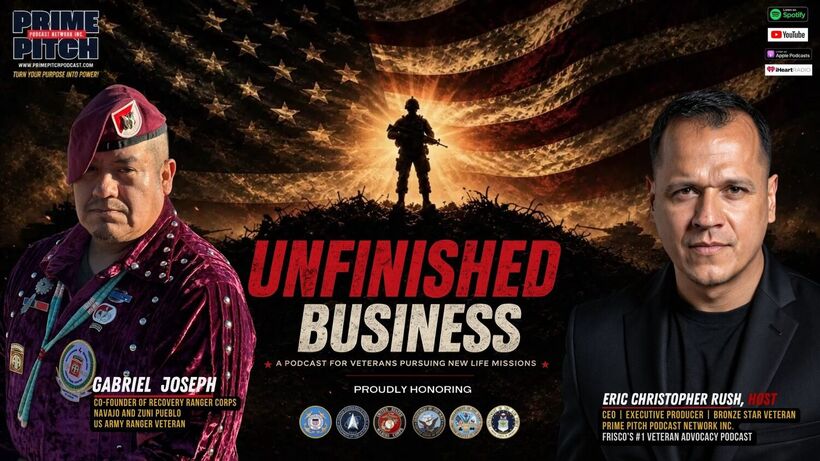
Gabriel Joseph
Co-Founder, Recovery Ranger Corps · U.S. Army Ranger Veteran
About the show
Unfinished Business is a podcast for veterans pursuing new missions after the uniform, and for the families and communities who stand beside them. Hosted by Eric Rush, The Conversation Architect, a Bronze Star combat veteran and the founder of Prime Pitch Podcast Network.
Read the full transcript
My daughter wasIt took doctors, uh, a total of a year and a half to figure out what was wrong with her, because we could not for the life of us figure out what was wrong with her. Hmm. And come to find out she had, uh, a neuroblastoma. Hmm. It was around the central nervous system.
Um, and at that time, as she got worse, uh, my pops was taking care of her back here in Arizona. Uh, at the time I was going through, uh, basic and AIT, and jump school and ranger school, right? And my first duty station was Fort Bragg. And I was maybe with my unit 3 weeks, and we end up getting sent to Bad Kreuznach, Germany. Hmm.
And while there, my daughter passed. Hmm. I did not find out until a week after. Yeah. You,Red Cross, all that, you know.
Yeah. It, it did take time. But by that time, you know, uh, my daughter was already laid to rest by my pops. I'd already left behind, you know, that game plan should something happen. And the moment that I got that, that news from the chaplain, um, I can say I, I, I lost my stuff.
I lost my, my ever-loving mind. Unfinished Business missions. Step by Hey, what's up guys? Welcome to Unfinished Business, a podcast for veterans pursuing new life missions. Before he was a soldier, he belonged to a people.
Before he wore a uniform, earned his wings, attended ranger school, or deployed to war, he carried a name, a lineage, and a story that began long before he was born. Most of us are taught to answer a simple question the same way. What do you do? What have you accomplished? What have you achieved?
Gabriel Joseph answered a different question. Who do you belong to? The United States Army gave Gabriel a language for discipline, danger, and duty. A- life after war asked him to learn another language entirely, one of peace, sobriety, memory, and responsibility. Gabriel's story lives in the, in that space.
It is a story about service, but not merely military service. It's a story about recovery, but not merely recovery from addiction or trauma. It's a story about belonging, about responsibility, about memory, about what remains when titles, accomplishments, and expectations are stripped away. And perhaps the most importantly, and most, and perhaps more, most importantly, it is a story about a man who chose to turn his own search for peace into a mission of helping other veterans find theirs. My name is Rush, and this is my conversation with G- Gabriel Joseph, co-founder of Recovery Ranger Corps.
Gabriel, brother, my man. Um, when, as I was reading, I always ask this question, I lead with every d- all the time, um, uh, when I read, when I read this cold opening out, out loud, what thoughts and feelings went through your mind? Uh, as we talked, uh, thank you again for having me, and I really appreciate it. Uh, I was like, dang, uh, there's been a long trek. There's been a long walk to get here.
Yeah. You know, um, and a lot of that, uh, is very true. Uh, a- as far as what goes as, as who I was beforehand. And, you know, with those of us who struggle with addiction, uh, whether it be drugs or alcoholism, right? Us, one of the first things that we forget is that, uh, uh, it's been a long time since we've seen that person.
Hmm. Yeah. Yeah. Right? Um, so in that sense, uh, allow me to introduce myself, um, traditionally, culturally.
Um, say, y'at'e, say, Gabriel Joseph, y'in'che. On'a ani nish'lingo, put ani abashis chin, set now betle'e das chei'n'a, sesh dine'e, dash'nalí. Uh, what that is, it says, uh, Navajo language. It's the same language used World War II by the Navajo code talkers and the US, uh, Marine Corps. Um, we are amongst Navajo, in Navajo culture, how the clan system works is that the belief is we have 4 clans.
Hmm. Mother, father, and then your, um, grandparents, uh, one from each side, your mother's, and then your father's. Hmm. Right? Um, so it would be your mom's ma, and then your dad's dad are the last 2, uh, clans.
So what I said was, "Greetings. Hello. Uh, my name is Gabriel Joseph. Uh, I am the one who walks around one people clan. Born for the folded arms people.
Uh, my maternal grandparents are the sleeping rock people, and my paternal grandparents are the Zuni people."Hmm. Uh, amongst my Zuni people, uh, it would be hard to translate, uh, or, 'cause, uh, I'm of the Mud Head Kiva, uh, and, uh, I am Child of Eagle. Hmm. So- Wowthat's who I am. That's amazing, man.
It's such, so, so depth, so much depth and as you were speaking, uh, your native tongue, it was just, it just was like, oh my God, this is happening right now on your podcast, man. Like, this is so, this is so dope, man. It's so cool 'cause you're getting, you're getting, you'reIt's a, it's a level of authenticity that we don't normally see, you know? You know, we get to a, to, to the roots of who we are. You know, we talk about-You know, before this podcast we were learning a lot about, about ourselves, each other, you know?
Mm-hmm. And, and, and, and as you're speaking, you're speaking, like you said, the same language they, they spoke, you know, in World WarWhich war was it? World War II. World War II. You know?
Like your were, were ancestral s- beings are in this room right now, man. That's, that, that's, that's amazing. Um, what does that reveal about, about how you see yourself? Uh, going back, uh, again, when, uh, this is all tying in, this is awesome, boy. This isI'm, I'm seeing it in my head- Mmand I can kinda see it, one half here, one half there, a little piece there, right?
Uh, goes back to the original question or the, the cold opening, uh, like what do you see in y- yourself or, you know, what did that kind of drag, drag up? Growing up as a kid, one of the first things that our, our elders tell us, right, is that in order to be recognized by God, by, by a higher power, and to our other deities that we have, right, to the land, uh, to the sky, uh, even to the sun, right, is that you introduce yourself in these ways, uh, so that way it connects you backto where you came from. Mm. Right? Because all of this is universal is what they explained.
So knowing your clans, uh, knowing the just basic deal of just who your mother and father is, right, that roots you. That puts you back into who you are going to be as you grow. Mm-hmm. And the second aspect to that of what our elders would always tell us the, in that is that, uh, with that you'll never stop growing. Mm.
I was like, "Well, that's, uh, that's not how that works," you know? Yeah. That's amazing. Um, what has your, uh, Navajo and Zuni heritage taught you, um, what has it, uh, heritage taught you that you think modern America has forgotten? Who we are.
Mm. Who we are. You know, we talk about, um, the way our warriors are treated. We talk about how war has affected us. Uh, we also talk about the low lows for our veterans and our fellow warriors, right?
Um, even just in that term in itself, Americans use that term, I feel, it's more the civiliza- uh, the, the civilian aspect of society. You know, "Oh, that guy's a warrior. Oh, that guy's"You know what I mean? And even with that, I had to remind myself what a warrior was. I had to be reminded- Mmwhat a warrior was.
And that name, that, that feeling, even that title, I think America forgets its roots is because we as American Indians, those of indigenous, uh, bloodlines, right, fromAnd we believe as, as American Indians that from North America, very tip of, uh, the Arctic Circle going all the way down to the other end of the Arctic Circle, South America, we're all related. Mm. Right? Yeah. And with that we all share almost similarity in customs, in culture, in traditions.
Um, and when those of us who have lineage the way that, uh, as do I, um, we've been fighting for the freedom of this country, for this land long before. Yeah. Right? And which is pretty funny, because on June 2nd, a couple of days ago, uh, in 1926, 1927, uh, we were finally, as American Indians, identified as citizens- Mmof this country. Wow.
We helped. Geez. We fought in the Revolutionary War, right? All the Eastern Band Indians. Uh, granted, we chose the wrong side.
Yeah. You know, we, majority fought for the British. Uh, but, uh, then comes the Civil War. You had native tribes who were split. You know, some fought for the, uh, Confederacy, uh, some fought for the North, right, for the Union.
And right after that, you go, uh, and we're still not recognized as citizens about this time, right? Wow. World War I breaks off. Again, we go. The first natives to use their language in combat, but were not recognized until recently, in World War I were the Choctaw.
Mm. The same nations who ran up and down these very same prairies from Texas-Mexico border all the way up to Oklahoma, Kansas, Nebraska area, right? Yeah. And then World War II, you know, the Navajo code talkers used the language. And mind you, uh, again, what America forgets is those roots.
The same government that asked for us to enlist, not even asked, some of us said, "This is my land. I'm gonna go to war.""I'm gonna fight for it."Uh, many may not know this, but I, I am the descendant of 5, uh, code talkers. Wow. One of the original, uh, 28, 29. And then his, uh, his brothers, my other grandpas, decided, literally they told us, "We decided that he wouldn't get all the glory.
He wasn't gonna go have all the fun, so we went."That's funny. And so they, when the U- when the US Marine Corps found out that they were Navajo and that who's their older brother was, they're like, "Oh, hey, can you guys speak the same language?"They're like, "Yeah."And they're like, "Well, guess what? You're gonna learn how to code talk."You know? Uh, so in that sense, it's roots. Yeah.
Don't ever forget where you came from. Yeah. I wannaHold on one second. I wanna get this coffee for you. It's bothering me.
I want you to have it. Here, here, I want you to feel comfortable here. Sorry. Here we go on, woogie woogie bill, we'll keep it moving. Um, but I just wanted you to have coffee with you.
It's important that my, you know, my guests, you know, they walk in with coffee, don't make them make it sit there and get cold. I was like, "Uh, I can't do that to this guy, man."I want you to feel comfortable if you can. If you wanna hold it, you can. It don't matter. Thank you.
Um, yes, sir. Um, um, looking back, what part of your identity had to be discovered, re- rediscovered? My clans. Yeah. Um, many do not know this, although I, I do share it openly with, uh, um, men of our program, uh, many people who do get close to me, but it's, it's nothing that I, I don't shy away from.
Yeah. Um, and that is, uh, incarceration. Mm. Right? Um, I was, uh, medically honorably discharged, uh, from Iraq in May of '03.
Mm. In one week's time, I encountered my first IED, where I lost guys, and several days later, uh, in clearing a, a building, I was, uh, shot in the back. My vest, uh, fortunately saved me. If you remember, uh, back when with the, uh, SAPI plates we had. Okay.
Yeah. Remember that? Yeah, yeah. And, um, youAt that point in time, at that point in time, there was, um, how do you say? A lack of, of, uh, equipment.
Yeah. So you had to choose which- Which one? where your SAPI plate was gonna go. Yeah, yeah, what side. Yeah.
So I, I figured it back that day. Mm. Sure enough. Go ahead. Well, this is not even to i- include the injuries that I had a year prior in Afghanistan, right?
But, uh, my unit saw me at that, "Dude, you're, you're, you're done."Yeah."You're going home."So I came home, uh, Stateside. I ended up a civilian for 2 weeks. Mm. And ended up catching a federal case involving weapons. Mm.
Um, people wonder, why, why did you end up in federal prison, not state prison? Happened on an Indian reservation, and Indian reservations treated a lot like a military installation- Mmwhen it comes to laws, right? If it's a violent crime, you're going feds automatically. Mm. Right?
So fast-forward, there's some other things that happened in between my initial arrest and a year later to when I'm sentenced. Uh, it involves me going on the run from the feds for about a month and a half. Mm. Uh, but anyways, during that time, um, and once I hadI voluntarily surrendered back to the US Marshals in Albuquerque, and-During that time, let's go back real quick. For that 2 weeks I was home, I was not sober one single minute.
Mm. I was not one singleEven when I committed my crime, I was drunk as all get out. Mm. Um, when I was out on the run, I stayed intoxicated the entire time. A matter of fact, when I turned myself in to the US Marshals, I was intoxicated.
Mm. Uh, but, uh, I remember specifically once the marshals put me in a cell and the US marshal who put me in the cell had told me, he says, "You know what? Uh, I'm, I'm reallyI just want you to know this. I'm reallyI respect you because you turned yourself in."Mm-hmm."'Cause it could go a whole lot more different than this."Yeah. I said, "I understand."And that evening, as they were bringing evening chow in through the cells, I told myself, "This has gotta stop.
This, this is, this has gotta stop."Yeah. Then throughout the evening, you know, I was just in my head, and I'm still pretty intoxicated, but at the same time, an enlightenment happened where it, I literally felt sober for, like, maybe a few minutes, and it was like a plan just appeared in my head. Ask Creator for forgiveness. Put down your arms against Him- Mmor Her, right? And just sit down and shut the hell up.
And that's what I did. Mm. By that next, I did not sleep a single wink that night. Um, by the next morning, I literally had my conversation with Man Upstairs, which I hadn't had in a very, very long time- Yeahfor myself. And I said, "Whatever it is that you want me to do, I'll do.
This is what I would like out of all of this. I would like to leave out of here sober. I would like to go back and reconnect to who I was- Mmbefore I left."Mm. And I want, I want to learn about who I am now again, right? Yeah.
Because, again, you hear my, uh, introduction as far as introduce myself in culture. It starts off with after you say greetings, hello, I amAnd then you go into who your mother's clan is. Yeah. That's a definitive stamp. Mm.
That is- YeahYeah. Do not return. Yeah, that's, uh, that's insane, man. That's, uhThat's poetic because if you, if IYou know, we, we know where, where we're at in the present moment, right? And for you to share that right now, it just like, dude, like you said, you wanna return to who you were, you know?
Like, who you were before all this. And, and then I think right now you're, like, in that exact place. You know what I mean? And that's beautiful, man. Um, was there a moment when you realized surviving something and understanding it were 2 different things?
Yes. Yes, indeed. Um, one of the things that I got back into and that I still carry today, and matter of fact, um, I use with, uh, fellow veterans- Mmthat I meet at Dallas VA, um, the traditional cultural sweat lodge. Mm. Yeah.
That clarity came to me in, in, in prison. Just on the federal side, uh, where I was at. You could, we could only sweat once a week, right? Whereas back at home on the outside, you could sweat whenever you want and as many days as you want,Yeah. But, uh, it happened to me in that sweat lodge.
And what, uh, what, what came out of it? Like, what- So I'm sitting there, and I'm, mind you, I'm, I'm sitting there next to other Native brothers who are also doing time with me, and one of them is a vet from, uh, the, uh, Panama invasion. Mm. Right? He was in the Corps.
And, uh, he was, uh, he, he's an old gunnery sergeant. Yeah. And, um, looking at him, you never would've guessed. You never would've guessed. And, uh, I just remember at 1 point I was praying, and a recollection hit my, hit my memory, and it just, it lit up so bright that I could not ignore it.
And I just broke down. I'm talking this is, at that point in time, I wanna say it probably been close to about, since when, 8 years- Hmmsome years I had actually cried-cried. Wow. You know? And I'm sitting there wondering, a- it's funny, it's like the Grinch movie with Jo- with Jim Carrey.
Mm-hmm. And he was all like, "Oh, whose there's blinking?"You know? Um, that's exactly the way I felt. And this elder turns to me and he says, "Little brother, that's okay. You're home."Mm.
Yeah. This, this home. Wow. And he, you know, in the sweat lodge there's hot, uh, rocks that are heated outside and brought in, and it's just right there, it's just kicking off all this heat. And he tells me, he says, "There's things that we live by, and there are things that we live with."Hmm.
And he says, "I know what the hurt and pain is. I've seen it, and I've heard it."Yeah. And he says, "It's okay to give it to your elders right there."And I did. Hmm. And afterwards, I talked to him about it.
We, we were, we had gone to, uh, chow, and, uh, I asked him then, I said, "Hey, how'd you know what I was"You know? He says, "Panama."I was like, "Really?"And he said, "Yeah. USMC."Hmm. One of the things you don't go running around doing is you don't go checking out dudes' tattoos or whatever. Yeah.
You know what I mean? Yeah. And he turned around and he pulled up his shirt, and he had a big old USMC down the side. And I never even saw it. Yeah.
He went in there shirtless. Yeah. And, um, and I said, "Oh, okay."And I said, "Well, thank you."Yeah. You know? And he said, "You know, there's gonna"He says, "Remember this, because there are gonna be others like you."Hmm.
Mm-hmm. Now you pass it on. Yeah. And that's what got me to understanding there is a difference between surviving and, uh, a- and living. Yeah.
That's what I took that question as. Yeah. That's awesome, man. That's so true, man, and there are, there are a lot of us, you know, you know, behind the walls, uh, so to speak. You know?
Like, uh, um, it says it makes up of a, it's like 10%, 8%, but 8 to 10%. They don't even have a really real count of how many veterans are incarcerated right now. Mm-hmm. And, and, um, and you know, that's a, a, a real thing. You know, if you think about guys like myself, you know, you know a little bit of my story now, where you don't getYou're getting treated for the symptom, but you're not actually getting treated for the root cause and you're not doing the screening.
That probably needs to be, um, before someone has to go through a whole host, a whole host, the system. Mm-hmm. Yeah. Unhorsely. Yeah.
You know, you've said you've eventually made peace with yourself and, and with what combat had done. What does peace mean to you today? Hmm. In Lakota there is a phrase we use. Onchechia, onchechia checkia elo.
It means that I am one standing upon here. Give me your prayers. Hmm. Um, when I first heard that phrase, I'd only heard it once before in my entire life, and it was when I was, like, about 6 or 7 years old. Uh, some relatives of mine in South Dakota.
And this was the second time in my life that I heard it again. And at this point in time, I'm years into sobriety, years into incarceration, uh, years and years into unraveling what's in my head. Mm. Right? Mm-hmm.
And I asked a Lakota elder, I know the words. goes back to the previous question, knowing and understanding. Yeah. But I would like to understand that specific, why is that? Why does it exist?
And he says, "Well, it's pretty simple."So what do you mean? And he says, "I am one standing here, right? You give me your prayers. If you stand in, if you stand, if you just stand there with nothing to do, what are you doing?"Mm. But what can you be doing instead for the people, not just for yourself?
Mm. Right? Yeah. Because you're already here in the present, so if you still want to be of service, he says, "This is what our Lakota warriors did- Mmages ago,Whenever they weren't protecting the village, whenever they weren't out fighting, war party and hunting, whatever the case, right? They spent the majority of their time in silence."In order to receive or to ask for prayers from someone, or for someone for that matter, one of the biggest obstacles that human beings, uh, forget to do in that process is remain silent.
Yeah. Right? Yeah. He said, in that sense, when you do that, and because you are here, you're able to receive these gifts. It's a gift for someone to come up to you and say, "Hey, my loved one is hurting.
I, I would like to pray for them."Right? Yeah. And who best to weather that, that burden than our veterans- Yeahthan our soldiers or, or our service members? Because they understand that burden. Yeah.
Right? Yeah. Uh, especially for combat veterans. Yep. Right?
Um, because given that prayer from one person to that veteran lets them know that they're still wanted and needed in this society. Yeah. My, uh, that's pretty- Yeahthat's, that's, that's amazing, man. Um, um, what did, what did recovery force you to be honest about? Me and only me.
You know, uh, majority of the time, I'm not a person, even my socials, right? I'm, I'm signed up on every single social there is, and, uh, so is, uh, our organization, RRC. Uh, and I, but we don't ever post, I don't ever post anything. And it's not I don't trust the system or whatever the case, right? I'm just that- Yeahkind of person.
Yeah. Private. Yeah. You know? Um, but in that sense, you know, we, um, we have learned in recovery that it is the only one and only time it is okay and acceptable to put me first and talk about I.
Mm. Right? Yeah. Because for, if it were not for me, I or myself, I wouldn't have gotten into half the crap that I got into good or bad, right? Yeah, yeah.
Um, and so with recovery, that is always the first thing that I try to put first. Yeah. Right? And in dealing with, uh, uh, others, uh, helping them with recovery, I let them know that. Yeah.
You know, you can sit there and you can talk to an individual about why they're coming to the program, what interested them in the program, and majority of the time you're gonna get someone, a majority of our guys who want to get into the program will say, "Oh, you know, my wife said," "My mama said," "My dad said."Yeah. But what is it that you say? Yeah. I don't care about what they said. Yeah.
They already know you're screwed up. They already know that you need help, but do you know that you need help? Yeah. Talk about you and, "Oh, man, I don't, uh, I don't really care. You know what I mean?"It's like, "See, that's your problem."Yeah.
You, you're not a, y- you're not a leader, you're a follower. Yeah. Because if you were leading, you would say, "I realize that I'm sick. I realize that I'm hurting people. I realize that I'm stealing to support my habit.
I, I, I'm lying to people to get what I want, where I want-" Mm-hmm"and who I want."You know? Yeah. Your mom ain't making you do that. Your dad ain't making you do that. Yeah.
And your wife- Yeahain't making you do that. Yeah. Instead, they begging for your life. Yeah. You over here just, "Eh, whatever."Yeah.
So yeah, recovery has definitely gotten, uh, to allow me to see me for who I am. Good, bad, ugly, doubtful, shameful, right? Yeah, yeah. But most importantly, recovery has taught me not to dwell on all that- Yeahthat negativity. Yeah.
But instead is, yeah, I've been shameless in my life. I, I've been shameless up, up to the other day. I forgot to tip my, my, my, uh, barista at the Starbucks. You know? I'm like, oh, dear.
Yeah. But what can I do about it? Yeah. Yeah. That's so, that's so true too, 'cause, you know, like, it does start off with, with, with, uh, you know, me.
You know, like, you know, I gotta have self-love if I'm gonna love somebody, you know? I gotta, I gotta have s- I gotta have self, you know, self-care and, and personal agency, and I have to be able to, to have the things I need to have. You gotta have the tools in the toolbox if you're gonna, if you're gonna build a house, right? You gotta, you know what I mean? You're gonna build a frame, what are you gonna do withRight?
You gotta have things that areAnd what about, what about the foundation you're gonna set, right? Mm-hmm. Do you know how to do that? Do you know you know, you know? Mm-hmm.
You gotta know how, right? So you, and you have to know, well, how and why. Why do you, you know? And your why has to start with you. You know?
Mm-hmm. Do you agree with that? Oh, yes, and, and indeed. You know, and one of the reasons why e- every aspect of our organization, who I am, is done thoughtfully with process. Yeah.
And with, with, with full meaning behind it. Yeah. Right? Let's talk about your, let's talk about your organization. Let's go- So-go into thatthe, it, it's Recovery Ranger Corps, right?
And we wanted to put the recovery first in the name. Mm-hmm. Because you need to recover who you were. If you do not know who you were before you got caught up in all the negativity of, of, of life, right? Yeah.
And just said F it and pushed it to every single bit that you possibly could until you're right there in front of me. Yeah. Right? Um, we gotta go back and understand where that's at and recover that person. Mm.
Because that person had morals. That person had value. Yeah. They had values, I should say. Yeah.
Right? Yeah. They had a creed to live by. Yeah. They had something going right in their life.
But whatever it was, person, people, or places that tricked them in their mind to include the devil. Mm-hmm. Right? Yeah. Devil's always there in the back, da, da, da.
Mm-hmm. That made you go so far off course that you were willing, free willing, to harm not only yourself, your family, your friends, complete strangers. Yeah. You know? Uh, most importantly, the most innocent of all people, our children.100%.
Right? Yeah. And so that's why we put recovery first in the name. Yeah. Um, I've had people ask me, you know, "Why not put, uh, Ranger Recovery on?
Because you're a ranger."Yeah. First and foremost, I'm gonna always come second in this organization- Mmand its co-founder. Yeah. Right? Yeah.
I said mainly because this was not my original idea. This is an idea I got from a fellow veteran who is our founder. Yeah. Um, and he's a Vietnam vet, and he's gone through the same crap- Yeahin that one. Yeah.
And you wanna talk aboutUnfairness as a veteran Yeah Those guys from Vietnam. Yeah, 100%. Yeah. I was raised by one. Yeah.
Uh- Yeahand so, and I said, "You know," I, I, I've had fellow Rangers ask me, "D- do you think it's wise to put our Ranger title in the name of something that's gonna, you know, for substance abuse, alcohol abuse-" Yeah"and treatment?"Yeah. So why not? I said, "Hell, that's where my drinking got worse."Yeah, exactly, right? I'm like, "Come on, man."Yeah. Come on.
Uh- But I told them, I said, "Most importantly it's this," what does that tab stand, or what does the word Ranger mean in, in the military community, right? Mm-hmm. Our reputation has been so deep-seeded rooted in that we are experts, if you will, in warfare. Yeah. Right?
You need something gone, send in a Ranger. You need something completely, utterly destroyed, send a Ranger, right? And so what if we use the exact same techniques and tactics as Rangers in sobriety and recovery? Hmm. Because one of the first things that we learn in Ranger School is the Ranger creed.
That- Yeahsets your momentum. That sets what's expected, and that sets the standard, if you will,So with the organization there'll always be a standard to be kept, there'll always be a standard to be met, and there will always be a standard to be set. Hmm. That's it. Yeah.
Right? No more is it just, you knowI've always explained to other branches what an Army Ranger is. I'm, we're the Marine Corps of the US Army. Yeah, yeah. Pretty much, yeah.
Yeah. I mean, you get deployed, you sometimes you're, you're standing next to a Marine, right? Yeah, like, "This man ready to fight."Well, and that, that happened to us. Yeah. You know?
Uh, but, um, and the Corps of everything, right? Uh, C-O-R-P-S. I took that from researching and, and defining where the US Marine Corps got their corps from. Hmm. And I looked up the actual definition of it, and it fit.
Yeah. A bunch of people who come together for the same cause. And I said, "That cause is sobriety and recovery."Yeah. It loops right back to itself. Yeah.
You know? And so that's what in itself, uh, and I always remind people in reading, uh, not only about our organization, but knowing every single aspect of what we have tied to RRC is indeed, it's been thought, processed out. Hmm. Right. Yeah.
Every single part has a meaning, and you, by God, you will earn every aspect of that title. Wow. Yeah. That's, that's cool. Uh, where, where, uh, we'll talk more about where they can get ahold of you out in a m- in a few minutes.
Um, um, let's see here. What belief about life has changed the most since you were a young man? Man, that one, I've sat on that one for a long time. Hmm. Let me first start by going back just a little bit more real quick on that question.
Yeah. I think when I think about my time of service, you know, and then when I tell people about my time of service, people will often ask, uh, "Was it worth it? Would you go back and do it again?"You know. And there's, thank you for not going there. Yeah.
Because those are the same routine questions. Yeah. And this is deeper. And what, what, what brings me to this is that not many people know I'm outside of this. Um, you're the first actually, uh, apart from my family.
Um, I was a, a single teen father when I, uh, enlisted into the service. Hmm. Wow. Um, and my daughter was ill. It took doctors, uh, a total of a year and a half to figure out what was wrong with her, because we could not, for the life of us, figure out what was wrong with her.
Hmm. And come to find out she had, uh, a neuroblastoma. Hmm. It was right on the central nervous system. Um, and at that time, as she got worse, uh, my pops was taking care of her back here in Arizona.
Uh, at the time I was going through, uh, basic and AIT and jump school and ranger school, right? And my first duty station was Fort Bragg, and I was maybe with my unit 3 weeks, and we ended up getting sent to Bad Nauheim, Slovenia. Hmm. And while there, my daughter passed. Hmm.
I did not find out until a week after. You you, you Red Cross, all that, you know. Yeah. It, it did take time. But by that time, you know, uh, my daughter was already laid to rest by my pops.
I had already left behind, you know, that game plan should something happen. And the moment that I got that, that news from the chaplain, um, I can say I, I, I lost my stuff. I lost my, my ever-loving mind. Hmm. Now, a couple of years before that, I lost her mom in a car accident.
Oh. That's why I was- Oh, my mana single parent. Wow. And so-uh, what I did for a living and what I was learning how to do for a living, um, was, uh, the Army loved me for it. Um, and I just went with it because I was so full of anger- Hmmhatred.
That's when I personally quit dealing with the man upstairs, with Creator. Yeah. I, I abandoned all of that and just committed myself to the Army, to my job, to my guys, to my command. I just literally said, "Here I am."Hmm."Do with me what you wish. You say that, it's done.
You s- you want me to go there? No problem."I had no ties to nothing or no one. Hmm. That's how far off the deep end I went. Yeah.
Right? And so, 0 and so we come back to the question of what it is that I see in life now that I learned from a young man. The difference in back then, anguish and despair. What I have learned now since that time, it's a little bit of hurt for a little bit of time for the greater good. Hmm.
That's why, that's what I've come to, and that's what makes me peaceful with not only my past, uh, but my present. But at the same time, I personally take it as a duty that was bestowed upon me, uh, leaving, uh, uh- Okayleaving the, uh, razor and the fence, leaving incarceration. Yeah. I had a Native brother, uh, ask me on the way out 0 of the gates, he says, "Can I make a request of you?"Sure."You know, you've done a lot for our country, I can tell. it's pretty messed up that they put you in here."Yeah.
Uh, "But, you know, will you promise to take care of 5 things for us?"Said, "What's that?""Always look out for our children, our infants, our babies. Always look out for our, our young kids, the, the little ones that are in elementary school, right?"Mm-hmm."And, uh, look out for our young adults, especially our young adults, because many of them are, uh, uh, completing suicide, right? Always look out for our women, all of our women, right? And always look out for our elders and your fellow brothers and sisters-" Hmm"and veterans. Will you do that?"Said, "Absolutely."Yeah.
So all that little bit of time, all that little bit of painhas been for the greater good. That's what I've, I've come to learn in life. Yeah. Yeah. You can either wallow and live in that, uh, anguish and despair- Yeahwoe is me.
Yeah. Or you can pick yourself up. Don't even bother dusting yourself off, 'cause you're gonna, you're gonna fall a few more times. Yeah. Right?
Yeah. You, you, you're gonna bump your head a few more times, but that's all right. That's okay. Yeah. Just don't stay there on the ground and get too comfortable.
Mm-hmm. Get up. Yeah. Get up. That's amazing, man.
You know, it, the, um, little bit of hurt, a little bit of, what'd you say? A little bit ofIt's a little bit of hurt, little bit of pain, for the greater good. Yeah, a little bit of hurt, little bit of pain, for the greater good, right? Mm-hmm. I like that.
That's measured, right? That's measured in self-care as a statement. It's like someone did self-care, right? Mm-hmm. You gotta con- You gotta, you gotta, you have to incrementally take these steps, right?
Be, be, I mean, yeah, this just takes, you knowAbsorb, don't over absorb. Don't, you know, don't take on more than your, your spirit allows you, right? Or your- Mm-hmmyour, um, your soul can handle, you know? guys like you and me, and, and a lot of other people, right, um, we can take on a lot of, a lot of shit, right? Yeah, we can.
Yeah. But does it- But doesn't mean that we should. Yeah, exactly. Yeah, exactly. Right?
Yeah. Um, what, what have you learned about the difference between pain that dimish- diminishes a person and pain that deepens them? Like, I guess that's what we're talking about right now. Yeah. It's kinda like it- Yeahyou know, uh, that, it actually kinda ties back, right back in.
Yeah. Um, which is a great topic because pain that diminishes you is what I think you and I have definitely, we've definitely experienced it. Yeah. There is not a combat veteran alive that I personally do not think would not understand that. Yeah.
Right? Because again, it goes back to the knowing and understanding. Mm-hmm. You have diminishing and you have deepening. All right?2 different words.
You ask, let's pick on the Air Force right now. You ask a Air Force guy, "What is the difference between, uh, uh, dimi- uh, uh, pain diminishing or pain deepening?"I would guarantee you they would probably tell you it's when the AC gets cut off. Hmm. Right? They're like- But you ask guys like, uh, yourself and me, throwing in Maria, uh, Jarhead in there, throwing, throwing in a Marine, and we're gonna sit there and say, "Well, it's either gonna be a hot MRE or a cold MRE.
Just depends."Yeah. You know? Yeah. What's the, what's the combat environment like? Um, I tell guys i- i- in program that, uh, that little bit of pain is your guideline.
Mm-hmm. You have pain that is emotional, you have pain that is mental, you have pain that is physical, and you have pain that is spiritual. Mm-hmm. When you have all 4 of those up against, uh, the ropes, if you will, or down on the mat, and you're just feeding it with alcohol, with drugs, with sex even. Yeah.
Right? Yeah. When everything that comes out of your mouth going to someone else is nothing but degrading, negative talk- Yeahright, you are diminishing that pain. You're helping that pain diminish you even further. It's not a outward thing, it's an inward thing.
That's the way I see it. Yeah. Pain that deepens you is someone who's going to come up and not criticize you, but critique you. Mm-hmm. Mm-hmm.
When I work with fellow vets in helping them understand, uh, sobriety and recovery, I always remind them that that's how it works. The job is to get you sober. The mission overall is long-term recovery. Mm-hmm. Right?
Yeah. And so what happens in between sobriety and, and recovery in itself is a whole list of stuff. Yeah. Right? Now, that pain that deepens you, you're gonna un- you're gonna learn your pain, you're gonna understand your pain, you're gonna talk about your pain, and most importantly, you're going to accept that pain.
Hmm. Because if you do not accept it, if you do not make peace with that pain, guess what's gonna happen? You're gonna keep diminishing yourself in your pain, and you're gonna- Hmmkeep going back to saying, "Oh, well, that pain's the reason why I'm like this."No, it's not. Yeah. Pain is pain.
Hmm. Yeah. Right? Yeah. Yeah.
But if you put it in that guideline, this lets you know how far to the left you can go of it, how far to the right of it you can go of it. Yeah. That's a lot like zeroing in your weapon. Yeah, 100%. You can go too high up, you can go too- Yeahfar down, you can go, you know.
Yeah. That's how I explain it. Yeah. That's a, that's a cool way to take it, absorb it, you know. You know, I think that, that is, like, really cool.
I'ma, I'ma go back and listen to that soundbite later on, make sure I got that locked in. Um, I got a few, a couple more questions. Um, after everything you've experienced, what does patriotism look like you to, uh, look like to you today? I would definitely have to say every third Sunday of every month, I meet with others who wish to walk 2.2 miles to raise awareness of veteran, law enforcement, first responder suicides- Hmmout in, uh, Rockwall- HmmTexas, on a bridge that, along with many other incredible individuals, uh, we helped got renamed, uh, Heroes Memorial Bridge- Hmmuh, several years back. Wow.
And at the same location, we have, uh, a one of a, one of its kind memorial in the entire country. Every name that is placed on the walls of this memorial are individually engraved, of course, but every name up there so far, and every name that is going to be engraved there soon, are all from these 3 different communities who have all taken their own lives. Hmm. My 2 brothers are up there. Hmm.
My, uh, our youngest brother, uh, Josh, and our oldest brother, John. I lost them both in 2019 to veteran suicide. Hmm. Josh was still active duty, and John had retired out earlier, in January 2019, after 22 and a half years of service. Yeah.
Multiple deployments, both Afghanistan and Iraq. Josh spent a whole year in 2018, uh, deployed in Syria, when stuff was really hot there. Hmm. And that patriotism is every third Sunday. Hmm.
When these folks, especially huge shout-out to the Young Men's Service League out of Heath, Rockwall, and a Young Men's Service League, uh, I wanna say out of Lake Ray Hubbard. Um, these kids come out every month. They've been fully involved i- in this walk, I would probably say the past year and a half. There has not been a third Sunday that they have not missed. If they are not, as a whole, able to make it, they give me a heads-up, and they will usually send a family member to come walk.
So one way, that's still- Yeahyou know, be a part of it. Yeah. And so I say all that to say that it is our youth. Hmm. Um, I, I live right behind the high school.
Hmm. Right? Yeah. And, um, couple years ago, a, uh, young girl who had enlisted, she was already enlisted, MEPS, everything, had her date set to leave for the Navy, and she unfortunately was killed in a hit-and-run. Hmm.
And for about 2 weeks-Uh, the person who did it was still on the run. They had no idea who'd done it, but- Yeahthat person eventually heard the police, saw the police on social media, and turned themselves in. And I could not help but think, a young lady, uh, 18 years old at the time, committed herself to wanting to serve in the best Navy in the world, right? Mm-hmm. And she was look- I'm, I'm still in contact with their family.
I'd, uh, met her. After her funeral and everything, after everything settled, I wanted to do an honor walk for her. And every year since, I, I still will do that honor walk for her. I get a Navy flag, put it on dim, get my gear, roll out, and do a good 3.8 mile walk for her. Wow.
You know? And to see that a lot of these, uh, youth are coming out on a third Sunday and are not only learning about the stasit- statistics of veteran suicide, right? But also for veteran and law, uh, law enforcement, or, uh, first responders. Yeah. Because it's all tied together.
Yeah. We have a lot of our brothers and sisters who are in those fields. Yeah. Yep. Right?
Yeah. And so getting these youth, uh, to come out and ask me, "Hey, excuse me, sir. Do you mind if I carry your flag?"There you go. Yeah. You know?
Yeah. Uh, I understand that patriotism in this day and age is getting questionable. Yeah. But I always remind people, that flag and our patriotism has nothing to do with any negativity. Hmm.
What it represents is 3 colors, right? Stars and stripes. Because there is someone, whether you know it or not, that is connected to me, you, complete stranger, right? Yeah. That they came home under that flag.
That's patriotism. To understand the roots- Yeahof America. Yeah. There has, the reason, it, it is an awesome saying on a meme that I read one time. You know?
Mm-hmm. Uh, the reason why the US flag blows in the wind is because of the, the, the hearts and minds of the warriors that fought behind it. Hmm. Wow, that's pretty cool. You know?
Yeah. And, but at the same time, uh, patriotism is also, for me, defined, again, my lineage. Yeah. My grandfather, one of my grandfathers, he, he would hold ceremony, uh, for, uh, individuals who were leaving for service, way back when. Yeah.
And he would always say this i- in ceremony, which was that, uh, and I never got the opportunity for him to say it to me, he had passed by the time I entered service. But he would tell them, "This path that you have chose to leave our homelands and, and go serve this, this United States," right, "is a great honor because this is the only way we as American Indians, as, as, as natives of this land, can contin- uh, continuously and, and, and traditionally,uh, protect this land- Yeahis by serving in the military."Yeah. You know?"And when you do, and you go out there, and you're gonna meet all these different people, remind them of who we are. Remind them that we're still here."Yeah. That's awe- yeah.
That's cool. Um, um, if people wanna get ahold of you, tell 'em, tell everybody how they can, um, they can go to, uh, to Recovery Ranger, um,Uh, so to get ahold of us, jump on any search engine- Yeahand just punch in Recovery Ranger Corps. Yeah. We're the only organization that'll pop up. All, all, all the other titles that you'll get, you'll get something Ranger related, right?
Yeah, yeah. Um, but, uh, it's recoveryrangercorps- Yeah. org. Yeah. And, uh, you can also, on there, on the website, and we're on all social medias, uh, so you can either punch in Recovery Ranger Corps, or for short RRC, and it should- Manhit you up.
Okay. Very cool. Last question. Um, it's a legacy question. Um, when future generations of your family look back on your life, what do you hope they remember?
I think my, one of my, uh, youngest brothers already said it, um, years ago. And he and I, we have a great relationship today, and he says, "It still hasn't changed."And I said, "What's that?"And he says, "Man, you're still the craziest damn aunt Ferb's brother."There's no one gonna be able to outlive, not outdo you in, in certain things- Yeahsimply because, man, it was like, what theYou know? Um- But, um, as, as I have told him, and I've told others in my family, one of the biggest things that I did coming out, uh, of, uh, of incarceration and being gone away from extended family, right, is that, um, I apologized to them for embarrassing them. Hmm. Hmm.
Right? Yeah. AllNow, although they have done plenty enough to embarrass themselves- Yeahbut that wasn't my part. My part is what I did- Yeah, yeahand what it cost, right? Yeah.
Um, to also know, and I didn't find this out till years later, that the FBI had, uh, in looking for me, uh, they had gone and busted down some of my family members' doors. Oh, man. Damn. You know? And but most importantly, because of family lineage and because of just simple, simple commonality, right, the only thing that I could think of at that point in time was apologize to them.
Yeah. Because they did not deserve, they didn't ask for that. Yeah. You brought it to them. Mm-hmm.
You know? And so in that, my, a lot of my family members have come back around and were like, you know, "We really appreciate you doing that."Hmm. You know? We, we, we kind of see you in this differentYou know, not the crazy guy- Yeahbut the- The-more of the okay The inner self guy. Yeah.
It's like he's, he's finally catching on. This is what we wanted from you all theseYou know? Yeah. Habit self- Yeah. inner self, right?
Versus inner self, right? Yeah. Yep,But- Um, overall, I just would love to leave behind, uh, encouragement for anyone and everyone who wants it. Yeah. Encouragement to not only chase your dreams, but most importantly, to continue helping our warriors.
And I don't care background, I don't care discharge- YeahI don't care color, I don't care creed, none of that. Yeah. Help them. Yeah. You know, that's what I want.
Yeah. That's beautiful, man. I just gotta tell you, you know, I, you know, I've watched you, uh, you know, we didn't know each other very well. Mm-hmm. Just knew each, of each other probably, you know?
And, you know, I've watched you walk miles and miles and miles and miles or, you know, hear stories about it. And, uh, and, and you know, when you or, m- as we sit here today, I've learned that it takes a lot of strength to do that, you know? And it takes a lot of, um, a lot of strength to walk those miles that you do, you know? And for me, I'm learning where that strength come from. I, I've learned today where that strength came from and where it comes from now.
And now when I look, now I understand, I have so much respect and admiration even more so today because I know, um, where that's rooted. You know, where, where the, what roots it came from, and what you want to grow, what you want to grow out of those roots. And it's a beautiful, uh, uh, this was a beautiful opportunity for us to share time together today, and I wanna thank you, man. Thank you so much for being on the podcast. Um, adding, um, you've added so much to, to the conversation about, uh, like incarce- incarcerated veterans and those that are behind the laws still trying to f- trying to figure out, they don't know why they'reYou know, they, they, they know what they did, but m- they don't know why they did it, you know?
And, um, and, um, it, that is an important topic that needs to be discussed a little bit more. And, uh- Mm-hmmuh, man, I wanna thank you, man. I wanna thank you for being on the podcast. It's a pleasure to have you today, Joseph. Pleasure, pleasure brother.
Thank you. Gabriel, Gabriel. Yeah. Um, yes. And, um, guys, uh, that's it for, for Unfinished Business, a podcast for veterans pursuing new life missions.
As I always say, have peace and a light in you, and remember that the ocean refuses no river. Unfinished business, mission calls. Step by step until the wall falls. New life missions, we rise anew.