Gabe Castaño
Gabe Castaño joins Rush on The Rush Outrospective, the flagship show about purpose, healing, and finding the way back to yourself. As 2020 Olympic Swimmer · Mexico, Gabe brings purpose, healing, and the road back to identity to the table.
They get into the work, the cost, and the reasons it still matters, in the kind of long-form conversation this show was built for.
In this conversation
- The road back to yourself
- Purpose found through honest reflection
- What outrospection looks like in a real life
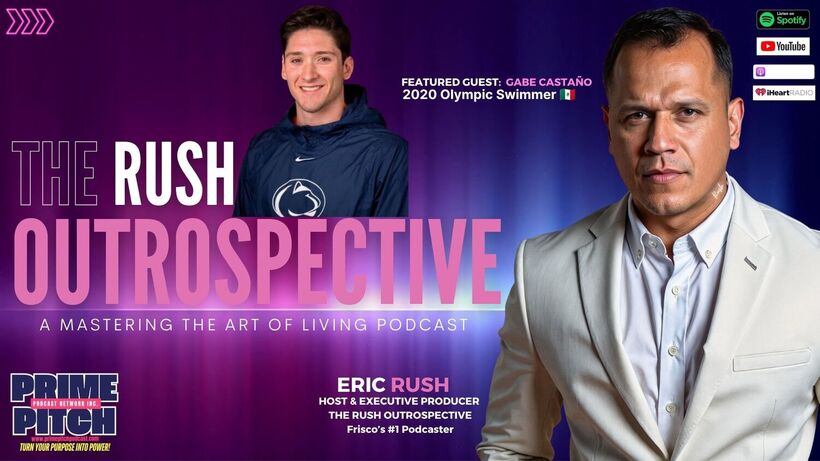
Gabe Castaño
2020 Olympic Swimmer · Mexico
About the show
The Rush Outrospective is a Mastering the Art of Living podcast: raw, honest conversations about purpose, healing, and the road back to identity, the flagship series where outrospection began. Hosted by Eric Rush, The Conversation Architect, a Bronze Star combat veteran and the founder of Prime Pitch Podcast Network.
Read the full transcript
you know, ask anybody in my family, ask any of my friends, I shouldn't be here. I shouldn't be at this level. It was not something that I expected. And it just kind of it was step by step, you know, from the from the get go and swimming. I was very I knew I had some talent, but I was never at the level that that you might say, oh, he's going to go to the Olympics.
Hey, what's up, guys? Welcome to the Rush Out Perspective, a Mastering the Art of Living podcast. Today, we take a deep dive, no pun intended, into the extraordinary journey of swimming sensation Gabriel Castaño, who defied the odds. From a Mexican dreamer to an Olympic contender, we will learn about Gabriel's relentless spirit that earned him a spot as a sole Mexican swimmer with an A-cut qualification for the Tokyo Summer Olympics and his achievements of being named an NCAA All-American and a member of the Big Ten teamin 20 20. But we're not just going to talk about his personal achievements.
We're going to learn about what it takes to have a heart of a champion and what impact impacts he wants to make on this community and those around him now and in the future. Thank you for having me. It's great to be here. For sure, man. It's great to have you on the podcast.
I was doing a lot of research on you. It opens up a Pandora's box of how you want to approach a conversation about this. You want to talk about having a championship mindset, how to go intoyou know, cultural, the cultural aspect, you know, that, you know, many sports, you know, many sports, professional sports are, I mean, you see a lot of great, great, great athletes in boxing and in swimming. And different sports with a Mexican background and the pride about being a Mexican athlete is definitely one of the things that we're going to talk about today. And, you know, what you're striving for in the future and taking what you've learned as a professional athlete and representing a country on a large scale and what you want to do in the future, okay?
Let's do it. Let's do it. I was looking at your journey and one of the things that stood out was that your journey from a young swimmer to an Olympic athlete is pretty amazing. Take us back to the early days and what initially sparked your interest in swimming in the first place. yeah so for me actually i wasn't i wasn't a swimmer my whole life i actually started in high school which is uh considerably late for somebody that's into swimming yeah most of my friends that are you know high level they started when they were very young i did start young to you know just to learn to swim my mom put me in lessons to obviously you know for safety reasons and all that but it wasn't anything i took very seriously i was into cycling i was into triathlons so it did come in handy once or twice when i was little but not until i got to high school was when iWhen I really, you know, went for it and it started to, you know, grow on me because swimming isn't really considered a fun sport, if you will.
But it is definitely something that that I became obsessed with. And you have to be when you're when you want to get to a certain level. And that's that's kind of what drove me to that point. But growing up, yeah, it was definitely a big adjustment for me to move from from cycling and swimming. Yeah.
Was there somebody that you were emulating when you were taking swimming classes? Was there somebody that really sparked your interest, said, hey, man, this is a sport for you? Was there somebody that really pushed you that direction? Not really. I mean, I definitely had, you know, I looked up to some people, Nathan Adrian being one of them.
He was an Olympic gold medalist in 2008, 2012, 2016 as well in all those Olympics. And he was the, you know, the great American sprinter of the time. I definitely looked up to him. But before that, I mean, I really didn't know many swimmers besides, you know, obviously Michael Phelps. Everyone knows him.
But other than that, you know, I started to it was it was something that I took interest in. And over time, learning from those guys and watching those videos and learning those techniques was was something that I was really obsessed with. And I was trying to emulate as much as possible. yeah you know honestly michael phelps it's ironic that i'm um i'm actually we're interviewing today because michael phelps is probably the top 2 athletes that i respect and admire the most just you know how he dominated the sport of swimming you know so it's great to have you for sure um you know off the camera you and i talked a little bit about some of the challenges you faced umthat you faced on your path to becoming a swimmer for the 2020 Olympics. In particular, we were talking about how you know when you were chasing your your your Olympic dreams during the height of pandemic, how that what what are some of the obstacles that you had to go through with that?
Yeah, well, beginning in 20 20. Well, before that, actually, I'll start before that because, you know, I had a knee injury in 2019 that started to get worse and worse over time. I was going into my junior year at Penn State and I remember competing at Pan Ams, which actually the next Pan Ams is in about about a month and a half. So already 4 years ago, it's crazy. But at the time I competed at Pan Ams.
representing Mexico and I had my knee was about twice the size that it should have been just from fluids and all that stuff. So it wasn't good to say the least. And it was definitely a big uphill battle coming back from that into my junior year at Penn State, trying to rehab, trying to stay healthy,you know, stay on top of those things. Because for me, it was, it's something that I've always been a little bit iffy on is like the recovery aspect of things, the, you know, stretching, all that. I'm not very flexible.
So trying to stay on top of that was definitely a big obstacle at first. But, you know, fast forward to the pandemic is when I kind of took a step back and I was like, I'm going to let this heal fully. I'm going to try to not do a whole lot, let it recover on its own. and do some rehab here and there and try to stay healthy. But coming back from that, obviously all the pools were closed.
There was nothing that I could do. Since it was a swimming injury, I did it while swimming. I'd never really felt it walking or running or anything like that. So it only flared up when I swam. And over those months that I wasn't swimming, I was like, okay, well, I feel better.
I don't think this is a problem anymore. But sure enough, I got back in the water and immediately started feeling the same pain. So I said, you know, there's about 12 months to go to the Tokyo Olympics. It's time to do a surgery or, you know, try to look at some alternatives. And I had some long conversations with the doctor, with my trainers, with my coaches, and we decided that surgery was the best alternative or the best path to recovery.
And so I went forward with it. This was July. The end of July in 20 20. And it took me a good amount of time to get back into it because of the COVID protocols and because of all that. Personally, I think it was all a bit too much.
I think it was a little overdone and I don't want to get into it too much, butFor me, honestly, it was definitely a hard time going through all that rehab, going through, you know, with school, with swimming, with everything, trying to balance all that. With, you know, crutches and everything else, it was definitely not ideal. That being said, though, Ii definitely uh made the most out of it and during that time my my roommates and and myself actually you know periodically would get like contact traced or whatever so the penn state protocols were very very strict on that yeah i missed about i want to say about a month of rehab overall yeah um in that time that you know it should have been a six month recovery it was probably closer to 7 or 8 months yeah um and it was definitely something that i was i was very upset about um you know with with the short amount of time i had until the olympicsSo for me, it was trying to balance all of those, trying to balance school, trying to balance the recovery process. And coming back from that, it was my, well, I guess the end of my senior year at Penn State. For me, it was definitely a lot tougher to get back into it and get back in shape because actually at the end of January, when I was starting to get back into things, I actually got COVID myself.
So asymptomatic, by the way, which is not great. So I had no symptoms. I had to be locked down for 14 days. And then Penn State Protocol wouldn't allow me back until I did some heart monitoring and stuff. So it was another week on top of that.
And then right after that, I had the Big Ten meet of my senior year. So, you know, no preparation. I was out for like three and a half weeks. Really not ideal. And with all that, you know, that's a very small portion of that journey with COVID.
But after that, you know, I started to, well, we qualified for NCAA. So it was another month or so of prepping for that. And after that, it was like, okay, now it's time. If I don't go now, if I don't start working my ass off right now and stay consistent and stay away from this COVID stuff, I can maybe be in shape in time to qualify for the Olympics. And I traveled to Europe for 3 weeks trying to qualify.
I did 2 meets there. um i came back and i did one in california and that was that was where i qualified was last very last meet um that that you know that i could have qualified in and at the time at the time there was a lot of you know push for for certain you know the umthere was a lot of treatments that people were asking me to get and stuff. And I was very, you know, I was very adamant on the fact that I didn't want to be a part of that. And for me, honestly, not to get too into it, but I was very, very, you know, personally, I believe that it's that it's everybody's choice. And I didn'tgo forward with it, but it was very, uh, it was definitely very controversial and I had to go through a lot of hoops to be able to, to do what I wanted to and to be, uh, stay healthy and do what I wanted to.
So, um, yeah, for me, COVID was a roller coaster, but luckily that's, that's done. yeah or so they say but yeahBut, yeah, I mean, for next year, I'm very excited because I don't have those things in mind. I don't have that injury. I'm very, very excited to get back into racing. I'm already training, so it's only a matter of time.
That's awesome, yeah. I could see that one of my personal friends, Dustin Stanton, I talked to you about that, how he had all these scouts coming to him after he rehabilitated and then COVID hit, and then all the scouts, all his meetings with different scouts around the league. disappeared and ended up retiring but yeah i could see how that was a huge impact and then you're you know you're in a catch22 you either do this or you don't do that or and you do that or you don't do this and you don't do that kind of situation which is is a horrible position to be in especially when it has something to do with your health you knowyour decisions to what's best for your own personal health. You know, touch on it a little bit. You know, Penn State has been a hot, you know, been in the national news for various reasons.
You know, with differences, you know, boys, men swimming, female swimming. What's your take on that a little bit? You want to touch a little bit on that? As far as like the team culture? Like the, you knowlike men competing with girls, you know, and that kind of thing.
Yeah. I can definitely get into that. That was actually Penn, UPenn. It's different than Penn State. But no, that's still very relevant.
I can go on a long time about that. But I think it's BS. I think it should be nowhere near the level that it is, and it shouldn't have been allowed in the first place. I'm very outspoken about it. I'm not afraid to, you know, and I don't think anybody should be afraid to speak their mind about it.
It's ridiculous. If I were to do that, I would break every women's record on the books. It's very simple. And I don't believe in that in the slightest. I believe that there is no room for that and there shouldn't be any room for that.
And finally, they're starting to pass laws that prevent that from happening. You know, I think women are more afraid to speak than they should be. There's a few like Riley Gaines, for example. She's great. She's been very outspoken about it.
And she's one of the only prominent voices that I know that are willing to stand up to that side of things and, you know,deal with all the backlash because even though there shouldn't be any there for some reason is And I think that women should be that women's sports should be protected. Of course You know if my daughter my my sister whatever I don't have a daughter I'm saying like in the future Yeah, if I had a daughter and everything that would be something that I'd be very very passionate about very outspoken there's no reason for for a man to be competing with women in any way and As much as people would like to say that's not that's not a woman. That's a that's a man. SoYeah, I appreciate that. I apologize for making the school misrepresentations.
Yeah, I did a lot of research when I was getting my master's on Title IX, and to hear it just flips on its face is pretty astonishing. I hate to change the word and get it back on you. What do you think sets apart the mindset of a successful athlete? from the rest and how do you maintain the mental resilience in high pressure situations? It's a good question.
Before COVID, I would give you a different answer just because I think it has to do with confidence and the training that you've done. Because before COVID, my mentality through high school and through my early years of college was I'm invincible. You know, it's obviously not. That's something that I'm obviously very realistic. But having that mindset puts you above other people just in the sense that you don't hold yourself back in any way.
You see yourself as, you know, you're racing against the best in the world and you can say, well,I'm going to do my best and I know that I can that I can compete with them and put, you know, put up a fight that at least gives you a chance. I know a lot of people that are just like, oh, you know, that's this person that I'm racing against this X, you know, time, whatever this this and that. And I think that that already mentally holds you back. And I think the mind is extremely powerful and relying on it and believing everything that you that, you know, if you if you start visualizing things, negative things, they'll become true and all that. So I think that's something that I've been working on lately because of my whole injury and everything.
That was something that my confidence took a hit, obviously, because I was out for so many months, not training consistently and all that going on. And I was very worried about the fact thatThat I'm racing against guys that are obviously very consistent. They're very strong. They're very, you know, they've been in the sport for longer. They've been in high pressure situations more than I have.
And for me, it was it was something that I definitely am still working on. And I believe repetition as well is very, very important because especially for sprinters, you know, my race is 20, 22 seconds in an Olympic pool. And anything, any little mistake is going to cost you the race. So I believe just repetition, having the stroke down, the underwaters down, the start, everything, every component of it has to be right in order to succeed in those high-pressure situations. Wow, 22 seconds?
Yeah. Wow, that's crazy. How far do you swim? It's 50 meters.50 meters? Yeah, yeah.
Wow. So one length of the pool is 50 meters. That's fast, man. I got to see you do that with me. Yeah.
OK. And as I touched on a little bit, it's about we've seen Mexican athletes compete in various sports, right? Well, in the Olympics particularly, Mexican people stand out in the Olympics a lot in boxing and other sports, soccer. What is the significance of representing your country in swimming, and how does it align with your personal goals? Well, for me, it was it was a little interesting because since I got into into it so late, I was born and raised in Mexico.
I lived there for 12 years and then I moved to the US and I've lived in the US ever since. So for me, it was a little bit I was a little disconnected from from sports in Mexico for a while before I joined the national team. But for me, it was it was interesting because this was my my freshman year of college was when I finally decided to startcompeting in Mexico and trying it out. Because before then I was good, but I wasn't near the level that I wanted to be because, for whatever reason. And so I showed up to a national meet, I remember this, and everybody just spoke to me in English.
Everybody thought I wasand at the time I actually wasn't. So I was still, Spanish is my first language. People normally don't assume that, but I feel very connected to my culture in Mexico and I know that there's a lot of people that areThey're big fans of swimming, but the representation isn't necessarily there. With swimming at a high level, it's very difficult to be at the Olympic level and all that. Unfortunately, Mexico is a country that has those resources but doesn't allocate them properly to those athletes that want to represent them at a high level.
Fortunately enough, I was able to make it work with Penn State. My parents were veryI'm very lucky to have my parents support me and all that. But the resources in Mexico that are misused, I feel like they could be putting into athletes and making much more than what they have with sports. You mentioned boxing. Diving is another one.
I know a lot of the divers on the Mexican team. I roomed with some of them in the Olympics. And they're some of the best in the world. They get medals pretty frequently at the world level. And it's impressive to see it.
And I think that there's just so much more to be had in Mexico if those resources were properly allocated. But, you know, shoulda, coulda, woulda, I think that there's hopefully some change coming soon. But to me, it's very, very important and very, you know, it means a lot to be able to represent Mexico at a high level when it's, you know, the crowd that does represent Mexico at a high level is very limited. So that's definitely something that made me very proud. You know, I'm a big martial arts guy, mixed martial arts guy.
My wife is a 4thdegree black belt. you know the ufc does a lot of things they've actually built an institute of a pi a performance institute in mexico and they're investing in the professional athletes i think there's 3 there were 3 champions last year ufc champions right and from mexico so yeah you know um and my grandpa actually my grandfather's from mexico he lived in mexico so my family my lineage is from there so um okay next question is umIn Mexico, sports can be a source of national pride. That's what we've been talking about, right? How do you feel about being a role model for young Mexican swimmers who dream of Olympic success? Yeah, I mean, that's a tough one.
And it's interesting because it goes back to what I was mentioning about the resources because a lot of people, you know, they have those dreams. They have the work ethic. They want to put in the work, but they don't have the There's only so much you can do when you don't have the proper, you know, the properinfrastructure, you don't have a pool to swim in that's nice and well kept and has nice starting blocks. All that stuff is out of your control. And I and I and it's kind of sad to see that in a lot of parts of the country where, like I said, I get I get DMs on Instagram that are like, you know, I want to get to the level that you are.
I want to put in the work. I'm willing to put in the work. But, you know, I'mAnd I get this one a lot, too, is the physical aspect of it, too. I'm 6 foot 4. You know, there's not that's this is not really normal.
I wasn't supposed to be this tall. My dad's like 5, 5, 10, 5, 9. My mom was like 5, 6. Oh, wow. So just it kind of happened out of nowhere.
I'm obviously very blessed, but it was not something that I was, you know, supposed to, I guess, I guess be this tall. But I get it a lot. You know, people are like. i'm being held back by this and that and and it's and it's tough it's tough to see that because number one i i don't believe in in limiting yourself and making you know excuses if you will yeah um i know that there's you know you're you're dealt with uh you know a deck of cards yeah and sometimes it's what you got to do i have friends that are not nearly as tall as i am and they're still very very fast like you knowathletes, very good, well-rounded athletes. And you've got to make the most out of what you have, unfortunately.
But I think, yeah, going back to that, I think that it's very disappointing to see the lack of attention in sports in Mexico. And that, it goes for every sport, really. But swimming being a pretty expensive sport, you know, you've got to build a pool, and it's hard to maintain, and it's a lot of money, a lot of resources. You know, people aren't willing to put that in. AndFor the future of the sport, it's concerning, but there's a lot of people that are working hard to make that right now.
Yeah. Is there a difference between, this is a random question, is there a difference between swimming in an ocean? I mean, I know there's the wholeyou know all the uh what do you call it variables in place right but is is it more is it much harder to swim in the ocean i guess yeah i mean you can't swim the same way you can't try it you can't no i mean i've i've done open water swims before um in lakes and oceans um i actually did the cancun umcruce de cancun um which is uh it was about i want to say 3 kilometers or something like that it wasn't very long but you know even then i was i was feeling the waves uh you know the salt water the lack of water um and uh it's totally different yeah but umthat's not really my thing. Because you were a triathlete, too, right? You didn't triathlete.
Yeah. So you had to do some. That was mostly where I did the lakes, the lake swims. And actually, when I was yeah, when I was like 7 or 8, actually, was my first open water swim in the South Padre Island, actually. That's crazy.
OK, could you share with us a story about a mentor or coach who played a significant role in your journey and helped you? connect with your Mexican heritage with your competitive drive? Yeah. So for me, personally, it wasn't. I didn't have a coach that was Mexican.
I trained in the US my whole life. But at Penn State, Matt Hurst, my coach, I still talk to him every now and then. He was the big difference maker for me. He helped push me to the next level that I didn't know I was capable of. Through the time that I was in high school, I knew that I was capable of a lot.
I knew that I was good, but I remember there's my sister,showed me this newspaper article that was that was written about me in high school. And I said, I said, I would love to represent Mexico in the 2020 Olympics. And that was that was so far fetched at the time. I did not even consider, you know, that actually becoming true. Yeah.
But for me, it was it was definitely about unlocking that mental that attitude that, you know, you can do it and getting to that next level. But at the same time,baby steps. You know, I can't I can't just jump from that high school level where I was a state champion to an Olympic level in 2 years. I mean, it was it was definitely a work in progress. And my coach was definitely something that or somebody that I very much appreciate being a part of my life and being a part of my career in those in those early college days and later in the college days into the Olympics.
But, yeah, as far as the Mexican heritage, I haven't had the honor to work with a Mexican coach as much. I know Nicolas Torres. He's from Chihuahua. He does really great work with a lot of his swimmers. Trained a lot of really high-level swimmers as well.
So maybe in the future I'll be able to work with him. Speaking of, when you were talking about it, I was just thinking about, like, you know, when you say that you would, like, love to represent Mexico in the Olympics, right? Yeah. Like, there's a lot of faith involved in when you say something like that and having to take the small steps. How WhatHow does your faith play a significant role in that, continuing to show up?
That's a good question. I definitely take that very seriously because for me, I know what I'm capable of, but I know that I wouldn't be able to get to this level without my faith. And I think that, you know, for me, especially through the pandemic, it was very important to stay true to that and straight to stay grounded in that. And ever since I've been I've grown a lot in it. I've tried to do my best to stay with it and and obviously, you know, grow in it because.
In sports, there's a lot of setbacks with injuries, with whatever it may be. You have a bad day, you have a bad training week. Those are horrible. And then when you don't have maybe those friends or the family that are always there for you, or maybe you don't want tospeak out or you know talk about it whatever it may be there's always the faith aspect to it and I firmly believe that there's there's high power that that helps me you know achieve all this and has given me the the physical aspects the mental aspects and everything else and I'm obviously very grateful and blessed to be you know at this level so. That's beautiful, man.
It's awesome. Yeah, you know, I agree with you a hundred percent. Like, you know, especially for athletes, I think you're always going to have, you're going to have some setbacks and, you know, you're going to have to lean on something, you know, spiritual power that's going to transcend your own mindset. Someone else's, you know, just, you know. you know subconscious you know whatever you know like people sometimes subconsciously restrict you from reaching achieving your goals so you kind of have to escape the the human element you know and go to to a higher place so i value i respect you for that man umOkay, the Olympics are not all about sports, but also about diplomacy and unity.
How do you view your role in fostering international camaraderie through your swimming career? Yeah, that's something that I definitely wasvery aware of before the Olympics. Um, but when I got there, I remember it was the, uh, the opening ceremony where I was just like, I was able to take it all in, you know, everybody from, from all over the world, it doesn't matter what race, what religion, what anything, um, everybody was, was united at one, one place, one time. And, uh, the whole world was watching the, the, the opening ceremony. Unfortunately, nobody was allowed to be there, um, in the giant stadium.
That was a bit of a disappointment, but anyway, I think it was, um,Definitely something that it hit me. It hit me hard. I was like, what a privilege it is to be there in that stage with all those people, all those superstars. I think I saw, I'm not really big into basketball, but I saw Kevin Durant. I saw Djokovic, really high level athletes that were in Tokyo.
And I was able to really appreciateyou know what what god has given me and and this opportunity and uh i i have friends from all over the world too from from the swimming world uh it's a big you know the swimming community is big but it's also small in the way that um everybody kind of knows each other everybody uh at least yeah at least knows of each other um so it's definitely uh i i love that about swimming um i have friends from you know every every corner of the earth so yeahDude, that's so beautiful, man, to have you, to know that I, that, know somebody that has experienced it at such a, have an omnipotent experience for your life. Yeah. And that's, that continues to, that's part of your, like, now it becomes part of your responsibility, right? Like, you know, you carry that mantle and say, you know, I still hold that torch for Mexico, right? Right.
Or the United States, too, right? Speaking of, youYou're kind of in and out, you know, you're practicing, you're working on your craft, right? Also in the community, what does that look like for you? And what role do you want to play as a professional athlete who has a voice, who can make a difference? Speak to me about that and how important it is and what your vision and dreams are for that.
Yeah, I mean, I've always liked speaking, you know, speaking out about whatever it may be. I love, I would love the ability to speak publicly, maybe some motivational talks about swimming and my trajectory because, you know, ask anybody in my family, ask any of my friends, I shouldn't be here. I shouldn't be at this level. It was not something that I expected and it just kind of,It was step by step, you know, from the from the get go and swimming. I was very I knew I had some talent, but I was never at the level that you might say, oh, he's going to go to the Olympics.
Yeah. And and be, you know, top 30 in the world at 1 point. Yeah. It was definitely a lot of work put in, obviously, but. For kids that maybe don't have that it factor yet, I can make sure to tell them that it's all about the work.
You can have that talent, but it'll only get you so far. And that's something that I'm very passionate about and speaking to people about, especially the young kids that arethat look up to me and that I want to put obviously a good image for them and represent them well and everything. So for me, it's definitely very important. And I would love to be more involved with the community, swimming community here in Texas. And I'm already starting to get involved a little bit with it.
That's something that I'll definitely grow in a little bit more. Awesome. If people want to get a hold of you to invite you to a speaking engagement or to do some public relations work, where can they get a hold of you at? I think my Instagram would probably be the best way to do it or my email. I guess we can link it somewhere on the podcast.
That would be something that I'd be very happy to entertain the conversation. Very cool. Gabe, it's a pleasure to sit down and talk to you and learn about your story and, you know, just get to experience what, you know, just be in that moment as I ask you questions and watch, listen to what you say and have you feel the experience with you. So I appreciate you sharing that with me today. And guys, that's it for the Rush Outrospective.
As I always say, have peace in life and remember that the ocean refuses no