Drew Carlton
Drew Carlton joins Rush on Unfinished Business, the show for veterans pursuing new missions after the uniform and the people who stand beside them. As cEO, Mesa Springs Hospital · Marine Corps Decorated Veteran, Drew brings building something meaningful to the table.
They get into the work, the cost, and the reasons it still matters, in the kind of long-form conversation this show was built for.
In this conversation
- Building an organization with a mission
- What experience teaches about leadership
- Turning purpose into work that lasts
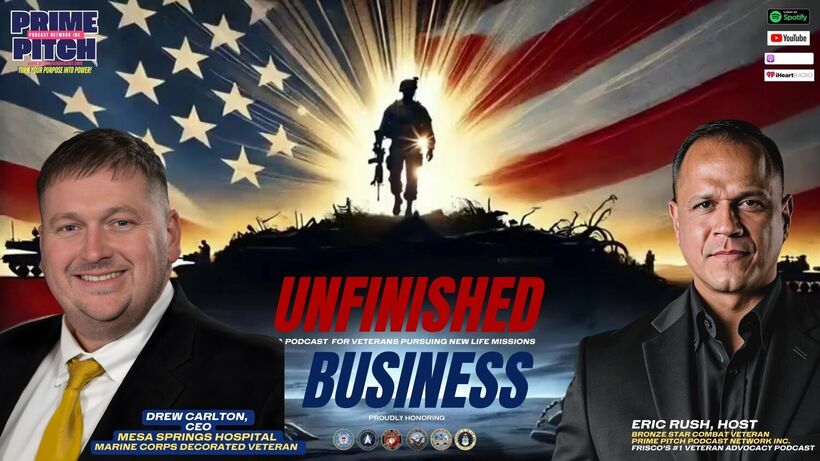
Drew Carlton
CEO, Mesa Springs Hospital · Marine Corps Decorated Veteran
About the show
Unfinished Business is a podcast for veterans pursuing new missions after the uniform, and for the families and communities who stand beside them. Hosted by Eric Rush, The Conversation Architect, a Bronze Star combat veteran and the founder of Prime Pitch Podcast Network.
Read the full transcript
You know, you've helped many veterans and families find behavioral health care. Um, what have you learned about the invisible battles veterans face at their service? You- W- When you say, when you say, "Helping many veterans and- and their family members," the rush that is- that is, uh, the thing that charges my batteries the most. Like, that is, uhThere's some day, there's some aspects when you're looking at PNLs and, uh, and challenges with implementing, uh, uh, electronic medical, uh, uh, records that are- that are happening in the hospital and implementing multiple things. When you- uh, when you get a call or you know that you've been able to help a vet or their family members be able to seek treatment or someone that- that a l- you know, a loved one in general, there is a- a sense of, uh, kind of like a- I don't know, an endorphin that hits my body that I've never been able to replicate in anything that I've ever done before in my life.
Unfinished Business, stand up tall. KadaHey, what's up, guys? Welcome to Unfinished Business, a podcast for veterans pursuing new life missions. There's a special kind of discipline a Marine Corps uniform gives you that never fades. It's not just how you follow orders, it's how you move through pressure, how you notice what others miss, how you steady a room when it starts to panic.
That kind of training leaves an imprint. It becomes part of your wiring, not just in how you lead, but in how you serve long after the mission ends. For Drew Carlton, that imprint became something new. A marine who once measured success in precision now measures it in people, in presence, patience and trust. His mission didn't end when the war it evolved.
At Mesa Springs Hospital, that evolution has formed. Discipline became design, structure became safety and leadership grew into something far quieter, the art of helping others heal. That's where the- our conversation begins, with a man who carried lessons from command into the language of care, and built a place where both could finally exist. Brother Drew, it's awesome to have you on M- on Unfinished Business, a podcast for veterans pursuing new life missions. Um, you know, when I- when I read that intro, what- what was- what was one thing that just you said, "Oh my God, that- that"Bro, I've never been talked about like that before in my life, so I kinda thank you for that.
That was incredible. But yeah, no, I- I think everything that you talked about resonated well. Um, yeah, when you talk about transition, uh, that is- that is, I think the area that, uh, can be the most challenging and tr- risky for vets. Um, and I appreciate you giving me the opportunity to kind of tell my story about that. Yeah.
Let's- let's- let's do a brief, uh- uh, a little bit of brief background on- on- on your military experience. Sure, yeah. And- and we'll go from there. Yeah, so I went in to the Marine Corps in 1999, um, and, uh, so went to boot camp in Charleston South Caro- or in, uh, Parris Island. I was actually going to college at The Citadel in Charleston, South Carolina, so Parris Island about- being about an hour away, that was a- uh, that was a very easy bus ride over to Parris Island.
Mm. Uh, and so, uh, boot camp, um, and then I was 03, I knew I wanted to, uh, go into the infantry. Ultimately, my grandfather shot for the Navy on the Navy Pistol team, so I wanted to be a scout sniper, and that was from day one, that was my goal. I, you know, grew up on, um, you know, Tom Clancy books and- and those types of movies and things like that, and so I- I knew that that's really where- the direction that I wanted to go in. So, went to boot camp then went to SOI, uh, and then got assigned to the fleet and, you know, uh, what I've known about scout snipers is that, uh, you had to try out, they had to select you.
Um, they had done a pilot program that if you had a first class PFT and you shot expert while at boot camp, they- the commander could just put you in that platoon. And so, uh, when I got assigned and I got to- got to third Battalion, third Marines in Hawaii, they automatically put me in a scout sniper platoon, and I was terrified, absolutely, 'cause, you know, you kinda wanna build up to that, and I know that my seniors had been in that place where they had to try out for it, they had to spend their time in the platoon, and so, you know, I was met with a lot of resistance, right, when I got put into the platoon because I didn't have to go through the indoc and stuff like that that they had to go through. So, ultimately we, uh, the ones that were selected for that got a- a- a kind of a rude awakening, uh, by the seniors that actually put their time in, butUm, so obviously, if we kinda know the timeline of- of American history, '99 kind of in a peaceful time, Kosovo's going on, um, then boom, September 11th happened, right? And so life changes completely, um, and, uh, you know, it was interesting to kind of see what happened, um, and from one day that you kind of go from a peaceful environment and then overnight you're- you're just, like, potentially going, uh, you don't know where you'll be deployed, and so, umWe saw, we heard movements of, uh, some people being mobilized. Perhaps Iraq, perhaps Af-Afghanistan.
Um, we got sent to the Philippines. It was a very short period of time. And, uh, I think it was, like, one of the very first missions of, uh, Enduring Freedom. Um, but it was, in comparison to what other individuals have gone through, like where they spend their entire enlistment or, or their commission in a wartime environment, mine was a very, very brief period of time. And so, um, you know, looking back on it, there was a lot of, I, I've experienced a lot of guilt because I, you know, I got stop-loss for a short period of time.
Mm-hmm. Um, and in order, you know, there were, uh, folks out of California that were gonna be going to Iraq and our juniors that were there, they were like, "Yeah, let me, let me go get reassigned and, and go get deployed."And so when we got stop-lost, um, and then all of a sudden they let, they, if you wanted to get out, you could get out. I always wanted to be an officer. Like, that, that was one of those cycles that I wanted to, to be able to go through. And so, um, I opted to, to leave and go to Texas A&M and then enroll there.
Um, and, uh, you know, th- those are those types of moments where you sit back and you have a little bit of guilt associated with that. And so, you see the other people go off and go get deployed, um, and, uh, you know, still today I think about that, right? Where would my life be any different had I, had I, uh, gone through that process and never decided to get out and continue to deploy? Um, a lot of great marines, uh, that I knew decided, went down that, that route. Um, but those are those things that kinda you wake up and you try to figure out, you know, what would be different had I decided to have stayed in?
Um, and I really, genuinely feel that God, uh, chose this path for me and I, uh, I d- I listened at the time, fortunately. Mm-hmm. Um, and, um, I've been able to help in ways that I, uh, would never have been able to had I decided to go in that pa- that particular trajectory. But, you know, to kind of go back, after I went to Texas A&M, um, I decided, uh, that I was gonna be a lawyer. That, that, um, uh, realized I really didn't like reading books that much and I knew that that's a big important aspect of becoming a lawyer.
Um, and, uh, then I decided to go to nursing school, um, and so I worked, uh, I worked overnights in a psychiatric hospital. Mm-hmm. Um, and so working overnights while I was going through nursing school and, um, you know, I remember the challenges associated with that. But, you know, my goal was I was gonna be a, I was going to be, um, a flight nurse. I wanted to get on helicopters and save, you know, pull people out of, of cars and stuff like that.
So after I graduated nursing school, um, I got a job at the local emergency department here in Fort Worth and, um, you know, uh the most critical element that a emergency department nurse can have is to be able to start an IV and I could not start an IV to save my life. Mm-hmm. And so, uh, it was, uh, they, they would, uh, they would generally stick me with the psych patients because I would always like to talk with the psych patients. Um, working with psych patients, your ability to be able to communicate, be empathetic is the equivalent of being able to start an IV on somebody that's completely unconscious and, and bleeding out, right? And so, um, I realized at that point that that might be where my calling would be.
Mm-hmm. Uh, and so, uh, I transitioned from, uh, the emergency department, uh, into becoming a psych nurse full time. Worked my way up, um, uh, as a unit manager, um, uh, chief nursing officer, uh, and then ultimately I realized that I liked the business side of that, uh, aspect too and, and leadership and so Chief Operating Officer and then ultimately led me into becoming a, a CEO of a hospital. Um, I was able to do that within 4 years after graduating nursing school, so, um, along the way there were a lot of speed bumps, a lot of lessons I had to learn, a lot of, um, uh, failed relationships with friends, with, um, significant others, um, and, um, I, I think that, um, right now I've finally kind of got all those important pieces all together. And so kind of the culmination of all those challenges, uh, where I'm really kind of reaping the benefits of, of where those, those speed bumps had led me before in the past.
You know, I was, uh, when I wrote, when I, when I, that, that's an amazing, first of all, that's an amazing, you know, journey, for sure. For sure. Which you covered in 3 minutes right? There's so much, there's so much- Yeah. backstory to that, right?
Yeah,Um, I want to rewind for a second and, and, and, you know, when I, when I first started this I said you, you had, um, you, you took, you carried the lessons of command into the language of care. And, and, and built a place where both could finally exist. Was that statement on point? Did you- Yeah, I tell you, it's beautiful. I don't think I could, uh, said it any, any better, uh, Rush, because, um, you know, when you, the lessons of command, when you find those individuals specifically, you know, that I was surrounded with in Marine Corps, it was the servant leadership that was the strongest.
So obviously there was that built-in respect. There's individuals that have already been there, done that, had graduated sniper school or were just rock stars in general, right? By, by things they've done previously. Often you saw those individuals be willing to be the first one to be able to raise your hand to be able to do that, right? And so, uh, taking those lessons specifically and translating that over to within the first week of, uh, taking a new assignment as CEO of a hospital to, uh, getting a mop and mopping up an area where a patient had been, been able to spill.
Hmm. Uh, s- some of the feedback that I get or I'll hear, you know, 3 months afterwards, I, uh, uh, starting that, you know, "I remember that day that you picked up a mop."You know? And, "I- I remember when you did that," right? And a lot ofI- I- I had a blessing of when I started out, um, you know, in behavioral health. I was mentored by individuals that actually work for me now that are in the same role that they were, you know, 17, 18 years ago.
Yeah. And so they actually work at the, at the hospital with me and they remember."I remember when you, you know, you started out on your first day."Um, and so kind of full circle, but, you know, to- to- to kind of bring back to what the point you're- you're trying to make is, is those initial examples of servant leadership and- and- and mentorship, uh, that is what has been carried over and resonates most well for where I- w- translating that over into the healthcare field. That's awesome. Um, you know, IAnd, and, you know, the question I have, the question I have for you is kind of very specific, right? Uh, the, umWhen you think back to your time in the Marines, what part of that experience still shapes the way you lead now?
Man, um, again, you know, I would have to say it's that piece of- of- uh, of the servant leadership that I, that I, that I was able to be exposed to, uh, and then, and translating that over into the way that I lead and that they- they see me lead on a daily basis. Yeah. Um, you spent your life in very structured environments, right? Yeah. Um- Yeah.
When did you finally real- When did you reali- When did you realize leadership also needed something more human, like empathy? So yeah. So yeah, y- you take a military perspective, uh, of, um, you know, uh, we always heard something, "Mission accomplishment first, troup welf- troop welfare second," right? Mm-hmm. I think that the challenge from transitioning from the military environment'Cause that's, that's built in, right?
You understand that. Everybody understands, hey, mission comes first and then your needs come second after that, right? Yeah. And when you translate over that into the healthcare, you have to learn how to blend that together and create that for your teammates that work underneath you or work aside from you, your peers, um, how to blend those 2 together where they all stay in line, right? And that's the biggest challenge because, um, if you have teammates thatUh, obviously, uh, it's weird to call them civilians 'cause I've been a civilian for so long, but civilians that work, uh, that- that work there, if they don't feel that you care about them at the same level as the hospital or whatever organization that you're associated with, they won't trust you, right?
And if they don't trust you, if they don't trust administration, that carries over and that directly impacts the patient, right? Yeah. They come in, they're pissed off already coming into work, they're distrusting. Doesn't matter how much money you spend on a Christmas party or what you try to do for- for, uh, morale around the- the organization. They won't trust you.
And so you have to learn how to blend that and be able to communicate that effectively. Yeah. That's a unique, uhOne of my friends said, "You know, what- what you did in the Marine Corps doesn'tIs n- It won't work."So, you know, it'sUh, y- yeah, and- and I- and I hope I- I can hop in and say that I, uh, I learned that mistake, unfortunately, very acutely, and I walked into an organization and- and, umSeveral years ago, uh, with that mentality, right? Um, and I was, you know, I was recruited into a position and they had said, "Hey, here are these problems, and if you can fix thes- these problems, you know, uh, uh, you know, your- uh, uh, your- your career is wherever you want it to take from that point."And, um, I immediately came into an organization without trying to build the respect of the individuals that- that ultimately were on my leadership team. Yeah.
And immediately started finger-pointing, saying, "You're not doing this. You're not doing this. You're failing here and- and there."And, uh, it didn't take long to realize that, um, thatTo understandIn the military, you're given a rank, um, but in leadership in an organization, if you don't have the buy-in of those individuals, you'llThat they- that- they will turn on you or they will make it into an environment whereby nobody is happy and working. And so, um, I learned that- that lesson very quickly, and that's, um, you knowI think we were talking about this earlier, is I've learned so much more from my failures in order to be able to- to, uh, where I feel that I'm functioning at a- a higher level, that had I not had those failures, um, you know, I- I don't think I would be near the person I am today. Yeah.
My friend, uh, uh, Juando Y. Williams said, uh, has a term called humanized leadership. Mm-hmm. Is thatIs that on point with that? Yeah, yeah.
I- IIt couldn't be any closer. Um, many veterans struggle to find purpose after service. Um, what inspired you to make behavioral health your next mission? Yeah. Uh, so I- I kind of stumbled into it, you know, Rush.
It was, uh, uh, uhYou know, my trajectories, I thought I was gonna be a flight nurse, right? I wanted to be on the helicopters and- and doing that. And then I realized that, uh, you know, I- I couldn't do what was necessary at that particular time, um, and at the speed that I wanted to be able to- to get into that, um, and- and- and kind ofI feel that behavioral health found me in that perspective. And so, you know, there's a lot of individuals that will talk about, you know, "Uh, you know, the reason why I went into mental health is, you know, I had challenges in my family," or, "I had, I had this," or, "I had that," right? And these personal experiences.
You know, I didn't have that, right? It- it literally just found me, and, you know, theFor wanting to be able to an- and enjoying to communicate with individuals, especially when they're struggling, right? Um, that is how I feel that I kind of maneuvered into that. And so I say behavioral health found me, um, as opposed to a lot of people that kind of say that from that perspective. Well, how would you define behavioral health?
How, I mean, it's the most holistic form of healthcare possible, right? So you've got, you g- there's aspects of medicine or healthcare that are, are very, very speci- specific to the part of the body. Behavioral health encompasses your physical health, it, it encompasses your emotional health, it encomp- it encompasses your environmental health, um, all of those aspects, wh- which is what makes behavioral health so nuanced. Mm-hmm. Um, because if all of those aren't in sync, ultimately your, your, your, your, your wellness is gonna be affected by that.
And so, uh, that's why I think it's the most challenging to be able to treat too as well, because you have, uh, you haveIf you got diabetes and your blood sugar is 300, right, you can take a shot of insulin, it's gonna bring it down, right? You, uh, have experienced a life of trauma for 20 years, right, and something triggers you or you, it pushes you over the edge, it's not just as simple as getting an injection. It's not as something as simple as, "Hey, I'm gonna take an antidepressant and everything's gonna be fine," right? Mm-hmm. There's other pieces and other notches and, and other therapies that have to happen in order for you to be aligned with your, your wellness.
Yeah. Um, I, I told you, um, when I had the opportunity and the privilege to go down to Mesa Spring- Thank you by the, by the way. Thank you. That was-amazing, man. Like, you know, mental health and behavioral health has been part of a, as I shared with you privately, um, that behavioral health has been a part of my, part of my pro- my continual, um, recovery program.
Yep. You know, and how, how, how it forged new paths for me to, to be able to, to host this podcast- Yeah. and ƒ down and, and, and just do different things. And just, uh, cognitively change the way I look at life and the way I, I think about things. So true.
So I have admiration and respect for you, but it was such a amazingUm, it was crazy that- True. you and I crossed paths- I know, yeah.'cause we have that, I have, we have interrelated in this- Yeah. We connect in this way. Um, do youThis is a funny question. Um, do you ever notice yourself leading your hospital team the same way you lead ƒ Marines?
No. And what parts of that mindset help you, and what were parts that you had to learn? You know, uh, you're soLove that question. If I can circle back to what you said, I d- I actually do want to thank you for telling me what you did tell me, right? And I appreciate you being as open and honest, and which, like I said, has led to a, a great friendship and moving forward.
So thank you again for being so open. And, um, man, what an incredible story you have, Rush. Appreciate it. And I know, I know, uh, a lot of people know your story but, um, I, again, I, uh, kind of where that, that huge mistake where I, I went into an organization without building that relationship or rapport with the individuals and immediately started finger-pointing, ah, you can't do that, right? Yeah.
Uh, there's not too many environments that, that, that you actually would be successful. And you, again, I've worked for leaders that do that too, and it doesn't resonate well, and it's very, you, it's tracked very easily by attrition, right? You see an organization that has a massive amount of turnover- Yeah. and then they hire new individuals. You know, you can have turnover for, for particular reasons.
There could be alliances with a orga- uh, you know, I love the director and the director just left, and you know, maybe they want to go work for the director in a different environment. But if you continually see these repetitive sykes, cycles of, of, uh, um, uh, uh, attrition of your teammates that are leaving the organization, you need to kind of put the brakes on and, and identify, you know, what, what, where those, uh, challenges may be. But, um, I love that the fact that themy team recognizes that they love that I love being a Marine. Mm-hmm. Mm-hmm.
Right? Um, so they get excited on November 10th. And if you guys don't know, November 10th is the most hallowed day, uh, uh, for a Marine. Like, it isI get more excited for November 10th than I do Christmas, than I do, um, uh, a lot of, you know, major, major holidays around there, uh, with the exception of my kids', uh, birthdays andFortunately, I have, my, my wife, uh, her birthday is November 10th too as well. So kind of like a- Cool.
Yeah. Yeah, so, uh, that was a fun conversation when we first started dating. Yeah. Um, but I think that they know what it's like to be a leader. And when I work, uh, I've got a tremendous amount of therapists that are- Mm-hmm.
that work directly, that report up to me. Um, and they understand that I'm kind of, uh, very straightforward and I try to have direct communication, because I don't feel an organization can be run well if you can't have hard conversations, right? Mm-hmm. If you're constantly having to tiptoe things around, um, you, you won't have a good organization because the trust is not there, right? So if you say, "Hey, you know, I really need you to be able to get this, this, and this accomplished," and you always have to be able to end at, "How can I help?"Right?"What, so what barriers can I remove or what, what do you physically need me to do in order to help you get that accomplished?"And so whenever I try to give that, I always end up saying, "How can I help," right?
Because there could be something in order for that to be accomplished much faster by some of the actions that you're capable of being able to do."Well, if you could make this phone call or if you could get this person to respond to me from corporate who I've been emailing for the last 2 weeks because, uh, you know, they've ghosted me about that."And then you find out, and then, you know, whatever you need is done at that point. So, um, you know, that aspect of they appreciate that I'm, uh, a Marine and they work around that and they understand that I don't use a lot of therapeutic languages. Um, and, you know, um, you know, I, uh, words of affirmation are not necessarily my love language, right? You know, uh, and, and they understand that and they appreciate that and they embrace it. Yeah.
So that, I would say that that's how that translates. Well, for the record, I think you're very, uh, articulate and, uh- Oh, thank you. I appreciate that. Yeah. charismatic- Uh.
in how you g- y- you, you carry yourself and, um, and, uh, how you articulate what you have to say. Um, um, uh, what was I gonna say? And, and, you know, I was thinking about it as we were talking, like, like, they probably know you've been through some things, too. Yeah. Yeah, yeah.
You know, so, so you have that armor up- Yeah. uh, you know, breastplate of, of, of life experience- Yeah. to, to help, to support. Humility, right? It's humility.
I think you- Yeah. hit the nail on the head there. You know, I, uh, the i- my most difficult piece was transitioning out of the military and the mistakes that I'd made leading up to getting into leadership, right? And so I'm very open about, you know, some of the things that I've endured or I've experienced, and so that's something that, uh, I'm very passionate about. But thank you, yeah, thank you for, uh- I-reminding me of that.
Absolutely. Um, Mesa Springs, um, runs with such calm and precision. At times, maybe when I was there, I just gotta- I don't know, you know? But, uh- Yeah, yeah. when I was there, it felt very calm and, and it was just, I could tell it was at- Yeah.
that precision. Um, what did, what did you want people, patients and staff, to actually feel when they walked into- Exactly what you just said, right? That, and that's the, that's the critical com- component. Behavioral health is one of those aspects where one day could be completely on fire and it, it could the next day could be so mundane, right? You really never know what you're walking, walking into.
Especially, you know, Mesa Springs is a 24/7, uh, it's considered a Class B emergency department. Hm. Our door's never shut, right? We are, we are constantly accepting patients. It doesn't matter if it's raining, it doesn'tWe have no closed days.
Uh, so somebody that comes into crisis on a Monday could look somebody, you know, the, the 7 individuals that show up in crisis, uh, on a, uh, on a Thursday is completely different, and, right? Mm-hmm. The, what we talk with our team and, uh, specifically the senior leadership team is you have to have that, that air of understanding andBecause your teammates are always looking at you and, and understanding. If they're looking at so much of your subliminal body language, uh, if they see you panicky, it's gonna resonate with them, right? So we're constantly in check, and, you know, I think the most important meeting I have every day is our morning flash meeting.
That's a, a 9:30 morning meeting. I, I have each one of my senior leaders report out on particular what's happening in their department and if I notice that one of them is a little bit more anxious or not giving eye contact or some of those things that I feel will translate to the individuals that report up to them, I pull them aside and say, "Hey, is everything okay? You know, you, you seem a little off today. What can I do to be able to help?"Right? Um, that, that aspect and constantly checking those individuals, um-is, is a critical component.
So again, I think that that, that morning meeting to really kind of understand where my leaders are at and, uh, and how that's translating to the teammates that report up to them, which ultimately are then touched by the patients, right? And so having that air of calmness is critical in, in an emergency environment. So, you know, you got a, a patient that's, y- coming in. Let's just say they're, uh, experiencing-acute psychosis, right? Um, and to be able to treat that versus the individual that, um, has been struggling with depression for some time and, and is, uh, fi- finally a family member found them right before they were about to, um, um, uh, do something to harm themselves.
Yeah. Right? To be able to understand, you know, the, the treatment between those 2 is a little bit different and the engagement is there, but the wa- the manner in which the treatment is implemented needs to be calm and consistent every time. Awesome. Um, you've been on both sides of service, breaking things down and helping he- people heal.
Yeah. Um, what does healing mean to you now? Oh, man. Healing is such a challenging word because, uh, and that's something that I feel that I really have to work on on a daily basis, uh, where are you doing enough? Are you, are you, um, are you impacting enough lives?
Could you do better in some department? Um, I wouldHealing, to me, would be able to kind of calm and, uh, calm those negative intrusive thoughts. And this is just specific to me. When I feel that I'm operating well, I'm not having, kind of, negative intrusive thoughts as much, um, and I feel that my team is jiving. Um, so healing, to me, I think would be-when you feel supported, when you feel that you're making a positive impact and there's meaning behind everything that you're doing.
Mm-hmm. Um, so th- that, and I think healing will be a different definition for everyone, but that's just what it is for me. Yeah. You know, you've helped many veterans and families find behavioral health care. what have you learned about the invisible battles that are in space after service?
You, w- when you say, when you say helping many veterans and, and their family members, the rush that is, that is the thing that charges my batteries the most. Like, that is, there are some day, there are some aspects when you're looking at P&Ls and, uh, and challenges with implementing, uh, electronic medical re- uh, uh, records that are, that are happening in the hospital and implementing multiple things. When you, uh, when you get a call or you know that you've been able to help a vet or their family members be able to seek treatment or someone that, that a lo- you know, a loved one in general, there is a, a sense of, uh, kind of like a, I don't know, an endorphin that hits my body that I've never been able to replicate in anything that I've ever done before in my life. Um, so that is what I'm most passionate about and what really recharges my batteries. Um, sorry, I don'tWhat was your original question?'Cause again, yeah, that- You helped, um, many veterans and families find behavi- behavioral health care.
Yeah. what have you learned about the invisible battles veterans face after service? The, the individuals that are quiet and not are actively seeking help are the ones generally that need it the most. Mm-hmm. Um, the ones that are a little bit more out, uh, that, that are saying, "Hey, I'm, I'm struggling," right, those are the ones that, uh, I feel are the 0 uh, the individuals that have, uh, that are more apt to be able to receive the treatment.
But it's the ones that where you get a, a phone call, "Hey, I got a buddy, Tom, I serve with and I haven't heard from him in 2 weeks, and I normally hear from him every, you know, every, uh, m- you know, every, eh, every 3 days or something like that and I haven't heard anything about him. I'm really, really nervous about him. His wife called me."Um, the ones that kinda go off grid and isolate, those are the ones that I feel, uh, are the, uh, is the most challenging to be able to kind of, A, make contact with them, B, be able to get them implemented. Those are the ones that, uh, that really kinda keep me up, um, from that perspective. So, um, isolation w- I guess what I, I, I would say from the, the, from the veteran perspective is when they kinda just stop talking and stop engaging- Mm-hmm.
that's the time that the red lights need to start their way and then the flags and like, "Hey, we, we need to do something about it."Uh, because it, it generally doesn't have a good outcome afterwards from that, that perspective. Yeah. Um, this is a good transition to talk about Mesa Springs Hospital. let's talk about Mesa Springs Hospital. What, what do you guys, or what, what do y'all, what do y'all do?
Sure. And then programs that you have that, that are, you're really excited about? Yeah. And all that kinda good stuff. You know, uh, Mesa Springs has been exi- existence from, uh, in 2014 when it was opened.
Uh, we're a 72-bed inpatient hospital, as well as we have 3 outpatient sites. Um, we treat, uh, on the inpatient side, uh, for individuals that are experiencing acute crisis, um, we treat ages 12 and up. Um, one of the things I'm most excited about, uh, moving forward in January is we're gonna have a dedicated 12-bed unit to our heroes, right? So, in order to be admitted to this unit, you have to either be a veteran, active duty, a frontline healthcare worker like a nurse, a doctor, uh, working actively in the frontline of healthcare, or a first responder, so a police officer, uh, EMS, uh, fire department. Uh, those are the only, only individuals that will be able to be admitted to that particular unit, right?
And they receive their specialized training, especially, or they, uh, the, uh, the, uh, therapeutic services, uh, that are geared specifically towards them. So, staff are specifically trained with that, different kind of, uh, um, uh, schedule routine for them. Um, you know, we currently have a heroes outpatient which is thriving. I would say, of the ones where you, we gauge a lot of our success with, uh, our patients coming back, right? Uh, because again, voluntary therapy, uh, is something that it's a personal choice whether or not you choose to come back and engage in that.
And the individuals that come back are actually getting something from that. Mm-hmm. Our Heroes Outpatient program is, is, is by far our, uh, most engaged with like a 95%, uh, individuals that are coming on a daily basis to be able to, to, um, uh, be able to, uh, to work with their therapist. Um, so theWe already have that place in, in, uh, on our outpatient side. Uh, but the implementation of our inpatient side, which is what we're gonna be doing in January, so those individuals that are in acute crisis, um, that's, that, that is what, uh, uh, you knowMan, it's just like a culmination ofWhen I talk about, uh, when I was a, um, you know, working overnights, going through nursing school, right?
Everything, that culmination from that moment to where we are now, this feels like this is what I amI've been put- Mm-hmm. in the position and been able to be able to, uh, help get this implemented. You know, that's what is kind of the culmination of everything, so what I'm so excited about. But yeah, getting back to your question, uh, we, uhSo the, uh, 72 beds that we have, we treat adolescents on the inpatient side as well as adults. And then outpatient, uh, we treat, uh, child, uh, starting at the ages of 8.
We've got a location in Fort Worth, um, 0 on Camp Bowie, and then we've got another location in Arlington. And again, our onsite, which is specifically for adults, which our Help for Heroes is a component of that too as well. And, uh, our Help for Heroes component is actually part of a national organization, uh, where there's Help for Heroes hospitals, uh, that are, uh, that are, uh, associated with LifePoint Health, which is our, our parent corporation, um, around the United States. And so what I was really excited is we were able to get the Help for Heroes unit on in my hospital. Mm-hmm.
And, uh, so it's led by some amazing, uh, individuals that are just on a daily basis just 100% focused on getting, um, our, uh, our heroes, uh, placement on a daily basis. There are individuals flying in from Germany, 0 overseas on bases. Uh, uh, um, our, our first responders are coming in to our hospitals for treatments and, and things like that. And, um, yeah, it's just a blessing. Yeah, that's amazing, man.
Like y- you know, it started off, it started off in, in psych ward and now you're the CEO of a, a hospital and, and, and, and now you're, you'reyou're implementing a program for veterans- Yeah. as you know. Yeah, yeah. And inpatient and outpatient- Yeah. programs that are really, really, um, thriving and, and gonna grow, you know?
Yeah. Yeah. That's, that's suchW- when you think about w- that journey, when you think of weThe stuff we just walked through, um, and now you're at that place where you're like, "Okay, here's, here's, here's this w-" You know, "Here's"Here's aIs thisDoes th- does this, uh, veteran program, likeWould it be part of your legacy that- Oh, man. A h- a 100%. Like I said- Yeah.
and I know that, you know, the individuals I report to, they are, they are exhausted about my, my tempo with this and, and, uh, how long I've been talking about this, um, 'cause like I said, this is what recharges my batteries. And when you find that, like the way, uh, the way you've been able to implement this and touch with so many veterans, uh, and, and individuals listening to your podcast, thisI can tell this is what recharges your battery. Mm-hmm. Yeah. Yeah, this is what recharges my battery, is being able to implement this and see individuals be able to, uh, be, um, connected, be able to get the treatment.
And the friendships and camaraderie you make along the way, um, working with amazing organizationsCan I give a shout-out to a few organizations? So like One Tribe Foundation, Big Country Veterans, um, uh, you know, they're led by amazing individuals that genuinely, truly care, um, b- having the, the, uh, opportunity to be able to work with their leadership, to be able'Cause theyThat's generally where if you kind of think of it, you know, it's not people calling directly to my hospital. It's, um, because, you know, I know Mike Grohman or I know Jake Schick, uh, they give me a phone call and say, "Look, you know, I've got a buddy in Arizona that just gave me a call, um, and they re- he really needs some help," right? Mm-hmm."How can we get him some help," right? Mm-hmm.
It's not because they'reYou know, they're going through that process even though we have a channel for individuals to reach out to us directly. It's those organizations that you build relationships with where you stand across from the way that you and I are looking right now, and we- we're looking at each 0 each other's eyes that if you call me or you text me and you say you've got somebody that needs some help, you know I'm gonna pick up that phone and you know I'm gonna do everything I can to be able to get them the help that they need, because if you're calling me and it's important to you, it's gonna be important to me, right? And so to be able to build those relationships with organizations is absolutely critical. Well, wait, I'd be remiss if I didn't, if I didn't, um, mention the one organization that brought us 2 together, which is Air Power Foundation. Yes.
So we gotta give them a shout-out. Yeah. Tell me about what- With, uh, yeah. Air Power Foundation You know-does for a nation. I, I, I've gotI'm, I'm totally gonna air some dirty laundry there.
I knew nothing about Air Power Foundation, uh, until I, uh, met, uh, Melissa, uh, uh, Dobbie, uh, out, uh, the, uh, executive director over there. And immediately when I talked to her and understood the, the passion that she has for helping, uh, our vets and, umIt wa- it was a no-brainer to be able to connect with her, and, you know, she's helping us work through to be able to get something launched, uh, with, uh, American Hat Company, um, where our, uh, individuals graduating from our Heroes program are gonna be given a, um, an American Hat, you know, the, the cowboy hat company. Wow. Uh, excited about that, right? And so, um, just a, uh, a, a token, and so those types of, uh, of relationships to be able to be able to address that.
And I, IIf you've never been to an Amer- um, uh, uh, Air Power Foundation, uh, event, you are missing out, because they know how to throw a good party and connect the right individuals in order to be able to get things across and be able to really-um, uh, to be able to make some significant improvements into veterans and, and, uh, active duties li- uh, lives. And so, yeah, um, I appreciate you circling back, 'cause I think I would have left this podcast upset that I, uh, didn't mention Air Power Foundation.'Cause we were at the Sky Bowl together, and man what a great, what a great time. Yeah. So- No, it was awesome. I was surprised they played my song at the beginning.
I was, I was like, "Oh my God," I started crying and everything. No, no, no, yeah. Um, okay. Um, last question for you. If someone walked through Mesa Springs, um, through Mesa Spr- Springs years from now and you were gone- Yeah.
what would you want them to feel that says you once led there? Oh, man. Man, I, I, uh, IThe Heroes program. You know, Mesa, Mesa is a special hospital. Um, when I t- I heard a statistic, I, I haven't been able to verify it, but I actually heard it from my boss's boss, that, uh, the average tenure for a behavioral health CEO is 1.5 years, right?
So a lot of turnover that happens, uh, you know, a lot of moving different pieces, um, but the average time that a, a, an individualFortunately, I've been with Mesa for, uh, just right at 3 years ofI've been that. But my predecessor was CEO there for 10 years, right? So that's something really unheard, that you're, you're remaining in that particular position. So a lot of steady leadership. And I think, you know, we talked about that piece where you walked into Mesa and you felt that, right?
Yeah. There's a feeling, right? Uh, that, I think, is, um, uh, really what I would like to ensure, that when I knew that, uh, Barbara, who was the previous CEOThere was a feeling of being honored to be in a position to lead Mesa Springs. Mm-hmm. And the day that I'm stepping out of that CEO position, whenever that may be, whether I'm dragged out or, uh, have a heart attack or what have you, or where- wherever that replacement is that, that comes from that perspective, that they feel honored to be working at Mesa Springs.'Cause I genuinely, and I may be biased, you know, I took that job at Mesa Springs because I knew they were the best, right?
And it was kind of that culmination to be able to move those pieces from that perspective. But having worked as a consultant, having worked at multiple different behavioral health organizations, Mesa Springs in the DFW area was, always had that reputation of being the best. And so I would hope that whoever comes into the, to, into that situation would be, um, would, would feel that and I would have continued that type of reputation that I had walking into. That's beautiful. Yeah, thank you.
Drew, my brother. Yeah. Man, like it's so, it's so s- uh, you know, uh, first of all, uh, it's an honor to have you on the podcast, like that, you know, just sitting down and like I said, I had admiration and respect for you 'cause you're working in a behavioral health field. That's something that resonates in my heart, in my head, and my soul, and all, all that who I am today. Yeah.
How it changed my life and, um, so I have admiration and respect that, and, uh, to your dedication and, and your commitment. And also to the, you know, flipping the narrative on its head, you know, you know, this hard exterior of, of a Marine, a Marine- Sure. and, and, and turning it into something- Yeah. yeah, something of, of, of, a place for healing. Yeah, vulnerability.
Yeah. You know, or, orYeah, exactly, yeah. And, and I have, uhIt's just amazing, man, and I, um, and I love you as a br- uh, a brother and a friend and, uh, and it's, uh, a pleasure to have you on the podcast, my friend. Thank you so much, Rush. I appreciate it.
Yes, sir. Um, all right, guys, that's it for Unfinished Business, a podcast for veterans pursuing li- new life missions. As I always say, have peace and the light in you, and remember that the ocean refuses no river. Unfinished business, stand up tall. Alpha Kadence, we answer the call.
New life missions, rise like steel.