Dr. Katie Baillio
Dr. Katie Baillio joins Rush on Unfinished Business, the show for veterans pursuing new missions after the uniform and the people who stand beside them. As rural Veterans Career Advisor · Retired U.S. Army Veteran, Dr. brings the weight of service and what comes next to the table.
They get into the work, the cost, and the reasons it still matters, in the kind of long-form conversation this show was built for.
In this conversation
- The transition out of the uniform
- Finding the next mission
- What stays with you, and what you build next
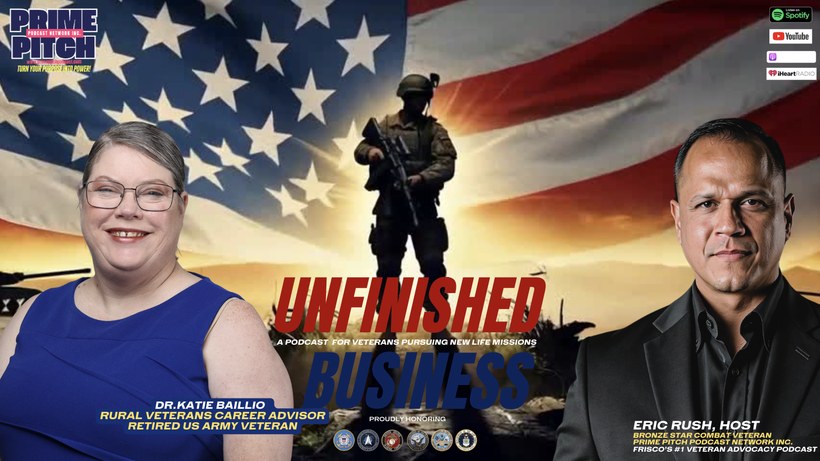
Dr. Katie Baillio
Rural Veterans Career Advisor · Retired U.S. Army Veteran
About the show
Unfinished Business is a podcast for veterans pursuing new missions after the uniform, and for the families and communities who stand beside them. Hosted by Eric Rush, The Conversation Architect, a Bronze Star combat veteran and the founder of Prime Pitch Podcast Network.
Read the full transcript
When you look at today's military culture, what gives you hope about the next generation of women stepping into those boots? We have more women serving now more than ever. We're one of the fastest-growing demographics there, and there's far more research on women veterans. So, the hap- the hope is what my sisters in the past have gone through, whether it's medically or whatever, that the research now will be there to support them. Research for women veterans is just now starting to happen in the last 5 to 10 years and there is much more in Congress going on.
So I'm hopefully that my sisters will continue to step up. My brothers will be there to support them and at the end of the day, if they need it, then the research will be there so the VA can get them the help they need. Unfinished Business, stand up tall. what's up, guys? Welcome to Unfinished Business, a podcast for veterans pursuing new life missions.
After years of talking with veterans, here's what I've learned. Women carry a weight in this country most never see. They serve the same nation, wear the same uniform, and take the same oath, yet so much of their story is unseen. People notice the rank and the ceremony. They rarely notice the weight she shoulders or how hard she works to hold her ground in rooms that were never meant with her in mind.
And when the uniform comes off, the mission doesn't end. It shifts. She has to rebuild who she is outside of the chain of command and prove her story belongs inside the word veteran. Dr. Katie Ballio knows that journey well.
She spent years advocating for women who served from the research she's pursued as a scholar to the spaces she built as a leader. She's created rooms where women can tell the truth of their service, be met with respect, and finally seen without explanation. And that's where this conversation belongs today, with the truth women carry and the power that rises in them when someone finally listens. Katie- What's up? It's awesome to have you on the podcast, you know?
I know. We've known each other for years, so I'm happy to actually be here. I am, too. You know, we have known each other for, for years, and, and I think, um, you know, it's, um, for me personally, uh, I've always appreciated your a- your affirmations and your support as a, as a combat veteran and, and hearing my story and, and affirming my d- my pursuits and, uh, scholastic pursuits when I was, uh, finishing my master's degree and, and knowing that, uh, that you are a pillar of strength in the veteran c- uh, veteran space with regards to how you represent women has always, um,has always been inspiring to me. And, uh, this thing was long overdue, and it's a pleasure to have you here today.
Well, you know, I always say thank you, and when you first asked me, uh, this last year, I was like, "Wait til my PhD is done. I will do it then."And when I finished it this last August, I said, "Yes, we're going on the podcast. We're gonna do this."Dr. Katie, can I call you that now? Yes.
All right. That's awesome. Well, it's a pleasure to have you and I just, I, I just think the world of you and all that the, all the things you're accomplishing, accomplishing in and outside the veteran space. Um, let's talk about a little bit about your journey in, um, in the military. We'll just, do a li- uh, summary of it if you don't mind, and show people where you come from and, and, and all that goodness.
Ooh. A summary. How do you summarize 20 years? No. Uh, so yeah, I did 20 years in the Army.
Um, I joined actually when I was 17, went to base training at 18, retired at 38, which to be fair was not the goal. My goal was 2 years, 22 weeks. That first enlistment, fast forward and stuff, uh, you know, and life happens, you know. Children happen, marriages happen, divorce happens, and I wouldn't trade it for anything. Um, it changed me, who I was, and who I am, and it set the foundation of life of service.
That's beautiful. Man, 0 over 20 years, 17 years old, and, and such a, such a, uh, youthful age to, to retire pretty much, right? I mean - Well, 38, uh, well, I retire from the military. I still work. Yeah, yeah, that's awesome.
Um, yeah. Retire from the military. Um, when you first put on the uniform, what part of you felt seen for the first time and what part you, do you feel disappeared? I don't wa- I wanna make sure I say this sort of correctly. When you first put on the uniform, I was in a all women's, uh, company, so we were all together.
There was no men there serving. So you disappear, but you disappear because it becomes more about we than I.'Cause you know, the Army trains you that way."We are doing something. I'm not doing something."So I think you get seen more as the team, the concept, so you know, that's ingrained from basic training that it's a we thing not a I thing. Yeah. That's amazing.
All women's company. What, what, what, uh, what was the, what field of expertise were you doing at the time? Uh, well, it was basic training, so Charlie 228 Black Lines if you know, you know Fort Jackson. Oh. So, but, but there was male companies, but I would gladly say w- and in 1992, we were the only ones that graduated everybody.
So we outdid the males at that time. That's awesome. Um, you know, every woman who serves learns different l- language of endurance. What did your sound like and who taught you? Who, who, who taught it to you?
Um, mine sometimes sound, sounded like one step at a time. Um, I'm always gonna say my grams, my grandmother is the one that probably instilled life to me. And I say life because my uncle, uh, was born handicapped, spina bifida, and it would be years later in the military that my first daughter was born in the severe and profound, and I got to share some of that resiliency with my grams. Jokingly it was like, didn't matter where I was in the military, if jeopardy was on, you don't talk to my grams. That's, that's a fact in the family, uh, before she passed away.
But my grams is the one that taught me volunteerism, giving back to the community. I knew what blood drives were before it was-a thing in the military or afterwards, so it was my grams that instilled the believing too much is given, too much is, you give back. That's awesome. Um, in your lineage, uh, are, are you the h- a- are you the only one that, or what, are you the only one that joined the military in your family, or do you come from a, a, a background of pe- So, okay, w- funny, as, and which I did not know this growing up, both of my grandfathers served in the military. Um, my grandfather on my mother's side actually served in the Korean War.
Um, he would pass away when I was about 2 years old from complications for serving in Korea. And on my dad's side, um, we believe my grandfather, who never talked about anything, served in the Aleutian Islands. So yes, there's military in my family, but it wasn't talked about and obviously I didn't know my dad's, uh, f- fam. Wow. Um, it's w- it's, it's almost genealogical that you got, you, you, you served for so long too.
Um, excuse me. There's a version of military life the public imagines, and then there is the one that happens between the lines, barrack doors closing and, uh, and briefings ending. Um, what truths from those quiet spaces do you still, uh, th- uh, spaces still stay with you? I think some of it is just the, for people that understand, for the Army units I was in, um, it's a lot of repetition. I don't think anybody is like, "What are you gonna do every m- during the week?"You're gonna go to PT.
What are you doing Monday? You're going to the motor pool. If you're in the Army and you have a Friday, you have a safety briefing. So there's a lot of standard repetition, but it's the quiet moments, it's the 0300 wake-ups and it's raining outside. And you define family, 'cause family will carry you through the military.
And it may change. People come and go. Some people that I've met when I first went in the military are still in my life. Doesn't mean we always talk, but you have real conversations when you're on guard duty or you're on CQs and it's 1:00, 2:00 in the morning and you laugh and you joke and everything else. SoThat's awesome.
You know, we didn't touch on, on, on, on the list of accolades that you have. Would you, would you run through those, be, uh, uh, during the military and post-military? well, okay. So yes, I mean, you know, in the military I was fortunate, uh, for overseas service I did 2 tours in Korea and one in Okinawa. I've been to Iraq.
Uh, post-military I've only worked for state and federal government, um, so that gives me a very unique perspective. Um, there's only been one year that I haven't worked for the state. Um, I've gotten numerous awards for my, uh, what I do for my day job, and I've also been Congressional Accommodations. And so a lot of that fueled me to continue to do what I do. And you've also done some work with the VFW, right?
No, I wanna make sure I'm fair. I am a member of the VFW, I'm a mem- uh, I'm a Gold Legacy life member, I am a PUFML in the American Legion, and I'm a life member of DAV, but the VFW is my primary. Um, I've been a post commander, uh, I was the first female district commander out of District 1. I've been, had a number of state level chairmans, and currently I'm the Department of Texas Youth Scholarship chairman and teacher. That's amazing.
That's amazing. You know, I had to make sure I pulled that out of you, you know? There was some stuff I said, "I gotta get those accolades out there."Wow. I mean, that's somewhat a wild sense of accomplishment, um, uh, so much patriotism, you know? Um, so much pride in, in serving.
But is that, am I saying that right? Yeah. I mean, definitely. Um, okay, so it's, I'm gonna make a sarcastic comment and l- the rest will understand this. So my brother makes a comment.
So my birthday's July 4th, uh, so- So my brother used to say, "The only somebody who's, uh, born on the 4th of July served 12, served 20 years in the military and continued to serve the mili- uh, the veterans."Yeah. I think that was fate, July 4th being my birthday. I don't know. That is crazy 'cause my friend, uh, Um, John Wayne Walding, born under, uh, bo- born on the 4th of July, named after John Wayne and, and you know, and a Green Beret. Right.
So first, uh, um, the, a Green Beret amputee, uh, that, that went on to, uh, complete a, um, sniper school as a amputee and a Green Beret. Um, you know, when you, when you first realize that the w- When you firstWhen did you first realize that the, the word leadership could mean something different for women, that authority that didn't have a, to sound like anyone else's voice? I was fortunate in the military that I had a warrant officer that believed in me first, so let me say, I wanna make sure I say that, but saw the potential and everything else. So her comment was always, "Know your job."So it wouldn't matter if you were a veteran, male veteran, woman veteran, female veteran, know your job and get the respect because you know it. That actually transferred more probably and so in the VFW when I had mentors in that and they would say I carried around bylaw books.
There'sOh, yeah, it is still in my car today. And so because I went to an event and it was always try to know the, your job the best you can. You don't always have to know the answers, but people respect you not because of your gender, because of your knowledge. Yeah. That's awesome.
Um, you've lived inside command and now you work outside. Um, you work, you work outside care. What's the hardest habit from service to unlearn and what did you, what, what do you still protect at, at all costs? I think the hardest one when you're getting out is you can't want it more than somebody else and that's hard. Whether it's doing what I do to help veterans with employment and you want them to do it, but it has to be their thought.
And so whether you're working in the VFW, "Hey, we should probably do this."And then you run into the phrase, "We've always done it that way."Uh, uh, I used to tell people, "Well, you've never had a female post commander, never had a female district commander, so you can't say you've always done it that way because we're all a little different."And it'sChanging people's perception is hard and sometimes the hardest thing to do is not always take it so personally. And that's hard when you care, when you care when I'm working with veterans, whetherThose are my brothers and my sisters. And sometimes you just have to, like, know when to say no, and that's a hard thing to do sometimes. That's amazing. Yeah.
I could see that. I, that's the first time I, uh, I, I, I've heard it that way is say k- you can't care more than someone else, right? That, I never thought of it that way 'cause you think about it, it's like, well, you're, you know, you're coming in a little in too, a little too hot for me, right? And that, that, that's a, that's a, I think that's a standard for a lot of the, uh, combat veterans or especially career veterans when they're going into the market, you know, saying, "Man, he's a, you know, this guy's like a, he's like a tank just driving through. She's like a, she's, she's like a drill sergeant pushing on."Well, I think it'sIt comes from a place w- of service and so'Cause sometimes people can see more potential in us than we see in ourselves.
Mm. Depending on where we're at in our lives. So you're trying to be that hype person, but sometimes they've got to go through their own journey, whether that's from a professional or personal perspective, and wanting more than them gets frustrating. And so sometimes you have to be like, "I've given you the tools, now you have to make a choice and I'm still there whether you use them or not."Um, for, for many women veterans, the, the real battle isn't recognition, it's, it's redefinition, which is basically something you just said. How did, how did you start rewriting who you were when the uniform came off?
So I always wanna make sure I'm fair when I say that is that I retired in 2012 and only one year have I not directly worked with veterans. And so transition's a little different when you're in, you stay in the veteran space. But I always tell the, the joke and the comment is the first time I got my nails done, I was pearl. I was like, "I could handle pearl. Pearl's easy."Then I went gunmetal and I literally sat in the chair for 5 minutes looking at it.
Because for me, I never really saw my nails painted, and that's not a skill set, I had to pay for these. But it was something totally different for me and it's like, "Okay, I can do this too."And, you know, your identity shifts, but it isn't changed. You take on new roles and stuff. I'm, I've been a wife, I'm a mom still, I have adult children. Taking off the uniform, I'm still a veteran, and for some, they can make that distinction, and some never leave it.
It's justIt depend. It's a personal thing, and I always say in the academic world we have to say women veterans. I'm still struggling when I say female veterans 'cause it's indoctrinated after 20 years. So I would, I'll argue with my chair and be like, "The VA says w- uh, female veterans."But academically, it's women veterans. So again, there's always little, little bitty things, but, you know, it's a work in progress.
That's awesome. Well, and Dr. Ballio, I would say your nails look really amazing today for sure. Thank you. I was like, "Hey, you've kind of went from pale, from pearl to dynamic green ƒ."Give 'em, give 'em flash.
Okay. Um, you study and build spaces where w- uh, women veterans can speak freely. Um, what happens in those rooms or forums that still doesn't happen anywhere else? I think there's a truth in healing. Um, truth means thatAnd maybe a safety, uh, a safe area, so where a woman can say what did she go through, good or bad, and stuff like that.
I've seen it where a woman feels, like, the safety to be able to open up whether whatever she dealt with in the military and then watch women come around her. And it's, the safety comes in, I don't have to explain it. I used to joke and say the first time leaving Fort Bragg or, Fort Bragg, I never wore a skirt. They didn't w- We didn't wear skirts. We wore jump pants.
And I got to Korea and they were like, "Skirts."I was likewhy I gotta wear a skirt? Um, but other women knew that. I didn't have to explain some of those things. So the truth and healing happens when we can speak our truth and not always be judged for it. I mean, we're all women, we're all different.
We're not all the same. No veteran is all the same. But yeah, the ability to say, "This happened to me," and then from a good and bad perspective, and they know that there are appear- people cheering you on that know what you've been through. You know, when I started this, uh, podcast with the cold opening, I talked about there's women, um, their stories are never, like, never heard, right? And as I was preparing for our conversation, I actuallyit kind of, like, really, uh, hit me hard.
It hit me, like, you know what? When's the last time I've seen, uh, somebody, you knowYou see a lot of, uh, n- you know, respectfully I'll say, you know, I'm not, I don't attend every event in the world, but, e- event in the world, but w- you know, it's like when do weWhen is the recognition bestowed upon a, a, a woman who's a veteran, who's dedicated her life to service and, and the military? And, and I had trouble thinking about that, you know? And so, um, that's how special this interview is for me, I want you to know, is to, to celebrate your career and, and celebrate your, your life and your journey that you're on right now and, and how you serve, uh, veterans. So I just want you to know that, uh, today.
I want you to know that. Um, um, there's a quiet sisterhood among women who served, one built more on witness than words. What have they, what have they taught you about strength that leadership books never could? That it's okay not to be okay. I mean, we know, as veterans, not just women vet- we, we know that.
But sometimes women veterans, we probably, sometimes, not all, again, we're not talking about everybody, we look at ourselves very differently. Maybe we look at ourselves through from a vision of being a mom. Was I good enough? Let alone being a veteran, and trying to really adjust all those identities is like, who are we now? Who are we now in one space could be, "I'm the veteran."Who are we now at 1 point in my life?
I was a bad mom. So it's really just to be okay to not be okay. And know that not everybody sees ourselves the way we see ourselves, and that's a good thing and that's a bad thing and stuff. I'd be, I was being fair to It's like the way he did the wrote a- write-up about me, I was like, "Damn right."But, you know, but, but, you know, and it was just like sometimes we just have to pause and be like, "All right. I'm in the space and we can do this."And sometimes it takes our sisters and our brothers to bring that out.
It's not that it's not there. It's just that, that we d- we champion ourselves, but having others champion us, that's what sometimes leadership is. Y- That's amazing. Thank you for saying that too, 'cause IThat's usually what I lead with. And as, as you were talking, you know, I was like, I usually lead with, like, you know, what about would I, would IYou know, the cold opening hit you the most?
And which part d- do youCan you think about it? Can you think about which part hit you the most? So I think it's when you go into, like, the room- rooms that are opening and, uh, you mentioned the ripple effect and stuff. And I really do believe in the ripple effect, meaning that, um, we've had conversations just today while we were working on this stuff, and you never know when you talk to other people what sparked somebody. When you get to tell them, "Hey, you didn't know about this resource," and you really get to affect change.
And it's like, when I'm working with even in a VFW capacity, it's like, there's things to help you. If you don't need it, pass it along. Change other people one person at a time. That's amazing. Um, when you look at today's military culture, what gives you hope about the next generation of women stepping into those boots?
We have more women serving now more than ever. We're one of the fastest growing demographics. ThereAnd there's far more research on women veterans. So the hope, the hope is what my sisters in the past have gone through, whether it's medically or whatever, that the research now will be there to support them. Research for women veterans is just now starting to happen the last 5 to 10 years and there is much more in Congress going on.
So I'm hopefully that my sisters will continue to step up. My brothers will be there to support them and at the end of the day, if they need it, then the research will be there so the VA can get them the help they need. Um, I have one other question, um, before we wrap up. But, um, I do wanna ask you, um, what are you working on? What- what's exciting out there?
Programs that you would like everybody to know about, um, that, you know, that's out there available for, for, uh, veterans right now? Ooh, what am I working on? Uh, yeah, I mean, soThat's a, that's a lot. Actually, you know, and I wanna make sure 'cause people are always like, "Well, what are you gonna do now since you got your degree?"I'm like, okay, so first of all that was 4 years in the making, and you're like, I'm not exactly sure. I'm always gonna be there.
Uh, you know, different opportunities will come, the right opportunities. But at the end of the day, I'm always gonna choose something that makes, that gives me purpose, whether it's going to be something veteran related or if I'm just talking to another veteran or a resource and like, "Let's connect. Let's help each other out."So we'll see. I know, uh, I mean, a lot of stuff is happening in 2025 for me, uh, professionally and personally, and I always said it would not sto- it's not gonna end the way it started. So I'm looking forward the rest of the year.
Still time. This is my, my, um, my, um, I would say moment to help you celebrate this, this, uh, great achievement. Um, um, if a young woman, uh, if a young woman were listening right now wondering whether her story will ever fit inside the word veteran, what would you want her to know? She's enough. Um, no, um, DJ, and I had this conversation one time, and I said, "Did you raise your hand and say, 'I will'?"And she was like, "Yes.""Well, then you're not different than me."Um, different, I might have been deployed, you might not have been, and to realize that own the term veteran.
Um, I worked with a veteran one time, uh, she served in the 1980s, nothing going on, and she never earned, she never even put veteran on her driver's license. We're in Texas, that's a thing. And the more I got to talk to her and it was like she realized she was one, but it was actually from her family that served in Vietnam that they told her she wasn't. So I get to go around and tell this, like, "You are a veteran," and so there's a lot of formal definitions and there's not."You wore the uniform, you said 'I will,'" that, and just remember that, and I'm always fair when I'm out speaking, like today I, I'm in a more business professional, you don't see veteran. And I've been saying, "Sometimes we can't see ourselves, and that's okay.
Just because we're not visible does not mean we're invisible," and stuff, and don't be afraid to own your voice and know that you're not on an island. There's a lot more of us out there than that, and if you ever need to reach out, look, there's a lot of resources out there for you. Dr. Katie Balio, amazing, uh, conversation, amazing, um, opportunity to spend time with you and, um, so much more to un- unpack with you and I and, and get, get underneath the hood a little bit more with the questions I wanna ask you and we'll, we'll do that at another time. I would love to revisit with a whole nother set of, um, experiences for sure.
Oh, definitely. I was glad to be on it. Thank you for this opportunity. Absolutely. All right, guys, that's it for Unfinished Business, a podcast for veterans pursuing new life missions.
As I always say, have peace and light in you, and remember that the ocean refuses no river. Unfinished business, stand up tall.