Dr. Kanene Ubesie
Dr. Kanene Ubesie joins Rush on Next Level Thinkers, the show about mindset, effort, and how high performers actually operate. As double Board-Certified Acute Care Surgeon · Educator, Dr. brings mindset, effort, and human potential to the table.
They get into the work, the cost, and the reasons it still matters, in the kind of long-form conversation this show was built for.
In this conversation
- How high performers actually operate
- The difference between effort and outcome
- Mindset put to work, not just talked about
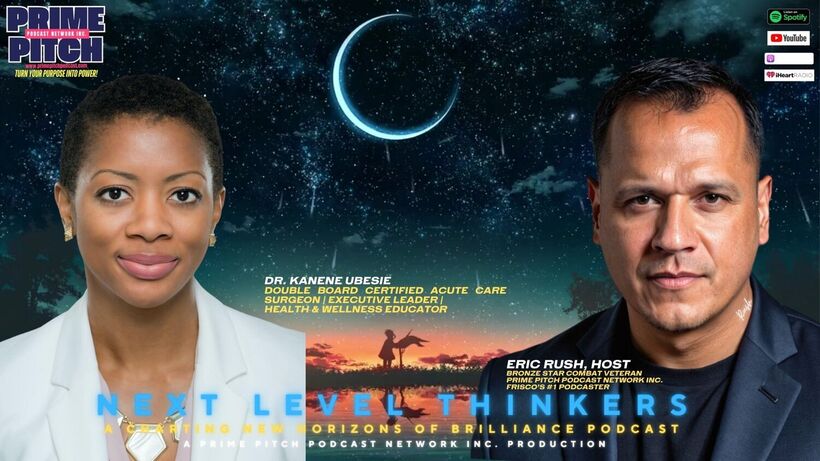
Dr. Kanene Ubesie
Double Board-Certified Acute Care Surgeon · Educator
About the show
Next Level Thinkers is a Charting New Horizons of Brilliance podcast: conversations with high performers pushing the boundaries of effort, mindset, and human potential. Hosted by Eric Rush, The Conversation Architect, a Bronze Star combat veteran and the founder of Prime Pitch Podcast Network.
Read the full transcript
I remember there was a, there was a match day. Match day is a big celebration and, and, and, um, a very prominent memory for a lot of physicians. It's the day that they fig- they find out where they're gonna go for school, for, um, residency. Um, of course because of this incident, I unfortunately was robbed of match day. Hmm.
Um, it was very painful. I remember sitting in my closet and literally underneath a pile of clothes crying 'cause I, I, I missed match day because of something that wasn't even my fault and something that I couldn't even control. Um, and I remember thinking, "Okay. I can either sit here and cry amongst these clothes and water this carpet, or I can use these tears to water the ground that's going to f- uh, to be my foundation in being a surgeon."So I decided that day that I was never gonna let somebody else determine my future regardless of what I'm going through. And so I decided that day to fight for me being a surgeon.
And so no lo- the goal no longer was make sure people see that I am right, make sure people see that I am valid or worthy. Hmm. The goal was be a surgeon so that I can help people. Next level, next level come and take a ride. To the future where brilliance and power lie.
Hey, what's up, guys? Welcome to Next Level Thinkers;a charting new horizons of brilliance podcast. Operating rooms are built for urgency. Every movement calculated, every decision final. But sometimes someone comes in walking into that space carrying more than training.
They bring a deeper kind of preparation;one shaped by faith, culture, and a refusal to separate who they are from what they do. Dr. Nkenene Ubesie is that person. She's a trauma surgeon with exacting standards, but she's also a wellness entrepreneur, a mentor, and a faith leader who brings healing, who believes healing should affirm who, the whole person, not just repair what's broken. She's often the only one in the room, the only woman, the only Black voice, the only person asking if the system itself could do more than stabilize, if it could help people feel seen.
She has redefined how those spaces could function. This conversation is about what gets embedded into systems when someone refuses to fragment, fragment their brilliance. You're listening to the Next Level Thinkers Charting New Horizons of Brilliance podcast, and today we're sitting with, with someone who doesn't just lead with skill, but with soul. Dr. Nkenene Ubesie- Thank you.
uh, nice to meet you. It's a pleasure to have you on the podcast. Thank you. You know, know, when- whenever I think of, uh, when I, when we kind of do research on people that are really, um, reaching more, like doing more than, than, than, that's required, you know? We, you already have a, uh, an amazing, um, pedigree in, in, in the medical field, right?
Yeah. it extends beyond that. Yes. And learning about your journey is that I said, "Man, we gotta get, we gotta get Dr. Ubesie inside, in the podcast."And I'm so excited to have you here today and, and to tap into what, what ignites you, what sets you on fire, and why you do the things you do.
So it's a pleasure to have you on the podcast. Thank you so much. It is a pleasure to be here. I am very honored. I'm ver- I feel very blessed to be sitting in this chair, uh, speaking with you and telling my story.
So I'm happy to be here and, uh, let's go. Let's go. Let's go. You know, um, you know, I was thinking about like, you know, people go into operating rooms. You're, you're seeing a, you're, and you're, you're a trauma surgeon.
Yes. So you, you, you, you see people in their, in the most, uh, um, maybe broken and vulnerable position, space. course. Yes. Um, when you, when we think about it, it's like w- you're, you're, you have some, you, who, you, uh, a patient puts their, their trust in the, to the trauma surgeon's hands.
Yes. They're saying, "Please help me re- help rehabilitate my, my personal injury 'cause I know I just went through something like that."Right? Yes. Yes. Um, when you walk into an operating room, what shows up first?
Your faith or your training? So, um, I'm actually 4 surgeons in one. I'm a trauma surgeon, general surgeon, critical care surgeon, and burns and wounds. And so all of those surgeons are th- I take them with me everywhere I go, especially in the operating room. When I show up in the operating room, my faith goes first.
In fact, beforeProbably nobody knows this up until today. Yeah. Wow. Um, before I even go into the operating room and before I even scrub in, I find a quiet corner outside of the operating room and I s- say a prayer. Hmm.
I pray for my patients. I pray and thank God for the gift that he's given me to operate and have this opportunity to help somebody. They are literally on that table asleep at the hands of me through God. Right? Yeah.
Um, and, or at the hands of God through me. And so I have to be, I have to cherish that. I have to carry that with honor. And anything can go wrong, anything, but everything can go right. Yeah.
And that's what I pray for. I pray for an alive and well patient at the end of the case. I pray for steady hands. I pray for an astute mind, and God always comes through. Nice.
That's beautiful. You know, it, it is so true. You know, I just had a first, my first major surgery with the, the hip, uh, hip replacement surgery. Congratulations. Thank you so much.
Yeah. You know, and you, you have never been put in that position where it's like so vulnerable. Like this could go a certain way or could not go a certain way. Yeah. Yeah.
Right? Um, um, so it's beautiful to hear you say that you're praying for your patients before you, you, you lay hands on, you know, g- you know, you, you put your hands in, in, in, in, in work, in, into work, right? Serving, serving your absolute faith to, to heal this person. So that's, that's such an amazing, um, um, thing to know about you. Um, what was med- uh, okay, what was medicine never meant to prepare you for?
So medicine was never meant to prepare me for. how physicians are treated, especially physicians of color, and especially female physicians, especially in the surg- in the field of surgery. Mm. Um, I came into medicine bright-eyed and bushy-tailed, and I still am. Medicine every day is a learning opportunity for me.
Uh, I didn't know how deep discrimination and bias can go within the system of medicine. I'm thinking, we're all here to help the human race, right? Um, people come to us vulnerable. People come to us wanting to stay alive. Life doesn't have any color.
Life has no boundaries other than the, the death that God gives us. And I didn't realize that it w- discrimination also existed when it comes to human life- Mm. and it comes to the people that actually care for those human beings. And so that was kind of a surprise for me in medicine, but I guess if it ex- if it's in society then it's everywhere else, so. Yeah.
How did your upbringing, um, uh, help you overcome that, 0 overcome this issue? Yeah. So my parents, my dad, b- both my parents are Nigerian. Um, they are American citizens. good.
They've been American citizens for a long time, decades. But they came here in the late 70s, um, at, my mom was a teen, a late teenager, my dad was in his early 20s, and, um, they came here after they got married in Nigeria, started a whole family. There's 5 children. Uh, my parents are still married to this day. Uh, my dad built his dynasty from hi- from his 2 hands.
He came here, he tells this story all the time, that he, um, uh, came here with $200 in his pocket, and now look at where he's at. He's currently an OB-GYN. He travels for work. Wow. He loves his job.
Um, but he instilled into all of his children to treat everyone with fairness and respect. Mm. Um, he, later on in my years, in my medical school years, he used to tell me he regretted not teaching me how to see color or how to see people of different races, um, because he, it, it pained him to see me go through those experiences. He always taught us everybody is the same, whether they are a millionaire or they have 2 pennies, whether they're the president of a company or they're out on the streets. Everybody has the same amount of human d- dignity.
Wow. And so that's how he taught me going into medicine, so you can see why it was a shock when I got into medicine and I experienced the things I did. D- do you ever go back and talk to your dad, your dad and he, he, he shares with you what he went through? And then- Yes. and then, um, um, do you see a, a difference in, today's society and back then?
What, what would youhonestly don't see much of a difference. Mm. Um, he got a little bit more, um, scrutiny because he was a foreigner and had a, still had this foreign accent. Yeah. Um, and then I'm a woman, so I, I got a little bit more on that side.
Uh, so it, it al- honestly he went to medical school and trained in the '80s, and it's still kind of the same today. Mm. mm. Yeah. That's interesting.
Yeah, you know, uh, when we think about culture, you know, I'm a Hispanic male, um, like what is it about the s- your, your Nigerian spirit that you, like, when, when you, when you put on those gloves and you put on the mask to go in, what spirit of the Nigeri- Ni- Nigerian culture goes in with you as well? Kingdom. Kingdom. Kingdom spirit. And that's the same spirit I take biblically as well.
Um, Nigerians have such a strong heart. Mm. They have, they're so courageous, they're so thoughtful, and they put everything they have into one thing to make it the best. Mm. And it's almost, uh, a kingdom-like experience.
Like, we are the best. Um, not saying that we're comparing to anybody else. That's not really what we're trying to do. But we want to be the best- Mm. and we want to make sure everybody that touches what we touch also is the best.
So we like to share and experience with everybody else. So I take that with me. That's beautiful, you know, to ha- um, a proclamation of victory as well. Yes. You know, it's like, hey, this is, this is, this is by God's design.
Yeah. This is by this, God put me in this, this ni- beautiful Nigerian woman into, into the hands of, of the person that's- Yeah. that's laying on the, uh, hospital bed trying to, uh, uh, get their surgery done. Tha- that's amazing. Um- Thank you.
What, uh, was there a moment you realized the system wasn't neutral, and what shifted in you after that? Um, I think the biggest take on meAnd I, and I want people to know, um, I've been in training in medicine since 2003. Okay. And, um, I've been a practicing surgeon for the past 11 years. So this is a long time.
So I would, I would say probably 20% of that ps- experience was discrimination and bias. Um, and so it wasn't the- all of it. It was, for the most part, a very enjoyable experience, but that 20% was very impactful. Um, and then w- the time that it became, um, not neutral to me was in medical school. Hmm.
Uh, I had a, um, incident with a fellow student that felt just shouldn't be able to succeed in surgery. Um, and so she was successful at convincing the school to, uh, go against me. Mm-hmm. I've never been in trouble before. I've been an A student.
Never been in the principal's office before. I was that student that all the teachers gloated about. Um, I was that student that all the schools wanted to put on their pedestals, so I never knew what trouble in school was, right? Um, but unfortunately, when you have a certain demographic that cries to authorities, um, without that being investigated appropriately against another certain demographic, people that look like me, the tables are turned and, um, you don't have a say. Hmm.
And you basically h- are at the, the whim of whatever this- the authority wants to do because your skin color tells people you're not believable. Your skin color tells people you're a criminal. Mm-hmm. Your skin color tells people that whatever comes out of your mouth is not the truth compared to your constituents, and that's what happened, and that kinda set the trajectory of how I saw medicine and life in general. Yeah.
Wow, that, that, like, that impacted me really hard. And I- it got me emotional, honestly, 'cause if you think about those type of cultural hurdles that you- that there- them unconscious biases. Yes. Sometimes they're very conscious. Yes.
You know? But there's unconscious biases that you- that, that people kinda lament over peoples' lives. Yeah. You know? It's just- it is very disheartening.
W- w- how did you- what w- you know, was there a threshold that you had this one breaking point where you said, "You know, I got- I'm tired of, of entertaining this m- my- I'm, I'm tired of having this, this spirit ar- around. I'm gonna defeat this."How- was there a moment where you were like- Yes."I got this. This is, you know, I, you know, I'm gonna make this mine"? Yes."This kingdom, mine."Um, when I- I had to really dig deep. Um, I remember there was a, there was, um, match day.
Match day is a big celebration and, and, and, um, a very prominent memory for a lot of physicians. It's the day that they fig- they find out where they're gonna go for school, for, um, residency. Um, of course because of this incident, I unfortunately was robbed of match day. Hmm. Um, it was very painful.
I remember sitting in my closet and literally underneath a pile of clothes just crying 'cause I, I, I missed match day because of something that wasn't even my fault, and something that I couldn't even control. Um, and I remember thinking, "Okay, I can either sit here and cry amongst these clothes and water this carpet, or I can use these tears to water the ground that's going to f- uh, to be my foundation in being a surgeon."So I decided that day that I was never gonna let somebody else determine my future regardless of what I'm going through. And so I decided that day to fight for me being a surgeon, and so no lo- the goal no longer was make sure people see that I am right, make sure people see that I am valid or worthy. Mm-hmm. The goal was be a surgeon so that I can help people.
So I had to switch my mind and my focus in order to keep going forward. And ironically, um, when- after the match I went through this scramble. I had to call, um, different residencies to see what open positions they had, and through that I found different people, constituents that saw the magic in me over the phone and connected with that and said, "You know what? I'm going to fight for you."And these constituents did not look like me, but they were willing to help me. And so that also opened my eyes that not everyone is the same.
There are a few bad apples in the bunch, but not the whole bunch is bad. And to always look for the good in people. That's beautiful, and that's so p- so, uh, motivating, you know? You know, I know 'cause, you know, I've s- have had that happen as well where I got off a, uh, I've got off a plane and the people from Ohio were like, "Wait, your last name is Rush. Your first name is Eric.
I thought you were-" We're"You're Hispanic."Like, send him back. No, I'm just kidding. Yeah. Oh, gosh. you know what I mean?
Not, not in that way, but you know. Yeah, yeah. But it was kinda like, "Wait a minute. Like, what's going on here?"You know? Right, right.
That kinda one moment. Um, I- so when I first started off this presen- this presentation, I said you were the only, right? The only, the only woman. Mm-hmm. The only Black voice, right?
It's really now, it seems like it's turned into one and only. You know what I mean? Which is a totally different, a different mindset. Yeah. Um, uh, it seems like that's, that's where you're at right now.
Would you say you're positioned in that space now? I, I, I, I do say there, there has to be some- a couple of times where I would- was the one and only, but I cannot leave my community behind. Um, we are partWhen I say we, I mean the people that are part of the double negatives, um, women and, um, minorities, Black and brown women in medicine. We are a big community and we support each other, and, um, I am not alone in this. Even though I feel alone, I look alone, uh, I am not alone in this, and I do have, uh, a cohort of women behind me and women that I'm behind as well and that I support, uh, to, to make this thing called medicine a thing for all.
Mm-hmm. You know, we all have common ground, we all have a common goals, and I share that with them. Now individually, we each 0 all have our own, um-magic Yeah. for lack of better words, and that makes it beautiful. Yeah.
Um, now if you wanted to look at it externally and just, um, uh, on, a tangible level, yeah, in some spaces, most spaces, I am the one and only Black woman in there, especially in the leadership s-, in the leadership roles. And so I use that as my opportunity to, um, banish the norm- Mm. and the stereotypes. Um, I walk into that room and there's an instant stereotype of what a Black woman should be, look like, talk, act- Mm. and I go against those norms.
Sometimes it's a little confrontational because they don't know what to do. They're like, "Oh my gosh, you, I, I, this is not what I expected."Right? Yeah. Um, but then it's a blessing because it's an opportunity for me to share the good things about what's, what it's like to be someone like me and what it's like to also carry the Go- the Lord with you. SoThat's so beautiful.
That is amazing. Um, was, uh, I guess we talked about it a little bit, um, uh, I guess where have your ethics been tested and, and did you pass, uh, pass by your own standards? Did you pass your own standards when your ethic- ethics were sta- um, tested? Yeah. I did pass by my own standards.
Um, I would say recently, uh, I had a interesting event happen in, um, my recent employment, and, um, of course it was expected for me to be angry, the angry Black woman and show up like that and, you know, um, because it was unfair what happened to me. Um, and what happened to me had, has no explanation. To this day, I have not got- gotten an explanation and it left me without a lot of resources and it left me in, in pretty much a valley and a hole. Um, so I was, um, I had a, I was, I was able toHow can I say? It was fair for me to have an emotion of anger, you know?
Yeah. Um, it wouldn't have been out of character for me to be angry and upset and disappointed. But instead of that, I used that as forgiveness because they don't know what they're doing. Yeah. Right?
Um, they're, they're leading with their emotion, they're leading with their heart. Um, maybe not their heart, but emotion, definitely. Um, they're leading with their mind and, um, and that is not for me to judge and decide. And so instead of being angry and disappointed and react in that way, um, I thanked them and I said, "Thank you for this opportunity."And then I took care of myself, right? Um, I definitely went into my prayer cause and my devotions and I just went to God, you know?
And he's provided me, for me and blessed me in so many ways that is beyond imaginable. Um, and I'm grateful that I did not show them my offense. Instead I showed them my forgiveness. SoMm. That's beautiful.
I felt this omni- omnipotent spirit when you were talking about like, you know, how you forgave and, and that's, that, that's just like majestic and, and magical. Thank you for sharing that. You're welcome. Um, um, if you, if you stopped treating wellness like an industry and started treating it like cultural repair, what would it look like? Everybody would be healthy.
It would look so awesome and amazing. I know, you know, it's, it's not culture to say awesome, but I like that word. Um, but, you know, if, if we actually treated people like human beings and like a culture and just alive and took care of people like we're supposed to, as opposed to take care of the bills, um, every single person will get equal access to healthcare. Every single person will feel alive and healthy. Every single person will feel loved.
I cannot wait until we get to that moment. You know, I also, in my introduction I talked about, um, peop- uh, individuals. I, I, I'll give you an experience that I just shared. Sure. I spent, you know, I'm, I'm dealing with the VA, I, I go through my VA with all the- Mm-hmm.
all my everything. So- Good luck. Yeah, exactly. Sometimes, uh, sometimes, I mean, it took a year and a half to just get the, uh, the hip- Yeah. hip, uh, the hip replacement surgery- It does.
right? In, in my opening, uh, uh, cold opening, I mentioned that people wanna feel seen. Yeah. Um, talk to me a little bit about what that means to you. Yes, um, so personally, feeling seen means that you're being heard and, um, you're being considered.
When you're not being considered, oftentimes people don't see you and they overlook you. Mm-hmm. And a lot of times people can turn that not being seen and not being considered into not being worthy and we have to be really careful about that because asYou were born worthy. Every single person on this earth was born worthy and nothing can take that away from them. You can add to it if you want to, um, but every single person was born a cake.
Mm-hmm. You may not have icing, you may not have candles- I like that. but you were born a cake, right? Yeah. You can't take the cake away once you c- make, once you make it.
So, um, but when you're not seen, that's when you feel naked, right? Mm-hmm. And I think personally there's been a lot of spaces where I haven't been seen, um, but that's okay. You know, a lot of times that those are the times where you turn into your inner self and find who you are truly and work on that and build on that. Now, as far as my patients, I do realize the patients I see that feel seen and heard are the patients that do the best.
Mm-hmm. When you don't feel seen and you don't feel heard or you don't listen to the physician, you become distrustful. You just don't do anything and it's detrimental to your health, so I make sure every patient that I see, I'm a surgeon so this is unheard of, but I talk to them. I explain what's going on in their language, okay? Not, not doctor speak.
Yeah. And I answer any questions that they have that they might have gotten from the internet or false information and I answer it with love. I don't chastise them. I don't make, like, make them feel like they're stupid, you know? I explain everything, you know."Why does my knee hurt?""Oh, this is why.
This is how you can help it."Mm-hmm. And when patients feel seen, they feel connected to you and they instantly, it's, it's almost like, um, a magic pill that they take and they get better faster. Yeah. That's so awesome. I think I had that, um, experience with Dr.
Eldon Hopkins. He's a, a amazing. Um, um, you were one of the firsts, you're one of the on- one of the first to, um, to build a, a Frisco's, uh, from Texas Health of Frisco's first trauma designation program. Yeah. Um, what values were you quietly embedding into the system when you were, when you were getting that going?
Yes. Um, so I was a, uh, UT Southwestern a hun- I was employed by UT Southwestern 100% and this was one of their affiliate hospitals and, um, THR is another huge, uh, hospital system in Texas, but that one hospital was affiliated with UT Southwestern, so I was really under the UT Southwestern umbrella. And so when I got to work with U S- UT Southwestern it was really a full circle moment with me 'cause UT Southwestern was also the medical school my dad went to. Mm-hmm. And so to come back and also my mentor, who's a surgeon, went to UT Southwestern with my dad.
And to come back to Dallas and come back to UT Southwestern, I just felt like it was a full circle moment, so I was grateful. Um, I felt honored to be on such a big institution and campus. Uh, and then when they put me as trauma medical director, they recruited me for that because when IBefore that I was in Houston and I helped 2 hospitals go through several designations as well. They recognized that history and they brought me in to do the same at their hospital. Um, I came in there, the hospital was in a deficit as far as, um, getting their survey completed and so, uh, I've never had the opportunity of working in a deficit and bringing it up to where it needs to be, but we did it in 8 months, uh, total.
I was able to bring them out of that deficit and up to a point where we were acceptable for survey. But not only were we acceptable for survey, we were phenomenal. In fact, the surveyors at the state went back to the state and said, "THR Frisco is a hospital that we have that every single hospital has to emulate in trauma survey."And so I was flabbergasted because we worked so hard. I worked with 2 nurses, um, the trauma, uh, nurse, the head trauma nurse manager and a- another trauma nurse. They are the most wonderful people.
We worked as a team. We put our head down and we put everything we had into this program. Mm-hmm. That taught me tenacity and resilience. It was some tough days.
Some day- lots and lots of days, I would say 95% of the days I was working 16 to 18 hours a day. Wow. S- doing operations, taking care of patients and then quietly going to do administrative work so that we can bring this hospital out of the hole to where it needs to be to be a huge trauma system. And I made sure that I, every single day I poured into people that were working with me. Now every single day wasn't happy.
Don't get me wrong. I mean, every single day I wasn't like this calm and collected, happy-go-lucky. It was frustrating, but we're humans- Yeah, yeah. right? And that's what we have to understand.
Not every day is going to be a great day. And you have to give grace for those days, right? Mm-hmm. Um, and I made sure that I was able to give grace to, um, the nurses around me, the hospital administration, but also in that grace exude a power enough to be able to bring them to where they needed to be. Wow, that's amazing.
That's a lot of, uh, you know-tapping into another un- you have to have that faith and you have to have that spiritual- Yes. wisdom an- and- and emotional IQ. Yes. High, high, high, I have so much respect for nurses and doctors 'cause that emotional IQ you have to, to endure with patients they're dealing- Yes. with certain, certain ailments that some of them may not be curable, some of them- Yes.
are curable and you have to kinda, um- Navigate that. Mm-hmm. navigate through that. What a, what a challenge, um. What do you do, what do you do when you're not doing those things?
There, I, I know-. that you, um, you mentor students. Can you talk a little bit about that? Oh, yes. I mentor students in my free time.
Uh, I love to mentor students. That is academics, education, giving back to previous generations is my passion. And opening up s- new worlds for them is just my passion. Now, I don't have a lot of free time, and I try to mentor one at a time so I can dedicate to that. Um, I recently spoke to a group of nurses at the Arizona College of Nursing School and, um, that was phenomenal.
The nurses loved it. They had so many questions. They were so excited. Um, I also did a suture clinic, the very first suture clinic at UT Dallas for, um, Black students in medicine. Wow.
And, um, they asked me to come and teach them how to suture. They loved it. We sutured bananas. Nice. Nice.
Um, and they were really good actually. They did a very good job. And it, just to see the light in their eyes, um, light up and have them interested in medicine, it just, it, that, seeing that is, it makes any 16 to 18 hour day just disappear. Mm. Like, that is what I live for.
And e- especially, also when I see patients wake up an- from their surgery and they feel better- Mm-hmm. that, there's a spark in their eye that just makes you say, "Okay, this is why I do this."Right? Yeah. Um, and so right now I am, uh, starting a internship and onboarding program in my clinic, uh, that I just soft launched this month and my purpose is to provide a pathway for, uh, for minority students, um, or, uh, all students but I'm, I'm concentrating on minority students because they have kind of a leg backwards and, um, to, uh, promote them in medicine and g- let them see what it's like to be a physician in the hospital and in the outpatientbase as well. Wow, that's amazing.
Um, I can't wait to see when that, uh, how, how, how is that growing? Is it, uh, building momentum? we just started. started. Okay.
I have my first, uh, um, protege. yeah? And so she's from my church, One Community Church. Hi. So yeah.
Okay, um, what systems or mindsets do you believe we must outgrow and how is your leadership making that possible? I think the systems and mindsets that we have to outgrow is that there, we, there's a boundary in life in that nothing is attainable. Um, but let me put a caveat on that. We have to be careful and treat that with maturity. Uh, nothing is impossible, but you have to work for everything.
And I think there's, there's a sense of underachievement that's going around in our society today, um, where that's okay because, um, we don't have enough resources or there's not enough, uh, um, there's not enough mentorship going around. Mm. Right? We're mentored by AI or mentored by IG or mentored by Facebook, all the medias, and not by real human beings. And I'm seeing the younger generation give up too easily.
I'm seeing them wanting to do things that they dream and desire and aspire to but because they go through one hiccup, they say, "It's not for me."And it's, it's disheartening. And so it take- and I'm s- am I, I'm noticing as the years go by, I'm having to pour into the younger generations harder, more, because they- they're, they're tired. Right? Yeah. And so I think we need to give up the system that you can't try again or there's a boundary, there's a ceiling, um, or I'm, I'm a certain color, I'm a certain gender, so I can't do this.
Um, you don't know what you're capable of. Yeah. You're gonna have to go through valleys in order to get to the mountaintops. You have to. Um, maybe you start at the mountaintop, but to get to the next mountaintop, you have to go through a valley.
Yeah. Right? And that's just part of life. And I think we're not instilling that tenacity and resilience enough in our younger generations or in our systems, um, and we have to really concentrate on that. Yeah.
I agree with that. Um, when I was thinking about when you were saying that, I was thinking the word shortcuts is also a thing, right? Shortcuts, yes. Like taking two, like you're thinking you can shortcut your way to becoming a surgeon. Mm-mm.
You can't shortcut your way through. There are no elevators. Yeah. There are no elevators, right? Um, I think there was an analogy with that, something like there was a staircase behind or something like that.
don't know which one that is, but, but, um, uh, no, I, I definitely believe what you're saying as far as like, you know, you have to go through the valleys. Mm-hmm. And, and that, that, that's where your character is built. Yes. That's where the, the, um, ownership of what you're doing, you know, you really grasp with that.
Also, what do you think about like, I, I had this philosophy, you know, at some point like when you said, "I'm gonna be a surgeon. That's it. That's where I'm at."I have this mindset where it's like, you don't have to s- you don't have to be, you don't have to start where you have, like, it's like you, you have to go from point A to point B, right? You don'tBut you can start from where you wanna be- Yes. which is a surgeon.
Yes. And you don't have to start from point A. You don't have to start from people tell you where you have to start- Yes. or you have to, well, n- na- finagle just to get to B when you can start from B and go to C and D. Yes.
Do you agree with that? I definitely agree with that. In fact, I am a walking textbook of that. That's what I feel. I, I didn't, I don't have the conventional walkway of a surgeon whatsoever.
Mm. Um, for example, my board exam, I'm a double boardofied, I'm a double board certified surgeon, um, in general surgery and critical care, and I also did a burn fellowship as well. Burn fellowships unfortunately don't have a certification process, but you get a degree. Um, so although I'm that, people are just, "Wow, you know, that's so cool."It took me seven years to get there. Mm.
Okay. I took the sameSo for board certification for general surgery, you have to do a written exam and you have to do an oral exam. And I took the written, the same written exam six times, and they only offer it once a year. Wow. And then I took the, um, the oral portion twice, and they only o- you can take it multiple times a year, but waited a year in between.
So, um, it, it took me that long to pass my board exams. Not because I didn't know the knowledge. Um, it was because I had so much post-traumatic stress disorder from my experiences in training and medical school, and it wasn't until I actually started getting therapy and, um, really tapping into my faith that I started passing the test. I literally would go into the testing room and see a blank screen- Yeah. for two hours.
And then my oral exam, of course, the first time I did it was in a hotel room in front of a bunch of white surgeons. So that brought back a lot of PTSD for me. Yeah. And so it took a lot of work with therapy to work through that, um, in order to pass my boards. And when I finally passed it, I passed it with flying colors and I knew all the information.
You, no one today can tell me that I don't know my knowledge. Yeah. I tell everybody, I went through residency twice. I went to actual residency for seven years, and then I went to another residency for seven years while I was taking my boards. So I, I did residency for 14 years.
Hey, that's awesome. You gotta, you, you're double, let's say, double board certified, you know, it's like God's credentialing your experience and he's making it stick for a lifetime. Yeah. that's beautiful. Um, um, when, when pace threatens your peace, what anchors you back to joy?
Oh, gosh. I would definitely have to say my worship. I have a huge Spotify worship playlist that I've curated myself, and, um, I go there and when everything is just crazy and I just feel like I'm spinning on wheels, um, I put on that playlist and I pray. Awesome. pray and worship, and that's really what brings me back to, um, just grounding me.
Right? And then outside of that, I also, I am an avid fitness person. I love outdoors. I run. I'm a marathoner.
Oh, wow. So, um, so fitness and faith are what, the two things that ground me. That's beautiful. Um, yeah, you're gonna have to send me that playlist 'cause I, I definitely need-that worship. Uh, Wendy, my, she, uh, w- my, uh, Wendy, my breath coach is here and my yoga, private yoga instructor's here.
Definitely. And she definitely sends me playlists all the time just to get, get my- Awesome. get everything- Yeah. very centered and get, get right back on track. Um, um, okay.
So this is the part where I say, where I talk about like, um, what else, uh, is there other things that, you got any interesting books that you've read that you, you, you've t- that helped you kind of, like you said, "I've read this book while I was going through my journey that, that helped me, grab ahold of this career a little bit stronger"? Yeah. So I, I always say this. I, I don't like saying this book because it's such a, um, it's such a common book. But it, it really, um, has really helped me shape my journey in life.
Mm. And I've read it s- several times, and it's The Purpose Driven Life. Mm. And so, um, it, it's very faith-based, and but it, it provides a foundation of having purpose in your life. And, um, and it's really helped me ground my feet into solid ground.
So yeah. Yeah. That's beautiful. Yeah. I know, uh, I went to that church.
Uh, what's his name who wrote it? Um, I forgot his name. Uh, John Lewis, I think. John Lewis? No.
Was it John? No. No, it's it wasn't John Lewis. It's PastorI forgot his name. Yeah.
But, uh, yeah, I, I, I was going, I went to the church, again. should know, I've read it like three times. Um, no. Okay. So this is the part where I, I turn it over to you.
uh, if you got something inspiring to say to someone who's, um, kind of going down that journey. They're in medical school. they're trying, they're white-knuckling it trying to get a grip. So if a Black, uh, little, uh, African American woman, like, that's just trying to break through those, those biases and, and, uh, limitations that are, you know, that are invisible, um, but definitely felt. give some words of encouragement to somebody listening to this, um, a, a young lady that, that might be listening to this.
Yeah. So this would be for young women, young men, any age, any race, and any gender. Uh, life is tough. It's not easy. It's not supposed to be, you know.
Um, if, if it's easy then it would be, then it would be heaven on earth. Right? Uh, I would have to say it always gets better. There's always light at the end of the tunnel. You just have to live through what you're going through.
And it's easy for me to say that now because I'm somewhat on the other side of the tunnel. But I've been there, and I've been there recently, and I know what it feels like to have everything in your life go wrong. It seems like nothing is going right. I promise you, it will get better. You just have to put your head down and keep putting one foot in front of the other.
Keep putting one idea in front of the other. Do one small thing. One puzzle piece makes a huge picture. And I promise you, it will get better. That's beautiful.
Yeah, you gotta be present to win. Yeah. E- even if you don't wanna show up, just show up anyways, you know? Yes. What's it gonna hurt to you on?
It's a pleasure to have you on the podcast. ThankIt's so exciting to meet you. What a fantastic journey you have. A trailblazer in your, in, in your field in, in breaking down all the barriers of, of being a woman, an, an African, African American voice in the community, Nigerian kingdom, um, kingdom, uh, possessor. And, uh, it's, it's a pleasure to know you today- Thankand to sit time- sit some time to talk to you.
We will talk again some more. I would love to have you on another pod- Yes. uh, some other podcasts. Yes. mean, we can share some space together and, and, uh, collaborate with, uh, Dr.
Hopkins when he comes in. Oh my gosh, that would be awesome. He's awesome. Yeah. He, he's great.
He's an ortho, right? Yeah. Yeah. And he's, he's amazing. Yes.
Yeah. So I would love to see you guys, connect. Ortho and trauma surgeons in one room. You better be ready. Yeah, let's go.
Hey. Yeah. I'll be making sure I'm prepared 'cause Dr. Hopkins is, uh, he's one of those guys. And, uh- I love it.
that's what I respect- I loverespect about him. Um, but we'll get you all together and we'll, we'll have ano- we'll extend this conversation and have a- Awesome. some more impact. Thank youIt's a pleasure to meet you today. It'shave you on Next Level Thinkers.
Guys, that's a wrap. That's it for Next Level Thinkers, our Charting New Horizons of Brilliance Podcast. As I always say, have peace and light in you, and remember that the ocean refuses no river. level. We're reaching for the sky.
Next level thinkers. We're aiming high. Pushing through the galaxy, there's no turning back. We're on a mission. Blazing a new track.
Next level, next level come and take a ride. To the future where brilliance and power collide.