Dr. Ian Ellis, MD, CPT
Dr. Ian Ellis, MD, CPT joins Rush on Next Level Thinkers, the show about mindset, effort, and how high performers actually operate. As founder & CEO · Lead Physician at VOAFIT, Dr. brings performance, health, and doing the work to the table.
They get into the work, the cost, and the reasons it still matters, in the kind of long-form conversation this show was built for.
In this conversation
- What high performance actually costs
- Discipline over motivation
- The habits behind the results
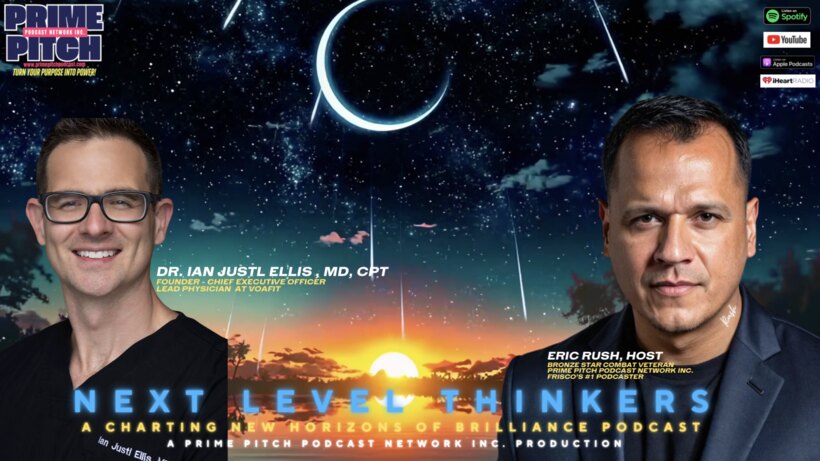
Dr. Ian Ellis, MD, CPT
Founder & CEO · Lead Physician at VOAFIT
About the show
Next Level Thinkers is a Charting New Horizons of Brilliance podcast: conversations with high performers pushing the boundaries of effort, mindset, and human potential. Hosted by Eric Rush, The Conversation Architect, a Bronze Star combat veteran and the founder of Prime Pitch Podcast Network.
Read the full transcript
I took my first injection, okay? Semaglutide. And, uh, about 24 hours later, it was likeI, I don't wanna overstate this, but it was like the doors of heaven opened up. Because I was going through my day, and I had made a sandwich, and this was like someUh, we had some leftover, like, ribeye steaks or something like that. So I had made, like, the ribeye sandwich, and every other day of the preceding thousand days, I would have stood there with that sandwich and just, like, battled with myself.
How much of this am I gonna eat? When am I gonna stop? How many calories are in this? Next level, next level. We're reaching for the sky.
Next level, next level. Hey, what's up, guys? Welcome to Next Level Thinkers, a Charting New Horizons of Brilliance podcast. A lot of people have heard the same advice: eat better, get plenty of sleep, be disciplined, and stay consistent. And for some people, that works.
But for a lot of people, it doesn't. They're putting in the effort, they're trying to follow the structure, they're doing what they've been told should make the difference, and still something feels off. After a while, they start wonderstop- they stop wondering whether they're doing enough and start wondering what you're missing. Dr. Ian Ellis knows that experience firsthand.
He's a board-certified em- emergency physician and the founder and lead physician at, of VAO Fit. At the center of his work is a closer look at appetite, energy, meta- metabolic health, and what itwhat's actually happening to the body when someone feels stuck even after they've done what they've been told should be enough. That's why this conversation belongs on Next Level Thinkers, a Charting New Horizons of Brilliance podcast. This show is built for conversations that move past the surface and into deeper forces shaping the way people think, live, and respond. Dr.
Ellis is part of that challenging conversationis part of a challenging conversation in health, one that reaches into performance, precision, GLP-1 therapies, peptides, and the judgment it takes to use those tools with real care. Dr. Ellis, it's a pleasure to have you on the podcast, my friend. Um, it's, uh, you know, it's, it's, it'sWhen youWhen I was reading this, when I was reading the cold opening, what, what, what thoughts go- went through your mind? So what comes to mind to me is my early and midlife experience of really experiencing for myself exactly what you described, which is, okay, we were all sold this bill of goods that if you have enough willpower and you do the right things, uh, you exercise, you eat right, you sleep right, all those things that you mentioned, that things will work out and you'll be in great shape and you'll be healthy, you'll be happy, and you'll be functional, um, throughout your life.
And that's actually just not true, uh, statistically speaking, for most people. I mean, if you look at the, the country, 75% of people are overwe- overweight or obese, uh, and most people are struggling with some health condition or another. And here's the key: it's not for lack of trying. Like, there aren't a lot of people out there, there are some, but not many, that have just, like, given up and say, "This is just the way it's gonna be."I feel like almost e- I mean, statistically, 50% of the country's on a diet at any given time. Hmm.
Everyone's trying, and most people are failing. Yeah. Okay? So it's not necessarily effort. There has to be something under the surface, and that- that's kinda where my story started.
You know, I was a teenager, you know, 14 years old. T- my family, you know, most of my family, uh, struggles with overweight, overweight and obesity, and were on that same hopeless treadmill of always trying, never losing. Uh, uh, but again, not for lack of effort, for lack of result. Hmm. Okay?
And I, I remember, I mean, I had a mirror moment when I was 14 years old. I was looking at my teenage body-and just saying, "You know what? I'm not gonna lose this battle. I'm gonna win. I'm gonna figure out how to be healthy, stay healthy.
I'm gonna have enough willpower to actually get across the finish line," as opposed to all the people that I had seen in my life, right? Not really having specific knowledge of what that looked like, what I believed at the time was, "I guess I just have to try even harder-" Hmm"than they are trying."Okay? That's the problem, is they don't have enough willpower. They don't have enough effort. They don't have enough education.
And so I started on that health journey for myself to figure out and see if I could solve that problem thatand a- avoid ending up in the same place. Well, here's the punchline of that. Externally, you fast-forward 10 years, 15 years. Hmm. I was a competitive athlete, a competitive dancer, uh, you know, an athletic training major working full-time as a personal trainer, giving nutrition advice to people, you know, doing all those things that I had set out to do, and on the outside looking like I had achieved success.
You know, 8 to 10% body fat, finely tuned athlete, everything looking and feeling good. On the inside, that was the furthest possible thing from the truth. Hmm. Because how was I actually achieving that success? Sacrificing time with my family and friends, not going to parties 'cause I was afraid of temptation from food.
You know, not being willing to travel because I didn't have access to a gym 24/7. Okay? Counting every calories. Like, there were, there were periods of time where I was literally measuring out, you know, 80 calories on the hour every hour, okay, to hit my numbers exactly, perfectly, precisely to get the outcome that I wanted. Um, really toxic cycles of, you know, overeating and binging, bulking up, kind of in a bodybuilding-type community, and then periods of extreme restriction- Hmmwhere I'm basically trying to eat as little as possible for as long as possible to cut down and kind of uncover, you know, th- that physique- Hmmthat I wanted to show up.
You know, an anecdote I share frequently is, uh, you know, there was a Thanksgiving Day, this was one of the lower points for me actually, where, you know, I knew that I was gonna overeat on Thanksgiving because, you know, everyone does. Appetite's a thing. It's really hard to say no. But you try to plan ahead. You try to not eat the day in advance.
You try to make some room, okay? Uh, so that you end up not kinda going over your daily allowance and, you know, not have to make up for the next day. Okay? So I got to Thanksgiving. Of course I'm starving.
And you start eating. You have a little bit more, you have a little bit more. Maybe you already have a little bit more than you planned, so then you start to feel bad, frustrated, you know. I'm, I'm already not kinda sticking to the plan. We've all had that experience where the wheels mentally kinda fall off.
You go, "Oh," you know, like, "Screw it," you know?"It's Thanksgiving. I'm just gonna let theYou know, let it fly for a day and I'll make up for it tomorrow."Okay? So I go, and I, and I, you know, dutifully, as I'm overeating way past the point of satiety, you know, I'm still counting and logging and weighing and measuring every calorie. Okay? But by the end of Thanksgiving dinner, uh, I was 2,600 over for the day.
Wow. Okay? A whole extra day on top. And of course, that, a lot of people do that on Thanksgiving, but I had that number in front of me, right?2,600 calories. Well, what am I gonna do to get rid of this, okay?
And what I did is I went out the next morning and I ran a marathon.26 miles. Wow. Okay? Not because I had planned to run a marathon, not because I had a life goal of h- of running a marathon. I'd never run a marathon prior to that.
That was just how many miles it took- Hmmto get those calories back. Okay? Wow. Well, I couldn't walk for, like, a week. You know, I, 'cause I, I ran it untrained, okay?
St- you know, and I ran it on a treadmill by myself, okay? This wasn't even, like, a community experience. This was just, I gotta deal with these calories that took in- Hmmokay, and have no other way of dealing with. So I share that to illustrate that's not normal and that's not the ideal at all. Externally, had it all together.
Internally, a hot mess, diagnosable eating disorder, extreme cycles of excess and restriction, waking up at 3:00 in the morning, cleaning out the fridge, you know, and then running on the treadmill 3 hours the next day, trying not to eat for extended periods of time to make up for it. So just this really imbalanced, really unhealthy place that really wasn't winning, right? Externally, yeah, I won the battle. Hmm. I'm in great shape.
I look good. I'm at a, an ideal body fat percentage. But I was sacrificing everything to get to that point, okay? Yeah. And, you know, when you are single and you're on your own and you can be in the gym 8 hours a day and your job is to be a personal trainer and work out and give nutrition advice for li- a living, you can pretend that you've made it.
Okay? The punchline for my story, and I know I'm being a little long-winded here- No, go ahead. is then I went to med school, and then I went to residency, and I got married, and I had a kid. And I was confronted with real responsibilities. Hmm.
The hours in the day that I had to compensate for my excessive appetite and for the bad habits and the toxic cycles I was in was removed. I didn't have the capacity anymore to overexercise, to be in control of every calorie. I'm work- working a 36-hour call at the hospital, and you're eating the hospital food and what's on the nurses' station, which isn't great food most times-and not being able to go home and, and exercise. What happened? The wheels totally fell off.
Hmm. Okay? You fast-forward, you know, to the end of my training experience, and I had become what I most feared. I gained 60 pounds. I was 40-plus percent body fat.
I was snoring like a freight train, and I'm getting winded, you know, running to, you know, code calls in the hospital. And so I exited my training experience in, you know, really, uh, i- in my experience, certainly compared to what I had been, a desperate physical situation, but realizing, like, oh, I get it now. It's not so easy. It's not just put in the time, put in the willpower, put in the energy, you know, try harder. Because there's other things in life-that are really important, and that once you have a family and kids and a career and other things that are important to you, you can't just overcompensate.
You have to find a way to actually find balance. Yeah. Okay? Now, what does balance look like? You know, this is the way I always describe it.
It's like 75% of the country is overweight or obese, but most of them, at least many of them, are at least getting some enjoyment out of life. Okay? Yeah. The other 20, 25% aren't overweight or obese, but a huge percentage of those are making fitness and the pursuit of fitness the focus of their entire life. Hmm.
Like, every minute of every day revolves around that pursuit. And how many things areAnd I put myself in that previous category, right? How many things are you sacrificing and leaving on the table in order to gain that fit, healthy outcome? Okay, so my passion when I graduated from residency was starting to i- i- you know, investigate, is it possible to actually be somewhere in the middle? To be healthy, to be functional, to be fit, and also to have balance, to enjoy your food, to enjoy your life, to enjoy your relationships.
Um, and turns out, I think it is possible. Uh, and we'll get into that- Yeahas far as my own personal answers for that. But suffice to say, it's extraordinarily difficult for most people. Yeah. Well, yeah.
Wow. That's like a, you know, you're in- this, uh, your introduction about what, where you, your journey. Like, right, right off the bat. It's like, how many peopleI mean, just I was just, as you were going through it, first of all, I was relating to everything. I, I, I was in the dance industry for a while.
I, I, I was a personal trainer f- you know, for almost every gym when I was in college. And, and, and I know, you know, you, you know, you have the, the tools there, right? And maybe we're a little younger then, but, uh, you know, to, toI think a lot of, um, a lot of individuals who go through that too. I just had a conversation with somebody the other day where he's, you know, he's, you know, he likes to run, he likes to lift, he likes to do everything. He's getting ready to get married, and she has 2 kids and, and, you know, and, uh, and he's, he thinks that, you know, his lifestyle's gonna be, you know, very much the same as he was single, you know?
And, um, you know, I said, "Man, you're gonna have to, you're gonna have to figure it out. You know, you guys are gonna have to negotiate, sit down and get that plan in place 'cause, 'cause if you wanna sustain this, you know, you, you're gonna have to be more practical about it."So I respect, I, I love the fact that you're d- And, and one of the things I was thinking I was gonna ask you is, like, how much, how much of that was the power of premeditation in everything that you were doing? Like, you know, everything, you were like, "In the next meal, I gotta, the next, uh, the, you know, the next lift, the next calorie I eat."How, how, how, how did that play? Well, i- if I, if I'm understanding your, your question correctly, you know, I was thinking about what I was gonna eat, how I was gonna eat it, how I was going to exercise, and what that day's plan for maintaining my physique was going to be almost every minute of the day. Wow.
And that's not really an exaggeration. It's like you, I planned every activity around that. I planned every meal around that. I planned every experience around that. It's always making the plan, like how am I going to navigate today and not, you know, stray too far from that, you know, ideal- Yeahthat I'm chasing from.
And, and when you're in it, you start to think that it's, it's a good thing. It's like, look how well I'm doing. Look how focused I am. Look how dialed in I am. Okay?
But once you've, you know, exited that mentality and arrived at a place of a little more balance, and I, I like to think that I'm a lot more balanced now- Yeahyou look back and go, "Man, what a waste of time, of focus, of mental energy that should have been put in other places that are more productive than just weighing, you know, things to the gram."Um, and then eating twice as much as you weighed and then trying to make up for it later. You know? Because it was always a losing battle. Yeah. I- Yeah, yeah.
Um, and we'll talk about that more. Yeah. But, uh, it was just, it was absolutely all-encompassing. Yeah. Um, you know, being kind of a part of the bodybuilding community for a while- Mmit's like you become so neurotically focused.
Yeah. I mean, I remember I had, uh, I had Michelangelo's David, like the statue. I had his wrist to neck to chest to waist- Wowto quad to calf ratio, you know, taped to my wall in college, and that's what I would compare myself to. It's like, oh, what are we shooting for? Oh, you know, just the classical Grecian ideal-uh, by a master sculptor.
I mean, that's-That's not excessively lofty you know what I mean? Yeah. that was what I was shooting for. Hmm. And, you know, turns out it's, it's really difficult to achieve that degree of perfection.
Um, and I wouldn't even describe it as perfection because now I would say that that shouldn't be the goal. Hmm. Okay, we'll talk about that. Yeah, yeah. Um, but, uh, you know, it's not, it's not easy.
Yeah. To do that. Yeah. Well, just for the record, in- instead of, uh, Apollo 11, I was gonna have Arnold Schwarzenegger in the background 'Cause I hadI mean, I, like you, I'm, I, I was always mesmerized by Arnold. You know?
It was like how perfect his body was. I had the encyclopedia and everything, so I get it. You know, like I said, I had everyI wanted his biceps, and I think I accomplished that for a while. So there's this famous picture of him on stage with his arms kind of out like this- That's rightand I had that hanging on my wall in college. And I like painted a whole like basically mural around it, so that I would look at every day.
Yeah, yeah. Yeah, it does. Yeah. There. You know, uh, many, many use the word appetite, and, and people hear that in different ways, right?
Um, when you say appetite, what are you actually talking about, both physically and mentally? Yeah. So that's a perfect question because, uh, solving what I call the appetite problem is the central dilemma of the modern age. Hmm. Okay?
And I, and I'll, I'll explain that a little bit more. So if you go back 100 years, 200 years, 5,000 years, you know, before the industrial age, okay? Most of people's lives revolved around expending enormous amounts of physical energy to catch, procure, grow, prepare, and eat low energy density food. Okay? In other words, you had to work really hard and really long to get anything out of the ground or to chase anything down that was running away from you, okay?
Once you caught it or grew it, you had expended so much energy in the process that there was no cost to eating at all. Okay? In fact, you needed it. Okay? Yeah.
Not only did you need it, you probably needed to eat to excess because it's gonna take you more energy to grow and catch the next one. Hmm. Okay? So, you know, whether it's evolutionary or design or a combination of those things, our bodies are perfectly designed for that type of environment where you have to expend a lot of energy to catch a little food. When you get it, when you have access to itAnd again, this was pre-industrial.
This, we didn't have easy refrigeration. We didn't have, you know, you know, uh, processed foods that can shit on, sit on, you know, sit on a shelf- Mm-hmmfor, uh, years at a time. You know, preserving it also took work. You know, I remember like, uh, reading Little House on the Prairie when I was a kid and going through that old school like, "Okay, we're gonna break down a pig, and we're gonna cut it in quarter, and we're gonna, you know, and we're gonna hang it up in a smokehouse."And there was like a whole day's experience of physical labor to process that animal and prepare it for storage and to, to consume, right? Well, it makes sense in that environment- Mmthat when you have access to food, you eat it, and you store it as fat for a damn good reason, 'cause you're gonna need that storage- Hmmfor the next time, okay?
And not only that, it wouldn't make any sense at all for your body to freely liberate those stores. It makes sense for your body to say, "I'm gonna hold onto that as long as I can," 'cause it's there for a reason.'Cause I'm not gonna have access to unlimited food. There may be a famine around the corner. There may be illness. Hmm.
Okay? Pre-antibiotics, right? Yeah. Your body had to have a reserve to deal with things. Well, then you fast-forward, and you, you reach the modern age, where everything in that story was upturned within just a fraction of a blip of a moment in time.
Hmm. Now we have unlimited access to food. Like, truly unlimited. Yeah. You can eat as much as you want, whenever you want.
There's no limit. You also don't have to expend energy to do it. I mean, now, like, you can DoorDash 100% of your calories to your front door, and even instruct them in the app, "Leave it inside the front door."You don't even have to open the door and go get it. Mm. Okay?
So you have unlimited access to food that you don't have to spend any energy cost to get to, okay? the food quality, of course, we know has catastrophically deteriorated. Uh, our food supply, the soil it's grown in, the way that we grow and process it is not natural anymore. We're not as nutrient-dense as we used to be. And of course, processed foods, they take everything that's good and natural within the food, they take it out, and they add a bunch of things that aren't helpful.
That's your added fats, and your added sugars, and your added chemicals, and, you know, things that make it hyper-palatable, et cetera. Okay. So where does that leave us? Our bodies haven't changed. Our bodies have not significantly changed in 100 years in any meaningful way, okay?
So we're s- now we're in an environment where there's food everywhere. You still have a biological drive to eat it 'cause your body thinks that famine is right around the corner, okay? You layer on hyper-palatable foods that are much more delicious. Like, Oreos don't grow on trees. Wow.
Okay? Yeah. Uh, y- you have hyper-palatable foods that are very difficult, that don't tickle those satiety centers- Mmlike real whole foods do to say, "I'm good. I'm full. I'm done."Okay?
And so you consume available calories, just as your body tells you to do. You gain the stored fat, just as your body is intended to gain. But the famine never comes. We never have that period of time where we're forced- Mmto dip into those stores. So what do we do?
We try to manufacture a famine. That's called a diet. And we go, "I know the food's right over there, but I'm not gonna eat it. I'm gonna force my body to dip into those reserves."Here is the problem, and this is the, the crux of the appetite problem: your body keeps a score, an account. Mm.
And it knows exactly how much you are drawing from that storehouse, okay? And when I say exactly, I actually mean that literally. So if you start January 1 at 200 pounds, and you end the year January 1 at within a couple pounds of that, which is most people's experience. Most people maintain their weight, generally, okay? And they kinda have a set point where their body wants to be.
If you're within 2 pounds of where you started at the end of the year, this is real math, you can verify it, your body nailed the ins to the outs to a 99.9998% accuracy. Wow. Okay? If you have any sort of mechanical mind, you know how unbelievably difficult it is to do anything with that degree of precision, okay? Yeah.
Your body knows to that degree of accuracy and tunes it. A, a little extra bite here, a little sip there, a little cheat meal there, a little something else around the corner to keep you exactly where it wants you. Mm. Mkay? Because it knows that it has this tool called appetite to force you eventually to refill that storehouse that you're taking those hard-earned, hard-stored calories from.
Okay? Um, what I think people underestimate drastically is the power of appetite as a physiologic drive. Mm. Okay? We've all had the experience, though.
You s- you start a diet on Monday. You can do it. You lose a little weight. It's probably water weight, but fine. You feel good.
Tuesday, you're, like, pretty hungry. Wednesday, food noise is really turning up. You're kinda thinking about food all the time. Thursday, it's all you can think about. And, you know, y- y- you know, you walk into a room, you see food on the table, and you're just like, as you walk by it, you're just like, "Man," you know, "I see that, I smell that, I want that, but no, I'm not gonna do that."And then you get to the weekend.
That urge, it becomes intolerable. Mm. The proverbial wheels fall off. You eat back every single one of those calories that you burned throughout the week, okay? And by everyone, I mean really precisely.
We all have a point where your body says, "Okay, I'm done. I'm not eating anymore."Well, guess that? Guess what? That's the exact point where your body goes, "I'm good. We refilled all that stuff that you took from me, and, and I'm happy again.
I'm at my set point. I'm where I wanna be."Okay? Yeah. It's just like telling someone not to sleep. Don't sleep.
You can do it for a day. What about the second day? Really tired. third day, you're hallucinating, and 4th day, you're sleeping sitting up. Okay?
It's the same with appetite. We're not in control. We like to think that we are, and you can white-knuckle your way with all kinds of unusual structures and, you know, pre-prepping your meals, and everything's laid out, and all of the things that I did for so many years to keep control of my appetite. But we're not really in as much control as we'd like. It's an extraordinarily powerful urge, and the problem is that because we're in this modern environment with food everywhere, with no energy cost to procuring or making or storing it-We, most people do gain excess weight, and then to lose it is extraordinarily difficult.
Mm.'Cause your body says, "But why would you do that to me? Why would you take these hard-earned stores that I worked so hard to, you know, store up for you for a rainy day when the food's right over there? Just go eat it."Okay? And so we do. All right?
Anyone can be in shape if they move to deserted island where there's no food available, and you have to cook and grow and procure your own food, and all you have access to is a meal preparation and a gym. Okay? The, being healthy is a, is a physiologic imperative in that environment. Mm. It's kinda hard to do anything else.
You go back 100 years ago, 1920, you know what the average weight of an, of an American male was? What was it?160 pounds. Wow. Okay?160 pounds in this day and age is a freaking lightweight. Yeah.
Okay? Wow. The average American male is over 200 pounds now. Mm. Well, that's a 40-pound delta in 100 years of a collective, you know, accumulation of those extra calories that none of us ever have to really spend.
But back then, 100 years ago, everyone was healthy because there was no other option. Diabetes didn't exist- Yeahas a medical condition 100 years ago. We're talking about type 2 diabetes. Type 1 diabetes was rare, but type 2 diabetes really wasn't a thing, nor was CHF, nor was, you know, excessive amounts of hypertension, stroke, and all the downstream effects- Mmfrom obesity, right? All that stems from the appetite problem.
When we need to be in a deficit over time, can we do it? Can we sustain it? And can we gain mastery over that very powerful physiologic drive when we're not in an environment where we have to? Mm. Okay?
Yeah. turns out most people can't.75% overweight or obese. The people that can, they sacrifice everything to do it. So what is the answer? Well, we'll get to that in a minute.
But that's, that's the problem. When I say appetite, it's a physiologic drive- Mmthat your body is telling you, "I wanna be here. There's a set point. Don't make me bend from that tolerance."Mm. Okay?
And as much as we like to think that we're in control of our physiology, we're really not. Your body has a, an amount of muscle mass that it wants to maintain. It has an amount of fat mass that it wants to maintain based on your state, environment, et cetera. And to deviate from that is extraordinarily difficult. Yeah.
Uh, it's, it's as hard as telling someone, "Just don't sleep for a month."Wow, that's crazy. Okay? Your body goes, "Eh, I'm not gonna let you do that."That's so crazy, man. I like the way you broke that down 'cause it's just, just like, man, I wanna go back and listen to this, this particular question over and over and over again, you know? I think everyone should go back and really examine what, what, what the heart of what you were saying is because it's so, it's like, it's so itThat was why that question was there.
I was like, "Dude, I wanna, I wanna get this answered," 'cause I think that's, that's part of it, you know? And I, I'm, I'm so grateful. IThat sound bite's gold. That's a, that's awesome, man. And I, I think, uh, when you look at it, it's like you almost have to pull a psyops on your own or just accept what, what your disposition is at some point.
Do you agree with that? Like, you have a predisposition, then you kinda have to- Well, the thing is we have predispositions based on genetics- Yeahand we have an environment- Mmthat makes that, you know, happen or not happen. Okay? Yeah. The problem is our current environment is not conducive- Mmto healthy lifestyle, to maintenance of a healthy, strong physique.
Okay? If you just live life in the modern world, you're not gonna be healthy. Okay? Our structures in our society, our culture, our systems, our food supply, uh, all of those things, all of that stream is pushing you downstream to poor health. Okay?
Wow. So you have to find a way to swim upstream, but that's what I just said. Like, swimming upstream in a physiologic sense is extraordinarily difficult. Yeah. Okay?
So that's the problem we have to solve. And u- and up to this point, it's been intractable. You look at since the 1970s, the obesity rates have climbed just without even a, a deviation from the rise for 40 straight years. And again, not for lack of trying. Yeah.
It's like something changed in our environment that we as human bodies were not capable of dealing with, and we've had been desperately trying to find a solution for that, you know, ever since. Yeah. That's, that's, that's crazy, man. okay. during your, uh, during your medical training when the demands of life were stacking up- Hmmwhat changed in your own health that made you look at it, at this differently?
Well, I already g- I already answered that previously. Yeah. Yeah, you did. Yeah, yeah. But, you know, I, I think the, the take home, just to circle back to that- Yeahwas that it's not enough to just try harder.
It's not enough to just set up enough rules and systems and, you know, prep this and do that. Um, you have to find a way to deal with the underlying physiologic dilemma- Hmmof appetite in order to make lasting change. Um, you can push back against that and succeed for a while. Uh, you can white-knuckle your way to health, "health."I did that for a long time, but the minute you take your eye off the ball, it all falls apart- Hmmbecause you just get washed downstream. The minute you stop swimming upstream, you don't stay where you're at.
You end up downstream and over a waterfall and dashed on some rocks. Right. I'm gonna never see that scene again, and I'm gonna remember that story. Yeah, and that's what happened to me in, in residency. I, I was forced to stop swimming.
Yeah. And I ended up down, you know, river with everyone else. Yeah. And everyone goes, "See? We told you it wasn't so easy."Which, which, which brings us to this, uh, you knowI think this is a good point to start talking about, um, um, this i- in particular, the work you're doing with your patients.
Yeah. once you started working with your patients, what patterns kept showing up that told you the, the standard way of handling this was missing something important? So I, I love this question, um, I'll answer it. I didn't start working with patients- Hmmfirst. I started working on myself.
Okay? Nice. The beginning of that story was I was working a shift in the ER overnight, just working with one of my dear nurse practitioner friends. This is in 2021 or 2022, whereabouts. And it's about that long ago.
And, uh, you know, we both had been kind of on a weight loss journey, uh, you know, for most of our lives, and just we'd always kind of talked about it. And she said, "So, uh, I heard this, there's a new drug, it's called Ozempic."And I'd never heard of it before. This is before it was like, you know, the most popular drug in the world. And I said, "Well, what's that?"She says, "Well, it's this new drug. It, it's, you know, a repurposed diabetes drug, uh, but it, it takes away your appetite."And I s- you know, I asked her more questions and I went, "So, so what do I n- need to know?"She's like, "Nothing.
Like y- you just take it, and you just lose weight."And I said, "You know, I've heard that before, but like sign me the frick up, okay? Because I'm so tired of fighting this battle every minute of every day."Okay? And, uh, so I said, "Well, will you write me a script?"She said, "Sure."You know? So I got the vial of semaglutide in the mail, and I had the, you know, instructions, right, of how to take. There's a standard dosing protocol.
You know, you start low, and then you increase progressively over time to kind of reach this max treatment dose that was the most effective dose. And not knowing any better, and honestly being so desperate, uh, to achieve freedom from that, I didn't really look into it, um, with much rigor. I just said, "Okay, let's, let's give it a shot. Let's see what happens," okay? Well, I took my first injection, okay, of semaglutide, and, uh, about 24 hours later, it was likeI, I don't wanna overstate this, but it was like the doors of heaven opened up.
Because I was going through my day, and I had made a sandwich, and this was like someUh, we had some leftover like ribeye steaks or something like that. So I had made like a ribeye sandwich. And every other day of the preceding thousand days, I would have stood there with that sandwich and just like battled with myself. How much of this am I gonna eat? When am I gonna stop?
How many calories are in this? Am I gonna stop at one, or am I gonna eat 2 or three and then have to go serve my time on the treadmill? Yeah. Well, I started eating that sandwich, and halfway through, it's like the weirdest thing happened. I just didn't wanna eat it anymore.
Like, it tasted good, it was delicious, but I just kind of put it away. And I put it back in the fridge. And as I walked away from the fridge, I went, the hell is that? Is this what it's like to actually feel full and satisfied when I haven't eaten to, you know, excess?"Okay? Yeah.
And, and you know, uh, and that, you know, continued throughout the course of that week. Uh, just the food noise turned down. I wasn't thinking about it all the time. I could just kind of eat whatever I had prepared, push it away when I felt full, and go on with my day. And the whole time I'm almost like outside myself goingI've, I've literally never experienced this.
Ever since the beginning of that journey where I started, you know, on these vicious cycles, um, I had lost the ability to just respond to my body's cues- Hmmappropriately and say, "You had enough. Stop eating. Move on. Do something else."Okay?4thWeek 2, I took another dose, same dose, and, uh, I felt similar the next day, although, um, I had just the little tiniest hint of almost like food started to look a- aversive. Hmm.
Like I didn't really want to eat at all, and I'm like, "Well, I know I need to eat something," you know? So you, you have a few bites here and there, and then youand but you get this sensation of like, "I, I really need to stop," like, "I don'tMy body's not really into this right now."Next week, same dose. Really developed a really strong food aversion where I, I really had to struggle to eat, and I was feeling sick. So when I did eat, like I f- I had some side effects. Uh, week 4, a little bit worse, and then week 5, uh, on the recipe from the doc, it's the standard protocol, is you double your dose.
Hmm. Okay? Well, I did that, and I got super sick. Hmm. And so nausea, vomiting, diarrhea, couldn't eat at all, and I had 3 or 4 days where you're just likeyou know, just like you had the world's worst stomach bug.
Believe it or not, in hindsight, so dumb and ignorant, but I thought it was a stomach bug-because nobody had really taken the time to explain to me the side effect profile of these drugs. Hmm. Okay? Well, you know, 3 or 4 days later, that kind of wears off and you go, "Oh, man, okay. Phew.
that was hard."And you take your next dose the next week, and I got the same stomach bug after that. And, you know, eventually a few weeks in, I started to put two and two together."Okay, this is the medicine."I'm like, "I'm experiencing side effects here."But, you know, you're still following the recipe and you're still escalating your doses. Well, I never really felt good after that. And at the end of 3 months, I had lost about 30 pounds, solid. Okay?
Great outcome. Certainly didn't have to try. If anything, it was a struggle to eat. Hmm. Uh, there were long periods of time where I wasn't eating much at all.
Um, I got to the end of it, I, and I got on a, a body scan, and I got a body composition scan 'cause I had reached my goal weight that I had been chasing for quite a long time at that point. Yes. I was absolutely horrified because, uh, of that 30 pounds, about 20 of it was lean mass- Hmmand about 10 of it was fat. And my body fat percentage, which is this like gauge of health, right? Had almost not changed.
Oh, wow. Okay? I lost 30 pounds. I solved the appetite problem, and then like defeat from the jaws of victory. Right?
You look at it and you go, "Oh, crap, like now I'm skinny fat."Like I'd lost a ton of muscle. I was weaker. I wasn't as functional. My lifts at the gym had gone down, and my body fat percentage wasn't really different. Hmm.
And I went, okay. Well, like, that's not okay."Right? Yeah. Like you solve one problem, the appetite problem, and I created a host of other problems with GI side effects and muscle loss and, you know, all the other things. And that, uh, left me really i- in a, in a, a tough place 'cause I was like, "I'm not willing to go back to what I did before and just gut it out," 'cause that just wasn't okay anymore.
I was hurting my family. I was hurting my, people around me. I was, you know, just, again, in that toxic obsessive cycle. But also, this outcome is not acceptable. Well, at the same time, I'm working full-time in the ER, and I'm seeing all these people that are coming in in the same situation I was in, nausea, vomiting, diarrhea, you know, all related to- Hmmtaking these GLP-1 medicines, some of them having to be hospitalized, some of them, you know, having to really have, y- you know, difficulties from it.
And I would ask them, so like, "Well, what's your dose?"And they would tell me, and I said, "Well, did, did they just increase your dose or whatnot?"And sometimes the answer would be yes, sometimes the answer would be no. But invariably, they're taking the standard prescribed protocol. Well, I started to, like, I call it putting my doctor brain back in, 'cause I had, I had-- I was so all in on, like, the promise of these medicines that I hadn't taken a lot of time to think about what I was taking, how it was actually affecting me, how these drugs actually work. And it's like I put my doctor brain back in and I said, "I gottaOkay, I gotta go back to first principles here, understand what these drugs are, how do they work, what is e-explaining this experience, and is there a better way?"Mm-hmm. Okay.
Is there a way to maximize the ap- the appetite suppression? Or I wouldn't even say maximize, optimize the appetite suppression. Kinda rightsize my appetite and avoid side effects, avoid muscle loss, avoid food aversion, not being able to eat. And I became a little bit obsessed with that question because I could see that these could be the answer- Yeahto this global catastrophe of obesity and overweight. But the outcome I experienced in my first go-around was not the end goal.
Hmm. Okay. So I had to figure out, is there, is there a better way? Okay. Uh, I'll-- I can move right into what that better way was, or I can follow up- Yeahlater, but- Let's, uh, let's, uh, yeah, I'll go, I'll go with this next question and we'll see where it leads, okay?
Um, um, as you, as youOkay, as your work developed, you began using the tools that are getting more attention now, including the GLP therapies and peptides. Yeah. Um, when you decided to use the tools, what are you actually trying to correct and support in the body? Yeah. Is that okay?
Yeah. We'll, we'll, we'll get into that. Yeah. Sure. So the process I went through is I started to study the drugs and understand, okay, how do they actually work?
When you take a dose, what happens? What is the GLP-1 receptor anyway? Uh, how do these medicines function in your body? Mm. And try to start to get-- put together the pieces comparing it to my lived experience, okay?
Because I remember back, I was like, I remember that first week when it's like, this is how I want life to be every day. And I started to try to figure out, but why was week 2 not quite so great? Why week 3 did I feel quite a bit worse? And then why in week 5 did the wheels fall off and I got super sick? Okay.
Because I had stayed at the same dose, right, for those first 4 weeks. Well, when you look at the pharmacokinetics, which is basically how these drugs are absorbed and metabolized by your body, the answer immediately became obvious. Because, uh, these medicines, if I gave you ibuprofen right now, okay, it doesn't take long. Like, you'll feel a little better, your fever might come down, and then 6, you know, 6 hours later, your fever's back. You need some more.
Okay. Yeah. GLP-1 is not that way. If I were to inject you right now with a GLP-1, uh, half of that dose would still be in your body a week later. Hmm.
Okay? Half of that, what remained, would still be in there a week after that. Okay? It actually takes 5 weeks for a single dose of semaglutide to be fully metabolized. Hmm.
All right? Well, imagine, this is simple math, but once, once I started to see it, then you can't unsee it. If I inject you with one milligram of something, and a week later there's half of it left, how much is in your body? Half a milligram, yeah. Yeah.
Okay. I take another dose of one milligram, same dose. How much is now in my body? Um, um, one and- One and a half. One and a half.
Okay. Wow. Because it's additive. Uh. Right?
I took that first dose. You would think it'd be one. Yeah. But it's not. Hmm.
And this is the, this is the absolute key to understanding the challenges and problems with GLP-1 therapy, is ha-half of it's left, you took the same dose and it stacks. It builds up. Ah. So now you're a 50% greater drug exposure than you were in your first week, even though your, your dose stayed the same. Okay?
Well, my first dose was perfect for me, right? That therapeutic level, the amount of drug in my system, was ideal. Week 2, even though I took the same dose, I didn't get to choose. Now all of a sudden, I had 50% more, which was just a little bit too much. Hmm.
Okay? When you fast-forward another week, half of that's there left still. You take another one milligram dose, and that adds on top of it. So now you're even higher, and that continues for about 5 weeks. It takes 5 weeks to reach a steady state, where the amount in is kind of matching the amount out.
Well, what happens in the standard dosing protocol for GLP-1s? In week 5, they tell you to double your dose. So just as I was reaching an equilibrium, it says, "No, you don't get to stop. We're gonna keep that escalator going."And believe it or not, in the standard dosing protocol, 20 consecutive weeks, you escalate your drug level relentlessly. Every single dose you take, you go higher and higher and higher and higher and higher.
Okay? Well, why did that protocol exist? It existed because they were studying a large population, and they wanted to prove efficacy. Does it work at particular, you know, stages of that escalation? And, and it's designed brilliantly for that.
Okay? But what the study never thought to ask is what drug level is ideal for an individual person. Of those 20 steps- Yeahwhat's the best one for you- Yeahat any moment in time? The study doesn't ask that question, and so of course it doesn't answer it. And the problem with the standard dosing protocol is it doesn't even allow you to attempt to answer it because it continuously escalates.
You have oneAnd, you know, and for me, that just happened to be week one. For some people, maybe it's week three, and they go, "Oh, this feels great. This is perfect. Can we stay here?"No. Next week you get more, and all of a sudden you're, you're overbaited, and you have side effects, and you have food aversion, all those kind of things.
The challenge being if you push your body higher and higher and higher, your body tries to catch up and adapts to those higher doses, and it adapts to those higher doses. So eventually, once you get to the max dose, okay, um, you, you can get stuck. You can plateau. You have nowhere else to go 'cause you've forced your body to adapt to those- Mmhigh doses over time. Okay?
To put a pin in this, okay, if there's an ideaThis is kind of likeThis was my working hypothesis when I was figuring this out. If there's a drug level, not a dose, but a level that works best for me, that makes me feel like I'm in that sweet spot, okay? Yeah. Where your appetite is controlled. You still have energy.
You can eat, but you, you know, you can put that half of the sandwich away. Okay? If that level exists for an individual, can I figure out what that is? Can you identify it? Can I know that number?
What is the drug level that works best for me? Okay?'Cause the standard dosing protocol doesn't helpdoesn't give you the tools to know that answer. Mm. Okay? So can you calculate that?
That's, that's number one. Let's assume that you can, and it turns out you can. Uh, what is the dose I need to take at any given moment to get back there? Simple as that. I, I identified my ideal level.
How much do I need to take to get me there instead of overshooting, building up- Mmchanging over time? How do I find that stable experience where I just, like, feel good every day, right? Well, it turns out you can do that. It just involves a lot of math. Like, it's complicated equations based on absorption coefficients and elimination coefficients, and when did you take that dose, and how far was it from the last dose, and what percentage stacked on what?
It's just math. And unfortunately, doctors at scale don't have time to do complicated math, and patients at scale don't have any idea about any of this because their doctors aren't even telling them. Right? Yeah. So you end up in a situation where everyone is treated the same.
Everyone is prescribed the same standard dosing escalation ladder. Patients think they're taking the same dose when they're actually experiencing different drug levels with every dose, and doctors, um, don't have an ability or a cookbook to do anything different. Okay, so what does that do? It results in a population of millions of people, and there's, I think, 100 million people plus on GLP-1s right now in the, in the world. Wow.
Wow. Millions of people who are being systematically pushed to extremely high drug levels when they may or may not need them at all, with no way to step off the treadmill. Mm. Okay? Um, and that's what happened to me.
Week one, felt great. Week 2, I escalated. Un-un-unbeknownst to myself, my drug levels were higher. It was a little too strong, and then I never felt good after that. Mm.
And so IMy, well, my process was to, uh, ask those questions. Can I calculate these levels? Can I calculate the amount of the dose to take to hit that level? And if so, then would my outcome be different? Okay.
Well, I regained the weight on purpose 'cause I wasn't satisfied with just being small and weak. Okay? Regained the muscle mass, regained quite a bit of the body fat as well, just kind of bulked back up. And I'm like, "You know what? I'm gonna try this again."Okay?
And rather than just following the standard cookbook, I calculated my drug levels with each dose. Whenever I felt good, uh, I would calculate what is the dose I need to take at whichever interval felt the best. Whenever I got hungry again or my cravings were too high, food doses straight up, how much do I need to take right now to get back to that particular place? Well, what was the outcome? I lost the same 30 pounds, and I lost almost no muscle this time.
I barely experienced any side effects. I felt great the whole time, and I exited that experience going like, "Yes."Like, this is what it's supposed to be, okay? I have control over my appetite. I'm not being controlled by the drug. In other words, the drug is not saying, "You can't eat right now."Okay?
Um, but I had the ability to adjust my own experience, almost like kinda like a dial on a thermostat. It's like, "Hey, I'd like a little more control."Okay, let me increase that target level a little bit. Oh, maybe I am adapting to the medicine slowly over time. Let me increase slightly- Hmmokay, to kinda chase that sweet spot. Okay.
Well, it, it worked. And I went, "Oh my gosh," like, this could be the answer because it was the same drug. I, I mean, I wanna make sure and put a pin on that. It's the same drug. I just took it differently, and I took it in a way that actually was looking for the right answer and the right level for me and my own body.
Hmm. Okay? Well then, you know, you go, "Other people need to be able to do that too."There's- Yeahmillions of people that are suffering- Oh, yeahyou know, the course of treatment of these drugs, right? Yeah. And there's a better way.
Well, I, I mean, call me crazy, but I retired from the ER, or at least wound down that side of my career, opened my own clinic, and started treating patients using this method. Okay? Can we calculate your ideal level? Can we find it? Can we understand what the right doses to take?
Can we actually, you know, you know, titrate up that, uh, journey with these drugs in a way that is actually individualized to you? And, you know, I calculated every dose for every patient for a year in Google Sheets-and a calculator. Okay? Totally not scalable. This is not something that, like, anyone can just do because, like, doctors don't have time to do that.
But this was my own, like, passion project, and I have to prove that this works. Hmm. Okay? Well, what was the outcome for that first cohort of patients? You know, it was 112 patients.
This is what we kind of retrospectively looked and saw, okay, what was the outcome of this novel method? Okay. Believe it or not, they lost weight faster than the trials- Yeeon half the dose. As a population, they took half the medicine, and they lost weight just as fast or faster than the standard dosing protocol. Hmm.
And- Wowyou might go, "Well, how is that possible? You're taking less medicine. Wouldn't you lose less weight?"And it turns out the answer to that is n- is no. Because if you right-size the dose and the levels to the individual person, you don't have those weeks where you can't eat at all, where you're having nausea, vomiting, and diarrhea, where you're losing muscle mass left and right and shredding your metabolism. Hmm.
So if you can maintain slow, gradual weight loss that isn't damaging your body and metabolism on the way up, you don't ever really have to plateau. But what happens with these drugs typically is they escalate them to the highest possible level. They have a hard time on the way up. They crater their metabolism. They shred their muscle mass, and then there's nowhere to go.
You can't go up on the drug, but your metabolism is so low that you can-- if you do try to eat, you'll gain weight. Right? So, we validatedNow, this is retrospective, right? This is not a ran- and, uh, for everyone out there, this is not a randomized, double-blinded, controlled trial. This is real world, real people experience.
Yeah. It's observational, so this is just what happened. Um, it, it worked. Wow. And so then the next phase began, "Well, okay, I can't do this with Google Sheets for mi- you know, even, even hundreds of people."Like, you know, doing it for 100 people, once I hit 100 people in my clinic, it was all I could handle.
And I started to figure out, "Well, I gotta fig- find a way to, make this possible for more people."And so that's when I started developing, you know, hired a tech team, and I started building some technology to do this automatically. Hmm. And so that's where the MyLevel app came into the world. We found a way to automate this process where patients can log their doses. It'll automate, calculate their levels.
They can select their target level of that available range. Uh, they can select their individual best frequency. How often do I wanna take a dose to get back to that level? And allow people at scale to individualize their GLP-1 experience. And so that's what we're doing now, and it's been honestly, uh, amazing- Yeahto give people the power to control their appetite in a way that's precise, that's, uh, tuned to them and their needs, not tuned to the needs of the New England Journal of Medicine.
For a population study Yeah Right? And, you know, that's where I've spent most of my time the last year, and, uh, it's been quite a journey. It's not been easy. Uh, I'm almost more of a tech CEO than I am, like, a-- running a clinic now, because- Manwe're in the world of technology and apps, and development is certainly nothing I was trained to do. Like, learning how to do that as we go.
Uh, but it's been very successful, and, uh, I've been excited to kind of spread the word, let people know that this-- that a better path exists- Yeahto solve the appetite problem without overdoing it, having excessive side effects and issues from GLP-1s, but also solving this intractable appetite problem we've all been struggling with. It's like, you know, kind of finding that balance, where you're just in control of your appetite, you're feeling good, and you're able to take all that energy you were applying to solve that problem and put it into the, like, other things that matter, into your family, into your wife, into your kids, into your career, and not have to revolve my life around the pursuit of fitness to stay healthy. Hmm. And that's the dream I've achieved is I, I don't do that anymore. I do have balance.
I don't wake up and eat 3,000 calories before breakfast, okay? I'm able to go through my day and enjoy the experiences that I have, not have the pursuit of that, uh, Greek statue ideal, you know, be at the forefront of my mind all the time, and also be healthy. Like, I'm at an ideal body fat percentage. I'm as strong as I've ever been. You know, I feel like I'm there, not through willpower, not through just white-knuckling it, trying harder.
Finding a way to use tools that are now available- Yeahamazingly powerful pharmaceutical tools to basically take that stream which is pushing so hard to get you downstream, and the-- I'm really stretching more metaphors here. I'm making this up as I go along. Turning it into a pool where you can hang out in and make decisions and not be at the mercy of things. Yeah. Right?
So anyway. That- A lot of words Man, that is-- I mean, honestly, well, I gotta, I gotta say, I'm so happy we're having this conversation. I think a lot of, a lot of people, I'll go back to saying this, is that a lot of people need to hear this. We need to hear it in our home. Like, you having, being, you being here present today is like, "Oh, my wife's gonna love this podcast," 'cause we have, we have, we have semaglutides in our refrigerator right now that we're working through, you know?
And- Mm-hmmand it's, it's so important for us to be-- to understand this. So this, like in a real home right now, you are blessing this home with- Yeah. your, with your, with, um, your wisdom and your experience, and lived experience for that matter too. A- and clinical, you know, your, your own prac- in your own practice. So I think that's so important, you know?
I wanna thank-- Oh, first I wanna say, hey, Lindsay at Next-- as NextGen Scientific, I gotta tell you, thank you. You were right. You were right. Yeah. Dr, Dr.
Ellis is all that and so much more. Um, um, now, uh, y- as we know, there's, there's, uh, this, this situation where this, these become so popular, you know, and everything like that. Um, you know, these tools are now being pulled into culture, uh, in a culture that's impatient, right? And, uh, which is image-driven and often looking for speed, right? Just what we talked about, right?
Um, how do you separate real, um, a real medical need from pressure that is, uh, really coming from appearance, urgency, and frustration? I, I, I absolutely love that you're asking that question, okay? Um, 'cause it's so important. Yeah. Um, a lot of what I do in my first consultations with patients, and kind of what, what I teach my MPs to do as well, is dive into what is a patient's goal?
What are you shooting for? Okay? And trying to understand, is that at align with actual health or is it not? Hmm. Okay?
Great example of that, a bodybuilder who gets on stage, who's 270 pounds at 3% body fat, okay? Externally, we can be convinced that, oh, that's the pinnacle of health. but it's actually a very drastically unhealthy physiologic situation- Hmmfor that body. Okay? That heart is having to work really hard to feed two hundred and seventy pounds of muscle that aren't anywhere near what that body was designed to sustain.
Wow. That body has no physiologic reserve for illness or for famine, okay? There's nothing there to pull from except for hard-earned tissue, you know, be it organ or muscle that you shouldn't dip into when you're in trouble, okay? Yeah. Uh, a lot of those, you know, guys have, you know, terrible sleep apnea, and, you know, because they're not doing a lot of cardio necessarily to sustain that muscle mass, their, and, and their cardiovascular system is really out of shape.
Hmm. Well, you know, not to mention cardiomyopathy and everything's from steroid abuse and all the things you have to do to get to two hundred and seventy pounds of solid muscle, okay? You can't do that without aggressive use of anabolic compounds. It just doesn't happen, okay? So what's the outcome for the, for that group?
A, a lot of them drop dead- Hmmin their 50. Okay? Um, that's not health. That's aesthetics. Okay?
That human vision for that physique is really incompatible with physiologic health and a sustainable body you can live in for a long time. Okay? So when I have people that come from that, from that world talk to me, we have the conversation of like, "So what are your goals? Do you wanna live a long time?"Basic stuff like that. Yeah.
Do you wanna have kids someday? Do you want to, you know, be able to sleep without snoring and, you know, keeping your wife awake? Okay? All those kind of things. Well, of course, they say yes to all those things because people have those goals in mind, and then I, I'm forced to have the conversation like, "Well, the, the, the pursuit you have right now, the image you have that you're driving yourself towards is not compatible with those goals."Okay?
And, and trying to gently lead people to the conclusion that these aesthetic pursuits that we're chasing towards actually have almost nothing to do with health. Hmm. Okay? It is culture. It is an aesthetic.
Having, you know, a 6pack and veins everywhere all the time has nothing to do with health. It isit's a pursuit of a, an image or a picture in a magazine that doesn't have anything to do with whether you're healthy or not. What's, what's interesting- Hmm. That's crazyis, uh, you know, this has been studied, okay? Uh, they-- anyone who's a gym bro knows.
We, we, we develop our bodies in the bodybuilding community for, for ourselves and other gym bros. Yeah. Okay? Because girls see that physique and they go, "Ew, gross."Okay? Like, "Uh, I'm not into that.
That's weird."Like, "That's way over the top."Well, they've studied, like, you know, women and what they find attractive on a population basis, okay? Based on, like, basically, uh, uh, standardized body fat percentages, okay? They've studied this over and over. The answer is always 15 percent. Hmm.15 percent is the most attractive to the opposite sex body fat percentage.
Hmm. Well, what does 15 percent look like? You have a suggestion of some abs-but you're not ripped, okay? You're not carrying a lot of excess weight- Hmmthat your body has to work extra hard to carry around. That's enough reserve to be really strong and really functional, but not so much reserve that your body has to do extra work to carry it around, okay?
So it's the ideal balance between function, strength, reserve, you know, ability to do work, um, main- mainyou know, maintaining adequate hormone levels, 'cause when you're at 6 percent body fat, it is really hard to keep your testosterone up, okay? You have a sex drive. You have energy, okay? All those things are possible in that, you know, ideal range. Well, isn't it ironic that that's also what women find attractive?
It's not ironic at all. It's by design. Okay? Because, again, evolutionary or, or by design, women know this is someone who's healthy. It's someone I wanna have kids with.
It's someone who can provide for me. It's someone who is going to be functional when I need him to be a protector, okay? To not, not be able to run after, you know, X, Y, and Z because they're too heavy and get winded, okay? That's what health looks like. It doesn't look like being 6 percent body fat.
It doesn't look like being 25 percent body fat either. This is male percentage we're talking about. It's being somewhere in the middle. Balance, not too little, not too much, okay? Unfortunately, in our culture, we've lost sight that that is the goal.
Okay? People get to that point and they go, "Oh, but I wanna be ripped."Okay. Well, why? You're not improving your health outcomes. You're not improving your function outcomes.
In fact, you're getting weaker, and you're feeling worse. If you ever talk to a bodybuilder the day before a show, they look and feel like absolute garbage, okay? Yeah. Nobody wants to live like that all the time. Yeah.
But they get there for a day, and what do they do? They bounce right back up. No one lives there all the time. Yeah. But the point of all of this is, um, actually I don't even know what the point is.
What are we talking about here? We're talking, we're talking about, you know, the, the- Ohthe image and- Yeah, yeahand- So, so I try, and fail sometimes, but I try over time to move people away from the pursuit of aesthetics towards the pursuit of health. Because health is aesthetic- Mmbut aesthetics isn't necessarily- Mmhealthy. Okay? Yeah.
Start with health. Find a place where you're optimal in your daily function and your experience, and guess what? You're gonna look freaking great. Mm. And if that's not enough for you, then that's a brain problem.
That's where your vision of what you should be has become perverted by culture, by what's around you. I see it all the time, like, people that have a normal, healthy body sense, they end up in a bodybuilding crowd, or they end up with a certain crew, and they start to change over time of what they sense as the, the goal, the ideal, what's normal. And before you know it, you know, they're hopping on a- anabolic steroids, and they're doing all these things that are very dangerous- Mmum, because they now have internalized that this is the goal. Well, it's not. Yeah.
Well, and I think you let a lot of, a lot of men off the hook at, at 5% body fat or 7% body fat or whatever other, other, otheruh, and women for that matter, you know. It's to be, be kind to yourself, you know? I was, uh, I was wondering if, uh, if you had a chanceUh, this is a, this is a side question. Um, I was, I was recently, recently watching, um, um, Jelly Roll on The Joe Rogan- Uh-huhuh, Experience. Yeah.
Did you, did you, didWere you able to listen to his podcast about, um, being on GL- uh, GLP-1 a- or Z- or Ozempic? Did you get a chance to listen to that and- No, I, I did not. Oh, you didn't? Okay. Okay, he was talking, this was something that he had, he had referenced.
He said, you know, he said, "We overestimate, we, we overmes- overestimate 90 days, and we underestimate0 overestimate what we can do in 90 days, and what we under- and we underestimate what we could do in a year."Yeah. And he was referencing, um- Yesthis, this health, this, um, in health, with his health. Um, what are your thoughts on that? So, a, a big thing with these drugs is, uh, uh, uh, like most of what I do, is making sure they're not too strong, making sure you don't lose weight too fast, okay? Because you can turn that up to 11 and never eat again.
Yeah. But that's, that's possible now. Yeah. It's possible to, like, literally, you know, overuse these drugs to the point where you don't have any desire to eat, and you, you honestly feel better when you don't, 'cause if you do, you get sick. Mm.
Okay? Well, that results in very rapid weight loss, but as I demonstrated with my own personal story, it's not the kind of weight you wanna lose. Yeah. Okay, so-I, I sp- expend a lot of energy with my patient population saying, "Look, a pound," uh, for women, "a week, 2 pounds a week for men on average."Of course, there's exceptions. That's all you get.
Mm. Okay? Anything above that, you eat into tissue you don't wanna lose. And I do help people do the math and say, "I know a pound a week doesn't sound like a lot, but there's 50 weeks in a year, and if you lose 50 pounds in a year, that's an exceptional outcome."Wow. You lose 100 pounds in 2 years, that's a life-changing outcome.
Okay? And helping people see the long game and do the math to be like, "I don't have to get there this month. And if I"This is the key, "If I get there this month, I'm gonna run out of gas. I'm gonna plateau. I'm not gonna be able to lose any more weight because I've shredded my metabolism.
I've lost a lot of muscle mass, and now I just can't eat to maintain this weight."Yeah. Okay? And that's what I demonstrated in my patient cohort is you actually make it further. It's like the tortoise and the hare. You make it a lot further if you go slower.
Mm. If you go fast, you're gonna run out of gas, you're gonna plateau, and you're gonna haveYou know, you're gonna be stuck. Yeah. So just help people understand, like, you don't get to lose 4 pounds a week indefinitely. Yeah.
Just can't happen. You can lose a pound a week almost indefinitely until you get to your goal because you're not, you know, damaging yourself in the process. Yeah. That is, that, that right there isPeople need to hear that too, you know? That soundbite.
This, this one question was like, man, that, that's what people need to hear. I need to hear that. My wife needs to hear that. You know? I gotta say, "Hey, we gotta slow this down."Like, you know, you gotta eat, you know?
Um, that, that's so important. Okay, last question and then we'll wrap, um, and then I'll ask you about what you do, what, what, where people can get ahold of you, okay? Yeah. Um, um, for someone listening who's, who's feel- who feels exhausted by the cycle of trying, failing, and blaming themselves, what would you want them to understand before they reach for the next answer? Uh, so this might come acro- across as a cliché, but I genuinely mean it.
Um, there are perhaps some exceptions, but not many. It's, it's really not your fault. It's, it's genuinely not. And trust me, the people in the 20% that have worked and fought so hard, and white-knuckled and tooth and nailed their way to fitness, they really don't want me to hear that because in that group, it's like, no, you can. You know, it is your fault.
It is a lack of willpower. Mm. It is a lack of ability in trying. But what I would say to that is, but for many people, they try and do everything they can, and they just can't succeed. Why?
Because of the environment we're in, because all of that, the power of that stream that's washing them downstream that is so difficult to swim against. And, uh, just understanding how powerful these physiologic set points are and how difficult it is to bend yourself from that curve. Again, 99.9998% tolerance in a biological system. It just simply won't allow you to be 50,000 calories off by the end of the year to lose weight without it pushing back really hard. Mm.
Okay? So letting people know it's, it's not really your fault. and, and if it's your fault, then it's everyone's fault 'cause we're all in the same situation. We're all fighting this battle. Most of us are losing.
Okay? Then you go to the next step, which is, well, how do we fix it? Okay, the answer to that is part structure, part habits, but also part good medicine. Okay? Fixing your appetite, which has been deranged over time with chronic excess of calories.
Okay, I mean, we're talking deranged in a true medical sense, like your leptin sensitivity is, is, you know, decreased. Your insulin sensitivity is decreased. You simply can't respond to the same cues the, the way you would other any- anymore. Mm. Your body has changed.
Mm. Your body can't tell you anymore when you should stop. You don't get the cues that this is enough, okay? And so you have to fix that. GLP-1's just an amazing tool to do that, to reset your body's cues to where you know and you feel that, um, just like I did, just put it down.
You've had enough. Okay? Mm. And not having to take so much energy to do that, okay? But there are other components to this.
Hormones, testosterone for men. Mm. It is a global epidemic of low testosterone, uh, compared to historical norms. Okay, you go back 100 years again, like the reference range went up to basically like 1,100 for men was the top number. They had to downgrade or change the reference range because nobody could meet the historic norms anymore, okay?
I check young men's testosterone levels all day long in my clinic, and it's really rare to see someone, like above 500. Well, 500 is middling, okay? Yeah. But there are many people that are 400, 300, 200, in their 30s, in their 40s. Wow.
Okay? Well, testosterone is a hugely important hormone. It, you know, relates to many, you know, biological systems. But your muscle mass set point, how much body fat you carry, the energy, you know, your sex drive and libido, all those things are related to testosterone. Well, primary care doctors look at and they see it green.
They say you're in the normal range, and they move on. Mm. Well, green normal doesn't mean green optimal. It doesn't mean that it shouldn't be higher, and it doesn't mean that 100 years ago without microplastics and, th- you know, bad food and poor sleep and all the things that we deal with as a society, that you wouldn't function at a higher level. Okay?
So optimizing your testosterone, right-sizing your testosterone levels to you really helps. Um, the world of peptides, which we don't have time to talk about in probably too much depth today, that's kind of what the world of peptides opens into, is saying what are the physiologic components that are creating that downstream pressure, and can we fix those? Okay, again, I'm abusing metaphors here, but let's say there's all these jets that are pushing the water downstream, like in a spa or like a hot tub, right? And you say, "Okay, testosterone being out of whack, that's one jet. Turn that off.
Fix that. Optimize that."Appetite being out of control, that's a big one. We'll turn that off, okay? Uh, growth hormone deficiency- Mmrelative, that's another one. Okay?
You turn that off. And you go on down the line, and you optimize your physiology with peptide therapy, with better sleep, with all th- different things, and all of a sudden now you're in a calm pool, where now I'm like stable, I'm safe, I'm feeling good. And now the energy I put into, uh, swimming upstream, I can put all that energy into, like, enjoying my day-to-day experience, right? So in answer to your question, to summarize-it's not your faultWe're all swimming in the same river. It's really, really difficult, and the answer is not generally more willpower, more intensity.
It's understanding the reality, making targeted adjustments with appropriately dosed and leveled pharmaceutical agents as needed, and then taking the energy that you save from not having to fight that battle and deal with your other stuff in your life. Deal with your mental challenges, deal with the stress, deal with the lack of, you know, X, Y, and Z that are also contributing. Now because I'm not expending all of my energy on my appetite- YeahI can fix the other stuff- Mmthat is hurting me and get to a place where I'm actually enjoying life in the day-to-day. Dr. Ellis, if people wanna get ahold of you, where do they go?
Um, what, what services do you offer and all that good stuff? Yeah. So, uh, first of all, I really, I really try to be accessible to as many people as I can. So my email address is md@volfit. com.
That's V as in Victor, O-A-F-I-T. com. Can email me anytime. If you go to volfit. com, you can schedule a free initial consultation with myself or my team to get a, to spend a full hour going over your individual situation, figure out what your stream looks like and figure out what, uh, you know, jets we need to turn up or down to get you where you wanna go.
Okay? Um, that's the easiest starting point. Uh, you know, our, uh, office phone number and all the other social media accounts and everything else is linked on the website, so just go to volfit. com and check us out. And, uh, we would absolutely love the opportunity to take care of anyone who'd like to see us.
Doc, it was a pleasure, Dr. Ellis, to have you here on Next Level Thinkers: Charting New Horizons of Brilliance. This has been a new horizons that I think, I think when people get done listening to this, they're gonna see, it's kinda like a ray of light hitting people, you know, especially in the GLP and, and peptides, uh, sphere. Next time we get you on, we'll talk about peptides maybe. Absolutely.
You get, get, get underneath it a little bit. No, absolutely. Yeah, for sure. I'm excited about peptides. I'm a big, huge fan of peptides and, and they helped me rehabilitate my hips and, and for sure, so, um, but I think today was, um, you know, very informational, educational, and ins- inspirational for that matter.
Um, um, so thank you so much for your time and come, making the trek down here to come, come to be on the podcast. We appreciate you. Yeah, you're, you're welcome. I mean, the last thing I'll say isWell, a couple things. first of all, it's a privilege.
Thank you for having me on. I, I loved the opportunity just to share that ray of hope for so many people that have been trying so hard for literally, in some cases, their entire lives, and always failing, never succeeding, always feeling like that was their fault. Um, and realizing actually, like, we're all in this together. We all have these challenges. We're all fighting the same battles, and there is a path to actually having that balance, enjoying your life, enjoying your family, enjoying freedom, enjoying food.'Cause freaking A, like, food's a huge part of-our day-to-day experience.
We shouldn't be afraid of it. Finding a way to enjoy that and also have health without obsession. So that's kinda my, my passion, and I hope to help as many people as I can get there. That's awesome. Well, guys, you know, I, I, I'll, I'll say it right off the bat, like, you know, whenever I have a podcast, you sit down with people and you, you, you listen to how they articulate themselves and listen to their passion and enthusiasm and, and joy, and, and I gotta tell you, Dr.
Ellis is a real one. I mean, I feel it, like, yeah, I feel it. It's notYou know, the biggest part too is just you, you know, as, as a, as a host, you wanna feel, you wanna feel the spirit of what, what, what's inside of them, and today I f- I got my cup full and it's flowing over, um, with your wealth of information and, and, and, and, and wisdom and, and education and a- all the great stuff. So I appreciate, appreciate your time again. You're so kind.
Yes, sir. So much. Yes, sir. All right, guys, that's it for Next Level Thinkers: Charting New Horizons of Brilliance podcast. As I always say, have peace and align you, and remember that the ocean refuses no river.
Next level,We're reaching for the sky. Next level thinkers. We're aiming high. Pushing through the galaxies, no turning back. We're on a mission.
Blazing a new track. Next-