Dr. David Hausmann
Dr. David Hausmann joins Rush on Next Level Thinkers, the show about mindset, effort, and how high performers actually operate. As founder, Stronghold Health Chiropractors · Amputee Care Advocate, Dr. brings building something meaningful to the table.
They get into the work, the cost, and the reasons it still matters, in the kind of long-form conversation this show was built for.
In this conversation
- Building an organization with a mission
- What experience teaches about leadership
- Turning purpose into work that lasts
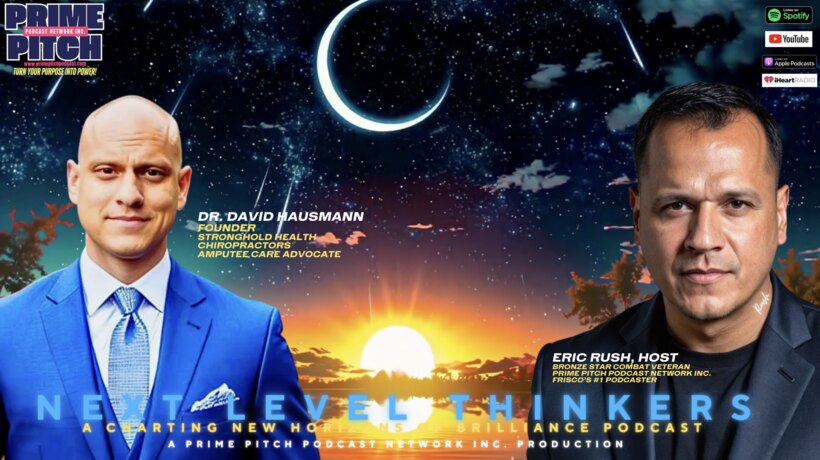
Dr. David Hausmann
Founder, Stronghold Health Chiropractors · Amputee Care Advocate
About the show
Next Level Thinkers is a Charting New Horizons of Brilliance podcast: conversations with high performers pushing the boundaries of effort, mindset, and human potential. Hosted by Eric Rush, The Conversation Architect, a Bronze Star combat veteran and the founder of Prime Pitch Podcast Network.
Read the full transcript
'Cause the majority of my life I would say, like, as a thought leader and entrepreneur, et cetera, et cetera, et cetera, it's mind becomes your greatest attribute, where you can think your way out of a situation, and you can leverage resources, and you can basically lean into the mantra of there's always a way. I can figure this out, right? At that point in time, though, it, it's less about control, and it became much more about surrender. Mm. And that was, like, the, the hardest lesson to live through experience, but also in the same manner, the easiest, because it was forced.
It's almost like-God was like, "Oh, you have trouble asking for help? Oh, you have trouble leaning in, surrendering, and trusting? Okay. Well, I'll just take away any ability you have to do anything else other than sit your ass there and surrender."Mm. Yeah.
Very, very uncomfortable, especially, like, if, if you don't like asking for help. level, next level. We're reaching for the sky. Next level. Thank God.
Hey, what's up, guys? Welcome to Next Level Thinkers, a charting new horizons of brilliance podcast. Dr. David Hausmann died 3 times. He survived one of the deadliest infections in the world, he lost his leg, and when he came back, he had to learn how to live inside the different, a, a different life.
There's a record for what happened, charts, numbers, procedures, and the language medicine uses to account for a body in crisis. But what doesn't sh- what those records don't capture is the moment a life separates from what it was and starts again under different terms. This week inside of Adaptive Training Foundation, you could see that response.2 sessions a day, 5 days straight, the room was full of people working with what remains. Dr. Hausmann moved through it without drawing attention to himself.
Steady, deliberate. You can tell he understands exactly what it costs to keep going. When David isn't putting himself back under pressure, he's building the exact spaces his life forced him to understand. He's a doctor of chiropractic, a clinician, an adaptive, an adaptive athlete, and an advocate working in clinical care, amputee healthcare, and performance. He helps others take back control of their own bodies.
There's a line he returns to, he, and he doesn't say it lightly, "It became me versus me."That's what the Next Level Thinkers is about. People don't just go through something, they turn it into how they operate, th- how they build, how they lead, how they create something that didn't exist before. Dr. Hausmann, welcome to Next Level Thinkers, a, a charting new horizons of brilliance podcast. It's good to have you here, my man.
Man, I'm so excited to be here. Awesome, brother. You know, if you got that mic, you wanna move it closer to you, it's up to you. Like- Yeahyeah, perfect. Okay, cool.
You know, um, when I was reading the cold opening, like, what, what thoughts, what, what feelings and thoughts went through your mind? Um, you know, when you said the statement that I keep returning back to, it became me versus me, hearing someone else say it is kind of not necessarily the surreal moment, but for me, just hearing it- Mmgave me the, the goosebumps on my skin- Yeahand a chill. Because saying it to myself is one thing, but then hearing someone else say it without truly knowing the depth of it- Mmfor me, brings me back to the moment of when it became that for me. Yeah. That's, that's insane.
I don't know if that makes sense or not, but- Yeah, it does. Yeahit's pretty deep. Yeah, it is pretty deep, man. Yeah. You know, okay, you and I, we, we just, we, we, we just got done, um, a, a program called Hypertraining at Adapt, uh, at Adaptive Training Foundation.
Um, A- ATF, and, um, let's talk, let's, let's go ahead and start it off by- Yeshonor, let's honor it right now. We'll, we'll start- Yeahlet's start off with honoring that. Um, let's share, share a little bit about what, what Adaptive Training Foundation is and how you got involved with them. Yeah, so, uh, so ATF is unlike anything else I've, you know, personally immersed and voluntarily put myself into. Uh, what it sounds like, it's adaptive training, so you're surrounding yourself with other individuals that have been put into a life situation of limitation.
Maybe lost a limb, lost a piece of what they were before, um, lost so- some form of identity or function, and these people are all in, in conglomerate group of putting themselves into a coachable position of beat my ass up. You know what I mean? Yeah, yeah. Like, grind, grind me through the mud. Like, do what y- do what I need to do so that I can push myself beyond the limit of what I've placed myself right now.
You know what I mean? Like- Yeahwith this new life that I've got where I've lost a leg, it's like I, I can't do that. I can't jump up a box. I can't, you know, sprint down. I can't do lateral shuffles and all this stuff, and we, we place these limitations on our, on ourselves, and yet there's these pioneers and other individuals who have been in a similar place in their life, and they've figured it out.
They've pushed themselves. They've gone to that limit, gone to that edge. Mm-hmm. Um, and so it's, like, one thing to do 2adays. Like, any of us that have, that have done diet, workout, like, I'm gonna, I'm gonna get cut for summer and get my 6pack abs.
Like, we've all, we've all done it, but doing- Yeahthen doing 2adays where it's like everything more or less is, "Oh, shit. I don't know if I can do that. I'm gonna fall flat on my face."Yeah. That's, uhI, I, I mean, I, myself am not a military vet. I've never been in the military.
My brother, my mom, my dad, all military, right? And the mind aspect of going to, like, boot camp and, like, putting yourself through the fire- Mmright? Is different than just doing 2adays, and that's kind of what I would maybe relate it to. It's like the mental aspect of the squeeze of when's my mind gonna break? Yeah.
Yeah, it's crazy. You know, in that, in the hi- in, in that hyper traded environment this week, where did things actually start to break for you? Now, now that you mentioned the word break, and, and how did you rely on, uh, on in that moment when you kept going? What did you rely on when you, uh, in that moment when you kept going? I don't know if everything broke all at once.
I'd say it's more like of a slow erosion, 'cause it's, again, the beat down, the beat down, the beat down, the challenge, until eventually you get yourself so fatigued, they get your heart rate so high where you stop thinking clearly. And I'd say in those moments are when it becomes the most challenging, not, obviously not just for me, I think for everybody. Um, but what, what kept me going, I would say, is identity over exhaustion, right? Yeah. Where before, uh, I was in very, very good physical shape when I had, you know, both my legs before that leg loss, and, um, I would always rely on the physical.
Hmm. But also the mental. I'm a very mentally strong person, always have been, how I was raised. And so, like, the combination of the 2 is just like, I'll just pu- I'll just effing push through, you know what I mean? Like, I'm just gonna bull rush this thing and get to the other side.
And it's like, when that limitation, the physical limitation now is there and you- Yeahgot the loss, it's much more mind- Yeahat that point. Yeah. And so it did become identity of what- Hmmis pulling me through. So, like, who do I have to be to get through this? Yeah.
Not what do I have to do. And that w- that was the hard struggle for me, though, because I get my, my head, like most of us do, and coach is like, "No, you have to do this."Like, ph- physically, this is how you have to do it. And in my head, it needed to be less of how and more of who. Hmm. That's- What's the identity that, like, I'm making this decision from?
What's the identity I'm gonna show up? Yeah. Yeah. That's what I would say helped carry me through the, the hard struggle moments. Yeah.
That's interesting. And the reason I ask is, you know, we went through this journey together, and, uh, you know, I could have, uh, all the participants in this room, and I would wanna pick their brain in this capacity and see what, what was that, what was, what w- what actually started to break i- in them, you know? What was like, what was that thing that, like, said, you know, like, okay, you know? Like, um, you have anything to add to that? I'm just thinking, uh, you know, break it down a little bit more.
It's like the identity of who you are ties very strongly as a man-in terms of masculinity in modern society to your physical capacity. Yeah. Physically what you look like. If you got the muscles, if, uh, you know, you've got the appearance of money. It's, it's all the external validation, if you will, that we seek as guys to fill the role of provider, f- fulfill the role of, you know, strong and dominant, uh, protector, right?
And so a lot of that identity still ends up being c- it's, it's like old rooted identity. Yeah. Yeah. So, like, to, to the point I was making before, it's like having to ask the question, am I still showing up with that identity of like, oh, you're physical, you're a badass, you're a beast, you can just push through it? Yeah.
Or am I showing up with this new integrated identity that I've worked so hard to build? Yeah. That's crazy. Yeah, you're right, man. Like, that was, that was the one thing, like, you know, when I was looking at your journey, was following your journey on the, the Instagram, right?
And- Yeahon Instagram when I was looking at your story, like true story, I was like, dude, this guy was a beast. Like, you know, jumping rope and all these things, and I was like, that's exactlyThat I could relate to the j- jumping rope and all that. I was like, wow, that's crazy. Um, yeah. Yeah, absolutely.
Um, and to, to try to go, to go off of that, um, when your body starts sending signals that something's off, how do you decide what to push through and what to respect in this, in this space right now? That's a tough question because, again, still old identity creeps in. Um, I think people maybe get it wrong at this point where they need to distinguish, I guess, the difference between danger and discomfort. Mm-hmm. Yeah.
Right? Because, like, when you push yourself and you know change is coming, anytime there's change, it requires what? Yeah. Pressure. Right.
And, like, pressure is uncomfortable. So I would say, like, discomfort versus danger would be the distinction in, in those moments. Yeah. Like, for me now is asking the question, is this something that is just discomfort that's going to cause growth? Yeah.
Or is this legit danger? So, like, really listening to my body, at 1 point they, they had us, uh, you know, with a knee disarticulation, I have no knee joint, right? So they had us doing, remember, those, the squats. Yeah. The RDLs.
Typically no problem doing that before, but at this point it's like you have to fully put all of your weight on and trust this robotic microprocessor knee thing- Yeahthat it's gonna stop when you stop on the good leg, and it's like psychologically, mentally, I'm like- Mmnot there yet. You know, like, don't trust this leg, and he keeps telling me, like, "Trust your good leg," and in my head, what am I thinking? Trust my, my good leg. He's like, "No, this is your good leg. This thing's way smarter than this thing is, and this thing's stronger than this one is."That's crazy.
Right? Yeah. But in that moment I'm sitting there thinking, "No, this is dangerous. I'm gonna blow out this leg."And the reality is it wasn't danger, it was discomfort. Mm.
It was you haven't learned to trust it yet. Insecurity, right? Yeah. Other than insecurity. Insecurity.
Right? I don't feel safe, and so it's hard in those moments when you don't feel safe to really figure out is this danger or is this discomfort? And honestly, I don't ha- I don't have a clear answer for what it is at that point in time other than just trusting the instinctual voice in your head, like, this is gonna rip my muscle in half, or no, this just really hurts like hell and I'm gonna do it anyway. Yeah. Which is what I leaned into, and that discomfort did cause the growth of I can trust this.
Yeah. I can do more than I thought I could. Yeah. That's awesome, man. Yeah.
That's awesome. Y- and, and, you know, as a, as a doctor in chiropractic care and, and clinician, you, in your practice, um, not just in yourand, and also in your, in, in your life, um, you've seen what real system failure looks like. How does that change the way you approach limits now? Hmm. That is a tough, tough question.
Um, I think how it changes how I approach limits now is that system failure doesn't all happen at once. Hmm. The tipping point of when systems fail seems to happen all at once, but, you know, in hindsight, in 2020, when you look back at things, you realize it never actually all came toppling down at 1 point in time. It was a slow erosion. Hmm.
So I'd say the way that it approaches, that hel- helps me approach things now is to, uh, I r- I remember saying this maybe a couple times is, like, widen the lens. Yeah. Right? Because we assign as, as p- as people, as humans, we assign an identity, not an identity, more of like a designation, right? We as- we assign a designation of good and bad to things way too soon sometimes, and it's because we have a lens that we've learned to hone in and narrow to look at, you know, a, a system or to look at, you know, an event in our life or to look at what we're going through right now as is this good or is this bad?
And I was very narrow-minded or narrow-sighted, I guess you could say, before leg loss and all this stuff had happened, um, and it served me well. Making quick decisions, driver mentality, like, get shit done, entrepreneur, build business. The problem is that narrow lens didn't, it didn't, um, include enough thought, enough, uh, I guess foreshadowing is not the right word I'm looking for, but thinking through further into the future from now- Yeahhow is this going to affect 2 years from now, 3 years from now, 5 years from now, things that are more important- Hmmthan what I've got my sight on narrowly. How is this going to affect my family in 3 years? How is this gonna affect my family in 5 years?
How is this going to affect the employees and the team that I'm working to build? How's it gonna affect their lives- Hmmin 5 years? So when you start widening the lens, I think it helps you identify and, and pick out different com- components or different parts of system failure, where the erosion is much more obvious- Hmmthan it would be if I was still so focused on the narrow. Yeah. Does that make sense?
Yes, it does. Yeah. Yeah, 'cause it impacts your surroundings, your environment as well, you know? Like- Yeah, almost like a-Think more legacy Mm. Gotcha.
Yeah Than, you know, short-term gain, short-term moment. Yeah. Yeah. That's amazing, man. Um, before we go into the next question, let's discuss a, let's talk about if you feel comfortable, always say that other people's trag- ev- other people's suffering, other, other people's trauma is sacred, right?
Mm-hmm. And that's one thing I've learned is that it's very sacred. If you feel comfortable, you wanna share, um, what, what exactly happened that, that caused you to lose your, your leg? Yeah, I don't, I don't mind sharing. Okay.
Um, I, I think, you know, I've heard this said so many times before in so many different ways, and there's alliteration. Smart people have come up with these phrases before me, but, like, your greatest test becomes your greatest testimony. Um, and, and I know it's been said so many other ways, but sharing your story, whether it's insane and wild and crazy statistically, or other people might deem it small, it's, it's irrelevant. Everybody's story deserves to be shared because it's their experience- Mm-hmmand what's helped them evolve and tr- and transform and, and grow. Yeah.
You know? Um, and to that end, I guess for mine, you consider, you could consider it, like, wild, absolutely crazy, and extreme. Um, I don't even know where to start. Like, you, whether you want the short- The abri- yeahor the- The bri- yeah, we'll keep it abbreviated, and we'll expand. Okay, okay.
So, you know, uh, about six and a half, 7 months ago, I was at the, the peak of my career, I would say, uh, peak physically- Mm-hmmof what my body looked like. I mean, I'm 6'3", currently 206 pounds. I was about 230 pounds, so that much more muscle mass than where I am right now.9% body fat, um, just having a grand old time. Uh, and then out of nowhere, driving home from my chiropractic clinic on a Friday afternoon, I started feeling tired, just, like, feel like I'm falling asleep at the wheel. So, I- MmI call, you know, my wife at the time, and she's like, "I'll come pick you up."I'm like, "Cool."So I lay my head down on the seat after parking, and then the next thing I know is I wake up, like, well, I've, I've got some weird, crazy, lucid dreams, all kinds of- Mm-hmmgnarly stuff going on in the dream.
Wow. And I'm like, "I can't wait to wake up," like, this is wild stuff, right? I don't know how many days later, it's weeks later, wake up in the hospital bed, tube coming out of my throat, cords coming off my body. Basically, I, I woke up on life support, woke up out of a coma. Um, had no idea what was going on.
My body was 53 pounds lighter. Wow. Catalyzed 53 pounds of muscle mass and tissue to stay alive and survive. Um, and the long story short of it is somehow, some way, I got a, an infection of Clostridium septicum, which is the rarest, deadliest, most aggressive form of flesh-eating bacteria in the world. Um, when you get the infection, you have a 20% survival rate within 48 hours if it isn't diagnosed and, and, uh, caught and s- being stopped from s- uh, spreading.
And for mine, it, it hit my body, it infected, turned to flesh-eating bacteria, gas gangrene, reached the bone, uh, reached visceral organ, and by the time they had found it and discovered it, I had pretty close to about a 2% survival. And then, uh, within four and a half hours, my wife picking me up and taking me to the ER, uh, for passing out and losing consciousness. It rapidly evolved into, you know, screaming leg pain, and they already had me back in surgery doing debridement, cutting out tissue off my leg. So in four and a half hours, it hit from my left ankle all the way up to, basically up to my knee. The whole back part of my calf, the whole front anterior compartment just decimated the tissue.
Wow. And then I coded on the table during that leg surgery, so they couldn't get, uh, the part where it spread to my large intestine. Um, somehow I stabilized overnight after a couple of hours, and then they went ahead and did the abdominal surgery, cut that part out. I coded a second time. I coded a third time when I was talking to one of the, the doctors, um, in intake, and turned blue.
Had all these people come into the room. So, you know, in the experience, I had coded 3 times. I'd been, uh, on life support for weeks, in, in the darkness where it was just literally me- And me. Mm. Yeahyeah.
And then I woke up to this reality. So for, for a lot of us, when you go to sleep, you don't remember what happens when you sleep, right? Put your head down, close your eyes. You wake up, and it's like 8 hours passed, and we have no perception of time. I, I would say imagine it like that.
Like, you lay your head down on the seat. Your life is a certain way. You wake up, even if it was a weird dream or whatever, no perception of time, and then all of a sudden, 53 pounds lighter, your leg's completely gone. You're so weak you can't lift your arms. You can't even speak, 'cause of the tubes and stuff down your throat, and then you're just laying in this hospital bed- Mmasking what the f- like, "What the fuck happened?"Yeah.
Where, where am I? This has to still be a dream. Mm. And then, uh, I had to piece stuff together from doctors' records, or medical records from some of the doctors coming in and telling me little tidbits, from, uh, my, my wife, like the horror and shock and trauma in her eyes trying to tell me little parts of it, all to figure out, I guess, somehow I got an infection and I died. Okay.
Right? Yeah. Um, but then my leg was still there. Yeah. And it was wrapped in a wound vac, and so, uh, it took about 3, maybe 4 days for them to come and change the, uh, dressing and the wound vac, and it was the first time I saw my leg.
And that was, that was like the moment where it was, this is no longer a dream. Like, this is real. Yeah. And I had to make that decision myself. Do I pursue some plastic surgery route and try and save what's left, or cut it and move forward with life?
Yeah. So that's, I made that decision. I said, "Let's cut it."You know, it, that, thank you for sharing that. You know, like I said, every, every, everyone's suffering is sacred, you know? Their struggle, their trauma, whatever they experience.
I can't imagine, you know, what you went through. It's just, um, but it's good to, to hear for other, other, other individuals who are gonna watch this podcast. They're gonna feel, they're gonna feel, they're gonna feel what you've shared, and they have similar s- maybe even worse situations, right? Yeah. Yeah, yeah.
As crazy as it sounds- Yeahthis, I- Yeahin- Yeahin my mind and my heart, I know just so many people have it way, way worse. Yeah, and if you weren't physically prepared to, to endure that, like, you know, that could've been a whole different thing too. There's, there's- Yeaha couple doctors that have said that. They're like- Yeahwhat if, you know, your discipline to work out and take care of yourself for the 5 years leading up to that to get into that shape was all so that you could survive that? That's amazing, man.
You know what I mean? Yeah, yeah. That's- Damn. Yeah. Uh, this leads me to the question I wanna ask you next, um, and that's why I asked you, 'cause I, I think it's so important to get, you know, get this part out, you know?
Um, and, and thank you for sharing that. Um, when, when everything was going wrong medically, what w- was there a moment when you realized this wasn't something you could think your way out of, s- something deeper had to take over? Yeah. Um, 'cause the majority of my life, I would say, like, as a thought leader, an entrepreneur, et cetera, et cetera, et cetera, it's mind becomes your greatest attribute, where you can think your way out of a situation, and you can leverage resources, and you can basically lean into the mantra of there's always a way. I can figure this out, right?
At that point in time, though, it, it's less about control, and it became much more about surrender. Mm. And that was, like, the, the hardest lesson to live through experience, but also in the same manner, the easiest, because it was forced. It's almost like God was like, "Oh, you have trouble asking for help? Oh, you have trouble leaning in, surrendering, and trusting?
Okay, well, I'll just take away any ability you have to do anything else other than sit your ass there and surrender."Mm. Yeah. Very, very uncomfortable, especially, like, if, if you don't like asking for help. Yeah, yeah. Um, so it became, again, less, less about control and more about surrender.
And, um, I, I didn't come up with this phrase or statement, but I heard it said somewhere, and maybe I, I changed it a little bit to, to fit my s- circumstances, but it was very much the universe meets you at the depth of your surrender- Mmnot at the height of your struggle, right? Yeah. And there's no way to explain it other than I can't figure this out myself. I can't think my way through this, so I just have to lean in and trust and surrender that everything that's happening right now is happening exactly the way that it should happen. Yeah.
Not for a reason.'Cause I was, I was raised, you know, everything happens for a reason. And then I'm sitting there laying in this hospital bed-Function taken away, my business collapsing, chiropractic clinic gone, business employees quitting, people leaving, no sense of security and safety, filing bankruptcy from a hospital bed for my, for my business, right? So, like, all these things that were me or, like, my capacity and my ability, unable to control. And I'm sitting there laying, thinking, "How, how am I gonna get through this?"And then it's kind of weird in a sense because in the surrender where you're just like, you know, throwing my hands up like, "I can't control this, so I'm just gonna let it be"- Hmmthere became serenity. As weird as it sounds, because it's like having control though and having certainty in itself to a certain degree is peaceful.
It's like, "Ah, I know what's gonna happen. I've got this. I've got control."Everything's cinched up, and then all of a sudden your world gets turned upside down, and nothing is what you remember, and you're like, "Is this reality?"It's scary as hell, right? You're like, "Oh my God," like, "What's gonna happen?"Like, "How do I control this? Oh my God," like, everything's blowing up.
Hmm. And you try and hold onto it and cling and grasp for control and power, and if you keep doing that, it's just discomfort, man. Yeah. That's- Instead it's, the surrender is just like, okay- I mean-I can't control this. Yeah.
What I can control is who I am- Hmmand how I will respond when I have the ability. The-- And then that surrender is just like serenity. It's weird. Yeah. That, that's so sick, man.
I, I love the way you described that too. It's like, you know, 'cause I w- you know, it, it-- and that's the part, you know, you-- that's like when I started thinking about it as you were talking, I was saying, "Well, maybe that's what our group had in common is that we had-- we've reached a place of surrender at some point in our journey."You know what I'm saying? It's that, yeah. Yeah. I was starting to-- as you mentioned, I was like, we had to have that point in, of surrender.100%.
Yeah. It's, it's unique too, 'cause I hear you talking about your experience, and we're sharing yours, but mine happened in, in a six by 9 in a max prison in solitary confinement, you know? That, yeah, and that's interesting. It was like I- YeahI'm, I'm like, I can't even imagine, like- Yeahthat. Yeah.
I'm scared thinking about that. Yeah. Yeah, and, and, and yeah, how that serenity and the serenity came in that same mo- in that same place too. Yeah, right. So yeah, that's, that's, that's so, that's so, it's, yeah, it's so de- deep and, you know, we have-- we're assigned a certain- Hmmnow there's a certain expectation that comes from that, I believe, you know, you know, of our experience, right?
Um, wh- uh, when you, when you say me versus me, what specifically had to go, and how did you know it could not come with you anymore? Um, so you're talking about widening the lens, right? And like surrender. In the surrender, uh, part of what led up to that, you know, when I, when I was conscious again and awake again, was the battle that ensued before I woke up. Hmm.
So a lot of people ask, like, "What, what was it like near-death experience DMT trip?"Like, 'cause if I coded 3 times, like, what the hell happened when all that occurred? And when I woke up, I also-- I didn't remember anything. Even though I was full sentences, conscious, talking when, when she checked me into the ER and whatnot. She's like, "How, how do you not know, how do you not know what happened?"My brain, when I coded, deleted all the trauma. Hmm.
Which is also kind of an interesting-tidbit to-- from lived and learned experiences, like- Mm-hmmI could've been burning, like they could've burned me a, a witch, you know, burned me at the stake and- Yeahlike, oh, burning alive in fire. But that trauma, for whatever re- like the creator of universal intelligence, God, programs the brain neurologies to like when you code and you go on a DMT chemical release, it deletes out all that trauma. So like- Mmhad I actually died on, on the table, I wouldn't have remembered all that stuff anyway. Mm. I'd have just remembered, like, all the magic moments.
Yeah. crazy. We could do a whole other podcast- Yeah, yeahabout DMT trip and all that kind of stuff, but, um, man, I got distracted there for a second. Yeah. But the, the me versus me occurred, I think, you know, when I coded and when I was on life support.
It was just m- myself in the darkness, and during that, that DMT trip, it, there's some stuff that happened, but vividly there was a certain point in time where in order for me to come back to life and to survive, I had to face myself- Mmin a legit battle. Mm. Like fists, baseball bat, knives, like whatever was available and around, I was faced with a version of myself that I knew are all my vices. Uh, the liar version of me, the sneaky version of me, the hiding person, you know, version of me, the, the one with all the vices. I can't even describe it other than like you look in the mirror and you look at yourself and you know, and you look at yourself in the eyes of like, "Dude, you fell short doing that.
Dude, you shouldn't have done that. Man, you should've been honest about that," when you're reflecting on your entire life. So that version of Dave faces me in the darkness, and I know this might be a little vivid, but I'm getting to, I'm getting to the point here. I had to face me. Mm-hmm.
And it was that version of me where it's like I don't wanna face that version of me, 'cause those are all the parts of me that I don't like. Yeah. But there's no mirror in this experience. I couldn't see from my eyes, first person point of view, who am I? All I could do is look down at my hands, and it's like 16-year-old Dave.
So I knew as a younger version of myself that in my mind is weaker- Mm'cause it doesn't have all the ego-driven versions, right? Yeah. And there was a legit battle where I did have to battle myself, and it was me versus me, and what ended up happening is in the fight, eventually I did win, and when I made the landing blow to that version of me, he didn't disappear. He came into me and absorbed. And it was a, it was a moment where I realized every part of who we are is part of who we are, and it deserves to be honored.
The shadow self-the elevated version of our perceived self, it's all how we were formed, created, or evolved in our lived experience, right? And when you try and suppress your ego, and you walk through life with your, uh, self voice or your innate, you know, conscious voice, you, you don't win. There's parts of you that don't show up. If you show up and walk through life all in your ego, you also- Mmruin relationships. You don't honor yourself.
You don't do things that are just true, that hold up to who, who you are, who your standards are. Yeah. Right? Yeah. And I could go on and on and on.
So basically what ended up happening is I had to accept and honor my shadow self, my hero self, my innate self, relationship with my creator, and bring all of those voices an equal seat at the table. And it was the integration of those 3 voices- Hmmthat at certain points in life I would let take the driver's seat exclusively at the expense of the others. Mm. That is so deep, man. It was the integration where all of you guys deserve a seat at the table.
Yeah. This is who I am- Yeahand I'm going to unapologetically show up as that man moving forward. Yeah. That is deep, man. That is so deep, you know, you know, finding that, the true human si- a humanized leadership kind of way, right?
It's to take-- You gotta be confident to talk about your shortcomings. You gotta have, you gotta have a sense of, um, integrity to talk about your shortcomings. You have to have a certain honor, you know what I mean? Yeah. You know?
And, but also at the same time, you have to y- you have to be okay with having your ego take- Yeahthe driver's seat at times. Yeah. And there's a lot of, like, men's mental health stuff that you just, just completely suppress it. Yeah. And like, no, that's not honoring parts of who you are.
Like- Yeah, you gotta have the creativity, yeahego, your ego voice also de- deserves a seat at the table- Yeah'cause it's part of what gives you your drive, gives you your push to succeed, right? To go into the uncomfortable, we were talking about, and like grow. Y- when you, um, when you start putting things back together, uh, when you started putting things back together, what was non-negotiable? Especi- uh, yeah, what's non-negotiable? What was, what was non-negotiable, and what had you, what had to be rebuilt first for anything to work?
You know, not the sexy stuff. It's foundation. So what became non-negotiable was if I'm showing up asThe man who survived all this and no form of me that walked into the darkness, this integrated version of myself has to honor all 3 voices at the table. And so the foundational stuff, sleep, rest, asking for help- Mmslowing down. Also cutting people out, saying the uncomfortable truth, being the a-hole for a moment, right?
All the things that we know we should be doing, and oftentimes we either don't voice our need to do. Like being okay with the fact that my body is tired, it takes 30% more energy for me to freaking walk, just walking like I would before. Yeah. And being okay with, like, being perceived as weak for a moment to say, "No, man, I, I, I need a couple minutes. Like, I need to rest," and honoring myself.
So all to say the not sexy stuff, but some of it c- I guess could be perceived as sexy. Yeah. I, I Getting invited to a party and I'm like, "No, I don't wanna go to a party," and my friend's like, "Well, why not? Like, everybody's gonna be there."And not because I don't like you or I don't wanna be there, but because I'm just not gonna enjoy myself. I'm gonna be leaning against a wall uncomfortable with a swollen leg.
Yeah. Versus before it would be like care more about making my friend happy than taking care of myself. So it's that kind of stuff- Mmwhen it becomes non-negotiable at this point where what people deserve is the unmasked version of yourself. Mm. The world deserves your light, and your light never shows when you arrive with a mask or a partial mask on.
Yeah. Right? Yeah.'Cause you give yourself to the world as a fractured version of yourself, and people deserve the real you. Yeah. That's beautiful, man.
I do agree, man. Like, you, you canYou know, I've certainly worn my fair share of masks, you know? And- All of usyeah, yeah, yeah. It's, it's-- and it's, it-- I think you're absolutely right there. Um, how has this-- how has that experience changed the way you make decisions today, especially when there's risk involved?
I mean, I'm gonna go back to making decisions with a wider lens. Again, um, you know, is this gonna benefit me now, or is this gonna benefit me in 6 months? But then also it can sound kind of selfish to make the decision based on am I honoring me and putting myself first. But it's not selfish. And I'd challenge people to start thinking that way more.
Not is this gonna benefit me for the short-term pleasure and gain. Is this gonna benefit me in making this decision, am I violating my identity or am I honoring who I am? Mm. Because when you make the decision from the honor instead of, you know, the short-term pleasure, sometimes making a decision now honoring myself is painful. You know what I mean?
Yeah. And because of that, we don't make that decision. We make another one that, for example, like the party thing, I go to a party to make my friend happy and appease them, and end up causing myself more harm to my leg that's still swollen, can't fit in a socket, and end up harming myself. Is that really benefiting him when now I disappear for another 2 months because I can't go to events because I didn't honor myself? Yeah.'Cause I tried making someone else happy instead of taking care of what my needs were.
That is, that is so high level, too, to, to kind of differentiate, to have some self-advocacy. You know, I think that's a, a point that I, I just, like, got, got really accustomed to worry at your own personal, your own self-advocacy. I just learned that, like, 2 years ago. What does that mean? You know?
It's like, you know. And then to, to really unders- advocate for myself, you know? Yeah. Yeah. Loving yourself isn't selfish.
Yeah. Um- Loving yourself is loving others if loving yourself and putting yourself first and honoring yourself is gonna give yourself the ability to show up more whole, more authentic, and more real for other people, right? Yeah. Let's talk about your clinical work. How's, how's that, how's that going for you?
What do you, um, and where do youAnd, and in your work that you've, you, you do and, and have done, um, where do you see people give their power away without realizing it? Hmm. Um, I think, you know, naturally people just give their power away by not realizing that their body is capable of healing itself. I'd say more of, like, a surface level or, like, a 30,000-foot view, my experience as a, as a clinician, as a doctor, is seeing people outsource decision-making and destiny when it comes to their health to someone else. Like, "Oh, well, the doctor said that I can't run."Yeah.
Right? Yeah. Did you hear that one before? Yeah. Yeah, I've heard that.
Yeah. I heard that one for sure. Right? And, and it's like, well, just because my leg dealer, my prosthetic clinician says that, you know, it's too soon for me to run, that could be a risky decision for me to still go and push myself and do it, but it could also be just that he doesn't have experience working withAnd by the way, if you're watching this, bud, I'm not talking about you. This is just a, an arbitrary example.
My leg dealer's awesome. Um-but, you know, it, it could be that he just doesn't have experience in working with adaptive athletes that are willing to push themselves in that way. Yeah. He could have a lot of experience in working with diabetic patients that are older that lose their limb because of a vascular issue. Yeah.
Like, right? So the point is, um, you know, if I'm diagnosed with cancer and the doctor says, "You only have 6 months to live," is that really true? Like, who made that decision? Yeah. Do I?
No. Like, I could have way more life in me if I decide that I do. So I'm g- instead of giving up my power to a destiny that someone else decides- Hmm. I take it back and I claim the destiny that I know to be true- Yeahor I know is possible. Yeah.
That's, that's awesome, man. Yeah, that was a, a, a turning point when I looked at the, uh, when I started seeing myself running on the treadmill, you know? For sure. Um- that was awesome, by the waythank you, man. Uh, yeah, it was, you knowAnd that's what he, that's what, that's what Dr.
Hausman is ta- is talking about. He's talking about, um, when I got my hips replaced, um, not my primary care doctor s- visiting, I guess, someone who, who was filling in f- when he's not there or whatever, had suggested that I not run anymore. And, um, and my primary care would never say that. I don't think he would ever do, say, "Just take your time. Get, get healthy and strong."But this guy, um, took me, uh, took me on aBut it was before that, I wasn't even running before, you know, 2 years before that, 'cause I just didn't, I felt like there was some serious damage going on anyways.
Yeah. Yeah. Right? Yeah. So more to that, though- YeahI'd say, um, I just, I just looked at my notes- Yeah, yeahand I was like, "Yeah, I was, I forgot about this."Um, you know, people outsource responsibility when it comes to health.
Hmm. And that, I think that's what I was trying to get to, is like, well, the doctor said this, and- Yeahit's in a way outsourcing responsibility of, like, I don't have to take accountability for it now. Yeah. Oh, it's kind of out of my control. Like- YeahI don't have to do it.
Yeah. And I would say from my own experience, like with this whole leg thing, that is true to a certain extent. Like, outsource the responsibility to someone else. Well, the doctor said that's limited, or, oh, the user manual says I can't do step over step with this. But I can still, like, try and figure out how to do it maybe in a different way.
Yeah. And take the responsibility of pushing myself into an uncomfortable scenario where the pressure is there and it's discomfort, not danger. Yeah. And maybe I can figure it out. Maybe I can grow, and I can take a step sooner and faster.
Yeah. So stop outsourcing responsibility. It's like I can encourage, I can give patients resources, I can empower, but I can't carry them. Yeah. Yeah.
Um, w- what's something you've learned about recovery or rebuilding that most people don't, um, wanna accept? Hmm. Um, surrender. Like, lived experience for my, for myself, uh, while this is all going on, I do have a friend that, uh, sh- she tore her ACL in her knee, and we had a conversation, I think, exactly about that. Like, in, in the healing process, you have to surrender.
Like, there is a s- surrender that is required, and it's if you don't, if you don't honor it, if you don't, like, fully surrender when you need to- Yeahyou cause yourself more harm. Hmm. Yeah. I mean, I, I know there's a lot more to that, but that's probably the short answer of it. Yeah.
That's, that's probably right. I mean, that's 100% right. Um, what are you building right now that reflects who you've become, not who you were before all of this? There's a lot, there's a lot that I'm building right now. Um- It's awesomemen's mental health is one of the things.
So there's a program that a lot of what I'm describing of, like, inviting voices to the table to have an equal seat, and being okay with accepting shadow versions of yourself and different parts that you idealize as your hero self, um, or, like, your god, creator, innate guided voice version. So there's a program that's a men's mental health program, it's gonna be an app, um, and it's called The Integrated Man, or, uh, He, like Him, uh, He 3, so the, it's the m- the 3 inner voices of a man. Mm. And it's how toIt's like an assessment that's built into it, and in that program helps you identify what voice you've been allowing to kind of take the driver's seat, and do it at the expense and suppression of the others. Mm.
And then, uh, guided walkthrough program and, and, uh, the, the whole program itself is designed to help you to identify very, very concretely which voice helps me make which decisions, and at what points throughout the day am I actually tapping into or completely suppressing those other voices. And when I say, like, super practical, very, very practical. Mm. Like, any guy could pick it up, they could do the program, and it's designed for you to kinda do as a sprint, so a 30-day program. You download the app, you pay to get into, uh, access for the full program, you take the quiz, um, and then you go through the daily activities, about 30 minutes a day, and then you start integrating the practices.
And in doing that, you invite all 3 voices a seat at the table, and then from that foundation, rewrite your identity. Mm. So it's how to integrate the identity of who you believe you've, you're destined to be instead of what the world says you're supposed to be- Mmas a man. That's okay. So that's one program.
It's, uh, it's called The Integrated Man. Then the other one is, it's, it's helping amputees get what they need. So- Mmme and 2 other founders are currently in the process of, we're pretty close to launch, so it'll happen sometime the 6 n- the next 6 to 9 months. We're getting, uh, the proper funding in place right now, but it's called AmpuHealth. Mm.
And AmpuHealth is a program for a lot of people that don't know that, uh, health insurance does not cover what you need for prosthetic sockets. Microprocessor knees, components, all the parts for this. Um, a lot of people are surprised when, if I were to get invited to the beach, go to a beach day with my buds, with family, with friends, whatever, this thing, I can't get wet. Mm. The $68,000 microprocessor knee.
Wow. Wow. Right? And there's a lot of stuff it can't do, and one of them is it can't get wet. Can't get salt water in it, it'll void, void the warranty.
Can't get salt into different, you know, parts of the gears and stuff like that. So b- I would actually have to get, like, a beach leg. I can't take a shower wearing this because taking a shower standing and, you know, balancing on one leg or sitting in a little shower chair. And the point is, insurance won't cover that, though. Mm.
They consider it a luxury item. Or if I wanna get a running blade foot or any number of other different things, or I go through a body change right now and maybe I gain a little bit more weight, this socket, this carbon fiber won't fit me because my leg might swell and expand. New socket, I just got one, my insurance won't cover it. Mm. So there, there's an injustice that's taking place for about 2.7 million amputees, um, annually with about 700,000 each year- Mmadding to that population, where a majority of them outside military vets, VA takes great care of amputees.
Um, but most of the others, private health insurance, I'm paying $1,200 a month, and I still can't even get what I need covered. So the program, AmpuHealth, is a member-funded program where amputees can join as a, a member. They pay a membership, and it gives them full exclusive access to what they need when they need it. Mm. No questions asked, no insurance submissions, and then it gets denied for medical necessity or it's a luxury item.
So I'm really, really passionate about that. Me and another founder, who's an amputee, and a really good friend of ours, we're deep in, in, in the thick of it, and we're building it. That's amazing. That is amazing. Seriously, I just- when I read, when I read your bio, I was like, that's what's up right there.
I know one thing I've learned through this experience, 'cause this is the first time I've been, you know, I, you know, I've been to, you know, I've been to galas and stuff like that. But to share space with, um, those that, that, that require extra s- uh, medical s- medical service or medical equipment to, to function, um, that, for me, was one of the reasons I wanted you on here as well. And I'll have, I'll have Michelle on it, too, 'cause I, I think it's, um, I think it's so important toI think it's important to advocate, you know, to, to, to have theseI have a now another advocacy that I, in my toolbox that I wanna represent. I wanna be able to support in any way possible, and that's providing a platform for, for, for the things you just, y- that you said you were, that you're, you're working on making better. Thank you.
Yeah. That's the truth, man. I was likeAnd, and yeah, so Michelle and, and probably we get Morgan in, we'll figure it out. But- Yeahyeah. Um- It's wild because, like, before living, living in- Yeahthe community or, like- Yeahbeing put into that s- situation, it's like I always thought it's just like, oh, well, you know, you open a catalog and you pick a leg, and it's like, you know- Yeahright off the shelf type of a thing.
Yeah, yeah. Not the case. Like, these, these sockets, they're all completely custom to each person's anatomy, their body shape, their size. Like, otherwise, it doesn't work. Like, you can't wear it.
Yeah. It's, it's crazy 'cause I do also have a friend that, like I told you, he's, he's just now getting prosthetics. Yes. He's having to train it to use it. He's been in a wheelchair the whole time.
Shout out to Jace Wheeler. We gotta get you on the podcast, my brother. We'll get you here. And w- um, he's, he's documenting his journey in such a very- Like a vivid- Vivid, with scar, you know- Oh, that's awesomeand surgery. Yeah, and he's got it, and I'll connect you both.
Respect to you, brother. He, yeah, heYeah, and, um, Tunnel to Towers co- um, blessed him with a new home and all, and so he's a world-class dude. Um, okay, final question. Um, well, before we do that, let's talk, let's, um, let's go ahead and tell everybody how people can get ahold of you. Um, no, let's do that afterwards.
We'll do that. Okay. Here's a la- here's a final question, okay? Okay. When it's all said and done, Doc, Doc Gelsomin, done, your work, your patients, and what you've built, what do you want to be true about the way you've showed up for people who are trying to rebuild their lives?
Legacy is one of those answers that everybody says. Um, but I'd say for me, when I'm just a faded memory, I want people to think, "Man, that was a guy that didn't just give people answers."Right? Because we're in an information age where you can get anything you want at the tip of your fingers in a flash, in a moment, and there's so much information that's out there. For me, it's more about I want people to feel like they got their power back. Mm.
Right? Yeah. And that's the whole idea of the men's mental health thing that I'm doing right now, the amputee access for them to be able to get prosthetics. And anything else that I touch and build from here moving forward is going to be did it facilitate helping that person reclaim their power? Mm.
And I, I, I would say that, for me, would be ultimate legacy.'Cause even, I'm, I'm even thinking about, like, my kids, man. Yeah. Like my son who has autism. Mm. Is there a program that really exists in the world right now that helps people understand that's not a designation other than the world not understanding how that person's mind and brain neurologically is wired- Mmadvantageously?
Like, it's a gift. Just the same way as me losing my leg, as crazy as it sounds, is a gift. Because if it didn't happen, I wouldn't have evolved and grown into who I am now. And for example, Amput Health probably would never even be a thing. Mm.
And it could be another 25 years before someone else comes along and is like, "Hey, what the hell's going on? Why hasn't someone built this yet?"And so 25 more years of amputees suffering injustice of not being able to get what they need and live a mediocre, subpar life from what they really should be living. Yeah. Right? So I would say that's what it comes down to, is legacy in that he helped people reclaim their power.
Dude, that is so amazing, man. That is so sick. It's a pleasure and honor to know you. It's an hon- uh, I call you friend. Can I call you a friend now?
Heck yeah. Yeah, yeah. You know, I think- You're the bestyeah, yes, absolutely. You know, it's, I mean, that's the, that's the thing, you know? It's like in this process, youYou know, we're charting new horizons of brilliance in, and, and, and we have, we've, because of what we've had to endure and what we've gone through, and we're, and, and I think it's so, so amazing, um, to ha- to have captured your thoughts and, and, and- Oh, thank youand everything so that other people can listen and hear and, and get to, get to really see who Dr.
David Hausmann is and, and the, the stuff, the stuff through, that you got going. And I'm looking forward toAnd then one day I'm gonna say, "Man, I know the guy who created Amputee Health, man, and he was on my podcast. He was, you knowAnd, uh, and, and I went on a journey with him and, and we were, we were, we were sweating bullets for a while thereBut, um, no, but I'm super excited to have you on the podcast, man. It's a pleasure and honor. Why don't you tell people how they can get ahold of you, where they can follow you, and all that good stuff?
Uh, well, uh, probably the easiest way is, you know, the good old IG, Instagram, so I'm The Adapted Doc. The Adapted Doc. You can also, if you're an amputee, and literally as of today, the air date of this, you can go to amputeehealth. com. We are accepting now pre-registration for any interested individuals.
Um, and we have some loose pricing up there for the membership options that are available. And then on my IG, uh, very soon you will see The Integrated Man, so HE3, The Integrated Man, will be up there. Plan on launching that within the next 30 to 60 days. That's awesome, man. Yeah.
That's exciting. That's exciting, guys. Make sure you go, uh, follow, follow Dr. David Hausmann at The Adapted- Adapted DocThe Adapted Doc a- on Instagram. All right, guys, uh, that- Perfect.
Anything else to add? Cole, I know what you want- I wanna say, I wanna a- a- add this part too is, um, um, speak to someone out there who's gone through a similar journey, someone who you, you, you wanna reach out to. You, leave, you leave this with a final word for, for someone who's, who's lost, has, an amputee, lost, lost part, function of something. Give, give them some- Yeah. If you're, if, if you're going through it right now, your entire world's been turned upside down, it doesn't have to be an amputee.
If you've lost a part of who you are, if change has been forced upon you, if you did it yourself, right? You built a life, you know, you hid, hid certain things. Uh, for, for me I can say this, like on my business I took out a bad loan and I didn't tell anybody about it, right? And so, like, the secrets that we have sometimes can lead us into our own destruction. Yep.
And oftentimes they do, and they always come to light regardless. If you're there, you're in the thick of it, you're in the darkness, you're going through the transformation and the change, and you don't feel like there's an end in sight, remember the one truth. It's so hard, but the universe will meet you in the depth of your surrender, not at the height of your struggle. Let go. Stop trying to hold onto control, and remember that everything happens exactly the way that it should.
All you have is today. All you have is right now. You're not guaranteed tomorrow. Mm. So if you keep holding onto the control, you're so focused on, "This can't go on the way that it is," and you don't widen your lens, as crazy and upside-down, ass-backwards as it sounds, when you widen your lens it helps you focus on the narrow right now.
Don't miss the light that's right in front of you. Don't miss the beauty in the relationship. Don't miss the love you know, your, your children or your family in the moment that's right in front of you. Don't miss the majesty in the sunrise. Don't be so focused on later, future, that you miss what's right in front of you right now.
Surrender in the moment. Trust that you're more than enough already the way that you are, regardless of where you are and what you have, and your future will be brighter. All right, guys. That's it for Next Level Thinkers, a Charting New Horizons of Brilliance podcast. As I always say, have peace and the light in you, and remember that the ocean refuses no river.
Well put. Next level, next level. We're reaching for the sky. Next level thinkers. We're aiming high.
Pushing through the galaxies, no turning back. We're on a mission. Blazing a new track.