Dr. Cody Palmer & Michael Grohman
Dr. Cody Palmer & Michael Grohman joins Rush on Unfinished Business, the show for veterans pursuing new missions after the uniform and the people who stand beside them. As cEO & COO, Big Country Veterans, Dr. brings building something meaningful to the table.
They get into the work, the cost, and the reasons it still matters, in the kind of long-form conversation this show was built for.
In this conversation
- Building an organization with a mission
- What experience teaches about leadership
- Turning purpose into work that lasts
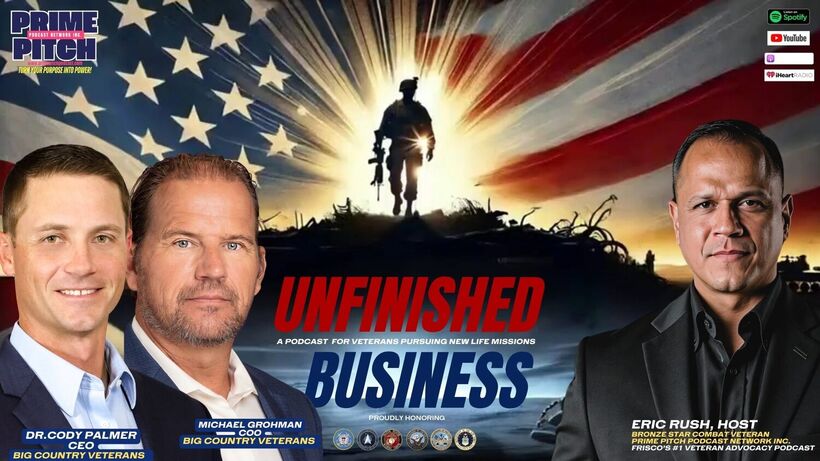
Dr. Cody Palmer & Michael Grohman
CEO & COO, Big Country Veterans
About the show
Unfinished Business is a podcast for veterans pursuing new missions after the uniform, and for the families and communities who stand beside them. Hosted by Eric Rush, The Conversation Architect, a Bronze Star combat veteran and the founder of Prime Pitch Podcast Network.
Read the full transcript
Guys that- Yeah. didn't want to come out, that came out. Then afterwards were like, "I don't care what it takes, I'm going to be here next year."Mm."I'm going to continue to be a part of it."And I think that's what makes us very special, is we're not a single touchpoint. Once you're part of the BCV family- Yeah. it's continuous.
Uh, we've got a Signal chat that I think there's, like, 120 people on it. It's all of our alumni. Wow. You have to turn notifications off, 'cause it's, it goes 1,000 miles an hour. Yeah, yeah.
But it, it's a place where you have continuous touchpoints every day with that group. And I think that, you know, it's not, "I attended this event. Hey, thank you guys for sponsoring me," and then I never talk to them again. Yeah.'Cause they're on to the next group of veterans. Uh, so I think that's where people are willing to drop their guard, um, when we go 0 offer a service dog, people are stepping forward going, "Hey, I would have never done this before, but I could really use help.
I need to go to Invicta."Mm."Can my wife and I come out? We're really struggling."Those barriers and walls come down, and they're wi- and they communicate with us. And they communicate probably more with Cody than they do with me. Mm. And it, and it's an amazing thing to watch, and it's amazing to be a part of it.1,Hey, what's up, guys?
Welcome to Unfinished Business, a podcast for veterans pursuing new life missions. Every veteran knows that moment when purpose begins to rise again. Quiet at first, then unmistakable, like a steady rhythm returning after years of uncertainty. That kind of renewal takes shape from people who understand the terrain, who speak the same language of service, responsibility, and the long road back to strength. Today on Unfinished Business, a podcast for veterans pursuing new life missions, I'm sitting with 2 leaders who live inside that word every single day, Dr.
Cody Palmer and Michael Broughman of Big Country Veterans. Cody brings insight of a clinician who has watched recovery unfold through movement, patience, and con- connection. Michael carries the instincts forged in special operations, where presence, loyalty, and calm leadership shape every decision. Together, they've built a space where veterans regain momentum through community, shared experiences, and a mission that keeps growing. Big Country Veteran moves with intention.
Steady systems, honest conversations, hands-on support, and a culture that strengthens everyone who steps into it. This conversation, in this conversation, we explore how paths converged, how their work continues to evolve, and the vision they're shaping for veterans and families across Texas. Guys, welcome to Unfinished Business, a podcast for veterans pursuing new life missions. It's a pleasure to have you both. Um, in that introduction, did anything, like, jar you and say, "Oh, man, that, that's what it's about, that's what it is?"Well, I think just kind of the passion built behind what we do now.
Mm-hmm. I- i- when you're living it every day, um, and then to hear it from someone else that's kind of outside, uh, uh, looking in, um, it kind of reaffirms what we're doing for our veterans and it, it kind of reassures us we're, we're going down the right path still, so. Michael? Mission. I mean, having, having focus, value- Okay.
and something that you have a connection or an emotional relationship to, I think is extremely important. And to Cody's point, it's every day. It's not, ah, well, maybe we'll do this a couple of times next week. It's, I mean, literally every day. So I think that's, uh, it's a great opening.
Let's talk, let's, let's, let's, let's start off with, like, talking about Big Country Veterans. Tell us what it, what it's about, what it stands for. Maybe b- each of y'all can bounce off of each other in that. Sure. What Mid Country Veterans is today is not what we thought it was gonna be when it started, I will say that.
Hm. Uh, it's been amazing to see the path that it's taken. When it began, um, it was honestly just a way to give back, built out of conservation. Uh, I come from a ranching community out in West Texas, and we started as a helicopter hog hunting event. Hmm.
Uh, it was in an area of Texas, kind of forming our name, Big Country Veterans, that's part of Big Country, Texas, it's big continuous ranch land. And with the Daniel family, out of the Circle Bar Ranch, their just welcoming invite to say, "Hey, not only do we want to help our neighboring ranches, things like that, with this, we're gonna bring in veterans to be a part of that too."Hm. And that combination that first year really ignited what Big Country Veterans is today. And yes, the helicopter hunting is incredible. Uh, it's about, you know, if you, if you ever wanted to do that, it's definitely a bucket list item, uh, that you want to get checked off.
But it's really the time off the helicopters that we started to understand and realize what Big Country Veterans was. Hm. And it was a community of people, being both veteran, I'm civilian myself, um, and just everyone kind of melting together in an environment that's open, that's understanding, that's loving, and allowing kind of walls to be dropped to say, "Hey, you know, I'm living this life with you."And as I started to do that, these incredible veterans that we serve, um, started to share some of the challenges, especially, you know, like Mike himself, retired, special operations, combat, you know, things that changed not only their lives but their families', it started to kind of create a call to action for us as an organization. And now we have 4 amazing core programs that we'd love to talk about more obviously, but it, it really set the stage for being an organization driven by those we serve. Absolutely.
And just being a platform for them, for that. Awesome. Michael, you want to add any- anything to that? Y- yeah, I want to reiterate the community piece. Mm-hmm.
The, you know, I, as a veteranRuss, you actually said this before we started, uh, you made that comment, you kind of disconnected yourself from the veteran world. Mm-hmm. I did the same thing when I retired. I completely, I didn't connect myself, I didn'tuh, follow all the kind of traditional trends. I went out into the world and did my own thing.
Mm-hmm. So, it was years before I came back into the veteran organization, if you will, and it was that community. It was, that's the piece I was missing, 'cause, you know, y- you work in an organization, in an industry where nobody's there for the pay. Let's just be honest, right? Nobody's there because you're making good money, uh, nobody's there because they give you the best of everything.
They're there because they're serving a higher mission and that community, that, that group of individuals creates an environment that's like no other. And being around those people, I missed that, and I hadn't been able to replace that anywhere. So, when I was introduced to Big Country Veterans, to me, that filled a huge void, uh, that I wanted to be a part of. That's amazing, man. Uh, that's f- that's amazing.
We're gonna tap into that a little bit more. W- we're gonna talk about those f- those 4 things, uh, those 4 programs you got going on. Both of you were shaped in very different environments. Michael, through the pressure of special operations. Cody, through years of clinical and rehabilitative work.
Mm-hmm. Which part of those early experiences still influence the way you show up for veterans today? Mike, uh, Cody? Well, I think, you know, not to s- step on Mike, but, uh, what he is gonna share, but- No, look-it comes out of a, a, a framework of service, just at the end of the day. Uh, both of those environments were about helping, um, to me, in the physical therapy world, um, at a time and a moment in life where, you know, j- they were having to deal with challenging things.
Um, after I got my doctorate at UT Southwestern Medical Center, just down the road from here, I worked at Baylor Institute for Rehab, which is a neurological rehab based, uh, facility here. Mm-hmm. And so, I was able to be humbled enough to be at a moment in someone's life, had fallen through traumatic brain injury, fallen through stroke, things that significantly changed their path. And, to be able to s- not only sit with them in those moments, um, to be a physical therapist, but to be a support to try to navigate those waters, um, during that time really helped shape, I think, again, just that passion to understand, hey, you know, we're all gonna have challenges in life, how do we plug in together to help each other through those? And specifically, our Optimal Performance Program has directly kind of connected that world back together, uh, for us as an organization and for me personally, with a lot of the stuff that we're focused on regarding, you know, physical and mental health of the individuals that we, uh, serve.
And soThe, um, Ultimate Performance, uh, Program, is what, what does that encompass? So, Optimal Performance Program actually stemmed from a relationship we had with Parker Performance Institute, uh, here out of Park University. They have a program called the INVICTA Project, and it is focused on, um, veteran and first responder kind of TBI treatments. What brought us to them was actually, again, to the point we were making, one of our veterans that had gone through our initialcame back and said, "Hey, I, I want to introduce you to this program that I went through. It really changed my life."So, went and did that.
Got to see that facility and what they were doing there. And really, to your point, um, like, God kind of taking me through the path of physical therapy, I was able to really understand and vet out to say, hey, this is a different, this is different than what you see out there- Mm-hmm. in normal businesses. So, that in itself created this opportunity to create some very specific and focused and meaningful, uh, physiological care for the veterans that we serve. And so, that program, we then started talking more to say, hey, what are we seeing?
And in these individuals that come out, there's a, a term called, uh, operator syndrome, uh, that has recently been accepted kind of in, in this veteran world that somewhat explains the physiological changes that operators go through because of that. I'll let Mike obviously- Yeah. speak more on behalf of that. But it's focused, it's focused care. It's what these individuals serve, from vestibular training to just new age, um, equipment that they have.
And so, we looked at it and said, how do we create this partnership? Optimal Performance Program is about connecting the dots from a health and wellness side of things to get them back to that level that they were used to functioning in during the military. So- Mm-hmm. yeah. Michael, I had never heard that term, actually, operator syndrome, until right now.
Mm. So that's why I'm like, "Wow."Talk to me. Talk to us. Yes. We, we were fortunate enough to meet an individual, Dr.
Chris Fruhi, and he is a psychologist. And Chris, if I mess that up, I apologize. Uh, at the University of Hawaii. Uh, deeply connected with military organizations. Not a, not necessarily a veteran himself, uh, but dove into this world of, you know, initially PTSD, yet there's, there's not a direct connection, right?
We, we kind of, like, classified everybody under PTSD, and they realized that there are some differences. And when you think of a traditional PTSD, uh, you think of someone exposed to a traumatic event, um, and one of the primary drivers of PTSD is fear of that event, right? Like, "I don't want to do that again. I don't want to be reminded of it."Military is a little bit different, right? Like, "We're going to go back to the call of gunfire," right?"We're going to go back into the burning building," if you will.
Firefighters, going back into the burning building, police, going back into that high, high-threat environment. So there's some difference between PTSD and operator syndrome. Mm. Several of the symptoms are very similar, but I think, from my perspective, and I'm not a, a psychologist, but as I read the symptomatology of PTSD and operator syndrome, uh, the piece that resonates the most with me is, there's still that willingness and desire to go forth and do God's work, right? Or the government's work, or whoever the work we're doing.
Uh, whereas in PTSD, more, it, it's not necessarily people trying to go back out. So, um, they studied this for many years. They took it to the, uh, the VA. And just recently, I got a notification that, uh, Stanford has now released empirical evidence, uh, that operator syndrome is, in fact, uh, more directly related to, uh, the individuals that they served and their experience. So, I think what we're starting to see, and I think that's gonna help a lot of folks that areThey kind of don't want to come out for many reasons and say, "I have PTSD," uh, where folks, I think, will be more open to saying, "Okay, operator syndrome sounds more appropriate to me."Uh, I think PTSD, and this is my opinion, I think we victimize veterans with that term and I think people don't want to fall underneath that, that victim piece, 'cause, "I served this country proudly," you know?
Um, I don't want to point a finger and say, "Well, this is their fault and it wasn't mine."Um, I'm happy with what I did and what I served, and I think 0 operator syndrome resonates more with, uh, folks that are in that environment. Now, there are PTSD, you know, e- uh, uh, in, in existence, but I don't think it's everybody. I think there are folks that they need that, and what I'm hoping is when we focus more on operator syndrome, the folks that have the PTSD elements, we can actually treat them at a better and different level. So I think it's gonna help, um, everyone, all the veterans, first responders, uh, that suffer from these different disease processes. That's interesting.
You know, off the camera, IOff camera, I shared a, uh, spirit experience of somebody I had on my, my podcast. And, and that was the thought that was going through my mind, actually. I was likeAnd then you guys bring this, this, you know, operator syndrome, I'm like, "Man," you know?"I wish thought about how, what heWhat he must be internalizing that he has maybe hasn't let go of," right? Right. And, um, um, that's, uh, interesting.
How, how new is that for health k- k-? So theStanford's released their empirical evidence week ago, 2 weeks ago. Oh, really? Uh, Dr. Chris Fruhi has been working on this, uh, for many years.
Mm-hmm. But we know that, you know, healthcare is great, but it's also monetary. The VA gets a lot of money for PTSD. So you walk into the VA and say, "Hey, we've got this new thing over here."Um, and they're like, "Well, hold on, that's not part of that monetary train."That even talking to a healthcare professional in mental health, I sent them the information on operator syndrome and the, the direct response was, "There's no ICD-10 code for that."Hm. Right?
So what ca- what does that mean? Well, you can't bill insurance for something that doesn't exist in the system. So who's gonna pick up operator syndrome as a diagnosis if they can't bill for it? So I'm hoping with that empirical evidence, the powers that be will actually recognize it as a disease process and start treating people appropriately. Wow.
Well, and what we noticed that was very intriguing to us is, when you kind of started looking at the list of changes, uh, physiologically, uh, when you look at operator syndrome, from a physical therapy side of thing, I was like, "We, we can address some of this."Like, from vestibular training, sleep deprivation, hormonal imbalances. You know, I think, to Mike's point, like, I think the, the one and only term a lot of times is just PTSD to, like, umbrella all those things. And you see that in healthcare with dementia and different things like that, youBut it allows us, and we talked about this even before the podcast, to go to maybe a root cause or go to something that's there that we can now change their body physically. Hm. And so many times, I've experienced it in my journey, uh, personally, uh, and then also in physical therapy, is like when that starts improve and change, uh, the brain itself, the cognition tends to go with it, right?
And so there's so much positive outcomes that can be had to creating these relationships that we are under the kind of umbrella that we have at Optimal Performance Program, where we're looking at these, quote unquote, "symptoms," but could be a root cause to then really make impacts, uh, in these individuals' lives.'Cause I always tell people, I was like, when we started looking at that, uh, it's like sit, sit in his body for a day- Mm. and just see how you mentally compartmentalize or, or function during that day. Yeah. So if there's a way we can physically help them, I mean, why not? You know, and that's, that's kind of been a, a theme a little bit, I guess, in BCV, is like if it's impactful, if it's meaningful-why not?
Like, why not check it out? Why not make these relationships? Why not make these partnerships to see if it's- can make an impact? Yeah. Michael, your special operations years left a mark that do- they don't just disappear.
How do those experience guide the way you serve and relate to veterans now? So, Cody mentioned the selflessness, right? And I mentioned this talking to, uh, a Veterans Day conversation that, you know, it is selfless service, right? It's not about you or what you're gonna get out of it. But I think really for me, the elements that I bring in the most, good or bad, uh, probably the dedication to the cause that I'm- I'm going after, I tend to connect myself to it.
And then the loyalties of the people that we serve. Mm-hmm. Right? I think it's important that, you know, we've heard the old cliché, you know, it's about the person to your left and to your right. Well, there's something to that.
And there's- and that to me is loyalty, that I'm dedicated to the point that what I'm going to do for you is what I'm telling you, um, and I'm gonna follow through with that, is keeping that loyalty. So, for me, those things were extremely important, uh, in special operations, um, in our small teams as we deployed, that we have that dedication to each other, that loyalty to each other. Um, and lastly, that commitment, right? That long-term commitment. I think those are the things that probably translate the most, uh, into my new role here in Big Country Veterans.
That's awesome. Um, yeah, I could see how that, you know, the loyalty for sure, that was like, oh, yes. You know, that's what it's about. You wanna have loyalty with your brothers and sisters and- and that trust and you have, uh, lived it. You have experience.
You've done, y- y- you know, you have body of work in- in, you know, in- in that field, so it's be- it resonates with you. You're bringing a lot more than, um, the intangibles and tangible assets. Yeah, you know, Rush. I mean, firsthand, right? Yeah, yeah.
Like that's just, you don't go, you're not gonna go into combat with some- somebody that isn't loyal to you and you don't trust, right? Like, that's just notBut you'll walk into an office and work with a million people that you have no loyalty or trust with all- all year long, right? Yeah. I don't f- so I- I don't, I don't do that anymore. No, I'm just kidding.
Same. Well, I- you know, and I think that's become a district differentiator for Big Country Veterans as well. You know, that loyalty, that trust in community, that connection, um, that they feel, you know, we hear about it. and it's- it's nice to have that again, and not to just be isolated to veterans. Like, to have that same connection with civilians, uh, just to your left and right, no matter who it is.
In Big Country Veterans, you know, we kind of term it the BCV family. Mm-hmm. You know, that's- that's what it is about and that's what's driving the organization forward in just incredible ways. That's awesome. Cody, um, working in physical rehabilitation gives you a close look at how the body and mind recover.
What patterns have you noticed in- in how veterans heal and how does connection strengthen that process? You know, as- as I look- I look at that from a very, uh, PT mindset that the body will respond to the stresses that it's exposed to. Mm-hmm. Good or bad, right? Yeah.
And so, I think, from my standpoint, is, um, for us as an organization, the psychological piece of rehabilitation, we understand that's not necessarily our direct fit and we, with our skill set, the connections that we have. But the physiological changes there, the things that we can kind of work on from, uh, a body that then becomes a mind aspect of that. To answer you directly, I've been able to see guys that, um, especially going through the INVICTA project, like, man, I didn't realize I had that issue. You know? Mm-hmm.
Uh, I didn't realize, as I was straining and testing myself, my brain, in certain ways, that they're, oh, man, that TBI did do a little more than I was aware of. But to not only be aware of that and educate them on it, it's to now have a tool, um, and some tool sets to take home with you. Because that's one of the biggest things for us as Big Country Veterans is to not just have a one touch point relationship with those we serve. It's about coming in, staying, and being a part of that veteran for their life. Um, as much as they want to plug in, we're gonna allow that opportunity on our side.
And so, to just see some of the changes that's happened with that, and even with our service dog program, um, just another animal being around, helping, assisting in certain ways, just how that's changed even their body, how they carry themselves. Kind of even, we talked about this, that the community creating motivation, uh, within each person to like, how can I be back to who I was and not even that, how can I be the best version of myself right now? Mm-hmm. You know? And so it's been incredible to see.
Like I mentioned, every single one of our programs isn't something like, I think they need this, let's form it and make them fit. It's more the veterans coming to us and saying, "Hey man, this was extremely impactful."Mm-hmm. How do I help the next guy- Yeah. maybe receive this? How do we work together?
So honestly, the service dog program stemmed from my gentleman right here to the right of me. And so, look for- Yeah, you want to speak more about it? Yeah, Michael? Rush, I was in the same shoes you were a couple years ago. Um, I was like, that'sdon't agree with it, don'tyeah, whatever, on all your own.
And, uh, our current trainer, uh, was someone that I had, I don't even remember how I got connected to her, to be quite honest. And she kept calling me, "Hey, I've got a dog. I want to "I'm like, "I don't need it. I'm good."So after a couple years, my wife just kind of beat me down. And then at a very, I think, opportune time, she happened to reach out to me, the trainer did, and said, "I have a dog that would fit your personality.
I think it's exactly what you need. It could offer you exactly what I think your, y- you know, your body needs at this point."And I was transitioning back from Washington DC to California. So I was like, "All right, you know what? I'll give it a shot."And so my wife flew up and I got this dog, and it absolutely changed my life. The, I mean, I didn't s- I didn't notice the differences, but everybody else did.
Mm-hmm. And there were things that, you know, one of the things, and you know, I'll share, 0 open a little bit. You know, I, I'mso to Cody's point, I've got vestibular damage. Mm-hmm. I've also got bad hips, bad knees, like all the sameyou know, you- Yeah.
you know better than that, right? Yeah. If I'm in thatif I'm in line like you are- Yeah. I'll probably gonna need those replaced. So getting up and, you know, mobility is an issue.
So this dog was trained to help me get up, right? Well, also with my vestibular issue, um, my balance is off, and I tend, if I'm in between people who are walking, I tend to walk diagonally. Mm-hmm. So this dog was trained to kind of help me keep walking straight. Mm-hmm.
But on top of that, everything this dog did for me was absolutely amazing. Uh, and unfortunately, I put, I had to put him down a couple months ago. Uh, he got cancer and, and we've had to put him down. But when I joined BCV as, um, a board member and we were at a board meeting, they asked a question, you know, our sponsors, our board members, our f- our alumni, where do we go next? And at the time, we were just The Hog Hunt.
And I couldn't, I couldn't get it out of my mouth fast enough. I'm like, "If we want to impact someone's life for the remainder of their life, we can have service dogs."And we called the trainer that got me my dog, and I got her on board, uh, 'cause I, I believed in that. And we've started that process. And, and it is absolutely changing people's lives. And it makes an impact.
And we don't, we don't get between the veteran and the trainer. We don't know what each dog is trained to do. Um, we do know that we have veterans with special needs and they get, umthere are things taken care of by, with those animals. Um, and it's kind of a ver- a powerful thing to watch as they transition, they bond. Um, very proud of what we're doing with those dogs.
Yeah. That's amazing, man. Yeah. My buddy was like, "Now you have a dog."And it was like, it was like yeah, we were, we had this huge thought over that. We did.
Yeah. So it's really cool to hear about- Yeah. you know, the, what you guysum, you know, it's true. I, Iwe, you know, you couldwe understand each other, how we have to work through those, jump those mental hurdles, right? And mental/emotional hurdles, um.
Well, and some of that's just kind of those times in isolation, right? Like- Yeah. how do we, how do we impact those- Yeah, 100%. at that moment? And, and the service dog can check that box a lot of times.
And it's, it's kind of the motto of that program is kind of there when it matters most, like when no one else is there, that dog can be there and will be there for that individual, soYeah, it's crazy. I used to say, I didn'tI don't even have, I don't even have a goldfish in my home. You know? Right. That's the isolation.
Right. You know? For sure. Um, how did you 2 cross paths, and when did it become clear that, that you were supposed to build something together through Big, A Big Country Veteran? Oh, I got to tell this story.
Let's hear it. So, uh, and, and I think it's important. I think it's a relevant story. It kind of goes to the heart of BCV. So I was invited to the event, The Hog Hunt, by a very good friend of mine, Derek Kasmar.
Texted me, he's like, "Hey Mike, you got to go to this event."And this was right before COVID. Mm-hmm. Yeah. And I thought about it, and I'm like, "Eh, I really don't want to go."My wife was like, "Oh, you should go. Flying in a helicopter, shooting stuff.
You guys will have a blast."Well, I'm not a hunter either, so to me, there wasn't really a lure, uh, to go shoot an animal. Not something I grew up doing. And, uh, I was always the kid holding the gun for my dad, right? In theor the flashlight. Well, COVID came along and they canceled the hunt.
So I actually felt relieved, like, I don't have to go do this-stupid thing with all these, you know, idiots. And, uh, the next year, I get a text from Kasmar and he goes, "Hey, we just kept the same list, so all you guys are, you're coming out to the hunt."And the, the day before the hunt, I told my wife, I'm like, "I'm not going. I'm just not gonna show up tomorrow."And she convinced me to just give it a try. She's like, "Worst case scenario, it's two and a half hours from our house. I'll drive out and pick you up if it's, if it's horrible."So I got out there.
Of course, this is theand then I get forced off the bus first, right? And this is the first guy I shake hands with. That's kind of the last time I really saw him for the weekend. So I'm not sure who he was at that point. But we arrived on Thursday.
By Friday, I was looking for the people that were facilitating this thing, and I said, "I don't know what it's, what it's gonna take, but whatever it is, I'm coming out next year to volunteer."Hm. Like thatjust like he said, theshooting out of a helicopter was great, um, and I think it's important for people to understand that for those like me that don't necessarily hunt-It's actually providing a service, uh, for the ranchers out there. These invasive species are actually costing people their livelihoods, uh, their ranch. And the one that was the most powerful to me the year that I went out, and I can't remember her name but she had come down to talk to us and we were hunting on her land, and she had mentioned that the ranch next to her the year before had lost their ranch, uh, because the hogs had destroyed their entire crop. Hmm.
So at that point, to me that was a mission and purpose to do what we were doing. It wasn't just for the fact of shooting something. So, uh, so there was purpose behind what we were doing. And, uh, I remember meeting Cody and telling Cody that, you know, I wanted to be a part of this. And my wife had come out to pick me up, because to Cody's point, I wanted her to come out to where we had experienced this over the weekend because it was that impactful.
Um, and we were leaving, and this is the next, the second time I saw Cody, um, that entire weekend. We pulled into this little gas station and they had all gone down there to get burritos, and I open the door and I see Colton, um, and I see Cody. And I'm like, "Oh, hey, let me introduce you to these folks."So I took my wife over and introduced them, and then Cody and I started talking for a little bit and there was just this connection. And then we found out shortly after that that we have the same birth date. Oh, wow.
Um, and, uh, and other than that similarity, we are polar opposites. Yeah. And everything, we are, we are the yin and the yang. And people wonder how we get along, but it's, I think it's an amazing, great relationship, and it makes it work for us. That's how me and this guy met.
That's awesome. Yeah, when I first met Mike, you know, we had, and we still do, and that's, like, that's what's the magic of it. You get, uh, veterans coming out that kind of step off and go, "Okay, where am I at? What am I doing?"Um, and then by the end of that weekend, really understanding, I see it. I, I, I see the piece of what you guys are trying to do."And so I, I don't take that lightly.
No one on Big Country Veterans does, like, that trust, that, that connection, especially from the, the veteran community that we kind of seek to, to serve. And so when Mike came to me about that, again, I did not take that lightly. Mm. Um, and so, for one, I need help 'cause I was kind of a one man show, uh-uh, in a lot of ways. Yeah.
And, and we knew we wanted to make it beyond just that event, you know, at that time, to, to Mike's point. And so I actually set up a time, uh, a lunch, to just get to know him a little bit more and, and pitched the idea of saying, "Hey, we'd love to have you come join our board."And so that relationship kind of more intimately within the backside of Big Country Veterans as a board member, um, he was invaluable in so many ways. Uh, he was our first veteran to be on the board, and so brought a lot of insight from that standpoint. But also, you know, going back to his selflessness, um, Mike Brown is an extremely talented individual. He could do whatever he wanted in this life, no doubt.
And for him to choose and make that choice to come in, and he chose to even step off the board, come in as now our COO, uh, because he saw the need and, and the impact that that would make. And so now us, to his point, working together on that level every day, um- Yeah. and is it every day? Uh, to have that yin and yang, because I think that's what makes the beauty of BCV what it is. Yeah.
Because we have multi kind of personalities or views or angles coming at stuff, but we're all on the same mission together. Yeah. And I think that's what's incredible, that, you know, I pull him this way, he pulls me that way, but that expands even beyond that to our sponsors, our veterans, and they see it and itI wouldn't say they see it. I think it's felt. Like, it's hard to explain it, but if you're around it, you're like, "I got it."Yep."I get it."That's, that's so cool, man.
You know, I, I got invi- I got invited to be part of, uh, Guitars for, Guitars for Vets, you know? Totally. You know, it's a ten week program. They give you a free guitar after you finish the classes, right? Wow.
But for weeks, the invitation was sent, right? Mm-hmm. Guys said, "Hey, we'd like for you to join."And I lettheAnd you getYou know, I went to my first session, never went back, and the guitar was sitting in my house the whole time, right? Um, how you guys bridge the gap is you invite a veteran and youYou know, they got everything to gain from this, right? They got everything to experience from this- Mm.
Mm-hmm. And they look at that invitation and pass it by every single, you know-for days and weeks, you know, like I did, which is why I stayed with this program, but- Yeah. it took me, that mental hurdle. What's your, what's your, what- I'll tell a little bit of an origin story, and then I'll, I'd like to kind of expand on that- Okay. personally.
So the event was happening under the flag of an different organization. And in 2019, literally a month or so before the event was set to happen, they said, "Hey, if you guys want to do it, here you go."And so Colton and I looked at each other along with some other key individuals and said, "Yes, we want to do this."And that was truly the, the birth of Big Country Veterans- Mm-hmm. uh, at that time. But with that being said, you know, we knew we wanted the right people to be there. And so Mike and I, uh, connected with an individual that had gone since the very first event out there and said, "Hey, man, we want this to be special, but we don't know who we need now."So Colton and I- Yeah.'Cause you said, "Mike and I."It was Colton and I.
Oh, sorry. Yeah, it is Colton. I didn't say Mike. It was Colton and I. That's why I'm here.
You're right there next to me. I see you- We didn't need no camera. We didn't need no camera. It's working. So Colton and I reached out to this individual, and, uh, he said, "No matter what happens, just getting these, this group back together, connected is going to be an impact."Mm.
So I say all that to say we don't choose. It's actually kind of stimulated by those that have been there, done that. Mm. And, and Mike's been a big help for that, keeping it going. Yeah, Russ.
So, uh, you know, I think that's what makes us different, right? So to your point, I don't know who invited you to the guitar thing. Um, we had kind of had a conversation about potentially donating one of our spots. We don't control the spots. Mm-hmm.
Uh, our alumni control the spots. So we have, uh, about 113 people, veterans that are associated with us right now, uh, that are actively, almost actively engage with us on a, on a daily basis. Yeah. Um, and what we do is around June, July timeframe, we start soliciting nominations from our alumni group. Mm.
I give them a couple week window 'cause some of them are slow to respond, and then we, we comprise a list, and we can get anywhere from 40 to 150 people that they recommend. Um, and then we turn that list over to our alumni. Uh, they create a board, and then they go through, and they look at all of those individuals, names removed. We take the names off of it, and they look at the individual based on, uh, their combat experience and what they've kind of been exposed to, uh, and they rank them. Um, and then they send it back to me and say, "Hey, here's our, here's the 20 people we want to bring out."Wow.
And then I reach out to those 20 people and say, "Hey, uh, we'd love to have you."And then I reach out to all the other folks and say, "Hey, um, we just, we don't have capacity."I mean, I, I wish I could bring 100 people out. Yeah. Uh, but we know that, you know, if it gets too big, we're gonna lose that, that special feel of it. So our alumni are the ones that control who comes out every year. And the group that comes out- Mm.
next year, uh, will be part of that process the following year, soAnd it's usually that guy calling his friend that says, "Hey, man, I know you've never liked doing this stuff, but you need to come out. You need to get off your ass, get on that fucking plane."And we've had guys that we've had to tell them, "I don't care. Get on the fucking plane and get out here."Mm-hmm. And then they're like, "Thank you for pushing me."So- Yeah. And that, to me, is a special thing about us.
It'sAnd I don't mean this in a, in a negative way, but not everybody can come. It's not- Yeah. just open doors and just show up. Mm-hmm. Um, it's that there's a process.
And I think there's an element that resonates with that with special operations people. Yeah. Um, we've all been part of a selection process throughout our career. Everything that we do is based on selection. Mm.
So in a way, this kind of gives them a little bit of that purpose again, like, "Oh, um, we get to go through this."Now, Cody and I always have the, you know, the veto authority. Yeah. Right?'Cause y- Um, but at the same time, we really try to, tr- tr- try to turn it over to those guys and let them do that. And I think that's where we get that continued support. And to your point, uh, I just notified the group a couple weeks ago that, "Hey, you guys were, were selected."And within the day, I had confirmation from every single one of them.
Wow."I'm there, I'm there, I'm there, I'm there."And, uh, and then from there, we'll start coordinating and getting them out. That is so cool. Yeah. And so many of them don't know who else is coming. And that's- Yeah.
sometimes in a way. Yeah. And so to have them show up at Truskett, Texas, uh, middle of nowhere and go, "Haven't seen you in a decade," but yet they share these life-changing moments together, you know, in combat. Yeah. I mean, that, that's, uh, just one piece of the puzzle that makes that weekend just so special and Big Country Veterans in general, soThat's very cool.
I like that system, man. Like, you get, get people to get on there. Yeah, it took me a minute, and that second, that third call, I said, "What's up, man?"Like, "What's the deal here?"Mm-hmm. And that's what did it. I was like, oh man, this guy's donating his time, his energy, and his talent to me, and I, and I can't say yes.
I can't say, you know, like- Right. let me uphold my end of the deal, you know. This guy's willing to do that for me- Yep. and, and c- create this experience for me. I'm sure that's what these- Mm-hmm.
gentlemen are going through, too. Um, um, in your, in the work you've done, what has stood out to you about how trust grows within veterans who arrive guarded and carrying heavy experiences from their service? That's a heavy one. You know, we had to really kind of think about that. And I don't want toOne of the things that we don't ever want to do, and I, from kind of day one told Cody, I'm like, "I don't, I don't wanna market these guys," right?
Yeah. Um, some of the individuals that we have associated with Big Country Veterans, probably some of the most lethal warriors on the planet. And I don't say that lightly. Like, w- uh, you know, if it was a, if it was a batting lineup, uh, you know, we're Los Angeles Dodgers, right? I mean, that's, that's the folks, and we don't wanna market that.
We've, have some really, really, really unique relationships. But what I've noticed, once they get in that environment, and I'm gonna relate it to humor, 'cause I think that resonates the most with people. In the military, there's a, and Rush, you know that, there's this humor that most people don't understand. Okay. We all make fun of stuff, and it's usually a coping mechanism, uh, some of the worst stuff on the planet.
And once they get out there, and they, and it's not only the group coming in, it's all the alumni come back out to support the event. Mm-hmm. They come out days early to set up. Uh, sometimes they sleep on the ground if we don't have our lodging set up yet, or they crash in their car. Um, but they come back out to be part of the event.
So when they get off that bus and we welcome them, they're in shock at all these people that are there. And then they realize that they're in the safe zone, they can say whatever they want. We're apolitical, um, aracial, you know, a- um, anything. It's whatever you wanna say, say it. Nobody's gonna get offended.
Um, it's back into that safe space. And with, their walls come down. Mm-hmm. And we've ha- I've had folks approach me that if you would have asked me, "Hey, does that guy have a problem?"That guy's the most solid person on the planet. And they'll come up to me like, "Man, I, I was at the end of my rope."Like, we actually had one of the veterans, and I'm not gonna say their name, and, that actually wrote us a letter and said that prior to the event, uh, they were considering suicide.
That event saved their life. And that, I think, resonated. Guys that- Yeah. didn't wanna come out that came out that afterwards were like, "I don't care what it takes, I'm gonna be here next year."Mm-hmm."I'm gonna continue to be a part of it."And I think that's what makes us very special, is we're not a single touchpoint. Once you're part of the BCV family-it's continuous.
Uh, we've got a Signal chat that I think there's, like, 120 people on it. It's all of our alumni. Wow. You have to turn notifications off 'cause it's, it goes-1000 miles an hour. Yeah.
But it, it's a place where you have continuous touchpoints every day with that group. And I think that, you know, it's not, "I attended this event. Hey, thank you guys for sponsoring me," and then I never talk to them again. Yeah.'Cause they're onto the next group of veterans. Uh, so I think that's where people are willing to drop their guard.
Um, when we all offer a service dog, people are stepping forward going, "Hey, I would've never done this before, but I could really use help. I need to go to Invicta."Mm-hmm."Can my wife and I come out? We're really struggling."Those barriers and walls come down and they're w- and they communicate with us. And they communicate probably more with Cody than they do with me. Mm-hmm.
And it, and it's an amazing thing to watch, you know? And it's amazing to be a part of it. Yeah. Wow. Yeah.
Cody, you wanna talk about, uh, this might be a good opportunity to talk about the 4, uh- Yeah, the programs thatYeah, absolutely. So, we have 4 core programs, um, service dogs, couples of treats, a program we call Rally Point, and then our performance program. Um, I'll start with the one that started those, is the Rally Point program. We had some individuals that were donating, um, like, trips and that, um, and the organization prior to us were using them for fundraisers, you know, totally understand it. But when we took the event over, I said, "You know, these are, these guys are giving us trips or opportunities.
Why don't we give it right back to the veterans? It's what it's about."Hm. And that kind of started that whole thought process of we don't want this to be the first touchpoint and only touchpoint. So, we created these, and they stemmed off of kind of hunting, uh, fishing, outdoor adventure, just 'cause that was the community we were around. Yeah.
And to see that program now develop not just for the veteran but for their families, their family units, doing things such as going to LA Chargers game, you know, a few weeks ago, to now we're- Thank you, LA Chargers, by the way. Thank you, LA Chargers. Yeah. Uh, now we're really excited, we, uh, just recently this week, uh, Mike's really excited about it. I'm very excited about it.
Uh, we're gonna be attending the F1, uh, race in Miami to give back to our veterans. Those kind of things. So just different opportunities. And we're very blessed to have some very unique opportunities that, again, it's not necessarily about the event or the opportunity. When it is unique, I think it allows for walls to be broken down a little bit differently too.
And so, that's why I see the value of the actual event, being there but again it's the time, it's the energy, it's the focus we have with them to say, "Hey, you're here. We, we welcome you with open arms. Stay connected."You know. Uh, you kinda got a history of the service dog, how that originated. Yeah.
And then our couples retreat was really going back to opening that trust level up, uh, with those that we serve. And they come to me and say, "Hey man, like, like, that weekend saved my life, or changed my life dramas- dramatically, uh, but yet I went home and I didn't know how to tell my spouse that.""Like she doesn't know half the stuff I shared with you guys, or even any of the stuff I shared with you guys that weekend. H- what do I do?"I said, "Bring her out."Yeah. Let's do it. Let's bring it out to the ranch.
So that event started as us coming out as couples to the ranch where they're literally stepping on the soil that might've changed their spouse's life, and now they're getting to understand what it's about. Uh, and those spouses that have come and be a part of that, now they're creating their own connection points. Hm. And just under- deeper understanding about what Big Country Veterans is all about, but like, what we're all trying to accomplish together. And then, eh, we get so many of like, "I get it now."Like, "I understand why he wants to go be a part of what you guys do and staying connected with Big Country Veterans because it's like, it's different.
He's tried other stuff, this is different."Yeah. So that we canAnd going back to how I grew up, like we integrate horses, horse training, like all those things that were impactful and create these moments of- Fill in feeders. Yeah. Feeders, whatever they are. Yeah.
Hunters of bags of stuff. Just doing things together- Yeah. as not only a couple but within a community of couples that, again, have a relatable story- Yeah. with each other. Um, and then our, like I said, our last one, our optimal performance, we've talked on that but that's- Yeah.
about really, uh, focusing on the health and wellness of the individual and how we can create connection points and meaningful, uh, programs for them that we could help support for them. That's amazing. I like, I like the, you said the feeder stuff. It's like, you know, I can't think of how- how many veterans I know said, "I wanna just go live on a ranch for a while and do some, just some get my hands dirty, get-" Oh yeah."I don't wanna be around anybody but a horse."Yeah, yeah. You know?
You know? So like, I can res- Well I think that's the, the beauty of it is like the connection point. I gr- like you said, I wasn't military. My family, like my grandfather also served. Um,The agricultural community- Yeah.
um, typically, uh, at least what I've seen, extremely patriotic people. Yes. They understand kind of the hard work- Hm. what it takes, uh, the kind of backend of a different reality than, uh, a lot of Americans, uh, do. And I think that's a part of, uh, the individuals that we serve too is like, they were exposed to a very different reality than most people in America are, are ever exposed to.
Yeah. And so, this relatability, um, you know, life and death, e- even on the ranch, like you know as animals but you still were exposed to some of those things together. So there's kind of this commonality- Yeah. of like-minded thought, and just understanding, and kind of opennessUh- And rattlesnakes. A lot of rattlesnakes?
Yeah. Um, as Big Country Veterans has expanded, what systems, habits, or practices have become essential to keep the mission stable and sustainable? Ooh. That's a great topic right now. Yeah.
So we were actually talking about this driving over here. Man we had, we have s- you know, I, we have so many amazing people that have become part of Big Country Veterans. People that I would've never imagined that would step forward. But we've created this huge community whether it's the veterans, the local community of Truscott, Texas, which is an amazing place, the Daniels family, the Circle Bar. And the Circle Bar will always be whereActually my Marine buddies might get mad at me, but you know, you think of before we were in the Marine Corps, uh, you know, Ton Tavern.
To me, the Circle Bar Ranch is that to us, right? That's where we formed and that's always gonna be our home. And if, if it doesn'tAnything we do if it doesn't touch the Circle Bar, um, then we're not gonna do it, because that's part of who we are. But it's that we could get rid of every program, all the fancy lights, all the cool stuff, but at the end of the day, BCV will just be a family. Yeah.
Uh, whether it's, you know, standing into you- you know, standing in the middle of a shed, uh, drinking a beer or iced tea, whatever your flavor is, and just talking. And I think the point that resonated that the most was at last year's hog hunt. Uh, torrential rains-like we've never seen before in Truscott, Texas. Yeah. I think we got 6 inches in an, in 30 minutes or so.
Oh, it, it was- It wasWe were, we were wading through water. Yeah. We didn't fly for most of Saturday. That was the best part of the entire weekend. Yeah.
And even some of the sponsors that weren't quite sure what to expect actually commented that the helicopters became second fiddle, because it was just about the community. And I think at the end of the day, take everything away from BCV, it's just the community. And we'll continue to be a community whether we're going to Miami or going to Las Vegas or New Mexico, it's community. And I think that's what we're striving- Yeah. to grow-and it, and spread that community as BCV across the United States.
I, I was kind of visual about this, right? And, and the body itself is, I think the beauty behind Big Country Veterans and how it originated is, it's from the heart. Mm-hmm. And it's always been that way. And so, it's cool to see, like, that heartbeat getting stronger and now everything's expanding out.
And because of that, staying who we are in our origin, it's just genuinely and organically and naturally just growing in the right ways. And st- you know, yes, we're standing up new tools and processes and things like that to absorb that. But again, it always falls back onto this, to me. Mm-hmm. Uh, and why it's different.
Um, yeah, we're, we're extremely excited, our, those that support us from sponsors to volunteers, it, it's just continuing to grow. So, we have the challenge of just making sure the foundation to absorb that growth is in place. Definitely. Right? So, that's an exciting time we're in 'cause like, I think the mission, uh, all that stuff's there.
Now we're building a business around it, um, uh, uh, a organizational business that can absorb that. Mm-hmm. It's great. Ah, that's amazing, man. I, I think just you saying that, it just s- they had, you know, helicopter, the HAWCON was secondary, you know?
Like, that, that, that says a lot, you know? Like, you're in there, say we're, "Hey, we're together in this," yeah."Good or bad or indifferent."Well, not-I'm not trying to get a hotel at, uh- Yeah. Hennessy Suites or something. Yeah. Like, I want to stay here, right here with you- Exactly.
with everybody. That, that's, that's super cool. Yeah. Um, when you imagine, uh, Big Country Veterans 5 or 10 years from now, what kind of community do you hope veterans walk into, and what impact do you hope this work leaves behind? We were talking about that on the way up here too.
And the exciting thing is, um, at least for me, because of those that have s- stepped in and, and, and starting to help, at the beginning, it was just so fast, like, just going to the next thing, keeping it afloat, that now we have the ability to sit and kind of have that long-term vision on, on where we want to go. Mm-hmm. And to me, and I can expand on it, it's, we want to create a Trusket, Texas in Florida. And, you know, different areas where those communities, those people, uh, and especially as we expand our footprint of, like, the impact of the veterans we serve all across the nation, for them to have that same feel, no matter where we're at. And so, geographically, being able to expand our footprint- Mm-hmm.
in that way, the right way, uh, I see that being a goodAnd then, you know, Mike and I just stepping out of our direct roles and being able to manage that from, you know, say, "Hey, we're, man, we're looking at this holistically, and look at all these great impacts we're making."But yet, it always kind of, again, goes back to that origin, you know? Yeah. Anything, Mike? Oh, I think Cody kind of wrapped, you know, hit that nicely. We, we, you know, we want to replicate what we're doing.
I always say, we want to grow- Mm-hmm. but stay small. Mm-hmm. Right? We want to keep our, we want to keep our shot group tight, um, that way.
I think that creates a special connection. Uh, we want to serve as many veterans as we can, right? Um, that's my goal in life, is- Yeah. there's, it, you know, and I, I think a lot of times folks will reach out to us, um, you know, going back to the PTSD conversation, "Hey, a friend of mine's struggling."And I'm like, "Well, we, we don't necessarily do that," right? Like, there's some amazing organizations out there that do PTSD.
Mm-hmm. So, why do I want to replicate or crowd that space? So, what we've also created is this partnership with organizations. So now, when someone reaches out to us if they need help, uh, you had Drew on here a couple weeks ago. Yeah.
Or last week from Mesa Springs. Yeah. He's our direct partner. Yeah. Right?
So, when I have someone that reaches out to me, I call Drew and say, "Hey."And that guy, that, we, it's happened 3 times already. Mm-hmm. Literally right after we met, I got someone that called me that said, "My husband is at the end of his rope."And I'm like, "Well, you know, we don't really do PTSD, but-"" I got a guy that does."And he got them in, immediately admitted. So, that's what, that's an element that I think is important for us as we grow, is we're gonna stay true to who we are. But we're gonna create these relationships with these organizations that do the stuff outside of our circle.
Yeah. Um, and we're in some great conversations right now. Uh, I won't say any of the, the other foundations, because it's not, we haven't cemented that agreement, uh, but we're excited about that because I think it gives us the freedom and the ability, uh, to replicate what we're doing here, uh, in other places across the United States and serve more veterans. Yep. Yeah, it's increasing the touch point- Yeah.
uh, either directly or through these strategic partnerships. Yeah. That we're blessed to, to be able to have this conversation with, and that will continue to grow, uh, and so it's exciting to see it. Guys, what an amazing podcast to learn about Big Country Veterans. More than II mean, I was like, I knew you guys were doing something special, but I wanted to get underneath the hood and see what, what, you know, get in the, get in the dirt and see what, what's, what's going on behind the, what, what, what makes y'alls tick and, uh, what makes the organization tick in that capacity.
There's so much, so much in, in this podcast is, uh, that really sheds a light on everything so people can see, um- Yeah. um, before I close up, I wanna say, I, yeah, always give, uh, uh, organizations the opportunity to thank certain people that the organization, they wanna, um, thank, so I'll give, I'll let y'all do that right now. Well, first and foremost, I wanna thank, uh, the veterans that, that come out and are a part of this. They don't have to do that. They choose to come and be a part of that.
Um, also in that same breath is the sponsors, the donors, everyone that's been a part of helping us get to where we are, um, not only from a funding side of things but just a basic, like, just holistic support. And so, uh, a few special people that I honestly would love to, uh, specifically show is Gary Schlesman. Um, Gary has been a supporter, um, the supporter, uh, in a lot of ways, uh, from the very beginning, and he helped, uh, even stand up our Silver Star program by coming out and saying, "Hey, what do you guys need?"And so Gary Schlesman with the Schlesman Family Foundation, thank you very much. There's just so many countless people to thank- Yeah. and it's, uh, that Rolodex is becoming larger by the day.
But do understand, um, if it's $1, to a penny, to whatever our sponsorship is, we thank everyone who's a part, uh, of Big Country Veterans in that capacity, and support, and the generosity, and the gratefulness that, that we have for that. For sure. Awesome. If someone wants to get ahold of you, where can, where do they, where can they go? Yeah.
You can catch us on our website bigcountryveterans. org. Uh, same thing for our Facebook, Instagram, and LinkedIn accounts. Just search Big Country Veterans, you'll find us there. Plenty of opportunities within those platforms to see who we are, but then also if you feel drawn to donate or fund, you can contact Mike and I directly.
Those are on that, um, reach out, learn more about us, and we have some pretty cool opportunities coming up within the new year, uh, to not only help fund but kind of get them backdoor entry into who we are- Mm-hmm. and be a little bit more connected to Big Country Veterans. Well, make sure you pass that information on to, to me, and I'll, I'll make sure it gets out too. Thanks, sir. Guys, thank you so much for being on Unfinished Business: A Podcast.
Appreciate it. Really appreciate it. Um, you know, this podcast was dedicated to people who are veterans pursuing New Life Missions, and, and you, you guys are, are facilitating, um, helping, helping that cause, and, um, I, I admire and respect it. Appreciate everything you're doing in the community. Oh, well, thank you.
We appreciate the opportunity. Absolutely. All right, guys. That's it for Unfinished visit, Unfinished Business: A Podcast for Veterans Pursuing New Life Missions. As I always say, have peace and light in your heart, and remember that the ocean refuses no river.1,Unfinished business.
New life missions.