Don “Doc” Ballard
Don “Doc” Ballard joins Rush on Unfinished Business, the show for veterans pursuing new missions after the uniform and the people who stand beside them. As medal of Honor Recipient · Vietnam Veteran, Don brings a life defined by valor and service to the table.
They get into the work, the cost, and the reasons it still matters, in the kind of long-form conversation this show was built for.
In this conversation
- A career shaped by service and sacrifice
- What valor looks like away from the battlefield
- Lessons carried home from combat
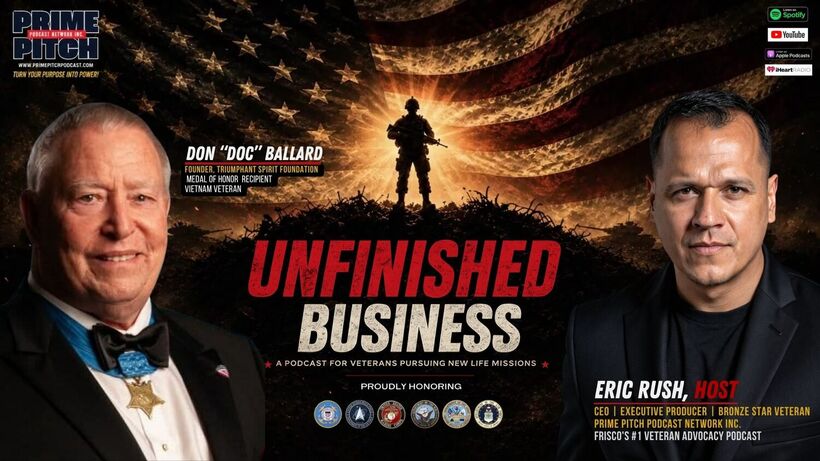
Don “Doc” Ballard
Medal of Honor Recipient · Vietnam Veteran
About the show
Unfinished Business is a podcast for veterans pursuing new missions after the uniform, and for the families and communities who stand beside them. Hosted by Eric Rush, The Conversation Architect, a Bronze Star combat veteran and the founder of Prime Pitch Podcast Network.
Read the full transcript
When mar- when, when Marines called for a, for a corpsman, what did it mean to you in that moment, in your- Um, I had the worst job in Vietnam, um, but it was the most rewarding. I'd been wounded 8 times myself, but it didn't, uh, you know, 6 times didn't prevent me from continuing my job. Hmm. And my, I know that I was the only medical asset that the, uh, Marines had. And so if they got wounded, th- I, I was it.
I either had to save their life or they died. So that compelled me to be all I could be, uh, to be the corpsman or the doc. And you know why the Marines call us doc?'Cause they can't spell corpsman. Or, or they wear out their Crayolas before they get that far. That's funny.
No punching. No punching. Okay. Unfinished business. Stand up tall.
Alpha cadence, we answer the call. Welcome to Unfinished Business, a podcast for veterans pursuing new life missions. There are moments in a man's life that happen in seconds but never really leave him, not because of how they're remembered, but because of what they require in the moment they happen. In May 1968, in the Quang Tri Province of North Central Vietnam, Doc Ballard was serving as a Navy corpsman with men, with Marines, when that kind of moment found him. What he did that day would later be recognized with a Me- with the Medal of Honor.
What isn't always understood is everything that came after: the responsibility, the memory, the life that had to be lived forward from that point on. For Doc Ballard, service didn't stop there. It continued in a quieter way, making sure every ve- veteran who didn't have the means were laid to rest with dignity, spending time with young people and speaking honestly about service, staying connected to the veteran community by supporting the National Medal of Honor Museum here in North Texas, working alongside nonprofit organizations like Air Power Foundation, continuing to show up for issues that matter, including the reality of veteran suicide. That's where this conversation is going, forward into the life that followed him, what it means to carry something like that, what it means to, to, what it l- what it leaves behind. To have a Medal of Honor recipient, uh, sit down in this space is one of the highest honors this podcast has had.
Mr. Ballard, Colonel Ballard, thank you very much for being here today. We're here at the lovely, uh, King Ranch, uh, Do- Doc and Donna's, uh, h- um, estates, and I'm so excited to have come, come down here and finally walk into their home like they walk into mine. So I feel, I'm very appreciative that you, uh, you have, you're here to be on the podcast. I just wanted to say that.
Well, thank you. You know, I'm, uh, grateful to have a platform that I can reach other veterans. Yes, sir. So I'm enjoyingI will enjoy this. Yes, sir.
When you, when you listened to the intro, what stuck out it, out, out to you? Oh,All of us, uh, have challenges, and we don't know what we don't know. And unless you've actually walked in the shoes of the individual that we're reflecting on, we really don't know much about that person, what challenges he had, or she, and what difficulties they had in fitting back in society and how they cope with their problems today. So there's a lot of messages in that, uh, introduction that has to be analyzed on an individual level because all of us are individuals. Yes, sir.
Um, Doc, when you, uh, Doc, before the Vie- before Vietnam, before any of this, who were you, and what kind of person were you back then? Well, I got married at the age of 17 while I was still in high school. And I had a goal of d- uh, becoming a dentist, so I worked at the college, the dental college in the, uh, prosthesis area, you know, where we made false teeth, crown and bridge. And so we did the, uh, behind-the-scenes support, and that's how I earned my tuition, uh, to go to college, uh, at the, at the dental college. So when I ran out of money, uh, I looked to find another source of income, and, uh, my personal dentist was an Army reservist, and, uh, he was in the National Guard.
And he told me that the military offered an opportunity for them to pay my, for my education and, uh, what, and the only thing I had to do is pay it back by serving in the military. That sounded pretty good at the time. All my family had come back from the second World War as veterans, so I was taught early on that you can't live in this country for free and that there's a price to pay, and you do the best you can at that, uh, paying that price, or you find another way of paying that price. Hmm. So for going into the military, I, it was not about going to war.
It was not about, uh, anything except my tuition, uh, primarily. I, I felt the need to wanna serve, so that added to the, uh, ability for me to make a decision that, yes, I'm gonna earn my degree, and I'm gonna learn how to be a dentist, and I'm gonna serve in our military being a dentist. Hmm. So that's why I joined the military. Yeah.
That's, that seems to be a common, uh, a common denominator that peop- that a lot of, uh, men and women when they're, when they're younger and, you know, 18, 19, 20 years old, they're saying, "Well, what am I gonna do, and where can I, how can II wanna go to c- college."Um, have you, how you ref- when you, when you reflect upon that time when you decided, do you, do you say, uh, did, d- were you able to go to college after you get out? Or how did, how did that, how did that, um, help? Well, I, I started junior college because it was in my backyard right there at home. And, uh, so it, you know, right out of high school, right into another form of, uh, institutionalized education, um, you know, was pretty common at that time. Although I tell the kids today when I, and I speak to a lot of youth that are, that you talked about, is that they're lost or they have no guidance or they have no direction.
You know, the military offers every job that the civilian has. And, uh, you might have to change uniforms, but that's what life is all about, is life's about choices. So I did. I, I served, I served by joining the Navy, I served with the Marines, and I retired out of the Army. Wow.
So life's about choices, right? Yeah. So I chose to take different paths for different reasons, for different benefits. Hmm. So I tell the kids, uh, uh, how to, uh, look at the military in just an extension of, of their growth, you know?
And that by going in the military, it offers them a, a s- a slowdown period where they can absorb some of life, learn new techniques, learn new skills, learn stuff that they would not have had an interest in learning. But by getting that broad scope of, of, uh, training and exposure, that helps them make decisions, helps them become a man or a woman, helps them be a better well-rounded person. So in all, I'm not a recruiter for the military, but yes I am. I believe all Americans ought to serve in some capacity, uh, either with the military or in support of the military. When, um, when you reflect back, you know, and that's a, that's a greatUh, I love what you said about, you know, everyone should.
When you reflect back, what, uh, what did res- what did, what did that responsibility mean to you at that point in your life? Well, again, my pa- family were a World War II and Korean veteran. Okay. So I felt an obligation to wanna serve. I wanted also to take advantage for my own personal benefit.
I just didn't wanna go serve and not accomplish something. So I, I set a purpose about wanting to, uh, to be that dentist, uh, with the idea that I could come out of the military someday and become a dentist, you know? So you go in with goals and then the military was just a vehicle to get me where I wanted to be. Yeah. You know, I was thinking about as you, we were talking about responsibility, do you think that a lot of veteran- a lot of, a lot of individuals, when they join, they don't know what they're getting themselves into, per se?100%.
No, I, you know, I, I went to the Marine Corps first and the guy says, "We don't need no stinking dentists. Go across the hall."And that was the Navy recruiters. So that's how I signed up in the Navy, 'cause the Marines told me to go over there. Yeah. That's funny.
That's crazy. I had no knowledge of what I really wanted to be. I was lucky that I, uh, growing up, that my personal dentist was a military guy. So he had the brag wall. I could go, um, waiting for my turn to be treated.
I could see him on a tank, or I could see all the good parts of the military. Hmm. I never got to see any of the bad parts. Yeah. So I, I was intrigued with the, uh, the military even long before I was 16, you know?
Yeah. Is that part of the reason you, you, uh, educate peop- when you go to the schools, you talk about the military, is to educate, to close the gap between understanding what it means to serve and what it, what the responsibilities you hold, um- 100%, uh, because going into the military, you're not in charge of anything. Yeah. As you know. Yeah.
So the issue is go in, uh, uh, uh, get the exposure, get the skill training, become what you later decided to become, you know? Because they don't know what you're gonna be, you don't know what you're gonna be. It just happens, and it happens over a period of time that both of you, well, you know, the military as a whole figures out what you're good at and you figure out what you wanna be good at. So you end up where you need to be by choice, uh, but also by design. Um, when Mar- when, when Marines called for, for a corpsman, what did it mean to you in that moment, in your- Um, I had the worst job in Vietnam, but it was the most rewarding.
I'd been wounded 8 times myself, but it didn't, uh, you know, 6 times didn't prevent me from continuing my job. Hmm. And myI know that I was the only medical asset that the, uh, Marines had. And so if they got wounded, th- I, I was it. I either had to save their life or they died.
So that compelled me to be all I could be, uh, to be the corpsman or the doc. And you know why the Marines call us doc?'Cause they can't spell corpsman. Or, or they wear out their Crayolas before they get that far. Uh, well- No punching. No punching.
Okay. Um, uh, when you thinkOkay, when you think back in your story, um, when you think back on that day, what stands out to you that people don't, don't usually ask about? What was in my mind and why I did what I did because, um, most of the people that received this are either dead and can't tell their story or, uh, they did- they killed the enemy, which was important. You know, I mean, IThat was not my mission. My mission was to keep our Marines alive and get them home as best I could to their loved ones.
But there was times when I had to kill also. I killed 6 Vietnamese soldiers. Hmm.3 of them was with my knife. Hmm. Wow.
Oh my gosh. Yeah. So you wanna screw with me? No, I don't wanna screw with you, sir. No.
That's part of myPeople don't know how deep the water is until they get into it. Yeah. And that's the same with you're talking to a veteran. You don't know what he's been through. How do you expect me to come home and be normal?
That's true. Yeah. And that's the question I ask the kids, you know? You, you don't know me. You don't know what I've been through.
You, you can't look at me and say, "Oh, that guy's screwed up," or, "That guy has overcome his challenges," orThere's, there's no analytical equation that, that means anything to me, uh, the veteran. You know, "Yeah, thanks for your service," all that is rhetoric. Uh, you know, theySome of them are thanking us sobecause they didn't have to go. Yeah. So- Yeah.
I, I- Never thought of it that way. Yeah. And so my comment is, "Well, you were worth it."You know, I served this country to protect you and your family. Hmm. Yeah.
Said that, um- Oh, yeahy- your actions, the actions you- Yeahyou took to save Marines- Yeahum, were, were builtwas instinct, right? Um- Rightwhat do you think that instinct was built from? Love. I certainly believe that, uh, this medal represents love. Hmm.
I loved the Marines that were saving my life. They loved me 'cause all Marines love their doc, you know? Uh, it's because I was the only medical asset they had. We had no ambulances. We hadYou know, we hadThe only evacuation we had was the helicopter, and there'd be days it couldn't fly.
You know, bad weather, enemy activities. A lot of things that caused us to have to change our course of treatment, uh, from scoop and run to stabilization before transportation. Hmm. So we developed the golden hour. We developed everything that's on the streets right now in the cities of America- Hmmwere brought home by the, uh, medics and the corpsmen, uh, in combat.
Hmm. All we practiced airway management. We did, uh, g- hemorrhage control. Everything was done. Uh, and there was no paramedics or EMTs on the street of Dallas, Texas, or anywhere else in the country prior to Vietnam.
Wow. That, that is such aThat's mind bugg- boggling to think about, you know, that there was no infrastructure to, to care for people in, in our own country and that whatever you guy- whatever in Vietnam, what, what was built was being built in Vietnam literally, right? I mean- Yeahy- you know, you builtIt came back and, and, and became part of our system. That's- It is, and most people don't identify with that- Yeah'cause they don't know. Here again, you don't know what you don't know.
But, uh, we also had the ability to, uh, treat by trial and error, you know? Yeah. Uh, the, the Marines are part of the GI issue, you know? Uh, but they, uh, uh, they had a choice. Let me treat you or die.
Hmm. So we tried different things. We tried different techniques. We wereI was credited with saving 79 lives because of a different form of treatment that I provided. And- Wowand I, I had, umPrior to going to Vietnam, I, I worked in the orthopedic and neurosurgery department.
Hmm. And we'd go in and clamp off the arteries so that we could s- control the hemorrhage while we were working on whatever we werethe bodies thatparts that we were working on. So I did the same thing. When we ran out of battle dressings on the, in the field, I would clamp off the arteries, tie them off, and then I'd recover the Hemostat or Kelly forceps in order to use them on the next guy. I didn't worry about infection.
Hmm. That was for the guy in the rear to worry about. My job was to get him alive and keep him alive until he got back there. Wow. What a awesome, what an a, a awesome responsibility f- um, to take on, you know?
And so manyin a very fluid situ- in very fluid situations, right? Yeah. Very active situations. Um, when you look at, look on that moment now, um, do you, do you see it as something you chose or something you were placed into? Both.
I, I think God had His hand in my, uh, uh, shoulders leading me and pushing me and, you know, sometimes pushing because I didn't wanna do what I was required to do. And it, it, uh, it brings relevance, but also responsibility. I, as I said, I had the worst job in Vietnam, but the most rewarding because- Mmthose guys loved me. Yeah. And I met them.
I stayed in contact with them much, uh, even, you know, years later. Even today I, I've, I've talked to different veterans that I saved, and that's more meaningful to me than this trinket that I wear around my neck. Wow, that'sThat's like mic drop moment. We could stop this podcast right now. It's such a heavy, um, a heavy thought that, you know, like you said, um, you, you feel like, you know, love.
This represents love, you know? And that, that you had the worst job but the most rewarding, which is such a, you know, like polarlyI don't think people could grasp that, right? Um, could you add to that? Could you add what youto that? I can share my experiences, but what I, uh, you know, I don't want people to think that if you join the military, you have to go fight.
Yeah. You know, there- That's-90% of the jobs in the military are in support of the 10% that's actually doing the fighting. Mm. So a lot of people go into the service, uh, and never get to see combat. Um, s- to say that I did something extraordinary was, uh, was me all along.
I've served in uniform since I was 6 years old. Boy Scouts, Cub Scouts, you know, uh, Girl Scouts if they'd let me in. Uh, so but I don't have PTSD like I did when I first came home. Yeah. Like some veterans tell their story, I suffered.
I, I went through dark times. I went through suicide attempts. I went through losing my wife and 2 kids, 'cause I, I had a wife and 2 kids before I went to Vietnam. So I wanted to get home as much as the next guy, but when I got home, they weren't ready for me. You know?
Mm-hmm. Dark time here in the country. We were the problem. We weren't part of the solution, you know. The Vietnam veterans were treated very badly- Yeahwhen we came home, and, uh, it just added depths to my problems.
Mm. You know, 'cause I, I had no one to talk to. I had nobody, uh, that I could confide in. That's why I went back in the military, because at least the people in the military understood me. Mm.
Where the civilians possibly understand. They can't even walk in my shoes, let alone evaluate my attitude. Yeah. And so when I go to the VA and they're trying to tell me what's right and what's wrong, I laugh at them because they've never seen combat. They do not know what I went through.
Mm. And the doctors in the VA and other psychiatrists, they can't help you. They h- But they can guide you where you can help yourself. Hmm. That, that is true.
That is so true. Um, you know, I was gonna say, like, something you said was, like, really impactful when you, when you were talking about h- how you, how you actually, you actually understand, you know, that you went through struggles, you know? And you understand that,A lot of veterans, like, you know, I shared a little piece of my story too, you know? It's like- Sureyou know, and, and you don't know what you don't know is so im- is, is one of the biggestYou know, if you, if you don't know what you don't know, you can't be consciously, you know, you can't consciously grasp of what you're, what, what you're dealing with. You know, one of the, uh, little bit, uh, one of the things I did before I, before I got deployed was get married, and, and, and the psychological pressure of that alone, y- uh, can you speak on that?
Like, you know, you, you know. Well, yes. Uh, I can. Uh, again, I was married at the age of 17. Oh.
Like I knew what I was doing. Um, I had 2 kids. Uh, and, uh, you know, I wanted to get home as much as the next guy. Yeah. But I don't, I, I don't recommend getting married and taking on all that baggage, uh, if you don't need to.
Yeah. You know, wait. I k- I, I kinda look at the military as another stepping stone. GoYou know, you're undecided, you're coming out of high school, take that other step. Go, go learn some other skills before you make up your mind it's gonna control your rest of your life.
Mm. So get that exposure, get that, uh, knowledge that will help you make good decisions later on in life. So that's, uh, again, I'm not a recruiter- Yeahbut I believe. I spent 35 years in the military. Uh, I'd still be there today if I was capable.
For the record, my mom was really mad that I got married before I left and, and because she's, she knew the pressure I had. I was already in, going, getting involved in, um- We make mistakes. You know? You made yours. Yeah, I did.
Yeah. Um, from that time i- at that time in your life, um, what ti- what from that time in your life stayed with you the longest? That's a good question because it takesIt, it's not a surface answer. You know? It's depth.
Mm-hmm. Uh, the, the fact that I was messed up, the fact that no one understood me, uh, the fact that my family left me, the fact that I had nowhere to turn to. Um, pretty dark. Yeah. And it, and, and I surrounded myself with like-minded people that understood me, thatThey, they never walked in my shoes, but they were closer than the civilians were.
So that's why I chose to go back in the military. And I, I, I recommend that we stay, uh, connected. If we're a veteran out here, we need to go back to our reunions. You know, go back to the- Mm-hmmthe group. I did not for years and years because I didn't wanna know who lived and who died.
Mm. My job was to treat them, get them on a helicopter. Hopefully I never saw them again. You see? Yeah.
And so I didn't wanna know that they died. I did my best I could, and now it's up to God and the, and the guys in the surgical tent back be- behind us. Yeah. So I did not take my own advice. And it, and as we get older, we learn our mistakes, and we learn that, um, we could have done things differently.
Yeah. And, uh, as you have, you, you were, you surround yourself by accident sometimes and by choice sometimes with people more knowledgeable, more understanding, and more willing, uh, to work with you and help you get through your challenge for that day. Um, uh w- people see the Medal of Honor. You've had to live with what came with it. What's something about carrying that recognition that people don't really understand?
Well, what is a war hero supposed to act like? Yeah. I, I'm tougher on myself than I'll, I'll ever let you be on me. Yeah, yeah. You know?
I'd kill you before you messed with me like I mess with myself. Okay. Well, I'm not gonna mess with you. Well, the point meaning is that, um, the hardest person to deal with is yourself. Mm.
You can turn away from other people, but there's no space where you can get away from yourself. Yeah. So it is what it is because you allow it to happen. We, we are in control of our activities to some degree. Yes.
But we certan- certainly can worsen them because of attitude. So that's why we try to help the veterans that need a helping hand. We don't give anybody a handout. We give them a hand up. Mm-hmm.
And we try to help them help themself. Yes. Um, you've made sure veterans who didn't have, uh, the means to, uh, the means were la- You've, you've made sure veterans who didn't have the means were laid to rest with dignity. What led you to take, take that on? Drinking habits myself and, uh, seeing so many of my buddies, Vietnam guys, uh, dying.
Um, Agent Orange, different, uh, effects. I, at the age of 60, I went back to college to become a practitioner. Wow. So I own 2 funeral homes today based on the fact that I wanted to be there to help. I bought the first one with the idea of completely giving everything away free.
The problem with free is you don't pay the bills, so I had to get a second funeral home going- Mmin order to pay for the first one. Mm. So I'm there when all else fails, and I was not, uhYou know, it's, it's not being a corpsman. It's just being helpful. It's being there for the community.
It's being there to pay respect to the veteran. You know, I had a first sergeant in the Army die, and, uh, he was not entitled to any benefits. Mm. And he spent, spent 30 years of his life, but he got in trouble at the last minute and, you know, uh, didn't qualify. He lost his benefits.
Mm. Uh, in my book, in my eyes, he was overqualified, and he made a mistake. Mm. So I stepped up, and I did his funeral for him. And I made sure that he got the honors and the respect that he deserved.
Mm. That's, uhI mean, that's, that's, that's amazing. You went, you, when you were 60, you went back to school, number one, to just, just follow through and have that, um, what is it say? Unfinished Business is the name of this podcast. Yep.
You, youHow does that phrase unfinished business ra- resonate with you when I, when I say it? Keeps me alive Hmm .'Cause if I had my, uh, my, if everything had been accomplished, I wouldn't have a job tomorrow. So my attitude is I'm saving one more person. Hmm. I'm trying to help, uh, another veteran.
Uh, it's unfinished, and my job is to, uh, do what I can for the people that I'm, uh, responsible to. Hmm. And as a corpsman, as a, as a funeral director, I can take care of you dead or alive. Yeah. Um, let's talk about a, a s- a, a topic that we're both are familiar with, uh, veteran suicide.
Um, have you, uh, what have you come to understand about the i- that issue that people don't always recognize? So what causes suicide? That's the age-old question. It's a man not being able to deal with his own demons or his own problems. You know, I would kill you before I'd kill myself.
So I don't have the, the mindset that, "Oh, poor me. I can't deal with this anymore. I, I have nowhere to turn."You know, so suicide to me is, um, is totally wrong. You know, it, there's not, there's no room in my life for suicide. Yeah.
And so my goal is to reach out to those 22 a day. You know, we're losing more by suicide than we did by combat. Hmm. Something's wrong. Yeah.
And a lot of it's copycat. A lot of it's give up. A lot of it is, uh, lack of purpose. So you know, my new, uh, venture into this nonprofit is just all about that. We wanna give a new sense of purpose.
Hmm. We want that d- that veteran at risk to know he's got a family to turn to, you know, 'cause, uh, we treat him in the hospital or the clinic, they go home and, uh, you know, an hour or 2 later they're back into oh, poor me syndrome. Hmm. You know, one of my veteran friends had lost 2 legs and an arm, and what's he got to live for? Yeah.
You know, he can't get in and out of the bathroom by himself, you know, without the, uh, aid of the, uh, motorized wheelchair. Hmm. So purpose does he have? You know, so we workYou know, that's where my motivation kicks in, is to help the people that are deserving. You know, he didn't just get that injury because he was fooling around.
He was protecting me and my family. Mm-hmm. I love him. Yeah. And so I owe him.
All vet- all civilians owe, owe the military, and they just don't understand. My job is to prove, you know, the worth of, of the veteran- Yeahand the cause of what, uh, and the price of freedom. For us to wanna create a sense of purpose, a sense of quality of life, uh, develop a new family, he can roll over to this radio right here behind us in his wheelchair and start communicating with anywhere around the world. Hmm. Certainly right close, and you know there's not one person on that radio listening to him that even sees that he's disabled.
Hmm. Whole new quality of life. Yeah. That's my goal, is to help them un- understand the benefits of this hobby that saves lives. Yes, sir.
Let's talk about that. We're gonna ch- we're gonna ch- uh, I have a sc- I have that question about HAM radio right now. We'll just bring it u- up, uh- Okaya few, few down the road, but I'm gonna get this one right now. Let's go ahead and hit that. Um, HAM radio, what is it about that form of c- uh, connection that, that matters to you, and what have those conversation meant, those conversations meant over time?
Oh, it allows an ordinary person to treat himself. Hmm. Uh, we all need help. I did. You, you have.
All of us have gone through the darkness, and we survived because, um, well, we g- we had encouragement from other people, but on, at the end of the day, we corrected our own problems. Yep. Uh, so I seen the radio as a vehicle that, uh, affords them an opportunity to set their problems aside for a few minutes and talk like they didn't have a problem. Hmm. No disability, you know?
I mean, w- I've got a face for radio myself. We both do. So, so the issue is if I was half my face was blown off or my eye was knocked out or, uh, you know, if I look the part, then I don't wanna be embarrassed by going public. Hmm. This is a perfect way to segue it into a new quality of life.
Yeah. New sense of purpose. So at the end of the day, uh, he can treat himself 24 hours a day. Yeah. The, the w- the dialogue you've had on, on, on ham radio, is there one particular story that sticks out in your mind where you're like, uh, this one story where me and this, uh, veteran, um, shared, shared something, if you wanna give a little tidbit about that?
I will. I, um, you know, this is worldwide. Yeah.800,000 people just in the United States. Wow. And we're growing.
We're gonna double that this coming year. Hmm. So our whole mission is just that, and, uh, encourage people that wanna take up the hobby. Hmm. Uh, the perfect s- answer to your question was out in, uh, California where you were.
California VA Hospital out there has been on record saying that we introduced the ham radio. Uh, they, uh, they have a radio station- Ohin the hospital, and they have reduced the suicide rate from 66 down to 0. Wow. Why? Well, this is such a purpose.
It's that it's, it's a study that, uh, the government's not willing to do. Now, the VA did not do this. It was individuals within the system. So the VA, uh, either cares or don't care depending on where you are and what your problems are. Yeah.
And then we exacerbate that ourself by being bigger problems for them. You know, some veterans are just, uh, you know, we are our worst enemy. Yeah. So. Yeah.
So that was the best story for me, is the, the guy with the, uh, amputee, you know, triple amputee. Wow. No quality of life now is, uh, doing better on radio than I am. Wow. So between the VA's employees that took the initiative on, hopefully someday we'll get it throughout all the VA system.
Yeah. What perfectNow we're going to the American Legions and the BFWs, and we're using that as a recruiting tool for the, that organization. Hmm. You know, they're dying on the vine. They, they have no interest.
These kids have no interest in supporting them. Yeah. But if they put something that's interesting for the veteran to do besides smoke and drink, now that they got, they develop a new sense of purpose. They create that hobby. They, they, they fund it for the veteran so he can come down and, uh, wanna join the Legion.
Yeah. We're setting up a national organization, and we're gonna recruit to that, uh, mission. That, that's amazing. And for the, for the record, in the background is, uh, a radio system back here that is, um, that, that simulcasts, uh, convers- What is, howExplain a little bit about what, what, what I'm looking back at, looking at back here. Well, different pieces of equipment accomplishes different things.
Okay. So you develop that on a one-to-one base. Hmm. If you only wanna reach the neighborhood, you can use a hand-to-hand talkie, you know, walkie-talkie. Yeah.
And then you expand the, uh, uh, the ability of the equipment to reach whatever you wanna reach. Hmm. Like the antenna we have outside, you know, 60, 80 feet, 100 feet tall. Yeah. And, and, uh, different than a handheld 3inch one, you know?
Hmm. Yeah. So you got wattage, you got voltage, you got amperage. Uh, it's a whole new, uh, realm of understanding the, the emergency broadcast system. Hmm.
Because it was here long before cell phones. Yeah. And it'll be here when the cell, cell phones quit working. So, uh, again, there's, uh, we have, we have a lot going on here. Yeah.
It'd take the rest of the podcast- Yeah. Yeahto explain it. Yeah. But what I'm gonna say is that it's individualized to your desires. Hmm.
I talked to Japan, I talked to Germany. Wow. You know? Yeah. And, um, uh, Australia just the other day.
Yeah. At the end of the day, it, it serves as a mean of, means of conversation and connection and, and, and engaging in dialogue with one another. Agree?100%, and that person doesn't know I'm disabled. Yeah. That's the secret.
Yeah. That's true. I mean, that's the secret sauce is, uh, I can be myself. Matter of fact, I can develop a new self- Yeahwithout anybody being judgmental. Air Power Foundation, um, what is it about that work that keeps you involved?
I've been on board several years. I met Rex, uh, there as well. Uh, I think that they're, um, uh, um, an organization that's a pass-through. They don't have any mission, uh, or project outside of helping the already existing nonprofits. So they, they vet nonprofits that come and ask for grants.
Hmm. They raise money in order to fund the other nonprofits' grants. So, uh, they don't have a program. There's no waste and abuse when you don't have a program. You know, there's- Yeahthey have one staff person, and the rest of them are all volunteers, as myself.
And my, my attitude is it's probably one of the better nonprofits that I'm familiar with. I dropped-- When I got injured, I dropped all my nonprofits. I was in 33- Hmmnonprofits. Whoa. So when I got injured and, um, I, uh, had, uh, my challenges, the only organization that I loved and stayed with was Air Power Foundation.
Hmm. And, uh, because they, they do more with less than anybody else. Yeah. I've been completely, umIt's the only, it'sI've been a part of 2 organizations, and this is the one that I'm, you know, that I'm gonna stick around for a while, 'cause I really love what they're doing. I love this, the system they have in place to, and the reach.
You know, that's, that's been really impactful. Well, we do need to have them. All nonprofits need to make a profit. Yeah.'Cause we can't keep the doors open if we don't. But, uh, 99% of their money that they raise goes to other nonprofits to fund their mission.
Yes. Shout out to Air Power Foundation. We've got 2 guys here that are representing the cause. Uh, we love y'all. National Medal of Honor Museum.
Uh, Wanda Cox, Wanda Cox gave me a call and told me the story, a little bit of the story about your influence in having it, um, um, be in North Texas in Arlington. Um, what does it mean, what does it mean to you to see that taking shape here? Well, Texas in itself is patriotic. Most patriotic state. Uh, does more for veterans than any other state that I'm aware of.
So if I had a choice, and I did, we, we reached out. I was on the original board, uh, for the museum- Hmmin, uh, Mount, in Mount Pleasant in South Carolina. Hmm. It's aboard a ship, and it's still there today. That's our headquarters.
Wow. Uh, and but we, we wanted to grow it because the ship was sinking, and it was ta- you know, it was, uh, we needed to get a land-based museum. Hmm. So we start- We reached out the, you know, the 4 lower 48 states to figure out, uh, who would want us and, and who would fund it and who would treat the veterans right. And we went through, uh, all of the, uh, states, uh, and it actually boiled down to 2 states, Denver, Colorado, and, uh, Texas.
Arlington, Texas. I attended every, uh, event that we had in Arlington, Texas to, to show my support for Texas. Hmm. And to show my support for the mayor of Arlington. You know, I was at an Air Power Foundation meeting, and, uh, Sid Epps, who was the president at the time, said, "What's up, Doc?"You know, I said, "Oh, I never heard that before.
What's up, Doc?"And I said, "We"You know, that's my humor speaking. And he says, um, "What are you up to?"And I said, "Well, we're gonna be looking for a new home for the Medal of Honor Museum, and, uh, we're gonna try to name it the National.""Oh, well, I've got, I got contacts down there in Texas."And I said, "Oh, I figured you did."And so he called the mayor of Arlington and gave him the information. He said, "Doc's in town. Let's meet with him and talk about it."So we did. And so Arlington assured us that, uh, they had the interest and, and had the, the means of, of pulling it off, you know?
So, uh, it was an easy task for me to convince the, our group that, uh, you know, we didn't have to close for winter as Colorado did. So so we get, we're open more. We haveAnd, you know, other than smoking marijuana out there, they don't have anything else going for them. Maybe panning for gold sometimes some places. But Texas is, uh, much more respectful, uh, and I mean that as a patriotic statement.
Uh, uh, I'm not talking politics. Yeah. You know, not going there. But the whole issue is, uh, my, I fell in love with Texas. I fell in love with everything that Texas does for the veterans, and I, I thought it would be the best home for the museums.
That's why I fought to have it brought to Arlington. Well- Let me plug the museum. Yes.'Cause it's- Absolutelynot like any other museum. Yeah. There's not a lot of trinkets in there.
You don't go in and see, uh, collectibles. Hmm. It's all about education. It's all about educating the youth- Nicethe new leaders of this great country. So, uh, I'm, I'm 100% supportive of their attitude and how they present, uh, military history.
Now, what part of your life has meant the most? Well, as I get older, I have a tendency to make better choices because I get exposure to different, uh, skillsets and different desires. Uh, I'm completely retired. I mean, I still do funerals. Hmm.
But that's not a job. I, I take no money. Uh, I, I only do it out of a passion. I do it because I can. Yeah.
I'm licensed. A- and I'm, I'mI don't have to make money on the veterans. Yeah. So, uh, for me to take on this new passion of helping the veteran before he needs a funeral- Yeahhey, how about let's get ahead of the curve and let's make him happier, let's make him healthier, let's make him more, um, uh, f- whatever the word normal means- Yeah'cause I don't know what that word means. Community ready.
How about- Get back. Yeah, get back to where you're comfortable with your life and you're, you're kind of enjoying more of it than you did last year, you know, or the year before. So that's, that's where I feel like I've, uh, I've enriched my own quality of life by helping others. Hmm. And I'm gonna continue to do that by, uh, you know, because the radio saved lives.
That's great. Um, the name of your nonprofit, what's the name of it? Triumphant Spirit Foundation. Oh, that's beautiful. All right.
You know, it's been around 30 years. Got a website? What's the website? Well, it's Triumphant Spirit Foundation. Okay.
Tri- Triumphant Spirit Foundation. Yeah, Triumph- Okay. Yeah, let me, uh- dot-org? Dot- dot-org is one of them. Okay.
Perfect. Yeah, triumphantspritfoundation. org. Oh, no, that's beautiful. Now, we sell stuff, and, and let me restate that.
Yeah. We don't sell a thing. Yeah. We ask for donations, and we've got the merchandise right here. We sell the Medal of Honor book.
We have, uh, you know, it's got autographs in it. And we have the My Challenge coin that's got my ham radio on it and license. And, yeah, can you see that one? Yes. One side's about the Medal of Honor Society, and the other one's about my personal, um, travels and, uh, how I lived it.
Beautiful. And then we've got a very special gift, uh, that's, uhAnd people can use the gift themself, and that's the, uh, cowboy buckle. That's awesome. Medal of Honor buckle that, you know, it's illegal to wear anything Medal of Honor, but this one here is designed in such a ways that you, you're supporting the Medal of Honor recipients. Hmm.
You're not claiming that you are one. So it's been approved by anybody and everybody that wanted to chop on it. And, uh, we only made a, a limited number, like 1,000, so- Yeahthey'll be worth some money someday, more than what they're paying for it today. It's selling for $100, and we've already been offered 5,000. Wow.
That's great. It's beautiful. Matches all my gold, so you know I need to- Well, we'll sell it to you cheaper. Okay. Awesome.
Veteran's discount. Veteran's discount. All right.5%? Just kidding. Let's see here.50.
Okay, I'll take it. I'll take it. It's done. Oh. Let's see.
Outside, umLet's see. Okay, no. We've already talked about what unfinished business means to you. Um, last question. Yes.
Um, when your family, uh, talks about you years from now, what do you hope they say, not about what you did, but about who you were? That was my answer. Nothing. Uh, uh, now that's my post-traumatic stress humor side. Um, you know, I, I hadn't really, uhI want my family to appreciate what I've been through and what I'm doing.
I want them to, uh, think, uh, obviously more than just being a provider, being a father, being a, a husband. You know, it's, it's, umWhy do I get up every day? Why, at the age of 80, I'm 80 now, why, why do I, uhWell, you know, let me share that with you. I got my ham radio license when I turned 80 years old. Wow.
Yeah, so I don't want anybody complaining that they're too old. Yeah. And the youngest that I'm, we know about is 5 years old- Hmmand got licensed. Hmm. So there's no reason for you not to get your license.
Yeah. But all that to say is I wanna be remembered for, um, what I accomplished after this medal. Hmm. You know, it's one thing to be a hero 30 minutes or an hour or 2 days into your life, but what do you do the rest of your life? Yeah.
You know? Hmm. And I think that's more important to me than the c- the claim to fame as being a war hero, you know? Hmm. I just did my job to the best I could.
And, and for me to risk my life was, uh, was norm for me. I did it more than multiple times, but it was unwitnessed. And here's something else for the, for your viewers. People don't always get what they deserve. Hmm.
There's a lot more people, a lot more veterans that deserved this medal than I did. Hmm. But I got it because I had witnesses that lived long enough to write my story. Hmm. And they didn't, their Crayolas didn't melt.
So, but there's a lot of prejudices. There's a lot of, at every level, as you know, you, it can be chopped. I mean- Mmin company level, battalion level, and division level. Anybody could say, "Oh, I don't like that guy," or- Mm"Uh, I don't like his personality. I don't like his, uh, genealogy, his nationality."There's chops at every level.
For somebody to get all the way through all that process, it's an undertaking. And, uh, I want everybody to know that I, I don't hold myself out as a hero. I feel that I'm a, a, a caregiver, care provider, and that's what I wanna be remembered more for is my ability to, uh, help others. You know, uh, I, I, first of all, I wanna tell you thank you so much for taking the time to be on the podcast. Um, you know, um, your name, I, I didn't share this, I probably should've started with this, led with this, but your name had been popping around, popping up on my circle around me for at least a year.
Your name just kept coming up, coming up. And when I had, uh, uh, Rex and Donna on, on the podcast, they mentioned you."Have you ever met?"I said, "No, I haven't."Then I went to an event and someone said, "Where's, where's Doug Ballard?"And, and I was like, "There's that name again. There's that name again, and there's that name again."And, um, and then, uh, umSorry. Sorry. Um, then Rex reached out to me and sent me a message, and he said, "Hey, would you be interested in, in having Doug Ballard on your, on your podcast?"And sorry, I got emotion.
I got emotion. That's all right. I'm here for you. Yeah, you know? That's what brothers are.
We're, we're brothers. And the fact that, that we're here today sharing space, you knowWhen you put the podcast, I've been going through the podcast. We talked through the history of the podcast, and you work so hard, you're working hard to, to, to develop a relationship with, with the veteran, um, veteran community and develop, and, and push veteran advocacy. And so for your name had been popping up, like I said, all around me, and then for us to be sitting here together is just a, a great, uh, a great, uh, um, I would say a great accomplishment for, for the work I've been putting in and, and putting myself around. And, uh, I, I'm really thankful for you to be here today.
Well, all I have now is time to give. Yeah. You know, I don't, you know. Yeah. And my time is, uh, worth more to me than anything else.
Yeah. So for me to give time to you, uh, says a lot as well. And I wanna partner with you on our broadcast. We're gonna start a Medal of Honor Roadie-O Club. Okay.
And I want you to become a member. Okay, I will. Uh, that, that's a promise now. That's a promise. Okay.
All right. Hey. And in doing so, I want you to be able to handle other podcasts. I want you to have every Tuesday afternoon or Wednesday morning or s, you know- YeahThursday night, something I wanna, umYou can help me 'cause you, uh, are more in line with the, uh, type of people that I- Yeahwanna meet. And, uh, I want them to come onto the broadcasting station a- and, uh, talk about whatever they wanna talk about.
Maybe it's, uh, fly tying. Mm. Maybe it's fishing w- you know, trout fishing. Mm-hmm. Whatever it is, it's gonna be enter- entertaining.
It, it's not being done out there now. Yeah. And so I wanna be a source toIf I wanna be known in the radio community as a source of information- Okayand a source of t- education, a source of entertainment, I just wanna be a source thatI, I like being the first on the block to do something. Yeah. And I, and I'm, I'm recruiting you.
SoI'm re- IMy job now is to recruit like-minded people that can get the word out- Mmto help others. Yeah.'Cause, uh, most of the people that are listening to this won't take action. Yeah. We gotta have a call for action. Yeah.
And the call for action is get involved and help us, uh, doYou know, we can all do a little bit. We can all do a little bit more. Mm. You know? Uh, we have it better than the average veteran or the average civilian even sometimes.
So, you know, I find the ones that give the most really have the least to give. Mm. I mean, the multimillionaires, stuff like that- Yeahthey can do a hell of a lot more, and they don't even have an interest. Yeah. Colonel Ballard, thank you very much for being on Unfinished Business, a podcast for veterans pursuing New Life Missions.
I look forward to partnering with you, and we'll see how far we can, we can take this. We'll take it to the top. And, um, uh, I wanna s- I wanna, I wanna say a special thanks to Rex, Rex King, and Donna King for hosting it, hosting it here at their house. Of course, um, I'm gonna, I'm gonna get y'all in, into my studio so you can check it out. Um, and I would love to have you there, too.
Um, for those that know that, um, how long I've been working on this, uh, to, to have this, uh, um, to be honored this way, I just wanna say thank you for your support. Um, and that's it. That's a wrap, guys. Um, as I always say, have peace and enlightenment, and remember that the ocean refuses no river. Unfinished business, stand up tall.
Alpha Cadence, we answer the call. New Life Missions, rise like steel. Warrior voices battle for real.