David Einhorn
David Einhorn joins Rush on Next Level Thinkers, the show for high performers and deep thinkers exploring mindset, meaning, and the human story. David grew up Jewish on Long Island, carrying a family history that reaches back generations. There is a difference between inheriting an identity and reaching the point in life when you begin to understand what that inheritance really means to you.
This is a deeply personal conversation about Jewish faith and identity, family history, David’s interfaith marriage to his Christian wife Meredith, fatherhood, Israel, and the profound impact the events of October 7, 2023 had on the way he understands his heritage and his place within it. It reaches beyond one man’s religious identity and asks what happens when history that once felt distant becomes personal, how conviction can grow while curiosity stays open, and what responsibility we carry for the beliefs, traditions, and stories handed down to us. What do we inherit simply because we were born into it, and what do we choose to carry forward?
In this conversation
- The difference between inheriting an identity and truly understanding it
- Building an interfaith marriage and family with honesty and respect
- How the events of October 7, 2023 made a distant history suddenly personal
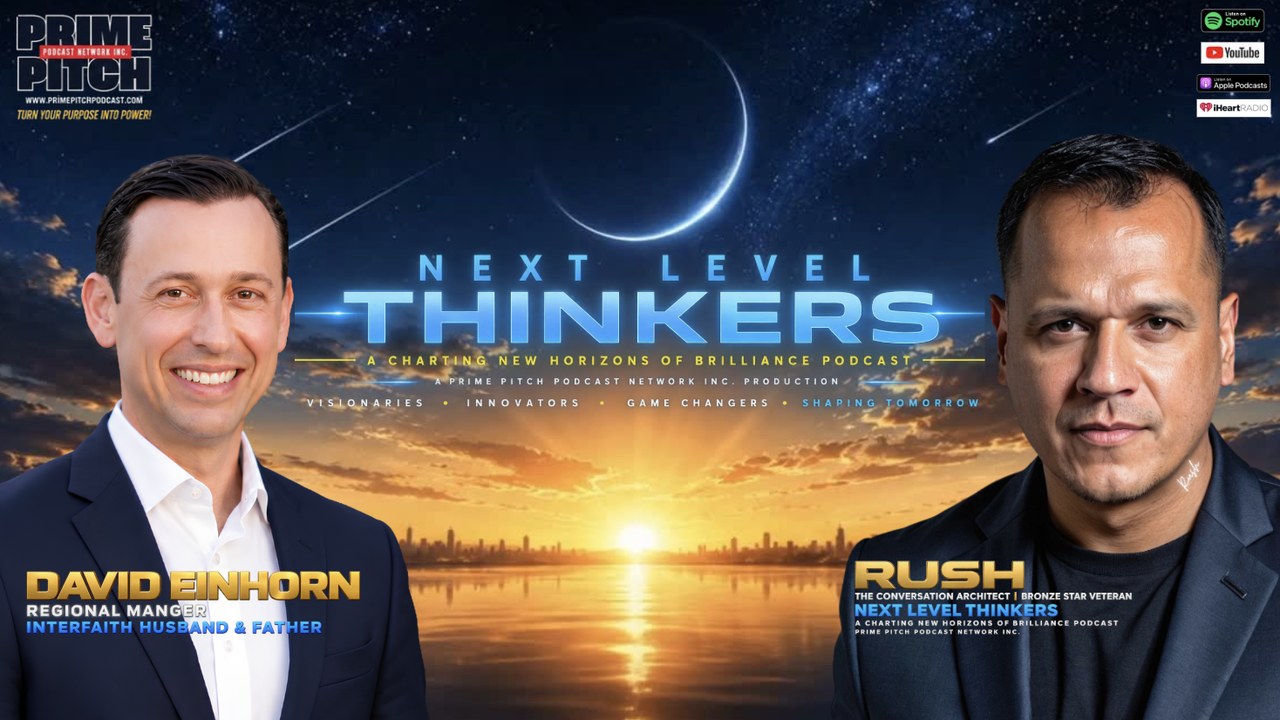
David Einhorn
Regional Manager · Interfaith Husband & Father
About the show
Next Level Thinkers is a Charting New Horizons of Brilliance podcast: conversations with high performers pushing the boundaries of effort, mindset, and human potential. Hosted by Eric Rush, The Conversation Architect, a Bronze Star combat veteran and the founder of Prime Pitch Podcast Network.
Read the full transcript
One thing that I've learned, and I've spent time doing more research over the past few years, besides as an adult, uh, I wanted to revisit some of the things that I learned as a child, is, uh, the whole notion about being, uh, the chosen people. Uh, a- and this is important because, um, some people, um, of- folks who are not Jewish hear this chosen people thing, like, "Oh, you think you're special?"And it's like, no. So, so we're chosen. I- and I really had to dig deep on this, and I, and I learned this at a young age, but I don't think it really stuck, or maybe I didn't fully understand it. What does that mean to be the chosen people?
Uh, we're actually chosen to be the light, to be responsible, to be, uh, the light in the darkness, and to, uh, to follow God's commandments. It's actually a burden to be the chosen people. Hmm. There are 613 commandments that if you're fully in and you're fully Orthodox, it's not just the 10 Commandments. There are 613.
Don't ask me to recite them. I don't, I don't know all of them. Um, but that is a responsibility and a, and a burden, and that's what it means to be chosen. And actually, I learned this recently. Um, or at least I learned the real detail behind it, and some of it was because I hear people say, "Oh, well, you think you're chosen."Like, we're not, we're not better than anybody.
Uh, but we are, chosen to be the light in the darkness and to follow God's commandments. Next level, next level. We're reaching for the sky. Next level thinkers, we're aiming high. Pushing boundaries- Hey, what's up, guys?
Welcome to Next Level Thinkers, a charting new horizons of brilliance podcast. We inherit parts of ourselves long before we're capable of understanding what they mean. A name, a history, a faith, a story that begins, began generations before we arrived. For much of our lives, those things exist quietly within us. We know they're there, we know they belong to us, but knowing what we've inherited and understanding what it asks of us are 2 very different things, and sometimes something happens that closes that distance.
History no longer feels distant. Identity becomes intentional. What once lived quietly in the background moves to the center, and we find ourselves reconsidering what we believe, what we value, and what we deserve, what deserves to continue through us. Because eventually, inheritance becomes a decision, and perhaps the greater question is whether we truly choose what matters most or whether there are moments in life when we finally recognize what mattered all along. This is my conversation with my very good friend, David Einhorn.
David, brother. Great to be here. Man, it's a, it's a pleasure and honor to finally have you here on the podcast. Yeah. You finally see me in a, a j- a, a, a suit jacket and You lookin' sharpin my podcast uniform.
No, it's a, it's a, it's a pleasure to have you, a pleasure and honor to have you here, um, on the podcast. When I have someone closely, closely as, um, closely associated, of course, it's such, it takes it to a whole nother level, a whole different meaning, 'cause we're sitting down as friends and brothers and, and in relationship to our, our own personal lives and get- and knowing each other, um, through, through, um, through fit- through fitness and, and that's, that's transitioned into something very purposeful and meaningful, and I'm grateful to have you here today. Yeah. Thanks for having me. I'm excited to be here.
Absolutely, man. You know, when I was, uh, reading the cold opening, um, what thoughts and feelings, um, did you, did you feel? I, I mean, you summed up a lot right there, and, uh, I, I guess it was a word that we were talking about before, which was intentionality. Hmm. And there are things that, you know, we travel through life and, and then things happen along the way, things you can help, things you can't help, but, um, what portion of what you're being intentional about is helping to direct yourself, direct your family, direct all the things about your, your world?
And, uh, that's, that's important. That's something that's, I mean, that's kind of a journey and, and something I've thought about, and then you forget about it, and then you think about it again but it's, that's, that's probably the biggest, uh, thing that stuck with me. Yeah, you know, you've been, uh, you know, obviously this is a kind of a weird statement. You've been Jewish all your your entire life. Yes.
But your relationship with Judaism has, has begun much more intent- become more intentional in recent years. Um, um, at this point of your life, what have you begun to understand about being Jewish that you d- you don't think you fully understood when Judaism was simply part of your world when you were growing up? Um, well, it's a couple things. I'll, I'll give you kind of the broad thing and then one really specific thing. So, um, you know, it's, it's a, it's a, it's a spectrum.
You know, there's, um, being Jewish, it's, it's a heritage, a culture, it's a faith. There are spir- spiritual elements to it. There are a lot of Jewish folks that are not very spiritual at all, and then there are some that are extremely spiritual. Um, there's also a very deep connection to, uh, our traditions, our history, our heritage, and things like that, and, uh, that's really unique and, uh, just the his- the, the stories, uh, kind of teaching, taking those teachings forward, um, has been important for me, but also being able to reflect on that, uh, as I get older is, is really important. But one thing that I've learned, and, and I've, I've spent time doing more research over the past few years, besides as an adult, uh, wanted to revisit, uh, some of the things that I learned as a child, is, uh, the, the whole notion about being, uh, the chosen people.
Uh, a- and this is important because, um, some people, um, of, you know, folks who are not Jewish, you know, you know, hear this chosen people thing, like, "Oh, you know, you think you're special," kind of thing. It's like, no. So, so we're chosen. I- and I really had to dig deep on this, and I, and I learned this at a young age, but I don't think it really stuck, or maybe I didn't fully understand it. You know, what does that mean to be the chosen people?
Um, we're actually chosen to be the light, to be responsible, to be, uh, the light in the darkness, and to, uh, to follow God's commandments. It's actually a burden. To be the chosen people. Mm. There are 613 commandments that if you are fully in and you're fully Orthodox, it's not just the 10 Commandments, there are 613.
Don't ask me to recite them. I don't, I don't know all of them. Um, but you know, that is a responsibility and a, and a burden, and that's what it means to be chosen. And actually, I learned this recently, um, or at least I learned the real detail behind it. And, you know, some of it was because I hear people say, "Oh, well, you know, you think you're, you know, chosen."We're like, "We're not, we're not better than anybody."Uh, but we are, uh, chosen to be the light in the darkness and to follow God's commandments, and that- that's all.
It's, it's actually pretty simple, and it's actually great. Yeah, man. That's, that's pretty soulful. It's so deep to really, uh, hear you say that 'cause it, you knowAnd this, and, you know, any, any faith could be sitting here right now, right? Like, uh, Christianity, uh, Buddhist, who- you name it, right?
And they'll, they'll have a, they'll have a structure, a, um, some kind of, uh, structure to their faith. And, and, and, and so any w- any faith is at the table right now. But you're just speaking, you're speaking on behalf of your faith, you know, a- and in, in Judaism. And, and, and I think that's so important because I think it's the same thing you could say for Christianity, right? Is you could say, you know, you know, Christianity, it's so, like, you know, self-righteous.
It's, you know, like, you can't make any mistakes. But it's actually the opposite of that, right? It means you can't rely w- you can't rely on, on your own self-will. You cannot rely on your own, your own, the God you see in the, you know, the god you see in the mirror. You need, you need to rely on a, a higher power.
And, and, and, and, and, you know, being chosen is a responsibility i- in Christian faith, too, right? It's like you're, if you've been anointed, you, you carry, you carry heavy, heavy responsibility. And I recently had somebody on the podcast, and, uh, this guy, he's been through a journey. He, he's lost his leg. He lost his brother.
He lost, you know, heAnd, and he's had all this trauma in his life, and he's been redeemed, delivered, and then I, and then the last phase is anointed. And when I asked him, you know, I said, "Uh, do you think you're anointed?"He had a very, a difficult time answering that. And it was, uh, it was, uh, compelling 'cause this guy's a very accomplished, um, speaker and, and very successful. So being chosen, I think he's, "I don't know if I want it."But you know, like, you know? Yeah.
Which is very, very honest answer. Sure. Yeah. That's crazy, man. Um, and, and, and I think it, I think that is so important, you, you being chosen to, to emulate light in the darks, in darkness, and that, that's so important.
You know, at 12, your parents gave you a choice, and I read your bio, and this is what it said. And, and, and I was like, "Okay, here we go. Let's do this."Um, it, I said, um, it said, uh, "A trip to Israel or the bar m- the big bar mitzvah party," and you chose the party. Yeah. I know now you're looking back at it and say, "Oh man, I regret this."You, you didn't think it was gonna come back to haunt you, did you?
Well, it's here. No, I'm just kidding. Um, today Israel means something very different to you. Um- Yeahwhat is, what does that distance between the boy who chose the party and the man trying to reach Israel teach you about how long it takes for us to understand the value of what we've inherited? Uh, well, it's a lot of things.
first of all, you know, uh, my frontal lobe was not fully formed when I was 12 years old. So for me to make that decision, uh, was, uh, I wouldn't say it wasn't fair, but, you know, it's one of those things, like, you know, I was, you know, went to Hebrew school and, you know, so I had lots of education. Uh, but there were some details missing. And, uh, when my parents threw that choice at me, um, there wasn't a lot of discussion about how meaningful it would be. You know, some, some general discussion, but, you know, my perception of Israel at the time was like, "Ah, you know, it's old, a bunch of old stone," and it's like, you know, you know, going to a museum.
Like, what a, like, how is that interesting? And all my friends were having these big parties, so it's like, yeah, you know, I'm 12 years old. What am I, you know, what am I gonna pick? Yeah. So, uh, so you mature.
Uh, you mature intellectually, you mature spiritually. Um, you get married, you have kids, you know, all, all these things. So it's, listen, it's still, it's still a journey. Yeah. And, uh, I've certainly reflected back on that, uh, many times over the years.
And, uh, I've had this kind of slow burn, this, this growing desire to, to visit Israel, and for, for lots of different reasons. Uh, obviously, um, my faith and my culture and, you know, all Judaism, that's, that's, it's rooted there. I mean, that's where it started. That's where Adam and Eve were. You know, all, all the stuff.
Um, and there's a lot of history in, in Adam, Adam, Israel. So there's a strong kind of, uh, religious and spiritual connection there. Um, there's also just the history of it. It's an amazing, amazing place, and I say this and I've never been there. Although I've planned to go there a few times, my plans have been de- derailed.
Uh, certainly had my own research, and I have friends there now. I have friends and colleagues there. So I have lots of reasons. I have friends to visit. I have business there.
Uh, I have the historical elements. I have the spiritual, religious, and cultural elements. I mean, there is no other place in this world that I have that many connections to. So it's actually kind of insane that I haven't been there yet. Yeah.
But we all know that it's kind of a challenging place to, you know, especially from our perspective here in the US. Yeah. You know, you think about that area of the world, it's like there's always something going on, so it never seemed like a comfortable time to go. Yeah. But, um, uh, but that desire has grown more and more.
And, you know, I'm in a place now where it's like I don't, I don't care what's going on there now. I don't care what might happen tomorrow. I'm going. Yeah. So my mind is made up.
Yeah. That's so deep. That's so deep because, you know, like me, me being deployed in the Middle East, you know, I was by the Jordan River, and, and you're like, you know, you know, and you- when you're in a holy place like that, you, you feel it, you know? And I could see whatI could understand it, being in, in such a sac- in such a sacred area, you know? In, in, in Jerusalem, it would be in Israel, and just that whole embodiment of, of faith, you know?
Mm-hmm. It's, it's, it's supernatural. It's super powerful, too. It don'tI mean, you know, and, and Saudi Arabia's different. You know, different faith, different, you know, diff- But you still feel the tr- you still feel the- Yeahthe, the, um, the historical, um, umObviously the historical value and the, and the, and, and the religious of, you can feel the faith for sure on a- History comes alive.
Yeah. It's not- Yeah. There you goit's not just in a museum where, you know, something was taken, put in a building somewhere. You are there in the place where so manyI mean, heard these stories for forever. I've read the Torah I don't know how many times over the course of my, my life, and how many of those stories were there.
Yeah. To be there isI'm just kind of anticipating the feelings. I'm kind of hyping myself up. Yeah. But I, I think it's, it's real.
It could be twice as, twiceIt's, it's gonna be more than you could imagine- I'm gonna be, yeahhow you're gonna feel. It's be- the spirit, the per- the presence is gonna be a- right in, in everything you do- Yeahand be when it's time for you to go, man. Um, you know, speaking of history, um, your family's, uh, reach, um, your family's history reaches back to relatives who left Europe as conditions for Jews were becoming increasingly dangerous. Um- Mm-hmmas you've gotten older, has that history begun to feel less like something that happened to your ancestors and more like something that places a responsibility on you? Yeah.
Um, so a- and, and by, and by the way, the history actually, uh, traces back to, uh, to Judea about at, you know, the time that the Romans expelled the Jews from, uh, from Judea, and, um, family fled, you know, there to what, you know, later was the kingdom, the Kingdom of Austria, and then, you know, all the stuff happened. We all know what happened. So what's, what's really interesting, and, um, it really came forward in my youth, uh, celebrating Passover. So to celebrate Passover, uh, you have, uh, a traditional meal called Seder. Uh, Seder translates to order.
So everything that night is done in a very specific order. So there are a series of, uh, of blessings and prayers that you do, but also retelling the story of Passover is important. Every year we retell the story of Passover. And what is striking, a- and, and also it, it explains why they do this, but when, uh, when you're reading the story, it's in, they say we. You know, we wereLike, and we're reading it out loud as- Hmmas kids.
You know, we were slaves in Egypt. Not they. Yeah. Not our ancestors were. Uh, yeah.
We were, and that's intentional to, to draw that connection- Mmthat we are the same. So there was always, there was always that connection there. Uh, and I, I think it's, it's really important, and it's a really important part of, of who we are, uh, because all these things that have happened in the past, uh, is not meant to, to, uh, you know, uh, harbor some kind of, you know, victim mentality or something like that. It actually, it fuels our resilience. Hmm.
So we retell the story and all these things that happened, and all the stories, whether it's Hanukkah and the, and the Maccabees, you know, when the temple was destroyed, and there's lots of stuff that's happened over a few thousand years, and we intentionally retell those stories, and not just what happened, but what happened afterwards. Yeah. And how we're able to rebuild and how resilient, uh, we are as a people. Uh, I think that's a lot about what, what fuels our desire to, you know, to, to, to study and do well in school and to be successful in business, you know, and all these things, and but not that my parents said, you know- You know, you know, do, do these things because of, you know, the history. I think it's just, it's just there.
Yeah. It's just kind of underlying current and we just know that we have this connection to the past, so- Yeahit's, it's certainly stronger now because of all the things that have been happening, uh, lately. Hmm. So, um, I, I never wanted the connection to be as close as it is now, of course. Um, but it's, even stronger w- yeah, because of October 7th and all that, so it's- Yeahit's like, you know, now it really is we.
Yeah. We're gonna talk about October 7th in a minute. Yeah. Uh, you know, um, what I was gonna say is this is a really cool conversation, man. Like right now, sitting here going, holy crap.
Like like, like, you know, we and I get together, we eat sushi, we go out and eat sushi every now and then. But when we get in these conversations l- and we're getting into a conversation that we've never had before and, and I'm getting to learn, you know, the like, the, um, the relatedness of, of, you know, of, of our f- uh, individual faith and, and it crossing over. I hear it's the cru- the, the how, how um, how they cru- they cross over, you know? Yeah. They, they, they kind of have the same meaning.
I like, I like the philosophy of like, you know, it's building that resilience, you know? Yeah. A- and that, that is superI think that's very unique in its own right, for sure. Um, we all inherit things from, from the generation before, before us, right? Mm.
But eventually we have to decide what we're going to carry forward. Um, when you think about your Jewish inheritance now, what do you believe is actually your responsibility to preserve and what are, uh, what are you comfortable allowing the next generation to decide for itself? Yeah. Um, well, like I said before, it's, uh, being Jewish is multifaceted. So, uh, so you have the history and the culture, uh, and you have the kind of the, the, the driving force and also the, the spiritual, uh, aspect of it.
Uh, growing up, um, you know, I had, I had one thing, you know? That's, that's, and that's all I knew. Um, with, uh, with my kids and, you know, my wife is Christian, now we have everything in the house. So, you know, I would really like for the history, the stories, the cultural elements, um, you know, all the things that kind of make us tick, uh, I would like, I would love that to be carried forward. Uh, I think there's some, uhYou know, obviously my, my wife and I have differences in terms of spirituality.
Uh, but we're still rooted in, you know, there's Old Testament, New Testament, there's, uh, you know- Yeahthere's lots of connections still there. So it's, it, does get easier, uh, in, in that sense because, you know, she's extremely supportive. Um, and you know, we celebrate all holidays. And, um, you know, we don't, we don't have a kosher house and, you know, all those kinds of things, you know, like super, super religious. Uh, so I think that, you know, having that history and the cultural aspects, and I, I don't want, uh, you know, my kids and my grandkids to forget, you know, my side of the, the, the family tree- Yeahif you know what I mean.
Yeah. Um, even if spiritually they, uh, they feel differently. You know, and that's okay. But still, you know, where the family comes from is really important. Yeah.
What got us here and, you know, all the stories and history. That's important. Yeah. It might circle back to them, too, at some point in their life, right? Yeah.
It might be like, "This is, you know, this is part of your heritage. This is part of, um, y- of your in- your inheritance," you know? You know, that's the thing. People don't know this, but w- uh, uh, David and I and his, and my wife and, uh, I, his wife w- me, myself andNo, whatever. All myself and I, and David and his wife and him.
Whatever. Um, no, I, we go to the same church. You know, we attend, we atten- at- at- attend church, you know, semi-regularly, and we get, weWhen I saw you there for the first time, "What are you doing here?"You know? I remember going, "What are you doing here?"Oh, yeah. And in my mind I just had, I mean, that's, that would be the, the surface quote, you know, reaction.
Mm-hmm. But the spiritual, I was like, that's what's up, you know? Like, for me, it's like to see, see that a, a man who's, who's the spir- uh, called to be the spiritual leader in their home to, to, to, to integrate into, into a, a interfaith relationship with his wife and, and to see you guys at church together, it's like, that's what's up, right? But I still say, "What are you doing here?"No, I'm just kidding. No.
But I think that's very special. That's, believe me, they all say that when I walk in there."What are you doing here?"That's funny. Um, you know, when you and Meredith got serious, you had to figure out how Judaism and Christianity could both have a place in, in the life you were building together, right? Um, now what did loving Meredith require you to learn about respecting a conviction you could honor without having to make, make it your own? Uh, well, listen, she makes it really easy because, um, she respects wh- um, where I've come from, um, my history, my faith, and she's not trying to change me in any way.
Mm. Uh, nor am I trying to change her. And we've both, uh, embraced each other's everything. Um, so we're both really giving in that way and both really flexible in that way, and again, the, the, the connection, the Old Testament, New Testament, um, is, umI mean, it's, it's, it's real. Yeah.
Um, so that makes it easy. Uh, and, and I'll, I'll, I'll tell you a quick story that, that, that really kinda made it easy for me. Yeah. Uh, when I first moved to Texas, we were living in Dallas. I went to Northwest Bible Church, and this was all new to me, and I was, like, having to get used to, you know, the whole Jesus thing and, and all that.
This was all super foreign to me. And, uh, but I'm, I'm gonna be supportive and, and, and I, I knew, you know, I, I knew what I was here for. And, uh, I think this was maybe the second or third time, and the pastor comes up and recites, uh, the Shema. Now, the Shema is theIf there is one prayer which is, like, the number one prayer for Jewish people- Mm-hmmit's that. That is, like, the, the, the one.
If any Jewish person knows any prayer, that's the one they know. Yeah. And I was like, "What is going on here?"And, uh, and it, it very quicklyAnd I think the timing, it was like, I don't know where the timing came. I think the timing came from somewhere else. Yeah.
Like, "You, you need to be hearing this right now, and you need to be drawing this connection" - Mmbecause I, I wasn't, wasn't really thinking about it that way. So I was really happy to hear it and also happy to hear it, him explain the, the relevancy of it and, you know, the connection to the, the past and to, you know, how the Old Testament connects to the New, New Testament, all that. It was one of those things that it was the right time, right place. Uh, like, I needed to hear that at that moment. Mm.
Uh, and, and that was super cool. So that, that kinda helped, uh, um, bridge any kind of mental or psychological gaps that I, that I might have had. Yeah. Uh, but again, it's, uh, umYou know, Meredith makes it, makes it easy and, uh, has embraced everything. And we had lots of discussions early on about, you know, what the house would look like, you know, how we're gonna raise the kids andYou know, e- even early on when we, when we were dating, um, I would consider myself at that point not spiritual at all.
So it, it wasIt wasn't even so much a, a conversation about Judaism versus Christianity. It was more a conversation of spiritual versus non-spiritual. Mm. And that was actually the bigger, that was actually the bigger discussion. Yeah.
Um, but it was a good opportunity for me to reflect and be introspective and, and think about kinda where I was in life. And, um, and I, I think at that point I knew that I, I needed more, and I needed to do more, and I needed to do more. Uh, and she actually pushed me to, to, to do more, um, you know, to get involved, whether it be with the synagogue or go find, go find some Jewish friends or, you know, go, go find, you know, a way to do Passover with a synagogue or whatever. So it's been, um, it's been great. That, that is so cool, man.
I, I think that's what drew me to have this, on wa- inviting you on the podcast is I, you know, youIt's, uh, it, it's, um, one of those things you, you, you wanna bridge the gap of, you, you know, wanna understand, like, how do they, how do they do, how do they work together in this, in, in this capacity, and I think it's just so, so beautiful that I think it deserves attention, you know? And I think a lot of peop- I think a lot of fa- families are struggling, um, on what they believe in and, and what, like you said, I think you said it's a spiritual thing, is that, you know, like, where their spiritual essence are, and maybe one person's not as spiritual and the other one is, and then you kinda find a, a, a, you find a, you've, you've, you've clearly found a sweet spot in your home between each other and- Yeahum, yeah, good luck trying to change Meredith. Oh, by the way, I did, there was one thing that I did know- Yeahwas that even though, you know, my spirituality has, has been a journey and, and, you know, you know, certainly had its low levels, I, I knew that I wanted my kids to believe something. Mm. Like, I see the, at least intellectually, I understood the importance of it.
And, uh, you know, I, I've, I've heard the messages, and I've been, now I've been to church many times, so, you know, so there, so there's a, there's a good message there. And, you know, the, the morality compass and, you know, just kind of the, you know, moral teachings that you learn, um, through religion is, is important. I think it's important for our children. I think it's important for, for our society. So I saw that, like, that was kinda my first intellectual, like, "Okay.
I'm not super religious, but Meredith is, s- but I see this as a good thing."Yeah So let's, let's figure out the rest. Then it was the holidays, and, you know, we, we figured it out. That, that's beautiful, man. I ki- that was gonna be my next question is once your children entered the picture, questions about faith stopped being theoretical. Um, was that fair to say?
Like, it stopped being theoretical, the, the, uh, uh, questions about faith? It started, um, you and Matt had to make a decision, uh, you had some real decisions to make about that, right? Yeah, for sure. And, uh, listen, it's still, it's still a journey for me. Yeah.
Yeah. For sure, as it is, I think, I think for a lot of people. Um, but yeah. Yeah, it, yeah, you have to at some point go from theory into, you know, to the real world, into, into practice. Um, and so yeah, th- there were some things that I had to get used to.
Um, and, and, and that's fine. Um, you know, it's all, uh, I think it's all for, um, for a good cause, good reason, and everything's been super positive. So, um, I'm still on my own journey though. Yeah. I love that.
I love that, that, that, that word journey, man, 'cause it is, it is like a full-on, on a full-on journey. And I like, that was like probably encapsulates, umThat's probably the, the most po- proper word to place on this, right? Your, your, s- your jour- your journey's a spiritual journey. You know, it's not a destination, you know? Um, um, okay, w- we're gonna touch, touch on a subject that I know, um, impacted you greatly, um, uh, the October 7th, the Hamas attack on, i- in Israel.
Yep. Um, that incident didn't make you Jewish, but something clearly shifted in how openly and intentionally you were, how you began expressing- Mm-hmmthat part of yourself. I know that as your friend and your brother, I, I, you know, I s- I know that of you. Um, what changed inside you that made, um, being re- um, being recognizably Jewish, uh, what changed inside that made being recognizably Jewish something you wanted the world to see rather than something you were simply content to know about yourself? Yeah.
I, I think, I think, again, it goes to the, the, the resilience piece and, you know, we're just, you know, we're not gonna take it lying down, you know? So, um, you know, when I was younger, I, I remember hearing about the, um, probably seeing it in the news, you know, the second Intifada. Um, and, you know, uh, bombed out buses and bombed out cafes and pizza places and stuff like that. But I was pretty young. So I, I saw it, of course, as a tragedy, but my, uh, kinda emotional connection to it, uh, was limited.
Uh, October 7th was very different. Obviously, I'm, I'm more mature, much, uh, more, uh, in tune with what's happening in society and everything that's going on. So, uh, and, it wa- I mean, it was horrific. So, you know, that was, that was the start, but actually that wasn't even the defining moment. Um, I, I, it certainly stirred some things.
Uh, but it also was a lot post-October 7th. The very next day, there were protests in the streets- Mmprotesting Israel, very quickly turned to, uh, pro-Hamas stuff. Mm. And this was before, you know, Israel even did anything in retaliation. So, you know, you just have, you know, 1,300 people get killed.
You got, you know, 300 plus, uh, people, you know, kidnapped. And the instinct of broader society is to protest the, the, the people that just got struck. Like, yeah, this is, this is not, this is not good. This is not the way- Yeahuh, society should be going. So I, I, I bought a, a Magen David, a Star of David, very quickly, and I wanted to wear it.
Actually, this is my second one. This, I wanted another one. Um, I hadn't wornI don't wear jewelry. I'm not a flashy guy at all. Uh, but I felt the need to, yes, show support.
Um, it is for myself, but also for any Jewish folks that are around me that need to know that they're surrounded by someone on kind of the same, you know, going through the same thing. Yeah. Because society's taken a kinda tough turn on, on, on stuff a- against Jewish people right now. So, so it's only grown. So, so my, my desire to be strong in the face of everything going on has, has, has only grown.
My desire to visit Israel has, has only grown. No matter what anybody says, keep on saying it, and that will continue to grow stronger, and, and that's okay. So I think that's part of what, what I mentioned before about, about the resilience. It's just, I, this was not a conscious thing. It just, and it just kinda, it just kinda happened.
Hmm. Um, but it has also kind of driven me to read more, research more, um, even question things, right? Yeah, yeah. You know, people going online and saying all kinds of crazy stuff, or marching in the street, whatever. And at, you know, 1 point I was like, "Well, I know what I know because I've been learning about this stuff for a long time, but I wonder, you know, they have some pretty loud voices.
Is any of that true?"Yeah."Is there any truth to that? Like, let me inspect this a little bit."You know, try to be objective and, uh, uh, kind of remove the, the confirmation bias. Um, and the more I read and the more I research, I'm like, "Nope. Uh, I, I, n- I know where the truth is- Hmmand I'm gonna keep, I gotta keep in my strength."Yeah. Yeah.
That is so important too, man, 'cause you could get, um, you could get angry and, and lose your way. And maybe for a moment where you felt, did you feel that intense, intenseness, uh, uh, the intense anger- Yeahif- Oh, that still happens. Yeah. Yeah. Like, like, um, when you were going through that, like, how did, how did you, how did you, uh, process that?
You know what I mean? Like, you're upset and you're angry. You're, you're very angry. I mean, you know, rightfully so. Oh, man.
I, you know, I think I went through all the emotions and, and all the kind of just thinking about, you know, should I be angry, should I be sad? Uh, like, what is going on with society that, you know, now all of the, uh, the World War II era, uh, anti-Semitic tropes and even, you know, hundreds of years before that, uh, it's all, like, coming back. And it's like, really? Like, we're, we're repeating history? Like, that'sSo you know what IYeah, first, first move is to get angry, of course.
Um, but then part of me is like, "Well, what's, what's going on with society?"You know, how are parents raising their kids to not be critical thinkers and just believe everything that they read on social media or what they hear- Yeahyou know, the loudest voices saying. And I don't believe everything I read on social media and, but there still are some really loud voices out there. And- Yeahit's, it's, it's really unfortunate. So, um, sometimes I go deep in it, and then I realize, you know what? That's not the real world.
Let meI'm gonna continue doing what I know how to do. I'm just gonna be over here teaching my kids, doing the right thing by my family, being successful in life, being successful in business, and, you know, just, just try to, just try to spread the light where I can. Yeah. That, that's so, so true, man. I, I couldYou know, I felt you there during that, during that time.
You know, I felt you 'cause you're my brother and I, I care about your well-being in those moments, how much, how much grief you were, you were going through. And, and I was in w- you know, kind of, you know, at the every set, saying, "Are you doing all right?"You know? Yeah. And a few times, and that was important. Um, um, do youLet me ask you a question.
Um, the choices you make, do they represent a deeper belief in God, a stronger connection to the Jewish people, a sense of responsibility his- to your history, or are you still figuring out what this change actually is? Uh, oh, that's a good one. Uh, it, it's really, it's, it's gotta be all those things, right? Because they're so- Yeahintertwined and- Yeahand they're so interconnected. Um, it's hard for me, uh, to consciously distinguish one from the other.
Um, so yeah, I think it's, I think it's really all those things. Yeah. How was Meredith, um, as a support network during that time, you know, during that whole, that whole process at, uh, October 7th and the days after? How, how did she, how did she c- how did she cover you and- Oh, she's, yeah, she's awesome. She's, she's right there with me in everything.
To, toListen, it's, it's stuff still going on today. Yeah. Right? So, so this season, if you will, is, is not over. Over, yeah.
Um, and she's, sh- she's got my back 100%. So, so there's, so there's no question there. Yeah. Yeah. That's beautiful.
But, and, and even like I mentioned before with my desire to travel to Europe, you know, she's got, you know, a real fear just because of stuff that's happening there. I mean, you know, war with Iran and, you know, all the stuff. Um, but she also recognizes my strong desire to go, and that's, you know, you gotta do what you gotta do kind, kind of thing. So, and that's, that's huge. You know, from her fear to be like, "Wait a second, are you risking your life to go to this place?"To, "I support you in this" is- Mm-hmm, yeahis, is a big leap.
Yeah. That's, that's beautiful, man. Um, you've become stronger in your conviction. Is that fair to say? Yes.
And, um, I'm curious about what, what that has taught you about staying open to other perspectives, uh, perspectives. As you be- uh, as you become more certain about the importance of your Jewish identity, what responsibility do you think you have to remain genuine, genuinely curious about people who, who see Israel, religion or other world differently from you? Um, well, first of all, I recognize that, um, there are a lot of different people from different walks of life and different faiths, uh, different degrees of faith, and, and that is, that is okay. Um, because even for myself, you know, my, my faith has, um, has fluctuated over time. Yeah.
Uh, and that's, and that's okay too. Um, uh, I, I am, I am reading more, I'm researching more. I've recognized that there's still so much that I don't know. Uh, and if you think about it, anybody that's, you know, really involved in religion, it, it is a lifetime of study. Um, and there is soThere's so many hours, so many hours of the day, so there's only so much I can go through.
But- YeahI started rereading the Torah, and I, I must have read it or not read it, been witness to reading it, you know, in synagogue, whatever. I don't know how many times.'Cause you go through it over the course of an entire year, and the number of times that I've been to temple over the years. Um, but I never really sat down and intentionally just read it myself. Like, I have lots of Christian friends and, and family members and, and whatnot where, you know, sitting down and, and reading the Bible, you know, is a thing. And like, I never just sat down and read, you know, the Old Testament.
Uh, and it's, it's a little hard to read, you know, but, you know- YeahI'm, I'm, I'm getting through it and kinda decoding it in my own ways. Um, but a- a- as much as, uh, I'm evolving and figuring out what I don't know and learning some new things, I have to be accepting of others. Uh, and the more accepting I am of others, hopefully they will reciprocate and be accepting of me. Um, so I think I'm asking, ans- answering a question. Yeah.
But- Yeah, yeah, you are. Yeah, yeah. For sure. No, I get it, man. Like, see how, that's such aThat's like, umYeah, I could see, you know, like, or visualize you as you're, you're, you're reading the Bible and, "That's not true."You know, like you have this internal, "Okay, that's true.
Well, that's not true."You know, like you know, yeah, if I was to do read the Torah, and I'd probably go through the whole mental gymnastics. Be like, "What am I doing here?"Like, dude, just read it and and like absorb, you know, absorb the experience of, of being there. And, and, and like I say, lean not unto your own understanding. Like, try to get in it and, and, and just process it, you know? And- Rightand, and, you know, let your, let, let the God over your life organize that stuff for you, you know what I mean?
Yeah. What's, what's funny about, uh, where and when I actually started reading, I started reading the Torah, uh, in church. So, so how about that? So how about that for kind of, you know, you know, diversity inclusion-and all those kind of things, right? Yeah.
Uh, and accepting of, of each other's faith and everything. So I, I had been wanting to, and I downloaded a couple of apps just to kinda take it for a test drive or whatever. Uh, and it's funny w- when, when I go with Meredith to church, um, first of all, the music is great, so that's cool. But, uh, you know, the message, you know, the message is the message, you know? Sometimes it's a message that I can relate to- Yeahand sometimes I totally can't relate to it.
And when I feel like this is not something I can relate to, I s- I start reading the Torah. Man. Just because I, I just wantedI was like, "Well, I should do something creative with my time, do something constructive with my time."So it was just kinda funny, and it was not, it wasn't like I intended to, like, sit there in church and start reading the Bible. But it just, it, it just kinda happened, which is funny. But, uh, um, but that, that's, that started it.
And, you know, then now from time to time, I just kinda think about it, like, "Okay, let me read a few passages."And, uh, it's, it's interesting to kinda revisit the stories that I haven't revisited since I'm like- Yeahyou know, 11 years old or, or whatnot. That's so cool, man. Like, you know how f- your faith comes back to you when you're older and you have, you have more wisdom with it, um, more, uh, spiritual wisdom, right? Mm-hmm. Um, uh, yeah.
Has anybody tapped you and said, "Sir, can you put your phone away?"That's the devil talking. That's- You know, the, the nice thing about kinda these, uh, you know, modern churches is they're, they're actually, you know, people who sit there on their phones with, you know, with like a Bible app- Yeahor something like that. So it's notUh, I know like I should be there like-listening to the sermon, but then, um, you know, I- You do what you gotta do, man. Yeah So, no jud- you know, no one's supposed to judge, right? Yeah, exactly.
Not at church. Yeah. Not in, not while you're talking about church either. What'd you do at church? Um, um, let's see.
Food and the dinner table keep showing up in your story when I was reading your, your, your bio, the thing you put pre- you put together for me. Um, um, they keep showing, uh, showing up in your story from the home you grew up in to the family you and Meredith have built. What do you think, what do you think becomes possible when people who believe different things are willing to sit at the same table long enough to know one another before deciding what category every other person believe? Everything becomes possible. Yeah?
Uh, I mean, to me, uh, to me food is love. And all, and, and, like everybody knows this about me, food is my love language. Uh, and that's come from my family. It's come from, you know, having, uh, a mother that cooked a home meal for us every night. Um, and we wouldn't go out for dinner that often, just, you know, kind of every once in a while.
Uh, we had Shabbat dinner, you know, almost every Friday night, and holidays were a big deal. The whole family'd get together, cook enormous meals, and I was, I say I was forced to help, but i-i, you know, in retrospect it was a good thing 'cause it taught me skills in the kitchen, so I've carried that forward. So thanks, Mom, for making me peel all those potatoes and, and, uh, chop all those onions till I cried. But it's okay. Um, uh, but I have a lot of great memories from being around the table, from even the prep work with my grandmother, my great-grandmother, just kind of being there.
Uh, and a lot of love was poured into those meals, and we all shared together, and we almost always had a great time together. It wasn't a time to, uh, you know, the kinda the cliché Thanksgiving dinner where somebody brings up politics and it's like a fight or whatever. Like, that stuff never happened. It was just, we were just glad to be there. We were celebrating the moment and we were eating and, uh, drinking wine.
Well, I was a little too drunk wine, but you know what I mean. So, um, so now I carry that forward to, um, to just my desire to cook, uh, and, um, and I cook for the holidays. I cook for the family. I cook for my friends. And because I'm a, a, an okay home cook, um, at first it was, you know, cooking the, the, uh, um, the Jewish holiday meals.
So okay, that was a good start. Then it was Thanksgiving, and, you know, all the stuff was like, it was my, my in-laws and, like, there were other folks that were doing it, and, you know, it was a burden for them to do it, so I was happy to kinda take- Mmsome of the burden and do some hosting, you know, cook some of the main dishes. Everybody still contributes. It's great. Now it's turned into I'm cooking Thanksgiving-Christmas Eve, Christmas Day, you know, Easter- But yeah, yeah.
you know, Hanukkah, you know, Passover, everything. And it, we do s- we do still divide and conquer, for sure. But I, I, I put my own little, uh, uh, my, my own little notes in there, and that's been great. So I'm received really well. Mm.
Uh, and, and Meredith's family has been, uh, great at accepting me, uh, and even, uh, being curious about my holidays and kinda, again, seeing the connection to everything. And I've just seen in my daily life when I sit down with friends and we eat a meal and it just, you know, you forget about all the BS in the world. Yeah. Right? That's not what is important.
And even if there is, uh, a- and I can't say that I've sat down, uh, for a meal with someone that I'm like, with like an enemy for instance, or someone that I'm like really, uh, uh, you know, opposed to, but I could see sitting down for a meal and just, you're enjoying the love that someone put on the plate for you. Mm. You're enjoying that together- Mmand drinking some wine. So I feel like that, that washes away a lot, and it's, I'll say in that instance it would be disarming. Mm.
Yeah. Right? Yeah. Because families sit together, right? Yeah.
And that's what families do. Families sit together with a meal. So, you know, even if you have kinda diverse viewpoints or whatever at the table, well, n- now we're family because we're, we're, we're cooking a meal and we're, we're eating a meal that was prepared with love together. Yeah. So it's kind of, for me, it's a, an instant bond.
That's beautiful. I wooden know. It's gonna happen. It's gonna happen. That's a, that was like, "Yay, I've never been, but-" I, uh, okay, I'll, I'll, I'll, I'll give you this one for the record.
I wooden know. I'm, I'm, I, I'm walking out and, and Meredith goes, "We should have over Russia Courtney for dinner."It's gonna- We're gonna do that. So how, so how- That was, you know, it's part of the record. Part of the record, yeah. That's what Iwooden know.
Yeah. No, it's funny 'cause I was listening to you, like, you were talking about, you know, we don't talk politics. We don't do any of this stuff. I was like, "Dude, you, you married, you s- you brought your mom a, a, a A Make America Great A- Again hat for Christmas. I, I did, I did that one time.
Like, I, I sent it to her. I said, "Ma, did your gift get there?"And she's like, she opens it up. It's a Make AmericaDude, they were so mad. They got so mad. Oh, yeah.
I told her, she goes, "Man, they, everyone got so upset that there was a Make America Great Again hat on it."And so for you when you were saying we don't talk about politics, I was like, "Oh-we did it differently in our Christian home."Now it's like, Yeah. Yeah, they burned the hat. They got together and burned the hat. I was like, "Okay."Yeah. It's never, you know- It just-those conversations never go well.
It's, uh, it- It's much more fun conversations to have. It was funny 'cause they did it on purpose just to, Just rile, just to rile it upyeah, yeah, yeah. Like, it'll get, umYeah, it's fun sometimes. We got, we got one more question, but I wanna ask you, are there any questions that I didn't ask that you wish I, I had asked you? Um, yeah, I guess, uh, the only thing kind of close or maybe related to what we're talking about is my, uh, my transition, uh, from New York to, to Texas.
Yeah. Uh- Talk about thatso there's, umI'd say there's a religious, uh, well, IIt's related in a, in a lot of ways. Obviously, uh, a little cliche, but you know, there are lots of Jews in New York, and so- Yeahit's just- Yeahit's part of the deal. That's true. And it's okay.
Um, that's what I'm used to, right? Or that's what I grew up with. Okay. And so, um, you know, part of this journey has been my move from New York- Yeahto Texas. So it was a, a major cultural shift for me, and I'd been here many times before, so I wasn't coming in blind.
Uh, um, so I always appreciated the Texas culture. Um, uh, and I knew what I was leaving behind. I, I left behind, you know, really good pizza and good bagels-and good Chinese food and all that. But I, you know, embraced Texas barbecue and unbelievable Tex-Mex and, you know, you know, all, all this kind of stuff. So, so again with the food thing.
Yeah. I can't, I can't help myself. Yeah. Yeah. Um, but, uh, I, I knewWell, you know, listen, we're in the, in the buckle of the Bible Belt, right?
Yeah. So far cry from, you know, Long Island, New York City, where there's, you knowI, I think it's the, the greatest concentration of Jewish people outside of Israel. I think it's, I think it's New York. Hmm. Either New York or Miami.
I forget now. I think it's New York. Um, and I, you know, I was wondering, um, what I might be met with a- Mm-hmmalong the way. And uh, you know, growing up, I had z- there was 0Well, there was one instance, uh, say that I, I witnessed an anti-Semitic comment from some kid in high school, whatever. Passing comment, not directed at me, just kind of witnessed it, and I was like, "Huh, that was weird.
Never heard anyone say anything like that before."Like, people actually think that way? But you know, I was, you know, 16. Yeah. Whatever. Yeah.
Um, so never experienced any conflict like that. Coming down to Texas, you know, in the back of my mind I, you know, I wondered. You know? So I'm different. Mm-hmm.
Um, you know, as, as Meredith likes to say, "I married a New York Jewish liberal."What? I'm like-"Oh, man, here we go."You know, my, my views have changed. I, you know, I've, I've assimilated. I've learned a lot of, I've learned a few- You've gotten TexasI've, I've learned a few things. Uh, um, but you know, there certainly were some differences.
A- and I'll tell you, I drove, um, when I was moving here, um, I shipped all m- my life's belongings and then, uh, the car that I had at the time, I packed whatever I had left and drove. Road trip. Drove from New York, you know, through Tennessee and, you know, all, all that stuff. And I stopped at aI'm trying to remember this, the rest stop I stopped at. I think it was in Texas, but it was somewhere along the way.
I stopped at a rest stop, went to the bathroom. On the wall was a swastika. Hmm. And I was like, "Oh, man."You know, really? Like, this, is this, is this the first sign that I need?
Like, I don'tLike, I mean, there was some vandalism, you know, you know, growing up. But I, ILike, that wasn't something I, like, saw. Like, uh, great. So all right, put that aside. Um, uh, months later, go to, um, I think it was the Fort Worth Zoo.
Either the Fort Worth Zoo or the Dallas Zoo, I forget now. But big guy, tattooed up, whatever, swastika on his leg. Wow. I'm like, what theLike, like really? Uh, and, and there were, like, little things here or there, um, that I saw, and I just kinda wondered what I was, you know, what I was gonna have to deal with.
Yeah. And, um, fortunately, besides a couple of those little incidents that were really not directed at me or whatever, just kind of seeing this kind of, just kind of out there in the world, you made me think a little bit, but, uh, I was able to f- compartmentalize it and put it away. Yeah. And, um, really everyone in Texas, um, i- of course family, but friends that I've met, people that I just kind of run into, um, everyone is unbelievable here. Like, everyone has embraced me.
There's no, like, any of those moments where I had a question, they were fleeting because, like, I've been accepted with open arms. And everyone, you know, even from the very beginning when I was trying to find a new job and stuff like that, you know, people coming out of woodwork to help me that didn't even know me. Mm. Just through, you know, one or 2 steps removed, just the generosity of people looking to help, again, whether it's a southern hospitality thing or that's a Texas thing, I, you know, I don't know, but it's certainly not a thing that you experience in New York- Mmwhere there are more walls built up, and there's more grit- Yeahand, like, I wouldn't call it selfishness, but it's, it's just a, it's a little bit of a different, kinda rougher mentality. Yeah.
You can get through that- Yeahyou know. You can break those walls down, but it, it takes a l- It- It takes some time. Yeah. Uh, here it was like open arms, lots of love, easy friendship. And so any of those fears that I had were, like, very quickly extinguished.
And it's, um, it's my home,That's awesome. Is that it? Any other questions? Uh, no. I, you know, the other thing I guess, uh, may be worth, worth touching on- Yesis, um, I don't know, call it a coping mechanism or, or, you know, the things that, you know, kind of, uh, get me through, you know, any of those moments.
And, and food is definitely one of those things. And, uh, another one of those things that, uh, um, you hear a lot about is, uh, humor. Mm. Uh, and that's, uh, a very kinda typical Jewish response is humor. Mm.
And that's why if, if you look back in history, there are so many amazing Jewish comedians. Yeah. And, uh, that's just kind of part of, of who we are, and we, we cope and, you know, diffuse wi- with humor. So I, I, you know, whether it's, uh, food, I guess my s- my big 3 are food, music, and humor. Mm.
So, um, you know, music keeps me centered, um, helps me kind of lose myself and that, and get out of the moment. Um, food brings me into all the stuff that we talked about before. And humor really helps, too, when things are getting really heated, getting really serious. And sometimes you gotta realize that, you know, life doesn't always have to be that serious. Yeah.
Right? And y- no matter what's going on, you gotta find, you gotta find the joy, and you gotta remember that there's, there's so much good stuff happening out there. In the moment, it's super serious, and I do this in business, I do this in lots of different scenarios where, you know, I just, I'm, I'm bringing a joke into the, the, the seriousness. Yeah. Um, we were talking about some, some, some crazy business stuff going on, and, you know, the stuff that's, you know, business is, is booming or whatever, and that's great.
And my response back, and this is to an executive from my company, you know, we, we need to build, like, we seriously need to build factories now to produce this stuff because business is crazy. And I just respond back with the, the Jaws quote, "We're gonna need a bigger boat."And that's- Yeah. You know? Yeah. Oh, yeah.
You know, I could've said a lot of things, you know? I've, you know, talking about millions of dollars of business, and I like, "We're gonna need a bigger boat."Yeah. You know what? You gotta have a little fun. Yeah.
You know, you gotta, you know, you gotta laugh. Yeah. And you gotta, you gotta enjoy, you know, even those serious moments. So those are, I guess, my, uh, my, my balancing things and my coping mechanisms. Yeah.
You know, I should've did a better job of setting you up. The, what I didn't include in this podcast is that, uh, David is a ba- bass guitar, right? Are you bass- Lead guitarlead guitarist for Pearl Jam, um, a local band that's, um, kind of a s- um, a tribute to, to Pearl Jam. Yeah. And, um, if you haven't ever seen them, I can tell you that they're phenomenal, they're amazing, and, uh, um, uh, he's a, um, uh, he, his taste for music and, and, and the style of music he plays is, is very versatile.
And, uh, I had the pleasure and honor of, of inter- interviewing Pearl Jam w- um, uh, maybe a couple years ago, maybe 2 or 3 years ago. Yeah, yeah. And, uh, it was awesome to sit, sit there and watch you jam out and, and, and get to it. And, and, um, but, um, Pearl Jam is a, a amazing, um, amazing group. Um, w- what, uh, w- what are you guys, what are y'all working on right now?
What, you got, uh, events coming up, or you got- Yeah, we have a gig coming up here, uh, actually in Oklahoma City, uh, coming up here soon. Uh, it's been a little quiet, uh, recently. Um, but, uh, that's okay. I think we're all kind of busy with, uh, you know, family and stuff, and, you know, our drummer's getting married and, you know, all kinds of stuff like that. Mm.
So we're, uh, and also Lava Cantina over here has been closed- Oh, yeahfor a period of time. Yeah. So they're, they're doing some construction, looking forward to get back i- i- in there. So, uh, you know, we're al- we're always trying to find our, our balance between- Home life, family, work, and, and the band. Yeah.
You know, you know, we fit it in where we can, and it's, uh, great to have that alter ego and- Yeahbe out there, and people that don't know me in that, uh, in, in that light see me and they're like, "What?"Like-you know, I see, like, the clean cut, you know, business guy- Yeahlike, getting to see me onstage, and it's like a totally different person. I'm like, "Yeah. Well, you know."You gotta be versatile, man. You gotta be a multidimensional person in this world, you know? And I, I think that's what I appreciate and admire about you, man, is you have, you know, you have many d- layers, you know, dimensions to who you are, you know, in a very subtle way, but it's, for me, I was like, "Ah, okay.
Hudson, what's up?"And I got a lot of catching up to do. Um. Um, last question. Um, uh, what do you call it? Um, your family carried its Jewish identity across generations.
Mm-hmm. Now you and Meredith are raising children inside a home where both of your traditions have a place. Um- Yeahwhen your children eventually decide for themselves what they believe and what they will carry forward, what do you hope the way you and Meredith have lived, um, have lived gives them the wisdom to recognize as worth preserving? Oh, that's a great way of phrasing that question. Um, so I, I hope they really see, um, the generosity of both of our spirits with each other.
Mm. Uh, we, we both have a tremendous amount of respect for each other, um, our upbringings, our heritages, and, um, uh, and the moral compass that, that we, that, that we both have. That's big. And, and, and that's, that is really, really important. Um, you know, I want them to see, um, how I treat my wife and how I respect my, my wife.
Um, and the life lessons that, you know, they've learned through us have come from everything that we've learned. And some of that is lived experience, some of that comes from our parents, and some of that comes from, you know, uh, religion and spirituality. So, um, whether it's intentional or not, that's, that comes through. Uh- Yeahand that's, and that's, that's parenting, right? Yes.
And that's, uh, that, uh, that is why you have to be careful about, you know, um, how you raise your kids because the way you behave, the way you act, the way you treat others in the presence of your, of your kids, that, that comes, that comes through, uh, no matter what. Um, uh, but on the kind of the, the religious and heritage side, uh, you know, I, I hope, I, I hope they carry some of the traditions forward. Uh, I hope they carry some of the food forward. Mm. Yeah.
Um, I, I, I hope celebrating the holidays, th- that not only continues forward as a, as an act, but the meaning behind it- Mmis, is remembered and revisited so that they can pass that on. Because it's one thing to just say, "Oh, it's celebrating Hanukkah. You know, 8 crazy nights. You know, do we get presents? Oh, great, we get presents for both Hanukkah and Christmas," which we don't do, by the way.
Yeah. Um, but, you know, it's, it, there's so much to it. And the, the stories behind that and the lessons learned from that is really important. So, um, I, I hope, I hope they carry that forward. That's awesome.
David, brother- Rushthis is a bad, this is a badass, uh, podcast, 100%. And, uh, uh, I have such a, you know, hu- huge respect and admiration for you. You know, like I said, um, you know, these conversations, we've had lunch together, and I'm glad we, we transcended the, you know, transcended this conversation to a whole nother level. Um, this, this conversation, this podcast is called Charting New Horizons of Brilliance. You know, it is tru- it's charting new horizons of brilliance and having that, that, um, that, um, high level of con- conscious awareness of what, how you navigate through life, and, and, um, um, and being unconventional and, and being, uh, innovative in, in your faith and, and, and, and being untamed, you know?
And, and knowing that you can walk in both a church and, and a synagogue and be, be a man of, of, uh, uh, faith in both, uh, wherever you're at. Yeah. Wherever you go, there you are, brother. Yeah. And, uh, I'm so excited.
I'm so happy we got, we got to share some time today, brother. I appreciate you. Yeah, I appreciate it. appreciate it. It's, uh, it's given me good cause and good reason to, uh, think in different ways.
Yeah. And, uh, you know, it's, you know, not, not oftenWell, I've never done this before, so, you know, I had to really sit down and, and think and be introspective. And so that was a new horizon for me, just kinda like really thinking this stuff through and, like, uh, again, that whole intentional thing. So this has been, it's been great for me too. Well, just for the record, I wanted to Roy- Roy Firestone you.
You know, get one question that would make you likeBut I didn't. I left it out. I'm just kidding. Roy Firestone did notRoy Firestone question did not come in this, so appreciate that. Of course.
I'm just kidding. All right, guys, that's it for Next Level Thinkers: Charting New Horizons of Brilliance podcast. As I always say, have peace and light in you. And remember that the ocean refuses no river. True that.
Next level, next level, we're reaching for the sky. Next level thinkers, we're aiming high. Pushing through the galaxies, no turning back. We're on a mission blazing a new track. Next level, next level, come and take a ride to the future where brilliance and power collide.