Dangelo Lee
Dangelo Lee joins Rush on The Rush Outrospective, the flagship show about purpose, healing, and finding the way back to yourself. As dynamic Leader, Strategist & Author · Theology of Fitness, Dangelo brings the craft of telling stories that matter to the table.
They get into the work, the cost, and the reasons it still matters, in the kind of long-form conversation this show was built for.
In this conversation
- Why the right story changes how we see things
- Turning lived experience into words
- The work behind the writing
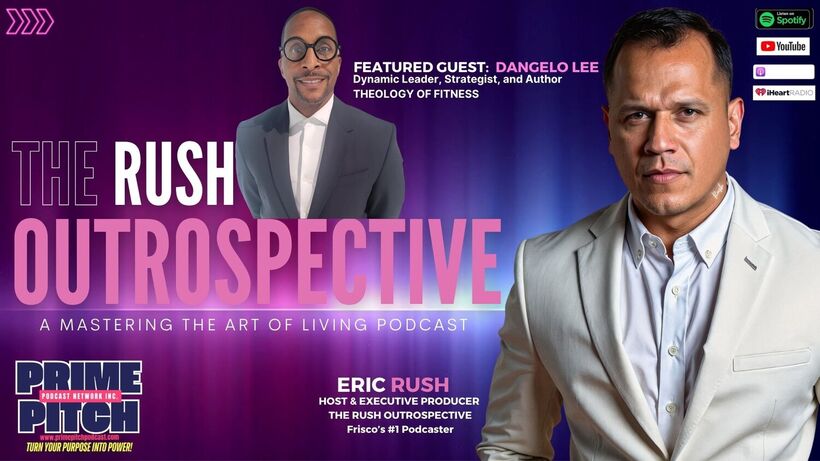
Dangelo Lee
Dynamic Leader, Strategist & Author · Theology of Fitness
About the show
The Rush Outrospective is a Mastering the Art of Living podcast: raw, honest conversations about purpose, healing, and the road back to identity, the flagship series where outrospection began. Hosted by Eric Rush, The Conversation Architect, a Bronze Star combat veteran and the founder of Prime Pitch Podcast Network.
Read the full transcript
Most people don't understand the relationship between faith and fitness. They're synonymous, they're anonymous to one another. When we learn that, which is the knowledge that God has given us the ability to gain, we can break that cycle. We can break the cycle of preventable diseases like diabetes and high blood pressure just by changing our diets. You know, moving around just a little bit could change your diet.
There have been studies that have shown that when you are fit, there's a domino effect. Your finances change. Your relationships change. Your future change. Your whole ideal changes because you understand that your body is a temple and you honor God when you take care of your body.
what's up, guys? Welcome to the Rush Outrospective, a Mastering the Art of Living podcast. What if I told you that transformation isn't a feel-good concept? It's a fight. That discipline is the bridge between faith and action, and that if our body is weak, our mindset is probably weak, too.
This isn't about hype. It's about real reinvention, the kind that forces you to face yourself, strip away excuses, and rebuild from the ground up. D'Angelo Lee has been a financial strategist moving millions on Wall Street, a city builder shaping communities, a pastor leading congregations, an inmate finding purpose behind bars, and now a leader redefining what it means to merge faith, fitness, and freedom. living proof that your body, your mindset, and your soul are all connected. And if you ignore one, you'll suffer in all.
This isn't just an interview. It's a collision of ideas, discipline, and truth. And if you're ready to stop talking about change and start making it happen, then let's step into the arena. D'Angelo, Mr. Lee, I'm so happy to have you on the Rush Outrospective, a Mastering the Art of Living podcast.
And, you know, when we first met, you and I met at the Prison Entrepreneurship Program. And I got to tell you, man, likeWe're there together sharing in this unique experience where we're independent people. We're strangers to one another, number one. But there is just something that innately drew us to one another, that interconnected us. And I believe that is a mind, spirit, and soul that brought us together.
I just feel blessed to have you on the podcast. And whenever I go out in the community, I always see people that have a, you know, you notice the ones that have that ray of light that's kind of over them. Right. Not the dark cloud. You know where those are, too.
Thank you so much. No, but we see those people. They really stand out. And I said, man. I've got to know you better, know you better and know part of your story.
And we're going to share some of that today. But I wasn't wrong, man. So I feel blessed, brother. Feel blessed. Awesome.
And and speaking of the prison entrepreneurship program, we'll just we'll just we'll start with them. We'll give them a shout out. Talk to me about let's just tell you. Why don't we tell them what prison entrepreneurship program is to start off with that? Well, first of all, thank you for this opportunity.
I'm always grateful when I have an opportunity to share and to, you know, tell my story because we all are just what, there's a Hebrew word called nephesh. And nephesh means a bundle of experiences. And so we all are a bunch of nepheshs. Maybe I did not conjugate that correctly, but that's where, so when we get an opportunity to do that, man, I'm just always elated and excited about that. I am a proud member.
a prison entrepreneur program. I was introduced to them last year and I was checking my calendar and I give significant amount of time to PEP and the programming that they do in and outside of the prison. It has been an awesome opportunity. One of the realities of it, Rush, I must admit,I said I had not gone to an institution prior to that time. I didn't want any memory of it.
I did not. It's still very surreal to me, but I needed to have that experience. I remember speaking to Brian, who introduced me to it at Entree Capital. And I needed to have I needed to confront that demon. And once I did, man, my world just opened up and, you know, like meeting you and meeting Chip and meeting all of the wonderful people like Mike and all of these wonderful persons.
And Brian, through this experience, man, has just been invaluable. And then just to reach out to the young men. that I know are going to be wonderful entrepreneurs and have an opportunity to seed with them and to water them and even sometimes get some of the harvest of them, man, it's invaluable. And I thank God for PEP and the opportunity to share. Yeah, we must have hit it right at the same mark.
That's the irony, too, because I hadn't been I hadn't been to a prison in many, many years, almost 2 decades to walk in one for the first time afterAfter so long being apart, it's like you're confronting old demons that tried to conquer us. I guess we were in that unique time, that special timing to get to know each other and forge a friendship and a brotherhood for sure. Yes, sir. And also, I must admit, man, your sneakers always give meI said, look at this dude over here, man. I mean, this guy has the baddest shoes on, man.
And I'm a sneakerhead, as you may see. And when I saw him dressed and then he had Jordans on, I said, that's my man. And then he has on my fraternity collar. I'm a proud member of Kappa Alpha Psi fraternity. And I love this crimson that you have on, man.
Let's let's talk. Let's let's tap into a little bit about your, you know, a little bit about you being incarcerated. Let's just touch on it a little bit. And if you if you if you're willing to do that right now, we can touch on it. And then we can.
I got some I got a lot of questions to ask you. So if you want to feel comfortable to share that, that'd be. Absolutely. It's been the darkest time of my life. I figured that if there was an image of a successful black man, I thought I was, meaning that I attended Ivy League schools.
I went to Morehouse College. I'm a proud Morehouse man. I did my master's work at Southern Methodist University. I worked on Wall Street. I have been in development and pastored and I was a public servant, had been married about 20 years at that time.3 awesome children.
And, you know, at the height of the social registry and just having an awesome time. And I remember I tell this story. I don't know if you are familiar. I'm a very biblical person. And if I get too preachy, man, just tap me.
But it's in my spirit. And there was a story about Joseph. And Joseph had a coat of many colors that his dad had given him. And my dad had given me this blanket of many colors. And I would pull that blanket over me on many nights and just think about how fortunate I am.
How blessed I am, how favored I am. Every time I would throw that over and then to be a part of a city where I was making decisions and a part of boards that was making Dallas a beautiful place, I just reveled in that. And just as routinely as I covered myself with that cover, thinking that I am God's gift to the world,The following day, I took it off. And my life just fell into a whirlwind. Wow.
The life that I knew it from that time, even to now, has not been the same. It's almost like Dorothy going from Kansas to Oz. And I've beenAnd through that time, just as in the movie, I've learned that I had a heart, I had a mind, I had a soul, I had a spirit. And I met so many young men there during that time out of my sadness. you know, being separated from my children.
My children are my pride and joy. I have 2 wonderful sons and an awesome daughter, and I'm a proud grandparent now of 2yearold Norrie. Shout out to you, Nono. And just being away from them, man, was the most debilitating time and painful time of my life. And one way I was able to get some life out of that is when I was incarcerated, I was a GED teacher.
And so many men there, as you may know, you have to get your GED to get a good job. And since I already had a master's degree, I had a pretty good job there. But I learned that many of the men there could not pass the GED. They couldn't until they met me. And mind you, I struggled in school because I did not know I was dyslexic until I had my son tested.
And it all became clear why I had problems in math and things of that nature. And so it was fearful for me to try to teach someone else because I knew that I struggled. But I did. And I was able to graduate over one hundred and twenty five men that had been trying to get their GEDs for, you know, 5 to ten years. And, you know, the beautiful part of it is that, you know, I love faith and fitness.
I like working out. And many times I'm out on the gym in between class and I see these big burly men run up to me and grab and hug me. Thank you, Mr. Lee. Thank you, Mr.
Lee. I passed. I passed. I passed, man. And that made that experience a little bit worthwhile.
because I did not have opportunity to be there with my children because they were doing their school age years. I wrote a book about it called Parenting from a Distance. We're not going to talk about that today. But I tutored my kids. with the resources that were made available to me because my number one concern and my mission was to keep my family together despite the distance.
And we'll come back and talk about that at another time. But it was a dark time, but I've learned, and I'll probably repeat this again, that I've learned that my condition was not my conclusion. Wow, that's awesome, man. My what? What was it?
Not my conclusion? My condition. My condition was not my conclusion. It's not my conclusion. That's beautiful, man.
And not yours either. You know, maybe you've gone through this experience, but I remember myself when I was going through a similar journey, going through being incarcerated. There was a time where I said,I don't belong in this. I don't belong here. I don't belong in this place.
Like, was there a moment where you said, okay, I don't, I need to be out there making a difference instead of in here. Was there a time when that happened to you? Oh, absolutely, man. I used to tell people, I said, if God was trying to teach me a lesson, I could have learned this on the golf course. He didn't have to send me here to learn that, man.
He didn't because I'm just like, I could have gotten this. I didn't have to get it there. And then, you know, on the streets, they say that, man, you're not cut like that. I was just not cut for that. I just was not cut.
I had a really fortunate life. My dad really gave me a very, very fortunate life, man. And I just wasn't cut like that. I just I didn't speak like that. I just didn't think that I could endure that.
But God had other plans. He had a whole nother vision and purpose for my life. And then I learned also that because something is deferred doesn't mean it's denied. And what God has for me and has for you and everyone else, you may have to take a detour. But it's not denied because it's destiny.
And I had to really, really gather that in the darkest time of my life, man. And when you look at most of the great leaders, they've learned this in the dark times of their life. It's something about in the darkness, man, that the light just can't shine and show you. Yeah, I always say, man, even in darkness, man, the light. Humanity still flickers.
We talk about humanity. How did humanity, you know, you knew your life, you built a lot of social capital in many streams that you were part of, the congregation, city, you know, and different sections of your life. How much, what did you learn about, how did humanity impact you when you were incarcerated? Well, it didn't start there. You know, I remember if we can go to, you know, one of the questions that was askedAnd it talked about how do you feel about your experiences in life and basically the question that you were speaking of.
And I've come to gather that all things, not some things, work together for the good. of those that are called according to a purpose, man. And I am, I am, you can't convince me that I'm not of purpose. You just cannot convince me of that in any way, form, or fashion, despite what I've gone through. You know, yea, though I walk through, I'm walking through.
I'm not stopping in the middle. I'm going through. And as a result of that, man, I've just learned, man, just to persevere. And that's been my humanity. And then I see that in so many different people.
I have a wonderful opportunity to be the leadership over large groups of people and indirectly. My position had allowed me to have hundreds of people that I had provided leadership to men. And that allowed me to see their humanity. It allowed me to be a more vulnerable leader, a more compassionate leader. A leader that was able to meet the people where they are.
I always tell people that I see people before I see their work. Some people see the work and I would get on my managers and I would say, man, listen, I said that person has a life outside of here. Try to understand. Be empathetic. Be empathetic.
Put those shoes on and then judge from there and then lead from there. there's no other way. There's no perfect way of demonstrating humanity. It's through compassion and vulnerability. When we first, recently you shared with me that you have a book, it's called The Theology of Fitness, is that correct?
That is correct. In the book you talk about radical ownership of mind, body, and soul. Most people try to compartmentalize these things. What was the moment in your life when you realized that they were inseparable? And what did you what did the realization cost you?
Now, that's a really great question. You would think that I would have learned or got this revelation being reared in the church all of my life. You know, having a dad, I was a pastor and mother, first lady and grandfather, my uncle and all my cousins are bishops. And, you know, I'm just in the church. She would think that I would understand the continuity and the synergy between body, mind and soul.
I call it faith and fitness, but I didn't learn it there. You would think that I learned it going to a Perkins School of Theology, mind you, School of Theology. I didn't go to a seminary. I went to a school of theology. And the difference is, is that a school of theology allows you to theologically reflect upon any type of literature, the Bible or whatever the case might be.
So I was well equipped toto reflect on that, you would think that I got it there. You also might think that, dude, you pastored for over almost 2 decades to hundreds of people, conferences and et cetera, et cetera. You didn't get it there. No, I did not get it there. You can even venture to say you were a public servant.
to a large constituency. Did you get it there? No. I got it when I served high. And more specifically, Russ, I lost both of my parents during that time.
It was the darkest, darkest, darkest moments of my life, man. Yeah, that sounds, I mean, to almost render yourself almost at God's mercy. Is that a good way to Yeah, because during that time, man, I fell in depression, the deepest depression you could possibly imagine. And all I knew is that when I worked out, my depression lifted, it faded. My dark clouds just evaporated.
And I was able to hear God more clearly. I was able to, I more clearly understood his word to me like, yea, though I walk through the valleys and the shadows of death, I shall fear no evil. And I knew it intellectually, but not existentially. The word, you know, that weeping may endure for now, all of these scriptures came alive in me. And that's when I understood the synergy and the homogeny between faith and fitness.
And the costAnd the price that I had to pay was, first of all, losing my parents who were the wind beneath my wings. And then secondly, with my children not being able to be there for my children, teach my children how to drive and my son how to shave. And the bigger, the more macro sense, it is the cost and the price I had to pay of all those missed opportunities. When I had opportunity to preach to people about the synergy between faith and fitness and I didn't when I was a public servant, didn't talk about it at that time. That's an irreparable cost.
Hence the book. I wrote the book to right the wrong so that now you have a blueprint on how to speak about faith and fitness. I love it, man, because you're getting life lessons and you're documenting it, man. So this book, Theology of Fitness, it's like you're like documenting, you're like, this is what I've learned. This is what I need to make sure that it's a living entity in this world.
So that's like so powerful, you know, when I think ofof imprinting, putting your fingerprint, and putting this God-spoken word in your life and actually executing an actual book out of it. So that's admirable, man. We've talked about this a little bit, but I'm going to go through this question anyways. It says, you've walked through extremes, financial power, spiritual leadership, incarceration, and now health care leadership. Which of these has tested your discipline the most?
And what did you experience? that experience reveal about your own limitations? Again, it was incarceration, man. Again, as they say in history, I wasn't cut like that. I didn't think I was going to make it, man.
But God showed otherwise, man. You know, there's a passing scripture said that my borders were enlarged. I realized, man, that I didn't I didn't know what I could handle. I did not realize that I could endure that. Well, let me restate that is I felt that I was going to get through it because I just, you know, my family is resilient.
And but I felt that when I if I came out of it, I would have been so broken and worn and torn and almost irreparable. But I learned that that was not the case. And it goes back to that statement that I made before is that I learned that my condition was not going to be my conclusion, that I was going to make not just lemonade out of this, but I was going to do orchards of lemons so that I can leave a blueprint for. I met so many incarcerated parents, man, for some of the excuse my just the dumbest stuff ever. There was a beautiful couple.
He and his wife were separated from wonderful children. I mean, men of deep integrity. they were separated from their families, man. And so I've learned a lot, man. And my borders have been enlarged.
My territory has been enlarged. My mind has been enlarged. My spirit has been enlarged as a result of that. And again, it makes me a better leader. I'm much more sensitive.
I'm much more compassionate. My emotional IQ has risen. as a result of that experience in my life. That's beautiful, man. I like the broader borders, right?
Stretch you out. You know, it's such a mind, you know, this whole experience can be, we've walked through it. We've walked through the valley, right? I think there's a part where I was, I watched this pastor say, and he maketh me lie. You know, maketh me lie.
Yes, sir. I never got that until recently. Maybe about 6 months ago, I saw this guy. He's like, they're making me lie. That's what was happening.
They're making me lie. I like that, man. I like that. Okay, I'll be using that, okay? I say my friend rushed in at first.
He's making me lie on this green mattress. Making me lie down. This green mattress. We're yellowing it, and it's not my favorite color. Yeah, definitely, man.
Okay, let's revert back to your book, Theology of Fitness. You argued that a weak body reflects a weak discipline. That's an uncomfortable truth for many. How do you convince someone who's stuck in a cycle of complacency that their physical health is a mirror of their deepest struggles? Another good question, Russ.
Hosea four and six says we perish because of our lack of knowledge. When we know better, we do better. When we know better, we do better, we can break that cycle of complacency. Most people don't understand the relationship between faith and fitness. They're synonymous, they're anonymous to one another.
When we learn that, which is the knowledge that God has given us, the ability to gain, we can break that cycle. We can break the cycle of preventable diseases like diabetes and high blood pressure just by changing our diets. Now, moving around just a little bit could change it. There have been studies that have shown that when you are fit, there's a domino effect. Your finances change.
Your relationships change. Your future change. Your whole ideal changes because you understand that your body is a temple and you honor God when you take care of your body. And if we can get individuals to know, to understand that we can break that cycle. And that's the deepinter-struggle that people are having that they just don't know.
But when you know better, you do better. And that's the purpose of theology of fitness. It is to demythologize the idea that you can put whatever you want in your body, but then your faith is okay. It challenges that theory that I can put whatever I want in my mouth, but say something else. That dichotomy is addressed in theology of fitness.
They're one in the same. They're not exclusive, but they're inclusive of one another. And your fitness is an outward expression of your faith. How do you show faith? One way of doing that is taking care of your temple.
How do you honor God? by taking care of your temple. Watch what you put in your mouth. Watch what you drink. Watch your stress level.
Work out. You become a better congregate, a better person in ministry because you feel better. When you feel better, you do better. When you wrote this book, where were you in your place in life? All of my books I wrote while I was away.
Wow. Yeah, I wrote 5 manuscripts and I have published 2. So I got a couple more out there that I have to do. But yeah, I wrote both of these books during that time. Wow, that's crazy.
Faith is often associated with surrender, while fitness is about control, right? So we say faith is often associated with surrender, while fitness is about control. How do you reconcile the paradox between trusting God and taking complete control of your body and mind? Again, Rush, it goes back to this paradox. I don't see it as a paradox.
Faith and fitness is not a paradox. Discipleship and control is not a paradox. The root word in disciple is discipline. You have to have a level of control to be disciplined. I have to control what goes into my thoughts.
I have to control my impulses. I have to control my imaginations. There's a passage in scripture that says whatsoever is good, whatsoever is right, whatsoever is pure. It gives a litany of these wonderful, great ideas that we should think on. on a daily basis.
And if we're able to do that, then it's not a paradox that is one in the same. And that's, again, why I wrote the book, to demythologize the idea thatBeing a disciple and being in control is a conflict. They're not diametrically different, but they're diametrically the same. Wow. Wow.
That's crazy, man. Like, you know, whenever I sit, you know, I always say when I'm sitting here with a guest and they're saying something that's profound, I say, how are you doing this, Rush? Like, how are you doing this? How are you doing? Yes, sir.
If there was clouds popping up over me, different kind of animated clouds, you'd be like, hmm. You're like, okay, let's go, man. That's the unique thing about having conversations like this, man. You bring an arsenal of a treasure trove of wisdom and knowledge and experience that took you to a place where you had to –You were confined to it with just yourself in Christ and your love for your family and working through this, navigating through this process for you to Come out on the other side. Come out on the other side to share this piece of gold, man.
Yes, sir. You know, many people find motivation in pain, right? Whether it's a loss, failure, or even incarceration. But fire fades over time. That fire fades over time.
How do you maintain a relentless drive once the immediate struggle is over? Man, that's easy. That's an easy one, man. My children. When I see the faces of my children and know that incarceration is a part of their history and their knowledge of me, man, I wake up every day to change that story, to change that narrative.
Not for that to be excluded from the legacy, but to turn it into an archard of wonderful experiences like the book. You know, being able to write about it so I can reach back and help others. There's another passage in scripture where Jesus goes to the pool of Bethesda. And there is a man that were that laid their lane for 38 years. And when Jesus came to the man and asked the man, did the man want to be made whole?
You would think, why would Jesus ask this man? The man had been sitting there for 38 years, but he asked him. Do you want to be made whole? The man said, yes. And he said, take up your bed and walk your heel.
Take take up your bed. He didn't just say, go away, go walk. He said, take up your bed. Why do you take you take up the bed? Because I want you to forget.
Didn't want to forget where you came from. My book lets me not forget. My children let me not forget my beautiful granddaughter, 2 years old. you know, makes me not forget. Being here on the podcast makes me not forget, realizing that I have a responsibility to give back.
You know, there's an old African proverb that says that when you see me, know that I'm standing on the shoulders of many that have come before me. So I have a responsibility. They taught me that in Morehouse College, that I have a responsibility to give back. That keeps my fire, me,just giving back knowing that my condition is not my conclusion is uh you know they say like in recovery you know being willing to make amends whenever possible as long as they don't injure or injure or harm people um you know it means you apologize for somebody who's don't apologize someone who's not ready to accept your apology right do you feel like this is part of an immense moment for you like you know you're talking about how important your family is andSure. Sure.
Absolutely. Whenever I get an opportunity. And as I shared with you before the broadcast of the podcast, this is the very first time I talked about my experience of incarceration. I was afraid. Yeah.
I was just afraid that it is a part of my resume, you know, that I wear this scarlet letter. And, you know, I'm so honored and grateful for PEP. Just allow me to go back into that space to open up and to talk about it, man, because I had tucked it away so deep down. Because to be honest, I was angry with God. I was just, God, how could you let me do that?
How could you let that happen to me? And I know I did not do that. I had the purest intention as a public servant. I don't know what it means to take a bribe or anything of that nature. I had no idea.
All I know that I wanted to give back to my community because that's what I was taught. But, you know, nevertheless, you know, you live and you learn. And again, my condition is not my conclusion. Yeah, I like that man. You've talked about what you did while you were incarcerated with helping individuals with GEDs, and you've built a recidivism reduction program, led massive business deals, and written a book challenging how we think about fitness and faith.
What's the most misunderstood part of your mission and why do you think people struggle to grasp it? Again, man, it comes down to knowledge and we know better, we do better. And it's our responsibilities as leaders, all types of the faith leaders, business leaders, parents, et cetera, et cetera, to teach. My dad was a teacher, man. If you take P off a preach, you get reach.
If you take the R off a reach, you get each. If you ain't reaching each, you ain't preaching. Nice. And I've learned that I have a responsibility to teach. Not only teach, but practice what I teach.
Walk my talk, not just talk the walk, because that's what I did in the past. As a pastor, I talked the walk, but I didn't walk the talk. There was never a synergy. There was never a marriage between faith and fitness. And I was always fit.
I went to the gym every day, but I never thought that I needed to teach my congregation that. When I when I would see young people that, you know, start off in their teens and over time, I saw them blow up. Or I remember so vividly just pastors that were my mentors, men that were just struggling to get upstairs and breathing hard. And we would go down after service and we would eat these heart attacks on a plate. And.
Not being able to to to marry those 2 men has been, you know, the biggest struggle, you know, the biggest struggle to teach people do that. Your your temple belongs to God and you have to be careful about what you do with it. And it is service. Faith without works is dead. What you put in your mouth is your work.
which exhibits your faith. And so just getting that message across, man, seems to be the struggle, hence the book. You know, part of the subtitle is a blueprint for leaders to teach the relationship and intersection between faith and fitness. But just getting that out to the masses, man, continues to be a beautiful struggle, man. It hurts so good.
Let's see here. Your past could have easily dictated a different future. What mental chains did you have to break to make sure your story was one of mastery rather than victimhood? Wow, man, that's good, Rush. Man, I just, when I think about chains, man, the day that I knew my liberty was gone is when they put them chains on me.
It wasn't the 5 years that I was investigated. It was not the time that I spent. It wasn't the 7 months I was in the trial. It wasn't any of that. It was the day they those chains on me.
And I declared I'd never wanted that experience again. But I understand what you mean about the mental change. After coming home, the most difficult chain that I had to break was the chain of unworthiness, feeling that I wasn't worthy anymore of God's love and God's favor, that I was not worthy to succeed again. I was a success. to succeed again.
I didn't feel valued. I felt like this may be proof that it was okay to prostitute my knowledge and my experience because typically that's what people did. They took all of the 25 years of public and private experience and they drained me and they kicked me to the curb. And guess what? I allowed it.
But when I began to understand, man, that God still has a purpose and a plan for my life, when I began to understand, man, that God has an awesome, has consistently given me awesome opportunities and I have gifts and graces, man, that is beyond man's reach. And as Bishop Jakes would say, favor is not fair. And I know I have the favor of God. I know that I have the favor of God upon my life. And then I move in it.
Sometimes it comes off. I remember my my ex-wife when she was testifying for me and they were talking about me. She says, D'Angelo may be many things. He may be conceited. He may, you know, he may be aloof.
You know, he may be all of these things, but he is not a thief. He is not this man that you guys are describing him to be. And, you know, sometimes, you know, the favor comes off that way, man. But yes, I am convinced that God has an awesome plan for my life, not just my life, but for everyone's life who's willing to submit and commit their lives and be a disciple. gain some control over their lives.
That's awesome. I think I love the fact that you said, man, favor is not fair. It isn't. I mean, some people, I think people fail to realize that when they start delving in where God's hands are already at. When they start, the realization is that here I am trying tohurt somebody that belongs, is in God's favor at this present moment, there's a lot of danger in that, don't you agree?
Absolutely. Let me share something. This may be prude. You may edit this out of our interview. But there was, you know, when you think about our parents coming together to procreate us, I mean, there's been hypothesized that millions of sperm cells are entering into our parents' womb.
And just say a million of them. Nine hundred and ninety nine thousand of them did not make it. but I did. And you did. Do you know what the odds of that is?
That's like winning the lottery every day for the rest of your life. I am a winner. If I never win again, I won the life battle. I won coming out of eternity into time and going back to return. I'm already a winner.
You're already a winner. The mere fact that you are here. means that you're a winner. And I don't need nobody to tell me that. Amen to that.
I just need to know. Amen to that. Let's see, we've got one more question, and then we're going to wrap it up, but I've got to ask you one more after this. If you could strip everything away, titles, money, status, even faith, as an external structure, what's the one unshakable principle left that defines D'AngeloAgain, man, that's your condition. It's not your conclusion.
I wanted to close with this little story. There was a kid that wanted to spend some time with his father. The father was busy and wanted to find something for the kid to do, so he saw a magazine. He got the magazine, flipped through the magazine and found a picture of the world. He tore that picture up and tore it into pieces like a puzzle and gave it to his son to put together.
You know, said that this should take him some time to do that. But oddly enough, the little boy came back with the picture of the world put back together. The father was amazed and he said, son, how were you able to put the world together so quickly? The little precocious son looked up at his daddy and said,On the backside of the picture of the world was a man. He said, I put the man together first.
Then the world came together, too. That is awesome, man. That is awesome. We keep putting men, put folks together, men, women, boys and girls, man. Your worlds will come to your family worlds, your financial worlds, your fitness world, your faith world.
Those worlds will come together. And that is the best praise you can give to God. Amen to that. And to the world. Put yourself back, put yourself together.
Yes, sir. Starts with you, right? Starts with us. Okay, this is a section I always do for all my guests. I always say, you know, let's talk about your book and let's talk about where people can get it.
Do a little disclaimer on what the book is and then I'll tell everybody where they can get it. Well, again, hey, Rush, thank you for this opportunity, man. I just love your spirit, man. You know, God has really bonded us together, man, in heart and spirit, man. I'm just excited about what's coming as a result of that.
Yeah, but again, I am a proud, proud author of my book called Theology of Fitness. It is a look into a faith leader, meaning myself, journey to develop theology of fitness. And it also provides a blueprint to faith leaders on how to understand faith and fitness. It can be found on Amazon. My ways of getting in touch with me.
I am just now learning how to get into social media, but I have a Facebook page. It's D'Angelo Lee, 100. Also, I. G. and LinkedIn.
And I'm getting on those other places as well. But those are the ways that you can pick up the book. awesome i'll make sure i include a leak a link for that okay last section i would say give give somebody a shout out either you know a group or you know someone you know you should just give a shout out to that deserves it you know or someone needs some encouragement so like some somebody and or some people would have definitely pep man i am on this podcast because of you uhTo Chip and to Brian, man, thank you for introducing me to PEP, man. It gave me an opportunity to tell my story that had been buried away for so long. I am so grateful for my children, man, D'Angelo, Adam, and Fallon, man.
I could not make it without you all and my wonderful granddaughter, Noe, 2 years old, man, that I just absolutely love, man. And just for all of the wonderful people, man, that continue to bless my life, Eric Walker andand Dr. Cerise and all of these wonderful people, man, that have blessed my life and Alan Williams. I mean, I just, man, God has just placed me in such a loving and caring environment, man, that has caused me to make these wonderful, wonderful transitions, man. And for that, I am grateful.
Angelo, my brother, I love you, man. It's great to have you on the podcast. I, you know, I had, you know, I knew that we we would we were intertwined in some way. And somehow when I saw when we when we we were at the prison entrepreneurship program together in front of everyone, it's an honor to hear your story and hear the depth of of of what you learned through your experience. And also, man, just.
You just gave me a bunch of ammo that I can take with me and walk out of here, some tangible things. And that's the essence of this podcast, the Rush Outrospective and Mastering the Art of Living podcast, is to give people something tangible that when they hear this conversation, they hear it, they have something that sparks fire in their heart, mind, and spirit. And I think we accomplished that today, brother. Absolutely, man. And remember, your condition is not your conclusion.
God is not through with you yet. All right, guys, that's it for the Rush Outrospective, a Mastering the Art of Living podcast. As I always say, have peace and the light in you.