Chuck Wright
Chuck Wright joins Rush on Unfinished Business, the show for veterans pursuing new missions after the uniform and the people who stand beside them. As texas Veterans Commissioner · U.S. Marine Veteran, Chuck brings the weight of service and what comes next to the table.
They get into the work, the cost, and the reasons it still matters, in the kind of long-form conversation this show was built for.
In this conversation
- The transition out of the uniform
- Finding the next mission
- What stays with you, and what you build next
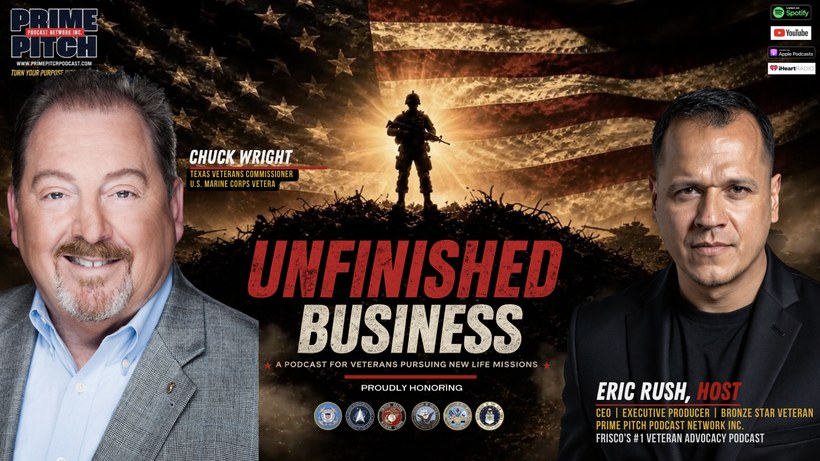
Chuck Wright
Texas Veterans Commissioner · U.S. Marine Veteran
About the show
Unfinished Business is a podcast for veterans pursuing new missions after the uniform, and for the families and communities who stand beside them. Hosted by Eric Rush, The Conversation Architect, a Bronze Star combat veteran and the founder of Prime Pitch Podcast Network.
Read the full transcript
Last question before we wrap up. Um, when this chapter of service is over, what do you hope your boys say about the way you carried it? Dad lived a good life. I'm sorry. That's a powerful question and I want to be like Dad.
up, guys? Welcome to Unfinished Business, a podcast for veterans pursuing new life missions. Every decision made on behalf of veterans carries consequence. In Texas, more than 1.5 million veterans are building careers, raising families, managing injuries, and finding out what comes next. The direction of the Texas Veterans Commission influences that journey.
Commissioner Chuck Wright helps guide it. He, he once flew Marine Corps helicopt- helicopters in tight spaces where precision mattered and hesitation had costs. That role demanded clarity under pressure. It demanded knowing where the line was. Today, that same discipline meets legacy.
A six and seven generation Texan helping shape decisions that affect veterans he may never meet, but still serves. Unfinished Business exists for veterans pursuing new life missions. Chuck Wright was the first leader to sit in my studio when this platform began, and he returns now to open a new season and a new space. This conversation is about the man behind the title, about the pressure, about boundaries, and about how service carriedhow, how service is carried forward at home and at scale. Chuck, welcome to Unfinished Business again, sir.
Hey. Thank you. Thank you for having me back. Awesome. Yeah, no, it is great.
I- it's a pleasure to have you in my home, in my space. Um, I always say, you know, now that I've transitioned into this, this, uh, this space, it's, itTo have you come in, and bring your spirit and, and yourand all the things you represent in our home, it, it's really an honor and I want you to know that from the bottom of my heart. Deeply appreciate it, my friend. As I was going through this, uh, cold opening, um, theWhat stood out in you? The- was there something that grabbed you and said, "Oh, man.
That, that, that, that hit me."? Well, the one thingNumber one, Texas loves her veterans. I can't say that loud enough. Um, I am honored to have been appointed by Governor Abbot to serve as one of the Texas Veterans Commissioners. Uh, we just went through a Zoom yesterday, uh, highlighting a lot of the things that we've done, and we're gonna make things better, uh, for our Texas veterans.
Um, and you can see the impact of that. As you mentioned, um, Texas is home to over 1.5 million veterans. We are the leading state in the nation. Uh, we've now surpassed California and we're growing that margin every year. And te- uh, excuse me.
Texas is good for everybody, but, uh, what I meant to say was Texas is very, very good for veterans. What most people don't know, I'll, I'll start here because it's the economic impact. Um, te- or, excuse me, veterans havekeep going back and forth on that. Veterans have a higher real median income than non-veterans. Um, veteransWe are home to over a quarter of a million veteran, um, owned run, uh, businesses.
And we track that through the Secretary of State's office. Uh, but an interesting statistic that I learned recently from the Small Business Association, um, veteran businesses are 45% more successful than non-veteran businesses. Hmm. And a big part of that is because of the ethos and the culture of veterans, they don't go out of business as quickly as other businesses. Hmm.
We hear about this all the time. Business starts up, it shuts down. There's all kinds of reasons for that. The realtors will tell you it's location, location, location, and there's, there's truth to that. Um, it's small businesses being underfunded and every small business owner understands that.
But the gist of it is, and one of the things I hope we can get into is not just the Texas Veterans Commission, but the other resources that the state of Texas brings to veterans to make this an attractive place to come. And if you're listening to this and you're thinking about getting out, let me tell you, our office is here to help you make Texas that decision. Because there are jobs here, there's employment here, uh, there are, umThere will be a brand new program rolling out that has to do with skill labor training that, um, uh, the Texas Workforce Commission is actually going to run, um, but I was asked to help them, uh, rewrite the way that they presented everything. Hmm. Uh, which was interesting.
IYou always lead with the problem. They weren't leading with the problem. And, um, from what I understand, the governor's office absolutely loved it and hopefully we've got that announcement coming out. I've teased a little too much, but that announce will be made before this goes out, so we're okay. That's, that's amazing.
I mean, just to know that you, you, you have your hands in everything. I think that was the firstwhen we first met and when I first thought about this, this, this, uh, podcast was like, listen, like, uh, you know,I wanna have, I wanna have a space where I can learn as a veteran to become a better veteran, like I, like I had mentioned to you before the podcast started. But also, it was important for me to touch, uh, have someone who comes, who, who has had their hands i- you know, have, have worked, you know, have their hands dirty with trying to, to, to, uh, find a solution and fill the gap that we talked about. Uh, and, uh, so that was such, that's a, such a blessing. And you're still continuing to do that, and I admire you.
I've seen you at several events recently, uh, out in Fort Worth and, uh, and then it seems like we're both going that direction for some unique reason, and that's very cool. Well, you have, uh, you have gotten connected with, uh, a group of people with the, uh, the Air Power Foundation that I am a big fan of. Yeah. of course, I kinda love it, because they don't apply for grants from us, so I don't have a conflict of interest there. And I, I, it, it's always a delicate line to, to cross, and we'll drive into, a little bit into that, the grant process, uh, because it, it is an incredible program, uh, I know that, um, I met through the, uh, WVU's Leadership Fellow Program, not that I was part of it yet, um, I'm trying, but, um, I've met quite a few of the people that have been through that.
And one of the individuals, um, just reached out to our, to me and our office. Uh, they are trying to get Louisiana to adopt a, a similar program like that. Um, but to come back and to kind of talk about, um, what TVC does, and I, I love to use one word, resources. Mm. Every veteran gets out, and one of the first things that they do is they look around, and it's, "Where are all these resources I was promised?
Where's all these benefits?"In Texas, especially for those that come to Texas, um, and if you're asking this question, I used to tell the story, it's like prairie dog. It might be 6 weeks. It might be 6 months. It might be 6 years. But a veteran's gonna pop his head up like a prairie dog and look around a little bit and go, "Where are those resources they promised?
Where are my people?"And this is the key. The veteran is part of a community. It is part of a tribe. And we've had, I know you've had several friends, um, um, that we know, mutual friends, one of 'em is Jake Schick, who runs the One Tribe Foundation. Um, but it's that concept of tribe, um, there's a really good book called Tribe, it's a perfect book for Marines because it's one of those little books.
It's kind of like a Malcom Gladwell. He puts a lot of knowledge in a very tiny little book, and it's perfect for Marines. Excuse me, sorry about that. Um, but we are part of a tribe, and veterans will look up and they're missing that tribe. But they're also wondering, "Where can I go to find those benefits?"And if I may, I'm gonna throw an email out, um, and I ask people to email, not to call us, because phone calls don't get recorded, you know, wish we had better systems that way, but it's, it turns into he said/she said.
Send an email to I-N-F-O, info@, T, the letters, tvc. texas, spelled out, dot-gov. I don't care what it is you need. Do you have a problem with claims? Do you need VA advocacy?
This is something that is huge. We handled 16,000 VA advocacy cases last year. One of my goals, my executive director sometimes cringes when I say this, the Charlie Wilson movie line, "Double it."Mm. I wanna double it. I want it to be more.
Um, we brought in, in additional claims, this is a staggering number, I had to check it, 9.5 billion to the economy of the state of Texas- Wow. in increased claims. Wow. So it's either or- original claims or our support getting claims through the claims process. Um, very quickly, I will run down, um, we talked about a little bit, you kind of touched on mental health.
Uh, we run c- uh, statewide through the counties, we run the county veteran, um, it's the Military Veteran Peer Network. I always stop at, 'cause it's MVPN but I hate using, I hate talking in anagrams 'cause people are like, "Well, what does that mean?"Well, it's the Military Veteran Peer Network, and these are peer programs to get people connected, and these are for, not only for veterans, but for their families. Extremely important. We love this program around the state. Um, so we do employment.
So again, back to that info number, you wanna know any of this information, hit us up at that info, um, I said number, um, email, and, uh, we've got that, that information. Education. Most people don't know that we, uh, uh, are the ones who accredit the schools who are gonna file VA claims. Hmm. So obviously they really like us.
Um, but we also manage the Hazlewood program in Texas. Texas has a unique program for veterans who enlisted from Texas, uh, to provide for additional education benefits, and that's kinda where the, hopefully the governor's, uh, announcement will come out soon. We're about to add a new layer to that, uh, although that's the one that will be run by the Texas Workforce Commission, but we all work real closely together. Employment. Um, the number one driver.
Why do you come to Texas? Because the jobs are here in Texas, um, because of the fact that this is the best run state in the country. Go ahead Florida, prove me wrong. My Florida friends like to say that they're the best run, but no. I'm sorry.
You gotta prove me wrong, and you can't. Um, but people are coming here, veterans come here for the same thing. For opportunity. You mentioned something a- and I wanna touch on that for a second also. You talked about we think of Fort Worth, but it's really Tarrant County and, and, and it's, but it's true across the entire state.
This state loves and respects her veterans. I have friends that come from other states, and they're like, "It's different here."It's different here. You had interviewed me at the Patriot Roundup. I'm plugging the, uh, Air Power Foundation just a little, but it's an event that's coming up at the end of July, right? Yeah.
You interviewed me there last year. I got a chance to meet, um, Mo Brings Plenty from the, uh, show Yellowstone. What an amazing man he is. Um, and there's this incredible legacy of the Native Americans, um, serving in the military, and they're incredible veterans, and they had brought in their, their team. So it'sThere's a feel in Texas that's not like everywhere else.
Yeah. Yeah. That's, that's amazing. Yeah. Uh, yeah.
Air Power Foundations, uh, Patriot Roundups, it is in the end of July. Gotta give a shout-out. And they just made me an ambassador for the, for the organization, which is an, a complete honor, and we're working close, I'm working closely with them 0 on that, on that. And, uh, I'm really looking forward to that, so good plug. And, um, Chuck, you know, you've covered a lot about veterans at, of, uh, uh, Texas Veterans Commission.
People wanna know the man behind the purpose, so I got a few questions about that. Um, B- uh, Chuck, before marines, before commissioner, before business owner, what sh- what shaped you most growing up, and who, who or what formed your sense of discipline and direction? Absolutely great question. Um, I really like that question. That, full disclosure, he set me up with some of these so I wouldn't stumble and bumble over my words so badly.
Um, I grew up an Air Force brat. My dad was a, um, a Army World War II vet. Uh, he got out, as most, most of the men and women did after World War II, and then, uh, the Air Force made him an offer he couldn't refuse. He went back in, and that's where he met my mom. Um, and so being a brat, being part of this culture, and brats are, and I say brats, we're talking about military dependents, um, but we wear that brat title proudly.
Um, but it is. It is a little bit more rigid. It's a little bit more strict. Um, we grew up, you know, but it was funny. Didn't change the fact that we had a lot of fun.
Got into more than a little bit of trouble. Funny, it seems like a lot of marines I know gravitate towards the Marine Corps 'cause they are a little bit of troublemakers, and it's been fun connecting because so many of my classmates went into the, for us, it's the family business. And then I, in high school, I got involved playing football, and I never realized how important that was, to learn that discipline, to be part of a team, to be part of something bigger than you were. And that leads to, and I'll throw this in and we'll talk about it more later, a concept I call Charlie Mike, and that's actually the title of a very good book. And again, another one of my little short marine jokes.
But, uh, it, it is a great book, and there have been a co- uh, a couple of them that talk about, um, um, I can't remember his middle name, the guy with the 3 J names that's on, um, the marine who lost both legs. He just did a similar book, and I apologize. Hmm. Um, but several people we know, Jake Schick being one of them, were written up in that book. But they talk about the incredible, um, work that people do, and Charlie Mike means continue the mission.
So when you leave the service, don't leave the service. Don't stop doing all those things that made youBoy, this is gonna sound a little bit tacky, but just a little bit better than your average civilian. Hmm. Generally speaking. Uh, I am a big believer, when you look at, at, at veterans, they are leaders of industry.
And as I said, Texas is home to over a quarter of a million, um, veteran-owned businesses. Uh, it is incredible th- the impact, uh, 0 on a very large scale. I think about, um, recently departed, uh, Fred Smith, who founded, uh, FedEx. In fact, h- he used the thesis for FedEx- FedEx Airlines as his Harvard MBA paper. Wow.
And he got a B-minus. And I get the biggest kick out of that, one of the biggest companies in the world. But, uh, veterans are leaders. And we talked about, and I'll kind of come back to, uh, Jake Schick, we're talking about leaders that are not leading business, but they're leading the community. Yeah.
So, kind of, I jumped, as you well know, I tend to get off on tangents. Please. Hang with me, the story will eventually get back, and it'll all make sense, if you can remember where we, how we cir- Circle back? Yeah, how we circled back toBut, uh, no, it was a great question, and thank you for that, because I realized, and I actually, uh, as I thought deeper and deeper about that question, all of that really came into play when I was in flight school, because I really, really struggled with it. Hmm.
And I was able to get through because of that discipline. Speaking of, you just transitioned right into my next question. You, you, you're on that right, you, you're, you're falling right into it. Um, you flew CH4- 46? Yes.
Uh, what Marines call The Frog? Is that what you said? We call it The Frog. Okay. So when you look at it head-on, it, it looks like it's squatting like a frog on a lily pad.
Oh, okay. Yeah. I did some research on this. Yeah. I know what it was, wha- what it's called.
Um, for people who may not know what that aircraft, what, what was it, uh, what was it built to do? So it's a people mover. Uh, and most people are familiar with the much larger, also built by Boeing, they look very similar, um, the CH-47 Chinook. So all of the helicopters are named after Indian tribes. Almost all of them have developed their own handle.
Okay. Yeah. Now, although the Apache and the Chinook both kept theirs, uh, they don't really have, um, you know, but we became Frogs. Um, the Huey was the Iroquois. Hue- the Huey was very famous from Vietnam.
Uh, you know what, I just realized that the Black Hawk has also kind of kept its name too. It didn't develop its own handle, but a lot of them have. Um, the, uh, Marine attack helicopters are Cobras. Uh, you know what, and I'm not even sure what their Indian name is, but they're Cobras. The army flew them in, uh, in Vietnam, and then transitioned to the, um, AH-64 Apache, which is just the nastiest helicopter in the world.
Boy, you do not want to face an Apache, and, if you're on, if you're on the bad guy's side, but what we did, and the Navy, it's, uh, the Navy and the Marine Corps do most of their, their, uh, um, what is the word? Purchasing. They, they acquire most of their gear together, generally speaking. One of the reasons the Navy loves the CH-46, the Frogs, is because it's dual-rotor, so it's got one big rotor in the front and one big rotor in the back. Mm-hmm.
Uh, and that makes it very maneuverable in tricky winds. So landing on a ship becomes very tricky. Mm-hmm. We landed on a ship with a whole bunch of other helicopters landing and taking off, and it was, uh, it was amazing ballet. Mm-hmm.
I actually took a, uh, a jet pilot up one time, and we let him sit. We weren't supposed to, but he was sitting kind of up in the cockpit as we landed, and he goes, "Man, I land on carriers, but they didn't have anybody around me when I land. You guys are landing between turning helicopters."I said, "Yeah."Let me a- let, let me ask you this, I didn't mean to interrupt you. Uh- Go ahead. Was there a particular flight mission that you had to, you had to perform that, where, you know, something changed, a moment when you s- understood the weight of what you were carrying?
Um, so it, it is, it is a, uh, a huge amount of discipline. Okay. Um, if you're up in a fighter and you do something stupid and it crashes, generally speaking, as long as you don't crash, um, into a populated area, and there are reports of fighter pilots who could have bailed out but didn't because they weren't going to allow that plane to crash, um, over a populated area, so real h- they went down as real heroes. Um, but we're always carrying, there's at least 4 people on the aircraft at all times. Uh, so we've always got other lives.
Well, if you're full of troops, we've got, generally speaking, 20 people on board. You're responsible for all those lives. Mm-hmm. Um, I always think about that because we kind of, and I have, uh, made fun of my friends that fly airplanes, but it is a little, more than a little bit of a weight, and it is important. You have those people's lives in your hands.
Um, it is an element of discipline. I, I was blessed to fly an aircraft that was absolutely a dream to fly. Yeah. Um, and we think back of some of the great aircraft of, you know, World War II and Vietnam and, and, and recent times, and some of 'em are, I'll be candid, some of 'em are easier to fly than others, and the CH-46 was very, very forgiving. Um, it was a lot of fun to fly, and, um, and, and, and one flight, and this is gonna come across as a little bit arrogant but please don't take it this way, uh, because it let me know that I was actually becoming a very good pilot.
We were landing in, um, on the carrier off of Australia, which led to one of my funnest flights, which was herding kangaroos, 'cause they travel in packs or herds. Hmm. And because they are hopping, they look like waves on an ocean from up above. Hmm. And they're hilarious.
But they would, like a, a school of minnows or something, you'd fly down and you'd spook 'em and they'd split apart, but then they'd come back together. Mm-hmm. And it was really cool, something we enjoyed. The flight rules in Australia were a little looser-than everywhere else. But as I was coming back on board the ship, uh, you can actually pull too much power in a helicopter.
You have to be careful. You can have too little power or you can have too much power, so it's this constant balancing act. Uh, and you're doing that with your left arm, and with your right arm, you're controlling the stick, and with your feet, you're controlling their directional pedals in a helicopter, but I still call 'em rudders, even though helicopters don't have rudders per se. Um, but, so you're constantly doing something. Some people say it's like trying to balance on top of a beach ball.
Um, but you can pull too much power, and that's dangerous as well, 'cause you literally can spin the rotors off the helicopter, and that's, that's a real bad day when that happens. And I was flying with a very experienced pilot, and we've got a, it's called a torquing horn. So when you're pulling too much power, you get this little beep. And as he was landing, and, and the winds were very tricky 'cause the, the aircraft carrier was turning. We were in a very tight space that we were working in, uh, because we had to stay away from the prawn fields.
So the great big shrimp are called prawns down there, and they were during harvest or whatever it's called. Um, I didn't get the torquing horn once. Wow. And I realized very quickly, okay, um, a- a- and this was, for a kid who grew up like most kids do, and let me go back to, to do something I'll share that most of our veterans go through. Um, they get to boot camp, and one of the things boot camp does is it starts to break 'em down.
Hang with me. This will make a lot of sense in a second. But most of us, for all of our outward bravado, are insecure, especially teenage boys. Yeah. But it's all testosterone and macho, and you can't let anybody see that.
And boot camp is, it tears you down. There is an element that it breaks you. And I don't mean break like you're broken and you- you're useless. No. It's like breaking a wild stallion.
You need to get them, you don't wanna kill the spirit, but you've gotta get them to realize they're now part of something bigger, and there's a power in that that we know. Yeah. Uh, we're part of something bigger than us. And we, we hope it's more special, but it's bigger than us. And from that, you go, "Oh my gosh, I've accomplished this.
I got through boot camp."This is an accomplishment that can never be taken away from you. And so, like that, with a pilot, I realized, "Okay, I can be good at this," and it drove me to be better and better and better as a pilot. Wow, that's, that is amazing. And you hit it right on point. It's like, uh, like you said, it's like breaking in a, a, you know, a Mustang or, you know, it, you wanna-You wanna have thatYou wanna get that energy and package it a certain way so it, it can perform, it canIt won'tIt's not gonna blow a cylinder right, you know in the first, in the first year of, of serving or whatever, you know, that kinda thing.
Um, when you came back home after active service, um, what felt different about you, and what, what did TexasWhat did you s- what did Texas see that maybe you were still figuring out about yourself? And again, another transition whichKind of the other side when, um, you go from being active duty to veteran status. Um, I was insecure, um, I had doubts about myself, I was starting my own business, uh, which is what I did, and I've, I've ri- justLiterally just hit 40 years, my 40-year anniversary. Started one February in, in 1986, uh, with that. Um, so it were those insecurities.
And the one thing that I didn't do, that I failed to do, I was the prairie dog that waited 6 years, actually I waited more, to reconnect with my community. Mm. And I, IIt is one thing that I see today that is different, and it's different in a better way, is that there are more organizations out there for veterans to connect with, there are more opportunities. Uh, I'll do a shameless plug for Black Rifle Coffee. A lot of their locations are starting to have a veteran coffee on Saturday mornings, where veterans can come get together and justAnd I love that concept.
I realize they're trying to share cof- they're trying to sell coffee. Nothing wrong with that. I'm a capitalist pig, I'm all about selling stuff. But it's an opportunity and a space where veterans can come, just hang out with other veterans. Yeah.
There was a, a gentleman here in Frisco that talked about one of his goals was to get to the point where he was one of those guys, um, that would go to breakfast one morning a week with ju- with a bunch of other veterans. Mm. I know thatI don't know if the audience knows Dale Dye. You should. He was the silver-haired battalion commander in, um, both, uh, Saving Private Ryan and Band of Brothers.
More importantly, he literally, along with R. Lee Ermey, changed the way Hollywood treated movies in theirThey have brought a level of authenticity to it. And he has moved to Texas, and then his new home here in TexasHe had no ties to Texas at all before he came. Um, so i- uh, an absolutely great story, and I don't wanna steal all of his story, but he talked aboutHe says, "Oh, yeah, we got a group of Marines that meets every so often."And there are more organizations, there are more, um, groups, there are more things like that, where, hey, you don't have to join the club, you're already in the club. Come by and have a cup of coffee- Yeah.
and just sit and talk. Um, and I don't know if Black Rifle Coffee is doing that intentionally or if it's growing organically. I'm going to ask them- Yeah.'cause we have a meeting next week. Man, man, Ch- Chuck, we're sitting down and, and I think so many people wanna know this side of you. Uh, you know, w- you, you, you, you have a major role in, in, in, in the veteran space, and you have a major role in Texas, and, and nationwide.
You know, you represent a lot, you know, 1.5 million veterans that are looking for, for the things that I mentioned in the, in the opening. Um, so it, it, it's cool to hear you talk about, talk about your- Thank you. your history and your story. And this question I really wanna know. This is one I, uh, I, I really t- dialed in is, um, you're a 6th and 7thgeneration Texan.
How conscious are you of that legacy in your day-to-day life? It isIt has become more and more significant. Um, and we are right now, uh, on the tr- what I call the trail to Texas independence, when Texas became a republic. Um, and I need to share something up front. I had a, I had a professor from a nearby university who, umWe talked about the Alamo.
WeI'm part of the Alamo Letter Society. We're gonna de- dedicate W- uh, William Barrett Travis's, uh, uh, Victory or Death Letter, that a lot of people are familiar with, but the letter he did from the Alamo. And she was like, "Oh, well, that, that, all that is tainted."And I said, "Why is it tainted?"Well, you know, it was just, it wasn't for the right reasons, and I need to correct that myth. I wanna start by correcting that myth. Most people don't realize that Santa Anna was the head of Mexico.
Uh, Mexico had kicked the Spaniards out. They were a colony, and they kicked them out in 1824, and that year, they wrote the Mexican Constitution of 1824. And it was a constitution patterned much like ours. Um, and in 1834, he illegally seized power in 1834, late-1834. In 1835, he tore up the Mexican Constitution of 1835.
Well, that stripped every Mexican citizen, the entire country of Mexico, of their rights, their rights to land. And at the, or remember, we're talking the early 1800s. At that point in time, the biggest way to create wealth, to have anything, to be more than just a servant to somebody else was land, was agriculture. We were an agrarian society at that point in time. If you were in New England, in the New England area, yeah, you did some trading, and that was good stuff, but generally speaking, the rest of the country was land.
It was one of the reasons the Louisiana Purchase was so important, um, pulled off by himself by, uh, the last of the Founding Fathers, James Monroe, uh, the most underrated of the Founding Fathers. So I wanted to, to share that story, because this was a fight for what was right. And guess what? Most people don't know that, um, the, the states of, and I may say this one wrong, Zacatecas in Mexico and the State of Veracruz rebelled. In fact, the State of Veracruz continued their fight well into the 1840s to fight for the individual rights to own land, to, to create something.
Uh, and, and this ties directly into being a veteran. These veterans that we're working with that are coming to Texas, they're coming here for a sense of purpose, but they're coming here to create something, and it may very well be all they're creating is a family. Hmm. And you know what? That's enough.
Yeah. So to, to, to talk about Texas, we're right in the middle of it right now. It occurred 190 years ago. Um, and it is, it is near and dear to my heart, especially now in the middle of, um, what I call the trail to Texas independence season, and it's very appropriate, a little shout-out to my wife. It is appropriate that I, a sixth and seventh generation Texan, is married to a woman born on April 21st.
April 21st is San Jacinto Day. Ah. Obviously, a very significant day in our history, because that literally was the day we fought a battle that gained Texas its status as a republic. And to this day, I believe it's a bar in London, but you can still go to the, um, the consulate, the Texas consulate in London and have a beer. But sadly, they don't sell Lonestar.
That's awesome. That's awesome. I like the way you put, you put a finishing touch on that. No, that is so cool. I mean, so much history, and you're like a, uh, a savant of, of just a whole encyclopedia of knowledge, and, and especially right now, you just, I s- I say it like this, you waxed some poetic stuff up, you know, right now, just waxed amazing, um, classics.
I of- I often prefer a plethora of worthless trivia, but- I think- And, and, and part of it is the Marine Corps, which has such an incredible, rich history, and I think there is just something about getting a little bit older, you start to connect to what's really important, and unfortunately, as a country, we've gotten away from it. And I'm not sure you're gonna touch on this in a question, but if you'll allow me a segue, I am absolutely convinced one of the greatest movements in American history was the civil rights movement of the '60s. You know, it's like, yeah, let's start looking at each other like human beings. Yeah. You know, we're not Black.
We're not white. We're not Mexican. We're not Brown. You know, and I say polka-dotted because I'm part Irish, so, you know, that's the freckles. Um, sorry, it was a joke.
It usuallyBut what I was gonna say is, we're Americans, and it's important that we understand that. And, and, and where I'm going with veterans is, is in World War II, as the country was still very racially divided, we started serving with, um, out of Hawaii is based, they're down to the, they're the 40, 442nd, um, Infantry Regiment. It was the RainThey call them the Rainbow Division, but I think they're down to a regiment now. They earned more medals as a unit than any other unit in all of World War II. These were all the Asian-Americans who joined the fight- Hmm.
against tyranny, and it's the same thing. This isI, I, I liken Santa Anna, going back to Texas history, he was the Saddam Hussein of his day, because he was an absolutely brutal tyrant. And you know what? We're a country that stands up to that. So-I truly believe it was the f- let me get, circle back here, make the point, uh, I truly believe it was these men and women seeing each other, realizing we all bleed red, we all fight for the same cause, they didn'tYou came back and it was, especially for the Marines, but for the Navy it's sailors, for the Marines it's a Marine, you became a fellow soldier.
You stopped being a color. Mm-hmm. And I am absolutely convinced that was the groundswell of, yeah, we absolutely need to do this. Um, you know, let's take that Constitution seriously. Let's take that Declaration of Independence seriously.
That all men are created equal, or divine by their creator, excuse me, let me say it right, talk about waxing poetic. Thomas Jefferson was amazing. Um, they were endowed by their creator with unalienable rights, that's what the Texans were fighting for. Mm-hmm. And if I may throw one where I said Texans, and that's not the right way to say it, there were 2 groups in Texas, they were the Tejanos, who were those from Mexico who came to Texas for the same reasons, to get land 'cause you couldn't get it in Mexico 'cause it was all locked up, um, that's why land reform in socialist nations, um, is so important, because all of the resources were locked up and they came to a land with new wealth, and the Texicans, who I descend from, um, my great-great-grandfathertimes 4, I'm a direct descendant, uh, on both sides, uh, both the sixth and seventh generation, um, and they were the Texicans, they were the Anglos.
And let me tell you, at the forefront of that first convention for Texas independence, it was led by one of the, the Tejanos. Juan Seguin, uh, and it's a great story that I'm probably gonna publish a little bit online today, um, was actually ordered out, uh, as a courier to seek support with his best friend, um, but they had to be ordered out. Juan Seguin did not want to live, and thank God he lived, because he became one of the most important figures in the Texas Revolution. Wow. That's amazing.
Um, leadership, you know, you tal- you said you'd mention leadership in, in this, in this, um, as you finished off, um, every leader has a boundary that defines who they are, um, what is the line you refuse to cross even when the pressure is high? Loyalty. And unfortunately we're in the middle of silly season, and it's voting season, and I, at times, have allowed my emotions to kind of get the better of me, um, I say this all the time, if you don't like a candidate, run a better candidate, um, you don't get to go out and just call somebody names and run really bad candidates, uh, and I am seeing this, I don't wanna go too far down this path, 'cause, uh, there are people onall kinds of sides of it, but if you're gonna run for office, have a platform. And if you're just gonna go on the attack, um, w- we have a whole lot of people running right now, I've gotten in a little bit of trouble for this and I apologize because they're some of the things I shouldn't have said, I need to stay more in the background, but I tend to be loyal to a fault. Now, you become less of a quality person, you start doing things wrong, yeah, I'm gonna jump off your bandwagon.
But loyalty, it's, it is, it is missing out there. And at the end of the day, my loyalty is always going to be to our Constitution first, to our nation. Uh, m- the 2 are inseparable. Um, certainly it's gonna be to the state of Texas, but I think everybody should be loyal to the state that they're in. The, the, every state out there has incredible history.
So, um, that's more I have a hard time crossing. Mm-hmm. Now, there are certainly candidates out there this year that have done some stuff that I'm like, "Okay, dude. I'm off the bandwagon."Um, well, one of 'em up here- Mm-hmm. that's fairly well-known.
But we don't need to go into that. They're running for another office, and I'm like, "You know what? Go for it."Yeah. I'm not supporting you. Yeah.
Yeah, it's a hard line to cross. You know, I mean, hard. It's hard to figure out, like, y- you're, you're, you're in it a little bit deeper than me. You know, I have a s- a kind of a bird's eye view. You, you're, you're in the trenches, you know, you, you run policies for Texas Veteran for- Veterans Commission, so you have to be, you have to understand what's going on, uh, from a bureaucratic standpoint.
Um, in your role at the Texas Veterans Commission, where does this work get hardest for you personally? Well, just gave you an example of one where I need to keep my mouth shut a little more often. Yeah. So that, that has been a little bit of a challenge for me as I transition. Um, we are, we are a very, very small agency, um, but our number one problem, um, is summed up in one word, and that is awareness.
We are a great, uh, we use a couple of one-word descriptions. We bring resources, but our problem is, is nobody knows who we are. And I see this, like, on Facebook. There's all these different veteran groups. Like, I'll, I'll watch 'em, and they'll show up in my feed.
Um, but I'm always looking for an opportunity to say, you know, "Hey, if you're looking for resources, info@tvc. texas. gov is just a great place to start."And I've had people who've stood upI, I attend several, uh, congressional, um, uh, veteran groups. Um, and I do it to promote, you know, TVC, we're a resource. And I actually was at one, I had a lady slam me.
Well, my first reaction was not real good. But I did check myself, and I reached out to her, and I got the staff to reach out to her, and I found out what the problem was, which the one thing I've asked her to do, and I don't know if she's done it or not, but that's okay. Uh, I'll continue to go out, and I will s- I will sing, I will praise the gospel, if you will, of TVC and what we can do. So our problem is, our biggest challenge is awareness. We run, this is gonna drive my executive director and his deputy crazy, 'cause they're both army guys, but, uh, we, we run like the Marine Corps.
We have a fairly small budget. We are a very small, we're one of the smallest agencies in the state. Um, so we run a lot like the, uh, the Marine Corps. We're lean and mean, and we've gotta figure out how to put our message out without spending a lot of money, which isI, I said, uh, a conversation this morning with a gentleman. He's like, "Yeah, I see you on LinkedIn all the time."I said, "Yeah, 'cause I can do that for free."So, and the, and the one ask, and this is where I'm going, for any of our listeners, if you're on LinkedIn or you're on Facebook, please follow us, Texas Veterans Commission.
Um, you will be amazed at the wealth of knowledge that comes out. You know, you're welcome to connect to me, but more importantly, connect to TVC. I actually stamp on the back of my state business card, I actually am a state official. Um, on the back of my business card, I stamp info@tvc. texas.
gov so people have it. Now, it's, it's written on the front, but the print is so tiny I can no longer read it without glasses. So I got bigger font on the back, and it's like, but the name, but the email on the back is way more important than the name on the front. Mm-hmm. Yeah.
To me. This is aboutAnd may not be exactly your question. I get to spendI get to tell a, real fast, Debbie's story. Yeah. So he was interviewed in a, in a film that a veteran made, and it was filmed as they were sitting in the Oval Office.
And my plug for W, if you've not been to the Debbie Library, it is really, really good. Now, nothing is the Reagan Library, but it's, it's coming in there, and I, I have actually been told the Clinton Library is excellent. I need to make a road trip up to see it. Um, but they're being interviewed, and the question is about his work, because one of the arms that they work with is, uh, veterans. And he says, "Well, I want to spend the rest of my life serving veterans."And I leaned over to my wife as we were in the screening of this movie, and I said, "That SOB stole my line."No, it gets worse.
At one of the Warrior opens, I get to meet Debbie. Now, I had heard him speak before, but I had never met a president of the United States before. Uh, and I'd got to hear him speak, and I was amazed. He is really a funny, relaxed guy. And we meet him, and if you haven't figured out already, sometimes I talk before I think.
No. Which is what got me in trouble this week. Um, it, and you know, I, I, I was wrong, but I told him the story-And then I'm like, "Oh, my Lord, I just called the president of the United States an SOB."Thank God, he started laughing. He goes, "Chuck, it's yours."That's funny. That's so funny.
Man, um, yeah, I've been in trouble by you before onIt was like, I was like, "Okay, I'll never moan and bitch" But man. Like, I don't know. No, that's- Oh, yeah, that was about the VA. I did too. It was about the VA.
Yeah, finally got, which is really good. Th- Which is outstanding. And one of the things, you know, beautiful segue, thank you for that. Yeah. One of the things we do, I think I mentioned it before, but we handled 16,000 VA advocacy cases.
We have a Texas Veterans Commission employee in every VA hospital and clinic in the state. So if you're in there, go find them, they will help you right then and there on the spot. And if you're not, reach out to us because that is the thing, and I've gotten in trouble for that too. I actually had a guy in California, was trying to blame the VA for the suicide problems. Um, and let me say this, um, we know the number 22.
Well, that number is down to 17 because of awareness. Still way too high, still wanna drive it down. Um, but he was trying to, uh, blame an individual case and I pointed out, this is all of our problem. So when we talk about veteran suicide, and I don't really like to use the S-word, uh, I like to talk about veteran mental health because we have a way too large, but still a small fraction of our people who are at risk for the S-word. We have a much larger group of veterans, and quite frankly, a lot of Americans that we need to remove the stigma from all mental health.
And so I talked about our, our Military Veteran Peer Network program, MVPN. What a great way to go to connect. But quite frankly, if there's an organization that you show up at, that you're visiting with other veterans, that's all mental health. Yeah. It's all feeling better.
It's all that sense of camaraderie. Um, but if you're struggling with the VA, which you were, and I understood that, and hopefully we're able to help you, uh, it is a huge bureaucracy. It is a- a- a- a- a Byzantine morass, especially just trying to get straight answers. We know who to call. We know how to find that.
The VA is better than their reputation, not as good as they should be. I- is, it is the natural problem of a bureaucracy. Mm-hmm. And I- I- I- I'm not, please, I'm not making an excuse for it. And, and because this is gonna go out over the entire nation, like the Texas Veterans Commission, every state has a state veteran agency that can provide some, most, all of these services.
Again, Texas does it better. Prove me wrong. Um, and I get that from other counterparts around the country, including some other people in roles like mine that are like, "Yeah, we, we wish we could do"Uh, and, and, and my, my take to them is keep pushing, keep asking for help because when they can go to their Congress and say, "Look, you know, we've gone from"I'll talk about, uh, VA 'cause it's on the mind."We've gone from 16,000 to 32,000 cases we've worked on. We don't have enough people. We don't have enough bandwidth."Um, we're pretty good in Texas right now.
It is one of the questions. Tom, if you're listening to this, I will be asking you, wh- what is our bandwidth right now? Can we grow? And we've got some things, by the way, coming down the pike. Sorry, I'm totally going off on tangentsYeah.
bragging about TDHC. We've got some things coming down the pike that are gonna make us a lot more effective, but also a lot more efficient. Mm-hmm. And there are some changes that are, that are, that have been done and they've all been approved, and you know, but it's, it doesn't happen instantaneously. Um, you know, you talk about, you don't, you don't turn an oil tankerI mean, when they go to turn, you're talking about 5, 10 nautical miles.
They don't turn quickly. Yeah. So bear with us, um, but reach out. Yeah. That's, that's, that's, that's true.
I, I will say what, what you were saying about how, um, you know, we're not, we're, we're, we're, they, they may get a ve- a vet, the, uh, um, the veteran, the Veterans Affairs or Veteran, um, ment- uh, the mental, the veterans space, right, as far as, uh, um, medical stuff, right? Like mine was the hip stuff. But it's like, but they saved my life, you know? Like- Yeah. you know what I mean?
Like, it's like- Yeah. It's like I can moan and groan about not having to go to-to Fort r- to Dallas to go get a MRI, but first I have to go to Plano and then go back toBut- Yeah. But they saved my life, you know? So- Yeah. For, for, for, for the bad rap that is not asIt's not, I don't think it's a bad rap at the begin- begin with.
I think they're sets, they're set. Now, I will say this, and I, I think I can legally say this. I have to be careful- Yeah. lobbying, 'cause do that. Not supposed to do that.
The VA used to have major problems. You know how those problems started getting better? Shows like this. Yeah. Awareness.
And again, I'm back to that awareness word. Awareness of Texas Veterans Commission and what we can do for you. Awareness of the challenge of veterans and mental health, and when they start moving over to, um, and it, it, uh, uh, it, when they start moving over to that end of the spectrum where they're in danger, I, I use the analogy, I've had clinicians tell me. Eh, it's not the worst thing they've ever heard. It, it's fairly accurate.
When a, when a veteran takes his own life or her own life- Yeah. they're moving closer and closer to what I call the abyss. Mm-hmm. Um, and when they get to that point where their toes are over the edge, yeah, that's, that's a danger zone. Yeah.
And that, you know, that's where it's bright red and they really need help. And so, the, the gentleman in California went absolutely nuts on me 'cause it wasn't just the VA's fault. Guess what? It's our fault. This guy had a dad, he was a Marine also, who had a dad who was a Navy vet.
His dad didn't see it. like, w- where, where are his brothers and sisters for the Marines? I, I, I look at the Marine Corps League. Why wasn't the Marine Corps League reaching out? I want all these groups to reach out a- a- I'm not blaming everybody, but it is, there's an element of it's everybody's fault.
So the more we connect, the more organizations and, and we'reYeah, well, I don't wanna turn this into an ad for Air Power Foundation. But it's one of the things they do. One of the reasons I like them is they help me with outreach. Yeah. They know how to reach and they've gotta reach.
And I'm calling on everybody who's watching this, everybody who's listening to this, figure out a way to reach out. Yeah. I 100% agree with that. Yeah. And I agree with that.
Air Power Foundation. Ask. Um, they're gonna be like, "Yeah, Rush, go get 'em."Both of us. Um, when you s- uh, let me ask you this now that we've, we're talking about mental health and reaching out. Um, when you sit across from a veteran who is struggling, what do you pay attention to first?
Demeanor. Mm-hmm. UmAnd sometimes it's not obvious. There are veterans who can put on, umMy wife was really surprised after we were married to realize that I'm still incredibly insecure. Mm-hmm.
Because I've got this exterior out there. And part of it, part of the beauty of talking about veterans, I'm not talking about me anymore. I'm talking about veterans. I have a purpose, I have a cause that is larger than I am. And it allows me to shield some of that personal insecurity.
So you've gotta be careful for the shields, but for some of 'em, it's really obvious. They don't wanna make eye contact. Simple things like that. Um, but I also wanna listen. I'll raise my hand, uh, you know?
Yeah. Uh, simple things. Um, I wanna listen. What are they trying to do? And, and if you listen, and obviously I'm horrible about this, but we have one mouth and 2 ears.
That should be the ratio. Uh, if you really listen, they'll tell you what they need, or they'll tell you what's not quite right. And you know what? Sometimes the guys that I, eh, I just did this with a, with another Marine over in, uh, we met them, um, in Grapevine. Um, but it's a really cool combination hotel and they're trying to turn it into an office, but you go in and it's like an old train station.
Y- And I mean the big, like, uh, Grand Central Station or- Mm-hmm. something. And we're sitting there talking and I realized, you know what his biggest need was? How do I serve others? Mm-hmm.
That was what he really wanted. His life is good. Yeah. Um, so what is it that you want? What is it that you need?
Um, I, I love to encourage, again, I talk about the Military Veteran Peer Network. It is not the onlypurely in the mental health. Um, equestrian, um, um, veteran equestrian work. In fact, we're about to getAnd you're gonna need to put them on one of your podcasts 'cause their story's amazing. You know who I'm talking about.
You're talking about the Freemans and YLAX. Okay. Yeah. They, they are kind ofI just met with them fairly recently. They are bringing an equestrian riding facility to, um, to this area.
Um, it's gonna be over inIt's the town of, uh, Crossroads. Um, incredible people with an incredible heart. Um, but there are programs like this around the state. We haveAs TVC, we have started to fund a service dog program, and I'm going to be advocating when we do our changes to the request for grant. I'm, I think that's right.
Um, sometimes my executive director talks in anagrams, and always, like, going, writing it down, going, "I gotta go ask somebody. I gotta phone a friend and figure out what that means."But, um, we're looking at some changes to, to expand that program. This is something that the state legislature gave us money for over and above everything else, but they wanted to see how it worked. Hmm. Um, we've already put twice as much money into it as they originally, uhAnd, and we're loving it.
We're still in the pilot phase of this, and we'll be through '27. Um, but, um, this is a great, great program where, where individual service members will have a service dog that works with them, and we've got several friends that use service dogs. Um, that's an incredible program. We have, um, uh, Heroes On The Water, which is a program that was founded by an Air Force Academy, uh, football player, as a matter of fact, Tim Dolan, who's, umSadly, we've lost. He unfortunately had a stroke, but he created this program for veterans to go out and kayak, fish on the water.
Mm. AndAnd in Texas, uh, now, they've actually got ones, got programs that will go out on open water, like down in San Diego. We got a lot of lakes. Uh, even on the loca- the Frito-Lay location, they got a bunch of stocked lakes. Mm.
And these guys go out, and it's justIt's really cool, and it's just, it's just fun. So there's, there's all kinds of different ways. Team Red, White, and Blue is a program that weekly gets together with veterans to go out, and they do walks, and they do, uh, runs, and they do physical stuff. Um, one of my absolute favorites that's a real difference maker is David Vobora, who was Mr. Irrevel- Irrelevant in the 2008 draft.
Wound up being s- a starter for both the St. Louis Rams and the, uh, Seattle Seahawks. Um, one of the best people in the space that I know, but he does Adaptive Training Foundation- Hmm. where he takes our veterans, um, who've lost arms and legs and things like that. And if, if you, if you wanna get your heart ripped out and get the onions going, uh, watch the Adaptive Training Foundation Doritos commercial from the Super Bowl that never got aired, sadly.
I think it was, uh, literally convinced it was too powerful. Um, but watch it all the way to the end, and you will be crying- Yeah. because it is so powerful. But the work that they're doing to take these veterans that, in the past, we basically have forgotten- Mm. those guys that have a lost arm, sort of legs, or Travis Mills, lost all 4.
He was the first quadruple amputee survivor. Mm. And David built a program to work out for him. Wow. That's, uh, that's amazing.
Yeah, the, uh, Adap- uh, Adaptive Training Foundation does amazing, amazing work. I need to get out there. Um, last question for- So- Last question before we wrap up. Um, when this chapter of service is over, what do you hope your boys say about the way you carried it? Dad lived a good life, I'm sure.
That's a powerful question. And I wanna be like Dad. That's beautiful, man. That's beautiful, Chuck. Um, you, you, you are, you are, you've carried this service.
You're carrying this service today and now, and I want you to know, w- it's night, we're both gonna get emotional. Um, but I want you to know that we're c- we're, we're like converging in some unique way, you know. We're like, you're at Fort Worth, and then I'm at Fort Worth, and we're both like going this way. And today you're on my podcast, and um, I'm looking forward to sharing experiences with you down the road. You have a lot of wisdom to, to, um, to bestow upon me, and I'm listening.
You know, that's what I'm designed to, to do and be at the present moment. And um, I'm very fortunate to be in good, in co- in your company whenever I see you. And I see you involved in the community, I'm going, "Okay, you know, it took a man, like, it took you 6 years, it took me 20, you know?"And, and just to understand what, what, what, what it meant to sp- that, what me- what sacrifice meant for, you know? And, and um, and for me to, to have you in the home is an honor. Before we leave, is there anything else you wanna leave on the table?
Uh, Texas loves her veterans. We are here. We are a resource. If you remember 2 things, 1, the word resource, and 2, info@tvctexas. gov.
Reach out if there's anything that a veteran needs, or if you know a veteran that is in need. can get a little bit difficult, 'cause we've gotta then contact them, and it depends on what the issue is and things like that. Um, but yeah, Texas loves her veterans, and uh, we're gonna continue to be the best state in America for veterans, just because a lot of it is that attitude. And I'm gonna say this to what you just said before. One of the reasons that we keep running into each other is we both run in circles of people who do right things for right reasons.
Yeah. Yeah. Uh, yeah, you got me. No, it's, it's true. It's, uh, it, it's, it's a, it's a, you, you know, just keep showing up.
And that's what, that's, that, the message you said is you, you know, you've gotta reach out. And, and every, every time, uh, it's like, "Dude, be present. Get out there. Be, be involved. Get, get through that, you know, learn and grow."And, and so yeah, and, and you're right.
We're, we're surrounded by people with, that, that are doing things for the right reasons. Yeah. And that's beautiful, and is it beautiful to share that common bond with you, shoulder to shoulder. Um, whether it's at BBC, or, or whatever, the Patriot Roundup, or any of these other ones, you know? Um- BCV.
Yeah, BCV, yeah, BCV. Big Country Veteran. Yeah, yeah, yeah. Oh, uh, I'll f- I'll throw this plug out. Eric did a song, wrote a song, and, and, and we, we heard it, um, at the Big Country Veterans.
Uh, I can talk about them. They haven't asked for a grant, so I'm not, uh, I'm not- If they do it next year, I can't talk about 'em anymore. But um, um, and I was a guest of another marine there, um, but uh, that was pretty cool. That was a good song. Thank you, yeah.
Good job. It's one of the things I've been tapping into the l- last couple of years, maybe 2 or 3 years, and learned how to organize it in a certain way, with, with, um, instrumentation and music. And, and um, I, I want even the, uh, Raise the Flag Again with, uh, with Air Power Foundation, um, that, that song was played at Globe Life Field, and then it's, it was built at, it was played at, at Dinky's Sports Arena in Fort Worth at S- Stock Show Rodeo. And I was just like, as lo- I want, it's not about the, any of the other stuff, the money or the monetization. It's more like, it's just gonna be used as a tool.
Like, it's a tool to, for your, to re- raise awareness, to build, uh, build your brand, and, and, and create that spirit of common bond with each other. And so, um, yeah. It's, uh, thank you for acknowledging that, and thank you for saying that. Um, but again, Chat, Chuck, thank you so much for being on, um, on Unfinished Business: a Podcast- Uh-for Veterans Pursuing New Life Missions. Um, I have to put a, um, this e- episode, I'm gonna put a box of Kleenex right here, just in case guys like you start crying on here.
Hey, you know what? Um- Just kidding. No, I sent you that. as, uh, as Tom Arnold said to, uh, to Arnie in, uh, True Lies, "Dude, you gotta get in touch with your feminine side."My macho credentials are intact. I can cry in public.
But when you started talking about my boys, for me personally, nothing more important than the 2 of them, uh, and the family that Michelle and I have raised. Um, you know, like any, any other family, we've had our struggles, but I raised a proud pair of Eagle Scouts and honor students. And uh, and, and they're actually good kids. And don't mess with either one of 'em, 'cause both of 'em have been in fights. It didn't end so well for the other guy.
Yeah, it's cool. May- they made, you made some tough SOBs, I guess. Yeah, only, only when they were provoked. Only when they were provoked. Yeah.
But they are, you know, I'm proud of my boys. They're, they're, they're- They're proud-pretty special. Man, they have everything to be proud of. Um, um, yeah, so thank you, thank you, Chuck. Um, I hope, you know, one of the biggest goals was, this is to, to, for people to see your heart, to show your heart in this, in this podcast.
And, and I think that, that is, uh, that mission has been accomplished today. So thank you- Hey-Thank you. Appreciate it, man. Love you, man. All right, guys, that's it for Unfinished Business: a Podcast for Veterans Pursuing New Life Missions.
As I always say, I peace, enlighten you, and remember that the ocean refuses no river. Tell me your- One, 2. Tell me your- 3, 4. Unfinished business. New life missions.