Charles Bischoff
Charles Bischoff joins Rush on Unfinished Business, the show for veterans pursuing new missions after the uniform and the people who stand beside them. As u.S. Army Veteran · Veteran Advocate, Charles brings the weight of service and what comes next to the table.
They get into the work, the cost, and the reasons it still matters, in the kind of long-form conversation this show was built for.
In this conversation
- The transition out of the uniform
- Finding the next mission
- What stays with you, and what you build next
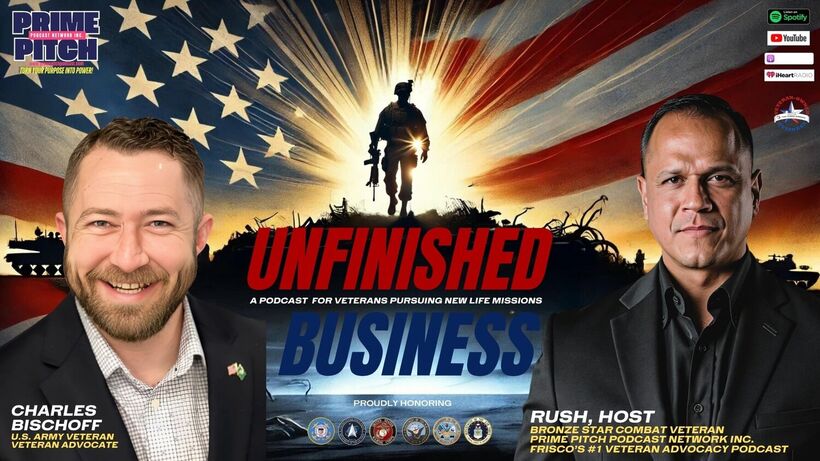
Charles Bischoff
U.S. Army Veteran · Veteran Advocate
About the show
Unfinished Business is a podcast for veterans pursuing new missions after the uniform, and for the families and communities who stand beside them. Hosted by Eric Rush, The Conversation Architect, a Bronze Star combat veteran and the founder of Prime Pitch Podcast Network.
Read the full transcript
So many veterans are told to move on, but you chose to move deeper. What does it mean to live in continuation, not just recovery? Yeah,The biggest thing is living for them, right? So when we talked about moral injury and or survivor's guilt,you know one of the greatest, and i don't remember who i heard it from, but it's probably one of the podcasts i listened to, right? yeah.
so it's about honor their sacrifice, and you could not do a better thing by doing that right. it's really easy to get down and get out and and get stuck. and but if you really think about that right, likewhen you're sad or mad or one of those anniversaries pops up that reminds you of a loss- do you think that they'd want you to be sad? Yeah,Do you think that they would want you to sit there and sulk? Or do you think that they would want you to celebrate their life and go out there and crushAnd go out there and do your best to give back to everybody else?
Right,That's what they would want. Hey, what's up, guys? Welcome to Unfinished Business, a podcast for veterans pursuing new life missions. The mission changed the day he came home, not because the war was over, but because Charles Bischoff knew it wasn't. He had saved lives in Afghanistan, pronounced the ones he couldn't, faced the weight of impossible choices.
and when the gunfire stopped, the noise inside didn't. But Charles didn't numb it. He turned it into emotion,into mentorship, into a map for other veterans stumbling through the fog. Today he's the North Texas program manager for Next Stop, the founder of Enlisted to Employed and a committed mental health advocate. He's still serving, still leading just in new ways.
The battlefield changed. the enemy did too, but the mission is still unfinished. My name is Rush, and this is Unfinished Business, a podcast for veterans pursuing new life missions. And today we have Charles Bischoff, founder of Enlisted to Employ, and North Texas program manager for NextUp. It's a pleasure to have you on the podcast, my man.
Thank you so much for having me. I really appreciate it. Yeah, you know,Dude, for me it's always about who's making the difference in the community and who's on that next mission. I'm reading your story and learning about all the things you had to endure,And you're still in the battlefield for veterans like myself and all the many other thousands of veterans that are in our nation and around the world for that matter,And it's so important to have that advocacy, to highlight the advocacy that you're doing and many other individuals like yourself that are leading from the front. So I just want to let you know that.
Thank you,Appreciate it,Awesome,Tell me a little bit. Let's take a little brief. Let's take a little bit. I know you have your service dog today. It's okay.
A dog is awesome. He can make all the noise he wants. If he wants to bark, he can bark. Okay. I want to say: tell us a little bit about your journey.
I know you're a combat veteran yourself. Talk to us a little bit about that. Yeah, so I originally enlisted back in oh 9. as soon as I got done with combat medic training was sent to Fort Hood and right away they're like: hey, gear up, you're going to do some training. and then straight to your first deployment.
And so did one deployment to Iraq at the very end of the war and thenupon, even before we even left Iraq, we were told we're going to go to Afghanistan the following year,And so you know, raised our hands, for there's a select few that went. We only took half the battalion at that point,But then we went to Afghanistan. And so that's kind of where things kind of really kicked off. My first tour wasNegligible,All right,It wasn't as kinetic as what I saw in Afghanistan. And so me and my team of 3 medics and we had our platoon sergeant and then, of course, our doctor that was profis to us.
That's kind of where we would go on to do some pretty cool things during our deployment. Yeah, that's, I mean that's a heavy, you know, it's like. hey, you know, you get that call Red Bull alert. you know we're getting deployed. you know it's a, it's a.
it's surreal,Would you agree? Yeah, for sure. So you were at Fort Hood,And do you what? what were you doing at that time when they said: hey, we're packing up, we're taking off? Yeah, so, as a new guy, right, you don't know anything, right,You're just kind of like going with the motion, looking at your leaders, like: where do I need to be?
Where do I need to do? So my first tour and kind of that kind of notice was just like: all right, we're going,No idea what to expect. Got to Iraq,I was actually the aligned medic for 2, 7 Cav,And that was the majority of my time in the military was spent in 2, 7,And so my first tour. we went to Missoula, Iraq,at the very end of the war,And that kind of deployment and kind of that expectation kind of helped me understand things and kind of go,I had phenomenal leaders growing up in the military, very old school mentality:Hey, we take care of our soldiers, you're gonna work, but you're also gonna understand, like, how to be a great leader. And so everything that I was able to achieve and or do in the military was directly because of them.
And then the second tour:As we were kind of getting notified of where we were going to go and what we were going to do, we were all like, oh, this might be a little kinetic,This might get a little hairy,And so kind of. for that one, I think more people were kind of on an edge, maybe a little bit at least for what I would say is likethat, kind of like middle enlisted. We had a lot of senior leaders who had a lot of combat experience from the original kickoff and the original pushes into Iraq and those types of things. But we were kind of on that. where do we go from here?
What is this actually gonna look like for the second tour? Yeah, you know, being in that situation where you have, you're kind of likein-betweeners, right, like you just starting out your military career. it's a a lot of emotion, would you agree? yeah, talk a little bit about that. what was your emotion?
what were the emotions around you? like, what did you witness from your peers? and just around? yeah, i think, um, a lot of people, you know. i think the hardest thing for soldiers, honestly, um, you know, is leaving the family behindright before your.
those are so many different emotions, and i was lucky, um, because looking back at it now that i have 2 children now, um, looking back at watching my friends say goodbye to their children on those deployments and like knowing that they're going to leave the spouse and the family to go serve our country. such a sacrifice, right, and i was still leaving my wife,But the extra pull on the family is so hard and the emotions run with that. And so you see that whole thing play out as you're going,And then, once you're on the tarmac to go, it's hey, shut it off. Yeah, if you can, right,Yeah, for sure. Yeah,No, I know, like you know, I remember when I was deployed, I got married and my mom was so mad at me.
She was like: why did you do this? Because it added like so much more pressure. you know, just now you have someone you really love and adore and you're like married and you like, want to be with her now. but you just committed to leave. So it's a well of stress and then you see other people going through their own experience with that.
Yeah,When did you first realize that war wasn't something you went through, but something you came with? Yeah, great question,I think the first kind of kickoff to that for me was: there's 2 instances. The first time that me and my medics kind of paused. So what I mean by that is on my second deploymentWe wound up treating over a hundred and ten combat casualties-I think it was like 1 13, if I remember correctly-And so that was tough. And so, with that being said, there was one particular incident where we had a routine.
So we would treat, we would call the medevac and then we would move forwardRight,And in thatWe'd reset, restock, make sure the aid station was squared away for the following,And in that from there we would always go outside and kind of kick back and then we would go eat together, usually right. And there was this one instance where we wound up treating, I want to say, 4 casualties with 80 percent burns across their bodies,And so that was a lot. It literally looked like they were mummies. I cannot explain it in a different way. It literally looked like they stepped off set of something.
And so, with that, that was the one time that none of us went to eat and we were all kind of in our own mode of like not talking,And I knew that that was kind of the precipice of like. hey, this might be an issue long term,And then, upon returning, was when it actually hit. I remember going on a cruise with my wife and our best friends at the time,And we were looking forward to it. It was a 7day cruise out in the Caribbean,Had an amazing time,And from thatThere was 2 instances where we really looked at that. Okay,So the first one was walking into where you get to go on the ship right.
It's basically like a huge TSA type deal where all your luggage goes into this thing to make sure you're not carrying anything you're not supposed to be. And then you know, my anxiety, like just I started to have. I know now is like my first panic attack,And then, on the ship, I wound up having some serious issuesOn the second night- I think it was I had my first nightmare,And so that's when I really realized, like I need help,And prior to that, I had promised my wife, if I had any issues, I would go seek help. Yeah,Wow, that's surreal, you know, because I can understand what you've gone through when you have those,that intense emotion that just drops on top of you, when you least expect it, when you're looking at this joyful moment and you still have vulnerabilities inside you that haven't been addressed or even willing to acknowledge in some cases. Am I right about that?
Yeah,Actually, I tried to hide the fact that I had a nightmare on the cruise ship from my wife and from my best friend. You know, I had the second one the following night, and then I wound up kind of walking around the ship. And then also, like when you're having those types of issues, sometimes you'll wind up sweating profusely,And so it's almost like you know why is the bed wet,Like what is going on here. And so that's kind of what I was starting to go through. So the physiological changes that I was going through, I just couldn't hide anymore,And then I told my wife I'm like, hey, I had back-to-back nightmares where I just couldn't stop,And it was based off of one of the casualties that I couldn't save,And that was really starting to replay in my mind because I was able to relax.
It was the first time- it was like a month after we had come home, and it was the first time that I had gotten to just not think, be around the wife, hang out with friends and just chill. And that's when things kicked off for me. Wow, that'sWow,Are you, are you? you look at that, you reflect upon that, you, are you like glad that it started like? I mean that's not the opportune moment to have it, but I mean you know, are you glad that that kind of broke, the kind of started setting your ball in motion and it started rotating your lifeFor sure?
I thinkThe biggest thing for that was the amount of support that I got from my close knit team of family. Right,So, my our best friends, they're phenomenal,We still keep in touch. And then, of course, my wife just had my back. She's like, hey, I know that we were worried about this potential, but we said we're going to do things. I got youAnd my wife- actually, her father was in the military as well,And so she's not completely foreign to a lot of this stuff anyway,And so she's always been super supportive ofthat.
That's amazing man. I get welled up with emotion hearing because you know, you know, you experience that and you kind of relate in the emotion of having your wife. you have your back and stuff like that. You know it's a that's. I know you're lucky, right.
You're one of the lucky ones that have the support right. That let's see. you've said before that treating the wounded wasn't the hardest part,It was. it's what came afterWhat stayed with you the longest that you couldn't treat. Yeah, I think for me, I,When you think about some of those things right of like what stays with you, it's always in the things that you second guessAnd in combat, anybody who's been there, you know that it's a split second.
You don't have time,You make the choice right. That's why training is so important, because you train repetitions. so that way, when things do hit the fan, you just act,You just doYeah. Andwhen you come back home, you're left with. did I make the right decision?
And so for that it has been one of those things for me where that has always stayed with meAnd that led to a lot of my real issues with: did I make the right decisionAnd also, like you, always think aboutthe things that, logically speaking, they weren't in my control to begin with? yeah, and so, like the you, instead of looking at that frame- because you're in an emotional state- when you're thinking about those things, you can't think logically, and so the things that always stayed with me are the things that i couldn't even control to begin with. and so, having that logical framework and learning that has helped me kind of cope and deal with and and move forward in life,Well, when did you start getting that tool in your toolbox to say: you know,Man, it's been a long journey. Yeah,And it's still a journey, right. And so, with it being a long journey and it being part of my journey, I think that I continue to grow and continue to learn those skills.
But I think for me, the one moment that really sticks out with learning how to deal with that was when I went into, so I blew my knee out playing sports. Basically, when I came home from Afghanistan, I raised my hand to go into the hospital. I'm like, hey, I need a break, I gotta take a knee. And when I went to take a knee, I basically became a healthcare administrator ran like 5 clinics-Really cool opportunity, got to do some cool things. But with that I wound up getting hurt and going into the med board.
I got medically retired- super blessed that it all worked out for me and my family. But in that process I knew that I was getting out and my time was going to be cut short. And so with that I put myself into an intensive outpatient program for mental healthAnd that was like a thirty day process of 5 hours a day. I got to go home so it wasn't a full on inpatient, but I was there 5 days a week, 5 hours a day. and the curriculum that we went through was phenomenal.
The curriculum that we did was it's called CPT, which is cognitive processing therapy,And it's part of behavioral therapy. But for me, what it allowed me to do is talk about one instance, which is the main kind of precipice that has, or the main kind of thing that hasheld me back or affected me the most in my transition, and it allowed me to see my emotional side. but then, on one side of the chart, then see the logical frameworks and the logical side. so every yearI look at that. I have a drawing, because we put it up on a whiteboard.
and so you put it up on the whiteboard and on the left hand side you would see the logical or, excuse me, you'd see the emotional and you'd rate all the feelings that you had throughout that entire event. on the right hand side, you got to put up all the logical side of those same feelings. right. socould I have controlled everything was one of the ones that I did not give myself credit on. And then being able to walk through that and also being a group of other people- there's a group of ten of us for that cohort- and to have them back you up and what you say they're like you're not being fair to yourself.
And then me being able to take a picture of it at the very end and then hold on to that forever, has tremendously helped me. Yeah,That's amazing man. I've done the CPT myself. It's a very intense program. You've got to do a lot of inner work and really examine where your thoughts and feelings are coming from and, if they're rational and, like you said, what you can control and what you can't control.
Just so you know, guys, Doc is Charles' service dog and you might hear some scratching. It's because he's never been in a studio before like this. maybeI don't know if he has or hasn't. No, he has not,But he's actually currently chasing your watch. So he is catching that eye, that light.
So he recently came into the family. back in October,I was awarded him by an amazing nonprofit called Rebuilding Warriors. Prior to this job, I was working in the mental health world for veterans and I met an amazing gentleman named Jeff Anderson and I had asked him one day I said: hey man, how much would you charge me to train one of my dogs? And I wasn't asking for a service dog. at that pointHe's like: ah, we don't do that.
And Jeff, if you know Jeff,He is a very straight to the point guy,And he's definitely. he acts as if he doesn't love everybody, but he does right,And so he's just a tough guy, right,And he's cut from that old school cloth. andAnd about an hour later he sent me a photo of my first service dog named Mando, and said: hey, make sure it's good to go with the wife, but this is yours if you want him. He said, and then he went on to tell me that you do everything for everybody and expect nothing in return. And sohere you go.
this is for you, man, wow and um. unfortunately i had to have mando put down last year. um, he wound up with kidney failure out of nowhere, and so i got doc um back in october, end of september, actually end of august, beginning of september. and um,he came from another family, and so he has struggled with a few things, and the only thing that he tends to struggle with is he will chase light, and so that is a correction that we've been working on, but he's not quite 3 yet, and so that is his personality, but he's been absolutely amazing to have. You were right, man.
I took off my watch and he, kind of just like, just sat and laid down. You were right about that. I was like, wow, it's my watch,Took it off, so that way I won't drive him crazy. I guess you could say:In the middle of chaos, combat, blood, adrenaline, was there ever a moment, an unexpected moment of clarity, a flash that told you that you were really underneath it all? I think the moment of clarity came when I started to treat the first casualtyWhen we were in Afghanistan.
we got a call. was like 24 or 48 hours we had only been on and we had this amazing junior medic. he was a corporal at the time. his name was Corporal Holloway and a phenomenal guy, and he hadBeen there, done that, checked all the boxes, super intelligent. It actually bothered me at the time when I first met him that he was a Corporal.
He should have definitely been an E5, but the way the Army works, it was a points game,And so, with that being said, he'd wind up getting promoted, of course, but he was just so phenomenalAnd we got that first schedule. And me being the E5 in front of young soldiers, I'm worried. What is gonna happen? Am I gonna react correctly? Am I as good as everybody thinks I am because they've seen me do stuff, right?
Am I as good as I think I am? And when you're younger in that kind of context, you sometimes have a little bit of ego. And I probably bordered the cocky versus confident in my younger years. And that first casualty, I felt like I took a lot of time in the back of the ambulance that we had. But in reality, it wasn't very long at all.
And that moment right there told me thatI was not being arrogant or cocky. I was confident because I had earned confidence. I had done the work, I had put in the time, I had put in the reps, and so did my medics. And that was kind of the catalyst to know that, man, like, I am good enough. And so when you ask that question, it reminds me even now, like in my entire journey, it's I think the one thing I have struggled with is, am I good enough?
Right. Yeah. And so to me, like when you have that earned confidence, you don't have to ask that question to yourself anymore. You already know. Yeah, that earned authority, right?
Like, it's so cool to hear you say that, you know. You know, there are times where I've had combat veterans in, you know, shared conversations with, and for you to know that answer, that question is so, like, even that in itself is, like, you haven't, you have, you've dialed in to understanding yourself so well that, like, you know, you're going back to this experience, andand to have that retrospective look at it and say, man, this earned authority, earned confidence is like for you to tap into that today. It's like, man, I own what I know, you know, that even in that time you were owning what you knew, you just weren't really sure you knew as much as you thought you did at the time too, right? That's amazing to look back at, man. Much respect for you to have that, you know, that's so pat on yourself, you know, pat on the back and have that ownership of it.
SoThere was something in your bio that kind of stuck out at me that I really wanted to address because I was like, what is moral injury? Yeah, what is moral injury? You know, it's something I never heard. I never heard until I read this. I read your bio and I was like, what isTalk to me about what moral injury is.
So along my own journey through the kind of IOP and then also starting at a local mental health authority and working part of the veterans program there, one of the slides that we had talked about moral injury. I'm like, what is, I kind of knew, but kind of had heard, but it wasn't something that was really talked about. And so it's now, thank God, I think the VA had come out with a study probably a few years ago and then more and more people are kind of diving into it, which has been great because moral injury kind of shows up very similar to like complex PTSD. And so oftentimes when we're going to therapists and we're talking about all these things and we're opening those wounds and opening up Pandora's box, if you will, what happens is we're actually not getting the thing that we need the most. And so some of the behavioral therapy treatments, if you will, and the tools that you work through, it may not be good for something like moral injury.
And that's why CPT actually worked better for me because I was able to see the emotional versus the logical and actually have a percentage. And so with moral injury,It could be something like you're told to kill somebody that, you know, it could be that dark, right? Where you had to shoot a child because they were trying to shoot you, right? Or it could be something for me, and what it was for me was not quite that, but more in the fact that I blamed myself for somebody dying. I basically went against my own morals and principles ofmaking the right decision.
And that's not necessarily something that is probably fair for me to do. But the situation in which happened, it's March 8th, 2013. We had a green on blue incident. And so 3 Afghan National Army tried tocome after us um they shot at us and i was running because the SOG had come he said hey um you know there's casualties all right cool i have no idea what's going on um long story short there was a moment in time in that whole entire incidentthat I chose to move left instead of go right. And it got me to my female medic who was coming out of the latrines, pushed her, and then went and grabbed my rifle because I was only carrying my M9.
And that split-second decision, on our way back, we heard gunshots. the gunshots that were happening ultimately killed a civilian contractor. And that is the person that forfor the longest time because I moved left instead of went right. I blame myself for that. And in a logical framework that split second decision, it probably saved me.
It probably saved my soldier. And you never know. You just don't know. And so that was really hard for me to kind ofhold back, but the moral injury side of it is I made a decision which went against the moral of saving people, right? My morals are to save and to know better and to do better.
And so that's where I struggled the most, which also goes intoyou know, survivor's guilt, right? Those are the things that correlate to that. And so for me, having that logical framework and knowing that it wasn't necessarily my fault, right? Because I was judging myself based off of a split second decision, but that also, you know, if you keep going down that line of, I saved my soldier, saved myself potentially, and then I saved the 5 people that were injured that day,Like, I'm the one who called in the 9 line. I'm the one who got, you know, all those things.
And so as you go down further in the logical framework, you start to like, OK, I can still deal with this and I can live to honor them. Yeah, that's amazing, man. Like, yeah, I could see the internal struggle, the struggle with. having to negotiate with that, you know, and try to find some healthy rationalization on how to come through it and get out of that well, you know. So I empathize with that situation for sure.
Thank you for sharing that, too. You know, this is something I say with all my guests, and as I said this in this previous podcast, I always say it on my podcast, you know,I'll say it again, as long as I hear stories like yours and other people that go through journeys of struggle and trauma and just, you know, struggle, suffering and sacrifice, they go through it and they feel the pain of that. I always say it's such a sacred thing to have. It's a sacred thing to, when someone shares it with me or shares it with an audience or with someone else, it's something sacred. It's like you're holding this beautiful, you know,beautifully painful experience that took you out of that and brought you to where you are today, which is the founder of Nextop, you know, and I mean, I enlisted to employ.
And for me, it's like, you know, you see it and you go, it's a tragedy, but it's also very sacred. And I just wanted to thank you for sharing that because also, you know, I should have said, hey, don't go down any wells you don't want to go through at the beginning, but it seems like you probably haveI've done a lot of work to be able to share a lot of my story and I still get emotional. Yeah. And I think that that's healthy to deal with. But, you know, one of my friends slash, you know, younger soldiers who wasn't a direct report of mine.
But one day I had started sharing my journey. and online, which is kind of to the enlisted employee side, right? It's just me writing, right? It's it's my ability to write. And then it created a business on an accident of basically teaching other people how to write blogs, write and newsletters.
And so butWhen he reached out to me, he said, man, I didn't realize you struggle. You know, a lot of people talk about social media as being a bad thing because everybody posts their highlight reels. And so I started talking about some of the things I was struggling with and I made a connection with him. And so if my story in this small world can help anybody,know that they're not alone and know that, yes, you see, I'm married, have kids and have a cool truck or whatever, like these quote unquote materialistic things, you know? But you know that like, hey, I also go through the gauntlet as well.
If that gives somebody like the fortitude to go get help or they know that I went and got help, so they're going to go get help or they know that because I did go get help, maybe I'm a good person to like,you know, bounce something off of, I want to be that person, not for myself, but for them. You know, I had since being out of the military, I've had ten friends die by suicide or to drug overdose. And so as I look at that, I take that personally. You know, we're soAnd, you know, the whole Facebook thing of like, you know, RIP and all those things, it's so tough to deal with because we've done something extraordinary with those people. And we've lived a life that, you know, most people never get to, right?
It's so funny because the correlation to that is the football player who's back home talking about the good old days, right? And I think in a healthy manner, that can be OK. But for us, when we see things like that, it's tough. And so how do you deal with it? And so for me, I share my own journey to hopefully either help, inspire, educate,That's what I want to do.
It's not about me. It's aboutAnd I'm tired of watching my friends die because I mean, quite frankly, I have a service dog. Right. And so to say that I haven't had suicidal ideation, I wouldn't say that it's been prevalent, but I would say that there's been instances where I've been in very, very dark places. And I don't ever want anybody to feel alone or, you know, not have the tools or resources to grasp on to help.
Yeah. You know, we say that our stories aren't meant to be carried alone. And you you coming out with your story right now on this podcast is thisis such that it's the next best, it's the best thing. You know, it's like, our stories aren't meant to be carried alone. I say when every time you share a story, it's like you're holding a mirror to the person who's listening or to mine.
You know, like I told you before this. What credentials do you have? Talk a little bit about that, yeah. Yeah, so as far as credentials go,uh in what what regard whatever i mean yeah so um currently i work for uh next stop where 51 c 3 non-profit we help post 9 11enlisted veterans okay find meaningful employment we do a completely free charge yeah um and so i've been doing that you know for 3 years now i've been there um prior to that you know i was a mental health advocate and things like that i was used to be uh just recently let go of my ummy instructor, but I was a mental health first aid instructor. For anybody who's looking for a mental health class, go to that class.
It is phenomenal. It is an 8 hour class, but it will teach you so many things of how to deal with mental health, deal with people who have mental health issues. It's just a phenomenal class. I can't recommend it. Where is that?
Yeah, so mental health first aid, you can get anywhere. It's taught by a ton of nonprofits. Mental health first aid in general is a nonprofit. And so there's a lot of different places that you can go get it for free. Go get just the certification.
The instructor part usually has a cost associated to it. As far as the credentials go, you know, what I love to do is literally, you know, helping service members find meaningful employment after their service or veterans, you know, who come up to me like, hey, Charles, you know, one of the coolest stories was actually happened last week. You know, a gentleman that we were working with, we saw at a career workshop. And this actually wasn't a career workshop that I was hosting, but one of my recently new connections was. And we got him enrolled in our program at Next Stop, and he came to us with a resume.
We're like, oh man, we can definitely help you. We're going to tailor this a little bit. And the coolest thing ever was we redid his resume. and he got promoted. So the position that he was interviewing for, he got one step above that with his brand new resume.
And so when you think about impact and you think about how we're doing things to help others, that's what I love to do. My friend Brian Fleming, he's a suicide bombing survivor, and he says, don't let your military be the greatest thing you've ever done. Yes, one hundred percent. Do you agree with that? Yes.
for me it's you know we have all these skills and tools and you know for my path um you know it was really easy just kind of like going back to that high school equivalent of like i was the quarterback or whatever right yeah um we have a tendency especially when you do some great things um to wrap ourselves in that like that's our whole identity and i thinkWhen you do that, it's a double-edged sword, and it also can be a bad thing. In the moment, it can be great, right? Because it gives you purpose, it gives you confidence, it gives you all those positive things, but when it's done, athletes go through it too, right? And so for me, you know, looking at the military, it's a chapter in the book, right? It's part of my journey.
It is a part that I'll always cherish and love, and the people that I have met and connected with and did great things with, likethey'll always be there, right? And so it's just a chapter in the book, and you have to learn that I've got to write a new chapter. Yeah. Yeah, you're part of a sacred fraternity of brotherhood, a brother and sisterhood of people that sacrificed and, you know, that served and sacrificed. So, you know, that's one of the most vulnerable things you're doing.
And then what's your extent? And then what? Like, what's next, right? What's next? Becauseum let's see here okay my next question is um let's talk about i think we've done this right now but i'll just ask it again um let's talk about the systems you've built now to help veterans land with purpose and but when you were in limbo yourself what internal battle did you have to win or just to just show up again yeah so um the systems that i've kind of built for myself i think we kind of briefly talked about right but it'sin looking at it, it's more in the frame, right?
So not everything that bad happens to you is something, and we talked previous to this podcast, right, a little bit about that, but not everything that happens to you, and there's been people who talk about, it doesn't happen to you, it happens for you, right? And so with that, I would say I like to reframe things. And because I think that there's a point in time whereYou know, you need to be the victim. You need to go through those wounds and kind of work on that. But there also has to be a time where you have to be the victor or the person who's continuing to push forward.
Yeah. And I think the biggest hack that I've had or the biggest thing I've learned, rather, it's not even a hack. The biggest thing I've learned is is just doing that. Yeah. Like, hey,this kind of hurt but what what can i do to look at it from a positive perspective and that's not easy it's hard yeah um but if you can look at it in a positive perspective and really put that to it you know that's where the magic happens yeah as far as what we personally do uh and what i do as far as like a job that also gives us the next mission right so for meI was looking, as a combat medic, I saved lives and I did cool things, but my job was always to help people.
And so I still, and everybody in the military has that, whether they went in with it or not, they wind up having this want and need to help others. It's a service thing. And so what better way, I started in the mental health world and then transitioned into, I said, hey, I want to focus on one thing. If you focus on one thing,you can be great. So you can go from good.
If you're focused on too many things, you'll maybe be good at your best. But if you focus on one, you can be great. And that's really what I wanted to do. And so when I found the opportunity to work for Nextop, I ran a hold of it. And so we walk our candidates through a three step process.
Recruit, develop, and place. The recruiting, it's working one-on-one, kneecap to kneecap, with every one of our employment coordinators. So they'll get assigned one person, they'll work with them. We look at their skills, history, background, education, all that stuff, and then we wrap that into a target goal. The cool thing about us is, 17 out of the 19 of us on staff, we're service members.
And so anybody that works directly with those candidates is a service member, and so we can have those kind of tough or direct conversations. And so,We select a target goal, and then we move them into resume refinement, LinkedIn, optimization, interview prep. We'll send them some career-specific resources, and then the third, most important phase is the direct introduction to companies that we work with on a day-to-day basis. If I can't give them the fish through that direct introduction, I will teach them how to fish, right? We came to, we won a few grants to move to North Texas and provide a physical presence of the great things that we had done previously in Houston, in New Orleans, and now we've built 2 other new places out, one in Huntsville, Alabama, and then another one in Tennessee, Kentucky.
And we have3 other remote employees that are kind of out there doing great things as well, North Carolina and the Eastern Seaboard, Wisconsin, and then Virginia. That's awesome, man. I got to pay you a compliment, man. Like I said, I have veterans in the space, and there are always these exceptional ones that when you sit down and talk with them, like you're talking now,they emote a certain, they communicate differently and they say different things, right? Because sometimes you can be with better, no disrespect to anybody, but you can follow a cadence sometimes and be like, I'm caught in this vortex of military lingo.
But what I'm listening to you is you say about framing and reframing, like the way you put your words together. This podcast has, we're here, we've been here for a minute, but it's like,There's going to be so many golden nuggets in this particular interview that if you rewind it, you're going to hear so much information. And this is one of those podcasts for sure, hands down. I just want to give you that compliment. Thank you.
I appreciate that. A wealth of information. I'm going to go back. It's going to be my wife. We're going to put this in on a trip or something when we're driving somewhere.
you know, oh my God, what the, like, you're gonna, we'll go back and listen to this conversation, man. And I hope that everybody, you know, this is, you might see it, you might hear it for one time, but I challenge you to go back and listen to it once or twice or 3 times and write it down, you know, because there's a lot of information that's being shared that's really important because it has a different spin, has a different angle that to look at it from a, you know,foot you know mountain and you and you're seen in a different way and that's not ever been presented to me in the way you're doing today so yes you're welcome so many veterans are told to move on but you chose to move deeper what does it mean to live in continuation not just recovery yeahThe biggest thing is living for them, right? So when I talked about, when we talked about moral injury and or survivor's guilt, you know, one of the greatest, and I don't remember who I heard it from, but it was probably one of the podcasts I listened to, right? And so it's about honor their sacrifice. AndYou could not do a better thing by doing that, right?
It's really easy to get down and get out and get stuck. But if you really think about that, right? Like when you're sad or mad or, you know, one of those anniversaries pops up that reminds you of like a loss. Do you think that they'd want you to be sad? Yeah.
Do you think that they would want youto sit there and sulk? Or do you think that they would want you to celebrate their life and go out there and crush and go out there and do your best to give back to everybody else? Right? That's what they would want. So execute on it, right?
And so for me, you know, living a life to honor others, you know, carry the load is a huge thing. We're going to be participating in that this year. And I'm super happy to you know, next stop selected to be one of their nonprofit partners and, you know,Nice. Because I've been a huge advocate of them before I even got to Next Stop. And so for us to kind of have a shot at that and to really share that message as well, to listen, who are you caring is kind of their slogan.
And for me, you know, I talked about the ten people that I've lost, you know, they're on my arm. You know, I have a sleeve tattoo and there's ten crosses there. And it's for each one of them. And so, you know, with that, it's living to honor the ultimate sacrifice. Man, that's awesome, man.
You know, this isn't about me today, but I'll say there was a time where I didn't want to have anything to do, you know, with any military stuff. I didn't want to talk to anybody that was in the military. And now, like, you go through that. Has that ever happened where you're like, man, I don't want to be around, you know, like, I want to forget this ever happened to me, this ever happened, and that kind of thing? Yeah, I think there's an ability to want to shut a lot of that stuff out because you're having to then go back and look at those things.
Right. And there's a level of guilt that's associated with why me or why them or. And so it's sometimes it is easier. And personally, for me, I just get angry with I've alwaysI've looked at it as anger of like why me why did I get this great life or why you know things like that more so and beat myself up versus where you know shutting it out was never really an option for me but I've had plenty of friends who have been like man like I just can't deal with it no more and I think that there's certain spaces for that for sure and there's definitely places that I won't go because I do know that I don't want to be associated with things like thatAnd it's nothing against them necessarily, but I'm ready to help. And so if you're in a stage where you want help, I got you.
And even if you're not in that stage, I'm going to share something for you to look at. But for me, the hardest thing isknowing that there's people out there that are struggling and not being able to help them, right? They always talk about like, you can lead a horse to water, but you can't make them drink. Well, you know, maybe, but at the same time, it's like, they have to hit that rock bottom for them to, you know, we all do. We all do in our own journeys, whether that's, you know, a complete rock bottom or that's, hey, like, this is my rock bottom, right?
And so, but yeah, I think a lot of people tend to deal with that. Yeah, that's true, man. Okay, let's see here. A couple more questions. You once wore a uniform that gave orders.
Now you lead without one. How has your definition of service evolved, and what does it require of you now that it never did before? What does it require of you now? I think living a life of kind of helping others and being there. Right.
So when I was serving in the military, you know, quite frankly, I wasn't the guy who I always had a lot of wantBut when I got out of high school, I started making decent money and I was a copper cable slicer. And so joining the military and taking a huge pay cut was not the thing. And when the recession hit, it allowed me to not only lose everything for the first time, financially anyway, but it also allowed me to then do what I wanted to do from the get, which was join the military. And, you know, my grandfather, he's a hundred years old. He's a World War II vet.
and he's an amazing man and i look up to him and uh he's definitely my hero for sure um and in that when you're talking about you know living that life it's what can i do to help others it's always been for me um you knowstarted with, hey, I have nothing. I want to rebuild and I want to join the military and rebuild my life. But I think everybody kind of gets in that mindset of like, hey, now I'm in this culture. Now I'm all about the military. I'm all about my service.
And, you know, maybe it was the Toby Keith song that you heard at your graduation for those that graduated in my time frame. And, you know, it really got you pumped up all about America. Right. And that service component. And so for me, it continues to be that itIf I look back and I look deep enough,even outside of the things I did in the military, I had that heart of service before.
And so now it's just where do I position myself to continue to give back and to continue to serve? You know, started, you know, in my local community doing the mental health side of the house, and then it's evolved into me doing this for Next Stop and then serving other small local businesses with, hey, I can help you get leads, right? I can help you write. I can teach you how to do this newsletter where you can now havehave some generation and profit back with a very low lift. And so no matter what part of my life that I'm currently in, I'll always be serving in some form or fashion.
That's awesome, man. We're fortunate to have you as an advocate. There's individuals that you go, wow, man, this guy, this girl, they're rocking, they're knocking it out of the ballpark, man. I want to go circle back to like one of the questions at the beginning because I think this is a really important one because you came out, you had a solid foundation with your family, right? And as we talked about, some individuals don't, right?
They come back, they ran from something. They ran from their family to join the military and then they ran from chaos and conflict, right? And then they got in and they joined the military and were a part of chaos and conflict. they return back and they're having internal chaos and conflict, right? What advice would you give somebody who's an individual that has gone through that experience and comes out on the other side and doesn't have a support system?
So I've been very blessed. And it's not to say that things weren't rocky, whether it be in my marriage or whatever, right? Everybody goes through that stuff. But I've been very blessed. Up until 2 years ago, I had both my parents.
My dad passed away 2 years ago. But I had my wife. I had her whole family. I had my best friends. I have 2 best friends, which is wild, that I've known sinceI think I was like right?
So the last 27 years, I've had these 2 guys in my life, which is wild. And so, you know, I knew I had a lot of support. And so, probably that's one of the things that I always want to help others because I've had a great life or had a good amount of support. And so,With that, those people who don't have that support, they have to find somebody that can lean in on them. They have to find somebody that either they can look up to or they can grab their hands around.
I think for me too, I tended not to lean on people as well because I felt like I'd be burdening them, which I think is one of the things that everybody tends to think about that's going through a struggle. And, you know, one of the greatest things I've ever heard was just read ten pages a day. You make that a habit. It's amazing how many books you can go through in a year. Right.
And it's ten pages like you're done with that ten pages. You're like, I'm going to keep going because I want to be done with the chapter. Right. And but you have to find. a North Star.
You have to find somebody that you can lean on, a book that you can read. You have to find something that is going to help you move forward. And it's not easy, but if you want it, you'll find it. That's awesome, man. That's beautiful.
It's true. I think that North Star, I think, yeah, II can relate to that. I told you before this, God said, go north, get back home, go north and move north. And it was this North Star that was saying, go do this and go down. Start a podcast for veterans.
I'm going to put you, you don't want to talk to veterans? Guess what? You're going to start a podcast for veterans. and pursuing new life missions, you know? And who am I to say no to God, right?
That's right. Okay, last question, and then I do this with, the next thing I do is for every one of my guests, if you could speak to the version of yourself standing in that aid station in Afghanistan, the one covered in blood, still holding it together, what would you tell him now? Well, if my soldiers see this, they're going to know that there was only one instance where I got blood on myself. I was meticulously, for whatever reason, I would never get a lot on me. And my soldiers, well, Sergeant B, how are you staying so clean, right?
And so it was always a joke. So for you guys, if you guys watch this, that's for you. But the one thing that I would say, and I would tell that kid,is that know that you're enough. So we talked earlier about being confident and having earned confidence. We also talked about wrapping our whole lives in a military uniform.
And as you look at those things, they're what they are. But if you do not believe in yourself,and you do not know that you are enough, you will go down very dark paths. And I think that I struggled with knowing that I was enough. It's not that I didn't hear it when I was a kid, I did. My mom and my dad always told me how great I was.
Yeah. I don't think that I believed it because I don't think that up until those points in time, I'd ever done anything hard enough to know that I was good enough. And so if I could set that in my mind then,a lot of the things that I did go through potentially wouldn't have had the full-on negative. It would have still been there, but it would have allowed me a lot more clarity as I was moving forward. That's amazing.
What would you think you would say back? I don't know. I don't know if I would get the smart aleck remark because I was that guy or I would get the I don't listen yet remark. And I think that that's probably one of the reasons why it didn't come into my mind because I was very hard headed and very stubborn. I still am probably.
But I tend to listen to others who I value and hear people out probably a lot moreand really, truly learn to hear and respect others' frames and perspectives because I wanted to learn. It's no longer about my personal ego or having that. I know for sure that I'm a confident person now, but it's either because I earned it or because I know. And if I'm wrong, I'm okay with being wrong. And that's true growth.
yeah that's beautiful man okay this is the part of the podcast where i say i say um there's always someone out there that you i want every guest i say i want you to give somebody a shout out that deserves a shout out some praise some maybe some like affirmation confirmation you know of them or it's or a team it could be a person it could be a team whoever you want you just give them a shout out by name say their name and um the floor is yoursSo only one or you can say, no, you can say whatever. Well, you know, hey, I'm going to take advantage of this. Right. So first and foremost, my wife, she's absolutely amazing. And then I got to say.
the Next Stop team and my family there. They're awesome. And the other one that I have to mention is my mom. My mom is currently the caretaker for my hundred year old World War 2 grandfather who fought in Battle of the Bulge. And he's got such an amazing story.
But, you know,The work that caregivers do often goes unheard and unseen, and I know she's dealing with a lot right now. And so, hi, Mom. Charles, my man, brother. Thank you. Like, that was a beautiful conversation.
Beautiful. Just you, you know, it's like you can't, it's like you, all the, everything you emoted just was resonating with me, just like really solid. It was like, it got, it,You know, I'm going to learn a lot from our conversation today. I want you to know there's so much information that I can look back on and say, oh my God, that was amazing, amazing, amazing. So I feel blessed and fortunate to have shared this space with you today.
And thank you for your service and thank you for extending your service past. your service and not letting your military career be the greatest thing you've done. The greatest thing you're doing now is serving the community with Next Stop and Enlisted Employee, right? Yep. Yeah, Enlisted Employee.
So I'm grateful to have you on the podcast, my brother. Thank you so much. All right. All right, guys, that is it for Unfinished Business, a podcast for veterans pursuing new life missions. As I always say, have peace and enlighten you.
And remember that the ocean refuses no river.