Carla Wicks
Carla Wicks joins Rush on Unfinished Business, the show for veterans pursuing new missions after the uniform and the people who stand beside them. As author & Speaker · USAF Veteran · Gold Star Mother, Carla brings the perspective of a Gold Star family and what it means to honor the fallen to the table.
They get into the work, the cost, and the reasons it still matters, in the kind of long-form conversation this show was built for.
In this conversation
- What it means to carry a Gold Star
- Honoring the fallen and the families left behind
- Turning loss into service for others
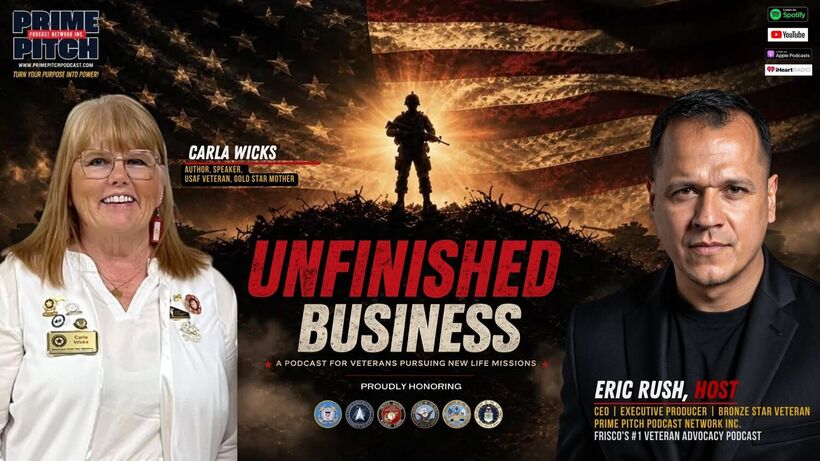
Carla Wicks
Author & Speaker · USAF Veteran · Gold Star Mother
About the show
Unfinished Business is a podcast for veterans pursuing new missions after the uniform, and for the families and communities who stand beside them. Hosted by Eric Rush, The Conversation Architect, a Bronze Star combat veteran and the founder of Prime Pitch Podcast Network.
Read the full transcript
If I'm vulnerable and I share and you're vulnerable and we share, this is the thing that our spirit enjoys, is that we were meant to be relational beings. We weren't meant to be on an island all by ourselves and to handle things all by ourselves. So that empathy for me, for someone else, is becauseCompleting a journey is so worth it when you get healed, when your spirit is now ready to turn around and say, I've got a new mission in life. Hey, what's up, guys? It's Rush with you on Finish Business Podcast, a podcast for veterans pursuing new life missions.
Carla Wicks exemplifies extraordinary resilience and inner strength. From her service in the Vietnam-era US Air Force to a distinguished career in dental hygiene, she has shown unwavering dedication to service. As a Gold Star mother, Carla has transformed the grief of losing her son, Paul Joseph Stock III,into a force for good, particularly through her active involvement with American Gold Star Mothers Incorporated. Her journey highlights her profound capacity for post-traumatic growth, and her nurturing spirit and dedication to community reflects high levels of empathy and emotional intelligence, essential traits for effective leadership that align with love, compassion, and interconnectedness. Finding meaning in personal loss and valuing collective well-being, Carla Hicks' journey challenges conventional success definitions, suggesting true fulfillment comes from inspiring and uplifting others.
Carla, it's a pleasure to have you on the Unfinished Business Podcast, a podcast for veterans pursuing new life missions. I got to tell you, I've been so excited about having this conversation with you. before my own story, my own passing of my dad. I feel like people can learn a lot from your story now. It's a pleasure to have you here today.
Well, thank you very much, and I hope they do. Awesome, awesome. Yeah, you know, I know you had just got back from atraveling around the world, Globetrotting in America, and going through and dealing with the terrains of going on train and planes and automobiles, as we said. It was an experience. That's awesome.
It's good to have you back so that we can have you here today. You know, as I wasDoing my research and understanding Gold Star Mothers and understanding the trauma that's involved in that and having that post-traumatic growth process, I really had a new insight in who the person I'm getting ready to interview with, so I feel blessed by that for sure. When you look at your tenure, because I looked at your multi-dimensional, it's like larger than life story of a woman that served in the Air Force during the Vietnam era. What can you talk to me about how serving in the Vietnam War shaped your view on service and dedication? Well, you know, that was kind of drilled into me.
My father was United States Air Force senior master sergeant, retired, and it became something that was just in all of us. We felt a responsibility to do it. And I kind of came away from that whole time with the mantra of it's really something that every able bodied American should do, at least for some stint. I can say thatProbably the biggest thing that I learned coming back, Vietnam era was a little bit different than all the conflicts since, is that you have to have a certain amount of inner strength. At the time that I went in the military, I didn't think I had it, but I soon learned that I did.
Wow. Yeah, I know. It's just all the professional reputation, the whole feeling of coming back with so much turmoil and then having this polarizing experience. What was that? How did that speak to you during that time?
Well, being a woman and goingin the Vietnam era, people were not so friendly as to why we went in. They didn't see that we were going in to serve and to do something larger than ourselves. They thought we always had an ulterior motive, which wasn't really nice. And at the time, I wanted to. It spoke to honor.
And I wanted to serve. I was glad to raise my hand and take the oath and go in. So the hardships that I had to endure coming home after that made me who I am today. Wow. What would you say, like looking back at it, what are some of the traits that help you succeed both in military and your civilian careers?
Well, I think the biggest one is commitment. We learned a commitment in the military that we had each other's backs. And to this day, you know, I'm a firm believer in you have to have a certain amount of commitment to something. You need to also have some perseverance. You need to know what it's like to be in something for the long haul.
And when the going gets rough, you just don't throw in the towel. Being able to communicate, being able to speak effectively to people,Those are all huge. They were huge skills that I learned in the military. That whole experience took me through some low lows and some high highs, but those were some of the things that stuck with me and are still with me today. Wow.
Yeah, I can see, was it 35 years in dental hygiene? Is that what I read correctly? Yes. Well, I actually started as a dental assistant and then became a hygienist, but my total dental career was 35 years. That's amazing.
now you you've you've done you Vietnam War veteran which is amazing and it's like for me like I told you a few minutes ago is that you have these these impactful periods of time in your life right and Vietnam War is one of them right and your crew in having your successful career as a dental hygienist umNow you're taking an active role in different organizations, right? You're part of the American Gold Star Mothers Incorporated. Knowing that you lost your son, Paul Joseph Stock,it must have came to a shock to you at that time. Talk to me a little, speak to me if you would like to about what that, how you navigated through that period of time in your life. Well, it was difficult.
Everybody who's lost somebody in the military remembers the day they got the knock at the door. I think that will be embedded in my brain forever, because it's not something that you're ready for. It's not something that you've even prepared for. You know that it might happen, but deep down inside, you have this feeling that surely not. His life, however short it was, because he died when he was 21,There was a lot of skills and a lot of traits that I saw from our family.
And those things are things that I use when I was involved with the American Gold Star Mothers. I've been officer at the local level as well as our state level, which we call department. And then I also was for a time the national flag guard for our national organization. And I was lucky enough to meet a lot of women. But the thing that I say I come away from is that we were all in a different place in our grief.
And until you've experienced a loss, you don't really understand what grief and mourning are. And trying to help people negotiate that is what's given me an extra push in my mission. Yeah. You know, it's interesting that you mentioned that because recently, you know, that I had experienced some loss in my life with my father passing away. So having this interview is kind of timely for me because I'm for me, it's like I would be the first time.
Sure. I've had some person like my own personalgrief but grief and loss at the same time is is something totally different you know like somebody passing away that you love you know passing away and um that was very um uh eye-opening to me and i've learned that i've never experienced grief and you know grief and loss in that in this way this is my first time inin this experience for sure. What has being part of the Gold Star Mothers, American Gold Star Mothers Incorporated, how did it give you purpose and how did it enrich your life? Well, all the ladies that are there, we've all experienced the same thing. And being able to take that and channel it, because American Gold Star Mothers is a veteran service organization.
We are unlike taps where people go for their tragedy assistance. We actually serve the veteran community and being able to channel what our loss was and who our child wasand how we want the world to remember our child, it's like we pick up their torch, and we continue where their service and their life ended, we continue, and we reach out to the veterans, the military, and our other Gold Star families. And having that camaraderie of all those women, we're a pretty big, mighty force. Yeah. Wow.
Carrying the legacy of your boy, Paul, and making sure that his light stays burning bright so people have remembrance of his service and sacrifice is something that I hadn't really thought of in the bigger picture of understanding. you know, understand what a gold star mother has gone through, but now what she's advocating, who she's advocating for, and how she's taking that mantle, her son's mantle, and hoisting it up for the world to remember and see. We have a saying that we use in gold star mothers, and that is, say their name. Just recently I was on vacation, I was on the cruise, and they had a military appreciation day. And the cruise director asked me, he said, I understand you're a Gold Star mother, so do you feel comfortable?
I said, always ask a Gold Star mother what they want to say, because the one thing they're going to tell you is, I want to say their name. Because that way you assure the world that they're not going to be forgotten. And I do what I do. And the inspiration and motivation I have is because I'm doing this where he stopped. I continued.
And people can use that for any grief. Anybody you lose, you've lost your father. You can do the same thing. You can pick up and say, I'm going forward, not just me, but he's with me. That's amazing.
Sorry, that got me. No, no, it's like, yeah, it's, that's, that's, that's amazing, you know, like, I think you're right, like, say, say his name. It's like, that is such a prioritized, when I prioritize talking about a loved one, like when I interviewed Rick Irving, I made sure I said his dad's name, made sure, make sure I say your boy's name, you know, Paul's name. That's such a big priority for me when I sit down and talk about past and present, people that have transcended to heaven. How did losing your son Paul change your understanding of grief and resilience?
Prior to the loss, I thought I knew what grief was, but I didn't. And now that I've experienced it and I couldn't even begin to serve in Gold Star Mothers until it was 20 years after he had passed. Now, there are some ladies that jump right in, I mean, just a couple months, and I honestly don't know how they do it, because they're not still through that process of healing their heart and healing their spirit enough that they can serve without being very emotional. When it's so early on, we're expected to have those emotions. I mean, that's what mourning is all about.
You're going to cry, because if you love hard, those emotions are just naturally going to flow. That's just our natural body. Having had the opportunity to be with these mothers, though, I see how even in their early infancy of their grief, to those like myself that it's been well over 20 years,we carry each other along as we remember our children so that's what it's done for me is it's shown me that no matter what state of grief that you're in because it's a process yeah it's a journey there are steps and if you you can't skip steps but once you do them all you get to a place where your heart and your spirit is healed enough that you can now take on another mission in lifeWhich is what we've all found. Every single one of us, if you'd have said to us before, what was your mission? Some of us, like myself, would have said, I didn't have one.
I mean, I grew up in a family where I was told most of my life I probably wouldn't amount to anything. It was very male-dominated, my family was. So I struggled a lot with trying to find what my purpose, what my mission, why was I here? But after this event, it showed me that there is a lot that you can do, mission greater than life, if you just allow yourself and you don't get stuck in the process. Because I do see some people that get stuck.
They get stuck in the anger phase. They get stuck in the denial phase. Oh, it didn't happen. Or I'm so angry. Why did this happen?
Instead of allowing themselves to go all the way through the process and then be able to look back and go, I see now and now I can help somebody else because it's hard to help somebody if you're stuck in the middle. yeah wow that's that's so true you know like I could see how that could get people broken they break their spirits right it breaks their spirits and their mental emotional and psychological you know spirit is fractured and they never sometimes they never recover from that but it's such a blessing to havean organization like American Gold Stars, Mothers Incorporated, around to help parents of the fallen go through the grieving process and educate them on that. When I first started this, I said,Her journey highlights her profound capacity for post-traumatic growth and her nurturing spirit and dedication to community reflect high levels of empathy and emotional intelligence, traits essential for effective leadership that align with love, compassion, and interconnectedness. Was that right? Did I hit the marks when I said that?
Yeah. My biggest thing now, when Paul died, I asked the questions that everybody asked, why? As I started to recover and I had gone through the grief process, I was like, how? I need a place to serve and I want to do something and I want to honor him. This resilience that comes only comes because you've gone through something and are able to look backand get something from it.
I said, if nothing ever happened that Paul's death would mean something to someone, I make it a big point. I don't hide the fact that I'm a Christian and I believe in the God that saved me and the Christ that took away all my sins. make it a point of that so daily when I'm praying I would say Lord I don't know why he's gone he just took the journeys earlier than I did but I don't know why he's gone but if there's somebody's life that I can touch with this please show me that person and if you don't mind I'll share a little story yeah it was about ten years after he had passed and I was working for a dentist in ArlingtonAnd I had a patient that the front desk told me now, do not talk to this woman. Just put her in the chair, clean her teeth, and let her go. Don't try to engage her in conversation.
You'll find that she's a very hostile, angry lady. Just treat her. Well, so I immediately am like, okay, I'm getting my room ready. And I'm saying, Lord, I don't understand. But if you open a door, I'll walk through it.
Why should anybody be in a place like that? That's horrible turmoil to live their life. So I'm cleaning her teeth, and you're right. They had described her exactly right. She was a very angry person.
You could tell it just by looking at their countenance. A very angry person has a countenance. And so I'm cleaning her teeth. And when I'm cleaning somebody's teeth, I have my hands in your mouth. So you're not talking to me.
I'm doing all the talking. So I asked her a question. How are you today? And I got a very angry answer. And I said, you know, there was a time in my life when I was really angry, too.
And it was when I lost my son. I said he was in the military and he died and just 21 years old. And I said, it was, I was so angry. And she reached up and she grabbed my hand and she put my hand down and she goes, tell me about this. And so I thought, okay, Lord, is this this open door?
Because here I go. So I did. I shared and then she shared. She said, I lost my son ten years ago and I've never been able to go in his room. I've I don't know how to go on.
And I'm so mad and I'm so angry and it's eating me alive and I don't want to be this way. But she says, how are you able to function? And so I shared I shared my faith. I also shared. But I said, here's the biggest thing you need to know.
There's no one right way to do this. But it's all about you don't forget this person. You just learn how to go forward. You're never going to forget them, but you find a new way forward. And I said, I would just hope that for you.
And she started crying. And so I kicked the door shut to my room. And for the next hour, we did nothing but just booger each other's shoulders. We cried and we cried and we cried. And when she sat back in that chair, I literally saw her countenance had changed.
She's in there with the woman. And ever since then, I've always said, if Paul didn't die for any other reason, he died for that one woman. It's made it all worth it. Yeah. Everything I do, every place I go, everything I say, it's made it all worth it because you never know when you're going to be in a place where you're going to touch somebody and they're going to go, I'm not alone in this and I will get through this and there is something beyond this that's bigger than me and I'm going to see it when I get through this process.
Yeah, what an amazing story, you know, and the transformational power your son's passing, Paul's passing into this was presented before this woman's life, you know, who was dealing with her own personal turmoil. And it just, that's omnipresent, omnipotent Christ in that room for sure. That's amazing. Let's see. I always talk about hope.
There was a time where I didn't believe in hope. I was like, no hope. Is or isn't? That's it, right? And as I started to go through my own personal journey, I started to realize I was wrong.
I also realized that there's a difference in the type of hope you have. Right. How much does joyful hope. You know, as of hope, instead of hope with your fingers crossed or you know, I hope, you know, angry hope, you know, but joyful hope. How much is when you think about joyful hope?
How much is how much have you learned about that? Well, scripture will tell us that grief comes, but joy also comes. And I'm a firm believer in once you've completed the process, you've gotten past the anger phase, you've gotten past the denial phase, and you've let your spirit that got a very abrupt blow when you heard of this loss, once that spirit has recovered,there is another joy and people will say how can you possibly say that there's joy after losing your son or losing any loved one or any loss a divorce a loss of a job any loss that just freezes you in the middle of a storm how can you say that there's joy on the other sideAnd I say, I know there is because I have a faith and everything. I don't know how people negotiate it without a faith that Paul's waiting for me. I'll see him again someday.
He's waiting where home really is. This isn't home. This is just someplace we are trotting through together as mortal flesh and bone beings. But our spirit is going to go to another home. And that's where we will see all of those loved ones again.
So. That is the source of the joy. The joy is in knowing what's yet to come that we haven't tasted yet because we're still here. But our eternal spirit is longing for that. And that is what gives you the joy.
Wow. When we think of empathy, how has your empathy grown through your experience of loss and service? Well, like I said, prior to the loss, I didn't know. Grief, mourning, I mean, it's just words that you see. Yeah.
But coming out of the process and looking around at so many people that are angry, quiet, confused, hurt, miserable, but yet if you ask them how they are, they'll say, I'm fine. I try to engage them in a conversation of, if you will be vulnerable, I'll show you my vulnerability too. Because really, that's all people are wanting. People are wanting people to be real. They're not wanting somebody to get up there and say, OK, here's the ten steps, and you do this, and everything's going to be fine.
Because no, it might not. But if I'm vulnerable and I share and you're vulnerable and we share that, this is the thing that our spirit enjoys is that we were meant to be relational beings. We weren't meant to be on an island all by ourselves and to handle things all by ourselves. So that empathy for me, for someone else is because. Completing a journey is so worth it when you get healed, when your spirit is now ready to turn around and say, I've got a new mission in life.
you do it with that joy. And it is something very hard to understand if a person hasn't gotten themselves to that point yet because they still look back at all the woulda, coulda, shouldas, the what ifs, things I did wrong, things I should have done better. And that's just a laundry list of negatives instead of giving yourself one positive. And that's what I say, if every person would respect other people enough to just share one positive thing about them,this world would be a whole lot better place. Because people just don't do that.
They avoid. There's avoidance. And that never helps anything. Real people are hungry for other real people. When it's not good, you need to say, it's not good right now.
It's terrible right now. I'm having a really bad day today. And then you can engage in conversation that's really going to take you someplace. I love that. I love that because I have that philosophy that everyone's looking to be inspired by you.
Your story, whether it's coming through a loss or whatever tragedy and triumph you've accumulated in your life, people want to be inspired by you. The people closest to you, like your friend at the grocery store. We want to be inspired by each other. I tell people all the time, it takes 2 valleys to make a mountain. All of the skills and the richest things that I've learned in my life, I've learned because I trudged through the mire and the mud and the dirt of the valley to get to the mountaintop.
I didn't grow sitting on that mountain. I grew in those valleys and everybody else does too. I have to write that down after this for sure. I won't put that on a note. You talked about your faith.
What specific ways did your faith actually help you through mourning and healing? The biggest one was knowing that I'm going to see Him again, that hope. Without my faith to believe that there's a place that we're all headed, those of us that believe in God and believe in heaven, we know that there is a place waiting for us that's much better than here, much, much better than here. And to know that our loved ones that have made the journey first, and that's just how I say it. I don't say, you know, well, we lost them or they're gone.
You know, they took the journey first. I'm going to take the journey when it's my turn to take the journey. But that knowing that I'll see them again has been huge. Like I said, I don't know how people that don't have that confidence and don't know how to find that confidence and that peace, because there is a certain amount of peace to that when you know you're going to see them again, versus they passed and they're gone, and that's all I have are memories. I'm never going to have anything else.
No, we're going to have an eternity together. and so like i tell people all the time when you've lost somebody really close to you they've gone ahead and you're still here so you've got the best of both worlds i tell people i say if i die tomorrow i've got people waiting there but if i live tomorrow i've got lots of work to do here and people that i love here so it's kind of likeThe best of both worlds. Yeah, that's an amazing way to look at it, for sure. Now that my dad's passed away, there's reflection points where I'm like, he's teaching me stuff, and maybe he's teaching me stuff that he wouldn't have taught me if he was here, you know what I mean? from his spirit being still here on earth.
Can you share a moment when you felt a deep spiritual connection while honoring Paul's memory through Gold Star for the Gold Star Mothers? Yes, it happened last October. Paul's given and gone over 20 years and our family was selected as the Gold Star representative for the Iron Mancompetition that they were gonna have in Waco. They pick a different Gold Star family at each one of their events, and they pick an athlete that's going to do the triathlon. And that athlete honors by carrying a flag at the end, carrying the memory of this service person that has passed.
So we were chosen and I actually got an opportunity to meet the young man that, I say young man, anybody younger than me is young man. I was able to meet him and he found out he lived not too far from me, very close to me. And having coffee a couple of times before the event, he was served in the Navy just like Paul did. He was actually stationed in the Virginia Beach area about the same time that Paul was there. And he's justHe when I would look at him, I would think, wow.
It was kind of shocked me because I thought this is what Paul would probably look like had he lived, because I'm seeing an older version. You know, we get the same picture that we saw the last time we saw him get stuck in our mind. And the pictures that I have on my wall at home, his military pictures, that's what I see all the time instead of thinking, oh, no, he would be almost 50 now. So he would look. like this.
For me, that was such a spiritual event, because I had never processed it like that. In my mind's eye, he was still that 21yearold face. So, to see another guy that Navy veteran, got the same kind of passion and go-gettedness that my son did, it was likeThat was very spiritual for me. It's cool that you connected with him, had coffee with him, and he competed honoring your son, Paul. That's great.
Let's see. How do you feel your son's spirit, Paul's spirit, guides you or influences you today? Paul loved to set goals for himself. Prior to his passing, I might have had some goals for life, but they were like, I might do this in 20 or 30 years. but since he's been gone I've made it my mission since I'm picking up his torch to actually define some goals and actually target them with actual work to do them and that's probably the biggest thing I've taken away fromhis life and his legacy is that why can't I do the same thing?
I don't have to have lofty goals that are a long way in the future. I need goals that are attainable and something I can do right now. So I've done that in a couple of areas. I've done it in physical fitness. I was becoming a couch potato, and I was like, I don't like this.
And so I've channeled it into working out. dropping weight, trying to get healthier. And the same thing for service organizations. I do stuff with Gold Star Mothers, but I also do stuff with Roll Call. And serving other veterans is huge for me.
So those have been goals that I've just set out there. This is something else I want to do and go after it. Let's see. I was going to ask you a question. I forgot it.
Okay, let's see here. How would you describe divine purpose in the context of your son's service and sacrifice? Well, we all have it. It's just tapping into it and finding out what it is. Prior to when all of my children were alive and we were navigating life, it was just day to day, mundane routine.
But after you lose somebody, it causes you to get a lot more reflective about what's actually inside, what's actually in your spirit. And in my case, especially with Paul,was knowing what would he want me to be and do, and it certainly wouldn't be to just resign myself that there's no future. That would not be what he would want. So that's probably the biggest thing that has helped is knowing that I can channel intowhat I knew he was, and all of his traits, and all of his passions, and all of his desires, and his love of life. He never knew a stranger.
He loved everybody, and so I try to walk forward that way myself. That's amazing. When you think, if you look at this whole veterans, you've been part of different veteran organizations, what is the, what are some of the things, a couple of pros that you say that, you know, we're hitting the marks on this, but we're not hitting the marks on, with regards to advocating for veterans? Well, I think there needs to be a whole lot more work done on helping veterans reintegrate. I know not only for myself, but every single veteran that I've ever met has had a challenge because we know, we've been there, it's very regimented and you have a regimented life.
You know when you're going to get up and you know when you're going to exercise and when you're going to eat. When you go from that kind of an environment and you come back, I can remember myself thinking, wow, people are sorry, but they're just sloppy. I mean, they're sloppy. They don't care what they do and when they do it, they don't care what they say and they don't care who they hurt. I'm like, oh, whoa, whoa, whoa, this would have never have flown.
I think there needs to be a whole lot more done to help with that reintegration process. especially for our veterans that have been over and have seen the ugly side of war. Because there is definite trauma that they need help with. And if they don't have the resourcesand some way to help them as soon as they come home, they are left to flail and try to figure it out on their own. That's never usually going to work out in a good result.
So that's the one thing if I was going to advocate for anything, it would be there has to be some reintegration and especially on the trauma side. immediately as soon as they come home. It can't be something that, well, okay, 6 months from now or 12 months from now or, you know, take this pill and this will be better, you know. I think there needs to be more programs for them initially coming home. Yeah, I agree with you.
It seems like sometimes a re-socialization is one of the things like there's like a, you know, you got that, you know, put your nose to the ground and march on, you know, like, you know, embrace the suck and like march on. But that can only last you so long, you know, until you finally realize that even if you're just kind of powering through, it doesn't mean you've actually rehabilitated some of the things that you've actually been through. because you'll have a mask on, you know what I mean? We'll have a mask and walk through that life with masks, but in the meantime, there's turmoil all around you that we might be ignoring at times. I remember a very good example of this was when my other son, who served 14 years in the Army,He came home and he said, I've got something to show you.
I've got just this little video clip of something that I was able, I don't know if he had it legally or illegally, I don't know. But he showed us this little clip and it was of an operation where when he was over in Iraq, they had to light up a car because it had hostiles in it. And he's describing what we're looking at. What we would look at and think, oh, this is the kind of stuff to see in the movies. He was describing it because he was there, but the way he was describing it is like I'm talking to you right now.
We'll see that car, and then we're going to do this, and this woman. I, right then, thought for him, he's describing this like no big deal, and we're sitting over here going. You know, and that was when it really solidified it for me that he's found a way to normalize this as that's OK. Because how else can you do it knowing that you're killing somebody? So, I mean, it was like to me, that's what drove it home to me that, wait a minute, but you're home now and then that.
did something in here and they have found a way to wall that off when they're there to get a job done. But when they come home, there's got to be a way to help them figure out how to bring themselves back to the lifestyle where you're not facing an enemy around every bush. Yeah, I get that for sure. It's that addiction to adrenaline and the power of premeditation and stuff like that that kind of sometimes will take us down that road. onwith Carla Wicks now.
What's she working on? What are some major projects? You talked about some of the projects that you're working on. Share a little bit about what's going on. You're in Fort Worth, right?
Right. I live in Fort Worth and just recently joined the board of Roll Call. So I'm going to be their events person and I'll be getting veterans to different events that are happening around the area. That's all really exciting. Anything we can do to help treat these guys to something we deserveto do that for them.
I love serving at our monthly luncheons. It's a big thing for me, just hugging on these guys. It's incredible. The camaraderie, and they'll get there at 9 o'clock in the morning, just because they want to visit so bad with each other, so that's one of the big projects. I've still been dabbling, doing some community theater,And currently on my radar now is I want to have a food truck.
I've decided. So, yeah, my husband says, yeah, you've got an idea. How much is it going to cost me? So but it's been a passion of mine ever since my grandchildren were little. that whenever they would come to my house, I'm their Mimi, and we would have colored waffles.
And so I thought, you know, I think it's time to have Mimi's colored waffles, my food truck. So that's kind of my immediate thing I'm pursuing right now. That's awesome. Well, I got to know when that made my stomach. I was like Mimi's colored waffles.
I got to have that. So you make sure you let me know. We'll put another podcast on Mimi's colored waffles. No, it's such a pleasure to have you here today and have you in a time where I'm dealing with my own sudden loss and with my father passing away. I knew this conversation would bring some some some.
some answers that I need to look back at when I watch this video. That's why this conversation is so important to me right now, but it's also important because there are other people out there that are dealing with grief and loss and personal struggle. I always give my guests one opportunity to talk to the audience and say one piece of advice. What would you like to say? Well, the one piece of advice I'd like to share since we've been spending a lot of time talking about grief and loss and mourning isWhat I found very helpful for me are just 5 simple things that I do.
That is number one, you identify, go ahead and own your loss, be vulnerable, be willing to let that guard down. Make sure that you don't get stuck along the way. Take the process, go through the phases, be angry, be in denial, but get through it. Don't stop moving forward because the realization on the other end is that not only will you get some joy there, but you will also be able to reach back and help somebody else. but you're not going to be able to help somebody else if you're in the thick of the mire.
And I start every morning with one thing, and that is that I pray and I say, OK, God, who am I supposed to meet today? What am I supposed to do? Where am I supposed to go? And I then sit back and do one thing that most people don't do, and that is I listen. Because if you'll sit and listen,he'll answer you, and then you just go and do what he tells you to do.
That's beautiful. That's so amazing. I'm going to separate that audio and spread that out everywhere, so expect to see that because that's beautiful and amazing, seriously. I want to thank you so much, Carla, for coming out here from Fort Worth to come be on the podcast. I feel like you bring such insight with your journey in life and loss, andand mourning, and healing, and like I said, you actually have this transformative experience that's helped you realize how you can bless other people's lives by being an active member in the community through as being a Gold Star Mother and more.
Thank you. So I appreciate you. It's a pleasure to meet you. You too. Guys, that's it for the Rush Outrospect.
As I always say, have peace and light, and you remember that the ocean refuses no river. All right, guys. It was a wrap. But Carla presented me with this book. It's called That's Still a Small Whisper.
Carla, tell me a little bit about this book. She just sprung it on me. I got to give her an opportunity to talk about it. AndThis book came out of a conversation that a group of ladies, we all got together and we had a time of sharing just a word. We'd be in our prayer time and we'd hear a certain word.
And so we would study it, study that word, talk about it, how it affected our lives. And later I took this 40 words that I had and I spread it out over 40 days and I decided I would try to write a devotionalwith the intent being the name of the book is that still small whisper, because that's how I hear from the Lord. I pray, but then I wait and I listen. And that's usually the place where a lot of people say, I don't know what to do. And it's like, well, they've usually prayed and then just run off, got about their business or whatever.
And this is a book to try to help people take that little bit of quiet time and just actually stop and just designate some time to actually let the Lord speak to you. And it's amazing. It's amazing when you actually sit in His presence and just sit there without an agenda or without a thought in your mind, and you just solely want Him to speak to you. he will and this book is full of 40 different days 40 different words and it also has some personal stories from my family and others that on each one of these words how you can implement them in your life